Email: sabrangind@gmail.com


The Union has maintained its puzzling stand on detention centres. PM Modi at a recent public event had claimed that India has no detention centres. The Home Ministry has confirmed in parliament that there are 6 detention centres in Assam but indicated that there are no detention camps in any other state, while Karnataka was preparing in full force to get this detention camp ready for ‘new year’.
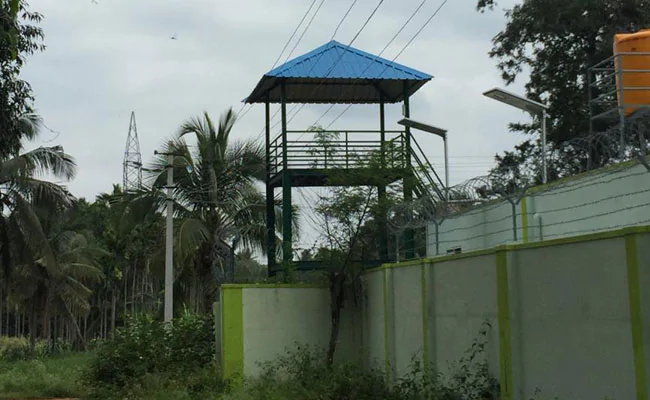
The building constructed in 1992 was a hostel for SC/ST and backward class students but as the hostel strength kept diminishing, it was finally shut down in 2008 and has since worn a decrepit look. It is located in Sondekoppa village, 40 kms from Bengaluru. The villagers’ various suggestions to put the building to use were neglected and nobody is aware when the process of converting it into a detention centre began. It is a small building which can house only 30 persons at a time.
The building has facilities like urinals and bathrooms, borewell, overhead tank. Chandra Naik U, secretary, central relief committee of social welfare department said eight months ago, they were informed by police that the building would be converted into a detention centre.
As per the manual for detention centres issued by the Centre, a detention centre must be outside the premises of a prison, should have facilities like electricity, water supply, beds and food must be provided as also creche facilities for young children of detainees and access to education for older children.
This facility in the outskirts of Bengaluru does not, however, yet have separate toilets for men and women neither does it have creche and recreational facilities.
Karnataka’s Home Minister Basavaraj Bommai, however, objects to the term ‘detention centre’ saying , “There is no purpose per se to detain someone on the issue of citizenship.” He added that the purpose to keep the facility ready was to lodge African nationals overstaying in India and indulging in drug peddling.
But in September, Bommai had said, “A large number of people have come from other countries, especially Bangladesh, and settled in Bengaluru and other cities of Karnataka. Karnataka is one of the states where people from across the border are settling. We are collecting information and will discuss with the Union Home Minister on the road ahead.” Notice, how there was no mention of African nationals then?
The push for early operation comes as a result of a case involving 15 illegal Bangladeshi immigrants who were arrested in August 2018 — a judge of Karnataka High Court has nudged the state government to open the facility soon.
Related:

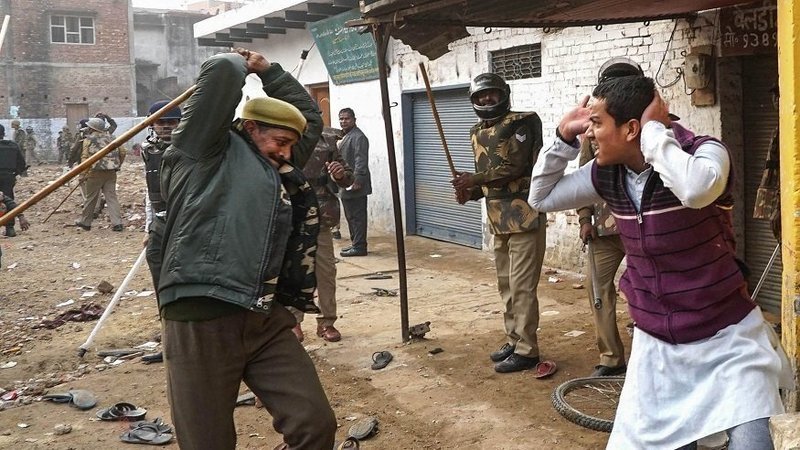
While protests across the country have seen students being fired at, peaceful protestors being detained and also suspension of internet, Uttar Pradesh has become a state that has seen the worst until now. With a BJP government in majority, and a Chief Minister like Yogi Adityanath who conforms to the Centre’s plan of action, Uttar Pradesh has become the worst example of excessive police action by a force which has been clearly given a free hand by the state with one agenda, to create and establish a climate of fear among people. This is being done to subdue the masses and to dissuade them from agitating against the government.
Here’s a look at how 9 major districts in Uttar Pradesh have suffered in terms of deaths, detention of minors, rampant arrests, filing of FIRs, destruction of property, seizure of property which is reflective of the vengeance of the state government against protestors and the Muslim community.
Following is a District wise list of police atrocities and state action which has unleashed a climate of fear, starting with the worst affected area and continuing with the lesser affected ones.
Muzaffarnagar
Mobile and landline telephone services blocked; internet suspended since December 19.
As many as 3,000 unidentified persons booked; additionally, 262 identified persons have also been booked.
72 persons have been arrested so far, 40 of which are students of Saadat Madrassa.
More than 67 shops sealed in Meenakshi Chowk and Kachchi Sadak localities in Muzaffarnagar; Meenakshi Chowk being the hub of Muslim businessmen.
Property has been seized by government for non-payment of land revenue in Meenakshi Chowk.
UP police allegedly vandalised the house of Haji Hamid Hasan after he and his son took part in protests; they looted jewellery and cash of Rs. 5 lakh at gun point.
Around 70-100 men allegedly broke the lock of 74-year-old Anwar Ilahi’s home, smashed his car’s glass, stole Rs. 3.5 lakhs and destroyed property in his 3-storeyed home; he said not all men were in police uniform.
Meerut
5 persons have died in police violence
43 persons have been arrested
172 identified persons have been booked
Police in Meerut have filed cases against people who have died in police firing.
A fact-finding report found that no FIR is being accepted by the police on behalf of the family members of the deceased. The situation in the Muslim neighbourhoods remains tense, the families are anticipating more police raids
The worth of damage to property was assessed to be at Rs 14 lakh and District administration blamed 141 people for the damages
Bijnor
Internet has been suspended since December 20
2 persons have been killed allegedly due to police action – one was a UPSC aspirant and the other was a father to a 7-month-old, neither of them had taken part in the protests.
As many as 3,000 unidentified persons have been booked by the police
104 persons have been detained, 21 of which are minors – who have now been released
These detainees, including minors, were reportedly beaten up while in detention.
153 persons have been arrested, some of them have even been booked under section 307 (murder) of IPC
In Nehtaur, Police allegedly vandalized people’s homes, harassed women and threatened their children to disclose the location of the male members of their families.
Aligarh Muslim University
The Vice-Chancellor and Registrar of University allowed police to enter campus
Police used tear gas, pellet guns, pistols, rifles, stun grenades on students.
A student who was running away from the violence was hit by a stun grenade. He lost his dominant hand and in his other hand, he lost 4 fingers.
The police used abusive language, communal slurs and there are videos showing ruthless beating of students above waist height and RAF (Rapid Action Force) personnel pointing guns at male students.
Police even damaged university and student’s property on campus. Police forced students to recite Jai Shri Ram, abused with words like Pakistani, Deshdrohi (traitor), attankwadi (terrorist), anti-national.
FIRs have been filed against 1,200 unnamed students.
Kanpur
Internet has been suspended since December 20
As many as 21,500 unidentified persons have been booked by the police
729 persons have been detained
13 persons have been arrested, including SP MLA Amitabh Bajpai and former MLA Kamlesh Tewari. Most of the persons arrested belong to PFI (popular Front of India) and AIMIM.
3 persons have died, 9 have been injured due to gunshot wounds and 11 more have been injured owing to other police atrocities
Begumganj saw nearly 100 policemen allegedly breaking open the shutter of shops and damaging parked vehicles
Lucknow
Internet was suspended on December 19 and December 20
54 persons have been booked including 4 TMC MPs and activist Deepak Kabir
More than 1,000 persons are under house arrest, including retired police officer SR Darapuri, Sandeep Pandey a Magsaysay award winner.
Advocate Mohd Shoaib has been detained by police and his whereabouts are unknown; Mohd Shoaib’s wife, Arundhati Dhuru, and activists Meera Sanghamitra and Madhvi Kukreja were detained for several hours when they went to the police station to inquire about Shoaib.
Sadaf Jafar, activist and member of Congress party, has also been in police custody since December 19. She has, reportedly, been beaten up in custody and no medical help has been provided to her or any of the other persons arrested.
Gorakhpur
Internet has been suspended since December 20
More 1,000 unidentified persons have been booked and additionally, 36 identified persons have been booked.
More than 60 persons have been detained and 26 have been arrested.
District administration has sent show cause notices to 33 persons for seizure of property claiming damages to public property in protests.
Sambhal
Internet is suspended since December 19
2 persons have died
19 identified persons have been booked; 250 unidentified persons have been booked
30 people have been arrested, including SP Leader Shafiqur R. Barq and Feroz Khan
Varanasi
Internet has been suspended since December 20
6 people have died, including an 8-year-old minor
57 persons have been booked under grievous offences
218 persons including students and activists, have been arrested; out of which are 69 activists
Rampur
Internet was shut-down between December 20 to 22
1 person has died in firing
150 identified persons have been booked
33 persons have been arrested
Notices have been issued to 28 persons for damages to public property which has been assessed at Rs. 25 lakhs
More than 1,100 people have been arrested and 5,558 kept in preventive detention in UP

A six-member team from the People’s Union for Democratic Rights (PUDR) has released a fact finding report that looks into the incidents of alleged police brutalities at the Jamia Millia Islamia University (JMIU) campus on December 13 and December 15, 2019.
The team went on a four-day fact-finding endeavor, from December 16 – 19, speaking to a number of students and workers at the university campus, as well as eye-witnesses to the events from neighboring areas, to reconstruct events. Though the report does not claim to provide a complete account of the events that transpired, it does cover a number of simultaneous happenings across the campus from December 13 to 15, 2019.
Recalling the alleged police brutalities in Jamia Milia Islamia University on 9 April 2000, documented in PUDR’s fact-finding report “Bloody Sunday: Brutal Attack on Jamia Students” of May 2000, this report attempts to provide an extensive account of this bloody Sunday of 15 December 2019.
The major findings of the report are as follows.
Excess Police Force
The decision by the Delhi police to disallow students from conducting a march to Parliament on December 13 was followed by an excessive lathi charge. This was not just aimed at pushing back protestors, but allegedly at also injuring them. This action did not dissuade the protest, but only ensured that more students joined in, leading to police forces coming closer to the campus for an even more violent attack.
As per the Vice Chancellor Najma Akhtar during her press conference on December 16, 2019, the forces entered campus without the permission of the university administration.
The police entered the campus without authorisation from University officials. The destruction of the CCTV cameras by the police at the gate, library and reading rooms was found to be clear evidence of the police trying to engage in actions that were prohibited, amounting to criminal offences.
The findings of PUDR about the attacks on guards, students, the Imam of the SRK masjid and other employees indicate that this was indiscriminate. Whoever the police could catch hold of, was subject to lathi charge and tear gas, apart from being subject to communal abuse. Added to that, their entry in the library and reading rooms is further evidence to show that they targeted people unconnected with the protest.
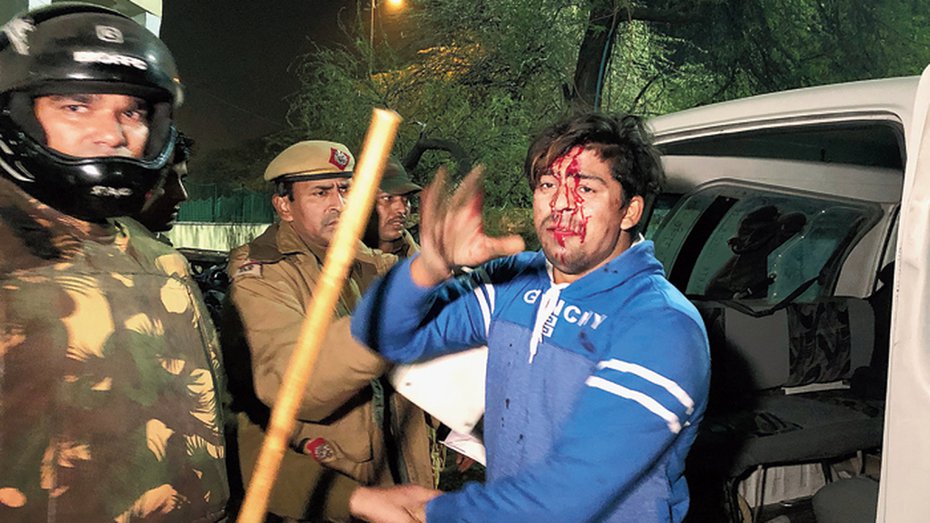
The police used brute force – hitting people on their head, face and anterior side of the legs; force hard enough to cause deep gashes and bone fractures aimed at terrorising students and the wider community.
On December 15, the rally had taken the form of a march at around 3:30 PM. Before 4:30 pm the rally had bypassed the police barricade and found its way through a branch road to the Mata Mandir Road towards the Mathura Road and some people at the head of the rally had attempted to block traffic on that road. It is on Mathura road that two persons received bullet injuries, one on the chest and one on the leg. Two videos coordinated and aired by NDTV channel show three policemen with small firearms shooting and one fleeing protester getting hit by a bullet.
People running roadside vends, those at the temple and guards at houses with gates opening onto the road told us that the crowd consisted of very few students who ran back quickly towards campus-side once the police lathicharge started.
A school girl (9th or 10th grader) was running inside campus and crying, saying “Bhaiya bahut maara.”
Three students caught in the violence outside campus when the police entered the university were trying to get inside near Gate 1 but 8-10 policemen saw them and started beating them up. There wasn’t a single female constable with them. Out of the three, one of the women students was beaten up the worst. The police hesitated for a second before hitting her but then noticed her scarf and started beating her.
The guards at both gates who were present at the time of the incident stated that approximately 50-60 uniformed men (with some in civilian clothes) attempted to enter through the gates forcibly. When the guards tried to stop them, they broke the lock and chain at the gates, kicked and assaulted the guards, and broke the windows of the guardrooms.
From here, multiple eyewitnesses (including students and passersby who were present at the scene) stated that the forces began to beat up and lathicharge indiscriminately anyone who they saw on their way, including students both men and women, staff such as guards and workers etc. Particularly, brutal assaults, tear gassing and lathicharge took place at the library and mosque.
On the ground floor, the police broke the window meshes and the glass panes lining the reading room, and tossed many rounds of teargas inside where the students were studying.
The police were lathi-charging the male students and when the women tried to help them, the police started hitting the women students who then ran into the women’s washroom.
Students started pleading with the policemen to not beat them as they were only studying. The police launched communal abuses on them (“jihadi”, “deshdrohi”, “katwa”), and then had them line up and come outside the room with hands on their heads, after which they sat them down on the stairs and beat them. The communal abusing continued, “tum mulle ho, katwa ho, tumhein chodenge, tumhare 7 pushton ko chodhenge”, alluding to threats of sexual violence.
The policemen launched communal abuses and beat the Imam with lathis along with 2-3 others who were at the gates with him, reminding them of the Golden Temple incident (“swarn mandir yaad hai na?”). One of the policemen in this troupe was a Sikh man who did not react to this reference.
Detention and Prevention of Medical Aid
The police had detained 15 students and one local resident from the New Friends Colony PS, and around 34 students at the Kalkaji PS. The detainees were prevented access to family members and lawyers and even those detainees who were gravely injured were denied medical aid. The injured were removed from the hospital and ambulances were prevented from reaching there.
The Al-Shifa Hospital saw a total of 85 injured students being admitted and AIIMS, a total of 22. Two students with bullet wounds were admitted to Safdarjung Hospital.
At the PS, the police took the student I-card of the detainee we spoke to, which was never returned to him, and clicked a photo of him. Though he asked to be released once they had taken his ID, a police officer kicked him, causing him to fall, and said ‘10 number ka joota hai, dekh le.’ The student and his friend were then shoved into a room, where 15 people, several of whom were badly injured, had already been detained.
The Facebook post of one male Kashmiri student who had been detained at the NFC thana narrates that he had been brutally beaten up on his head repeatedly when he was in the library, had communal abuses hurled on him, and flogged by at least 40-50 policemen on the way from the library to Gate 7.
Throughout 11 this time, they were told to keep their mobile phones away, continuously barraged with verbal abuses, taunted with ‘kya problem hai tumhe CAB se’, etc.
While leading them out, police officials were grabbing the hands of those injured on their lands, and making those with injured legs walk.
Only the most gravely injured were put on stretchers or given any firstaid treatment, though most were in need of some. No water or food was given to the detainees there.
Police Account
The police has given different accounts of its actions, what it did and did not do, and provided different explanations for each of these, in tandem with the new facts as they emerged.
PUDR spoke to DCP Biswal who said police were compelled to use force against the protestors to control a riotous mob. In response to emerging allegations of firing, DCP Biswal categorically denied use of guns, and of bullets of any kind. One of the questions that had repeatedly arisen is whether the police used firearms, and bullets, or alternately rubber bullets. He has said that they had only used tear gas shells, both claims that were supported by the Ministry of Home Affairs (MHA).
The DCP at his Press Conference on December 17, after reiterating that the claims of gunshot wounds were false, brought up a medical report that had surfaced that referred to a gunshot wound. He continued that “if”, underling the “if”, there indeed was a gun -shot wound the police would inquire into “kaun zimmewar hai” / who is responsible.
Speaking about why teargassing took place, the DCP said, ““Jo log police par pathrav kar rahe the, public property mein aag laga rahe the unko disperse karne ke liye teargas shells ka istmal kiya gaya.”
Destruction of Property
The Bloody Sunday witnessed widespread damage and destruction of property, especially in the university library. DCP Biswal has claimed that the police were compelled to use force against the protestors to control a riotous mob that had resorted to violence and was destroying public property, and that its justification for entering campus without permission was to find out about the stone-pelting happening from inside campus.
Some persons from the protest rally were responsible for damage to private vehicles parked in the NFC area and arson on one motorcycle, while other protestors tried to restrain them from doing so to ensure peace and calm. The police was found to be responsible for damaging the vehicles of student and other residents, and also the destruction of CCTV cameras, window panes and other properties in the library.
Why the judiciary must take suo moto action against the Delhi Police
On December 16, 2019, senior advocate Indira Jaising on behalf of Jamia students/ alumni, petitioned the Supreme Court seeking suo moto action against police brutalities on Jamia and AMU campuses the previous night, before a bench headed by CJI SA Bobde through an independent committee. The Bench first refused to hear the matter, citing destruction of public property by protestors but posted it for hearing the next day. On December 17, 2019, the three-judge bench headed by the CJI refused to constitute a special committee to look into the incidents, asking the petitioners to approach their High Courts instead.
However, the scale of the attack and the brutality of the police, along with their unauthorised entry into the campus should have been sufficient reason enough for the judiciary to look into the matter and issue appropriate directions to ensure medical relief and enquire into the conduct of the forces.
Both, the Supreme Court and the High Court refused to hear the matter immediately, with the SC stating that it wasn’t a court of first instance for determination of facts.
What PUDR demands
1. That the right of citizens to protest must be recognised as inalienable and the practice of routine refusal to grant permission must be stopped.
2. That an FIR should be registered against the police for brutal use of force inside the campus in Jamia Millia Islamia.
3. That a Commission of Enquiry be instituted to examine the unauthorised, unjustified and excessive use of force and wanton acts of destruction by the Delhi Police.
4. That the police personnel to be posted at police stations in the Jamia area need to be sensitized to counter a communal outlook and to ensure civil behavior as becoming of a public servant. The police personnel and officers who were part of the attack on students need to be shunted out of the police station without delay
The declaration of the contentious Citizenship Amendment Act (CAA) has propelled large scale protests throughout the country, with major protests beginning in Assam.
The agitation soon found its voice in students who deemed the Act to be religiously discriminative in nature and the students of JMIU were the first to spearhead the movement against it.
In their peaceful protest, they were met with unwarranted and uncalled for brute force by the Delhi police, the actions of which were okayed by the Ministry of Home Affairs.
In a shameful display of power, the basic rights of the students were trampled upon. There was a ‘war-like situation’ in their campus and many innocents had to suffer due to the actions of people who were identified as not being students of the campus. PUDR’s findings state that a growing number of outsiders had joined the protest.
The atrocities of the police on the students can only be said to be state-sponsored and highly condemnable. Not only Jamia, a repeat of the incident took place at the Aligarh Muslim University (AMU) where the police indiscriminately beat up students and injured many in tear gas lobbing and the use of stun grenades injuring scores and leaving one handicapped.
The entire report by PUDR may be read here.
Related:

Image Courtesy: Reuters
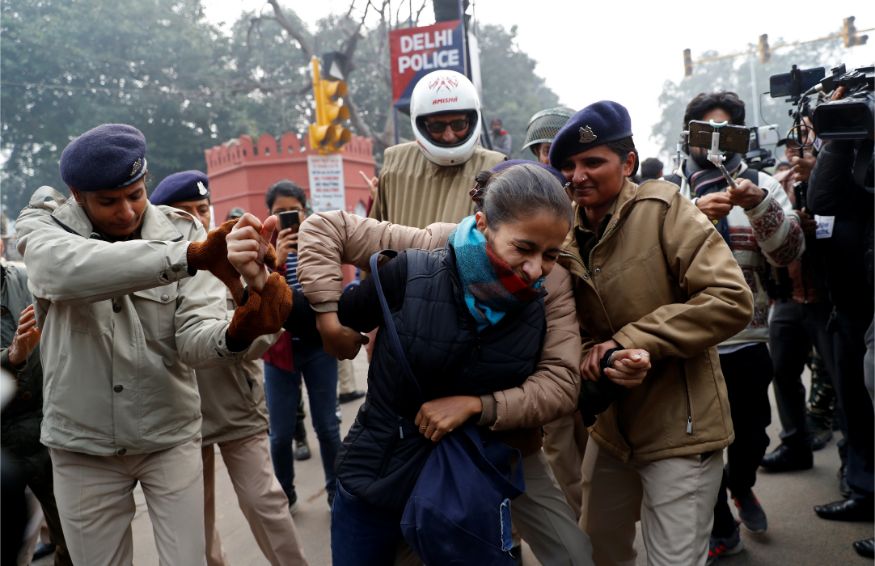
The Delhi police detained about 350 protestors, including women who were set to stage a demonstration outside the Uttar Pradesh (UP) Bhawan in the capital on Friday against the Citizenship Amendment Act (CAA) and the police brutalities on students. They have since been released.
The gherao of the UP Bhawan had been called by the Jamia Coordination Committee (JCC) which comprises of various political groups active on the campus, but according to reports the police had denied permissions for protests at the site. They had also prepared a memorandum to be submitted to officials at the site, but that too didn’t happen because the protest wasn’t allowed to take place.
A senior police official told reporters that Badre Alam, the leader of the protests and a student of Jamia, was told to take requisite permissions to hold the protests at a designated place like the Jantar Mantar, but he did not pay any heed to the advice of the police.
The JCC released a press statement on Friday evening stating that it had called for a peaceful gherao of the UP Bhawan starting at 3 PM which was met with the ‘now-normal repression tactics by the Delhi Police’.
The statement read that entire buses of protestors headed to the site were detained by the police and taken to different locations, including the Mandir Marg police station and Connaught Place police station. More than 300 students from Jamia, Jawaharlal Nehru University (JNU) and Delhi University (DU) had been detained and multiple students were manhandled.
People have been detained in groups outside UP Bhawan where they went to protest. Entire Bus coming from Jamia is being detained as some of the students from Jamia are reporting. The capital is literally turned into a battalion. And all this is so scary. :/
— Tejaswini Tabhane (@Tejaswi2406) December 27, 2019
“Almost all the buses which left from Jamia Nagar were detained by the police. Individual protestors who came via other means of transport to UP Bhawan were also detained separately,” the statement read.
The press statement referred to the detention as unlawful stating that the police could not show any papers to show that Section 144 of the CrPC was imposed in the area when they were questioned by detained students.
“The students continued their protest outside the station. The police have verbally assured that all detainees will be released by 6:30 pm. Protestors are gathering outside Connaught Place police station demanding the release of detained students. Lawyers have reached different police stations and have offered legal help,” the JCC said in the statement.
The JCC condemned the “ridiculous” actions of the Delhi Police and the State’s fear towards dissent. “It is clear that the current government is only holding itself back from unleashing its rage on the protestors in Delhi because of the international visibility that Delhi has. We ask progressive forces to exert more pressure on the Union and Uttar Pradesh governments to make them stop the atrocities that are being carried out in areas which are less visible to international media,” the JCC statement said.
The JCC also demanded an end to violence against anti-CAA protestors and Muslims in various states. It said, “We reiterate our demand that the violence being carried out against Muslims and anti-CAA protestors in Uttar Pradesh, Karnataka, Assam, Bihar and Delhi be ended immediately. We strongly condemn the ongoing communal violence against Muslims, which has accelerated in recent days.”
The police on Thursday too had detained about a 100 people from various groups and political parties who had arrived at the UP Bhawan to stage a protest against the CAA citing that Section 144 was imposed there.
On Monday, 46 students, including 27 women were detained outside the same venue when they were about to begin demonstrations against the CAA.
Related:

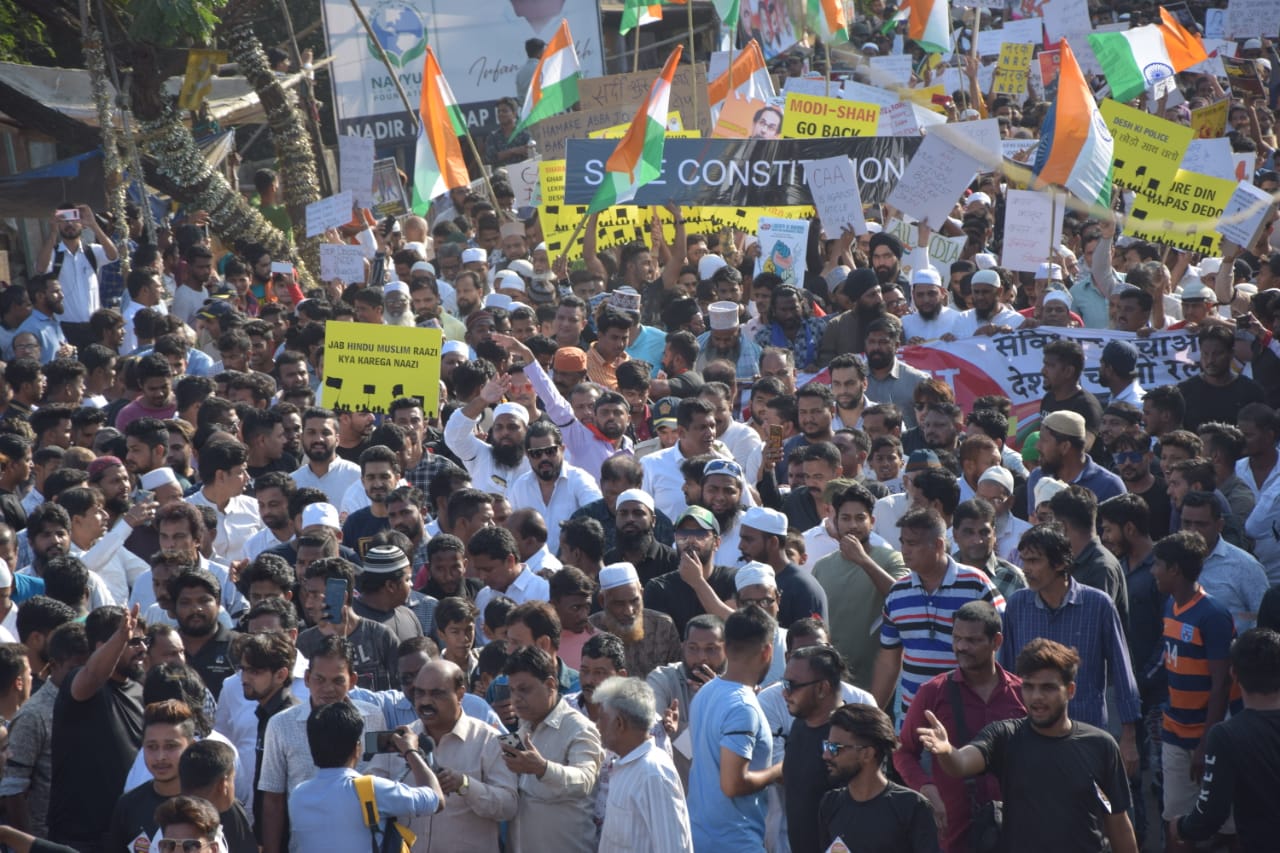
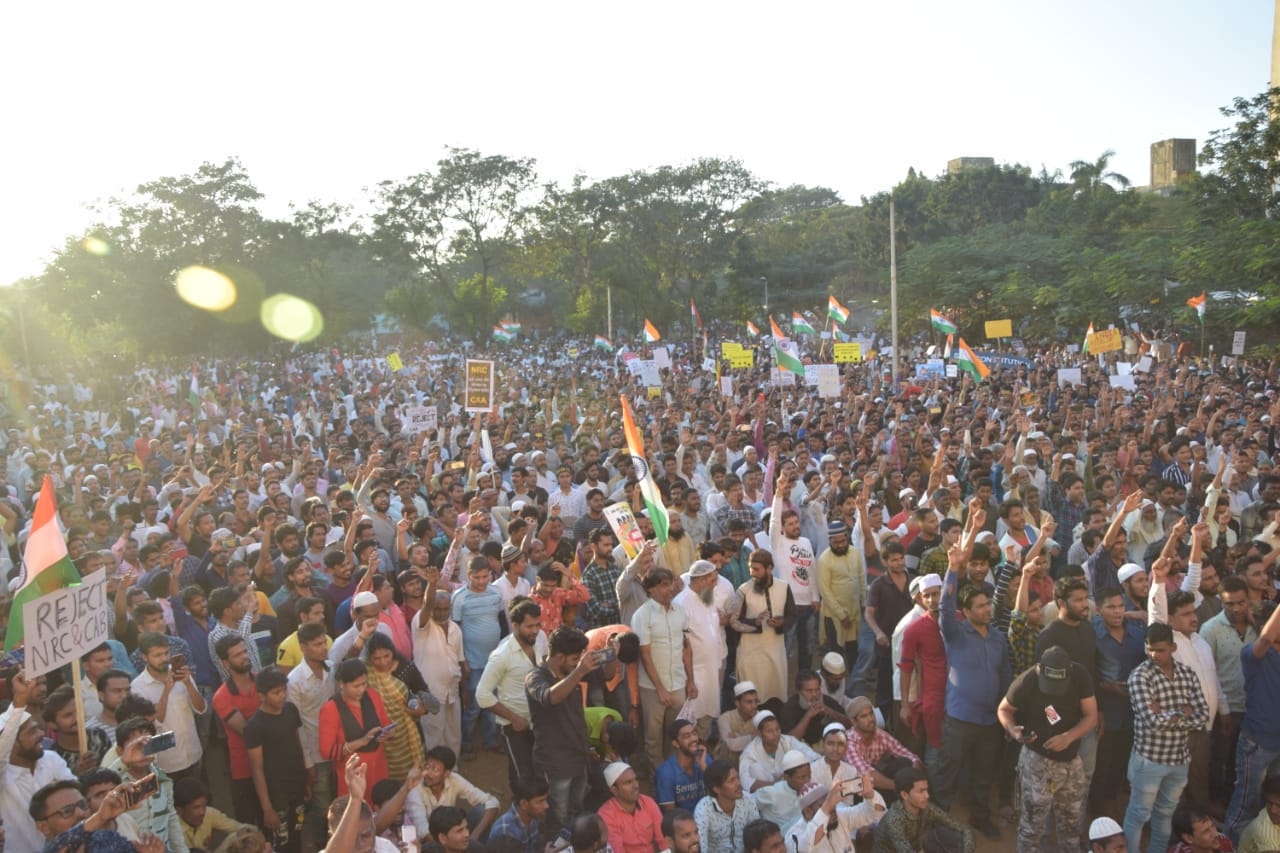
On Thursday, over 25,000 people held a peaceful protest against the Citizenship Amendment Act (CAA) and the National Register of Citizens (NRC) in Mumbai’s Malvani area. The protest was organized by people from all communities living in Malad, Madh Island, Orlem and Malvani.
Malad MLA Aslam Shaikh told The Times of India, “There was no untoward incident. I raised the question of why the government was not trying to solve issues like farm crisi and unemployment. We have opposed the government’s decision to divide people in the name of CAA and NRC.”
The protesters gathered at a ground in the area and then walked down the road with banners and placards saying “Boycott NRC”, “We reject CAA” and even “Jab Hindu Muslim Razi, Toh Kya Karega Nazi”.

Meanwhile, the Vanchit Bahujan Aghadi (VBA) organized another peaceful protest in Dadar where questions were raised about the two detention camps planned in Maharashtra. Prakash Ambedkar addressed the crowd saying, “People should strongly oppose the CAA and the NRC and work together to defeat the BJP, else they should be ready to be stationed at the detention camps in Kharghar and Nerul.” This protest saw participation from many nomadic and denotified tribes as well.

In the wake of flagrant violations on human rights of CAA-NRC protestors across the country and also in light of the debate over why other minorities like Rohingyas were excluded from purview of CAA, this order comes as a breath of fresh air; leaving some hope for human rights in the courts of law.
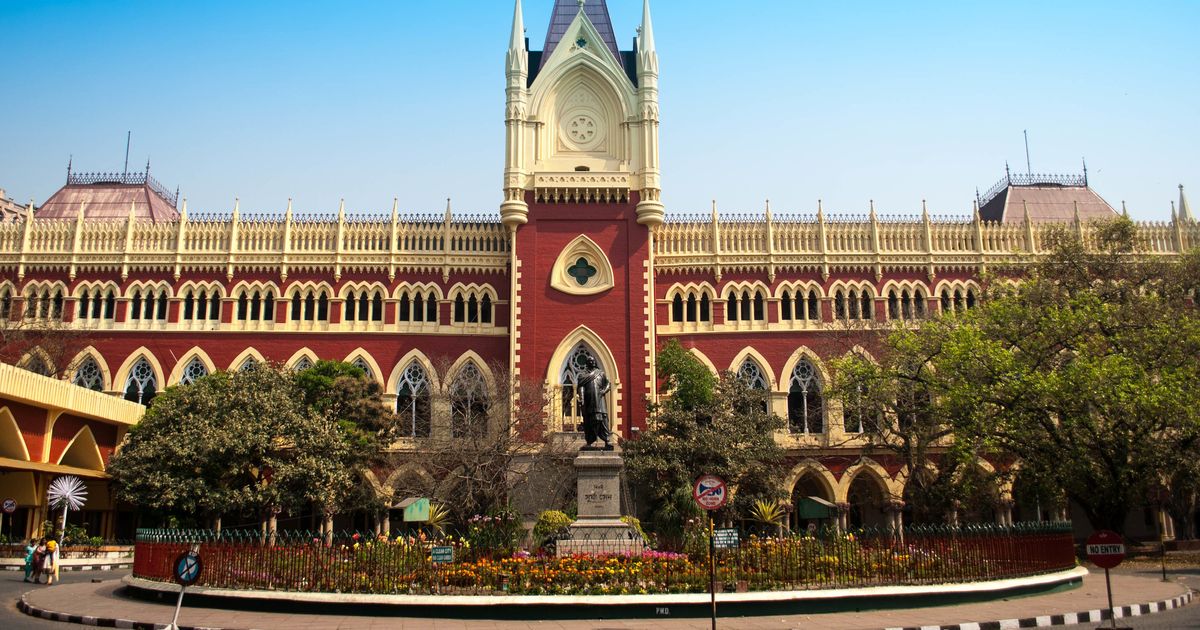
The Calcutta High Court on December 24, passed an order staying the deportation of a Rohingya couple to Myanmar. The order was given in response to a writ petition filed by the couple who have, as per their petition, already served their sentence in prison.
The petitioners submitted that now that they have completed their sentence, the government is trying to deport them back to Myanmar. They also submitted that such deportation would be tantamount to a death sentence in view of their plight in Myanmar which has the declared policy of an all-out onslaught on Rohingyas.
The court ruled, “in view of the imminent plight of the petitioners, who, despite having basic human rights in consonance with the Fundamental Rights provided by the Constitution of India as well as the U.N. Charter and the norms of any civilized society, a minimum protection ought to be given to the petitioners till the writ petition is decided, in order to uphold the spirit of humanity, if not the Fundamental Rights enshrined in the Constitution of India, which is the grundnorm of all Indian statutes”
The Court restrained the government by an order of injunction ‘from deporting the petitioners from India during pendency of the writ petition’ and also directed the government to ‘ensure that the petitioners are provided with the basic amenities, compatible with a life worthy of respect’.
The Court went a step ahead and even directed the government to allow the counsel of the petitioners to visit them from time to time.
Rohingyas are an ethnic group, majority of whom are Muslim. They have been denied citizenship in Myanmar since 1982 which has effectively rendered them stateless. They face extreme violence and persecution in Myanmar and hence have been compelled to flee to other neighbouring countries to find harbour. They are considered as the world’s most persecuted minority.
The order can be read here

A fact-finding team comprising activist Kavita Krishnan, psephologist-turned-politician Yogendra Yadav and research scholar Riad Azam visited Meerut to take stock of ground realities in wake of violence during protests against the Citizenship Amendment Act (CAA). They presented their findings in a report that also contains eyewitness testimonies, where serious allegations have been made against the UP police.
For instance, a dead man named Asif has been accused of being the ‘mastermind’ of the violence that erupted on December 20. But according to Asif’s father Idul Hasan, 20-year-old Asif was an e-rickshaw driver. He left for work, but parked his rickshaw and decided to come back home when the violence erupted. His family was unable to contact him and only discovered that he had been killed when the person transporting his body to the morgue called them. Asif sustained bullet injuries to his chest, but the family had not received a post-mortem report at the time of publishing the report.
Another testimony by Mr Alauddin, Director of Falaah-e-Aam Hospital, about the aftermath of the violence near Jama Masjid revealed that “police began cracking down harshly on the protesters and went inside various Muslim neighbourhoods shooting. This eventually led to the death of 6 people (five of them died on the spot and the 6th died on 24/12/19). Among those dead, 1 died at Gulzar-e-Ibrahim Mohalla, 1 at Jaliwali Gali, 1 at Ghantewali Gali, 2 died in Ahmednagar (9 and 10 no Gali). Another person got shot near City Hospital and eventually died at a hospital in Delhi on 24/12/19. The people who died at Gulzar-e-Ibrahim, Jaliwali Gali and Ghantewali Gali were not part of the protests.”
The entire report may be read here:
Meanwhile, the organisers of the nationwide peaceful protests under the banner of Hum Bharat Ke Log also issued a statement condemning police brutality against protesters. The condemns the Uttar Pradesh government for “employing unlawful and lethal tactics to harass and intimidate” protesters and also alleges, “The authorities are brazenly targeting Muslims, besides all peoples movements and human rights activists, throwing democratic norms, constitutional rights and the due process of law to the winds. The goal is not just to suppress all dissent against CAA/NRC in Uttar Pradesh, but to send a signal to anyone who may dare to raise a voice against anything.”
Taking the Adityanath government head-on the statement says, “There is little doubt that all this is happening under the personal direction, sanction and supervision of the Chief Minister. He publicly announced a doctrine of revenge against the protesters. In a shocking audio tape in wide circulation, a senior police official can be heard saying that he has the CM’s instructions and full immunity to beat the violent protesters to pulp, so as to teach everyone a lesson. Sadly, none other than the Prime Minister has openly supported this wanton cruelty and breakdown of law and order.”
The statement identifies the regime’s tactics such as unlawful mass detentions, custodial torture, use of excessive force and intimidation of friends and families of detainees. It also minces no wrds while holding the administration accountable for selectively targeting members of the Muslim community. It says, “There are more than one reliable reports of the police raiding Muslim colonies, entering homes, ransacking them, and detaining people indiscriminately. In several places, state authorities have sealed shops and commercial establishments owned by Muslims. Notices have been issued to Muslims unrelated to any protest or violence to compensate for the damage to public property.”
Their demands are as under:
1. The government of Uttar Pradesh must to stop this state-sponsored attack, release innocent detainees forthwith, quash FIRs with large number of anonymous accused;
2. A credible and independent inquiry by an SIT under the supervision of the Supreme Court should be set up so as to ascertain the truth about protests, violence, police action and killings;
3. Institutions like the National Human Rights Commission and the National Minorities Commission must take up this case suo motto and institute immediate inquiries into the allegations about violation of human rights and assault on the minorities, respectively;
4. Police officials and personnel, whose complicity in police atrocities is beyond doubt, should be suspended and all the guilty should be brought to the book;
5. Suitable compensation should be paid to those injured in police action and to the family of the deceased;
6. Citizens constitutional right to assemble and protest in a peaceful manner should be restored;
7. To ease the climate of fear and suspicion, and to allow a meaningful dialogue, the Government of India must announce that it is not going ahead with NRC and NRC-linked-NPR.
The entire statement may be read here:
Join our mailing list to get the latest human rights news that matters, straight to your mailbox.
© Sabrang | All Rights Reserved