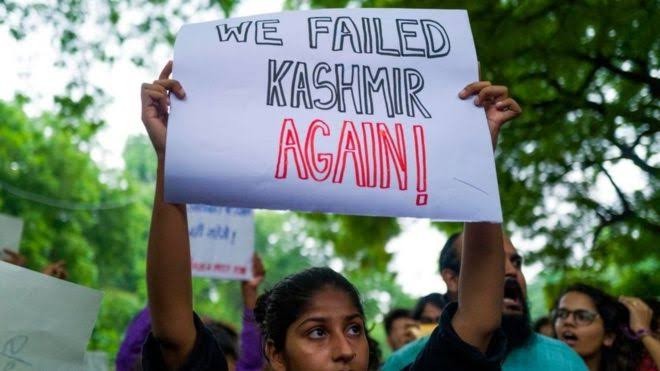
Following the decision to abrogate Sections 370 and 35A on August 5, the Jammu and Kashmir will be officially bifurcated from October 31 into two union territories: Jammu and Kashmir and Ladakh.
Courtesy: Newsclick.in
Decision comes after tech firms turn to govt for help after EPFO makes linking Aadhaar with individual PF accounts mandatory
Image Courtesy: business-standard.com
After the Employee Provident Fund Organisation (EPFO) made it made it mandatory to link the Aadhaar card with individual Provident Fund accounts, a bunch of technology and back office companies turned to the government for relief, The Economic Times reported.
The companies, seeking help on the clarification of norms, approached the labour minister Suresh Kumar in Bengaluru last week, saying that the company was struggling to implement the mandate.
An executive from tech major Hewlett Packard (HP) said, “Employees are claiming that they will not give Aadhaar number for EPF as per the Supreme Court order. The EPFO, on the other hand, wants us to collect the number,” said the executive at the meeting.”
“Many of our employees are citing the SC judgment that said any such linking is optional,” he added.
In September 2018, the Supreme Court had ruled that Aadhaar wasn’t mandatory for pension schemes. The SC bench while upholding the constitutionality of the Aadhaar Act, had then said that Aadhaar can’t be made mandatory for the delivery of many public services including pension.
Last month, the Bombay HC had granted ad interim relief from prosecution to JP Morgan Services India Private Limited, after a criminal complaint by the EPFO for not sharing the Aadhaar link and bank account details of their employees.
What EPFO says
The EPFO points to a notification by the Unique Identity Authority of India (UIDAI) allowing the use of Aadhaarbased authentication for employee provident funds accounts. Additional Central PF Commissioner Pankaj Raman of the Employee Provident Fund Office (EPFO) in New Delhi cited a November 2018 notice on the matter.
Inc42 reported, in March 2018, a data breach through Employees’ Provident Fund Organisation (EPFO) also came to light via a letter circulated on Twitter. The letter titled ‘Secret’, which was addressed to the CEO of Common Service Centre, claimed that hackers exploited vulnerabilities through a government’s online website built to link Aadhar with PF account to steal data. This data breach is expected to have discouraged the employees to provide Aadhaar details to EPFO.
The way forward
A software professional, Elisha Ebenezer is also challenging the notification which has mandated linking of Aadhaar to Universal Account Number (UAN) for availing pension and provident fund benefits in the Madras High Court. He further believes that EPFO’s notification is unconstitutional and against SC directives.
While employees from tech companies said that their companies were planning to take disciplinary action against them for not linking their Aadhaar numbers with their PF accounts, it has come forth that employers are unable to contribute to a PF account as the EPFO isn’t allowing the company from creating a PF account in the absence of Aadhaar.
While companies on their part are trying to ease out things for its employees, EPFO suggests that they would introduce a facility that will facilitate employees to create the universal account number (UAN) on their own and link it with the Aadhaar. “This will remove apprehensions among employees as they do not have to part with the Aadhaar number,” an EPFO official told ET.
The official, who did not want to be named, added that the EPFO does not keep a database of Aadhaar numbers but it is used only to authenticate the credentials of the employees on the UIDAI database.
In February this year, a five-judge constitution bench had held that while Aadhaar would remain mandatory for filing of I-T returns and allotment of Permanent Account Number (PAN), it would not be mandatory to link Aadhaar to bank accounts and telecom service providers cannot seek its linking for mobile connections.
Related:
The linking of Aadhar Card: The benefits and perils
Did Aadhaar Glitches Cause Half Of 14 Recent Jharkhand Starvation Deaths?
Linking aadhaar with election ID would disenfranchise elderly and manual labourers: ECI told
“Aadhar reduced agency in citizens and empowered those in positions of authority”
Aadhaar Verdict: SC upholds constitutional validity, assuages some privacy concerns
Titled “Imprisoned Resistance: 5th August and its Aftermath”, the report uncovers the façade of ‘normalcy’ in the Valley that the government has tried to create.

Image Credit: BBC
An eleven-member team comprising advocates, trade union and human rights activists and a psychiatrist visited Kashmir with a view to understand the situation persisting in the two months since theabrogation of Article 370, as well as to assess the quality of access to justice in these circumstances.They have put together their findings in a report titled, “Imprisoned Resistance: 5th August and its Aftermath”, set to launch today.Here is a complete breakdown of their findings from the report.
This report seeks to draw the attention to the valley’s history while understanding the events just before and after the August 5, 2019. In the report, the team uncovers the collective aspirations of the people of Kashmir, the ongoing committed resistance of the people, theresulting structured state violence, the systematic denial of any legal recourse and the observable judicial trends from the time of the abrogation.
Mandate
The team comprised Advocates Aarti Mundkur, Clifton D’ Rozario, Lara Jesani, Mihir Desai, Saranga Ugalmugle, and Veena Gowda, along with activists, Gautam Mody, Nagari Babaiah, Ramdas Rao, independent researcher Swathi Seshadri, and consulting psychiatrist Dr. Amit Sen. Together, they spent a week in the newly constituted Kashmir Divison from September 28 to October 4.
In this time, they visited localities of Srinagar as well as villages in districts of Pulwama, Shopian, Kulgam, and Baramulla. Each member brought their expertise to the team’s investigations.
They visited the High Court of Jammu & Kashmir and met with Chief Justice Gita Mittal.They covered District Courts in Srinagar, Kulgam and Shopian, along with the TADA Court and the J&K State Human Rights Commission Justice, where they met its Chairman Justice(Rtd.) Bilal Nazki. They also examined the functioning of the Juvenile Justice Board (JJB) and the Child Welfare Committee (CWC) in Srinagar. Furthermore they visited the Post Office as well as public sector banks of Srinagar, along with the Parimpora and Sopore mandis.
The team members met with psychiatrists, medical health professionals, therapists, counsellors andsocial workers who are providing mental health services. They reached out to hawkers, traders and representatives of the JKCCI, and also therepresentatives of the Kashmiri Pandit community. While the team did try to meet the police authorities, specifically the DGP and the IGP, they were turned awayat the reception.
Let us have a look at their findings:
The week that preceded the abrogation
The team reports that an atmosphere of terror and panic was deliberately createdin the Valley prior to the announcement of abrogation. Towards the end of July, almost 38,000 additional troops were deployed in Kashmir, and further additions were made subsequently in early August.People were angry about the heightened presence of armed forces on the streets. Rumours were afloat that some “big” decision, like abrogating Article 370 ofthe Indian Constitution was about to be taken.
Panic spread in the Valley as falsehoods were floated in the form of the Security Advisory issued on August 2 by the State Government of Jammu and Kashmir, which stated:
“Keeping in view the latest intelligence inputs of terror threats, with specific targeting ofthe Amarnath Yatra, and given the prevailing security situation in the Kashmir Valley, inthe interest of safety and security of the tourists and Amarnath Yatris, it is advised that they may curtail their stay in the valley immediately and take necessary measures toreturn as soon as possible.”
Students faced immense hardships as all colleges were forcibly closed and hostels forcibly vacated.The armed forces came to pick up the non-Kashmiri students, and dropped them to the airport so they could leave Kashmir.The report notes that local students were also told to pack up and get ready to go back to their villages and that vehicles were being organized for their conveyance. However, nohelp arrived and they were left stranded in the midst of the curfew without food and water. Eventually they were physically driven out of the hostels by the forces and had to walk back to their villages, which took more than a day in the case of some students.
All forms of communications were cut off for the Valley folk on August 4,2019, without any formal order or warning.Then on August 5, 2019, Kashmir and its people were put on lockdown under CrPC’s Section 144.All this with the chilling silence from the media created an information blackhole in Kashmir.
Normalcy, interrupted
The team reports traffic jams were artificially created in Srinagar using road blocks so as to then capture images of normalcy with drone cameras. The Police even impound vehicles for minor traffic violations and file cases in courts in order to show normalcy in their area. The team witnessed what seems to have been ingrained as a new sense of ‘normal’ among the locals—Kashmiri youth and the army were pelting stones at each other as life went on for the rest of the neighbourhood. They witnessed a woman and a child wait by the roadside for the stone throwing to stop, as a police van approached the lane to capture the youth.
Mobility had been restricted within Srinagar and other towns; travelling in the Valley has become a nearimpossibility for people who rely on public transport. The city bus service in Srinagar along with bus services between various towns have been suspended operations since August 5. No one at the JKSRTC office was able to tell the team if the Corporation or the Government had issued any order to suspend these services. Some private buses have resumed operations but these are extremely limited, they report.
One person said,“..even the celebrated Kashmir railway system from Qazigand to Baramullahas been completely shut since 5th August. Running the railway is the central government’s job.Why have they shut it down? What are they afraid of? Are they afraid of normalcy?”
Another dead giveaway of how nothing is normal in the Valley was the communication blockade caused by the shutdown of mobile and fixed line services of the area. The team learnt of instances of house fires that could have easily been doused hadthere been access to telephones so that fire engine services could be called. They discovered that the government selectively provided mobile network to those assisting it, such as middle level government employees. A Public Prosecutor we met in District Courtat Srinagar proudly flaunted how his mobile phone was working owing to his “important positionin assisting the government”. These whitelisted persons had phone connectivity while those outside this circle and the rest of Kashmir’s civilian population was deprived of connectivity by design.
As to government services, the post offices were shut,save for the General Post Office (GPO) at Srinagar which is open until 2 p.m and doesn’t sell postal stamps. People can send out letters outside Jammu and Kashmir by Speed Post alone.
Livelihoods have been disrupted by the government services being shutdown and hartal started post abrogation. In a village in Pulwama district, baking, which is the major business in the village, has been affected. Tourism hasalso been affected in the Valley. The famous Kashmiri apple industry with an annual turnover of Rs. 10,000 crores has taken a big hit, with a direct loss of Rs 20 crore every day.
Many newspapers are unable to pay salaries of their journalists and have had to let them go. Print media has been reduced to “pen drive journalism” with a daily pen drive containing news being handed out by the state government’s information department.
The report speaks of how the people of the Valley have adopted a Hartal as a method of quiet resistance in response to these government actions, what they refer to as ‘the siege.’ The Hartal is observed by keeping all commercial establishments voluntarily closed except for two hours in the morning and in the evening.
The team notes, “The effect of the decision to abrogate Article 370 has resulted in complete unity in the Valley.Everyone we spoke to, belonging to any community, class or gender, are united in their belief of betrayal and dream of the right to determine their future. The hartal is the self-expression of thepeople’s will and not a Hurriyat call.”
On October 11, 2019,after more than two months of convincing Indiansand the world that the situation in Kashmir was normal, the government appeal to the people of Kashmir to lift the hartal via this full-page advertisement, the report shows:

*From the Report: Ad placed by the Government of Jammu & Kashmir in Greater Kashmir on October 11, 2019.
This J&K government advert is a clear admission of how things haven’t been as rosy as the Central government wants the masses to believe.
State Oppression
The team talks about how the sense of normalcy weaned off for them as soon as their flight was about to land in Srinagar:
“On our flight from Delhi to Srinagar, we were 10 among the handful of civilian passengers, including a few Kashmiris, while the majority were military and para military ‘jawans’ speaking in all languages from across India. About fifteen minutes before touchdown, the crew, unlike the norm, made an announcement to shut all window shades. One curious jawan seated behind us tried to open his window shade to look down, only to have a crew member pleading with him to pull it down immediately, as she could lose her job for this. … At the arrival terminal, a “Welcome to Paradise” ticker flashes at usopposite the conveyor belt for baggage.”
The team was confronted with massive militarization almost immediately. A journalist told them that for the total population of Jammu and Kashmir of about 1.25 crores, with about 80 lakh people living in the Kashmir valley, the region houses 8 lakh armed forces. Out of these, 1.4 lakh of the forces were brought in just before August 5. The armed forces in the Valley primarily comprise the army,various paramilitary forces like the BSF, CRPF, IRP, etc., J&K police along with itscounter-insurgency wing, the Special Operations Group (SOG)/ Special Task Force (STF), Special Police Officers (SPOs),Village Defence Committees (VDOs), and intelligence agencies.
The report notes people from Pulwama telling the team that armed forces were conducting night raids on villages and localities in the city almost every night, and most definitely if there was any protest or incident of dissent in thatarea.One person said, “They barge into the village screaming abuses and throwing stones at housing breaking window panes. …One of their favourite taunts is that they are going to choose girls from this village to get married to and that they are going to take over all the land in the village and nothing can be done tothem. During these raids, which are usually past midnight, the Army jawans are usually drunkthough not the police. The men are rounded up on the main road and their mobile phones aretaken away from them and checked. Simultaneously the armed forces enter all houses in thename of conducting checks, women and girls are physically frisked by male army personnel,are sexually abused and molested. If they try to defend themselves they are physically abused.”
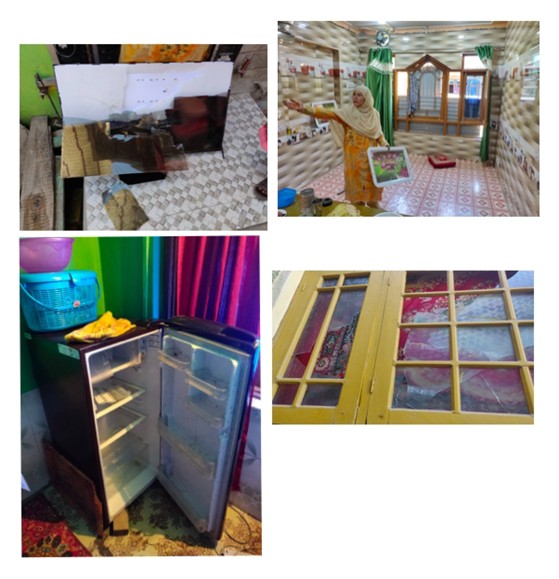
The team also got a first-hand glimpse into how destruction of property has been used as a mode of terrorizing the locals.The report recounts a woman’s story of the CRPF and the J&K police had come into the house, brokenwindow glasses, opened their refrigerator thrown all the food out including the meat from thegoat sacrifice made during Bakri Eid.

*From the Report: Pictures of broken LED TV, damaged window panes, torn clothes in the vandalism done bythe armed forces in the houses in Mansoor Colony, Bemina, Srinagar.
Arbitrary arrests and illegal detentionis the norm in the Valley, the team declares in the report. In every village they visited, they were informed of young boys and men from that village being held under illegal detention, either in the near by army camp or at the police station. Usually these arbitrary arrests happen during thenight raids, where the army would pick up a few boys and take them to the nearby Joint Interrogation Camps (JIC) for “questioning”.They also learnt that during the time the boys and menare in illegal detention and custody, the family members are forced to run from pillar to post, between the army camps in thearea and the police station, trying to locate those detained.
As the team states, this is the worst time for the family since they are unaware of the whereabouts of their missing loved one, there is no way of seeking help of other family members given thecommunication blockade, and there is nolegal recourse whatsoever against the detention. There is also the constant fear thatthey too would be arrested and tortured as they try to find their family member.
A new devious practice of community bonds has been introduced along with the illegal detentions, as per whichmany detainedpersons are released after obtaining community bondsbefore the Superintendent of Police (SP). The SP in such cases demands that 50-60 residents from thecommunity appear before him for a “Mulakkat” and take responsibility that the detainee shallnot participate in any protest and to maintain peace in the area.The team also heard of in-lieu arrests becoming another accepted practice in the region, where amale family member is arrested in lieu of a person that the armed forces are looking for, until the required person turns themselves in.
The disturbing use of pellet guns, the team contends,still continues in the Valley and there is no estimate of the number of injuries caused by its usage post August 5, 2019.
Reports of torture at the hands of the armed forces is not new to Kashmir and there is a plethora of evidence on the same, notwithstanding the outright denials of the same by the army and the Indian state The team noted the Zaldora camp commonly has reported cases torture, illegal detention and night raids.
As one person was quoted saying:
“Torture is common and can be ignored over time. Physical wounds heal,but what about the torn soul. But it’s the humiliation and aggression of the forces that is difficultto endure. Love begets love, and hate begets hate. Every night there are crackdowns and raidstaking place in the name of search operations, where drunk jawans humiliate and torture thepeople and sexual crimes are rampant as well but not spoken off because of social stigma.”
In the villages in Shopian and Pulwama, the team found young men and boys are picked up from the villages and taken to the camp in the morning for forced labour of constructing their camp. Persons in illegal detentionare also taken to camps where they are made to do construction work. There is an Industrial Growth Centre in Lassipora, Phulwama, where boys were taken from here and made to do begar for camp related work, mowing loans, construction work etc. under compulsion and with no payment
Religious freedom trampled on All across Kashmir, on Friday, people are not allowed to offer namaz at the main masjid and can only do so in the local smaller masjids. We were informed that on Fridays they are not allowedto go to the main road and for the first 15 – 20 days they were not even allowed to go out of their localities.People are convinced that now this is transformed from an attack on Kashmir, into an attack on Kashmiri Muslims
“Zulm is the one word that rings throughout Kashmir and is a part of every conversation. What makes the oppression even more blatant and suffocating is the systemic denial built into everything,” the report states.
Using the law against the people
The report proceeds to cover the systematic method in which the law has been used to propagate brutal violence on the people. It states that thousands of persons have been detained vide proceedings under section 107/151 Jammu and Kashmir Code of Criminal Procedure orunder the Public Safety Act, 1978 since around August 5, 2019.
The Jammu and Kashmir Public Safety Act, 1978 allows for detention upto 2 years, the report observes.Under this Act, the government can declare any area as ‘protected’ and exercise authority to regulate the entry of any citizen in the protected area. Attempts to forcefully enter the designated areas invite prosecution. PSA gives the J&K government the power to detain anyone who “acts in any mannerprejudicial to the maintenance of public order”. This detention without trial happens underthe pretext of maintaining public order. Lawyers advise clients not to apply for bail for atleast 1.5-2 months, otherwise they can be charged under PSA.
Section 22 of the Act further provides that no suit, prosecution or any legal proceeding shall lie againstany person for anything done or intended to be done in good faith in pursuance of this Act.These provisions of the act, the report states, give same impunity to armed forces as are given underthe AFSPA.
In the report, the team elucidates several examples detention orders which were passed under PSA, where they found that PSA has been slappedrather casually, without application of mind and without an appreciation of the law.
By virtue of a 2018 amendment to the Act, deteneus are now also transferred to jails in other parts of the country including Uttar Pradesh, Rajasthan and Bihar, further the mental trauma they face from such callous arrests.
In particular, detention orders under the PSA have been meted out against lawyers;several leading advocates had beenarrested and charged under PSA and some transferred to jails outside the State. The team said, “Advocates state that they are unable to voice any opinion regarding the abrogation. They say that alienation from the rest of India is complete on account of the “constitutional fraud” that has been perpetrated. They are under a constant fear of reprisal and backlash from the State if they were to speak out. Not a single advocate we met was of the view that the abrogation would lead to any sense of peace and stability.”
Access to Justice
Adding insult to injury, there is no judicial remedy available to these blatant violations of fundamental rights of the people in the Valley. All semblance to institutional checks-and-balances has been effectively eroded in Kashmir, as access to justice has been reduced to a mere mirage, the report observes.
The team notes:
“With the communication blockade, transport services not functioning and intermittent curfew indifferent parts of the valley, the courts have become inaccessible spaces and thus, justicedispensation, far-fetched. The lawyers were all of the view that there is a paralysis in judicialfunctioning that goes beyond the immediate boycott that they have called. Everyone we met toldus that the Courts are merely an instrument for the Government and in turn justify the acts ofoppression against the people of Kashmir. “It is a larger systematic problem when dossiersunder PSA are mindlessly accepted by Magistrates while passing detention orders”. More andmore people in Kashmir have started perceiving Courts as just another institution of the legitimising gross violations of human rights. Hence, even the court premises have become thesite of resistance and protests. Having witnessed how the integrity of the courts have compromised, lawyers say that they have been forced to strike.”
The team was informed that the habeas corpuspetitions in the J&K High Courthave balloonedfrom approximately 200 prior to August 5, 2019 to more than 600 now. The report also speaks of how while the district courts were courts were open and “functioning”, yet matters were not taken up except for bail matters, UAPA remand hearings and where the parties appeared party-in-person.
The team reports thatthey found a large number of cases that have been brought before the SHRC pertaining to enforceddisappearances with complaints stating that the lost one was taken forcibly by unknown personsor in some cases the army jawans and in some cases militants. The common thread they noticed among the cases isthe grief and anguish of the family that has no knowledge of the fate of the lost one.
On Kashmir’s Mental Health
Despite an exponential increase in mental health services offered in Kashmir in the last 15 years, these services and their functioning has been badly hit by the current crisis, the team reports. Of the children and adolescents coming in for Psychological First Aid (PFA) in two districts, were reporting extreme violence by armed forces and night raids.Some professionals spoke to the team of the effect of the restrictions and uncertainty on their own deprecating mental health.
There were reports of extreme impact in young people who were subjected totorture and abuse. The report speaks of two reported suicides and of many young people running away fromhome due to fear of persecution or possible dissociative states. Amongst the young people with pellet injuries who did not end up with adisability, those without financial stability or family support most commonly presented with Clinical Depression or Post Traumatic Stress Disorder.
Conclusion
In their concluding remarks, the team calls the abrogation of Article 370 “the proverbial last straw”, erodingany hope a peaceful and just resolution of the conflict arising from the people’s demands for democracy.
They note:
“The freehand given to the armed forces by virtue of laws which allow for almost anything to do be done under the garb of “maintaining law and order” in the valley has resulted in absolute impunity. This impunity enjoyed by the armed forces has led them to use the bodies and minds of Kashmir’s people as a political territory to perpetuate violence. The numerous instances of alleged killings, tortures, rapes and vandalism committed by the armed forces calls forinvestigation and those responsibility for such actions assigned. The Indian state cannot beseen to be allowing its forces to commit such gross human rights violations without them havingto face any consequences.”
They reason that thebelligerence of the army, the police and other agencies hassaturated the contempt people have for the forces. The people, they note, now say that their struggle will now end only with‘Azaadi’. They further observe that the people have reached a point where they almost completely refuse to engage with the machinery of the state owing to its futility. The report quotes one man saying, “Everyone keeps attacking us, including the politicians, armed forces, media bureaucrats and even yourjudiciary! We have no more faith left.”
With a view to their findings, the team recommends the following actions to the government as part of a lasting and peaceful solution:
You can read the report here:
Related:
#LetKashmirSpeak: Amnesty International calls for removal of communications blackout
Will New Delhi henceforth be guided only by mistrust in dealing with people of Kashmir?
Kashmir & Assam rights issues at US Congressional hearing: Oct 2019

The Committee to Protect Journalists (CPJ) on October 29, released its Global Impunity Index of 2014. This index highlights countries where journalists are murdered in their journalistic capacity and the perpetrators go unpunished.

The methodology used by CPJ in compiling its comprehensive report, is very stringent and only when it is confirmed through data gathered that the individual was killed while engaged in journalistic capacity, it is determined to be a case of journalist’s murder. The report highlighted the fact that “between 2004 and 2013 370 journalists had been killed in retaliation for their work”. Impunity of crimes against journalists was given international recognition in 2013 when the United Nations (UN) vide a resolution proclaimed November 2 as “International Day to End Impunity for Crimes Against Journalists”.
The Global Impunity Index
The first Global Impunity Index was launched in 2008 and in 2014, its seventh index was released. The Index calculates murders for which no convictions have taken place. Each index identifies murders that have taken place in the previous decade and includes countries only with 5 or more unsolved cases during that decade.
India in the Index
India has appeared in the Index ever since the inception of the Index and has retained its place in the Index, albeit the position keeps changing. As per the Index, in the last decade, in seven cases of journalists’ murders the culprits have received complete impunity.
The complete report can be read here.
Every two years, UNESCO asks from states a status update on judicial inquiries conducted in cases of journalists’ killings, as well as the actions taken to hold perpetrators accountable. India is one of the many countries which hasn’t provided such information to the UNESCO, it being a voluntary exercise.
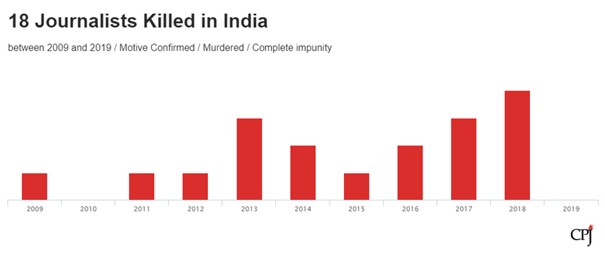
As per CPJ, between 1992 and 2019, 37 journalists have been slain in India and out of them 32 are cases where the culprits have gotten complete impunity; if limited to the last decade, this number stands at 18. Basically, 18 journalists who have died in India in the past decade have not received justice. The latest one of such casesis of Chandan Tiwaria local reporter with Hindi daily Aj in Jharkhand’s Chatra district who had reported on a Maoist leader’s indulgence in corruption and was murdered by 4 Maoists in October 2018. Although the FIR includes their names, no chargesheet had been filed until December 2018. The most prominent cases in the past few years is the murder of Gauri Lankesh who was the Editor of Gauri Lankesh Patrike, a Kannada-language weekly tabloid known for its criticism of right-wing extremism and the establishment. She was shot at by three unidentified assailants outside her home in September 2017. A Special Investigation Team (SIT) identified 18 accused in the case and the case is still awaiting justice in the Court.
In a special report of 2016, CPJ also reported that between 1992 and July 2016,in India more than half journalists who were killed were regularly reporting on corruption. Even if one takes into account the fact that the judiciary is burdened and it takes years before accused are convicted, the data from 1992 to 2002 may be considered and in that decade only 1 journalist’s murder was served with justice while 9 journalists’ murder were not.The trend of the last decade can be seen in the following bar graph:

The above graph is a representation of data gathered by CPJ in the last decade of journalists murdered and in whose case justice has not been served. Evidently, since 2015, the trend has been rising in India and the same is a matter of worry.
Freedom of press is embedded and entrenched in our freedom of speech and expressions and has been identified so by our country’s Supreme Court in various judgments time and again. Impunity in cases of journalists’ murders “is an open invitation for further violence,” said the United Nations high Commissioner for Human Rights.
Image Courtesy: The Hindu
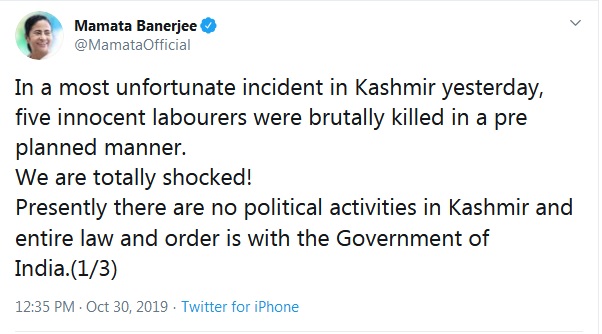
Slamming the Centre over the killings of five Bengal labourers in Kashmir’s Kulgam area on Tuesday, West Bengal Chief Minister said, “Presently there are no political activities in Kashmir and entire law and order is with the Government of India”, The Telegraph reported.
Banerjee expressed her rage through a tweet.
In the wake of the incident that took the life of the five men from Murshidabad, Mamata said that her party MPs and MLAs had reached the victims’ homes to meet the families, while also assuring a compensation of INR 5 lakh to all the families.
Alluding to the detention of political leaders when she stated there were no political activities in the state, she added that the incident had left her shocked and deeply saddened. She also demanded a “strong investigation so that the real truth comes out”. “We are deputing Shri Sanjay Singh ADG South Bengal to find out details from them.”
This is not the first attack on migrant labourers in Jammu and Kashmir. Since the abrogation of Article 370, militants have killed at least five people from outside the state have been brutally killed or injured.
Leader of the Congress in the LokSabha and Behrampore MP Adhir Chowdhury also blamed the Centre. “Since August 5, the day the Centre got the bill passed in Parliament to abolish the special status of Jammu and Kashmir, the safety and security of the people was its responsibility. Such brutal killings highlight the real picture Kashmir that the Modi government is desperately trying to hide from the rest of the world. Nobody but the BJP government should be blamed for this,” Chowdhury said.
Jangipur MP KhalilurRahaman, who visited the families of the victims along with Trinamul district president and Murshidabad MP Abu Taher Khan and state minister Jakir Hossain and local MLA SubrataSaha said, “Such unfortunate incidents only prove how miserably the BJP government at the Centre has failed to provide security to the Kashmiris, too. If the condition is so bad that non-Kashmiris are brutally killed, everybody can imagine the helplessness of the people of the Valley.”
Just a day before this incident, terrorists had attacked a truck driver in Anantnag district and targeted people waiting at a bus stand in Sopore. The afternoon that the labourers were killed, the state saw terrorists firing indiscriminately at paramilitary personnel deployed at a school in Pulwama district.
Incidents against civilians have been on the rise since the abrogation of Article 370 on August 5 this year. Yet, the Modi government insists on portraying that ‘all is well’ in the Valley. Two days ago, the Prime Minister took a bunch of European Parliamentarians for an ‘inspection’ tour to show them the ground reality of Kashmir, even when it has Indian leaders still under house-arrest and it is not saying anything with regards to the US Congressional hearingabout human right violations in the Valley after the revocation of J&K’s special status.
And then, in a usual blatant denial about the deaths of the five labourers being the inaccuracy of the Centre, Bengal BJP chief and Midnapore MP Dilip Ghosh blamed the Mamata government for the deaths by highlighting how joblessness in Bengal was pushing youths to migrate to “difficult areas like Kashmir that border Pakistan”.
“The Trinamul government should first create jobs for youths in the state so that they are not forced to migrate,” Ghosh said.
Related:
‘No outsiders in Kashmir’: Militants target non-locals, gun down apple traders and migrant labourers
Misrepresent “facts” a la BJP’s ideological Imperative: Mission Kashmir
Seeking external validation? Modi invites EU lawmakers to visit ‘normal’ Kashmir
Kashmir & Assam rights issues at US Congressional hearing: Oct 2019
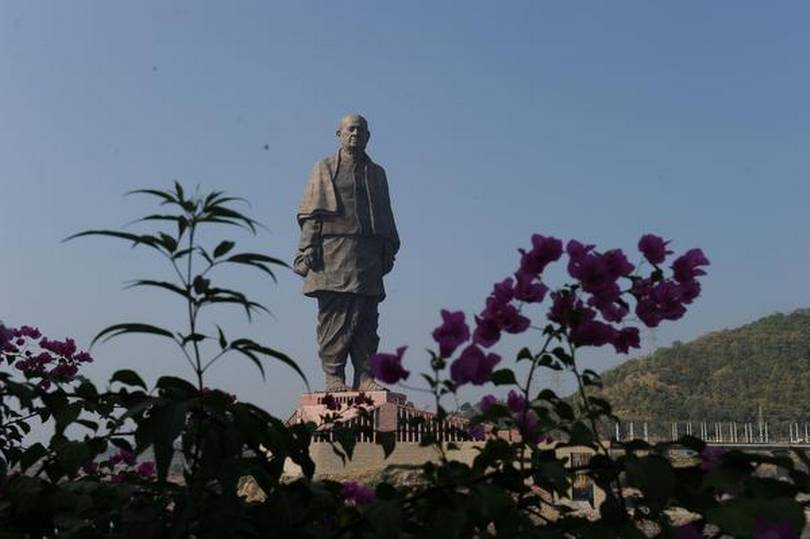
The Statue of Unity (SoU) seems to have been gripped in controversy right since its announcement and subsequent inauguration.
In another deplorable and shameless act against the public, ahead of the first anniversary of the inauguration of the statue to be held on October 31, 2019 which also coincides with the 144th birth anniversary of Sardar Vallabhai Patel, during Prime Minister Modi’s visit to Gujarat the police arrested prominent tribal activists from their homes near the SoU and as far as Surat and Baroda.
The detained activists are Dr Praful Vasava (Rajpipla), Rohit Prajapati (Baroda), Krishnakant (Surat), Shailesh Tadvi (Vagdiya), Gikubhai Tadvi (Shira), Nareshbhai Tadvi (Kevdiya) and Ramkrishna Tadvi (Gora) among others.
The tribals, from the villages of Navagam, Limdi, Gora, Vagadia, Kevadiya and Mithi had earlier protested that the land that was acquired for the Sardar Sarovar Dam project is now being used for the Shreshtha Bharat Bhavan and tourism related projects. Activists say this is in gross violation of Section 24 of Right to Fair Compensation and Transparency in Land Acquisition, Resettlement and Rehabilitation Act. Consequently, people are facing the threat of summary eviction.
In August 2019, environmentalist Mahesh Pandya had filed a PIL in the High Court of Gujarat against the land acquisition in six villages around the Statue of Unity in Narmada district. In his PIL Pandya said the government and the Sardar Sarovar Narmada Nigam Limited (SSNNL) were set to evict more than 5,000 Adivasis “under the guise of tourism development projects without following due procedure under the Land Acquisition Act”. Furthermore, he said, the authorities were asserting their rights over these lands by claiming that the lands had been acquired in the 1960s itself but since there was no need for the lands then people had been allowed to settle there.
Around 72,000 families had been displaced by the SSP Dam and the SoU project. Villagers detest the so called ‘development’ being brought in the name of tourism.
Speaking to The Quint, Raj Vasava, a tribal activist said that the police would have caught him too had he not been in Maharashtra at the time. He said, “The tribal folk living near the Statue of Unity are being deliberately displaced. The government is putting undue pressure on tribals living in 72 villages in the vicinity of the SoU as they want to start new projects to attract tourists. They have already started a butterfly park, river rafting and not to forget the Rajya Bhavan for each state in the country which will be built in the vicinity of SoU.”
He added, “These areas are protected under the Schedule V of the Constitution of India. The thing is they don’t want to spoil Modi’s image because of our protests. The diktat is to arrest any activist within 200 metres of SoU. But they have gone and arrested activists from their homes which are nearly 20 km away from the site. Couple of the activists hail from Surat and Baroda. What kind of democracy is this?”
The 72 villages around SSP (Garudeshwar taluka) are covered by Schedule V and therefore subject to PESA (Panchyats Extension to Scheduled Area) act, where anything that government seeks to do cannot be without the consent of the village Gramsabha. Yet Aadivasi agriculture, animals, life and livelihood have been wantonly dislocated.
What the government brought in the name of development
Activists have made innumerable accusations of environmental devastation and loss of land and livelihood.
Threat to aquatic life – Only after incessantly landing sea-planes in Lake No. 3, did the government belatedly realize that there were over 300 crocodiles in it.
The ruckus created by hovering helicopters has proved to be a nuisance to the birds, insects and even children. Also, they only later realized that the animals in the park that was set up overnight, would also be disturbed by the copters.
It’s not only people, including hawkers and vendors who have been displaced from the site, it order the chopping of more than 4,000 trees in the area for the widening of a four-lane road.
Standing crops have been destroyed to create parking lots.
None of the jobs promised to tribals have been materialized. In fact, in March, News Click reported that even employees, including, security guards, gardeners, sweepers, liftmen, ticket checkers hadn’t been paid for the past three months.
On the arrests of the activists, in a press note, the Lokshahi Bachavo Abhiyan, that has been one of the activist organizations at the forefront of the protest said, “They have been picked up to suppress the anger of the villagers when Modi arrives on October 31.”
The tribals have declared a National Disaster Day and have hoisted banners that say ‘Your Tourism. Our Destruction’, and ‘Give Us Back Our Lands’, the Frontline reported.
The press note also said that the government had claimed that for every Adivasi losing land, seven individuals would get a job. What happened to that promise?
The Lokshahi Bachavo Abhiyan puts it tersely when it says development for this government means “dispossessing the Adivasis of their jowar and bajra rotla to offer pizza and burger to the wealthy”.
Silencing voices seems to be the go-to strategy of the BJP. From tribals to celebrities, no one has been spared of the tactics that BJP has used to crush dissent.
Also, how ironical is it that ‘Ekta Divas’ or National Unity Day is being celebrated on the day Jammu and Kashmir are being bifurcated?
Related:
Gujarat human rights, tribal activists detained ahead of Modi reaching Statue of Unity
Are 1,000/ 1,700 acres ‘acquired’ off Statue of Unity, Narmada dam acquired without Adivasis’ consent?
Interim relief for Gujarat Adivasis as land acquisition stalled near Statue of Unity: Guj HC
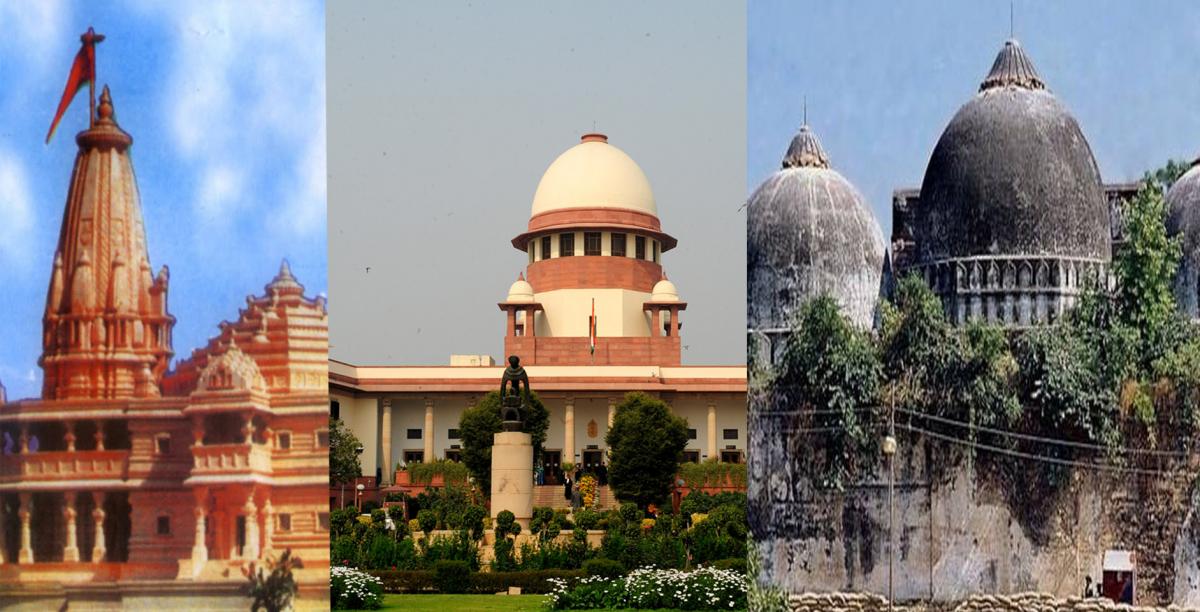
It is only natural for Muslims in India to be a little anxious as the country awaits the Supreme Court verdict on the Babri Masjid-Ram Janam Bhoomi dispute at Ayodhya to be delivered in a few days. A variety of rumours are floating which do not bear repetition in any responsible section of our media. But these are making many Muslims restive.

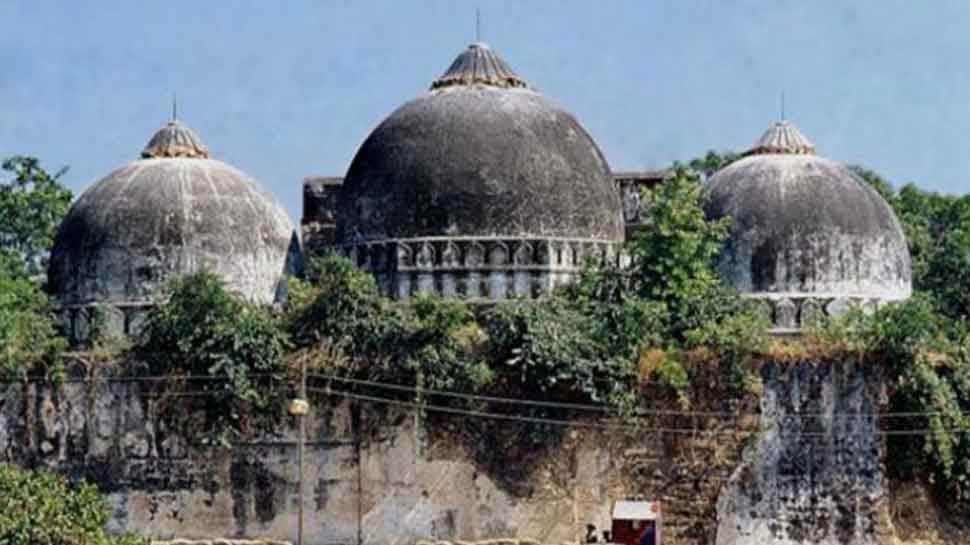
However, every challenge is also an opportunity. The demolition of Babri masjid on 6 December 1992 presented Muslims with an opportunity. Now that the masjid was no more and Muslims do not worship bricks and mortar or plots of land, they could have forgiven the miscreants who demolished the mosque and moved on, gifting the land for building a temple. I made this point in an article entitled “Opportunity for Muslims,” published by The Hindustan Times, New Delhi, on 13 Jan 1995. This was reproduced on NewAgeIslam.com on July 1, 2009.
Let me give you here some relevant excerpts from this article written almost 25 years ago.
“… This brings me to my main plea—forgiveness. Forgiveness is the essence of both the Muslim and Hindu spiritual traditions. It is the only way out of the vicious and very debilitating grip of bad karma. It is our belief that one has to always pay individual or collective karmic debts in this or any subsequent incarnations or on the Day of Judgement. Both Hindu and Muslim spiritual traditions consider God as the greatest teacher, this world a great school, the events that involve us in this mayajaal (illusionary world) as messages.
“What could this Great Teacher be teaching us in this section of the school through the great Babri Masjid-Ram Janam-bhoomi drama? Perhaps the all-important lesson of forgiveness. It may take us years, decades, centuries or millennia to learn this lesson. But learn we will. There is no escaping. God is a very determined teacher. We have the option to learn the lesson now. Let us exercise it.”
Then I had gone on to conclude: “…. If this mutual forgiveness and reconciliation does not take place — and if present Hindu and Muslim leaders are considered representatives of their respective communities, it is not likely to happen — ordinary people of both communities must make their presence felt and come out openly for peace at all costs. If that too does not happen, we Muslims should thank God for providing us with this unique opportunity to exercise our option of forgiveness and making a gift of a piece of God’s land on the specific condition that it be used for nothing but building a place of worship, so that its sanctity is maintained.
I know this is not going to be easy. Forgiveness is never easy, except for the spiritually evolved. But I don’t think we have any other option. We have many things, important things to do. We cannot afford to remain embroiled in inconsequential disputes. The renowned Islamic scholar, Maulana Ali Mian Nadwi had reacted to the opening of Babri Masjid locks (for all Hindu worshippers by Rajiv Gandhi government on 1 February 1986) the following day in these very sensible words: “Many mosques are in the possession of other people.” And indeed, they are.
“There were many mosques in East Punjab of the pre-Partition days? But very few are left as mosques today? A Punjabi Hindu friend of mine complained of so many mosques having been converted into gurudwaras and temples. His Muslim friend (not me, some great soul) reacted: “But they are still places of worship. There is only one God, after all. No matter what you believe in, you cannot but worship the same God.” Amen.”
However, guided by short-sighted, self-styled leaders as they are, Muslims did not take that opportunity. Now another opportunity beckons. The highest court in the land is about to give its final judgement. First of all, Muslims should make it clear that they would abide by the judgement and accept it willingly no matter what the verdict is. This is what out leaders have already done. But this bears repetition, particularly in view of the divisive, almost Rwandan nature of most of the media, print, electronic and social that has taken control of nearly all means of communication in north India. Unfortunately, some ignorant, greedy Mullahs too participate in the cockfights at prime time that go in the name of television debates, giving legitimacy to the palpable efforts to divide the society. The very least Muslims could have done to combat this national security threat was to socially boycott those treacherous Juhalawho are respectfully called Ulama by our media. But this is a subject for another day. The silver lining in these darkening clouds is that the secular, pluralistic foundations of Indian society are too deep to be shaken by these charlatans who are projected by the media as representatives of the Muslim community. The credit for pluralism in our society, I must add, goes largely to the broadmindedness of Hinduism that is willing to accommodate all religions.
Another reason Muslims should reiterate their faith in the Supreme Court now is that they have already committed once the cardinal mistake of pressurising a government to overturn a Supreme Court judgement delivered on 23 April 1985,based on the compassionate nature of Islam as the judges understood our religion. The Supreme Court invoked Section 125 of Code of Criminal Procedure, which applies to everyone regardless of caste, creed, or religion to rule that a divorced Muslim lady with no means of sustenance, 70-year-old Shah Bano, be given maintenance money, similar to alimony. Supreme Court concluded that “there is no conflict between the provisions of section 125 and those of the Muslim Personal Law on the question of the Muslim husband’s obligation to provide maintenance for a divorced wife who is unable to maintain herself.”
Considering the Holy Quran as the greatest authority on the subject, the court held that there was no doubt that the Quran imposes an obligation on the Muslim husband to make provision for or to provide maintenance to the divorced wife. But the Muslim leadership, both Mullah and non-Mullah, refused to accept it.
With this background, it is imperative that Muslims reiterate repeatedly their faith in the Supreme Court and declare that they will accept the judgement even if it goes against them, as this is the highest court in the land.
This also accords well with the exhortations in Quran and Hadith. All schools of Islamic thought accept that Islam requires Muslims to be loyal to their country’s institutions, regardless of the ruler’s faith. The Holy Quran states, “O ye who believe, obey Allah and obey the Prophet and obey those in authority from among you” (4:60). Prophet Muhammad declared, “Whoso obeys the ruler obeys me, and whoso disobeys the ruler disobeys me” (Muslim); “Listen to and obey your ruler, even if you [despise him]” (Bukhari).
Prophet Muhammad and his few followers endured bitter persecution for about 12 years in Mecca. But they did not defy the Meccan Establishment. They peacefully left Mecca, following the Quranic ruling, “Create not disorder in the earth” (2:13). Indeed, Islam not only requires Muslims to obey their government, but also to love their country. In a well-known Hadith, Prophet Muhammad instructed, “Love of one’s country is a part of faith” (Sakhavi; Safinat al-Bihar, vol. 8, pg. 525; Mizan al-Hikmah, Hadith # 21928).
Secondly, it is time Muslims use the next few days to introspect and consider what they would do if the judgement comes in their favour. It’s not just that they will find it impossible to build a mosque on that plot of land in the present atmosphere of heightened tensions and shrill Hindu demands and preparations to build a temple on that plot of land where the masjid stood for nearly five centuries. The important question is: is it even necessary for Muslims to do so. Babri mosque was a heritage building. Like the Bamiyan Budhas in Afghanistan, it is now lost for ever. It simply cannot be rebuilt. So common sense dictates that Muslims donate this piece of land for the building of the temple that our Hindu brothers and sisters want so badly. The argument that the faith in Lord Rama having been born exactly on that spot is a manufactured faith does not hold water. It doesn’t matter how a faith has taken hold. Now it is the Faith, and as Muslims themselves demand that their Faith, even the irrational parts of it, is given due deference, they too should respect the Faith of others regardless of its historical validity.
Courtesy: http://www.newageislam.com/

It was precisely on the ninth day of Dhu al-Hijjah (12th and last month of the Islamic year -6 March 632) in the tenth year of hijrah (migration from Mecca to Medina) that the Prophet addressed 1,44,000 pilgrims. The sermon, though seemingly addressed to a Muslim gathering, had a universal message. It consists of summarized exhortations based on some core teachings of the Qur’an and sunnah (Prophetic practices).
It captures the ethos of Islam and provides a great lens to view the religion through. Some of his advices have become the fundamental touchstones of the Islamic faith.
Muslims use the occasion a propitious time to rededicate themselves to the universal human values such as sacredness of life and property, equality, justice, peace, forgiveness, non-violence, women’s rights, the pillars of Islam and more. Upon these lofty principles, the religion of Islam was built. The Prophet died after unifying Arabia and his lifelong declared love of learning protected and contributed to classical knowledge and continued the tradition of Persian scholarship during the dark ages of Christendom.
For centuries, the Prophet inspired the Muslim world to thrive economically, culturally, scientifically and artistically. More than 1,400 years on, the divine providence of his philosophy, among myriad other socio-economic and political factors continue to anchor Muslim civilization.
We still have so much to learn from this 1,400-plus-year-old cry and we are so much in need of this message of Prophet Muhammad to soothe and heal our broken times where we continue to struggle with almost identical issues in our global human community.
The content of the message was powerful and intense and was redolent with Islam’s lofty values such as individual liberty, respect for the rule of law, social responsibility, mutual respect, and tolerance of those of different faiths and are inherently Islamic. The teachings of the Qur’an are unambiguous on being inclusive, and treating others with equality and justice.
The Prophet began by stating that he did not know whether he would meet the pilgrims again ‘in this place after this year’. After praising God and declaring the basic creed, ‘There is no deity but Allah and Muhammad is His Messenger’, he went on to speak on various themes. He then reminded them of the sacred character of the place and month, as well as of that of their lives, their honour, and their belongings.
He explained that the period of ignorance had come to an end, and so had its practices, its rivalries, and its conflicts based on power and profit. Henceforth, all Muslims were united by faith, fraternity and love, which were to transform them into witnesses of Islam’s message. They must under no circumstances accept being ‘either oppressors or oppressed’. They were to learn of the equality of all people in front of God and the desired humility because, he said: “You all descend from Adam and Adam was created from dirt. The most noble in the sight of God is the most pious. No Arab is superior to a non-Arab, except by their intimate consciousness of God [piety].”
He reiterated the need for tolerance to people of all denominations: An Arab has no superiority over a non-Arab, nor a non-Arab has any superiority over an Arab; also a white has no superiority over a black, nor a black has any superiority over white except by piety and good action.
The Prophet reminded all Muslims to treat their wives gently and added: “Be intimately conscious of God as regards women, and strive to be good to them.” He then added, as if to show the way and its conditions to all the faithful present and all those who were to follow his teachings through the ages: “I have left among you what will, if you keep to it firmly, preserve you from error: clear guidance, the Book of God and His Prophet’s tradition.” After each teaching that he reminded them of, the Prophet added: ‘Have I conveyed the Message? O God, be my witness!” At the end of the sermon, the pilgrims answered: “We bear witness that you have faithfully conveyed the message, that you have fulfilled your mission, and that you have given your community good advice.”
Concluding the sermon, the Prophet said, “You will be questioned about me (on the Day of Judgment). What answer will you give?” They replied, “We will bear witness that you conveyed to us what you were entrusted with….” The Prophet then pointed towards the people and said, thrice: “O Lord bear witness!” O God, be my witness! …. And let whoever is present convey this message to whoever is absent.”
A few hours later, near the summit of Arafat, the final revelation came down: “…This day have I perfected your religion for you, completed My Grace upon you, and have chosen Islam for you as your religion…” (Quran 5:3).
The last cycle of prophethood was drawing to its close, and the Messenger was to return to the place of his election, his home beyond this life, in proximity to the One.
Here is his sermon
“O People, listen well to my words, for I do not know whether, after this year, I shall ever be among you again. Therefore, listen to what I am saying to you very carefully and take these words to those who could not be present here today.
“O People, just as you regard this month, this day, this city as Sacred, so regard the life and property of every Muslim as a sacred trust. Return the goods entrusted to you to their rightful owners. Treat others justly so that no one would be unjust to you. Remember that you will indeed meet your LORD, and that HE will indeed reckon your deeds. God has forbidden you to take usury (riba), therefore all riba obligations shall henceforth be waived. Your capital, however, is yours to keep. You will neither inflict nor suffer inequity. God has judged that there shall be no riba and that all the riba due to `Abbas ibn `Abd al Muttalib shall henceforth be waived.
“Every right arising out of homicide and blood-killing in pre-Islamic days is henceforth waived and the first such right that I waive is that arising from the murder of Rabi`ah ibn al Harith ibn `Abd al Muttalib.
“O people, the Unbelievers indulge in tampering with the calendar in order to make permissible that which God forbade, and to forbid that which God has made permissible. With God the months are 12 in number. Four of them are sacred, three of these are successive and one occurs singly between the months of Jumada and Sha`ban. Beware of the devil, for the safety of your religion. He has lost all hope that he will ever be able to lead you astray in big things, so beware of following him in small things.
“O People, it is true that you have certain rights over your women, but they also have rights over you. Remember that you have taken them as your wives only under God’s trust and with His permission. If they abide by your right then to them belongs the right to be fed and clothed in kindness. Treat your women well and be kind to them, for they are your partners and committed helpers. It is your right and they do not make friends with anyone of whom you do not approve, as well as never to be unchaste.
“O People, listen to me in earnest, worship God (The One Creator of the Universe), perform your five daily prayers (salah), fast during the month of Ramadan, and give your financial obligation (zakah) of your wealth. Perform hajj if you can afford to.
“All mankind is from Adam and Eve. An Arab has no superiority over a non-Arab nor a non-Arab has any superiority over an Arab; also a white has no superiority over a black nor a black has any superiority over white except by piety and good action. Learn that every Muslim is a brother to every Muslim and that the Muslims constitute one brotherhood. Nothing shall be legitimate to a Muslim which belongs to a fellow Muslim unless it was given freely and willingly. Do not, therefore, do injustice to yourselves.
“Remember, one day you will appear before God (The Creator) and you will answer for your deeds. So beware, do not stray from the path of righteousness after I am gone.
“O People, no prophet or messenger will come after me and no new faith will be born. Reason well, therefore, O People, and understand words, which I convey to you. I am leaving you with the Book of God (the Quran) and my sunnah (the sayings and practices as evidenced in the behavioural mode of the Prophet). If you follow them you will never go astray.
“All those who listen to me shall pass on my words to others and those to others again; and may the last ones understand my words better than those who listen to me directly. Be my witness O God, that I have conveyed your message to your people.”
(Reference: See Al-Bukhari, Hadith 1623, 1626, 6361) Sahih of Imam Muslim also refers to this sermon in Hadith number 98. Imam al-Tirmidhi has mentioned this sermon in Hadith nos. 1628, 2046, 2085. Imam Ahmed bin Hanbal has given us the longest and perhaps the most complete version of this sermon in his Masnud, Hadith no. 19774.)
Courtesy: Counterview.org
Join our mailing list to get the latest human rights news that matters, straight to your mailbox.
© Sabrang | All Rights Reserved