Calling it “third party information, the Agra Central Prison refuses information, blocks transparency


The Good
Since its inception, on paper at least, India’s Constitutional foundations declare its push to become a casteless society. The New India was founded on principles of liberty, equality, and fraternity, andthe Indian Constitution was framed with a view to protect its people from being vulnerable to any kind of discrimination.
Article 14 of the Constitution underlines the right to equality before the law and Article 17 abolishes Untouchability. Caste however is not directly disparaged in India’s foundational document.
We have seen a lot of instances in this last decade of people exercising their liberty by determining an identity or themselves that foregoes caste and religion. In the 2011 Census, around 29 lakh people in India chose to not state their religion for the religion category.In 2014,the Bombay High Courthad directed the state not to compel any individual to declare or specify his religion in any form or any declaration, the Court quoted the apex courtwhich had observed:
“Article 25, as its language amplifies, assures to every person subject to public order, health and morality, freedom not only to entertain his religious beliefs, …but also to exhibit his belief in such outwardly act as he thinks proper and to propagate or disseminate his ideas for the edification of others.”
Similarly, the Madras High Court in 2016 affirmed that when a person or, in case of a minor, their parents do not wish or unable to disclose the religion and caste, the same need not be insisted upon in instances where they are seeking admission for their child.
More recently, during the 2017-18 academic year, more than one lakhschool students admitted to classes 1 to 12 in Kerala have left the caste and religion columns blank. In February 2019, M.A. Sneha became the first woman to receive a “no caste, no religion” certificate from the government.
These cases are a strong indication of the changing tide in the country where we see Indians are more self-actualised and are moving towards forming a more secular demographic.
The Bad
As heartwarming as these incidents are, and as hopeful as they make one feel for India’s future, are these examples are painting a complete picture? The Non-Savarna Indian would tell you a different side to the story. When you are bornDalit, letting go of your caste is often not possible.Far too often, others don’t let you. You can change your surname, convert to Buddhism,and you may still be primarily associated with what you were born into. Even after getting a Harvard education, parting from your Dalit caste is about as easy as parting from your shadow.Letting go of one’s identity would also mean letting go of any state assistance offered to offset the societal disadvantages placed on your community. Ajay Kumar, the executive director of the NGO Rights which works for the upliftment of dalits, while commenting on the news from Kerala, noted, “It is easy for the privileged to sacrifice caste while dalits can’t do that. It has been only 60 years since dalits in Kerala have accessed education. Even today, they are not in a position to sacrifice their legitimate rights.”
The Ugly
Worse still, socio-political non-representation and callously chosen government policies can result ineffective invisiblity for the non-Savarna Indian.This amounts to a moreforced loss of identity, and is precisely why the under priviledged often organize their politics around group’s interests.
Dr. Ambedkar once said, “rights are protected not by law but by social and moral conscience of society.”Forced invisibility can show us why the state’s efforts to uplift the downtrodden haven’t had much effect on their social standing.
A simple example of forced invisibility is the manner in which the governments of the last two decades have handled collecting census data. As stated by the Census Board of India, the decennial census performsthe dual objective of collecting valuable information which assistsgovernments in planning and formulating policies, and providing the basis for reviewing the country’s progress in the past decade.Despite the crucial role the census plays in forming effective government policy, we haven’t collected caste-wise data since the 1931 census (except to count the number of people falling in the categories of Scheduled Castes and Schedules Tribes). To this day, we rely on the 1931 censusdata to caste-relatedpolicies.While a caste census was conducted in 2011,the Centre has been sitting on its findings over alleged worries of the results causing political strife and more demands for reservation.
In August 2019, nearly 100 villages in Thane and Palghar districts passed a resolution to boycott the enumeration process for the 2021 census until the government reverses its decision to not include the OBC caste data in the census, going back on its promise from last year. “If you aren’t counted, you don’t exist. You need to demand your visibility first to be able to ask for what belongs to you rightfully,” explained social activist Sunil Deore.
Identity politics is not the problem
Is it fair to not count caste-wise data over concerns of encouraging identity politics?
Identity politics involves people belonging a particular groupengaging in politics to protect their group interests. Going by this definition, one can see that identity politics, in fact, plays anintegral role in the democratic process. Progressive movements for women’s rights and queer rights have both come from identity politics.The use of identity politics only becomes a hindrance to the nation’s growth when it fuels tribalism, creating in an “us versus them” dynamic. As long as a group’s interests are in line with constitutional principles and align with the overarching interests of the country, identity politics only builds a fulfilling democracy.
Another important point to consider is that caste-based and religious minorities often don’t have any other option but to rely on identity politics. Majoritarian political parties base their agenda on different forms of minority erasure, and while the supposed secular parties mayshow solidarity towards minorities, theyare rarely seen creating space for minorities among their ranks.
It is difficult to make policies that can benefit a community if they don’t have an understanding of that community’s struggles. For example, in an effort to prevent use of offensive slurs against the Dalits, the Centre directed private satellite TV channels and government departments to avoid using the term ‘Dalit’ and to use ‘Scheduled Castes’ instead. This advisory was in accordance with the orders of High Courts of Bombay and Madhya Pradesh.
However, what neither the Centre nor the High Courts had considered at the time was, being referred to as ‘SC’ has become offensive in practical usage, and the term ‘Dalit’ has been a term of empowerment for the oppressed community. This goes to show the need for minoritiesto be adequately represented in positions of power.Without the support of any other organisation, caste-based or religious minorities have no choice but to form their own factionsso as to participate in political affairs. In such cases, the only way to be heard is to be seen.
Conclusion
So how should the non-Savarna Indian navigate through issues of self-identity? In an ideal world, where every single Indian has been unshackledfrom the weight of their caste or religion, a “non-Savarna Indian” wouldn’t be defined as such—the term wouldhold no significant meaning. They, too, would then have the freedom to derive their identity from what they choose.
However, at this time, when an equal society remains a dream for vulnerable communities, and being a minority means facing resentment just for being that minority, the road to obtain civil rightsis of collective, relentless struggle. Out of necessity, then, one identifies with the community that has banded together to be heard in socio-political discourse.
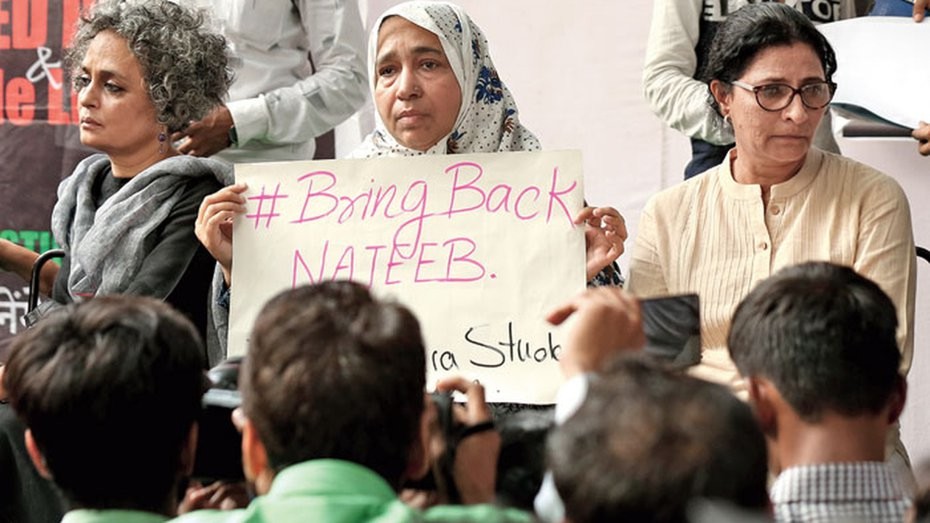
Fatima Nafess, mother of a JNU student who was reported missing after a clash on campus in 2016 shared a stage with relatives of victims of murders linked to Hindutva groups on Tuesday.At a public meeting to mark the third anniversary of the day her son Najeeb Ahmed was reported missing after a clash with supporters of the Akhil Bharatiya Vidyarthi Parishad, Fatima Nafis demanded justice. Along with Nafis was, Kavitha Lankesh, sister of slain journalist Gauri Lankesh and the wife of Jharkhand mob violence victim Tabrez Ansari.
At the meeting on Jantar Mantar road, Nafis said: “I am fortunate that all of you, my children, have done your duty to stand with me and say that I am not alone. This is a slap in the face of the Sanghis. The only thing the government is scared of are the youths who will be the leaders of tomorrow. Those who call themselves nationalists are selling airports and the railways and destroying institutions. The only people stopping them are the youths.”
Last year, the CBI closed its investigation into the disappearance of Najeeb. Fatima Nafees has however challenged this through a protest petition. BSP MP Danish Ali, author Arundhati Roy, senior Supreme Court advocate Prashant Bhushan, St. Stephen’s College professor Nandita Narain and several student representatives spoke in solidarity with the victims.
Kavitha, sister of Gauri Lankesh who was shot dead in 2017, said: “When (Narendra) Dabholkar was shot dead (in 2013) and (Govind) Pansare was killed (in 2015), I did not care. When (MM) Kalburgi was killed (in 2015) closer to home, it still did not sink in. Finally, when my sister was shot at our doorstep, I understood what fascism and the Hindu Rashtra is.”
The killers of all four rationalists are suspected to be linked. Ansari died in police custody after being assaulted by a mob which made him chant “Jai Shri Ram” in Jharkhand in June this year. His 19-year-old wife Shaista Parveen had a miscarriage during his custody on unproven charges of theft.She said: “I have been running from pillar to post and have come all the way from Jharkhand to demand justice for my husband. Modiji, please grant us justice.”
Ammi, a film by film maker Sunil Kumar and produced by Pedestrian Pictures traces this acute loss, search and longing by Fatima Nafis. “Our words haven’t reached those who should have heard our voices.”
This is one of the lines spoken in the beginning of Ammi, a documentary film by Sunil Kumar, produced by Pedestrian Pictures, which was recently screened at the YMCA, New Delhi and then last week at the Jawaharlal Nehru University. The essence of this line echoes throughout the film, prompting the viewer to recognise the gaps overlooked by the JNU administration as well as the law while investigating the disappearance of Najeeb Ahmed.
After Najeeb went missing on October 15, 2016, there were many cues left to be explored, from the minutest of forensic details (it is claimed Najeeb’s slippers were found on the staircase along with his phone and wallet in the room), to the fact that he was thrashed by students from the Akhil Bharatiya Vidyarthi Parishad (ABVP) in his room the other night, or the perplexing events which took place after his last conversation with his mother, Fatima Nafees, who was on her way to meet him.
Ammi is a documentary which attempts to outline the emotional and factual aspects of JNU student Najeeb Ahmed’s disappearance.
Related Articles:

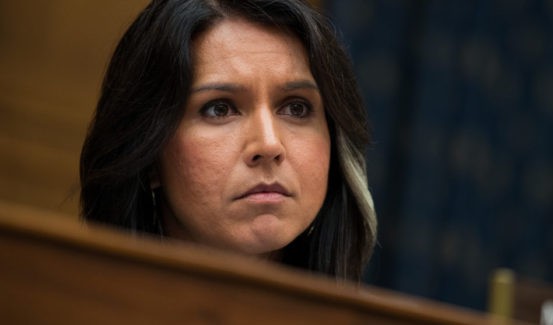
New Delhi: October 15, 2019 : She is nothing short of the US presidential candidate. Meet Tulsi Gabbard, US Congresswoman on a trip to her ‘home’ country. In a recent interview with The Times of India, defended the idea of Hindu nationalism by suggesting it is about “expressing pride in one’s religion.”
Earlier this year, in January, Gabbard had reportedly protested that she has “been accused of being a ‘Hindu nationalist’,” but she appeared to take a different approach in the October 13 interview. When asked about “the upsurge of Hindu nationalism and Hindu pride” displayed at the recent “Howdy, Modi” event in Houston, TX, she stated, “Hindu nationalism is a term that many people are using frequently without being specific about what they mean by that. Why is expressing pride in one’s religion a bad thing?”
These comments by Gabbard come just two weeks after she stirred controversy for apparently justifying a 2002 pogrom conducted against Muslims in Gujarat, India by militant Hindu nationalist outfits.
At an October 1 campaign event in Londonderry, New Hampshire, the presidential aspirant was asked about her relationship with Indian Prime Minister Narendra Modi. “Many consider him to be complicit in the deadly ’02 Gujarat riots,” an audience member said to Gabbard, who shot back: “Do you know what instigated those riots?” Her response was widely interpreted as a justification of the violence in Gujarat, which claimed approximately 2,000 Muslim lives.
In 2002, Human Rights Watch reported, “Communal violence against Muslims in Gujarat is intimately connected to a rise of Hindu nationalism.” Implicating the Rashtriya Swayamsevak Sangh and its affiliates as “directly responsible” for the killings, HRW explained that the RSS “has propagated a militant form of Hindu nationalism which it promotes as the sole basis for national identity in India.” In a February 2019 report, HRW warned, “The rise in Hindu nationalism in India since 2014, has fostered a climate of hate and discrimination against Muslims, Dalits, and other minority communities, leading to an increase in violent attacks against them in many parts of the country.”

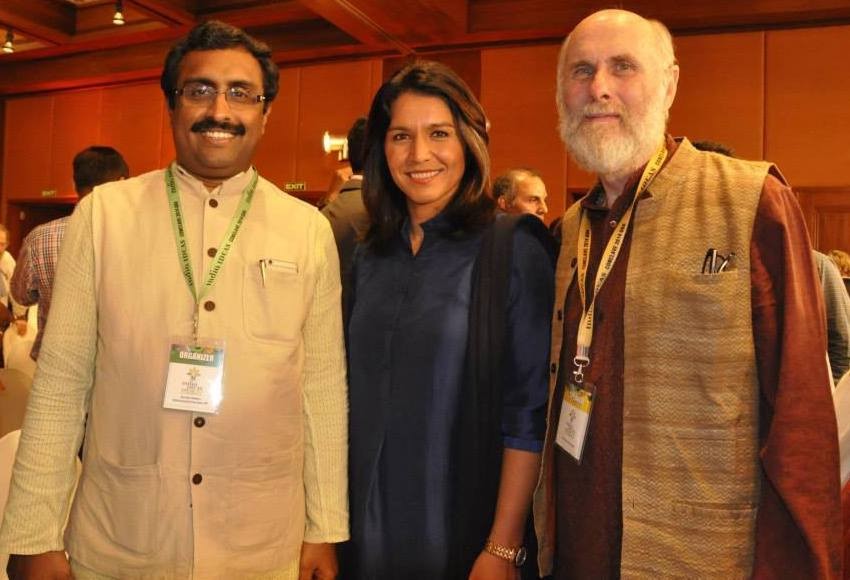
Gabbard at India Ideas Conclave 2014 with BJP spokesperson Ram Madhav (L) and RSS apologist David Frawley (R)
Last year, a report from a Special Rapporteur for the United Nations Human Rights Council warned, “The Hindu nationalist Bharatiya Janata Party (BJP) has been linked to incidents of violence against members of Dalit, Muslim, tribal and Christian communities. Reports document the use of inflammatory remarks by BJP leaders against minority groups, and the rise of vigilantism targeting Muslims and Dalits.”
Gabbard’s association with Modi and the RSS has inspired strong criticism. After neglecting to join the BJP’s Modi at his September 22 “Howdy, Modi” event, she issued an apology. “I’m sorry that I’m not able to join,” said the congresswoman, but offered no comment about the estimated 15,000 South Asians who protested the event.
Later that week, she met Modi in New York City for their fifth meeting since 2014.
“Tulsi Gabbard’s defense of religious nationalism is an appalling attitude for a member of the US Congress, which we hope would represent and defend a secular, pluralistic society,” remarks Arvin Valmuci of Organization for Minorities of India. “Considering the congresswoman’s cozy relations with the Hindu nationalist BJP, it is not surprising she deliberately obfuscates the crystal clear definition of Hindu nationalism. She should be ashamed for excusing the violent ideology of Hindu nationalism as nothing more than being proud of one’s religion.”
In her Times of India interview, Gabbard further argued that there is “an unfortunate Hinduphobic approach taken to Hindus who are expressing their pride.” She claimed her political opponents are “resorting to these Hinduphobic attacks,” stating, “What concerns me is that it may discourage other Hindu Americans from running for office.”
“Absolutely nonsense,” said Dr. Ashok Swain. A professor of peace and conflict studies, he added, “The opposition to Tulsi Gabbard is not that she identifies as a Hindu American but because she acts as a stooge of Hindu Supremacist group RSS in the USA.”
Just this week, Gabbard had stepped on to the US national stage once as she joined 11 other candidates for the Democratic Party’s fourth presidential debate in Westerville, Ohio.
Related Articles:
1.Tulsi Gabbard and Her Hindutva Connection
2.All in the Family: The American Sangh’s affair with Tulsi Gabbard
3.H.Res.417 – Praising India’s rich religious diversity and commitment to tolerance and equality, and reaffirming the need to protect the rights and freedoms of religious minorities.

The carnage
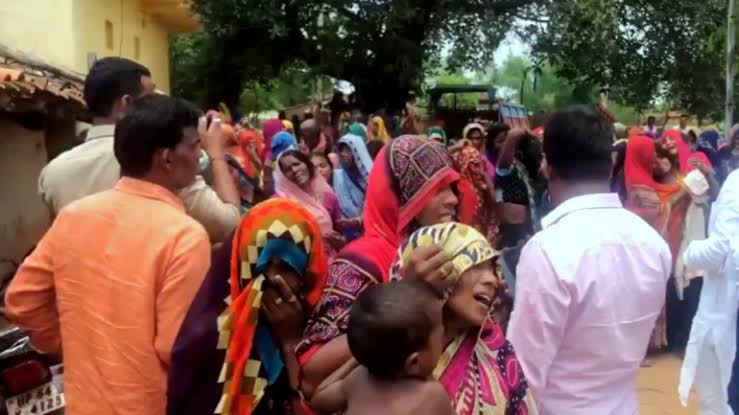
It was on July 17, 2019 that the brewing conflict, essentially a battle of Adivasis for their land and tilling rights, boiled over. Yagyadutt led a large group of the dominant, land-owning Gujjar community to indiscriminately fire guns at Gond tribals. Reportedly, close to 300 men who were atop 32 tractors rode onto the farmlands that belong to these tribals and started firing at the Umbha village of Sonbhadra. The incident occurred on July 17 when villagers belonging to the Gond community were farming the disputed land. A group of people led by Yagyadutt went to take possession of the land which they claimed was purchased by him and his relatives two years ago. They indiscriminately fired at the villagers, killing 11 of them and injuring 21 persons.
After the attack, the police seized five firearms, (including three double-barrel and one single-barrel gun), 19 tractors and 12 sticks.
Here is a quick recap of the issue.
The conflict
The district of Sonbhadra, while being one of the most backward in Uttar Pradesh, is also prime real estate for industrialisation. Nicknamed the ‘power capital of India’, it produces at least 12,000 MW of power, with 32 major plants, factories and mines dotting the area. The district has had aluminium and chemical factories, a cement plant and a steel plant established in the 1960s, and the reserves of coal, bauxite, limestone, and gold make it riper for mining-related investment.
The Gonds have been tilling land of Umbha, a village in Sonbhadra since before independence. Other than being their home, this land has played a role in their formation of a cultural identity. In the year 1952, 639 bighas of the area’s land was declared to be a ‘gaonsamajbhumi’—land owned by the village Gram Sabha under the Uttar Pradesh Zamindari Abolition and Land Reforms Act, 1950.
However, in 1955, Maheshwari Prasad Sinha used political connections of his IAS son-in-law Prabhat Kumar Mishra to get this very land transferred to a charitable society which he had formed in Sonbhadra. Sinha’s daughter and Mishra’s wife Asha Mishra was made the manager of the society of about 463 bighas of land. In 1989, another 200 bighas of this land was transferred to Asha.
In 2017, Yagyadutt bought 144 bighas of this land from Vinita, daughter of Prabhat Kumar Mishra. The Gond tribals complained to the revenue authorities and approached the court against what they termed was an illegal sale. Ownership of that much land by one person also goes against Land Ceiling law. Yagyadutt thereafter lodged FIRs against the Gonds for “encroaching” on his land.
Thus, the Gond tribals had their unequivocal right to their land put in jeopardy by a few Savarna politicos playing the system and misusing their power. (Read Systematic betrayal of the Adivasis since independence for more detailed coverage)
The chargesheet
Prabhakar Chaudhary, Sonbhadra’s Superintendent of Police, (SP) stated that this chargesheet has been prepared on the basis of scientific evidence along with statements made by 123 people. He told the Indian Express, “The role of 59 people has come to light. Fifty-five of them have been arrested and four others are on the run. On Monday, we filed the chargesheet against 51 of in a local court of Sonbhadra. The court has fixed October 24 for taking cognizance of the chargesheet,”
The chargesheet specifically states that Yagyadutt, his brothers Nidhidutt, Devdutt and Dharmendra, and one Vijay fired guns at the Gond tribals. It states that after Nidhidutt got injured at some point, another accused Neeraj Rai fired using his double-barrel gun. Most of the other persons charged are also related to Yagyadutt.
The chargesheet also names Komal Singh, suspended superintendent of Bhadohi railway station, as a key conspirator in the case. He spoke to Yagyadutt and Dharmendra five times each at the time of the crime. The document also notes that another railway employee contacted Yagyadutt 16 times and Dharmendra 17 times on the day of the killings.
The police has applied IPC sections 147 (rioting), 148 (rioting, armed with deadly weapon), 149 (unlawful assembly in prosecution of common object), 302 (murder), 307 (attempt to murder), 34 (acts done in furtherance of common intention) and 120-B (criminal conspiracy), in addition to the SC/ST Act and Arms Act. It has been reported that the UP Schedule Caste/Schedule Tribe Commission also asked the state government to invoke the National Security Act and the Gangster Act against the alleged culprits.
Can the meek inherit the Earth?
The hubris displayed by Yagyadutt and his associates might come as a rude shock to the uninitiated, but it comes as no surprise when one looks into all the injustices that adivasis suffer from ever so often. The cards are almost always stacked against them.
With respect to this incident, the village head, who is duty-bound to protect the interests of the villagers, has been been trying to unceremoniously turn the Gond tribals into encroachers of their own land, they are considerably socio-economically disadvantaged as opposed to their Gujjar adversary, the Ghorawal police has been accused of working hand-in-glove with Yagyadutt and helping him with every move since 2017, and now they have had their lives threatened over the property.
Even on a national scale, adivasis are often treated as the invisible class. The government does not provide any assistance to tribal applicants trying to assert their right over forest land, as a result of which lakhs of tribals are not facing eviction from their homes.
Against all odds, however, the tribal communities continue to fight back. Adivasi rights activists from Sonbhadra and other tribal-populated areas have found strength in numbers and collectively assist other tribals in making land claims and raising a voice against discrimination.
Adivasi rights activists Sokalo Gond and Nivada Rana are now seeking court intervention through an intervention application which is supported by CJP and the All India Union of Forest Working People (AIUFWP). (CJP has been actively campaigning for the rights of forest-dwellers. You can have a look at our work here.)
As Sokalo Gond (Sonbhadra native and member of All India Union of Forest Working Peoples) said to Scroll.in, “We have to stand with each other and with all the other communities who live in the forest. Even though there has been a stay order from the Supreme Court, we have to continue to show the people in charge that we are not afraid of asking for our rights.”
Related:

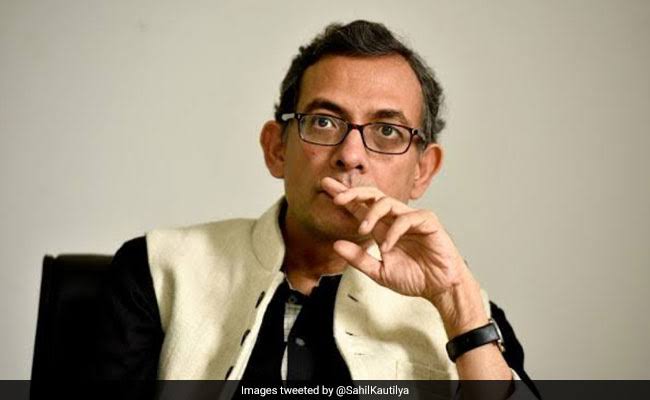
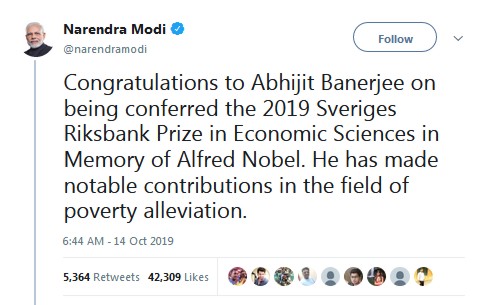
It was announced yesterday that the Nobel Prize in Economics for 2019 has been awarded to Abhijit Banerjee, Esther Duflo and Michael Kremer for “their experimental approach to alleviating global poverty”.
Abhijit, who was pleasantly surprised by his win and went on to sleep for a half hour after hearing the news, is everything the BJP stands against. First of all, Ahijit is a product of the Jawaharlal Nehru University (JNU) an organization that has been at loggerheads with PM Modi’s Hindu Nationalist BJP.
This association now makes Abhijit the most elite candidate for the ‘anti-national’ tag that has been freely doled out by the party’s jingoistic supporters.
He had also openly criticized the government’s decision of demonetization. In an interview, he’d said that the move was being viewed with ‘bewilderment’ in academic circles.
A alumni of the so called ‘tukde-tukde gang’, the acclaimed economist was one of the 108 social scientists and economists who had signed a letter to the government calling it out for hampering with the GDP statistics and showcasing inflated growth. The letter met with a lot of flak, not just by the government but also a few chartered accountants who claimed it to be ‘motivated’ and ‘devious’.
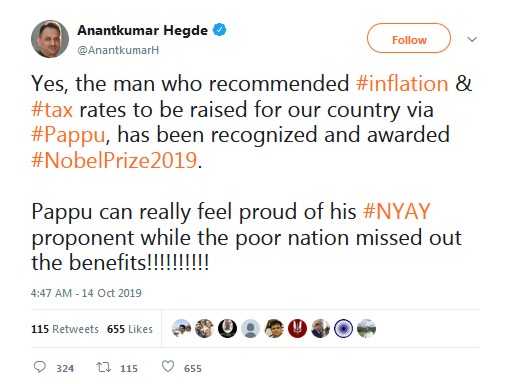
Not just this, in a supposedly ‘anti-national’ activity as some would say, he had also helped the Indian National Congress (INC) devise the Nyuntam Aay Yojana (NYAY) scheme. NYAY was a minimum income guarantee scheme that was the flagship social welfare programme of the party. The BJP then took potshots at the cou-founder of the Abdul Latif Jameel Poverty Action Lab that works toward methods of alleviating global poverty.
Rahul Gandhi tweeted in congratulations, but not without taking a jibe at the BJP.
https://twitter.com/RahulGandhi/status/1183717485171732481
Being a JNU student, Banerjee has seen his days of unrest. He was thrown into Tihar Jail for ten days, protesting against the then Congress government in the 1980s to reduce government interference in the educational campuses.
Even last week, he fearlessly spoke about the failing health of the Indian economy. While the BJP government keeps singing All Izz Well to the public regarding all problems faced by it and sweeping the economic crisis under the carpet, Banerjee put together some prescriptions to resuscitate the economy. The least he said we could do, was PRAY.
This surely must’ve come as a hit right in the Centre’s jaw.
There have been some who have been calling his win not the ‘right’ decision.
Though PM Modi extended his congratulations to the trio for their work in poverty alleviation, Twitter users pointed it out to be a very half-hearted greeting.
It is left to see whether the Centre will now gloat on Banerjee’s win for being ‘a person of Indian origin’ or shun away this moment by looking the other way.
Amidst some relief in wake of the partial lifting of the communication blackout in Kashmir, also emerging are several heartbreaking stories. Meanwhile, voices of dissent are growing louder.

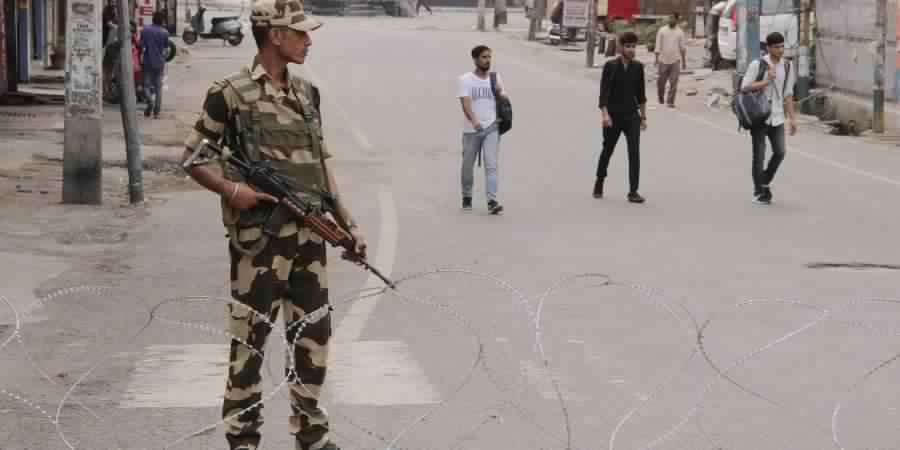
Post paid mobile services were restored in Kashmir on Monday after the state was placed under a communication black out for over 72 days. However, on the same day SMS services were stopped at about 5 PM, reportedly as a “precautionary measure”. Officials told Times of India that over 25 lakh prepaid mobile phones and other internet services including WhatsApp remain deactivated.
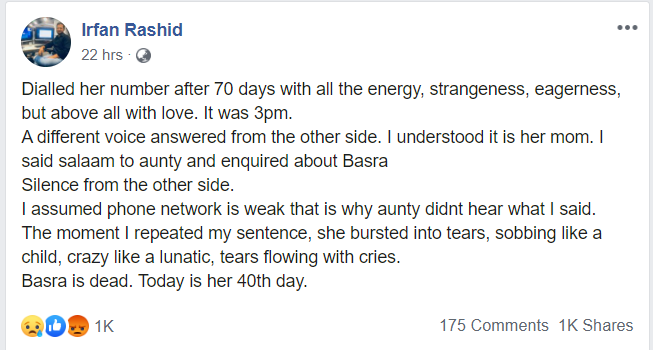
Meanwhile, in a heartbreaking Facebook post journalist Irfan Rashid shared how he was finally able to establish contact with a dear friend after 70 days, only to learn she had died 40 days ago!

Rashid’s post went viral eliciting condolenses and support, but in his grief it appears Rashid is taking a break from social media as his profile is no longer visible.
Voices of dissent
Women’s groups held a protest at Pratap Park near Srinagar’s Lal Chowk, but the police swooped in and detained the protesters. Among those detained included former Jammu and Kashmir Chief Minister Farooq Abdulla’s sister Suraiya Abdullah and daughter Safia Abdullah Khan. Suraiya told reporters, “On August 5, we were locked inside our homes and Article 370 was abrogated. This is a marriage by compulsion which won’t work.”
Though the protest in Srinagar was stopped by the police, many similar peaceful protests are being organised by different civil rights groups and students across India. For instance, a protest is being planned at Jantar Mantar on the 75th day since the abrogation of Article 370. At this Saturday’s peaceful public protest, poetry will be read and music played.
The State on numerous occasions has tried to impose the use of the Aadhar card upon the citizens. While, the Supreme Court has upheld a few of such mandates of the State, the question of whether the imposition is valid on few other services keeps coming up before the Courts of the land vide myriad petitions, rendering the rhetoric of the Aadhar in limbo.

On October 14, the Supreme Court refused to entertain a plea by BJP leader Ashwini Kumar Upadhyay seeking directions to the government and few of its agencies to make it mandatory to link social media accounts with Aadhar to ‘combat the menace of paid news and fake news’.
The Aadhar card, with its Unique Identification Number, at its inception was an identity document meant to be a means for inclusion. The Act itself is called The Aadhaar (Targeted Delivery of Financial and Other Subsidies, Benefits and Services) Act, 2016. The nomenclature of the law suggests its purpose quite clearly but the government’s employment of the card in the past few years across avenues has raised several questions regarding the validity of such use as per the Act and its constitutional validity.
Mr.Nandan Nilekani, back in 2010 in an interview with Civil Society Online had said, “The purpose of this programme is very clear. It is about inclusion. It is about the fact that there are a few hundred million people in this country who don’t have any form of identity, who don’t have a birth certificate, who don’t have a school certificate, 75 million homeless people…they are the ones who are suffering due to lack of identity.”
In the light of the petition seeking linking of social media accounts to Aadhar, and in times where the Aadhar data has been breached due to illegal practices of third parties, here’s a brief analysis of the government’s mandate on linking of Aadhar to various services and its effects.
Aadhar for PDS
Recent incidents are however proof that the arrival of the Aadhar Card has done the opposite of what it intended to do: inclusion. The Supreme Court, in its September 2018 judgment, has held section 7 of the Aadhar Act to be constitutional and held thus, “Section 7 of the Aadhaar is constitutional. The provision does not deserve to be struck down on account of denial in some cases of right to claim on account of failure of authentication.”
Following this, many state governments made production of Aadhar card/ Aadhar number mandatory at government run ration shops in order to procure monthly assigned ration. Sabrangindia reported that as per a survey conducted by the Right to Food campaign,as many as 272 families in Odisha’s Nabarangpur district did not receive their quota of foodgrains for the months of September and October because of discrepancies in linking their Aadhaar numbers to the public distribution system.Scroll also reported that the Right to Food campaign compiled data of starvation related deaths in the past year across 9 states and found that 19 of the 57 deaths were Aadhar related deaths. Aadhar related starvation is manifested in many ways like ration card is not linked with Aadhar card or failure of authentication of Aadhar biometrics, all of which ultimately means they cannot benefit from the subsidy scheme as per the National Food Security Act.
Aadhar for Direct Tax filings
The Supreme Court had in its landmark judgment of 2017 upheld individual’s right to privacy and temporarily halted government’s attempts to make the Aadhar card a mandatory document for all purposes. The Apex Court in its 2018 judgment, however upheld the linking of Aadhar card for income tax purposes in order to help the government in curbing incidents of tax fraud and to eliminate the menace of black money. Accordingly, the linking of Aadhar card to the PAN card has been made mandatory, failing which one’s PAN no. shall become inoperative, and a deadline of December 31 of this year has been set, which is an extension of already set deadline of September 30.
Aadhar for sim cards
The Central Government vide The Aadhaar and Other Laws (Amendment) Bill, 2018 made use of Aadhar for verification as an identity document voluntary for banking companies, financial institutions and intermediaries, as well as telecom companies. The implication of this amendment was that telecom companies, banks and other financial institutions and intermediaries cannot make production of Aadhar card mandatory for purposes of verification of identity of an individual in lieu of providing any kind of services.
However, this move came a little too late as many citizens had already linked their Aadhar cards to their SIM cards and Bank accounts following Centre’s directive in this regard in 2014.
Aadhar to vote
The Wire, had in its report analysed what means were used by the Election Commission (EC) in 2015 to link voter’s Aadhar cards and whether informed consent of voters was sought. The EC launched the National Electoral Roll Purification and Authentication Program (NERPAP) whose aim was to eliminate voter fraud and cases of duplicate voter IDs. The program was shut down by the Supreme Court in 2015, however, by that time, the EC, had already collected the Aadhaar numbers of over 300 million voters in a span of three months. In order to complete the herculean task in three months, the EC accessed the National Population Register in some states for seeding the Aadhar data in some other states it used DBT Seeding Data Viewer (DSDV) tool, a service that allows third-parties to view non-biometric identity data held by the Unique Identification Authority of India (UIDAI).[1]
In July 2019, the Delhi High Court had dismissed the plea of Ashwini Upadhyay of the BJP seeking linking of voter IDs to Aadhar cards, by asking the EC to take a decision in this regard within 8 weeks.It was recently reported that the EC is seeking to get legal sanction on the Aadhar – Voter ID linkage as it has made a proposal to the Ministry of Law to allow it to collect Aadhar details of new voters as well as of existing voters.
The current issue: Aadhar and social media
The Aadhar Act provides the usage of Aadhar identification mainly for the purpose of better distribution of social benefits and hence, if Aadhar is to be linked to social media accounts, the current piece of legislation is incapable of dealing with it and a new legislation, if at all, will have to be formulated and the same being a matter of legislation does not warrant a full fledged role of the judiciary.
A commentary in the Economic Times said that as a country, we must focus on investing on research to develop the technology to save our virtual space and not open our data for any misuse. It further pointed out that there is no “private” internet space for India per se and hence giving out such a pertinent ID number will expose user data to myriad threats in the cyberspace. Mahua Moitra, the MP belonging to Trinamool Congress, who has always been outspoken about pertinent issues, has taken a stand against the linking of Aadhar card to social media accounts and traceability of social media messages and seeks to implead herself in the case pending in Madras High Court. Mahua further said, “Technically skilled persons will always be able to use simple workarounds to mask their own phone numbers, or instead link messages to someone else’s number; technically unskilled individuals and laypersons would also be made more vulnerable by having their contact information exposed, thereby further eroding online safety and privacy norms.”[2]
Who is ‘Aadhar’ really ‘supporting?
The more widespread the network of linking Aadhar, the more are the chances of the same being breached making citizen’s data being subjected to serious danger. The linking of Aadhar card to services seems to have become some kind of political fashion, which is portrayed to people as a requisite for their security, while the resulting outcome is a stark contrast.The State is trying to portray itself taking up a paternalistic role by showcasing that surveillance is its only objective but even if the objectives of the government are assumed clean, such kind of surveillance only subjects the people and their data to grave peril.
The Aadhar debate is still on going, there is no absolute judgment by the apex court to determine what can and cannot come under the mandatory purview of Aadhar, neither has it given any directions to the central government to amend the law in that regard and hence, this Pandora’s box has opened up. What remains to be seen is for how long will the Supreme Court keep entertaining petitions against mandatory use of Aadhar and to what extent will it uphold the right to privacy that it so commemoratively affirmed.
Join our mailing list to get the latest human rights news that matters, straight to your mailbox.
© Sabrang | All Rights Reserved