IAS officer Rohini Sindhuri, 35, was removed from her position as the secretary of the Karnataka Building and Other Construction Workers Welfare Board for resisting attempts of possible misuse of funds meant for the upliftment of labourers.
Transferred on September 20, just when the Board was set to launch mobile creches for children of construction workers, Sindhuri has not been assigned a new posting. Labour Commissioner K G Shantaram has been given simultaneous charge of the board.
The Board currently sits on a corpus of around Rs. 8,000 crores, mostly acquired through the labour cess of 1% levied on all construction projects – government or private. Taking sight of the fact that only Rs. 800 crores were spent in the last eight years, Sindhuri was trying to streamline the Board’s expenditure. According to sources, she was put under immense pressure to allocate the funds in a way that could have led to pilferage.
Sources also claim that Sindhuri was directed by a senior IAS officer to discard the official tendering process and award various works of the Board to the state-run Karnataka State Electronics Development Corporation (KEONICS). Sindhuri was aware that KEONICS had a poor track record with implementation of projects and had decided on choosing service providers from the open market through a proper tendering process.
Sindhuri was also allegedly pressurized to divert a portion of the Board’s funds towards flood relief. She was first asked to part with Rs. 3,000 crores and then Rs, 1,000 crores for the distribution of food packets, furniture and lighting in flood-hit areas. She wanted proper procedures to be followed for this allocation since the Supreme Court monitored and laid clear guidelines on how the cess money was to be spent. She was worried that without adhering to the proper rules, the money for flood relief could be misused.
Past Instances For the past two years, Sindhuri has been having a tryst with transfers. In 2018, JD(S) Supremo H D Deve Gowda condemned her transfer as the Deputy Commissioner (Hassan). Calling it an instance of ‘high handedness’ on part of then chief minister, Siddaramaiah’s cabinet colleague, A Manju, Deve Gowda said that the minister had demanded her transfer as she was trying to curb financial irregularities in the Mahamastakabhisheka works at Shravanabelagola.
Similar Ousters from across the country Rohini’s transfer is just one among the slew of officers of the IAS and IPS cadre that the government has transferred in the past years.
IAS officer and a whistle-blower, Ashok Khemka has been in the headlines for stopping a land deal between Robert Vadra and DLF. He recently faced his 52nd transfer in his 27-year career as a price for his honesty. Due to frequent run-ins with bigwigs of real estate and political circuits, he earned disfavour within government ranks and even his own colleagues.
Also, in lieu of being transferred 27 times in a decade for exposing a scam, Karnataka Officer K Mathai registered a case in May 2019 with the Karnataka State Human Rights Commission (KSHRC) against Chief Secretary of Karnataka Vijay Bhaskar over alleged human rights violation. The case, registered under Article 14, 15 and 16 of the Constitution, states that his transfers were a result of vindictive action and he suffered mental agony due to this war against corruption.
A high-risk career The post of an IAS officer still holds a place of pride in the country. Hearing of the expulsion and transfer of honest IAS officers like Rohini Sindhuri and others for expressing their dissent or being booked by investigating agencies for standing up against corruption, really makes one wonder if there is any place for honesty in our ‘democracy’?
The court stated that chemical factories and oil refineries near residential premises pose grave health risks and security issues
The Bombay High Court, on Monday, directed the Maharashtra government to find alternative accommodation for Project Affected Persons (PAP) residing in Mahul within 12 weeks. Until that happens, the court ordered that the residents be paid Rs. 15,000 as monthly transit rent along with a deposit of Rs. 45,000 as a security deposit.
This judgement comes after a long battle by Mahul residents for their right to clean and safe air. The court noted that the level of air pollution in Mahul was ‘alarming’ and the residents were breathing in air filled with carcinogens (cancer causing substances).
The verdict stated by Division bench of Chief Justice Pradeep Nandrajog and Justice Bharati Dangre held that no family be rehabilitated to Mahul or Ambapada PAP colonies due to slum clearance and current residents of these colonies be rehabilitated elsewhere.
Case Background In the past few decades, Mahul witnessed growth by becoming home to 9 major industrial units like the Tata Power Thermal Plant, Aegis Logistics, Sealord Containers, along with refineries of the HPCL, BPCL and Rashtriya Chemicals and Fertilizers among others. But this, also made Mahul one of the worst polluted parts of the city.
The Eversmile PAP colony is separated by a 15 metre road from the BPCL refinery, is within 300 metre radius of Sealord Containers – a logistics company serving oil and gas industries by providing containers and storage terminals for hazardous chemicals; on its southern end is the Tata Power Thermal Energy Plant and in close proximity to BARC, the largest nuclear reactor in the country bearing weapons-grade plutonium for India’s nuclear weapons program.
The approximate 17,205 residents from 72 buildings of the Eversmile PAP colony challenged the allotments of these tenements when they started suffering from respiratory infections, skin infections and other health issues due to carcinogenic air pollution.
Around 256 people have already lost their lives over the course of this battle. The fight for the rights of the residents of Mahul took steam when in 2015, the NGT passed an order that said, ““…there is a perceptible threat to health of residents of village Mahul and Ambapada due to prevailing air quality in the area”.
Judgement The court heard three petitions – one filed by a group of PAP who had been offered accommodation at the Eversmile Colony, second by a group of residents already living at Eversmile and a third by the state government, challenging a 2015 order of the National Green Tribunal (NGT) that had issued directions regarding the PAP Colony.
Petitioners from the Eversmile Colony spoke of three issues that render the Colony uninhabitable. The first being the close proximity to the refineries that expose them to high levels of carcinogens, the second; a threat to the security of industries and refineries for being in the vicinity of residential premises and the safety of the residents lives itself; and the third and most appalling being the fact that the Colony is devoid of hygienic conditions and basic facilities like schools and medical centres.
The state government opposed this plea arguing that the NGT should not have generalized living conditions that prevailed at that certain period and stressed that the situation had improved.
The HC, however, taking into account the reports from the state pollution boards, the National Environment Engineering Research Institute (NEERI) and IIT Bombay, refused to believe in the state’s claim.
The judges noted, for example, the presence of a high quantity of harmful organic compounds like Benzene. While the permissible limit of Benzene according to air quality standards is a maximum of 5 microgram / cubic metre, the IIT-B report revealed a marked presence of Benzene in the range of 11.4 micrograms per cubic metre to 1039.7 micrograms per cubic metre. The bench took this as proof to be the deterioration of ambient air quality at the site.
The judges also took note of a report by the KEM Hospital, which elaborately stated that the health issues of the PAP were brought on by acute air pollution in the area.
On March 5, 2019 the Supreme Court upheld the NGT’s judgement which was earlier challenged by the State in 2018. Taking into account the reports from three government agencies, the SC said that the NGT’s judgement was beyond the purview of being challenged.
Verdict Citing a judgement of the Bombay HC in Oswal Agro Mills Ltd. Vs. Hindustan Petroleum Corporation Ltd. & ors, the bench ruled that no family in rehabilitation as a result of slum clearance would be shifted to the PAP colonies in Mahul and Ambapada and those rehabilitated would be offered accommodation elsewhere, up until then for which they are to be paid transit rent and a security deposit.
Also citing the Article 11 (1) of the International Covenant on economy, Social and Cultural Rights (ICESCR) which states – “Right to an adequate standard of living including basic income, food, housing, water, sanitation and clothing and the continuous improvement of living conditions”, the court said, “The state parties will take appropriate steps to ensure realization of this, recognizing to this effect the essential importance of international cooperation based on free content.”
Speaking of the verdict, Bilal Khan, an activist from the NGO Ghar Banao Ghar Bachao Andolan which has tirelessly fighting for the rights of these Mahul residents said, ““We are all extremely happy and prepared that the BMC will go to the SC but this time, the government will have to act. We are going start filing applications seeking to move out from tomorrow itself.”
The court has granted the State a period of 12 weeks to comply with the given directions.
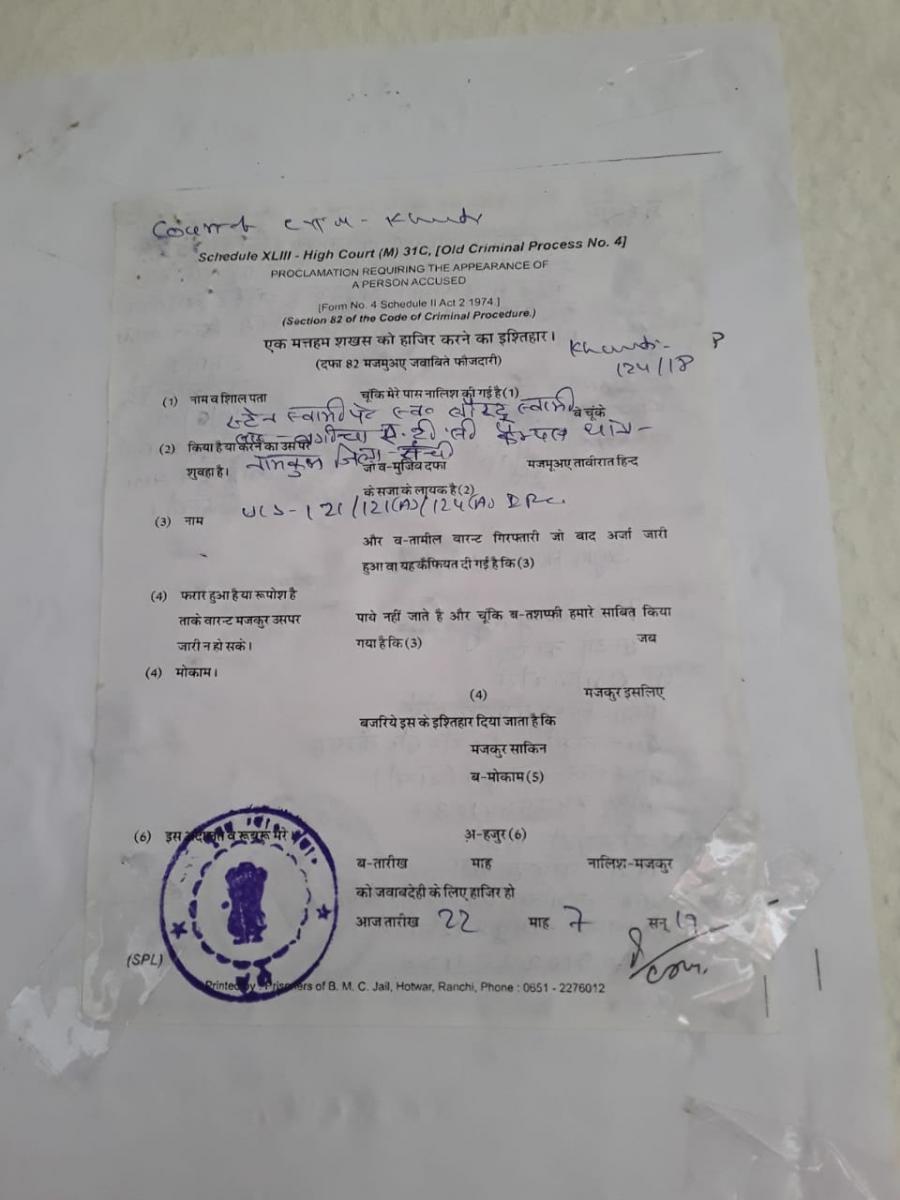
Summons issued under Section 82 CrPC dealing with ‘absconding’ persons
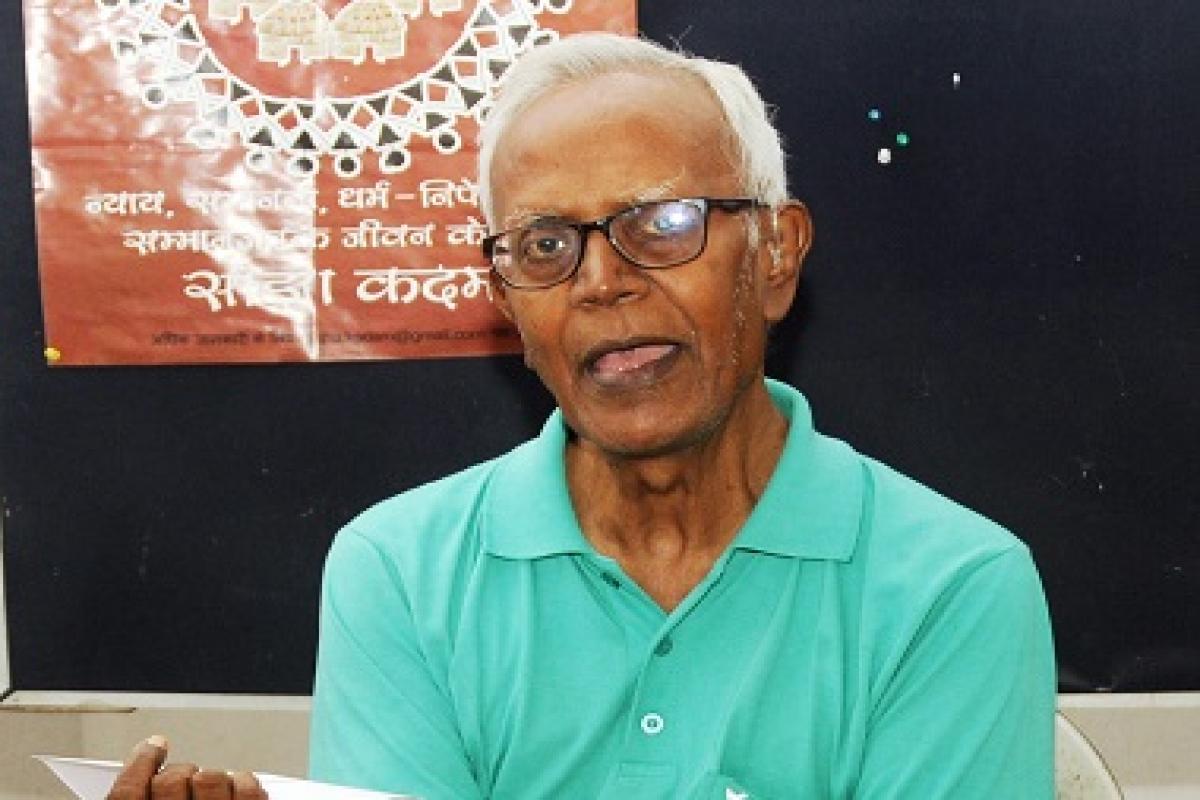
A notice for appearance under Section 82 of the Code of Criminal Procedure (CrPC) to the human rights defender and Jesuit priest from Jharkhand, Fr. Stan Swamy. Though the notice was issued –on the format under the Ranchi High Court’s schedule– on July 22, 2019, it has been served on Tuesday, September 24, 2019, more than two months after it was issued.
Section 82 of the CrPC is applied if any Court has reasons to believe that any person against whom a warrant has been issued by it has absconded or is concealing himself so that such warrant can’t be executed. In that case the Court issues summons/ written proclamations requiring them to appear at a specific place and a specified time not less than thirty days form the date of publishing of such summons.
In August, while hearing a petition filed Father Stan Swamy, the Ranchi High Court refused to grant him and others protection from arrest and scheduled the next hearing for August 7. Reportedly, the public prosecutor objected to the FIR being quashed on the basis that the Magistrate’s court has already issued a search and seizure order for the property of the defenders mentioned in the warrant, effectively classifying them as absconders.
An appeal against the High Court’s rejection of the petition for protection against arrest has been filed in the Supreme court. Just a few days ago, the SC has issued notices on the petition.
An FIR was filed against Father Stan Swamy, Aloka Kujur, Vinod Kumar, Rakesh Kumar Kiro and Babita Kashyap on June 19, 2019, a year after an FIR against 20 writers, intellectuals and activists was filed in Jharkhand on July 26, 2018 based on their Facebook posts.
All of them now face the imminent threat of arrests due to an arrest warrant issued by the Chief Judicial Magistrate Khunti District, Jharkhand on June 19, 2019.
Father Stan Swamy is a human rights defender who has long fought for Adivasis’ and Dalits’ rights. He founded the Visthapan Virodhi Janvikash Andolan, an all India platform to secure and protect the rights of Dalit and Adivasi peoples to their land. The platform supports people fighting against the forcible displacement of vulnerable communities against large corporates. Father has also worked for the rights of many Adivasi prisoners who languish in impoverished jails in Jharkhand without any crime or legal aid.
In July, 2018, the Jharkhand police slapped 26 sedition cases against as many as 20 senior activists allegedly for publishing social media posts critical of the Raghubar Das-led BJP government and apparently for “playing a prominent role in Pathalgadi movement.” These included activists Father Stan Swamy, former Congress MLA Theodore Kiro, and Aloka Kujur. They were also charged with allegations of creating communal tension, violating IT Act, and cause law and order problems. The activists, at that time had rejected these as the scare tactic of the government. One of them, Kiro had said, “Jharkhand is facing an undeclared emergency. Here, the state government is targeting all those who do support its policie..At the centre of our struggle is the conflict over land.”
Pathalgadi is an ancient tradition of Adivasis and forest dwelling communities. More recently, residents of many villages in Jharkhand erected traditional stone plaques with inscriptions of articles from Constitution, provisions of Panchayats (Extension to Scheduled Areas) Act, 1996 (PESA) and fifth schedule inscribed on them. This came to be known as Pathalgadi movement deriving from the words Pathal meaning rock and Gadhi meaning to dig or to erect or to build.
As per Adivasi rights activist, Dayamani Barla, “permanent camps of CRPF” came up in at least five villages of the Adivasis dominated district Khunti, in January 2019. Reportedly, the land was first obtained in the name of public services like community houses and when the villagers refused to give their land, it was acquired forcefully by picking up innocent villagers and Gram Sabha leaders and threatening them with false cases.
The Pathalgadi movement that resulted from the two-year long Adivasi agitations against the government’s proposal to introduce land acquisitions laws and state domicile eligibility, saw a wave of support from the villagers mainly Adivasis who declared the Gram Sabha as the sovereign authority. However, owing to the popularity of the movement among people, it faced severe repression from the Jharkhand state and police machinery, with as many as 150 named FIRs and thousands of unnamed FIRs.
Now the threat of arrest looms large on Father Stan Swamy who has been at the forefront of raising the issues of Adivasis falsely prosecuted and under incarceration.
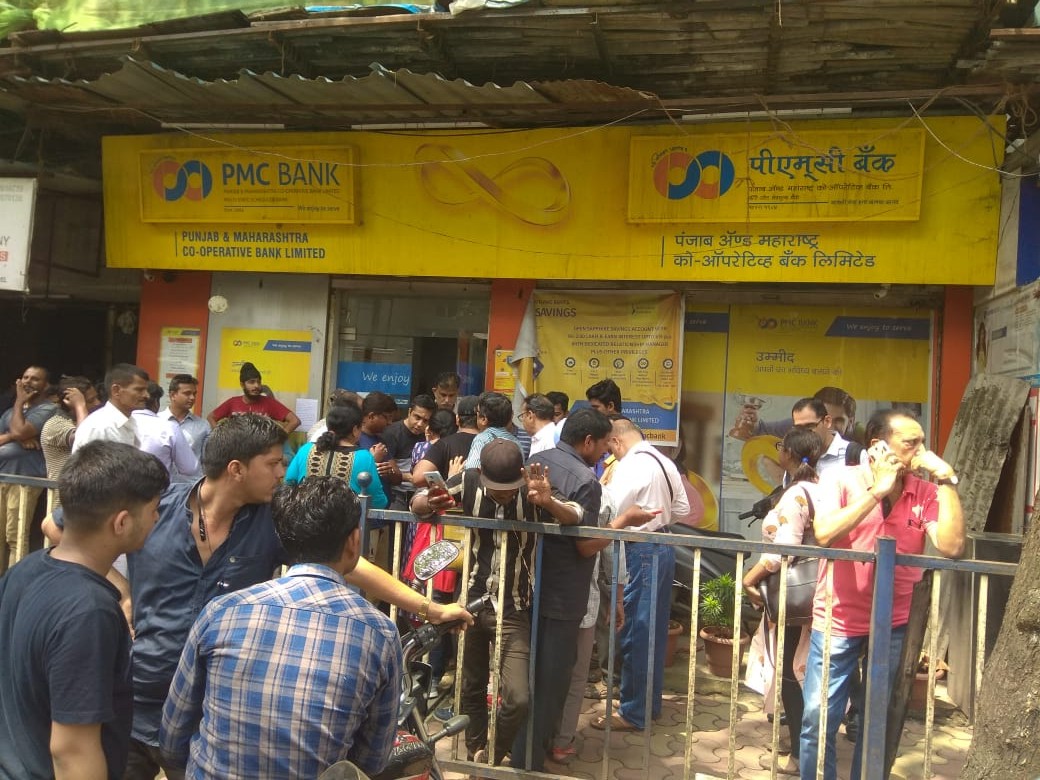
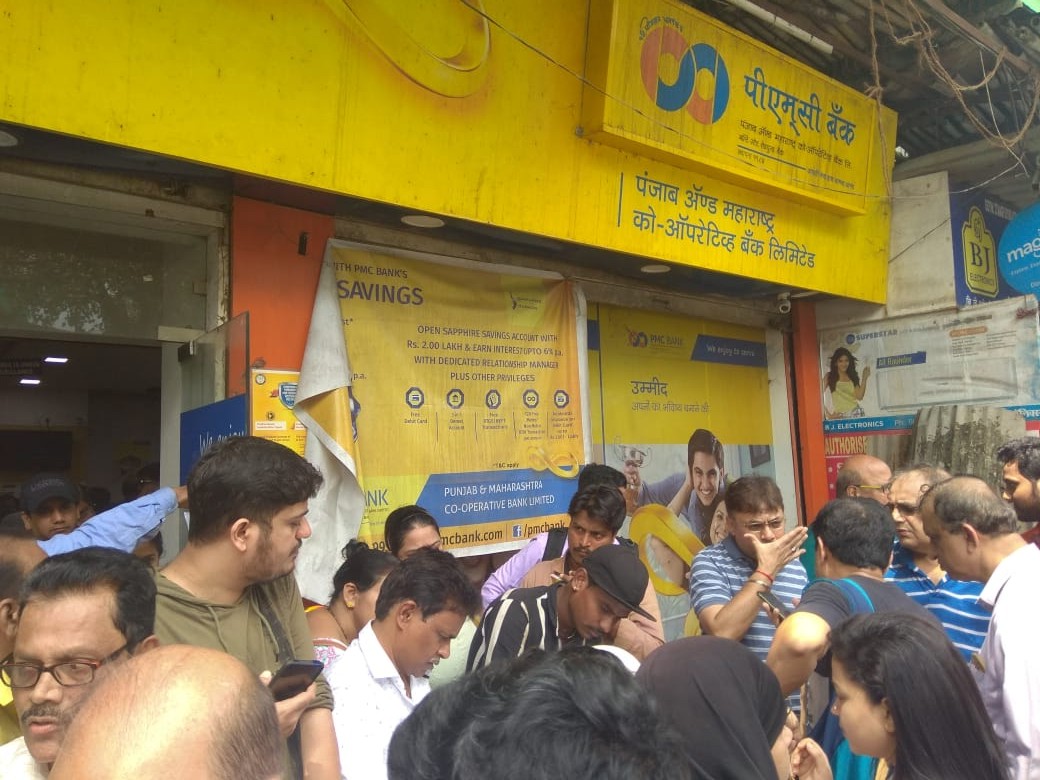
Irate and anxious customers swarmed offices of the Mumbai based PMC (Punjab and Maharashtra Co-Operative Bank Limited) bank branches as many depositors found out they could not withdraw their own money, leading to outbreak of complete chaos.
Sabrangindia has a video that may be viewed here.
A hapless citizen said, “PMC Bank stops functioning, people crying outside bank branches, Kandivali (Charkop) branch a business man’s cheque of 10 lakhs got credited today and bank shut operations!!! He fainted as he had to make payment today to his supplier, Very bad state”
The Reserve Bank of India has placed the bank under restrictions, suddenly disallowing the bank from conducting carrying out any kind of business transactions on Tuesday. This has sparked a state of panic among the banks depositors and sent shock waves in city trading community which uses this bank for their requirements.
Chief General Manager of the RBI, Yogesh Dayal said that as per the RBI directions, depositors cannot withdraw more than Rs 1,000 of the total balance in their savings/current/other deposit accounts. That this move has taken place without any prior notice raises serious questions over customer confidence.
The bank has been barred from granting, renewing and loans and advances, make any investments, accept fresh deposits, etc. without the prior written approval from RBI.
In a statement, the central bank has said that the issue of the directions shouldn’t be constructed as a “cancellation of a banking licence by the RBI”. And that it will continue to undertake banking business with restrictions until further notice/ instructions. Reportedly the RBI may consider these directions depending upon circumstances.
In response, the RBI said that it was exercising its powers vested in it under the Sub-section (1) of Section 35A of the Banking Regulation Act, 1949 read with Section 56 of the said Act. PMC Bank had deposits and advances aggregating ₹11,617 crore and ₹8,383 crore, respectively as at March-end 2019.
The Bank is a multi-state scheduled urban co-operative bank with its area of operation in the States of Maharashtra, Delhi, Karnataka, Goa, Gujarat, Andhra Pradesh and Madhya Pradesh. It has 137 branches.
Jinnah propounded his two-nation theory in 1939—exactly two years after Savarkar presented it.
Who could have been the best prime minister of independent India? Nehru or (Vallabhbhai) Patel?
For more than last five years, we have been a witness to this manufactured debate—courtesy Bharatiya Janata Party (BJP), which has tried all the tricks in its kitty to create a false binary between these leading stalwarts of independence movement, who called themselves ‘Gandhi’s sipahis’.
Anyway, thanks to the differences of perception within the saffron fraternity, a new competitor to Sardar Patel seems to have emerged from within the Hindutva Brigade who is being projected as someone who would have been a “better PM”.
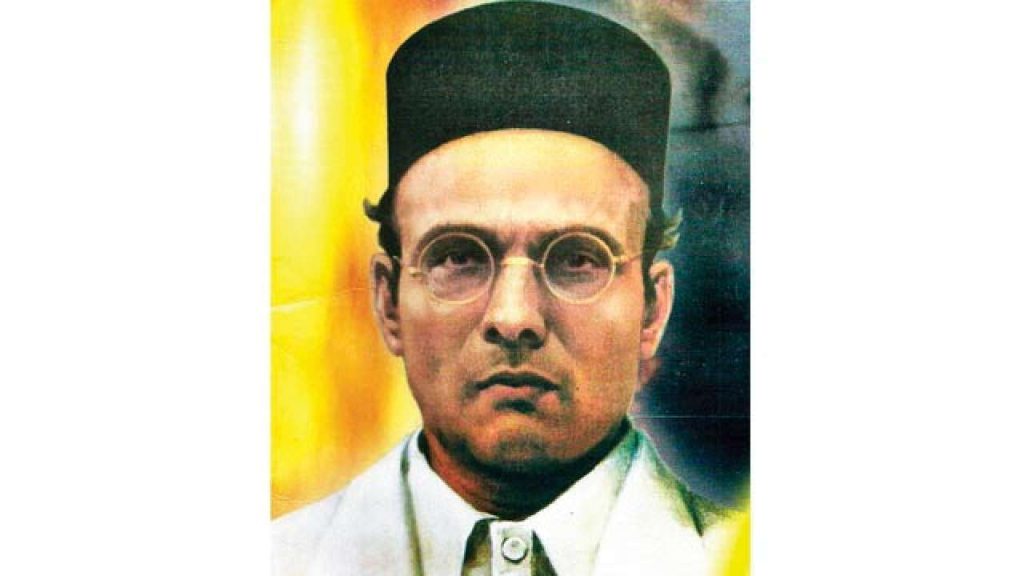
Uddhav Thackreay, chief of Shiv Sena and at present, a junior ally of the BJP in Maharashtra, recently made his choice clear by stating that if Veer Savarkar would have become the prime minister, “Pakistan would not have come into existence”. At a book release event, he even refused to call Nehru a Veer (courageous), making a rather provocative statement: ‘I would have called Nehru brave if he would have survived jail for 14 minutes against Savarkar who stayed in the prison for 14 long years.’
Definitely, the fact that Nehru spent more than nine years in different jails of the colonialists without ever compromising his basic principles—whereas, the 14 years spent by Savarkar were interspersed with mercy petitions sent by him to the British, wherein he had even expressed his readiness to ‘serve the government in any capacity they like’—did not bother him at all.
What is rather worrisome is that it was no mere expression of an alternate viewpoint. Thackeray even asked the gathering ‘to beat [Mani Shankar Aiyar] with shoes for showing disrespect to Savarkar’. Senior Congress leader Aiyar had openly said last year that it was Savarkar who himself had proposed the two-nation theory and had coined the term ‘Hindutva’. This had infuriated Uddhav Thackeray to no end. However, it is a fact that Savarkar, in his presidential address in Ahmedabad at the 19th session of the Hindu Mahasabha in 1937, had openly declared that India comprises of two nations. According to him,
“..[T]here are two antagonistic nations living side by side in India, several infantile politicians commit the serious mistake in supposing that India is already welded into a harmonious nation, or that it could be welded thus for the mere wish to do so.These our well-meaning but unthinking friends take their dreams for realities. That is why they are impatient of communal tangles and attribute them to communal organizations. But the solid fact is that the so-called communal questions are but a legacy handed down to us by centuries of cultural, religious and national antagonism between the Hindus and Moslems … India cannot be assumed today to be a unitarian and homogeneous nation, but on the contrary there are two nations in the main: the Hindus and the Moslems, in India..”
(V.D.Savarkar, Samagra Savarkar Wangmaya Hindu Rasthra Darshan (Collected works of V.D.Savarkar) Vol VI, Maharashtra Prantik Hindusabha, Poona, 1963, p 296)
A year later, he said: “The Hindus are the nation in India—in Hindusthan, and the Moslem minority a community’(Page 25, Savarkar and Hindutva, A G Noorani, Leftword, 2003). Remember Jinnah propounded his two-nation theory in 1939—exactly two years after Savarkar presented it. It was a reflection of the political ambience then that R C Majumdar, a historian with pro-Sangh parivar views, acknowledged that there was ‘one important factor which was responsible to a very large extent for the emergence of the idea of partition of India on communal lines. This was the Hindu Mahasabha.” (R C Mazumdar (General Editor), Struggle for Freedom, Bhartiya Vidya Bhavan, Mumbai, 1969, p. 611) It would be political naivety to think that this euologisation of Savarkar by the Shiv Sena supremo on the eve of elections was spontaneous. On the one hand, it was an attempt to raise an emotive issue to garner a few more votes and on the other hand, this projection of a Marathi icon was Shiv Sena’s oblique way of getting even with its ‘senior ally’ BJP, which has used name of Sardar Patel—a Gujarati—to further its anti-Nehru propaganda. This, in a way, also conveys discreetly that BJP’s “love” for Savarkar has been a very recent phenomenon.
It should be recalled that Savarkar’s plaque was removed from Port Blair’s cellular jail (in 2004) where Savarkar had served his jail term. Vikram Savarkar—Savarkar’s own nephew—in an interview to a national daily had exposed BJP’s lack of interest in his uncle and had castigated them for their sudden love for him. The report read: “It may be noted that he had accused the senior leaders of the BJP for ‘keeping mum despite noticing the removal of his uncle’s quotations from Port Blair’s Cellular Jail’. According to him, Ram Kapse, the then incumbent Lt. governor of Andaman and Nicobar and former M.P Ram Naik ( both BJP workers) ‘did not utter a word when the plaque was removed’.”
The report further says that he is not surprised at the BJP’s lack of interest in Savarkar. “We know very well that the BJP and RSS did not appreciate his (Savarkar’s) philosophy.” Vikram then claims that BJP’s sudden love for the legend is an eyewash. “It is an effort to woo voters for the Assembly elections in Maharashtra,” he is quoted as saying. (Savarkar nephew hits out at BJP, August 30, 2004, Indian Express) No doubt the debate around Savarkar’s ‘greatness’ cannot be reduced to the internecine squabbles within the Hindutva fraternity and there is an urgent need to unpack the whole issue for a wider interaction.
One can clearly see two phases in his life.
First phase which lasted till a few years after he was transported for life to Andamans, when he was all for Hindu-Muslim unity. However, in the second phase, he emphasised Hindu unity and propounded the theory of Hindu nation.
Born on May 28, 1883, to a Marathi Brahmin family, Savarkar was attracted towards anti-British movements and was even instrumental in establishing Abhinav Bharat Society (Young India)—drawing inspiration from Mazzini’s ‘Young Italy’ during school days. He went to England to study law where he got further involved in radical political activities. Inspired by the 1857 uprising against British and with the aim to communicate with the dormant masses he even a wrote a book in Marathi titled ‘The Indian War of Independence of 1857’, which talked in glowing terms about the Hindu-Muslim unity displayed during this war. Later, he was arrested for instigating radical/violent activities in London as well as for his connection to the similar activities back home in India and was sentenced to two life sentences and was sent to Cellular Jail in Andamans. It appears that the tough life in the jail—which was endured by other prisoners without any compromise—broke his spirit and he sent petitions to the British government for early release. After a long time, British government conceded to his request and sent him home, put restrictions on him and asked him to not to participate in political activities. He was finally released when there were provincial elections in India and Congress party-led government came to power in the then Mumbai province.
Coming back to the present debate about whether there is any merit in Thackeray’s claim that India would have remained united if Savarkar would have become PM. Question immediately arises whether Savarkar was really for united India. Definitely not. This original proponent of the two-nation theory had this to say at a media conference in August 1943 which was quoted by Congress on its official Twitter handle shedding its normal ambivalence about Savarkar:
“For the last 30 years we have been accustomed to the ideology of geographical unity of India and the Congress has been the strongest advocate of that unity but suddenly the Muslim minority, which has been asking one concession after another, has, after the Communal Award, come forward with the claim that it is a separate nation. I have no quarrel with Mr Jinnah’s two-nation theory. We, Hindus, are a nation by ourselves and it is a historical fact that Hindus and Muslims are two nations.”
Thus, Uddhav’s hypothesis is itself superfluous/meaningless. It is like saying that Jinnah could have led a united India after independence. But what was Savarkar’s own situation in early 1940s when anti-imperialist forces led by Congress and other radical sections of society were waging a ‘do or die’ struggle against the British? It is now history how the formations espousing the cause of Hindutva adopted a compromising attitude. It is worth noting that while the RSS preferred to keep itself aloof from the ‘Quit India Movement’ and concentrated on its divisive agenda, Savarkar, the pioneer theoretician of the project of Hindu Rashtra went one step further. He toured India asking the Hindu youth to join the military with a call ‘Militarise the Hindus, Hinduise the nation’—thus strengthening efforts of the British to suppress the rising tide of the people’s movement.
When Congress party asked the state governments led by it in different provinces to resign, Hindu Mahasabha under Savarkar’s leadership had no qualms in running coalition governments in Sind and Bengal sharing power with Muslim League and justifying this compromise.
“..in practical politics also the Mahasabha knows that we must advance through reasonable compromises.” (V.D.Savarkar, Samagra Savarkar Wangmaya Hindu Rasthra Darshan ( Collected works of V.D.Savarkar) Vol VI, Maharashtra Prantik Hindusabha, Poona, 1963, p 479-480 What is interesting to note is that despite the fact that Hindu Mahasabha was sharing power with Muslim League and a few other parties to run provincial governments in Bengal and Northwest province, and despite the services offered to the British empire, he was a ‘spent force’ for the British. A G Noorani, constitutional expert and political commentator, in his book ‘Savarkar and Hindutva’ (Page 92, Left Word, 2002), shares details of the minutes of the then Head of the Political Department in the India Office named John Percival Gibson. According to him, he minuted on August 1, 1944 that ‘he did not consider it necessary to acknowledge’ a cable Savarkar had sent to the Secretary of State for India, Leopald S Amery on July 26, 1944. It had claimed that the Mahasabha was ‘the only all-India representative body of Hindus’. Noorani notes that Savarkar adopted the same tactics normally adopted by fading politicians to remain in the news, which comprised not only issuing regular statements to the press, but to see to it that they are more and more rabid.
Definitely, the present Shiv Sena supremo would not be even aware of the fact that Savarkar had no qualms in hurriedly applauding Aiyar, the Dewan of Travancore, when he had exhibited the audacity of declaring the state independent. Qutoed in Frontline, A.G.Noorani says: Sir C.P.Ramaswamy Aiyar, the Dewan of Travancore, had declared the state independent of India! The perfidy did not stop there. He gallantly and speedily appointed an ambassador from Travancore to Jinnah’s Pakistan, thus affirming once more his credentials as an inveterate enemy of India free and whole.And, for this treason, who lustily applauded Aiyar in all of India? Who else but “Veer” Savarkar?
And last but not the least, this iconisation of Savarkar by the Shiv Sena appears at variance with the own track record of the first government led by Shiv Sena-BJP in mid nineties, (with Shiv Sena as the senior partner) when Uddhav’s father Bal Thackreay used to boast that he has the remote control of the government with him. Uddhav will have to explain why never once they (neither Shiv Sena nor BJP) thought of putting Savarkar’s portrait in the state assembly.
Why were they careful enough to keep themselves aloof from Savarkar’s now ‘cherished legacy’?
Subhash Gatade is the author of Pahad Se Uncha Aadmi (2010) Godse’s Children: Hindutva Terror in India,(2011) and The Saffron Condition: The Politics of Repression and Exclusion in Neoliberal India(2011). He is also the Convener of New Socialist Initiative (NSI) Email : subhash.gatade@gmail.com
New York: At the United Nations (UN) emergency climate summit, 16 children, including India’s Ridhima Pandey, said they would petition the UN against five big carbon polluters in the world–Argentina, Brazil, France, Germany and Turkey–for violating their rights as children by failing to adequately reduce emissions.
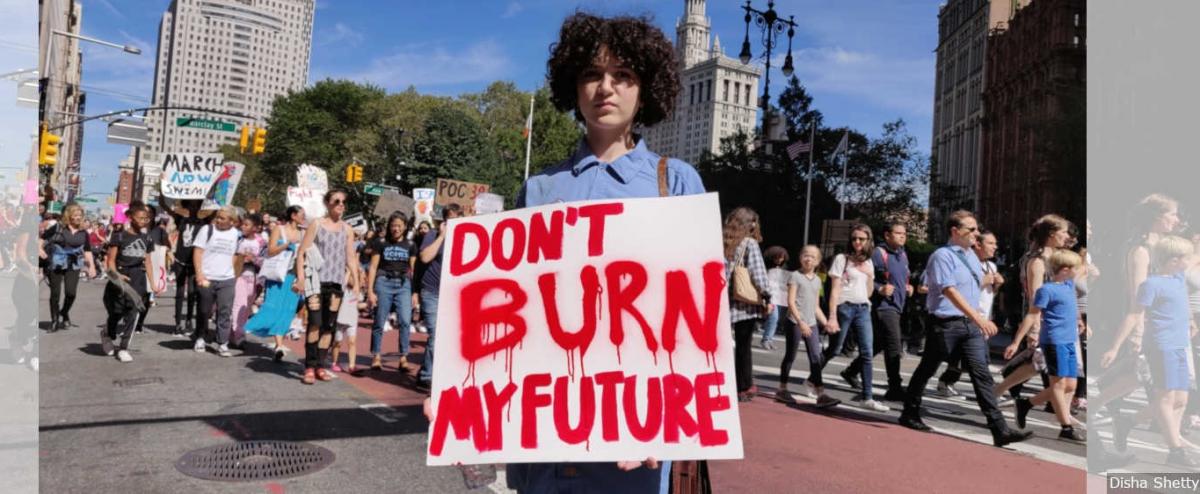
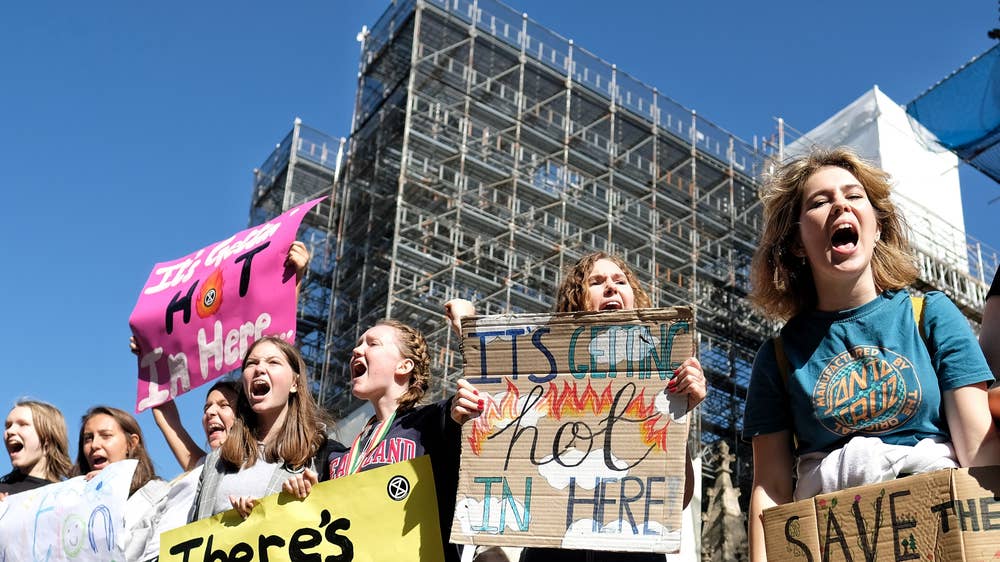
On September 20, over a million students skipped school in New York to demand climate action. The youth have emerged as a key voice urging climate action.
Pandey, 11, is from Haridwar in Uttarakhand, and had, in 2017, filed a case against the Indian government at the National Green Tribunal for failing to take action against climate change.
As countries reiterated old promises to control climate change, the youth, led by 16-year-old Swedish climate activist Greta Thunberg, emerged as climate leaders. “I should be back in school on the other side of the ocean. Yet you come to us young people for hope. How dare you?” said Thunberg.
Every country, except the United States, has ratified the UN Convention on the Rights of the Child. Of those countries, 45 have agreed to an additional protocol that allows children to petition the UN directly about treaty violations.
Within that group of 45, Argentina, Brazil, France, Germany, and Turkey are some of the biggest emitters of the pollution that causes climate change. None of the five is on a path needed to keep the planet from heating over 1.5 or 2 degrees Celsius by the turn of the century.
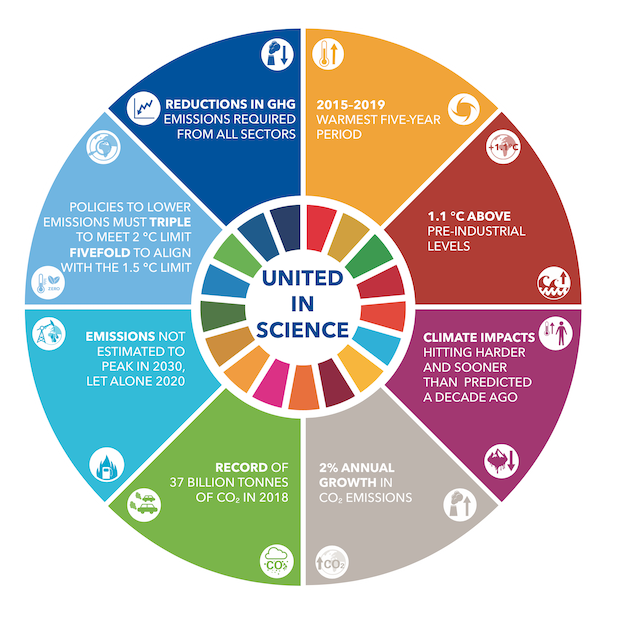
The petition by children comes on the heels of the latest report by the World Meteorological Organization (WMO) that said global temperature has risen by 1.1 degrees Celsius since systematic record-keeping began in 1850, and by 0.2 degrees Celsius compared to 2011-2015.
“Climate change causes and impacts are increasing rather than slowing down,” said Petteri Taalas, secretary general of the WMO.
Antonio Gueterres, the UN secretary general, has praised Thunberg for her leadership, calling it “absolutely remarkable”. The UN credits the pressure from the youth for pushing climate action across countries.
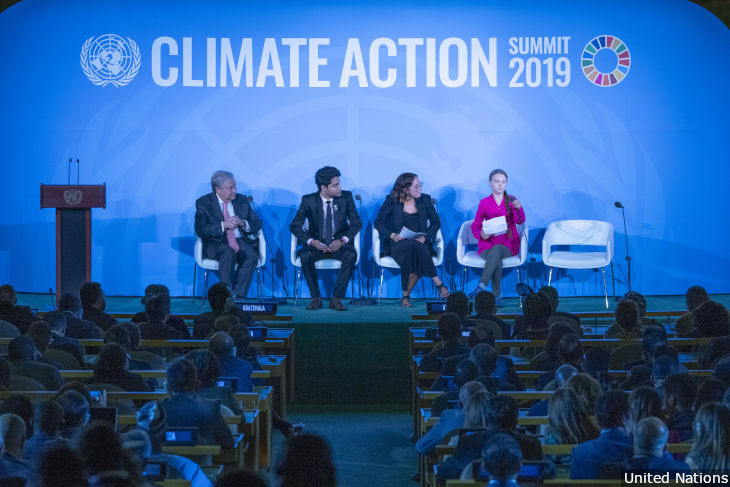
“I should be back in school on the other side of the ocean. Yet you come to us young people for hope. How dare you?” said 16-year-old Swedish climate activist Greta Thunberg at the United Nations Climate Action Summit 2019 in New York.
Closer home, 600 million people living in the Indo-Gangetic plain stand to be affected, as global warming causes Himalayan glaciers to melt, threatening the steady flow of water to the Ganga and its tributaries, according to World Bank estimates.
Nearly 148 million Indians live in areas that are “severe hotspots” of climate change and are already witnessing large-scale changes, as a special IndiaSpendreporting project has chronicled. Climate change has led to a rise in extreme events like floods and heatwaves. It threatens India’s water security and could widen inequality.
Yet, at the summit, India only reiterated commitments already made several years ago.
India’s plan
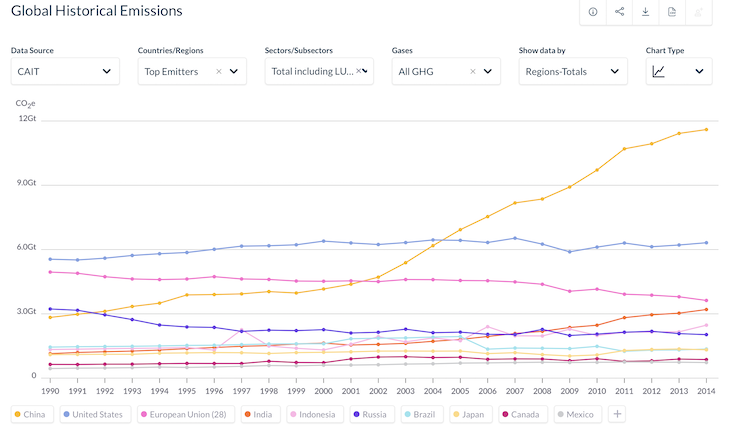
Despite efforts, CO2 (carbon dioxide) emissions continue to rise at a 2% growth rate. Currently China is the highest emitter of earth warming greenhouse gases (GHGs), followed by the United States (US), the European Union (EU) and India.
Prime Minister Narendra Modi was one of more than 90 speakers at the climate summit. India will scale up renewable energy to 175 gigawatt (GW) by 2022 and to 450 GW in the coming years, he said, without giving a specific deadline. He also said that India was focussing on increasing the use of bio-fuels and was successful in providing 150 million families with clean cooking gas. He reaffirmed India’s commitment against single-use plastic but said nothing about reducing the use of coal, which has been flagged as a concern in fast-growing India and China.
India is one of the few countries on track to meet the targets it set itself at the 2015 Paris summit and justifies the platform the UN has given for it to speak at the climate summit, said Leena Srivastava, outgoing vice-chancellor of Delhi-based The Energy and Resources Institute (TERI) School of Advanced Studies, and co-chair of the Science Advisory Group of the UN Climate Summit. “If you look at the totality of it and not just one part of it then I think we deserve to be on the platform.”
Countries need to do more
China is the highest GHG emitter followed by the United States, European Union and India. Source: CAIT Climate Data Explorer. 2017. Country Greenhouse Gas Emissions. Washington, DC: World Resources Institute
“Science tells us that on our current path, we face at least 3 degrees Celsius of global heating by the end of the century,” said UN Secretary-General Guterres. He had set an ambitious target for those in attendance: reduce carbon emissions by 45% by 2030 and make it net-zero by 2050.
Policies to lower GHG emissions must triple to meet the 2 degrees Celsius target and increase fivefold to meet the 1.5 degrees Celsius target set by the UN, found the latest WMO report released on September 22 in New York.
“We are at risk of crossing several critical tipping points in the country systems,” said Srivastava of TERI. “There is also in the science community a greater recognition of the fact that climate change impacts are hitting harder and sooner than what climate assessments had estimated nearly a decade ago and that is something we need to worry about.”
So far 66 countries have said they will step up their Nationally Determined Targets or NDCs–targets to reduce carbon emissions that each country sets for itself under the 2015 Paris Agreement.
The UN had said that only countries with strong plans would be allowed to speak at the New York emergency climate summit, but most countries, including India, as we explained above, only reiterated old promises.
“While countries were expected to come to the summit to announce that they would enhance their climate ambition, most of the major economies fell woefully short. Their lack of ambition stands in sharp contrast with the growing demand for action around the world,” said Andrew Steer, President & CEO, World Resources Institute (WRI), a global research organisation.
Pakistan’s Prime Minister Imran Khan repeated his earlier promise of planting 6 billion new trees.
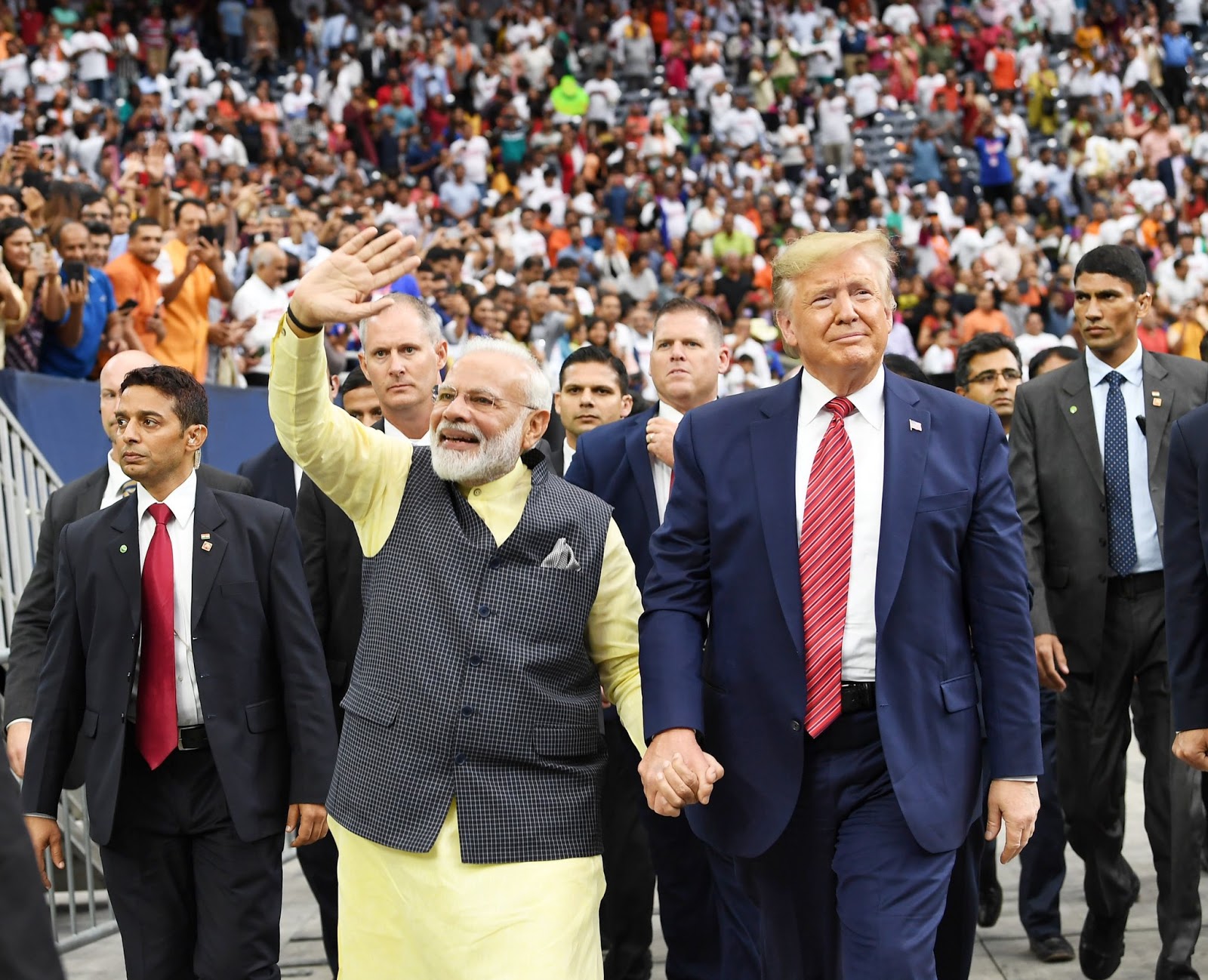
The US President, Donald Trump, who was invited but had said he would skip the climate summit and send a delegation instead, made a brief appearance as PM Modi took to the stage. The US, one of the largest greenhouse emitters, has pulled out of the Paris Agreement.
New Zealand Prime Minister Jacinda Ardern spoke of her country’s prior commitment to plant a billion trees by 2028. She reiterated that New Zealand has also stopped issuing permits for offshore oil and gas exploration and aims for 100% renewable electricity generation by 2023. German Chancellor Angela Merkel said her country would phase out coal by 2038, an announcement she had made earlier this year.
Businesses pledge
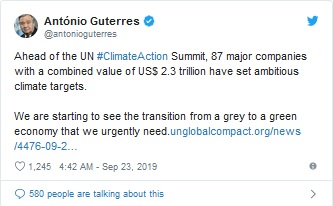
Recognising the need to rope in corporations, the UN has made an effort to encourage them to set ambitious targets. Eighty seven major corporations–with a combined market capitalisation of over $2.3 trillion and annual direct emissions equivalent to 73 coal-fired power plants–are taking action to align their businesses with the Paris climate summit targets.
Banks financing development projects and CEOs of companies said they would stop investing in coal. “Coal is out of the window for funding,” said Peter Hiliges, head, climate change at the German bank KfW that funds development projects. Oliver Bäte, the CEO of Allianz, an insurance company, reiterated their stand of not selling insurance to companies investing in coal.
In a recorded message, Pope Francis called the post-industrial era the most “irresponsible” and questioned the political will to mitigate the impact of climate change.
No fossil fuel subsidies
The world temperature has increased by 1.1 degrees Celsius since systematic record keeping began in 1850, and by 0.2 degrees Celsius compared to 2011-2015. Source: United in Science report, WMO, September 2019.
Without climate action, human emissions are expected to peak well beyond 2030, according to the latest WMOreport.
The UN has asked governments to end all subsidies to fossil fuel companies by 2020, and incentivise renewables. “After all, is it common sense to give trillions in hard-earned taxpayers’ money to the fossil fuel industry to boost hurricanes, spread tropical diseases, and heighten conflict?” Gueterres asked at the climate summit.
“Fossil fuel companies must pay to clean up the mess they have made. Rich country governments must stop giving handouts to those companies. Instead, they need to support communities on the frontline of the climate emergency rather than those who created the crisis in the first place,” said Harjeet Singh, global lead on climate change at ActionAid, a South Africa based nonprofit.
The UN has also called for no new coal plants from 2020, asking countries to turn to renewable energy instead. India currently gets over 76% of its energy needs from coal, as IndiaSpend reported earlier. Only one-twentieth of its energy comes from renewables, although it is a fast-growing segment. PM Modi was silent on coal during his UN address.
India and China continue to open new coal plants despite the 2020 deadline set by the UN, as these countries have to balance the energy needs of the underserved population while meeting climate targets.
“Yes, there are plans to build coal-fired power plants but we are doing very well in terms of renewable energy expansion,” said Srivastava of TERI on India.
In its interim order, the Supreme Court bench has ordered a review meeting of four chief ministers of Gujarat, Madhya Pradesh, Maharashtra and Rajasthan, and the Union water resources minister, in order to seek a solution to the contentious issue of filling up the Sardar Sarovar dam up to the full reservoir level (FRL), 138.68 metres, which has submerged tens of villages in the Narmada Valley in Madhya Pradesh.
The interim order said that the review, which must include issues related with the rehabilitation of dam-affected people, should be carried out in accordance with the Narmada Water Disputes Tribunal (NWDT) award, which has the provision to set up a committee of chief ministers of the lateral states, with Union water resources minister as chairman. The committee has the power to look into any dispute that may arise on water sharing, rehabilitation of the oustees, and other related issues.
The next hearing of the petition filed by dam oustees, supported by the anti-dam organisation Narmada Bachao Andolan (NBA), has been fixed for September 26, in which three state governments — Gujarat, Madhya Pradesh and Maharashtra — and the Government of India have been asked to remain present and put up their case.
The interim order was passed by a bench consisting of Justices NV Ramana and Ajay Rastogi. Senior advocate Sanjay Parikh appeared in the court on behalf of the oustees.
Commenting on Prime Minister Narendra Modi’s big show in the town, “Houston Chronicle” (HC), even as calling Modi visit “historic for a foreign leader”, as it “strengthens bonds between the world’s two largest democracies”, has warned that “Texas’ hospitality should not be confused with an endorsement of India’s recent actions in Kashmir nor of Modi’s troubling brand of Hindu nationalism.
In an editorial, “Howdy, Modi! Now, about Kashmir…”, HC says while “Modi could not have chosen a better place than Houston”, seeing India’s economic interests behind the big show in the NRG Stadium where more than 50,000 had gathered to welcome him.
It says, “Our region boasts a vibrant Indian-American population that enriches us culturally and economically”, with Houston proposing to be a “major player” as sanctions on Iran “spur India’s need to look elsewhere for oil and gas”, adding, “The country has already committed to billions of dollars in new imports, and Modi was scheduled to meet with major energy company executives while in town. Several deals are in the works.”
However, the editorial underlines, “But neither increasing business ties with India nor their economic benefits should lead us to turn a blind eye to concerns among human rights groups over increasing hate speech, alienation and violence targeting religious minorities, including Muslims and Christians, and Modi’s empowerment of Hindu hard-liners.”
Especially referring to Kashmir, the editorial states, “The ongoing problem in Kashmir is of particular concern. In August, Modi revoked the constitutional autonomy granted in 1949 to Jammu and Kashmir, with security forces taking control of the region, detaining thousands and instituting an ongoing communications blackout.”
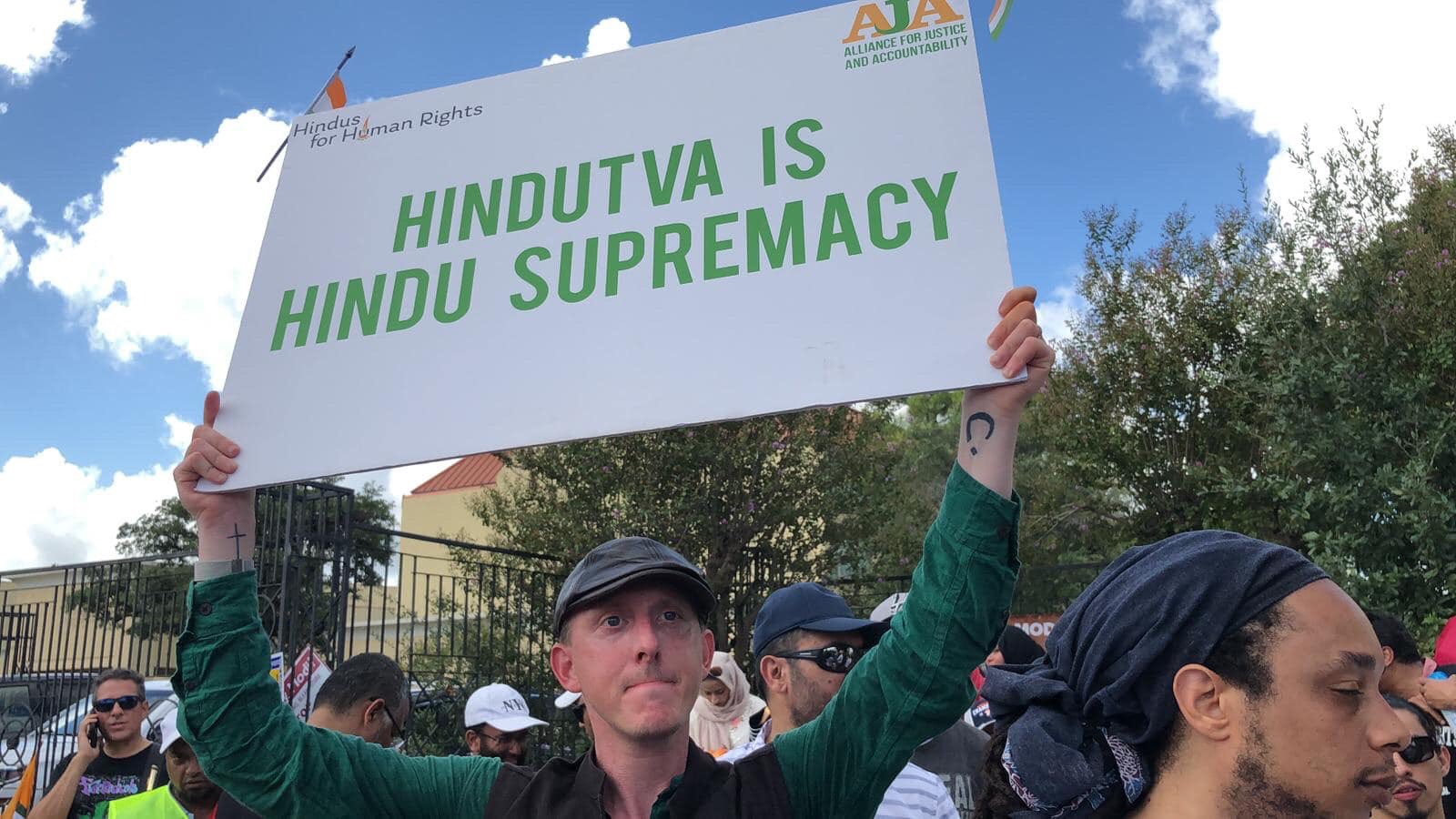
An anti-Modi rally in Houston
It adds, “Indian officials defend the move as a way to curb terrorism and bring the region in line with more progressive social and economic federal policies, but the crackdown on the Muslim-majority area follows other accusations of targeting religious minorities.
The editorial quotes Nidhi Trehan, a visiting scholar at the University of Texas’ Lyndon B. Johnson School of Public Affairs as stating, “There has been an erosion of constitutional norms under Modi.There’s been an attack on minorities, hate crimes have increased, and Rohingya asylum-seekers have been mistreated.” It adds, “These accusations may sound familiar; in some circles, Trump is known as the ‘American Modi’.”
The editorial says, “This hasn’t stopped a bipartisan call — including by Trump ally Senator Lindsey Graham — for the president to press Modi on Kashmir. In a letter to the White House earlier this month, a group of senators asked that India fully restore telecommunications and internet services, lift the lockdown and curfew completely and release detained Kashmiris.”
It urges Trump “to take this high-profile moment, with the eyes of the world on Houston, to demand nothing less”, as India is and will “continue to be an important partner for America”.
The editorial concludes: “Friends also tell each other the truth. And the truth is it’s time for Modi to clearly signal — through action, not words — his respect for human rights. That starts with ending the crisis in Kashmir.”