Mumbai: On August 5, 2019, when the lower house of parliament abrogated Jammu and Kashmir’s special constitutional provision, it also passed–with almost no debate–the Transgender Persons (Protection of Rights) Bill, 2019.

The bill, as passed–after some revisions since it was first placed before parliament in 2016–is meant to prohibit discrimination and make transgender life more secure, but transgender representatives and activists call it “regressive”. They have termed the day it was approved by the Lok Sabha as “Gender Justice Murder Day”.
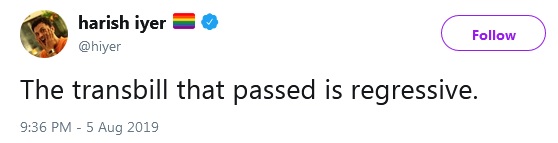
“The transgender bill is regressive and half-hearted,” Harish Iyer, gender-rights activist, told IndiaSpend.
Here are activists’ main contentions:
- Instead of the freedom to determine their sexuality, India’s transgender people must now submit to a certification process involving a government official and doctor.
- If transgender people are sexually attacked, their attackers face a maximum jail term of two years–against a minimum of seven years for women who are attacked.
- If young trans persons want to leave home because of pressure to conform to the sex they were born with, they can no longer join the trans community. They must go instead to a court, which will send them to a “rehabilitation centre”.
A trans person may require a certificate of identity to access a variety of social-welfare programmes that exist or might be offered, including those relating to food, healthcare, educational opportunities, insurance.
The 17th Lok Sabha, the lower house of parliament, whose monsoon session ended on August 6, 2019, passed a record 35 bills, working 281 hours over 37 days. On average, a bill was passed every eight hours, but none was referred to a committee, with critics saying many approved bills had infirmities and required further debate. This story is the first in a series that will examine some of the most significant of these 35 bills.
The religious foundation for transgender rights
The Hindu concept of ‘ardhanarishwara’–an androgynous deity that comprises the merged forms of Shiva the destroyer and his female consort–forms the religious foundation for the acceptance of transgender people in India. But this pious underpinning of the lives of transgenders has subsumed their demands to be regarded as full citizens of a modern democracy, transgender representatives allege.
“When we appeared before a parliamentary committee, the level of ignorance was too much,” Grace Banu, a transgender-rights activist from Chennai, told IndiaSpend.
“One asked me if I had a penis,” said Banu, who was born male but now identifies and dresses as a woman. “As for the BJP [Bharatiya Janata Party] MPs [members of parliament], they only kept talking about us as ardhanarishwara.”
The first bill on transgender rights introduced by the Dravida Munnetra Kazhagam’s Tiruchi Siva in the Rajya Sabha in 2014, was “an ideal bill” in conformity with the National Legal Services Authority (NALSA) judgement of the Supreme Court that year, said Ashok Row Kavi, founder and chairperson, Humsafar Trust, an advocacy. The bill was a private member’s bill, accepted and passed in the upper house in April 2015.
When the transgender bill was next introduced by the government in the Lok Sabha on August 2, 2016, as the Transgender Persons (Protection of Rights) Bill, 2016, it was opposed on many counts, including the proposal for “screening committees” to decide who was a transgender and who was not, and the criminalisation of begging, a mainstay for a majority of transgender Indians.
“To the credit of the government, they took a lot of our inputs and redefined the initial draft of the bill which was extremely regressive,” Iyer said. “Earlier they defined trans people as ‘not wholly male nor wholly female’. Now they removed that and inserted the right definition of transgender.”
Although the screening committee has been removed, trans persons still need a certificate from a government doctor and the district magistrate.
“The pivotal point is you have to go to a committee or a doctor to get registered as a trans person,” said Iyer. “A trans person could be put through so many hardships, the kind of questions that would be asked–related to genital organs–which would not be asked of you and me.”
The bill must be cleared by the Rajya Sabha, parliament’s upper house, and the president of India, to become law.
Transgender representatives said they proposed about 100 amendments, but the bill that was first passed on December 17, 2018, had 27 amendments. It lapsed with the dissolution of the house before general elections in 2019. Those 27 amendments stayed in the latest version, which transgender organisations say annuls the progress enshrined in a five-year-old Supreme Court order.
The landmark Supreme Court judgement
The Supreme Court in 2014 recognised transgender persons as a ‘third gender’, affirming their fundamental rights under the Constitution.
The judgment in a case between the government of India and the National Legal Services Authority (NALSA)–known popularly as the NALSA case–gave transgender people the right to “self-identification” as male, female or third-gender and granted reservations in educational institutions as well as public employment.
The new transgender bill prohibits discrimination by “denial” of “services”, such as education, employment and healthcare, but omits mention of affirmative action in jobs.
The bill defines a transgender as “a person whose gender does not match with the gender assigned to that person at birth and includes trans-man or trans-woman (whether or not such person has undergone Sex Reassignment Surgery or hormone therapy or laser therapy or such other therapy), person with intersex variations, genderqueer and person having such socio-cultural identities as kinner, hijra, aravani and jogta [terms used in Indian languages for transgender people]”.
The marginalised status of transgender people was recognised by Justice K S Radhakrishnan, who said in the NALSA case: “Our society often ridicules and abuses the transgender community and in public places like railway stations, bus stands, schools, workplaces, malls, theatres, hospitals, they are sidelined and treated as untouchables, forgetting the fact that the moral failure lies in the society’s unwillingness to contain or embrace different gender identities and expressions, a mindset which we have to change.”
Recognition rescinded
The 2019 bill mentions self-identification by transgender people, as made possible by the NALSA judgement, but a district magistrate and a government doctor must determine if they medically qualify.
For a community that is discriminated against, these can be insurmountable hurdles, transgender representatives say.
“There is something wrong with the whole systemic approach towards the transgender community, which this bill is supposed to correct,” Kavi said. “The whole process needs to be drawn into the public health and the beneficiary system, which is missing.”
The first and second drafts were “totally regressive,” Kavi said. “It is not a perfect bill and needs far too many amendments and modifications,” he said.
The identification process
The bill says transgender persons must file an “application for certificate of identity” with the district magistrate (DM), who will then issue a “certificate of indentity.”
This certificate “shall confer rights and be a proof of recognition” of a transgender person’s “identity”.
After the certificate is issued, “if a transgender undergoes surgery to change (the) gender either as a male or female,” that person will have to make an application to the district magistrate for a “revised certificate”, the bill states.
The DM will, on the basis of “the application along with the certificate issued by the medical superintendent or chief medical officer, and on being satisfied with the correctness of such certificate, issue a certificate indicating (the) change in gender,” according to the bill.
“So the screening committee still exists but [the new bill] does not mention the word,” said Banu, the transgender representative.
Another lacuna is the “total absence and invisibilisation of trans men” [female to male transgender]”, said Kavi. “All the problems dealt with are those involving [those who go from] male to female.”
Trans men are born as women who want to become men, and sex-reassignment surgery is more difficult, said Kavi. It requires removal of the breast, Adam’s apple and a series of other operations. “But there is no mention at all about the facilities or help they should get,” he said.
Reservations and children
The new bill does not, according to activists, go into issues of livelihood, beginning from school.
While the new bill requires the government to “formulate welfare schemes and programmes to support livelihood” including “vocational training and self-employment” for transgenders, it ignores a key demand–public-sector job reservations, such as those for differently-abled people.
“The Supreme Court judgement said trans people are considered socially and economically backward,” said Banu. “In India, trans people are considered OBC [other backward castes], and, especially in Tamil Nadu, the MBC [most backward class] category. I am a Dalit, an Adivasi, a Muslim trans, how do I accept this OBC or MBC category reservation? It’s complete injustice.”
The issues with the bill begin from its failure to recognise the early stage of transgender life.
“The bullying of transgender or LGBT students in school is an issue which the govt is not addressing,” said Kavi. Bullying of trans persons, he said, is a systemic social problem in India, especially among children. Trans children are “significant in number though they are a minority”, and many are in school and not itinerant, as policymakers mistakenly think, he said.
Another contentious issue is the departure of transgender people from families that do not accept their non-binary or fluid sexuality.
“No child shall be separated from parents or immediate family on the ground of being a transgender, except on an order of a competent court,” says the bill. “If any parent or family member is “unable to take care of a transgender, the competent court shall by an order direct such person to be placed in rehabilitation centre.”
This also means that young people would no longer be able to decide if they want to join the trans community; a court would decide if they have to go back to their families or a rehabilitation centre. “In India, a lot of trans people have committed suicide, most are within 25 years of age,” said Banu.
The trans bill has also been criticised for a lack of attention to discrimination. Iyer cited the example of the Protection of Children from Sexual Offences (POSCO) Act, 2012, which, for instance, explains how a police station should welcome children. “This bill lacks all of that, it does not show any plan of action and is half-hearted,” said Iyer.
(Mallapur is a senior analyst with IndiaSpend.)
Courtesy: India Spend