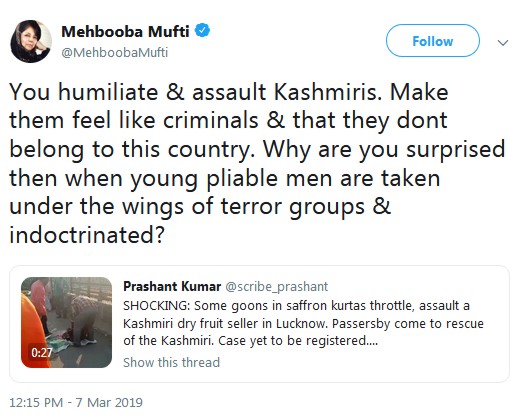
Lucknow, March 7 (IANS) All four accused of thrashing three Kashmiri dry fruit sellers here after calling them “stone-pelters” on Wednesday have been arrested, police said on Thursday.
Briefing the media about “the unfortunate incident”, Director General of Police (Law & Order) Anand Kumar and Additional Director General of Police (Lucknow) Rajeev Krishna, said they had arrested the accused, who were identified as Bajrang Sonkar, Amar, Himanshu and Anirrudh. Sonkar, who was arrested earlier, is affiliated to the Vishwa Hindu Dal (VHD) and has a dozen criminal cases registered against him including one of murder, Senior Superintendent of Police Kalanidhi Naithani said.
The attackers were initially booked under the Indian Penal Code, but non-bailable offences have also been included now, he added. The officials also said that the victims have been assured of security to carry out their business and have been provided medical care and compensation for the losses they incurred.
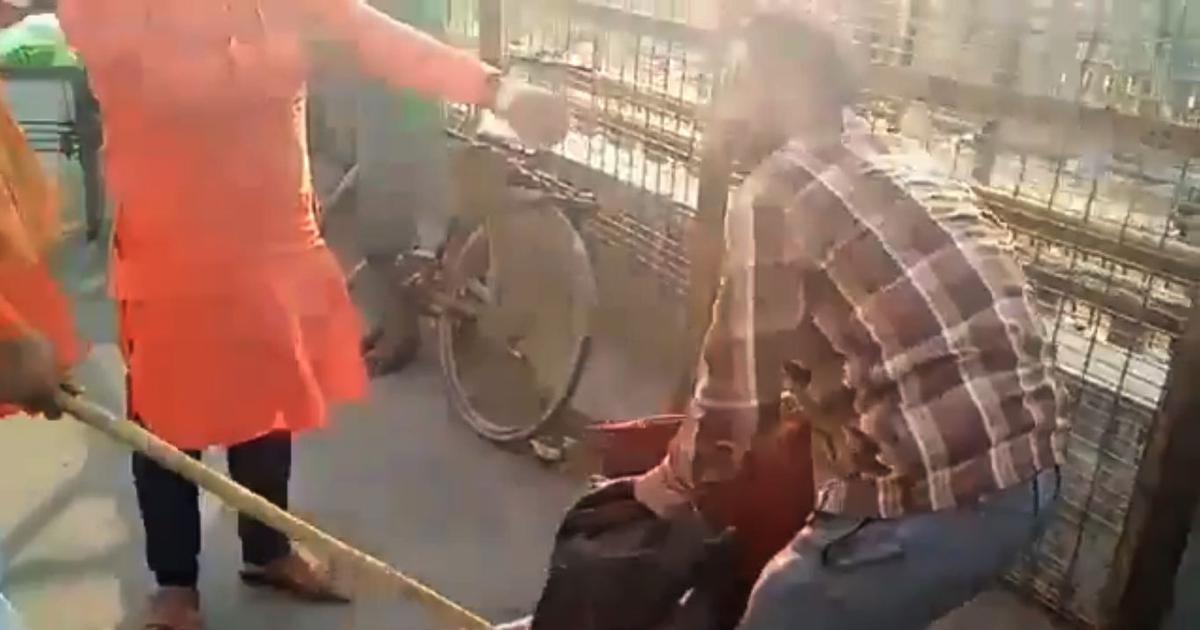
The attack took place on Wednesday when a group of saffron-robed youths came out of a car and pounced on the Kashmiri men who were selling dry fruits on the Daliganj Bridge. The vendors were beaten up mercilessly, witnesses said, and their wares were thrown around. The attackers called the victims “stone-pelters” and asked them to produce their Aadhaar cards. The Kashmiris obliged but the attackers continued to beat them.
No one came to the rescue of the victims. It was only after someone called the police that the Kashmiris were saved.
Two of the injured vendors went away before police arrived there but a third, identified as Afzal, was taken to the local police station. Afzal was questioned for over an hour before an acquaintance vouched for him.
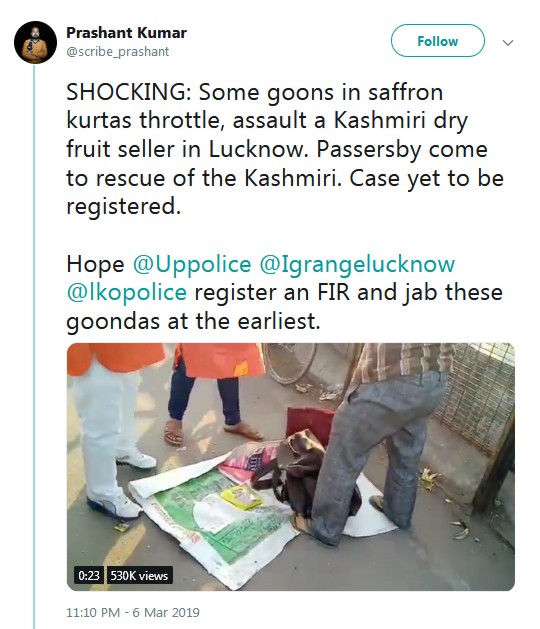
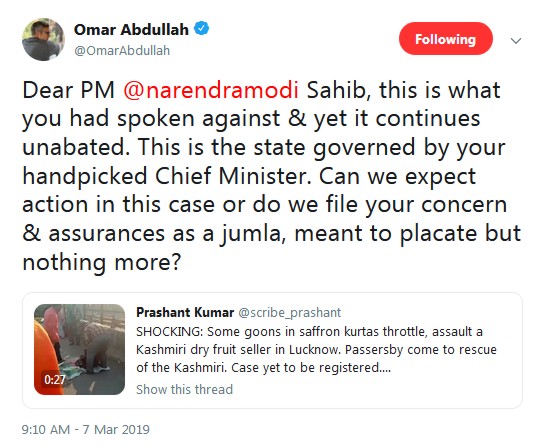
No FIRs were registered against the attackers initially. It was only after a video of the incident went viral on the social media that police did so. Former Jammu and Kashmir Chief Minister Omar Abdullah condemned the brutality. “Nothing will do more damage to the idea of India in Jammu and Kashmir than videos like these,” he said in a series of tweets along with the video post.
“Keep thrashing Kashmiris like this on the streets at the hands of RSS/Bajrang Dal goons and then try to sell the idea of ‘atoot ang’ (unbreakable part), it simply won’t fly.”
He called upon Union Home Minister Rajnath Singh, who is also the Lucknow MP, to punish “those guilty of this assault”.
The government has threatened The Hindu with action under the Official Secrets Act.
The government on Wednesday told the Supreme Court that documents related to the Rafale aircraft deal have been stolen from the Ministry of Defence and, and threatened The Hindu newspaper with action under the Official Secrets Act. Prabir Purkayastha, editor-in-chief, Newsclick, and senior journalist Paranjoy Guha Thakurta discuss these developments.
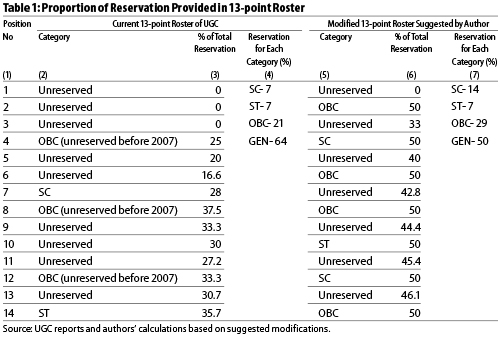
The Union Cabinet on Thursday (March 7) cleared an ordinance on reservation mechanism for appointment of faculties in universities, Finance Minister Arun Jaitley said. On March 5, a countrywide Bharat Bandh of Scs and STs had focussed their demand on the inequitous and discriminatory 13 point roster system as also judicial efforts to dilute the The Scheduled Tribes and Other Traditional Forest Dwellers (Recognotion of Forest Rights) Act, 2006.
In response to the social media storm around the #5MarchBharat Bandh, earlier this week, Human Resource Development Minister Prakash Javadekar said the centre was committed to restoring the reservation roster in educational institutions following a series of protests over the issue by various students’ and teachers’ organisations. They had been urging the government to bring an ordinance to restore the 200-point roster taking college or university as a unit for reservation in teaching posts.
Ironically the issue began with a shift in policy within the Modi regime itself. The University Grants Commission had announced in March last year that an individual department should be considered as the base unit to calculate the number of teaching posts to be reserved for the Scheduled Castes and Scheduled Tribes candidates, following an order by the Allahabad High Court in April 2017. The Supreme Court had upheld an Allahabad High Court order over reservation of SC/STs in the appointment of faculty members in universities in January.
The Supreme Court had last month dismissed a review petition filed by the Human Resource Development Ministry after its special leave petition against the court order was rejected by the top court. Mr Javadekar had said in the Lok Sabha on February 11 that the government can “bring an ordinance if its review petition filed in the top court is rejected“.
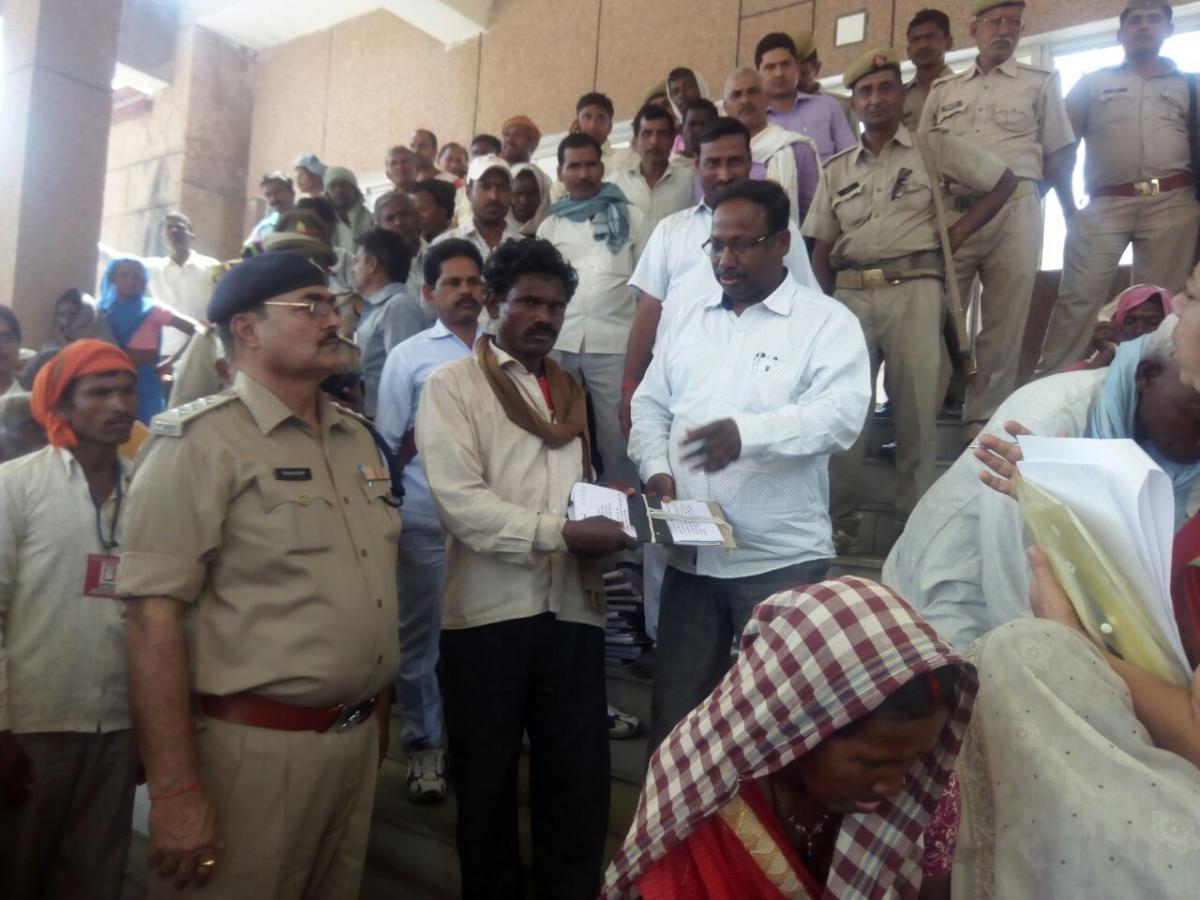
Nandu Gond, resident of Lilasi village of UP’s Sonbhadra district was released today after a rigorous national campaign launched by Citizens for Justice and Peace (CJP) with its partner the All India Union of Forest Working People (AIUFWP). We first reported on March 1, 2019 that he was missing from his village, suspected by family to have been arrested, despite the fact that protection against arrest had been granted to him through an order of the Allahabnd High Court on February 8, 2019.
Image: Nandu gond presenting village claim to SDM March 23, 2018 in Robertsganj
There was jubilation in Lilasi village today after his release. The fact that hundreds of calls made by supporters and activists making inquiries impacted on the administration is also a key lesson for the human rights movement and defenders. For close to a week Nandu Gond of Lilasi Village, Sonbhadra district had been untraceable and his family and relatives were seriously concerned.
Sabrangindia and CJP had been talking consistently to the local administration to trace his whereabouts. So far, despite the legal requirements, he has not been produced in a court. Sabrangindia had reported on March 1, that Nandu Gond has been arrested in an allegedly second false case even after HC has protected him against arrest before in another related, reportedly malicious case. Nandu Gond’s only crime seems to be is that he is an assertive land and forest rights activist and is president of Forest Rights Committee (FRC), Lilasi area, thana Nevarpur.
For the past four months, he was forced to be on the run for about four months, even after the Allahabad High Court directed on a stay against his arrest (February 8, 2019). He his family used to live in the village with his wife, two sons, two daughters and his brother. His activism and involvement in the organisation is being used to target him.
Cjp.org.in had, after ateam visit to Lilasi village recently reported how terror was unleashed on his home in December 2018 and his family and the belongings targeted. The story titled, “Forest Rights: A daughter awaits her father’s return in Sonbhadra’s Lilasi nexus of UP Police, Forest Dept. officials and brokers destroy Nandu Gond’s home” was first published on cjp.org.in.
Nandu Gond was prominent among the team of the All India Forest Working People(AIUFWP) making land claims under the Forest Rights Act, 2006. Community forest rights land claims were submitted at the district headquarters, Robertsganj, UP on March 23, 2018 and the repression against three prominent leader activists from Lilasi, Kismatiya Gond, Nando Gond and Sokalo Gond (from another village) was unrelenting for months and began on May 18, 2018 and and May 22, 2018 when the police authorities of Muirpur police station as well as officers of forest department allegedly committed atrocities on the women of the forest schedule tribes. Thereafter Kismatiya was jailed for a month before she got bail but for Sokalo Gond it was only November 1, 2018 before she could walk out of Mirzapur jail. They were all picked up from the railway station on June 8, 2018 after, ironically they had successfully submitted a memorandum to the UP Forest Minister, Dara Singh Chauhan.
It is in this context that the relatively quick release of Nadu Gond is significant. In December 2018, on the pretext of a kukri (seizure) operation Nandu Gond’s home had been broken down and destroyed. CJP has written about this soon after the team visit to the area in February 2019 (A Daughter Awaits Her Father’s Return).
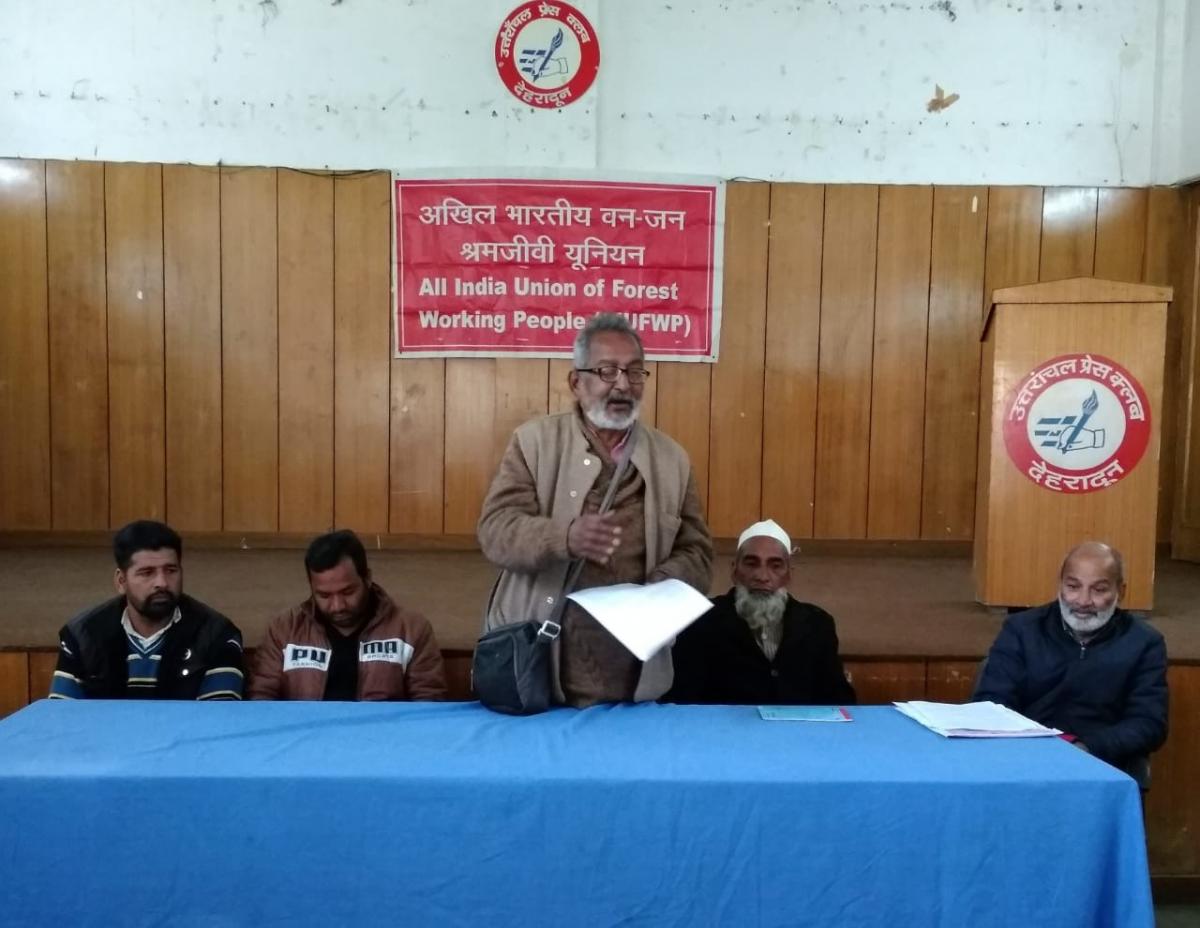
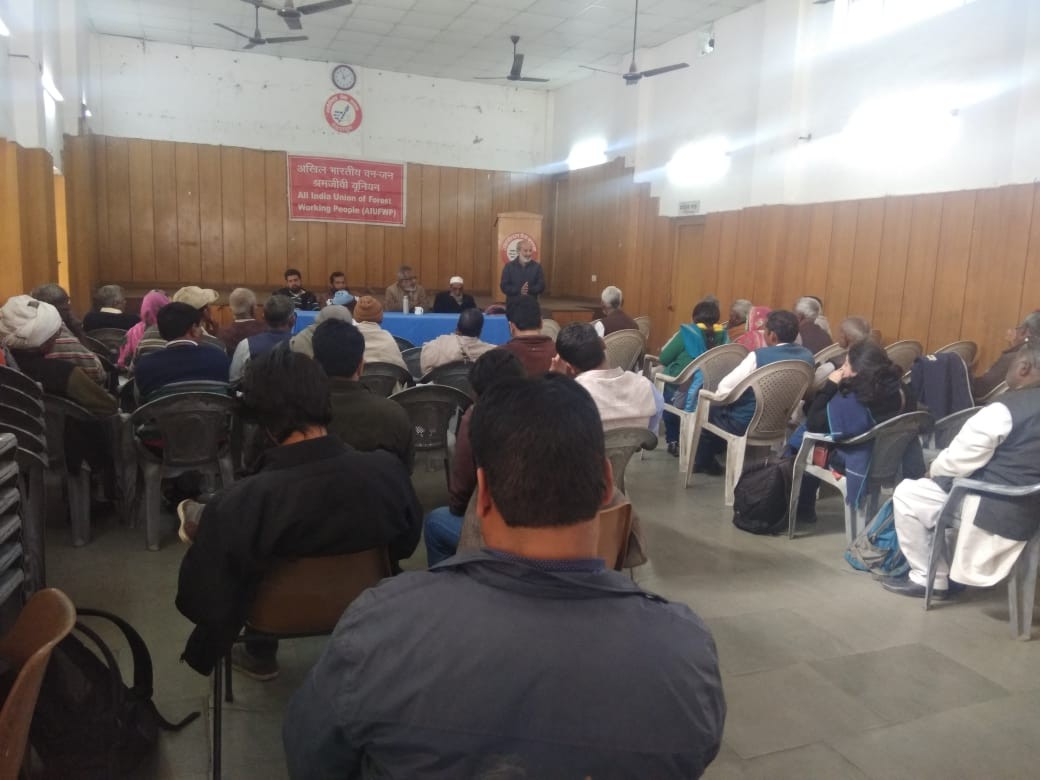
The Akhil Bharatiya Van Jan Shramjivi Union, Panchayat Sangharsh Morcha and Bhu Adhikar Abhiyan released a statement from a press club in Dehradun, Uttarakhand, opposing the displacement of tribals in an unconstitutional manner from their ancestral forest lands and condemned the condemning the SC order so-called wildlife lovers and forest officials for conspiring to oust millions of forest-dependent communities.
Dehradun: On February 13, 2019, the Supreme Court decided to displace millions of forest-dependent communities from the forest area over the petition filed by Wildlife Fest, Nature Conservation Society and Tiger Research and Conservation Trust (TRACT).
Millions of tribal Adivasi people had filed their claims for recognition for their housing and agricultural land under the Forest Rights Act 2006, and many claims which were rejected by the authorities.
The Supreme Court directed the governments of 17 states to submit its report by July 12, 2019. Even though a stay order on evictions was issued, the communities are fearful for their future and as they look at a possible displacement.
The Centre has asked state governments to go to villages and validate the 19.5 lakh rejected forest rights claims on the ground within a fortnight. As per statistics of the ministry, 40.5 lakh claims have been filed across states under the Act.
Of these, 18.5 lakh have been given land titles. An additional 2.5 lakh are in different stages of government consideration. The remaining 19.5 lakh claims have been rejected. Speaking to ET, secretary (tribal affairs) Deepak Khandekar said, “The states have to go down to the villages and check the status of 19.5 lakh. There could be duplicate rejections.”
This has created even more fear in the tribal regions.
The Akhil Bharatiya Van Jan Shramjivi Union, Panchayat Sangharsh Morcha and Bhu Adhikar Abhiyan released a statement from a press club in Dehradun, Uttarakhand, opposing the displacement of tribals in an unconstitutional manner from their ancestral forest lands and condemned the condemning the SC order so-called wildlife lovers and forest officials for conspiring to oust millions of forest-dependent communities.
“This verdict is a violation of the constitutional rights of millions of displaced communities and it further strengthens the historical injustice that has continued for centuries,” they said.
“Under the Forest Rights Act, 2006, the forest-dependent communities have been provided 13 residential and community rights, including ownership of residential and agricultural land and forest produce. In the process of ensuring that the claims of the underprivileged community are accepted, the Gram Sabhas have to overlook the formalities. The village level committee is responsible for verifying the claim. The right to investigate is given to the village level Forest Rights Committee who will send it to the sub-group level committee for recognition after the investigation. The sub-group level committee will accept the recognition on these claims and forward it to the district level committee which will recognize the claims of the claimants,” the release in Hindi said.
“If the District Level Committee has any objection to the attached paperwork in relation to these claims, then it can send it back to the Gram Sabha so that another process for a second claim can be completed. Subdivision or District Committee has no right to dismiss the claim but the committee can send it to the village committee with its objection for review. The right to dismiss is with the village level committee, therefore the illustrations given by the authorities to dismiss the claims are illegal. Most objections have come from the forest department, which has been against this law since the beginning and is causing obstructions due to its inherent greed. It is to be noted that the Forest Rights Act is a Civil Rights Act 2000, in which the forest department cannot interfere as it is a law, not a forest. Because of this, the organizations and political parties standing with all the tribal communities against the decision are opposing this attack on Adivasi citizens. In this case, the attitude of the Indian Government in the Supreme Court was very irresponsible because they did not cooperate in the process and neither did they appoint any competent lawyers who were present during the hearings or could give reasonable counsel. The result was a one-sided decision which clearly shows that there is a conspiracy to eradicate FRA,” they said.
They listed their demands: –
The Government to stop this tragedy by passing an Ordinance keeping in mind the rights provided under the Forest Rights Act.
Submit a reconsideration petition against the Supreme Court judgment and firmly advocate for the provisions of the law.
Direct the state governments to immediately stop the displacement being conducted by the forest department.
Clear guidelines should be issued to remove the obstacles in enacting the FRA.
The provisions given under FRA, 2006 should be implemented effectively.
Update: Former Commissioner of Police, Mumbai, Julio Ribeiro has in a comment piece in The Indian Express today (Saturday, March 9) written how “The fake news is correct : Constant tall claims by BJP detract from the positives of the government”. A few days ago an extract in a speech in his name was circulated which we too published. All other data in the story was verified, save the fact that it emanated from Mr Ribeiro. For this we apologise-Editors)
In the decade leading up to 1947, undivided India was ravaged by famines and food scarcity. In the 21st century, it is among the top 10 economies of the world. How much of it can be credited to policies and how much to politics?
Speaking in the Parliament in March 2016, PM Modi had said, “If the Congress had helped the poor in 60 years, the poor wouldn’t still be facing trouble…We can’t ignore 60 years of misgovernance.” The constant harping on the 60 years of Congress rule and that the country achieved nothing in that time period could not farther from the truth.
At public rallies before the election in 2014, he would say, “You gave 60 years to the Congress, they gave you nothing but misrule. Give me 60 months to fix the nation’s ills.”
Data collected from several quaters counters this claim and suggests that the PM should not take the masses for granted. “You are the Prime Minister of a country which was under British rule for more than 200 years. The people were living just like slaves. Congress came to power in 1947 after independence started with zero. There was nothing in this country except garbage left behind by the British. India didn’t have the resources then even to produce a pin since the British left India. Electricity was available only in 20 villages across the country. Telephone facilities were available only for 20 rulers (kings) in the country. There was no drinking water supply. There were only 10 small dams. No hospitals, no educational institutions, no fertilisers, no feeds, and no water supply for cultivation. There were no jobs and rampant starvation in the country. There were many infant mortalities. Very few military staff manning our borders. Only 4 planes, 20 tankers & fully open borders on all 4 corners of our country. Very minimum roads and bridges, empty exchequer. Nehru came to power under such circumstances,” he said.
Without taking sides with either party, it would be good to take an objective look at what India achieved in 60 years before Modi came to power.
“In the decade leading up to 1947, undivided India was ravaged by famines and food scarcity. Soon as India became independent, it was confronted with a food and milk crisis. The country had to import 55,000 tonnes of milk powder every year in the early 1950s, according to government records,” a report by Scroll said.
“India was not yet one, its territorial integrity was being challenged, the 1948 war had complicated an already-fraught relationship with Pakistan, new state institutions had to be built, and so on. Through it all, food security could not be compromised. Self-sufficiency was, after all, a key agenda of independent India’s first leaders, and tied deeply to nationalism,” the report said.
In a radio address to the nation in 1952, Prime Minister Jawaharlal Nehru declared that he will raise food production by nearly 8 million tonnes as their goal for the Five Year Plan.
Relying on the economist S Sivasubramonian’s data, Balakrishnan arrayed the growth rate of three key sectors – agriculture, industry and services – to map the trajectory of the Nehruvian economy. He analysed the data for three periods – 1900-’01 to 1946-’47, 1950-’51 to 1964-’65, and 1947-’48 to 1999-2000 – and showed that “not only does growth in the Nehru era amply exceed what was attained in the final half-century of colonial rule but the quickening of the economy observed over the second half of the 20th century may be seen to have been already achieved in the Nehru era,” the report said.
“What has India achieved after 60 years? World’s largest army. Thousands of warplanes, tankers, lakhs of industrial institutions, electricity in almost all villages, hundreds of electric power stations, several kilometres of national highways and over bridges, new railway projects, stadiums, super speciality hospitals, most of the Indian households with television, telephone services for all countrymen. Improved infrastructure to work in and outside the country, Banks, Universities, AIMS, IITS, IIMS, Nuclear weapons, submarines, nuclear stations, ISRO, Navarathna Public sector units,” Ribiero wrote.
“Indian Army split Pakistan into 2 pieces. One lakh military & commanders surrendered to the Indian army. India started exporting minerals & food items. Bank nationalisation by Mrs. Indira Gandhi. Computers were introduced to India and many job opportunities were created in India and outside. India is ranked among the top 10 economies of the world. GSLV, Mangalyan, Monorail, Metro rail, International airports, Prithvi, Agni, Naag, Nuclear submarines….all these were achieved before you became PM,” he said.
His claims are yet again not entirely unfounded. India’s growth story is not fake news.
“Modi would not have been the prime minister of the country had it not been for the first leaders of independent India who held the centre against all odds,” said the historian Ramachandra Guha in a report by Scroll, whose book India After Gandhi traces the early years of independent India and the immense, complex work that went into making of the nation.
“Jawaharlal Nehru, Sardar Vallabhbhai Patel, BR Ambedkar for about four years from January 1948 to January 1952 did a truly extraordinary job,” Guha added. “They gave India a fighting chance by determining territorial integrity, uniting the country, resettling refugees, working out an egalitarian Constitution, setting economic growth in process and then conducting the first general election. Think of India as a start-up, not even the most optimistic investor would have put his/her money in 1947 because it looked like it would collapse in a year,” he said in the report.
“Nehru’s administration pushed for planned economic and agrarian growth; public sector spending; setting up of steel and power plants; establishing Indian Institutes of Technology and Indian Institutes of Management, among other measures. He spoke endlessly about ensuring progress for all Indians and cultivating a “scientific temper”. His government encouraged space exploration and put the country on the nuclear path – boldly for a new and struggling nation,” the report said.
Though the Congress rule had its flaws when it came to primary education, healthcare, planned urbanization, personal law reform and increasing communal divide; the country saw relative progress.
“The economic reforms of 1991–initiated by the late Narasimha Rao, Dr. Manmohan Singh, Shri P. Chidambaram and Dr. Montek Singh Ahluwalia–opened up the minds of Indian corporate leaders to the power of global markets, helped them accept competition at home and abroad, and raised the confidence of consumers. Our hard currency reserves have gone up from a mere $1.5 billion in 1991 to over $220 billion today. The reforms encouraged entrepreneurship and gave confidence to businessmen and entrepreneurs to dream big, create jobs, enhance exports, acquire companies abroad and follow the finest principles of corporate governance,” a report from 2007 said when India actually celebrated 60 years of Independence.
“Please do not come to people asking what Congress has achieved in 60 years rather tell the people what you have achieved in the last four and a half years except changing names of places, building unwanted statues and introducing cow politics, failed demonetisation, poorly executed GST, and making people stand in long queues,” Rebeiro asked.
India’s unemployment rate rose to 7.2 per cent in February, the highest since September 2016, and up from 5.9 per cent in February 2018, according to the Centre for Monitoring Indian Economy (CMIE). It reported that demonetisation led to a loss of 3.5 million jobs.
The Rafale deal has raised a stink as news sources claim that BJP colluded to get the deal for a 2-month-old company founded by Anil Ambani over HAL owned by the Indian government.
Oxfam’s latest report Reward Work Not Wealth shows that 1% of India’s population owns about 60% of its private wealth and that in 2017 the wealth of India’s richest 1% increased by over Rs 20.9 lakh crore, equivalent to total central budget in 2017–18.
Farm distress, attacks on minorities and women, the dismantling of nation’s biggest institutions are just some of the highlights of the last four and a half years.
So what more did India achieve in the 60 years since Independence and what did the Modi led BJP government achieve in the last four and a half years? The reports available in the public domain are there for everyone to see.
All are members of the Vishwa Hindu Dal, a right-wing fringe group. Himanshu Awasthi, the president of the Vishwa Hindu Dal bragged about the attack on Facebook, claiming he and his men had carried it out. The video of the attack that he shared on Facebook has been taken down.
Lucknow: The market in the busy street of central Lucknow’s Daliganj area was bustling with activities as sellers were calling out to customers to sell their wares. At 11 am on Thursday, Prashant Kumar, a political journalist posted a video from the street. A Kashmiri dry fruit seller was beaten up mercilessly by saffron clad men on Wednesday evening and the video soon went viral on social media.
“A man was seen in a viral video thrashing a Kashmiri street vendor in Lucknow, the vendor was later saved by locals. The culprit Bajrang Sonkar has been arrested by police. Sonkar has criminal background and has 12 cases including a murder case against him,” said Kalanidhi Naithani, Senior Superintendent of Police.
All are members of the Vishwa Hindu Dal, a right-wing fringe group. Himanshu Awasthi, the president of the Vishwa Hindu Dal bragged about the attack on Facebook, claiming he and his men had carried it out. The video of the attack that he shared on Facebook has been taken down.
Sonkar was picked up late Wednesday night and three more were arrested on Thursday. The accused Himanshu Garg, Anirudh Kumar, Amar Mishra and Sonkar belong to Vishwa Hindu Dal Trust run by one Ambuj Nigam.
An FIR has been registered in Hassanganj police station under Sections 147, 323, 504, 153A and 307 (attempt to murder) of the Indian Penal Code and Section 7 of the Criminal Law Amendment Act, said SSP Lucknow Kalanidhi Naithani.
“These men just descended on us. They started beating us and calling us terrorists. We have been coming for 20 years. Something like this has never happened with us before,” one of the dry fruit sellers said.
“First, they argued and we thought they were bargaining for the price of dry fruits. Then people asked him for his Aadhar card. Suddenly, one of them started slapping the Kashmiri guy and then all of them assaulted him for few minutes,” the priest, who was one of the eye-witnesses of this incident, told Newsclick. The priest further said that people who were passing the bridge did try an intervene.
A passerby, who is said to have shot the viral video, said on the condition of anonymity that “the attackers were asking the dry fruit seller to prove his identity and were demanding his Aadhaar Card. Then they asked him where he was from and after hearing the word ‘Kashmir’ the attackers went crazy and started beating him and dubbing him a stone-pelter.”
“It seemed like they had come with the intention to beat up the guy because they stopped their car near him and were not buying anything,” the teenager who runs a fruit cart said in the report.
Kashmiris have faced discrimination and assaults in several parts of the country following the February 14 terror attack in Pulwama in which 40 CRPF soldiers were killed. In Uttarakhand, students were forced to leave college campuses. Two Dehradun-based educational institutions have said they will not admit Kashmiri students in future.
Reacting to the Lucknow incident, former Jammu and Kashmir chief minister Omar Abdullah tweeted, “Nothing will do more damage to the idea of India in J&K than videos like these. Keep thrashing Kashmiris like this on the streets at the hands of RSS/Bajrang Dal goons & then try to sell the idea of “atoot ang”, it simply wont fly. (sic)”
Last month, the Supreme Court had asked 10 states, including Uttar Pradesh, to take “prompt action” to ensure Kashmiris living across the country do not face social boycott or attacks.
A protest against hate has been organised at 5 pm on Thursday in front of SSP residence, Sapru Marg, Lucknow. Activists and concerned citizens have urged every peace-loving citizen and organisation to come together to stop such hatred from spreading in their city and that no such incident is repeated again.
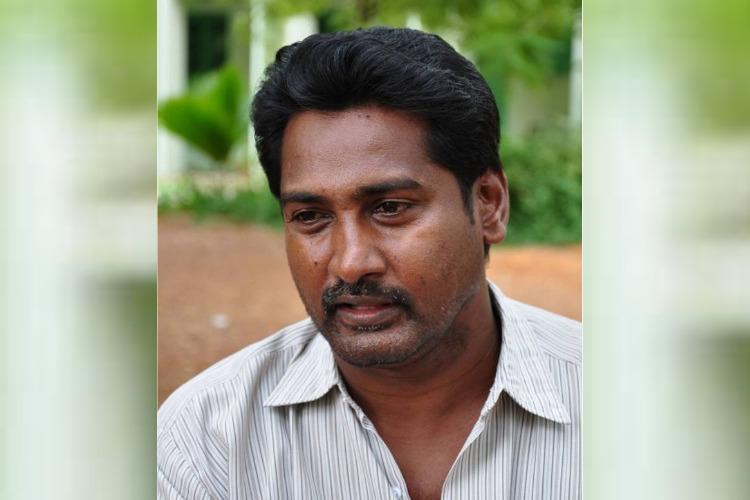
RS Mugilan is a human rights defender from Chennai and the Coordinator of the Tamil Nadu Environment Protection Committee. He has worked tirelessly on environmental issues in Tamil Nadu, opposing such issues as illegal sand mining and nuclear power.
As of 4 March 2019, human rights defender Shanmugam Thangasamy, better known as RS Mugilan, remains missing. On 15 February 2019, RS Mugilan disappeared while on his way from Chennai to Madurai. He was last seen at the Chennai Egmore Railway Station after having co-organised a press conference relating to the killing of 13 protestors at a demonstration in May 2018.
RS Mugilan is a human rights defender from Chennai and the Coordinator of the Tamil Nadu Environment Protection Committee. He has worked tirelessly on environmental issues in Tamil Nadu, opposing such issues as illegal sand mining and nuclear power. He has most recently been involved with the Anti-Sterlite Movement, which opposes a copper plant in Thoothukudi set up by copper-smelting company Sterlite Industries (India) Limited, a subsidiary of the UK-based company, Vedanta Resources. The human rights defender had been part of the fact-finding team to Thoothukudi and it is believed that his disappearance is linked to this line of work.
At 11.30am on 15 February 2019, RS Mugilan took part in a press conference, which he had co-organised, at the Chennai Press Club. Its purpose was to discuss the violence that broke out during the anti-Sterlite protests in Thoothukudi on 22 May 2018, at which police shot and killed 13 persons.
At the press conference, RS Mugilan released a 46-minute-long documentary entitled, Koluthiyathu Yaar? Maraikkapatta Unmaigal (Arsonists – Sterlite – The Hidden Truths). The documentary claimed that the police—in collaboration with officials from Sterlite Industries—had allowed a number of individuals, who RS Mugilan believe were hired by Sterlite, to disrupt the protest. The group set fire to bicycles and damaged CCTV cameras around the area in which the shooting subsequently took place. In the documentary, the human rights defender demanded that police officers involved in the shooting be arrested. He named high-level police officials, including the then-Inspector General of Police, Mr Shailesh Kumar Yadav, and Deputy Inspector General of Police Mr Kapil Kumar Saratkar as being complicit in orchestrating the incident.
After the press conference, at around 6.30pm, RS Mugilan made a call to his friend, who is the Tamil Nadu State Focal point and Regional Coordinator of Human Rights Defenders’ Alert – India (HRDA) for South India. In the call, RS Mugilan told his friend that he had received threats and that he was worried about police action against him following the allegations he made against high-level police officials.
At around 9.30pm on 15 February, RS Mugilan informed his friend via SMS that he had arrived at the Chennai Egmore Railway Station to catch the Nagercoil Express train to Madurai. He also arranged to meet with his friend in Madurai the next morning. However, when the friend called RS Mugilan at 6 am on 16 February 2019, the human rights defender could not be reached as his phone was turned off. CCTV footage from the station shows RS Mugilan walking out of Egmore Railway Station after 10 pm, but there is no further information about his whereabouts and also no indication of whether he, in fact, boarded the train. According to fellow human rights defenders, RS Mugilan’s phone was last connected at Olukkur in Villupuram District.
On 18 February 2019, fearing that RS Mugilan had been forcibly disappeared for his claims at the press conference, People’s Watch submitted a habeas corpus petition to the Madras High Court, after their complaints about RS Mugilan’s suspected abduction to the Chief Minister’s office and the Tamil Nadu Director General of Police (DGP) were not acted upon. The Madras High Court proceeded to direct the Commissioner of Police, Chennai and the Superintendents of Police of Kanchipuram and Villupuram districts to submit a response by 22 February 2019. Since then, Tamil Nadu police have registered a “missing person” report.
On 25 February 2019, the Tamil Nadu Director General of Police (DGP) issued an order to transfer the case to the Crime Branch of the Crime Investigation Department (CB-CID) for further investigation.
This is not the first time that RS Mugilan has been targeted for his peaceful work in defence of human rights. In March 2012, the human rights defender was illegally detained by police for three days in relation to his involvement in exposing illegal sand mining in Koodankulam. In September 2017, he was arrested once again for his work on the same issue and was only released in September 2018 after his lawyer obtained bail.
Front Line Defenders, a foundation for HRD’s, based in Ireland and Belgium, issued a statement expressing grave concern about the disappearance of human rights defender RS Mugilan and feared that his disappearance may be in retaliation for his involvement in investigating and denouncing the human rights violations linked to Sterlite Industries’ copper plant.
“Front Line Defenders expresses further concern over the lack of a safe and enabling environment in India for human rights defenders to carry out their valuable work,” they said.
Front Line Defenders urge the authorities in India to:
1. Take all necessary measures to determine the whereabouts of RS Mugilan and guarantee his physical and psychological security and integrity;
2. Carry out an immediate, thorough and impartial investigation into the disappearance of RS Mugilan, with a view to publishing the results and bringing those responsible to justice in accordance with international standards;
3. Guarantee in all circumstances that all human rights defenders in India are able to carry out their legitimate human rights activities without fear of reprisals and free of all restrictions.