A documentary film made by award-winning filmmaker Deeyah Khan finds that many young British ex-Muslims live in the shadows hiding their true beliefs.
Courtesy: https://www.ex-muslim.org.uk

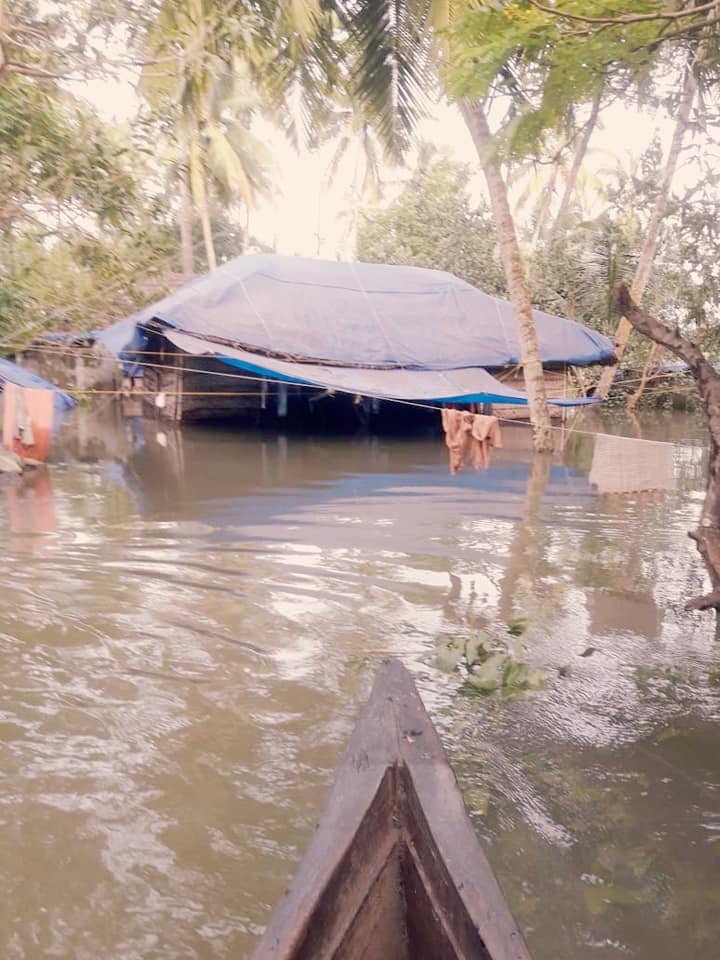
Residents of Pandanad sit in a bus stop surrounded by flood waters, in Kerala, India. Manjunath Kiran/AFP
In the mountainous Coorg or Kodagu district in the neighbouring state of Karnataka, thousands of people have been marooned because of torrential rains. Exacerbated by landslides in hilly terrain, flooding has led to the destruction of homes, bridges, road networks and industries.
Far from being a surprise, the possibility of such devastation was highlighted several years ago.
In 2011, the Western Ghats Ecology Expert Panel, chaired by the internationally renowned ecologist Madhav Gadgil, submitted a report to the Indian Ministry of Environment and Forests. The report warned that an ill-thought focus on development was impacting the sustainability of the Western Ghats hill chain, one of the world’s most biodiverse areas that runs along the west coast of India. The expert report urged a number of states, including Karnataka and Kerala, to adopt an approach of thoughtful conservation, limiting activities such as quarrying, dams and construction near protected forests in hilly areas. The report was rejected by the Ministry as well as by both states.
With the experience of hindsight, it is clear that the worst flood damage took place in those regions where the Gadgil committee recommended protection.
The Nasa released the video of Kerala in South India hit by heavy rainfall.
In Kodagu, for instance, tens to hundreds of thousands of large trees were felled in 2015 to construct a high-tension electric wire line. Uncontrolled sand mining has constrained river flows, while the rapid spread of high-rise buildings on unstable hill slopes has weakened the soil. This unplanned development has left the area susceptible to flash floods and landslides, caused by a combination of tree felling on steep hillslopes and heavy rainfall.
The flooding of the Kochi airport is another example of poor planning leading to disastrous outcomes. The airport was built on the paddy fields and wetlands adjacent to the Periyar river, and extends up to the banks of the river on one side.
The longest river in Kerala, it has a number of dams – some of which had to be opened to release water during the rains. The airport was badly hit, with estimated economic costs of at least Rs 500 crores because of its forced closure for several days.

Kochi’s International airport apron is seen flooded following monsoon rains in the Indian state of Kerala on August 15, 2018. AFP
The Periyar river is not the only one that has been dammed. The state of Kerala has 44 rivers with a total of 61 dams. Many had to be opened across Kerala as they were dangerously full – a step that, while essential during a time of emergency, contributed to the heavy flooding. A 2017 report by the Comptroller and Auditor General of India warned that not a single one of these dams had an emergency action plan in place for disaster management. Pre- and post-monsoon safety inspections had not been carried out for any of these dams either.
Given how likely it is that coastal and riverine cities will experience flooding in coming years, you would think we know better than to build airports near bodies of water. Yet Kochi airport is not an exception. The runways of the Mumbai airport have been built over the Mithi river, and the airport is located on a reclaimed pond. One of the runways of the Chennai airport extends over the Adyar river, affecting its long-term safety and stability.
It is no surprise that these airports, which are among the busiest in India, frequently flood when the rains are heavy – leading to large-scale economic losses. Yet the new Navi Mumbai airport is coming up in an equally unsuitable location on coastal wetlands.
In the era of climate change we have just entered, extreme rainfall events are going to become increasingly common. Uncontrolled growth at the expense of the environment will severely exacerbate the impacts of climate change. Our cities are simply not prepared for extreme weather events. The recent collapse of a bridge in Genoa, killing at least 43 people, is linked to poor maintenance, but also to heavy rainfall.

Rescuers work at the site where the Morandi motorway bridge collapsed in Genoa on August 14, 2018. At least 30 people were killed on August 14 when the giant motorway bridge collapsed in Genoa in north-western Italy. Valery Hache/AFP
Certain types of infrastructure may be less suitable to some contexts in a changing climate scenario. Wildfires in California cause extensive damage to private property because many cities are extending their boundaries into forest areas. As local climate becomes hotter and drier, with fires becoming more likely, new homes are being built in areas that are highly susceptible to fire instead of less exposed locations.
Some cities are seeking to reverse this trajectory of unplanned construction. Nairobi is in the midst of an extensive demolition drive, uprooting thousands of buildings built on riparian land that choke the flow of water and contribute to severe annual floods.
In Seoul, between 2002-2005, the city municipality tore up an elevated highway that had been built over the Cheonggyecheon stream. This internationally famous urban-renewal project reduced traffic, reduced air pollution and cut the urban heat-island effect. In Yonkers, New York, an ongoing project aims to restore the buried Saw Mill river.

Millions of dollars have been invested to rehabilitate the Saw Mill River in the state of New York and bring nature back in the city, August 2016. Jim Henderson/Wikimedia, CC BY-NC
Similar urban river daylighting projects are gaining traction in cities around the world. Zurich has been an early pioneer, developing the Bachkonzept (stream concept) to create, restore and uncover a number of streams and springs. London, which built over a number of famous rivers, has now uncovered and restored a number of these waterways, while Sheffield, having experimented with daylighting, is now considering uncovering sections of the local Sheaf river.
The demonstrated ecological and environmental benefits are clear – as are the social and economic returns. For example, Seoul’s iconic Cheonggyecheon stream restoration led to a more than six-fold increase in biodiversity, a 35% decrease in air pollution and a growth in property prices that is double of that in other parts of the city.

Investment in the Cheonggyecheon stream is amply repaid many times over in economic security and growth, local health and quality of life. riNux/Flickr, CC BY
The restored stream attracts tens of thousands of visitors daily who contribute significantly to local economy. Such ideas of restoration need to become more widespread, and embedded in routine climate change and disaster management planning. The investment made is amply repaid many times over in economic security and growth, biodiversity, local health and quality of life, and resilience against future disasters.
Once the emergency relief is attended to, Kochi and Kodagu would do well to use their recent experience as a warning of future disasters to come in a world of increasingly uncertain climate.
The focus must be on long-term restoration projects that can reverse some of the environmental and ecological damage that has led to the current situation. But such learning need not be confined to the areas that have experienced the worst. The rest of the world has much to learn as well.
Harini Nagendra, Professor of Sustainability, Azim Premji University
This article was originally published on The Conversation. Read the original article.
Mumbai: Low pay and wage inequality persist in India despite 7% annual average gross domestic product (GDP) growth over the past two decades, according to a new report by the International Labour Organization, a United Nations agency.

While real wages almost doubled over 18 years between 1993-94 and 2011-12 and GDP grew four-fold, “the Indian labour market remains characterized by high levels of segmentation and informality”, inhibiting India’s path to achieving decent working conditions and inclusive growth, said the India Wage Report, which used government wage and employment data from the national Employment and Unemployment Survey (EUS) and National Sample Survey Office (NSSO) to analyse wage trends in India and reflect on policies for inclusive growth.
“We are surprised that wage policy has not made, up to now, a great impact on low-wage earners,” Xavier Estupiñan, wage specialist at the International Labour Organization and one of authors of the report, told IndiaSpend. “If you have a sound wage policy in place, this will benefit the part of the workforce who are casual workers, getting their income on a daily basis and have less job security.”
Up to 62% (121 million) of employed people in 2011-12 were casual workers, the last available data from the EUS show. Yet while employment in the organised sector has grown, many of these jobs are casual, informal and lack basic social security benefits.
Wide disparities across gender, states and casual/salaried workers show a pervasively unequal employment landscape across the country. Women still earn, on average, 34% less than men (though down from 48% in 1993-94), and the daily wage of rural regular workers is, on average, 49% less than their urban counterparts.
A divided India
Gender
“Labour markets in India are characterized by gender-based disparities,” the report said.
While women’s daily wages may have increased more rapidly than men’s between 1993-94 and 2011-12, female workers are still paid lower wages than men in each employment category, according to NSSO data.
The report attributed the narrowing in the wage gap (falling from 48% in 1993-94 to 45% in 2004-05 to 34% in 2011–12) to the implementation of the Mahatma Gandhi National Rural Employment Guarantee Scheme (MGNREGS)–a government scheme that guarantees employment and minimum wages for rural workers. Enrolment in this scheme has pushed up wages for women and caused the gender wage gap to fall.

However, at 34%, the gap is higher than the global average, estimated to be 23% in 2015, the report pointed out.

The gender wage gap between men and women remains high even after higher education–a graduate woman is paid Rs 609, on average, across sectors while a man with a graduate or higher degree will earn Rs 805, according to the government’s ‘Men and Women in 2017’ study.
If India discarded religious beliefs that perpetuate gender inequalities and caste discrimination, it could more than double its per capita GDP growth of the last 60 years in half the time, as IndiaSpend reported on August 18, 2018.
Employment status and location
Regular workers in urban areas earn an average of Rs 449 per day, 49% more than their peers in rural areas who take home Rs 300.
Casual workers in rural areas earn the least at Rs 138; however, the gap between this group and regular workers is narrower than between those in urban centres (a Rs 33 difference, rather than Rs 149).
Dissecting the data through a gender lens revealed further disparity, with women again fairing the worst. Women earned less than men in every category, the report found, with regular urban male workers earning the highest daily wage (Rs 470) and casual rural female workers the lowest (Rs 104).
There appears to be a trend towards the casualisation of the workforce, the report stated. More casual and contractual jobs are being added to the organised sector but there has been a lack of substantial growth of regular jobs after 1991.
The debate over job creation is hampered by a lack of available data (though the government has set up a technical committee to improve matters, according to this June, 2018 NDTV report), but corporate data from the Centre for Monitoring Indian Economy (CMIE) Prowess IQ database show job growth is roughly at 2% per annum–down from a peak of 4-5% between 2006-11.
However, it is not yet clear whether this indicates an improvement or a decline in working conditions. While contracted workers may lack social protection and benefits, moving from the unorganised sector can cause wages to rise and underemployment decline, the report stated.
State-wise disparities
The gap between the highest and lowest average daily wages across states has increased since 1993-94.
Casual workers in the highest earning states earned 238% more than those in the lowest earning state in 2011-12, compared to 168% more in 1993-94, faring worse than regular workers over the same period (106% vs 54%, respectively).
More developed states with better economic indicators do not have higher average wages for regular workers than less developed states, the report said.
That Haryana tops the list for the highest average daily regular urban wage (Rs 783), followed by Assam (Rs 607), Jharkhand (Rs 543), and Jammu & Kashmir (Rs 495), shows there is little correlation between state per capita income and regular urban wages.
Punjab, Tamil Nadu, Gujarat and Karnataka–states with per capita income above Rs 100,000–all indicate lower average wage levels for regular urban workers.
| Nominal Regular Urban Wages By State, 2011-12 | ||
|---|---|---|
| State | Average Daily Wage (In Rs) | Per Capita Income (In Rs) |
| Haryana | 783 | 1,48,485 |
| Assam | 607 | 54,618 |
| Jharkhand | 543 | 56,737 |
| Jammu and Kashmir | 495 | 62,857 |
| Punjab | 362 | 1,14,561 |
| Tamil Nadu | 388 | 1,30,197 |
| Gujarat | 320 | 1,24,678 |
Source: India Wage Report, International Labour Organization, and Press Information Bureau, Government Of India
For rural regular workers, the association between economic development and high average daily wage for a regular worker is also missing and is puzzling to the report authors. Jharkhand (Rs 485), Uttarakhand (Rs 463) and Jammu and Kashmir (Rs 431) are on top and Karnataka (Rs 300) last.
Why wage inequality persists despite the Minimum Wage Act
Though India was among the first developing countries to establish a Minimum Wages Act (1948), multiple issues restrict its ability to address poverty and inequality.
Its complex nature (there are an estimated 1,709 different minimum wage rates across the country) and the fact that its legal application is limited to workers in ‘scheduled’ occupations–jobs classified by the government as most vulnerable to low wages and exploitation such as mill workers and miners–mean that its impact is “ineffective”, the report said.
Minimum wage rates are set by state governments, and do not always reflect the cost of living. In 2013, agricultural labourers in Arunachal Pradesh were paid Rs 80 per day, Rs 126 in Orissa and Rs 269 in Karnataka, the report said.
Furthermore, only 66% of workers are covered by the Minimum Wage Act. The remaining 34% not in “scheduled occupations” remain outside the scope of the minimum-wage law.
A national minimum wage was introduced in 1991, but its application is not legally binding. In 2009, 15% of regular workers and 41% of casual workers earned less than this minimum daily wage, the report said.
Addressing wage inequality
Simplifying minimum wage structures, extending the legal scope to all wage workers and adding statutory backing are key steps to closing earning disparities, but legislation itself is not enough, the report warned.
Governments should facilitate a transformation from low-productivity to high-productivity sectors by focussing on skill accumulation and growing a supply of more educated workers. Increasing the proportion of higher-skilled workers may force an increase in the wages of lower skilled workers and thus reduce inequality, the report said.
Awareness-raising campaigns and labour inspections have both been shown, among others, to be effective ways of galvanising community action and using compliance to hold stakeholders to account.
The report uses the example of MGNREGS educating workers about minimum wage and their rights, allowing workers to share this knowledge amongst other groups who demand wage hikes. Similarly, the fact that MGNREGS wages are transferred electronically aids monitoring and compliance.
“While addressing wage policy is not the answer to everything, I’m a strong advocate of it because I understand what has been done in Brazil and also China to some extent,” Estupiñan said. “At this moment, when the economy is growing, there is the possibility for better inclusion”.
In Brazil, minimum wages are revised on a regular basis and GDP growth over the previous two years is taken into account, according to the report.
(Sanghera is a writer and researcher with IndiaSpend.)
Courtesy: India Spend
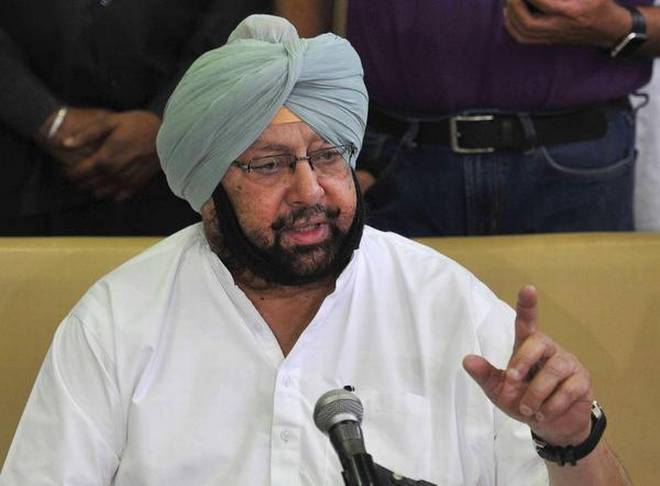
Punjab’s Congress government trading a dangerous path again trying to ‘beat’ BJP in using religion as a pretext. Why Mr Amrinder Singh feel that any critique to religion is sacrilege and the person need to be punished for life?
While, I can understand that in multicultural societies we need to be very careful. As administrator we must be above our personal prejudices based on caste, religion and regional identities and therefore ensure that deliberate attempt to dishonor faith or humiliate people on the basis of their faith must be protected, in the very similar way as people have right to profess their faith as well as declared that they are non believers.
This country developed secularism under the guise of multiculturalism which left non believers, humanists, atheists, rationalists outside the prism of ‘secularism’ even when our first prime minister was a proclaimed atheist yet secularism was more used as symbolism to look better governed and functioned than our problematic neighbours where religious bigot dominated the political discourse as well as politics.
The Sarv Dharm Sambhav business in India has hurt those who seek reforms with in their own religions. It stop people from doing so as the religious groups join hands. Multiculturalism and secularism are not synonymous as being suggested in India. Secularism is basically for the state to be non religious and treat all equally as per rule of law.
Now, Punjab Sacrilege bill is still not known as what is sacrilege. Frankly, Punjab was not bothered about others. The Akalis had prepared the bill that any one who defile Guru Granth Saheb or speak ill against it will be punished and the bill was returned by the center and now punjab government has become more ‘inclusive’ and included Geeta,Quran and Bible in it. Question is what is the definition of sacrilege? Will it be physical burning or defiling of the religious books or the definition would be enlarged to include any critique of religion or religious practices, in the name of ‘hurting’ ‘religious sentiments’ of the people or spreading animosity among communities. If the bill stops people from critiquing religion then it will become blasphemy law and will be dangerous. We all are witnessing how secular, human rights activists, minority rights activists are being attacked in countries like Pakistan, Bangladesh, Saudi Arabia under the blasphemy laws where questioning Islam is blasphemous. Will Punjab lead India towards a new blasphemous act ? Will other states too follow this ridiculous act to appease all the religious people of sarv dharm variety ?
All religions have deeply inbuilt prejudices. There are discriminatory practices divinely sanctioned by religion. You can say some are better than others but by and large they remain rigid as religions do not allow you to ‘amend’ their ‘verses’ or hymns which are absolutely out of date as per our times unlike our constitution which allow people to amend the rules or acts to suit the interests of the people according to the time.
It means all the critique by the Dalit Bahujan Adivasis in India to the so called brahmanical religious text which degraded them and devalued them, will come under this act ? It means any Muslim woman or former Muslim who question Quran or any christian who write ‘ Why I am not a Christian’ should face life imprisonment ? It means Dr Ambedkar’s ‘Riddles of Hinduism’ will be prohibited ? It means we can’t read Salman Rushdie’s book ‘freedom at midnight’ or Satanic verses. If means all the Mazhabis and Ravidasis who critique Sikkhism will get life imprisonment. In democratic societies, we need not to agree with everything said by people or written by them but we defend their right to express themselves. Differences are only countered through providing better critique and alternatives and not by stifling their voices or sending them to imprisonment.
It is dangerous. All Ambedakrites, human rights activists, those believe in human freedom must oppose the Punjab bill as it is an attempt to stop people from critiquing religion. We can understand and will support if some one defile a religious place physically but writing critique of religion or speaking against it does not and should not come under such stringent laws. Even if Punjab government want an act, it must consult human rights groups, general public at large, social activists on the issue. The supreme court must reject it unconstitutional which gives us freedom of expression and thought.
Is not not strange and shameful that religious critique which our constitution allow us to do is being banned and punishment being made to life imprisonment while those who are burning the constitution and insulting it are let off lightly.
What an India. Rahul Gandhi and Congress party must ponder it whether Amrinder Singh is deliberately hurting Congress or whether he has the support from Congress high command. If the party high command support it, then we must say, the congress has still not learnt its lessons well and continue to appease the religious groups. It is time, the voices of common people must be heard and not merely the religious heads. Punjab government must be forced to take this bill back which is against our constitution and all democratic norms. It violate the fundamental rights of an individual to critique religion and can be misused by police officials as well as politicians to target their opponents which will bring more chaos and anarchy in the society. India has to be guided by religious morality and not through individual religious values.
Vidya Bhushan Rawat is a social and human rights activist. He blogs at www.manukhsi.blogspot.com twitter @freetohumanity Email: vbrawat@gmail.com
Interview with Urmilesh
Interviewed by Pranjal Produced by Newsclick Team,
In this episode of Hafte Ki Baat, Urmilesh talks about the rule of mob which has taken over the streets. He feels that these mobs are getting protection from the government and the RSS wants to run the country on the same lines.
Courtesy: Newsclick.in

Q) Could you shed light on the condition of people who were internally displaced following the anti-Christian violence in Kandhamal? What are their lives like today?
A) The anti-Christian violence in Kandhamal was horrific. People were slaughtered on the streets, women were raped, they didn’t even spare the children! 6,000 homes were burnt across 400 villages. 395 churches desecrated and demolished. The official death toll was 39, but actually it was closer to 100. In the immediate aftermath of the violence more than 50,000 people were forced to flee their homes. Their entire lives were uprooted. There was a loss of land and livelihood. Many of the victims were Adivasis who were dependent on forest produce and once they were ousted from their villages they struggled to sustain themselves. Many of the victims were also Dalits who have historically faced several layers of oppression and continue to even today. Many of these people found their way into relief camps. Gradually, some of them moved to other states like Kerala and Goa to start life afresh. But even today 5,000 to 6,000 people are still afraid to go back home to their villages. They still live in relief camps amidst squalor and deprivation. Every day is a struggle.
Q) But it has been a decade. Why are they afraid to return now?
A) They are afraid for several reasons. One of their greatest fears is forced conversion. I know of a case where a young Dalit girl who was gang raped because her uncle refused to convert. The perpetrators of the Kandhmal carnage walk free in the same villages the Christians were forced to flee. I know of people from at least 10-15 villages who have stayed away fearing forced conversion and violence when they return. The perpetrators have either managed to secure bail or cases against them have been dropped. Witnesses were coerced into taking back their statements. Oppression, intimidation and harassment is high and these people operate with impunity because the government has done nothing to prevent these people from putting pressure on the survivors who, unlike the perpetrators of the attacks, are economically weak and don’t enjoy any socio-political clout. Even the police are indifferent.
Q) Only a fraction of cases that were originally filed ever made it to court. How does that affect the survivors?
A) There is no doubt that this is a travesty of justice. Over 2,000 complaints were filed, but just over 300 trials have been completed and there was conviction in only 78 of them. The conviction rate is in single digits. In fact hundreds of cases were dropped by the police because they could not find any evidence or witnesses. There is pressure on witnesses to turn hostile, sometimes the complainant turns hostile due to intimidation. Even though the Supreme Court in 2016 directed that 315 cases that has been closed previously, be reopened, no real progress has been made in investigations. This is probably because there was no deadline for reopening these cases and completing investigations. This is very demoralising for the survivors.
Q) What about the government’s claims of having provided compensation to survivors?
A) There was tremendous loss of life and property. However, despite the government’s claims of no compensation being pending, thousands of people are yet to be compensated. The process itself was flawed because the assessment of damage was not proper. There was no standardised compensation. In amny cases amounts sanctioned varied between a meagre Rs 10,000 to Rs 1,00,000. This is not enough to rebuild lives. Moreover, names of many people never made it to the list of those who should be compensated.
Q) In your opinion, why did the Kandhamal carnage take place and who benefited from it?
A) The upper castes and the businessmen were the masterminds and they had support from the government. They realised that the Dalits and Adivasis were being empowered by the Church with education and would soon slip out of their hands. So they pitted tribes against tribes in the name of religion. They did not realise that they were killing their own people. The oppressed became both, the foot-soldiers and victims in this hate filled agenda, and the oppressor had the last laugh.
*Feature image: House destroyed in Gunjibadi in Kandhamal, Odisha. Image Courtesy: World Watch Monitor
This video was first published on newsclick.in.
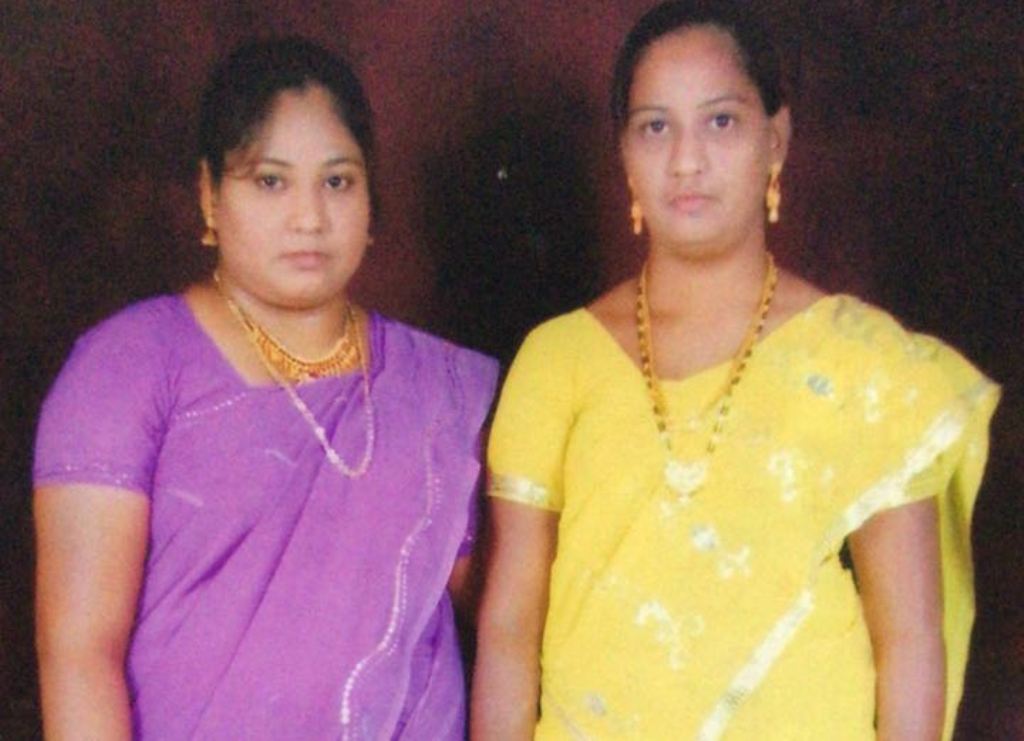
Hajida and her mother Zareena were walking back home through the market, engaged in a light conversation when Subhan flung two buckets full of acid on them.
Her mother Zareena instinctively shielded her daughter and took the major brunt of the attack. Subhan fled from the scene leaving both the mother and daughter writhing in immense pain as the acid quickly burnt the skin and the tissues exposing the burnt flesh.
Passersby took them to the Government Hospital in Machilipatnam, a town located about 70 km from Vijayawada. Both were critical having suffered major burns all over the body.

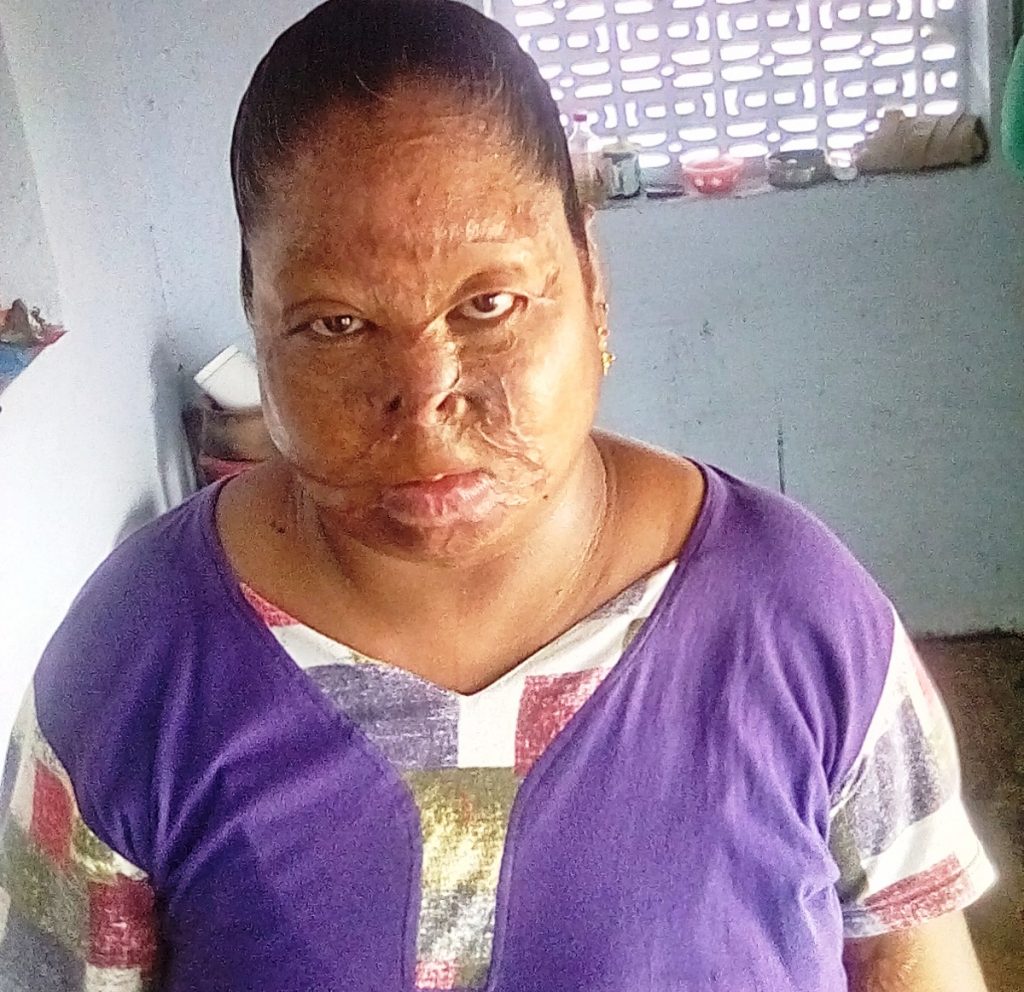
Hajida after the attack and partial treatment.
The police arrested Subhan whom not just Hajida and her mother but also others had seen. However, Subhan who in the process had burnt his hand was out after a few days.
Subhan was their immediate neighbour and though married with kids of his own he had been harassing Hajida. And he never lost an opportunity to propose her. He tried the angle of a ‘sad husband’ telling Hajida that his wife is very ill and will not live beyond a year. So he wanted Hajida to marry him.
Hajida, however, was not interested and refused each time. He kept pestering not just Hajida but also her family to agree to his proposal. When they refused, his frustration mounted he decided to seek revenge.

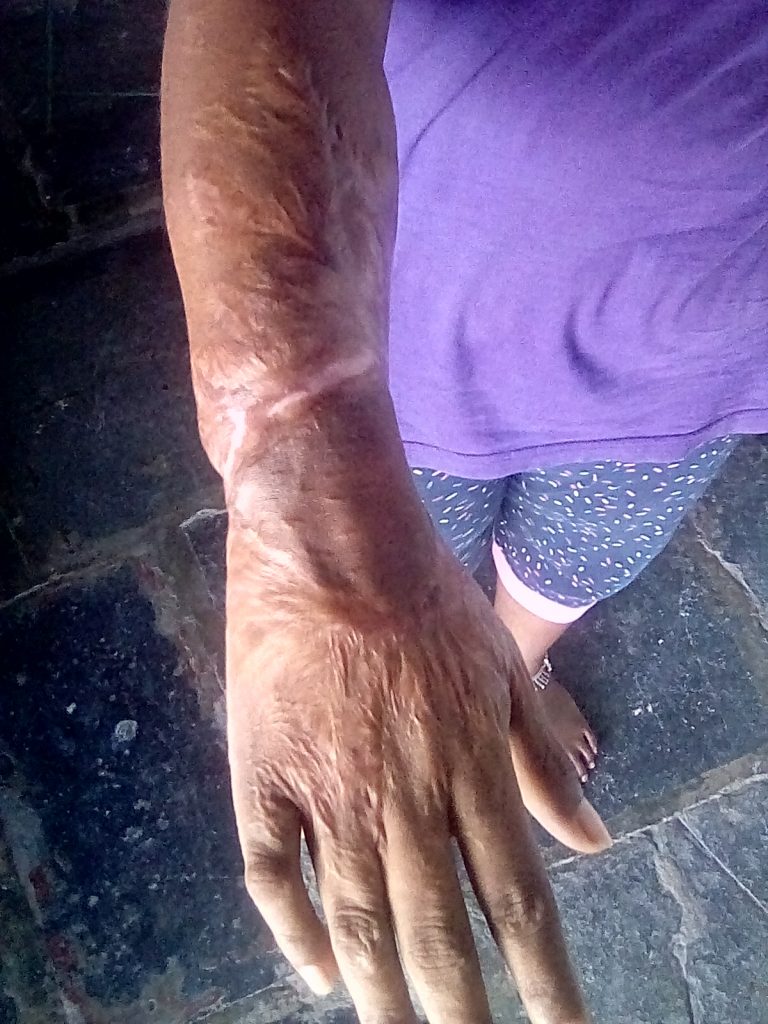
Hajida shows her burnt hand
It was the month of March 2014 when he flung acid on Hajida in an attempt to kill her. But instead, he killed Zareena who succumbed after a month and disfigured Hajida.
Hajida had lost all will to live after suffering severe agony due to the burns. Her whole body and face were burnt except for her legs. She also lost 60% of her eyesight. And it was Asma her older sister who stood by her like a rock. Asma nursed both her mother and Hajda on two different beds in the same hospital.
But the treatment was not getting anywhere at the District hospital in Vijayawada, as it was not equipped with the kind of medicines needed to treat acid attack survivors.
After the death of their mother, Asma decided to take her sister to Hyderabad for treatment. And it was in Hyderabad that a group of women activists contacted them and offered both moral and financial support. They even helped in accommodating them during their stay in Hyderabad for treatment in Apollo Hospital.
Hajida underwent many reconstructive surgeries in the last four years that helped her regain her vision and move her wrists. Now she is able to do some work at home.
Recalling the ordeal Asma and Hajida went through, Asma said, “ The neighbours used to fight with us frequently asking us to vacate the house because their children were scared of Hajida”.
It hurt Hajida hearing all these cruel references to her because she did not go outside and did not even peep out the window or the door. Still, the neighbours accused her of scaring their children. After a year, Asma could no longer fight the neighbours anymore as she was already burdened with nursing her younger sister, working to feed the family, grieving the death of her mother and comforting and giving strength to Hajida. Added to this were Subhan’s threats to withdraw the complaint. So they relocated to Chilkalpally, lcoated on the outskirts of the town.
And each time Hajida heard Subhan’s voice she trembled with fear. Asma approached the police who assured them that soon the case would be concluded and Subhan would be in Jail. But it took four long years for the sentence from the lower court in Machilipatnam to arrive. Finally, on July 30, 2018, Subhan was convicted and sentenced to a life term.
However, even after shifting to a different locality, Subhan visited a couple of times to threaten the sisters.
Were it not for Asma, Hajida would have succumbed to her injuries that had eaten away her flesh and her zest for life. Asma gave her sister all the comfort Hajida needed. And Hajida slowly built her confidence and her will to live bit by bit.
Hajida grew from strength to strength also because of the support she got from the women activists who treated her like their younger sister. The bond of sisterhood helped both Asma and Hajida steer through the toughest of the times.
The court case was also going nowhere and Hajida though outwardly seemed calm and determined to punish Subhan was hurting all the time both from inside and outside. The healing process was as slow as the days that passed.
But Hajida requested for a change in the public prosecutor on the advice of her well-wishers. And luckily the court changed the public prosecutor after which the case seemed to be moving ahead. She received a compensation of Rs. 50000 twice in the last 4 years which was all spent on her medicines.
The government also allotted her a small plot of land and a loan to construct the house. The loan will be sanctioned if she can contribute her side of the amount for the loan.

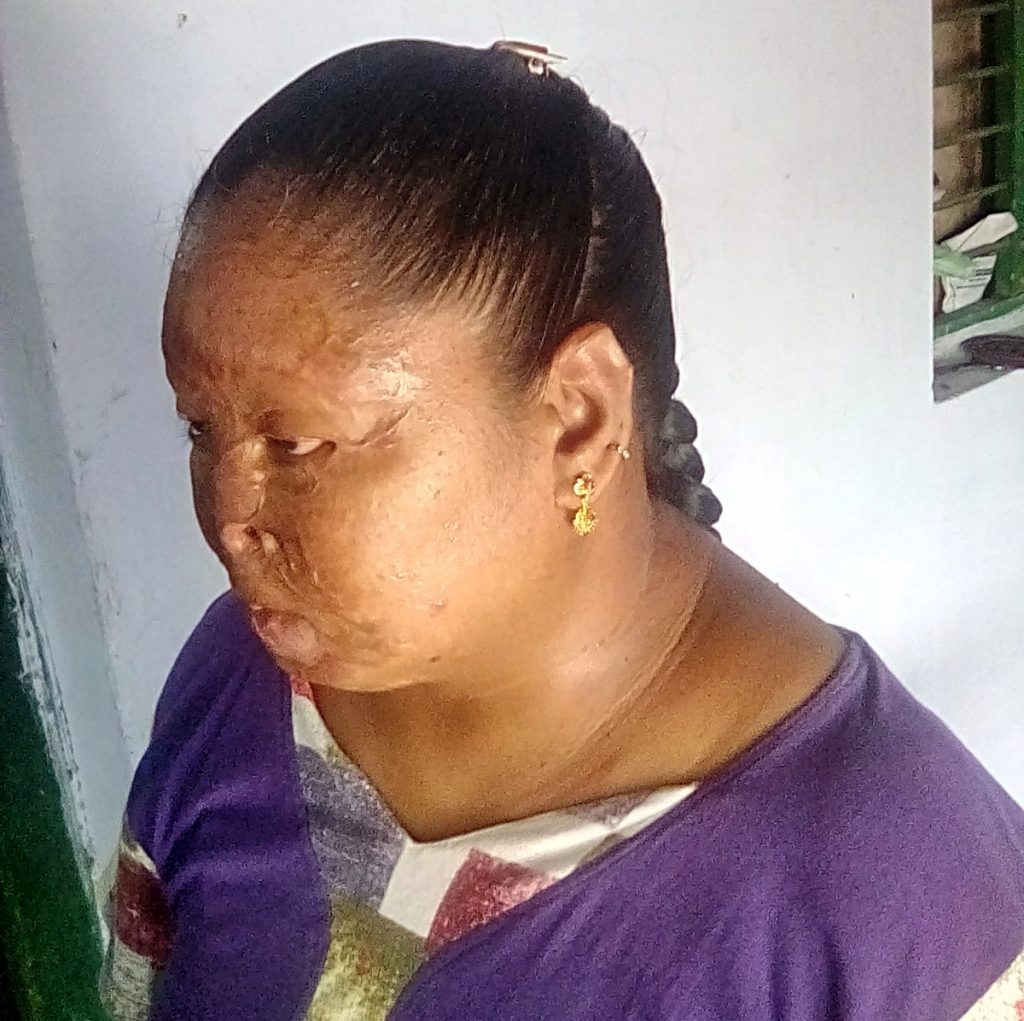
Hajida now
Hajida has to use eye drops 3-4 times in a day regularly to be able to see properly. However, she still cannot see the smaller, finer things as her vision is not fully restored.
Travelling to Hyderabad which is roughly 340 kilometres was another cumbersome task the sisters had to put up with. And finding accommodation each time was also difficult. There seemed to be no option for them until Dr Lakshmi Saleem, the seniormost and reputed plastic surgeon examined Hajida and kindly agreed to conduct all her future surgeries free of cost at St. Ann’s Hospital, Vijayawada which is 67 kilometres from Machilipatnam.
Hajida finished her last surgery on 13th August in Vijayawada.
Again the women activist have come to her rescue and raised funds for this surgery. She still needs another 5- 6 surgeries on her face including reconstructing eyelids and nose.
Asma, her sister is the only breadwinner in the family while their father gets a pension off Rs.1,000 under the old age pension scheme.
Efforts are on to raise more funds for Hajida as she needs money not just for surgeries but also to construct a small house on the land allotted to her by the government.
With Subhan behind the bars, the sisters are feeling safe to move around and live their life in some peace.
Asks Hajida, who is still unable to forget the nightmare “ If I don’t like a guy and am not interested to marry him, can’t I say No to him?”
It may take time for Hajida to look normal again till then she has to keep fighting. Her first priority after her surgeries is to build her own house so no one will ask them to vacate again.
PS: People who wish to help Hajida rebuild her life can do so by contributing to the following account:
Account number: 027210100091504
Bank: ANDHRA BANK
IFSC code : ANDB0000272
Name: SHAIK ASMA
Branch: Javvarapeta, Machilipatnam
This article was first published on twocircles.net.
Join our mailing list to get the latest human rights news that matters, straight to your mailbox.
© Sabrang | All Rights Reserved