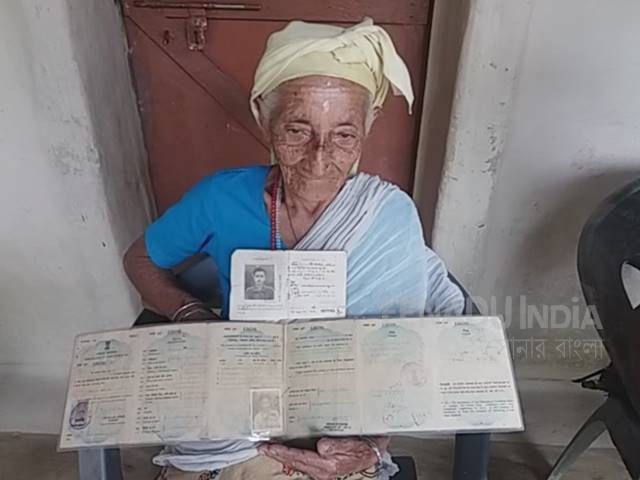
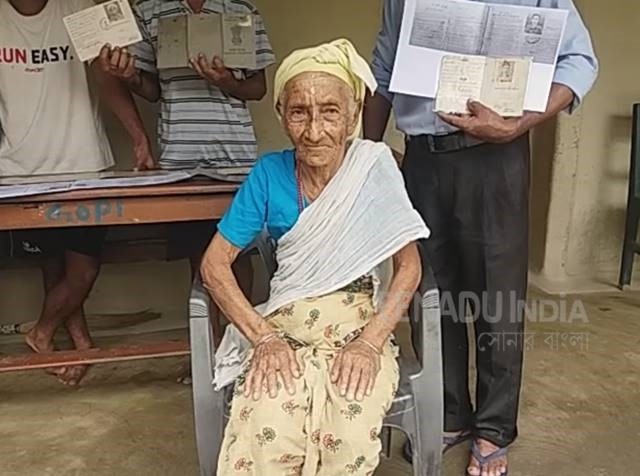
Family of Ziauddin Ali Ahmed, nephew of India’s 5th President Fakharuddin Ali Ahmed is kept out of the NRC’s final draft despite being from a known family in the region. He has had villagers confirm his lineage as well. Even then Ziauddin has been kept out of the list since because he could not find any legacy document.
In the 12th century, when Constantinople was the biggest market in the eastern Mediterranean, the poet John Tzetzes boasted he could speak to the residents of the Byzantine capital in seven languages, including Persian, Arabic, Russian and Hebrew. In Izmir (Smyrna in Greek) many centuries later (at the start of the eighteenth century), in addition to lingua franca (that is, Italian without tenses or syntax; a purely spoken language used throughout the Levant till the 19th century), ‘twelve languages could be heard in the streets of Smyrna: Turkish, Arabic, Persian, Armenian, Greek, Russian, Hebrew, Italian, Portuguese, French, English, and Dutch’ (Mansel, Levant, p. 30). At the other end of the world, in Malacca early in the sixteenth century, according to the reliable Portuguese witness Tomé Pires, on any given day one could hear up to 84 (!) different languages spoken.
Istanbul c.1875, in an early photo by the Swedish photographer Guillaume Berggren
Port cities like Constantinople, Smyrna and Malacca were microcosms of the world market in the sense that people from all or most parts of the world were drawn there, so that many different languages could be heard. When the state was committed to maintaining this cosmopolitan character, rulers consciously sought to encourage a culture of religious tolerance. One can hardly say this about the present government of India, despite all of Modi’s international pretensions!
Religious tolerance was the main feature of Calicut / Kozhikode that impressed the shipwrecked Breton navigator François Pyrard, who wrote (in the early 17th century), ‘it has merchants from all parts of the world, and of all nations and religions, by reason of the liberty and security accorded to them there: for the king permits the exercise of every kind of religion…(he) holds that to be a cardinal maxim of government’. ‘Everyone lives there in great peace and concord, notwithstanding the great diversity of races and religions…and of strangers and sojourners’. Calicut was ruled by the Nair Samoothiris. On the other coast of India, Masulipatnam in the 17th century was another case of a cosmopolitan port with a mixed population where the rulers (in this case the Qutub Shahis, who were Shias) ensured what Arasaratnam describes as ‘communal harmony’ at a time when most east-coast ports were plagued by ‘civil strife’, mainly caste rivalries among Hindus.
Against Kirti Chaudhuri’s strange view that ‘it was unusual for a Hindu merchant to conduct business with a Muslim’, Irfan Habib was able to show that ‘the brokers of Muslim merchants (in Surat) were invariably Hindus’, that is, Banias.
This image of an early capitalism characterized by cosmopolitan cultures of trade partly survives in the pages of the Communist Manifesto, only there it is transposed to industrial capital with its restless search for markets and sources of raw materials. What doesn’t characterize capital in the pages of the Manifesto is the fierce nationalist rivalries that would start tearing the world apart from the early part of the twentieth century. Nationalism, prepared by the struggles between mercantilist powers in the seventeenth and eighteenth centuries, only finally blossomed in the age of industrial capital. And we are still living with its hideous legacies.
Take the latest example of this: the NRC is overloaded with meanings. At one, totally prosaic, level it is an elaborate attempt to manipulate the voter lists, so terrified is the BJP of losing the next election. At another, more purely ideological, level it is an exercise in communalism, a drive to purge some mythical ‘nation’ of so-called ‘illegal’ immigrants (read: unwanted Muslims) in a way that mimics Trump and goes way beyond him. And it tries to do all this by deliberately stirring up sub-nationalisms throughout the country, destroying the very idea of ‘India’ itself.
Can the next leader of Pakistan lead the country out of corruption, poverty, and war?
Photo of Imran Khan by Awais khan via Shutterstock
The July 25 general elections in Pakistan heralded a seismic shift in Pakistan’s politics few would have envisaged a mere six months ago. The Pakistan Movement for Justice (PTI)—led by the charismatic former cricketer Imran Khan—bagged 115 out of the 272 directly contested seats in Pakistan’s Parliament. That’s the most of any party. Khan is thus Pakistan’s prime-minister-in-waiting, an achievement that marks the pinnacle of his two-decade-long political career.
Khan’s rise to power, however, is not without controversy. The run-up to the polls was marred by some of the most extensive pre-election rigging Pakistan has ever witnessed in its turbulent history. The Pakistan Muslim League-Nawaz (PML-N), the ruling party before the elections, was expected to further strengthen its hold on power in the 2018 polls.
Instead, it found itself as the runner up to the PTI after becoming the target of dubious political maneuvering and of uncertain judicial decisions that resulted in the party’s leader, Nawaz Sharif, and his daughter jailed on the eve of the elections.
In the past, the military has usually been responsible for such political machinations. Since Khan benefitted from this onslaught against the PML-N, his party came to be seen as a stooge of the military, a claim that has tarnished the PTI’s reputation in some quarters and that has raised questions about the health and the sustainability of Pakistan’s democracy.
Khan will thus come into office with the knowledge that many segments of Pakistani society are challenging his legitimacy to rule. Despite these allegations, however, Imran would not have been able to acquire such a commanding lead in the National Assembly had he not been generally popular amongst Pakistan’s masses.
His narrative of being anti-status quo and his promises to eradicate corruption in Pakistan resonated strongly with the millions of young, literate, and unemployed Pakistanis who chase increasingly elusive dreams of upward mobility. Imran’s own unique blend of a Western past and his conservative socials views also makes him popular with voters across Pakistan’s political spectrum. Pakistan’s liberals, for instance, remember Imran the cricketer as a flamboyant celebrity and playboy who broke bread with some of the biggest names in the Western World.
The Khan of today, on the other hand, decries Western feminism for having “degraded the role of a mother,” and has publically spoken out against repealing some of Pakistan’s most orthodox laws. Whether he succeeds in uniting the different strands tugging at Pakistan’s social fabric, however, remains uncertain.
The PTI promises a significant break from Pakistan’s political past and the chance to try a new, untested, and so far untainted political party. The problems the PTI faces, however, are the same ones that have been plaguing the country for decades, including a burgeoning foreign and fiscal debt crisis, rising unemployment, a faltering foreign policy, climate change, and the perennial threat of extremism and terrorism.
Pakistan’s fiscal and foreign debt crisis possibly poses the biggest challenge for the incoming government. Pakistan’s currency has depreciated nearly 25% in value over the past few months. With imports continuing to increase and exports failing to catch up, there seems to be no respite for Pakistan’s falling foreign reserves. The precarious situation could force Pakistan into another agreement with the IMF, a possibility PTI’s candidate for finance minister, Asad Umar, claimed is likely.
The structural problems plaguing Pakistan’s economy thus demand a fundamental rethink of the country’s economic policy and a shift away from the neoliberal growth model that the country has followed since the 1990s. The PTI, however, adheres to the tenets of this model, which casts doubt over its ability to substantially alter Pakistan’s economic trajectory.
The PTI also faces an uphill battle to protect Pakistan’s interests on the global stage. In June, for instance, Pakistan was placed on the Financial Assistance Task Force’s (FATF) “grey list” of countries that have failed to curb money laundering and the financing of terrorist outfits.
This move was a result of declining relations with Washington, which has threatened to punish Pakistan for its alleged support of extremist groups operating in Afghanistan. Secretary of State Mike Pompeo, moreover, claimed in a recent interview that the US would deny IMF funding to Pakistan if the latter used these funds to pay back “Chinese loans.”
Recalibrating relations with the United States will thus be the biggest foreign policy challenge for the PTI. The new government will also have to rethink its approach towards Afghanistan to assuage fears that Pakistan supports the Afghan Taliban. This will pose a significant dilemma for Khan, who has historically voiced support for peaceful negotiations with the Taliban and who opposed the Pakistan military’s operation against the Pakistani Taliban in the country’s northwestern regions. While in power in the Khyber Pakhtunkhwa province, moreover, the PTI funded the Darul Uloom Haqqania, a religious seminary notorious for educating many members of the Taliban. These precedents have led to many of the detractors of the soon-to-be prime minister to dub him “Taliban Khan.” The PTI will thus have to battle both personal ideological inclinations and strategic interests to improve Pakistan’s relationship with Afghanistan. This will also require making peace overtures to New Delhi, a move that will bring the party into direct conflict with Pakistan’s military. The military, for its part, has historically opposed any peace deal with India, and has traditionally enjoyed a veto on Pakistan’s foreign and security policies.
Imran Khan’s promises of a naya (new) Pakistan thus face significant hurdles even before the cricketer-turned-politician has set foot in his new office. Pakistan, after all, has suffered from decades of poor governance and a weak democratic structure. But Khan came to power carrying with him the hopes of millions of Pakistanis who have witnessed extreme violence, poverty, and uncertainty in their lives, and who want to break the hold traditional political parties have on the organs of power in Pakistan.
Abrahim Shah holds Bachelor’s degrees in Economics and History from Cornell University and is currently working in journalism and in academia in Pakistan. mabrahim.shah@gmail.com
Delhi/Gurgaon: Underneath two gigantic chandeliers in the conference room of a posh Gurgaon hotel, 250 elegantly dressed women are ferociously beating drums. Faster, slower, louder, stop. It’s easier than it looks. The women break out into a sweat as they whistle and shout hoi in unison, on cue.
The idea of this 45-minute exercise, said Blesson Joseph of team-building company Dfrens, is to demonstrate the power of cooperation. “If you come together, you can make a difference,” he said.
GurgaonMoms, the organiser of this day-long event of talks, competitions, pitches and, yes, drumming, aims to do precisely that: Get women to form a network where they help each other.
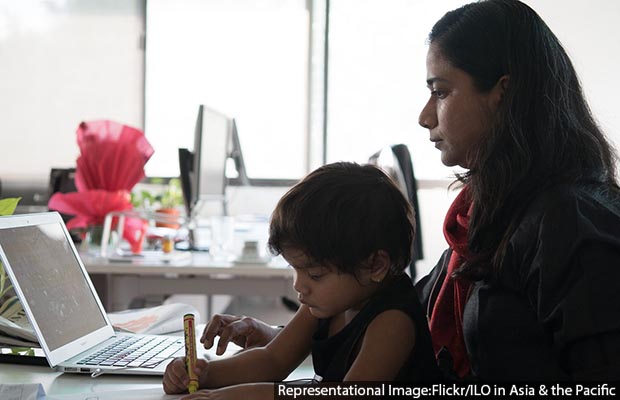
Launched in 2011 by Neela Kaushik, an MBA with a background in digital marketing, as an online support group for mums with queries–what’s a good school, recommend a reasonably-priced dentist, yoga instructor, and even heated discussions on politics–GurgaonMoms now claims 25,000 members, all of them mothers, most of them professionally qualified and some of them in search of opportunities that will put their qualifications to use.
There’s Pooja Sardana, an MBA from Indian Institute of Management, Ahmedabad, mother of two children–a girl aged seven and a boy aged four–who put in 14 years in various companies including Unilever and GSK before she quit after the birth of her son in 2014 to “explore a different side of myself”.
“I needed the time to figure out what I want to do,” she said. For a while she shared stories on her travel blog and by the end of this year, she plans to launch a brand of children’s shoes.
Shagun Singh stayed with her sales job at a five-star hotel in Mumbai even two years after the birth of her son in August 2006. Then her husband got a job in Delhi and, so, she took a transfer. But the Delhi office expected her to clock in twice a day before and after going out on calls. “The work culture did not allow for flexibility and I started exploring options to make better use of my time as a mom and a professional,” she said.
Singh’s father ran a business that provided security and housekeeping services. “I realised there is a demand for professional housekeeping services,” she said, “So I launched my own firm, HomeWork.” The job gives her flexi-hours and, more crucially, she’s home by 2.30 pm, which is when her son, now 11, gets home from school. “It’s important for me to be around when he gets back,” she said.
Smiti Puri completed her MBA from City University New York and landed a job with a bank in New York. When she got married to a Delhi-based businessman, she moved back to India and took a transfer from the bank. But, she said, the work culture here was “totally unprofessional”. For a while she worked for an internet incubator. Then she got pregnant.
“That’s when I decided to help my husband’s family business of textiles, shawls and carpets get online,” she said. But when her second child was born, said Puri, it was like being “hit by a train”.
“Nothing I have done, not 20-hour days nor impossible deadlines, has been as physically and emotionally challenging as bringing up my children,” she said. As of now, Puri is happy to be a stay-at-home mom, watching over her two boys aged four and one. She has no plans to get back to a job.
Corporate’s India’s motherhood bump
The motherhood bump is showing in corporate India. “While there are few entry points for women, the exit gates are many – pregnancy, child care, elderly care, lack of family support, and unsupportive work environment,” said an April 2018 study, Predicament of Returning Mothers, conducted jointly by Ashoka University and the Genpact Centre for Women’s Leadership.
“Having a young child in the home depresses mothers’ employment, an inverse relationship that has intensified over time,” found a March 2017 World Bank policy paper, The Motherhood Penalty and Female Employment in Urban India, written by Maitreyi Bordia Das and Ieva Zumbyte.
India’s low female workforce participation rate, at 24%, according to the 2018 Economic Survey, is amongst the worst in South Asia. Between 2004 and 2011, the year of the last census, nearly 20 million women fell off the labour map, and there are no signs that this slide has stopped.
This dwindling participation by women in employment is perplexing because it comes at a time of increased educational attainment, declining fertility and economic growth. Paradoxically, as our September 2017 story showed, it is India’s most educated women who are leaving jobs faster than others.
Our nation-wide investigation (links to other parts in this series at the end of this story) found that women are falling off the labour map for various reasons, including the need to get their family’s permission to work, social attitudes about what is appropriate work for women, bearing a disproportionate burden of unpaid care work, safety issues and the lack of infrastructure such as affordable and reliable public transport.
And motherhood.
A silent but stark effect on mums
In most cultures around the world, mothers are the primary caregivers of their children. But in India, motherhood has been elevated to an exalted status.
“Socially, mothers are expected to put their children’s needs above all others, and certainly above their own,” said Das, author of the 2017 World Bank paper we referred to earlier. A woman who prioritises her career ahead of, or even alongside, young children being brought up by domestic workers or in daycare “often receives implicit or explicit censure both within and outside the house”, she said.
When women get pregnant, the barriers they already face at the workplace just making a name for themselves are amplified, said Sairee Chahal, founder and CEO of Sheroes, which describes itself as the world’s largest online career destination for women with two million members.
“For mothers, managing the logistics–daycare, reliable household help, a support system–can become problematic,” Chahal said. The incentive to remain employed thus decreases dramatically as a result. “There is a silent but stark effect on mums.”
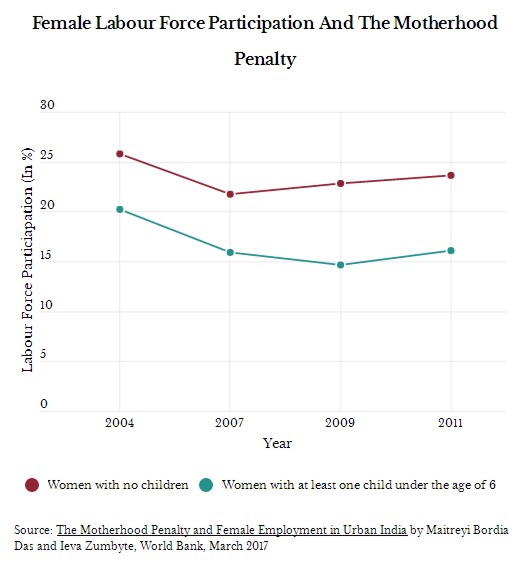
As joint families break down, the burden of child rearing goes up. “Motherhood places a penalty on almost all female workers–unless formal or informal institutions, as well as fathers and husbands, step in to share care responsibilities with women and female wages are high enough to compensate for the monetary and non-monetary costs of childcare,” said Das.
“Our own studies have found that having young children constrain women’s employment whereas having an older female relative, say, a mother-in-law, increases her chances of employment,” she said.
Globally, mothers of children below the age of five have, at 47.6%, the lowest employment rate compared with 87.9% for fathers and 54.4% for women who had no children, found a June 2018 study of 90 countries by the International Labour Organisation (ILO), Care Work and Care Jobs for the Future of Decent Work.
The report confirms that motherhood definitely and demonstrably impacts women’s employment prospects. But is it alone in keep women away from employment?Source: International Labour Organisation, Care Work and Care Jobs for the Future of Decent Work, June 2018.)
Defining women’s work
All over the world, it is women who bear a disproportionate burden of not just child care but also other work around the house–cooking, cleaning, looking after the elderly and disabled, fetching firewood, fodder and water.
In no country do men and women equally share unpaid care work. It is women who end up doing over three-quarters of the total global amount of unpaid care work.
This work, needless to say, is unpaid.
Of course, it comes at a cost. Gender inequality in household work is reflected in the labour market. Put simply, the more you work (unpaid) in the house, the less time you have to work (paid) in the market.
In 2018, found the ILO report authored by Laura Addati and others, 606 million women of working age all over the world declared themselves to be unavailable for employment due to unpaid care work, while only 41 million men were inactive for the same reason.
It is unpaid care work that constitutes the “main barrier to women’s participation in labour markets”, noted the report.
Source: International Labour Organisation, Care Work and Care Jobs for the Future of Decent Work, June 2018. Note: ‘Personal’ means education, sickness or disability. ‘Reasons related to labour market’ includes awaiting recall to work, believing no work available and lacking required qualifications. All numbers in percentage.
“A high road to care work implies achieving gender equality in labour markets and in households, therefore addressing the motherhood penalty,” said Laura Addati, lead author of the report and maternity protection and work-family specialist, ILO, Geneva. “Since care is a common good, the report calls for the overall and primary responsibility of the State in adopting transformative care policies in five main policy areas: care, macroeconomic, social protection, labour and migration policies,” she said in an email response.
Farzana Afridi, an associate professor with the Indian Statistical Institute, agreed: It is marriage, rather than motherhood, that is the first stumbling block in women’s workforce participation.
In 2011, for instance, half of all unmarried women in the 15-60 age bracket were in the labour force while the comparative rate for married women was 20%–a figure that has remained more or less stagnant for three decades, she said.
“For most women, there is a very narrow window to join the labour force between the time they complete their education and the time they get married,” she said. With motherhood, the chances of remaining in paid employment do go down–but not as much as they do with marriage, said Afridi.
Time-use data also show that whether a woman has one child or three, the time she spends on unpaid care work remains the same, said Afridi. The issue is not so much having children, the issue is unpaid care work. “You cannot address women’s workforce participation without first addressing the amount of unpaid care work they are required to do,” said Afridi. “Motherhood is a penalty but it is not the only one.”
Bearing the cost
Mandating paid maternity leave is one obvious intervention that governments can make, even though in India it impacts only the roughly 5% of women who work in the organised sector.
Yet, found a recent study by human resources services company TeamLease, in the short-term, enhanced maternity leave could lead to as many as 12 million women potentially losing jobs across all sectors in 2018 as a result of the Maternity Benefit (Amendment) Act of March 2017 that increased maternity leave from 12 to 26 weeks.
The job loss would typically take place in small and medium-sized enterprises and is “likely to vary from reduced demand for women to unethical behavior of reducing the upfront salary for women”, said the report.
However, “large, professionally managed companies–both private and public sector–and medium-sized public sector companies will actively back the amendment and are more likely to hire more women”, it said.
Among some companies, there is a recognition that they will have to lean out if they want to retain female talent and pursue employee diversity as a goal.
Diversity is not a warm, fuzzy idea for corporates but makes sound business sense with a more heterogeneous group likely to throw up better innovation, said Roopa Wilson, who manages diversity and inclusion at IBM India.
Quoting IBM chairman, president and CEO, Virginia M. Rometty, Wilson said: “IBM thinks about diversity the way we think about innovation–both are essential to the success of our business…. When we incorporate diversity into our business, we create better innovations and outcomes.”
IBM has several programmes designed specifically for returning mothers–from providing an additional six-months’ unpaid leave post the mandatory six-month maternity leave to providing online learning courses and trainings so that employees, particularly women on long leave, don’t become redundant, said Wilson.
In addition, she said, the company provides for childcare centres in almost all locations across India and even has an elder care programme designed for the parents and parents-in-law of employees (picking up medical reports, sending a nurse for shots etc).
Despite these steps, said Wilson, last year the company realised it had not fully factored in women themselves and their desires.
“The girl child in India has a strong education identity; we tell them ‘study hard, become a doctor’,” said Wilson. “They even have a sense of job identity and know that once they graduate they will get jobs. But we still have to develop a sense of career identity in our girls.”
Up to 51% of all entry-level jobs are filled by women, and these women only start hitting roadblocks after the first three to four years of their jobs, found a 2011 Nasscom survey. That’s when they might get married and have to relocate to where their husbands live and work. When they have children, there is a “social and cultural issue where priorities change”, and this is the challenge that workplaces have to address, said Wilson.
But, warned Sairee Chahal, workplaces are becoming leaner and there has, in the past few years, been a lot of “change and churn”. “Our economy is not creating enough jobs. We are creating 1.5 million corporate jobs a year, whereas we need a million jobs every month,” she said. In this straitened situation, “one person out is one person less” and women who choose to opt out of jobs are not going to be anyone’s priority.
Leaning in, leaning out
Reams have been written ever since Facebook chief operating officer Sheryl Sandberg advised professional women to “lean in” and stick it out.
It’s important to stay the course, agreed Paroma Roy Chowdury, vice president, public affairs, Softbank, and mother to a 26-year-old son. “It can get really tough and the greatest attribute a woman at work can have is a thick skin,” she said.
Chowdhury made the switch from journalism to corporate communications, taking three months off when she had her son, and then diving right back to work. What moms want at work, she said, is a certain degree of empathy, when a kid falls ill, for instance. Having more role models and women in mentorship roles would also help. And, of course, she added, there is no over-estimating the value of good support structures at home and at work.
But dads are changing too, and it’s important to recognise this, said Aparna Samuel Balasundaram, an author and psychotherapist who has conducted corporate training sessions with companies such as Wipro and Accenture. Balasundaram said she recently held a parenting workshop that was attended by three times as many men as there were women.
“There’s a realisation that if you’re going to remain a two-income family to enable a certain lifestyle, then men are going to have to support their wives,” she said. “Moreover, today’s men just want to be better fathers.”
But ultimately there is no getting around the cultural mindset change needed to get more mothers back into the workplace.
“Everything goes back to the way we are raising our daughters,” said Deepa Narayan, a former advisor to the World Bank and author of Chup: Breaking the Silence About India’s Women. “We want our daughters to become doctors but her ultimate goal is marriage to be able to ‘adjust’ after marriage. So her inner conditioning is to pull back and be respectful, silent and obedient.”
But, “for many women the challenge is not external but internal. They are hitting up against their own guilt all the time. It comes from your own judgment, the judgment of your family, and that of your peers,” said Kachina Chawla, a public health specialist whose portal, GharKamai, connecting women professionals with project-based work recently got acquired by Sheroes.
“We were brought up to believe that we could change the world, so does staying at home mean we are letting down the side?”
This is the twelfth part in an ongoing nation-wide IndiaSpend investigation into India’s declining female labour force participation.
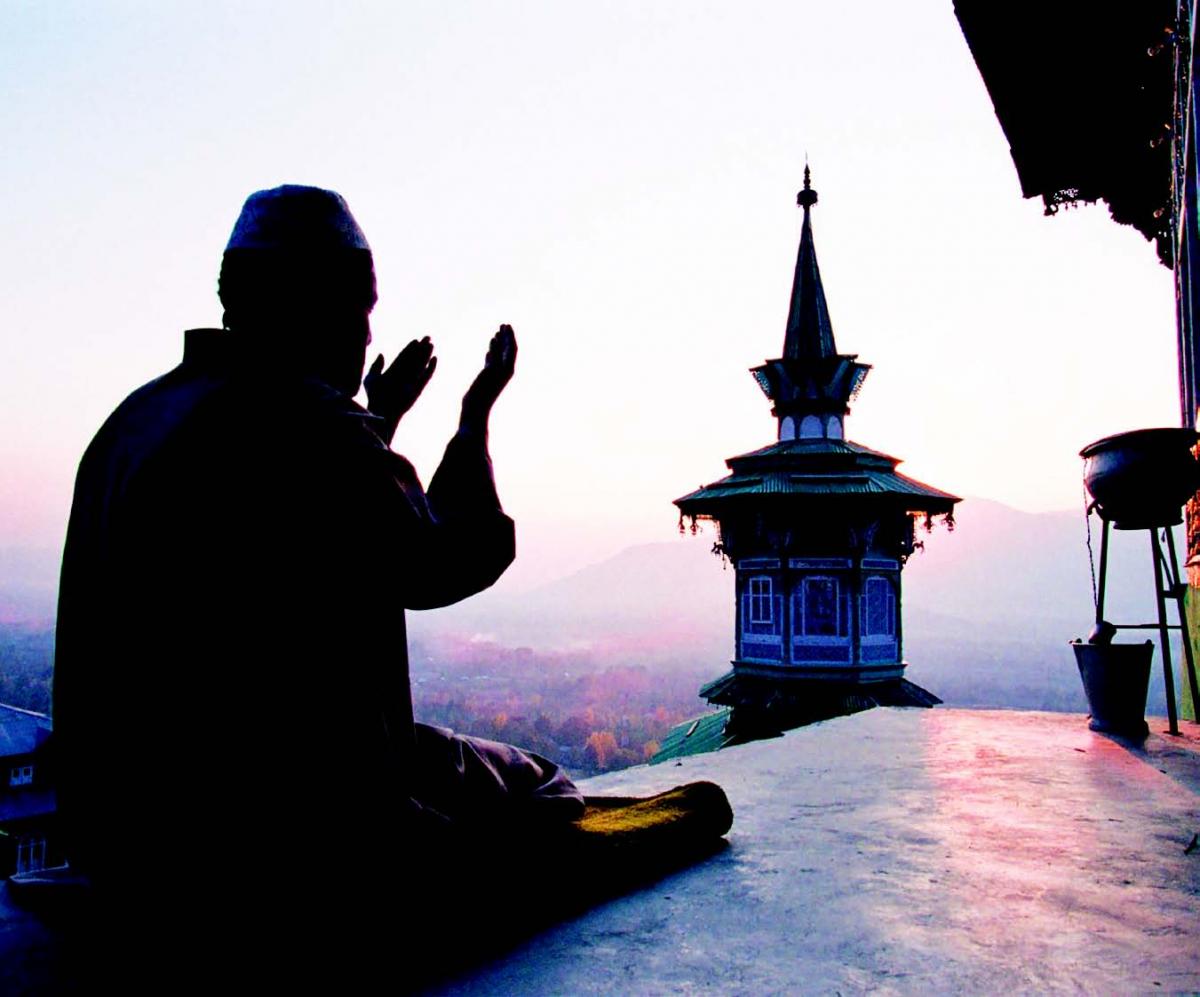
Kashmir is a melting pot of cultures, religions, ethnicities and regional identities. The Kashmiri identity is contested and variegated. It is still developing and has survived despite centuries of onslaught from different quarters. Religion has played an important role in shaping the indigenous Kashmiri identity. Kashmir embraced Hinduism, Buddhism and Islam equally with open arms. All these religions went on to create an identity and culture that we witness today. These religions left an indelible mark while shaping the identity of a common Kashmiri. Due to the egalitarian message and practices of Islam, most inhabitants of Kashmir who were reeling under the darkness of social prejudices and caste system embraced Islam without much resentment. Islam in Kashmir was spread through the egalitarian practices of Sufis. Sufism too accepted local influences of Hinduism and Buddhism and an indigenous strand of Sufism termed as “Rishism” evolved.
These Rishis evolved a culture of harmony, fellow feeling and community welfare in the Valley. Further they did not proselytize and rarely engaged with theology. Hence they were never at the centre of controversies. They practiced the values of Islam and for them most mystical practices of every religion lead to the same goal. The God of all religions is same for them and religions are different paths that lead to the same goal. It was their inspiring lives and moral characters that drove hordes of men to their hospices that still continue to be the centres of attraction even centuries after their death. Most of these hospices had a madrasa, boarding, lodging facilities and a free community kitchen associated with them. But now those are relics of past as most shrines and hospices have now been rendered as dens of nepotism, sectarian hatred and money minting institutions for those who control them.
Most of the Rishis spoke against this clergy and priestly class of Islam using derogatory term (Mullah) against them. The poetry of Sheikh ul Alam better known as Alam Dar e Kashmir (torch bearer) or Nund Rishi is full of criticism against this priestly class. Unfortunately, this message of Nund Rishi has been distorted by clergy class who has co-opted and annexed his hospice and now is indulging in the same acts against which Nund led a crusade during his whole life and was even incarcerated by the nefarious designs of the mullahs of his times.
Most Kashmiris have a deep faith in transcendence and the divine reality of God. The shrines and hospices were revered but with the advent of Islamic revivalist movements in the mainland India, the reverence of shrines and hospices came to be disputed. The puritanical, exclusivist Ahle Hadith or Salafi movement started a tirade against the shrines that they described as institutes of grave worship. So in order to behold and save Muslims they started a venomous campaign against shrines, describing them as bastions of shrik.
To supplement them Deobandis too jumped in the bandwagon and reinforced their efforts, though unlike Salafis they had a soft corner for Sufis and were not as vociferous in their criticism and campaigns against the Sufis, shrines and hospices. As a reaction to their efforts, the mullahs who have economic interests associated with shrines started supporting the Barelwis, who started owning the Sufis, describing themselves as their real inheritors and piling up wrong evidences for every economic activity conducted at shrines being in spirit with real Islam.
All these discourses of Salafis, Deobandis and Barelwis are quite alien to Kashmir. All these schools of thought are extremist in their outlook and rabidly sectarian and if provided with hospitable environs violent too. These groups have carried out violent acts against each other and different other sects in the recent past. Earlier they engaged with each other through writing diatribes, pamphlets and books denouncing each other and describing them as deviated and charging them with heresy. The sectarian mosques were used to hold debates against each other. Also the co-option and annexation of shrines by Barelwis who wrongly masquerade as Sufis has done a severe damage to the syncretic and plural message of Kashmiri Rishis.
The distortion of Sufism by Barelwis is another challenge that needs to be met. Now the fault lines between these sects are evident even among the common masses that are caught up in non ending diatribes because social media and internet has made it possible for masses to have a peek into these debates. Literary rebuttals against each other were confined to a refined section but now the videos of the sectarian mullahs are available for mass public consumption, thus widening the divide. Add to it the crisis in Middle East particularly Syria that has opened the Pandora’s box of Shia-Sunni violence. It has its impact on the Muslims of subcontinent too. Although we do not hear about violence between Shias and Sunnis in India but with each passing day the fault lines are widening. To add insult to injury some deobandi mullahs in Kashmir like Noaman Nowsheri and Muzaffar Qasmi are openly attacking the other sects. The show-boy Noaman Nowsheri is being elevated as the Manazir e Islam (Debater of Islam) as he claims to have defeated many Salafis, whereas Salafi mullahs like Abdul Latif Al Kindi and Abid Salafi are refuting him and others.
Many mosques and madrasas have been retrograded into debating theatres and in some cases physical abuses have taken place too. These repugnant debates are streamed live to score points over the opponents. In Prophet Muhammad (pbuh)’s era Masjid e Zaraar was established by certain Muslim hypocrites to carryout nefarious designs against Islam and Muslims. Prophet (pbuh) ordered the mosque to be demolished. These sectarian mullahs are retrograding every mosque to Zaraar, their designs need to be fought against and a social boycott of these sectarian mullahs needs to be orchestrated. They are vilifying the real message and values of Islam for cheap publicity and earning few bucks.
M.H.A.Sikander is Writer-Activist based in Srinagar, Kashmir
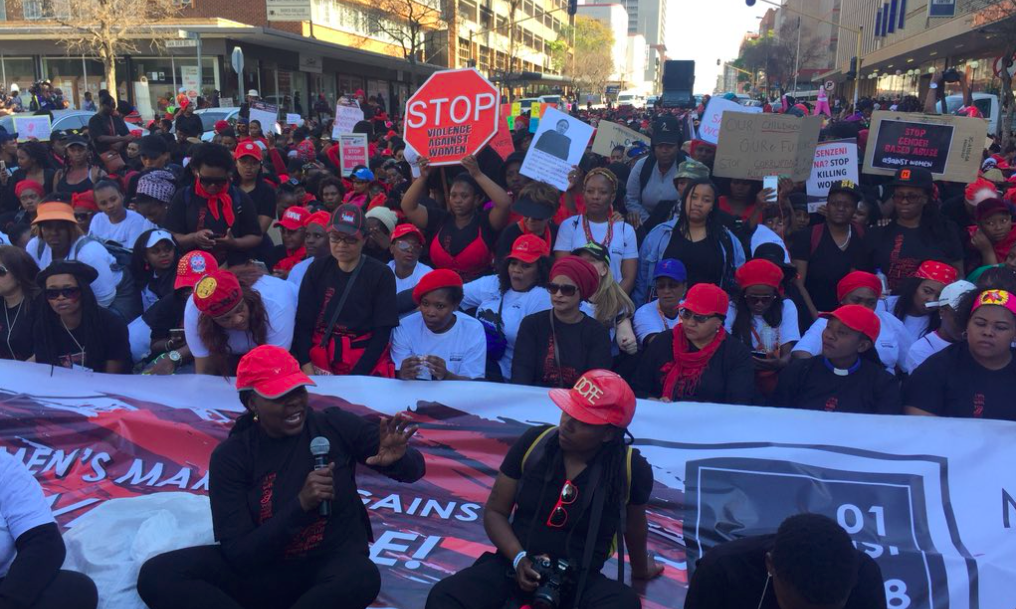
Marches were organized in all nine provinces in the country and also in Lesotho, Swaziland, Botswana and Namibia
Women and GNCs march to demand an end to gender based violence and rape culture. (Photo: NUMSA/ Twitter)
On Wednesday, South Africa witnessed a nation-wide shut down against the increasing gender-based violence. Tens of thousands of women and gender non-conforming (GNC) people marched across the country demanding an end to rape culture and gender-based violence. Chanting ‘enough is enough’ and ‘my body is not a crime scene’, they marched through various cities.
Marches were organized in all nine provinces in the country and also in Lesotho, Swaziland, Botswana and Namibia. As part of the march, a call was given for a shut down of economic activities for the day or at least between 1 pm and 1.30 pm.
“Every week, we receive multiple reports of women, children, and gender non-conforming people who have been brutally murdered, kidnapped, or abused, and there is no sense of urgency from our leaders to find ways in which society can tackle this violence,” said the organizers of the Intersectional Women’s march.
According to South African Police Service (SAPS) crime statistics, in 2017, 49,445 sexual offences were recorded, while in 2016, 51,895 complaints of sexual offences were filed. The South Africa Demographic and Health Survey 2016, conducted by Stats SA and the South African Medical Research Council (MRC), noted that one in five women had experienced violence at the hands of a partner. Also, the report underlined that women living in the lowest wealth quintile (among five) experienced the most physical violence, as did women with no education.
The major trade unions, South African Federation of Trade Union (SAFTU), National Union of Metalworkers of South Africa (NUMSA) and Congress of South African Trade Unions (COSATU), among others, extended their support to the march. NUMSA, in a press statement, speaking about the rising gender-based violence and xenophobia, noted the case of a Zambian woman, who while speaking at last week’s Working Class Summit narrated the discrimination faced by her and the horrific treatment she had received at a hospital after being gang raped and attacked. The total shutdown is happening as Women’s Month begins in South Africa commemorating the the August 9, 1956 Women’s March, when more than 20,000 women led by the Federation of South African Women (FSAW or FEDSAW) marched to the Union Buildings in Pretoria against country’s apartheid law. The law required a form of internal passport system designed to segregate the population and prohibit black people from urban areas, which were declared as ‘white only’.
The Chief Justice of India, Dipak Misra, while hearing a petition for a ban on the Malayalam novel Meesha by S Hareesh, observed that “the culture of banning books directly impacts the flow of ideas”. The court has asked for the publisher to produce a translated copy of the novel, and has reserved orders on the case.
With the rising number of cases of attacks on writers and the freedom of expression, this observation has been welcomed by a number of writers.
Activist and Malayalam editor in the National Book Trust Rubin D’Cruz said, “The Supreme Court’s observation on the petition to ban Meesa is a landmark statement on freedom of speech and expression. This comes on a continuation to the Chennai High Court order on writer Perumal Murgan’s case. It is a very reaffirming development in the present scenario where artists and intellectuals are being threatened and ridiculed.”
Konkani writer Damodar Mauzo, who was one of the names on the hit list of Sanatan Sanstha, and who has recently been given protection by the Goa police, said, “At a time when people are losing faith, this comes as a moral boost to the free thinking community, particularly the community of writers. I’m very happy with this judgement. Freedom of expression upheld by the Supreme Court. This will strengthen people’s faith in the Judiciary.”
Malayalam poet K Satchidanandan impressed on the importance of context. He said, “I am very happy to note that the Supreme Court has taken cognisance of the Writers’ unfettered freedom of expression, and taken a stand against the banning of books. It has also made a clear distinction between deliberate pornography and creative writing. A character’s s conversation in a novel cannot be read like a press statement by the author. And no reader is supposed to identify the writer with his characters as fiction is not autobiography. The language the characters use too depends on the narrative context and the background of the character. Hence the whole case is baseless and filed with the deliberate political intention to create divisions in the society. The publication of the book has been widely welcomed in Kerala though a few miscreants have burnt its copies. Most writers in Kerala are in solidarity with S. Hareesh.”
Kureepuzha Sreekumar, who is a Malayalam poet and who was also targeted by the RSS, had similar concern. He said, “Banning the works of any writer is an attack on their creative thoughts. As readers, we have the right to read whatever we want. At the same time, the reader also has the liberty to dislike the book if they want to. Let the people read the work and let them decide. If they don’t like they will stop reading his work. We should not jump into conclusions before reading it. The Supreme Court’s comment is welcomed. I congratulate the court’s decision to stand with the writer.”
K P Ramanunni is a Malayalam writer who has faced threats from Islamic fundamentalist groups. He donated his Sahitya Akademi award prize money to Junaid Khan’s family. Sharing the enthusiasm of other authors, Ramanunni said, “The Supreme Court of India upholds our Constitution. As writers and artists we are indebted to this institution. It has always upheld the constitutional rights – freedom of speech and expression — especially for the writers. The Supreme Court’s stand on S Hareesh’s case is a very welcomed one. But I would also like to point this; it should also take a clear stand against the mob attacks on the writers. The mob in this country uses a third degree violence method to snub our rights. The court should bring out a law against legally and socially banning of a book.
If the final judgement comes in favour of writer S Hareesh, then it not only just a victory over a case of a writer, it’s a victory for the rationalists, journalists and intellectuals like Dabholkar, Kalburgi, Pansare and Gauri Lankesh, and for the values they stood for. They were murdered by the right wing fundamentalist group because they wanted to curb their freedom of expressions.”