Email: sabrangind@gmail.com
AIUFWP rally on March 23 to demand forest rights for Adivasis
‘Serial Harasser’ professor being safeguarded by JNU Admin?
Looks like multiple allegations of sexual harassment is not a valid enough reason for the JNU administration to suspend a professor who has been charged with offences which are non-bailable in nature.

Students in JNU have been in a constant tussle with the administration since the past three days over the demand of suspension of Professor Atul Johari who has been charged with cases of sexual harassment and wrongful gestures by several women students. Seven women filed an FIR on Thursday while two filed on Friday.
The Delhi police registered cases against him on Friday but did not make any arrests. Meanwhile it was reported that Prof. Johari has “tendered his resignation”
The students say that ideally the administration should have suspended the professor right away but they did not do it. Instead, as per the students, they confined six of the girls in a room with the acting VC and tried to persuade them to take back their cases or raise it within the university ICC.
On the night of March 16, the students called for a March to Vasant Kunj thana to demand that police immediately arrest him. However, police refused to do anything before Monday.
The Deputy Commissioner of Police (South-West) Milind Dumbere said that a case was registered under Section 354 (sexual harassment and punishment for sexual harassment) and 509 (word, gesture or act intended to insult the modesty of a woman) of the IPC.
Professor or a Serial Harasser?
The series of harassment came to light when a 26 year old research scholar “went missing” from the campus and a missing report was filed by the father. The report was later withdrawn as she informed her parents about her whereabouts. Purportedly, in an email that she sent him, she called him “characterless” and that he did not have “manners to talk to girls”
Once this became public, several students from the School of Life Sciences (SLS), who had been working in Prof Johri’s lab, came forward to share stories of how he is a serial offender. Allegedly, the professor often “made sexually coloured remarks, openly demanded sex and commented on the bodies of almost of every woman. If a woman objected, he held a grudge against her and threatened to ruin her research career”
The JNU administration, though, did not show any interest in suspending the professor immediately. Moreover, students also reported that they were beaten up while they were protesting outside police station in the night.
This incident has brought back the debates of the replacement of the GSCASH (Gender Sensitisation Committee Against Sexual Harassment) by ICC (Internal Complaints Committee)

GSCASH vs. ICC debate
GSCASH, a body constituted by JNU in 1999 by the recommendations of the Working Groupd on Sexual Harassment in 1997. The Rules and Procedures were approved by JNU Executiev Council in 2001. The Committee implemented the Jawaharlal Nehru University Policy Against Sexual Harassment (1999) as also the guidelines laid down by the Supreme Court of India, in its ruling on the Writ Petition (Criminal) Vishaka vs. State of Rajasthan (1997) on the prevention and deterrence of sexual harassment at the workplace.
Afterwards, it also implemented modifications as per the newer developments such as SAKSHAM guideline by UGC in 2013. Its rules applied to all students and teaching and non-teaching staff. By its nature the GSCASH was more democratic as it had elected representatives.
However, the GSCASH was replaced by the ICC in its 269th Executive Council meeting held on September 18 2017 and ICC, which was supposed to have members nominated by the administration, was formed.
Students’ demands
In the recent incident, students have alleged that they don’t have any faith in the working of ICC and have continued their protest. Students also allege that members in ICC are close acquaintances of Prof Johari and are more interested in giving clean chit to the professor than taking any action against him as they have been publicising that he has “tendered his resignation” Also, as per the students, “. *His resignation is not from his job in JNU which means he will still be allowed to take lectures and supervise lab students. This will mean that he will potentially be able to be in physical communication with the complainants since they are from his own department.” Also, reportedly, Prof Johari had supported the very controversial mandatory attendance rule newly introduced by the JNU administration.
Students believed that this is once again completely antithetical to gender justice and cases of sexual harassment where the accused is issued a restraint order to not contact the complainant any cost and this can be ensured when he is suspended from his administrative as well as academic duties.
Students also called for a protest this afternoon outside acting VC Chinatamani Patra’s house and gathered there in large numbers
Related Article
Gender Justice First: Delhi HC Stands by GSCASH, JNU
How the Law and Society have treated Muslims in India
Sachar Committee Report on the status of Muslims in India, 2006
The Justice Sachar Committee Report 2005 is the first of its kind in India that provides useful insights into the socio-economic and security issues facing the Muslim-minority constituting 13.4 percent (about 173 million) of the population). Muslims are the biggest chunk of the Indian minorities.

Image: http://caravandaily.com/
The Sachar Committee report states: i) Muslims in India face a double burden in that they are regarded as anti-national and are at the same time are said to be pampered by the government; ii) police are highhanded in dealing with Muslims; whenever an incident occurs Muslim boys are picked by the police; iii) the state does not function in an impartial manner, the acid test for a just state; iv) Muslims, the largest minority in India, are lagging behind the other Indian communities in terms of most human development indicators; iv) ‘every bearded man is considered an agent of the Pakistani Inter Service Intelligence’; v) fake encounter killing of Muslims is common; vi) Police presence in Muslim areas is more common than the presence of industry, schools, public hospitals, banks and the like; vii) security personnel enter Muslim homes at the slightest provocation; viii) the plight of Muslims living in border areas is worse since they are treated as foreigners and are subjected to harassment by the police and the administration; ix) violent communal conflicts, often include targeted sexual violence against women, which tends to have a ‘spread effect’ even in areas not affected by communal violence; x) immense fear and a feeling of vulnerability that prevail have a visible impact on mobility and education, especially of girls; xi) the lack of adequate representation in the police force accentuates the problem in almost all Indian states and heightens the perceived sense of insecurity, especially in a communally sensitive situation; xii) insecurity leads to Muslims living in ghettos; xiii) the perception of being discriminated against is overpowering amongst a wide cross section of Muslims, resulting in collective alienation.
The much discussed and lauded secularity of the Indian state appears bogus when judged by the scale, intensity and widespread nature of the violence against India’s largest minority community since independence.
Though detailed research is needed and despite the many factors that must be considered, it can be broadly stated that in electoral terms, the ruling Bharatiya Janata party (BJP) has been the biggest gainer in the unprecedented communal mobilisation and mass violence against the Muslims that have been unleashed in Indian politics through the 1980s, the 1990s and after. In successive parliamentary elections, the party has steadily bettered its performance: the successive parliamentary (Lok Sabha) election years mentioned here are followed by seats won, in brackets: 1984, 8thLok Sabha (2); 1989, 9thLok Sabha (86); 1991, 10thLok Sabha (120); 1996, 11thLok Sabha (161); 1998, 12thLok Sabha (182); 1999, 13thLok Sabha (182); 2004, 14thLok Sabha (138); 2009, 15thLok Sabha (116); 2014, 16thLok Sabha (282).
The communal mobilisation of the last few decades in India has benefited the BJP di hugely in electoral terms. Besides winning three successive state assembly elections in Gujarat (never mind the carnage of 2002), the BJP led by Narendra Modi won the big parliamentary election in 2014 even if he won only 31 percent of the popular vote. The biggest losers in this process have, of course, been the Indian electorate!
It is not surprising that Prime Minister Narendra Modi is hesitant to condemn stoutly the Hindu communal mobilisation and violence that confronts him as Prime minister, no matter if it gives his party and government a bad name and his country a black mark.
The Criminal Justice System
Following features of the Indian criminal justice system are noteworthy: i) criminal justice system in India vis-a-vis the minorities, especially the Muslims, Christian and the ethnic communities in the Northeast, is in virtual collapse. Members of these communities are being implicated in many false cases, tortured and ill-treated in the criminal justice system; ii) The Supreme Court of India said that over 60 percent of the arrests made are illegal or unnecessary; iii) In 2009, it was found, on the basis of field investigations in several states, that about 1.8 million people are being tortured in police custody every year. Many of the victims are members of the minorities and weaker sections; iv) extrajudicial executions or ‘encounter’ killings are taking the place of torture in investigation. Such killings are occurring in several states of India.; v) ‘Encounter’ is an event in which the police shoot dead a person and later claim that he was killed while he undertook an ‘encounter’ with the police; vi) the repressive criminal justice system created by the colonial authorities was retained after independence; vii) the penal and procedural codes enacted by the British in the 1860s need revision in the light of the imperatives of the Constitution of India 1950; vii) the Indian Penal Code begins with chapters on criminal conspiracy and offences against the State. The prevention and detection of offences, the main task of the police are relegated to Chapter XVI and Section 299. The Bengal Regulation III 1818 used to deport people was not repealed. The offence of ‘sedition’, untenable in a parliamentary democratic system, introduced in 1870 in the Penal Code has been retained. Legitimate protest in a democracy is being penalised as ‘sedition’. Similar provisions can be found in the Criminal Procedure Code, 1861 and the Police Act 1860 (Anandswarup Gupta, 1979, Police in British India 1861-1947’); viii) the Supreme Court of India has said that ‘dehumanising torture, assault and death in custody are so widespread as to raise serious questions about the credibility of rule of law and criminal justice’; ix) the Second Administrative Reforms Commission, 2007 noted the ills of the Indian police as: ‘politically oriented partisan performance, partiality, corruption, inefficiency … the public complained of rudeness, intimidation, suppression or concoction of evidence and malicious padding of cases’. 80 percent of the people surveyed mentioned they had to pay a bribe in their dealings with the police. Out of the 11 public agencies surveyed, police were found to be the most unsatisfactory; x) in the name of investigating crimes, torture is inflicted not only on the accused, but also upon bona fide petitioners, complainants, informers and innocent bystanders’; xi) police training is abysmal; xii) the Indian judiciary needs reform and is over-burdened with a huge backlog of cases.
Other relevant points
The Constitution of India, 1950does not define minorities but refers to ‘minorities’ and speaks of minorities based on ‘religion and language’ spelling out their rights in Part III on Fundamental Rights, which are legally enforceable.
Part IV of the Constitution provides the Directive Principles of State Policy, which are not enforceable by law.
The government of India passed a National Minorities Commission Act 1992 and set up a National Commission for Minorities, 1993. The Commission mentions five religious Minorities: Muslims; Christians; Sikhs; Buddhists; and Zoroastrians. The Jains were added in 2014.
The Ministry of Minority Affairs and the Ministry of Home Affairs in the government of India deal with minority issues.
The UN Declaration of 1992 mentions ‘National or Ethnic, Religious and Linguistic Minorities’. This is a comprehensive phrase which goes beyond the category of the six religious minorities mentioned by India’s National Commission on Minorities, 2005.
It would be advisable for India to adopt a more comprehensive term and include national, ethnic and linguistic minorities. The Constitution of India needs amendment for this purpose. There must be a separate law for the prevention of violence against minorities in India.
There is increasing violence against minorities other than Muslims: indigenous communities in Central India and ethnic minorities in the Northeast of India, which are not included in the list of the National Commission on Minorities in India.
The National Commission on Minorities has the powers of a civil court and can summon witnesses. The Constitution needs to be amendment to provide the Commission with criminal powers of a High Court of India. The same should apply to the National Commission for Women and the National Commissions for the SCs and the STs along with the National Human Rights Commission, all concerned with minority protection.
The Constitution of India came into force in 1950. In view of the existence of a multiplicity of minorities in India including National and Ethnic Minorities and in view of the conflicts that are emerging from identity assertions across the country, there is a need for amendment of the Constitution of India and define the term ‘minority’ and enumerate the categories including religious, linguistic, national, ethnic minorities. The Constitution must also incorporate specific provisions for the protection of minorities from all forms of violence and provide them a fair and just criminal justice system. A separate law on minority protection on the lines of the existing law for the protection of the Scheduled Castes and the Scheduled Tribes needs to be passed in Parliament.
The Preamble to the Constitution of India declares India to be a ‘secular’ state (this is of special relevance to religious minorities) and to secure to all ‘liberty of thought, expression, faith and worship and equality of status and opportunity’.
The Fundamental Rights enumerated in Part III of the Constitution are judicially enforceable. The Directive Principles of State Policy enumerated in Part IV, though not judicially enforceable, are fundamental in the governance of the country. It shall be the duty of the state to apply these Principles in the making of laws.
Significant for the minorities are elimination of inequalities. The Fundamental Rights include, among other things, equality before the law; equal protection of the law; prohibition of discrimination on grounds of religion, race, caste, sex or place of birth; freedom to profess, practise and propagate any particular religion; freedom of religious instruction and worship etc. These provide for a multi-religious, multi-cultural, multi-racial Indian society with communal harmony.
The Muslim, the Christian and Sikh minorities have been victims of extrajudicial executions, torture, rape, intimidation, and implication in false cases, destruction of property and utilities and other illegal acts under the criminal justice system.
Non-listed minorities in the North-eastern region too have been subjected to similar abuse.
The Sikhs were subjected to genocidal killings after some members of the Sikh security forces assassinated former Prime Minister Indira Gandhi in protest against the killing of Sikhs during and after Operation ‘Blue Star’ (1984). The genocidal killings of the Muslims in Gujarat (2002) also violated the norms of the criminal justice system.
‘Transfer of power’ in 1947, led to the retention of colonial criminal laws, such as the Indian Penal Code (IPC), 1860, the Criminal Procedure Code (CrPC), 1861 and the Evidence Act, 1874 and the Police Act, 1860, which do not institutionalize human rights of minorities.
The primary focus of the Indian criminal laws is on the security of state, public order maintenance and state-centric intelligence collection. The first 299 sections of the IPC do not have anything to do with the investigation and detection of crimes.
There are no specific protective legal provisions for the minorities, who are increasingly subjected to violence, torture and extrajudicial executions in the Criminal justice process. Police, prosecution and the judiciary are not sensitised to minority issues; they tend to function within the existing framework of law and order.
International principles and standards on minority issues are yet to be incorporated in the Indian criminal justice system.
Police powers and Muslims
The new anti-terrorist politics have encouraged the devaluation of the criminal justice system resulting in the prosecution of innocent Muslims. They are not involved in terrorist activities but are falsely implicated by the police in such cases for getting government recognition and rewards. The criminal Justice System (CJS), now jocularly termed ‘criminal administration of justice’. Far from getting any specialised attention and protection, the minority communities especially the Muslims are targets of police harassment for alleged ‘terrorist’ activities.
This problem is clearly brought in a study, which documents registration of false cases against innocent Muslims (and an ethnic minority person from the North-east) who are subjected to systematic police harassment, cruelty and torture and implication in false criminal cases under special security legislations involving prolonged imprisonment and more (see: ‘Framed, Damned, Acquitted: Dossiers of a very Special Cell, A Report by the Jamia Teachers Solidarity Association, New Delhi, 2015)
Indian police organisation is of colonial-repressive, paramilitary origins and subject to civilian authorities and politicians. Its priorities are not service to the people but to their political masters. Police is centralised and relies on secrecy with limited understanding of the causes of communal violence. It indulges in periodic exhibitions of force with interplay of police and military functions. It is linked rural and urban propertied interests and equates force with authority and opposition with crime. In the law, police officers cannot be prosecuted without prior permission from their superior authorities.
The Indian Penal Code, 1860 (IPC) is preoccupied with state security and begins with chapters on criminal conspiracy and offences against the state. The detection of property offences and offences against the person come only from Part XVI and section 299. Obnoxious regulations such as Bengal Regulations III, 1918 which was used to deport freedom fighters are retained. The offence of ‘sedition’ was added as an IPC offence in 1870.
The Criminal Procedure Code, 1861 (CrPC) has chapters on security for keeping the peace and maintenance of public order including use of force by the police, which take precedence over the investigation and trial of criminal offences.
The Police Act of 1861 prioritises collection of political intelligence. The prevention and investigation of crime is only from section 23. It provides for punitive policing. Police officers including the constabulary vested with vast powers.
The police are not popular given the persistence of repressive colonial laws which have continued.
The East India Company’s Board of Directors had said (1856)that ‘the Indian police are all but useless for the prevention and sadly inefficient in the detection of crime; unscrupulous in the use of authority they had a generalised reputation for corruption and oppression’.
David Bayley (‘Police and Political Order in India’, Asian Survey, 1983) said: ‘police officers are preoccupied with politics, penetrated by politics and participate in it individually and collectively.
No serious police reforms have taken place in India since independence. The reports of the National Police Commission (1979-81) and of the Second Administrative Reforms Commission (2007) are gathering dust in government archives.
More generally, i) the National Human Rights Commission NHRC) said that 60 percent of the arrests made are unjustified or unnecessary; and 75 percent of the complaints made to the NHRC were against the police; ii) the Supreme Court of India observed that: ‘dehumanising torture, assault and death in custody are so widespread that questions about the credibility of the rule of law and the administration of criminal justice arose’; iii) the Vohra Committee report 1993, dealt with the ‘criminalisation of politics and politicisation of crime. It noted the ‘nexus between politicians, criminals and civil servants’.
Addressing root causes
Lack of political will and non-implementation of recommendations made by several reforms Commissions are among the causes. Structural inequality and injustice in the social and political system too need to be mentioned. Muslims (13.4 percent of the Population) and Christian (2 percent of the population) and Sikhs (about 2 percent) are the primary victims of the failure of the criminal justice system in India.
Some practical suggestions
The Constitution of India needs amendment to include, not just religious minorities but also national and ethnic, indigenous (Scheduled Tribes) and caste (Scheduled Castes) minorities and their languages and cultures; a list of recognised minorities should be provided.
A new law must be enacted to prevent and punish crimes against the minorities, especially Muslims and Christians, on the lines of the SC/ST (Prevention of Atrocities) Act, 1989.
Accountability mechanisms must be strengthened for police and political misbehaviour.
Criminal justice reforms must include UN guidelines such as i) the Code of Conduct for Law Enforcement officials, prosecutors, lawyers and judges; ii) Basic Principles on the Use of Force and Firearms; Standards and Norms in Crime Prevention and Criminal Justice; iii) Special Procedures of the UN Human Rights Council such as Working Groups on Arbitrary Detention, Enforced and Disappearances, Special Rapporteur on Extrajudicial, Summary and Arbitrary Executions, Torture and other Cruel, Inhuman or Degrading Treatment or Punishment and Standing Invitation to Special Rapporteur on the human rights and Fundamental Freedoms of Indigenous Communities.
((*** This is the concluding part of KS Subramanian’s essay ‘Babri Masjid 1992 – Gujarat 2002 – Kashmir 2016: How the SanghParivar has wrecked India’s secular social fabric by sustained anti-minority violence’. The author is a senior, retired member of the Indian Police Service-IPS.))
About the author
K.S. Subramanian is a former officer of the Indian Police Service. He was a member of the Concerned Citizens’ Tribunal on Gujarat 2002 led by Justice VR Krishna Iyer. He has a PhD in Political Science (Karnatak University). He has worked in the Delhi administration; Himachal Pradesh and the Northeast; the Intelligence Bureau; and the Union Home Ministry. He was professor the Indian Institute of Public Administration, New Delhi; and the JamiaMillia University, New Delhi. He was Visiting Fellow at the Indian Institute of Advanced Study, Shimla; Queen Elizabeth House, Oxford; Centre for Contemporary Studies, Nehru Memorial Library, New Delhi; and Institute of Development of Studies, Sussex. He was a member of the Concerned Citizens’ Tribunal on Gujarat, 2002. He has authored several books three on the Indian Police and two on the Northeast. He is the author of ‘Parliamentary Communism: Crisis in the Indian Communist Movement (1989) and State, Policy and Conflicts in Northeast India, (2017). He contributes to Asian Age, Hongkong.
Remembering defender of secularism who died for standing up for people’s unity
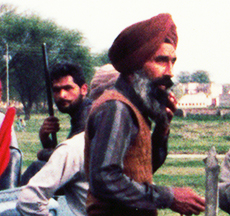
This month marks 30 years of the assassination of Jaimal Singh Padda- a leftist activist from Punjab who died for standing up for secularism.
Early Life
Born in 1943, Padda’s father Santokh Singh Mastana was a Sikh farmer and an activist associated with the Akali Dal – a regional party of Punjab that claims to represent the interest of Sikh peasantry. As Padda grew up, he inherited the Sikh values from his father and always believed in the progressive aspect of Sikhism. Padda who eventually became a dedicated social justice activist drew lot of inspiration from the Sikh philosophy that is based on the principles of egalitarianism and teaches its followers to stand up against repression. He used examples from the Sikh history to connect with the masses who understood religion more than the dynamics of left wing politics. Padda was good in sports and fond of reciting poems when he was in the high school.
Social Work and Politics
Under the influence of a veteran Communist in his native village Lakhan Ke Padda, he gradually got drawn to the Communist movement. He started getting involved in activities, such as raising awareness against social ills and superstition through plays and cleaning up village streets and drains. They also tried to educate people about current affairs and various struggles using ordinary tools such as blackboard in the village.
Padda had to struggle hard to earn his livelihood through farming as he had a very small landholding and tried his luck by driving taxi outside Punjab. He also taught the seniors as part of the state run program of educating the illiterates.
He got married to Amarjit Kaur in 1964 and the couple had three children. However, the life of domesticity and economic hardships did not deter Padda from spending more time in political activism. In 1967, he became involved in the revolutionary communist movement that started with the uprising at village Naxalbari in West Bengal following police repression of tillers fighting to liberate themselves from the shackles of the landowners.
He now represented the Communist Party of India (Marxist-Leninist). As a member of this group he led many agitations and had to suffer police torture and arrests. He raised voice for the revolutionary communists who were killed by the Punjab police in staged shootouts. He was also in the forefront of the agitation against Emergency that was imposed by the then Prime Minister Late Indira Gandhi in 1975.
Amarjit Kaur stood behind him like a rock throughout this period. But more challenges were yet to come.
Padda was a good singer. His voice and rebellious poetry became handy in mobilizing crowds for the public meetings of CPI (ML). This had inspired prominent documentary filmmaker Anand Patwardhan to make a film on the communists who were fighting against reaction and the state in Punjab. The film is named after the lines from Padda’s famous song “Una Mitran Dee Yaad Pyari” (In sweet memories of those comrades).
The Punjab Crisis
In 1980s, Punjab went through another political crisis. This was a time when the Akali Dal was asking for political autonomy of the state and concessions for the Sikh minority who merely make two percent of the Indian population. Some believe that the Indian state under Indira Gandhi kept lingering on the issue in order to polarize Hindu majority against the Sikhs. This saw the emergence of a parallel movement of Sikh extremists who believed in an armed resistance. As a result, death squads began targeting innocent Hindus and political critics, including moderate Sikh politicians.
Under those circumstances, the Golden Temple Complex, the holiest shrine of the Sikhs in Amritsar became a battle ground. Accusing the militants of turning the place of worship into a fortress, Gandhi ordered a military invasion on the shrine that resulted into the deaths of many innocent pilgrims and devastation of important buildings inside the temple complex. This had enraged the Sikhs all over the world following which Indira Gandhi was assassinated by her Sikh bodyguards on October, 31 1984. Gandhi’s Congress party organized anti-Sikh massacre in different parts of India not only to avenge the death of their leader, but to win the next general election by creating Hindu-Sikh divide and scapegoating Sikhs.
Padda has been vocal against both the Sikh and the Hindu fundamentalists during this time. His slogan was “Naa Hindu Raaj, Naa Khalistan, Raaj Karega Mazdoor Kisaan.” (Neither Hindu state, nor Khalistan, we want the working class to rule)
Even though he had organized public forums to challenge the stereotyping of the Sikhs outside Punjab and their continued harassment by the police in the name of war on terror, he kept receiving threats from Khalistanis who also saw communists as their enemies. So much so, Padda who wore turban and sported flowing beard was also detained on couple of occasions on suspicion of being a Sikh militant by the police. The state did not really discriminate between the Khalistanis or the communist revolutionaries.
On one occasion, Hindus from his village intervened to get him released. He had two houses in the village. One was located in the Hindu dominated colony. For his safety he mostly stayed there during the night. On March 17, 1988 he was killed right outside this house by the shooters belonging to Khalistan Commando Force (KCF) that later claimed responsibility for his murder. Years later though, the KCF leader Labh Singh had acknowledged in his diary that to kill Padda was a mistake. Singh wrote that though Padda was against Khalistan for ideological reasons, he wasn’t someone who was working in the interest of the Indian state.
‘Anti-national’ youth arrested in Bihar based on ‘doctored video’?
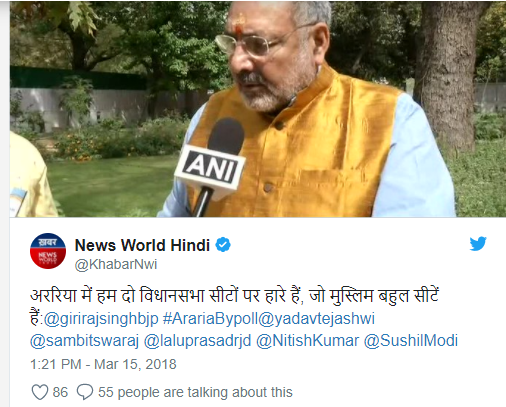
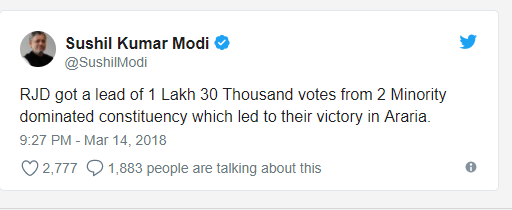
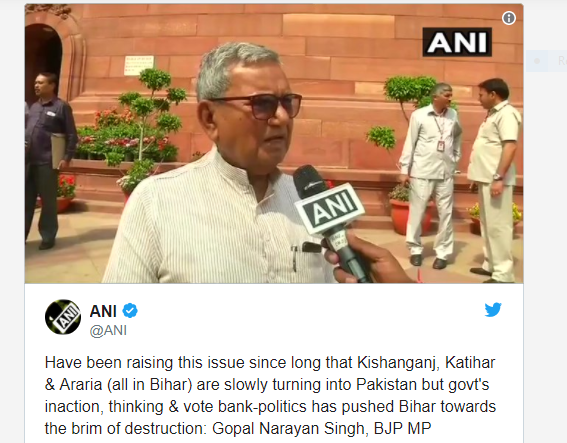
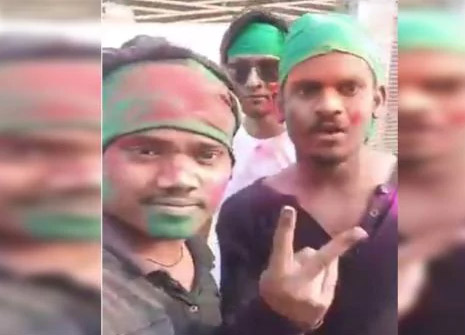
After BJP’s loss in Araria by-poll election two persons were arrested today for allegedly raising anti-national slogans. Apparently, they were celebrating RJD candidate, Sarfaraz Alam’s victory in the election.

However, fact checking websites like altnews have claimed that the video, which became viral and on the basis of which the people were arrested, is doctored.
The video seemingly has the accused shouting “anti-India” and “pro-Pakistan” slogans after the declaration of the by-poll results on Wednesday.
The District Magistrate Himanshu Sharma said, “Two persons named in the FIR — Mohammad Shahzad and Mohammad Sultan — have been arrested. The third accused, Mohammad Abid, will be nabbed soon” They were arrested after the SHO of Araria town police lodged an FIR against a group of persons — three named, the rest unidentified — under various sections of the IPC and IT Act.
However, altnews website claimed, “Even a casual look a the video will make it apparent that there are serious issues with lip sync in the video” They also claimed that at a certain point in the video the background noise becomes zero which raises initial doubts. Further there is no audio-video sync. Illustrating that the video isn’t reliable, they have suggested for the examination of the video by a certified forensic laboratory for its authenticity observations necessitate that the video be examined by a certified forensic laboratory for its authenticity.
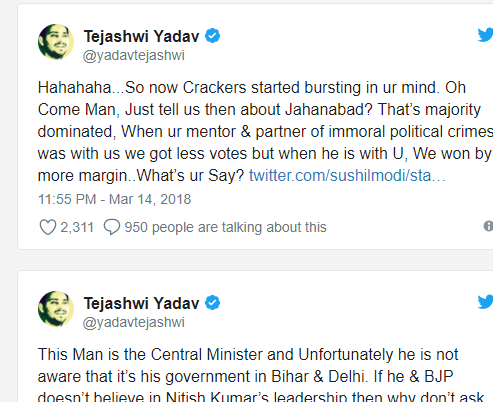
On similar lines, the leader of Opposition in the Bihar Assembly, Tejashwi Yadav said, “Let the matter be thoroughly investigated. Videos that go viral are not always authentic. Moreover, those named as accused may not necessarily be our party workers”
He also alleged that as per his conversations with Alam, he had told him that no victory celebrations were taking place and that BJP is already running a smear campaign against them, saying that RJD’s victory is a boost to terrorist activities.
Related Article
1) How Social Media, TV Use Fake News: Basirhat Riots
Jharkhand victim’s widow says she does not want death penalty for convicted gau rakshaks
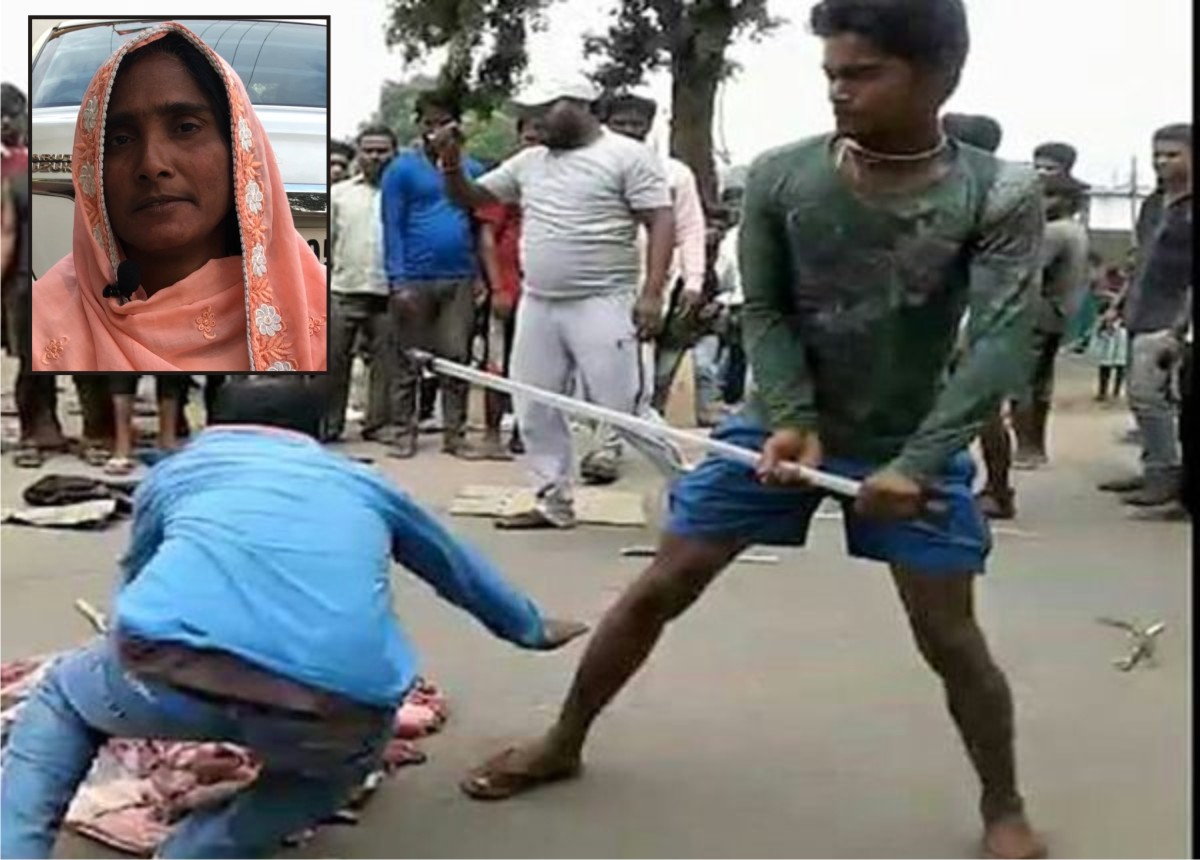
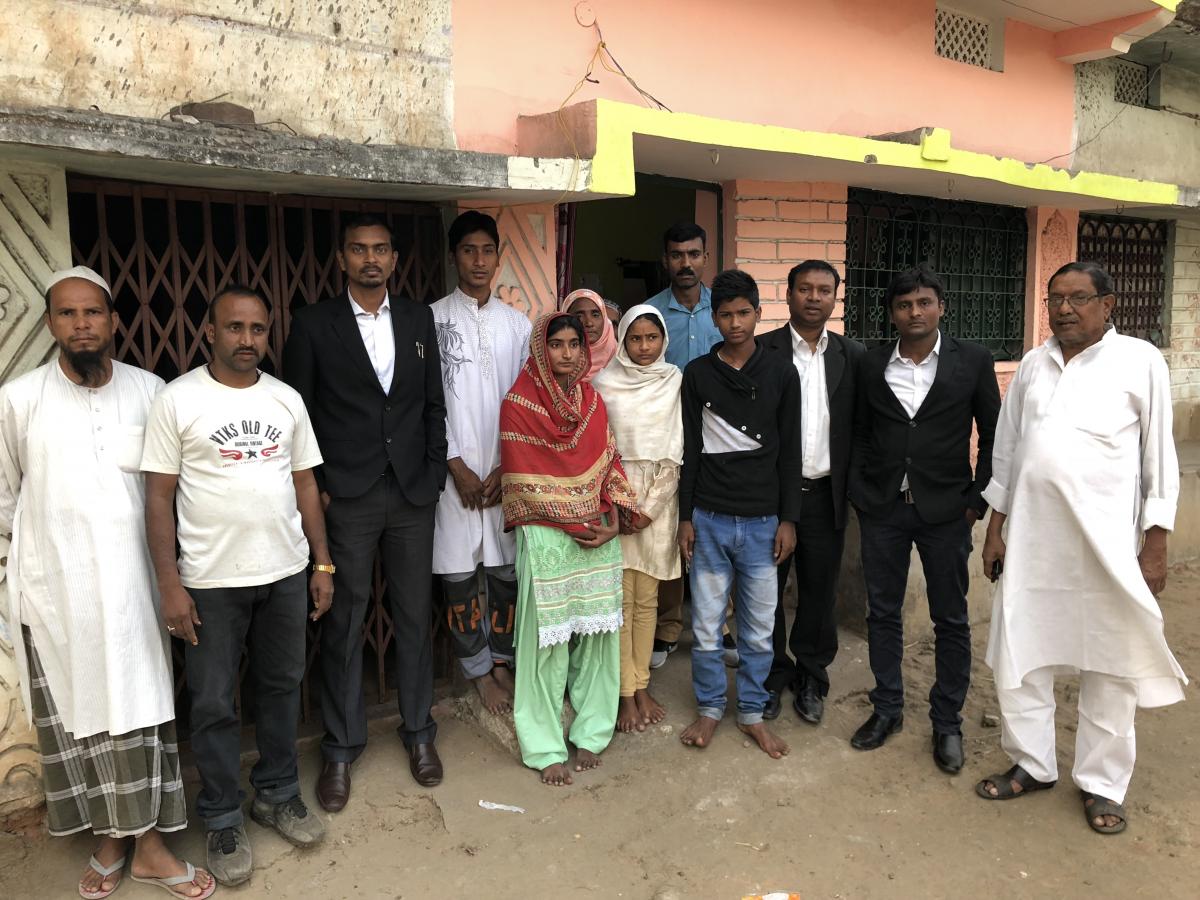
RAMGARH (Jharkhand), March 17, 2018 — Mariam Khatoon, the widow of Alimuddin Ansari who was killed by gau rakshaks on June 29 last year, has said she does not want her husband’s convicted killers to hang.

“Though they murdered my husband I don’t want them to lose their lives,” she told this reporter at her home shortly after a court here found the 11 accused guilty of killing him. “I would prefer the court gave them life imprisonment.”
The court’s guilty verdict for the 11 men is the first conviction in India for gau rakshaks, the self-styled cow vigilantes linked to the RSS-BJP-VHP-Bajrang Dal, who have gone on an attack-and-kill spree especially since the BJP-led government of Prime Minister Narendra Modi came to power in May 2014.
While the 11 men, at least one of whom was a well-known BJP leader in this district, have been found guilty of murder under section 302 of the Indian Penal Code, three of them were additionally found guilty of conspiracy under section 120(B) of the IPC.
Sentencing is due on March 21, Wednesday.
Mariam Khatoon implored prime minister Modi to put an end to continuing assaults by the gau rakshaks on innocent Muslims across India.
“There is terror of the gau rakshaks among the Muslims and Mr. Modi should realise it is not good for inter community relations,” she said. “Please, for god’s sake, stop it.”

She also said that the Hindu neighbours in her village were no less supportive of her and her family than the Muslim community. In fact, she said, never had there been any chasm between the Hindus and Muslims in not just the village but in the entire Ramgarh district.
Announcing the verdict in Hindi in open court at about 3.30 pm on Friday, Additional District Judge Om Prakash said that he had considered all evidence and witness statements before ruling the accused as guilty. A full judgement in writing is expected to be delivered along with the sentencing.
Alimuddin was waylaid by gau rakshaks at a prominent city thoroughfare on the morning of June 29, 2017, and severely beaten. The gau rakshaks accused him of carrying beef in his car. After the police arrived on the scene he was taken to a local hospital where he shortly died of his injuries.
The defendants denied they had assaulted Alimuddin and, instead, claimed he died of in police custody due to police torture. The judge rejected this contention.
For hours before the verdict was given the road leading to the courthouse, as well as the court premises itself, was heavily patrolled and guarded by a special police force.
The sprawling lawns of the courthouse teemed with young men in bright saffron shirts, many of whom also sported saffron bandanas around their foreheads, who were obviously supporters of the defendants. Many said they were active members of the Bajrang Dal.
Women and children from the families of the accused crowded the narrow corridor at the end of which lay Judge Prakash’s courtroom. None, however, but the lawyers and a handful of journalists were allowed into the court, right after the 11 accused, their hands tied with a long, single rope, were marched into the massive iron cage inside the courtroom.
Dressed in shirts and trousers, all the accused wore fresh saffron tilaks on their foreheads.
This reporter counted at least 22 lawyers on the defendants side, greatly outnumbering the lone public prosecutor flanked by three lawyers that represented Mariam Khatoon’s family.
As the judge pronounced his verdict there was stunned silence all around in the courtroom. In conversations with this reporter before the verdict was read the families as well as the Bajrang Dal supporters had appeared confident that most, if not all, the accused would be acquitted.
As the team of lawyers left the courtroom the convicts’ families and supporters crowded around individual lawyers trying to make sense of what had just happened.
Mariam Khatoon and her family were conspicuous by their absence from the courthouse, although about half a dozen of their well-wishers from her village were present. After the verdict was given, they quietly hurried out.
The defendants’ lawyer, M. B. Tripathi, told this reporter they will appeal the conviction at the Jharkhand High Court in Ranchi after the sentencing.
National Register for Citizens Update in Assam: Issues of Concern
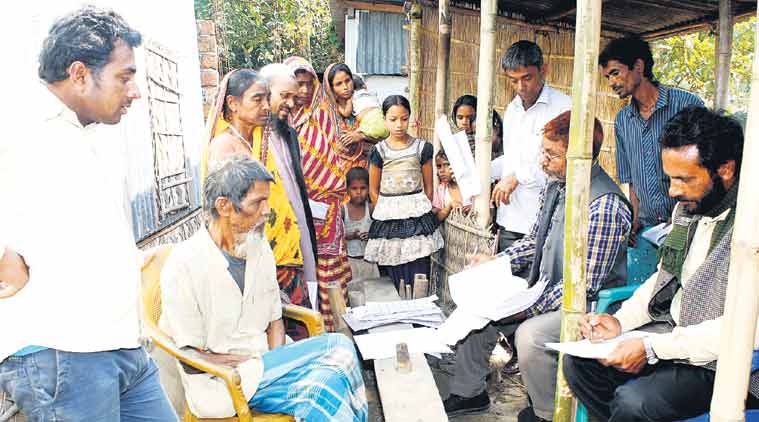
On February 3, 2018, Sadbhav Mission, in collaboration with Delhi School of Social Work, organized a one day seminar, “Migrant Workers: Rights and Concerns”. A special session was held on NRC update in Assam. Based on the presentations and discussions following consensus emerged.

Image: Indian Express
- Assam is the only state in the country where National Register for Citizens (NRC) exists. It was created in 1951. Now the update of the NRC is underway under Supreme Court monitoring. Its basic premise is unfortunate. The constituents of the present regime in the state have carried out vicious propaganda for long that the state was infested with large percentage of Bangladeshis. The voter list update in 1998 (that marked D against doubtful voters) and subsequent Tribunals’ findings indicate that less than one percent of the Muslim population in Assam are of Bangladeshi origin. Yet 99% citizens were treated with contempt. During the 2012 Bodoland violence, in which 100 people were killed and 4,00,000 rendered homeless, Indian citizens were not allowed by the BTC (Bodoland Territorial Council) to accept even the meagre compensation announced by the Centre for several months simply on the pretext of revenue record verification.
- The Bangla speaking Muslims in Assam are overwhelmingly working class. Their forefathers have been living in India for millennia. During the colonial period, as village industries perished, many people were forced to migrate to other parts of the country for survival. Some travelled to the barren areas of Assam. According to the 1941 census, the Muslim population in Assam was 26%. The partition of India in 1947 was a calamity forced on the people. The working classes had no role, what so ever, in it. It only made them vulnerable to sectarian killers. Partition was a division of political power, some provinces were to come under Muslim League rule and remaining others under the Congress rule. People could stay where ever they liked, in India or Pakistan. Another calamity fell on the working classes of our common origin in 1970-71 when military crackdown in East Pakistan forced millions to seek refuge in India and India fought a war with Pakistan, creating a sovereign Bangladesh. Many refugees returned to Bangladesh. but some overstayed. In India Accord of 1985, signed between the central government, state government and AASU, accords citizenship to those who arrived in India prior to March 24, 1971, the day Bangladesh was created.
- The current update of NRC demands the following procedures: an applicant must find the name of his or her father or grandfather or great grandfather in either of the three places: the NRC of 1951 or voter list of 1966 or voter list of 1971. Then one has to submit the proof of his/ her link with this person, by producing documents, that have applicant’s name and his/ her father’s name, father’s name and grandfather’s name, grandfather’s name and great grandfather’s name. For girls, who never went to school, this was extremely difficult to establish. For them, the Supreme Court (SC) has made certificate from Gram Panchayat admissible, subject to verification of its authenticity and contents. The state must maintain transparency in the process and must not let partisan officers sabotage the process.
- The first draft of NRC released on December 31, 2017 carries only 1.9 crore names from a population of 3.4 crore. In the Kokrajhar area alone where some of us visited the villages, only 70% of the Rajvanshis and 30% Muslims find their names in the draft. Yet the people are maintaining hope that their names will figure in the second draft of the NRC.
- The second draft is expected in a few months. Many genuine names may still be missing from it. This will break peoples’ backs. They must be allowed a substantial period of time to file their responses. No harsh conditions must be imposed on them. No discrimination be made on the basis of religion, as was proposed by the state government some time ago.
- One believes that the update will accommodate those who entered India prior to March 24, 1971 but acquired citizenship in later years.
- One is not clear what would be the status of children and grand children born in India from those parents who entered India after March 24, 2071. These children have lived here for decades. Their ancestral roots are in India. They must be treated on par with the laws that are applicable on people of Indian origin living in other countries. In the USA and 30 other countries of the world, for instance, the children of illegal aliens have right to citizenship in the country of their birth. These people are not a burden on economy. They are the victims of global modern economy that forces them to migrate for survival. A worker contributes more to nations’ wealth that what he gets. These people must not be thrown at the mercy of criminals and communalists. If they have to be deported, it should be done following the international norm
(These were the findings of a visit and report by the Sadhbhavna Mission, Delhi)
Local BJP leader among 11 convicted in Alimuddin Ansari lynching case: Jharkand
A local BJP leader was among the 11 people convicted in the Alimuddin Ansari lynching case in Jharkand that took place on June 29, 2017 in Ramgarh district of Jharkand. In a first, the conviction of any of the lynching cases that have taken place post 2014 when the new government came to power a trial court in Jharkhand today convicted all of the 11 people accused in a cow vigilantism-related murder case. Ansari was a meat trader who was mercilessly killed in the attack.

All of the 11 accused – including a local BJP leader – were convicted under IPC Section 302 (murder). In addition, three of them were convicted under Section 120B (conspiracy) – indicating that the court was convinced that the attack was pre-meditated. This is the first time, ‘gau rakshaks’ or self proclaimed cow protectors have been convicted in a case relating to ‘Gautankwad’ or violence in the name of cow protection, anywhere in India. The sentencing will take place on March 20.
Alimuddin Ansari aka Asgar Ali of Mouna village was allegedly carrying 200 kgs of meat in his van when he was intercepted by the mob at Bazartand in Ramgarh district. They dragged him outside his vehicle and beat him with sticks and pieces of meat. The mob also set his car on fire. His assailants had been keeping tabs on him ever since he purchased the meat at 7:30 in the morning and tracked and followed him for 15 kilometers before attacking him. His car was also set on fire. The police had intervened and rescued him within 30 minutes. He was first taken to Sardar Hospital in Ramgarh, but transferred to Rajendra Institute of Medical Sciences, Ranchi because of the severity of his injuries. It was at the second hospital that Ansari breathed his last. Interestingly, the attack on Ansari took place on the same day Prime Minister Narendra Modi decided to finally break his silence around the issue of cow vigilantism.
Two people were arrested in the case, including local BJP leader Nityanand Mahato. Another prime accused Chhotu Rana then surrendered before the Ramgarh court. Five more persons had then been arrested in connection with the incident. According to the Ramgarh police, arrests were made based on videos and photos. A special team had also been constituted to review the videos and photos which were circulated in the social media. In videos of the assault that did the rounds on social media, the assailants were seen beating Ansari with pieces of meat while his car was on fire in the background.
Ansari’s wife, Mariam Khatoon, had told the media then that she was certain that members of the Bajrang Dal were responsible for her husband’s death. “They were rogues owing allegiance to Bajrang Dal,” she had alleged.
The case also made headlines when in October 2017, a witness was unable to testify because his wife was killed in an accident outside the courtroom. “Alimuddin’s brother Jalil Ansari, a witness in the murder case, had come to depose before the court on Thursday. He had forgotten his identity proof, so he asked his wife Julekha, aged around 50, and Alimuddin’s son Shahzad Ansari (22) to go home and get it. The accident occurred while they were on their way. The police said that an unidentified bike hit the victim’s bike,” the Indian Express had reported then. Khatoon had alleged then that the accident could have been a ploy from the other side.
Defence lawyers told the local media that they will be appealing the conviction.