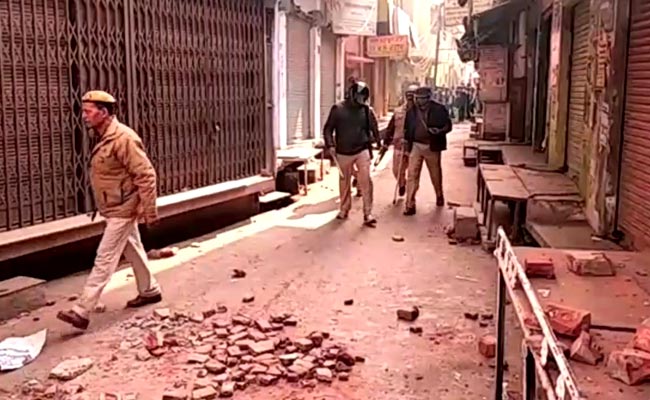
An organisation called ‘Sankalp’ was at the epicentre of the violence.
Courtesy: Newsclick.in
Jamiat Ulama-i-Hind, one of the largest Indian Muslim organisations, helped release eight inmates of Tihar Jail, Delhi who were locked down behind bars because they could not pay the fine imposed on to them.

Jamiat deposited Rs 53,000 on behalf of eight prisoners — all non-Muslims — setting a “humanitarian example at a time when the country is reeling under the communal tension.”
The function was organised in Jail No. 2 of Tihar on February 2, 2018. Ajay Kashyap, DG (Prisons) attended the event as the Chief Guest of the function. SS Parihar, DIG (P) was also present at the occasion along with few other officials.
In the program, all eight convicts were immediately released from the jail and were let out for a new beginning of their free life. DG Ajay Kashyap thanked the Jamiat and its national general secretary Maulana Mahmood Madani for the generosity shown. He also urged Jamiat to continue their support for such noble cause in the future also.
Ajay Kashyap has advised that special emphasis is given to the inmates belonging to the economic and social backward strata of the society. Kashyap said, “Delhi prison is a correctional institution that aims to rehabilitate inmates with a human touch so that after releasing from jail they can again rejoin as productive members of society by providing them with useful life skills, education, and support.”
“During the period of incarceration, the inmates are occupied in positive and constructive activities and encouraged to participate in various activities,” he added.
Kashyap also talked about the “Constitution Week”, which was celebrated in the last week of November 2017 by the prison department. The focus in the week was on identification of prisoners who were granted bail but could not be released due to their inability to produce sureties.
During this exercise, several poor convicts were identified who were undergoing sentence in lieu of the fine. Jail administration tried to reach out to several philanthropic organisations for help for these convicts. “It was decided to join hands with some organisations so that the fine amount can be deposited to ensure the release of such convicts immediately to re-integrate in the mainstream of the society again as a productive member of society,” said the press statement released by Jamiat.
On the occasion, Kashyap thanked Jamiat Ulama-i-Hind for approaching prison administrations and coming forward to cooperate on humanitarian ground. On behalf of Jamiat Ulama-i-Hind Maulana Hakeemuddin Qasim, Maulana Ghayyur Qusim, Qari Abdus Sami, Qari Naushad Adil, Maulana Yaseen Jahazi, Maulana Shafiq Qasmi Mufti Suhail Qasmi, Maulana Azeemullah Qasmi were also present in the function. The JUH delegation also gifted sets of Holy Qur’an to the DG.
Courtesy: Two Circles
As frightening spectres of untouchability and unseeability hover around the festering sore of the ‘caste-wall’ at Vadayambady in Kerala, as the so-called mainstream left-led government here continues to pour its energy and resources into aiding and abetting caste devils there, as most mainstream media turns a blind eye, as the Kerala police continues its mad-dog-left-loose act, many friends ask me: why have you not yet written about the struggle there of dalit people fighting of the demon of caste now completely, shamelessly ,in the public once more?

I can only say: I am tired. I am hoarse of writing about the emerging order in which coercion, not consent, becomes the state’s instrument of producing subordination, about the emerging security state overshadowing the welfarist state, about the inadequacies of the rhetoric of Malayali cosmopolitanism in the wake of resurgent caste-community power, about the deterioration of early twentieth century caste-community organizations into caste-corporates managing community assets for the community elite, about the persistent efforts of the state to push the dalit people into a state of abjection.
Am I surprised by this ‘division of labour’ between the NSS and the RSS? No! I have written about it in the wake of the Hadiya case – of how the NSS and SNDP manage economic interests of the twentieth century new elite (by this term I mean caste-communities which managed to secure their interests in twentieth century Kerala, and this includes certain elite sections of the Ezhavas, who were an avarna jati in the traditional order), while they outsource the business of keeping people, especially young people, in submission to family and community to the RSS. Am I surprised that Ananthu A R was dubbed Maoist and carted off? No, not at all. Did I not write about how young people siding with justice were attacked precisely this way? And now, according to the police authorities’ logic, the best minds in Kerala’s civil society – BRP Bhaskar, K Satchidanandan, B Rajeevan, T T Sreekumar – the list is long – are all Maoist by implication as they protest the police’s vile attacks on the dalit activists at Vadayambady and horror of horrors, even side with the transgender people who the Kochi police consider fair game! We meet bizarre representatives of the state: District Collectors hallucinate that they live in the Raja of Kochi’s — the Ponnutampuran’s — times before Indian independence and protect Brahmanadharmam the Raja upheld; police chiefs who coolly state that their job is to protect the respectability of the genteel middle class and not the rights of all; left political leaders who kiss the feet of NRI capital and remain permanently indebted to them; and of course, the slimy intellectuals of the CPM who run with the hares and hunt with the hounds.
Much has been written on the Vadayambady struggle, and indeed we need to keep the issue from being despatched to darkness, which was what the craven mainstream media would happily do. I however, want to think about the future. For that is where hope lies, and it is important to break free from the fossilizing stare the state now holds us in, preventing us from thinking of how to survive, stay alive, be human — in other words, how to craft a politics adequate to today’s challenges.
And therefore I want to think of feminism in Kerala, post-Hadiya’s struggle, post-Vadayambady. Both events reveal to us some of the challenges that we can no more deny – I mean, no one who has any political spine left can deny: one, that the new elite caste-communities of the twentieth century (the SNDP, NSS, the Syrian Christian community organizations) are ready and eager to outsource the business of policing community boundaries, and the violence that it entails, to the RSS/other Hindutva organizations; two, the mainstream left is very much part of this game and will not seriously interfere – unless the anti-caste struggle seems to be winning, at which point they may enter and carry off the honours.
But more importantly, the time has come when we need to realize that all of us who are opposed to caste and patriarchy, and to the gross inequalities of resources and power wrought by our late twentieth-century integration into the globalized world economy (and these cannot really be understood apart of each other) need to work on our differences and come together. I do believe that treating our differences as insurmountable and irreconcilable is not just childish and petulant, but also outright dangerous now. Now, whatever we may think about our differences, all of us, humanist and anti-humanist, are ‘Maoists’ and/or ISIS supporters in the eyes of the security-obsessed, Hindutva-inflected state, as many statements by the police now state quite baldly. We, then, need to rethink politics in ways that will help us work together, and this is my way of contributing to it.Though I say ‘ feminism after Hadiya’s struggle’, I want to highlight not just the learning from that specific struggle but from the entire set of resistances in recent times.
So how do we rethink feminism?
————————————–
Here are a few thoughts:
To start from Hadiya, I want to say that it is she, more than anyone else, allowed us to see the crucial importance of destroying sajateeya marriage – marriage between members of the same caste—among the powerful new elite caste-communities in contemporary Kerala.
We need to carefully think of endogamy as it exists across the savarna/new elite- oppressed community divide – of its functions, form, impacts and consequences for us. I think savarna/new elite feminists ought to break endogamy totally – and that ought to be one of the pillars of the feminism practised by feminists born in the savarna/new elite communities. By now, I am tired of the empty evocations of intersectionality and the self-restraining practiced by savarna feminists whose main mode of engagement with non-savarna politics seems to be through a careful avoidance of engagement and passive agreement – functioning as the Facebook-likes-providing brigade. Which is really easy, because your lack of engagement gets read as support, and of course, you don’t really need to think of your ‘own work’ in smashing the caste-patriarchy-class nexus. Those times, I feel are over. If savarna-born women are serious about feminism, they better start doing their own work: and I say, the most important task they need to take on is the breaking down of sajateeya marriage, and indeed, even marrying between the savarna/new elite communities. For this is the bolster that holds up these dominant communities now. Indeed, the massive violence against young women of these communities who choose to marry Muslims shows that the bolster is under strain, and that is generating great insecurities.
Put differently, I am saying that fighting for equal rights within savarna/ new elite communities might lighten patriarchy there but does not remove the caste privilege savarna/new elite- born women enjoy over their avarna sisters. So getting the fuck out may be necessary – and if we choose partners from our own castes, engage in radical self-critical concrete proposals on how to exit the community altogether. I mean, I think savarna feminists should not contribute to the reproduction of their regressive communities in any way, implicit or explicit.
Exiting through marriage – exogamy — is one way this may be done, but also maybe through conversion, coming out as queer, building queer families – we need to think more. Maybe we should think of marriage and relationship sites which will help people connect beyond their communities of birth! However, for avarna, muslim, and christian communities in India now endogamy may hold different significance and so the thrust could be on democratising marital relationships fully as a condition for continuing endogamy.
So while the goal to democratising marital relationships remains important for all women, savarna/new elite-born women ought to strive beyond it by actually breaking the endogamy imposed by their communities.
—————————————-
2. Learn a lesson from the struggles of the transgender communities
The transgender community in Kerala has made an active bid to enter the social and political mainstream, and this has now brought them much visibility here. But what has been truly moving and humbling for us has been the stern refusal of leading voices in the community to condemn those among them who may be relying on sex work for a living. In their responses to the accusations raised by the Kerala police, these voices have stressed over and over that the transgender community, in order to be a truly empowered constituent of the mainstream, may need not just resources and government support, but also time – and convivial friendship – from others. They have asserted the right of members to form alternate families, and have refused to judge each other with patriarchal standards
This is a lesson that feminism in Kerala has taken too long to learn. To build a strong alternate community, one needs to first stop moralizing and refuse patriarchal explanations for our failures and success. We need to take seriously other women when they speak about state violence, especially when they belong to groups the state actively demonises. We saw the regrettable reluctance among leading feminists to listen to sex workers around a decade back; in Hadiya’s struggle, too many feminists were ready to dismiss Hadiya without even listening to her; too many sniggered, telling her to be grateful to the Indian Constitution, at a time when we were appalled by the Supreme Court’s treatment of her. This cannot build a feminist community, whatever else it may lead to. And sucking up to the social right-wing, or to the NIA, for that matter, is not going to save anyone from the heavy hand of Brahmanical dandaneethi that will surely fall on all women, and goody-goody feminists (except those who as clever as Madhu Kishwar) are not exempted.
——————————–
It is time that we began to take head-on the reality of the oppressive relations that exist between savarna/new elite women and avarna women – that the genteel domesticity and mobility of the former are dependent on the later. Instead of focusing on how the order of caste permits men to oppress women, we need to focus on how it permits women to oppress other women. This demands that we focus on domestic labour especially, and all forms of women’s undervalued labour in the productive and other sectors historically, and the manner in which it shapes the relations between women and divides them. The struggle for justice and fair wages and practices, and rights and voice for domestic workers then needs to become central to all feminist politics. But we also need to develop radical theorising around domestic labour and emancipatory politics around paid domestic work. By the latter, one means going beyond the discussion of fair wages, but of building feminist work relationships between employers and employees, that does not reduce it to merely an exchange within the capitalist circuit – and indeed, builds solidarity in the full realization that the domestic worker’s struggle is not merely hers but integral to all anti-patriarchal struggles. And this needs to be extended to the struggles by all women workers — whether they work at home, in the municipality, hospital, or tea garden.
——————————-
In Kerala now, the young are fighting for their bodies – for the right to dress their bodies as they deem fit, to define their sexuality, to free their bodies from being turned into instruments of reproduction of caste-communities and families, to resist the reduction of their bodies into labour power saleable in the global job market. Feminism cannot dither anymore in its decades-old habit of being wary of demands for sexual liberation, for in these times, that just cannot be feminism anymore. Feminism needs to be shameless, totally shameless, in insisting that sexual rights, inequalities, issues, and injustices have to be public concerns, and take an unambiguous position on this vis-à-vis the social right-wing. It cannot afford to be queasy about discussing questions of dangers and pleasures in sex, as well as rights and violations in intimate relationships. Any talk of gender that refuses to do so, one may say, is immediately complicit with the massive apparatus that runs the length and breadth of the state, extending from the patriarchal family, through schools, tuition centres, coaching camps and so on, to technical institutes, finishing schools etc. into which our young people are being sucked in and turned, quite violently these days, into docile labour for the global labour market.
——————————
For some time now, cyberspace is where feminism – arguably, third-wave feminism in Kerala — has found voice[s] and presence[s]. This is an exciting moment of defiance by Malayali women, who have, by default, all been made into ‘feminists’ there. Surely, it is not just the insecurity of the misogynist majority that is responsible for this, but also the very structure of the social media. In Kerala, judging from the past, it is women who have written autobiographies, or engaged in some kind of active self-construction, who have faced the offline equivalent of trolling here, from the 1930s at least. Kamala Surayya is a well-known example, but there are many others too.
The patriarchal unconscious here gets stirred up when a woman reveals that she does indeed possess a ‘private’, as opposed to just the domestic – and finds resources from it to construct herself. This ‘private’ exists by implication and signs of its presence provoke a great deal of patriarchal anxiety, especially of a sexual sort, since the ‘private’ is associated with the sexual. So, then, this chain of associations means that every woman who engages in self-construction is by default overstepping the family’s and community’s construction of her, and this means that she does indeed possess a ‘private’, which by association, is sexual – therefore, the woman who engages in self-construction is by implication likely to engage also in sexual transgression. And worse, any woman revealing herself in an autobiography or self-construction is also revealing her ‘private’, which indicates her propensity to be sexually transgressive – and is therefore ‘asking for it’.
Now, consider the enormous proportions of this ‘problem’ for patriarchal authorities in the time of the Internet: thousands of women are engaged in self-construction, of various degrees, through the social media and other cyber spaces. Indeed, each woman, however demure she may appear, is constructing a persona for herself in cyberspace, however minimally. That means that to the patriarchal unconscious, all these women are revealing their ‘privates’ and hence their tendency towards sexual transgression, and therefore pose a veritable tsunami that must be immediately put down. No doubt then, that the attacks on assertive women in cyberspace, especially sexually-coloured threats, have been particularly intense. But what is truly interesting is the way in which most of these women have refused to be cowed down and continue to take and guard spaces online.
Yet we need to ask ourselves the question if the very structure of the social media has also not worked to individualize resistance intensely, and indeed, cultivate the individual through what is often outright narcissism. Feminists need to see that cyberfeminism is not merely talking feminism in cyberspace, or using cyberspaces to feminist ends. Indeed, cyberfeminism is already distinct in that it did not share the positions of the early techno-enthusiasts uncritically; and now we need to also recast it in ways that allow it to shape empathetic communities and mutual learning. And this is not unique to Kerala; this has been widely discussed in the literature on third-wave feminism elsewhere too.
—————————–
I stop here, hoping to spark off a conversation.These are of course only a beginning – however shaky, one must begin somewhere, and beginnings are always risky. To me this is important precisely because I want to break the petrifying stare of the state, and fly off into the world of possibility. That is perhaps the only way to survive the state’s relentless draining of the energy of resistance.
Courtesy: kafila.online
Two days ago we had published a story that a growing number of Iranian women are defying the authorities, protesting in novel ways against the imposition of hijab by the Islamic state. Now watch an old woman pitching in her might in the Iranian women’s fight to their choice of dress.
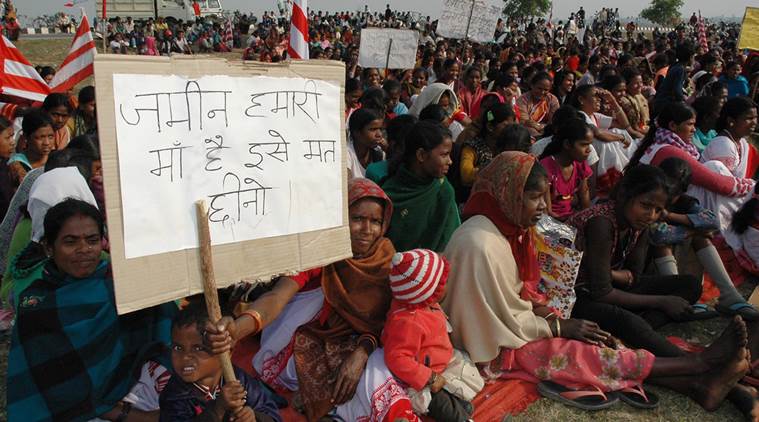
The Adivasi people of Koel-Karo Jan Sanghatan paid their homage yesterday [February 3] to the eight martyrs of the uprising of February 2, 2001 and renewed their resolve to assert their rights over their ancestral land. More than a thousand people from surrounding villages first took out a silent procession around Tapkara village, then assembled at the site of the police firing and held a public meet wherein they resolved to continue their struggle against the present Jharkand government’s back-door move to ear-mark and acquire their non-agricultural lands such as village roads, rivers and rivulets, water bodies, places of worship, burial grounds, village forests, hills & hillocks etc.

Representation Image Courtesy: Indian Express
The name of the game is Land Bank! About a year ago, during the much publicised ‘Momentum Jharkhand’ held in Ranchi, where about 4000 industrialists from within and without the country had been invited and treated as state-guests at enormous public expense a formal announcement was made: the state government had then proclaimed that getting land to set up industries and mines would not be a problem because the Jharkhand government had set up a Land Bank in which about 20 lakh acres have been ear-marked for seizure. Of this about 10 lakh acres, the government assured, was ‘ready for acquisition’ by corporate houses.
People across the State are now becoming aware of the implications of this disturbing move of the government. They have started protesting this policy move through their Gram Sabhas. They are even appealing to the Governor of Jharkand to stop this reprehensible move of the government. In case the ‘constitutional custodian’ of Adivasi people of the state does not act decisively to stand by the people on their rights over their natural resources, the Adivasi people of Koel-Karo Jan Sangatan will fight this out, even as they successfully fought against the proposed Koel-Karo dam. If constructed, this dam would have submerged 132 villages and inundated about 50,000 acres of their cultivable & forest land. The sacrifices this struggle paid were high. The success of stopping a disastrous dam from taking shape, was at the cost of the people of Koel-Karo Jan Sangatan making a heart-breaking sacrifice: eight of their colleagues being killed in police firing, 35 of them being seriously wounded, five of whom have become handicapped for life. Their present struggle is being inspired by this truth” the blood of our martyrs will not go in vain.
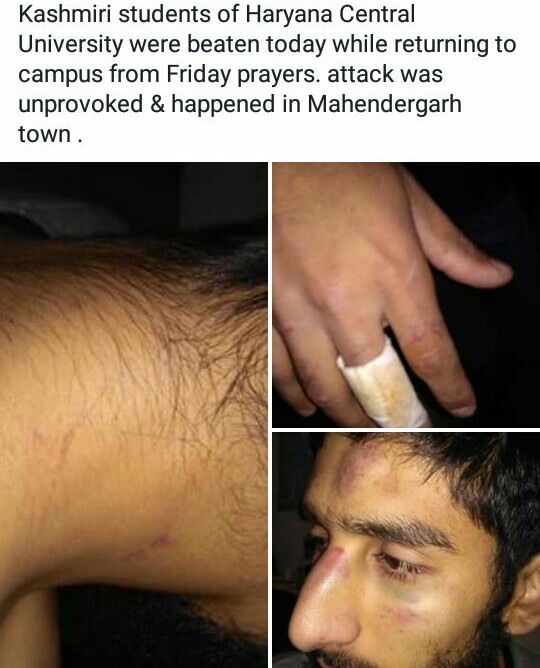
In a brute manifestation, yet again, of the burgeoning hate crimes in India, two students hailing from Jammu & Kashmir were brutally beaten up by a group of people in Haryana’s Mahendragarh. Even the Haryana police had to admit to this adding that six persons have been identified, two of whom were arrested. It was fellow students from the college who ensured that the injured (who live in the hostel) were given succour. Photographs of the injured men were also sent to Sabrangindia by fellow student Ravindra Meena from Rajasthan.

There was absolutely no ‘reason’ for the violent attack. “They started beating us for no reason. I was lying on the ground and don’t know what happened… the police also reached the spot after the locals called them. They (police) dropped us in the hospital and left,” Aftab said.


The identity of the assaulted students has been established as Aftab Ahmad (23) and Amjad Ali (22), both pursuing MSc (geography) from Central University of Haryana in Mahendragarh district and are reported to be the natives of Rajouri in Jammu and Kashmir. Aftab informed us in a telephonic conversation that a group of not less than 10 people started following them soon after they came out of a mosque in Mahendragarh.
The Indian Express reports that J&K Chief Minister Mehbooba Mufti expressed shock at the incident as she sought strong action from the Haryana government on Friday. Haryana chief minister ML Khattar assured Mufti in a reply to her tweet that those behind the assault will not go unpunished.

Image credit: India Today
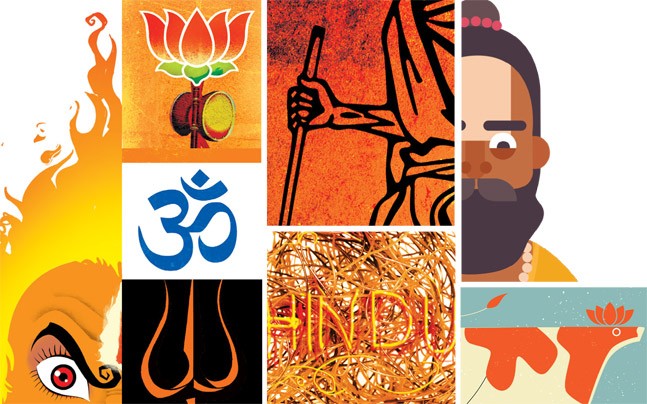
On 30 January 2018, retired civil servants and veterans of the armed forces jointly organised a conclave on ‘Hinduism and Hindutva’ at the Indian Social Institute, New Delhi. The conclave attended by over hundred participants, emphasized the need to rescue both Hinduism and the Indian Constitution from the clutches of the political project that calls itself Hindutva, and which has nothing to do with religion as such. The participants at the conclave sought to make a plea for saving Hinduism without making any concessions to the monstrosity of caste oppression, which in the spirit of many earlier reformers, they rejected.
This conclave followed an earlier one on ‘A Fractured Polity: The Relevance of Gandhi Today’ organised on 10 October 2017, which had been addressed by Justice A P Shah, Mrinal Pande and Ramachandra Guha. The speeches are available on YouTube (Justice A.P. Shah, Mrinal Pande, Ramachandra Guha). These civil servants and veterans have also raised severe concerns about the present situation in a series of open letters over the last few months: on vigilantism and hyper-nationalism; the suspicious death of Justice Loya; and violence and discrimination against minorities in India. (See: Retired Civil Servants open letter – 10 June 2017, Armed Forces Veterans open letter – 30 July 2017, Retired Civil Servants Letter 02 December 2017 – Enquiry into Judge Loya’s death, Armed Forces Veterans letter to Supreme Court & Bombay High Court on Judge Loya’s death, Retired Civil Servants open letter – 28 January 2018).
The Conclave on ‘Hinduism and Hindutva’ began with all observing silence for two minutes in tribute to Mahatma Gandhi on the anniversary of his death. It was
chaired by Air Marshal Vir Narain (Retd), and addressed by Prof Ram Puniyani (Retd), Shri Ashok Vajpeyi IAS (Retd) and Swami Agnivesh. The speeches were
video-recorded and live-streamed on Facebook and can be accessed at (30 January Conclave – Speeches).
Air Marshal Narain began the proceedings by asking why a group of retired civilservants and veterans have chosen to speak out at this moment, though they are
not known for making public statements. The reason was that they have sworn allegiance to the Constitution of India, and this is a post one does not give up after
retirement: it is a life-long commitment. They are speaking now because they think constitutional values are under threat.
Professor Ram Puniyani (retired, IIT Bombay) began by taking the audience into a fascinating detour into “communal historiography” aided by the British policy of
‘divide and rule’ for their own interests. He pointed out how, over time, with the rise of new social and economic groupings like industrialists, the working and
middle classes, the ‘perks, powers and privileges’ of the ruling classes like Rajas and Nawabs were threatened. These groups camouflaged their political interests
behind the banner of religion, and created the Hindu Mahasabha and the Muslim League. Though they claimed that their religion was under threat, it was actually
their power which had been threatened. As a result, the core ethical aspects of religion were displaced by concerns about religious identity.
Professor Puniyani contrasted these Hindu and Muslim nationalisms with Indian nationalism as practiced in different ways by Bhagat Singh, Ambedkar, and the
Indian National Congress of Gandhi, Maulana Azad, and Annie Besant. The need of the hour is to focus upon liberty, equality and fraternity, and improving
the living standards of the poor and disadvantaged in India, rather than upon emotive issues of religion, orchestrated for political gain by whipping up hatred
against minorities.
This orchestration often takes place through the rewriting of history. For instance, many Muslim kings such as Akbar had Hindu officers, and even Hindu leaders
such as Shivaji had Muslim bodyguards; indeed, Muslims formed a considerable portion of his army. Yet we do not see these complexities.
Shri Ashok Vajpeyi pointed out that religions today have grown intolerant, even of their own plurality, and violent as well. As a result, they have ceased to make
spiritual progress. Though the Constitution of India is a socio-political document, not a spiritual one, the values of freedom, justice, equality, fraternity stressed in
the Constitution are essentially spiritual values.
What is distinctive about Hinduism is its plurality, and the fact that it is born out of a sense of lila (joy), rather than a consciousness of sin. That plurality is reflected
in the six schools of philosophy and in the absence of a single book or God. It has been the fount of a great deal of creativity, and has allowed for much by way of
dissent and criticism – even of the Gods.
Unfortunately, this pluralistic and open metaphysical structure has not translated into an open social structure: the caste system, whatever its origin, is simply unpardonable. Recent research affirms that there has been a lot of violence displayed by Hindus in the past. In any case, both in terms of spiritual and creative progress, Hinduism seems to have hit a roadblock, and one does not see spiritual leaders come out and condemn violence in the present moment.
However, Hindutva should not be seen as a religious movement at all, but rather as a 19th century attempted Semitization of the religion, which has led to violence, hatred, and the ‘othering’ of minorities. In fact, votaries of Hindutva, with their adherence to a single doctrinal interpretation blissfully ignore the richness and diversity of thought that Hinduism offers. They are ignorant of the Indian intellectual tradition. They may say, for instance, that the Gita should be the Holy Book of India. However, our tradition is one in which one makes a book one’s ‘own’ by writing, commenting upon it: thus Tilak, Aurobindo, Radhakrishnan and Gandhi. Which RSS leader has written a commentary on the Gita?
It is a shame that so few people are speaking out today about the current situation; that this group has done so is commendable. After all, as the poet said, even if
nothing comes of my speaking out, at least someone spoke – and that is something.
Swami Agnivesh began by invoking both ‘Om’ as well as ‘Bismillah’, saying that he would anger either Hindus or Muslims if he invoked only one of these. But in
fact, there is only one religion, and it stands for truth, compassion, love, and justice: values recognised by believers and non-believers alike. All great souls in
the various religious traditions have reminded us that God does not live outside us, but within us. A focus on the external realm leads us to divide god for our own
purposes: we then focus on ‘religion’ rather than dharm, peddle it in the marketplace, and create strife. We end up caring more for the purity of our temples
and other places of worship than for our own purity.
Swamiji pointed out that we do not get to choose the religion into which we are born; the earliest source of religious indoctrination arises in the family His own
childhood was ‘religious’ in nature because it involved practices and rituals which were not to be questioned; at the same time, many injustices in the form of
untouchability and bonded labour were not questioned.
Seen correctly, religion involves rationality as well: one must question what one sees, rather than accepting things blindly, like sheep. Followers of false sadhus
and babas make the mistake of not questioning their leaders, but this is not the path of true spirituality. One should in fact be sceptical of all organised religions
as opponents of true spirituality.
Different people realise this truth in different ways. His own realisation came from reading the Vedas in college (they do not teach discrimination themselves, and
nor does the much-maligned Manu Smriti; these are later interpolations, he held). Gandhiji said earlier that God is Truth but later came around to the view that Truth is God. That is the knowledge which leads to true religion rather than sectarianism.
Satyam vada (Speak the Truth) and Dharmam chara (Do what is right) are the very essence of religion.
He commended the organisers – retired citizens who could have lived a quiet life – continuing to ask questions: “It is a courageous thing you are doing, to keep
standing up and questioning.”
More than a hundred participants attended the Conclave. There was a general consensus about the need for concerted action to preserve our Constitutional
values and rebuild our democratic institutions. It was also agreed that Hinduism as a religion should be distinguished from Hindutva as a political project, and that
new narratives would be needed to resist to the forces of communal polarisation.
Courtesy: Kafila.

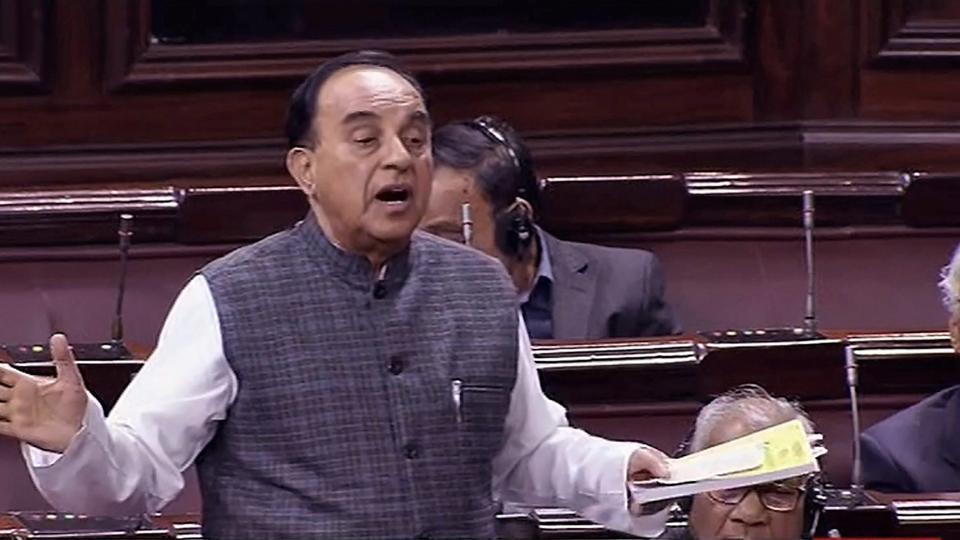
BJP member of parliament in the Rajya Sabha, Subramaniam Swamy, known for his supremacist even extremist views has proposed a new national law against cow slaughter that includes death penalty as ‘deterrant punishment.’ A private members Bill was tabled in the Rajya Sabha yesterday. After moving the private member’s bill for a countrywide ban on cow slaughter, Swamy withdrew it after the government assured that steps have been taken to protect the animal.
During a two-hour discussion on the cow protection bill, the Upper House witnessed heated exchanges when Opposition members objected to railway minister Piyush Goyal’s remarks that an important issue was being “made fun of”.
The Bill pushes for the ‘creation of an authority for the stabilization of the population of cows, measures to comply with Article 37 and 48 of the Indian Constitution to ban cow slaughter and provide deterrant punishment including death penalty.’ The authority is called the National Cow Protection Authority.
A copy of the Bill tabled may be read here.
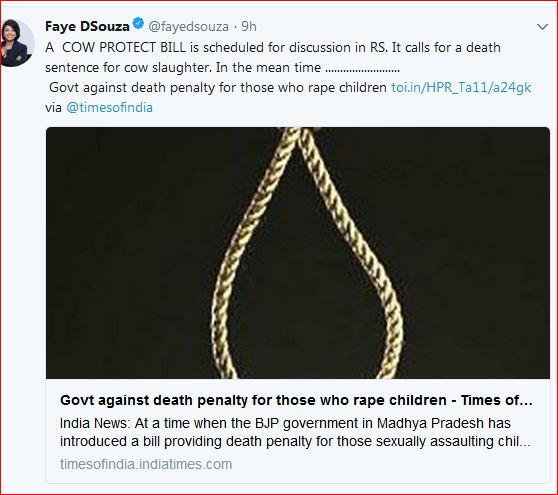
Ironically we have a situation where this government, the Modi regime says it is ‘against death penalty for those who rape children’ but a member of the same party that rules wants death for cow slaughter!!
Only recently the Centre told the Supreme Court that it was not in favour of amending laws to provide for death penalty to those found guilty of sexual assaults on infants and children. Additional solicitor general P S Narasimha told the SC that “death penalty is not an answer to everything”. Clearly to some of the ruling party death and killing is an answer to many things!
Narasimha had said in the SC the Protection of Children from Sexual Offences Act provided graded stringent punishment for sexual assault of children — a minimum 10-year term and maximum life imprisonment for raping a child while the punishment for a minor’s gang rape ranged between a 20-year term and life imprisonment.

Join our mailing list to get the latest human rights news that matters, straight to your mailbox.
© Sabrang | All Rights Reserved