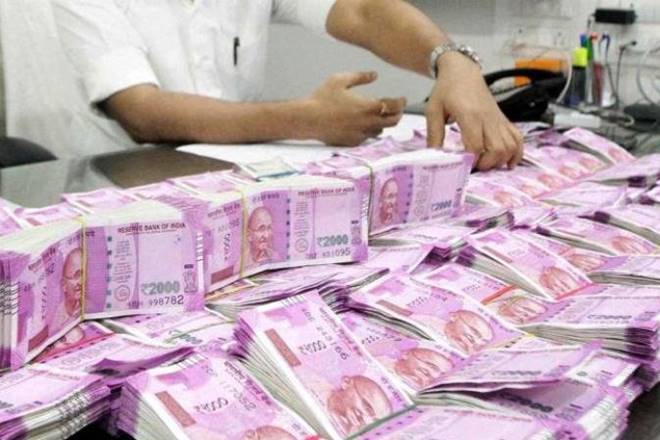
In the first series of conversations, Teri Meri Sabki Baat, Kanhaiya Kumar asks some sharp questions about corruption. Is it ingrained deep in the policies that govern us?
Courtesy: Newsclick.in
I was preparing to leave Bangalore for three weeks when I got a call from a friend in Mumbai asking me to switch on the TV immediately, saying that Gauri had been shot. I though Gauri had gone driving off on one of her trips and been shot at. She had always received threats since the time she took over Lankesh Patrike. Within minutes of the news of her death, people from all over were sending messages and calling. Many of my friends, who had met her at my place, were also devastated. By the time we rushed to her house, journalists and other people had already reached, and a crowd began to gather. In the sleepless nights after that evening, an absurd thought ocurred again and again—of Gauri sitting at her desk at the office that night before the edition and calling out, ‘Stop press! Gauri Lankesh has just been killed, we have to cover that!’

Neither her family nor her friends had expected such a great public outpouring of grief and anger at her death. We had not thought that she was so powerful. With us, she was more vulnerable, speaking of her struggles and always good for an argument or a joke. We used to pop into each other’s houses when we were depressed, to unwind. She could be brutally frank.
Gauri lived two streets away from my place, in a house built by her mother, an astute businesswoman who owned a popular saree shop which had supported the family in lean times. Though we both grew up in Basavangudi in South Bangalore, we only met when I moved into my new studio in Rajarajeshwari Nagar in 1996, after twenty years of having been away from the city. But I had known her father, P. Lankesh, since the early 1970s when, as a silly teenager just out of school, I used to hang around Central College with a disreputable bunch of older friends known as the ‘Chod’ gang. The English department was famous. It had professors like the influential intellectual T. G. Vaidyanathan and P. Lankesh, the celebrated Navya (Modernist) Kannada writer, each with adoring groups around them. Later becoming a new wave filmmaker himself, Lankesh had played the role of the rebel Brahmin Naranappa in the first Kannada new wave film Samskara, directed by Pattabhirama Reddy and based on the novel by UR Ananthamurthy, with Girish Karnad playing the good Brahmin. It was a strong critique of caste, particularly dealing with the hypocrisy of the influential Madhwa Brahmin community (to which my family belongs). Though the censors had initially banned Samskara, the Union Ministry of Information and Broadcasting had revoked the ban. I do not remember much of a commotion from the Brahmin community when it was released in 1970. My mother and her friends went off to see the film with a naughty air. I even acted in a play directed by Lankesh which had been staged in the Town Hall. It was the Kannada translation of Aristophanes Lysistrata, a comedy about a woman, Lysistrata, who persuades the Greek women to boycott sex with their men to force them to end the Pelopponesian War. A family friend, member of the Swatantra party, wrote a strong letter to the Deccan Herald that the play was obscene. Though I was only in the crowd scenes, my father was furious and that was the end of my theatrical career!
Lankesh left his job and started the first Kannada weekly Lankesh Patrike in 1980, against the disapproval of his literary friends who thought it would vulgarize his writing. He was probably inspired by the popular success of his political column in the Kannada newspaper Prajavani. Lankesh was a Lohiaite influenced by the charismatic Karnataka socialist leader Shanthaveri Gopala Gowda . I think his decision came out of a desire to ‘go to the people’ after the tumultuous days of the 1970s, a decade marked by widespread movements for social justice and protests against the Emergency. Bangalore was the hub of the influential Navya literary movement, new wave cinema and new theatre dealing with social issues. Prasanna had founded the left theatre group Samudaya just before the Emergency which had been doing political theatre all over Karnataka. The local paper Deccan Herald had also become a leading opposition after KN Harikumar came back from JNU and took over as editor in 1978. The actress Snehalatha Reddy, socialist and wife of Pattabhi Rama Reddy, who had played Naranappa’s Dalit lover Chandri in Samskara, was falsely accused in the Baroda Dynamite case and jailed and tortured during the Emergency. She died soon after being released.
Based on Gandhi’s Harijan, Lankesh Patrike was a powerful anti-establishment voice for the oppressed and marginalised which ran on readers subscriptions with a strict policy against advertisements. It grew to have a huge readership. It was a mixture of political exposes and sensational tabloid writing mixed with a strong literary content, giving a platform for new voices. What Lankesh also did was to invent a new language, or maybe many, delightfully tweaking Kannada with the fluidity of a master. Film scholar Madhav Prasad says he used to wait to see the new edition in Kolkata for the sheer pleasure of reading the language. One cover had the title “Bam Gum Yuddha’ (Bangarappa- Gundu Rao War). No one had used Kannada with such audacity.
When I moved to Rajarajeshwari Nagar, I was introduced to Gauri by our older friend and the ex-cricketer Balaji, a neighbour of the Lankeshs’. His house had served as an intellectual adda in Basavangudi where Lankesh used to go to play badminton every evening. Basavangudi was the centre of Kannada literature and theatre. The Vidyarthi Bhavan café in Gandhi Bazaar had been the meeting place for two generations of writers. Prasanna used to have a running joke that the great Kannada Navodaya (Rennaissance) writer Masti Venkatesha Iyengar was so lusty that he had not one, but ‘two-two dosas’ every day.
When I first met Gauri, she was a journalist for the Sunday magazine under Vir Sanghvi and we used to meet often. Rajarajeshwari Nagar was lonely and scarcely populated. Gauri and her filmmaker sister Kavitha used to talk in a racy, slangy Kannada that was delightfully new to me. We both had completely different sets of friends and used to throw large parties. My then husband Ashish Rajadhyaksha and our group of friends, all old Bangaloreans who had returned, had just started the Centre of Culture and Society. Lankesh and Ananthamurthy were the yin and yang of Navya literature and their children were good friends. But after Lankesh attacked Ananthamurthy in his paper, there was a rift. Gauri was loyal to her father and I never met the URA crowd at her place after that. I remember that, in one of her parties, I was dancing on one foot because my other leg was encased in plaster after a bad scooter accident, when Prakash Belawadi (now a leading Modi bhakt) came up to me and bemoaned that people did not use their hands to dance and demonstrated some fancy moves.
In 2000, when Lankesh suddenly died, there was a crisis and Gauri had to take over the paper as editor. Though Kavitha had been Lankesh’s favourite and Indrajit, the youngest son, was his pet, Gauri was the only journalist in the family. She had recently moved to Delhi and was enjoying working in the new ETV channel for the first time as a television journalist. After his death, the family realised that the paper was broke and there was only a few thousand rupees—‘ just enough for his cards money’—in his bank account. Lankesh Patrike, which had a readership of two lakhs in its heyday when Lankesh was known as a kingmaker, had lost to the new era of 24/7 television. The family thought of shutting down the paper, but Gauri told me that if the paper had been shut down, the agents would not return the collections from the last issue and they would not be able to pay salaries. She chafed when her younger brother Indrajit was named proprietor, at the thought that she would have to work under him as the editor. Some years later, when they fell out over her activism, she opened her own paper, Gauri Lankesh Patrike .
Having been an English journalist, Gauri had to start from scratch and learn to think and edit and write in Kannada. She was belittled as a ‘convent educated’ English journalist who was stepping into the shoes of a legend. For some years she disappeared from her friends to immerse herself in her new world, working relentless hours, until three or four in the morning every day. In Bangalore, many of us mix English words with Kannada, and the joke is that if you add an ‘u’ sound to an English word it becomes Kannada – like table-u, chair-u. She had to stop thinking in English. Her writing would never have the literary magic of her father, but she followed his advice—that the secret of good writing was to express one’s ideas simply and honestly. She had a naughty sense of humor and a sense of the absurd. There was a lot of palace intrigue in the paper when she joined. She laughed that her appointment was similar to the young Indira Gandhi being set up as president of the Congress by the old guard who had thought that they could manipulate her. Soon many of the experienced journalists left the paper. It was tough going. Towards the end she was practically writing the whole paper herself and continuing to run it without advertisements, trying to finance it with an examination guide and publishing section. She had recently talked to a friend about going digital. No one thought that her Kannada columns would someday be translated and published as important documents as they are being done today, or that she would win a major International award.
Gauri never considered going back to a job in English journalism despite all her struggles in running the paper. She thought English journalism was frivolous and, if national, had a scattered audience. While as the editor of her own paper, she would have the freedom to take up her own causes and intensely address a local but real constituency. (In fact, recently, when she was invited to write for an English daily, her column was so hard-hitting that it was soon taken off on orders). The literary content went after a while, as that was not her forte. She soon realized that journalistic activism was not enough and she would have to plunge into activism on the ground to change things. While she continued her father’s fight for secularism and social justice, she brought in her own radical politics, contemporary feminist sensibility and subjects such as LGBT rights, to the conservative Kannada readership. And in the middle of all this, bred in a literary milieu, she was also translating fictional works and essays.
The Kannada literary and journalistic world is extremely patriarchal and dominated by male chauvinists. Gauri was a rare being who was cosmopolitan, well-travelled, and very contemporary, while being deeply rooted in the regional. Gauri must have been one of the few women who owned and ran their own political paper with a fearless voice, not only in the state but internationally. I would put her in a long and rarely recognized tradition of activist women journal owners and writers from the early nationalist period in India, like Nanjangud Thirumalamba and Belegere Janakamma from Karnataka. Incidentally Thirumalamba’s writing was publicly dismissed by Masti Venkatesha Iyengar in an essay in the 1960s, resulting in her disappearance from the Kannada literary scene in humiliation. But Gauri was made of sterner stuff. One of our journalists wondered patronizingly why, as a woman. she did not stick to culture instead of getting into politics. He seems to have been unaware that cultural figures, from MF Husain to the ‘award wapsi’ writers, have been the butt of attack of our Hindutva forces. In fact, Gauri had started off at Times of India by covering the culture beat. She had several paintings in her house gifted by artists from those days. I had given her a photograph from my Phantom Lady series, which showed me jumping from a building in a masked Zorro costume. Recently, When she had called us over to meet Jignesh Mevani, she introduced me as an artist and dragged him by the arm to show him my work on the wall. Jignesh was astonished and they both cackled with laughter.
One of the things we had discussed when we met Jignesh were the threats to Gauri’s life. I used to drop by to her office for a chat and coffee when I was in Basavangudi. Once, in the early years, she showed me a pile of postcards on her table and asked me to look at them. They were filled with filthy sexual abuse and lewd bodily descriptions. Long before the internet, the ‘chaddis’ as her father had famously named them, had discovered Gandhi’s postcard to be an invaluable tool for trolling. And postcards had no censorship. I asked her how she could work facing this abuse day after day, and she said she used to get upset at first but then decided to ignore it and not be intimidated.
As women living alone in independent houses, for some years we had a policeman on a yellow and black spotted bike from the Cheetah force checking on us every night and signing a notebook. Once, years ago, Gauri had attacked a powerful film family and had received threats. Late one night, I heard some rustling sounds from the garden and found two policemen peering through the living room window like two comic characters from a master Hirannaiah play. They said they had come to warn me that they would be patrolling my house all night, asking me to not to get alarmed. At my look of surprise, they asked me if I wasn’t Kavitha Lankesh? I knew at once that they had come to protect Gauri Lankesh, only they thought I was Gauri and Gauri was Kavitha!
I had only seen bodies lying askew in a pool of blood in crime films. Dear Gauri. It is heart wrenching to think of your shock and pain. Gauri was smart, pretty, fun loving, gutsy and independent. When she threw herself into Kannada journalism, she became an indomitable activist. Towards the end, she seemed to be moving away from all the vanities, towards living an austere life. She ‘adopted’ the rising young leftist leaders like Kanhaiya Kumar, Shehla Rashid and Jignesh, pampered them and organized meetings for them in Karnataka. Film maker Anand Patwardhan questioned why she was killed now, not before or later. Everyone agrees it is because the elections are coming up. Because Gauri, being from the Lingayat community herself, strongly supported the demand for a different religion status for the Lingayats (which apparently had been researched thoroughly by Kalburgi)—a strong vote bank—and had recently published an edition covering this issue. Yet onother friend is sure that the timing was because an important leader was visiting the city at the time. Gauri, who had become a nodal point for anti-establishment activism and an influential oppositional voice, had to go.
After those initial lonely years, Rajarajeshwari Nagar had grown and several good friends—all independent, like-minded, and vocal individuals—had moved here and we had a ‘gang’. Gauri was complaining about our last meeting, saying that we went off for a night show at the local mall leaving her behind.
In our future gatherings we will deeply miss that most incorrigible member of the ‘gang’, Gauri Lankesh who—hopelessly, carelessly, tragically—got herself assassinated.
Bangalore, November 2017
Pushpamala N. has been called ‘the most entertaining artist-iconoclast of contemporary Indian art’. She seeks to subvert the dominant discourse through her sharp and witty work as a photo and video artist, sculptor, writer, curator and provocateur. She lives in Bengaluru.
Courtesy: Indian Cultural Forum

Survey
Carried out by Act Now for Harmony and Democracy (ANHAD) in alliance with 32 people’s organizations spread out in 21 Indian states, and involving 3,647 respondents, the survey, seeking to ascertain the behaviour of the people during the demonetization or noteban period, November-December 2016, further pointed out that of those who said that they received Rs 400 or less amount for Rs 500 note, 51.3 percent reported it was exchanged for Rs 400, 12 reported they exchanged it for Rs 300, and 3.3 percent reported that the Rs 500 note was exchanged for as low as Rs 200.
Among the respondents, about 25 percent of respondents were students, 13.7 percent unemployed, 18 percent employed in private sector, 10 percent working as ‘labour’, 4.9 percent reported household work as their profession, 3.4 were in government job and 4.4 percent were involved in agriculture.
The percentage of those who reported ‘Hindu’ was 65.0 and ‘Muslims’ were about 27.0 percent – constituting together about 92 percent. There were about 3 percent of Christians and about 2 percent were Sikh. About 3 percent said that they do not follow any religion or said humanity is their religion.
Caste-wise distribution showed that about 37 percent belonged to the general category, 29 percent were SC/ST and 30.7 percent belonged to OBC. Then, 80 percent said they had access to television, 29 percent listened to radio, 50 percent read newspapers, and so on.
The report, which has been published in a new book, “Demonetization: Exorcising the ‘Demon’”, released to mark one year of the surprise Modi government announcement to withdraw from circulation Rs 500 and Rs 1,000 notes, said, “Region-wise distribution showed that this form of corruption was rampant in all the regions.”

Pointing out that the “industry to exchange old notes cropped up overnight across the country”, the report said, “The fate of the banned Rs 1,000 note was not very different”, adding, though, that here “the percentage of those who said that they exchanged their Rs 1,000 note for the same amount without any reduction was reduced to 17.4 percent.”
The report noted, “Region-wise distribution showed that more than 90 percent respondents witnessed reduction of cost of Rs 1,000 note in Central (98%) and Northern (91.4%) regions”, adding, astonishingly, “10.4 percent of the respondents said that in their locality a Rs 1,000 note was sold for as low as Rs 100.”
The report commented, “It is quite evident that the claim made by the Prime Minister that the objective of demonetization was to clean Indian economy of black money was hollow. Instead, a new channel for generating black money opened up.”
It is dialogue versus demagoguery in Gujarat. It is soft civilized language versus shrill slogan shouting of a road side peddler of a male potency potion. It is direct one-to-one, two-way communication between politician and public versus one-way barrage of rabble rousing by a demi-god before his devotees.
The contest is between Rahul Gandhi, whom his opponents seek to deride by calling him ‘pappu’ (kiddo) and Prime Minister Narendra Modi who has earned the sobriquet of ‘Feku’ (Bluff master) from his detractors.

The battle ground is Gujarat where the Congress has been reduced to a shambles during the last 22 years of the Bharatiya Janata Party’s (BJP’s) unchallenged rule. The Congress is still licking its wound of defection of nearly one-fourth of its MLAs to BJP barely two months ago at the time of the Rajya Sabha elections when the dates, December 9 and 14, for the state assembly polls were announced.
For BJP, Modi is like a one-man army. He began addressing rallies much ahead of the announcement of the assembly election dates. In his official capacity as the prime minster, Modi has launched new projects envisaging investment of millions of rupees. At all his programmes, audience was mobilized using state transport buses and trucks requisitioned from contractors.
However, Modi’s rabble rousing speeches have failed to impress the audience, if a large number of people seen leaving the venue mid-way is any indication.
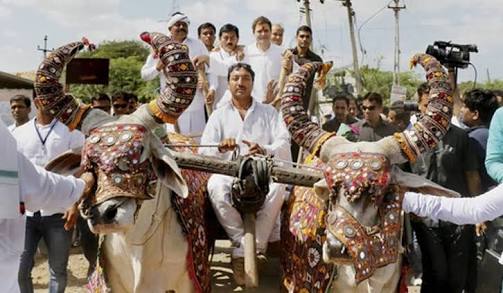
Then, Rahul Gandhi began his party’s election campaign in Gujarat. In the last one month, he has participated in ‘Gujarat Navsarjan Yatra’ in an open vehicle criss-crossing the state. He was denied permission to use an open automobile in the Saurashtra region on the pretext of being a security risk. Rahul outwitted the ruling party by riding a bullock cart, mixing freely with the crowd, sidestepping the black cat commandos.
People turned up in large numbers to see their ‘pappu’, who broke his security ring to dine in roadside dhaba. At some places, on noticing a sizeable number of youth, he even changed into jeans and t-shirt and posed with boys and girls and obliged them with selfie snapshots.
Rahul’s sterling performance was in Surat, a city known for its textiles and diamond industry which employ more than a million migrant labourers from across the country. He visited small and medium scale industrial units, disregarding the security concerns, chatted up with both owners and workers in an effort to know their working conditions and problems.
He followed this with an interaction with the representative of the local trade and industry in the evening. During the hour-long interaction, organized in an auditorium which was packed, Rahul gave a short ten-minute speech before throwing open the meeting for questions from the audience. “Main apse kuchh kahne nahi, aapke man ki baat sunane aaya hoon” (I have come here not to tell anything to you but to listen to you).
For forty five minutes, Rahul patiently heard representatives of different trade and industry associations and replied to them. There were some uncomfortable questions too from the audience. However, this did not make Rahul shirk and evasive. “Mujhe abhi bahut kuchh seekhna hai. Maine bahut galatiya ki hain, dheere dheere sudhar lunga” (I have still to learn many things. I have committed a lot of mistakes too. But I hope to rectify them in due course), he said.
Former Prime Minister Manmohan Singh too addressed a gathering of businessmen and industrialists in Ahmedabad who cheered him with applause every time he spoke about how ill-conceived and disastrous the demonetization and GST action was. At the end of his half-hour speech, Dr Singh received standing ovation.
At all these occasions of interaction between the Congress leaders and the public, state party leaders appealed to the party workers and sympathisers to refrain from using foul language against Prime Minister Modi, BJP president Amit Shah and other BJP leaders even on the face of provocation.
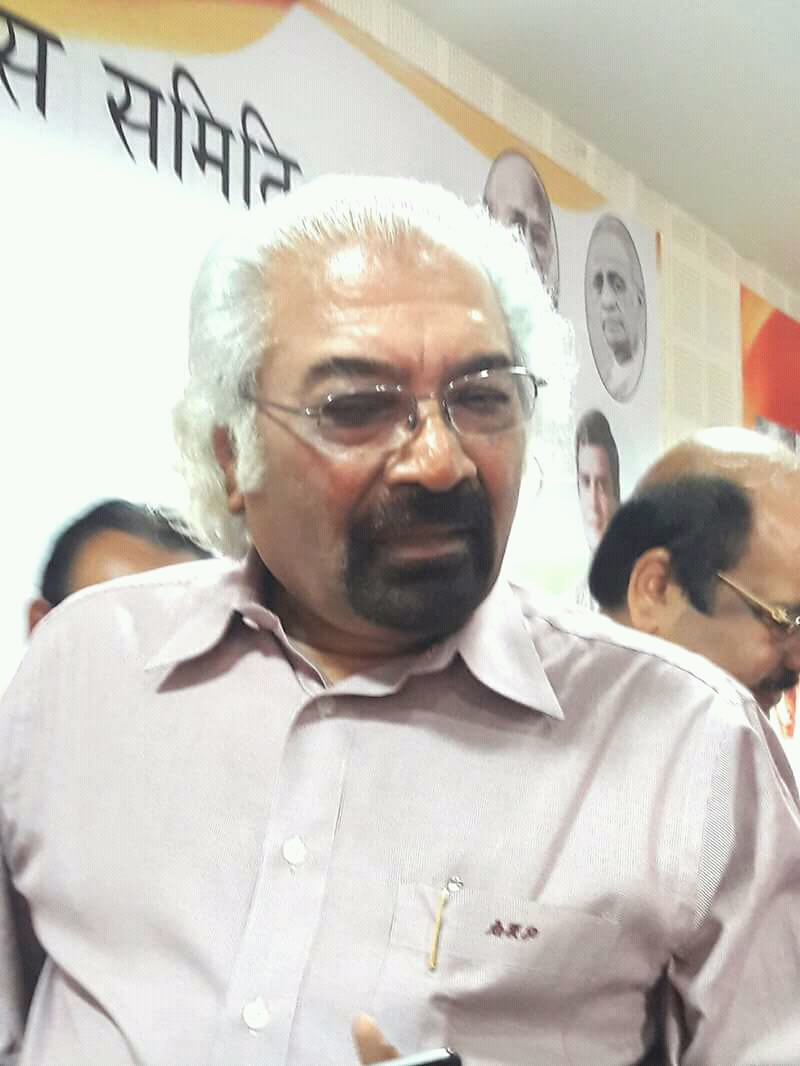
In a move aimed at striking a chord with the people of Gujarat, the Congress party sent Sam Pitroda, the pioneer of telecom revolution in the country, to draw up a ‘People’s Manifesto’ after holding a series of consultations with a spectrum of social groups representing women, youth, small and medium scale entrepreneurs, artisans, educationists.
“We need to work for the ‘down to up’ model of inclusive development instead of the top to bottom model”, he said. “A small number of the rich and powerful people have hijacked democracy the world over. India can provide an alternative model of development on the Gandhian principle of participatory and decentralised economy,” he added.
Pitroda, a Gujarati born in Titlagarh, a small town of western Odisha, had done his graduation from the MS University of Baroda. He expressed grave concern over gross commercialisation of education and it’s falling standards and stressed the need for government intervention to ensure good quality higher education at affordable cost.
By roping in Dr Manmohan Singh and Sam Pitroda and engage them in interaction with the people the Congress party has initiated a process of dialogue which both exposes the chicanery and demagoguery of the unchallenged dream merchant that Narendra Modi has proved himself to be.
—
*Senior Ahmedabad-based journalist
Courtesy: CounterView
Mirjapur and Indore (Madhya Pradesh): Keshu Singh Patel, 56, was nowhere to be seen at Indore’s flower market on November 7, 2017, 364 days after the government’s decision to invalidate Rs 500 and Rs 1,000 notes. Repeated calls to his cell phone by this reporter were answered with the message: “The number you are dialling is switched off.”
2
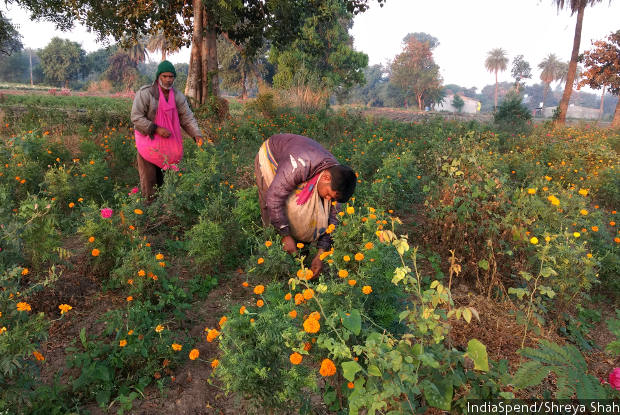
Keshu Patel and his son Kantilal pluck marigold flowers in his field in Mirjapur, Madhya Pradesh. Post notebandi, the unpredictability of getting cash, which he needs for all his transactions–groceries, payment to labourers, transporters–has left him anxious.
On the morning of November 8, 2017, IndiaSpend found Patel plucking marigold flowers on his farm in Mirjapur, near Indore, the commercial capital of Madhya Pradesh. “The phone isn’t working since the past 20 days,” said Patel. “It can’t be repaired and we don’t have the money to buy a new one right now.”
Patel’s predicament underscores the difficulty small farmers face in moving to digital payments, which have increased overall over the past year.
Though, farmers and traders said the move to demonetise notes did not have a lasting effect on prices in the flower market, the shift to payments by cheque for large transactions had delayed when farmers would get cash in hand, impacting household purchase decisions, particularly as small farmers and traders struggle with the banking system, and low financial and digital literacy.
Many farmers do not own a smartphone–1 billion people across India do not–so they cannot access mobile banking services or internet-based payment systems.
Last year, IndiaSpend had spent a day with Patel to understand the impact of demonetisation or, notebandi as it is locally known. Because of lack of cash in the market, flower prices stayed low even in the wedding season, leading to a loss of 70% of Patel’s usual income between the months of October and January.
One year after the decision to invalidate overnight Rs 14 lakh crore–or 86% by value of Indian currency in circulation–IndiaSpend visited Patel and the Indore flower market to know whether there were any lasting effects of the move.
Cash still most important, don’t use cards or cheques for payments
Patel is one of 118.6 million Indian farmers, as the Census recorded in 2011–equivalent to the population of the Philippines. As many as 9.8 million farmers live and work in Madhya Pradesh, one of India’s poorest states. Patel is a “small farmer”, as he has about 2.5 acres of land, less than the average land held by an Indian farmer (2.84 acres), according to the agricultural census of 2010-11, as IndiaSpend reported in December 2016.
This year, Patel first sold onions, which he said sold at a rate lower than what he had expected. But the main problem he faced, he said, was that traders would insist they pay him via cheque, some of them post dated. “It would take 4-5 days for the money to come into the bank account, and then we would have to go and withdraw from the bank,” he said. For everyday transactions which would barely amount to Rs 500-1,000, including paying for the transport of produce, engaging with the banking system was more trouble than it was worth.
“First you go to the bank to deposit the cheque,” said Patel. “When you go back to withdraw money, they will sometimes tell you the signature doesn’t match, sometimes you will be asked to get the Aadhaar card.” He said his older brother who lives in the same village sold about 25 quintal of soyabean at Rs 2,300-2,400 per quintal about five days ago, but the money hasn’t reflected in his account yet.
The Madhya Pradesh government had said farmers could be paid upto Rs 50,000 in cash, but reports said farmers were still being paid by cheque.
“We need money immediately if some disease attacks our crops. If we don’t spray the davai (insecticide or fungicide) immediately, it causes us a loss,” said Patel. This year, a part of Patel’s marigold crop withered due to a disease he calls “kapadia”, similar to blight, which blackens leaves and withers flowers.

A diseased marigold plant in Keshu Singh Patel’s farm. This year, a part of his crop was spoilt because of disease.
When asked whether he uses a card to make payments at the local grocery store, Patel is at a loss. He said grocery shops don’t have a card, that his bank doesn’t give him a card–only cash–and then that he only has a bank account. His son, Kantilal, explains that he owns a card he uses only to withdraw money from the ATM, but right now they have no money in the bank.
Prices currently low in the market, but not because of notebandi
It is a period of low prices at the mandi (market), not because of any lasting effects of notebandi, but because of the usual ups and downs in the market, said Shabbir Abbasi, 52, a worker at Bharat flowers at the Indore mandi. “Prices should go up in some days as the wedding season begins,” he said.
Patel hasn’t started regularly selling his produce of marigold and chrysanthemums at the market–he said he will start in a couple of days as his produce matures and prices go up.
“There is no money in the market. I don’t know why,” said Champalal Kehlewad, 47, a farmer who sells his produce–flowers, soyabean, potatoes, other vegetables–at the Indore market. “It’s like even nature isn’t supporting the current government,” he said, giving the example of poor monsoons this year.

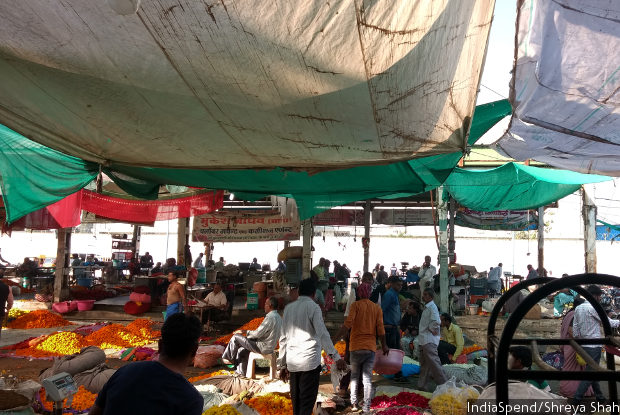
The flower market in Indore, Madhya Pradesh. Last year, the month after notebandi, flower prices had stayed low even in the wedding season. But there hasn’t been a lasting impact of notebandi on prices, traders and farmers said.
Small transactions by cash, only big traders use cheques
“I still don’t have a bank account,” said Jagganath Mahadeo Bhuyyer, who goes by the name Bhausahab, and owns a flower shop in the mandi. He had told IndiaSpend last year that it was too much trouble to start and operate a bank account. “But I am going to open an account tomorrow, on Wednesday, which is an auspicious day,” he said. He said he was selling his house, and he would put money from the sale into the account.
Overall, India has high bank account ownership with 63% Indians owning a financial account of some kind. But only 12% used an advanced bank account service such as bill payments, insurance and loan payments in 2016, as IndiaSpend reported in October 2017.
Mukesh Mukati, a farmer who sells at the market, has a bank account, but he doesn’t use it regularly. “There has to be enough money in the bank to use it,” he said, explaining that he has also taken a loan from the bank. He said he runs the household on the the cash he receives at the flower market everyday.
For everyday transactions at the market, Bhuyyer said bank accounts were of no use. “Why would anyone who pays us Rs 200, 500, 1,000 use an account for it? Why would we pay the farmer such small amounts by cheque?”
It is the big traders in the flower market who receive payments by cheque.
Pankaj Parod, 37, a trader, has been working in the market for 15-20 years. Before notebandi, there were some payments by cheque or direct bank transfers, but most of the transactions were still in cash, he said. “Now people who buy in bulk, pay by cheque or transfer the money to the bank, but farmers still want us to pay them cash because the amounts are too small, and this delays payments,” he explained.
“Now there is no certainty when we will be paid,” said Gajanand, a farmer who has been selling in the market for 30 years. “But we understand that it’s not the traders fault.”
No one in the mandi has a credit or debit card machine for payments.
‘Ask the government to let traders pay farmers in cash’
Last year, the Patel family had about Rs 30,000-40,000 in the bank account, but they used the money for seeds for the next year, and household expenses. This summer, they spent Rs 50,000-60,000 to dig a new borewell because the old one dried in the scanty monsoon. “We borrowed money from someone we know in the village, and are now paying that money back.”
“Earlier we used to buy groceries–oil, sugar–in bulk but now we only buy a 1 kg of oil or ½ kg of sugar at one go,” Patel, the farmer, told IndiaSpend. “We are uncertain when the next cash payment will reach us. I’ve never been so anxious about all this in my life. But now I am,” he said.
“The government should say farmers can be paid in cash. We are small farmers, we don’t have black money to hide.”
“The good thing is that they still pay us in cash at the flower market for small transactions.”
(Shah is a writer/editor with IndiaSpend.)
Courtesy: India Spend

The Jana Jagratha Yathra entered its second day with thousands lining up the streets to welcome the Northern leg of the Yatra lead by CPI-M Kerala State Secretary and Polit Bureau Member Comrade Kodiyeri Balakrishnan. The day kicked off with its first meeting in Uduma, in Kasaragode, where tens of thousands of people attended the meeting. Addressing the meeting, comrade Kodiyeri called upon the people to unite to fight the divisive forces of the saffron brigade and stop the corrupt Congress.

The northern leg of the Yatra, which was inaugurated by Com. D Raja, national secretary, CPI will be over at Thrissur on 3rd November. Pointing out the outline of the development model of the LDF government, Comrade Kodiyeri said that prime aim of the government is to ensure all-round development. “A government that is implementing policies based on social justice. The government will implement it in a time-bound manner. And the Congress and BJP know well that in the next few years, the Kerala model of development will become a model to look upon. Both Congress and BJP want to stop it.”
BJP is pulling all strings to destabilise the peace and harmony of Kerala. “BJP got over people from outside the state to show crowds in it’s recently completed yatra. And they are threatening to attack the party in Kerala. But, their attempts will fail in Kerala. We will resist and will .”
Courtesy: http://cpim.org
Political discourse in the contemporary period is by marked an affective intensity. Regardless of the issue an acute depth of feeling is in evidence. Righteousness, betrayal, entitlement, anguish and aggression suffuse arguments across the political spectrum. What seems at stake is not merely the desire to speak but to have the terms of one’s discourse deemed legitimate, to be understood as one understands oneself. The sizzle, crack and snap of rhetoric expresses the heightened temperature. One could credibly interpret it as the sound of an existing order breaking down under multiple pressures. This would however be a partial explanation. The surcharged atmosphere is equally evidence of the ties that bind those passionately disagreeing with each other. And therein lies a clue.

II
The politics of liberation in ‘societies structured in dominance’ (Stuart Hall, 1980) partly entails the effort to distinguish between diversity as a form of natural variation and difference that is socially produced. Put another way, it involves learning to differentiate between difference conceived as “otherness” carrying values assigned to it by the prevailing social order, and difference understood as a kind of specificity that exists in context of an interdependent diversity. Prevailing conceptions of gender, race and caste are examples of socially produced difference, difference as otherness. The diversity of plants, shrubs, trees, grasses are instances of difference conceived as specificity, a benign variation that manifests the play of interdependent diversity.
The two conceptions are not discontinuous. Otherness is most often produced through a negative and hostile evaluation of specificity on the spurious grounds that it diverges from and/or threatens a prevailing norm and must therefore be policed, domesticated or subordinated. A politics of liberation could have refused this distinction. It could have insisted that difference as otherness must in all instances cede ground to difference as specificity, as in the rest of nature. But with the exception of indigenous movements, whose histories require a different mapping, that has not been direction taken. For the most part, political movements have chosen to reclaim otherness, to re-signify its meaning, to challenge the identification of particular characteristics with specific groups, and to broaden the range of cultural, sexual, bodily and identitarian differences to which we must attend if we are to embrace a truly inclusive vision of liberation.
That this became – and still remains – the preferred strategy is not surprising. Post-Enlightenment thinking proposed a sharp divergence between humans and the rest of nature. Humans were held to be superior and other to the natural world of which they were a part. A part, yet apart. Bounded, autonomous entities possessing a singular awareness and agency, self-willed humans stood in stark contrast with the rest of nature which was construed as inert matter uniquely subject to its environment (broadly understood) and a resource for us to do with as we pleased. Extracting humans from our place in nature facilitated nature’s exploitation by humans. That said, difference in the non-human natural world was understood as the effect of irreducibly complex evolutionary processes that were multifaceted, trans-species and interlinked. This enabling notion of difference – as a kind of specificity expressing complex and multiple interdependencies – made diversity in non-human natural world a source of endless aesthetic pleasure and scientific curiosity, not to mention spiritual succor. Might radical politics stand to gain by extending this notion of difference to the human realm?
III
Dominant ideology interprets concepts and social relations in accordance with its own logic. The axes along which it divides and the hierarchies it proposes as legitimate vary depending on context. But most frequently at the heart of such maneuvers to exclude or oppress are gender, sexuality, ethnicity, religion and where pertinent race, caste and tribe. The history of such contentions and their consequences is a complex one, the subject of extensive scholarship. But one recurrent strategy has been the invention of the lie of otherness via the “truth” of “history,” “science,” “biology” or “religion,” often deployed in some combination.
Regardless of the particularities of a given lie, such “othering” produced a state of estrangement. It rendered concepts, peoples and social relations other than what they were. One does not need to subscribe to a golden age theory of the past to consider what is being said here. To mark out a difference is to intervene. It is a deliberate act and as well an act of deliberation. It suggests something being made, re-made, made up even. In any event it inaugurates a shift whose contemporary forms and reverberations we inherit. And it is these that are challenged in current struggles for justice.
Arguments for equality generally combine pointing to similarity with insisting on difference. Sometimes this involves reclaiming a difference which had been disparaged (black is beautiful) at other times rejection of it (the association of purity with a particular caste or race). And at yet other times, the category is itself made incoherent as with gender post the emergence of the movement for transgender rights. Pressured to accommodate so much diversity gender risks imploding. What kind of difference does gender make? What kinds of genders does difference make? Add to gender non-conformism the proliferations of sexualities and matters become even more complex.
As always contradictory dynamics are simultaneously in play: an expansion and as well a consolidation. Even as the category of gender threatens to become meaningless it gains traction in medical and psychological literature via the idea of gender dysmorphia, the misalignment between one’s sense of one’s gender identity and the gender that would customarily be attributed to one’s physical body. Gender non-conformists are required to ground claims about their true gender identity on conventional notions even as their ways of embodying gender can stretch it beyond recognition. By way of example, a transwoman who has declined hormones and surgery and opted to keep their beard and move in the world in women’s clothing. Law may have created a third gender but the route to reclassification is haunted by the binary, as if transgender were a space holder for gender migrants who can expect to be denied full-citizenship in the gender(s) of their choosing. The binary is dead, long live the binary.
So long as difference is understood as otherness, proliferation and consolidation will feed on each other keeping the norm dynamically intact even while instigating impassioned counter discourse on the uniquely particular and/or exceptional nature of the experience of a given gender, caste, sexuality, race, ethnicity, religion or tribe. The two processes are activated in tandem. The violence of othering initiates a hardening of categories and stances. It inclines us to talk at and past each other. Our mutual ignorance (at times incomprehension) become confirming signs of the incommensurablity of our experiences. We confront each other as distressed opponents across the divides of past and present injustice. The ensuing pain and antagonism is seen to vitiate the atmosphere, making dialogue impossible. But there is more to noticed. The emotional pitch also testifies to the intimacy of this stand-off. This aspect begs our attention.
IV
Othering is a strategy of power. It distorts complexity. It denies relationality. It asserts a hierarchy. Complex wholes are fragmented. Entities and processes that have evolved in multiplicitous contexts and interrelationships are deemed radically separable, wholly autonomous. Or else as existing only in the relationship of subordination proposed by the logic of otherness. Certain modes of understanding gender, race and caste may be located here.
Concepts are not the world but an attempt at its description. The world precedes and exceeds them and it cannot be simplified by dint of will. Discourse about the world is thus intrinsically vulnerable to disputation, permanently unsettled. Difference as otherness is at odds with the heterogeneous complexity of the social world. The affective intensity of our debates is a sign of this. It registers a kind of intuitive discomfort with the idea of otherness even as it is being deployed. It is discursive static overlaying the pulse of all that is suppressed, all that can at any time erupt and disrupt the arguments being made.
Difference as specificity within interdependent diversity is a much more capacious and flexible conception, one that offers the added benefit of not carrying the burden of an a priori value judgement. It enables one to analyze social variation in all its multi-constitutedness. In an interdependent universe, everything emerges out of relationality and exists as relationality. Relatedness is a fact of nature and the grounding truth of sociality. To posit difference as otherness is to refuse to integrate this reality, to wittingly or unwittingly collude in its distortion. Any ideology or perspective that segments, separates, divides and hierarchizes individuals, communities or experiences obscures this first principle.
Regardless of what supremacists might falsely claim about gender, caste, race, sexuality or religion, we are a complexly interconnected diversity; mutually and multiply constituted in relation to each other and all that exists, human and non-human. Segregation spatializes some people’s fear of proximity, contamination and pollution. But it does not alter the fundamental truth of mutuality. Which is why such elaborate and violent mechanisms are needed to enforce the lie of hierarchy and separateness. And why the assertion of essential difference is less threatening to supremacists of all stripes than insistence on intersectionality, inextricability and syncretism.
Our lives are composed of myriad intimacies. Yet we experience these as so many estrangements, antagonisms and irrelevances. To speak of equality is to tacitly acknowledge multiplicity and relationality: equality is always with-within-among-between-across. But we are yet to embrace the full implications of this. Which is why we can so easily take recourse to a rhetoric of otherness or position ourselves outside the structures of which we are a part, no matter how differentially we may be located within them.
But there is no outside. There is no other. There is only intimacy. It may be denied, resisted, violated, distorted or celebrated. It may be eclipsed by our indifference, inattention and ignor(e)ance. Still it hides in plain sight. Patiently awaiting language adequate to its truths.
Reference:
Stuart Hall, “Race, Articulation and Societies Structured in Dominance.” In UNESCO, Sociological Theories Race, and Colonialism, Paris: UNESCO Press, 1980, 305-45.
Courtesy: Kafila.online

Image: PTI
However, the central demand of the Anna Hazare-led movement which doubtlessly captured the public mood against growing instances of corruption and scam under the UPA dispensation was to have an all-powerful Lokpal in place; an institutionalised ombudsman who would be invested with no holds barred powers for nabbing corruption in high places. This campaign brought a sting into the prime ministerial campaign of Narendra Modi. The Modi campaign, of course, added spice by making a very specific claim that within hundred days of his assumption of office, each Indian citizen would be richer by Rs 15 lakhs which would directly find its way into the individual bank accounts!
That is now history; and, indeed, a ‘bad joke’! No less than Modi’s man-Friday, BJP president Amit Shah has publicly admitted that it was a mere electoral rhetoric – a jumla. But nobody talks of the Jan Lokpal which added the urgency in the momentum to oust the Congress and to install Modi in South Block. After three and a half years, India awaits the establishment of a new Lokpal.
‘CRUSADE AGAINST BLACK MONEY’
The Modi bandwagon’s familiar trait has been to adopt a hit and run approach. To shrug off these obvious omissions, an anti-corruption, anti-black money narrative has been their mainstay. The initial honeymoon period and the comparative demobilised state of the principal opposition helped the government to have its writ run with consummate ease.
Having no less comprehension than anybody else, the Modi government’s narrative on black money stashed in secret foreign bank accounts and tax havens have remained largely confined to repeating mundane details of number of investigations, number of possible cases, number of individuals involved and so on and so forth. The Special Investigating Team (SIT) set-up at the behest of the Supreme Court has reportedly completed its primary study of the material. Based on that, the SIT is also said to have given its recommendations to the government. However, the opacity with which the government functions ensured these recommendations are not shared in the public domain.
Obviously, the Modi government with its aggressive neo-liberal policies which fringes on completely abrogating personal freedom of individual citizens, in its bid to create a National Security State, much in the line of most ultra-rightwing regimes in other parts of the world, knows well that the legal framework of the country is ill-equipped to deal with the international financial flows which make ‘black money’ to be stashed in foreign locations and often, re-routed back to the country for super profits.
In fact, this is all too well-known. After the share market scam, in the first years of this century, the parliamentary committee enquiry concluded that new financial instruments which marked the current phase of financial globalisation like participatory notes, incorporation of Overseas Corporate Bodies and their activities which made financial flows both outside and inside the country to facilitate tax evasion and other activities for enhancing the wealth of the super rich were beyond the reach for our regulators. Therefore, any meaningful initiative to stop generation of black money using the foreign route would require a new law. That law needs to take into account the experience internationally define new types of financial crimes and so on and so forth. Specifically, the UN convention on corruption could be a good starting point, enabling us better access to offshore data. But, alas, this was not to be!
DEMONETISATION: ‘SPEARHEAD TO WEED OUT BLACK MONEY’
Knowing full well that in the present age of international finance driven globalisation, only 6 per cent of India’s black income are held in cash, the fateful announcement by the prime minister to the nation on November 8, 2016 unleashed an unprecedented campaign which targeted the large denomination notes which accounted for 86 per cent of cash in circulation. With black incomes mainly held in real estate, shell companies formally located in tax havens, precious mineral, gold and ornaments and so on and so forth, the government was destined to fail in its mission against black money.
Naturally, almost the entire amount of extinguished currencies have come back proving the government’s claims and estimates even made in statements before the Supreme Court to be totally without any practical basis. It has brought untold miseries to the ordinary people starving the informal and unorganised sector, the peasantry and millions of common citizens and small depositors in banks who had been debarred from accessing their own money deposited in savings accounts. The overall impact of this disaster is now for all to see. The growth rate of the economy has plummeted. But the main burden of the catastrophe has been borne by the more vulnerable sections of the working population. The most severe impact has been on the employment sector, with not only the failure to create new jobs but even slashing existing ones. Whichever way the employment figures are being calculated, the grave crisis is palpable.
But far from admitting their mistake, the government is continuing with its grand narrative of this ‘crusade against black money’. While responding to the opposition’s call for observing the anniversary of demonetisation to bring out the tragic outcome on the life and livelihood of the people, the government has announced its celebration of this crusade on November 8. Deceit could not be more sinister!
PARADISE PAPERS: A STRANGE IRONY
But an earthshaking revelation of the dynamics of international finance capital and the architecture of the present, globalised international financial and economic order has hit the global media space with unprecedented strength and velocity. The Paradise Papers have been brought into the public domain.
The Paradise Papers constitute a stock of 13.4 million corporate records primarily from the Bermuda firm Appleby and Singapore-based Asiaciti Trust and corporate registries maintained by governments in 19 secrecy jurisdictions which go by the description of `tax paradises’. The leaks of these corporate records were secured by the German newspaper, Süddeutsche Zeitung. The German media group shared their great acquisition with the International Consortium of Investigative Journalists (ICIJ), obviously realising that the humongous material could not be processed in a publishable form without international cooperation. The Indian Express, as the Indian collaborator of this international media effort, has now come out with the results of their stupendous scrutiny of information and data.
Unlike the earlier material from Offshore Leaks (2013), Swiss Leaks (2015) and Panama Papers (2016), Paradise Papers focused on the shadowy activities of giant corporate groups and their veiled offshore financial activities rather than those on individuals. Appleby, like the Mossack Fonseca (as in Panama Papers 2016), facilitates setting up of companies and bank accounts overseas providing for nominee office bearers and helping secure bank loans and transfer of shares behind multiple secrecy jurisdictions. In a true sense, Paradise Papers symptomatise the soft underbelly of the shenanigans of international finance capital, providing them the ‘veil of secrecy’. Entity like Appleby, although not a tax adviser, with an experience of 119 years is a leading member of the global network of lawyers, accountants, bankers and other operatives who helps set-up offshore companies, manage bank accounts for clients to avoid or evade taxes, manage real estate assets, open escrow accounts, purchase private aircrafts and luxury yachts paying low tax rates and simply employ offshore vehicles to move millions of dollars across the world.
Setting up offshore financial facilities for corporate benefit in a rapidly globalising world may not be per se illegal. But, for a growingly unequal world, firms like Appleby hold a key in helping MNCs to exploit loopholes in respective domestic laws to avoid legitimate taxes thereby accentuating the inequality which is eventually threatening those economies.
In the wake of the Paradise Papers, Bernie Sanders has rightly posed the question – “The major issue of our time is the rapid movement towards international oligarchy in which a handful of billionaires own and control a significant part of the global economy. The Paradise Papers shows how these billionaires and MNCs get richer by hiding their wealth and profits and avoid paying their fair share of taxes.”
THE INDIAN STORY
Among the 180 countries whose references appear in the data, India ranks 19th. Their numbers amount to 714 individuals. Among Appleby’s clients, Sun Group, an Indian corporate, is the second largest, internationally. A large number of Indian corporate including the Adanis and Ambanis also appear in the references along with well-known politicians including sitting and former ministers.
It is clear that the offshore footprints of some of India’s major corporate players came to incorporate shell overseas companies on a huge scale. The memos show how most of these were controlled from India. The papers reveal that assets of Indian companies were being used to guarantee loans by offshore companies without disclosure to Indian regulators, change in ownership of offshore companies to actually change the ownership of shares held in Indian companies without paying taxes and, of course, round tripping.
All these could take place because of absence of appropriate provision in the Statute Book or the text of the bilateral treaties for avoiding double taxation.
Paradise Papers should definitely help Indian regulators to access information for plugging revenue leakages and criminal actions.
DECEIT OF MODI GOVERNMENT IS PARAMOUNT
The Paradise Papers have actually proved that black money or rather black incomes arising from avoidance and evasion of taxes on income and wealth at the cost of public exchequer is not so much through manipulation and concealment of cash held; but essentially through such web of transactions concealed through the ‘veil of secrecy’. It is also clear that the government whose initiative should be in evolving clear laws to plug the loopholes for such activities to deny information to regulators. As much as demonetisation had a disastrous impact on the economy in general and the poor and the vulnerable in particular, it was more of a charade to cover up the delinquencies of the rich and the powerful corporates who are backing the government.
The changes brought in the Foreign Contribution Regulation Act and Companies Act through Finance Acts of 2016 and 2017 have resulted in removing the cap on corporate donations to political parties, enabling of foreign contributions conducive to influx of foreign and corporate capital flooding their coffers, obviously for a quid pro quo and removing the requirement of disclosure of the recipients of such donations.
While the ‘brave new world of global finance’ as revealed in the Paradise Papers is wreaking havoc for the public exchequer, the corporates are being further facilitated to gain further stranglehold on the political process and government formation.
The demonetisation exercise is, therefore, a distraction to create an impression that the government is seriously waging a war against black money! In every other way, the rich and the powerful have been its beneficiary and the most vulnerable its worst victims. The hypocrisy of the government is now way too obvious from these experiences!
Courtesy: http://peoplesdemocracy.in/

Join our mailing list to get the latest human rights news that matters, straight to your mailbox.
© Sabrang | All Rights Reserved