Kavita Lankesh, filmmaker and sister of Gauri Lankesh remembers Gauri and the importance of her activism. Kavita also talked about her work.
Courtesy: Newsclick.in

(AFP)
Writing in a Tamil weekly news magazine, the popular star said, “The right wing cannot challenge talk of Hindu terrorists because terror has spread into their camp as well. In the past, Hindu, right-wing groups would not indulge in violence. They would hold a dialogue with opponents. But now they resort to violence.”
Haasan added, “Hindus are losing faith in ‘satyameva jayate‘ and instead subscribing to ‘might is right’.”
Political analysts feel that the latest stand, a bold one, by Haasan will help him occupy the emptying space in politics in both Tamil Nadu and and rest of India.
“I believe Kamal is trying to occupy the considerable anti-Hindutva space in Tamil Nadu vacated by a docile AIADMK and a confused DMK,” RK Radhakrishnan, Associate Editor, Frontline was quoted by News18.
His comments evoked angry reactions from RSS supporters. Rakesh Sinha, an RSS ideologue, demanded an apology from the actor.
“Kamal Haasan must apologise for hurting Hindu civilisation, defaming it, trying to create provocation for his petty political end,” Sinha tweeted.

Haasan has already made his intention to enter politics. The actor has made it clear that his colour wouldn’t be ‘saffron.’ implying that his new political outfit will be anti-right.
Haasan had recently apologised for supporting Prime Minister Narendra Modi’s demonetisation announcement last November. The 62-year-old actor, who has announced his intention to float a new political party, wrote, “If the PM accepts his mistake, my salaam (salute) awaits him.”
Courtesy: Janta Ka Reporter
As citizens of India, the largest democracy on this earth, we relish the claim that we are part of a civilisation based on principles of Satyameva Jayate (truth alone triumphs) and ahimsa (non-violence). Sadly, this may not hold true for many of us, specially, minorities and Dalits. Despite the Indian Constitution assuring no discrimination on the basis of religion and Caste, there are two kinds of system of justice; one for the majority community and high Castes and the other for minority communities and Dalits.

Image: Ram Rahman
Two Kinds of Justice
Whenever the country witnesses the large-scale violence against minorities and Dalits, the search for perpetrators continues endlessly and criminals rarely punished. Major incidents of violence against minorities like Nellie massacre (1983), Sikh massacre (1984), Hashimpura custodial massacre of Muslim youth (1987), pre/post-Ayodhya mosque demolition violence against Muslims (1990-92), and Kandhmal cleansing of Christians (2008) are testimony to this reality. Gujarat carnage (2002) broke this pattern –to some extent–due to the relentless pursuit of justice by Survivors and Rights Groups.
The status of anti-Dalit violence is no different. The major incidents of persecution and massacre of Dalits; 1968 Kilvenmani massacre, 1997 Melavalavu massacre, 2013 Marakkanam anti-Dalit violence, 2012 Dharmapuri anti-Dalit violence (all in Tamil Nadu), 1985 Karamchedu massacre, 1991 Tsundur massacre (all in AP), 1996 Bathani Tola Massacre, 1997 Laxmanpur Bathe massacre (all in Bihar), 1997 Ramabai killings, Mumbai, 2006 Khairlanji massacre, 2014 Javkheda Hatyakand, (all in Maharashtra), 2000 Caste persecution in (Karnataka), 5 Dalits beaten/burnt to death for skinning a dead cow 2006, 2011 killings of Dalits in Mirchpur (all in Haryana), 2015 anti-Dalit violence in Dangawas (Rajasthan) are some of the thousands of incidents of the Dalit persecution. In almost all these cases the perpetrators are yet to be identified. Even if identified the prosecution rate never exceeded 20%.
On the other hand, if ‘perpetrators’ of any kind of violence are from among the Dalit or the minority, they are most efficiently put on trial by constituting special investigation teams and punished by fast track courts. In order to meet the end of justice and national security they are even hanged, certainly jailed. But when the victims are Dalits or minorities no such urgency to mete out punishment is shown. In such cases Indian State is fond of playing the commission-upon-commission game. Commissions after commissions are then constituted to ensure that such heinous crimes disappear from the public memory. The horrendous massacre of Sikhs in different parts of India is a living testimony to this discriminatory play out of the Indian criminal justice system
Farcical Justice to Sikh Victims of 1984
After giving a free run to the killer gangs the then government appointed one man Marwah Commission to find out the perpetrators of the 1984 ‘riots’. This Commission was asked to disband itself within a short period of its existence and a sitting Supreme Court Judge Ranganath Mishra was asked to conduct inquiry into 1984 ‘riots’. He submitted his report in 1987. Shockingly, this fact finding (or fact-hiding) commission observed that “the riots which had a spontaneous origin later attained a channelised method at the hands of gangsters”. The apostle of justice, and champion of spontaneity was not unable to find out from where these gangsters came! According to Jarnail Singh author of the book I Accuse: The Anti-Sikh Violence of 1984, it was for this ‘service’ to the State that he was awarded a berth in Rajya Sabha.
Over the next two decades, not less than nine commissions of inquiry were instituted. This patten has become a convenient ruse, often to ensure that the new commissionor directs more compensation to the families of the victims in order to deflect the mounting anger. Highlighting the anti-minority bias of such commissions,H. S. Phoolka, a renowned lawyer, has commented that instead of getting convicted many of the political perpetrators get promotions within their political outfits.
The latest development in the Sikh massacre of 1984 is that the Supreme Court of India has, on August 16, 2017 ordered the constitution of a panel comprising two of its former judges to examine the justification in closing down 241 anti-Sikh riot cases. This ‘probe’ will be conducted by a Special Investigation team (SIT) and a report submitted over the next 3 months. Will this investigation also be consigned to the dustbin of history? We hope not. But one thing is sure that even after 33 years of the gruesome massacre of Sikhs, the Indian Republic is yet to locate the killers.
Betrayal by All
The RSS claims to have always stood for Hindu-Sikh unity. It occasionally expresses its gratitude to Sikhism for saving Hinduism from ‘Muslim’ aggression. It may not be irrelevant to note here that RSS does not treat Sikhism as an independent religion which discarded Casteism and Brahmanical hegemony but insists that it is part of Hinduism. The RSS/BJP leaders have blamed Congress for anti-Sikh violence
Modi while addressing a public rally during last parliamentary elections at Jhansi, UP (October 25, 2013) asked Congress leaders to explain who “killed thousands of Sikhs in 1984” and “has anyone been convicted for the Sikh genocide so far”. Modi, even during the Punjab state elections (2017) and 2014 general elections kept on referring to ‘qatl-e-aam’ or genocide of Sikhs.
Modi after becoming PM in a message (October 31, 2014) said that anti-Sikh riots in the aftermath of Indira Gandhi’s assassination were like a “dagger that pierced through India’s chest…Our own people were murdered, the attack was not on a particular community but on the entire nation.” Hindutva icon, RSS whole-timer and PM Modi lamented the fact that culprits were yet to be booked and tried for this massacre. However, Modi did not tell the nation what NDA governments (NDA I between 1998-2004) did to persecute the culprits. Modi also forgot to share the fact that, according to the autobiography of
LK Advani (page 430), it was his Party (the BJP) that pushed Indira Gandhi to go in for army action inside the Golden temple (Operation Blue Star) which killed a large number of Sikh pilgrims.
Renowned journalist Manoj Mitta, author of bookWhen a Tree Shook Delhi: The 1984 Carnage and Its Aftermath comments that “Despite the BJP rule, there has hardly been any will to enforce accountability for the massacres that took place under the Congress. It’s as if there is a tacit deal between the sponsors of 1984 and 2002″.
This is not what outsiders or critics of the RSS say. The perusal of the contemporary RSS documents show that major focus was on condemning the Sikh extremism, eulogizing Indira Gandhi and welcoming the crowning of Rajiv Gandhi as new prime minister.
RSS Ideologue Nana Deshmukh De-Humanised the Sikh Massacre
The most important proof of such a dehumanized attitude towards the massacre of Sikhs is a document circulated byNana Deshmukh, a prominent whole timer and ideologue of the RSS [now deceased].
This document titled as ‘MOMENTS OF SOUL SEARCHING’was circulated by Deshmukh on November 8, 1984, may help in unmasking the whole lot of criminals involved in the massacre of innocent Sikhs who had nothing to do with the killing of Indira Gandhi. This document may also throw light on where the cadres came from, who meticulously organized the killing of Sikhs. Nana Deshmukh in this document is seen outlining the justification of the massacre of the Sikh community in 1984.
This document also reveals degenerate and fascist attitude of the RSS towards all the minorities of India. The RSS has been arguing that they are against Muslims and Christians because they are the followers of ‘foreign faiths’. Here we find them justifying the butchering of Sikhs who according to their own categorisation happened to be the followers of an indigenous religion. In this document we will hear from the horse’s mouth that the RSS –like the then Congress leadership– believed that the massacre of the innocent Sikhs was unavoidable.
This document was published in the Hindi Weekly Pratipaksh edited by George Fernandes who later became Defence Minister of India in the NDA regime, in its edition of November 25, 1984 titled ‘Indira Congress-RSS collusion’ with the following editorial comment:
“The author of the following document is known as an ideologue and policy formulator of the RSS. After the killing of Prime Minister (Indira Gandhi) he distributed this document among prominent politicians. It has a historical significance that is why we have decided to publish it, violating policy of our Weekly. This document highlights the new affinities developing between the Indira Congress and the RSS. We produce here the Hindi translation of the document.”
Deshmukh in his document‘MOMENTS OF SOUL SEARCHING’is seen outlining the justification of the massacre of the Sikh community in 1984. His defence of the carnage can be summed up as in the following:
1. The massacre of Sikhs was not the handiwork of any group or anti-social elements but the result of a genuine feeling of anger.
2. Deshmukh did not distinguish the action of the two security personnel of Indira Gandhi, who happened to be Sikhs, from that of the whole Sikh community. According to his document the killers of Indira Gandhi were working under some kind of mandate of their community.
3. Sikhs themselves invited these attacks, thus advancing the Congress theory of justifying the massacre of the Sikhs.
4. He glorified ‘Operation Blue Star’ and described any opposition to it as anti-national. When Sikhs were being killed in thousands he was warning the country of Sikh extremism, thus offering ideological defense of those killings.
5. Sikh community as a whole was responsible for violence in Punjab.
6. Sikhs should have done nothing in self-defence but showed patience and tolerance against the killer mobs.
7. It was Sikh intellectuals and not killer mobs which were responsible for the massacre. They had turned Sikhs into a militant community, cutting them off from their Hindu roots, thus inviting attacks from the nationalist Indians. Moreover, he treated all Sikhs as part of the same gang and described attacks on them as a reaction of the nationalist Hindus.
8. He described Indira Gandhi as the only leader who could keep the country united and assassination of such a great leader such killings could not be avoided.
9. Rajiv Gandhi who succeeded Mrs. Gandhi as the PM and justified the nation-wide killings of Sikhs by saying, “When a huge tree falls there are always tremors felt”, was lauded and blessed by Nana Deshmukh at the end of the document.
10. Shockingly, the massacre of Sikhs was equated with the attacks on the RSS cadres after the killing of Gandhiji and we find Deshmukh advising Sikhs to suffer silently. Everybody knows that the killing of Gandhiji was inspired by the RSS and the Hindutva Ideology whereas the common innocent Sikhs had nothing to do with the murder of Indira Gandhi.
11. There was not a single sentence in the Deshmukh document demanding, from the then Congress Government at the Centre or the then home minister Narsimha Rao (a Congress leader dear to RSS) remedial measures for controlling the violence against the minority community. Mind you, that Deshmukh circulated this document on November 8, 1984, and from October 31 to this date Sikhs were left alone to face the killing gangs. In fact November 5-10 was the period when the maximum killings of Sikhs took place. Deshmukh was just not bothered about all this.
12. It is generally believed that the Congress cadres were behind this genocide. This may be true but there were other forces too which actively participated in this massacre and whose role has never been investigated. This could be one of the reasons that actual perpetrators remain unknown. Those who witnessed the genocide were stunned by the swiftness and military precision of the killer/marauding gangs (later on witnessed during the Babri mosque demolition, burning alive of Dr. Graham Steins with his two sons, 2002 pogrom of the Muslims in Gujarat and cleansing of Christians in parts of Orissa) which went on a burning spree of the innocent Sikhs. This, surely, was beyond the capacity of the thugs led by many Congress leaders.
The Deshmukh document was not penned in isolation. It represented the real RSS attitude towards Sikh genocide of 1984. It may be relevant to know here that the RSS cadres did not come forward in defence of the Sikhs. The RSS is very fond of circulating publicity material, especially photographs of its khaki shorts-clad cadres doing social work. For the 1984 violence they have none. In fact, Deshmukh’s article also made no mention of the RSS cadres going to the rescue of Sikhs under siege. This shows the real intentions of the RSS during the genocide.
The RSS English organ, Organizer in its double issue dated November 11 & 18, 1984 carried an editorial titled ‘Stunning Loss’ which praised Indira Gandhi in the following words: “It will always be difficult.to believe that the Indira Gandhi is no more. One had got so used to hearing her myriad voices for so long, that everything looks so blank without her. The violent manner of her death is the most shocking horror story, giving the nation the creeps…It is a case of treacherous fanatics stigmatizing the whole nation by butchering a remarkable specimen of Indian womanhood…She literally served India to the last drop of her blood according to her own lights.” The same editorial ended with the words supporting newly installed PM, Rajiv Gandhi who “deserves sympathy and consideration”.
Organizer also carried statement of RSS Supremo, Bala Deoras titled ‘Balasaheb condemns assassination, Delhi carnage’ in a single column. He mourned and condemned the carnage but not even once referred to the fact that Sikhs were under attack. For him it was “infighting in the Hindu Samaj”. He also overlooked the fact that it was not only Delhi where Sikhs were butchered/burnt but in many other parts of India. According to this statement “swayamsevaks have been instructed to form or help in forming Mohalla Suraksha Samitis” for restoring peace and rehabilitation of the sufferers. However, there are no documents available in the contemporary RSS archives to show how these Samitis functioned. It is a fact that RSS which is fond of displaying photographs of its cadres doing social work did not publish any visual of the activity of these Samitis.
In the same statement Deoras reacting to the assassination of Indira Gandhi stated, “It is shocking beyond words to express the feelings at the murder of PM Mrs. Indira Gandhi by some fanatic elements. She had been carrying on almost the entire burden of the country since 1966. She was loved and respected not only in this country but all over the world. Her passing away at this critical juncture will create a void in India and also in the world.”
According to the above mentioned Organizer “RSS Sarkyavah, Rajender Singh issued instructions to all the branches in the country to hold a special meetingin Shakha condemning the dastardly murder of the PM and paying homage to the departed soul. He also issued instructions to cancel all public functions to be held by RSS during the period of mourning”. Of course, RSS archives do not contain any instructions from RSS top brass ordering to mourn the Sikh martyrs.
The RSS continues to downplay the 1984 Sikh massacre. This is also clear from the perusal of charter of demands submitted to the National Council of Educational Research and Training (NCERT) in last July. The senior RSS ideologue, Dina Nath Batra on behalf of RSS-affiliated Shiksha Sanskriti Utthan Nyas submitted five pages containing list of items to be removed from school text-books. Batra demanded that any reference to violence against minorities in the text-books should be removed which included references to a simple apology tendered by the former PM Manmohan Singh over 1984 violence.
It is to be noted that in an apology in Parliament on August 12, 2005, Manmohan Singh, the then PM of India stated: “I have no hesitation in apologizing to the Sikh community. I apologize not only to the Sikh community, but to the whole Indian nation because what took place in 1984 is the negation of the concept of nationhood enshrined in our Constitution.” The objection is to the following text in the class XII political science book. “During his parliament speech in 2005, Prime Minister Manmohan Singh expressed regret over the bloodshed and sought an apology from the country for anti-Sikh violence.”
And so the search for finding the perpetrators of Sikh massacre of 1984 continues endlessly. The present RSS/BJP rulers who even claim Sikhs to be co-religionists prove no different from Congress.
Link to read the full text of Nana Deshmukh’s document: https://www.academia.edu/4890979/RSS_IDEOLOGUE_NANA_DESHMUKH_JUSTIFIED_MASSACRE_OF_SIKHS_IN_1984_From_RSS_archives_
The views expressed here are the author’s personal views, and do not necessarily represent the views of Sabrangindia.
As national attention was focussed on the death of 18 children over three days in Ahmedabad’s main civil hospital in October 2017, officials said most children were underweight and thus vulnerable.
That defence spotlights the fact that Gujarat–which is ranked second by industries and fifth by per capita income–is ranked 17th among 29 states on infant mortality and 25th by underweight prevalence among under-five children.
Up to 33 infants die per 1,000 live births in Gujarat, compared to Kerala (12), Tamil Nadu (19), Maharashtra (21) and Punjab (23), according to the Sample Registration System Statistical Report 2015, the latest available data.
Up to 39% of children in Gujarat are underweight–the national average is 35%–compared to 16% in Kerala, 21% in Punjab, 23% in Tamil Nadu and 36% in Maharashtra, according to the National Family Health Survey 2015-16, the latest available data.
Among 29 states, Gujarat is India’s second-most industrialised state by gross valued added, its state gross domestic product is fourth-highest in the country, and it is ranked fifth by per capita income, according to government data.
On underweight prevalence, Gujarat is ranked, as we said, 25th among 29 states–only ahead of Uttar Pradesh, Madhya Pradesh, Bihar and Jharkhand.
Smaller states such as Mizoram (11.9%) and Manipur (13.8%) and bigger states such as Kerala (16%), Punjab (21%) and Tamil Nadu (23%) have lower proportions of underweight children.
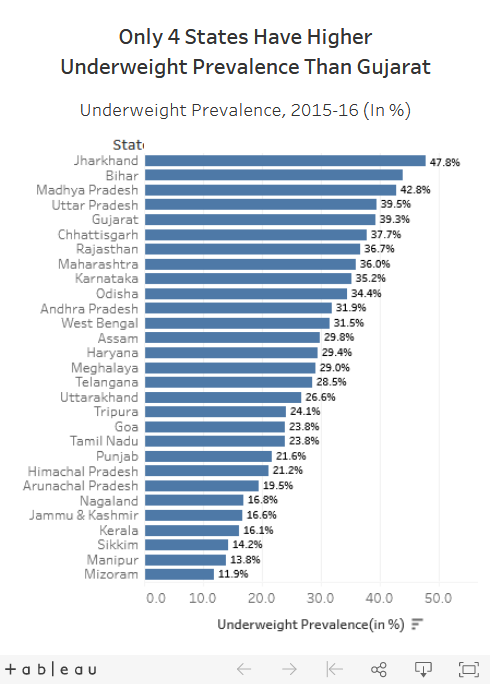
Source: National Family Health Survey 2015-16
As we said, Gujarat’s infant mortality rate (IMR, or infant deaths per 1,000 live births) is an outlier compared to its economic indicators, as is its under-five mortality rate, by which it ranks 18th, with India’s top five being Goa (13), Kerala (13), Tamil Nadu (20), Maharashtra (24) and Manipur (26).
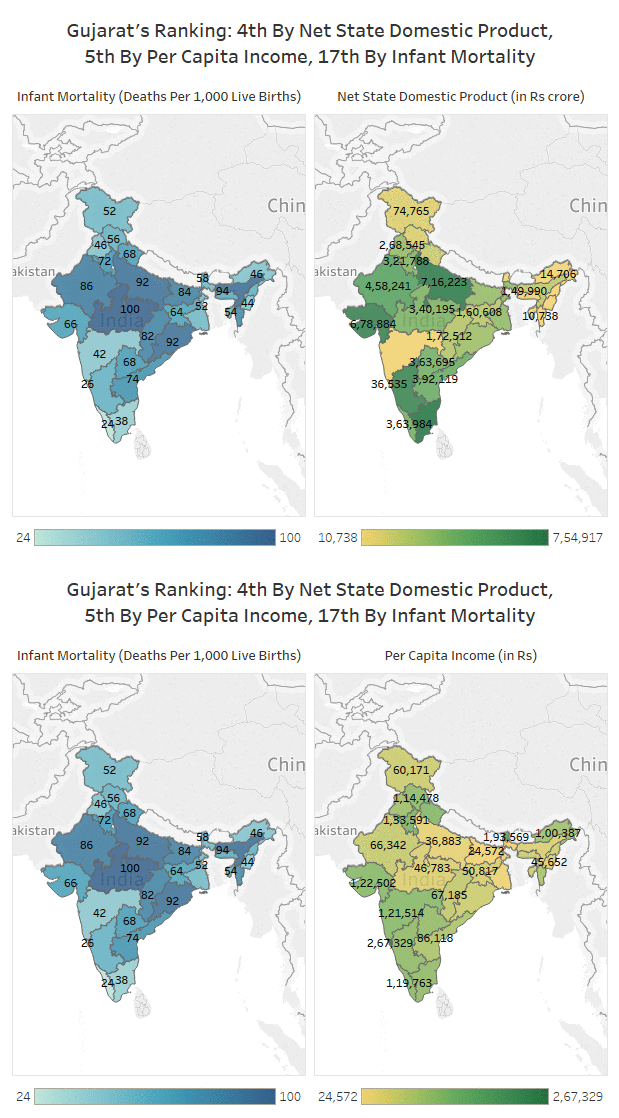
Source: Reserve Bank of India reports here & here; Sample Registration System 2015, National Family Health Survey 2015-16
Note: Domestic product at constant prices and per capita income data are for 2015-16; Economic data for Tripura are for 2014-15, West Bengal for 2010-11
Gujarat, which is ranked fourth based on state domestic product, is ranked 17th on infant mortality, behind poorer states such as Manipur (22), Arunachal Pradesh (23) and Tripura (27).
Gujarat has a per capita income of Rs 122,502 that is almost close to Maharashtra (Rs 121,514) and Kerala (Rs 119,763). However, its child health indicators lag Maharashtra and Kerala on all three parameters–underweight children under five, infant mortality and under-five mortality.
Jammu & Kashmir, with a per capita income of Rs 60,171–50% lower than Gujarat–has lower infant mortality (26) and under-five mortality (28).
Nearly 1.08 million Indian children under the age of five years died in 2015–that is 2,959 deaths every day or two each minute–many of them of causes that were preventable and treatable, IndiaSpend reported on August 16, 2017.
India has reduced its IMR by 68% in the last 41 years from 130 in 1975 to 41 in 2015-16, data from the National Family Health Survey 2015-16 reveal, IndiaSpend reported on May 3, 2017.
India’s IMR of 41 deaths is worse than than poorer neighbours Bangladesh (31) and Nepal (29).
The deaths of infants at public hospitals is a nationwide issue, revealing the depth of the crisis in India’s public-health system, IndiaSpend reported on August 29, 2017. This year, 52 infants died over 30 days at Jamshedpur’s Mahatma Gandhi Memorial Medical College hospital in Jharkhand, two weeks after 70 children died at the Baba Raghav Das Medical College Hospital at Gorakhpur, Uttar Pradesh.
Courtesy: India Spend
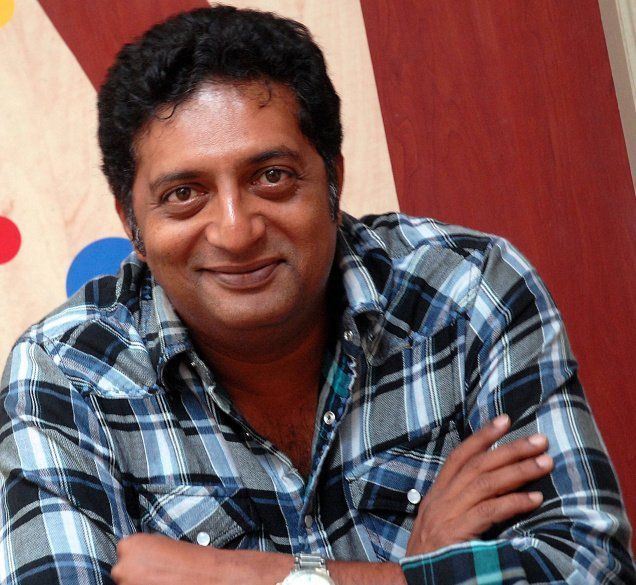
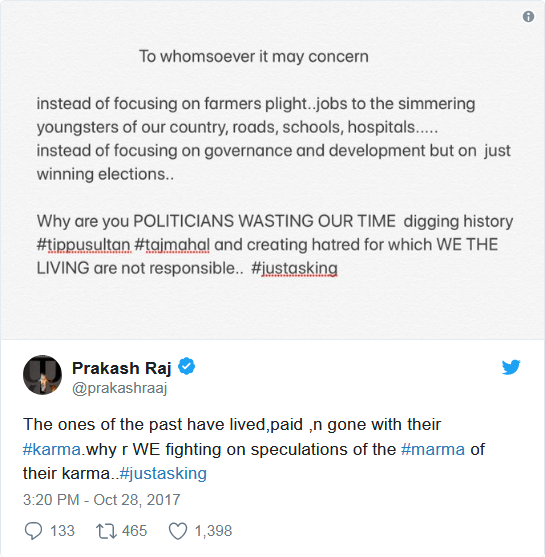
Actor Prakash Raj has once again slammed the Hindutva groups, this time for raking up India’s history involving Taj Mahal and the 18th century brave warrior, Tipu Sultan.

In a Twitter post, the popular actor wrote, ‘Instead of focussing omn farmers’ plight.. jobs to the simmering youngsters of our country, roads, schools, hospitals…..instead of focusing on governance and development but on just winning elections..
“Why are you politicians wasting our time digging history #tipusultan #tajmahal and creating hatred for which WE THE LIVING are not responsible..#justasking.”
Prakash Raj’s comments came in the wake of atrocious comments made by a union minister calling the brave Mysore ruler, who died fighting the British, a rapist. Ananthkumar Hegde had also called Tipu a mass murderer. Even though President Ram Nath Kovind had recently said that the 18th century ruler had died fighting the British.

Elsewhere in Uttar Pradesh, Hindutva forces have made more comical commenst questioning the history behind Taj Mahal, one of the seven global wonders.
Earlier this month, Prakash had slammed Prime Minister Narendra Modi for his silence on the murder of journalist Gauri Lankesh while calling the latter a better actor than him.
Raj also said that the would return the give National Awards he has received for his acting skills to recognise that Modi was a better actor.
Speaking at a function organised by Democratic Youth Federation of India in Bangalore on Sunday, Raj questioned Modi’s decision to follow vicious trolls on social media, who regularly attacked journalists and issued rape and death threats.
He said that while he was not sure who had killed Lankesh, he knew exactly who was celebrating the journalist’s murder.
Courtesy: Janta Ka Reporter
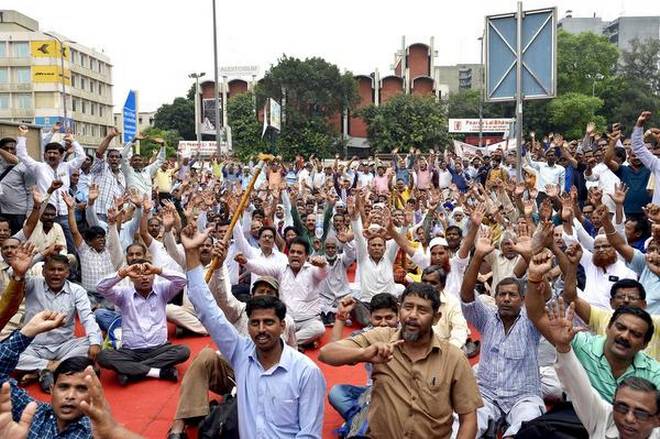
How will New Delhi and the Modi regime respond to the demands of hundreds of thousands of workers who arrive in wave after wave in the capital from November 9 to 11 pressing the key demand – increase the minimum wage?

Representation Image
The demand is modest and simple. Workers the productive end of India’s burgeoning population are demanding that a wage of Rs.18,000 should be declaredas the minimum wage by the government. There is a further demand: that henceforth it should be linked to the Consumer Price Index. This means that as price of what they need rise, their wages should go up equally.
Reports from all over the country and across all sectors indicate that workers and employees are facing a tremendous squeeze on their family budgets because of the constantly rising prices. According to a survey report published by the government-run Labour Bureau, about 57% of wage earning workers earn Rs.10,000 per month or less. In fact, nearly 20% or one in five of workers gets Rs.5000 or less per month.
Worse, the statutory minimum wages declared by the State governments are only on paper because the bulk of employers do not implement them. Although this is a gross violation of the law, the labour law enforcement machinery is defunct and employers bribe their way through the weak attempts if any made by workers to get their legal rights. It is only when workers are organized with strong trade unions that they can manage to get minimum wages.
Even in the organised sector the condition of wages is pathetic. According to the Annual Survey of Industries (ASI) brought out by the govt.’s Central Statistical Office (CSO), in 2014-15 the average wage per worker was just Rs.10,000 per month.
The situation is all the more dire for lakhs of contract and casual workers whose wages are not even linked to the statutory minimum wages declared by state or central govts. According to the Labour Bureau’s report, 87% of contract workers get Rs.10,000 or less per month.
A survey done by CITU last year showed that among all the big industrial sectors like steel, coal, transport, plantation, port and dock, etc. contract workers were earning roughly half of what their regular counterparts earned in the same industry. Employing contract workers has become the method of choice for employers to push down wages and escape labour laws. The condition of casual workers, who make up one third of workforce in India, is even worse with over 96% earning less than Rs.10,000 per month.
In most places, workers are so desperate that they are forced to accept work for 10 or 12 hours, often at normal wage rates (not double as stipulated for overtime) just to make ends meet. In other words, the harsh exploitation has effectively blown away the concept of 8-hour working day for many in India.
How does one know how much wage is needed for a worker’s family to live? It is possible to get an estimate of the bare minimum requirement – enough to keep skin on bone, as workers ruefully say – by using a formula first accepted by the 15th Indian Labour Conference (ILC), which is a body made up of workers, employers and govt.
Decades ago, in 1957 the ILC agreed that minimum wage should be worked out by taking the cost of following items for a workers’ family of two adults and two children:
1) Per capita food intake of at least 2700 calories for a worker’s family comprising three units (2 adults units + 2 children equivalent to 1 unit)
2) Per capita cloth of at least 18 yards per annum
3) Provision of housing as per minimum rent charged by government industrial housing scheme for low-income category
4) 20 per cent of the above total to be added for fuel, lighting, miscellaneous expenditures.
The Supreme Court ahd also intervened in 1992 to the 1957 conclusions and stipulated that, an additional 25 per cent of the above total should be further added to cover for education, medical expense, recreation and provision of old age and marriage while fixing minimum wage.
If you do the maths, this will work out to about Rs.20,000 per month. The central govt. has agreed to pay Rs.18,000 per month as the minimum wage for its own employees, based on Seventh Pay Commission recommendations.
If this is the rate at which govt. employees get paid, why should other workers get less wages. Cost of living is the same for a govt. employee and an industrial worker or a scheme worker. Why shouldn’t they get same wage? In fact the workers are demanding Rs.18,000 as the minimum wage.
On the other hand, big corporate houses, both domestic and foreign, continue to reap super profits. The govt., instead of providing some relief to workers, is dancing to the tune of monopolists like Ambanis, Adani, Tatas and Birlas, receiving directions from industry bodies like CII and FICCI. Their super profits are sought to be maintained by cutting “costs” of labour – by throwing workers out, by reducing or freezing wages and by contractualisation.
A recent study has shown that income inequality is now the highest ever in record, surpassing the levels found in 1922 under the British colonial rule.
Instead of accepting this just demand and amending the Minimum Wages Act accordingly, the BJP led government have introduced the Code on Wages Bill in the Lok Sabha, which has no mention of the 15th ILC formula and Supreme Court directions. In fact, it is an effort to remove wage fixation from the ambit of labour laws altogether.

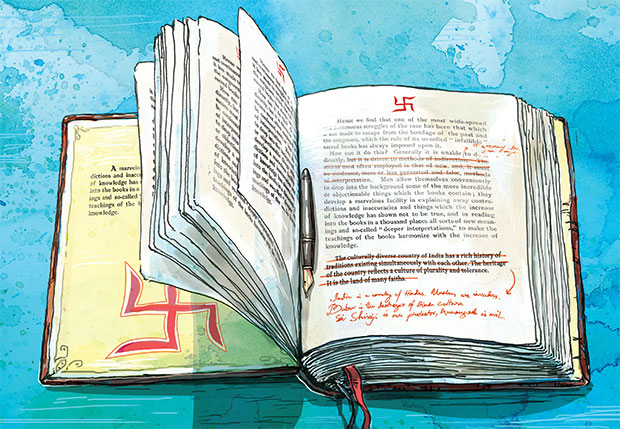
The controversial statement of the BJP legislator of UP State Sangeet Som denigrating Taj Mahal should not surprise us. ‘History’ propounded by the Hindu supremacists is stranger than fiction. It is a tool in the hands Hindutva to justify their ideology which considers Muslims and Christians, whose holy lands are outside India (land mass from River Sindhu to Arabian Sea) as foreign religions. Indian Constitution may qualify Muslims and Christians as Indian citizens but Hindutva political ideology (HPI) views them as foreigners to be gotten rid off or subdued to the status of non-citizens or second class citizens. Hindutva calls upon all Hindus to wage war on what they consider foreign religions. Hindutva ideologue Vinayak Damodar Savarkar called upon Hindus to “Hinduize all politics and militarize Hindudom”. Hinduizing politics meant to establish political and cultural hegemony of upper-caste Hindus.
The war that HPI wants to wage on the ‘foreign’ religions needs justification and convincing and mobilizing the lower caste sections of Hindus, without whom the war is impossible. They need to convince the lower castes that the Hindu religion, which practices oppressive caste system and treats a section as untouchables and sub-humans, is superior to the foreign religions – viz. Islam and Christianity. Demonization of Muslims and Christians was crucial to build militarized Hindudom that Savarkar called upon. One of the instruments used to demonize the Muslims and Christians was History. The political ideologues of Hidndutva fictionalized History and historicized fiction without having any intention to respect the science of History.
‘History’ propounded by HPI has basically borrowed from the colonial historiography of Henry Miers Eliot and John Dowson, both British civil servants. Eliot and Dowson periodized the Indian past according to the religion of the rulers – Hindu period and Muslim period. Though Eliot and Dowson periodized pre-Islamic history as Hindu period supposedly on the basis of religion of the rulers, but the rulers did not see themselves as followers of Hindu religion for most period. The word ‘Hindu’ was used more to denote inhabitants of the geographical region on the Eastern bank of river Sindhu. The Persians pronounced Sindhu as ‘Hindu’. “The term ‘Hindu’ was coined in opposition to other religions, but this self-definition through otherness began centuries before there was contact with Europeans (or indeed, with Muslim).” (Doniger 2013, 5) “Our word ‘Hindu’ originates in the geographical feature of the Indus River. It comes from a word for ‘river’ (Sindhu) that Herodutus (in the fifth century BCE), the Persian (in the fourth century BCE), and the Arabs (after the eighth century CE) used to refer to everyone who lived beyond the great river of the northwest of the subcontinent, still known locally as the Sindhu and in Europe as the Indus.” (Doniger 2013, 6-7)
The rulers before the Muslim rule did not identify their religion as Hinduism, it the outsiders who referred to all the inhabitants of the region as Hindus. It is Colonial masters who used the geographical term ‘Hindu’ to mean religion. The Britishers in their census enumeration used Hinduism to denote religion of those who were neither Muslims, Christians or other known religions. Besides the fact that many historians would question periodization of history on the basis of religion of the ruler, Eliot and Dowson called ‘pre-Muslim period’ as Hindu period, even though the different rulers followed diverse religious faith including Jainism and Buddhism.
Without critiquing the colonial historiography of Eliot and Dowson, HPI endorsed it and built upon it. HPI glorified the Hindu period to be golden period of Indian History and considered the Muslim period as a period during which there was a decline. Communal Muslims or Muslim nationalists glorify the Muslim period. Both viewed history from their respective ideological perspective to determine their future. Romila Thapar writes that historical interpretation can become a two-way process, where the needs of the present are read into the past, and where the image of the past is sought to be imposed upon the present; and the image of the past is the historian’s contribution to the future (1993; pp. 1). E H Carr reaches same conclusion and writes, “When we attempt to answer the question ‘What is history?’ our answer, consciously or unconsciously, reflects our own position in time, and forms part of our answer to the broader question what view we take of the society in which we live.” (Carr 1987).
Hindutva ideologues differ in their narratives of history as is evident from the different stances taken by different leaders on Taj Mahal. Yogi Adityanath once said Taj Mahal had no connection with India’s culture or heritage (Manish and Sanyal 2017) and omitted it from the booklet of tourism department of UP. Sangeet Som, BJP MLA called it a cultural blot on India and which was built by traitors (Sharma 2017). BJP MP Vinay Katiyar opined that Taj Mahal was originally a Shiv Temple (PTI 2017). Later Adityanath called it pride of India after visiting it and that sweat and toil of Indian people had built it.
However, their instrumentalist view of history is that the golden period of ‘Hindu’ history was over after invasion by the Muslim aggressors from the Northwest. Thereafter the social structure crumbled and ‘Hindus’ and ‘Hindu’ culture suppressed which caused their economic decline. The Muslim aggressors were despotic and their religious fanaticism required them to destroy every symbol of ‘Hindu’ culture and forcibly impose ‘Islamic’ culture and convert all ‘Hindus’ to Islam. ‘Hindus’ resisted the aggression which led to permanent war between the two communities or two nations – Muslim and ‘Hindu’ – not between two kings who happen to be Muslim or ‘Hindu’. The Muslim community through their Emperors enslaved and humiliated the Hindus and with the intention of completely destroying their culture. Muslims demolished their temples and constructed their mosques over it. Presently they claim there were 3,000 such temples which were destroyed and mosques built over them, including the Babri Masjid in Ayodhya, and the mosques in Mathura and Varanasi. The HP ideologues have never presented a list of all 3,000 structures which were destroyed and mosques constructed in its place.
The objective of writing such a history is primarily to stigmatize entire Muslim community and represent them as oppressors against whom all Hindus should be united and wage a war to seek revenge of historical wrongs done to them. There was little chance for the caste based hierarchically structured society to unite and for those on the lower rungs of the structure to defend the birth based social privileges of those on upper rungs when they themselves suffered inhuman oppression from the upper castes. One of the strategies to achieve this was to demonize other communities, historicise conflicts with it, pose it as an existing threat and call upon all Hindus to unite against them.
The second objective is to reclaim, own and control the land, institutions and structures owned by the ‘enemy’ communities. If you can’t build it, grab from others. The third objective is to create a case for expansionism – Akhand Bharat with not only capturing Pakistan and Bangladesh, but also South China in the North, Myanmar in the East, Sri Lanka in the South and entire West Asia as we shall see shortly. The fourth objective was to construct an image of glorious past in which all technological and scientific achievements that we see today was already achieved by the ‘Hindus’ thousands of years ago during the Vedic period, including aircraft (pushpak viman), plastic surgery (implanting Elephant head on to a human body), most advanced nuclear tipped missiles and used during the war in Mahabharat, genetic engineering etc. Pride in the past is one tool to not only unite the community, but also claim it to be superior to all other communities and therefore right to rule the world and to create a militarized and authoritarian state to achieve that objective. Claiming a glorious ‘Hindu’ past was also to deny glorious past of any other community. For example, if Taj Mahal and even Kaaba is a glorious structure, it must be a Hindu structure as no such glory belongs to ‘enemy’ community.
Purushottam Nagesh Oak was one of the HP Ideologue who established ‘Institute for Rewriting Indian History’ and wrote several books. The historical wisdom of HPI is largely informed by Oak’s writing. Broadly and Briefly, Oak’s claims are as under:
These assertions would be and should be normally questioned by not only students of history but also people with ordinary intelligence. Hindutva’s historical wisdoms are doled out to their cadres and followers who have been mobilized and recruited by touching their religious sentiments and amenable to orientation of a strong unitary collective that would act as their support network and give them a sense of belonging. The strong unitary collective is built around shared common objective and common hatred of those whom they call foreigners. Hindutva ‘history’ is an ideological tool to deepen the conviction of the mobilized cadres and imagine a past where the enemy ‘foreigners’ were oppressors even in the past. It induces them with hatred of the ‘foreigner’ and motivates them to commit worst crime against them. HPI built on imagined past in which the ‘foreigners’ are projected as having committed inhuman atrocities on them brings forth the need to exorcise the agony of having suffered such atrocities by inflicting it on the ‘foreigners’ around them. Such imagination of the past first suppresses the human within before they become cadre of Hindu supremacists.
The cadre convinced of such an imagined past is rarely able to stand up to rational scrutiny of his/her belief. They keep repeating their belief. They follow their leader who too keeps repeating his/her belief of what the past was and hope that it would be accepted as unassailable truth if enough number of people repeat it enough number of times. It is through this prism that Tipu Sultan is also looked from. That Tipu Sultan died fighting the Britishers notwithstanding, Tipu being a ‘foreigner’ should necessarily mean he was oppressor of ‘Hindus’.
Mobilized cadres of HPI need empathy and help to restore their rationality and humanity. However, they have demonstrated the destructive potential once by demolishing Babri Masjid. Other historical heritage of the country needs to be protected. Our education system should be strengthened to inculcate human values and equip students to explore past in order to understand it and learn lessons of history to shape our future.
The views expressed here are the author’s personal views, and do not necessarily represent the views of Sabrangindia.

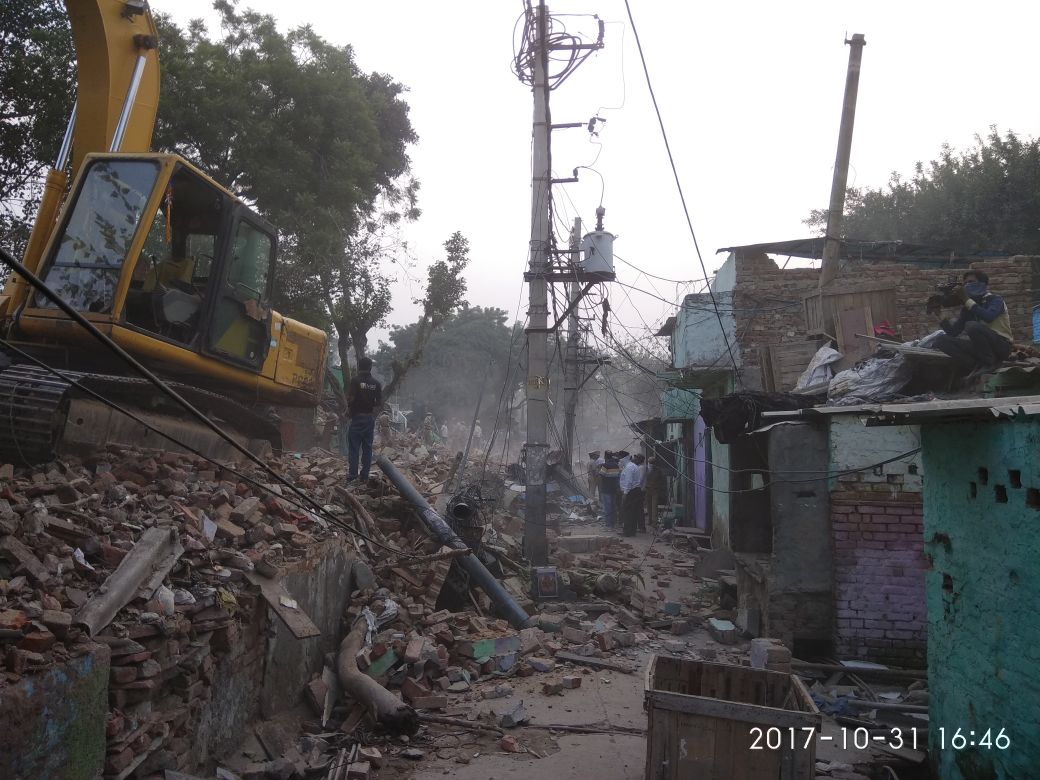
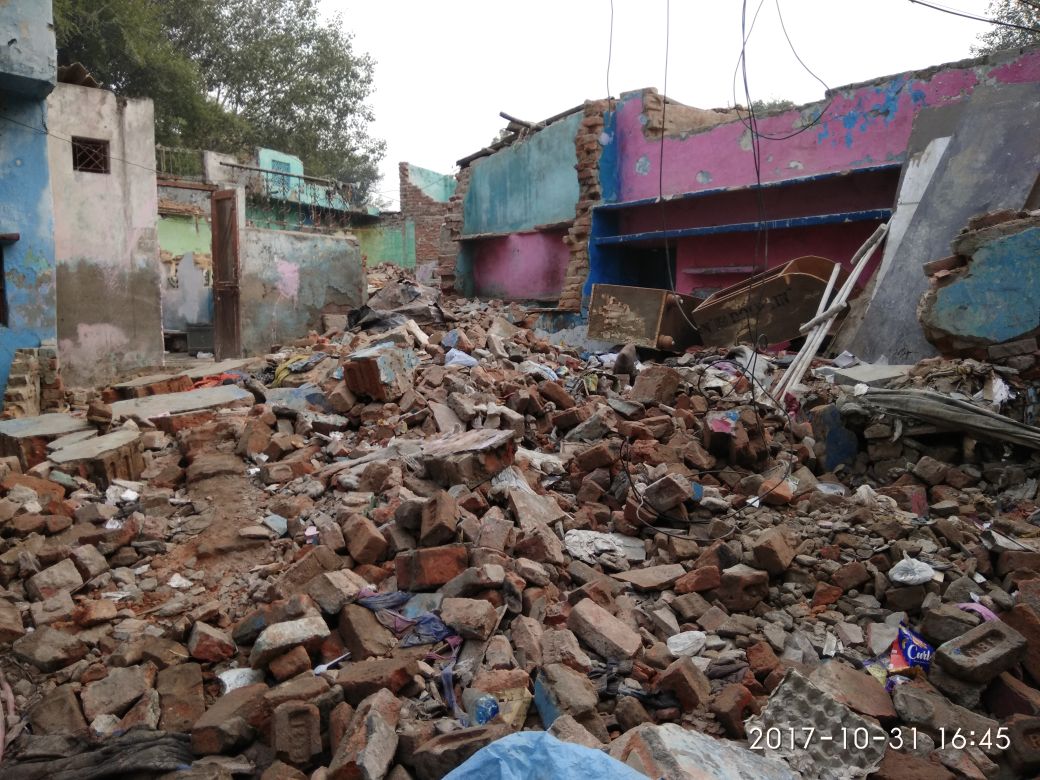
A bench of Acting Chief Justice Gita Mittal and Justice C Hari Shankar gave the order to allow people who have been found eligible to move to the designated relocation sites. Those found ineligible will not be “ physically removed from the demolished premises “.The bench ordered Ranjeet Nagar Police Station House officer to maintain “strict status quo”.
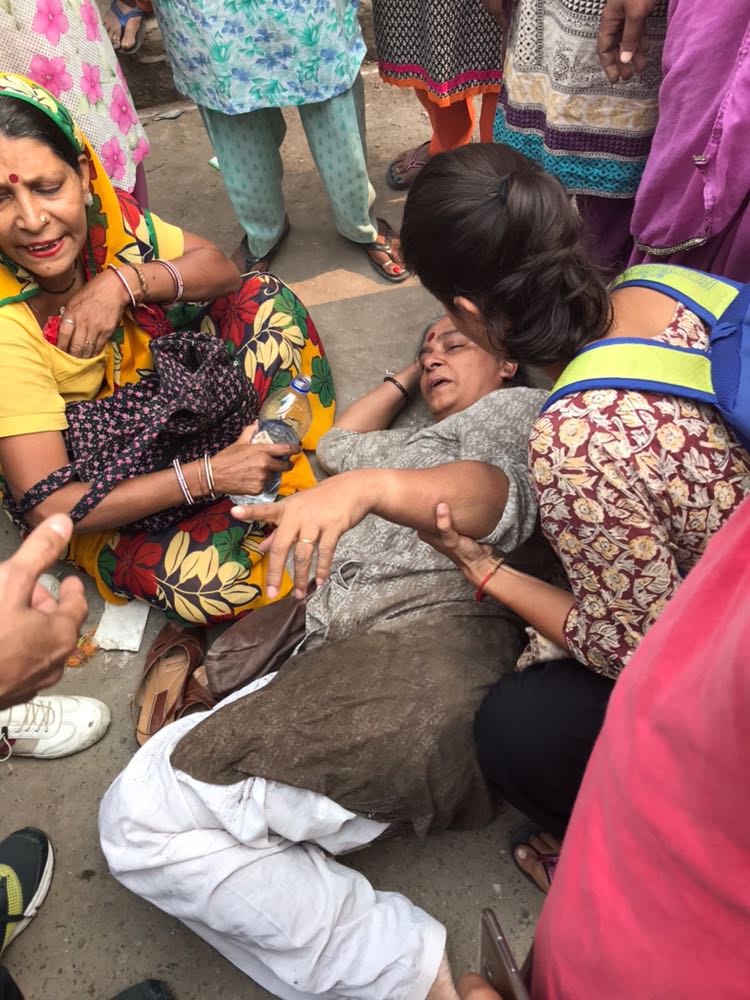
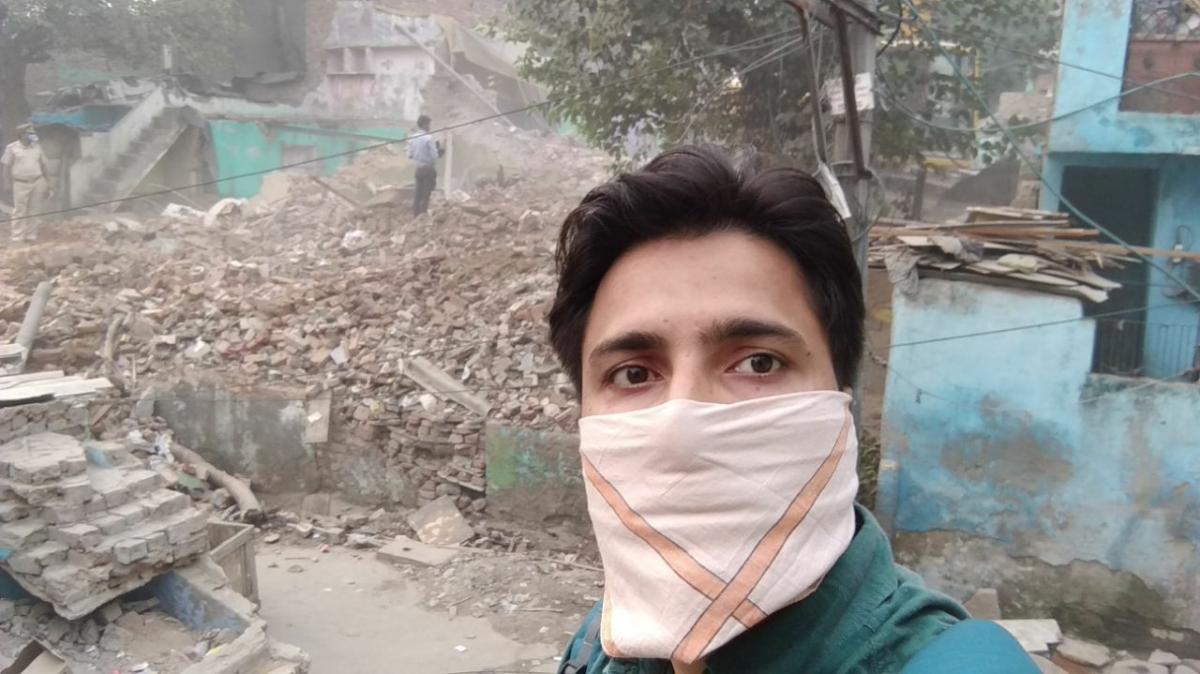
In a press release issued on 30th October 2017 by the National Alliance of People’s Movements ( NAPM ) activists mentioned that the brutal demolition drive started on the 30th of October in Kathputli colony. At some places tear gas shells were fired by the police and also young people were dragged out of their houses. The videos showed the bulldozers razing houses to the ground. Many people have been injured, an elderly lady tried to hang herself, some people claimed that their children were missing while a 2 year child has died. A 5 year old child, a journalist, Kshitij (journalist from The Quint) was also jailed with other alleged trouble-makers who were held captive for over 8 hours in Ranjit Nagar police station. Senior activist Annie Raja was seriously attacked with batons by the police when she went there to extend her support and had to be admitted to the hospital. An ambulance which was coming to take her to the hospital was not allowed to enter near the protest site and she had to stay in that state for an hour before she could be taken to the hospital.


The press release claimed that the DDA was working in tandem with the Raheja builders to carry out this drive despite the fact that many international and national level artistes stay here.
In a similar move last year, during the chilling winters of December, the DDA had tried to evacuate this area by force but had met with strong resistance from people and had to step back. It has become a trend for the DDA to carry out these demolition drives in winters where the people are left out in the open to bear the numbing cold without any protection. The children have been cut off from schools and we are at a risk of losing important cultural forms if this drive becomes successful.
The kathputli community is a community of artistes which have been staying in the area since past 70 years and it is important to save their art form as well as provide for a decent accommodation for them. A facebook post claimed, “2,800 families of magicians, snake charmers, acrobats, singers, dancers, actors, traditional healers and musicians and especially puppeteers or kathputli-performers from Rajasthan “ used to stay in Kathputli colony. Now a large section of them have been rendered homeless.

Residents and activists have planned to stage a protest today at 12 pm, in front the Lieutenant Governor’s office in Delhi They have demanded to know the answers to the following questions :
1) Why has the DDA changed its agreement and instead of sending people to the Transit Camp near Anand Parbat, they want to send people to Bawana and Narela?
2) Where are the records of the survey and how many resident families consented to being shifted?
3) Why weren’t notices handed out in time for the residents to evacuate before the demolition drive happened?
4) Under whose order did the police feel free to attack and physically abuse the citizens and residents of the colony?
5) Why were tear gas bombs and guns used in the drive yesterday? What threat did unarmed residents pose to a battalion of almost 500 police officers?
6) Why were ambulances and other relief measures not kept ready at hand to help injured residents?
7) Despite the Urban Development Minister ordering a halt on the demolition drive why did it continue for hours after the same?
8) What processes does the Government and DDA have in place to make sure the children’s education is not disrupted? What immediate relief will be provided by the same for the residents of the colony who are now homeless at the onset of cold winter nights
Related Articles
— The Right to Home and Hearth
— Stop Forced Evictions & Rights Violations in Chennai: CM Petitioned
— NOIDA Shanties where Zohrabi Lived Pulled Down, Amidst Heavy Rain
— How Progressive Cities Can Reshape the World — And Democracy
— Residents of Mumbai’s poorest slums know polls won’t change a thing for them – but they vote in hope
Join our mailing list to get the latest human rights news that matters, straight to your mailbox.
© Sabrang | All Rights Reserved