Email: sabrangind@gmail.com


Yes, it is that time
Lights twinkle and glitter and
And the sound of Pataki
Going bang, boom, crack
Fill the air.
But I hear not Pataki
But the sound of a gun…
Going bang, boom, crack
“We heard Pataki sound
The neighbours said..”
It was not Pataki
But bullets from a gun
That ended my sister
Spreading darkness..
I remember a time I burst the biggest of ‘bombs;
and revelled in the sound…
But now I hear the burst of crackers
Going bang, boom, crack
I hear Gunshots
Repeatedly piercing ..
Through my sister’s frail body
They gave a state honour for my sister
With three rounds of gun shots in the air
But when the last gun shot went
bang, boom, crack
I clutched my sister-in-laws hand
Tighter and tighter
And died a little inside.
When the final round was shot
There was loud rumble
From the dark cloudy sky above
It was as if Gauri, my sister
growled like a lion…
I WILL NOT BE SILENCED!!

Zapatista Church: a very small monument to liberation theology. Credit: Flickr/David Sasaki. CC BY-NC 2.0.
This June saw the passing of two of our generation’s most fascinating and controversial Catholic priests: François Houtart and Miguel D’Escoto Brockmann. Houtart was a Jesuit priest and prolific scholar on the faculty of sociology at the University of Louvain in Belgium. His leadership in the dialogue between Marxism and Christianity, his research on religion in society from Sri Lanka to Nicaragua, and his desire to connect social movements in the global South through the Tricontinental Centre (CETRI) which he founded in 1976, matched his academic output of some 50 books.
On the theological front, he assisted in drafting the Pastoral Constitution of the Church in the Modern World (Gaudium et Spes or “Joy and Hope”), one of the most influential documents of the landmark Second Vatican Council. Houtart was a hero to many around the world but certainly no saint. In 2010, he terminated a global campaign to nominate him for the Nobel Peace Prize when he admitted to sexually abusing an eight-year-old boy in 1970.
He is perhaps best remembered for his pioneering work on the analysis of, and resistance to, corporate economic globalization. Noting the pervasive influence of the World Economic Forum, he proposed the “Other Davos” in 1996, a counter movement against the mounting power of neoliberal economics.
Five years later, others including Chico Whitaker, a lay Catholic activist and secretary of the Commission of Justice and Peace of the National Conference of Bishops of Brazil, built on Houtart’s initiatives to launch the World Social Forum (WSF) in Porto Alegre, an annual meeting place for alter-globalists seeking solidarity under the banner of “Another World is Possible!” Houtart served on its International Council.
Miguel D’Escoto served as a Maryknoll missionary priest in his native Nicaragua after his education and ordination in the USA. A liberation theologian, he joined Nicaragua’s Sandinista movement (FSLN) in the overthrow of the dictatorial Samoza regime and its resistance to the US-led “contra” war, serving in the Sandinista government—including as Foreign Minister between 1979 and 1990. In 2008 he was elected president of the United Nations General Assembly. Though never entirely repudiated by the Vatican for his political work, he was suppressed for decades before being fully restored to his pastoral duties by Pope Francis in 2014.
Houtart and D’Escoto were both men of their times. In their generation, liberation was in the air through national movements against colonialism, through revolutions, and through New Left activism across the globe. Following Vatican II’s “opening to the world” and the Church’s fresh engagement with modernity, Catholic priests, missionaries and lay leaders were free to pursue novel forms of ministry.
Such novel religious activism wasn’t entirely new. Brazilian Archbishop Hélder Câmara, the “bishop of the slums,” had taken a radical approach to his ministry to the poor a decade before Vatican II; and the antecedents to what would be called liberation theology had been building in both Catholic and Protestant circles for years. But the 1968 meeting of Catholic bishops at the Latin American Episcopal Conference (CELAM) in Medellín, Colombia, marked a turning point for the realignment of the church away from traditional social elites. Liberation theology was thus liberated to pursue its “preferential option for the poor.”
This movement spread powerfully through Latin America—and with assistance from Houtart and others, in Asia and Africa as well. But the epicenter was Latin America, where the movement aligned itself with other civil society groups in opposition to right-wing military dictatorships.
Among this generation, Roman Catholic theologians Gustavo Gutiérrez (now aged 89), Leonardo Boff (78) and Jon Sobrino (78), and the Methodist José Míguez Bonino (who died in 2012) are among the better known liberationists. Many of their ideas were developed in association with Paulo Freire (who died in 1997), the Brazilian Christian educational activist, proponent of popular education, and author of the acclaimed Pedagogy of the Oppressed.
Also part of this group was the Paraguayan Fernando Lugo (still young at 66), who was ordained a missionary priest by the Society of the Divine Word and returned home to become bishop of San Pedro where he was known as the “friend of the poor.” In 2008 he was elected president of Paraguay, but impeached in 2012 in what neighboring countries called a “constitutional coup d’état.”
Why did this generation rise to prominence in Latin America? There are numerous reasons. For one, in the post-World War II period, some like Houtart in Belgium were radicalized by the plight of the European working class and challenged by its irreligiosity to find new ways of articulating and identifying with the poor. This experience spread to Latin America almost accidentally, for the simple reason that Europe was oversupplied with priests and Latin America needed more of them; knowingly or not, Latin America imported radicalized priests in significant numbers. Latin American priests also studied in Europe, absorbing radical thinking. These influences played out in societies dominated by the Catholic faith.
But the larger reasons were twofold: first, the abject poverty of the Latin American majority which even the Vatican could no longer overlook; and second, the rise of oppressive military regimes and bitter political revolutions in Brazil, Argentina, Chile, Nicaragua, El Salvador and Guatemala. The felt need for liberation among the poor, the marginalized and indigenous peoples was as palpable as it was necessary. From the 1960s through the 1980s, the struggle for liberation was very real.
Those days are gone. Democracy has returned to much of Latin America, as well as a more pragmatic form of social democracy, and liberation theology has lost some of its revolutionary raison d’être. In his open and honest postmortem on the movement, the Belgian-Latin American José Comblin (who died in 2011) admits that in many ways the liberationists misinterpreted the life experience of the Latin American poor.
While they focused on rural peasants they overlooked migration to the cities. They also missed the mood of the campesinos’ popular religiosity, which trended strongly towards the Protestant and Pentecostal churches. And they ignored the desire of the poor to become consumers. “The Catholics opted for the poor,” as the saying goes, but “the poor opted for the markets.”
Hence, liberation theology was but a moment. It was a particular theo-political response to a specific set of circumstances—a generation’s rebellion against grinding poverty in the killing fields of revolutionary Latin America. But the rich theology of the liberationists endures as a challenge to every church tradition. Their analysis of the causes of poverty and how it is structured into prevailing global systems—recently articulated by Houtart in his 2011 manifesto From ‘Common Goods’ to the ‘Common Good of Humanity’—challenges every church to open its eyes to the cold, hard analysis that’s required to grasp the changing world around them.
Is there anything else the rest of the world can learn from the liberationists?
In the West, the Protestant, Anglo-European North and the Catholic, Iberian South produced vastly different socio-political traditions, even though they share in common a white settler history of slave-holding, the suppression of indigenous peoples, and capitalist class exploitation. If the South trends social-democratic and struggles against powerful conservative elites, the North trends liberal, towards laissez faire capitalism and expressive individualism. As it was framed in Latin America, liberation theology could never succeed in the North.
Nevertheless, it has many lessons to teach. The first lies in its consciousness—its willingness to flip the social script from catering to elites to privileging the poor. Liberation theology was never only about theo-politics and revolution. It was also about overcoming alienation: the alienation that separates human beings from each other, people from the Earth, Western from pre-Western forms of life, and alienated psyches from transcendence. It taught ordinary people to perceive the reality of their own circumstance—to conscientize themselves, as the liberationists put it—through their own self-reflection, so that they were free to construct a social reality that resisted the powers of the age.
Secondly, we can learn from its methodology, simple yet profound: “See–Judge–Act.” That is, live in the concrete world. Describe reality as it is, not simply as theory tells us. But also judge reality from the horizon of a reconciled humanity, and act accordingly to bring that reality about. The liberationists put a lot of time into analysis, and that let them tell, in great detail, the hard truth that the world we have made is grinding others into the dust, and that this must stop, as much for our own salvation as for the wellbeing of others.
Third, we might even learn from its mistakes. To overlook popular religiosity—because intellectual and religious elites aren’t interested in the daily lives of the faithful, or because wealthy city dwellers forget rural life and laugh off its traditions, or because the successful classes denigrate the struggling classes and blame them for their own suffering—is to leave large segments of society without the material, intellectual, and spiritual resources to find their way in the world.
Lastly, we might learn to take our own churches more seriously. The liberationists believed in spiritual community, life-giving fellowship, and historical church structures to hold them together more than any religious movement that I’ve come across. They believed in a “new way of being church”—confident that the social power of faith can liberate societies as easily as it can oppress them.
Since the end of Soviet-style socialism in 1989, ‘alter-globalization’ rather than ‘liberation’ has come to define the radical imagination, but the problems of poverty and oppression persist—as does the possibility that we might draw again on the theo-political resources provided by a remarkable community of radical priests to inspire a new generation of alter-globalist activists and theologians.
Gregory Leffel, Ph.D., is a missiologist working on collective action, social movements and theo-politics, and is director of One Horizon Institute in Lexington, Kentucky. He is author of Faith Seeking Action: Mission, Social Movements, and the Church in Motion; and is past president of the American Society of Missiology.

Advertising continues to portray women as charming keepers of the home, making it harder to succeed at work. Andrea44/flickr, CC BY-SA
As an Argentinean woman who studies gender in the media, I find it hard to be surprised by Weinstein’s misdeeds. Machismo remains deeply ingrained in Latin American society, yes, but even female political leaders in supposedly gender-equal paradises like Holland and Sweden have told me that they are criticized more in the press and held to a higher standard than their male counterparts.
How could they not be? Across the world, the film and TV industry – Weinstein’s domain – continues to foist outdated gender roles upon viewers.
Television commercials are particularly guilty, frequently casting women in subservient domestic roles.
Take this 2015 ad for the Argentine cleaning product Cif, which is still running today. It explains how its concentrated cleaning capsules “made Sleeping Beauty shine.”
The prince could help clean up, but why bother when women can do it all?
In it, a princess eager to receive her prince remembers that – gasp – the floors in her castle tower are a total mess. Thanks to Cif’s magic scouring fluid, she has time not only to clean but also to get dolled up for the prince – who, in case you were wondering, has no physical challenges preventing him from helping her tidy up.
But why should he, when it’s a woman’s job to be both housekeeper and pretty princess?
Somewhat paradoxically, advertisements may also cast men as domestic superheroes. Often, characters like Mr. Muscle will mansplain to women about the best product and how to use it – though they don’t actually do any cleaning themselves.
Mansplaining domestic chores.
More recently, there’s been a shift – perhaps an awkward attempt at political correctness – in which women are still the masters of the home, but their partners are shown “helping out” with the chores. In exchange, the men earn sex object status.
Thanks for ‘helping out,’ hubby.
Various studies on gender stereotypes in commercials indicate that although the advertising industry is slowly changing for the better, marketing continues to target specific products to certain customers based on traditional gender roles.
Women are pitched hygiene and cleaning products, whereas men get ads for banks, credit cards, housing, cars and other significant financial investments.
This year, U.N. Women teamed up with Unilever and other industry leaders like Facebook, Google, Mars and Microsoft to launch the Unstereotype Alliance. The aim of this global campaign is to end stereotypical and sexist portrayals of gender in advertising.
As part of the #Unstereotype campaign, Unilever also undertook research on gender in advertising. It found that only 3 percent of advertising shows women as leaders and just 2 percent conveys them as intelligent. In ads, women come off as interesting people just 1 percent of the time.
Even before it was forced to reckon with allegations that Harvey Weinstein had also harassed women in London, the United Kingdom was making political progress on the issue of women’s portrayal in the media.
In July, the United Kingdom’s Advertising Standards Authority announced that the U.K. will soon prohibit commercials that promote gender stereotypes.
“While advertising is only one of many factors that contribute to unequal gender outcomes,” its press release stated, “tougher advertising standards can play an important role in tackling inequalities and improving outcomes for individuals, the economy and society as a whole.”
As of 2018, the agency says, advertisements in which women are shown as solely responsible for household cleaning or men appear useless around kitchen appliances and unable to handle taking care of their children and dependents will not pass muster in the U.K. Commercials that differentiate between girls’ and boys’ toys based on gender stereotypes will be banned as well.
The U.K.‘s move is a heartening public recognition that gender stereotypes in the media both reflect and further the very real inequalities women face at home and at work.
Worldwide, the International Labor Organization reports, women still bear the burden of household chores and caretaking responsibilities, which often either excludes them from pay work or leaves them relegated to ill-paid part-time jobs.
In the U.K., men spend on average 16 hours per week on domestic tasks, while women spend 26. The European Union average is worse, with women dedicating an average of 26 weekly hours to men’s nine hours on caretaking and household tasks.
In Argentina, my home country, fully 40 percent of men report doing no household work at all, even if they’re unemployed. Among those who do pitch in, it’s 24 hours a week on caretaking and domestic chores for men. Argentinean women put in 45 hours.
You can do the math: On average, Argentinean women use up two days of their week and some 100 days annually – nearly one-third of their year – on unpaid household labor.
These inequalities, combined with advertising that reinforces them, generate what’s called the “sticky floors” problem. Women – whether would-be investment bankers or, I dare say, aspiring Hollywood stars – don’t just face glass ceilings to advancement, they also are also “stuck” to domestic life by endless chores.
The cultural powers that be produce content that represents private spaces as “naturally” imbued with female qualities, gluing women to traditional caregiving roles.
This hampers their professional development and helps keep them at the bottom of the economy pyramid because women must pull off a balancing act between their jobs inside and outside of the domestic sphere. And they must excel at both, all while competing against male colleagues who likely confront no such challenges.
Former U.S. president Barack Obama once pointed out this double standard in homage to his then-competitor Hillary Clinton. She, he reminded an audience in 2008, “was doing everything I was doing, but just like Ginger Rogers, it was backwards in heels.”
The sticky floor problem puts women in a position to be exploited by men like Weinstein, who tout their ability to help female aspirants to get unstuck. Until society – and, with it, the media we create – comprehend that neither professional success nor domesticity has a gender, these pernicious powerful dynamics will endure.
Virginia García Beaudoux, Professor of Political Communication and Public Opinion, University of Buenos Aires
This article was originally published on The Conversation. Read the original article.
Not long ago, Darul Uloom Deoband issued an edict (fatwa) declaring its ideological offshoot—Tablighi Jama’at—as “misguided”, “preacher of perverted views” and “misinterpreter of Quran and Hadith”. It has even banned the Jama’at from conducting its Tablighi activities inside campus of the seminary as reported in the Urdu dailies on August 10. Thus, the Deoband seminary had tried to convey a message that it was now endeavouring to progress on the constructive lines. But to our utter surprise, the seminary’s authorities—Ulema and muftis (those who issue the edict) — seem to have no different opinions. With every new bizarre fatwa they pass, they just show that they harbour the same retrogressive ideas and thoughts that are commonly preached by the Tablighi proselytes.

The Ulema of Deoband have long been issuing retrogressive Fatwas and irrelevant theological edicts that make a mockery of the daily Muslim life. Yet again, they have come up with an irrelevant fatwa forbidding Muslim men and women from posting their or their families’
photographs on social media sites. The fatwa has been issued on Wednesday by the Deoband seminary in Saharanpur after a man approached it recently asking if posting photos on social media sites was allowed in the Islamic Shariah.
In this fatwa issued, one of the chief Islamic clerics at Deoband, Mufti Tariq Qasmi, stated that posting photos of one’s self or family on social media sites such as Facebook, WhatsApp is not allowed in Islam. He argues: “when clicking pictures unnecessarily is not allowed in Islam, how posting photos on social media can be permitted”.
In fact, such Fatwas relying on the medieval and misconstrued texts of the Islamic theology put the present-day Muslims to collective disgrace and cynicism. They actually cause greater defamation to Islam than the Islamophobic conspiracies bred by the outside vested interests. And this is also one of the reasons behind the stereotyped image of the Muslims in the wider world.
Earlier, the Deoband’s Darul Ifta (the fatwa-issuing department) decreed that women should be prohibited from going to the beauty parlours, plucking, trimming, shaping their eyebrows and cutting hair. The Ulema of Deoband termed all these activities as “against the tenets of Islam”. Head of the Darul Ifta, Mufti Arshad Faruqi stated that grooming the eyebrow to look beautiful is “against the tenets of Islam”. He said in his fatwa: “They (women) can trim the eyebrows if they have grown too long but doing it for the purpose of looking beautiful is un-Islamic. The same is expected from men too”. Surprisingly, many other Deoband clerics in Saharanpur endorsed the fatwa. Maulana Lutfur Rehman Sadiq Qasmi said: “Women visiting beauty parlours are sinful. This fatwa makes it clear that they shouldn’t do anything externally to look beautiful”, as reported in The Telegraph.
One wonders if the Ulema of Deoband are still stuck in the medieval age and are completely out of sync with the modern scientific advancements. While other religious communities in the world are grappling with vital social, cultural and geopolitical issues, the medieval-minded Ulema and ‘puritanical’ Islamic clergy continue to woo the Muslims in India through the theological polemics which are patently out of date. Their regressive clerical decrees only reinforce the deeply entrenched perception that Muslims are not open to progressive and fresh thoughts.
Apparently, the Deoband’s Darul Ifta has been on the lookout for the media limelight through the display of its absurd Fatwas. In the past years, it was particularly in the media limelight as it passed a fatwa against the chanting of the nationalist slogans ‘Jan Gan Man’, ‘Vande Matram’, and ‘Bharat Mata Ki Jai’, which turned a politically charged issue at that time.
Given the unceasing fatwa trend in the clerical circle, it is important to trace the history of fatwa culture in the Indian subcontinent. An objective debate on the institution of Fatwa and muftis’ position in Islam is highly required.
While the Qur’an always exhorts reasoning and questioning over blind faith in the man-made theology, the ordinary practitioners of Islam do need proper guidance and consultation in matters of the religion. But at the same time, Indian Muslims need to ask the crucial question as to why India’s age-old, traditional spiritual Islam is losing its essence to the trail of Saudi-Wahhabi fatwa culture. It was in Saudi Arabia where a permanent committee for fatwa-issuing was launched, for the first time, by the kingdom’s clerics to issue the Islamic decrees and to advise the Saudi kings on religious matters. Nearly 21 Saudi Shaikhs and paid muftis were appointed, on lucrative salaries, by the theocratic government of the then King Fahd. According to a research work by Sadaqat Qadri, the Saudi muftis exported their views to as many as 80 percent of the non-Arab Muslims across the globe. Qadri writes in his book “Heaven on Earth: A Journey Through Shari’a Law from the Deserts of Ancient Arabia”: “They (Saudi clergy) reintroduced the advice of trained scholars to many Muslims who had turned to do-it-yourself religious interpretation, but also changed the nature of fatwa advice giving, which had traditionally been local and so relatively confidential and conditioned by customs.”
Ironically, there is no dearth of “online fatwa” services and websites today that transmit the Saudi Fatwas to the non-Arab Muslim societies, particularly in the Indian subcontinent, regardless of their local contexts, customs, cultures and national ethos. Such pronouncements can be stumbled upon the online fatwa portals such as IslamQA.info, fatwa-online.com, and AskImam.org and many more. Scores of Indian Maulvis are treading the path of the Saudi-Wahhabi muftis in running the online fatwa factories. This is a daunting challenge that Indian Muslims face in the wake of every fatwa of this nature. Therefore, we need to directly challenge the ideological infringement on our free religious rights that our Constitution confers upon all Indians. The right to profess and practice one’s religion with his/her Indian social and cultural ethos — which is the essence of Article 25 in the Indian Constitution — is basically the point to be discussed and safeguarded in the Muslim community in India. The misplaced clergy in the Indian Muslim society like the muftis of Deoband are antithetical to this universal right. They are trying to denying it not only to the adherents of other religions living in the Muslim countries, but also to the Indian Muslims practicing Islam well-embedded in the country’s composite culture. The notorious Islamist televangelists and muftis in India often give unsolicited “Fatwas” in the name of “appeal” to the Indian Muslim masses. Remember how the 46 Maulvis of Assam signed a pamphlet, which they claimed was not an Islamic jurisprudential decree (fatwa) but only an appeal, against the young Muslim singer Nahid Afrin. Even if they considered it an ‘ethical appeal’, and not a fatwa, how could the 46 Maulvis be justified in invoking the “wrath of Allah” on Afrin and warning against that “her parents will not enter paradise” because of her “sinful act”?
At this critical juncture, the well-established Islamic jurists (Faqihs) who have nuanced understanding of the Muslim religious affairs require an honest introspection. They cannot overlook the deplorable threat of the fanatic Fatwas that looms large in India scaring a sizable section of the Muslim community. But the fact that most of the Islamic scholars don’t reflect on this deeper ideological crisis in the community is more appalling. Without brainstorming the effective ways to end this theological dilemma, the Muslim community’s socio-cultural development and integrity will remain merely a mirage. This situation calls for the Islamic clergy’s serious engagement in broadening a theological worldview incorporating the progressive Islamic traditions in full harmony with the established scientific advancements. Regrettably, while other faith leaders have opened their doors to fresh scientific ideas, Muslim theologians are still lacking the logical progression in their socio-religious thoughts.
Ghulam Rasool Dehlvi is a scholar of classical Islamic studies, cultural analyst, researcher in media and communication studies and regular columnist with www.NewAgeIslam.com
Courtesy: New Age Islam
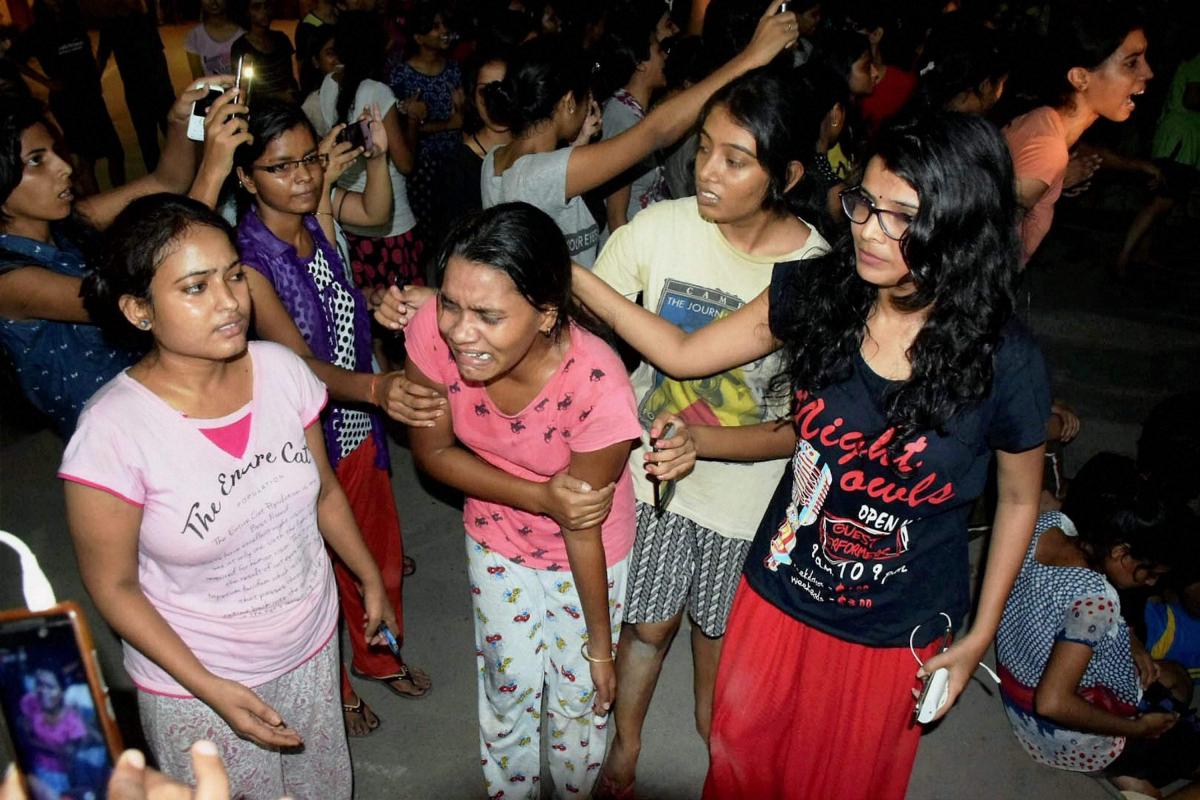
On September 22, Varanasi witnessed one of the biggest student protest in the Banaras Hindu University. The protests started after an incident of sexual harassment inside the campus on September 21. When the victim approached the University security board and other officials to complain about the incident, her whereabouts were questioned and she was instructed to remain silent on the issue.

Image; PTI
A month after student protests and the brutal crackdown of the same by Varanasi police and University administrations, it is clear that little has changed for the better inside the campus.
A visit to the campus and conversations with students showed us that the administration is yet to address issues which helped three male students harass a female student. Take the area inside the campus where the incident took place: the boys used the lack of streetlights to their advantage, but even now many streets inside the campus remain dimly lit or without any lights at all. Even the street where the incident occurred is yet to be lit adequately to avoid any such incidents in future. Ironically, the road where the incident was recorded has a temple under-construction since last few months, but BHU administration could not provide a well-equipped security infrastructure to avoid eve-teasing and sexual harassment cases.
Below are some images which were taken on the evening of October 20:


No lessons learnt from September
It seems that neither University nor the students have taken any lesson from what happened previously on the campus. After the students returned from the holidays following the protests, a boy entered a classroom in the presence of a teacher and slapped a girl multiple times. He also snatched her mobile and broke it. However, the police were quick to respond and the accused boy was arrested immediately.
A few days after this incident, an international student from Fiji was assaulted by his seniors on the pretext of ragging. The student was beaten two times during a period of 24 hours. This time too, police immediately filed an FIR, but arrests in the case are still awaited.
A professor at the University explained why there has been no change in the pattern of incidents in the campus. “It first comes to the students who come from a very patriarchal background. They were supposed to take a lesson from the past, but it seems they have taken none. Seeing this, it can easily be inferred that eve-teasing cases inside the campus would not have dropped,” he said. This is confirmed by Radhika Banerjee, a postgraduate student in science faculty. Banerjee said, “I have not come across any case of that sort – which happened on September 21 – but eve-teasing cases are still happening. Girls are still being pressurized to remain silent, and the boys are still being let off the hook.”
Radhika confirmed that she had faced eve-teasing at least a couple of times in the last twenty days.
BHU has extended the gate-closing timings of girls hostel until 10 pm – which was until 7 pm before – but the university is yet to address the actual issues.
Recently, 400 girl students of the university wrote a letter to vice-chancellor demanding relaxation in the curfew rules. The students wrote that they expect the university to ensure equality within the campus, citing UGC rules which are not discriminatory on a gender basis.
Defying the promise made with the students of the university, the district, as well as the university administration, has not moved an inch towards the formation of Gender Sensitization Committee against sexual harassment (GSCASH). The letter written by the girls testifies the same.
However, newly appointed chief proctor Royana Singh has ensured that she will monitor the hostel rules after talking with the girl students or their representatives.
A side without any voice
Be it a student union or a GSCASH, the students – especially girls – have lacked any sort of representation when it comes to making any rules. In the same course of one month after the incident, the representation of girls is still lacking. Mineshi Mishra, a student told TwoCircles.net, “They decide hostel timings and whether we should get non-veg food and wifi or not. But all such decisions come as they do not consider talking to us while taking the same decision. They make rules for the girls on an arbitrary basis and without any consultancy.”
The university is still running on Malviya values defying any sort of democratic environment, at least that is what several ex-students of the university said. Sunil Yadav, a social activist from Varanasi said, “The university lacks any sort of democratic environment, and I feel that it does not even want to make one.”
However, for BHU administration, the things are fine now, even if there are fewer street lights and security measures. University’s PRO Rajesh Singh said, “We have installed streetlights and CCTV cameras only at those places which we feel sensitive. These are the places where maximum movement of girls and boys have been recorded.”
Singh completely passed the question whether the University is planning to reinforce the security practices to the other areas as well. He said, “We cannot say that university has taken any lesson from the recent incident because the university was always bound to protect its students. We have always been strict when it came to security.”
About enacting of GSCASH at the university level, Chief Proctor Prof Royana Singh told TwoCircles.net, “That has not come on the table yet. We have prioritised other demands of the girls, like street lights and security camera. But the process of GSCASH will start soon.”
With the gagging of student rights’ inside the campus, there is no GSCASH in the campus and University is trying to convince the students over a mere ‘internal complaints committee’ and grievance redressal cell’, where the university has the only authority. But according to Prof Singh, the university is trying to sensitise the students – especially boys – about the sexual harassment and gender discrimination to put a stop on such cases.
Meanwhile, university’s vice-chancellor Prof GC Tripathi covertly came back into the campus on Diwali eve and performed a Puja. He left within three hours from the back door of the University after meeting several officers of the University. Sources inform that Tripathi – who still is VC – will come back before his tenure ends in next twenty days.
Courtesy: Two Circles

Though the Insecticides Act was enacted in 1968 to ensure a mechanism to regulate the import, manufacture, sale, transport, distribution and use of insecticides with a view to preventing risk to humans and animals, several lacunae in the Act made the unregulated flow of pesticides possible in the markets. Some of these loopholes include a lack of clarity on qualification for manufacturers, dealers, stockists and commercial pest control operators, larger representation of experts in the Central Pesticides Board and the Registration Committee, fixing tolerance limits of pesticides as a pre-condition of their registration. Also, since the Act was drafted about 5 decades ago, an elaborate description of pesticides to cover any substance of chemical or biological origin intended for preventing, destroying, repelling, mitigating or controlling any pest, including unwanted species of plants or animals, which may enable regulation of existing pesticides as well as new discoveries, is missing.
A new Pesticides Management Bill was tabled in the parliament in 2008. The said bill claims to cover all aspects of development, regulation and quality monitoring, production, management, packaging, labeling, distribution, handling, application, control, including post registration activities and disposal of all types of pesticides. The Bill proposes stringent punishments to check production and sale of misbranded, sub-standard and spurious pesticides, besides, and most importantly, providing for the disposal of expired, sub-standard and spurious pesticides in an environment friendly and safe manner.

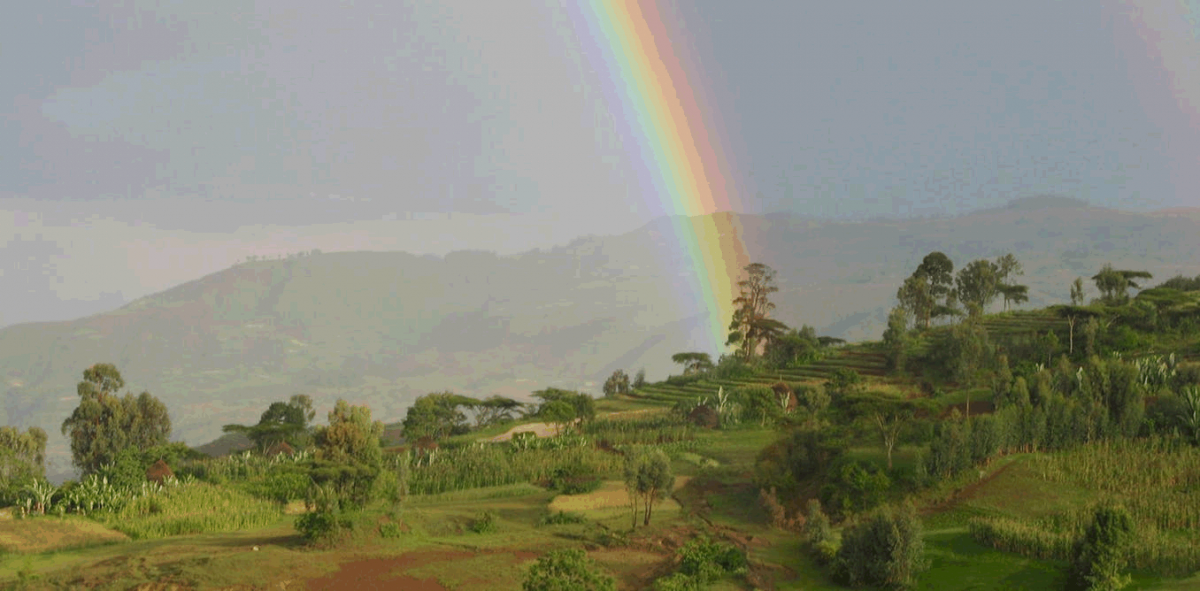
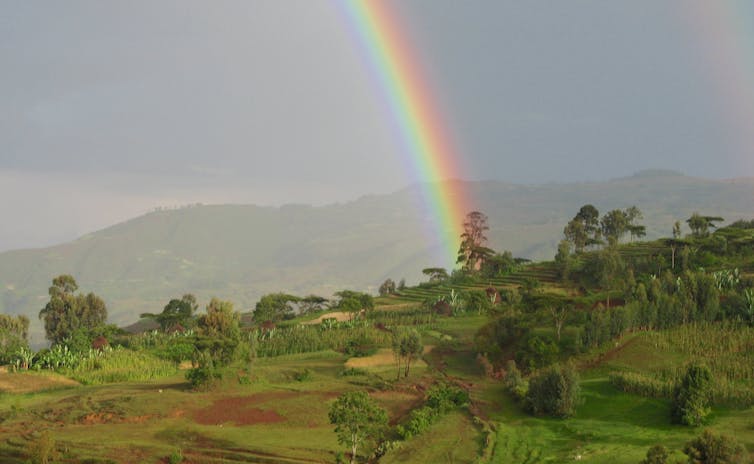
Smallholder agriculture in southern Ethiopia. Smallholder farmers are particularly vulnerable to food insecurity. Leah Samberg
Between 1990 and 2015, due largely to a set of sweeping initiatives by the global community, the proportion of undernourished people in the world was cut in half. In 2015, U.N. member countries adopted the Sustainable Development Goals, which doubled down on this success by setting out to end hunger entirely by 2030. But a recent U.N. report shows that, after years of decline, hunger is on the rise again.
As evidenced by nonstop news coverage of floods, fires, refugees and violence, our planet has become a more unstable and less predictable place over the past few years. As these disasters compete for our attention, they make it harder for people in poor,
marginalized and war-torn regions to access adequate food.
I study decisions that smallholder farmers and pastoralists, or livestock herders, make about their crops, animals and land. These choices are limited by lack of access to services, markets or credit; by poor governance or inappropriate policies; and by ethnic, gender and educational barriers. As a result, there is often little they can do to maintain secure or sustainable food production in the face of crises.
The new U.N. report shows that to reduce and ultimately eliminate hunger, simply making agriculture more productive will not be enough. It also is essential to increase the options available to rural populations in an uncertain world.
Around the world, social and political instability are on the rise. Since 2010, state-based conflict has increased by 60 percent and armed conflict within countries has increased by 125 percent. More than half of the food-insecure people identified in the U.N. report (489 million out of 815 million) live in countries with ongoing violence. More than three-quarters of the world’s chronically malnourished children (122 million of 155 million) live in conflict-affected regions.
At the same time, these regions are experiencing increasingly powerful storms, more frequent and persistent drought and more variable rainfall associated with global climate change. These trends are not unrelated. Conflict-torn communities are more vulnerable to climate-related disasters, and crop or livestock failure due to climate can contribute to social unrest.
War hits farmers especially hard. Conflict can evict them from their land, destroy crops and livestock, prevent them from acquiring seed and fertilizer or selling their produce, restrict their access to water and forage, and disrupt planting or harvest cycles. Many conflicts play out in rural areas characterized by smallholder agriculture or pastoralism. These small-scale farmers are some of the most vulnerable people on the planet. Supporting them is one of the U.N.‘s key strategies for reaching its food security targets.

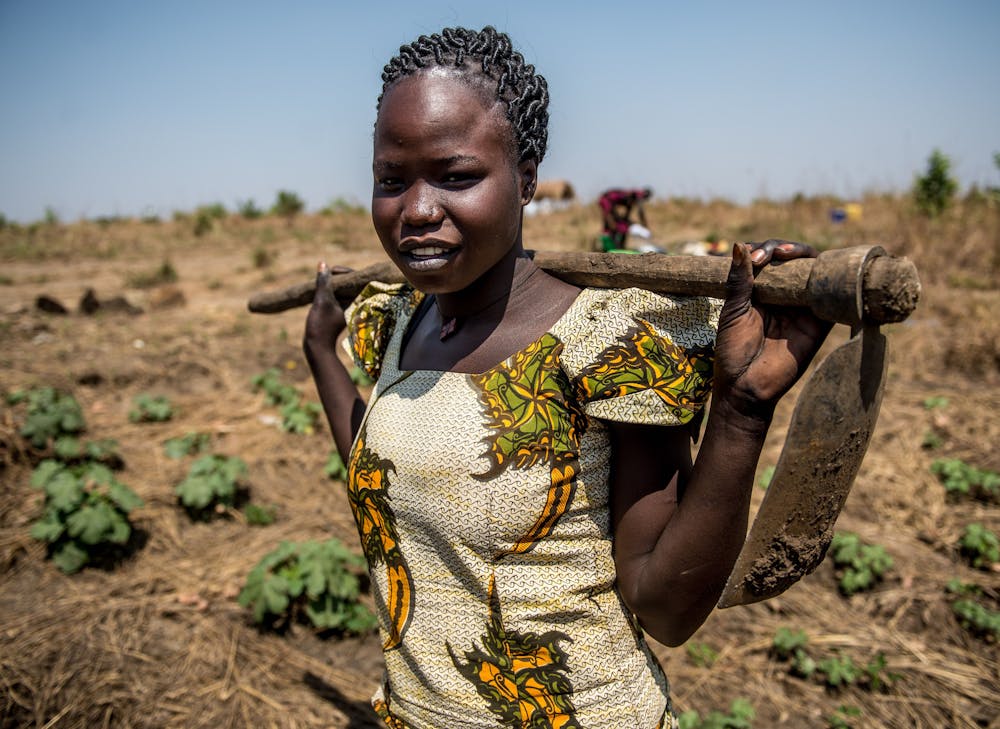
In September 2016 Viola Tabo fled her home in Lanya village, South Sudan, after government troops executed three of her brothers. She now cultivates vegetables to supplement refugees’ diet of maize and beans at Bidi Bidi camp. Trocaire, CC BY
Without other options to feed themselves, farmers and pastoralists in crisis may be forced to leave their land and communities. Migration is one of the most visible coping mechanisms for rural populations who face conflict or climate-related disasters.
Globally, the number of refugees and internally displaced persons doubled between 2007 and 2016. Of the estimated 64 million people who are currently displaced, more than 15 million are linked to one of the world’s most severe conflict-related food crises in Syria, Yemen, Iraq, South Sudan, Nigeria and Somalia.
While migrating is uncertain and difficult, those with the fewest resources may not even have that option. New research by my colleagues at the University of Minnesota shows that the most vulnerable populations may be “trapped” in place, without the resources to migrate.
Displacement due to climate disasters also feeds conflict. Drought-induced migration in Syria, for example, has been linked to the conflict there, and many militants in Nigeria have been identified as farmers displaced by drought.

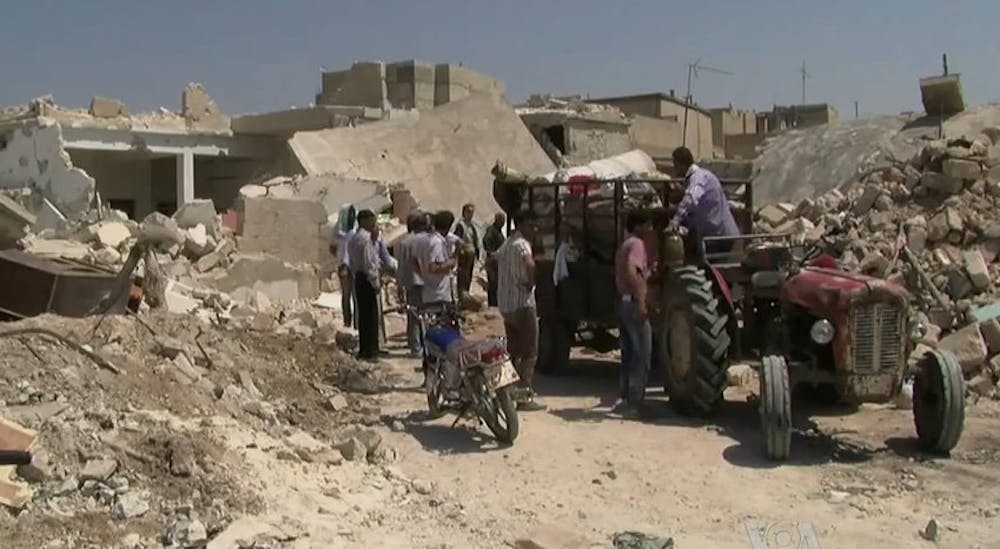
Displaced persons in Azaz, Syria, Sept. 3, 2012. Research has linked climate-induced drought and internal migration to the Syrian civil war. VOA
To reduce world hunger in the long term, rural populations need sustainable ways to support themselves in the face of crisis. This means investing in strategies to support rural livelihoods that are resilient, diverse and interconnected.
Many large-scale food security initiatives supply farmers with improved crop and livestock varieties, plus fertilizer and other necessary inputs. This approach is crucial, but can lead farmers to focus most or all of their resources on growing more productive maize, wheat or rice. Specializing in this way increases risk. If farmers cannot plant seed on time or obtain fertilizers, or if rains fail, they have little to fall back on.
Increasingly, agricultural research and development agencies, NGOs and aid programs are working to help farmers maintain traditionally diverse farms by providing financial, agronomic and policy support for production and marketing of native crop and livestock species. Growing many different locally adapted crops provides for a range of nutritional needs and reduces farmers’ risk from variability in weather, inputs or timing.
While investing in agriculture is viewed as the way forward in many developing regions, equally important is the ability of farmers to diversify their livelihood strategies beyond the farm. Income from off-farm employment can buffer farmers against crop failure or livestock loss, and is a key component of food security for many agricultural households.
Training, education, and literacy programs allow rural people to access a greater range of income and information sources. This is especially true for women, who are often more vulnerable to food insecurity than men.

Pakistani farmer reads a text alert on best farming practices. USAID Pakistan
Conflict also tears apart rural communities, breaking down traditional social structures. These networks and relationships facilitate exchanges of information, goods and services, help protect natural resources, and provide insurance and buffering mechanisms.
In many places, one of the best ways to bolster food security is by helping farmers connect to both traditional and innovative social networks, through which they can pool resources, store food, seed and inputs and make investments. Mobile phones enable farmers to get information on weather and market prices, work cooperatively with other producers and buyers and obtain aid, agricultural extension or veterinary services. Leveraging multiple forms of connectivity is a central strategy for supporting resilient livelihoods.
In the past two decades the world has come together to fight hunger. This effort has produced innovations in agriculture, technology and knowledge transfer. Now, however, the compounding crises of violent conflict and a changing climate show that this approach is not enough. In the planet’s most vulnerable places, food security depends not just on making agriculture more productive, but also on making rural livelihoods diverse, interconnected and adaptable.

Smallholder agriculture in southern Ethiopia. Smallholder farmers are particularly vulnerable to food insecurity. Leah Samberg
Leah Samberg, University of Minnesota
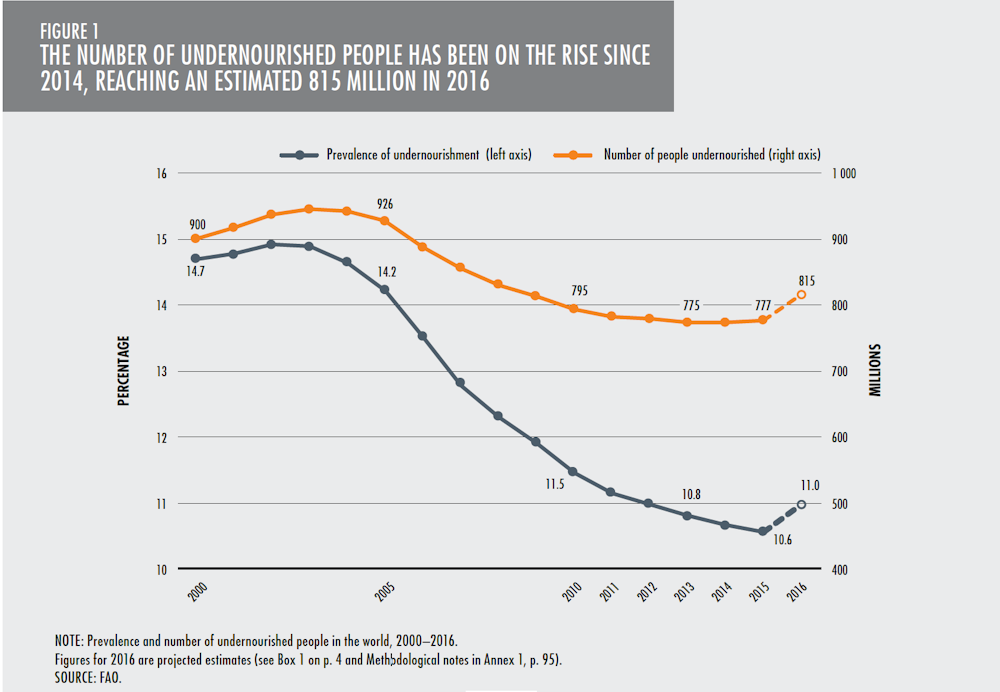
Around the globe, about 815 million people – 11 percent of the world’s population – went hungry in 2016, according to the latest data from the United Nations. This was the first increase in more than 15 years.
Between 1990 and 2015, due largely to a set of sweeping initiatives by the global community, the proportion of undernourished people in the world was cut in half. In 2015, U.N. member countries adopted the Sustainable Development Goals, which doubled down on this success by setting out to end hunger entirely by 2030. But a recent U.N. report shows that, after years of decline, hunger is on the rise again.
As evidenced by nonstop news coverage of floods, fires, refugees and violence, our planet has become a more unstable and less predictable place over the past few years. As these disasters compete for our attention, they make it harder for people in poor, marginalized and war-torn regions to access adequate food.
I study decisions that smallholder farmers and pastoralists, or livestock herders, make about their crops, animals and land. These choices are limited by lack of access to services, markets or credit; by poor governance or inappropriate policies; and by ethnic, gender and educational barriers. As a result, there is often little they can do to maintain secure or sustainable food production in the face of crises.
The new U.N. report shows that to reduce and ultimately eliminate hunger, simply making agriculture more productive will not be enough. It also is essential to increase the options available to rural populations in an uncertain world.
Around the world, social and political instability are on the rise. Since 2010, state-based conflict has increased by 60 percent and armed conflict within countries has increased by 125 percent. More than half of the food-insecure people identified in the U.N. report (489 million out of 815 million) live in countries with ongoing violence. More than three-quarters of the world’s chronically malnourished children (122 million of 155 million) live in conflict-affected regions.
At the same time, these regions are experiencing increasingly powerful storms, more frequent and persistent drought and more variable rainfall associated with global climate change. These trends are not unrelated. Conflict-torn communities are more vulnerable to climate-related disasters, and crop or livestock failure due to climate can contribute to social unrest.
War hits farmers especially hard. Conflict can evict them from their land, destroy crops and livestock, prevent them from acquiring seed and fertilizer or selling their produce, restrict their access to water and forage, and disrupt planting or harvest cycles. Many conflicts play out in rural areas characterized by smallholder agriculture or pastoralism. These small-scale farmers are some of the most vulnerable people on the planet. Supporting them is one of the U.N.‘s key strategies for reaching its food security targets.

In September 2016 Viola Tabo fled her home in Lanya village, South Sudan, after government troops executed three of her brothers. She now cultivates vegetables to supplement refugees’ diet of maize and beans at Bidi Bidi camp. Trocaire, CC BY
Without other options to feed themselves, farmers and pastoralists in crisis may be forced to leave their land and communities. Migration is one of the most visible coping mechanisms for rural populations who face conflict or climate-related disasters.
Globally, the number of refugees and internally displaced persons doubled between 2007 and 2016. Of the estimated 64 million people who are currently displaced, more than 15 million are linked to one of the world’s most severe conflict-related food crises in Syria, Yemen, Iraq, South Sudan, Nigeria and Somalia.
While migrating is uncertain and difficult, those with the fewest resources may not even have that option. New research by my colleagues at the University of Minnesota shows that the most vulnerable populations may be “trapped” in place, without the resources to migrate.
Displacement due to climate disasters also feeds conflict. Drought-induced migration in Syria, for example, has been linked to the conflict there, and many militants in Nigeria have been identified as farmers displaced by drought.

Displaced persons in Azaz, Syria, Sept. 3, 2012. Research has linked climate-induced drought and internal migration to the Syrian civil war. VOA
To reduce world hunger in the long term, rural populations need sustainable ways to support themselves in the face of crisis. This means investing in strategies to support rural livelihoods that are resilient, diverse and interconnected.
Many large-scale food security initiatives supply farmers with improved crop and livestock varieties, plus fertilizer and other necessary inputs. This approach is crucial, but can lead farmers to focus most or all of their resources on growing more productive maize, wheat or rice. Specializing in this way increases risk. If farmers cannot plant seed on time or obtain fertilizers, or if rains fail, they have little to fall back on.
Increasingly, agricultural research and development agencies, NGOs and aid programs are working to help farmers maintain traditionally diverse farms by providing financial, agronomic and policy support for production and marketing of native crop and livestock species. Growing many different locally adapted crops provides for a range of nutritional needs and reduces farmers’ risk from variability in weather, inputs or timing.
While investing in agriculture is viewed as the way forward in many developing regions, equally important is the ability of farmers to diversify their livelihood strategies beyond the farm. Income from off-farm employment can buffer farmers against crop failure or livestock loss, and is a key component of food security for many agricultural households.
Training, education, and literacy programs allow rural people to access a greater range of income and information sources. This is especially true for women, who are often more vulnerable to food insecurity than men.

Pakistani farmer reads a text alert on best farming practices. USAID Pakistan
Conflict also tears apart rural communities, breaking down traditional social structures. These networks and relationships facilitate exchanges of information, goods and services, help protect natural resources, and provide insurance and buffering mechanisms.
In many places, one of the best ways to bolster food security is by helping farmers connect to both traditional and innovative social networks, through which they can pool resources, store food, seed and inputs and make investments. Mobile phones enable farmers to get information on weather and market prices, work cooperatively with other producers and buyers and obtain aid, agricultural extension or veterinary services. Leveraging multiple forms of connectivity is a central strategy for supporting resilient livelihoods.
In the past two decades the world has come together to fight hunger. This effort has produced innovations in agriculture, technology and knowledge transfer. Now, however, the compounding crises of violent conflict and a changing climate show that this approach is not enough. In the planet’s most vulnerable places, food security depends not just on making agriculture more productive, but also on making rural livelihoods diverse, interconnected and adaptable.
Leah Samberg, Research Associate, Institute on the Environment, University of Minnesota
This article was originally published on The Conversation. Read the original article.

Join our mailing list to get the latest human rights news that matters, straight to your mailbox.
© Sabrang | All Rights Reserved