..Kovind acknowledged that “the key to India’s success is its diversity” and “our diversity is the core that makes us so unique” and ended his speech with a call to build an egalitarian society as “envisioned by Mahatma Gandhi and Deendayal Upadhyayaji”… The Congress took umbrage at the way Kovind mentioned Upadhyaya in the same breath as the Mahatma. “The President should remember that he is not a BJP candidate any more. He is the President of India. He has to… rise above and think beyond party politics,” Congress veteran Ghulam Nabi Azad said.

Image: Wikimedia Commons
1. In Search of an Icon
Fighters for Hindu Rashtra who have reached topmost echleons of power in this part of South Asia and are expected to extend and deepen their influence in coming times – if secular and democratic and left forces do not act together now – find themselves in a typical quandary. No doubt that they have created thousands and thousands of dedicated workers to their cause who have worked selflessly all their lives – away from the public glare, no doubt their political adversaries – while challenging their exclusivist, bigoted worldview – also admit albeit in muted tones their organisational skills and their journey from the margins of Indian polity to its centrestage after independence has been near miraculous; yet, it is evident that they suffer from a serious limitation and it pertains to their past still hovering over them.
The fact is that neither they can claim any legacy over the anti-colonial movement nor project themselves as real inheritors of the social emancipatory/revolutionary current which arose during the same period which challenged the sanctified-legitimised hierarchy of caste and challenged the inequitous nature of Hinduism as practised then.
It is undeniable that their highly conservative worldview of Indian society which denied any internal fissures – as defined by caste, gender etc -in Hinduism and their peculiar sense of history which refused to see the ramifications and specificities of British colonial conquest and the mass upsurge which accompanied it have landed them in such a peculiar situation. It has become further complicated because of the manner in which they looked at history through the prism of the Hindu Muslim binary and peddling a theory of 1,200 year old period of ‘slavery’. (Ref 1)
The trajectory of post independence times is also qualitatively no different.
It is history how they had opposed the making of constitution and instead proposed that Manusmriti should be made into independent India’s Constitution ; ( Organiser’ November 30, 1949, p.3, details follow) it is well documented how they resisted enactment of Hindu Code Bill – which according to Ambedkar was the first attempt in India’s history to bestow some rights on Hindu women – by claiming that it would be an attack on India’s culture ; ( “We oppose the Hindu Code Bill. We oppose it because it is a derogatory measure based on alien and immoral principles. It is not a Hindu Code Bill. It is anything but Hindu. We condemn it because it is a cruel and ignorant libel on Hindu laws, Hindu culture and Hindu dharma” – Golwalkar, Organiser, Dec 7, 1949, http://indianexpress.com/article/opinion/columns/br-ambedkar-2762688/) , it is part of common folklore how they were supportive of the United States and the Western bloc in the Cold War-contrary to India’s long-standing (but now abandoned) policy of Non-Alignment and in sharp distinction to most other political parties. It even went to the extent of supporting America’s war on Vietnam, which was deeply unpopular in India. ((https://www.countercurrents.org/comm-bidwai290504.htm) It is well documented by various commissions of enquiry – which were appointed to look into outbreaks of communal violence in post independence period – that they had always put under scanner role of Hindutva Supremacists. And whatever their claims to bravery, their cowardice was very much visible when Indian democracy faced its first big challenge in the form of internal emergency, (1975-77) which was a reaction of the powers that be then towards rising discontent of people accompanied by mass movements of various kinds.
Today with levers of powers in their hands they can claim otherwise but there is enough documentary proof available about the way they prostrated before the Emergency regime. e.g. Tapan Basu, Pradip Datta, Sumit Sarkar and others, in their publication Khaki Shorts and Saffron Flags, (Page 55,Orient Longman, 1993) highlight the behaviour of the top RSS leadership. According to them,
“RSS attitudes under the emergency revealed a curious duality, reminiscent of the 1948-49 days”. While the RSS was banned and Sangh supremo Balasaheb Deoras was put behind bars, he like Golwalkar in 1948-49, “…quickly opened channels of communication with the Emergency regime, writing fairly ingratiating letters to Indira Gandhi in August and November 1975 that promised cooperation for lifting a ban [on RSS]. He tried to persuade Vinobha Bhave to mediate between the RSS and the govern-ment, and sought also the good offices of Sanjay Gandhi”.
It was a period when thousands of workers of various parties were jailed, many organisations including RSS was banned and a resistance to this autocratic step was building up when people discovered to their dismay that then leadership of RSS led by Balasaheb Deoras had not only opened channels of communication with Indira Gandhi but had also asked her to lift ban on RSS and asked its followers to give an undertaking promising the then rulers that they will not do anything ‘[w]hich is detrimental to internal security. According to Socialist leader Baba Adhav’s important book (in Marathi) it read,
“Shri-detenu…class-prison agrees on affidavit that in case of my release I shall not do anything, which is detrimental to internal security and public peace… I shall not do anything prejudicial to the present emergency” (Sanghachi Dhongbaji, Baba Adhav, 1977, translated from original Marathi by author).
The absence of real icons among them who are really loved, respected by the masses – whose popularity is not limited to a particular group – has prompted them to adopt a unique three pronged strategy witnessed nowhere at least in this part of South Asia which is based on three inter related actions : Manufacture/ Construct , Appropriate/Coopt, Sanitise
Definitely they know pitfalls of this strategy but they must have calculated that they can manage.
How to Manufacture or Appropriate or Sanitise Icons and claim that it works
For a city of 1.6 million people, Islamabad has 827 mosques, some of which come with madrassahs and shrines of a varying degree of religious and political importance. “Islamabad the beautiful” is getting a new addition to this collection – the grave-turned-shrine of Mumtaz Qadri, the man who brutally gunned down then Punjab Governor Salmaan Taseer in 2011.
(https://www.dawn.com/news/1302289)
The metamorphosis of Nathuram Godse, a Hindutva fanatic, and leader of the terror module which killed Gandhi, from a hated figure to a person worth reverring , where moves are on even to build this ‘great Patriots’ temples all over the country. (http: //www. thehindu.com/ news/national/other-states/meerut-villagers-rally-against-godse-temple/article6754164.ece) seems to be a recent development for the wider populace but it has been surreptiously done since decades. The world came to know about it more than a decade ago when Nanded bomb blast happened ( April 2006) when two activists of Hindutva Supremacist formation were killed while making bombs.(Ref : Portents of Nanded, 27 May 2006, EPW,http://www.epw.in/journal/2006/21/commentary/portents-nanded.html ) On further investigagtion it was revealed how these fanatics use to ‘celebrate’ martyrdom day of ‘Hutatma’(Martyr)’ Godse and it was not limited to a particular area or city. (Ref 2)
And Godse is no exception to this mission ‘manufacturing’ an icon.
There are many other people in the Hindutva fraternity – who if the legal process of the country would have been allowed to function without any prejudice would have been tried for their criminal acts involving arson, murders or demolition of prayer houses or engineering riots – who are similary glorified for their actions against the óthers’ or their crimes against humanity. One still remembers when Babri Mosque was demolished in 1992, one of the chief architects of this mission demolition was felicitated as Hindu Hriday Samrat. Or how birth centenary of well established author cum Hindutva apologist was celebrated on a grand scale with chief ministers and political leaders of the saffron camp attending, who had admitted on records how the 2002 carnage in Gujarat was planned and executed with precision. (http://www.countercurrents.org/gatade070414.htm) Or when Malegaon bombers – part of a Hindutva terror module – were presented in courts in the year 2008, people had gathered there who showered rose petals on them reminding the way the Islamist Mumtaz Qadri was greeted in courts.
Apart from ‘constructing’ icons they have also tried to coopt/appropriate great leaders of the anti-colonial and social emancipatory movement as their own, perhaps with a thinking that they can bask in their reflected glory. (Ref 3) Today it is common occurence even in their regular shakhas – where they daily gather for sports, discussions and other activities – that apart from other great heroes of Hindus the likes of Gandhi and Ambedkar are also being included in their list of ‘Pratahsmarniy’ ( worth remembering in the morning). Thus it is a marker of the changed ambience that today they have no qualms in projecting Gandhi, Patel and even Ambedkar as their own knowing fairly well that when alive they have been ruthless in criticism of their worldview. Patel had even castigated them for their alleged role in Gandhi’s assasination or Ambedkar had even warned his followers how Hindu Raj would be a menace to liberty. (Ref 4)
Not content or satisfied with this cooption/appropriation they have also resorted to presenting a sanitised images of their own leaders to make them more acceptable to the wider populace. (http://www.catchnews.com/politics-news/deendayal-comic-strip-in-up-schools-haryana-univs-to-teach-golwalkar-savarkar-76767.html) It is not for nothing that today there is growing clamour among them for giving ‘Bharat Ratna’ to Savarkar despite documentary evidence that this ‘Veer Patriot’ (as they like to call him) had no qualms in sending mercy petiotions to the Britishers when he was lodged in Andaman Jail or was tried for his alleged role in Gandhi’s assasination and J L Kapoor commission which looked into it had proved that he was a key conspirator in this gory act. (http://www.frontline.in/static/html/fl2919/stories/20121005291911400.htm, As for Savarkar, “Godse was an ardent follower” of his. After a thorough probe a former judge of the Supreme Court, Justice J.L. Kapur, held that “all these facts taken together were destructive of any theory other than the conspiracy to murder by Savarkar and his group”.) Or the centre is planning to portray Golwalkar, the second Supremo of RSS as a great philosopher and a champion of “robust nationalism”.(https://www.telegraphindia.com/1170705/jsp/nation/story_160286.jsp) It is a different matter that none of their leaders could be absolved from their role in the debatable/controversial past of the Hindutva stream and this has made the task further difficult. Despite this their efforts in this direction still continue and with assumption of political power at the centre and many states and greater acceptability of their world view among articulate sections of our society, they have gained fresh momentum.
“DEENDAYAL UPADHYAYA is to the BJP [Bharatiya Janata Party] what Mohandas Karamchand Gandhi was to Congress” opined R. Balashankar, former editor of the Rashtriya Swayamsewak Sangh’s (RSS) organ Organiser and now a member of the BJP’s central committee, on Prasikhshan Maha Abhiyan (The Indian Express,; September 24, 2016).
The birth centenary celebrations of Deendayal Upadhyay – one of the founders of the Bharatiya Jana Sangh – forerunner of the present day BJP – and a RSS Pracharak all his life have proved to be such an occasion for them where they intend to project his larger than life image. An indication of how they viewed him could be had from the quote by a senior leader of the RSS mentioned above.
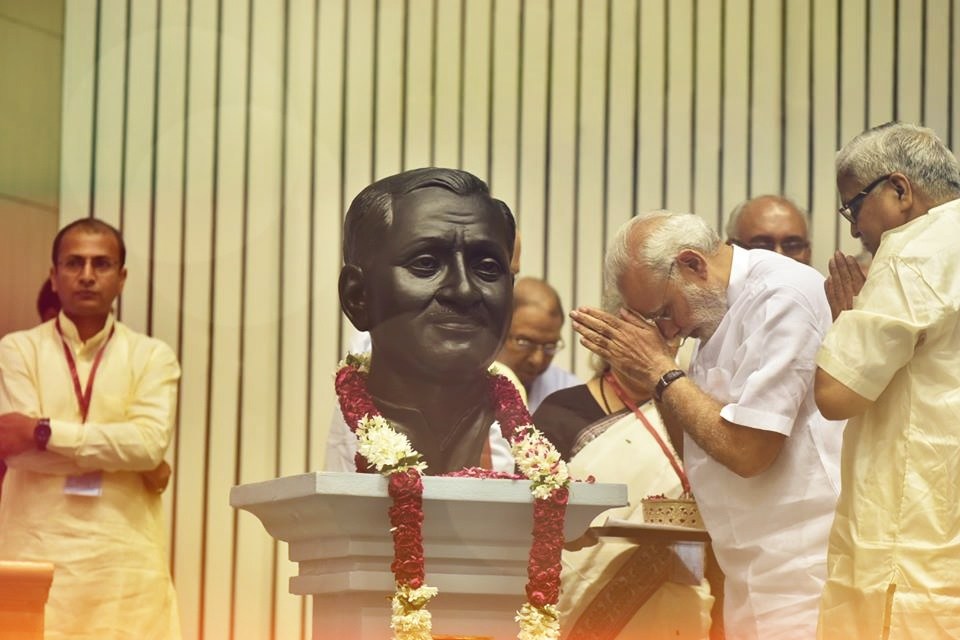
The centenary celebrations were inaugurated by PM Narendra Modi himself who also released a fifteen volume collection of his writings and speeches on the occasion which are now being sent to different government run schools in BJP ruled states for a price. (See appendix). Addressing the BJP National Council Meeting in Kozhikode, Kerala a few days later PM Modi also paid glowing tributes to him and quoted what Upadhyaya said 50 years ago:
Pandit Upadhyaya said do not reward Muslims, do not rebuke them, but purify them. Do not treat Muslims like vote ki mandi ka maal (vote banks) or ghrina ki vastu (object of hatred). Unhe apna samjho (regard them as your own).
(https://www.thequint.com/politics/2016/09/25/prime-minister-narendra-modi-bjp-national-council-meeting-kozhikode-kerala-muslims-deendayal-updadhyay)
Quizes are being organised, schemes are being relaunched/launched, roads are being named, railway stations are being renamed all supposedly to communicate to the people how great personality Deendayal Upadhyaya was. Rajasthan government led by the BJP has even asked its elected representatives in Rajasthan to use a logo featuring a photograph of RSS icon Deendayal Upadhyay on their letterheads for all official correspondence.
(http://www.hindustantimes.com/india-news/rss-icon-deendayal-upadhyay-s-image-to-feature-in-official-correspondence-of-rajasthan-govt/story-S1aMkPloNtqCLcqRYhmaFP.html) . Assam government has decided to name twenty two new model colleges being set up after Deendayal Upadhyaya (http://indianexpress.com/article/india/assam-opposition-slams-move-to-name-new-colleges-after-deen-dayal-upadhyaya-4785502/)
Sample this questions which find mention in the booklet released by BJP to prepare students for the general knowledge test organised by it on the occasion of birth anniversary of Deendayal Upadhyaya for which 2 lakh party workers had been engaged to conduct the exam so that “Upcoming generations should know about the great personalities and heroes of history, about whom people were not told so far. ” (http://indianexpress.com/article/india/deendayal-upadhyaya-centenary-bjp-hands-students-booklets-to-prep-for-exam-on-rss-schemes-of-modi-yogi-govts-4778173/) Remember in its hurry to educate people about great personalities the booklet does not even mention Gandhi and Nehru.
Who said India is a Hindu country?
Answer: Dr. Keshav Baliram Hedgewar
Swami Vivekananda led which religion in ‘Dharma Sabha’ in Chicago?
Answer: Hindutva
Which Muslim invader did Maharaj Suheldeo cut to pieces?
(“Maharaja Suheldeo ne kis Muslim akranta ko gaazar-mooli ki tarah kaat diya tha?)
Answer: Syyed Salar Masood Ghazi
Where is Ram Janmaboomi?
Answer: Ayodhya
What book did Dr Ambedkar write challenging the claims of Gandhi and the Congress about Harijans?
Answer: Congress and Gandhi Have Done
These loaded questions are part of Samanya Gyan Pratiyogita 2017, a 70-page booklet to be distributed to students in schools in Uttar Pradesh.
The correct answer to the Ambedkar question is ‘What Congress and Gandhi Have Done to the Untouchables’ and he also wrote a book called ‘Riddles of Hinduism’ and ‘Annihilation of Caste’ but then a question about them serves no purpose for the BJP. Vivekananda spoke about the Hindu religion and not its politicised manifestation, Hindutva, but then accuracy is clearly not the purpose behind the production of the booklet.
(https://thewire.in/163836/bjp-distributes-booklets-to-up-students-on-modi-yogi-government-schemes/)
The centrality being given to Deendayal Upadhyaya’s by the ruling establishment was also visible in the first speech by President Ram Nath Kovind on the eve of India’s 71st Independence Day. Reports tell us that in his speech he made a strong pitch for a “compassionate and egalitarian society that does not discriminate on gender or religious background” and also invoked the concept of “integral humanism” propounded by Sangh ideologue Deen Dayal Upadhyaya.
“New India must include that integral humanist component that is in our DNA, and which has defined our country and our civilisation,” Kovind said in his first Independence Day-eve address, remarks which assume significance because they come amid attacks on the Modi government over alleged rise in communalism. This is the first time that “integral humanism”, the credo of BJP, figured in a presidential speech – a thread which marks the Sangh Parivar’s current dominance.(http://timesofindia.indiatimes.com/india/kovind-new-india-must-have-integral-humanism/articleshow/60066912.cms)
Question arises whether Deendayal Upadhyaya – who started his social political life as a RSS worker in 1937 and later became a close confidante of Golwalkar Guruji, the RSS Supremo then, was really such a great man as his followers want us to believe akin to ‘Gandhi’ or was another RSS Pracharak with similar sectarian worldview and prejudiced mind who was intelligent enough to fashion the majoritarian ideology much in tune with the times he lived in recognising the fact that Hindutva was on the margins of Indian polity then.
Was he really a ‘rebel’ in the Hindutva ranks who wanted to come out of the the straightjacketing one witnesses in similar organisations where discipline is the key word and wanted it to make a transition to ‘Bharatiyata’ ( Indianness) or was well aware that if the idea of Hindutva is to be made popular then it should ‘look inclusive’. Perhaps he was well aware that memories of the organisations keeping itself aloof from independence struggle are still fresh in people’s minds or role played by the Hindutva Supremacist organisations in brutal killing of Mahatma Gandhi has not been forgotten, and there is an urgent need to speak in a new language which was more amenable to the people.
No doubt a tricky problem arises in his evaluation as he died relatively young ( who was merely 52 years at the time of his death) under mysterious circumstances in 1968 when he was found murdered in a train journey on way to Varanasi. And a controversy still dogs his death where it was even claimed by a senior member of ‘Parivar’ itself , and one of his erstwhile colleagues, in his autobiography that the death was a result of a conspiracy hatched by section of his own people.
“”One thing is clear. Behind the murder of Deendayal Upadhyay was neither the hand of Communists nor of any thief…He was killed by a hired assassin. But conspirators who sponsored this killing were those self-seekers and leaders with criminal bent of mind of Sangh-Jan Sangh”
[Balraj Madhok, Zindagi Ka Safar—3:Deen Dayal Upadhyay Ki Hatya Se Indira Gandhi Ki Hatya Tak, Dinman Prakashan, Delhi, 22, 23.](5)
An added reason which makes his correct evaluation a challenging task also arises from the fact that the document prepared by him titled ‘Integral Humanism’ which was presented as a basis for the work of Bharatiya Jan Sangh, – which had definitely helped it expand base – had at least formally tried to widen Hindutva appeal by appearing inclusive and was drafted apparently using Gandhian discourse.
Was it the reason that when Deendayal Upadhyaya’s columns titled ‘Political Diary’ published in ‘Organiser’ were compiled in a book form postthumously, Sampoornand, who was a Congressman and also happened to be Chief Minister of UP for a brief while, readily agreed to write a forward to it.
“..[T]hese words express ideas of an important leaders of our times, who had dedicated himself for the best interests of the country, was of clean character and was such a leader whose words could mesmerise thousands of educated youth.” ( vi, Deendayal Upadhyaya, Political Diary, Suruchi Prakashan, Delhi, Nov 2014, translated from original Hindi by author)
Perhaps a cursory look at Deendayal Upadhyaya’s social-political journey and a browsing of his major writings can give us a clear idea to reach any concrete conclusion.
Cast in the Golwalkarian Mould !
Born in the year 1916 (death Feb 1968) Deendayal Upadhyay did his graduation from Sanatan Dharma College, Kanpur and did his L.T. from Allahabad. He became a close friend of Sundar Singh Bhandari, an activist of RSS, in his college days. He formally joined RSS in his early 20s and decided to become a Pracharak ( full time worker) in the year 1942. According to his biographer :
When he was studying for his graduation at Kanpur in 1937, Deendayalji came into contact with Rashtriya Swayamsevak Sangh (RSS) through his classmate Baluji Mahashabde. He met the RSS founder,Dr. Hedgewar there. Hedgewar used to stay with Babasaheb Apte and Dadarao Parmarth in the hostel. Deendayalji invited him for an intellectual discussion at one of the shakhas. Sunder Singh Bhandari was also one of his classmates at Kanpur. This gave a fillip to his public life.
Deendayalji was a student from 1937 to l941 when he passed his B.T. from Prayag. But he did not enter a job; nor did he marry. He had attended the 40-day summer vacation RSS camp at Nagpur where he underwent training in Sangh Education in 1939 and 1942.
Deendayalji, however, could not withstand the physical rigour of the training, but he stood out in its educational segment. Babasaheb Apte writes in this connection: “Pandit Deendayalji versified several parts of his answers. It was not merely versification, nor was it a flight of imagination. He simply adopted the medium of verse instead of prose in writing his answers. It was balanced and logical. I could not help being impressed by hill.
After completing his education and second-year training in the RSS Education Wing, Pandit Deendayal Upadhyaya ji became a lifelong pracharak of the Sangh and he lived this life till the very end. He entered politics through the Rashtriya Swayamsevak Sangh, became the General Secretary of the Bharatiya Jan Sangh, and later its President. His life was thus an embodiment of thorough political thought process. (http://deendayalupadhyay.org/rss.html)
In 1942 he was appointed to be a full time tehsil organiser in Lakhipur district, north-western Oudh ; and in 1945 he was made joint provincial organiser for the whole of United Province. Although it was a period of tremendous ferment in Indian society – where anti colonial struggle against the Britishers was at its peak and people were going to jail or facing batons, bullets, he like all the fellow Swayamsevaks/Pracharaks kept himself aloof from them and concentrated on organisation building.
The intensity of the unfolding struggle could be gauged from the fact that from 9 August 1942 to 21 September 1942, the Quit India movement:
…[a]ttacked 550 post offices, 250 railway stations, damaged many rail lines, destroyed 70 police stations, and burned or damaged 85 other government buildings. There were about 2,500 instances of telegraph wires being cut. The greatest level of violence occurred in Bihar. The Government of India deployed 57 battalions of British troops to restore order.
(John F. Riddick, The History of British India: A Chronology (2006) p 115)
To suppress the movement which was moving with the spirit of ‘Do or Die’ the British government arrested more than a lakh people during that stormy period or it had to use firing from helicopters to quell people’s uprising. Thousands were killed and injured in the wake of the ‘Quit India’ movement. Strikes were called in many places. The British swiftly suppressed many of these demonstrations by mass detentions. Mass fines were levied and demonstrators were subjected to public flogging.[ D, Fisher D; Read A (1998). The Proudest Day: India’s Long Road to Independence. WW Norton. p. 330] All well known national leaders were either put behind bars or had to go underground who continued their struggle by broadcasting messages over clandestine radio stations Parallel governments were established in many places which replaced the existing British rule at least over those districts/regions. According to reports the Britishers were so terrified with the movement that they had even kept a battleship ready to take Gandhi and the Congress leaders out of India but ultimately dropped the plan because of fear that it could intensify the revolt.
One can browse the contemporary reports of the British intelligence agencies on the Quit India Movement which were explicit in describing the fact that RSS kept aloof from the movement. According to one such report,
“..the Sangh has scrupulously kept itself within the law, and in particular, has refrained from taking part in the disturbances that broke out in August 1942”.[Andersen, WalterK.&Damle, Shridhar D.The Brotherhood in Saffron: the Rashtriya Swayamsevak Sangh and Hindu Revivalism, Westview Press, 1987, 44.]
Later Deendayal Upadhyay explained his understanding in the following words which in a way stigmatised the great martyrs who had sacrificed their lives for the cause of independence.
“we were obsessed by the misleading notion that freedom consisted merely in overthrowing foreign rule. Opposition to a foreign government does not necessarily imply genuine love of Motherland…During the struggle for independence great emphasis was laid on the opposition to British rule…It came to be believed that whoever opposed the British was a patriot. A regular campaign was launched in those days to create utter dissatisfaction against the British by holding them responsible for every problem and misery which the people in our country had to face.”
(C. P. Bhishikar, Pandit Deendayal Upadhyaya: Ideology and Perception: Concept of the Rashtra,vol. v, Suruchi, Delhi, 169. )
It was clear that he was just following the line set by Sangh Supremo Golwalkar as he had famously said :
“In 1942 also there was a strong sentiment in the hearts of many. At that time too the routine work of Sangh continued. Sangh vowed not to do anything directly. However, upheaval (uthal-puthal) in the minds of Sangh volunteers continued. Sangh is an organisation of inactive persons, their talks are useless, not only outsiders but also many of our volunteers did talk like this. They were greatly disgusted too.”
[M.S. Golwalkar, Shri Guruji Samagra Darshan (Collected Works of Golwalkar in Hindi), vol. IV, Bhartiya Vichar Sadhna, Nagpur, nd, 40]
Alongwith raging anti-colonial struggle – a period when national liberation struggles in many of the third world countries were near culmination – what was the overall scenario when Deendayal Upadhyaya jumped into the fray as an ordinary Pracharak. It was a period when on the one hand Nazism-Fascism was ready to swamp the whole of Western Europe, and on the other hand the great experiments of Socialist construction undertaken in Soviet Russia coupled with the rising tide of communist led militant movements were proving to be a defining characteristics of the era. Retrospectively one can say that it was such a juncture in world history when the old world of feudalism, colonialism, was crumbling down and a new world was emerging.
And how did the politics of proponents of Hindu Rashtra unfolded in those times. Perhaps a cursory glance at how Golwalkar – the RSS Supremo then – viewed the situation and planned actions would make it abundantly clear the picture what Swayamsevaks/Pracharaks like Deendayal Upadhyaya did in those times.
And it would not be incorrect to state that due to his peculiar weltanschauung (world view) which yearned for building a Hindu Rashtra based on the ‘glorious traditions of Hinduism’ and which looked towards Muslims as bigger adversary vis-a-vis British colonialism and which sought inspiration from the experiments in ‘social engineering’ undertaken by Nazism-Fascism, Golwalkar completely failed to have a pulse on the march of history. In fact due to his intransigence he not only kept himself personally aloof from the surging anti-colonial struggle but also did not chalk out any positive programme for his organisation to participate in it.
As already mentioned the first of his theoretical contributions for the cause of Hindutva appeared in the form of a pamphlette called ‘We or Our Nationhood Defined’ (1938). A quote from the 77 paged book would be opportune at this moment to know the content of the same.
“The foreign races in Hindusthan must either adopt the Hindu culture and language, must learn to respect and hold in reverence Hindu religion, must entertain no idea but those of the glorification of the Hindu race and culture, i.e., of the Hindu nation and must loose their separate existence to merge in the Hindu race, or may stay in the country, wholly subordinated to the Hindu Nation, claiming nothing, deserving no privileges, far less any preferential treatment — not even citizen’s rights. There is, at least, should be, no other course for them to adopt. We are an old nation; let us deal, as old nations ought to and do deal, with the foreign races, who have chosen to live in our country”.
(Madhav Sadashiv Golwalkar’s, We or Our Nationhood Defined)
The above mentioned book was so straightforward in its appreciation of the ‘ethnic cleansing’ of Jews undertaken by Hitler and such an unashamed proponent of the submergence of ‘foreign races’ in the Hindu race that later day RSS leaders have tried to create an impression that the said book was not written by Golwalkar but it was merely a translation of a book ‘Rashtra Meemansa’ by Babarao Savarkar.
It is a different matter that in his Preface to ‘We or Our Nationhood Defined’ dated March 22, 1939, Golwalkar himself described Rashtra Meemansa as ‘one of my chief sources of inspiration and help. The American scholar Jean A. Curran who did a full length study on RSS in early fifties, in his sympathetic book, ‘Militant Hinduism in Indian Politics: A Study of the RSS’ (1951) confirms that Golwalkar’s 77-page book was written in 1938 when he was appointed RSS General Secretary by Hedgewar and he calls it as RSS’s ‘Bible’.A. G. Noorani in his famous book ‘ The RSS and the BJP: A Division of Labour, {Pgs. 18-39} Leftword Books) also tells us that Rajendra Singh and Bhaurao Deoras made an authoritative statement on that book in Para 10 of their 1978 application:
‘With a view to give a scientific base to propagate the idea India being (sic) historically from time immemorial a Hindu Nation, late Shri M.S. Golwalkar had written a book entitled, “We or Our Nationhood Defined”,’ In Para 7 they ‘placed on record’ his book Bunch of Thoughts (1966) in order ‘to clarify and understand the true purpose, the exact nature, the ambit and scope of the RSS work… and its activities.’
Another arena where Golwalkar proved much behind his times was his love for Manusmriti’s edicts. When leaders of newly independent India were struggling to have a constitution which was premised on the inviolability of individual rights with special provisions of positive discrimination for millions of Indians who had been denied any human rights quoting religious scriptures, it was Golwalkar again who espoused the same Manusmriti as independent India’s constitution.’Organiser’ ( November 30, 1949, p.3) the organ of RSS complained :
But in our constitution there is no mention of the unique constitutional developments in ancient Bharat. Manu’s laws were written long before Lycurgus of Sparta or Solon of Persia. To this day laws as enunciated in the Manusmriti excite the admiration of the world and elicit spontaneous obedience and conformity. But to our constitutional pundits that means nothing.
When attempts were made under the stewardship of Ambedkar and Nehru in late forties to give limited rights to Hindu women in property and inheritance through the passage of the Hindu Code Bill , Golwalkar and his associates had no qualms in launching a movement opposing this historic empowerment of hindu women which was to take place for the first time in history. Their contention was simple : This step is inimical to Hindu traditions and culture.
Definitely Deendayal Upadhyay – as a disciplined Pracharak of the organisation – was a witness and participant in the organisation’s work then which brought him closer to the then Supremo. Later he seems to make a more refined sounding argument justifying casteism and even equating it with Swadharma ( one’s own religion) :
“Even though slogans of equality are raised in the modern world, the concept of equality has to be accepted with discretion. Our actual experience is that from the practical and material point of view, no two men are alike… Considerable bitterness could be avoided if the idea of equality as conceived by Hindu thinkers is studied more carefully. The first and basic premise is that even if men have different qualities and different kinds of duties allotted to them according to their qualities or aptitudes, all duties are equally dignified. This is called swadharma, and there is an unequivocal assurance that to follow swadharma is itself equivalent to the worship of God. So, in any duties performed to fulfill swadharma, the question of high and low, dignified and undignified does not arise at all. If the duty is done without selfishness, no blame attaches itself to the doer.”[vii] [vii] C. P. Bhishikar, Pandit Deendayal Upadhyaya: Ideology and Perception: Concept of the Rashtra,vol. v, Suruchi, Delhi, 169.
It was a marker of his close relationship with Golwalkar that a senior leader of RSS commented that both ‘shared same wavelength’.
Dattopant Thengadi, another senior leader of RSS who helped found Bharatiya Mazdoor Sangh and Akhil Bharatiya Vidyarthi Parishad adds :
“Panditji ( Deendayal Upadhyay) shared most important and intimate relations with the then Sarsanghchalak Shri Guruji.
It is difficult to describe in words the relations they shared. It was noted by every close people that Shri Guruji had special expectations from Deendayalji as a Swayamsevak, Pracharak and worker. Both shared same wavelength. Only Deendayal could guess what would be Shri Guruji’s reaction about particular incident.”
( Page 11, Tatvjigyasa, Pandit Deendayal Upadhayay Vichar Darshan, Suruchi Prakashan, Delhi, 2016, translated into English by author)
No less troubling have been Golwalkar’s ideas around ‘Hindu Experiments in Cross-breeding’ which extolled North Indian Brahmins at the cost of the rest of the Hindus themselves and in fact propagates an idea that India had a superior race or breed of Hindus and also an inferior race of Hindus, which needed to be improved through cross-breeding.
In his address to the School of Social Science of Gujarat University on December 17, 1960 ( Organiser, January 2, 1961, p.5) he had formulated this racist thesis.
Today experiments in cross-breeding are made only on animals. But the courage to make such experiments on human beings is not shown even by the so-called modern scientist of today. If some human cross-breeding is seen today it is the result not of scientific experiments but of carnal lust. Now let us see the experiments our ancestors made in this sphere. In an effort to better the human species through cross-breeding the Namboodri Brahamanas of the North were settled in Kerala and a rule was laid down that the eldest son of a Namboodri family would marry only the daughter of Vaishya, Kshatriya or Shudra communities of Kerala. Another still more courageous rule was that trhe first off-spring of a married woman of any class must be fathered by a Namboodri Brahmin and then she could beget children by her husband. Today this experiment would be called adultery, but it was not so, as it as limited to the first child.
As rightly noted by Dr. Shamsul Islam, in his book ‘Golwalkar’s We Or Our Nationhood Defined A Critique’ ( 2006, Pharos Media, Delhi.pp. 30-31)
‘The above statement of Golwalkar is highly derogatory in many respects. Firstly, it proves that Golwalkar believed that India had a superior race or breed of Hindus and also an inferior race of Hindus’..’Secondly, a more worrying aspect was the belief that only the Brahmins of the North, specifically Namboodri Brahmanas, belonged to a superior race.”
Shyamprasad Mukherjee, RSS and formation of Bharatiya Jan Sangh :
Alliance of convenience or meeting of hearts ?
Deendayal Upadhyay was made Sahpracharak of UP in 1947. Dattopant Thengadi, tells us
“‘Rashtradharma Publications’ was established in 1947 which started bringing out a magazine ‘Rashtradharma’, a weekly ‘Panchajanya’ and a daily ‘Swadesh’.Panditji worked as editor of the last two publications. Nanaji Deshmukh was the managing director of the publication.” (Page 5, Tatvjigyasa, Pandit Deendayal Upadhayay Vichar Darshan, Suruchi Prakashan, Delhi, 2016)
The idea behind starting this publications was to spread the ideology of Hindutva nationalism.
Assasination of Mahatma Gandhi by Nathuram Godse – a Hindutva Supremacist – and the terror module led by him in connivance with top leaders of the ideology, which was followed by banning of RSS and arrests of its activists, rather precipitated an old debate in the RSS which revolved around need for a political platform led by it. And this led to formation of Bharatiya Jan Sangh with Shyama Prasad Mukherjee as a face of the new political formation.
But who was Shyama Prasad Mukherjee, who had suddenly become important for the RSS to spread its impact.
Born in 1900, Shyamaprasad Mukherjee started his political leader in 1929 and became a member of the Bengal Legislative Council. He joined the Hindu Mahasabha in 1939 to espouse the cause of the Hindus in India and was a close associate of Savarkar. He was the opposition leader in the state when a coalition government led by Krishak Praja Party – Muslim League coalition was in power 1937-41. Later he joined the Ministry headed by Fazlul Haq as a Finance Minister and continued sharing power during the tumultuous times of the ‘Quit India’ movement when the Britishers faced mortal challenge to their rule. The experiment to share power with Muslim League then was not limited to Bengal alone, it extended to Sind and as well as NWFP (North West Frontier Province) and was part of a conscious policy adopted by the Hindu Mahasabha. He had also worked in the Cabinet of Jawaharlal Nehru as a minister and had later resigned on a policy issue. It was decided after dialogue between Mukherjee and Golwalkar that RSS would depute few of its senior Pracharaks to assist him and Deendayal Upadhyay was the key person from the RSS side who worked with Mukherjee.
The provisional working committee of the new organisation comprised of: President Shyamaprasad Mukherjee, General Secretaries Bhai Mahavir and Maulichandra Sharma ( both from Delhi) and fifteen members team to assist the leadership which comprised of Deendayal Upadhyay ( from UP), Balraj Madhok ( from Delhi) and thirteen other members from different states. ( P 29, The immediate Origin of the Bharatiya Jan Sangh quoted in Hindu Nationalism and Indian Politics – The Origins and Development of Bharatiya Jana Sangh, B. D. Graham, Cambridge University Press, 1990 )
Question worth pondering how should one view this coming together of two streams of Hindutva right ? Was it merely an ‘alliance of convenience’ – as Mukherjee – who was a popular face then – was in search of an organisation which could act as a strong basis for founding a party and the RSS, which wanted to build a political platform, was in search of a ‘known face’ or it was a real meeting of hearts with a realisation that it was the best option before them in the unfolding situation. Under close guidance of Golwalkar, the challenge to forge/consolidate this alliance ( on behalf of RSS) and ensure a strong foundation of the party was in the hands of Deendayal Upadhaya, Balraj Madhok and other close associates from Sangh. Perhaps Craig Baxter has the best comment to offer on the formation.
“It has been said with good reason that the Jana Sangh resulted from a combination of a partyless leader, Syama Prasad Mookerjee, and a leaderless party, the RSS”.
(The Jana Sangh: A Biography of an Indian Political Party, by Craig Baxter p. 54)
How RSS itself looked at the formation could be gleaned from what K R Malkani wrote in the first issue of ‘Organiser’ immediately after the ban on RSS was lifted
..K R Malkani, under the the pen name ‘Kamal’, wrote that “the only way to restore dharma was by putting the shoulder to the political wheel”. (The Jana Sangh: A Biography of an Indian Political Party by Craig Baxter p. 55, quoted in https://thewire.in/11626/a-relationship-that-goes-back-a-long-way/)
It would be opportune to see how Golwalkar viewed this emergent political formation and its relation with the parent organisation :
..Later at Sindi (Wardha, Maharahtra) in 1954 from March 9 to March 16 a political training camp was organized for 300 pracharaks. The camp was aimed to train national RSS leadership for running the affairs of the country through Jana Sangh. RSS sarsangh chalak (supreme dictator) M.S. Golwalkar in his speech (March 16) elaborated his vision for Jana Sangh,
“If we say that we are part of the organization and accept its discipline then selectiveness has no place in life. Do what is told. If told to play kabaddi, play kabaddi; told to hold meeting then meeting…For instance some of our friends were told to go and work for politics that does not mean that they have great interest or inspiration for it… If they are told to withdraw from politics then also there is no objection. Their discretion is just not required.”(Golwalkar, M. S., Shri Guruji Samagar Darshan, Volume III, Bhartiya Vichar Sadhna, Nagpur , 1978, p. 32.)
[ quoted in http://sacw.net/article865.html]
Recent events have shown that some members of the Congress have functioned almost as if they were members of the Hindu Mahasabha or some like communal organisation. Indeed, some people have actually resigned from the Congress and gone over to the Jana Sangh. This itself is significant because a real Congressman should be as far removed from the communal organisations as anything can be. Our chief opponents in our work and in the elections are the communal organisations.
(Nehru, letter to PCC presidents, 19 September 1951, in Congress Bulletin, September 1951, p. 173.)
In a circular letter of 19 September published in the Congress Bulletin he declared that
there is almost nothing in common between the Congress approach and the communal approach. Therefore, Congress candidates must be chosen with particular care so that they might represent fully the non-communal character and approach of the Congress. Persons who have been connected with communal organisations should therefore be suspects from this point of view.This is important as there has been a certain infiltration, in the past, of communal elements in the Congress.
(Nehru, circular letter, 19 September 1951, in ibid., p. 176.)
A pertinent question arises what prompted Shyama Prasad Mukherjee to break away from Hindu Mahasabha and what was the basis on which he decided to align with RSS.
There is no doubt that their approach vis-a-vis British rule was not qualitatively different. It is now history how in 1942 when the Britishers were engaged in the World War II and the Congress’s call for ‘Quit India’ reverberated throughout India, thousands of people engaged in government jobs including police and military left their jobs to protest continuation of British regime, the formations espousing the cause of Hindutva adopted a compromising attitude. While the RSS preferred to keep itself aloof from the ‘Quit India Movement’ ( as discussed in the earlier section) Savarkar, then Supremo of Hindu Mahasabha went one step further. At that time Savarkar preferred to tour India asking Hindu youth to join the military with a call ‘Militarise the Hindus, Hinduise the nation’ .. thus strengthening British efforts to suppress the rising tide of people’s movement. The support to the Britishers did not remain at that. Hindu Mahasabha also shared power with Muslim league. It was not limited to Bengal alone, it extended to Sindh and as well as NWFP (North West Frontier Province) and was part of a conscious policy adopted by the Hindu Mahasabha.
Prof Shamsul Islam, in his well researched book ‘Religious Dimensions of Indian Nationalism : A Study of RSS’ (Media House, Delhi, 2006) describes how ‘[H]indu Mahasabha and the Muslim League had a coalition government in the North Western Frontier Province (NWFP) also.’ (Page 313) He quotes Baxter :
‘In the Frontier, Sardar Aurangzeb Khan formed a ministry which combined Muslim Leaguers, Sikh Akalis and Mahasabhaites, and placed the Congress led by Dr Khan Sahib temporarily in the opposition. The Mahasabha member of the Cabinet was Finance Minister Mehar Chand Khanna.’ (Craig Baxter, The Jan Sangh : A Biography of an Indian Political Party, (Philadelphia : University of Pennysylvania Press, 1969, P. 20).
Defending this power sharing Savarkar had famously said :
..in practical politics also the Mahasabha knows that we must advance through reasonable compromises. Witness the fact that only recently in Sind, the Sind Hindu Sabha on invitation had taken the responsibility of joining hands with the League itself in running coalition government.The case of Bengal is well known. Wild Leaguers whom even the Congress with all its submissiveness could not placate grew quite reasonably compromising and socialble as soon as they came in contact with the Hindu Mahasabha and the Coalition government , under the premiership of Mr Fazlul Haq and the able lead of our esteemed Mahasabha leader Dr. Shyama Prasad Mookerji, functioned successfully for a year or so to the benefit of both the communities.
( V.D.Savarkar, Samagra Savarkar Wangmaya Hindu Rasthra Darshan ( Collected works of V.D.Savarkar) Vol VI, Maharashtra Prantik Hindusabha, Poona, 1963, p 479-480)
Savarkar’s address to the twenty fourth session of Hindu Mahasabha at Kanpur is worth quoting where he outlined Hindu Mahasabha’s ‘policy of responsive cooperation’ with the British rule.
The Hindu Mahasabha holds that the leading principle of all practical politics is the policy of responsive cooperation. And in virtue of it, it believes that all those Hindu Sangathanists who are working as councillors, ministers, legislators and conducting any municipal or any public bodies with a view to utilise those centres of government power […] are rendering a highly patriotic service to our nation. [..] The policy of responsive cooperation which covers the whole gamut of patriotic activities from unconditional co-operation right up to active and even armed resistance, will also keep adapting itself to the exigencies of the time, resources at our disposal and dictates of our national interest.
( V.D.Savarkar, Samagra Savarkar Wangmaya Hindu Rasthra Darshan ( Collected works of V.D.Savarkar) Vol VI, Maharashtra Prantik Hindusabha, Poona, 1963, p 474)
In fact, Savarkar was of the opinion that with banning of Congress in 1942 and its removal from
“..[t]he political field as an open organisation..the Hindu Mahasabha alone was left to take up the task of conducting whatever ‘Indian National’ activities lay within its scope.’ (do – Page 475)
As a close associate of Savarkar, Shyamaprasad Mukherjee, who later became President of Hindu Mahasabha in 1944, was a party to all these decisions and had no qualms in British efforts to suppress people’s movement against the British rule. In his book ‘History of Modern Bengal’ Ramesh Chandra Mazumdar provides details of his letter to the then Bengal Governor on suggesting measures against the Quit India Movement. According to him
“[S]hyam Prasad ended the letter with a discussion of the mass movement organised by the Congress. He expressed the apprehension that the movement would create internal disorder and will endanger internal security during the war by exciting popular feeling and he opined that any government in power has to suppress it, but that according to him could not be done only by persecution…. In that letter he mentioned item wise the steps to be taken for dealing with the situation …. ” (Ramesh Ch. Mazumdar, History of Modern Bengal, Part II, pp 350-351).
He was clearly of the opinion that
..Anybody, who during the war, plans to stir up mass feeling, resulting internal disturbances or insecurity, must be resisted by any Government that may function for the time being” (Prabhu Bapu (2013). Hindu Mahasabha in Colonial North India, 1915–1930: Constructing Nation and History. Routledge. pp. 103–. ISBN 978-0-415-67165-1.)
He even promised the British government that the government led by them would make every effort to suppress the movement in Bengal. :
“The question is how to combat this movement (Quit India) in Bengal? The administration of the province should be carried on in such a manner that in spite of the best efforts of the Congress, this movement will fail to take root in the province. It should be possible for us, especially responsible Ministers, to be able to tell the public that the freedom for which the Congress has started the movement, already belongs to the representatives of the people. In some spheres it might be limited during the emergency. Indian have to trust the British, not for the sake for Britain, not for any advantage that the British might gain, but for the maintenance of the defense and freedom of the province itself. You, as Governor, will function as the constitutional head of the province and will be guided entirely on the advice of your Minister. (Abdul Gafoor Abdul Majeed Noorani (2000), The RSS and the BJP: A Division of Labour, LeftWord Books, pp. 56–, ISBN 978-81-87496-13-7)
Interestingly after independence, with partition of the country becoming a reality, Mukherjee seems to have realised the need for (majority) community based parties to shed their exclusiveness and become inclusive. If one goes into details of what prompted Shyamaprasad Mukherjee to leave Hindu Mahasabha and what was his vision for the party which he founded with due support from RSS, we come across interesting facts which have not come to the fore earlier.
Mukherjee who became President of Hindu Mahasabha after Savarkar resigned from the post in 1944 was of the considered opinion that after independence membership of Hindu Mahasabha should not be restricted to Hindus alone ( Statesman, 23 Nov 1948, Press Statement, (Calcutta), 24 th Nov 1948, quoted in Hindu Nationalism and Indian Politics – The Origins and Development of Bharatiya Jana Sangh, B. D. Graham, Cambridge University Press, 1990). After Gandhi’s assasination when public hostility was further directed towards Mahasabha he declared on 6 th February 1948 that
..[i]n my considered judgement the Hindu Mahasabha has today two alternatives before it. The first is that it can break away from its political activities and confine its attention to social, cultural and religious matters alone., it being open to its members to join such political parties as they may choose. The other alternative is for the Hindu Mahasabha to abandon its communal composition, to reorient its policy and throw its doors open to any citizen, irrespective of religion, who may be willing to accept its economic and political programme
( Mukherjee, Statement of 6 Feb 1948, Statesman, 7 th Feb 1948, pp. 1 and 7, quoted in Hindu Nationalism and Indian Politics – The Origins and Development of Bharatiya Jana Sangh, B. D. Graham, Cambridge University Press, 1990)
Initially it appeared that the Hindu Mahasabha was contemplating to revisit its overall policy and also thinking of suspending political activities and concentrating on social – cultural work but it proved to be an illusion/eyewash, its Working Committee meeting held in Delhi (6-7 Nov 1948) not only decided to resume political activities but also decided to restrict the membership to Hindus alone. Mukherjee resigned from the said committee on 23 rd November and his resignation was ratified by a meeting of the All India Committee on 26 th December ( Statesman ( Calcutta) 9 Nov 1948, 24 th Nov 1948 and 27 th December 1948, -do-)
And the manner in which he explained his position at the time of resignation made it further explicit that there was no basis to form exclusive organisations of Hindus in Independent India
In the India of today more than 85 per cent of her people are Hindus and if they are unable to protect their own economic and political interests or India’s inherent rights through the working of a fully democratic constitution, no separate political party which would confine its membership to the Hindu fold alone could ever save Hindus or their country.
On the other hand, if the majority community itself retains its political exclusiveness it would inevitably encourage the growth of communal political organisations representing the interests of various minority groups within the country itself, leading to highly prejudicial results.
( Mukherjee, Press Statement, 23 Nov 1948, Statesman ( Calcutta) 24 th November 1948, P 7, -do-))
Words which would appear blasphemous for anyone believing in Hindutva Supremacist worldview.
Mukherjee’s untimely death when the party he wanted to build was still in the stage of infancy rather abruptly brought to an end the differing approaches vis-a-vis building the organisation.
The unfolding debate around article 370 provides a glimpse of the differences which existed between them.
6.
Article 370, Shyamaprasad Mukherjee and Bharatiya Jan Sangh
Not a day passes when name of Shyama Prasad Mukherjee, founder of Bharatiya Jan Sangh –is not invoked by BJP to oppose Article 370 which guarantees special status to Jammu and Kashmir. With new facts coming to the fore this claim is under question now. It is being now said that Mukherjee, who died in 1953 under mysterious circumstances after being arrested for opposing the special status to Kashmir, had initially accepted the inevitability of Article-370.
In fact A G Noorani’s important book ‘Article 370 : A Constitutional History of J and K’ (OUP, 2011, Pages 480) is able to clear many a confusions about the tumultuous era in post independence times pertaining to Jammu and Kashmir.
Basing himself on authentic documents, letters, memorandums, white papers, proclamations and amendments the author, a constitutional expert himself, had not only provided fresh insights about the period but had also tried to bring forth an important summary of the developments then and the role played by different stakeholders. While we have been witness to a process of erosion of the article 370 today, the book underscores the politics behind its erosion, which was negotiated between Prime ministers Jawaharlal Nehru and Sheikh Abdullah and had a stamp of approval from Sardar Patel and Shyama Prasad Mukherjee.
It is well known that ..Sardar Patel played an important role in getting the provision for J&K’s special status cleared by our Constituent Assembly. Contrary to the BJP-propagated opinion, Patel intervened in a dispute between some Congress party members opposed to the special status and Jawaharlal Nehru’s minister (without portfolio but entrusted with the task of dealing with the issue) Gopalaswamy Ayyangar to ensure the smooth passage of Article 370 (called 306 then). (http://www.firstpost.com/politics/bjps-kashmir-conundrum-article-370-is-stronger-than-partys-ambitions-1812089.html)
No doubt for the BJP this exposure that the said Article had full approval from Mukherjee as well as then Home Minister Sardar Patel is nothing but blasphemous. Despite its important bearing on its overall posturing, one is yet to come across any strong rebuttal from the saffron quarters to this claim barring its usual rhetoric which says that it is an “[a]ttempt to distort history at the behest of separatist friendly pseudo-secularists and pseudo-intellectuals.” Interestingly while lashing out at the contents of the book, Mr Jitendra Singh, the then spokesperson of BJP for J & K and its National Executive member had rather indirectly acknowledged what the author wanted to convey by stating that “[T]he late leader had suggested to first Prime Minister Jawaharlal Nehru to put a time-bound rider on ‘Article 370’ and specify for how long it was being envisaged,” (http://www.siasat.com/english/news/shyama-prasad-mukherjee-never-endorsed-article-370).
It is worth emphasising that this is not for the first time that Dr Mukherjee’s consent to full autonomy to Kashmir has come up. In his write-up in ‘The Greater Kashmir’ (http://www.greaterkashmir.com/news/2010/aug/8/leaf-from-the-past-4.asp) Mr Balraj Puri, the veteran journalist from the state had provided further details about the same:
“[S]hyama Prasad’s prolonged triangular correspondence with Nehru and Sheikh Abdullah on the status of the State, which was published at that time by the party, is the most authentic evidence of his stand on the issue. In his letter dated January 9, 1953 to both of them, for instance, he wrote: “We would readily agree to treat the valley with Sheikh Abdullah as the head in any special manner and for such time as he would like but Jammu and Ladakh must be fully integrated with India.” While Nehru rejected the idea straightway warning against its repercussions in Kashmir and its international implications, Abdullah sent a detailed reply in which he, inter alia, said. “You are perhaps not unaware of the attempts that are being made by Pakistan and other interested quarters to force a decision for disrupting the unity of the State. Once the ranks of the State people are divided, any solution can be foisted on them.”
He further adds that the prolonged correspondence is concluded with Dr. Mukherjee’s letter to Pandit Nehru on February 17, 1953, in which he suggested.
1. “Both parties reiterate that the unity of the State will be maintained and that the principle of autonomy will apply to the province of Jammu and also to Ladakh and Kashmir Valley.
2. Implementation of Delhi agreement—which granted special status to the State—will be made at the next session of Jammu and Kashmir Constituent Assembly.”
Nehru replied that proposal for autonomy to the three provinces had been agreed by him and Abdullah in July 1952. If Mukerjee had realised his mistake, he should withdraw the agitation unconditionally. Mukherjee was unwilling to do it as it amounted to surrender. The deadlock prolonged over some way which could provide, what may be called, a face saving to the Jana Sangh.
It is important to note that after the sudden death of Mukherjee, Nehru had appealed to the people of Jammu to withdraw their agitation as their demand for regional autonomy had been conceded. The State government endorsed the appeal on July 2, when Praja Parishad leaders were released who went to Delhi where they met Nehru on July 3. Thus the Praja Parishad agitation was withdrawn on the assurance of regional autonomy and immediate implementation of the Delhi Agreement.
But there are number of ifs and buts. One factor which prevented its implementation was that Praja Parishad and Jana Sangh backed out of it. According to Balraj Madhok, who later on became the president of the Jana Sangh, the party withdrew its commitment to the State autonomy and regional autonomy under the directive from Nagpur (the RSS headquarters).The party continued a ceaseless campaign against regional autonomy and Article 370.
((http://www.greaterkashmir.com/news/2010/aug/8/leaf-from-the-past-4.asp))
Till date the BJP maintains that if the government then had heeded to Mukherjee’s opposition to the said Article, Kashmir would have been in a different situation right now but still have not gathered courage to admit that he had conceded to the proposal in writing earlier.
Being one of the top leaders of the nascent Bhartiya Jan Sangh, Deendayal Upadhyaya – like his colleague Balraj Madhok – must have been aware of the real situation on the ground but he sticked to the ‘official line’ which was strongly influenced by ”Nagpur”.
And not only article 370, a closer look at the trajectory of Bharatiya Jana Sangh – after the demise of Mukherjee – makes it further clear that there was a difference of perception between how Mukherjee envisaged building the organisation and how RSS leadership viewed it.
With untimely death of Mukherjee, (23 rd June 1953) Deendayal himself emerged as one of the most important leaders – its theoretician and ideologue as well – of Bharatiya Jana Sangh, the forerunner of the present day Bharatiya Janata Party, till his own death (11 th February 1968)
Maulichandra Sharma from Delhi, who was one of the two General Secretaries of the newly formed organisation – alongwith Bhai Mahavir, was appointed as President of Bharatiya Jana Sangh after Mukherjee’s death. Son of Pandit Din Dayal Sharma, a sanathanist Sanskrit scholar, promoter of the Hindu Mahasabha in the 1920s, Mauli Chandra Sharma was an accomplished politician in his own right. And when Mukherjee launched Bharatiya Jana Sangh, he played an active role in forming Punjab-Delhi branch of Jana Sangh.
He was earlier associated with Indian National Congress up to the time of independence. He also had close ties with Delhi Unit of RSS and in fact, when RSS was banned after the assassination of Mahatma Gandhi, he had organised a civil rights group, Janadhikar Samiti, to campaign for lifting the ban. He was arrested for this activism under the Public Safety Act.( Choudhary, Valimi, ed. (1988). Dr. Rajendra Prasad: Correspondence and Select Documents, Volume 10. Delhi: Allied Publishers. pp. 150–151) He later acted as a mediator between the Home Minister Vallabhbhai Patel and the RSS chief M. S. Golwalkar to help reach an agreement on the constitution of the RSS.(Page 11, Andersen, Walter K.; Damle, Shridhar D. (1987) The Brotherhood in Saffron: The Rashtriya Swayamsevak Sangh and Hindu Revivalism. Delhi: Vistaar Publications)
Unmindful of the fact that RSS exerted control over the functioning of the organisation, he had to ultimately resign from the Presidentship of the Party when his independent initiatives to build the party did not find favour with the leading members. Balraj Madhok, a member of the RSS faction in the Working Committee of the party had, warned in the RSS magazine Organiser that whoever became the next President of Jana Sangh would need to secure the “willing cooperation” of the RSS swayamsevaks in the Party. (Page 11, Andersen, Walter K.; Damle, Shridhar D. (1987) The Brotherhood in Saffron: The Rashtriya Swayamsevak Sangh and Hindu Revivalism. Delhi: Vistaar Publications) It is notable that at the Indore session of the Central General Council in August, Sharma’s Presidential address emphasised the principles laid down in the Party constitution, namely, “secular nationalism and unflinching faith in democracy.”
As an aside it may be noted that that according to A G Noorani, in the succeeding years, Jana Sangh and its successor, Bharatiya Janata Party, forced out two more elected Presidents, Balraj Madhok in 1973 and L. K. Advani in 2005, at the bidding of the RSS. ( A. G. Noorani (3 December 2005). “The BJP: A crisis of identity”. Frontline. Retrieved 2014-11-06.)
With the exit of Sharma, one notices a perceptible change in the power relations within the party. The post of General Secretary of the Party became much more important than President and Deendayal Upadhyay, as a General Secretary emerged as a key person in the organisation – who was not only expected to develop policy but also further build the organisation. The network of RSS workers was now firmly entrenched in the party and the lines of communication and command now passed without a break through a chain of full-time organizing secretaries, who worked with the same self-discipline as their counterparts within the RSS itself.
As far as building Jana Sangh was concerned analysts tell us that he “proved to be an acute and capable administrator” who not only “took an increasing interest in the discussion of policy and party doctrine and toured widely within India” but who in effect. became Party’s Principal spokesman, a role which was earlier exercised by Mukherjee and later by Sharma as Party President. To assist him two assistant secretaries were appointed : Atal Bihari Vajpayee for Party’s northern Units and Jagannathrao Joshi for its Southern Units.
Key policies of Jana Sangh were shaped under his de facto Presidentship only. The demand for ban on cowslaughter always found place in its manifestos which implied that it would serve both economic and religious ends. For example, the 1954 manifesto stated :
Cow is our point of honour, and the eternal symbol of our culture. Since immemorial times it has been protected and worshipped. Our economy too, is based on the cow. Cow protection, therefore, is not only a pious duty but an indispensable need. It is impossible to protect and improve cattle so long as its slaughter continues. The only way to stay the rapid decline of cattle is to ban its slaughter forthwith. Jana Sangh will impose complete ban on cow slaughter and with the cooperation of public and administration improve its quality.
(1954 Manifesto, BJS Documents, I, p. 68. See also Bharatiya Jana Sangh, Manifesto (1951), p. 5; 1958 Manifesto, BJS Documents, I, p. 119; Bharatiya Jana Sangh, Election Manifesto 1957, pp. 21-2; Election Manifesto 1962, pp. 16-17; Principles and Policy [New Delhi, 1965], p. 35 Page 149)
In fact, a major movement pressurising the government to ban cow slaughter took place in this period only for which a joint front with due participation of like minded organisation had come up. This movement also witnessed tremendous violence before the parliament for which role of Bharatiya Jana Sangh also came under scanner.
A cursory glance at some of Deendayal Upadhyay’s speeches and writings gives one an idea about his thinking who was of the firm opinion that “The solution of the world’s problems lies in Hinduism and not in socialism”. For him Hindus only form the nation
“Hindutva alone is the basis of nationalism in Bharat […] It is altogether wrong for the Hindus to prove their nationhood by European standards. It has been accepted as axiomatic for thousands of years.”[ibid., 27.]
and Muslims were a ‘complex problem’
“after independence many important problems had to be faced by the government, the political parties and the people…But the Muslim problem is the oldest, the most complicated and it assumes ever-new forms. This problem has been facing us for the last twelve hundred years.”[[v] BN Jog, Pandit Deendayal Upadhyaya: Ideology & Perception-Politics for Nation’s Sake, vol. vi, Suruchi Prakashan, Delhi, 73.]
Anybody can see that the manner in which Deendayal Upadhaya looks at Muslims as ‘problem’ has deep resonance with the worldview of Golwalkar – the second supremo of RSS who has described Muslims as Internal Threat no 1 in his book ‘Bunch of Thoughts’ or his ideas about freedom struggle, or Hindus as basis of nationhood are no different from Golwalkar’s worldview.
It followed that he disliked rather abhorred the idea of secularism. In an RSS meeting in Aligarh, Upadhyaya said:
“By declaring Bharat as a secular nation, the soul of Bharat has been attacked. A secular state is full of woes [sic]. Although Ravana’s dharmaless state of Lanka had plenty of gold, it had no Rama Rajya (state) in it.”
In one of his articles he said:
“If we aspire for unity, we must really understand Bharatiya Nationalism, which is Hindu Nationalism, and Bharatiya Culture is Hindu culture.”
For him the Constitution had to be changed radically as,
“it runs counter to the unity and indivisibility of Bharat. There is no recognition of the idea of Bharat Mata, our sacred mother land, as enshrined in the hearts of our people. According to the first para of the Constitution, India, that is Bharat, will be a federation of States, i.e. Bihar Mata, Banga Mata, Punjab Mata, Kannada Mata, Tamil Mata, all put together make Bharat Mata. This is ridiculous. We have thought of the provinces as limbs of Bharat Mata and not as individual mothers. Therefore our Constitution should be unitary instead of federal. [The] Jana Sangh believes that Bharatiya culture like Bharatvarsh is one and indivisible. Any talk of composite culture, therefore, is not only untrue but also dangerous, for it tends to weaken national unity and encourages fissiparous tendencies” (Jana Sangh’s Principles and Policies, January 25, 1965, page 16).
Or he defended casteism in no uncetain terms
“Even though slogans of equality are raised in the modern world, the concept of equality has to be accepted with discretion. Our actual experience is that from the practical and material point of view, no two men are alike… Considerable bitterness could be avoided if the idea of equality as conceived by Hindu thinkers is studied more carefully. The first and basic premise is that even if men have different qualities and different kinds of duties allotted to them according to their qualities or aptitudes, all duties are equally dignified. This is called swadharma, and there is an unequivocal assurance that to follow swadharma is itself equivalent to the worship of God. So, in any duties performed to fulfill swadharma, the question of high and low, dignified and undignified does not arise at all. If the duty is done without selfishness, no blame attaches itself to the doer.”[C. P. Bhishikar, Pandit Deendayal Upadhyaya: Ideology and Perception: Concept of the Rashtra,vol. v, Suruchi, Delhi, 169.]
Unpacking Deendayal Upadhyaya’s much talked about ideas of Integral Humanism Christophe Jafferlot discusses fascination of the Hindutva idelogues towards Varna vyavastha for whom it was ‘a model of social cohesion to which each caste could adhere, including the ‘untouchables’ Jafferlot adds
“Upadhyaya shared similar beliefs. The organic unity of the varna vyavastha is one of the key ideas of his philosophy of ‘integral humanism’, referred to as the cornerstone of their ideology by Sangh Parivar leaders. In 1965, he wrote: ‘In our concept of four castes, they are analogous to the different limbs of Virat-Purusha, the primeval man whose sacrifice, according to the Rig Veda, gave birth to society in the form of the varna vyavastha.’ For him, the varna vyavastha was endowed with the organic unity that could sustain the nation-making process.
[http://www.frontline.in/the-nation/merchant-of-hate/article9266366.ece]
His euologisation in the Sangh-BJP camp is understandable as he sticked to ‘Golwalkar’s organicist thought’ but also ‘supplemented it with Gandhian discourse’.The Danish scholar Thomas Blom Hansen records:
“Deendayal Upadhyaya..developed a set of concepts that, under the name of ‘Integral Humanism’, was adopted by the Jana Sangh in 1965 as its official doctrine. Integral humanism did not depart much from Golwalkar’s organicist thought but supplemented it by appropriating significant elements of the Gandhian discourse and articulated these in a version of Hindu nationalism that aimed at erasing the communal image of the Jana Sangh in favour of a softer, spiritual, non-aggressive image stressing social equality, ‘Indianisation’ and social harmony. This creation of a new discourse suited specifically to the legitimate problematics and dominant discourses of the political field of the 1960s and 1970s in India also reflected an attempt to adjust the party and the larger Hindu nationalist movement to a new high profile on the right fringe of the political mainstream, with a considerable following in the urban middle classes in north India after the 1967 general elections. One of the most significant changes in relation to Golwalkar’s writings was the use of the term ‘Bharatiya’, which Richard Fox has aptly translated ‘Hindian’, a mixture of ‘Hindu’ and ‘Indian’” (The Saffron Wave: Democracy and Hindu Nationalism in Modern India, Oxford University Press, pages 84-85).
Pralay Kanungo, a Delhi Academic, expresses similar ideas :
“”Deendayal Upadhyaya supplements Golwalkar’s cultural nationalism with his theory of integral humanism (Ekatma Manavavad). This new theory adds some sophistication to the RSS concept of Hindu Rashtra and enriches its ideological underpinnings” (RSS’ Tryst with Politics; Manohar, page 118).
A year and half back a special issue of ‘Rashtra Dharma’ a journal which was started by Deendayal Upadhyay -former PM Atal Bihari Vajpyaee had also served as its joint editor once – was released by Union Minister Kalraj Mishra in Lucknow. This special issue of the monthly carried articles about him and his views.
An article in the magazine written by Dr Mahesh Chandra Sharma, who has edited the 15 volume compendium of Deendayal Upadhyay’s works caught eyeballs as it clearly said that Sangh ideologue Deendayal Upadhyaya was against ‘Hindu-Muslim unity’ and believed that issue of ‘unity’ was ‘irrelevant’ and appeasement of the Muslims. It also claimed that Upadhyaya said that “a person turns an enemy of the nation after becoming a Muslim”. According to the article, Upadhyaya also believed that while a Muslim may be good individually, he in “bad in a group”, and further a Hindu – who may be bad individually — is “good as part of a group”. According to the author, Upadhyaya called those advocating Hindu-Muslim unity as ‘Muslimparast’ and opposed such ‘unity’ policy of the Congress. (http://indianexpress.com/article/cities/lucknow/article-in-rss-monthly-deendayal-upadhyaya-was-against-hindu-muslim-unity/)
“If the nation’s control is in the hands of those who belong to India but are not different from Qutubuddin, Allauddin, Muhammad Tughlaq, Firoz Shah Tughlaq, Shershah, Akbar and Auarangzeb, then it should be said that centre of their affection isn’t the Indian life,” it read. (do)
As we go to the press reports are coming in from different parts of the country that ICONISATION of Deendayal Upadhyaya is moving ahead with feverish speed. Anyone can predict that it is just a beginning. If they can have the audacity of saying that it is lie that Akbar defeated Rana Pratap more than 450 years ago rather Rana Pratap defeated Akbar – discounting all historical evidence – who can stop them from claiming that someone against Hindu Muslim unity can be easily equated with other who sacrificed his life at the altar of Hindu Muslim unity.
References :
1. “Barah sau saal ki gulami ki maansikta humein pareshan kar rahi hai. Bahut baar humse thoda ooncha vyakti mile, to sar ooncha karke baat karne ki humari taaqat nahin hoti hai (The slave mentality of 1,200 years is troubling us. Often, when we meet a person of high stature, we fail to muster strength to speak up).
(http://www.firstpost.com/politics/1200-years-of-servitude-pm-modi-offers-food-for-thought-1567805.html)
2. On October 5, 1997, Organiser published an advertisement by a Delhi publisher for six “Readable Attractive New Books”, two of them by Gopal Godse: Qutub Minar is Vishnu Dhwaja and Gandhiji’s Murder and After. The third book advertised was May it Please Your Honour, the assassin’s statement in court. .. Organiser is hardly likely to accept advertisements for books critical of the RSS…
.. a stronger attempt has been mounted by that very Delhi publisher who specialises in books by this tribe (Gandhi and Godse by Koenraad Elst; Voice of India; 183 pages, Rs.250). The back cover lists books by Elst and others attacking Islam and Christianity. The book’s aim is not concealed. Gautam Sen’s foreword makes it clear beyond doubt. Gandhi’s assassination was a “political offence” committed in justified indignation by a thoughtful man. “Godse’s lengthy speech to the court highlights the profoundly political nature of his murder of Gandhi. Nathuram Godse surveys the history of India’s independence struggle and the role of Mahatma Gandhi and judges it an unmitigated disaster in order to justify Gandhi’s assassination. …The impressive achievement of Dr Elst’s elegant monograph is to highlight the actual ideological and political cleavages that prompted Mahatma Gandhi’s tragic murder by Godse. A refusal to understand its political rationale lends unsustainable credence to the idea that his assassin was motivated by religious fanaticism and little else besides. On the contrary, Nathuram Godse was a secular nationalist, sharing many of the convictions and prejudices of the dominant independence movement, led by the Congress party. He was steadfastly opposed to religious obscurantism and caste privilege and sought social and political equality for all Indians in the mould advocated by his mentor, Veer Savarkar.”
Sen adds: “Quite clearly, Gandhi’s assassin was not the raving Hindu lunatic popularly depicted in India, but a thoughtful and intelligent man who was prepared to commit murder.”
(http://www.frontline.in/books/the-bjp-and-nathuram-godse/article4328688.ece)
3. Not many people would remember today that in the year 2003 when Gujarat carnage and its aftermath was still being discussed Narendra Modi, then Chief Minister of Gujarat had taken out a ‘Veeranjali Yatra’ carrying freedom fighter Shyamji Krishna Verma’s ashes, lying in a marble urn in Switzerland for 73 years, who was born in Gujarat. (https://www.telegraphindia.com/1030825/asp/nation/story_2296566.asp)
4. Sardar Patel’s letter to Shyama Prasad Mookerjee, who was then a member of the Hindu Mahasabha and who later formed Bharatiya Jana Sangh with the RSS’s support provides enough details about the background (July 18, 1948):
… our reports do confirm that, as a result of the activities of these two bodies, particularly the former (the RSS), an atmosphere was created in the country in which such a ghastly tragedy (Gandhiji’s assassination) became possible. There is no doubt in my mind that the extreme section of the Hindu Mahasabha was involved in this conspiracy. The activities of the RSS constituted a clear threat to the existence of government and the state. Our reports show that those activities, despite the ban, have not died down. Indeed, as time has marched on, the RSS circles are becoming more defiant and are indulging in their subversive activities in an increasing measure.
#The government communique of February 4, 1948, announcing the ban on the RSS after Gandhi’s assassination said:
…Government have, however, noticed with regret that in practice members of Rashtriya Swayamsewak Sangh have not adhered to their professed ideals.
Undesirable and even dangerous activities have been carried on by the members of the Sangh. It has been found that in several parts of the country individual members of the Rashtriya Swayamsewak Sangh have indulged in acts of violence involving arson, robbery, dacoity and murder and have collected illicit arms and ammunitions. They have been found circulating leaflets, exhorting people to resort to terrorist methods, to collect firearms, to create disaffection against the government and suborn the police and military.
#
Pyarelal narrates an event in the wake of 1946 riots. A member of Gandhi’s entourage had praised the efficiency, discipline, courage and capacity for hard work shown by RSS cadres at Wagah, a major transit camp for Punjab refugees. Gandhi quipped back, ‘but don’t forget, even so had Hitler’s Nazis and Fascists under Mussolini’ Gandhi characterized RSS as a communal body with a totalitarian outlook’ (Pyarelal, Mahatma Gandhi: The Last Phase, Ahmadabad, page 440)
“I have heard of RSS and its activities and also know that it is a communal organisation” – Gandhi, Harijan, 9 th August 1942. (Quoted in http://www.coastaldigest.com/column/72028-what-was-gandhis-evaluation-of-rss)
In response to the rowdyism indulged by communal organisations he writes “I hear many things about RSS, I heard it said Sangh is at the root of all this mischief”(Gandhi, xcviii-320-322)(Quoted in http://www.coastaldigest.com/column/72028-what-was-gandhis-evaluation-of-rss)
# If Hindu Raj does become a fact, it will, no doubt be the greatest calamity for this country. No matter what the Hindus say, Hinduism is a menace to liberty, equality and fraternity. It is incompatible with democracy. Hindu raj must be prevented at any cost.” – Ambedkar
To put the matter in general terms, Hinduism and social union are incompatible. By its very genius Hinduism believes in social separation, which is another name for social disunity and even creates social separation. If Hindus wish to be one, they will have to discard Hinduism. They cannot be one without violating Hinduism. Hinduism is the greatest obstacle to Hindu Unity. Hinduism cannot create that longing to belong which is the basis of all social unity. On the contrary Hinduism creates an eagerness to separate.”- Ambedkar (http://www.huffingtonpost.in/2017/04/14/30-ambedkar-quotes-that-may-surprise-the-bjp_a_22039425/)
5 “Why was he murdered, who were the people involved in the conspiracy, what was their aim and goal behind this conspiracy all this is still shrouded in mystery. But all this will (surely) be unveiled as circumstantial evidences about his murder are quite revealing.” (p. 14¬-15).
“Information gathered from difference sources points the fingers of suspicion in the murder of Deendayal Upadhyay towards them.” (p. 23)
(http://www.countercurrents.org/islam030516.htm.)
Appendix I
Deendayal in Government Schools
Neglecting Education, Indoctrinating Exclusion
( State of Rajasthan could be described as a ‘model state’ or a ‘pioneer state’ if one looks at the way it has implemented programmes, taken steps which were later followed by other Hindutva ruled states. Right from making labour laws more flexible to implementing education criterion in Panchayat elections it has been in the forefront of many such acts. The manner in which it is ‘rewriting history’ – declaring Rana Pratap as the real winner of the battle for Haldighati – or has asked government schools in the state to buy collected works of Rajasthan – has similarly inspired” other states to follow.)
Rajaram (name changed) Principal of a school near Jaipur, Rajasthan is a worried man.
An honest teacher all his life, is not able to comprehend the rationale behind the recent order by the state education ministry asking every secondary and senior secondary school to purchase collected works of Deendayal Upadhyaya.
Not only that he has never heard this name before but does not know how funds can be managed for the same. The school does not have a proper library till date. The budgetary situation of the school is such that despite repeated demands by the girl students the sole toilet in the school still remains unrepaired.
The circular sent by the state government on 27 th February has asked all secondary and senior secondary schools to buy the compendium of essays and speeches titled ‘Deendayal Upadhyay Sampoorna Vangmay’ – which has been published by a Delhi publisher in 15 volumes at a concessional rate of Rs 4,000. Schools are asked to draw from the school development fund – meant to be utilised for local needs – to make the purchase. The compendium has been edited by Mahesh Chandra Sharma – former state BJP president – which was released by PM Modi in October last year.
Where can one keep all these 15 volumes and how their purchase can benefit ordinary students – who lack good quality text books – he asks himself but does not get satisfactory answer.
Definiely, as a Principal of a secondary school Rajaram is not alone who finds himself in such a quandary. There are scores like him spread across the state who have similar questions before them . It need be added that this is not for the first time that state government has ordered/instructed schools to order a particular book which is not at all related to their course . It was only last year that Rajasthan government was in the news when it was reported that a biography of RSS founder-member Dr Hedgewar – written by Rakesh Sinha – should be purchased by every government school.
First, asking to buy Hedgewar’s biography and now instructing to buy collected works of a RSS ideologue, it is becoming increasingly clear that the state education ministry is not concerned about the growing criticism of the status of education in state but more keen to push what Congress has called ‘saffron agenda’ in schools.
Close on the heels of the order to schools to buy Deendayal’s works came another news – credited to the education minister himself that he has changed the name of Akbar Fort in Ajmer to Ajmer fort. His alleged remarks about Emperor Akbar also created controversy.
Rajasthan Education Minister Vasudev Devnani Saturday indicated that the emperor Akbar may have been a terrorist. Devnani made the reference while responding to the alleged threat he received for changing the name of Akbar fort to Ajmer fort. He later denied that he called Akbar a terrorist, and had called him an invader.
(http://www.indian364.com/india/81006/Rajasthan-Will-remove-terrorist-names-says-Vasudev-Devnani)
And the biggest problem with all such orders and the debate or the controversy they generate is that the status of education in the state never gets discussed which suffers not only from lack of sufficient funds, good quality teachers and satisfactory infrastructural facilities in all schools but also is inundated with textbooks which as an expert committee said suffer from ‘limitations of content’ and implicit biases.
2. It was only last year that a website had provided details about ‘what is wrong with Rajasthan education’ through four charts. ( https://scroll.in/article/805320/four-charts-show-what-is-wrong-with-rajasthan-education-it-has-nothing-to-do-with-kanhaiya-kumar) The said story published exactly a year ago had described the education minister’s zeal to introduce “major changes” in the curriculum to “inculcate the feeling of patriotism in students”, ‘circumventing Right to Education law by scrapping “no-detention” policy that is believed to help keep students motivated to complete their education’ and his lack of concern “to remedy the falling standards of education in Rajasthan.” According to the report “Only about 45% of students of Class Three in the state could actually read words while 20% of those in Class Two were unable to recognise letters, according to the latest Annual Status of Education Report [http://img.asercentre.org/docs/Publications/ASER%20Reports/ASER%202014/fullaser2014mainreport_1.pdf ] published in 2014.” and over the years the reading and comprehension ability of primary students has actually decreased.
Quoting the survey report the write-up had also talked about ‘deteriorating learning outcomes’ in the state and compared it with nationwide figures and how “more than 80% of the students in Class 3 across the country were able to recognise words as opposed to Rajasthan’s tally of 55% in 2014.” The state’s record in keeping children enrolled had also come under scanner. According to it “ A 2013 study carried out across 21 cities at the behest of the Ministry of Human Resources Development found out that school leaving rates in the state are almost double the national average in some cases.”
Around two years back the state government’s move for Public Private Partnership in School Education had also come under scanner from members of civil society and educationists. The open letter issued by them had not only exposed status of education in the state and questioned the way government wanted to ameliorate the situation. It pointed out ‘extremely low levels of investment in the public education system in the state and expenditure made by the state government in elementary level of education which was above 3 % of Gross State Domestic Product and per-student expenditure by the government was much less in Rajasthan than in other states’ and how the state ‘has the highest number (in absolute numbers) of out-of-school-children in India and ranks 4th among the Indian states with respect to child labour and as per the recent Socio Economic and Caste Census, 2011, Rajasthan has the highest number of illiterates in the country and also its transition rate in secondary education is likewise below the national average. (http://www.epw.in/journal/2015/29/reports-states-web-exclusives/misguided-education-policy-rajasthan.html#sthash.LVsN35yQ.dpuf). This move to go in for PPP in education was later rescinded by the government when it faced resistance from more than 3.5 lakh teachers and also it feared a political backlash.
While the state suffers from double ‘school leaving rate than the national average’, ‘low levels of investment in education’, ‘highest number of out of school children’ it had no qualms in closing down thousands of government schools in rural areas since last more than two years under the name of rationalisation and curbing of ‘under utilisation of resources’. (https://www.telegraphindia.com/1160620/jsp/nation/story_92219.jsp#.WMJHpW997IU) It did not take into consideration the possibility that with increase of distance between home and school the poorer among them will not be able to bear the cost of commuting and will have to drop out. As an aside it may be mentioned here that the centre advised states to “follow the Rajasthan model of “merging” government schools with low enrolment” and the Union human resource development ministry has even decided to prepare guidelines for such mergers. (-do-)
The content of textbooks of Rajasthan state board has also been a cause of concern among academicians. (http://www.huffingtonpost.in/2016/05/23/rajasthan-school-textbook_n_10107124.html). A team of academicians which reviewed the revised textbooks had even decided to file a public interest litigation in the Rajasthan High Court looking at the inherent flaws and limitations of content from a pedagogical point of view. Apart from questioning the hurried manner in which these textbooks were prepared in mere 45 days they also shared the surreptious manner in which content was saffronised and the way marginalised communities remain unrepresented. For example the study material refers to Indus Valley Civilization as Sindhu Ghati Culture, calls Aryans the native of India, hails Varna Pratha as a good practice and striking as wrong or demonstrates its bias towards minority communities openly.
In such a milieu where Jawaharlal Nehru hardly finds mention or or Nizamuddin Auliya is described as a great saint ‘despite being a Muslim’ it does not appear surprising that Deendayal Upadhyaya is introduced before the impressionable minds with a bang.
Note : This article is also being published in the coming issue of ‘Think India Quarterly’