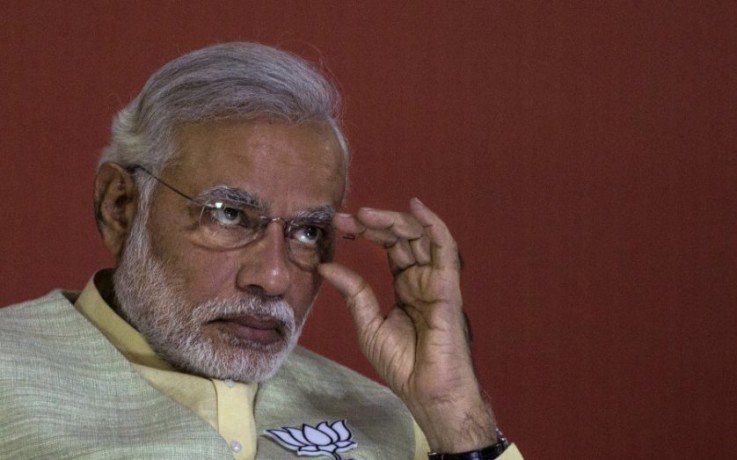
In a blow to him from unexpected quarters, the top Japanese journal, “Nikkei Asia Review”, owned by the powerful Nikkei Group, has warned that the NDA government headed by Prime Minister Narendra Modi is in the danger of falling into a trap similar to the “India Shining” campaign of the Atal Behari Vajpayee government.

The high profile journal says, Vajpayee’s “splashy” India Shining campaign highlighting the wave of optimism supposedly sweeping the nation failed because hundreds of millions of Indians failed to feel Vajpayee’s economic magic, and showed the BJP the door in 2004.
In an opinion piece, William Pesek, a Tokyo-based journalist, who is author of “Japanization: What the World Can Learn from Japan’s Lost Decades”, warns, “Fast-forward 13 years, and it is easy to suspect Modi’s party is treading a similar path…”, underlining, “Modi’s team is veering dangerously toward ‘India Shining’ territory, hyping modest successes and resting on its laurels when it should be accelerating the epochal reforms voters in 2014 chose Modi to enact.”
Conceding that Modi has “pulled off some vital wins”, such as cut in red tape, privatization of aviation, defense and insurance sectors, and a national goods and services tax, Pesek says, “Missing, though, are the truly audacious moves Modi promised: revising labour, land and tax laws to raise competitiveness.”
“Nor has Modi’s ‘Make in India’ push created millions of high-paying jobs in export industries. Moves to upgrade infrastructure and reduce power costs are a work in progress”, the journal insists, adding, “Until Modi shakes up pivotal areas like retail, it is hard to gush about the outlook.”
Pointing out that “instead of the ‘Gujarat model’, voters are getting Gujarat light”, the journal says, there is a “reform vacuum” which is threatening “India’s long-term prospects”, adding, “In a sense, Modi has fallen into the same hubris trap as Vajpayee: the cult of GDP.”
Conceding that Modi is “widely credited with transforming the place into a free-market exemplar with faster growth, fewer regulations, less corruption and strong entrepreneurship” and “Modi’s mandate was to apply those successes nationally and drain the swamp in New Delhi”, the journal says, “Unfortunately, Indians may have to wait for a second Modi term.”
Pointing out that Modi faces several major challenges, the first one being “a mounting bad debt crisis” with “nonperforming loans at state-run lenders recently hit a 15-year high”, the journal says, “When New Delhi admits to about $200 billion of zombie loans, the odds are that the true figure is markedly higher.”
“That weakens India’s foundations by increasing incentives to misallocate credit, warping financial priorities and blurring lines between private sector efficiency and public sector bloat. Modi has relied on the central bank to sort out a problem his finance ministry should be tackling”, it says,
“Second”, it says, is the “demographic pressure”, adding, “Roughly 25% of India’s 1.3 billion people are under 15 and its labour pool will jump to 1.08 billion people from 885 million over the next 20 years. What is more, India will enjoy this swelling-workforce magic for roughly 50 years. Demographic dividends, though, become political nightmares if job growth does not keep pace. Hundreds of millions of young Indians taking to the streets in anger would be bad for business for Asia’s No. 3 economy.”
“Third”, the journal says, is “regional competition”. It explains, “As Chinese production costs rise, India’s chances of wooing those jobs are not assured. While Indonesia, the Philippines, Thailand and Vietnam lack India’s scale, each is making a play for factories looking for cheaper and more pro-business locales. These upstarts are building better roads, bridges, ports and power grids at least as fast as New Delhi. Also, China’s push to recreate the Silk Road trade links may benefit East Asia more than South Asia.”
The journal regrets, despite a few reforms, “Modi should be accelerating market-opening efforts, not throttling back”, even as approvingly quoting Maitreesh Ghatak of the London School of Economics, who says, “Modinomics has turned into muddlenomics.”