Data shows that the Northern Indian state stands nowhere in front of the healthcare system in the South Indian state.
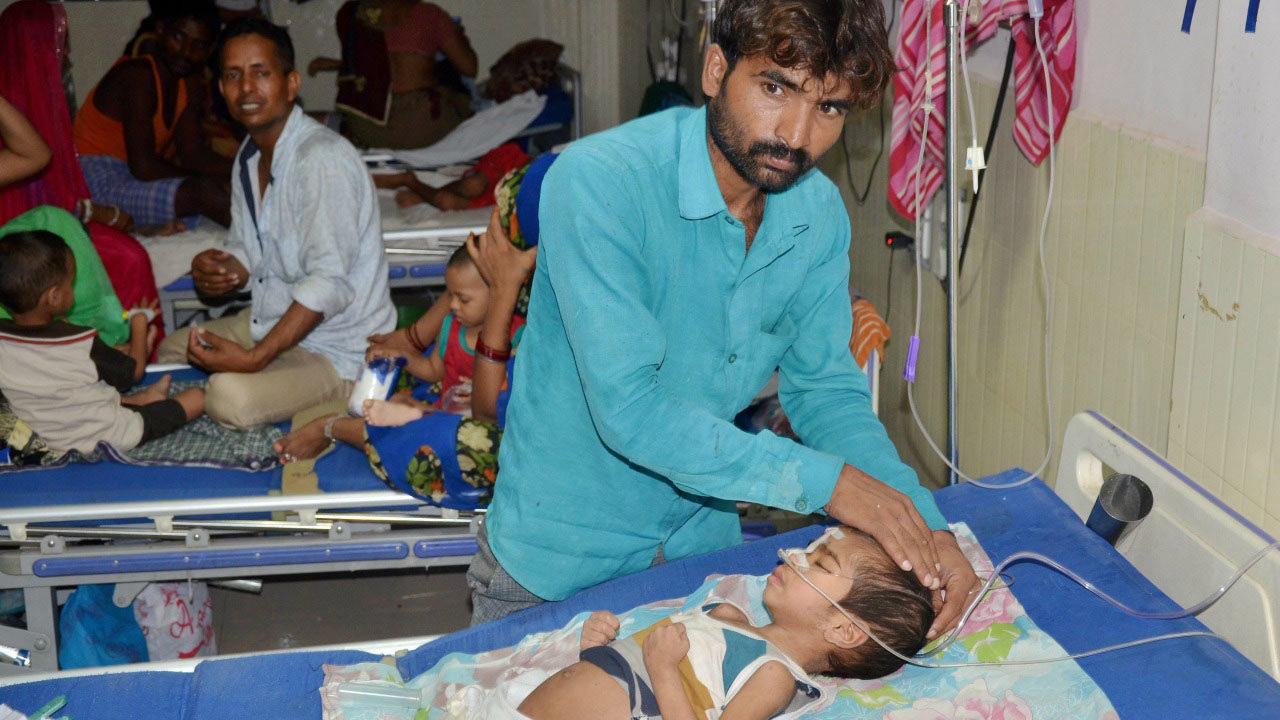
Uttar Pradesh Chief Minister Yogi Adityanath claims that the Kerala should learn from his government how to run infirmaries, but the data shows that the Northern Indian state stands nowhere in front of the healthcare system in the South Indian state.
Image Courtesy: IndiaSpend
According to the data provided by Baba Raghav Das (BRD) Medical College and Hospital in UP’s Gorakhpur district, a total of 433 children – highest in the past four years – died in September this year.
BRD had been in the spotlight for the past few months following the deaths of nearly 60 children because of lack of oxygen supply between 7 and 11 August.
The horror returned to BRD once again in less than three weeks with 42 children dying in 48 hours from August 30.
After the tragedy hit headlines, the government swung into action and suspended their staff, including doctors, for alleged dereliction of duty and corruption. Cases were filed against them and they were sent behind bars.
With an aim to improve the medical care, 20 new doctors were appointed at the BRD Medical College’s paediatrics department. But no improvement was observed. Against 372 deaths of children in September last year, 433 newborns died in the same month this year.
A maximum number of deaths were reported from the BRD’s Neonatal Intensive Care Unit (NICU) – an intensive care unit designed for premature and ill newborn babies – where 247 breathed their last in the previous month.
In addition, 186 children died of encephalitis and other diseases in Pediatric Intensive Care Unit (PICU).
The number of deaths that took place so far in BRD Medical College is highest in the past four years. In 2014, this number stood at 302 and it went up to 378 in 2015. The year 2016 recorded a marginal decline by registering 372 death of children.
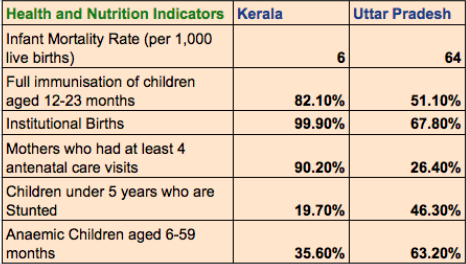
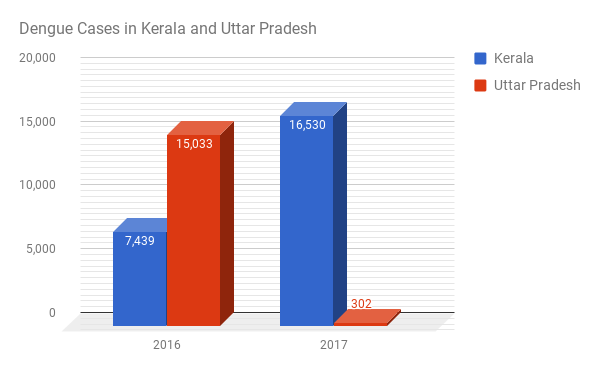
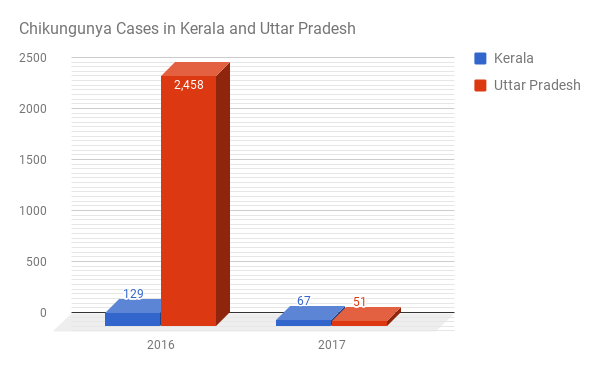
In fact, comparing UP and Kerala may not be such a great idea for the Bharatiya Janata Party (BJP). If one compares the data obtained from National Family Health Survey (2015-16) and National Vector Borne Disease Control Programme (until August 20, 2017), there is no-contest between UP and Kerala.
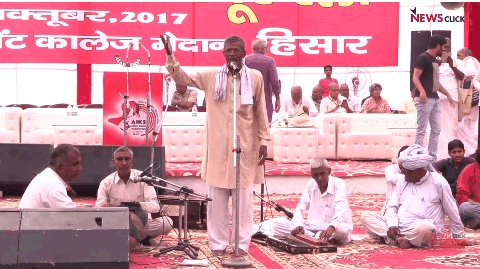
THE All India Kisan Sabha (AIKS) is gearing up for its 34th Conference, after a long, eventful four years of struggle and advances. It will be held in Hisar, Haryana, from October 3-6. A public meeting on the first day at Old College Ground will be addressed by Tripura Chief Minister Manik Sarkar. A total of 758 delegates from 25 states will attend the conference. Two delegates from UIS, the international farmers’ organisation, will also be present.
The 27th conference of the AIKS was held in September 1992 at the same venue. Since then, many changes in the international and national situation having taken place. Two-and-a-half decades earlier, the Soviet Union collapsed and the rule of international finance capital began. AIKS made no mistake in identifying the new danger in the offing. The conference correctly identified the real character of the neoliberal economic policies just accepted by the government of India then. We looked at these new and unknown policies as a disastrous onslaught on all aspects of life, especially the agricultural and rural economy.
It is an important task of the 34th conference to analyse the impacts of neoliberal policy on our agriculture and peasantry during the two-and-a-half decades, and find ways to fight against the menace in the coming days. In general terms, we call it an unprecedented agricultural crisis. This became manifest through different events and expressions, such as agriculture becoming a loss-making venture, large numbers of peasantry wanting to give up agriculture, 3,50,000 farmers committing suicide during this period as they were in a grave debt trap and not getting remunerative prices for their crops. Though majority of our population still depends on agriculture and allied activities, its relevance to our GDP came down by 75 per cent since independence. And this happened solely due to the policies pursued by different governments. Those were seen in the withdrawal of government from agriculture, declining investment in agriculture in the budget, eliminating subsidies, curbing institutional loans to majority of peasants, removal of quantitative restrictions on agricultural imports and integrating our agriculture with the world market, privatisation and FDI in agriculture, signing many FTAs, and finally the attempt to replace peasant agriculture by corporate agriculture. The total surrender by our government and policy makers to the World Bank and the WTO destroyed our independent agricultural policy. Rural employment reached its lowest level, intensifying rural poverty and pauperisation. The peasantry lost land very fast and majority of them were reduced to agricultural labourers or rural manual workers. During this neoliberal period, landlessness increased from 25 per cent to 35 per cent and the top 10 per cent of landholders’ land occupation increased from 56 per cent to 73 per cent. This is the most disastrous impact of the neoliberal policies.
The All India Kisan Sabha continuously analysed these changes critically and exposed the danger before our agriculture. We also countered this policy with alternative agrarian policies which could save Indian agriculture from such deep crises.
Just after the 33rd conference, the biggest attack on the peasantry came from the Narendra Modi government – the Land Acquisition Ordinance, 2014. The AIKS took up the issue, contacted other kisan organisations, and gave a call for burning of the copies of the ordinance which was done in the entire country. It created an atmosphere against the ordinance and many more organisations, NGOs and political forces came out against it. This battle was victorious as Modi shelved it for the time being after his three attempts failed to pass it and the anger of the farmers was widely expressed in the country. This was the first defeat of a central government before the kisan movement. But Modi instructed his BJP state governments to make state laws in this regard. We too shifted our struggle to the state level and it is going on.
The second attack against farmers came in the form of banning cattle trade recently. Thirty per cent income of farmers comes from their cattle and animal husbandry. They sell their old cattle every year and use the money to purchase new young cattle for milk or ploughing. This was an age-old practice. But the BJP government stopped it absolutely as part of their communal agenda. Their Sangh Parivar criminals under the garb of ‘gau rakshaks’ attacking cattle trade was a glaring example. The AIKS took up the issue on the day Pehlu Khan was killed in Alwar, organised protest meetings before Parliament, collected funds and gave Rs 15 lakh to Khan’s family, while both the state governments of Rajasthan and Haryana failed to help the family. The government’s notification for banning cattle trade was also challenged by Kisan Sabha in the Supreme Court and it ordered a stay on the notification in the whole country.
Through these two battles, AIKS succeeded in building a united kisan movement in the country and a new Kisan Morcha emerged as the “Bhoomi Adhikar Andolan” (BAA), a new type of united platform. It is working at the national level very successfully and we have held three national conferences of BAA during the last three years and have formed state chapters in Odisha, Rajasthan, Gujarat, Jharkhand, MP and Maharashtra. This is a new experiment in the united struggle.
The AIKS took up the issue of remunerative price as per the Swaminathan Commission’s recommendation – i.e., cost + 50% – and complete one-time institutional and private loan waiver for all poor, landless, tenant, marginal, middle peasants and agricultural workers. Along with this, a 15-point charter of demands was taken up to the entire peasantry of the country. To propagate these issues, AIKS took out an 18,000 km “Kisan Sangharsh Jatha” all over the country for 21 culminating in a huge successful rally before Parliament. This was the biggest programme of the AIKS since the last conference to highlight kisan issues before the entire agricultural community and the country. Along with that, AIKS, during this period, took up the kisan suicide issue in a big way; visited the houses of suicide-victims in most of the affected states, and brought their family members before Parliament for a two-day dharna. These activities of AIKS helped to highlight the issue before the nation in a big way for the first time.
During the last few months, due to growing kisan unrest and some successful kisan struggles, many kisan organisations, big or small, came out to raise kisan issues and join the struggles. In these efforts, two broad kisan united platforms have emerged. They came together, met and formed two new morchas called Rashtriya Kisan Maha Sangh and All India Kisan Sangharsh Coordination Committee. The former claimed 60 organisations as their constituents and the latter claimed 170 organisations as their members. Both the Morchas were formed on two agreed demands, a) remunerative price for agricultural products as per the recommendations of the Swaminathan Commission, and b) complete loan waiver – government and private – for all farmers. We discussed this idea in “Bhoomi Adhikar Andolan” and decided to join this movement unitedly. The 34th conference will discuss these new developments and give the proper guidelines.
The AIKS initiated many crop-wise mobilisations during this period and organised conventions and built new struggles. The Jute Convention, Rubber Convention, the Sugarcane Convention, the Vegetable Growers Convention were held and sub-committees formed to build crop-wise broader movements. The conference has to plan to expand this movement for other crops and products. Besides the national and regional or state level struggle, the importance of struggle on local issues are most important for intensive movements which involve more kisans at the grassroots level. So, movements on “local realisable” demands also should be planned properly.
The conference will self-critically discuss the issue of worker-peasant unity which remained a weak area of our activities. Some token attempt was made but many more things are to be done. The Kisan Sabha, Agricultural Union and Trade Unions should join hands on more concrete issues, plan joint movements and build unity among these sections of the people. Besides them, our united action with women, youth and student organisations did not take any shape so far. How to remove this weakness in our activities should also be discussed and proper short- and long-term plans are to be formulated by the conference.
Many more issues, subjects and matters will be taken up by the 34th conference. The policy issues will be analysed in depth, so that political, ideological clarity emerges as a guiding force. The other important task before the conference will be to discuss organisational issues. The fate of all decisions will depend on their implementation and the organisation is the only instrument for that job. Since the last conference, the organisational activities increased manifold. All those experiences would be discussed in order to strengthen the organisation further.
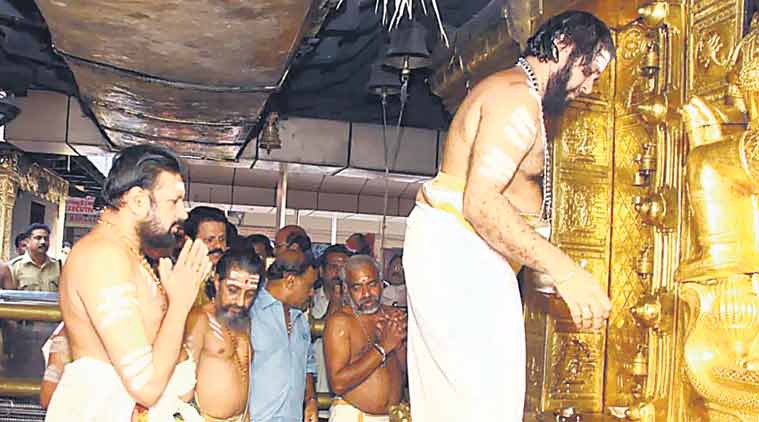
In a fairly radical step the Travancore Devaswom (Temple) Recruitment Board broke the tradition and has appointed people from Dalit, backward communities as priests. The board released a list of 62 candidates and 36 shortlisted people are from Dalit and backward communities, reported CNN-News18.
The candidates were selected after interviews and necessary tests and for the first time appointment is being done on the basis of reservation norms. The selected candidates will be appointed in temples under the Travancore Devaswom Board.
The Travancore Devaswom (Temple) Recruitment Board has led the way for social inclusion in Kerala as it shortlisted 36 people from Dalit and backward communities as temple priests.
The instructions had been given by Devaswom minister Kadakampally Surendran asking the board to comply with the merit list and reservation norms, said an official statement.
“Earlier, we had some priests from backward communities who made it to the list through merit. The demand for reservation for Dalits has been persisting for several decades. Previous attempts to meet the demand had faced stiff resistance from certain quarters. But now we have made it a reality,’’ said Board chairman Rajagopalan Nair.
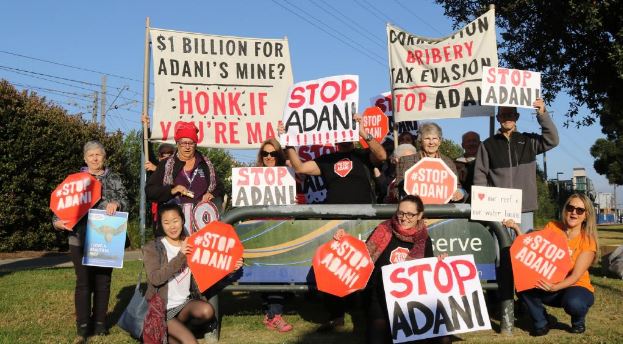
Four Corners, Australia’s leading investigative journalism program has been exposing “scandals, triggering inquiries, firing debate and confronting taboos” since 1961. This time around it chose to investigate Indian industrialist Gautam Adani as he has been in Australian news for several months now with his mega mining project, facing strong protests from local groups. Despite this he bagged the contract, with Four Corners journalists travelling to India for an expose that has been aired on October 2. The video link is at the end of this report for those who are interested in viewing it, filmed by Four Corners as it says “to serve the public interest.”
Four Corners reporter Stephen Long said that he had been in Mundra, in Adani’s home state in Gujarat for less than 24 hours when the police turned up at the crew’s hotel. He said that their main concern was to safeguard the interviews and footage they had filmed on the story they were investigating. Long said, “We were questioned on and off for about five hours, the senior policeman kept on going outside and talking to someone on his mobile, and whenever he’d return the questioning, the hostility, would ramp up.”
“It was obvious they knew why we were there but everybody was avoiding the ‘A’ word: Adani.”, he added.
“They’d told us that if we stayed there’d be officers from three Indian intelligence agencies coming to see us the next day, plus we’d have an entourage of crime squad detectives and local police wherever we went,” Long said on camera while introducing the film. The journalists left India and in their subsequent story telecast in Australia on October 2, share concerns whether Australia should be supporting Adani’s controversial mine in Queensland.
This is the text that Four Corners put out:
“Why would the crime branch want to see us?” Stephen Long, reporter
When Four Corners travelled to India to investigate the activities of the giant Adani group, they soon discovered the power of the company.
While attempting to film and gather information about Adani’s operations, the Four Corners team had their cameras shut down, their footage deleted and were questioned for hours by police.
The team were left in no doubt that their investigations into the Indian company triggered the police action.
For months, Four Corners has been digging into the business practices of the Adani Group. This is the corporate colossus that plans to build Australia’s biggest mine site.
“I do know about Adani and that means thousands of jobs for regional Queenslanders …” Annastacia Palaszczuk, Qld Premier
The polarising debate around the proposed mine site in Queensland’s Galilee Basin is often pitted as a simplistic jobs versus greenies argument.
But there are influential figures in India who warn that Australians need to know much more about the Adani Group.
“You know, the Australian politicians are obviously not properly briefed by their offices.” Former senior energy official
On Monday Four Corners examines the troubled corporate history of the Adani group in India revealing the findings of government investigations into financial and environment crimes.
“The report found not accidental violations, the report found deliberate violations, wilful violations.” Former Government Minister
The program analyses the Adani Group’s opaque financial operations and investigates the ramifications for their Australian operations.
“What this tells you is that here is a business group that will not stop at anything to maximise its profits.”Economist
This investigation examines whether, in the rush to secure jobs and shore up the mining industry, Australian politicians have failed to properly scrutinise the company that’s now hoping to receive a taxpayer funded loan of up to $1 billion for its project.
“I think the Australian Government ought to do environmental due diligence, which it seems not to have done. It certainly has to do financial due diligence. Both due diligences are required, both for the financial side and from the environmental side.” Indian politician
The film is fast being picked up by organisations and the media across the globe.This is what Greenpeace reported, for The Citizen readers to get a sense of how this investigation is playing out across the globe: “An expose aired last night by the ABC’s Four Corners program revealed a shadowy network of companies and trusts behind Adani’s Australian assets, which offer the Indian firm “multiple ways” to reduce their tax in Australia, experts say.
Adani Australia has previously boasted its Carmichael mine could boost Australia’s tax coffers by up to $22 billion over the life of the project.
However, Adani’s Australian assets are seemingly owned by companies domiciled in notorious tax havens such as the Cayman and British Virgin Islands, which provide a means to minimise tax paid in Australia.
The investigation also revealed that the man behind a British Virgin Islands company variously described as ARFT Holding Ltd, AFRT Holding Ltd, and Atulya Resources Family Trust, which appears to be the ultimate owner of Adani’s Australian assets, has been accused of money laundering.
Vinod Adani, the older brother of Adani Group chairman Gautam Adani, has been investigated by Indian authorities with ex-Adani Group employees and Adani companies for allegedly executing a “planned conspiracy of siphoning off foreign exchange abroad … and Trade Based Money Laundering”.
Adani has requested a $1 billion loan, currently under consideration, from the publicly funded Northern Australia Infrastructure Facility.
“The Four Corners revelations prove that Adani is a company which cannot be trusted with a taxpayer loan, or to build the world’s biggest export coal mine on the Great Barrier Reef coastline,” Greenpeace Australia Pacific Climate and Energy Campaigner Nikola Casule said.
“Now more than ever, it’s time for the government to rule out any public money for Adani and say no to the proposed $1 billion NAIF loan for Adani’s rail line connecting the proposed Carmichael mine and Abbot Point coal port.”
“Its secrecy, apparent use of tax havens and alleged money laundering provide the Australian government with all the evidence it needs to rule out even one cent of public money going to Adani’s rail line.”
This is what Adani group stated in its response:
Dear Mr Long, The team from ABC Television while visiting Mundra did not adhere to the journalistic codes of conduct and fairness. While you had earlier expressed your desire to visit Mundra, without further discussion or intimation you and your team landed in Mundra and started filming the sensitive areas without proper permissions and any kind of intimation to the company officials. To our mind it is both unfair and unethical apart from a serious security breach at the industrial site locations in border area.
The Adani Group is one of India’s leading business houses with a core vision of nation building. The group has created a portfolio of businesses aligned with the national priorities of infrastructure development, food security, energy security and clean energy. Each of our businesses is integrated to the core of the country, touching millions of lives and generating direct and indirect employment for thousands of families.
We at Adani Group follow every principle of law that governs operations of company like us in India. To therefor suggest through a documentary, which in its essence have been made surreptitiously and without any legal sanction, is indicative of the fact that the purpose of the documentary is malafide and riddled with the singular agenda of national shaming. For reputable organisation like ABC Television to indulge in this form of ethical violation is truly sad.
On the issues mentioned in your last email, please find our response below. We request you to use the same verbatim, without tweaking its context.
Issue 1 – The reference that has been made to the Lokayukta of Karnataka, Retired Justice Santosh Hegde
Pursuant to the report by Justice Hegde and reports of CEC the Hon’ble Supreme Court passed an order directing CBI to investigate the allegations over illegal export of Iron Ore from Belekeri Port. After the detailed investigation CBI came to the conclusion that Adani Enterprises Limited and its officials had never violated any State and/or Central laws of India. Accordingly, CBI filed closer report and the same was accepted by the designated CBI court at Bangalore.
With regard to another allegation of “Illegal gratification to public officials”, Karnataka Lokayukta formed Special Investigation Team. Adani Enterprises Limited submitted all the data to SIT as required. However after the detailed investigation, SIT found that no case is made out against AEL & others. Accordingly, closer report was filed and the same was accepted by the court.
To summarise, our activities at Belerkeri Port have been conducted within the framework of Law. The Adani Group is absolute and religiously Law abiding organization and respect Law of the land.
Issue 2 – The ruling of HC of Gujarat about developments in the Mundra SEZ without valid environment clearances The Gujarat High Court in its order passed in January 2014, ordered that 12 units operating in Mundra SEZ cannot operate till Mundra SEZ is granted the Environmental Clearance (EC). The said order was challenged before the Supreme Court of India and the Supreme Court stayed the order of Gujarat High Court and permitted 12 units to continue with their operational activities. The matter is pending before the Supreme Court.
There is no restriction for units to set up their facilities and operate in SEZ with their appropriate clearance, till SEZ is granted the EC. Even the Ministry of Environment and Forests (MoEF), Ministry of Commerce and Industries (MoCI) and Pollution Control Boards have granted clearances to units even irrespective whether the SEZ was having the EC or not. Therefore, it was not a case of development of Mundra SEZ without valid EC, as such practice has been followed in all SEZs across India. In any case, Mundra SEZ is also granted Environmental and CRZ clearance by MoEF on 15.7.2014.
Issue 3 – Sunita Narain on environment violation in Mundra The Sunita Naraian Committee submitted its report in 2013 and it was India’s largest business daily The Economic Times which in July 2014 revealed the manner in which the committee was appointed. In any case, the committee’s findings were just that – recommendations. Neither they were absolute; nor were they binding or implementable because of the malafide agenda driven nature of those findings.
Based on the Report, MoEF issued a show cause notice in September, 2013 which has been disposed of on 18.9.2015. The final order is not challenged since. Therefore, Report cannot be cited to defame the Adani Group. Further, the Gujarat High Court dismissed the public interest litigation in April, 2015 concerning this issue and the Supreme Court of India also did not entertain appeal against the order of Gujarat High Court.
Issue 4 – National Green Tribunals decision on Hazira Port The order that NGT has passed has been challenged before the Supreme Court of India. NGT failed to appreciate the facts and no reasons are given which supports the order. NGT observed that the company damaged mangrove whereas, in February 2007, MoEF itself substituted the condition based on NEERI report and permitted development in that area. The company came into picture only in November, 2010. Likewise, all the findings of NGT in its decision are wrong and contrary to the facts placed before it. In any case, the matter is pending before the Supreme Court and is sub-judice and it is unfair and unethical for responsible media to jump to any conclusion and report a story till the matter is finally decided.
Issue 5 – As for the really trite charge of money laundering On August 22, the adjudicating authority of Directorate of Revenue Intelligence (DRI) has passed orders striking all proceedings launched by the DRI against Adani Group for alleged money laundering. This can be only be challenged at the higher appellate authorities and that too by governmental authorities. Since no challenge as of now has been made, there is not only complete acquittal but in fact a validation of what we at Adani Group has always been saying.
Adani Group adhere to the laws of the land in which we operate – be it India or any other of the 50 geographies we work in. To suggest that we are non-compliant, deviant or unethical will once again attract defamation and severe legal action. As an organisation with more than 11,000 employees spread across the world, stakeholders and vertical businesses ranging from agriculture to port to logistics, we cannot be held to either ransom or blackmail by media organisations that indulge into sensationalism without any basis and contrary to facts.
For any media organisation to jump the gun and believe that we have indulged in any malafide is in itself is illogical because we shall have to wait for the Supreme Court of India to pass its judgement. Some of the issues have even attained finality which cannot be blatantly ignored and no damage can be inflicted on Adani Group on the basis of vexatious allegations.
Please note that any manipulation of this message by way of twisting the facts will compel us to undertake legal recourse. We request you to use our response in totality to avoid any misinterpretations.
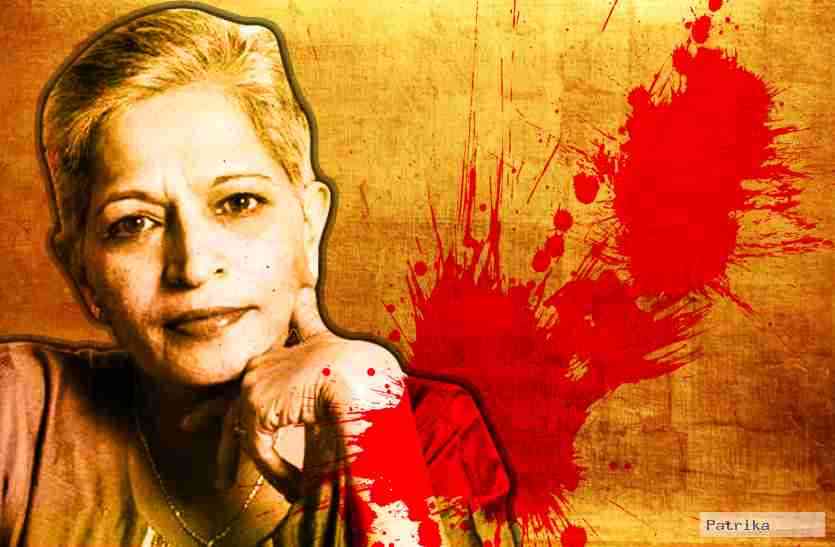
On 5th October, thousands marched together to protest against the brutal killing of journalist Gauri Lankesh, and against the growing intolerance in the country. They demanded that the culprits be punished.
One Month Days After Gauri Lankesh’s Killing: Some Thoughts
Gauri Lankesh saw the connections between the large scale localized and national corruption, the patently unequal policies and programmes of the government and the ideological framework of Hindutva that sought to damage and alter the social and political fabric of the country.
Over the last month, the diabolical killing of Gauri Lankesh has galvanized both civil society and journalists towards raising a collective voice against violence and the suppression of free speech. The importance of this unified protest cannot be sufficiently stressed but are we seeing the emergence of any real bond between the two? And, more to the point, what will it take to strengthen this bond?
As we came together to observe a month after the killing of Gauri Lankesh, a month when there seems little or no progress in the investigation into her death, these questions are important. Journalists have participated in the ‘From Gandhi to Gauri’ protests called by journalists press clubs and associations all over India on Oct 2. Some of them have also joined the ‘We are Gauri’ protests called primarily by civil society individuals and groups on Oct 5.
Gauri Lankesh, who was both a journalist as well as a social activist, would have been heartened at the unified protests against the killings, even if they were held on different days and in different venues across the country.
Of course, in some places, both journalists and civil society activists held joint protests. Perhaps the further journalists and civil society activists are from the political and business power centres of Delhi and Mumbai, the easier this is possible. The formal divide between the practicing journalist and the civil society activist is less sharp, the spillover of the life of the journalist and the civil society activist is more diffused, more fluid.
For civil society to protest the killing of a journalist is not unusual. After all, journalists are seen as messengers of information and opinion and also as a voice for civil society. The large amorphous mass that goes in the name of ‘civil society’ – activists from social movements, members of NGOs, trade unions, human rights groups, academia, literature, film and art – have been in the forefront of a range of struggles against the devastating impact of policies, laws and programs on the lives of people. They are conscious of the potentially chilling effect of both these policies as well as the violence that has increasingly been meeting its dissent.
But do journalists and journalists’ associations and press clubs and unions join the protests over the killing of a social activist? Do they join protests over other important events that shake up society? Or, do they distance themselves from these protests on grounds of objectivity and professionalism (while some prefer to stay away from the protests, preferring to let their work do the talking)? Will their grief and anger over the senseless killing of Gauri Lankesh even bridge the hitherto invisible chasm between ‘mainstream’ and ‘alternative’ media?
More questions, clearly.
The ‘activist’ journalist
When journalists are killed, as they have been with such alarming regularity over the last few years (31 since 2010 when the media watch site, The Hoot, began monitoring free speech attacks), several questions are raised about their identity – whether they were journalists at all and whether they were killed for their journalism. Often, it is the police – the first line of investigators – who raise these doubts. These are then picked up and amplified by the media reporting the killings.
In the immediate aftermath of the killing of Gauri Lankesh, there was such murmurs too. In the course of her work, Gauri Lankesh had opposed the rise of Hindutva terror. She had received multiple threats and it was clear she was targeted and silenced for her views as well as her work. But while doubts were raised over the motives for killing her, there was also considerablediscussion over the ‘activist’ nature of her journalism. Those from the ‘mainstream’ media questioned whether she was a journalist at all, as if her journalism was not the ‘real’, non-partisan or objectivity based journalism of mainstream media.
Gauri Lankesh belonged to what is referred to as ‘activist’ media. Writing in The Hoot, Prof B P Sanjaya traces her brand of journalism to her father P Lankesh, who was part of ‘a new brand of writers believing in “Bandaya” (revolt/resistance/protest) literature. Terms such as insurgent journalism and counter hegemonic journalism have been used to describe the journal and its practices.
What tends to get obfuscated in these semantics is the fact that her media was also an ‘alternative’ media. It positioned itself clearly on social and political issues and either as an alternative or in opposition to the views predominant in ‘mainstream’ media. While Gauri Lankesh brought out the ‘Gauri Lankesh Patrike’ in Kannada and, in the last few years, also wrote extensively in English for news websites. Gauri Lankesh Patrike was independent and free of sponsorship and advertising.
In this peculiar argument that seeks to privilege ‘mainstream’ media as more authentic, many structural flaws of the mainstream are blithely erased. Advertising drives mainstream media. But its also the business and political ownership that seek to maintain a stranglehold over the media’s spheres of influence in society. Media houses increasingly operate as professional corporate brands that lend theirmedia platforms to all manner of event-based advocacy – from literary festivals and cultural events, saving rivers to swacch bharat to aman across the borders to marathons and runs for womens’ safety and whatnot.
Ironically, while they enhance their brand values, they refuse to pay fair and legal wages to their employees. The mainstream media is united in faulty or non-implementation of wage board wages for permanent employees, arm-twisting them to take contractual employment. Layoffs and large-scale retrenchments have been the norm over the last few years.
For those of us who may shrug and say that’s just the way the news-business runs and is hardly pertinent to a discussion on the killing of Gauri Lankesh, let’s look at another issue: newsgathering. Journalists have rued the shrinking budget for newsgathering on the ground. How much do media houses that support rallies for rivers for instance, actually spend on legwork that reporters need to do to report on the state of our rivers or the real reasons for water pollution along rivers, the environmental degradation or the extensive sand mining that destroys river beds or even track the policies and programs of governments at the state and centre on such issues. Of course, while it would be instructive to look at the budgets for these and compare them with the amount spent for advocacy related events, it is important to examine the thrust of the advocacy itself (but that’s another ballgame).
Many of the journalists who were attacked or killed followed such stories. These freelancers and contractual employees were in a position of extreme vulnerability, compounded by the fact that the media houses that used their stories simply ‘played dead’ when these journalists were killed. They either denied they ever worked for them even in the face of evidence like press cards or emails giving them assignments barely a week before their deaths!
In only one instance – the killing of Mid-Day journalist J Dey in Mumbai in 2011, was an English language journalist felled. While in three other instances of journalists killed in 2017, journalistic motives are still to be established, in all other instances, journalists who were killed operated in regional media, were stringers or contracted by bigger non-english language media houses, or, like Jagendra Singh who died of immolation, had eschewed print media for digital media, publishing on social media networks like Facebook.
Unlike Gauri Lankesh, they operated as lone rangers, often operating on the fringes of or were part of mainstream media. They did not build media institutions. They may have participated in or even set up social organisations with others but their spheres of influence were much more localized and investigations into those who killed them, more often than not, pointed towards local businesspeople or corrupt politicians or mafias controlling illegal mining or smuggling.
Gauri Lankesh also wrote of all such nefarious activities in her publication ‘Gauri Lankesh Patrike’ but she was a social activist too. And her opposition to hindutva politics and anathema towards the BJP, which her friends and supporters believe had led to her death, is well documented.
Gauri Lankesh saw the connections between the large scale localized and national corruption, the patently unequal policies and programmes of the government and the ideological framework of hindutva that sought to damage and alter the social and political fabric of the country. She used journalism to speak out and did not merely write about issues but stepped out of the confines of her medium to actively push for the change she wrote about. She ‘mainstreamed’ issues that needed to be spoken about and written about.
It is this kind of journalism which was sought to be silenced.
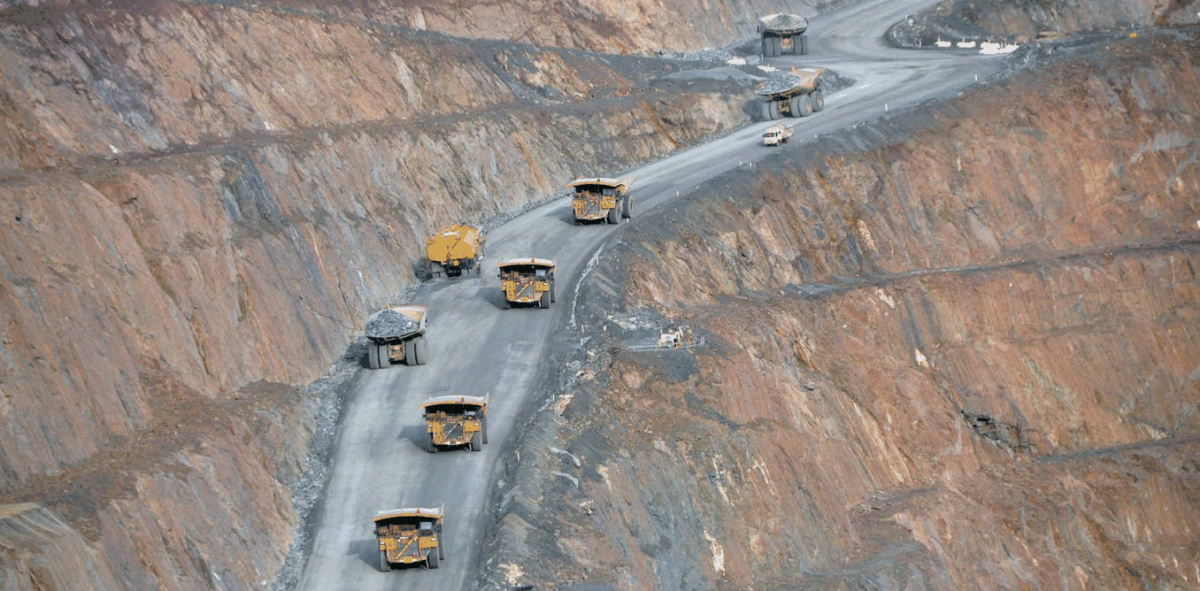
Gold miners are fighting back against the Western Australian government’s plan to hike gold royalties by 50%, from 2.5% per ounce to 3.75%.
What will happen to gold mines if royalties are raised? AAP
Western Australia is trying to improve its budget position. The miners claim that they cannot absorb the royalty increase. This fight shows the need to take a closer look at gold royalties and how much they raise, check out royalty rates on other commodities and consider how royalties could be done better.
There are some legitimate concerns about royalties. As they are paid almost immediately on production or “royalty” value, one concern is that payments are made before net profit is determined. Industry argues that this is a strong deterrent to investment in marginal projects (mines that are barely profitable).
A well-designed tax should not affect business decisions (they should be “neutral”). The way WA levies royalties is also problematic in that no adjustment is made for profitability of a mine. Among other things, this means the government loses revenue in times of high commodity prices as royalty rates are fixed.
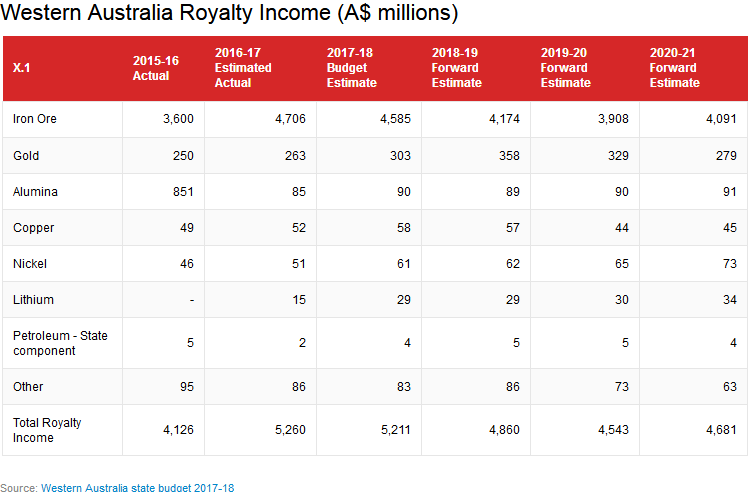
How much exactly does WA receive in royalties?
In 2015, the WA government released a report that analysed the state’s mineral royalty system. It stated that the system is designed to return to the community about 10% of the value of its minerals. Industry agreed in principle with the indicative 10%.
As you can see in the table below, gold is the second-highest royalty-earning commodity in the resource-dependent state. But this is estimated to fall from 2019-20, which is in line with the experience of Victoria, the other gold-producing state.
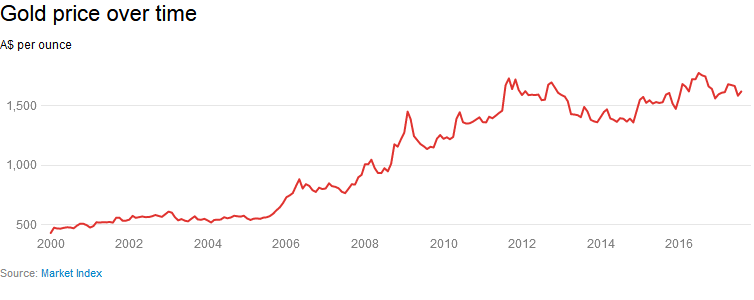
Coincidentally, the current price of gold is quite high, despite a slowdown since 2013. Prices are determined by the global market, subject to consumer sentiment on world events. Although there is trend of declining prices, the WA government’s move on royalties is driven more by its immediate debt concerns than by the gold price.
What is a royalty and how does it differ from company tax?
As early as 1400 the British Crown used the term “royalty” to describe any right or privilege retained by the crown. Today a royalty is a type of rent due to government as the resource owner (based on the volume, value or profits of minerals at the mine) in return for the privilege of extraction.
Crucially, a royalty is paid in addition to company tax. The justification for levying a royalty is that mineral resources are finite – extraction can only occur once.
WA uses two systems to collect mineral royalties. The first is a specific rate – levied as a flat rate per tonne produced. The second is “ad valorem” – calculated as a proportion of the “royalty value”, which is a form of market value of the mineral.
Specific rate royalties generally apply to low-value minerals and raw materials, such as salt, talc, clay and sand. These royalties are between 73 and 117 cents per tonne.
The ad valorem system has three general tiers of rates depending on the form in which the mineral is sold and used for higher-value commodities. Ore attracts a 7.5% royalty, concentrate (minerals that have been processed) 5% and metal 2.5%. The system takes into account price fluctuations and material grades in the royalty formula.
Gold is currently subject to the lower rate of 2.5%, and its industry has only been paying royalties since 1998.
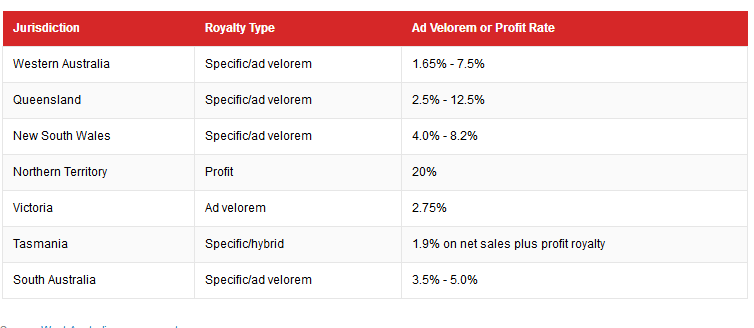
The table below shows the mining royalty types and rates for the states and territories in Australia. Queensland and New South Wales have higher ad valorem rates for coal. Northern Territory has a royalty profit-based system, which attempts to address the lack of “tax neutrality” in royalties.
If not royalties, then what?
So we can see a number of difficulties in the royalty system and lack of options for government. But if we want to see what a better system would have looked like we need only recall the mineral resource rent tax (MRRT) introduced by the federal Labor government in 2012.
One of the basic ideas of the MRRT was that payments on the value of minerals are paid after net profit is determined. Revenue collections would adjust according to profitability, which negates the main criticisms of royalties.
But industry and state governments fought against the MRRT from the outset. The MRRT was repealed in 2014. It could have been done better, using both systems in tandem.
The result is that state governments are left with an imperfect royalty system that needs regular adjustment to rates when more revenue is needed, which is unavoidable as the community requires an equitable return on its resources. Industry will always argue against any increase to taxes.
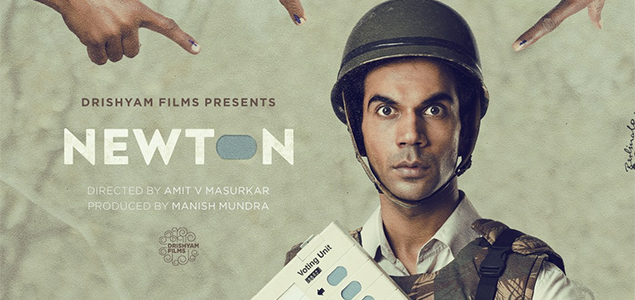
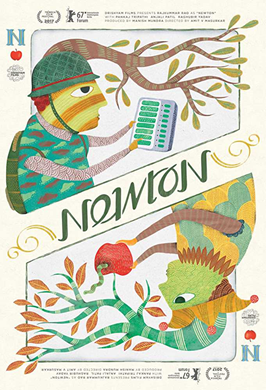
Amit V Masurkar’s recently-released film Newton explores facets of Indian democracy at its most vulnerable. For these times of ‘nationalist’ bravado, this is a courageous topic. The film is so named because it adopts for the most part, the point of view of its protagonist, Newton (Nutan) Kumar (Rajkummar Rao, thank you once again!) who resists corruption and hypocrisy at home and work.
An upright and idealistic electoral presiding officer, he volunteers to oversee free and fair elections in Konar in interior Chattisgarh. With a meagre total of seventy six registered voters, the zone is notorious for the influence of Naxal rebels who violently reject electoral processes. The name of the protagonist is no accident. As ‘Nutan’, he is the harbinger of newness, of change. And as Newton, he is, as someone explains to him about his famous namesake, a levelling and democratising agent, attempting to show that the same rules apply to all, the powerful and the powerless. Specifically, Newton lives up to the promise of his name (apple biting included!) as he realises Isaac Newton’s laws of motion (here, change)—he is the ‘external force’ that propels things out of their status quo, but equally, he realises that every motion has an equal and opposite reaction. We see through Newton’s sincere eyes, a lot that is askew with the country’s democracy today, especially the massive-scale elections that the world’s biggest democracy so prides itself on. As he travels through the densely forested area, he takes us along as it were into the nation’s subconscious terrains, where the yawning fissures of Indian democracy are most disturbingly transparent.
Newton’s delightfully apt antagonist, (CRPF?) commander Atma Singh (Pankaj Tripathi) is at the other end of the spectrum from him. He too claims to be doing his duty, and cloaks his many acts of misdemeanour under a perverse sense of entitlement as one who bears the burden of the nation’s safety. If Newton lives zealously by the rulebook, Singh has at best, casual disregard for procedure and is at worst, a cunning manipulator of due process. He keeps dissuading Newton and his team from setting up the election booth and tries his best to establish the region as ‘unsafe’ because of the Naxalites, even as we see that it is he and his team who repeatedly disrupt the peace of their environment and treat the locals with indignity and intimidation. He consistently talks down to all but his superior, and repeatedly refers to his previous postings at Kashmir, Manipur and Nagaland, as proof of his awareness of the reality of ‘these people’. The film initially portrays Newton-Singh’s frequent sparring as humorous repartee, swaying in favour of one and then the other, but grows steadily darker as Singh threatens and bullies the election officers and the voters and then unleashes his wrath on Newton for defying him. We are given to understand that his priorities are quite different—the sanction of new equipment (night goggles, etc.) to make his ‘brave boys’ safer in these hostile regions. These then are the weapons with which he seeks to uphold the country, instead of the elections that he is in charge of protecting. By pitting ideologues of opposing persuasions against each other, the film helps complicate our understanding of representation, democracy and nationhood. In case we turn sceptical at the lack of nuance with which Singh is portrayed and rush to condemn him as a villain, we are left with a radically different image of him at the end of the film. In the penultimate sequence, we inexplicably see him shopping in a supermarket with his family, pushing a cart in civilian clothes. Abrupt as the scene appears, we are given a glimpse into a different man—a family man with a wife and daughter, who can be pleasant, even indulgent, and whose profession apparently determines his ideologies.
And yet, the film refreshingly declines from making us identify completely with the self-righteous indignance of Newton, who after all, is an ‘outsider’ to the ignored, exploited tribal people whose right to vote he zealously tries to protect, as he goes about his duty. (The forest’s name Dandakaranya is meant to invoke the legendary forest of Ramayana; are we meant to draw parallels between notions of good, evil, othering and righteousness in the two tales?) In this regard, his two important interlocutors are his commanding officer who briefs him on his duties (a brief, yet significant cameo by Sanjay Mishra) and his colleague, the local booth-level officer, Malko (Anjali Patil). Both these characters put his idealism in perspective for us. The former does so by alerting Newton to the arrogance of his honesty that makes him think of the observance of his duties as a gift that he bestows upon mankind (This reminded me of the similar deep sentiment voiced by the grandmother in Rituparno Ghosh’s Dahan). Malko, is the Adivasi primary school teacher who is treated with suspicion by the accompanying paramilitary force, as a possible Naxal informer. As Newton grows increasingly exasperated at the state of affairs at the booth, first with the lack of voter turnout and then with the subsequent charade of voting, Malko wisely impresses upon him that change does not arrive overnight, like it takes a long while for a forest to grow. Lest Newton mistake his one-day stint as an opportunity for him to become a saviour, Malko explains that this state of affairs is something she has grown up with and mildly berates him for being unaware of such realities, indeed such people, despite residing not too far away from the tribal belt. Her comments draw our attention to the slow erosion of democratic values over a period of time (or their inconsistent presence from the beginning) and the convenient indignance that mainstream India sporadically professes for the oppression of the marginalised. As she leaves towards the end of the election day, she advises Newton to recognise and act by his sixth sense (as compared to the rules he so rigidly follows).
Newton (2017) directed by Amit Masurkar (image courtesy IMDB)
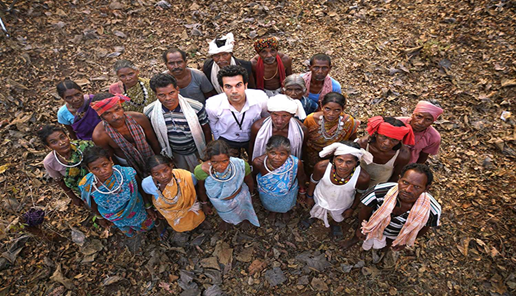
The crucial motif we find is the question of representation. The film takes great pains to alert us to the dangers of ventriloquizing the adivasis’ opinions. For the most part, they speak in the local Gondi that needs translation. Two translators take up this job, one of whom is Malko. Even as Atma Singh’s local stooge surreptitiously conveys misleading information to the people, Malko intervenes and becomes a conduit of communication between Newton and ‘her people’. And yet, she too falls prey to her good intentions, as she conveys to Newton that torn between the Naxals and the police, what the villagers want is freedom from both, an extrapolation that Newton is quick to recognise. On the other hand, some things are hard to translate. The concept of democracy and elections, for example. When Newton realises that the villagers don’t know how to use the EVM, he gathers them outside to deliver a lecture on how to cast one’s vote and the purpose of it all. The villagers uncomprehendingly ask why they need a leader when they already have a tribe chief, or what they will get in return for the exercise (put as a blunt monetary query) and which one of the candidates would get them the best rate for their produce (ironic since Newton knows that no politician considers them worth wooing). Newton, the perennial asker of questions, for once finds his own discourse of modern nationhood and democracy challenged.
The absolute penury and persecution that the villagers face is often presented to us—in the form of three boys rounded up as spies and forced to entertain the officials, as people being misled about election protocol, and most chillingly, as people who are later hounded in their huts and dragged forcibly to the polling booth to present a picture of a functioning democracy to the media. In a striking long sequence that is clearly meant to be an analogy, as the officers round up the villagers one by one, a woman among them chases a flapping chicken around, before beheading and then cooking it. Later, after casting their vote, when they are interviewed by national and international journalists about whether they feel any fear, they tellingly remain silent and in the background, we see officers with guns, the same ones who forced them to come along, standing guard. This silent juxtaposition of the oppressor (masquerading as the protector) and the oppressed, is a powerful image that stays with us, reminding one of disconcerting stories like Mahasweta Devi’s ‘Draupadi’. Though the film does try to leave things open-ended and teetering between idealism and cynicism, the political sympathies of the film maker are evident in the curious shadow presence of the Naxalites, the display of huts burnt by the police and their callous and apathetic behaviour throughout and finally, the recourse to the gun that we see towards the end of the film.
Newton (2017) directed by Amit Masurkar (image courtesy IMDB)
I disagree with the film’s classification as purely satire or dark comedy—one need only compare it to Jaane Bhi Do Yaaro orPeepli Live or Being Cyrus to realise this is both and something else. The film’s sense of humour manages to tread the fine line between witty wordplay (‘laal salaad’!) and disturbing recognitions too close for comfort. Perhaps the best example of the latter is when two local police recruits teach an election officer how to make quick money—by ‘surrendering’ to the police, with the reward getting more lucrative with the sophistication of the weapon being also surrendered. This fascination with ‘technology’ also finds its ridiculous counterpart as a canvassing candidate promises the electorate a mobile in one hand and a laptop in another and later, when electoral officer Loknath (Raghuvir Yadav) suggests that the Naxalite rebels can be tamed by bestowing upon them colour televisions. Whether the film is worthy of being India’s official entry to the Oscars is debatable, not because of the controversy over its alleged plagiarism (possibly an ill-founded allegation), but due to the feeling of ‘unfinished business’ that the film leaves the audience with. However, there is no arguing that much like its protagonist, it is a refreshingly honest and sincere film that is thought-provoking and entertaining at the same time, but unlike him, deliberately not overtly ambitious in its reach. If the film strikes a few false notes and appears to venture into the absurd (too much id, ego, superego anyone?!), it is helpful to read it in terms of allegory and symbolism (indelible ink, empty blackboard, sprained neck). Moreover, the acting by each member of the lead and supporting cast—notably Pankaj Tripathi, Raghuvir Yadav, Sanjay Mishra—is pitch-perfect.
Newton leaves us with many hard-hitting dialogues and images that give the film its solid character and nudge us towards introspection. For instance, on the way to the booth venue, Newton hears the area likened to Pakistan. When he wonders aloud, he is told the self-evident truth that the enemy equals Pakistan, thus bringing into focus the casual ease with which Pakistan enters popular discourse as the enemy par excellence, that can be made to bear the brunt of all that is antithetical to the commonsensical understanding of the Indian nation. Ultimately, Newton is a gift for the Indian audience that is often nowadays inundated with feel-good stories of national progress, that comfort one’s sense of patriotic pride. Newton pierces our collective conscience, and our blinkered patriotism that cannot tolerate any blemish on the image of the nation that we so hold dear. For both Atma Singh and the villagers, democracy is akin to a farce. This forces us to question: What makes a democracy work? How is one to identify with such abstract concepts in the face of immediate realities and loyalties? In the end, the film is not just about the illiterate and impoverished, as it makes us dwell on our own token participation during the occasional election, that makes us smug with the knowledge of our contribution as citizens to the democratic functioning of the nation.
[Rituparna Sengupta is a PhD scholar in Literature at the Department of Humanities and Social Sciences, IIT Delhi. ]