Sidney Morgenbesser Professor of Philosophy,
Professor, Committee on Global Thought,
Columbia University,

Any discussion on secularism would need first to focus on two basic aspects: Firstly, the word ‘secularism’ has no substitute in any of our languages. Like the ‘war’ is the opposite word of ‘peace’, in common parlance in the Indian context, ‘secularism’ is understood by its antonym ‘communalism’, while in the Western context, ‘secularism’ is understood by its antonym ‘theocracy. Secondly, the word ‘secularism’ was nowhere mentioned in the Preamble of the Constitution when it was enforced. It was included in the Preamble by the controversial 42nd Constitution Amendment during the Emergency with effect from January 3, 1977.

It is interesting to note that the Preamble , though the Constitution opens with it , was not the first to come into existence .It was the last piece of drafting adopted by the Constituent Assembly at the end of the first reading of the constitution . The motion to adopt the Preamble was moved on the October 17, 1949. It was suggested during the debates that the Preamble be taken up when the Constituent Assembly would meet in November for the third reading as by that time the Drafting Committee would also have submitted its final report to the House. Maulana Hasrat Mohani objected to the postponement submitting that unless the Preamble was passed on that day at the first reading itself , the Drafting Committee could not produce any report on the second reading . K.M.Munshi supported him. Maulana Hasrat Mohani by making a humorous comment – “Once in my life I support the Maulana Saheb !” The President ruled that the Preamble should be passed on that day to enable the Constitution as a whole being passed in its second reading and the Preamble forming part of the Constitution . Several amendments were suggested to the Preamble but they were all negated.
At the end, the President moved the motion –“That the Preamble stands part of the Constitution.” The motion was adopted on Novemer 2, 1949 . The Preamble was added to the Constitution.
In the words of Justice Jagan Mohan Reddy in his judgment in Kesavananda Bharati v. State of Kerala, 1973 (4) SCC 225–
“The Preamble to the Constitution which our Founding Fathers have , after the Constitution was framed , finally settled to conform to the ideals and aspirations of the people embodied in that instrument, have in ringing tone declared the purposes and objectives which the Constitution was intended to sub serve.”
The question arises as to why it was introduced during the Emergency. Was it not a challenge to the wisdom of the Constitution-makers? The Constituent Assembly consisted of persons who had no partisan motive nor they had any axe to grind. They were men of vision; they inspired confidence, and were all products of the struggle for independence.
In the struggle for independence, the people of different religious pursuits had a natural worry as to what sort of religious freedom they would be able to enjoy in an independent India. When Mahatma Gandhi appeared on the scene and transformed the freedom movement into a mass movement in 1920s, it was realised that people could hardly be motivated to go the whole hog for the freedom struggle unless they were assured that their religious beliefs and systems would be secure in a post-independent India and that they would not be marginalized and sidelined, in case they belonged to the minority community.
It was in the pursuit of this very assurance that Gandhiji gave to the people the much-valued concept of ‘Sarva Dharm Sambhav”–the principle that all religions are equal. The Mulsim League had boycotted the Constitutent Assembly when it started its session on December 9, 1946, and it continued to boycott it even thereafter. Evidently the pressure worked, and on June 3, 1947, Lord Mountbatten announced the coming into existence of two independent States with effect from August 15, 1947.
On August 14, 1947, the President of the Constituent Assembly, Dr Rajendra Prasad remembered Mahatma Gandhi in the following words while speaking on the floor of the Assembly, “Let us also pay our tribute of love and reverence to Mahatma Gandhi who has been our beacon light, our guide and philosopher, during the last 30 years or more. He represents that undying spirit in our culture and make-up which has kept India alive through vicissitudes of history.” And then he went on to say, “To all the minorities in India we give the assurance that they will receive fair and just treatment, and there will be no discrimination in any form against them. Their religion, their culture, and their language are safe, and they will enjoy all the rights and privileges of citizenship…To all we give the assurance that will be our Endeavour to end poverty and squalor and its companions, hunger and disease: to abolish distinction and exploitation and to ensure decent conditions of living.” These words of Dr Rajendra Prasad on the floor of the Constituent Assembly were clearly influenced by the overwhelming concept of “Sarv Dharm Sambhav” which reigned supreme in the minds of the members of the Constituent Assembly, and this later found ample manifestation in the provisions specifically incorporated in the Constitution. Article 15 says, ‘The State shall not discriminate against any citizen on ground only of religion, race, caste, sex, place of birth or any of them” and also Article 25 provides that “all persons are equally entitled to freedom of conscience and the right freely to profess, practice and propagate religion”. What needs to be taken note of is that absolutely nothing happened in the country from 1950, when the Constitution was enforced, to 1977 to hasten the urgency of bringing about a Constitution Amendment to incorporate the word “secular” in the Preamble of the Constitution.
As a matter of fact, the politics in the country remained during all these years focused on issues, people participated overwhelmingly and spontaneously in the poll process, and the public debates were focused primarily on the key issues concerning the masses of this country. In fact, cutting across all barriers of castes and religion, people voted on the issue of “garibi hatao” in the 1971 Lok Sabha election. Paradoxically, however, the post-1971 years unfolded nothing effective to tackle the problem of poverty and economic disparities, but, instead, the State, literally dominated by one individual, gave place to a process of demolition of Constitutional institutions. Three Judges of the Supreme Court were superseded. Then followed the Emergency, letting loose a reign of terror, and one of its fallouts was the apex court verdict in ADM Jabalpur case. Against this backdrop came the controversial 42nd Constitution Amendment.
Nehru told the members of the Constituent Assembly on August 14, 1947, “The service of India means the service of the millions who suffer. It means the ending of poverty and ignorance and disease and inequality of opportunity.” The country was to achieve this objective on the basis of the principles contained in Part IV of the Constitution, which were “fundamental in the governance of the country”. Incidentally, in the Statement of Objects and Reasons in respect of the 42nd Constitution Amendment, similar expression has been used in the following words, “The question of amending the Constitution for removing the difficulties which had arisen in achieving the objective of socio-economic revolution, which would end poverty and ignorance and disease and inequality of opportunity, had been engaging the active attention of government and the public for some years…It was, therefore, considered necessary to amend the Constitution to spell out expressly the high ideals of socialism, and integrity of the nation”.
Paradoxically, after the word “secular” found place in the Preamble as a result of the 42nd Amendment that it was lapped by sections of opportunistic politicians to fuel a highly retrogressive and diversionary debate of secularism vs communalism and vice versa. What the country saw in its wake? The demolition of the Babri masjid and the resultant communal holocaust followed by Bombay, Surat attacks on minorities and in other cities in january 1993, thereafter Gujarat communal massacre and then the recent Muzaffarnagar communal riots .
Looking back, the communalism vs secularism debate has only resulted in throwing into the backyard the issues of removing poverty, illiteracy, disease, and inequality of opportunity. On the other hand, non-issues became issues and issues became non-issues in politics and polls, and what has been worse, it generated its own pernicious offshoot. Politics and polls got additionally hooked onto castes versus castes. The real issues, confronting the people, like poverty, disparity, exploitation, hunger, unemployment, illiteracy, power crisis, environment degradation, and water scarcity, alarming loot and destruction of our forests, and population explosion have been sidelined. Likewise, criminalization of politics and corruption have also become non-issues.
There has been no difference between various governments at the Centre or the States during the last two decades on the question of following the economic policies on account which the forces of globalisation have slowly but solidly deprived India of its economic and political sovereignty so much so that the country has lost its right to determine its own agenda of governance and development, which now rests with the international powers, multinationals and world-funding agencies.
The question is how long shall we permit this to continue by keeping the people involved the nationally detrimentally quarrels over secularism vs communalism or castes vs castes?

We should thank Venkaiah Naidu, Vice President of India for wanting to build Ram Rajya of Gandhi’s dreams which will be egalitarian and non-sectarian.[i] But as a senior RSS cadre and ideologue he must share with the nation what is his take on the criminals who murdered Gandhi and claimed to have been led by the politics of Hindutva. Naidu by designation is a ‘Cersuspracharak’ in the RSS, He must also comment on the following words of Sardar Patel, the then home minister of India, which he wrote in a letter to Golwalkar, the then chief of the RSS on September 19 1948, “the RSS men expressed joy and distributed sweets after Gandhiji’s death”.

The complete letter read:
“Organising the Hindus and helping them is one thing but going in for revenge for its sufferings on innocent and helpless men, women and children is quite another thing…Apart from this, their opposition to the Congress, that too of such virulence, disregarding all considerations of personality, decency or decorum, created a kind of unrest among the people. All their speeches were full of communal poison. It was not necessary to spread poison in order to enthuse the Hindus and organize for their protection. As a final result of the poison, the country had to suffer the sacrifice of the invaluable life of Gandhiji. Even an iota of the sympathy of the Government, or of the people, no more remained for the RSS. In fact opposition grew. Opposition turned more severe, when the RSS men expressed joy and distributed sweets after Gandhiji’s death. Under these conditions it became inevitable for the Government to take action against the RSS…Since then, over six months have elapsed. We had hoped that after this lapse of time, with full and proper consideration the RSS persons would come to the right path.” But from the reports that come to me, it is evident that attempts to put fresh life into their same old activities are afoot.”[ii]
Earlier Sardar Patel in a letter dated July 18, 1948 to Syama Prasad Mookerjee a senior leader and ideologue of the Hindu Mahasabha wrote:
“As regards the RSS and the Hindu Mahasabha, the case relating to Gandhiji’s murder is sub judice and I should not like to say anything about the participation of the two organizations, but our reports do confirm that, as a result of the activities of these two bodies, particularly the former, an atmosphere was created in the country in which such a ghastly tragedy became possible. There is no doubt in my mind that the extreme section of the Hindu Mahasabha was involved in the conspiracy. The activities of the RSS constituted a clear threat to the existence of Government and the State. Our reports show that those activities, despite the ban, have not died down. Indeed, as time has marched on, the RSS circles are becoming more defiant and are indulging in their subversive activities in an increasing measure.[iii]
So far as egalitarian India is concerned the present RSS/BJP rulers including Naidu ji are committed to replace Indian Constitution with the Manusmriti which decrees a sub-human status Sudras and women in the Hindu society. The Constituent Assembly of India finalized the democratic-secular Constitution of India on November 26, 1949, RSS was not happy. Its organ, Organiser in an editorial on November 30, 1949, complained:
“But in our Constitution there is no mention of the unique constitutional development in ancient Bharat. Manu’s Laws were written long before Lycurgus of Sparta or Solon of Persia. To this day his laws as enunciated in the Manusmriti excite the admiration of the world and elicit spontaneous obedience and conformity. But to our constitutional pundits that means nothing.”
The alma mater of Naidu ji, the RSS is not familiar with the word non-sectarian. The RSS since its inception in 1925 is violently opposed to an all-inclusive. It surprised nobody when the English organ of the RSS, Organiser, on the very eve of Independence (August 14, 1947) editorially chalked out its concept of nation in the following words:
“Let us no longer allow ourselves to be influenced by false notions of nationhood. Much of the mental confusion and the present and future troubles can be removed by the ready recognition of the simple fact that in Hindusthan only the Hindus form the nation and the national structure must be built on that safe and sound foundation…the nation itself must be built up of Hindus, on Hindu traditions, culture, ideas and aspirations.”
Naidu ji will you act as VP of a democratic-secular India or an RSS pracharak? Do inform us citizens on which side of the divide you stand!
Saffron hued India is influencing how minorities may and can commemorate their cultural and religious moments. So it has been with Moharram the ten day mourning followed by the traditional Tazia procession all over India. There were clashes in 12 spots in Adityanath ruled Uttar Pradesh, Bihar under Nitish Kumar (now with the BJP) and also in Gujarat. In Uttar Pradesh it is Balia, Kanpur, Kaushambhi.

Image: Twitter
The Deccan Herald reports how 12 persons were injured near the textile town of Kanpur According to police sources here, the trouble began when a ‘Ram Barat’ (a ritual during Dasara) procession was passing by a mosque in the Rawatpur locality in the town.Sources told the newspaper that members of the two communities indulged in heavy stone-pelting injuring several people, including a few police officers. Other reports say that it was six people were injured in Kanpur district of Uttar Pradesh on Sunday, in a clash during a Muharram procession says the Hindu , that saw members of two communities throwing bricks at each other and setting vehicles on fire, the police said. The incident occurred when the procession deviated from its fixed route. Perturbed, some members of another community started throwing stones at the procession in Parampurva, Inspector General of Police (Kanpur zone) Alok Singh said.Two cars and four motorcycles were set ablaze during the clash, he added.The police resorted to baton-charge to control the situation, the Inspector General said. In a similar incident in Ballia, nearly half-a-dozen people were injured, after members of two communities clashed over a petty dispute in the Sikandarpur area, an official said. The incident occurred on Saturday evening at a Durga Puja fair, District Magistrate (DM) Surendra Vikram said.
The depiction in the Asian Age is graphic: In Kanpur, two communities clashed over the route of a Tazia procession and the police had to resort to a lathicharge to disperse the mob. Nearly half a dozen vehicles were set on fire and police outposts in Kalyanpur and Juhi localities were vandalised. Senior police officials rushed to the riot-hit areas and additional companies of RAF have been deployed.In Kaushambhi, an altercation between those taking the Durga idol for immersion and those taking the Tazia on Moharram took place and youngsters belonging to a community entered the house of a member of the other community and stabbed a brother and sister inside the house.
Additional security has been deployed in Manjhanpur area where the incident took place in the early hours of Sunday.In Ballia district, a small dispute in the processions between children took an ugly turn when the elders of two communities joined in and provoked a violent clash. The incident took place on Saturday night in Sikandarpur area in Ballia district at a Durga Puja fair.
15-year-old electrocuted: A 15-year-old boy was electrocuted and four others injured when a ‘tazia’ touched a high-tension wire in Kusaldeh village in Manikpur area here during a Muharram procession on Sunday.
In Kaushambi district, seven persons sustained burns when a tazia touched a high-tension wire in Manjhanpur area.
In Bihar, the Indian Express reports that A clash broke out between two communities after a group of people returning from a religious procession was attacked by members of another community in the district, the police said today. Five persons were arrested in connection with the clash that erupted at Akbarpur Bazar locality late last night in which one person was injured, Superintendent of Police Vikas Burman said.
The trouble began when one group of people belonging to a particular community was attacked with stones by members of another. Members of the first group then retaliated leaving one person seriously injured, Burman said.
The Times of India reports that communally sensitive Vadodara also saw violence break out between mobs of two communities in the sensitive Panigate area of the old city during Tazia procession late on Sunday night, leaving two persons injured in police firing. On Monday, 13 persons from both communities were arrested for rioting. The police had to open fire at the rioters who went on a rampage.
The incident occurred when a Tazia procession was passing from the Panigate police station road. “Some of the members in the procession were showing aggression and wielding sticks. Soon it sparked tension among the locals and those participating in the procession, leading to stone pelting,” said a senior police official.
“It seemed to be pre-planned. Some residents of Ektanagar, who participated in the procession, have an old enmity with Bavchavad residents. They tried to create disturbance near Bavchavad but we had tight police security there. So when the procession reached Panigate police station, some participants showed aggression and it snowballed into rioting,” the police official added.
The police had inputs of trouble being planned in the old city during Taziya processions but the location was different. “We had inputs that some trouble may occur near Mehta Pol so we deployed tight security there. However, riots occurred near Panigate police station,” said a senior police official. Though only Panigate and Wadi saw stone pelting, rumours of trouble in other areas kept the police on toes till late on Sunday night.
In Benal, the Telegraph reports that the Bengal government notably maintained peace further commenting that “… Yet West Bengal achieved this difficult task, not just in the city, but in the districts as well, although incidents were reported from a few other states, Uttar Pradesh being one of them.
What West Bengal has done is to show that peace is possible if everyone is determined enough. People stood up quietly against unreasoned violence; they trod gently, so as not to step on their neighbour’s toes. The police were at there best: everywhere, but not intrusive, just efficient. But it was possibly not just fear of penalties that prevented disruption. The people of West Bengal wanted to make a point; they would not let anyone destroy their peace and amity. Perhaps they have taken some lessons from the Dhulagarh violence of 2016 and the lethal potential of fake news. And they did not stop at simply doing nothing, which was, in any case, effective enough. Organizers and participants in the events of both communities made visible gestures of amity so that those waiting in the wings would not get even a toehold. In some places in the districts, processions of the minority community carried none of the traditional weapons. Members felt that if the weapons made other communities uncomfortable they would not be carried. Puja committees ritually greeted Muharram processions in one place, while another gave prizes for the best game of sticks the processions are famous for. There was also cooperation about the timing of immersions on that day so no one got in anyone else’s way. Wisdom, cooperation, administrative fairness and discipline and an overriding love of peace and amity can still stop communal disruption in its tracks.”

Weapons used in the attack in San Bernardino in 2015. Reuters/San Bernardino County Sheriffs Department/Handout
The fact is that, even leaving aside the assault in Las Vegas and terrorist attacks like the one in San Bernardino, California, in 2015, gun violence is becoming almost routine in many American neighborhoods. The U.S. homicide rate increased more than 20 percent from 2014 to 2016, while last year’s 3.4 percent rise in the violent crime rate was the largest single-year gain in 25 years.
The guns carried and misused by youths, gang members and active criminals are more likely than not obtained by transactions that violate federal or state law. And, as I’ve learned from my decades of researching the topic, it is rare for the people who provide these guns to the eventual shooters to face any legal consequences.
How can this illicit market be policed more effectively?

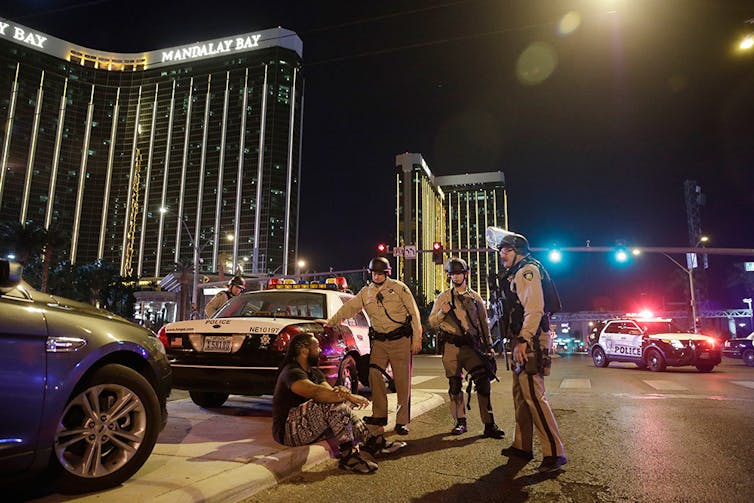
Police officers stand at the scene of a shooting near the Mandalay Bay resort and casino on the Las Vegas Strip. AP Photo/John Locher
The vast majority of gun owners say they obtained their weapons in transactions that are documented and for the most part legal.
When asked where and how they acquired their most recent firearm, about 64 percent of a cross-section of American gun owners reported buying it from a gun store, where the clerk would have conducted a background check and documented the transfer in a permanent record required by federal law. Another 14 percent were transferred in some other way but still involved a background check. The remaining 22 percent said they got their guns without a background check.
The same is not true for criminals, however, most of whom obtain their guns illegally.
A transaction can be illegal for several reasons, but of particular interest are transactions that involve disqualified individuals – those banned from purchase or possession due to criminal record, age, adjudicated mental illness, illegal alien status or some other reason. Convicted felons, teenagers and other people who are legally barred from possession would ordinarily be blocked from purchasing a gun from a gun store because they would fail the background check or lack the permit or license required by some states.
Anyone providing the gun in such transactions would be culpable if he or she had reason to know that the buyer was disqualified, was acting as a straw purchaser or if had violated state regulations pertaining to such private transactions.
The importance of the informal (undocumented) market in supplying criminals is suggested by the results of inmate surveys and data gleaned from guns confiscated by the police. A national survey of inmates of state prisons found that just 10 percent of youthful (age 18-40) male respondents who admitted to having a gun at the time of their arrest had obtained it from a gun store. The other 90 percent obtained them through a variety of off-the-book means: for example, as gifts or sharing arrangements with fellow gang members.
Similarly, an ongoing study of how Chicago gang members get their guns has found that only a trivial percentage obtained them by direct purchase from a store. To the extent that gun dealers are implicated in supplying dangerous people, it is more so by accommodating straw purchasers and traffickers than in selling directly to customers they know to be disqualified.

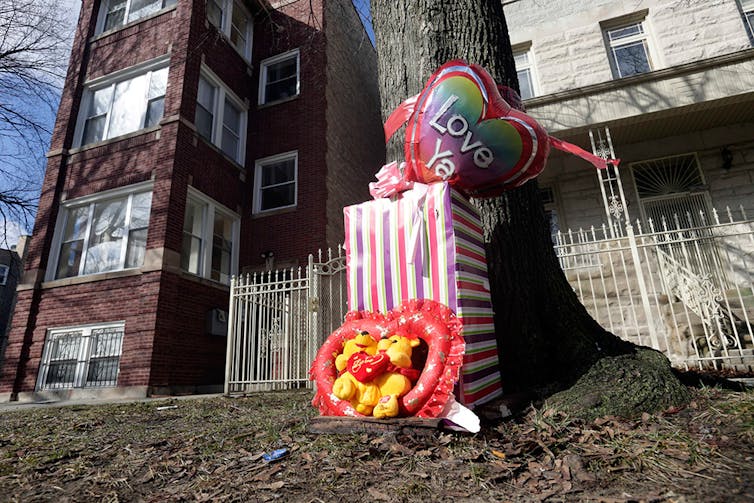
A makeshift memorial in Chicago lies at the site where a baby girl, her mother and her father – a known gang member – were shot in 2013. Most Chicago gang members appear to get their guns secondhand. AP Photo/M. Spencer Green
While criminals typically do not buy their guns at a store, all but a tiny fraction of those in circulation in the United States are first sold at retail by a gun dealer – including the guns that eventually end up in the hands of criminals.
That first retail sale was most likely legal, in that the clerk followed federal and state requirements for documentation, a background check and record-keeping. While there are scofflaw dealers who sometimes make under-the-counter deals, that is by no means the norm.
If a gun ends up in criminal use, it is usually after several more transactions. The average age of guns taken from Chicago gangs is over 11 years.
The gun at that point has been diverted from legal commerce. In this respect, the supply chain for guns is similar to that for other products that have a large legal market but are subject to diversion.
In the case of guns, diversion from licit possession and exchange can occur in a variety of ways: theft, purchase at a gun show by an interstate trafficker, private sales where no questions are asked, straw purchases by girlfriends and so forth.
What appears to be true is that there are few big operators in this domain. The typical trafficker or underground broker is not making a living that way but rather just making a few dollars on the side. The supply chain for guns used in crime bears little relationship to the supply chain for heroin or cocaine and is much more akin to that for cigarettes and beer that are diverted to underage teenagers.
There have been few attempts to estimate the scope or scale of the underground market, in part because it is not at all clear what types of transactions should be included. But for the sake of having some order-of-magnitude estimate, suppose we just focus on the number of transactions each year that supply the guns actually used in robbery or assault.
There are about 500,000 violent crimes committed with a gun each year. If the average number of times that an offender commits a robbery or assault with a particular gun is twice, then (assuming patterns of criminal gun use remain constant) the total number of transactions of concern is 250,000 per year.
Actually, no one knows the average number of times a specific gun is used by an offender who uses it at least once. If it is more than twice, then there are even fewer relevant transactions.
That compares with total sales volume by licensed dealers, which is upwards of 20 million per year.

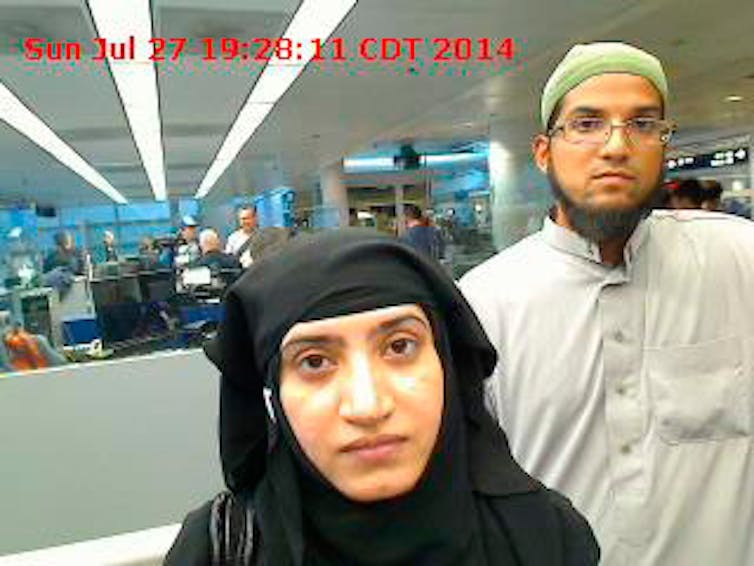
Syed Rizwan Farook and Tashfeen Malik acquired most of their guns legally. Reuters
So how do gang members, violent criminals, underage youths and other dangerous people get their guns?
A consistent answer emerges from the inmate surveys and from ethnographic studies. Whether guns that end up being used in crime are purchased, swapped, borrowed, shared or stolen, the most likely source is someone known to the offender, an acquaintance or family member.
For example, Syed Rizwan Farook – one of the shooters in San Bernardino – relied on a friend to get several of the rifles and pistols he used because Farook doubted that he could pass a background check. That a friend and neighbor was the source is quite typical, despite the unique circumstances otherwise.
Also important are “street” sources, such as gang members and drug dealers, which may also entail a prior relationship. Thus, social networks play an important role in facilitating transactions, and an individual (such as a gang member) who tends to hang out with people who have guns will find it relatively easy to obtain one.
Effective policing of the underground gun market could help to separate guns from everyday violent crime. Currently it is rare for those who provide guns to offenders to face any legal consequences, and changing that situation will require additional resources to penetrate the social networks of gun offenders.
Needless to say, that effort is not cheap or easy and requires that both the police and the courts have the necessary authority and give this sort of gun enforcement high priority.
This is an updated version of an article originally published on Jan. 15, 2016.
Philip Cook, Professor of Public Policy Studies, Duke University
This article was originally published on The Conversation. Read the original article.

The Supreme Court today issued notices to the Centre and Election Commission of India on a petition filed on behalf of Association of Democratic Reforms (ADR) and Centre for Public Interest Litigation (CPIL) challenging various amendments made through the Finance Act 2017 and the Finance Act 2016 in the Companies Act, Income Tax Act, Representation of People’s Act, Reserve Bank of India Act and Foreign Contribution Regulations Act.
The petitioners had submitted that the these amendments in question had opened floodgates to unlimited corporate donations to political parties and anonymous financing by Indian and foreign companies, which can have serious repercussions on the Indian democracy. The said amendments have removed the caps on campaign donations by companies and have legalised anonymous donations. There was also no transparency in the donation process. The petition, filed through advocates Prashant Bhushan and Neha Rathi, also sought a direction that political parties must not be allowed to accept any cash donations.
“The Finance Act of 2017 has introduced the use of electoral bonds which is exempt from disclosure under the Representation of Peoples Act, 1951, opening doors to unchecked, unknown funding to political parties. The Finance Act, 2016 has also amended the Foreign Contribution Regulation Act (FCRA), 2010, to allow foreign companies with subsidiaries in India to fund political parties in India, effectively, exposing the Indian politics and democracy to international lobbyists who may want to further their agenda. These Amendments pose a serious danger to the autonomy of the country and are bound to adversely affect electoral transparency, encourage corrupt practices in politics and have made the unholy nexus between politics and corporate houses more opaque and treacherous and is bound to be misused by special interest groups and corporate lobbyists,” it said.
The petitioners also submitted that such wide-ranging amendments in various statutes were brought in illegally as a Money Bill, in order to bypass the Rajya Sabha.
The details of the amendments made to various statutes introduced through Finance Act, 2017 and Finance Act 2016 are:
1. Section 31, the Reserve Bank of India Act, 1934 through Part III, Section 135 of the Finance Act, 2017,
2. Section 29C, the Representation of the People Act, 1951 through Part – IV, Section 137 of the Finance Act, 2017,
3. Section 13A, the Income Tax Act, 1961 through Chapter III, Section 11 of the Finance Act, 2017 and in
4. Section 182 of the Companies Act, 2013 through Part-XII, Section 154, the Finance Act, 2017.
5. Section 2 of the Foreign Contribution Regulation Act, 2010 (FCRA) through Finance Act, 2016.
According to the petitioners, the above amendments were unconstitutional and violative of the doctrine of separation of powers and a citizen’s fundamental right to information, which are parts of the basic structure of the Constitution.
The plight of approximately 40,000 Rohingya refugees came up for deliberations, once again before the Supreme Court today. There have been two hearings of the matter before when advocate Prashant Bhushan had petitioned the Supreme Court against the Modi government’s decision to deport the hapless refugees.
Image: Reuters
Chief Justice of India Dipak Misra today heard preliminary arguments on the Rohingya Refugee case. Fali Nariman, senior counsel appearing for the petitioners pointed out that, the government of India in its counter affidavit clearly says that this issue is non justiciable and is a pure matter of government policy and that Article 32 rights to file a writ petition in the Supreme Court is not available to non citizens. Nariman pointed out to the absurdity of the government’s position in light of the fact that Article 14 and 21 rights are available to all “persons” as well as the Article 32 right to move the court.
Nariman also read out the notification declaring the government policy on refugees dated December 29, 2011, in which it was stated that refugees fleeing persecution are different from illegal immigrants and should be given long term visas, employment opportunities and the right to study in educational institutions. Mr. Nariman further pointed out that the present government in July 2014 reiterated this 2011 standard operating procedure in a written reply to a question on rights of refugees in the Lok Sabha.
Nariman also pointed out that the government tried to paint all Rohingya as terrorists which was absurd. If the government had any specific information about any Rohingya persons being terrorists, those person could be excluded from the applicability of the Refugee convention and dealt with the government separately.
Nariman also read out from the New York Declaration for Refugees and Migrants dated October 3, 2016, which India is a signatory to, wherein rights of refugees to be given asylum had to be recognised and the principle of non refoulement reaffirmed. He also pointed out that though India is not a signatory to the Refugee Convention, 1951, it is a signatory to several other International Conventions which accept the principle of non refoulement and prohibit involuntary deportation of refugees, such as the Universal Declaration of Human Rights, The International Convention on Civil and Political Rights, International Convention on Protection of All Persons against Enforced Disappearances, Convention against Torture and Other Cruel, Inhuman or Degrading Treatment or Punishment, Convention on Rights of the Child, etc.
Tushar Mehta, Additional Solicitor General, appearing for the Government of India, said that he would like to argue on the question of maintainability and justiciability of this petition and said it should be left to the executive to decide. Mr. Mehta also sought permission of the court to file a sur rejoinder to the rejoinder affidavit filed by the petitioner, which was granted.
Chief Justice of India Dipak Misra, speaking for himself, said it would be difficult to accept the lack of jurisdiction of the court in a matter concerning human rights, particularly on the plight of women and children. The CJI directed the parties to the petition to compile a list of government notifications, treaties and conventions and cases relevant to the issue of refugee law in India.
The matter was adjourned for further hearing on the of October 13, 2017, 2 p.m.A copy of the Petitioners rejoinder affidavit may be read here.
Related Stories
1. In Its Attitude To Rohingyas, the Modi government is Repeating Komagata Maru: Indian Immigrants Forced Back from Canada, 1914
2.UN High Commissioner “dismayed” by rise of religious intolerance in India, “deplores” govt’s bid to deport Rohingyas

Image: Getty Images
NCRB data shows the state has one of the highest crime rates for injuries and riots, reports DNA.
The newspaper reports that when Piyush Parmar, 24, a youth from Limbodara village in Kalol taluka was assaulted by members of the dominant caste, little did he realise that he was part of a larger crime data in Gujarat that reflected how Dalits are at the receiving end of violence.For, Gujarat ranks second in the country (next only to Bihar) among 29 states in crime rate registered under sections of the Atrocities Act where the victims are grievously hurt.
The rate of crime refers to incidence of crime reported per one lakh of Schedule Castes (SC) population.According to statistics available with the National Crime Records Bureau for crimes committed against Schedule Caste during 2015, 40 incidents were reported in 2015 which led to the victims (in this case Dalits) being grievously hurt. The number seems minuscule, compared to Bihar (216), Uttar Pradesh (366), Odisha (75) and Madhya Pradesh (68).
But, if you start comparing the crime rate for incidences in which Dalits who were grievously hurt, the crime rate for Gujarat under the category is highest at 1, second only to Bihar which has a crime rate of 1.3. Gujarat has an SC population of 40.7 lakh against Bihar’s 165.7 lakh.
Is this because more such crimes are reported in Gujarat than elsewhere?James Dabhi, research director at the Human Development and Research Centre at St Xavier’s College Campus in Ahmedabad has an interesting explanation. He said Dalits in Gujarat were more aware of their rights and the Atrocities Act than say Bihar or Uttar Pradesh. “This means, they are more likely to protest against an injustice, although it doesn’t always mean that their complaints will be taken or heard. But the mere fact that they are more likely to raise their voice would mean they are more likely to be targeted for violence,” said Dabhi. This he said could be one reason why the crime rate for sections of the Atrocities Act in which the victim is grievously hurt is so high.
GV Gohil, ACP, SC/ST Cell in Ahmedabad said the figures are a reflection of better reporting of atrocities not more crimes being committed. “People are more aware of their rights and are coming forward to register complaints. It is not that the instances have seen a sudden spike. The figures are a reflection of better awareness among people about their rights,” said Gohil.
Dabhi’s explanation may also hold true for another interesting statistic about Gujarat as far as crimes registered under the Atrocities Act is concerned.
The crime rate for Gujarat under the riot category for cases under the Atrocities Act is second only to Maharashtra for the 2015. Data shows that Gujarat recorded 73 instances of riots under the Atrocities Act, which had 95 victims making the state’s crime rate for the category 1.8. This is second only to Maharashtra which has a crime rate of 2 for 270 riot cases and 365 victims. The all India rate for the category is 0.7.
But those like Dabhi don’t believe that the statistics reveal the true picture. “In rural areas discrimination against Dalits is a daily practice that is accepted as a way of life and the statistics that NCRB collects don’t take into consideration the many cases that are either not reported or are not registered by the police,” said Dabhi.
Jignesh Mewani, who led an agitation of Dalits in the state after the Una incident, said the statistics about atrocities against Dalits are an eyewash. “You may think more cases are being reported and hence the rate is on the rise. But the devil is in the detail. Why don’t you analyse the conviction rate in atrocity cases and that will show you the true picture,” said Mewani.
He said the conviction rate for atrocity cases in Gujarat is less than 3%. “What is the point of registering case after case if it is not leading to any conviction? Dalits may be hurt, maimed or killed but are the perpetrators getting punished? No, and that shows how well the police investigate the cases and how well the system works to give Dalit’s justice,” Mewani said.
Join our mailing list to get the latest human rights news that matters, straight to your mailbox.
© Sabrang | All Rights Reserved