The premier also directed the local government to make sure the sick and wounded Rohingya were well taken care of in the hospitals and they receive immediate medical attention.
Bangladesh Prime Minister Sheikh Hasina wipes off a Rohingya woman’s tear while distributing aids among the refuge seekers in different camps in Cox’s Bazar BSS
Prime Minister Sheikh Hasina on Monday said Bangladesh can feed 700,000 Rohingya refugees.
“We have the ability to feed 160 million people of Bangladesh and we have enough food security to feed the 700,000 refugees,” the prime minister at a programme after visiting the The Kutupalong Refugee Camp in Ukhiya, Cox’s Bazar.
After visiting the refugee camps and distributing aid, Sheikh Hasina spoke of the 10 million Bangali refugees during the Liberation War and said: “We have let the Rohingya in on humanitarian grounds and I ask the people of this country to help ease their suffering in whatever way they can.”
Violence erupted again in Rakhine State of Myanmar on August 24, forcing almost 300,000 Rohingya refugees into Bangladesh totalling the amount to 700,000 so far.
The prime minister went on to say: “I ask the international community to put pressure on the Myanmar government to take back their nationals.
“Bangladesh wants to maintain peace and good relations with its neighbouring countries, but it cannot accept unjust acts of the Myanmar government. We will do all we can to ease the suffering of the Rohingya refugees.”
Asking for peace, the prime minster said: “Does the Myanmar government not have a conscience? How can they displace hundreds or thousands of people because of a few?”
Hasina also directed the local government to make sure the sick and wounded Rohingya were well taken care of in the hospitals and they receive immediate medical attention.
The district of Leh has been in the news, but for all the wrong reasons. Over the past few weeks, this district has been simmering in tension after a local Ladakh Buddhist Association (LBA) issued an ultimatum to Muslims from Kargil district to vacate the region within seven following the marriage of a Buddhist girl with a Muslim boy.
The Ladakh Buddhist Association (LBA) on Thursday September 7 took out a protest rally in Leh town against the marriage and warned the government of a full-fledged agitation if the girl was not returned. The association has ‘given’ the government a week’s time.
The protesters also submitted a memorandum addressed to Chief Minister Mehbooba Mufti at the office of the Deputy Commissioner, alleging Muslims of luring Buddhist girls into their fold.
“Young girls are being lured by Muslim boys to marry and finally convert them,” the memorandum said. The association also made a direct threat in the memorandum, saying that the situation could turn ugly if the girl is not returned back to Leh.
“We feel that the Muslim community leaders, administration, and other stakeholders need to warn Muslim community and the state government machinery for immediate intervention and arrange to bring back the girl before peace tranquility and communal harmony takes an ugly turn.” Later, the leaders of LBA while addressing the protesters issued an ultimatum to local Muslims, who are in minority, to vacate the town within seven days.
However, among all these allegations, it seems the LBA has missed a small but rather important detail. The girl in question, whose earlier name was Stanzin Saldon, had converted to Islam way back in April 2015. In an affidavit signed by Stanzin now Shifah in April 2016 in Bangalore, Karnataka reads, “I have embraced Islam, giving up my former Buddhist faith on 22nd April 2015.Therefore I hereby confirm adopt and reaffirm faith in Islam.”
The allegations of LBA of marrying and converting a Buddhist girl fall flat as the girl in question converted to Islam way back in 2015. “She had converted two years ago and was looking for a Muslim guy who could marry her. The question of Muslims marrying Buddhist girl falls flat here. The girl was Muslim even before meeting the boy,” says Sajjad Hussain, a Kargil-based journalist.
According to locals in Drass, the girl and her husband have gone underground after the threats emerged. The girl has also written an open letter in response to LBA’s memorandum.
The girl accused LBA of issuing false statements and presenting a concocted version of the events.
“They (LBA) state that I was lured into Islam by him and also warning Muslim community in Ladakh (in general) to return me. So this is to clarify to your honourable self and the concerned parties that this statement of LBA is false and concocted, an effort to suppress and threaten the rights of an individual, a woman to be more specific, in the disguise of “luring”,” she wrote.
She further wrote, “LBA is trying to objectify me and demanding my return as if I’m a property, which I’m not and cannot allow anyone to perceive me as such. I’ve accepted Islam long way back, not because I dislike any other religion but considering my spiritual quest and an interest in religious philosophies, which was way before I met Murtaza. I repeat, my marriage has nothing to do with my spiritual choices, love and companionship being the only reason for our marital bond. The spiritual choice is a very personal matter not to be mixed with my marriage,” she added. She requested people to maintain peace and harmony by not letting dividing forces to deepen the fear and hatred.
Local Muslim leaders have also alleged LBA of communalising the issue and stoking communal tension in a region that has otherwise been mostly peaceful.
“The open letter written by the girl has already cleared many things and threatening Muslims to vacate the district is very unfortunate. We spoke to Superintendent of Police Leh to ensure the safety of Muslims because the administration is responsible for the safety of Muslims in the district,” Ashraf Barcha, President, Anjuman Islamia-Leh, told TwoCircles.net.
Sheikh Abdullah Jalili of Islamia School Kargil said the threat of communal violence is hardly a solution to this issue. “LBA has previously also issued open threats to the Muslim community in the region. Everyone has freedom of religion. If a person wants to convert to Islam or Buddhism, it is solely his/her personal decision and we are no one to interfere in that. Recently, a Muslim girl converted to Buddhism in Kargil, but we didn’t make such noise because this was her personal decision.”
The deadline given by the LBA to state government and Muslims is Thursday, September 14.
SHRIPAD DHARMADHIKARY and NANDINI OZA write a stinging response to Swaminathan Anklesaria Iyer’s unsupported claims in Times of India about how much tribals love being ousted for big dams. The newspaper did not care to publish this rebuttal so the authors posted this on Dharmadhikary’s blog and also in the comments section to Iyer’s article.
Image: Times of India
We reproduce Dharmadhikary and Oza’s original response in full below from Manthan.
However, here is an update from Shripad:
I put my comment in brief, within the allowed 3000 characters, yesterday in the Comments section. Today, it’s gone. Then, a friend brought to my notice that Swaminathan has written a completely new version of the blog and put it out yesterday. Wonder if he is in the habit of writing different versions of the same blog within a matter of two days! https://blogs.timesofindia.indiatimes.com/Swaminomics/most-of-the-ousted-tribals-are-flourishing-and-loving-it-thank-you-activists/ Have yet to read the new version of his bog properly (am out since early morning), but it appears that he has rewritten it in a way that tries to skirt the response we had given. Now I am planning to write another response to the new blog….but can only do it tomorrow as busy with meetings today.
And now, Dharmadhikary and Oza’s original response in Manthan:
SA Iyers’s piece in Times of India dated 10 Sept 2017, “Why many tribals don’t mind being ousted by dams”, examining the condition of some of the oustees of Sardar Sarovar Narmada dam is a classic case of misinterpretation of data, hiding the more important issues, and conclusions not supported by research findings. Indeed, a proper reading of the article itself shows that unlike Iyer’s assertion, his own figures show that tribals do mind being ousted. Some important points are given below.
Iyer claims that their “surveys showed, unambiguously, the resettled villagers were better off than their former neighbours in semi-evacuated villages.” In support, among the figures given from their survey, they point out that comparing the resettled with their former neighbours who remain in the original areas, the access to drinking water was 45% against 33%, to PHCs was 37% versus 12% and to hospitals 14% versus 3%. Given that the oustees were resettled between 25-30 years ago, and that the Sardar Sardar project has poured in hundreds of crores of rupees for resettlement, these figures don’t speak of oustees being better off, but indeed, point to the pathetic case of the oustees.
After 30 years and massive money being spent, 55% of the rehabilitated people had no access to drinking water, 63% no access to a PHC and 86% no access to hospital. And this is when the oustees have been settled in areas closer to the cities and the former neighbours continue to remain in remote hilly areas. True, cycle and motorcycle ownership was more favourably distributed towards the oustees, but that may be simply because in the hilly areas, these are less useful. In any case, they are less crucial than drinking water, access to health services etc.
While Iyer claims that “Resettled villagers said they adjusted to new conditions…within two years” (something which we, as former activists of the NBA who have lived for years with them, find completely unbelievable), Iyer also finds that in response to the question whether “Would they prefer returning to their old villages, with the same land they had earlier? Around 54% said yes, 30% said no…” This response, after 30 years of resettlement, itself speaks volumes. Iyer justifies this by saying that “For a majority, nostalgia for ancestral land and access to forests mattered more than greater material possessions.” But it’s not just nostalgia. The forests, the river, also provided the tribals with substantial economic and livelihoods resources including fodder, fruits and fish. The fact is that the majority of the oustees at the resettlement continue to face multitude of problems like bad quality of land, lack of basic amenities, hostility from original residents etc. and many promises made to them remain unfulfilled. (May be they were just jumlas to get the oustees to move?). That is why to them the original village would still appear a better proposition from even an economic point of view.
This is further substantiated by the response to the question “… if given the oustee compensation package, they would like to be ousted. In semi-evacuated villages, 31% wanted to move, 53% wanted to stay, in interior villages, a majority (52%) wanted to move, 35% wanted to stay…”. While clearly a majority of the former neighbours of the oustees indicated their lack of confidence in the rehabilitation package, the response of the “interior villages” is used by Iyer to make astounding conclusions about majority of tribals wanting to leave the forests. But the “interior villages” are those living near the mines of the GMDC, where mining has impacted them badly, even as it has brought them some access to infrastructure like roads.
Overall, Iyer uses his data to draw some highly unwarranted and astounding generalisations that “it’s entirely possible to implement resettlement packages making tribals materially better off. ..explodes the claim of some activists that modernisation is disastrous for tribals…”
Last but not the least, his concluding line is most revealing. “Many tribals want to leave the forest for a better life.” In saying this, Iyer never raises the fundamental question as to why the tribal have to be evicted from their original village in case they want to have a better life, why is it that they cannot have access roads, drinking water, health facilities etc. unless they leave their original lands, homes and forests. If they did have many of these facilities in their original homes, even the limited advantages which Iyer’s study shows the oustees got, would have vanished. In deliberately ignoring this fundamental issue, in not articulating what his own survey reveals, and in making sweeping generalisations, Iyer betrays a haste to give an unsupported clean chit to the project’s rehabilitation, the reality of which is far more dismal.
Shripad Dharmadhikary and Nandini Oza were full-time activists with the Narmada Bachao Andolan for close to 12 years.
Despite the SC verdict, the AIMPLB still clings to its view that though triple talaq is sinful it is valid in the eyes of Islamic law.
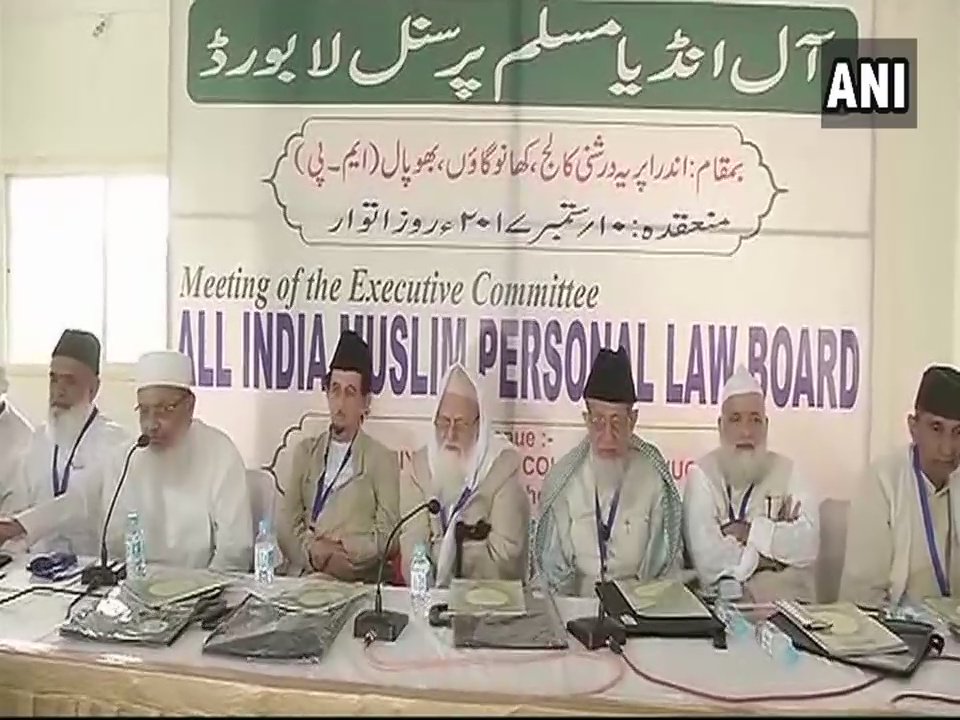
The national conference of the AIMPLB in Bhopal was an occasion to do some soul searching for this so called custodian of Islamic Sharia in India. It could have provided them the opportunity to call for some kind of introspection about the state of Muslim personal law in India and why it lags behind other communities in terms of being gender just. There could have been deliberations on why recently Muslims in India have come to have a bad name and why their religion is being termed as backward. Alas, all this was not on the radar of the AIMPLB. Rather what we got was the same old story of how the state was trying to interfere with the sacred nature of Muslim personal law and how it was threatening the constitutional freedoms guaranteed to the Muslim community.
There are two fundamental problems with the argument of the AIMPLB. Firstly, the sharia is not sacred in the sense that it is not the word of Allah. The sharia (literally meaning the path) has evolved over the centuries and there have been many interpretations to a particular religious problem. The very existence of four law schools within Islamic world is proof that different interpretations of scriptures were held valid not only in different points of time but also in different places at the same time.
This elasticity within Islamic law was the reason why it could evolve with the changing times and incorporate various contemporary social and political changes. After all, the law of marriage has been reformed in many countries, including some of the orthodox Muslim ones. No one has criticised them of tampering with the scared nature of Islamic sharia. Rather, people have welcomed the move and argued that it shows that Islam, like any other religion, can change with the times. The problem with the AIMPLB is that it thinks that Islam as a religion cannot and should not change.
Not just the Quran, but even the juridical pronouncements of some Mullah is considered sacred by them. This is clearly erroneous and a product of a faulty reasoning which equates sacredness with the community. Actually, truth and rights are not the concern of AIMPLB; rather it is the community which in turn is very narrowly defined as consisting of scholars having a similar opinion. Clearly then, nothing positive can come out of such a body as was witnessed during the recent Bhopal conference.
The second problem in the argument of the AIMPLB is related to the first. After claiming that Islam in unchanging, they project the same argument on the constitution arguing that it is the constitutions which has granted them religious freedom. Partly this is true. But what the AIMPLB forgets is that the constitution also is continuously interpreted and it cannot be read to justify practices which are clearly at variance with the cherished goals of the constitution. Clearly the Supreme Court did find that the practice of triple talaq was inherently discriminatory towards Muslim women and therefore it was struck down. The way forward for the AIMPLB should have been to debate which other laws can be read as discriminatory towards women and initiate reforms within the community. Rather the concern for the AIMPLB is just the opposite: it wants to study the SC judgment to see whether it contradicts the sharia in any way!
Despite the SC verdict, the AIMPLB still clings to its view that though triple talaq is sinful but yet it is valid in the eyes of Islamic law. None other than Mahmood Madani endorsed such a view soon after the verdict. Thus it is clear that the AIMPLB does not take even the Supreme Court and its decision seriously and opens itself to the charge that actually it does not believe in India’s constitutional democracy. Had there been a different political climate, the AIMPLB would surely have filed for a review petition. They have themselves argued that since the judge has changed, filing a review petition might throw up other practices like polygamy, nikah halala, etc. into the limelight and they fear that there might be another adverse ruling for them.
Thus it is entirely clear that in their hearts they have not accepted the judgment of the Supreme Court and that they still think that there is nothing wrong with the Muslim personal law. In short they have not derived any lessons from their defeat. The problem is that one does not require the AIMPLB to open the agenda of reforms on issues like polygamy and nikah halala. Anyone can approach the courts for this purpose. Muslim women organizations are already planning to do so. The Board will again try to meddle into this only to be soundly defeated by constitutional logic. Wont it be better that the Board itself gives a clarion call for reforming and outlawing these practices. But given the history of the Board, this is too much to expect from them.
In the calculation of AIMPLB, the call of reforming Muslim personal law is largely driven by urban educated Muslim women. The large majority of Indian men and women are with the Board and this assessment may be right. Since they do not want to upset the existing balance of power between men and women, the AIMPLB will never take a stance on upsetting that balance. Even a reasonable demand like the abolition of triple talaq was met with stiff resistance from the Board. The AIMPLB therefore does not exist for the cause of Islam, rather they exist solely to maintain the balance of patriarchy which obtains in the Muslim society. Until they sense that this balance is changing, they are not going to change their stance.
However, things have changed a little now. There are organizations now working on the ground who are ready to approach courts for this purpose. This is something new as in the past these organizations were not there and many so called progressive left organizations refused to take the line of reforms through judicial intervention. Today Muslim women have come out of the shadows of the organized left and are challenging the system themselves. Thus even if the AIMPLB has popular support, it amounts to nothing as the courts hopefully do not work on the logic of popular support.
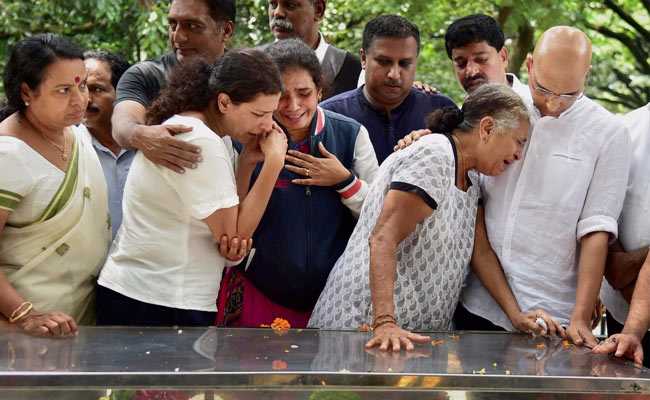
The greatest tribute one can pay to this courageous woman is to ensure that the rich legacy she has left behind will never die
Image: PTI
The celebrated German playwright, poet and fierce anti-Nazi critic Bertolt Brecht once wrote: “in the dark times, will there also be singing? yes, there will also be singing about the dark times”.
Apt words, as we remember the celebrated journalist and human rights defender Gauri Lankesh, who was brutally gunned down exactly a week ago on the night of September 5th in Bengaluru. Her murder has resulted in an unprecedented outrage of anger, shock and sadness from concerned citizens all over the world over. Gauri represented the very best of a free and fearless India, which respects the rights of her citizens, which celebrates pluralism and above all, defends the highest values of democracy! Gauri had the courage to take on the Sangh Parivar and all communal-minded people, she abhorred the caste system, she fought for the emancipation of women, she took up cudgels for the poor and marginalized and she was a relentless crusader for the freedom of speech and expression! She spared none, when injustice was the issue!
The bullets of the assassins that fateful night carried some clear messages: that it is they who ‘apparently’ control the destiny of the nation; that the likes of Gauri, had no place in their scheme of things, that they brook no dissent, that they are cloaked with immunity and can obviously get away with murder. .
The murder of Gauri provides other insights into her assassins and the powers behind them too; these include:
They are spineless cowards; masked in anonymity, they gunned down an unarmed defenseless woman
They are violent; they have the muscle, the money and the clout to do away with violently anyone who does not subscribe to their fascist agenda. ‘Ahimsa’ obviously means nothing to them
They lack the intelligence, the conviction and the staying power to debate or write objectively on critical issues plaguing the country and our people today. Gauri consistently wrote and spoke about these issues.
They are afraid of the Truth; when courageous and upright journalists like Gauri expose their evil deeds and other nefarious activities, they are just unable to accept them, leave alone swallow the facts
They are adept in defocusing and divisiveness; Gauri’s estranged brother conveniently speaks about ‘Naxalite’ involvement. Some TV channels with their stooge anchors vomit the same possibility The Central government in a manipulative manner asks the state government as to why Gauri was not given protection from the Naxalites!
They are good in sweeping other issues under the carpet. Gauri’s chilling murder is naturally headlines; but at the same time other major issues are quickly turned from the pages of people’s memories like the deaths of children in UP, the official report of the fiasco of demonetization, the institutionalization of corruption, the thousands affected by floods in several parts of the country and the official inability and apathy to respond to those affected, the crimes of ‘godmen’ against women like the Dera Chief and Asaram Bapu, the mob lynching of people; the list is endless.
They do not care about the rights and freedoms guaranteed in the Constitution of India; for them, journalists who speak truth to power, human rights defenders, right to information activists and for that matter, any one from civil society who dissents, is termed as ‘anti-national’; and needs to be done away with. The trolling and the venom spewed on Gauri in social media by the ‘bhakts’ of PM Modi is a clear indication that freedom of speech and expression is not something that they cherish. Gauri believed in the Constitution and passionately defended the rights of citizens until the very end!
The above are just some ways fascist forces in India operate today. There is no denying the fact that the cold-blooded, pre-mediated murder of Gauri has political patronage at the highest level. All this has been witnessed before, in the Gujarat Carnage of 2002; the ‘fake encounters’ which followed; in the gruesome killings of rationalists and intellectuals like Dabholkar, Pansare and Kalburgi; in the murders of several other journalists, human rights and RTI activists all over the country.
That there is an overwhelming outrage over Gauri’s murder from several sections of society, speaks volumes that all is still not lost for the country. Gauri’s death has brought together women and men from all walks of life in a show of strength and unity against the emerging fascist forces. Rallies, demonstrations and public meetings have been held in practically every major city and town. Her murder has found significant space in some of the most respected newspapers and magazines in India and abroad. On September 12th, more than 50,000 people gathered in Bangalore in a rally to protest the killing of Gauri.Shouts of “Gauri Lankesh amar rahe!”(Long Live Gauri!) rent the air.
This visible and vocal unity must continue. Many people are convinced that though they ‘killed’ her, Gauri’s spirit will never die! The greatest tribute one can then pay to this courageous woman is to ensure that the rich legacy she has left behind will never die; that all will be done to protect the democratic and pluralistic fabric of our great country! Above all, to be reminded of the words of Pastor Martin Niemoller, who during the Nazi Regime wrote:
“First they came for the Socialists, and I did not speak out— because I was not a Socialist. Then they came for the Trade Unionists, and I did not speak out— because I was not a Trade Unionist. Then they came for the Jews, and I did not speak out— because I was not a Jew. Then they came for me—and there was no one left to speak for me”.
LONG LIVE GAURI!!!!
(Fr. Cedric Prakash sj is a human rights activist. Contact:cedricprakash@gmail.com)
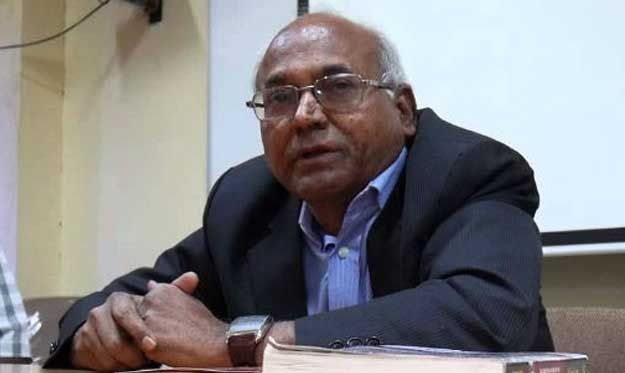
Well-known Dalit writer and intellectual Kancha Ilaiah has on Monday launched a police complaint alleging threat to life over his book on the Vysyas caste.
According to his complaint registered at the Osmania University police station, Hyderabad, he received abusive and threatening calls from unidentified persons over his book ‘Samajika Smugglurlu Komatollu‘ (Vysyas are social smugglers).
The police have registered a case under section 506 (criminal intimidation) of the Indian Penal Code (IPC) and have begun investigations.
Protest meetings have been held in Hyderabad by various Arya Vysya associations according to whom the title of the book and some of its contents were “derogatory and demeaning” to the community. They have lodged a police complaint against Ilaiah but no case has been registered as the police is looking into the plaint.
In his complaint Ilaiah has said, “I feel terribly threatened with their abuses, phone calls and messages. They are doing fearful activities against me on the streets.”
Plan to flood offices of the President, PM, Chief Justice, Law Minister and Law Commission with resolutions passed at Muslim conferences all over India opposing any change in Muslim Personal Law
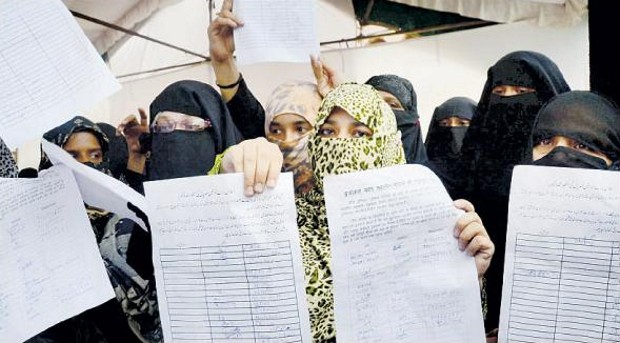
Image: Inquilab Urdu
At a public meeting of the women’s wing of the All India Muslim Personal Law Board (AIMPLB) held in Bhopal on Monday, it was “unanimously” resolved that any interference in Shariah laws is unacceptable to Muslim women.
Signed copies of the resolution passed at the women’s meeting in this regard were handed over to the AIPMLB president, Maulana Rabe Nadvi and general secretary Maulana Wali Rahmani.
The Times of India has quoted a Board member, Maulana KR Sajjad Nomani as saying the AIMPLB may hold a “referendum” to seek Muslim women’s views on instant triple talaq. According to the maulana, this is in response to the observation by the constitutional bench that a majority of Muslim women were opposed to instant triple talaq.
On Monday, the concluding day of the three-day meet of the executive committee of the AIMPLB it was noted that while on one hand the constitution bench of the Supreme Court affirmed constitutional protection to Muslim personal law, on the other it has set aside instant triple talaq practice which is an integral part of the Muslim Personal Law.
Responding to the separate judgment of Justice Kurian Thomas who held that instant triple talaq was “un-Quranic”, the Board members claimed that one, the Quran does talk about triple talaq and two, Shariah is based not on the Quran alone but rests on four pillars: Quran, Hadith, Ijma (consensus) and Qiyas (analogical reasoning).
A resolution passed at the Board’s concluding session said: “While respecting the verdict of the Supreme Court the AIMPLB is constrained to state that this verdict is not in accordance with Muslim Personal Law. Besides, the verdict also impacts negatively on the freedom of religion which the Indian Constitution guarantees to followers of all religions.
“In view of this, the AIMPLB has decided that because the issue concerns women, it will organise small and large conferences across the length and breadth of the country to familiarize women and men who are unaware about Shariah laws. At each such conference, resolutions will be passed copies of which will be posted to the President, Prime Minister, Chief Justice of Supreme Court, Union Law Minister and the Law Commission”.
The resolutions will state and affirm that Muslim men and women have full faith in Shariah laws and because talaq is also a part of Shariah laws they consider any external restrictions on it as a denial of their right to religion. In addition, the resolutions will demand that the currently existing right to follow and practice Muslim Personal Law be not meddled with in any manner.
Before the passage of the Board’s resolution, following a public meeting of Muslim women at Bhopal’s Iqbal maidan, a 50-member delegation led by Dr Asma Zahra presented a copy of the resolution passed at their meeting to the AIMPLB president, Maulana Rabe Nadvi and general secretary, Maulana Wali Rahmani.
The women’s resolution stressed that they fully abide by Shariah laws and any change in the same is not acceptable to them. Dr Zahra told the media that the proposed meetings of Muslim men and women across the country will be executed with the same fervor as the earlier signature campaign opposing any change in Muslim personal law.
A Dhaka Tribune world exclusive brings you an eye-witness report from the first journalistic incursion into Rakhine since the area was sealed to outsiders by Myanmar.
Hundreds of Rohingya line the narrow path that leads to Teknaf Syed Zakir Hossain/Dhaka Tribune
On Thursday September 7, I decided to go into Myanmar following the same routes the Rohingya were taking to escape to Bangladesh.
My journey started from Lomba Beel, a remote village in Howaikong union in Teknaf. From here, it takes an hour to walk to the Naf, where the three hour-long boat journey begins, ending with another hour spent trudging through the boggy coast of Myanmar.
Hundreds of Rohingya line the narrow path that leads to Teknaf | Syed Zakir Hossain/Dhaka Tribune
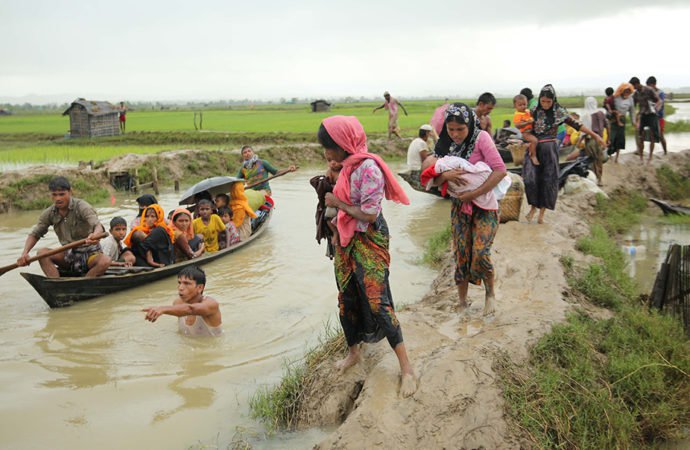
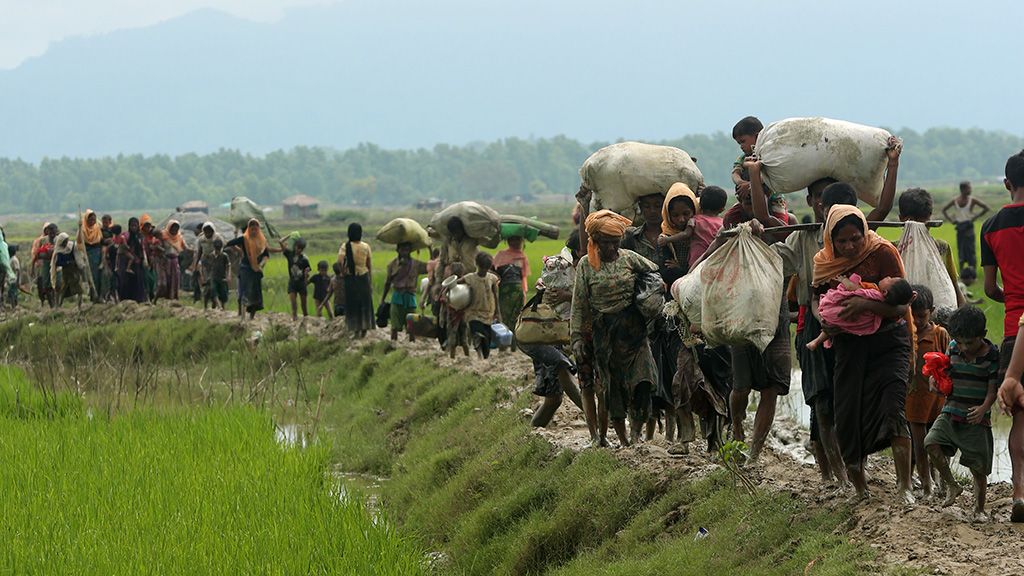
Thousands of Rohingya swarmed the roads, desperate to find shelter. They had haunted expressions and downcast, fearful eyes, aching to tell their stories of being chased away from their lands. Everyone had a story to tell, to anyone who would listen.
The march from the Naf to Lomba Beel is a stern testimony to the horrors that have driven over 270,000 people over two weeks.
Nothing like a humanitarian crisis to get rich quick
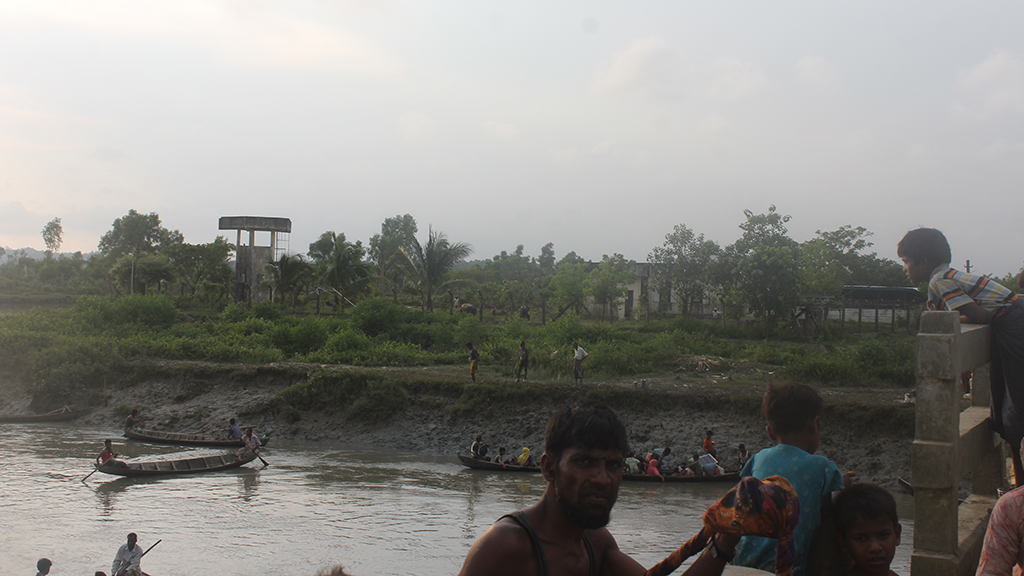
On the banks of the Naf, the fleeing Rohingya arrived in groups of ten to twelve on small fishing boats. The boats shook tumultuously, even ten people too much for them.
But there were too many boats with well over a dozen passengers each. It comes as no surprise that there are so many Rohingya reported dead during the crossing.
They are operated by Bangladeshi boatmen who have found a lucrative niche in this corner of the world.
The boatmen charge Tk10,000 ($122) per head to ferry each Rohingya from Rakhine to Teknaf.
When asked about the exorbitant rates, a boatman glumly replied: “Our humanity compels us to help our fellow human beings. If we did not provide a route to escape, they would never be able to escape to Bangladesh.”
The humanity is there, but it does not come cheap. The sympathy of the boatmen doesn’t extend to offering the fleeing Rohingya a way across the river for free.
After a boat arrived with a dozen Rohingya, including a month-old baby, all from Buthidaung, I asked the boatman to take me to Myanmar. At first he refused, but the incentive of cash encouraged him to oblige my request.
The Rohingya refugee have but one aim in mind, to survive the onslaught they have left behind | Syed Zakir Hossain/Dhaka Tribune
The boatman pushed away from the coast with all his might leveraged with the oar. He quickly rowed to get to the other side. I asked him what his hurry was. He replied it was to get into the Myanmar waters and away from Border Guard Bangladesh patrols.
As we cruised into international waters, a flotilla of boats, perhaps over a hundred boats – of the same size as the one I was on – filled the horizon. Thousands of Rohingya were huddled on these boats in their desperate attempt to escape the violence in Rakhine.
On my right, a BGB trooper stood like a sentinel atop an outpost, looking out over the flotilla.
After over 40 minutes of sailing, the boat slowly drifted into a canal flanked by border fences in Myanmar. The heart of the canal was crowded with empty boats, ready to ferry the Rohingya to Bangladesh, for a hefty price.
On Myanmar soil
The land of pagodas and fleeing minorities
“You do not need to be worry about their Border Guard Police or the Tatmadaw here. This area is under the control of Harakat al-Yaqeen (the former name of the Arakan Rohingya Salvation Army),” my boatman tells me.
He points towards an outpost and tells me it used to belong to the Myanmar BGP until August 25. ARSA had captured it and driven the BGP away. I gazed at the concrete structure in awe. This is what sparked the wildfire that was consuming the lives of hundreds of thousands.
The much vaunted Myanmar border outpost now overlooks Rohingya fleeing the country | Adil Sakhawat/Dhaka Tribune
It was hard to tear my gaze away from the outpost. But as I did, I saw hundreds of people scrambling for the boats. In the light of the setting sun, the lines of hardship on their faces seemed to be getting more and more distinct.
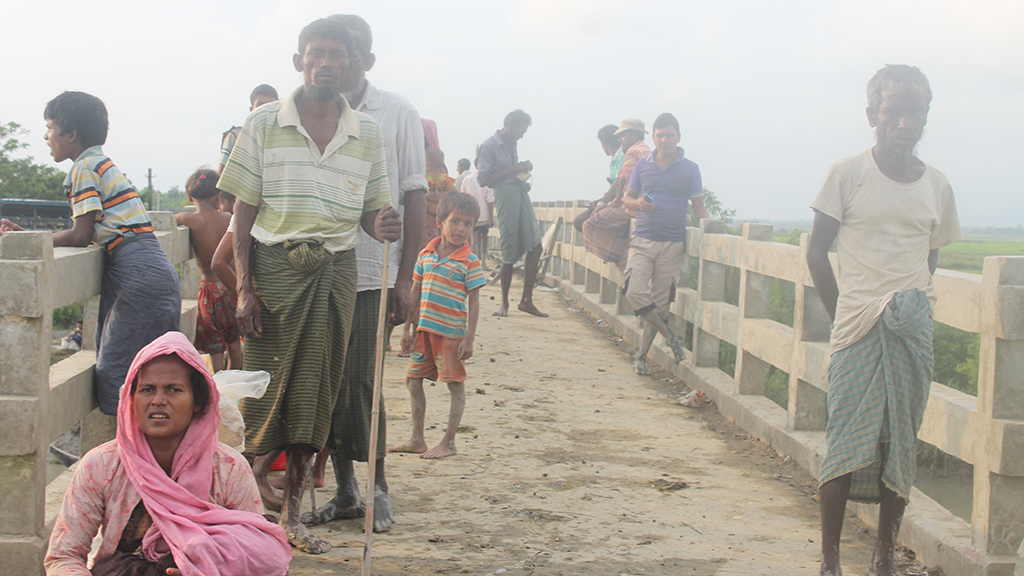
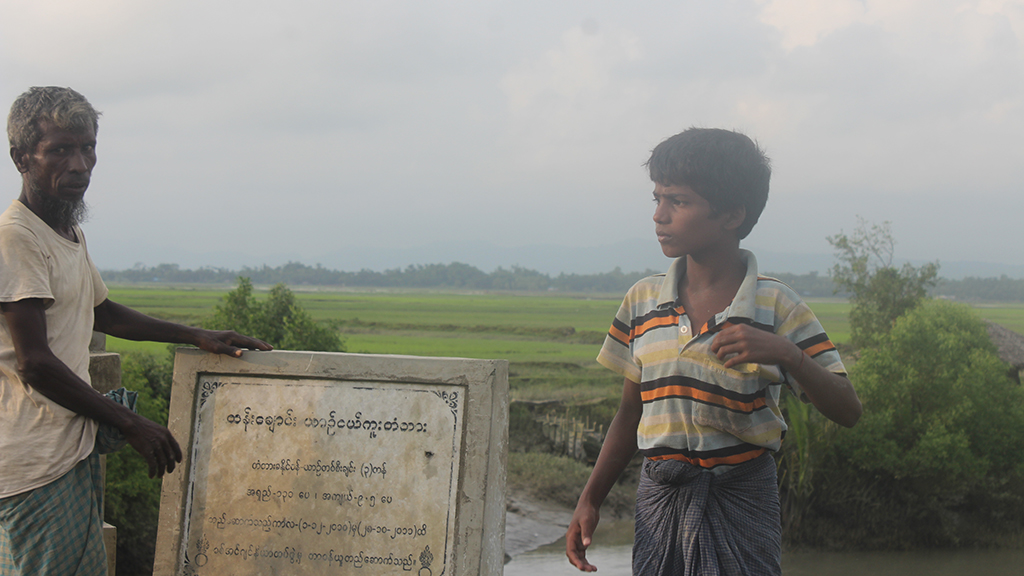
A small bridge arched over the canal connects the two village tracts of Shilkhali and Kurkhali. Two men carrying staves stood guard over the bridge. The boatmen pointed towards them and whispered: “They are ARSA.”
The area is less of an insurgency camp and more of a getaway hub for fleeing refugees | Adil Sakhawat/Dhaka Tribune
These two haggard-looking men in shirts and lungi looked more like farmers or fishermen than armed insurgents. But the wooden sticks they carried would at least help them shepherd the Rohingya away from the violence, if not combat the armed forces outright.
It was an endless stream of people. Desperate people. Frightened people. A people without a land. For all their bonds to their homes in Rakhine, they were now forced to flee to Bangladesh.
My boatman introduced me to one Rashid Ahmed, an ARSA member, and took off, pleading his urgency to ferry another boatload of Rohingya refugees to Bangladesh.
Where the army fears to tread
Rohingya refugees trudge across the mudplains to get to the shores of the Naf to embark on boats to take them to Bangladesh | Adil Sakhawat/Dhaka Tribune
Rashid told me that the bridge is a crucial point for ARSA and the Rohingya alike. The two villages it connected were controlled by ARSA. The canal was one of the major, if not the only, point of contact for the boatmen and the refugees.
I asked him how he felt about the conflict. He responded that the Rohingya had been oppressed by the Myanmar government for decades and the armed struggle was the only way they could resist. He hinted about another possible ARSA attack soon, but refused to reply to any further queries along these lines once he realised his slip.
I inquired about how far the Myanmar forces are. He confidently replied they were three kilometres away.
Those who have money, can purchase their crossing to Bangladesh. Those who do not, are stranded | Adil Sakhawat/Dhaka Tribune
“They do not have the courage to stand where you are standing right now,” he said.
I walked two kilometres upriver along the border fence, and found no end to the stream of Rohingya refugees. It was exhausting, to even see so many people arrive at the shores ragged and weary.
After all the perils they had braved, too many people remained stranded because they could not afford the Tk10,000 to make the crossing. But at least they were safer here, in ARSA territory, than their villages which burned on the horizon.
My excursion to Myanmar was over. I sought a boat to take me back to Bangladesh.
As the sun began to set behind me, I could not help but wonder how many of the fleeing Rohingya will ever see another sunset in Rakhine.