



This was first published on Newsclick.in.
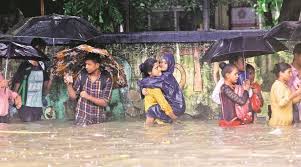
Photo Courtesy: Indian Express
Even as early morning warnings (Tuesday, August 29) warned of a ‘typhoon like situation’, Mumbaikars trudged to work keeping the proverbial work ethic of India’s most buzzing metropolis alive. Heavy monsoon rains however brought India’s financial capital to a halt, with authorities struggling to evacuate people with the scheduled high tide adding to the chaos. The Bombay Municipal Corporation, the richest body in the country, haunted by corruption and red tape apepars to have learnt no lessons from the floods of 2005 when close to 500 persons lost their lives.
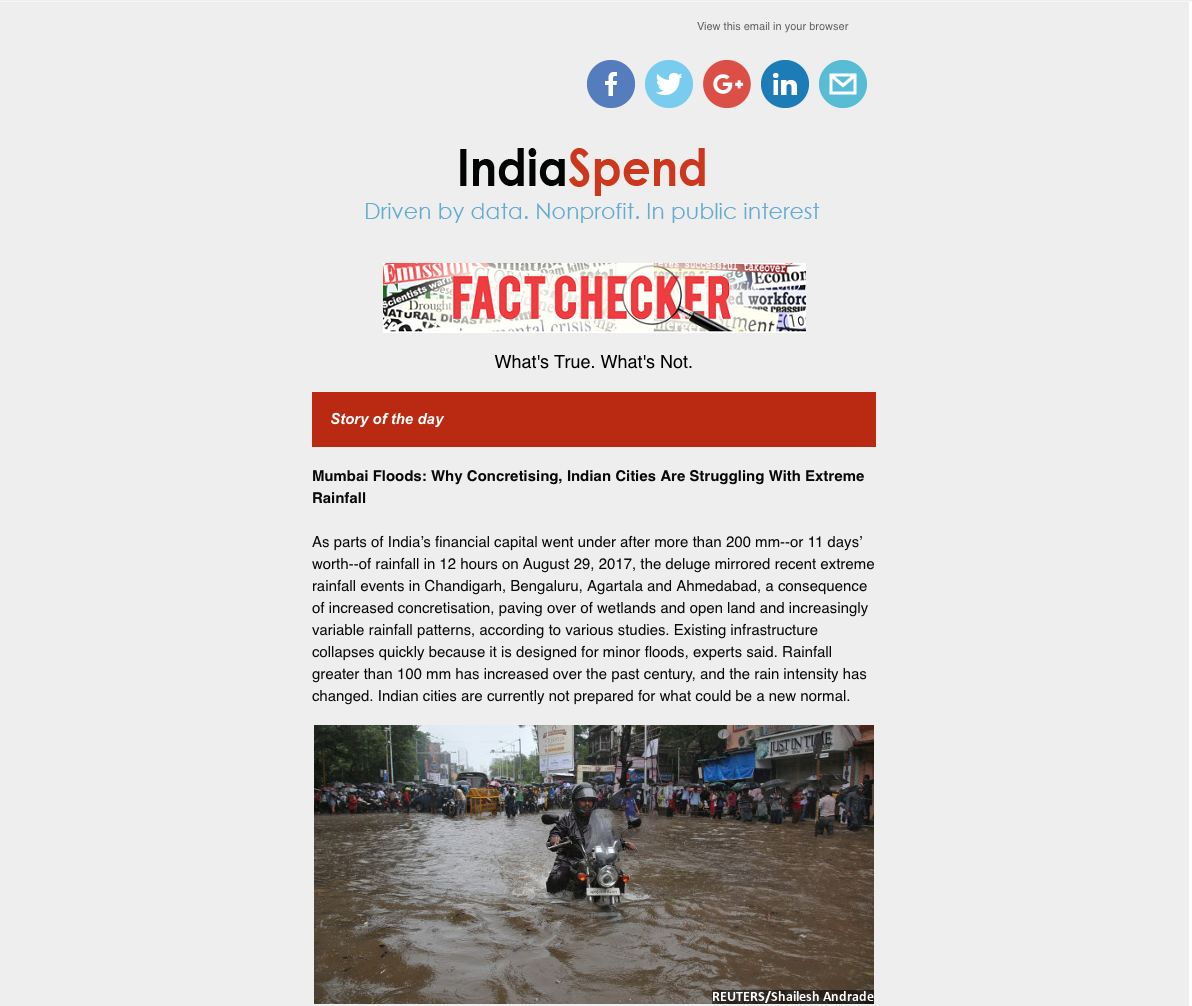
Incessant rain flooded several parts of Mumbai on Tuesday and paralysed train services used by millions of commuters daily, with many stranded at stations and hundreds of others walking home through waist-deep water on railway tracks.Poor visibility and flooding also forced airport authorities to divert some flights while most were delayed by up to an hour.
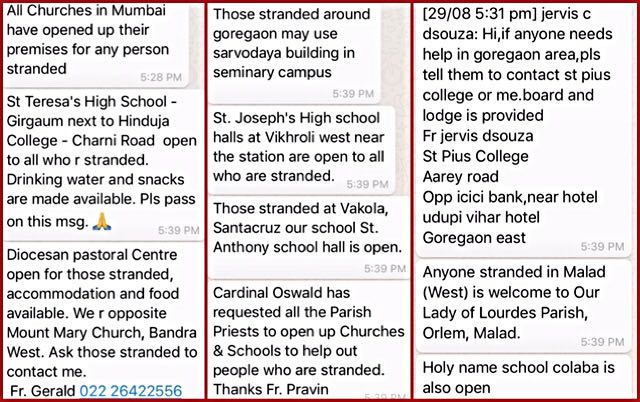
But what provided huge succour was how all faiths, temples, mosques, dargahs and gurudwaras came to people’s rescue. These notifications and warnings give just a glimpse of the compassion still alive and kicking in Mumbai.
Request everbody to spread this msg to all groups for people who are stranded :-
Note:- our volunteers are in that particular area
Sion hospital, near Gandhi market, 4 Road, King Circle, Dadar
1. Dadar Gurudwara for food and shelter. Opp chitra cinema
2. Anywhere in mumbai can go to any gurudwara sahib for food and shelter
For any help contact. 9323567555. MANPREET SINGH KHALSA ! 9022272252 HARNIT SINGH KHALSA
Gurdwara Dashmesh Darbar ready with hot Langar for stranded at GTB nagar Sion Koliwada.
Those stranded near Bandra , Khar , Santacruz ,Mahim , Sea link … can move towards * Trupti Bandra * at linking road near Amarsons … Food , water and tea have been made available.
Ripul 9769238333
Mahim Dargah
*Mahim Dargah* and Mahim Memon Hall has made arrangements for Shelter and Food for people stranded in and around the area of Mahim, Matunga and Bandra.
If anyone needs any help, please contact
Aslam Shaikh – 9821069376
Junaid Baugwala – 9892269786
Regrads,
Suhail Khandwani, Managing Trustee,Peer Makhdum Sahab Charitable Trust
If anyone needs any help, please feel free to reach Masjids and meet Volunteers, Imams and Trustees.
I have personally spoken to atleast 20 Masjids and all of them are open to help people from #ALL #FAITHS..
Few Names:
Chishti Hindustani Masjid, Byculla
Mahim Dargah
Mahim Memon Hall
Dawni Masjid, Nagpada
Bandra Jama Masjid
Millat School Boys, Jogesjwari
Madni Madarsa Masjid, Jogeshwari
Nazarali Imambargah, Kurla
Mehfil e Mustafa, Juhu Kapaswadi
Kesar Baug, Dongri
Shia Jama Masjid-Bada Imambada at Lotus Colony, Govandi (W)
National Market Masjid, Wadala – Kidwai Nagar
Five years ago around 11.30 a.m. and the Special Sessions Court of Judge Jyotsana Yagnik resembled a tight security jail. It was August 29, 2012. The judgement was due in the infamous massacre of 96 persons in borad daylight, the worst case of the genocidal carnage in Gujarat in 2002. Naroda Patiya lies on the outskirts of Ahmedabad, administratively falling under Zone IV, the same as the Gulberg society at Meghaninagar. Today, August 29, 2017, the concluding arguments in the appeal against Kodnani and other convictions are being made before a division bench of the Gujarat High Court.

Naroda Patiya and Gulberg, are, arguably, two of the two worst incidents of the reprisal killings that rocked the state as bodies of the Godhra mass arson victims were given to VHP strongman Jaideep Patel and thereafter paraded in angry processions in Ahmedabad and elsewhere. Three hundred such incidents were clocked in 19 of the state’s 25 districts.
On that day, August 29, 2012, women survivors and witnesses, who had testified bravely in the face of stiff threats, intimidation and opposition, haield the verdict. Will justice prevail yet again? Citizens for Justice and Peace (CJP) has represented the survivors. Counsel for the SIT has been Prashant Desai before the court. In all 32 persons had been convicted including former BJP MLA and minister in the Narendra Modi cabinet, Smt Maya Kodnani, Babu Bajrangi, Bipin Panchal, Ashok Sindhi and Kishan Korani (sitting corporator, accused No 20) have been convicted. Twenty-nine of the accused were acquitted.CJP has argued against the acquittals too before the Gujarat High Court.
In the interim five years, through controversial decisions, former BJP MLA and former minister (she was elevated after the carnage by then chief minister Narendra Modi to the berth) was granted bail, first by the High Court and then this was confirmed by the Supreme Court. It was only CJP for the survivors that had contested the grant of bail to this powerful accused.
The over 1,900 page judgement of Judge Jyotsnana Yagnik (that may be read here) has been hailed for its thorough expolaration of the contours of criminal law jurisprudence, especially related to criminal conspiracy, fair investigation, Sting Operation as Corrobrative evidence. The SIT invesigation came up for sharp reprimand especially in the matter of not investigating the phone call records of powerful accused and policemen.
Most of the accused have been charged with Sections 143, 144, 147, 148 with 149, 295, 427, 435, 436, 440, 153, 153a, 153a(ii), 323-326,302, 307 (attempt to murder) read with 149 read with 120(b) and BP Act 135(1). Accused No 22 Suresh Langda Chara has also been convicted under Sections 354 and 376 (sections that deal with rape and gender violence). Maya Kodnani was convicted under Sections 295, 427, 435, 436, 440, 153, 153a, 153a(ii), 323, 324, 325, 326, 302, 307, 120-B of the IPC. Babu Bajrangi has been convicted under sections 143, 144, 147, 148 with 149, 295, 427, 435, 436, 440, 153, 153a, 153a(ii), 323,324,325,326, 302, 307 read with 149 read with 120-B.
The raw courage of the victim witnesses, especially women witnesses who deposed fearlessly while still residing in Naroda Patiya is a reflection of the confidence generated after the Supreme Court monitoring and the protection from Central Paramilitary forces provided by the Supreme Court. CJP had applied to the apex court for protection of eye witnesses. CJP through its legal team advocates provided legal aid to about 70 eyewitnesses since 2009.
Eleven eyewitnesses had deposed in eye witnesses testimonies assigning in detail the role played by Smt Maya Kodnani, in inciting the mob to murder, fifteen witnesses deposed through eye witness testimonies against Babu Bajrangi, 48 witnesses testified to the crimes committed by Suresh @ Langda Chara including the offences of gender violence and rape. It was the genuine evidence, given under much therat and intimidation, given by eye witness testimonies that enabled convictions. Corroborative evidence was provided through the phone call records provided by police officer Rahul Sharma and Tehelka’s Operation Kalank. Without eye witness testimonies whoever convictions could not have taken place.
Victim witnesses supported by CJP had also filed separate applications under Section 319 praying for police officer and then first PI KK Mysorewala to be arraigned as accused along with former Commissioner of Police PC Pandey and SRP official Dhantaniya. While the Judge rejected these applications, she has observed in the victim application for compensation for rape and gender violence that the application would be considered in the final judgement.
Also Read
Excerpts of Women Testimonies on 376 Violations (Gender Violence) Naroda Patiya Trial
Names of accused who have been convicted. Naresh Agarsinh Chara (accused 1); Murlibhai Naranbhai Sindhi (accused 2); Ganpat Chanaji Deedawala (accused 4); Vikrambhai Maneklal Rathod (accused 5); Haresh @ Hariyo S/o Jivanlal @ Agarsinh Rathod (accused 10); Babubhai @ Babu Bajrangi Rajabhai Patel (accused 18), Kishan Khubchand Korani (accused 20); Prakashbhai Sureshbhai Rathod (Chara) (accused 21); Suresh @ Richard @ Langdi Kantibhai Dedawala (Chara) (accused 22); Premchand @ Tiwari Conductor (accused 25); Suresh @ Sehjad Dalubhai (Marathi, Charo) (absconding) (accused 26); Nawab @ Kalu Bhaiyo Harisinh Rathod (accused 27); Manubhai Keshavbhai Maruda (Bhangi) (accused 28); Shashikant @ Tiniyo Marathi Yuvraj Patil (accused 30); Babubhai Jethabhai Salat (accused 33); Lakshmanbhai @ Lakho Budhaji Thakor (accused 34); Dr. Mayaben Surendrabhai Kodnani (accused 37); Ashok Hundaldas Sindhi (accused 38); Harshad @ Mungda Govind Chara (Parmar) (accused 39); Mukesh @ Vakil Ratilal Rathod (accused 40); Manojbhai @ Manoj Sinhi Renumal Kukrani (accused 41); Hiraji @ Hero Marwadi @ Sonaji Danaji Medhwan (Marwadi) (accused 42); Bipinbhai @ Bipin autowala Umedray Panchal (accused 44); Ashokbhai Uttamchand Korani (Sindhi) (accused 45); Vijaykumar Takhubhai Parmar (accused 46); Ramesh Keshavlal Dedawala (Chara) (accused 47); Sachin Nagindas Modi (accused 52); Vilas @ Viliyo Prakashbhai Sonar (accused 53); Dinesh @ Tiniyo Govindbhai Barange (Marathi) (accused 55); Santoshkumar Kodumal Mulchandani (accused 58); Pintu Dalpatbhai Jadeja (Chara) (accused 60); Kirpalsinh Jagbahadursinh Chabda (accused 62).
Eight charge sheets were filed in this historic case that lasted several months. It was one of the nine cases being supervised by the Supreme Court and was investigated by the SIT.
What did some key witnesses say?
Aminaben Abbasbhai Belim, prosecution witness number 52, testified with clarity about the incident occurred on 28.2.2002 and more particularly the huge mob gathered in front of Noorani Masjid. She had spotted accused No.37 – Maya Kodnani and accused No.62 (Kishan Korani)– her assistant getting down from the white Maruti Car, instigating the members of the mob by telling the mob to finish the Muslim area and she was present in the Khakhi Uniform, and she heard whatever stated by accused No.37 Mayaben and thereafter the members of the mob started pelting the stones, damaging the houses, etc. This witness also witnessed the accused No.37 firing from the pistol like weapon and thereafter left in the car. This witness also spotted a truck containing gas cylinders and kerosene carboys that were used by the mob to attack. Members of the mob consumed alcohol and snacks on the road in the presence of the police before proceeding to attack innocents.
In her examination in chief, Aminaben had stated so that the truck containing the gas cylinders had arrived and members of the mob had access to the kerosene carboy, petrol carboys, had been drunk on alcohol and eating snacks, before they attacked innocents. This eye witness was herself hiding as she watched these horrific developments. She has also witnessed firing by leaders of the mob using a gun. She tried in vain to get help from the polive (PI KK Mysorewala refused to help though approached by this witness) control room from a local phone booth and this fact has been established by investigation. She was dressed in a khakhi uniform and this fact too was coorborated by other witnessed.
This witness also witnessed the incident of the killing of the family members of a Muslim Watchman near Mahavir Hall as well as the killing of Vermaji, wrongly believed to be the Muslim person and thereafter she went to hide herself at under construction building of Yasinbhai and thereafter took shelter in the house of daughter of Mohmedhusein where she stayed there for 2 hours wherein she witnessed the incident of ransacking of her house as well as from the Masjid Chali she witnessed the incident of accused No.44 – Bipinbhai resorting to the firing from the terrace of his garage.
This witness also stated to have witnessed the S.R.P. personnel ransacking and looting cash and other valuables from the households of Muslims. Since she could not trace her son Naeem she remained in the Masjid Ni Chali for the whole night and reached the Shah Alam camp the next day around 5 p.m. in a police vehicle.
In the appeal filed in the Gujarat high court, the high profile defence counsel attempted to bring the omissions and contradictions in the evidence of this witness.
Another prosecution witness (no 104) Mohammad Salim Mohammad Hussain Shaikh, a resident of Husseinnagar in Naroda Patiya has also beene explicit in his tetsimony. He has specifically narrated how the mob was allowed to gather at about 9 to 9.30 AM while he was drinking tea at Milan Hotel. He has spotted and identified many of the accused being armed with lethal weapons in the mob of 1500 persons. In panic, he informed his brother, ran to his home in the chawl and then went out on the road: there he again spotted the mob led by many accused persons wherein A/37 Maya Kodnani came in a Maruti fronti car, interacted with A/20, A/2 and A/41 from among the mob, thereafter called upon the mob to come near to her, said something to the mob and thereafter left in her car. According to this witnessed testimony, it was after this instruction and visit by Kodnani that the mob launched an assaulted on the Muslim area and two persons have lost their lives in the private firing. This witness then took shelter in the SRP Headquarters by about t 10.30 to 11.00 AM. Hispresence at the spot in the morning where he identifies four accused from the mob was established. The defence tried to discredit the witness by accusing him of exaggerating numbers in the mob (20-25,000) as appears in his statement before the Ahmedabad Crime Branch. He clearly stated that this was not a figure given to the Crime Branch by him at all. The investigation by the Crime Branch has been criticised for its unprofessionalism. In April 2002, in a controversial decision the Ahmedabad police had transferrd the investigation to the Crime Branch (officers Tarun Barot and NK Amin). During the cross examination, the defence has admitted to the presence of Maya Kodnani at the spot but construed it as ‘concern for her voters’ that had brought her there and tried to give a further twist to say that she was in fact instructing the police to come to the aid of the Muslims being targeted!
A third witness (PW 156)Abdul Majid lost his wife and eight children in the ghatsly Naroday Patiya massacre. He too has testified with clarity on then BJP MLA, Maya Kodnani coming to the spot after the mob had gathered at Kubernagar and Krishnanagar armed with lethal weapons. Kodnani, according to this eye witness account, comes with police cars from which three large black boxes were taken out. Kodnani is then supposed to have instigated the mob because arson attacks started. Two persons, both Muslims, Abid and Hasan Qureshi got injured in the firing by Muslims. One Khadir, autorickshaw driver was killed near public toilets of jawannagar chawl.
Another witness, prosecution witness number 192, RashidaBanuImtiyaz HusseinMomin was also key to the prosecution. Her family runs a small grocery shop at Husseinnagar. She testified on what what she saw when she went to the tea stall around 7.30- 8 a.m. so that her son Imran could go for breakfast. Police insisted that they shut the shop due to the VHP’s call for a Gujarat bandh. Just at the time they were proceeding to close the establishment and bring their possessions to their home, at Gali No.1, around this time this witness had gone to the corner of S.T. workshop and spotted two sets of mobs coming from Nataraj hotel side and Krishnanagar side. The members of both the mobs were pelting the stones towards them as well as Noorani Masjid and in that scuffle this witness identified accused No.37,MayabenKodnani, accused No.41,ManojVideowala, accused No.44,BipinAutowala, accused No.58, SantoshDudhwala, accused No.1, NareshChhara, accused No.22, Suresh Langada and his brother and accused Gudduchhara (since deceased), while accused No.37 was reportedly heard by the witness saying that ‘march ahead and kill them’. In this way, this witness testified to the former MLA instigating the members of the mob. She was also witness to criminal activities of the mob, how members of the mob slowly progressed towards them and first of all the witness went on the terrace of her own house wherein she spotted the members of the mob assaulting upon victims and hence she came down from her house and she took her children and reached a safer place at Pinjara’s terrace. She sustained injuries from a hockey stick as she fled to escape and her daughter Shamimbanu also received injuries from burns. Thereafter she also witnessed, from the terrace of Ramzanibhai that the members of the mob were engaged in arson, assaulting and killing and hacking the Muslims and thus she along with others stayed there till 12.00 to 12.30 O’clock in the late night of Feebruary 28, until the police took them to the relief camp. Essentially, the defence tried to discredit her testimony through ommissions and contraductions but she stood her ground in cross examination.
SiddikbhaiAlabuxMansuri is PW 236 and this witness has, in his testimony, categorically stated about the presence of accused No.37, Mayaben in front of Nataraj Hotel at about 8.00 to 9.00 O’clock in the morning with his P.A. accsed No.62 – Kirpalsing and delivered provocative speech and excited the mob and soon after the leaving the place by accused No.37, the mob started pelting the stones, towards Noorani Masjid. Further this witness has also stated that, in a second incident, MayabenKodnani in white Marutifronty car with Trax Jeep and met the other co-accused persons and distributed the weapons to them and immediately thereafter the frenzied attack re-doubled in its intensity.Though confronted in cross examination, this witness specifically sticks to his earlier version as stated in the chief in examination. The defence only brought out the contradiction with respect to the helmet worn by Accused-37 Mayaben which does not, in any way, so significant to discredit the version the witness.
Related Articles:
1.Witness File Application for Free Access to Papers in NarodaPatiya Appeal :Gujarat HC, December 2016
2.Maya Kodnani Appeal: 7th Judge Recuses, Why was Advocate Engaged at the Last Minute asks HC
3.Justice Delivered, The NarodaPatiya Verdict
The Supreme Court today overruled the 2012 order of the Gujarat High Court which had directed the state government to rebuild, at its cost, over 500 Muslim religious places destroyed or damaged during 2002 communal violence.
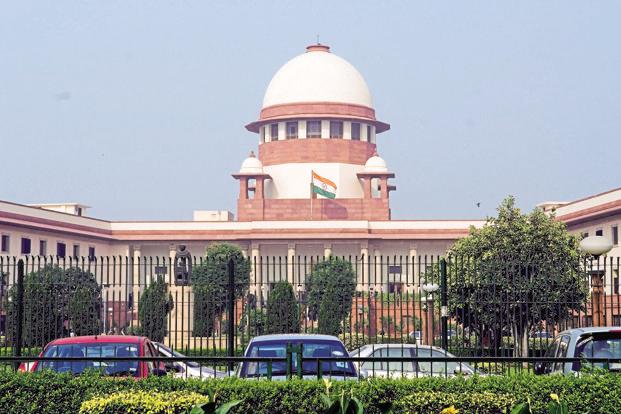
A bench of Chief Justice of India Dipak Misra and Justice PC Pant however added that the state government’s scheme of paying ex-gratia of Rs 50,000 for damaged residential and commercial properties would apply to religious properties as well.
The apex court’s ruling came after hearing a petition filed by Gujarat government challenging the high court order directing it to pay compensation to more than 500 shrines damaged during the 2002 communal carnage. While ordering the compensation, the high court order had also passed severe strictures against the then chief minister Narendra Modi’s administration for its failure to contain the violence.
In its appeal before the Supreme Court the Gujarat government had expressed its willingness to pay the same ex-gratia compensation amount of Rs 50,000 which it had earlier paid in case of damage to residential or commercial premises.
Two days earlier, on Monday the bench had wondered if it would be proper in a secular state to order compensation for rebuilding places of worship.
“Money is required for economic growth… individual injury is a different thing where compensation is granted under Article 21 (right to life and liberty) of the Constitution. Can it happen in a diversified country that a state is distributing public money to build religious places?” the bench had observed.
Appearing on behalf of the Gujarat government, Additional Solicitor General Tushar Mehta argued that Article 27 of the Constitution prohibits asking people “to pay any taxes, the proceeds of which are specifically appropriated in payment of expenses for the promotion or maintenance of any particular religion or religious denomination.”
Usually, I am not into writing long posts on social media platforms. But the events which have conspired (over Ram Raheem verdict) over last couple of days have moved me and prompted me to pen my thoughts. I literally have goose bumps as I write these words, thinking about the :
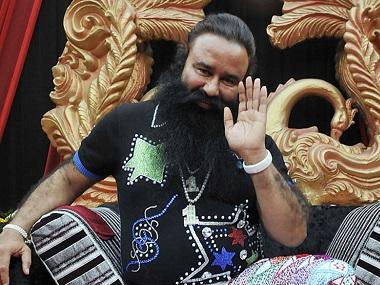
Image Courtesy: Getty Images
1) Two brave young ladies/sadhvis (identity withheld) waging a legal battle for FIFTEEN LONG YEARS , not 1,2 or 3 years , but 15 long years combined with the number of years they were subjected to sexual assaults. Imagine, with their meagre resources, travelling to court 250 kms to Panchkula for every single hearing, protected by a lone gunman, surrounded/chased by Dera followers drunk on power literally baying for their blood. Imagine, travelling on those rickety state transport buses, how close they must have come to quitting a no. of times, stacked against the might of their rapist, for 15 long years. One of the ladies also lost her brother (assassinated).
2) An upright CBI Judge Honrl. Jagdeep Singh delivering a historic judgement despite colossal political & mob pressure. To hell with 3 lakh people stacked outside the court, threatening violence. To hell with bigwig connections . It didn’t matter how many lakhs were standing with the culprit it just took one Honrl. and upright guy to stand with those two brave ladies , on the day of the judgement.
3) An assassinated journalist Honrl. Ram Chander Chhatrapati, who first broke this story in 2002 in a small local daily called “Poora Sach” and kept pursuing the issue despite death threats and ultimately paid the price with his life. This is what courage looks like in human form. Courage which was shot FIVE times from point blank range.
4) Anshuman Chhatrapati, a proud & bereaved son having lost his father at the age of 21 . Struggled to kept his slain father’s legacy alive in form of local newspaper ‘Poora Sach’ amid looming death threats and political pressure. Ultimately getting the CBI involved in the investigations after knocking on the HC door in 2003. Imagine a 21 year old, taking care of his father for 28 days , after five bullets have been pumped into his body and not even a single cop shows up to record the statement of the dying journalist.
5) Stalwarts lawyers Honrl. Rajinder Sachar, R.S Cheema, Ashwin Bakshi & Lekhraj ji, who fought this case pro-bono . They withstood the pressure , invested their time and lead it to its logical conclusion . Imagine Sh. Rajinder Sacher an octogenarian ( as he was born in 1923), an old ,frail, white haired upright gentleman fighting the case without charging a single rupee.
6) CBI DSP Honrl. Satish Dagar , DIG Mulinja Narayanan and other team members for rock solid and fair investigation without bowing down to ANYONE. Imagine receiving innumerable calls to go easy or go soft on a certain individual. Imagine standing in a court jam packed with Dera supporters and yet standing firmly behind those two scared yet brave ladies and reassuring them.
So, by my count it took just 11 upright people (I am sure there are many unknown faces, secret backers behind the scene), but these 11 were the face of the fight, vulnerable to threats and assassinations and were up against a self-proclaimed Godman worth 1000 crores , supported by more than 1 crore odd people and endorsed by political heavyweights and stalwarts.
So again, by my count it took just 11 ordinary people (one shy of a dozen) to bring down a hugely resourceful rapist, masquerading as a religious guru.
I bow down to these fellow Indians for keeping our faith intact in the system and for giving us a ray of hope. For showing us , that a handful few doing their Job in the rightful manner can withstand lakhs.
Quoting my favorite lines by Hindi poet Sh. Ramdhari Dinkar ji :
समर शेष है, नहीं पाप का भागी केवल व्याध
जो तटस्थ हैं, समय लिखेगा उनके भी अपराध
Loosely translated: The battle is not over yet, the one who oppresses is not the only sinner, the one who stands on the sidelines (read neutral) will be held equally guilty.
I choose to stand with these fellow 11 citizens, especially with these two young brave ladies, their courage should be recognized, commemorated and honored by the state.
What about you ?
#JaiHind # SatyamevaJayate.
In the end: AS received on Whatsapp
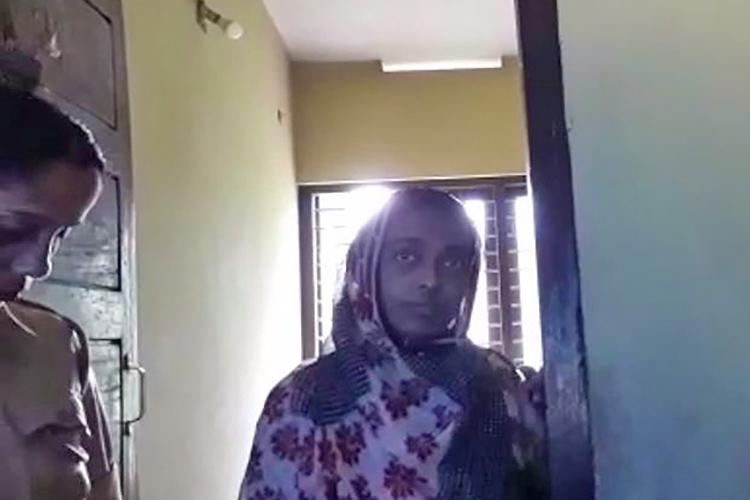
Image Courtesy: The News Minute
Your Lordship,
We write to you, to bring to your notice a recent judgement of the Kerala High Court which has annulled a consensual marriage of an adult Muslim woman. The judgement also makes many other remarks which can completely undermine any claim for equal citizenship for women and are violative of their fundamental and constitutional rights. Hadiya is a young woman, 24 years of age who has went on record to say that she willingly converted to Islam. Her parents have since approached the court twice asserting that she has converted to Islam under external force, demanding that she return to living with them. In their second petition to the Kerala High Court they also raised the allegation that she would be transported outside the country and demanded the court’s intervention.
During the proceedings of the second petition, Hadiya contracted a marriage with a Muslim man according to Islamic rites and rituals and stated her full consent in the marriage. The Kerala High Court has finally annulled the marriage and forced Hadiya into the custody of her father. She has not even been allowed a phone and has been denied any contact with the rest of the world beside her parents, in effect putting her under house arrest for no proven crime committed by her. Policemen guard her every day and just beyond stand RSS cadre further ensuring that their prize catch finds no exit from the situation.
On the judgement being challenged in the Honourable Supreme Court, the apex court ordered an NIA (National Investigative Agency) enquiry into the marriage, framing the whole case in terms of counter terrorism proceedings and completely bypassing concerns around the judicial recognition of women’s agency and the violation of women’s constitutional rights.
“IN HER BEST INTEREST” – A JUDICIAL PRECEDENT OF INFANTILIZATION OF WOMEN
The absolute denial of a voice to Hadiya by the Kerala High Court is a matter of grave concern, beginning from the court forcing her to live in a women’s hostel under surveillance to the annulment of a consensual marriage on grounds of coercion, despite an adult woman making a clear statement of her consent. The judgement states that ‘as per Indian tradition, the custody of an unmarried daughter is with the parents, until she is properly married’, and that Hadiya, being ‘a female in her twenties is at a vulnerable age’ and cannot understand what is good for her. The judgement expresses unabashed incredulity towards the statements made by Hadiya about her choice to convert to Islam, her interest in the study of religion and her choice to practice a religion different from her parents.
The court continues to address Hadiya as Akhila, a name she has surrendered, and refuses to acknowledge her decision to practice Islam. Most dangerously, the judgement throughout assumes that a father can judge the best interest of an adult daughter. The court only sees her as “indoctrinated and influenced” Akhila who is not to be left “free to decide what she wants in life”, who is not “capable of taking a firm and independent decision on her own” – who hence needed to be “rescued and handed over” to the “safe hands” of “parental authority”, to ensure that she is “protected” from “going astray”.
The Kerala HC goes on to assume a ‘parens patriae’ jurisdiction over Hadiya, i.e. the position of guardianship over her, which is available only in the case of minors or those considered of ‘unsound mind’ or who are ‘incompetent to understand their own interest’ and is completely unjustified and demeaning when applied to an adult woman.
All its utterances put together the HC judgement in this case exemplifies the submission of women’s agency and interest before ‘other’ ‘larger’ concerns. Women’s bodies have across history been made into battle fields for such ‘other’ ‘larger’ battles, those of cultural hegemony, religious and political domination, the formation and dissolution of nations and not least the establishment and demolition of (a country/ community/ family/ lover’s) honour. The present judgement of the Kerala HC takes us back to the point where a woman was at best the property of her male kin and her body the repository of the ‘honour/interest’ of the country/community.
It is indeed incredible how a court which everyday hears hundreds of cases of domestic violence and abuse, of ‘honour killings’ and dowry deaths could repose such blind faith in the institution of the ‘family’, to consider “the welfare and well-being” of their daughter “to be of paramount importance”. ‘Females in their twenties’ are full citizens of this country, who work, vote, study, own property and like all other citizens have a fundamental right to be treated as equals before the law. They must be recognized to be capable of discerning between the good and bad, must be allowed to exercise their discretion in matters concerning themselves and presumed to be capable of bearing the implications of those decisions. The denial of any independent decision-making capacity to such a huge section of the population as implied by the Kerala HC is unacceptable. It runs counter to the entire history of women’s struggle to gain social-political-economic independence and shall only exacerbate the vulnerabilities that we face as women in a patriarchal society.
PATRIARCHY RIDING ON THE BACK OF ISLAMOPHOBIA?
Clearly, the issue in the present case is not the well-being of Hadiya but what the HC records as “the widespread allegations of forcible conversion that were coming up and the national interest that is at stake”. The HC has so undermined Hadiya’s agency, only to address its anxiety around “conversion by radical groups… working in various parts of Kerala influencing young girls from other communities and forcibly converting them to the Islamic faith’. Is it that the choices Hadiya has made – of converting out of her parent’s religion as a young woman, and of converting from Hinduism into Islam – are so unacceptable to the court, so disturbing for the dominant patriarchal Hindu order that they must be overturned, even at the cost of going against the constitution’s mandate and compromising the rights and autonomy of all young women?
The present political situation is marked by increasing polarization on communal lines, a rapid escalation in the viciousness, impunity and public assertion of violence against the Muslim community and the permeation of Hindu fundamentalism into state structure and society. In such a circumstance, the invocation of the framework of terror by the courts in this case must be judged in the backdrop of Muslim youth accused in terror charges being acquitted after spending years in jail due to inadequate evidence.
The HC has justified all instances of overreach in Hadiya’s case citing concern over “forced conversion” to Islam, even as the state has remained silent on campaigns such as “Bahu Lao Beti Bachao” and “Ghar Wapasi”, very much campaigns of forced conversions into Hinduism. Such selective concern suggests that a prejudice is at work against Hadiya due to her being a Muslim woman. The judgement therefore seems to be inflicted by patriarchal presumptions riding on the back of Islamophobia.
OUR ‘BEST INTERESTS’ LIE IN THE RECOGNITION OF OUR AUTONOMY AND A VIOLENCE FREE AND EQUITABLE SOCIETY
As a collective of women students, what is happening to Hadiya is not new to us, many of us have experienced such violence and caging very closely, by this society, by our families, by the state, by universities, by partners and lovers we had ourselves chosen – the list is endless. The bind being currently negotiated by Hadiya is in fact representative in some ways of the challenges faced by numerous young women today. The albeit limited spread of education and employment over the past couple of decades has strengthened before us the prospect of some independence. Having gained greater access to the public sphere, an exposure to ideas and cultures beyond those of our father or our communities, we have before us greater opportunity to ‘choose’. Parallelly, gaining stronger bargaining terms and recognition than before as women, we slowly but increasingly also feel strengthened in our capacity to bear the implications of these choices. Yet, a deep patriarchal bias encounters us at every step we take in this journey, lashing out at many, more violently than at some others, but sparing none. The present judgement of the Kerala High Court comes to us as an institutionalised expression of precisely such a bias. By this judgement, the court has succumbed to upholding patriarchy despite the definite mandate that it has against such discrimination.
Like Hadiya at one point, many of us stay in private and government run hostel accommodations. These spaces are spaces of opportunity for us, often finally a space of freedom, and independence. At the same time, a diverse set of discriminatory rules and regulations, beginning with the ‘curfew’ are imposed by such institutions on women students to control and regulate our lives and decisions in the most intrusive and arbitrary ways, to ensure that we have no opportunity to go “astray”. Educational institutions across the country see themselves as accountable only to the parents of adult women and not to the adult women themselves. The fact that the Kerala HC decided to put Hadiya in a women’s hostel to make sure that she was under strict surveillance only further illustrates how these hostels often end up playing the role of being the transit house for young women from the homes of their fathers to their husband’s, instead of being their road to a self-reliant life. Over the past few years, young women across the country have taken to streets in hundreds and thousands to take greater control over these institutions, to make the best of these spaces of opportunity and not allow them to be reduced to spaces of surveillance and policing.
At such a juncture, the Kerala HC judgement sets a disabling example for all other state institutions on the question of recognising women’s autonomy and is a huge blow to our confidence in the judicial process and its safe guarding of our constitutional rights.
The HC has expressed concern over Hadiya not impressing them “as a person who is capable of taking a firm and independent decision on her own” alleging that the marriage they annulled was contrived to tie the hands of the court. However, the present judgement itself offers a ‘proper marriage’ as the only means through which a woman can leave the custody of her parents. Such an approach only further undermines women’s capacity for taking ‘independent decisions’, forces us into relations of dependence and makes us ever more vulnerable.
We request you to hear Hadiya, to hear the thousands of young women who have struggled so hard to challenge such silencing of our voices through history. Our best interests lie not in such infantilization, such surveillance, such caging and silencing. Instead, it lies in a full recognition of our rights and autonomy and the creation of a violence free and equitable society for all. We may have never met Hadiya, but her struggle is intimate to us! If the women of this country are to have any ounce of faith restored in the judiciary, Hadiya’s illegal house arrest and denial of agency must be immediately revoked.
Yours Sincerely,
Pinjra Tod
Courtesy: Kafila.online
Join our mailing list to get the latest human rights news that matters, straight to your mailbox.
Join our mailing list to get the latest human rights news that matters, straight to your mailbox.