The Supreme Court today overruled the 2012 order of the Gujarat High Court which had directed the state government to rebuild, at its cost, over 500 Muslim religious places destroyed or damaged during 2002 communal violence.
A bench of Chief Justice of India Dipak Misra and Justice PC Pant however added that the state government’s scheme of paying ex-gratia of Rs 50,000 for damaged residential and commercial properties would apply to religious properties as well.
The apex court’s ruling came after hearing a petition filed by Gujarat government challenging the high court order directing it to pay compensation to more than 500 shrines damaged during the 2002 communal carnage. While ordering the compensation, the high court order had also passed severe strictures against the then chief minister Narendra Modi’s administration for its failure to contain the violence.
In its appeal before the Supreme Court the Gujarat government had expressed its willingness to pay the same ex-gratia compensation amount of Rs 50,000 which it had earlier paid in case of damage to residential or commercial premises. Two days earlier, on Monday the bench had wondered if it would be proper in a secular state to order compensation for rebuilding places of worship.
“Money is required for economic growth… individual injury is a different thing where compensation is granted under Article 21 (right to life and liberty) of the Constitution. Can it happen in a diversified country that a state is distributing public money to build religious places?” the bench had observed.
Appearing on behalf of the Gujarat government, Additional Solicitor General Tushar Mehta argued that Article 27 of the Constitution prohibits asking people “to pay any taxes, the proceeds of which are specifically appropriated in payment of expenses for the promotion or maintenance of any particular religion or religious denomination.”
Usually, I am not into writing long posts on social media platforms. But the events which have conspired (over Ram Raheem verdict) over last couple of days have moved me and prompted me to pen my thoughts. I literally have goose bumps as I write these words, thinking about the :
Image Courtesy: Getty Images
1) Two brave young ladies/sadhvis (identity withheld) waging a legal battle for FIFTEEN LONG YEARS , not 1,2 or 3 years , but 15 long years combined with the number of years they were subjected to sexual assaults. Imagine, with their meagre resources, travelling to court 250 kms to Panchkula for every single hearing, protected by a lone gunman, surrounded/chased by Dera followers drunk on power literally baying for their blood. Imagine, travelling on those rickety state transport buses, how close they must have come to quitting a no. of times, stacked against the might of their rapist, for 15 long years. One of the ladies also lost her brother (assassinated).
2) An upright CBI Judge Honrl. Jagdeep Singh delivering a historic judgement despite colossal political & mob pressure. To hell with 3 lakh people stacked outside the court, threatening violence. To hell with bigwig connections . It didn’t matter how many lakhs were standing with the culprit it just took one Honrl. and upright guy to stand with those two brave ladies , on the day of the judgement.
3) An assassinated journalist Honrl. Ram Chander Chhatrapati, who first broke this story in 2002 in a small local daily called “Poora Sach” and kept pursuing the issue despite death threats and ultimately paid the price with his life. This is what courage looks like in human form. Courage which was shot FIVE times from point blank range.
4) Anshuman Chhatrapati, a proud & bereaved son having lost his father at the age of 21 . Struggled to kept his slain father’s legacy alive in form of local newspaper ‘Poora Sach’ amid looming death threats and political pressure. Ultimately getting the CBI involved in the investigations after knocking on the HC door in 2003. Imagine a 21 year old, taking care of his father for 28 days , after five bullets have been pumped into his body and not even a single cop shows up to record the statement of the dying journalist.
5) Stalwarts lawyers Honrl. Rajinder Sachar, R.S Cheema, Ashwin Bakshi & Lekhraj ji, who fought this case pro-bono . They withstood the pressure , invested their time and lead it to its logical conclusion . Imagine Sh. Rajinder Sacher an octogenarian ( as he was born in 1923), an old ,frail, white haired upright gentleman fighting the case without charging a single rupee.
6) CBI DSP Honrl. Satish Dagar , DIG Mulinja Narayanan and other team members for rock solid and fair investigation without bowing down to ANYONE. Imagine receiving innumerable calls to go easy or go soft on a certain individual. Imagine standing in a court jam packed with Dera supporters and yet standing firmly behind those two scared yet brave ladies and reassuring them.
So, by my count it took just 11 upright people (I am sure there are many unknown faces, secret backers behind the scene), but these 11 were the face of the fight, vulnerable to threats and assassinations and were up against a self-proclaimed Godman worth 1000 crores , supported by more than 1 crore odd people and endorsed by political heavyweights and stalwarts.
So again, by my count it took just 11 ordinary people (one shy of a dozen) to bring down a hugely resourceful rapist, masquerading as a religious guru.
I bow down to these fellow Indians for keeping our faith intact in the system and for giving us a ray of hope. For showing us , that a handful few doing their Job in the rightful manner can withstand lakhs.
Quoting my favorite lines by Hindi poet Sh. Ramdhari Dinkar ji : समर शेष है, नहीं पाप का भागी केवल व्याध जो तटस्थ हैं, समय लिखेगा उनके भी अपराध
Loosely translated: The battle is not over yet, the one who oppresses is not the only sinner, the one who stands on the sidelines (read neutral) will be held equally guilty.
I choose to stand with these fellow 11 citizens, especially with these two young brave ladies, their courage should be recognized, commemorated and honored by the state.
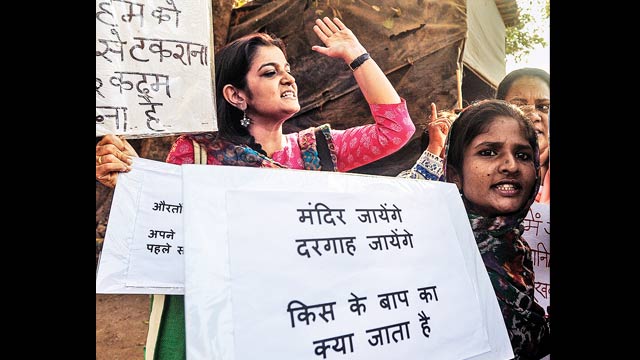
Guest post by PINJRA TOD, a Delhi-based collective of students fighting to “Break the Cages” of women denied the rights of adult citizens by the restrictive and patriarchal rules of women’s hostels.
Image Courtesy: The News Minute
Your Lordship,
We write to you, to bring to your notice a recent judgement of the Kerala High Court which has annulled a consensual marriage of an adult Muslim woman. The judgement also makes many other remarks which can completely undermine any claim for equal citizenship for women and are violative of their fundamental and constitutional rights. Hadiya is a young woman, 24 years of age who has went on record to say that she willingly converted to Islam. Her parents have since approached the court twice asserting that she has converted to Islam under external force, demanding that she return to living with them. In their second petition to the Kerala High Court they also raised the allegation that she would be transported outside the country and demanded the court’s intervention.
During the proceedings of the second petition, Hadiya contracted a marriage with a Muslim man according to Islamic rites and rituals and stated her full consent in the marriage. The Kerala High Court has finally annulled the marriage and forced Hadiya into the custody of her father. She has not even been allowed a phone and has been denied any contact with the rest of the world beside her parents, in effect putting her under house arrest for no proven crime committed by her. Policemen guard her every day and just beyond stand RSS cadre further ensuring that their prize catch finds no exit from the situation.
On the judgement being challenged in the Honourable Supreme Court, the apex court ordered an NIA (National Investigative Agency) enquiry into the marriage, framing the whole case in terms of counter terrorism proceedings and completely bypassing concerns around the judicial recognition of women’s agency and the violation of women’s constitutional rights.
“IN HER BEST INTEREST” – A JUDICIAL PRECEDENT OF INFANTILIZATION OF WOMEN The absolute denial of a voice to Hadiya by the Kerala High Court is a matter of grave concern, beginning from the court forcing her to live in a women’s hostel under surveillance to the annulment of a consensual marriage on grounds of coercion, despite an adult woman making a clear statement of her consent. The judgement states that ‘as per Indian tradition, the custody of an unmarried daughter is with the parents, until she is properly married’, and that Hadiya, being ‘a female in her twenties is at a vulnerable age’ and cannot understand what is good for her. The judgement expresses unabashed incredulity towards the statements made by Hadiya about her choice to convert to Islam, her interest in the study of religion and her choice to practice a religion different from her parents.
The court continues to address Hadiya as Akhila, a name she has surrendered, and refuses to acknowledge her decision to practice Islam. Most dangerously, the judgement throughout assumes that a father can judge the best interest of an adult daughter. The court only sees her as “indoctrinated and influenced” Akhila who is not to be left “free to decide what she wants in life”, who is not “capable of taking a firm and independent decision on her own” – who hence needed to be “rescued and handed over” to the “safe hands” of “parental authority”, to ensure that she is “protected” from “going astray”. The Kerala HC goes on to assume a ‘parens patriae’ jurisdiction over Hadiya, i.e. the position of guardianship over her, which is available only in the case of minors or those considered of ‘unsound mind’ or who are ‘incompetent to understand their own interest’ and is completely unjustified and demeaning when applied to an adult woman.
All its utterances put together the HC judgement in this case exemplifies the submission of women’s agency and interest before ‘other’ ‘larger’ concerns. Women’s bodies have across history been made into battle fields for such ‘other’ ‘larger’ battles, those of cultural hegemony, religious and political domination, the formation and dissolution of nations and not least the establishment and demolition of (a country/ community/ family/ lover’s) honour. The present judgement of the Kerala HC takes us back to the point where a woman was at best the property of her male kin and her body the repository of the ‘honour/interest’ of the country/community.
It is indeed incredible how a court which everyday hears hundreds of cases of domestic violence and abuse, of ‘honour killings’ and dowry deaths could repose such blind faith in the institution of the ‘family’, to consider “the welfare and well-being” of their daughter “to be of paramount importance”. ‘Females in their twenties’ are full citizens of this country, who work, vote, study, own property and like all other citizens have a fundamental right to be treated as equals before the law. They must be recognized to be capable of discerning between the good and bad, must be allowed to exercise their discretion in matters concerning themselves and presumed to be capable of bearing the implications of those decisions. The denial of any independent decision-making capacity to such a huge section of the population as implied by the Kerala HC is unacceptable. It runs counter to the entire history of women’s struggle to gain social-political-economic independence and shall only exacerbate the vulnerabilities that we face as women in a patriarchal society.
PATRIARCHY RIDING ON THE BACK OF ISLAMOPHOBIA? Clearly, the issue in the present case is not the well-being of Hadiya but what the HC records as “the widespread allegations of forcible conversion that were coming up and the national interest that is at stake”. The HC has so undermined Hadiya’s agency, only to address its anxiety around “conversion by radical groups… working in various parts of Kerala influencing young girls from other communities and forcibly converting them to the Islamic faith’. Is it that the choices Hadiya has made – of converting out of her parent’s religion as a young woman, and of converting from Hinduism into Islam – are so unacceptable to the court, so disturbing for the dominant patriarchal Hindu order that they must be overturned, even at the cost of going against the constitution’s mandate and compromising the rights and autonomy of all young women?
The present political situation is marked by increasing polarization on communal lines, a rapid escalation in the viciousness, impunity and public assertion of violence against the Muslim community and the permeation of Hindu fundamentalism into state structure and society. In such a circumstance, the invocation of the framework of terror by the courts in this case must be judged in the backdrop of Muslim youth accused in terror charges being acquitted after spending years in jail due to inadequate evidence.
The HC has justified all instances of overreach in Hadiya’s case citing concern over “forced conversion” to Islam, even as the state has remained silent on campaigns such as “Bahu Lao Beti Bachao” and “Ghar Wapasi”, very much campaigns of forced conversions into Hinduism. Such selective concern suggests that a prejudice is at work against Hadiya due to her being a Muslim woman. The judgement therefore seems to be inflicted by patriarchal presumptions riding on the back of Islamophobia.
OUR ‘BEST INTERESTS’ LIE IN THE RECOGNITION OF OUR AUTONOMY AND A VIOLENCE FREE AND EQUITABLE SOCIETY As a collective of women students, what is happening to Hadiya is not new to us, many of us have experienced such violence and caging very closely, by this society, by our families, by the state, by universities, by partners and lovers we had ourselves chosen – the list is endless. The bind being currently negotiated by Hadiya is in fact representative in some ways of the challenges faced by numerous young women today. The albeit limited spread of education and employment over the past couple of decades has strengthened before us the prospect of some independence. Having gained greater access to the public sphere, an exposure to ideas and cultures beyond those of our father or our communities, we have before us greater opportunity to ‘choose’. Parallelly, gaining stronger bargaining terms and recognition than before as women, we slowly but increasingly also feel strengthened in our capacity to bear the implications of these choices. Yet, a deep patriarchal bias encounters us at every step we take in this journey, lashing out at many, more violently than at some others, but sparing none. The present judgement of the Kerala High Court comes to us as an institutionalised expression of precisely such a bias. By this judgement, the court has succumbed to upholding patriarchy despite the definite mandate that it has against such discrimination.
Like Hadiya at one point, many of us stay in private and government run hostel accommodations. These spaces are spaces of opportunity for us, often finally a space of freedom, and independence. At the same time, a diverse set of discriminatory rules and regulations, beginning with the ‘curfew’ are imposed by such institutions on women students to control and regulate our lives and decisions in the most intrusive and arbitrary ways, to ensure that we have no opportunity to go “astray”. Educational institutions across the country see themselves as accountable only to the parents of adult women and not to the adult women themselves. The fact that the Kerala HC decided to put Hadiya in a women’s hostel to make sure that she was under strict surveillance only further illustrates how these hostels often end up playing the role of being the transit house for young women from the homes of their fathers to their husband’s, instead of being their road to a self-reliant life. Over the past few years, young women across the country have taken to streets in hundreds and thousands to take greater control over these institutions, to make the best of these spaces of opportunity and not allow them to be reduced to spaces of surveillance and policing.
At such a juncture, the Kerala HC judgement sets a disabling example for all other state institutions on the question of recognising women’s autonomy and is a huge blow to our confidence in the judicial process and its safe guarding of our constitutional rights.
The HC has expressed concern over Hadiya not impressing them “as a person who is capable of taking a firm and independent decision on her own” alleging that the marriage they annulled was contrived to tie the hands of the court. However, the present judgement itself offers a ‘proper marriage’ as the only means through which a woman can leave the custody of her parents. Such an approach only further undermines women’s capacity for taking ‘independent decisions’, forces us into relations of dependence and makes us ever more vulnerable.
We request you to hear Hadiya, to hear the thousands of young women who have struggled so hard to challenge such silencing of our voices through history. Our best interests lie not in such infantilization, such surveillance, such caging and silencing. Instead, it lies in a full recognition of our rights and autonomy and the creation of a violence free and equitable society for all. We may have never met Hadiya, but her struggle is intimate to us! If the women of this country are to have any ounce of faith restored in the judiciary, Hadiya’s illegal house arrest and denial of agency must be immediately revoked.
People like him are also responsible for making the community a sitting target for the Hindu Right wing forces.
BMMA Demonstration in Mumbai. Photo credit: DNA
Instant triple talaq, which is a Muslim man’s right to divorce his wife unilaterally in one sitting is now history. The highest court of the country has ruled it as unconstitutional and as violative of the right to equality. Understandably, there is a sense of jubilation among all those Muslim men and women who campaigned against the practice of instant triple Talaq.
Organizations like Bhartiya Muslim Mahila Andolan (BMMA) and scores of other Muslim women must be congratulated for having a sustained campaign on the issue for such a long time and having faced numerous difficulties not just from different governments but also from the leaders of the Muslim community. From being called as agents of the Hindutva brigade to being dubbed as not Muslim enough, these women have bravely fought prejudices and acerbic taunts from members of their own community and stood steadfast in their belief that it is high time the Muslim personal law be reformed.
It is interesting to note that voices to reform the Muslim law on divorce has a much older genealogy than what is normally conceded. Way back in 1920s, the All India Muslim Ladies Conference, in one of its annual conferences had raised the issue of instant triple talaq. Their argument then was similar to the argument that Muslim women’s organizations are making today.
What has been declared illegal is just instant triple talaq, not the system of unilateral divorce as practiced by Muslims.
The All India Muslim Ladies Conference was the first women’s organization to campaign against oral triple talaq and laid down rules according to what they believed was the correct Quranic practice of divorce. They drew up a model nikahnama (marital contract) which laid down the rules of divorce. Men had to give a valid reason for divorcing their wives. There would be provisions for maintenance made in case the divorce became effective. Moreover, they argued that the nikahnama gave limitless power to women to dictate terms and conditions to the prospective groom. And only when the groom accepts in writing that he would be fulfilling those demands that the nikah would take place.
One clause in the nikahnama was that in case the husband takes another wife without the permission of the wife, then the earlier marriage will automatically get dissolved. Thus there were conditions to make polygamy difficult and exceptional within Muslim households.
The appeal of the Muslims Ladies Conference was extremely limited as it remained confined to the feudal and elite circles of the ‘enlightened’ Muslim gentry of Bhopal and Hyderabad. It never became a mass phenomenon. Partition gave a death blow to this initiative as most of the campaigners became Pakistanis in an instant and there was hardly any leadership left for Indian Muslim women.
It must be said to the credit of BMMA that for the first time it made the issue of reforming personal laws into a Muslim mass phenomenon.
Organizations like the BMMA draw upon such an older tradition of Muslim reform. But it must be said to the credit of BMMA that for the first time it made the issue of reforming personal laws into a Muslim mass phenomenon. Thus when the Supreme Court declared that instant triple talaq was invalid, it was responding to the demands raised by millions of Muslim women in India.
For the first time perhaps, we have a genuine mass movement among Muslim women which is desirous of change and making demands by virtue of being citizens of this country. The question is whether they will stop at instant triple talaq or will it just be one of the many campaigns that women’s group will take up. Already organizations like the BMMA are arguing that they next step is a campaign for comprehensive gender just law for Muslims in this country. They are perhaps right in calling this as a victory but a very small one at that.
They are right. It took seventy years for this country to outlaw a system of divorce which was manifestly anti-women and drove them to destitution. And what has been declared illegal is just instant triple talaq, not the system of unilateral divorce as practiced by Muslims. In divorce proceedings, Muslim men continue to have the right of unilateral divorce and there is a need to make it more gender just.
Similarly, there should be a campaign to make polygamy illegal as it is an abhorrence in today’s times. Will the BMMA and other such organizations be willing to take up the challenge? Only time will tell. But going by their commitment and enthusiasm it is reasonable to suggest that they will not stop at this victory.
It is rather unfortunate that despite the Supreme Court ruling there are sections within the Muslims who think it is a conspiracy to defame their religion and they confuse Muslim personal law with divine law. The statement of the Jamiat Ulema e Hind suggesting that they would not follow Supreme Court verdict only goes to show how much faith they have in the Indian judiciary.
For them, as for a majority of religious fundamentalists, the matter is very simple: if the courts rule in their favour then they would hail the verdict, but if the law goes against then, the judiciary becomes a pawn in the hands of ‘vested interests’. People like Mahmood Madani bring shame to the Muslim community and people like him are responsible for making the community a sitting target for the Hindu Right wing forces who quickly announce to the world that Muslims do not believe in the Indian nation, far less the judiciary.
Unfortunately people like Madani have disproportionate clout within the Muslim community. Reports coming in after the verdict suggest that the petitioners and those campaigning against instant triple talaq are facing social boycott from within their families and the larger community. This tells us about the pitiable state of the community which it seems wants to be in a perpetual state of backwardness and are alright to be members of a community which is accused of being warped on issues of gender justice.
It is astonishing to see the silence of the left and liberals on the issue of social reform amongst Muslims.
The fight must go on. Till the time organizations like All India Muslim Personal Law Board become redundant within the Muslim society. This fight has to be taken forward by all right thinking Muslim men and women. But it is also important to underline that Muslim women’s organizations like the BMMA must be at the forefront of such a struggle. It is heartening to note that a number of progressive Muslim men have supported the BMMA, but their efforts should be limited to supporting these movements and not becoming the leaders of the movement.
Last but not the least, it is astonishing to see the silence of the left and liberals on the issue of social reform amongst Muslims. At least they should have come out in open support of organizations like the BMMA. Their muted response goes a long way to suggest that their ideas about Islam and Muslims are completely hazy and warped. Silently, Muslim women have marched together to claim their just space as Indian citizens. Triple talaq is just one stop in their long march to demolish the many citadels of male privilege legitimated through a misogynistic reading of Islam.
The death of 52 infants over 30 days at Jamshedpur’s Mahatma Gandhi Memorial Medical College hospital in Jharkhand, reported on August 27, 2017, by the news agency ANI, calls to attention the health of women and extent of malnutrition in India’s 10th poorest state by per capita income.
The number of deaths is not extraordinary, B Bhushan, medical superintendent of the state-run Mahatma Gandhi Memorial Medical College hospital, told IndiaSpend. “More deaths were reported this month because more children were admitted,” he said, adding that patients from Bengal too come to the hospital.
The deaths in Jamshedpur come two weeks after 70 children died at the Baba Raghav Das Medical College Hospital at Gorakhpur, Uttar Pradesh, revealing the depth of the crisis in India’s public-health system.
Jamshedpur, a city of 1.3 million, is the largest city in Jharkhand by population, and one of India’s oldest industrial cities, but the state’s health indicators are among India’s worst, according to an IndiaSpend analysis of 2015-16 national health data, the latest available.
Forty of these 52 infant deaths were in the neonatal intensive care unit (NICU) and 12 in the pediatric intensive care unit, said Bhushan. “Thirty-eight of the 40 infant deaths in NICU were due to low birth weight, other deaths were due to premature births and other complications like asphyxia,” he added.
“The most common reason for low weight babies is malnutrition in mothers,” he explained, saying that many mothers who come to the hospital are tribals, and from the poorest strata of society.
Jamshedpur better off than Jharkhand but poor child-health indicators
While the district of Purbi (eastern) Singhbhum, in which Jamshedpur is located, has a better infant mortality rate (IMR), with 25 infant deaths per 1,000 live births, than the average for Jharkhand (44) and India (41), the proportion of wasted children–with low weight for height–is 11 percentage points more than the state (29) and almost double the Indian average (21). Wasting is one of the indicators of malnutrition.
Purbi (eastern) Singhbhum is ranked among the 10 worst in India for the proportion of wasted children, with 40.6% of children under five wasted.
Similarly, the percentage of underweight children in Purbi Singhbhum (49.8%) is higher than the average for Jharkhand (47.8%) and India (35.7%).
Child undernutrition can not only lead to child deaths, but malnourished children also have lower cognitive abilities and are less productive members of a country’s workforce. “A failure to invest in combating nutrition reduces potential economic growth,” this 2015 World Bank report noted.
Jharkhand has the 6th worst infant mortality rate in India
Jharkhand’s IMR is India’s sixth worst, worse than the African nation of Ethiopia (41).
Some of the state’s districts have India’s worst health indicators, according to 2015 National Family Health Survey (NFHS) data, analysed by the International Food Policy Research Institute in New Delhi.
Paschim Singhbhum in Jharkhand has the 7th highest rate of stunting–low height for age–in India, with 59.4% of children stunted.
Three of Jharkhand’s districts are among 10 Indian districts with the highest rates of wasting in children under the age of 5 years–Purbi Singhbhum (40.6%), Dumka (41.4%) and Khunti (43%). These districts are also among the worst off when it comes to severe wasting among children.
Jharkhand spent Rs 750 per capita on health in 2014-15, compared to Rs 810 spent by other empowered action group states (EAG)–states that have some of the poorest socio-economic indicators in India.
Jharkhand spent 1.14% of their state’s gross domestic product (GDP) on health in 2015-16, less than than the average of 1.35% of GDP spent by EAG states, according to the 2017 National Health Profile.
High proportion of tribal population, low maternal health outcomes
One explanation for these indicators is that 62.5% of Purbi Singhbhum district is tribal. In general, tribals are among India’s most disadvantaged communities, and their children among the most malnourished.
Jamshedpur, named after Sir Jamshedji Tata, the founder of Tata Steel, was founded in 1919. As one of the few cities in a state where 76% of the population lives in rural areas–compared to 69% for the Indian average–it caters to scores of poor, tribal-dominated villages and towns.
There is also a direct positive correlation between the mother’s health and her child’s health as IndiaSpendreported on January 5, 2016.
Thirty eight of the infant deaths in Jamshedpur were due to low birth weight, of which there are three underlying reasons, all traceable to the mother: Poor nutritional status before conception, short stature (mostly due to undernutrition and infections during childhood), and poor nutrition during pregnancy, IndiaSpendreported in November 2016.
Over a quarter (28%) of rural women, 15-49 years, in Purbi Singhbum had a body mass index (BMI) lower than normal, one sign of undernutrition, according to 2015-16 data from NFHS. In Jharkhand, 31.5% of all women had a lower than normal BMI.
Jharkhand also has a high prevalence of anaemia, which caused 20% of maternal deaths in India and was the associate cause in 50% of maternal deaths, according to a 2014 study published in Nutrition, an international journal. Anaemia during pregnancy also increases chances of foetal deaths, abnormalities, pre-term and underweight babies.
Two Jharkhand districts–Simdega and Saraikela Kharsawan–are the 5th and 6th worst in the country, with 78.2% and 78.8% women of reproductive age anaemic in 2015-16.
Further, 62.6% of pregnant women in Jharkhand were anaemic compared to 50.3% in India.
1.08 million child deaths a year in India, but low government spending on health
Jharkhand reflects the state of India’s children and its lack of health spending.
Nearly two children under the age of five died every minute in India in 2015, many due to preventable and treatable causes, IndiaSpend reported on August 16, 2017.
Most common causes of death below the age of five years were neonatal causes (53%), pneumonia (15%), diarrhoeal diseases (12%), measles (3%) and injuries (3%).
In 2015, India had the highest under-five mortality rate among BRICS (an acronym for Brazil, Russia, India, China and South Africa) at 43 deaths per 1,000 live births in 2015, followed by South Africa (41), Brazil (16), China (11) and Russia (10).
Despite poor health indicators, India had one of the lowest public spending on health in the world in 2015-16, spending 1.18% of GDP on health compared to the the global average of 5.99%.
The Indian government contributed 31.3% of total citizen health spending in 2014, 15.7 percentage points less than the median government share of 47% in BRICS countries, our analysis on May 8, 2017 showed.
(Salve is an analyst & Yadavar a principal correspondent with IndiaSpend.)
We welcome feedback. Please write to respond@indiaspend.org. We reserve the right to edit responses for language and grammar.
The Indian Judiciary (at least a good section of it) seems to come of age: objective, faithful to the letter and spirit of the law and unmindful of the consequences, the threats and intimidations of their political bosses or the violent mobs! The last week in India has been a vibrant one in the history of India –with several landmark judgements being delivered. These judgements have come as a shot in the arm for democracy in India, for the pluralistic and secular fabric of the country and above all, they augur well for the future of India.
On August 25, CBI special court judge Jagdeep Singh, held Gurmeet Ram Rahim Singh, the Chief of the Dera Sacha Sauda guilty of rape and criminal intimidation of the two female disciples in 2002. On August 28th, Gurmeet Singh was sentenced to ten years in prison (many, including his victims, feel that he should have been given a life term) by the same judge. Given his mass following and the fact that Gurmeet Singh has the support of the ruling BJP both in Haryana and in the Centre – the judge has been brave enough to transcend political privileges. The fact that there was mob violence (in which thirty-six people were killed and with widespread destruction) on August 25, with complete approval of the Government, was another pointer in an attempt to intimidate the law and order mechanism of the country.
On August 28, the Supreme Court slammed the Gujarat Government for dragging its feet on the trial of another Godman Asaram Bapu, inspite of being arrested for sexual misconduct. It is common knowledge that Asaram Bapu enjoys the full patronage of the Gujarat Government. Several other fraud Godmen have been guilty for all kinds of criminal activity all across the country. Many of them have tremendous political patronage (mainly from the BJP) and with their mob, muscle and money clout, they literally get away with murder. The landmark conviction and sentencing of Gurmeet Singh will certainly go a long way in upholding justice and sending a message that no one is above the law!
The Supreme Court of India, on August 24, passed a landmark ruling on the issue of privacy, stating that the right to privacy will be counted as a fundamental right. The bench of nine judges held unanimously that the right to privacy would come under the right to life and liberty (Article 21) and part III of the Constitution. This important verdict is expected to have far-reaching consequences on the lives of millions of people. The judgement is also a slap on the face of the Central Government that is doing all they can to interfere in the private lives of the citizens of the country.
On August 22 , the Supreme Court set aside a centuries old practice of triple talaq in a landmark 3-2 verdict, in which the majority agreed that the practice was un-Islamic and “arbitrary”. This judgement is bound to have a far-reaching impact not only on the rights of Muslim women but also on gender parity for all women of India.
Some of the Judges in some of the courts in India continue to be coopted and corrupt and often toe the line of their political bosses. Many of those guilty of very serious crimes continue to go scot-free with both immunity and with impunity and obviously abetted by such judges. Thankfully, such judges are more an exception than a rule.
Most mainstream media in India today is either coopted or corporatized. Therefore, in the final analysis, the people of India still look up to the Judiciary for the protection of their rights and freedom and specially to safeguard the secular and pluralistic sanctity of the Constitution. Given also the current political scenario in the country today, the Judiciary is the bastion of hope, truth and justice for many. In this historic past week, our refrain without doubt needs to be “Hail Indian Judiciary!”
* (Fr Cedric Prakash sjis a human rights activist and is currently based in Lebanon and engaged with the Jesuit Refugee Service(JRS) in the Middle East on advocacy and communications. Contact: cedricprakash@gmail.com
BETHLEHEM, West Bank — Israeli military jeeps came barreling down towards Jubbet al-Dhib’s first and only primary school late Tuesday night, terrifying locals who had been finishing preparations for the school’s grand opening set for the next morning. Soldiers shot tear gas and rubber-coated steel bullets as they cleared the way for bulldozers and flatbed trucks brought in to take the school.
Palestinian school children from Jubbet al-Dhib sit and wait on the remains of their school that was destroyed by Israeli forces, as activists set up a tent for teachers to conduct classes in for the day. (Photo: Yumna Patel)
The school, located between four Palestinian villages on the outskirts of Bethlehem, was built with caravans on a concrete foundation by local authorities and international NGOs partnered with the European Union, hoping to mitigate the myriad of challenges facing students in the area.
Israeli soldiers quickly cleared the area with crowd control weapons, and within an hour of the soldier’s arrival the caravans had been loaded up and taken away along with the tables, desks, construction equipment and everything else other than the concrete foundation, bathrooms and tiny chairs brought for the seven-to-nine-year-olds that were expected to attend their first day of school the next morning.
Palestinian activist Munther Amira writes ‘Jubbet al-Dhib School’ on the front of the tent that he, and other local activists, set up to act as a make-shift school for the children of the remote Jubbet al-Dhib village. (Photo: Yumna Patel)
The only other school in the area, Hateen Primary and Secondary School for Boys and Girls, located in the middle of Ta’amra village on the outskirts of Bethlehem city, is actually a shoddily refurbished home rented by the Palestinian Authority to serve the children of four local villages.
The landlord lives in a home on the upper floor.
If it was not for the faded cartoon paintings etched along the wall of Hateen School, one might think they were passing a car garage instead of the main educational institution in the area. The front of the school opens to three large garage-like doors. Each door takes up an entire wall of each room, leaving the children’s cramped classrooms exposed to the main street some meters away.
In the first room boys and girls sat nearly shoulder-to-shoulder on their very first day of kindergarten. These children live closest to the school, so they were given priority to attend class there. The rest of the children from the surrounding villages have to travel from up to six miles away.
There are no school buses and many people living in the rural village, not connected to electric grids or water mains, have no means of transportation and little money to afford daily trips to and from the school — leaving most of the children with no other choice but to walk.
The classrooms are not anywhere near large enough to hold the students it serves, which is only a small fraction of the children in the community.
Standing inside one of the classrooms in the basement of the home-turned-school, the principal, Nesreen Duwayb, explained that twenty students were supposed to be taught in the tiny room.
“It’s too hard to study in this kind of room, it makes it so the students aren’t able to focus very well, because look at the conditions,” she said, motioning to the small room around her, whose peeling walls were decorated from floor to ceiling in art and projects made by the children — an attempt to brighten the dreary room.
The new school, which would have served more than 60 children, was built to help relieve the situation for the students, but while the old school is located in Area B under joint Palestinian-Israeli control, the new school was located in Area C, which falls under full-Israeli control.
Any construction in Area C, which comprises more than 60 percent of the West Bank, requires a building permit, 98.5 percent of which are denied.
The European Union and the Palestinian Authority had hoped to get the school approved retroactively, as the two bodies have been pressuring Israeli authorities to approve a “master plan” for the villages, which would also allow them to be hooked up to electricity grids, water mains, garbage facilities and more.
A Palestinian employee with one of the NGOs involved in the project, who asked to remain anonymous, told Mondoweiss that building the school in Area C was a calculated plan.
“We are persuading the planning regime,” the employee explained, referring to the pressure put on Israel to approve the master plan. “We can’t leave Area C, this is the PA and EU’s policy, otherwise it’ll be confiscated later for settlement expansion. Having a school in Area C is a way further to support a master plan and to convince the community not to leave.”
A spokesperson with Israel’s Coordination for Government Activities in the Territories (COGAT), the body charged with administering the occupied West Bank, said the school was confiscated after stop-work orders were issued days previously, however local activists said stop-work orders were only issued to the concrete bathrooms built next to the caravans. The bathrooms were left, while the caravans were confiscated.
Palestinian school children from Jubbet al-Dhib sit and wait on the remains of their school that was destroyed by Israeli forces, as activists set up a tent for teachers to conduct classes in for the day. (Photo: Yumna Patel)
The morning after the confiscation, the children still came. All 64 students who expected to start class at their new school gathered on the barren concrete foundation as part of a symbolic protest.
The children sang the national anthem to politicians, activists, parents and teachers before receiving brand new backpacks to take home with them.
For their second day of school, some of the children will return to the dilapidated school in the village, while most will continue taking the long walk to schools in other areas, where they are treated differently and made fun of, both for being from a rural area and for often showing up late in sweaty, dirty clothes from the long walk.
While very young, the children told Mondoweiss they understood very well what was happening around them.
“We came to school and found the school destroyed,” one young boy said. “It is the first day of school and we are just sad because the soldiers took our school, but we want to build it again and study here, we hope.”
Seventy years ago, Jawaharlal Nehru’s famous “Tryst with Destiny” speech not only marked India’s independence from British rule but also expressed the vision for a united, democratic, egalitarian and modern country.
Prime Minister Narendra Modi arriving to the Red Fort, New Delhi, India. EPA/Harish Tyagi
Not long after, that vision of the India’s first prime minister, as well as the values that guided the freedom struggle, was written in the constitution that Indians gave themselves. That constitution, its principles and the robust institutional architecture it put in place, helped India weather multiple challenges over the years.
Now the ruling Bharatiya Janata Party (BJP) appears is determined to erase Nehru’s legacy. To get the better of its political rivals and consolidate itself, the BJP has manipulated national institutions to short-circuit competition, undermine and even exclude its challengers.
In 2014, the BJP promised a radical rupture from the incumbent Congress Party-led United Progressive Alliance-II (UPA-II) and rode to power on the sentiment that “good days are just ahead”. From 2009 to 2014, the UPA-II government was marked by not just by economic downturn and sluggish policymaking but also cronyism and corruption.
Today, under the premiership of Narendra Modi, the optimism of 2014 is fast evaporating as an “its my way or the highway” mode of governance shows a culture of one-party dominance violating both standard operating procedures and “dharma” – right conduct in the exercise of duty in Hindu philosophy – to get the better of its political rivals.
Dharma lost
It was presumed by some that the BJP’s experience in the states and as the main opposition party for more than a decade would have given it a more magnanimous perspective. With its massive mandate and its quest for recognition, it was imagined the party would show greater generosity to its opponents as well as respect for the moral values embedded in the constitution.
Dharma is the right conduct in the exercise of duty: ‘Dharma Wheel’ at the Sun temple, Konark, Orissa, February 2014. Ramnath Bhatt/Wikimedia, CC BY-SA
One of the major election campaign planks of the BJP in 2014 was cooperative federalism. The issue of centre-state relations has been a core factor in the politics of the states beyond Hindi speaking areas of north and central India. The states anticipated a better deal since, as chief minister from 2002 to 2014 in western India’s Gujarat, Modi was highly critical of the functioning of the central government and even blogged of the “systematic disruption of our country’s federal structure both in letter and spirit.” In power, however, his party, like the Congress in the past, has proved to be a “reluctant federalist.” When in the opposition, the BJP was critical of Congress and its use of governors as instruments of the ruling party. However, within a month in office, the NDA-II government threw federal niceties out of the window and replaced the UPA-II appointed-governors with its own.
Controlling states
Over the last three years, the central government has unhesitatingly used Article 356, an emergency provision in the constitution that puts a state directly under the centre, via the office of the governor and the centre’s administrative and financial muscle, to further the party’s partisan ends.
In Arunachal Pradesh, for instance, the governor convened a meeting of the state legislative assembly without consulting the government, in which only BJP and rebel Congress legislators participated. In Uttarakhand, the central government imposed Art. 356 just a day before the chief minister was to assert his majority in the assembly. In both cases, the BJP had encouraged defectors to topple the ruling Congress governments.
The Inter-state Council (ISC), a constitutional forum for inter-governmental engagement met more frequently when state-based parties called the shots rather than when the Congress or the BJP dominated. Though Modi has hailed the ISC as the “most significant platform for strengthening centre-state relations”, his government chose not to use it as a platform to involve the states in national-level decision making.
Parliament undermined
The BJP’s attempts to manoeuvre to a position of strength and checkmate the opposition has also undermined parliament. For instance, the NDA-II introduced a potentially institution-weakening step by passing a controversial bill in a way that allowed it to bypass the opposition – this was contrary to the spirit of the constitution and serves merely to further corrode government-opposition relations.
Finally, over the last three years, the government has been intolerant of criticism and has often “shot the messenger” while ignoring the message. Unfavourable judgements of public policy and functionaries as well as positions that oppose those of ruling cadre are often interpreted as a threat to the nation.
On different occasions, party spokespersons, as well as government ministers, have sought to restrain the right to free speech in the name of preserving national security.
For instance, when student groups on certain university campuses took a position on armed struggles that was contrary to the government stand, they were dubbed as anti-national.
JNU student union leader Kanhaiya Kumar upon release from jail, February 2016.
The government, directly and indirectly, has been extremely critical of media organisations and individuals who have not toed the government line.
Bypassing the opposition, curbing the freedom of expression, violating the rights of states can at best win pyrrhic victories. There are certain obligations for rulers in office and to not follow those canons is a corruption of the terms of office. Constitutions are negotiated constraints designed to serve particular purposes and produce specific results. It is normal that not everybody is happy with the existing arrangements. Dharma ,however, demands that you work within the institutional logic. To ignore the complexity and subtlety and invent practices that undermine the institutional order violates the spirit of the constitution: the bedrock of this democracy celebrating seven decades of independence.