OK

Image: Indian Express
Courtesy: Kafila.online
OK

Image: Indian Express
Courtesy: Kafila.online
From Shahbano to Shayara Bano, it’s a great leap forward for Muslim women in India
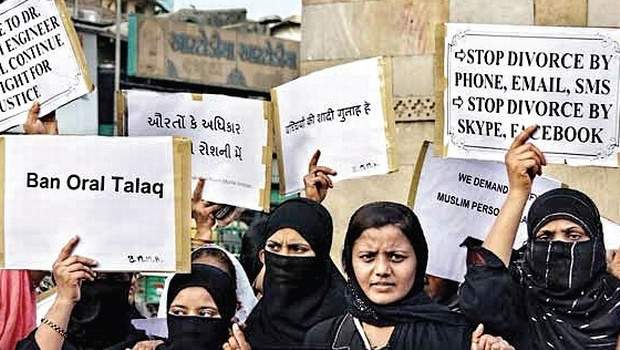
Photo credit: Indian Express
“It is not for a court to determine whether religious practices were prudent or progressive or regressive”
– Justices JH Khehar and S Abdul Nazeer
“What is bad in theology is also bad in law”
– Justice Joseph Kurian
“Triple talaq is manifestly arbitrary and therefore violative of the fundamental right contained under Article 14”
– Justices Rohinton Fali Nariman and Uday Umesh Lalit
By a majority decision of 3:2, a constitutional bench of the Supreme Court today declared the practice of instant triple talaq among Muslims as “manifestly arbitrary”, “void”, “bad in law” and “unconstitutional”.
Justices JH Khehar (chief justice) and S Abdul Nazeer held that the practice of triple talaq (talaq-e-biddat) enjoyed the status of a fundamental right as it came under protection of Article 25 of the Indian Constitution (Right to Freedom of Religion).
Justice Kurian Joseph set aside the practice on the ground that it was against the teachings of the Quran.
Justices RF Nariman and UU Lalit held that it violated Articles 14 (Right to Equality) of the Constitution.
Urging Parliament to enact a law to deal with the issue, Justice Khehar barred Muslim men from pronouncing instant triple talaq for next six months within which time he implored the political parties to shed their difference and bring in a new law. He added that once the legislation process is initiated, the bar on instant triple talaq will continue till the enactment, failing which the injunction will cease to be operative.
The major political parties have welcomed the verdict saying it will empower Muslim women.
“Judgment of the Hon’ble SC on Triple Talaq is historic. It grants equality to Muslim women and is a powerful measure for women empowerment,” Prime Minister Narendra Modi tweeted.
Here, in summary, are the justices in their own words, culled out of the 395 page judgment:
“It is not for a court to determine whether religious practices were prudent or progressive or regressive”.
“Despite the decision of the Ahmed Rashid Case on the subject of talaq-e-biddat [triple talaq] by the Privy Council, the issue needs a fresh examination, in view of the subsequent developments in the matter…
“All the parties were unanimous that despite the fact of talaq-e-biddat being considered sinful, it was accepted among Sunni Muslims belonging to the Hanafi school, as valid in law, and has been in practice among them…
“It would not be appropriate for this court to record a finding whether the practice of talaq-e-biddat is, or is not, affirmed by ‘Hadiths’, in view of the enormous contradictions in the ‘hadiths’ relied upon by the rival parties…
“Talaq-e-biddat is integral to the religious denomination of Sunnis belonging to the Hanafi school. The same is part of their faith, having been followed for more than 1400 years, and as such has to be accepted as being constituent of part of their ‘personal law’…
“The contention of the petitioners, that the questions/subjects covered by the Muslim Personal Law (Shariat) Application Act, 1937, ceased to be ‘personal law’, and got transformed into ‘statutory law’ cannot be accepted and is accordingly rejected…
“Talaq-e-biddat does not violate the parameters expressed in Article 25 of the Constitution. The practice is not contrary to public order, morality and health. The practice also does not violate Articles 14, 15 and 21 of the Constitution, which are limited to state actions alone…
“The practice of talaq-e-biddat being a constituent of ‘personal law’ has a stature equal to other fundamental rights, conferred in Part III of the Constitution. The practice, therefore, cannot be set aside, on the ground of being violative of the concept of constitutional morality, through judicial intervention…
“Reforms in ‘personal law’ in India, with reference to socially unacceptable practices in different religions have come about only by way of legislative intervention. Such legislative intervention is permissible under Articles 25(2) and 44 read with Entry 5 of the Concurrent list, contained in the Seventh Schedule of the Constitution. The said procedure alone needs to be followed with reference to the practice of talaq-e-biddat, if the same is to be set aside…
“International conventions and declarations are of no avail in the present controversy, because the practice of talaq-e-biddat is part of ‘personal law’ and has the protection of Article 25 of the Constitution…
“It is not for a court to determine whether religious practices were prudent or progressive or regressive. Religion and ‘personal law’, must be perceived, as it is accepted, by the followers of the faith. And not how another would like it to be (including self-proclaimed rationalists, of the same faith). Article 25 obliges all Constitutional courts to protect ‘personal laws’ and not to find fault therewith…
“The judiciary must therefore always exercise absolute restraint, no matter how compelling and attractive the opportunity to do societal good may seem…
“We understand that it is not appropriate to tender advice to the legislature to enact law on an issue. However, the position as it presents in this case seems to be a little different… The stance adopted by the Union of India supports the petitioners; cause. Unfortunately, the Union seeks at our hands what truly falls on its own…
“We would therefore implore the legislature to bestow thoughtful consideration to this issue of paramount importance. We would also beseech political parties to keep their individual political gains apart, while considering the necessary measures requiring legislation…
“Till such time as the matter is considered, we are satisfied in injuncting Muslims husbands from pronouncing talaq-e-biddat… The instant injunction in the first instance will be operative for a period of six months and a positive decision emerges towards redefining talq-e-biddat as one or alternatively if it is decided that the practice of ‘talaaq-e-biddat’ be done away altogether, the injunction will continue, till legislation is finally enacted. Failing which the injunction will cease to operate.
“What is bad in theology was once good in law but after Shariat has been declared as the personal law, whether what is Quranically wrong can be legally right is the issue to be considered in this case. Therefore the simple question that needs to be answered in this case is whether triple talaq has any legal sanctity…
“This court in Shamim Ara v. State of UP and Another has held, though not in so many words, that triple talaq lacks legal sanctity. Therefore, it terms of Article 141, Shamim Ara is the law that is applicable in India…
“[Quranic verses on divorce are] instructive verses and do not require any interpretation. They are clear and unambiguous as far as talaq is concerned. The Holy Quran has attributed sanctity and permanence to matrimony. However, in extremely unavoidable situations, talaq is permissible. But an attempt at reconciliation and if it succeeds, then revocation are the Quranic essential steps before talaq attains finality. In triple talaq, this door is closed, hence, triple talaq is against the basic tenets of the Holy Quran and consequently it violates Shariat…
“The above view has been endorsed by various High Courts, finally culminating in Shamim Ara by this court which has since been taken as the law for banning triple talaq… It has to be particular noted that [the] conclusion by the bench in Shamim Ara is made after ‘respectful agreement’ with Jiauddin Ahmed (Guwahati High Court] that ‘talaq must be for a reasonable cause and be preceded by attempts at reconciliation between the husband and the wife by two arbiters – one from the wife’s family and the other from the husband’s; if the attempts fail, talaq may be affected’…
“Shamim Ara has since been understood by various high courts across the country as the law deprecating triple talaq as it is opposed to the tenents of the Holy Quran. Consequently, triple talaq lacks the approval of Shariat…
“Therefore, I find it extremely difficult to agree with the learned chief justice that the practice of triple talaq has to be considered integral to the religious denomination in question and that the same is part of their personal law….
“[T]his court has done its part in Shamim Ara. I expressly endorse and re-iterate the law declared in Shamim Ara. What is said to be bad in the Holy Quran cannot be good in the Shariat, and in that sense, what is bad in theology is also bad in law…”
“Triple talaq is manifestly arbitrary and therefore violative of the fundamental right contained under Article 14 of the Constitution”
“Triple talaq alone is the subject matter of challenge – other forms of talaq are not. The neat question that arises before this court is, therefore, whether the 1937 Act [Muslim Personal Law (Shariat) Application Act, 1937) can be said to recognize and enforce the rule of law to be followed by the courts in India and if not whether Narasu Appa (Supra) which states that personal laws are outside Article 13(1) of the Constitution is correct in law…
“Marriage in Islam is a contract, and like other contracts, may under certain circumstances, be terminated. There is something astonishingly modern about this – no public declaration is a condition precedent to the validity of a Muslim marriage nor is any religious ceremony deemed absolutely essential, though they are usually carried out…
“[T]he 1937 Act is a pre-constitutional legislative measure which would fall directly within article 13(1) of the Constitution of India…
“[A]ll forms of talaq recognized and enforced by Muslim personal law in India are recognized and enforced by the 1937 Act. This would necessarily include triple talaq when it comes to the Muslim personal law applicable to Sunnis in India. Therefore it is extremely difficult to accept the position of the All India Muslim Personal Law Board [to the contrary]…
“As such we have concluded that the 1937 Act is a law made by the legislature before the Constitution came into force, it would fall squarely within the expression “laws in force” in Article 13(3)(b) and would be hit by Article 13(1) if found to be inconsistent with the provisions of Part III of the Constitution, to the extent of such inconsistency…
“It has been agued somewhat faintly that triple talaq would be an essential part of the Islamic faith and would, therefore, be protected by Article 25 of the Constitution of India….
“[I]t is clear that triple talaq is only a form of talaq which is permissible in law, but at the same time, stated to be sinful by the very Hanafi school which tolerates it…
“According to Javed (supra), therefore, this would not form part of any essential religious practice. Applying the test stated in Acharya Jagdishwarananda (supra) it is equally clear that the fundamental nature of Islamic religion, as seen through and Indian Sunni Muslim’s eyes, will not change without this practice…
“We have already seen that though permissible in Hanafi jurisprudence, yet, that very jurisprudence castigates triple talaq as sinful. It is clear, therefore, that triple talaq forms no part of Article 25(1)…
“And this brings us to the question as to when petitions have been filed under Article 32 of the Constitution of India, is it permissible for us to state that we will not decide an alleged breach of fundamental right, but will send it back to the legislature to remedy such a wrong…
“It is at this point that it is necessary to see whether a fundamental right has been violated by the 1937 Act in so far as it seeks to enforce triple talaq as a rule of law in the courts in India…
“It is clear that this form of [triple] talaq is manifestly arbitrary in the sense that the marital tie can be broken capriciously and whimsically by a Muslim man without any attempt at reconciliation to save it. This form of talaq must, therefore, be held to be violative of the fundamental right contained under Article 14 of the Constitution…
“In our opinion, therefore, the 1937 Act in so far as it seeks to recognize and enforce triple talaq is within the meaning of the expression “laws in force” in Article 13(1) and must be struck down as being void to the extent that it recognizes and enforces triple talaq. Since we have declared Section 2 of the 1937 Act to be void to the extent indicated above on the narrower ground of it being arbitrary, we do not find the need to go into the ground of discrimination in these cases…”
Read the full judgement.
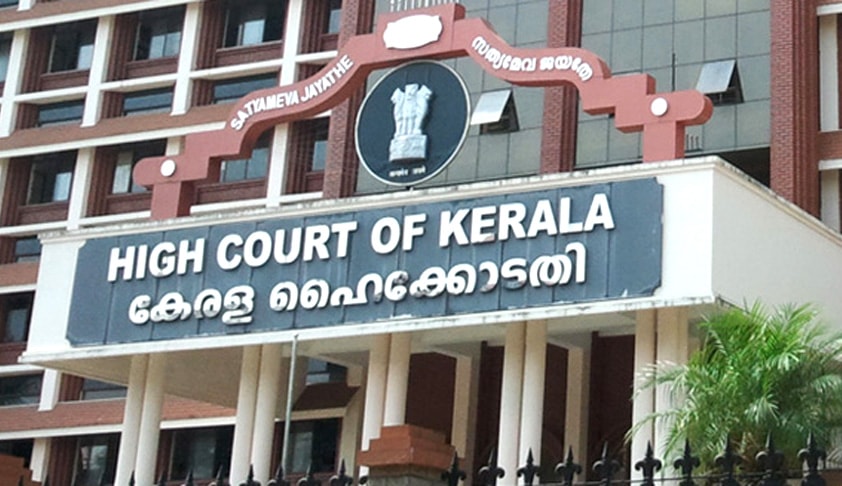
The Hindu Aikya Vedi (HAV) had moved the court against the building of the Mahabali memorial shrine at the famous Vamana Murti temple at Thrikkakkara in Ernakulam district. The temple is among the few in the country where Vamana, believed to be an incarnation of Hindu god Vishnu, is worshipped. The Sangh Parivar outfit was arguing that since Mahabali is considered a demon while Vamana is considered a god, it is wrong to have a shrine for Mahabali in the Vamana temple complex.
But the HAV received a setback as High Court refused to intervene in the issue. The court also asked the Kochi Devaswom Board to submit an explanation, reported Deshabhimani daily newspaper.
Sangh Parivar leaders have in the past courted controversy by coming out against the celebration of Onam. There are multiple explanations regarding the historical origins of Onam, and various myths – corresponding to various communities – are associated with the festival. The most popular myth is that Onam commemorates the return of the Asura King Mahabali, who was pushed to the netherworld by Vamana, to visit his people.
Last year on the eve of Onam, BJP all India President Amit Shah extended greetings to the people on the occasion of “Vamana Jayanti”, triggering widespread outrage among Malayalis. Sangh Parivar ideologues such as HAV leader KP Sasikala have for many years claimed that Onam is the celebration of the victory of Vamana, and not the home-coming of the Asura King Mahabali. Sasikala has repeatedly argued that Onam, which is often considered the national festival for Malayalis, should be renamed as Vamana Jayanti.
Chief Minister Pinarayi Vijayan had lashed out against Amit Shah’s remarks.
“[Onam] is a celebration of a unity beyond any boundaries of religion and caste. Mahabali embodies the spirit of equality espoused by Onam and the myths surrounding it, which has an emotional appeal to Malayalis.”, the Chief Minister had said in a Facebook post . “Onam is the imagination that there was a time in the past without lies and malice, filled with goodness and prosperity. Mahabali who is imagined to be the creator of such a time was pushed down to hell by those who were intolerant towards such an egalitarian society. Insulting the idea of Mahabali is an insult to all Malayalis who dream of the dawn of such an egalitarian age.”
Courtesy: Newsclick.in
“The myths of Mahabali and Onam are sources of inspiration for all progressive beings striving to create an egalitarian world devoid of malice”, he added.
Manu MR, Assistant Professor of Political Science at the University College, Thiruvananthapuram, told Newsclick that the Hindutva forces’ hatred towards Onam is symptomatic of their intolerance towards alternative streams of thought in Hinduism. “The Sangh Parivar’s attempt is to create a monolithic Hinduism. As part of this agenda, the Sangh has been trying to crush every narrative other than their own Brahminical narrative”, he said.
BJP Kerala State President Kummanam Rajasekharan was the state leader of HAV before he rose to the state leadership of BJP.
The Sangh Parivar campaign against Onam has run into yet another roadblock with the High Court decision.

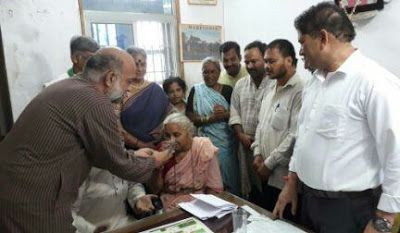
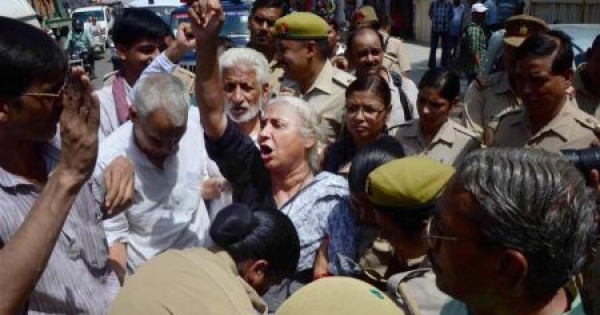
In what is being interpreted as a deliberate delaying tactic for postponing Narmada Bachao Andolan (NBA) leader Medha Patkar’s release from the Dhar jail, the Madhya Pradesh did not produce the case diary regarding her arrest under section 365, kidnapping, on Monday. In a statement issued soon after the failure to produce the case diary, NBA said, “The office of the Advocate General deliberately misinformed the Kukshi police station to produce the case diary (case No. 9029/17) on August 22, and not on August 21, the day of the hearing.” It added, “Senior advocate Anand Mohan Mathur brought to notice this delay to the court at 10:30 am and requested to proceed with the trial. The judge then asked the government lawyer to arrange the case dairy by afternoon and adjourned the hearing till then.”

Protests demanding Medha Patkar’s release
Yet, said NBA, “Till 4 pm, government lawyers didn’t produce the case diary in a clear attempt to delay the hearing in the matter”, adding, as per the information it has received, “The hearing of the case has now been rescheduled to August 23.” “This only shows the desperation of the government and every attempt at keeping Patkar in jail”, NBA said, insisting, “The governments delaying tactics are not going to dampen the spirit of our struggle. They can delay proceedings but can’t defeat us.”
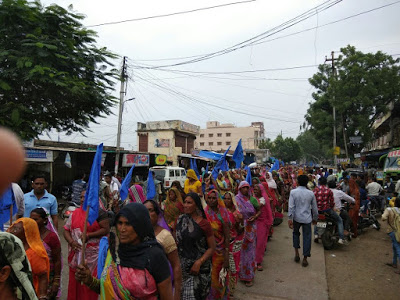
A letter writing campaign to Prime Minister was undertaken in numerous villages of Narmada Valley demanding withdrawal of all criminal cases and unconditional release of Medha Patkar, Santu, Vijay, and Dhurji, NBA activists lodged in jail since August 9th. They gave detailed picture of the incomplete and unjust rehabilitation work and asked, “will the lakhs of people be drowned without complete and just rehabilitation? Will the lives of lakhs of people be sacrificed to pay the price of Development? Will you accept the drowning of lakhs of trees and cattle in independent India ?”
A mass signature campaign to prime minister Narendra Modi has also begun. Meanwhile, protests continued across the Narmada valley for the release of Patkar and her colleagues. On August 19, 5,000 people marched to the office of the SDM, Kukshi, and submitted a memorandum detailing about the “illegal arrest” of Patkar, Santu, Vijay, and Dhurji, and asked for their unconditional release immediately.
The march was organised as part of the jail bharo andolan by NBA, challenging what it called “numerous false cases” filed by the Badwani and Dhar police against 2,500 people from different villages. “These are nothing but the intimidation and an attempt at muzzling the dissent and provoking the non-violent struggle of the people”, it added. This was followed by a letter writing campaign to the Prime Minister in the villages of Narmada valley demanding withdrawal of all criminal cases and unconditional release of Patkar and others.
The letter wondered: “Will the lakhs of people be drowned without complete and just rehabilitation in the Narmada valley? Will the lives of lakhs of people be sacrificed to pay the price of development? Will you accept the drowning of lakhs of trees and cattle in independent India?” The NBA has also asked the prime minister to take a serious note of the demands raised by the 32-year-long struggle, Narmada Bachao Andolan, and direct the Madhya Pradesh government to accept the ground-reality and complete just rehabilitation as per the NWDT Award and Supreme Court judgements of the 192 villages and one township affected from Sardar Sarovar Dam in Madhya Pradesh. Kisan Sangharsh Samit and many other organisations held demonstrations and also wrote letters to Chief Minister Shivraj Singh Chauhan with similar demands.
According to NBA, the Madhya Pradesh government has been seeking to delay Patkar’s release ever since she was arrested on August 9. “She was jailed after her release from the Indore Bombay Hospital on the same day. Since that day, the administration has wilfully delayed and also imposed a number of false charges against her including that of kidnapping government officials on the seventh day of her indefinite fast.” It was only on August 17 that Medha Patkar broke her indefinite fast.

“Last week, she was produced in the Kukshi court through video conferencing after a day’s delay on account of link failure, and she was denied bail. Even today, the government delayed the bail proceedings in the Indore High Court by not producing the case diary”, NBA said.
Even as parallel demonstrations were held for Patkar’s release by several other organizations, including the Kisan Sangharsh Samiti, reports say, the arrest of villagers‐activists — Durji (village Nisarpur), Devandra (village Nisarpur) and Vijay (village Khaparkheda) — on the basis of charges like ‘attempt to murder’ continued. In the past one week a large number of FIRs have been filed against key NBA activists on these lines.
An online petition has been floated by a Patkar fan, Kamayani M, asking the Madhya Pradesh government to immediately release Patkar and others.

Photo Courtesy: Indian Express
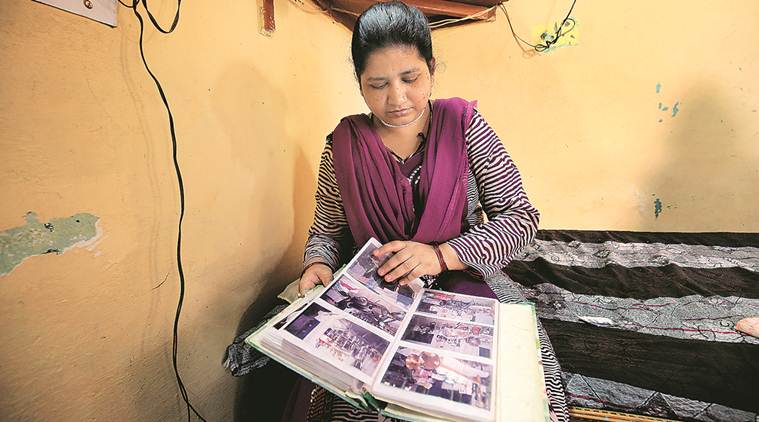
She is the woman who triggered this battle for justice, gender justice for Muslim women, Today she is 36 and Shayara Bano is battling multiple ailments following multiple abortions. Her husband of 15 years sent her a talaqnama (divorce) by post while she was with her parents at their home in Kashipur, Uttarakhand.
* Then there is the case of Ishrat Jahan is 30. Her husband uttered talaq three times over phone and allegedly took away her four children, leaving her at the mercy of her extended family in Howrah.
* Several Muslim groups including the Bharatiya Muslim Mahila Andolan (BMMA) signed a letter containing a petition titled ‘Muslim Women’s Quest for Equality’. A two-judge bench of the Supreme Court took suo motu cognisance of the petition (Justices Dave and Adarsh Goel). These three are petitioners in what is now called the triple talaq case.
Today, August 22, a five-judge bench of the Supreme Court will give its ruling on a clutch of petitions which have challenged the practice of triple talaq as “unlawful and unconstitutional”. The verdict by the bench comprising Chief Justice of India J S Khehar and Justices Kurian Joseph, R F Nariman, U U Lalit and Abdul Nazeer is to be pronounced at 10.30 am. The bench had reserved its verdict on May 18 after hearing it for six days starting May 11 during the summer vacation.
* In 1985, when the Supreme Court’s judgement in the Shah Bano case granted divorced Muslim women the right to alimony, the All India Muslim Personal Law Board, a non-governmental organisation that professes to represent Indian Muslims in all matters of their faith, shouted “Islam is under threat”. In response, Muslim women rallied to fight for their rights, especially in matters of marriage and divorce, and several women’s groups emerged from the community over the next three decades. Bebaak Collective, Awaz-e-Niswaan, Sahiyar, Muslim Mahila Manch, Pehchan, Muhim, Parvaaz Sangathan, and, more recently, Bebaak Collective Sahiyar articulated a radical politics, at one with secular and feminist causes.
During the detailed arguments that took place, advocate for Shayara Bano’s had contended: “The Muslim husband’s right to ask for divorce by uttering talaq three times in a row is completely unilateral, unguided, absolute and has no rationale. It cannot be identified with Muslim culture and is not part of Muslim law. So it is not part of religion and, hence, not part of the right to practice or propagate religion and deserves no protection.”
The entire battle for basic constitutional rights by aggrieved Muslim women had turned into an ugly one after the self-styled ‘leadership’ of the community under the All India Muslim Personal Law Board (AIMPB) — discredited on issues of gender justice — had adamantly refused to rise to the ocacsion and address the existence of a pracice, both un-Islamic and un-Constitutional that was causing immeasurable injustices to Muslim women. This coupled with the Narendra Modi government’s crocodile tears for Muslim women made matters worse.
In this context, the statement and interview of Shaista Amber, of the All India Muslim Women’s Personal Law Board exclusively to Sabrangindia that “Indian Muslim Women will Walk with the Quran in One Hand and the Constitution in the Other,” put things in sharp perspective.
The National Commission for Women (NCW) has endorsed the stand of the petitioners as also supported by the central government and demanded a ban on instantaneous triple talaq or talaq-e-bidat and polygamy in its affidavit to Supreme Court on the grounds that these practices are against the rights of Muslim women. “Triple talaq (talaq-e-bidat), nikah halala and polygamy are unconstitutional because they compromise the rights of Muslim Women (or of women who are married into the Muslim community) to their disadvantage, which is detrimental to them and their children. Therefore, these practices should be strictly prohibited,” reads the affidavit.The affidavit also adds that the Commission supports the stand taken by the Centre in the Supreme Court last month. “The National Commission is herein supporting the stand taken by the Union of India and is adapting the affidavit filed by them.”
Former Union Minister Arif Mohd Khan, who quit the Rajiv Gandhi government in 1986 to protest its stand on the Shah Bano case, described the triple talaq practice as equivalent to burying alive Muslim women. Senior counsel Kapil Sibal, who appeared for the All India Muslim Personal Law Board, however, took the stand that triple talaq was a matter of faith and the court should not interfere. Former Union Minister Salman Khurshid, who was allowed by the court to assist it as amicus curiae, told the bench that the system of instant triple talaq “cannot be justified or given legal validity”. He said the practice “was sinful but legal”, prompting one of the judges to wonder whether “something abhorred by religion can be made law by man”.
During the hearings, it was also pointed out to the court that many Islamic nations across the world, including Pakistan, Afghanistan, Egypt do not recognise the husband’s right to unilaterally divorce through triple talaq and that Sri Lanka was one of the non-Islamic countries to ban it.
Related Articles:
1. Personal Laws of All Faiths Violate Principles of Gender Equality, Why then the Sole Focus Only on Triple Talaq?
2. Modi Govt Position on Triple Talaq Determined by Sectarian Agenda Not Concern for Women’s Equality

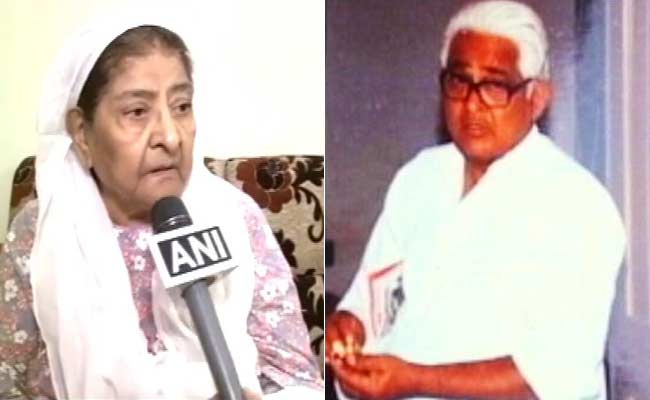
Zakia Ahsan Jafri, 78 years old Ahsan Jafri before he was brutally killed February 28, 2002
The Judgement in the Zakia Jafri Case –a criminal revision application filed by the survivor, Zakia Jafri, has been deferred. On Monday Morning, Justice Gokhani sat at 11 a.m. and asked the SIT counsel, Ratan Kodekar to be present as she wished certain c;arifications. Thereafter, after sitting again, first at 1 p.m. and then again at 2.30 p.m., counsel Mihir Desai (for Zakia Jafri) and SIT counsel, Vaidyanathan have been asked to remain present next week –at a mutually convenient date –to address the court on clarifications. Presently the date fixed is August 28 but this may be slightly altered. Judgement will be pronounced after that.
Earlier in the day, the judgement had been fixed for Orders on August 21, 2017.
Related Articles:
1. JUDGEMENT DAY, Tracing Chain of Command Responsibility for 2002: Zakia Jafri Case
Ceramic poppies from the Blood Swept Lands and Seas of Red artwork installed at St George’s Hall, Liverpool, for Remembrance Services in 2015. Peter Byrne/PA Archive/Press Association. It seems to be business as usual in the worldwide “war on terror”. The United States military is currently embroiled in many hotspots where violence, fear, and the ever present reality or threat of high explosive are the order of the day. Those conditions mean, for people at the sharp end, multiple distress. But for suppliers of weapons and military equipment, the good times – which never really went away – are back.
Consider, for a moment, just a few of the international conflicts stretching from Africa to east Asia where the US is a major player. It is increasing the use of armed drones in Syria as the war against ISIS accelerates. It remains active in Iraq’s evolving combat. Its military chiefs are working out how to persuade Trump to expand operations in Afghanistan, even as a resurgent Taliban tell him in an open letter to withdraw all American forces from the country.
It is also about to conduct a major “wargame” in South Korea, where Trump and his ally, Japan’s prime minister Shinzo Abe, seek to counter North Korea’s missile ambitions. It is providing heavy military assistance to the Philippines government as a much less comfortable ally, Rodrigo Duterte, takes on a local ISIS-affiliated movement in the southern city of Marawi. It is called on to deploy more resources in eastern Europe in face of Russia’s power, and to address the rise in paramilitary violence in the Sahel.
Such wars and rumours of wars require constant supplies, and this is where that perennial of human activity, the arms bazaar, comes in. The informative journal Defense News sums it up neatly with a report on military industries under the headline “A return to prosperity? Defense revenues climb for the first time in 5 years”.
The report lists the top hundred military companies, and in a helpful way. While highlighting businesses that may have many other interests, Defense News in this case focuses solely on their military-related activities. The results are most revealing. Take, for example, the top seven corporations with their country of origin and their defence revenues in 2016:
1. Lockheed Martin, United States: $43,468 billion
2. Boeing, United States: $29,500bn
3. BAE Systems, United Kingdom: $23,621bn
4. Raytheon, United States: $22,394bn
5. Northrop Grumman, United States: $20,200bn
6. General Dynamics, United States: $19,696bn
7. Airbus, Netherlands/France: $12,321bn
Even from such bare details, several important truths can be extracted or inferred. The first is the American dominance of the field, which is even more pronounced in that much of BAE Systems’s revenue comes from the company’s US-based activities. This leads to a second point, that all seven are transnational to varying extents. Airbus, for example, is active across western Europe, which allows it to use its clout with more governments. A third element is that these are very large outfits. Lockheed and Boeing each has annual military revenues larger than the entire GDP of Uganda, whose population is 39 million.
A fourth point is that this sheer wealth enables huge operations. These are often aided by the “revolving door” whereby senior civil servants and military chiefs who are concerned in any way with weapons development and procurement can secure very good post-retirement consultancies or even board memberships.
A fifth factor is that these companies, where their activity in relation to international arms sales is concerned, can rely on a favourable attitude from the states where their production is based. This positive outlook may extend to direct government encouragement and aid. A clear indication is a ruling which found against the Campaign Against Arms Trade (CAAT). The group had challenged the legality of the UK government’s arms sales to Saudi Arabia, where weaponry exported to Riyadh were being used in repeated bombing of targets in Yemen that had caused substantial loss of life among civilians.
**
A sixth and yet larger truth emerges, as obvious as the others yet all too frequently ignored. Major military companies actually need wars – or at least, they need very high states of tension and fear, of the kind which will guarantee increased sales potential.
The ideal in such situations, whatever the company’s apparent national status, is to sell to both sides. Just before Nato’s air-war against the Gaddafi regime in 2011, for example, French and Italian arms companies were working for the Libyan government to upgrade its aircraft and armoured vehicles. Within days these were being destroyed by Nato forces, bringing a potential double benefit: supplying Nato states with more bombs and missiles to replace those used, and replenishing the Libyan hardware after the war.
In this case, only the first part worked out well, for Libya came apart at the seams and its arms market has not so far been open to the big company deals of the good old days. But there are compensations: the condition of Libya, with its radical Islamist groups, migration pressures and other insecurities all make for an atmosphere of tension and fear. This is felt sharply across the Mediterranean, which improves the chances of higher military budgets in European states looking to protect themselves from the fruits of their own policies (see “Libya: victory, tragedy, legacy“, 3 November 2011).
Shakespeare’s line in Henry V, “now thrive the armourers”, relates to the battle of Agincourt in 1415. But it is ever topical, and in more ways than one: for armourers also thrive by flinging accusations of lack of patriotism against people who question their operations, connections, and practical consequences. The biggest difference today is scale. These huge conglomerates are protected by their colossal turnovers, formidable power, and absolute belief in the legitimacy of what they do.
It will take a great deal to change this culture. A single example makes the point. Two of the three largest military corporations, Lockheed and BAE Systems, sponsor Britain’s annual Red Poppy Appeal run by the British Legion (see “Red poppies and the arms trade“, 12 November 2014). Thus an organisation dedicated to helping the casualties of war and their families actually gets financial support from companies making money out of producing and selling weapons. Such stark contradictions need to be aired, as a step on the road to being able to say “now thrive the peacemakers”.
Courtesy: Open Democracy
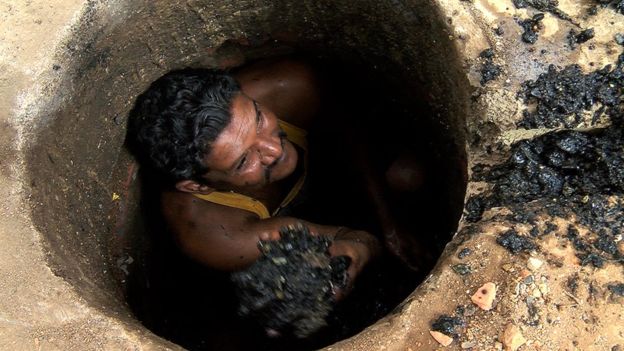
The Times of India has reported that sanitation worker Rishi Pal, 50, was the 10th victim of dangerous city drains as he tried to perform his job while cleaning the sewers. This is the tenth death in the past 35 days after he, along with three coworkers, entered a toxic gasfilled PWD sewer line in central Delhi’s Lok Nayak hospital on the afternoon of Sunday without any safety equipment. In a grim repeat of three such incidents since July 16 claiming nine lives, the labourers followed each other into the clogged, 15-foot-deep line after the previous person had stopped responding. Witnesses said Pal was the first to go inside the tank and was knocked unconscious within a few seconds. Two others are battling for life after being rescued in the nick of time.

Image: BBC
Cases under culpable homicide not amounting to murder (section 304) and attempt to commit culpable homicide (308) under IPC has been registered against the contractor, who is on the run. Teams have been formed to nab him, said Mandeep Singh Randhawa, deputy commissioner of police (central).
While ordering an PWD inquiry will take its course, the question is: whether officials in allowing the workers to enter the drain without any protective gear committed an offence ?
Join our mailing list to get the latest human rights news that matters, straight to your mailbox.
© Sabrang | All Rights Reserved