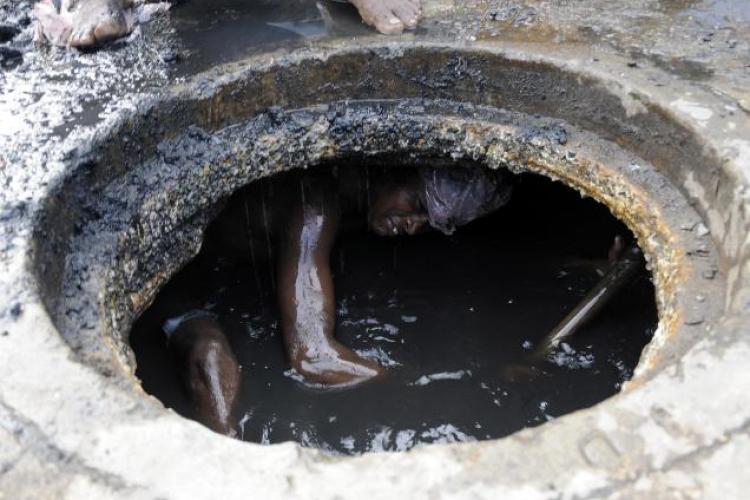
Bezwada Wilson: "Nobody takes responsibility for the deaths in sewers," sighed activist Bezwada Wilson on hearing of the deaths of four men while cleaning a tank in Vasant Kunj on Saturday.
These deaths are 'political murder', says Wilson, adding that despite his repeated petitions to the lieutenant governor and chief minister of Delhi and the National Human Rights Commission, even the Prime Minister, on the problem, the reactions were nil or lukewarm.
Wilson, a Magsaysay award winner is one of the founders and national convenor of Safai Karmachari Andolan, provides a startling statistic. He pointed out that in the past 100 days, 39 people had died across India while cleaning sewers. "This is not the first incident of the kind, just a part of regular occurrences," he told TOI. "Now Delhi government won't do anything claiming the matter falls under the LG's office. The PM too speaks on all issues but not on this."
Wilson also alleged that despite providing documents on 56 men who had died in this manner, the authorities had not identified them, so there was no question of their families getting any compensation.
"Who will take action under the Prohibition of Employment as Manual Scavengers and their Rehabilitation Act, 2013, which prohibits anyone from allowing a human to go into a sewer?," the irked Wilson asked. "The administration will simply claim that since 2013, nobody is entering sewers and cleaning has been mechanised. But the truth is not a single sewer in the country is cleared using mechanisation."
Bemoaning the fact that there is much talk about smart cities and bullet trains, Wilson contrasts this with double standards of Indians who never speak of smart sanitation "If 39 deaths in 100 days don't matter to the country, then this is one of the biggest challenges for our democracy," he declared.
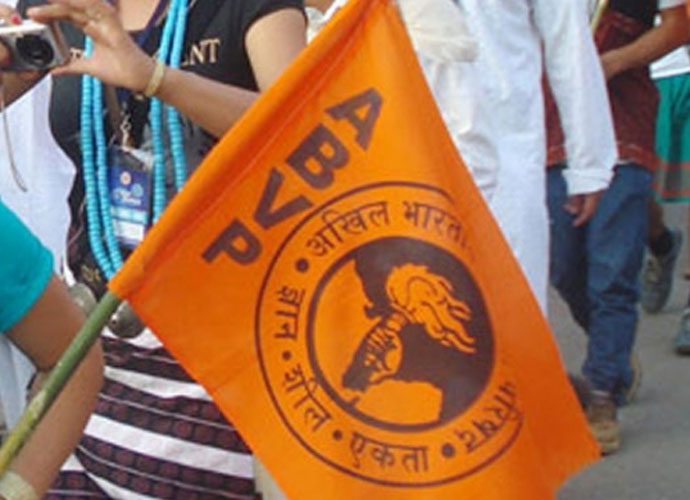
Delhi Police have filed an FIR against a student from Sri Ram College of Commerce for physically assaulting his teacher, who gave Pradeep Phogat of ABVP zero marks in the annual assessment.
Image: India Today
The principal of the college, R P Rustagi, said that Phogat got zero marks because he never attended classes. Phogat, for his part, said that he was being singled out for his association with the RSS-linked student organisation, ABVP.
The alleged incident took place on Friday near the parking area of the college. DCP (north district) Jatin Narwal confirmed that an FIR had been lodged under IPC sections 323 (voluntarily causing hurt), 341(wrongful restraint) and 506 (criminal intimidation) against Phogat, reported the Indian Express.
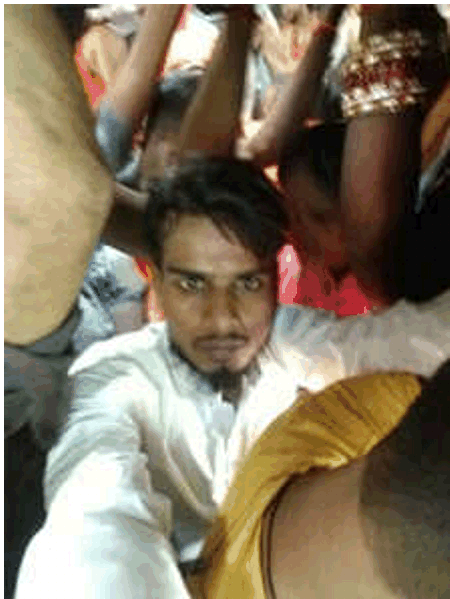
Another public lynching. Making a mockery of prime minister Naranedra Modi's words. A young Imam travelling in a train from Gaya has been attacked and pushed out of the compartment.
He adds, “There were four to five women sitting there who took mercy on me and requested them to leave me alone. They left me but then some passengers started shouting, ‘take his mobile’, ‘tear his clothes.’ I kept quiet and did not utter a single word. Had I said something my fate would have been worse than Junaid. There was only a small group that had attacked Junaid, but here where I was, the whole train would have lynched me. Everyone was shouting, ‘A Muslim has no right to sit on a seat. Get him out of here. The speed of the train was very slow at that time. They threw out my luggage and pushed me out from the emergency exit. I then somehow managed to go down two compartments ahead hanging on the window.”Gulzar Ahmad, originally from Bhagalpur, is an Imam in a mosque in Gaya. Yesterday he took a train to Bhagalpur. “When I boarded the train the compartment was quite empty. As more passengers arrived it started becoming crowded. About an hour later after departure a young man came to me and looked at me and abruptly pulled me by my collar with such a force that I fell down. As I fell others started shouting, ‘Maro, maro’ (kill him kill him).” Gulzar says.
Bharat Mata’s daughter? But the Hindutvavadi motherland produces only sons – Hindu, savarna sons – to protect their mother’s ever fragile honour.
Let us begin these reflections with a moment from Nisha Pahuja’s disturbing film the World Before Her, which tracks two young women – Ruhi, a beauty pageant contestant and Prachi, a trainer with the Durga Vahini, women’s wing of the Vishwa Hindu Parishad.
While Ruhi and her fellow participants emerge as conventional and pallid, Prachi is fierce and questioning, independent minded. But towards the end of the film, you realize that for both women (and not for Ruhi alone), this period of training was only a small window that gave them a brief glimpse of broader horizons. It was only a brief moment of excitement and hope, and what seemed like freedom, before real life – the real lives of real women – closed in on them.
Throughout the film, Prachi has been telling the film-maker that she will never get married, she will live her life as a Hindutva activist. She emphatically rejects the ordinary life of a wife and mother. But towards the end, her father declares quite explicitly that this is out of the question. She can never be a full time activist. Of course she must get married. She has a womb, do men have wombs? Her responsibility then, is to bring up children. Initially in this sequence, Prachi argues against him vehemently, verges on the insolent, but gradually she falls silent. Her expression, still rebellious, but devastated, resigned, signals to us her recognition that the daughter of the Hindu nation is only in training to be a mother. That is the highest ambition she can have.
Provided she has been born into a savarna family. Provided she follows the rules.
So who are the unruly daughters then? The recalcitrant, the wayward ones? This piece is an idiosyncratic journey across the landscape of potential and actual resistances to the Hindutvavaadi project, resistances that emerge from within, that disrupt the self-fashioning of what has come to be called Hinduism. It goes without saying that this journey is merely a bird’s eye view of a dense, complex landscape of resistances – we are just about skimming the tops of trees. The stories here are not exceptions, make no mistake about that.
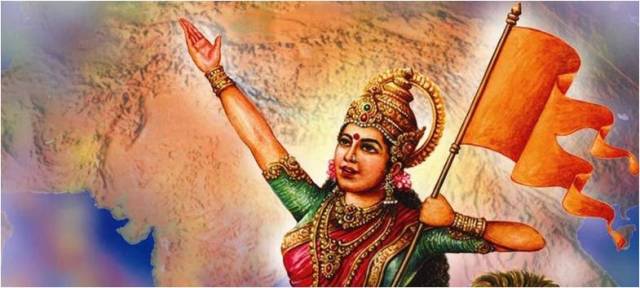
The Mother as Map Before we acknowledge the daughters, we must begin with the RSS Bharat Mata, always with the RSS bhagwa jhanda in her hand, never ever shown holding the national tricolour, but invoked nevertheless to violently challenge the patriotism of others. Behind her, a map of Akhand Bharat, stretching across Afghanistan, Myanmar, Tibet and of course, Pakistan and Bangladesh.
And yet, when it comes to maps depicting the current political boundaries of their Bharat Mata (as opposed to their delusional fantasies), the RSS can end up being…so anti-national. In 2015, the RSS mouthpiece, Organiser, used a map of SAARC countries in an article “Quest for Reintegrating SAARC” where parts of what India calls ‘Pakistan Occupied Kashmir’ were shown as part of Pakistan. Tendering a written apology, the Editor reiterated Organizer‘s commitment to the “unity and integrity of India” and explained that the issue had inadvertently used
a map of South Asia obtained from the web source that did not show certain parts of Pakistan occupied Jammu & Kashmir as Indian territory…
Interesting. A web source with a map of South Asia, freely available to the whole world, shows Indian territories ‘all wrong’, and poor Organizer made a mistake in using that map. The whole world in other words, sees one kind of map, while Indians living in India are protected from the world’s opinions of the borders of China, Pakistan and India. Magazines that depict the boundaries of India ‘wrongly’ are banned from entry or the map covered up. In such an incident with The Economist (November 19, 2011), the map of South Asia accompanying an article on water resources in the region (“Unquenchable Thirst”), was covered over by the government of India. But defiantly, The Economist added the following statement:
Missing map? Sadly, India censors maps that show the current effective border, insisting instead that only its full territorial claims be shown. It is more intolerant on this issue than either China or Pakistan. Indian readers will therefore probably be deprived of the map in this briefing. Unlike their government, we think our Indian readers can face political reality. Those who want to see an accurate depiction of the various territorial claims can do so using our interactive map at Economist.com/asianborders.
So what if you can’t control facts and images circulating globally? You can control your own citizens, especially if you are the world’s largest democracy. Earlier governments only waxed indignant over the world’s ignorance, this RSS-backed regime in May 2016 came right out with a proposal for a law that would punish those who wrongly depicted the borders of India, with imprisonment and fine. The draft Bill will also ensure that online platforms like Google will have to apply for a licence to run Google Maps or Google Earth in India. Let’s see where this goes – I predict that apart from harassing and arresting people who protest Hindutva politics, this law will leave the CEO of Google severely alone.
Good mother/Bad Mother Returning to Bharat Mata then, fair complexioned, saffron flag-bearing, ready to bear a thousand sons. Several writers have demonstrated how this image of the mother, far from being eternal, is constructed in the 19th century by the political project of Hindutva; and how this mother can only consider to be her sons, people defined by Hindutva as ‘Hindus’, never Muslims.
This mother is imagined as a body:
Do you see this map? It is not a map but the portrait of Bharat Mata: its cities and mountains rivers and jungles form her physical body. All her children are her nerves, large and small…Concentrate on Bharat as a living mother, worship her with nine-fold bhakti. (Aurobindo Ghosh, cited by Shoaib Daniyal)
If the Nation is a body – the body of one’s own mother – then it precedes its children; or is constituted by its children in Aurobindo’s vision (the “nerves, large and small”). From this image follow the implied hierarchies of birth and origin among the children (large and small, older brother and younger brother, sons and daughters). From this follows the idea that the children cannot leave the mother, for that implies amputation, the dismembering of the maternal body, an act that none can survive – neither the mother nor the children.
This mother is the mother who is the nominal head of the patriarchal household, whose power flows entirely from her maintaining the rules of patriarchy, blood purity, family hierarchies. She acts as the agent of her son or sons as long as she performs these functions. But this RSS-constructed, savarna, North Indian, Aryan vision of the mother is not the only one on this subcontinent. Sadan Jha, for instance, has drawn our attention to the ascetic Banga Mata of Abanindranath Tagore, imagined at the moment of the partition of Bengal.
Calm, reflective, a saffron clad ascetic, inward looking. She bears a book, sheaves of paddy, a piece of cloth (symbolizing the swadeshi movement) and a garland in her multiple hands. A far cry from the monochromatic RSS Bharat Mata who carries but the saffron flag, whose only passion is for Hindutva, not the Indian nation.
Then there is this mother, Kerala Maatavu, that J Devika has brought to our attention:
Mother Kerala, from a women’s magazine Shreemati (1935) is not wan and ascetic like Abanindranath’s Banga Mata – she is languorous, dreamy, looking away from the nation, away from her sons, out across the Arabian Sea with what Devika characterizes as a “wistful, Westward gaze“.
This mother’s gaze acknowledges that seas and oceans do not separate land masses, but link and connect them through trade and cultural interchanges, producing what Hoskote and Trojanow term Confluences. Kerala has for centuries had trade links with the lands across the Arabian sea, and its cosmopolitan culture long predates any 20th century ideas of cosmopolitanism emanating from that Other West – Europe. Kerala’s ties to the lands across the Arabian Sea are still stronger (in Malayalam, in its cuisines, in the Malayali imagination) than its identification with a myopic, ignorant, Hindi region-centric Hindutvavaad, which understands nothing of Kerala’s history and rich heterogeneous pasts. Typically, to take just one instance, BJP President Amit Shah termed Onam as Vamana Jayanti, turning it into a festival celebrating the Brahmin Vamana, when in fact it celebrates the righteous Asura king Mahabali, tricked by Vamana into giving up his kingdom. (More on Mahabali in a minute).
The Hindutva or Hindu nationalist project is predicated on the construction of a North Indian savarna-directed homogenization of ‘Hinduism’ – which is after all only a relatively modern late 19th C label for a wildly heterogeneous set of practices across this land-mass that came to be called India, practices that continually disrupt the Hindutva project from within.
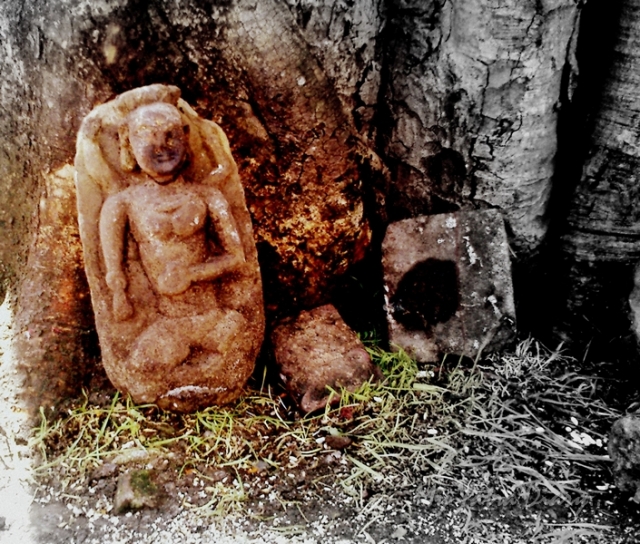
There are other, more ancient visions of female power in this land than the RSS Bharat Mata – black goddesses who predate the patriarchy normalized over centuries by Aryan migrations from the north – potent, mysterious forces that offered their devotees annihilation, blood and rage. One historical reading of such black goddesses of the southern part of the Indian sub-continent is offered by anthropologist Lynn Gatwood. In her book Devi and the Spouse Goddess, Gatwood makes the argument that the wild, independent, sexual tribal goddesses of pre-Vedic times were domesticated and tamed by Brahminical priestly classes in the process of pacification of the non-Aryan peoples of the South. They were domesticated by being “spousified” – they were installed as the wives of Aryan male gods. In addition we see the domestication of other kinds of divinities with complex histories of formation – also black, some ancient forest gods, many non-human – such as Ganesha, Ayyappa, Skanda/Subramanian – they become the children of these newly formed conjugal couples. The libidinal excess that that cannot be contained in these narratives escapes into myths such as the birth of Ayyappa from Shiva and Vishnu (in the temporary form of Mohini) – born from Vishnu’s thigh. However, the shrines to these deities continue to have an independent presence in the cosmological landscape, and attract large numbers of worshipers. The wild undomesticated goddesses are still present as living principles – Ellaiyamman, for example; and Sheetala Mata, who protects children from small pox.
The images below show two images of Ellaiyamman, one black, fierce, with blood-red lips; the other, domesticated, fair skinned, Aryan featured. Both images are taken from the same site that celebrates the goddess, and it seems Mariyamman or Kaumari, another village goddess, has also been incorporated into this deity.
As Vidya Dehejia puts it:
She is encountered in manifold guises. In a simple wooden shrine in the town of Chhatradi in the Himalayan foothills she stands as a glowing brass image, smooth and sensuous, adorned with jewels and silks. On a hilltop near Guwahati…worshipers invoke her presence in the simple form of a cleft in a natural boulder, filled with water from an underground spring…She is a bizarre fiendish figure riding a wild ass with a third eye in its flank in Tibet; in southern Madurai she is a dark stone figure concealed beneath crown, jewels, silks and flowers. And in the numerous villages of the Indian subcontinent, she is little more than a vermilion smeared stone or mound of earth. (“Encountering Devi” in Devi. The Great Goddess).
I have written elsewhere of the contemporary dancer Chandralekha’s insistence on disrupting the fertility/maternality dyad. For her, the fecundity principle is a mysterious force, over time being sought to be domesticated into the figure of the “Mother goddess”. Chandralekha demands:
“On what basis do you call them mothers, these dynamic figures of fierce power who look so calm and confident on the bull, lion, tiger; who wear weapons as ornaments in their hair, who are not at all maternal?”
(“Who are these age-old female figures?” The Economic Times, March 8, 1992)
Fertility goddess from the Indus Valley Civilization
Unruly daughters of unruly mothers? I use ‘daughters’ in the sense of secondary to the patriarchal family but necessary to its continuity; secondary to the project of Brahminism and Hindutva, the clear convergence between the two of which is emerging more clearly in this phase, with the sidelining of Savarkar’s modernist and rationalist Hindutva project, which was about consolidating and militarizing the Hindu community against Muslims (and Christians).
These ‘daughters’ are necessary in order to produce a certain Brahminical Hindu identity by being the outside, that constitutive outside that sets up the Hindutvavaadi identity. For the RSS Bharat Mata, all others than her savarna sons can only be expendable daughters.
By ‘daughters’ then, I mean the adivasis – and I use this term in its literal sense as well, ‘first inhabitants’ – to refer to both tribal peoples and Dalit Bahujan.
Let us consider some of the most fascinating revisionist accounts of popular Hindu festivals from the perspective of the Adivasi-Dalit-Bahujan Daughters of the Nation. Of course, they are not really revisionist, they simply bring to the surface older histories that have long simmered below the skin of mainstream savarna Hindu society, and are now breaking the surface of Hindutvavadi narratives from within.
Ambedkarite intellectual Kanwal Bharati reminds us that the myths behind almost all Hindu festivals involve the defeat of Asuras by Devas – whether Dussehra, Diwali, Onam or Holi. These Devas, Bharati identifies as Brahmins, and the defeat of the Asuras is the defeat of anti-Brahminical and pre-Brahminical ways of life and religious practices – in forests, and outside centres of established kingdoms. Very often this defeat is by trickery – (Mahabali by Vamana, Ekalavya by Dronacharya) – and by the co-option of willing elements in these non-Brahmin societies – Vibheeshana, Prahlada.
Bharati retells the story of of Holi to illustrate this claim. The pre-Hindu spring festival of Holi has a later Hindu mythology that draws it into the Aryan configuration of a perennial Deva-Asura confrontation. Prahlada, the pious son of the Asura Hiranyakashipu (himself pious, but too arrogant for the gods), is sought to be killed by his own father in various ways because he has become a devotee of Vishnu. One of the ways is getting Hiranyakashipu’s sister, Holika, Prahlada’s aunt, to sit with her nephew in her lap in the sacrificial fire, for she has a boon that fire will not burn her. Her boon fails, Bhakt Prahlad survives by chanting Vishnu’s name, and Hiranyakashipu is slain by Vishnu in the form of Narasimha. On Holi, effigies of Holika are burnt to symbolize this defeat. But what was it a defeat of? In Kanwal Bharati’s telling, Prahlad turns to the Brahminincal religion (Sanatan Dharma) while Hiranyakashipu and Holika continued to fight Brahminism.
A similar reversal of narrative is effected by MB Manoj, who says that reading Onam through the eyes of Dalits, the festival loses its natural association with the Malayali identity. In fact, in the words of Manoj
Onam is a black day for Dalits, a day of murder, even as it is a day of happiness for the upper castes.
From this perspective, the coming of Onam also marks the coming of the caste system and slavery to Kerala. Manoj talks about Dalit folk songs that criticise the upper-caste nature of Onam and its vegetarianism, as well as songs that criticise the temple entry proclamation of Kerala. There is a realisation among Dalits, says Manoj, that Onam is a celebration of the murder of their king by the upper castes. As part of this realisation, Dalit movements, and especially the Indian Dalit Federation, have observed hunger strikes during the Onam festival. Manoj remembers participating in one of these hunger strikes in Idukki town in Kerala during his college days. Manoj stresses that most Dalits, tribals and backward castes eat meat during Onam and their cultures fall outside the cultural milieu of Onam. Therefore, for the lower-castes, Onam is neither a cultural nor a national festival, but a festival of the upper-castes.
The presence of powerful women among these Adivasi-Dalit-Bahujan communities who must be killed, maimed, humiliated, has of course, not been unnoticed by feminists from Iravati Karve to Nabaneeta Deb Sen and Uma Chakravarty. Surpanakha for example, has been read as a woman unashamed of her own sexual desire, who was never taught that she must be passive and submissive, and must learn that lesson brutally by having her nose cut off. Uma Chakravarty in a fascinating essay, reads Valmiki’s Ramayana as a reconstruction of multiple elements of extant stories across South and South East Asia into a particular narrative whose aim is to establish a new norm over the variegated practices of the land – the Aryan, patriarchal, patrilineal order of sexuality and property. Thus, the Southern people of Lanka, where women were freer, have to be subjugated and taught proper codes of sexual conduct, the people of the forest (the vanaras) are pacified into the Aryan king’s loyal army, and Sita is instructed in the dangers that lie in wait upon crossing the limits set by the Lakshman Rekha.
( “The Development of the Sita Myth: A Case Study of Women in Myth and Literature”, Samya Shakti. 1, July 1983)
And as Kanwal Bharati reminds us, the young princes of Ayodhya while in exile, travel deep into forests establishing, by armed force, Aryan Brahminical rule over the original inhabitants – Asuras of various kinds who are killed for disturbing the austerities and ceremonies that sages insist on performing in their forests.
Or take the story of Mahishasura and Durga, which at one level, is yet another account of the defeat of Adivasis (in the broad sense in which I am using it here), by Brahmins using trickery. But a feminist reading produces another level of complexity.
Mahishasura Mardini – the slaying of Mahishasura by Durga
While the defeat of the demon Mahishasur by Durga is the occasion for one of the most important Hindu festivals, Durga Puja, Dalit Bahujan students of Jawaharlal Nehru University had been celebrating Mahishasur Puja for about five years before the big attack was launched on JNU for being anti-national in 2016. Indeed, the “demon worship” too at that point became one more factor in the ‘demonization’ of JNU as a space of incomprehensibly anti-civilizational practices. This charge reached Parliament, where the Minister for Education emotionally read out the charge of demon worship from a police report.
The journal, Forward Press had for some years been reporting on Mahishasur Puja in Eastern India by adivasis, and publishing images of Mahishasura, facing police raids and ultimately closing down its print version. The fact is that Mahishasura has for long been worshiped by Santhals and other tribal people across the swathe of the tribal belt in Central India.
Mahishasur being worshipped in Purulia, Bengal
The Asur tribe of Jharkhand of over 10,000 members is classified as a “Particularly Vulnerable Tribal Group” by the Indian government, and their language—spoken by some 7,000 individuals—is described by UNESCO as “definitely endangered.”
The Asurs, who claim ancestry from Mahishasura himself, believe that the Devi Mahatmya story of the Markandeya Purana, which describes the birth of Durga and her nine-day long battle with Mahishasura, is biased. According to the Asurs, the birth of Durga from the conjoined powers of Brahma, Vishnu and Shiva was a “crooked conspiracy” hatched because their king Mahishasura was blessed with a boon by Brahma that no man or god could kill him. Hence, the more traditionally-inclined members of Asurs sometimes even choose to completely isolate themselves and mourn Mahishasura’s death during the period of the Durga Puja.
The Santhals of Bengal too, have their own story about Mahishasura. This is how Santhal musical genius Bajar Hembrom described the origins and meaning of the Dashoi festival, which Santhals observe on the last day of Durga Puja, to Kunal Deb (translated from Bengali by Madhusree Mukerjee).
It is clear that the mythology is a deep sorrowful acknowledgement of the dispossession of adivasis from all that was once theirs – jal, jangal and jameen.
A long, long time ago there was the Har kingdom on earth. That is, a Santhal Raj. Our king was Adur. He was also called Raja Debi. He was as famed for his governance–for the way he looked after his people–as for his heroism. He could fight a tiger with his bare hands; he could alone stop the rampages of crazed elephants. His soldiers too were very fierce. Nobody could beat them in battle. Raja Indra had been crushed many times in battle against him.
But Indra too was not someone to give up. This time, in order to defeat Raja Debi and seize the Santal kingdom, he resorted to deceit and trickery. He sent the dancer Durga from his heavenly court to earth…(and) Durga had no difficulty in seducing Raja Debi with her beauty and dance.
Not long after Raja Debi got married. His queen was Durga. She started sending news to Indra about when the raja slept, when he was unarmed, when festivals preoccupied his soldiers and commanders, and so on. Indra linked these snippets of intelligence with one another to formulate a plan. He decided the day and time, and one day he imprisoned Raja Adur in a sudden attack. The soldiers were taken by surprise and could not recover from that assault. Debi’s kingdom was easily seized. Our Santal ancestors lost their king and their kingdom. Everyone scattered where they could.
The trusted guards and friends of the king started to look for their beloved monarch. Disguised as women, their weapons concealed, they wandered and danced in villages and towns, in many places, always searching. If they hear the faintest reply to their mournful song, from the imprisoned raja, out will come the weapons from under the feminine clothes of the warriors. They will fight and recover their lost kingdom. And when Raja Adur Debi returns, they will get back their Santal Raj, their lost wealth, their forests, their rivers, everything.
The real disdain for Hindu folk tales, oral ballads and other practices of many, many communities of believing Hindus is shown by the political face of the Hindutvavaadi project. Hindutvavaad is shamed and embarrassed by the glorious pagan aspects of Hinduism, and the refusal of Hindu practices to be tamed into the pallid, rigid North Indian upper caste version that is the basis of the Hindu nationalist project.
Now, the role of Durga here as a mere ‘seductress’ makes the story more complicated. Who is this Durga? Is this the same deity worshipped by savarna Hindus? Perhaps not.
A feminist reading must take into account two elements – the Durga/Kali image as well as the prostitute image.
On the first aspect, Mrinal Pande writes:
It is instructive that neither side denies that Durga is a powerful symbol of non-conformism. She is non-submissive – she will not subordinate herself to a male deity, and she also excels at what is deemed an exclusive male occupation, fighting in battle. What is also noteworthy is that for all her heroic exploits described in both local myths and classics, Durga never lends her power to the male gods of the mainstream pantheon. It is they who lend her their arms like the chakra (Vishnu), trident (Shiva), bow and arrow (Vayu) and so on. They give up their inner strength or fire to create her, and in doing so, surrender their potency to her…
Durga’s historical origins are embedded firmly among the indigenous pre-Aryan cultures of India. The Vedic tradition has no goddess similar to Durga, the warrior goddess. The early Puranic references to Durga from Mahabharata’s Virat Parva (the fourth book of the epic) to the later Harivansh Purana and Vishnu Purana, also associate her with the Sabara tribals residing among the Vindhya mountains. This was initially an intractable area described as awfully hard to access – Durgen gamyate, hence the name Durga. The mountainous region with thick forests and inhabited by wild tribes and animals, was peripheral to civilised society.
It is here that the concept of Vindhyavasini Durga was born. As Kaushiki, or shedder of the chrysalis, this virgin goddess became the mother lode in time, for various powerful goddesses in the mainstream and various substrata of Indian society… …this extremely powerful, militant armed goddess arrived as Durga, the mainstream Hindu goddess of peasants and traders, only during the medieval period. She brought with her her non-Aryan habits from her tribal background and continued to disdainfully fob off efforts by divine and demon male suitors to woo her, and also to enjoy offerings of liquor (madya), meat (maans) and blood (rakt) made in her honour.
Multiple myths were created in time and began to be circulated about Durga by a string of Puranas. In Vishnu Purana, the mainstream male god Vishnu beseeches her out of the mountains and enlists her aid to kill a demon king threatening an infant Krishna. In another text, Devi Mahatmya, her help is enlisted by another male god, Brahma, who is helping Vishnu kill two demons. Durga ultimately kills the demons as Vishnu sleeps. The Skanda Purana shows that Durga is none other than Parvati, a mainstream goddess. It says that when a buffalo demon named Durga threatened the world, Shiva asked his wife Parvati – mother of four (Lakshmi, Ganesh, Kartikeya and Saraswati) – to become a warrior goddess and slay the buffalo demon. [T]he myth says Parvati killed the demon as Durga. After braving a cosmic crisis and slaying the enemy, she retained this name along with her newly-rediscovered militancy and many-armed form.
The first images of Durga – armed to her teeth – slaying Mahishasur, a semi-male buffalo, begin to be visible throughout India around the fourth century CE. Her festival held at harvest time, the precursor to today’s Durga Puja, also associated her powers of fertility with not so much the womb, but vegetation (as Shakabhari). Motherhood of the genetic sort was not her priority and as an armed warrior and protector of men and women, it became entirely appropriate that this combative Durga be kept energised with blood offerings and wine as vital nourishment for her body and soul. Thus, in many respects, the Durga of the Puranas since the very beginning negates the misty-eyed and maternally inclined Mata Rani model being defended so fiercely by bhakts today.
So Durga never gets fully domesticated as Shiva’s wife Parvati, retaining these fierce and unpredictable, untameable elements.
The second element, in the Adivasi telling that must recover Adivasi masculinity from its defeat by Brahminism, is that of Durga as a mere agent of Brahminism, a “seductress”, a prostitute, a spy. From Mrinal Pande’s account, it is clear that that the Durga of Adivasi myth refers to the general principle of female power rather than to the specific goddess worshipped as Durga.
But even this Durga was reclaimed by another set of unruly daughters, sex workers of today.
It was indignantly reported by the Minister for Education in Parliament that one of the posters for Mahishasura Puja in JNU had termed Durga as a sex worker or prostitute. (We do not know if in fact such posters exist. The Minister read out the allegation from a written complaint by the ABVP).
Be that as it may, in response, a sex workers’ union wrote the following letter to JNU students:
Dear Students of JNU, Salute! Jai Bhim! Laal salam! We will win this war against sedition! March 3rd, International Sex Workers Rights Day, Zindabad!
We write from the sex worker’s rights movement to hail your struggle and to add to the discourse you have sparked. We would like to discuss why using the term sex worker in the alleged pamphlet in JNU on Mahishasura Martydom Day is a concept fraught with the Whore Stigma. The use of the politically correct sex worker instead of the commonly used `prostitute’ does not take away from the fact that it is used to depict an insalubrious deed. The use of this term has only led to more misunderstandings of the term itself.
Sex worker is the term used by the sex worker’s rights movement in order to claim dignity to the work adults do consensually by providing sexual services for money. The sex workers use this term to give dignity to those that exchange sexual services for money but the use here is to supposedly strip the `goddess’ in this instance, of any dignity. The term since then has taken a life of its own. From a politically correct term it is now being used to describe anti-nationals, anti-goddesses even anti- patriarchy! But the thinly veiled contempt for the sex worker is huge in every utterance, from the Hindu Goddess Durga to the `anti-national’ women students in JNU…
…The sex worker rights movement would like to bring to your notice the fact that it is the randi [whore] stigma that pushes sex workers outside the rights framework, effectively cutting them off from privileges and rights supposedly accorded to all citizens irrespective of what they do for a living…
We also demand Azadi!
Azadi from discrimination, azadi from the violence of a judgemental attitude, azadi from the multiplicity of injustice meted out to sex works, Azadi from the loose use of the politically correct but deeply stigmatised use of the term sex worker.Sex workers demand Azadi from ‘Goddess’ Durga.
What the recovery of older stories that mainstream Hindu society remained unaware of, tells us, is that the domestication of the goddess and the pacification of non-Aryan peoples was never completely successful – the project of homogenizing Hinduism and subjugating pre-Aryan deities remains an incomplete project to this day. The outside keeps fracturing the boundaries of what is sought to be termed ‘Hinduism’, and the simplistic Hindutvavaadi narratives forged in the late 19th and early 20th C, with their black and white Asuras and Devas, continually come up against the challenge posed by alternative narratives that robustly survive.
Asura kings Ravana, Hiranyakashipu and Mahabali are revered as scholars and as devout, even noble figures, by otherwise devout Hindus who worship Rama and Vishnu. In Jodhpur, the town of Mandsaur considers itself to be the birthplace of Mandodari, Ravana’s wife, and about 200 families consider themselves to be descendants of Ravana. There are two temples to Ravana here, and his effigy is never burnt on Dussehra. A merchant of Mandsaur explained to a journalist:
We remember Ravana for his knowledge of all the Vedas and his devotion towards Shiva. Burning his effigy is seen as a sign of disrespect towards him and so, ‘Ravana dahan’ is never done in this town,” said Ravi Ranka, a cloth merchant in Mandsaur.
Ravana is sought to be pacified by being enshrined as a devotee of Shiva, but the narrative of a Hindutvavaadi Ramayana is sharply disrupted nevertheless.
(Shiva of course, contains within himself multitudes, and is not quite the clean living, fair-skinned Aryan god. Nor is Krishna, the dark-skinned Yadava, who is another instance of the incorporation of pre-Aryan, more sexually free elements into Brahminical Hinduism.)
Villagers of Drongiri in the Uttaranchal Himalayas, will not worship Hanuman, for he defaced the mountain they worship by breaking off an entire side of it, when dispatched to pick the herb Sanjivani to revive Lakshman.
Unruly daughters all. Into this picture of disruptions of the homogeneous Hinduism project must be brought also Pootana, a bad mother, the Asura woman who tried to kill the baby Krishna with milk from her poisoned breasts. The baby suckles her life out of her, and her body is cut into many pieces and burnt outside Gokul. While her body was burning, the fragrance of agar filled the air. Because the Lord himself had fed on her milk, she was redeemed. The good son who can bring about the salvation of his wayward or wicked mother by killing her is another fascinating recurring image – Renuka and Parashuram spring to mind. But about Pootana what is remarkable is that other texts such as the Garga Samhita and Brahma Vaivarta Purana reveal her to have been the daughter of Mahabali in a previous birth, seeking revenge for the treacherous murder of her father by Vishnu, of whom Krishna is an avatara. Such counter narratives seek to redeem Asura ‘wickedness’ and refashion Asuras as characters with more complex motivations than simply evil hating the good.
Bharat Mata in the hands of the RSS is merely a sly and deadly weapon in the armoury of Hindutva, as is the cow. When they drop off from the the saffron banner bearing their names, the mother in everyday life is the woman abandoned in Vrindavan or among the teeming millions at the Kumbh Mela by her devout and dutiful sons; and the cow that pathetic beast roaming the streets of cities eating plastic; when she dies, her devout sons will not touch her carcass, but violently compel the Dalit, that unwanted expendable daughter of Bharat Mata, to lift it out of their sight.
But this Bharat Mata is a mere cardboard cutout, and the millions of living, breathing forces that challenge her erupt from out of the space sought to be labelled Hinduism. These unruly daughters are not only the Adivasi-Dalit-Bahujan who have continually refused to be integrated into mainstream Hinduism, but they are also the 21st C urban rebels.
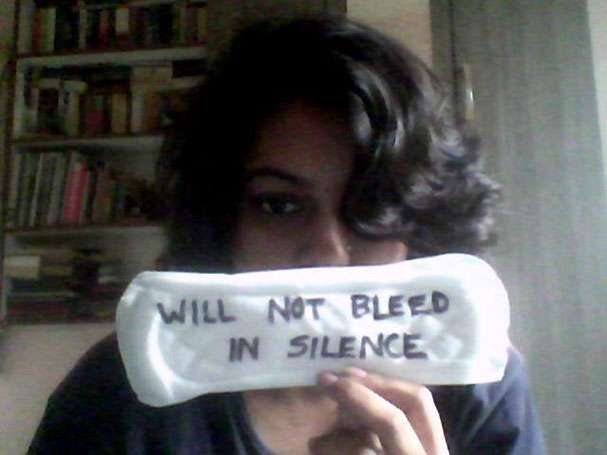
The women of Pinjra Tod (Break the Cages) who struggle for a safe campus, challenge nationalism, and explicitly reject the pressure to be Bharat ki Mata.
These are just two examples of the million mutinies across this land today.
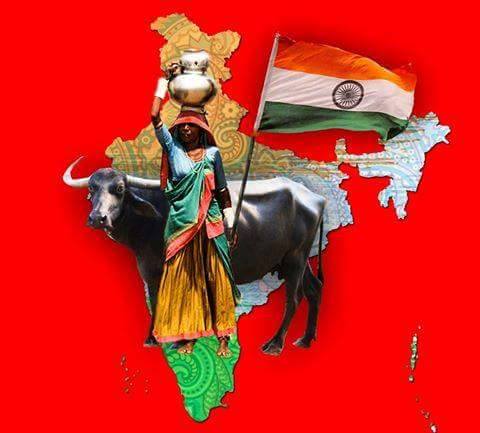
This, finally, is the image I conclude with, artist Lal Ratnakar’s Bharat Mata – simultaneously the Mother whose proud calm gaze refutes the claims of Hindutva, and an Unruly Daughter – claiming freedom for herself as much as for the Mother.
Or in Pinjra Tod‘s words – freedom from the Mother, freedom for the Mother
Ma se Aazadi, Ma ki Azadi.
There she stands, a dark-skinned, straight-backed, Dalit-Adivasi rural woman, accompanied by the black buffalo, not the sacred cow, claiming the Nation for unruly daughters and unruly nature.
Whether rejecting the Nation altogether or reclaiming it from the RSS Bharat Mata, these unruly daughters remind us that the Nation does not precede its people, but is shaped by them.
Based on lectures delivered at School of Women’s Studies, Jadavpur University, Kolkata (April 2016), South Asia Research Institute, Australian National University, Canberra (November 2016) and for an event organized by Academics for Democracy, Chennai (May 2017). I am grateful for feedback, suggestions and comments received at these talks.
The Loksabha MP from Maharashtra, Raju Shetty, to hand over a note to all MPs today, urging them to join him at Jantar Mantar tomorrow to pay homage to the farmer “martyrs” of Mandsaur and to extend their support to the farmers’ demands.
Kisan Mukti Yatra (Farmers Freedom March) reaches Agra; demands that Yogi government declare loan waiver for all farmers in UP.
Yatra will reach New Delhi tomorrow.
Countrywide support to the yatra.
Kisan leaders, including Nityendra Manav, Kishan Lal Guruji, Gopalchand Arya, Rameshwar Singh Shekhawat and Vikram Yadav will also attend the public meeting at Jantar Mantar.
All India Co-ordination Committee of Agitating Farmers appeals to all MPs: before going to Parliament, come to Jantar Mantar which is just 5 minutes away to extend your support to the farmers’ demands and to pay homage to the “martyrs” of Mandsaur.
The Kisan Mukti Yatra (Farmers Freedom March) which started from Mandsaur in MP on July 6 will be reaching Jantar Mantar in New Delhi tomorrow. On entering Uttar Pradesh on Sunday, the yatra was joined by the Kisan Adhikar Yatra which was launched in UP. The yatra will travel through Haryana on Monday and thousands of farmers led by kisan leaders from different states will enter the nation’s capital to highlight their two main demands: waiver of all loans to farmers, fair price for farm produce.
On Sunday the Yatra proceeded from Bishangarh. The yatris were received at Ladakbaas and Pavta by local kisan leaders. Thereafter they reached Kotputli where a public meeting was held. Addressing the gathering, Yogendra Yadav said in an appeal to all MPs: “When representatives of suffering farmers from across the country would be at Jantar Mantar to press their demands and pay homage to the six farmer “martyrs” of Mandsaur, our MPs will be inside Parliament just 5 minutes away deliberating over how best to serve the people. There are many MPs who have themselves struggled for farmers demands; many see themselves as well-wishers of farmers. So, the least the farmers will expect from the MPs is that they come to Jantar Mantar which is nearby, bow before the farmers who feed the nation, understand their problems and demands, pay homage to the “martyrs” of Mandsaur and help strengthen the movement to save agriculture, farmers and the nation”.
At Alwar, the kisan leaders addressed the media. The co-ordinator of the All India Farmers’ Co-ordination Committee, VM Singh said that only those will rule the country who ensure loan waivers to farmers and fair price for farm produce. He demanded that the Yogi government should declare full loan waiver for all farmers in UP.
Dr Suneelam deplored the fact that farmers have to face lathi charge and even bullets every time they take to agitation. He demanded that in all future cases of firing on farmers the policemen responsible must be charged with murder. He also called for a law prohibiting the use of bullets against farmers’ agitations.
While condemning the arrest of farmers from Tamilnadu who were agitating outside the PMO, the spokesperson of the Bharatiya Kaisan Union, Gora Singh, said sooner or later the Prime Minister will have to talk to the farmers.
While talking to the media, the general secretary of the Bharatiya Kisan Mahasabha, Raja Ram Singh said the Prime Minister should break his silence over the police firing on farmers in Mandsaur.
The Kisan Mukti Yatra has been launched by kisan leaders from 15 states across the country.
Recalling the police firing at Mandsaur, remembering the heritage of the Bardoli and Kheda struggles, the Kisan Mukti Yatra has embraced the dispossessed farmers of Narmada, the adivasi women of Vyara and the Koonch Yatra of Mehsana’s Dalit organisations.
The Yatra which started from Mandsaur on July 6 will reach Jantar Mantar on July 18 after traversing six states en route. Thousands of farmers will then sit on an indefinite dharna at Jantar Mantar, supported by over 200 farmers organizations from all over India.
Widespread speculation, even controversy had surrounded the visit of the then first Indian President under NDA I (Atal Behari Vajpayee) rule to strife torn Gujarat in August 2002. Kalam wrote about this visit extensively in his book “Turning Points” released in June 2012.
Image: PTI
The late Indian president writes about this fall-out when he recalls his visit to the state of Gujarat after the 2002 carnage. He states that the then Prime Minister AtalBihari Vajpayee appeared to be not keen on President APJ Abdul Kalam’s official visit to the state but he recalled the message he had given India and the world at the end of the two day tour. “I expressed my thoughts through a statement in which I the need for an intensified movement to completely communal and other forms of strife and bring about unity of minds.”
The former President in the book recalled this painful period when then chief minister of the state NarendraModi was with him, every step of the tour. Kalam said, “my mission was not to look at what had happened,not to look at what was happening,but to focus on what should be done”.But at the ministry and bureaucratic level,it was suggested that he should not venture into Gujarat at that point of time. He also said that the he was first advised not to go. “One of the main reasons was political. However,I made my mind that I would go and preparations were in full swing at RashtrapatiBhavan for my first visit as president,” he said. “The prime minister,AtalBihariVajpayee,asked me only one question, ‘Do you consider going to Gujarat at this time essential?’
“I told the PM,’I consider it an important duty so that I can be of some use to remove the pain,and also accelerate the relief activities,and bring about a unity of minds,which is my mission,as I stressed in my address during the swearing-in ceremony.”
Kalam described the visit when he had released the book in 2012, “I visited 12 areas – three relief camps and nine riot-hit locations where the losses had been high. NarendraModi,the chief minister,was with me throughout the visit. In one way,this helped me,as wherever I went,I received petitions and complaints and as he was with me I was able to suggest to him that action be taken as quickly as possible.”
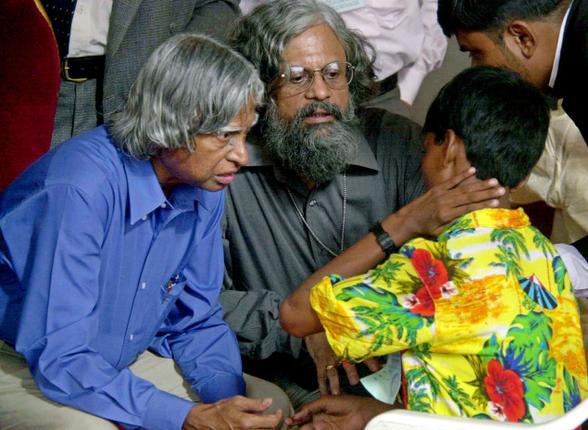
Recalling an incident during one of his visits to a relief camp,Kalamwrites,”A six-year-old boy came up to me,both my hands and said,’Rashtrapatiji,I want my mother and father.’ I was speechless. There itself,I held a quick meeting with the district collector. The chief minister also assured me that the boy’s education and welfare would be taken care of by the government.”
“While I was in Ahmedabad and Gandhinagar,people from all sections of society wished to talk to me and express their and views personally. In one such gathering,nearly citizens of Ahmedabad surrounded me. The interaction was in Gujarati and a friend of mine translated. I was asked about fifty questions and received 150 petitions.
“My visit to two important places in Ahmedabad was indeed significant,particularly in the light of the riots. I called on PramukhSwamijiMaharaj at Akshardham where he welcomed me. I discussed with His Holiness the mission of achieving unity of minds and bringing a healing touch to Gujarat,which has given to the nation great human beings like Mahatma Gandhi,SardarVallabhbhai Patel and Vikram Sarabhai.”
Kalam also visited Sabarmati Ashram,where he met many ashramites and saw the agony writ large on their faces,even they mechanically carried out their normal chores.
“I witnessed similar sentiments at Akshardham as well. As I was wondering why,Irealised that both these institutions,virtue of their inherent love and respect of human beings and their spiritual environment,work to bring happiness,and progress to society and could therefore not accept a situation of inflicting avoidable pain.
“I say this because in our land,with its heritage of a evolved civilization and where great men were born and stood tall as role models for the entire world,communal riots with their attendant tragedy are an aberration that should never happen.”
There was some controversy too, around APJ’s visit to Gujarat in 2002.
Internally displaced persons and survivors staying at the largest relief camp, Shah-e-Alam accused the state government of changing his itinerary at the last minute.Unhappy that President A P J Abdul Kalam did not visit them during his trip to Ahmedabad, inmates of the Shah-e-Alam relief camp went hungry on Monday.
The over 4,100 inmates — mostly from the riot-hit NarodaPatia area — protested against the arrest of their camp organiser Sharif Khan Pathan and the government's "evil designs" to keep the camp off the President's itinerary.
What happened in Baduria and Basirhat of West Bengal is a warning. What is happening in Darjeeling is a warning. What is happening in Jammu and Kashmir is a warning. When people are getting lynched for their food choices, it is a warning. What is happening to dalits, adivasis and other minorities in present day India is a warning. Can you read the writing on the wall?
It is alarming. India is sitting on a tinder box. Any day it can explode, inflaming the whole nation. It is time that saner people came out of their comfort zones and did something. Many people say I’m helpless. Many people blame it on the political parties. Many people say I’m not a political activist, what can I do? No, it’s not the time for forsaking India. It’s not the time for apathy. It’s time that everyone started doing whatever in their capacity to save India from a grave danger that’s lurking in the dark. When political parties, except for the right wing fascist Sangh Parivar and its political off shoot Bharatiya Janata Party (BJP), are in deep slumber it is time for people to step up.
During freedom struggle Gandhiji asked everyone to drop whatever they are doing and plunge into freedom struggle. I would say it was not a smart move, but it had it’s political impact. But it left many people without good education and knowledge to earn a livelihood. Finally when freedom came it also made many people disenchanted.
Now we have come to such a stage that we have to launch a second freedom struggle. Now people don’t have to leave their jobs or their studies. They just have to donate an hour for the well being of the country . On top of whatever everyone is doing, donate just one hour for the communal harmony of India. One hour is a bench mark. You can donate more or even just five minutes of your time a day. This can be spent in any meaningful social work that anybody can do. From a five year old child to a 90 year old elder citizen should be able to take part in this endeavor. While spending this hour people will be reflecting why they are doing it, where the country is headed, is this the direction the country should go.
Some Activities that we can do in this one hour or five minutes.
Blood donation camps. Sharing our bloods will make us realize that we are all brothers and sisters.
Community kitchens or food packet distribution to the needy
Know your neighbor. Spend some time with your neighbours to know about them more deeply and intimately. This can create communal amity.
Film screening on communal harmony
Poetry reading on communal harmony and social integration
Cultural Programmes
Seminars, workshops on communal harmony and social integration
Protest gatherings, rallies
Petition campaigns
Literary/painting workshop for children and college students on communal harmony
Spend time with disabled people, elderly people
Planting of tree saplings for a better India
Reviving/protecting a water body to protect our lives
Inter caste/inter religious food festivals to create communal harmony
Well, this is small list I just scribbled down. There is no end to creative actions that can bring peace, justice and communal harmony to India. We can build a better India. Let’s start dreaming and working together.
Binu Mathew is the Editor of www.countercurrents.org. He can be reached at editor@countercurrents.org
The ABAP will induct dalits as Naga sadhus in the Ardh Kumbh, which is scheduled to be held in Allahabad in January-February 2019.
Lucknow: The Akhil Bhartiya Akhara Parishad (ABAP), the apex body of saints and seers, has decided to ordain dalits as Naga sadhus.
The ABAP will induct dalits as Naga sadhus in the Ardh Kumbh, which is scheduled to be held in Allahabad in January-February 2019.
The timing of this coincides with the general elections and is apparently designed to consolidate the BJP’s dalit outreach.
ABAP president Mahant Narendra Giri, who is also the head of the Niranjani Akhara, confirmed that the ceremony for ordaining dalits into the Naga cult will take place in the 2019 Ardh Kumbh. “It is going to be a historic moment and all the 13 major Akharas have agreed on this,” he said.
Till now, only those belonging to upper castes, including brahmins, kshatriya and vaishyas, were ordained as Naga sadhus after a tedious process. Lower castes and dalits, as a tradition, were not included into the cult.
“If dalits and members of other lower castes are willing to lead the difficult life of a Naga sadhus, we have no problem in bringing them into the cult. In fact, we feel that this will put an end to caste divides,” he said.
The opening of doors for dalits is a major development in the world of seers.
Mahant Pradeep Acharya, a well-known seer in Lucknow, said, “This is a landmark in the history of Hindu religion which has been carried forward by upper castes. It signals the changing times and also the acceptability of all castes in the religion. We have come a long way from the days when dalits were not even allowed to enter temples.”
Mahant Divyagiri, the first woman priestess of the Mankameshwar temple in Lucknow, also welcomed the move and said that it would give a sense of belonging to the dalit community.
However, the BJP denied that the decision to ordain dalits as Naga sadhus had any political overtones.
BJP general secretary Vijay Bahadur Pathak said, “This decision is taken by the Akhara Parishad and there is no politics behind it. The timing of the ceremony may happen to coincide with the general elections but we have nothing to do with it. The BJP since the past several years, has been welcoming dalits into the party.”
The Kumbh Mela, incidentally, is known for ceremonies related to ordaini-ng of Naga sadhus. The ceremonies that include shaving of head and performing one’s own post-death ritual to signal alienation from worldly matters attract huge crowds. The highlight of the mela, which is held every six years, is the ceremony that heralds the alienation of Naga sadhus from the civilisation.
After being ordained, the Naga sadhus live in clusters called Akharas and shun interaction with the society, except during the Kumbh Mela. They rem-ain naked and carry a trident with them. The Naga sadhus practice celibacy to escape from the cycle of birth and death and to attend salvation.