
As MP Court Acquits 9 in 2013 Mass Arson Case over ‘Cow Slaughter Case’, Need for Law Against Mass Crimes, Critical Need for a Law that Defines Mob Violence
Representation Image
Violence over cow slaughter rumour: MP court acquits nine in rioting case
In a 2013 case, social activist Anurag Modi had moved the apex court, alleging that former BJP minister Kamal Patel and his son Sudip had instigated the riots with an eye on the Assembly elections.
Nine persons accused of burning houses and shops belonging to Muslims following a rumour about cow slaughter in Madhya Pradesh’s Khirkiya tehsil in 2013 have been acquitted by a trial court in Harda district, on ground of the ‘absence of prosecution witnesses who had fled’. Ironically, the acquittals in one of the 12 cases of rioting in the Chhipabad Police Station area has come days before the hearing in the Supreme Court of a petition alleging that the police did not properly investigate the riots. Around 50 Muslims lost their homes and shops on September 9, 2013, in Kheda and Pahatgaon villages as rioters took to the streets accusing Muslims of slaughtering a cow. The autopsy report said the animal died of consuming polythene bags.
Social activist Anurag Modi had moved the apex court, alleging that former BJP minister Kamal Patel and his son Sudip had instigated the riots with an eye on the Assembly elections. He had moved the SC after the Madhya Pradesh High Court rejected his petition. Investigating Officers have been asked to appear in the SC on July 17.
Only last week, Special Judge Vivek Agarwal acquitted nine of the 12 accused, observing that most prosecution witnesses were not present because they had fled. It was not established from the deposition of witnesses that the accused committed the crime, he said.
The complainant, Sayeed Khan had stated in his complaint: “A mob of 400 to 500 people shouting ‘Gai katne walonke haath kat do (chop the hands of cow slaughters)’ and ‘Jai Shri Ram’ entered our house and shoved a rod into the diesel tank of the tractor. They used the diesel to set vehicles and the house on fire.’’ The police, had later booked Surendra alias Tiger Gopal Singh, self-proclaimed chief of Gauraksha Commando Force, and 11 others under charges of rioting, trespass and arson.
When he was examined in court, Sayeed said he did not know the accused and would not be able to identify who set the house on fire. Defence lawyer Prakash Tank, representing the accused, said that neither the police nor the prosecution was serious about the trial.
The Code of Criminal procedure, section 311, encourages the court to be the ‘eyes and ears of justice’ and intervene when the investigations have been inadequate or witnesses turned hostile. Section 311 empowers the court at any stage of any inquiry, trial or other proceedings under the Code to summon any person as a witness or examine any person in attendance, though not summoned as witness or recall and re-examine already examined witnesses. In the fames BEST Bakery case, April 12, 2004, the Supreme Court had quoted from this section and the jurisprudence around it to encourage lower courts to act in the interests of justice.
Increasingly, the absence of adequate definitions of ‘mass crimes’, arson, mob violence and lynchings, have led to demands for a law against mass crimes that defines these crimes, and puts the onus on the participants of the mob, the financiers and instigators of the mob as also local police and administrative officials when such mob violence is allowed to take place.
On July 2, a Facebook post by a Hindu teenager sparked violent communal clashes in North Parganas, which led to the death of one person and the destruction of a few police vehicles. However, amid all this, the way the news played out on social media, and the reactions it received shows that in this day and age it is becomingly increasingly difficult to separate fact from fiction. It is important also to point out that BJP and its related organisations went on an overdrive to tarnish the image not just of Muslims in Bengal but also promote false news. While party members went berserk uploading fake images on social media, its leaders came out saying that they would ensure a Godhra-like incident happens in Bengal soon. In this two-part series, Mirza Mosaraf Hossain looks at Baduria and Bashirhat separately and focus on separating facts from fiction. In the first part, we look at how things unfolded in the week following July 2 in Baduria and listen to what the locals had to say about the incidents.
There is a high chance that before July 2, you may never have heard of Baduria, a municipal town with a population of 52,000 in North 24 Parganas district of West Bengal. One Facebook post and the reactions it evoked brought national attention to this town and for all the wrong reasons. But before we start explaining what happened, let us explain the demography of Baduria. Unlike what a lot of right-wing media said, the majority population in the town is of Hindus: 55% and Muslims 45%, as confirmed by the former chairman of the municipality. It has a total of 17 Wards and according to the results of 2015 elections, there are nine councillors from TMC, one from CPI, three from BJP, one from CPIM and three from Congress. Three months back, one BJP councilor-Sukla Mondal from Araberia (Ward no 8)- joined TMC. This town has a literacy rate of about 67%.
Magurkhali village is the 17th and the last ward of the municipality. It is a village of 2,500 families, as informed by an ex-vice chairman of the municipality, Amirul Islam, who coincidentally happens to be a resident of this village. In the last election in 2015, BJP candidate Manisha Ghosh defeated Rehana Begum with a margin of 50 votes—Begum got 450 and Ghosh 500. Ghosh confirmed Islam’s claim that the village consists of a Hindu majority, and the homes of Hindus and Muslims are distributed equally across the village. A local source also confirmed that the land for the mosque of the village was given by a Hindu and till now the mosque receives various contributions in his name. What makes this even more interesting is that the house of the accused teen happens to be in front of the mosque.
Sauvik Sarkar, the 17-year-old accused, is currently enrolled in the 11th grade, pursuing Arts stream from Rudrapur Rajballav High School, half a km from his house. Here he also completed his Matriculation. He lost his mother eight years ago and he was brought up by his elder uncle and aunt. Two of his uncles are Sub-Inspectors in Bengal’s police department. Each and every villager we spoke, whether Hindu or Muslims, confirmed that his family had or have no political link, now or before. His classmates also describe him as a gentle person.
Souvik’s house
On July 2, a derogatory photo insulting Islamic sentiments was posted in his Facebook profile between 2.30 to 3.00 P.M from his village, Magurkhali. This caused an uproar among Muslims of the region. By 7 P.M, about five thousand Muslims from various places, whom the villagers of Magurkhali had never seen earlier, assembled on the school ground of Rudrapur demanding immediate action against the boy. To keep the situation under control, Tushar Singh, the present Chairman of Baduria, Bappa Mitra, the local O.C of Baduria police station, SDPO reached there with a local Muslim leader, Abdul Matin who is the General Secretary of All India Sunnatul Al Jamayat, a non-profit Political Islamic Welfare Trust. Matin pleaded all Muslims to maintain peace in the locality and by 3 am on July 3, Sauvik had been arrested.
Next day, road blockades started in the nearby villages –Ramchandrapur, Keosha, Swarupnagar by Muslims demanding severe punishment for Souvik. The mob even torched tyres on the road, tried to inflame Hindu shops but there was no serious visible rampage at these villages.
Another incident took place at Sayestanagar market of Baduria constituency on Monday afternoon where an 18-year-old Muslim boy Safiqul Gazi from Katiahat village, was attacked when he was coming from the nearby Gachha village with his friend Rejaul Gazi. “We were assaulted by 10-15 Hindus on the road on our way to home and were rebuked with slang languages. They forced us to say Jai Sri Ram and snatched our bicycle, chains and ring”, said Safiqul whose right hand was wrapped with six stitches.
At around 5 pm on the same day, about 300 to 400 Muslims gheraoed the police station asking the police to hand over the accused. When police thwarted their demand, the mob torched three police jeeps in retaliation. More than 400 people, not from the Magurkhali village as confirmed by many Hindu and Muslim villagers, at around 6.30 P.M, gathered in front of Souvik’s house to torch it when the news of burning jeeps at the police station reached them. Many Muslims from this village urged the mob not to do so. “What are you doing? Who are you? We have not seen you earlier in this locality Why are you worsening Hindu- Muslim relation?” was the request of one of Muslims of the village. Later, he along with Hindus and many Muslims of the village watered the flame and called the fire brigade. Following this incident, the village calmed down to the persistence of its residents and nothing untoward happened after this.
“Souvik and his father and uncles bear good traits. They even do not go to the village club. The chances of them having political linkage are next to impossible. The boy looks simple and like any other youth: It’s unbelievable that he could do such kind of heinous activities”, said a Muslim neighbour of Souvik who knew him from his birth.
“At first, we were shocked when we heard Souvik was behind this. He used to remain silent all time and did not talk many other classmates except his four Hindu friends. How could he commit such a crime?” was the question posed by one of Souvik’s Muslim classmates from the same village. He also confirmed that Souvik had never uttered any anti-Muslim remark in the class or in the playground.
According to another of Souvik’s neighbour, who is a Hindu, “The reaction of Muslims made matters much more complicated. Who is behind Souvik’s brainwashing, what provoked him to do this kind of loathing deeds could have been answered if normalcy had prevailed after his arrest”. He also said that there is a high chance that his Facebook account must have been hacked or his friends have done it using his phone.
The imam of the village mosque, which is hardly 20 meters from Souvik’s house, said, “ I am serving as Imam in this village for 25 years. I have not seen anything such as Hindu-Muslim clash in this village. Now whatever happened is condemnable. On the very day it took place, Abdul Matin, the General Secretary of All India Sunnatul Al Jamayat along with local police and administration pleaded Muslims not to vitiate the situation and maintain peace in the locality.” He also added that Muslims of this village have full faith in law and order of the country and condemned the mobs that are not from this village.
Local police administration played a vital role in calming down the situation. From 3rd July 144 is enforced in the locality, internet connection was suspended until July 10. Prabhas Chandra Dey, the Sub-Inspector of Baduria police station who is handling the case, could not be contacted.
No rampage of shops, persons of both, Hindus and Muslims were seen in the village except the partially burnt marks in Souvik’s house. “No Hindu was injured in this mishap. No Hindu properties are damaged in this locality except Souvik’s one. Though the present situation is normal, Villagers are in utter tension for further possible consequences,” said Manisha Ghosh, the BJP Councilor of the village. She also said that local administration along with Councillors and MLAs took a decision in a meeting convened by the B.D.O for a communal harmony rally. But the date is not till now fixed.
So, in essence, while tensions ran high and tempers flew, Bhaduria did limp back to normalcy. But, if you were to see social media during this period, you would have been made to believe that all hell broke loose in the region. In the next part of this series, we will look at what conspired in Bashirhat, the other region where a series of events turned ugly.
Are trains and buses not safe for all Indians any more? No, it seems if you bear a certain identity. ' First it was Mohd Akhlaq (2015), recently Mohd Salman (Jharkand) or Junaid (Haryana) now it is Uttar Pradesh. Ruled by Yogi Adityanath since March 2017, this state has een increasing crimes and lawlessness. Of the family of 10, including the differently abled son, Faizan were severely injured: four have fractures, four head injuries and almost all severe internal stomach injuries.
The absence of any official of the Railway Police (GRP) and the failure of 100, the emergency call number for the police to respond, shows how fragile the security of ordinary citizens has become.
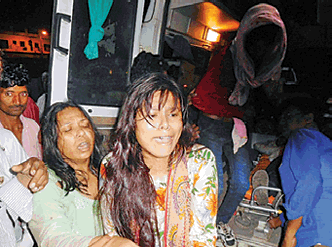
The Times of India reports that, a family of 10 that included women, children, a couple of elderly and a teenager with disability was brutally assaulted and abused on board the Shikohabad-Kasganj passenger train near Mainpuri late Wednesday evening (July 13). Barely recevering from the trauma, Asiya Begum told Sabrangindia that the police is finally waiting for the police to conduct a fair investigation.
A complaint has been lodged with the National Human Rights Commission (NHRC) urging an intervention to ensure justice, rehabilitation, security and compensation.
The family is currently lodged at the Dr Ram Manohar Lohia government hospital in Farrukhabad, the victims, who belong to are all Muslims, said they were targeted because they "appeared different". The incident took place between Mota and Nibkarori railway stations, some 30 km away from Farrukhabad junction. The incident is one more reflection of the vicious hatred being allowed to spill on our streets.
In the criminal complaint, the first information report (FIR) lodged by Mohammad Shakir, 50, he said, “At around 6 pm our family boarded the train from Bhongaon. The train had travelled about 4 km when a youth from a group of five men snatched the mobile phone of my son Faizan, who has been handicapped. When we protested, the men assaulted our family members, including women and Faizan.”
The injured have been identified as Shakir, his wife Asiya, 40, daughter Arsi, 18, his two sons Faizan, 17, and Arsaan, 22, brother Arif, 35, nephew Asif, 17, brother-in-law Shaheed and sisters Shenaz and Maenaz. Of the 10, four have fractures, four head injuries and almost all internal stomach injuries.
Shakir also told the TOI; “Later when the train was about to reach Nibkarori station, the youths stopped the train by pulling its chain and called up some of their friends, who arrived on motorbikes. Then, some more men, who were armed with iron rods and sticks, attacked us."
The victims had locked the train compartment's door from inside when they got to know that the attackers were calling up more men. But somehow about 20-30 men managed to barge in near Nibkakori station and continued the assault until some of the passengers fainted.
It was not simply assault but also molestation. A police officer involved in the investigation told TOI that the women appeared to have been molested as their clothes were torn. "Right now they are in no condition to spell out in detail what happened, but prima facie, it appears that some of the women were molested."
OP Singh, superintendent of police, GRP (Jhansi division), who has charge of Agra division, too, said, “An FIR has been lodged under IPC section 395 (dacoity), but more sections will be added once the investigation is done. Based on the video of the incident, special operation group and other police teams have detained three men and are questioning them.”
Mohd Shaikir re-lived the horror of the attack when he spoke. Shakir, who has suffered severe head injuries and a fracture on his right hand, said, “It was sheer horror. I will never be able to forget what happened. They attacked us with iron roads, robbed our belongings and molested our women. They didn’t even spare my 17-year-old physically and mentally challenged son. They abused us all the while and I heard someone saying, 'kill them'. They beat us until we became unconscious.”
A video of the incident obtained by TOI shows a group of men brandishing iron rods and sticks first banging on the train compartment's door, pelting people inside with stones and then finally getting in from the emergency window after breaking the glass panel. The carefully planned attacks included attacking, especially the women in the family.
Arsaan said, “The assailants groped my mother and tore my sister's clothes. They even attacked other passengers who initially came to rescue us. Later the passengers abandoned the coach leaving us behind to fight the assailants.” He added, “We attempted to contact police on Dial 100, but the call kept dropping. It was only when the train reached Farrukhabad junction that the GRP came and took us to hospital.”
Asked why no GRP squad was present in the train, the SP said, “Due to kanwar yatra the force has been deployed at various location to provide safety to pilgrims. It has caused shortage of men to provide security in trains.”
The New York times reports that Liu Xiaobo, the rebel Chinese intellectual who kept a dignified vigil on Tiananmen Square in 1989 to protect protesters from encroaching soldiers, promoted a pro-democracy charter that brought him an 11-year prison sentence and was awarded the Nobel Peace Prize of 2010 while locked away, died on Thursday, July 13. He was 61. It was the bureau of justice of Shenyang, the city in northeastern China where Mr. Liu was being treated for cancer, announced his death on its website.
The Chinese government revealed he had liver cancer in late June only after it was virtually beyond treatment. Officially, Mr. Liu gained medical parole. But even as he faced death, he was kept silenced and under guard in a hospital, still a captive of the authoritarian controls that he had fought for decades. He was the first Nobel Peace laureate to die in state custody since Carl von Ossietzky, the German pacifist and foe of Nazism who won the prize in 1935 and died under guard in 1938 after years of maltreatment.
The police in China have kept Mr. Liu’s wife, Liu Xia, under house arrest and smothering surveillance, preventing her from speaking out about Mr. Liu’s death and his belated treatment for cancer.
Mumbai, urbs prima, the financial capital, where possibly the difference between the rich and poor is almost as stark as the nation’s capital, New Delhi, has a sorry tale to tell. Its public health is fast deteriorating, having reached close to a crisis situation. Praja, a non-governmental organisation that monitors education and public health has just released this White Paper on Mumbai's public health.
Dengue Cases up by 265 % in 5 Years, 17,771 Cases in 2017 Alone, Mumbai Public Health’s Story Dismal
Shockingly, despite this state of affairs, municipal councillors asked only 45 questions in the past five years on TB, compared to 68 questions on naming/renaming of hospitals/health centres/cemeteries in the same period. Salient points of the White Paper:
Dengue cases have risen by 265% in five years, from 4,867 cases in 2012-13 to 17,771 cases in 2016-17.
In 2016-17, nearly 18 people are estimated to have died every day from tuberculosis (TB).
Directly Observed Treatment, Short Course (DOTS), the flagship government programme to tackle TB, has seen a dramatic drop in enrolment, decreasing from 30,828 in 2012 to 15,767 in 2016.
Nearly 1 in 3 deaths due to diarrhoea in 2016-17 was of children aged 4 years or less.
However, Public Health Committee Councillors did not ask even a single question on diarrhoea in the past four years.
Dengue cases have seen a massive rise of 265% in Mumbai in the last five years. Cases of dengue in government hospitals/dispensaries have increased from 4,867 in 2012-13 to 17,771 in 2016-17, as per RTI data.
TB cases have also seen a rise from 36,417 in 2012-13 to 50,001 in 2016-17, the data procured by the organisation revealed. Nearly 18 people are estimated to have died each day from the disease in 2016-17. However, DOTS, the flagship government programme to tackle TB, saw a dramatic drop in enrolment, decreasing from 30,828 patients in 2012 to 15,767 patients in 2016. At the same time, the percentage of defaulters in DOTS centres has increased from 9% in 2012 to 19% in 2016.
“The BMC needs to step out of denial mode and tackle the ongoing health crisis head on. The same goes for other governmental authorities, who must step up to the challenge and ensure a healthier city,” Shivali Bagayatkar, Project Officer at Praja Foundation, said.
This is in spite of the fact that Mumbai’s health budget for 2017-18 (Rs. 3,312 crores) is only marginally lower than the Thane Municipal Corporation’s total budget for 2017-18 (Rs. 3,390 crores).
Each year, Praja commissions a household survey to Hansa Research to incorporate the perspectives of citizens. This year, the survey was conducted with over 20,000 households. The survey found a significant difference between cases of various diseases registered in various government hospitals and the total estimated number of cases of the diseases. For instance, while dengue cases in government hospitals/dispensaries were 17,771, the total estimated number of cases as per the survey were as high as 1,09,443. The corresponding figures for malaria were 11,607 cases and 90,703.
Commenting on the findings, Milind Mhaske, Project Director of Praja Foundation, said, “The continuing increase in cases of major diseases such as these indicates that various authorities in Mumbai have much to worry about. Such findings coming from India’s financial capital indicate that we have a long way to go towards achieving goal 3 of the Sustainable Development Goals.”
Srinivasan Raman, Executive Director of Hansa Research said, “Such a huge discrepancy indicates that the Brihanmumbai Municipal Corporation has a long way to go when it comes to maintaining a proper health maintenance information system (HMIS). If various government authorities do not have access to accurate figures about the prevalence of various diseases, how can they evolve appropriate strategies to tackle them?”
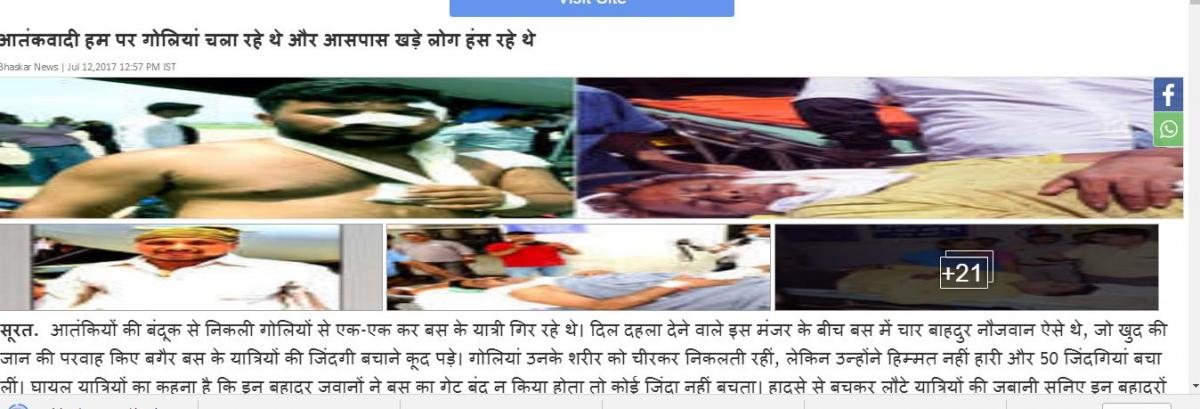
A report in the July 12 edition of Dainik Bhaskar published from Surat carried this provocative headline: “As Terrorists Fired Bullets at Us, Bystanders were Laughing Gleefully”, completely mis-reporting the incident and the circumstances around the terror attack last Monday.
The news story is in reference to the recent attack on Amarnath pilgrims and the headline translates to “Terrorists were firing at us while bystanders laughed”. The headline is from a quote in the report, from one Rajesh Naval, a resident of Valsad in Gujarat who was apparently on the bus. Naval’s quote is neither prefaced nor followed by any explanation of how or where he spotted shopkeepers laughing at the passengers’ plight while the bus was under attack (all of this while presumably, ducking for cover). The report also contradicts several accounts in the press of Kashmiris condemning the attacks, helping survivors and vowing not to let terror affect their hospitality or assistance – something even the Home Minister Rajnath Singh has applauded.
A report in The Hindu on July 11, driver of the bus Salim Sheikh stated that he drove the bus through the firing, without stopping, He had said, “We could not see anything as it was pitch black.”
Another report by News18 details the various ways in which Kashmiris have always provided basic needs to the pilgrims, and that many rushed to the aid of the injured pilgrims.
Other reports published in Greater Kashmir allude to the tourist town of Pahalgam shutting down for a day in protest and solidarity with the victims, while another report in Rising Kashmir quotes several of the pilgrims who survived, who thank local Kashmiris for rushing them to the hospital.
In the current atmosphere, a headline like the Dainik Bhasker’s fails to perform the journalistic duty of informing its readers details accurately and fairly, and instead relies on sensationalising a violent incident.
In the guise of giving the reader a detailed first-person account from those who survived the attack, the Hindi daily chose one sentence to amplify as the headline of its piece.
Blatant Violation of Press Council Guidelines PCI guidelines that we can refer, from here state
This goes against Press Council of India’s directive of exercising “due restraint and caution in hazarding their own opinion or conclusion in branding persons…. In the zest to expose, the press should not exceed the limits of ethical caution and fair comments.” The PCI also adds:
“The press shall eschew publication of inaccurate, baseless, graceless, misleading or distorted material. All sides of the core issue or subject should be reported. Unjustified rumours and surmises should not be set forth as facts.”
"The Network of Women in Media, India (NWMI) would like to register its dismay and protest against the provocative headline and news report in Dainik Bhaskar’s Surat edition, dated July 12, 2017. As as a body of journalists, we condemn such callous reporting and demand that Dainik Bhaskar publish a corrigendum clarifying and apologising for their misleading headline, directly in contradiction of multiple survivor testimonies. "
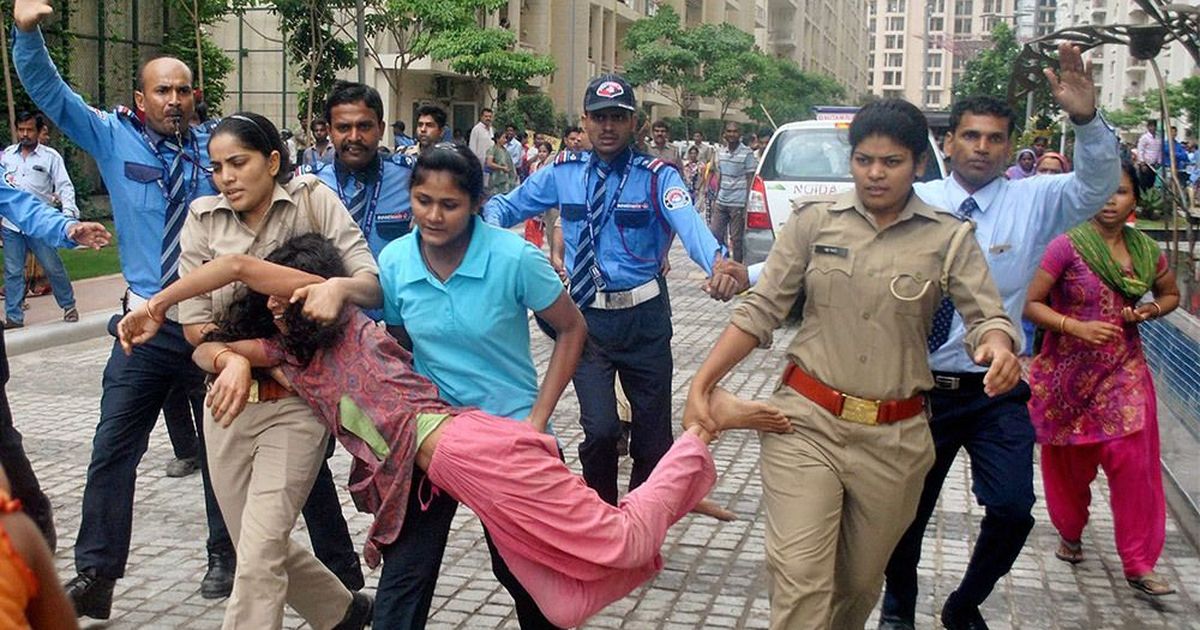
It was ‘citizen journalism’ at its very best. When Nilanjana Bhowmick and Tathagata Bhattacharya informed India and the world of the brute treatment meted out to 26 year-old Zohrabi, a domestic help in Noida, it set of a chain of concern and awareness that is seething, still. Their post said:
Edited after speaking to Zohra: This is Zohra, a 26 year old who works as a domestic help in Noida. Following a tiff with her employer, she went missing for a day. Her family and neighbors – poor day wage laborers – started protesting and demanding to know her whereabouts. I spoke to her a while back and she confirmed she was locked up in a room the whole day [not in the boot of the car as my original post said]. Noida police, instead of taking action, is now firing at the protesters. There are at least five of them waiting outside, waiting for me to address this. I feel helpless and quite wretched because apart from posting on social media and speaking to the police, I don't even know from where I should start addressing this deep rot!!
These photos also on the post are shameful visual testimony to the treatment meted out to her:
“We had to carry her to the car to take her for a medical examination. She vomited all the way. It was painful. And she kept asking, ‘why would they do this to me?’ Why indeed. I have never felt so ashamed of my privilege as I felt then. As I have felt all of today, ” said Nilanjana later.
Facebook that allows all manner of vitriol to be spewed on its pages deleted this one:
What happened?
On Wednesday at around 5.30 a.m. the husband, along with his friends and neighbours gathered outside the apartment complex and tried to enter the premises by force claiming that Zohra had been kept prisoner by her employer. After two hours they barged inside the complex.
They found Zohra inside the flat in horrible condition with injury marks on her back and her clothes were torn.
It was a dispute between a family in Noida’s posh Mahagun Moderne Society gated community and their Muslim domestic worker from West Bengal, which led to a riot-like situation on Wednesday morning that the Uttar Pradesh police was summoned to control. Media reports said that by the end of the day, two First Information Reports had been filed with the police. The first was against the domestic worker’s employer and unidentified persons in the housing complex. The other was against unidentified members of the crowd that had forced their way into the gated community early on Wednesday morning.
What caused the brute attack ?
There were baseless allegations that 26-year-old domestic worker Zohra Bibi, who had been working for the high-rise’s residents Harshu Sethi and his wife for six months, was an illegal Bangladeshi migrant but police denied the claim as she had all necessary documents. Zohrabi lives in a nearby slum with her husband Abdul Sattar and their three children. “Madam said to me, if you try to run away, I’ll throw you in the dust bin. I’ll kill you,” the maid, Zohra Bibi, lying on a small cot said in a whisper, NDTV reported.
Reports suggest that that Zohra’s decision to not to work at Sethis further does not go down well and therefore they held her captive and was beaten up. It was 35-year-old Mamata Bibi, a cook in the Sethi home, who accompanied Zohra Bibi to the Sethi apartment on Tuesday morning said, “While we left their house by 9 am, madam had asked her to come again in the evening to collect her dues.” “She [Zohra Bibi] had clearly stated that she did not want to work there any longer and madam was unhappy with her decision.” Her employer Sethi’s had accused Zohra of stealing money and following a fight with her employer on Tuesday, she went missing for a day.
Her husband filed a police complaint after his wife not returned to her home throughout the day and also in the night. Family and neighbors went to the Mahagun Moderne complex to enquire about Zohra’s whereabouts. They found Zohra’s entry registered in the society records but not her exit.
Domestic helps, a largely unorganised sector, who struggle hard in the society to make ends meet becomes a victim of suspicion and harassment at the hand of affluent bosses.
Social Media Peddling Hate Around Zohra
Some of the hysteria referred to the incident as “Malda again”, while some mischief mongers claiming on social media, referring to the communal violence that had broken out in the West Bengal district in January 2016. Others demanded that Bangladeshis be thrown out of India.
Zohra went Missing
By 3 pm on Wednesday, the shattered windows of the cabin that housed the security guards at the entrance of the complex and the unusually large number of policemen standing outside its gates were the only evidence of the tense situation that prevailed earlier in the day.
The tense situation started at around 7 am, when a group of over 100 persons attempted to force their way into the premises of Mahagun Moderne Society in Noida’s Sector 78. They were looking for a woman who was employed as a domestic worker at the housing society. Zohra Bibi, 27, who had three children, had not returned to her home in a slum in the same sector the previous night.
Videos of the incident show the complex’s security guards throwing back stones pitched by the protestors standing at its gate.
‘Pay my dues’
Zohra Bibi’s husband said that he was driven to despair when his wife did not return home on Tuesday and contacted the police. “What could I do?” said Sattar, a migrant from West Bengal’s Cooch Behar. “There was no other way to find my wife.” The register maintained by security guards at the entrance of the complex that Zohra had entered the society’s premises on Tuesday morning and did not come out. “I knew that she was there but both the police and security guards claimed that they could not find her there,” said Sattar. “So, the next morning, I went there with some neighbours to rescue my wife and soon people from some neighbouring slums joined us too.”
Mamata Bibi, 35, a cook in the Sethi home, said that she had accompanied Zohra Bibi to the Sethi apartment on Tuesday morning. “While we left their house by 9 am, madam had asked her to come again in the evening to collect her dues,” said Mamata Bibi. “She [Zohra Bibi] had clearly stated that she did not want to work there any longer and madam was unhappy with her decision.”
After Zohra Bibi emerged from the complex in the morning, the police took her to hospital for a medico-legal check-up. Later, Station House Officer Parshuram said that she had sustained no injuries.
Adding perspective to the incident were Facebook posts from Nilanjana Bhowmick, who lives in a complex in the vicinity. She said she had gone to the site as a “concerned citizen” and had intervened to stop the protestors from clashing with the police.
Bhowmick, who said that she had met Zohra Bibi on Wednesday evening, said that the woman “consistently reiterated that she was locked up in a room”.
A ban on workers
Scroll.in reports that the Mahagun website says that the homes in Mahagun Moderne, one of the several luxury properties the realty firm has constructed, “mirror the taste of affluent class and include an array of space options (2, 3, 4 BHK units) comprising of high rise apartments, duplex apartments, independent floors, penthouses in addition to an iconic tower Marvella dedicated to luxurious 5 BHK units”. According to the website, the complex is spread over 25 acres. Security guards said that it has over 2,800 apartments, of which 2,000 apartments are occupied. They said nearly 600 domestic workers visit it every day.
Mahagun Moderene. (Photo credit: Abhishek Dey).
On Wednesday evening, the society held a meeting of its residents, which senior Noida police officers attended. “In the meeting, we decided that no domestic worker should be allowed entry unless the matter is fully resolved,” said resident Dharmendra Rathode.
Over 150 families live in the isolated slum in Sector 78 where Zohra Bibi lives in a tin shack. A significant number of women there, including at least 30 who are Zohra Bibi’s neighbours, work at Mahagun Moderne.
The domestic workers usually have two shifts – between 6 am and 1 pm and between 4 pm and 9 pm. Their salaries vary. While basic household cleaning jobs bring them Rs 1,500 per household, salaries go up to between Rs 4,500 and Rs 5,000 for cooking and doing the dishes.
Solidarity of Workers
Domestic workers in and around the area have been shocked. “In Zohra’s case, we all joined the protest out of fear,” said Mona Biswas, a migrant from Siliguri in West Bengal. “Tomorrow, it could happen to any of us.” Biswas has been living in the National Capital Region with her family for over 10 years, and works as a cook in four households in Mahagun Moderne. Many left unions including those of the CPI(ML) have visited the area today.
As is the case with domestic workers across the country, humiliation by some employers is such a daily part their lives that some of them do not even recognise it as such.