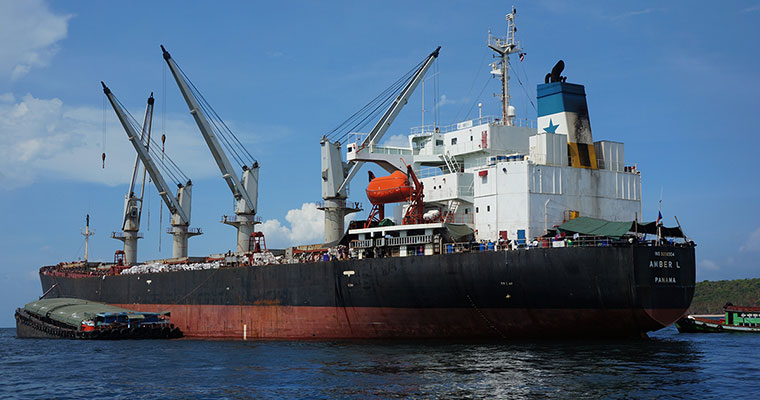
THE National Fish workers Forum has urged Shipping Minister to launch legal proceedings against the owner, Captain and crew of the Panama registered cargo vessel which had hit a fishing boat off Kochi, killing two persons. In a letter to the Shipping Minister, a copy of which was released to the media here, Forum national chairperson Narendra R Patil and General Secretary T Peter also said cargo ships and foreign fishing vessels should not be allowed in Indian coastal waters.
The nationwide forum has also demanded that adequate compensation should be paid to the families of the fishermen who had lost their lives and fishing boat and implements which had suffered severe damage in the collision should be restored.
Among other demands is that the Indian Navy and Coast guard should be directed to protect fishermen who put out to sea, the forum said adding free medical aid should be provided to the injured fishermen and their loss should be compensated. The cargo vessel, Amber L, had collided with the fishing boat on June 11 at 2.30 am. While two fishermen drowned, one was missing and 11 others had been rescued.
NHRC issues notices to the Haryana DGP and Gurugram Police Commissioner over gang rape of a woman: asks police chiefs of Delhi, Gurugram, Faridabad, Noida and Ghaziabad to explore joint action programme to check crime in the NCR region
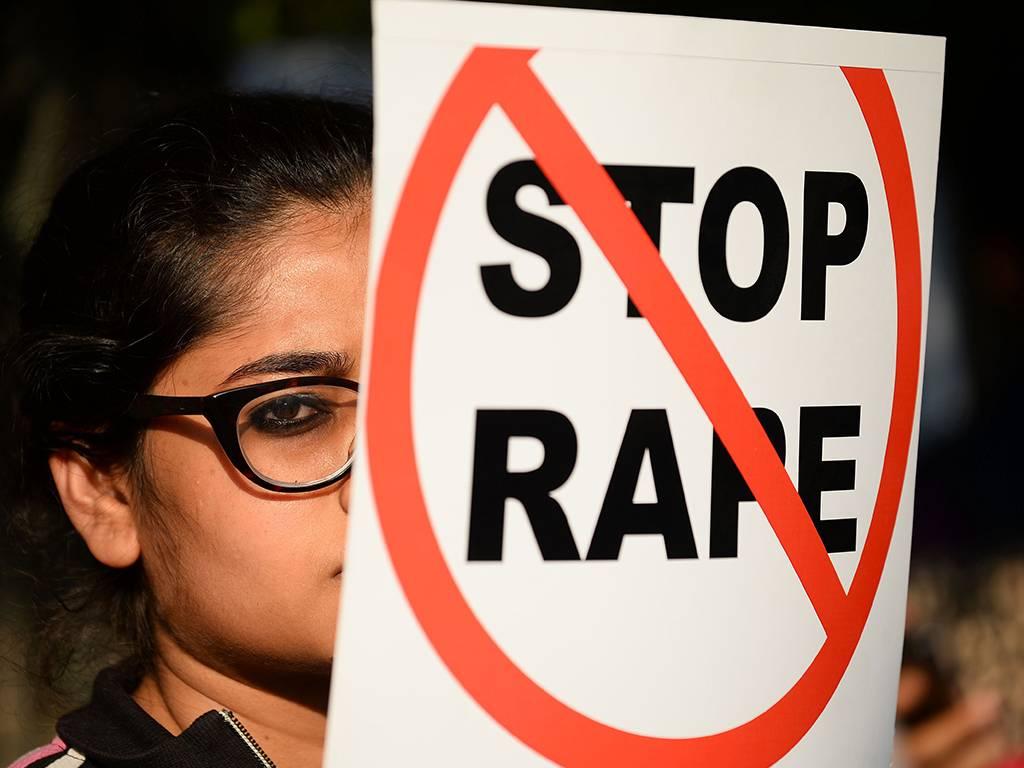
The National Human Rights Commission, on the basis of media reports about a gang rape in Gurugram on 30th May, 2017, has issued a notice to the city Police Commissioner calling for a detailed report. The Commission has observed that the incident makes it clear that night patrolling on the road by the police was not being done.
The Director General of Police, Haryana has been directed to inform about the steps being taken to ensure safety of the citizens, specially the women. They have been given four weeks to respond.
The Commission has also called for comments of the Police Commissioners of Delhi, Faridabad and Senior Superintendents of Police, NOIDA and Ghaziabad with their suggestions, if a joint action programme by the law enforcing agencies of the NCR region could be planned and executed to deal with such heinous crimes against women. Their response is expected within six weeks.
The Commission has observed that though the direct involvement of any public servant in the incident is not apparent yet the sorrowful contents of the media reports are indicative of an atmosphere of fear, insecurity and uncertainty prevailing in the NCR region, especially the places like NOIDA, Faridabad and Gurugram etc. Ensuring safety of the citizens, specially, the women and children, is one of the prime duties of the State. It seems that some conspicuous steps are immediately required to be taken by the law enforcing agencies so that these kinds of incidents do not reoccur.
According to the media reports, carried on the 7th & 8th June, 2017, a woman had some altercation with her neighbours in the night of 29th May, 2017. She decided to go to her parent's house. On NH-8, she got a lift from a truck driver who tried to harass her so she left the vehicle. Thereafter, she was offered a lift by occupants of a Magic van heading towards Gurugram only to be sexually assaulted by them. Her perpetrators snatched her daughter away and covered her mouth to stop her from crying. Before leaving the place of crime, one of the men threw the crying baby at the road divider inflicting injuries on her head.
The woman walked on the road with her injured daughter and reached a factory, where one guard on duty asked her to wait till the dawn when the baby was examined by a doctor who told that she was dead. The woman travelled with her child's dead body in a Metro train to reach her parents place at Tughlaqabad in Delhi. There, another doctor examined the baby and declared her dead. Later, the woman again went to Gurugram to lodge an FIR.
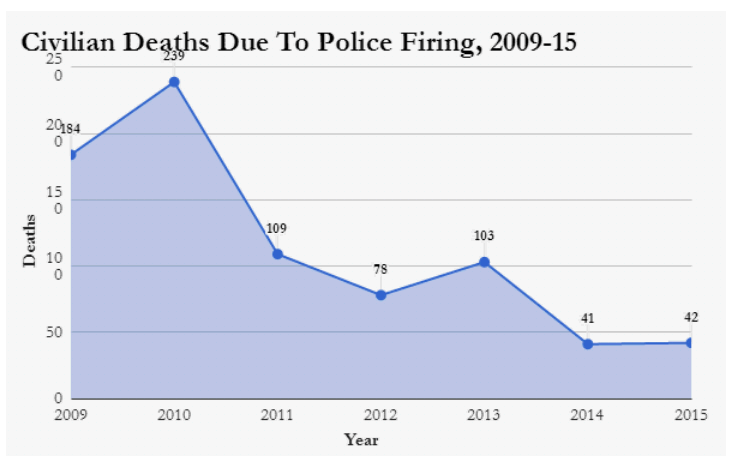
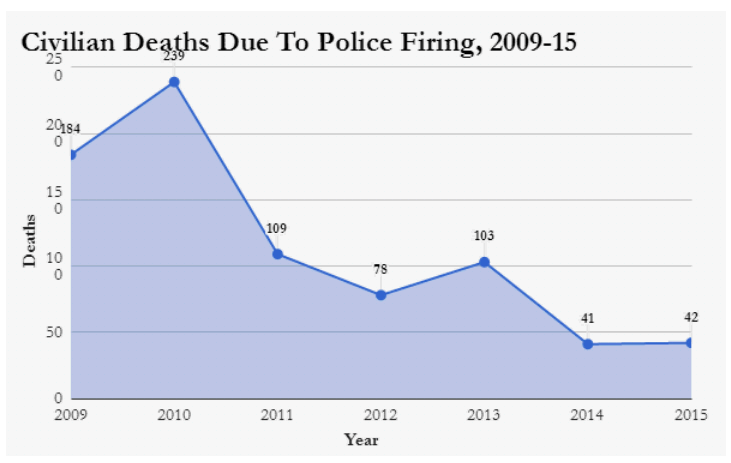
Two civilians died every week, on average, in police firing in India, according to national crime data for the years 2009 to 2015.
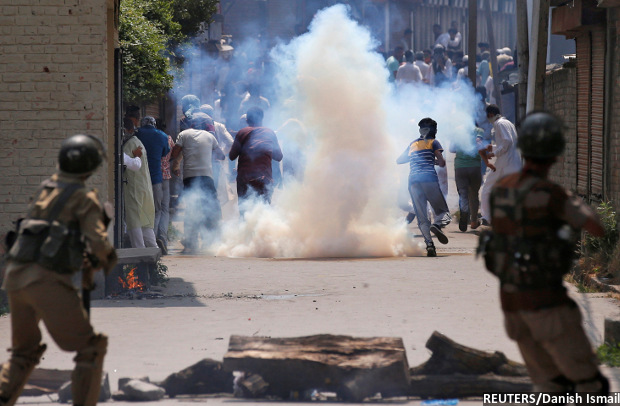
The data provide perspective to the death of six farmers in Madhya Pradesh’s Mandsaur district on June 6, 2017, when police fired on protesting farmers demanding better prices.
As many as 796 civilians died due to police firing between 2009 and 2015, according to data from the National Crime Records Bureau (NCRB).
A plentiful harvest in 2016 and imports drove some prices down 63%. A shortage of cash because of demonetisation led to “fire sales”, accentuating the price drops. Despite Rs 3.5 lakh crore–enough to build 545Tehri-sized dams–invested over six decades to 2011, more than half of all farms depend on rains. These are the three factors agitating Indians who depend on farming–90 million families, or 54.6% of India’s 1.2 billion people, IndiaSpend reported on June 8, 2017.
The Madhya Pradesh Human Rights Commission has issued notices to the state government in response to the deaths. The state’s home minister initially denied reports of firing by local police on agitating farmers but later admitted that police resorted to firing to gain control of the rioting mob during the protest.
“The National Crime Records Bureau statistics say 318,528 farmers committed suicide between 1995 and 2015. A study suggests more than 2,000 farmers are heading to cities every day to make a living.” wrote Shashi Shekhar, editor-in-chief, Hindustan, in a column for the Mint on June 12, 2017. “The time has come when New Delhi and state leaderships thought seriously about this issue. The police or para-military force of independent India don’t look good firing at their own people. We don’t need more Mandsaurs.”
J&K drives decline in police firing
As many as 4,747 incidents of police firing were reported between 2009 and 2015. Over the years, firing incidents have decreased, mostly due to decline in incidents in Jammu & Kashmir (J&K), which witnessed severe unrest between 2008 and 2010. For instance, in 2010, 662 incidents of police firing were reported in J&K, in which 91 civilians and 17 police personnel died, and 494 civilians and 2,952 police personnel were injured.
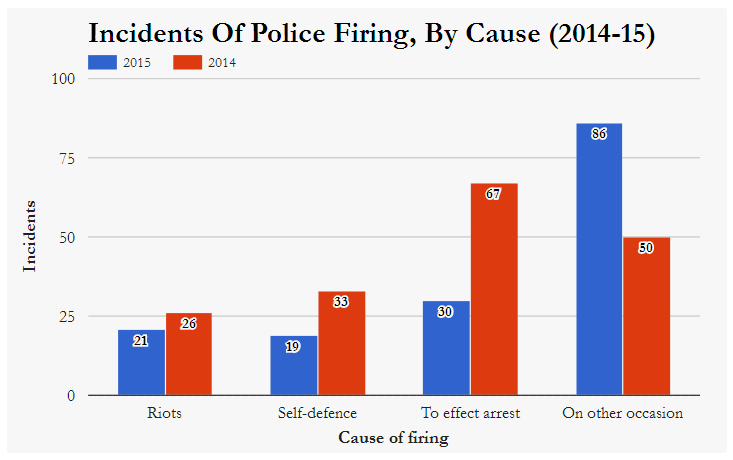
55% firing incidents in 2015 classified as ‘on other occasion’
Of the 156 incidents of police firing in 2015, 86 were classified as ‘on other occasion’, 30 to effect arrest and 21 in riots. These incidents killed 16, five and 11 civilians, respectively. In the same year, 19 incidents of police firing in self defence led to 10 civilian deaths.
Source: National Crime Records Bureau, Crime In India reports 2014, 2015
Among the states, Rajasthan reported the maximum occasions (35) where police resorted to firing in 2015, followed by Maharashtra (33) and Uttar Pradesh (29).
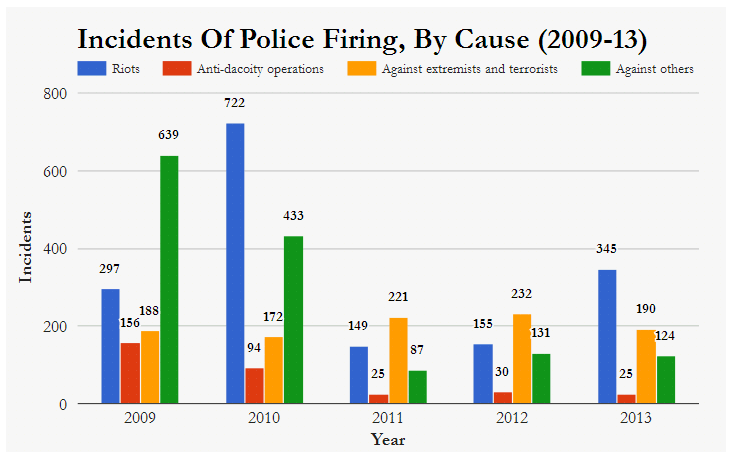
Before 2014, the incidents of firing were categorised as: Riots, anti-dacoity operations, against terrorists and extremists and others. Between 2009 and 2013, these categories saw 1,371, 174, 815 and 775 incidents of police firing, respectively.
Source: National Crime Records Bureau, Crime In India reports for 2009, 2010, 2011, 2012 & 2013
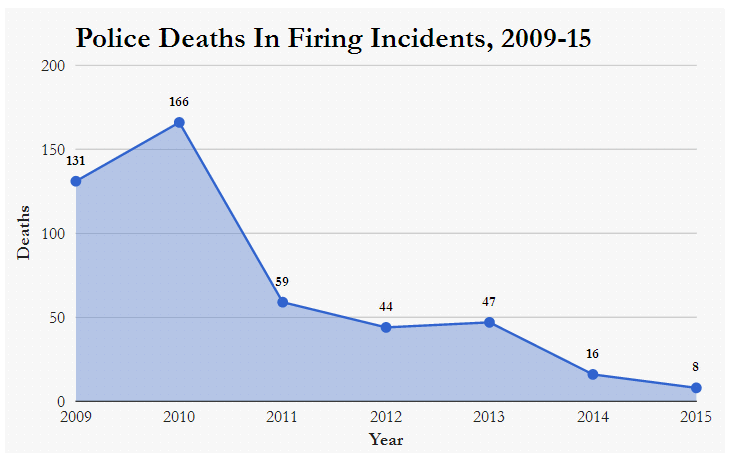
Between 2009 and 2015, as many as 471 police personnel died during police firing, the NCRB data reveal.
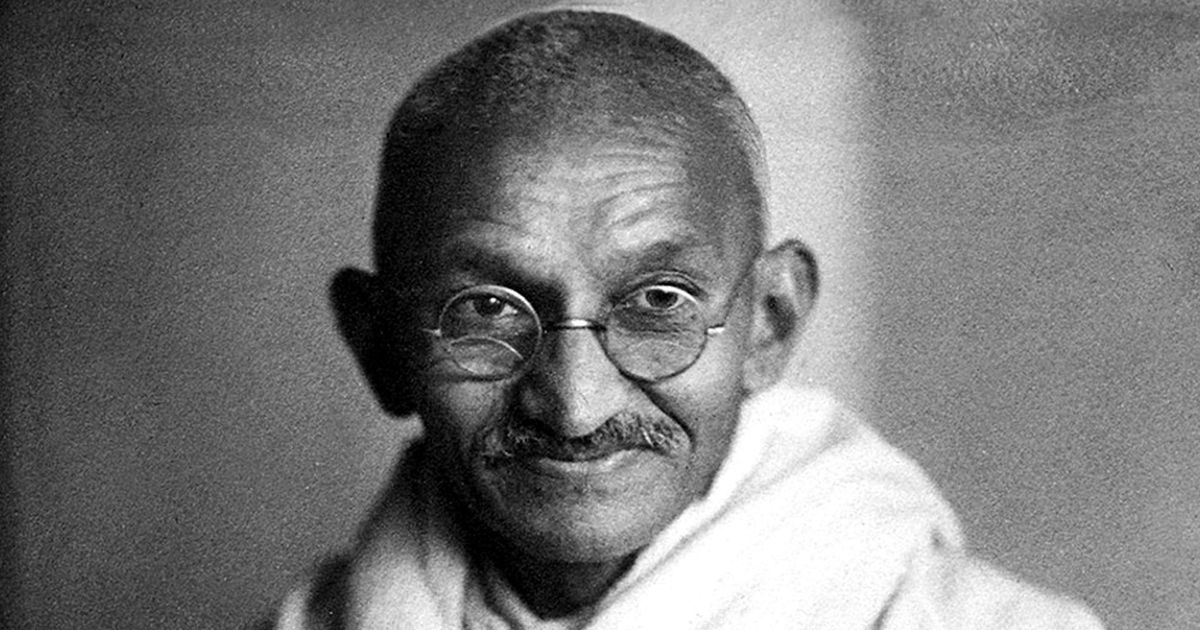
First they killed the Mahatma. And then they went after his message of empathy.
Image: Wikimedia Commons
At the finale of SPIC MACAY’S 5th International Convention in Delhi on June 10, the first act in the all-night concert was Carnatic vocalist TM Krishna, along with violinist RK Shriramkumar and mridangist Arun Prakash. Krishna opened with Thyagaraja’s spectacular composition Dasharathi in raga Todi – brooding, turbulent, and dissonant – before seguing into a soaring, cascading thillana in Behag by Lalgudi Jayaraman. Next he sang a plangent viruttam written by the Tamil writer Perumal Murugan in raga Sahana, and followed it with a crest jewel of Carnatic music, Syamasastri’s O Jagadamba, in the majestic raga Anandabhairavi.
Things were going superbly well – Krishna was intense and ecstatic as ever, and the playful ease between the three musicians (who are great friends) kept the performance energetic and unpredictable at every turn. Many other lovely ragas – Varali, Kharaharapriya, Neelambari, Begada – were woven into the main repertoire of compositions, framing the major pieces and leading from one to the next in Krishna’s inimitably mellifluous and agile way.
And then, a little over an hour and forty minutes in, Krishna, who can never resist some shock-and-awe tactics, began to sing Narsi Mehta’s 15th century poem in Old Gujarati, Vaishnav Jan To Tene Kahiye, which was adopted by Mahatma Gandhi into the roster of prayers routinely sung at the Sabarmati ashram.
A rendition of ‘Vaishnav jan to tene kahiye’, by Amjad Ali Khan and Bismillah Khan.
Krishna started off in Suruti (tuned by Arun Prakash, the mridangam player who is also a composer), before finally arriving at Khamaj, which is the raga in which this well-known bhajan is normally sung. It was electric to watch Krishna moving out of Telugu and his native Tamil into Gujarati (his accent is perfect, by the way), and bringing his Carnatic concert to a close with one of Gandhi’s favourite prayer songs, that was once so familiar to all Indians.
Every moment of the evening had been deeply moving up to this point, but to hear Vaishnav Jan To in Krishna’s voice was to have tears in one’s eyes.
For just hours before, Bharatiya Janata Party leader Amit Shah had insultingly referred to Gandhi as a chatur bania (“wily trader”) at a public meet in Chhattisgarh, dismissing the Mahatma’s contribution to India’s freedom movement as somehow clever, instrumental, transactional and devoid of the ideals and values that we invariably associate with the Gandhian struggle. Gandhi was just another scheming bania – a disparaging dig at his trading caste.
TM Krishna. Photo credit: Bharat Tiwari
Krishna timed his comeback extremely well, to remind us with this beloved and beautiful song of a man whose political and spiritual memory is daily being impugned in Narendra Modi’s India. The maestro sharply brought to our flagging attention the central theme of the bhajan, which is empathy, the ability to identify with the suffering of another human being.
Consider a person to be pious, says Narsi Mehta, only if he can feel another’s pain (peed paraai), only if he reaches out to alleviate another’s hurt (para-duhkha), and only if he does so without pride (abhimaan) in his own compassion. How terribly Hindutva distorts the essence of Hindu piety, and twists what it means to be a true vaishnav jan – the equivalent, in medieval Gujarat, of a devout Hindu.
Mehta wrote and Gandhi advocated sincere fellow-feeling, the capacity to suffer for and with someone else, without self-congratulation, as the quality that makes anyone a real Hindu. A regime led by a rightwing Hindu supremacist party that normalises terrorising of minorities, lynching of Dalits and Muslims, and breaking all bonds of human solidarity and mutual respect that have kept us together as a political community despite all sorts of differences, simply does not use the same idiom as Mahatma Gandhi. Nor is it truly “Hindu” in any recognisable traditional sense of the term.
Ravi Shankar and George Fenton
In the audience on that Saturday evening were hundreds of young people. Under the leadership of Kiran Seth, the non-profit SPIC MACAY has brought arts exposure and arts education to millions of students for the past forty years. I remembered attending free SPIC MACAY concerts and lecture-demonstrations in school and college, where I first got to see and hear some of India’s greatest living artists.
I realised I had grown up knowing the words and tune of Vaishnav Jan To, and that it was a Gandhian song, without feeling anxiety because its words were in a language that was not my own though it never felt alien. I wondered how many of the students sitting in the hall that night knew what Krishna was singing; what it meant for him to be singing this bhajan and not some other; and what had changed so horribly in the country that it became heartrending to hear this composition in the current context. Gandhi never felt so urgently important, nor so inaccessible, as for those 15 minutes of Krishna’s rendering of what ought to be – and was, for decades – a sort of anthem for all Indians, especially Hindus.
India’s tragedy under the Hindutva boot is not only that its opposition parties, especially the Congress and the Left, have failed to stand up to fascism. It is not only that Sangh ideologues feel free to play fast and loose with history, vilifying Gandhi, appropriating Ambedkar, tearing down every pillar of the Nehruvian state, and worst of all, eviscerating the Constitution. The most damaging effect of the BJP rule is the slow, steady erosion of empathy as a public value, leaving us morally impoverished – lesser human beings and lesser Indians.
Vaishnav jan to tene kahiye je peed paraai jaane re. Soon there will be no one of that description left in the majoritarian Hindu Rashtra.
As part of the Government’s agenda to privatize the railways, the upcoming auction of the Kanpur and Allahabad railway stations on June 28, has created tremendous amount of restlessness among the Indian populace.
We at Sabrangindia, attempted to identify the various stakeholders who would be affected by this policy change. The key stakeholders are, the railway employees, railway passengers, the Government and the private companies.
However, the worst losers, we can identify are the railway employees and passengers. Thus, we contacted members of various Workers’ Unions, Trade Unions. The unions very clearly state their disapproval of this move, terming it as undemocratic.
Some of the excerpts are given below.
We first had a telephonic conversation with representatives of the Northern Railway Men's Union, here is what they had to say.
Q. What is your opinion on the recent policy for privatization of railways? How do you think it will affect the railway employees?
A. The private owners (thekedars) will only take not give. (Vohsirfsabkijaannichodneaayenge). The existing employees may not be removed. No new employees will be hired on regular hiring terms. The thekedars may make employment on contract basis.
Q. How do you think this change will affect passengers? Will it be a boon or bane?
A. The passengers will be the losers. The private players will keep increasing the prices of the tickets. All their decisions will be for the sole purpose of profit making. The Indian Railways which were started 150 years ago were meant to be a service to society. The present Government has today decided to convert the age old service into a business. (Yeh log lootne aye hai, lootkechalejayenge).
Q. Do you think this will affect the rail routes in any way?
A. In my opinion, I do not think the rail routes will be changed as long as they enable profits. They will only concentrate on making profit.
Q. Ma’am, what is your opinion on the recent policy for privatization of railways?
A. The ruling Government is on a sell out spree. All national assets are being sold to make profits. Indian Railways is the biggest railway network in the world. It is a lifeline for the entire population whether the young or the old, rich or poor. Thus, making the railways private will cause immense damage to the Indian populous as a whole. The revenue from railways becomes part of Government revenue as of now. Privatising railways completely is the ultimate agenda of the Government; this will lead to loss of revenue to the Government treasury. This move exposes the capitalist, pro corporate agenda of the Modi Government, further proving that he has no regard for the poor workers.
Q. What do you think will be the direct impact of this move on Railway employees?
A. The employees will face massive unemployment. The private players will increase the workforce by hiring contract labourers. The salaries of railway employees will be reduced. No social securtiy will be provided to the employees. No consideration will be given to the safety of the employees. Thus, their performance will suffer and it will pose a higher risk to the safety of the commuters and passengers alike. The resultant precarious job situation will create havoc in the lives of the Railway workers.
Q. How do you think this change will affect passengers?
A. With the private players coming in, there will be no accountability. The subsidies in price of tickets that are provided to the poor, elderly will not be provided by the profit driven private players. Safety of passengers will remain a big question.
Q. What is your opinion on the recent policy for privatization of railways?Do you think there will be a negative impact of this move on Railway employees?
A. We are in support of continuing Railways as a Public Sector Undertaking. We are strongly against the privatization of railways.The employees will be heavily exploited.
Indians from across the country seem to be angered with this move of the Government. The time is not to raise voices but to unite and act.
This is a recording of a PARI Livestream event held on Sunday, 11th June 2017 at 1900 hrs IST.
The People’s Archive of Rural India (PARI) has published a live interaction video of P. Sainath on why our farmers are angry. He talks about the agrarian crisis in India and the present situation of agricultural economy.
From farmers being shot dead in Mandsaur, Madhya Pradesh, to those across Maharashtra now out on the streets in protest, to those from Tamil Nadu on hunger strike in New Delhi not so long ago, this has been a season of agrarian discontent. Why is this happening, which way will it go?
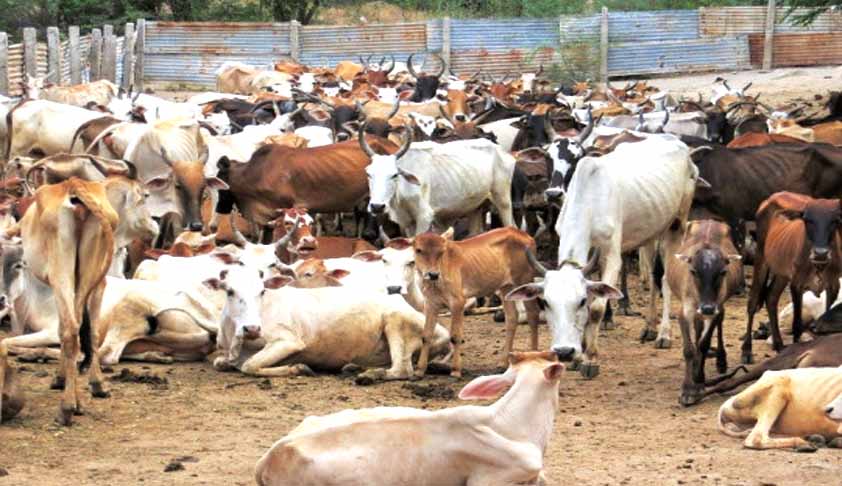
The Supreme Court today sought response from the Centre on pleas challenging its controversial notification banning the sale and purchase of cattle at animal markets for slaughter.
A vacation bench comprising Justices R K Agrawal and S K Kaul issued notice to the Centre and asked it to file response within two weeks on two separate petitions challenging the notification.
The apex court fixed the matter for hearing on July 11. Additional Solicitor General P S Narasimha, appearing for the Centre, told the bench that intention behind bringing the notification was to have a regulatory regime on cattle trade across the country.
He also told the apex court that the Madras High Court has recently granted interim stay on the notification.
One of the petitioners, who has approached the apex court challenging the notification, has claimed in his plea that the provisions in the notification were unconstitutional as they violated the fundamental rights including freedom of conscience and religion and right to livelihood.
The Centre had on May 26 banned the sale and purchase of cattle from animal markets for slaughter through an Environment Ministry notification — ‘Prevention of Cruelty to Animals (Regulation of Livestock Markets) Rules, 2017’ under the Prevention of Cruelty to Animals Act.
A court in Haryana’s Rohtak on Wednesday issued a non-bailable warrant against yoga guru Ramdev in a case over his remarks made last year against those refusing to raise the slogan of ‘Bharat mata ki jai’.
The court of Additional Chief Judicial Magistrate Harish Goyal issued the NBW against Ramdev and fixed August 3 as the next date of hearing in the case.
On May 12, the court had issued a bailable warrant against Ramdev.
“The order follows Ramdev’s failure to appear before the court yet again today. He also failed to appear despite summons and a bailable warrant,” counsel for the complainant in the case O P Chugh said.
Ramdev had made the remarks at a Sadbhawana Sammelan here in April last year, which was called to promote peace in the city that witnessed violence during the Jat quota stir. He had said that but for the rule of law he would have “beheaded” lakhs of people for refusing to chant ‘Bharat mata ki jai’.
On March 2, Goyal had issued summons to Ramdev after a complaint was filed by Congress leader and former Haryana minister Subhash Batra seeking registration of an FIR against the yoga guru.
The ACJM had then directed Ramdev to furnish Rs 1 lakh personal surety during the execution of warrant and also to appear in court on June 14.