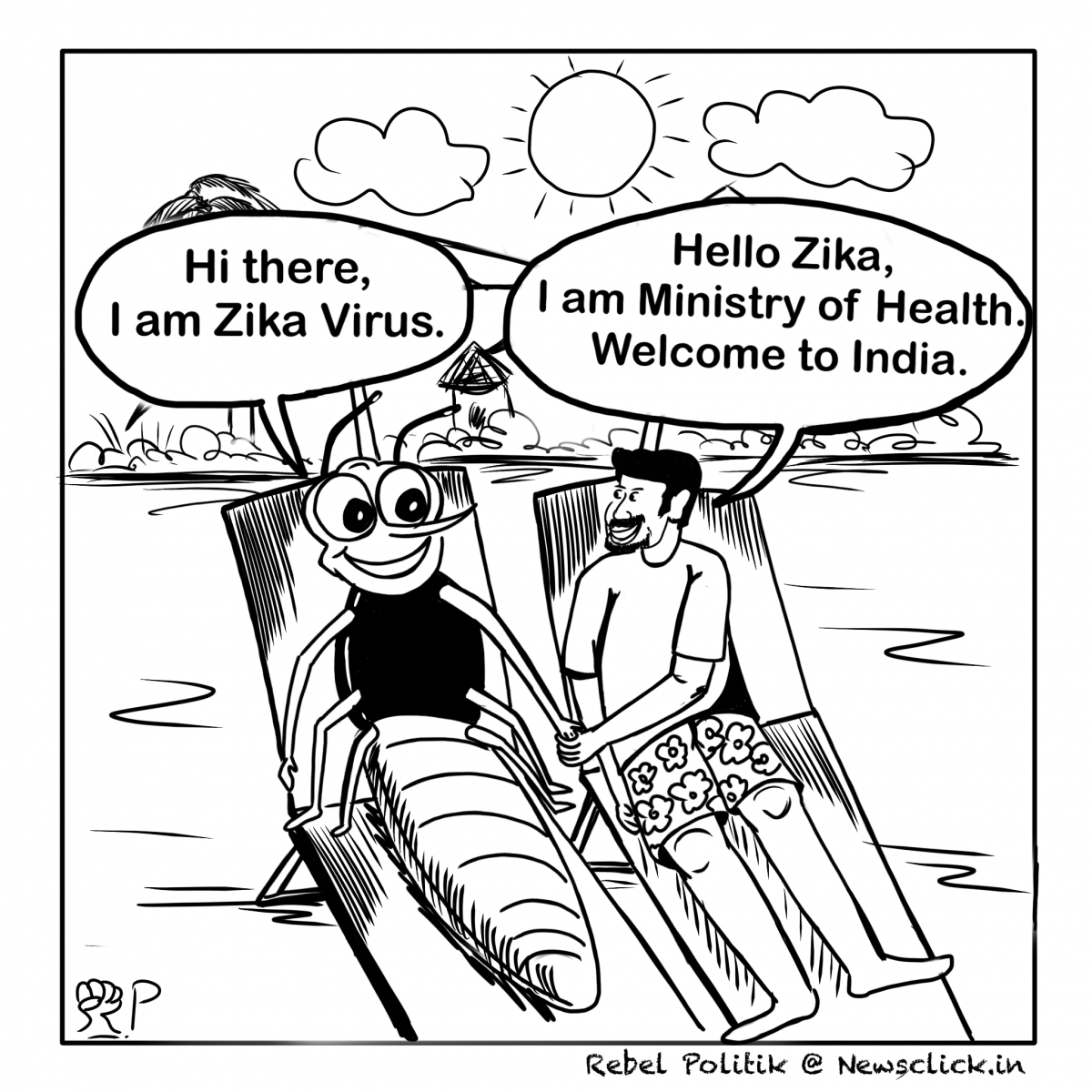
It is criminal for the govt to keep the country in the dark about confirmed cases for months.

Image Courtesy: Rebel Politik
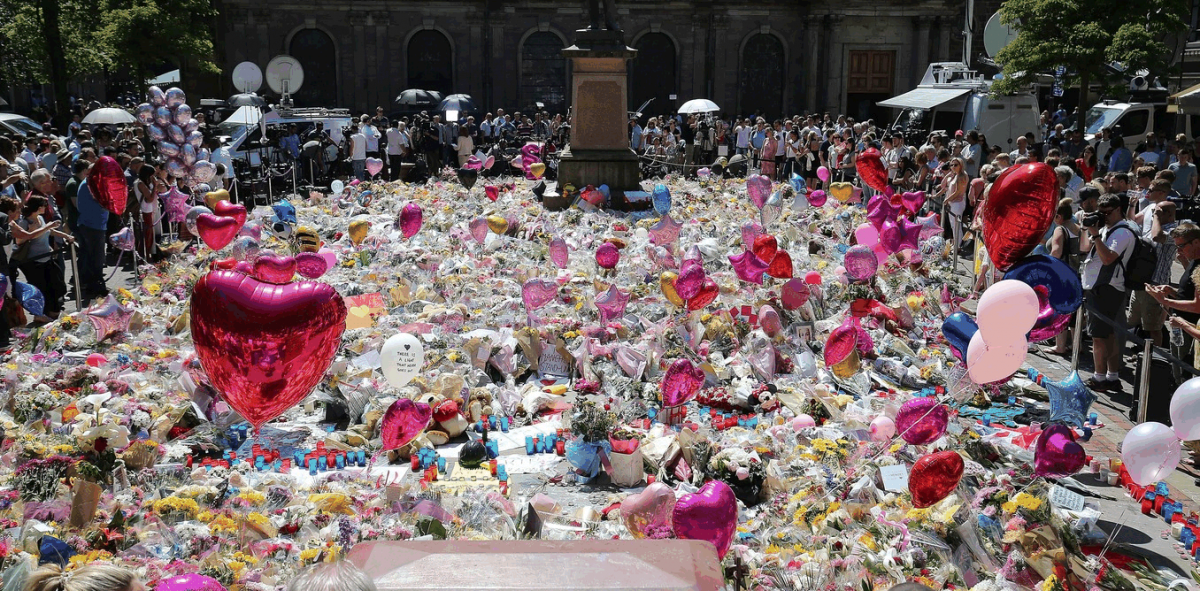
Courtesy: Newsclick

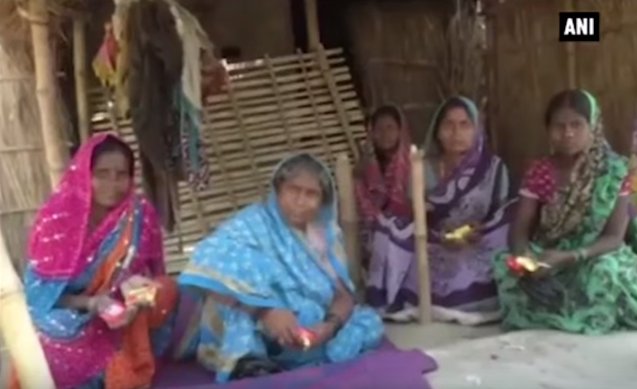
Courtesy: Newsclick

The Herald Sun devoted its first 11 pages to the bombing on Wednesday and another seven to it on Thursday. By Friday, Manchester had disappeared entirely from the front page of The Age, was reduced to a side column on the front page of The Australian and a small box at the bottom of the Herald Sun’s page one.
For as long as I can remember, media critics have cried foul that European and American deaths appear to be worth more in news terms than similar deaths in the Middle East. To which journalists mostly replied that “proximity” in a cultural (if not geographical) sense, or “rarity”, were the reasons.
So, is it now the case that European terror attacks have become normalised? Or is it just that news cycles have rightly moved on to other important news stories closer to home?
In Britain, the coverage is still around the clock. On Wednesday the stories and photographs on the front pages were mostly about the victims. There was a particular focus on the youngest girl, eight-year-old Saffie Rose Roussos, who featured on the front pages of all mainstream media.
This front page from The Sun, which compared the little girl to the bomber under the banner headline of “Pure Evil”, was particularly striking.
The Sun.Twitter
Across the week the media have reported on the threat level rise to “critical”, the hunt for other members of the terror group, soldiers on the streets, and public mourning.
By Sunday, the front pages were back in unison, with almost all mainstream newspapers’ front pages showing CCTV pictures of “the casual killer” Salman Abedi – this time from the day of the bombing.
Opinion about the media’s coverage of these incidents is intense on social media and elsewhere. The New York Times’ photograph of the bombing aftermath was widely seen as irresponsible during an ongoing security operation, and it led to a diplomatic row between the UK and US over security leaks.
There is no shortage of advice offered to journalists on responsible reporting. In March, UNESCO published a 110-page booklet, Terrorism and the Media: A Handbook for Journalists. On page 44, it lists 21 “Key Points” to be aware of in the coverage of terrorism. These include:
In February, in interviews conducted for a research project I am undertaking with Verica Rupar about terrorism coverage, I spoke to several French media editors about how they saw their editorial roles. Due to France having witnessed several major terrorism attacks in the past few years, all reported they had evolved their coverage from experience.
The editor of Le Monde, Jérôme Fenoglio, told me that after the siege at the HyperCacher supermarket in January 2015, he had published a front-page photograph of one of the terrorists, Amedy Coulibaly, sitting next to his sub-machine gun while justifying the murder he was about to commit.
He said that following the Nice attack in July 2016, in which 84 people were killed, he decided against showing terrorists’ “self-justifying videos and selfies”, as he believed it was the terrorists’ intention to make everybody talk about them through their deaths. He said:
And so their deaths give a supplementary dimension to these documents that they prepare in advance and circulate everywhere. I don’t want to republish these documents because it means to play, to be imprisoned, to be a victim of their own games.
Fenoglio stressed that he wasn’t advocating censorship, but rather “editorial choice”. He was not going to glorify the deeds of terrorists by showing pictures of them, unless they were alive and still being hunted by the authorities.
After the siege at the HyperCacher, the 24-hour BFM Television channel was censured by France’s Higher Council for Broadcasting (CSA) and sued by hostages over claims the channel put people in danger by reporting on live television that hostages were hiding in the basement. This outlet and others were also accused of “disrupting the arrival of security forces”.
At the public service broadcaster, France Télévisions, the director of news Alexandre Kara said they are constantly updating their handbook of coverage to learn from their latest experience.
His corporation also refuses to rebroadcast “Islamic State propaganda” and only uses “neutral” photographs of terrorists – for example, from their ID cards, rather than anything that might portray them in a sympathetic light. He said that this decision was made “after the Bataclan”:
There has been a big debate in France about whether or not one should show the photograph or give the name of a person guilty of a terrorist act. We decided to continue to give the name and show the photo. One of the reasons is because a terrorist is a criminal, and we show the photos of criminals, so there’s no reason to not show a terrorist. And secondly, I think that in not showing terrorists you add to the arguments of the conspiracy theorists who think that we hide the truth.
However, like Fenoglio, he believes there is a difference between transparency about who did what, and the danger of showing the terrorists’ actions to be in any way heroic, thereby doing their proselytising for them.
The co-editor of Libération, Laurent Joffrin, said there is now a “civic state of mind” in terms of co-operation between the media and police “because everybody knows they can be attacked themselves”. The main point is not to help the terrorists with untimely revelations, but to concentrate on the victims, and then the hunt for the terrorists.
After the Bataclan, the paper put a team onto writing biographies of all 130 victims killed at the venue and elsewhere in Paris. These portraits and photographs are still available to view “in memoriam,” in agreement with the families.
While the British threat level has now fallen back from critical to “severe”, nobody is under any illusion that these kinds of attacks will cease any time soon. The way in which journalists cover them will remain under scrutiny, as bitter experience continues to force changes in reporting behaviour.
Colleen Murrell, Undergraduate Coordinator for Journalism, Monash University
This article was originally published on The Conversation. Read the original article.
Jeremy Corbyn's speech on terrorism. BBC, fair use.
Michael Fallon richly deserved to fall into the trap that Krishnan Guru-Murthy recently sprang on him, which saw him pouring scorn on words previously spoken by foreign secretary Boris Johnson. His spluttering insistence that we not seek to understand the motives of killers such as Salman Abedi represents politics at its most grating – as a brazen insult to the intelligence of the public.
But behind the attacks faced by Jeremy Corbyn from both right and centre regarding his comments about the failure of the war on terror lies a serious and genuine debate. Can we really say, more than a decade after the Iraq War, that our foreign engagements are a major cause of jihadist terrorism at home?
In a recent column in the Guardian, Jonathan Freedland pours scorn on what he admits is Jeremy Corbyn’s ‘carefully caveated’ position. His argument is that jihadists are driven primarily by an inward-looking ideology which hates us for who we are, not for what we do. As he points out, within this frame of reference, even inaction by the West – as in Bosnia for example – can be used as material by entrepreneurs of grievance.
He’s not altogether wrong, but it’s more complicated than that.
Take, for example, a recent propaganda article by ISIS themselves, with the usefully straightforward title “Why We Hate You and Why We Fight You”.
The purpose of this article is exactly what it says it is: to clarify, once and for all, in the most straightforward terms, what the self-ascribed meaning of ISIS’s violence is.
And yet, this being so, the remarkable thing is that the article isn’t clear at all.
The piece opens by praising Florida nightclub killer Omar Mateen’s “attack on a sodomite, Crusader nightclub”, but goes on to express frustration at the idea that it might be considered a mere hate crime, or, worse, “senseless violence”. As ISIS insist, they have “repeatedly stated their goals, intentions and motivations” for violence, which are, it says, to be understood as “brutal retaliation” against “the crimes of the West against Islam and Muslims”, crimes which include “waging war against the Caliphate”, but also “insulting the Prophet” or “burning the Qur’an”.
“Although some might argue that your foreign policies are the extent of what drives our hatred, this particular reason for hating you is secondary… the fact is, even if you were to stop bombing us, imprisoning us, torturing us, vilifying us and usurping our lands, we would continue to hate you” the piece insists. And yet, a few paragraphs earlier, it hints at the idea that a temporary cessation of violence might be possible: “even if you were to stop fighting us, your best-case scenario in a state of war would be that we would suspend our attacks against you – if we deemed it necessary – in order to focus on the closer and more immediate threats”.
Utterly uncompromising as this all sounds, there is still a tension in the words. ISIS wants to declare an unlimited war on unbelief as such; but it also wants to retain the notion that it can use violence as strategic leverage, which requires at least some limited concession to the idea that it could choose to stop (even though it couldn’t choose not to hate). It is worth pointing out that this ideology is no different in its essentials from that upheld by hardline, but officially tolerated scholars in Saudi Arabia too: that there is an obligation for true believers to ‘hate’ all others, even if actual hot conflict can, for reasons of expediency, be put on what might in practice be indefinite hold.
What conclusion can we draw from this? Certainly not that ISIS is worth cutting deals with. Rather, what it ought to reinforce is the point that ideology is not a sort of ineffable uncaused cause. However rigid and vicious, it doesn’t predict how a group or an individual will behave on its own. Even ISIS, for all its savagery and hatred, didn’t as such start its campaign of killing and direct incitement against Western targets and homelands prior to the first Western air strikes aimed at containing and rolling back its sudden advance into Iraq.
If we have learned anything from the ‘war on terror’, it is that murderous ideologies (which increasingly often seem to be almost interchangeable), are not just things that fall from the sky, Invasion of the Body Snatchers style, but rather things which, like nettles, flourish in disrupted ground. Where military interventions – even interventions which may have been well-meaning – have led to anarchy, they have created conditions conducive to socialising young people into the habits and attitudes of seemingly incomprehensible violence. Libya is an obvious example.
In the case of ISIS, a totalistic and expansive ideology may well provide ready justification for violence under almost any circumstance. But radical movements cannot flourish as fragmented archipelagos of true believers. In recent years, research into radicalisation has been increasingly interested in the role of wider milieus of people who have some emotional sympathy for the radicals, even if they don’t accept their specific beliefs. ISIS are well aware of this, and narratives of victimisation of Sunni Muslims are a key part of their attempts to reach a wider audience.
The morning after the Manchester bombing, I happened to give a lift to a Syrian friend, a former politics professor, whose family had been obliged to leave the country because, among other things, the encroachment of ISIS into their hometown. Naturally, he was full of dismay about the attack, and concern for the victims; but after a few minutes, he added quietly that hardly a week goes by without his hearing from some friend or other about more civilians killed by Western air strikes. He wasn’t, of course, trying to use one to justify the other, or suggesting that the killer had himself been thus motivated. But he was in little doubt that this fact helps at least to blunt the outrage that some might otherwise feel at attacks on Western civilians. According to the monitoring group Airwars, the minimum estimate for civilians killed in Syria and Iraq by Western coalition airstrikes since August 2014 now stands at 3,681.
But what if Corbyn is wrong in his assessment? What if there has been an evolution of the almost meteorological system of interaction between state failure, murderous militias, global media, identity crises in crumbling Western communities, and the ‘long tail’ effect whereby, if a group like ISIS solicits widely enough for killers, someone somewhere is bound to answer the call? What if the complex link between terrorism and foreign wars really has broken? Well then, the only real solution is to properly fund interventions at the level of our own communities, by building robust and trusted partnerships; to do that, and to deepen our cooperation with European and other partners. The need for better community policing is perhaps the single intervention most agreed upon by counter-terrorism experts. But police can’t do it if they aren’t resourced to do it, not to mention the many other public servants supposedly charged with a duty of care under the UK’s Prevent strategy. Theresa May can’t have it both ways.
Gilbert Ramsay is a lecturer in International Relations at the Centre for the Study of Terrorism and Political Violence (CSTPV), University of St Andrews.
Courtesy: Open Democracy

Asang Wankhede, a Delhi based lawyer and a Dalit poet and activist, has reacted sharply and emotively to the recent incident in Kushinagar district of Uttar Pradesh. where UP government has provided soaps and shampoos to the Dalits in Kushinagar District and have asked them to come clean before CM Yogi meets them Asang Wankhede couldn't stop himself from replying to the said undignified act through a poem.

Poetry has been a assertive way to voice oppression in Dalit movement in India. Here is this poem .
Here is my offer
Asang Wankhede
Here is my offer
Manu made me unclean.
Your prejudiced mind makes me
reek of caste names and exclusion
I glow with the fragrance of sores,
I stink of oppression and not your shit.
To please your lord, you offered me
soap and shampoo today.
Have you ever used them to clean
those foul smelling tongues,
which talk of raping minorities and violence?
Or used them to clean those brains,
that preach Manuvād and varnashramadharma?
With your offer,
you have abused my dignity.
With my offer,
I am abusing your conceit.
Appropriators of my Babasaheb
act as my ephemeral cleansers.
Soap exacerbates my wounds
of caste oppression and exclusion,
I don’t want your sympathy,
I want your detestation.
I play the song of assertion
in the cries of protests;
It gives me dignity and freedom,
a freedom to fight for.
For two meals
I carry your faeces!
If I don’t, I will sleep
hungry in this Republic.
Soap and shampoo only feed your ignorance,
not my stomach.
Your lord is here to capture the nation’s spotlight
We are bleached, to look presentable;
We are told to cheer like minions,
What will tremble when my insides break their silence?
Oh Lord, come see my home!
It is cleaner than your bhagwa drape.
But talk only when your consciousness is clean;
Smile only when you burn the Manu
dancing in your heart.
For my silence is about to break,
It is dawn already.
Before you turn your back
here is my offer.
I offer you my soaps, Ambedkar and Buddha.
Go clean your mental slavery,
Go annihilate caste and the Manu infused in your reason,
bleach your bhagwa to white.
There cannot be two Suns on this side, and
We have our own, to incinerate yours.
AhlolBayt News Agency (ABNA) reports that the Saudi Arabian national television has aired a video, in which a self-styled Islamic family doctor is seen teaching men in the country how to ‘properly’ beat their wives. Believed to have been aired in the country in early February, 2016, after the KSA government approved the video. Not to be restrained in its obviously anti-women act, after airing the video in Saudi Arabia, the Saudi government released the controversial video in the United States via the Washington DC-based Middle East Media Research Institute, in April 2016. Women activists group describe the video as nothing less than infuriating.

This is not the first time the United States has turned a blind eye on happenings in Saudi Arabia. Early this year, Saudi Arabia embarked on an exercise of beheading people who speak against the dictatorial policies of the country’s ruling class. 47 people, including a prominent Shia cleric Sheikh Nimr Bakir al-Nimr, were beheaded on January 1st, 2016, for embarking on anti-government activities.
The content of the video features a doctor who is said to specialize in therapy; Khaled Al-Saqaby teaching men how to ‘properly’ beat their wives if their [wives] disobey them.According to Al-Saqaby, husbands should not immediately attack their wives, but should discipline them ‘properly’ first. He then makes it clear that in marriage, there is nothing like equality, and that men should take charged and rule the home.
In an event where women disobey their husbands, Al-Saqaby teaches in the video that the men should follow the steps below in making sure that the women are corrected. “The first step is to remind her of your rights and of her duties according to Allah. Then comes the second step – forsaking her in bed.The third step, beating, has to correspond with the necessary Islamic conditions” before taking action. The beating should not be performed with a rod, nor should it be a headband, or a sharp object.
Instead, husbands should use a ‘tooth-cleaning twig or with a handkerchief’ to beat their wife. The wife will feel that she was wrong in the way she treated her husband,” says Al-Saqaby.
Ending his controversial teaching, Al-Saqaby says his teaching of how to beat wives is not exhaustive, and that sometimes, men can beat their wives without following his steps when the women go to the extreme by disobeying their husbands.
He also blamed the women for provoking their husbands, expressing shock that some women are ‘stubborn’ to the point that only beatings can bring them to order.
“In addition, sometimes a woman makes a mistake that may lead her husband to beat her. I’m sad to say there are some women who say ‘Go ahead, if you are a real man, beat me’ She provokes them,” he adds in the video.
Critics of the video say, although some of the teachings Al-Saqaby espoused in the video concerning how husbands should treat their wives are found in the Holy Quran, they were used in a context.They accuse Al-Saqaby and the Saudi government of being selective with the verses of the Holy Book in order to satisfy their own interest.
The author Matt Agorist of the Free Thought Project has chronicled some verses from the Quran and Hadith to highlight how a religious text can be used to incite peace or violence; that Islam prohibits or promotes men beating their wives.
The Hadith is the record of the sayings and conduct of the Islamic Prophet, Muhammad during his lifetime. The record was recorded by his disciples and those known to be close to him.
According to Mr Agorist, Al-Saqaby teaching on the subject should not be taken serious because it is full of his own interpretations, in order to serve the interest of the ruling class of the country.
Some women groups have also called for the United States government to condemn the video, as it denigrates womanhood. But neither the State Department, which is responsible for international relations for the country, nor any government official from the White House, has commented on the controversial video.
This sparked huge tension in the Islamic World. The United States never commented, or issued a statement, on the beheadings.

olks with infantile minds keep laying down laws for what is dharma and the true path and what is holy or unholy, says Matsyendranath (the guru of Gorakhnath who laid the foundations for the Nath sect in North India), in his seminal treatise Akulveer Tantra (78-87). One doesn’t know if his present-day follower, the newly incumbent chief minister of Uttar Pradesh, Adityanath, would agree, but according to Guru Matsyendranath, to gain true knowledge is to rise above various petty rules and definitions propagated in the name of dharma. Kaulopanishad, the shorter but even more intense treatise of the Kaul Siddhanta (yes, the Kashmiri surname derives from it), goes a step further and says the only thing that is forbidden is badmouthing others (lok ninda). Real self-knowledge, adhyatma, means observing no fasting, feasting or rules thereof, and no desire for founding a sect. All are created equal and one who realises this becomes truly free (mukt).The present-day political dispensation, blinded as it is by its politicised and reductive vision of things, including vegetarianism, would do well to look towards the true Indian culture foreign to its lunatic fringes, and one that they are unable to absorb. My mother’s teacher, the great scholar Hazari Prasad Dwivedi, once used a wonderful term from the Shakta Tantra for a true understanding of history. He called it shav sadhana, a term used by a tantrik sadhaka to explain to him that to gain true knowledge (siddhi), one needs to find and straddle a dead body at a masan (cremation ground, a spot where all lives have been reduced to ash) and then meditate, shutting out everything around him. It is a long and tedious process during which evil forces try their best to distract the seeker with half-truths, but if he can remain detached and focused, at some point the head of the corpse will turn completely around and as it faces the constant sadhaka, address and explain the quintessential wisdom, setting all his queries at rest. Picture this: pure knowledge being passed on through an inert form with the head at an angle of 360 degrees, offering no attachment either to the old or the new, the traditional or the practised forms of life. This, Hazari Prasad Dwivedi writes, is knowledge that sets one free.
It is only against this rather long philosophical context (the Sanskrit for philosophy is darshan, meaning to see) that the highly incendiary subject of the long history of meat eating in India can be understood properly.
There is enough historical evidence by now that Indians since the days of the Indus Valley have indulged in dishes made with meat and poultry: zebu cattle (humped cattle), gaur (Indian bison), sheep, goat, turtle, ghariyal (a crocodile-like reptile), fish fowl and game. The Vedas refer to more than 250 animals of whom about 50 were deemed fit to be sacrificed and, by inference, for eating. The marketplace had various stalls for vendors of different kinds of meat: gogataka (cattle), arabika (sheep), shookarika (swine), nagarika (deer) and shakuntika (fowl). There were even separate vends for selling alligator and tortoise meat (giddabuddaka). The Rigveda describes horses, buffaloes, rams and goats as sacrificial animals. The 162nd hymn of the Rigveda describes the elaborate horse sacrifice performed by emperors. Different Vedic gods are said to have different preferences for animal meat. Thus Agni likes bulls and barren cows, Rudra likes red cows, Vishnu prefers a dwarf ox, while Indra likes a bull with droopy horns with a mark on its head, and Pushan a black cow. The Brahmanas that were compiled later specify that for special guests, a fattened ox or goat must be sacrificed. The Taittireeya Upanishad praises the sacrifice of a hundred bulls by the sage Agasthya. And the grammarian Panini even coined a new adjective, goghna (killing of a cow), for the guests to be thus honoured.
The meat, we learn, was mostly roasted on spits or boiled in vats. The Brihadaranyaka Upanishad has reference to meat cooked with rice. Also the Ramayana, where during their sojourn in the Dandakaranya forest, Rama, Lakshmana and Sita are said to have relished such rice (with meat and vegetables). It is called mamsambhutdana. In the palace at Ayodhya, during the sacrifices performed by king Dashratha, the recipes described are far more exotic with acid fruit juices being added to mutton, pork, chicken and peacock meat and cloves, caraway seeds and masur dal also being added to various dishes. The Mahabharata has references to rice cooked with minced meat (pistaudana) and picnics where various kinds of roasted game and game birds were served. Buffalo meat was fried in ghee with rock salt, fruit juices, powdered black pepper, asafetida (hingu) and caraway seeds, and served garnished with radishes, pomegranate seeds and lemons.
Then come the Buddhist Jatakas and Brahtsamhita (6th Century CE) that maintain the list of non-vegetarian food items, adding some more species. All in all, meat till then appears to have been deemed a nourishing food. It is even recommended by the famed physician Charaka for the lean, the very hard working and those convalescing from a long illness. The Jains, of course, remained totally averse to devouring any form of life. But the Buddha did not forbid the eating of meat if offered as alms to Buddhist bhikkus, provided the killing should not have happened in the presence of the monks. It was the responsibility of the giver of the alms to ensure this.
Down south, the inhibitions against eating meat and fish are rare. In the earliest writings on food dating back to 300 CE, pepper (kari) is described as the main spice for flavouring meat. Fried meat had three names and meat boiled with tamarind and pepper was called pulingari. It was occasionally ground to make a sort of pasty relish. Kapilar, the famous Brahmin priest of the Sangam age, speaks with a certain relish of consuming meat and liquor. Old Tamil has four terms for beef: valluram, shushiyam, shuttiraichi and padithiram. There were 15 names for pork, a special favourite, we learn, among the wives of traders in the coastal region. There are also references to wild boar, rabbits and deer being hunted with hunting dogs. Captured boars were fattened with rice flour and kept away from the female to make their flesh tastier. Among more exotic meats were porcupines (a favourite of the Kuruvars) and fried snails (favoured by the Mallars). Down south, there was also no taboo on eating domestic fowl (kozhi). Fish and prawns were greatly relished all along the coastal region, so much so that the word for fish, meen, also entered the lexicon of Sanskrit as the north learnt to relish this fruit of the seas.
Contrary to prevalent notions, the Ayurvedacharyas did not deem meat as avoidable. The Sushrut Samhita compiled by the physician sage Sushruta lists eight kinds of meats. The Manasollas, a treatise ascribed to the 13th century king Someshwara, similarly gives pride of place to the chapter on food entitled Annabhoga. It refers to nuggets of liver roasted or fried and then served with yogurt or a decoction of black mustard, to pigs roasted whole with rock salt and pepper with a dash of lemon and served carved in strips resembling palm leaves.
There are no fewer than three great artistic works in Hindi that, like the panels of a tryptich, portray the hellish vision of things for this century: Yashpal’s Jhootha Sach, Rahi Masoom Raza’s Adha Gaon and Bhisham Sahni’s Tamas. The Yogi’s Raj had only to make its entrance to mime what fiction had already imagined.
This Article was first published on Scroll.in
Now a dangerous misuse of such fake videos has again come to light.
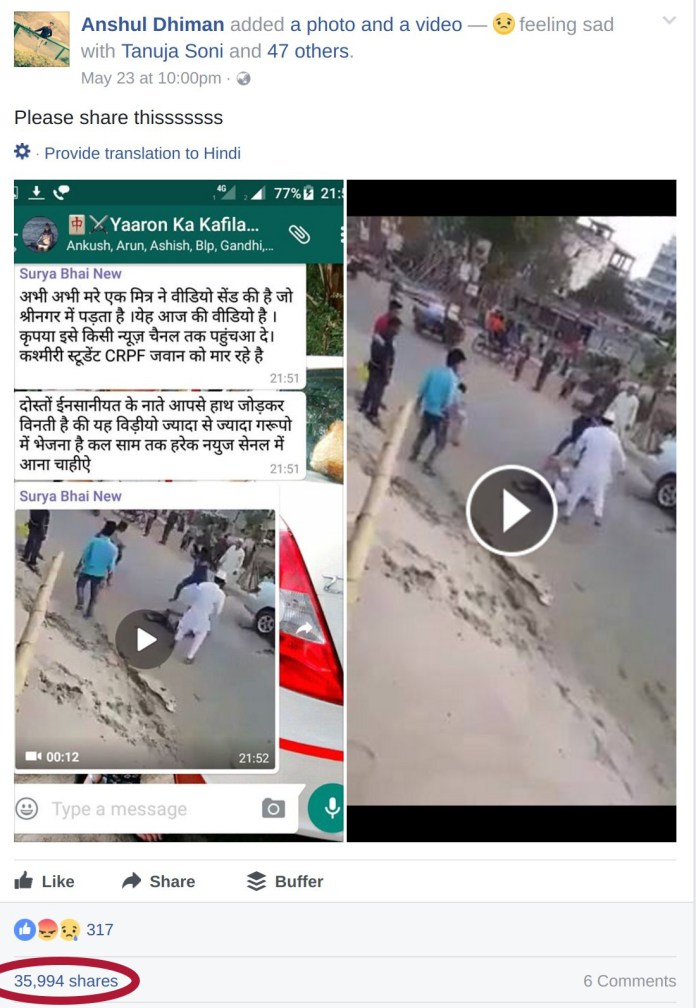
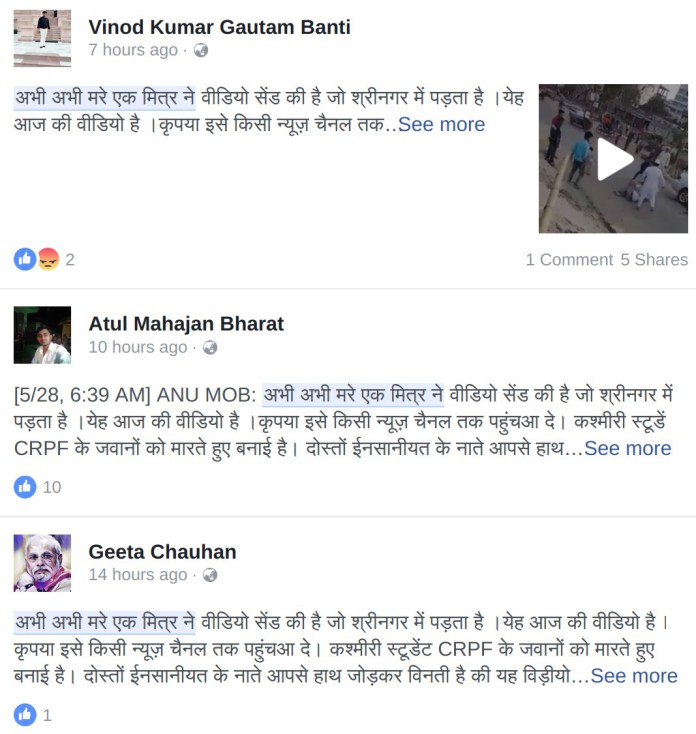
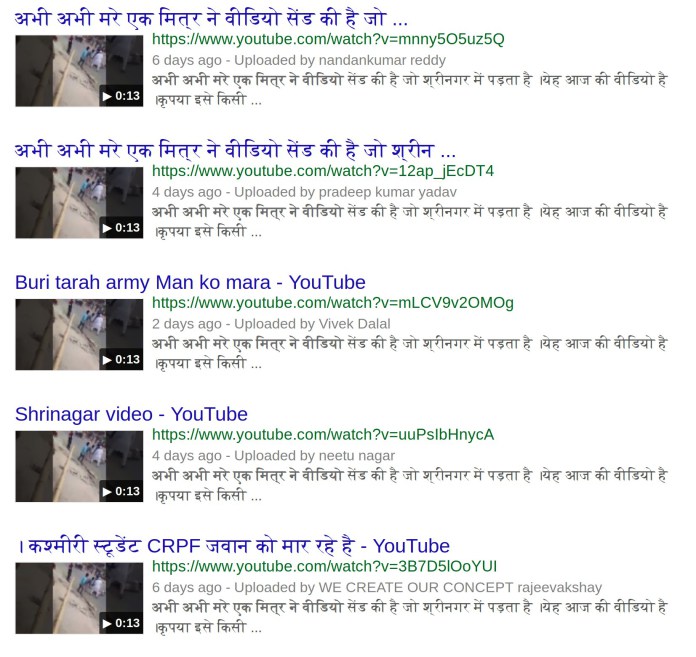
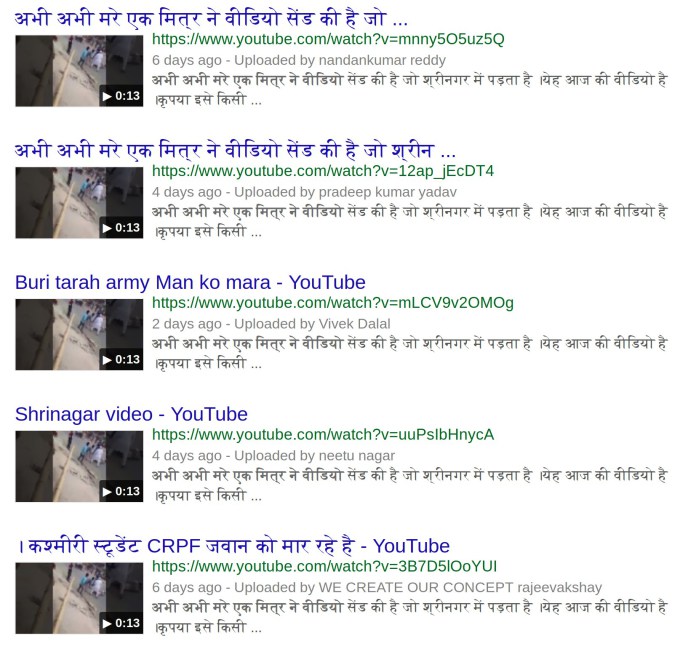
The same fake video has been made viral a third time, each time with a different narrative. Alt News had previous written about how a video was circulated as a Hindu man being killed by Muslims in Nawada, Bihar. The same video was then made viral as a Hindu man being killed by Muslims in West Bengal. The same video is now being circulated a third time as a CRPF Jawan being killed by Kashmiri students.
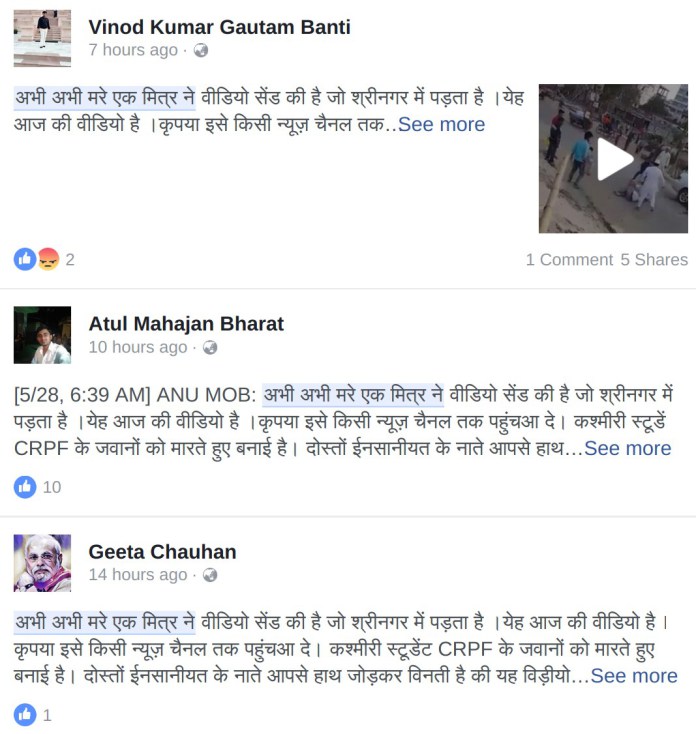
The image above shows how this message was circulated on WhatsApp and made its way to Facebook. Just this one post has been shared more than 35,000 times on Facebook. The text of the WhatsApp message says:
अभी अभी मरे एक मित्र ने वीडियो सेंड की है जो श्रीनगर में पड़ता है। येह आज की वीडियो है ।कृपया इसे किसी न्यूज़ चैनल तक पहुंचआ दे। कश्मीरी स्टूडेंट CRPF जवान को मार रहे है। दोस्तों ईनसानीयत के नाते आपसे हाथ जोड़कर विनती है की यह विड़ीयो ज्यादा से ज्यादा गृपो में भेजना है। कल शाम तक हर एक नयुज चैनल पे आना चाहीऐ।
Translation: Just a little while ago, a friend of mine who studies in Srinagar sent this video. This is today’s video. Please make sure that it reaches news channels. Kashmiri Students are beating up a CRPF Jawan. Friends, for the sake of humanity, I plead before you to send this video to as many groups as possible so that every news channel covers this video by this evening.


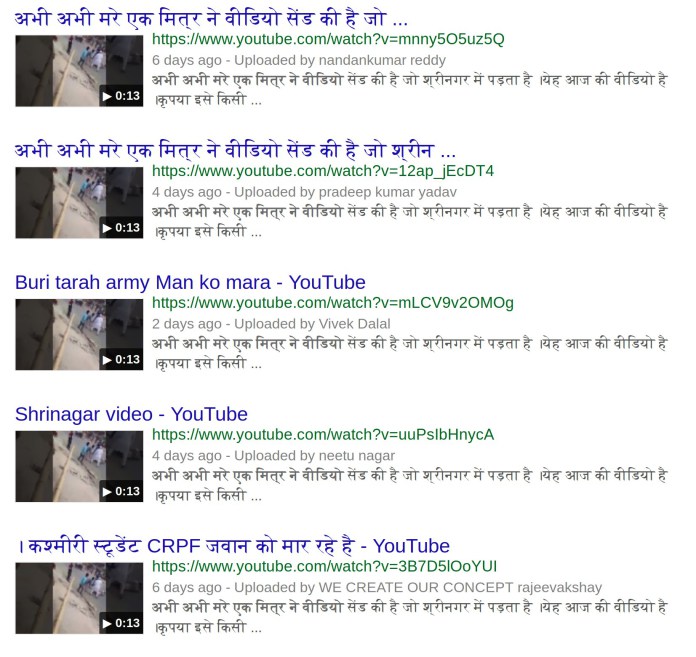
The video also made its way to YouTube with same narration as seen on Facebook/WhatsApp posts.


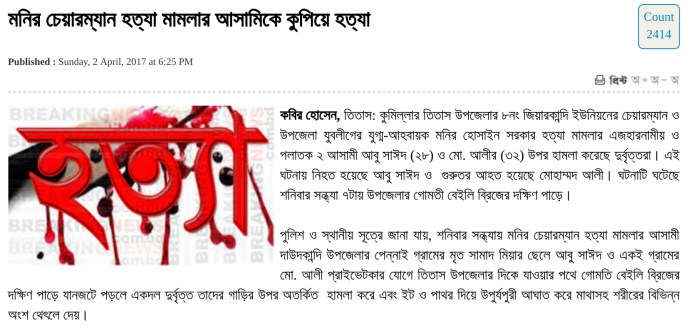
What is the truth? On April 1, 2017, unknown assailants killed Abu Syed and seriously injured Md Ali, two men who were wanted for the murder of Awami League leader Monir Hossain Sarkar. This incident happened in Titas subdivision of Coomilla district in Bangladesh. The issue was also covered by the local news website called Coomilla-r-Kagoj which translates to “Coomilla’s Newspaper”.

The video of the incident was uploaded by a Bangladeshi resident to Youtube on April 2nd.
One might ask, how is that the same video becomes viral over and over again with different narratives? The reason is that there is no one to reach the truth to the people. There’s a raging epidemic of fake videos but no one wants to do anything about it. Those who own big newspapers and big TV channels do not consider it their responsibility to inform their viewers about these fake videos. Facebook Inc that owns both Facebook and WhatsApp platforms doesn’t want to take up the responsibility either. And the Government? Well, less said, the better.

“Naa eppo varuven eppadi varuven nu yarukum theriyathu
aana varavendiya tithula correct ah varuven”
(No one knows when and how I will enter. But I will enter at the right time)
The above lines are from the 1995 blockbuster of Rajinikanth named Muthu. Rajinikanth is the tallest global star from India whose popularity is not just limited to south and not even limited to the Indian subcontinent. He’s the most popular Indian star in Southeast Asia and also Japan. The Bharatiya Janata Party(BJP) under the leadership of Amit Shah[1] is making a furious attempt to enter the unconquered regions of East and South India.
Tamil Nadu, with 39 MPs, is electorally the biggest state in South India. In 2014, BJP garnered just a single[2] seat here regardless of the enormous Modi wave.
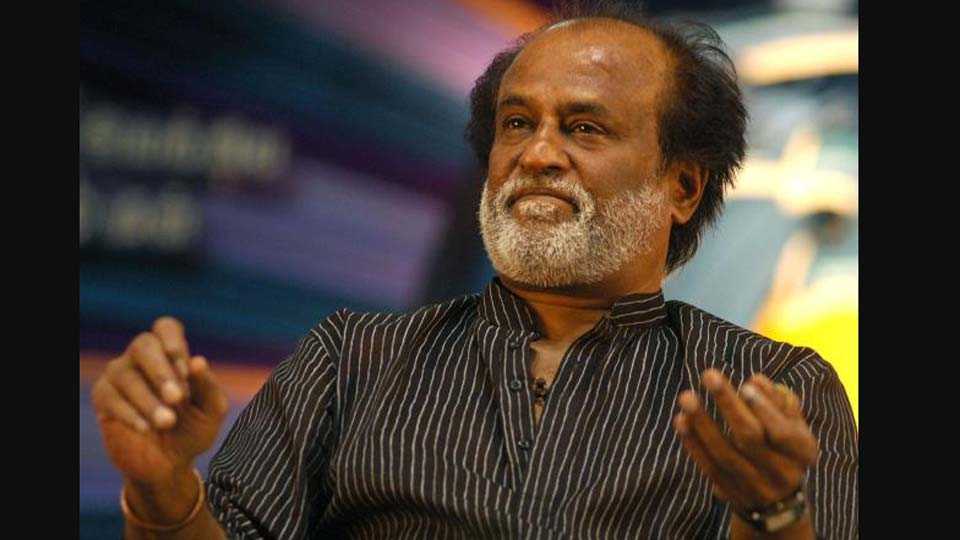
The greatest superstar of South Indian Cinema on May 15 suggested that that he may join politics. Meeting with his fans[3] in Chennai, hotshot Rajinikanth ended his hush in regards to the tremendously discussed issue of whether the superstar would join politics or not. For decades now, the land of Marudur Gopalan Ramachandran (MGR) and the latest lost icon, Jayalalitha, Rajinikanth's current articulations where he has clearly hinted that he could enter into the political arena if "god wills" has changed everything. For a state like Tamil Nadu where film stars and the silver screen have been projected onto the state’s political amphitheatre, the mere speculation of Rajinikanth’s entering politics is a sweet melody to the ears of the fans of the Thalaivar.
The Tamil cinema has, for the most part, focused on linguistic and cultural identity and Indian politics has additionally been worked on similar principles for a very long period.
"Whatever I had to say I said, now I have nothing more to say[4]," was the actor's response when he was asked recently about union minister Pon Radhakrishnan saying the BJP "welcomes" him. He did not however say “no”. The actor said that, while he had no political ambitions, but "If God wills it, I will enter politics tomorrow[5].” His remark is being seen as the stepping stone for setting up another career after his retirement from the movies. As far BJP's invitation is concerned "into politics or the party", Rajinikanth hasn't offered any comment yet.
The talk, possibility and hopes around Rajinikanth's entry into politics have assumed the form of an imaginary trailer –long time running! – of the ultimate, whimsical blockbuster in Tamil Nadu. First showing in 1995, it's been run for long years, teasing his fans but not tiring their interest. For the past 21 years, Rajini has kept the whole state in the will-he-won’t-he- mode. For some political analysts and fans, the most recent remarks signal his actual preparedness now, at this point. The only question before them is whether he will hold hands with the existing BJP or launch his own party. When the Congress held hands with Jayalalithaa in 1996, he supported the DMK[6] and had famously stated, “Even God cannot save Tamil Nadu[7] if AIADMK returns to power.” The DMK alliance went ahead and won those polls in a tsunami wave with Jayalalithaa losing her own seat and her party AIADMK securing just 4 seats in the 235-strong TN Assembly. It won’t be an exaggeration to state that it was Rajini who ensured Jayalalitha’s electoral rout with just a single statement.
The BJP desperately wants to gain a foothold in Tamil Nadu and the iconic actor is one easy way in. BJP, with its overt and obvious Hindi-Hindutva-Hindustan baggage has always been perceived as an organisation and outfit of Hindi-speakers and Brahmins and that's the reason it has so failed to find an echo and footing within the anti-Hindi and anti-Brahmin Dravidian politics of the state. The party is now making a more than decent attempt to recast itself, however, it desperately needs a face in the state and only Rajinikanth has the capacity to saffronise Tamil Nadu. Rajinikanth shares a personal kinship with Prime Minister Narendra Modi. In April 2014[8] just before the Lok Sabha election, Modi had approached Rajinikanth while campaigning in Chennai.
Former CM Jayalalitha has only left an inactive ailing Karunanidhi behind, which paves the way for superstar Rajini’s entry into politics as the most popular and importantly a clean face. On the off chance that Modi and Rajnikanth do finally hold hands, they would likely be seen as an invincible team. It seems feasible that the BJP would like to have the face and charm of Rajini, as well as Jayalalithaa to garner the maximum votes in the state. Rajinikanth has effectively communicated his regret of humiliating Jaya her in 1996, terming it as a "political accident"; this with the BJP clandestinely backing the AIADMK faction[9] driven by O Panneerselvam(OPS) that claims to be the genuine legacy custodian of Jaya, the formula of the BJP backed by the OPS faction backed by Rajinikanth appears to be the current calculation.
If not Tamil Nadu and Rajinikanth as its chief minister, there are also the crucial forthcoming presidential elections. If Modi’s BJP throws this gauntlet as Rajinikanth as President, , it would be extremely difficult for either the Congress or the regional parties of the South like AIADMK, DMK, JD(S) or K Chandrashekar Rao's Telangana Rashtra Samithi, to oppose a glamorous non-controversial South Indian candidate like Rajinikanth for the post. In the past, the Shiv Sena[10] has gone against the NDA and even supported UPA’s Pratibha Patil in the name of Marathi pride. Electorally, the BJP has also begun making inroads into the South. The party opened its account in Kerala[11] last year and has expanded its vote share from 6.3% to over 15%. The NDA will thus gain political capital for garnering Rajini as Indian President's seat and may, in this way, expect electoral gains for itself in the South, especially in Tamil Nadu for the 2019 general elections.
Rajinikanth’s popularity is beyond any other Indian politician today.
He commands the heights of adoration. He has seen fans queuing up for a few miles to have a glance of their superstar. His fans revere him like a God, purchase his film tickets en masse, and even urge him to join politics. Dissimilar to film stars of the past who have entered politics, Rajinikanth stands aloof and alone, even on questions of identity.
He is a Marathi by birth whose birth name is Shivaji Rao Gaekwad[12]. He hails from Karnataka and achieved stardom of epic proportions in Tamil Nadu.
“People keep saying I am not a Tamil,” Rajinikanth said. “Let me tell them that I spent only 23 years in Karnataka. The remaining 44, I have spent here. With their support, Tamil people have made me one of their own. I am a Pachai Tamizhan [pure Tamil]. If I am forced to leave this land, I will only head to Himalayas to be with the Yogis and not to any other state.[13]”
However, given his Kannadiga roots, Rajini will be solicited to experience the ordeal of proving his Tamilian sub-patriotism each time that Karnataka turns the Cauvery tap. Rajinikanth has over 80,000 fan clubs[14] spread across Tamil Nadu, a number greater than the supporters of any political party in the state. This popularity that he commands can also be mis-used or mis-appropriated if he becomes a full-time politician. Though high on popularity, he lacks political ideology.
Rajinikanth strongest hint, so far on about his political debut, was dropped on May 27when he stated “The current political situation is such that the system does not think about the people. It does nothing for them. That has to change,[15]”. Maintaining that the political framework is "corrupt" and democracy is in a "rotten" state in Tamil Nadu, Rajinikanth also urged his fans to be prepared for "war" at the right time.
The Dravidian politics’ domination in Tamil Nadu and Rajinikanth’s over-emphasis on spirituality and religion, both on and off cinema, has led to current speculation over whether he might eventually seek refuge under Modi and the BJP.
There have also been speculations about Thalaivar launching his own party[16] which will then become an ally of the NDA II government. Then, his own party could be a milder version of a saffron outfit. Either which way, Rajinikanth’s entry will be a game changer for Tamil politics. Until any clear confirmation from the Thalaivar, we can only await his move with bated breath.
Join our mailing list to get the latest human rights news that matters, straight to your mailbox.
© Sabrang | All Rights Reserved