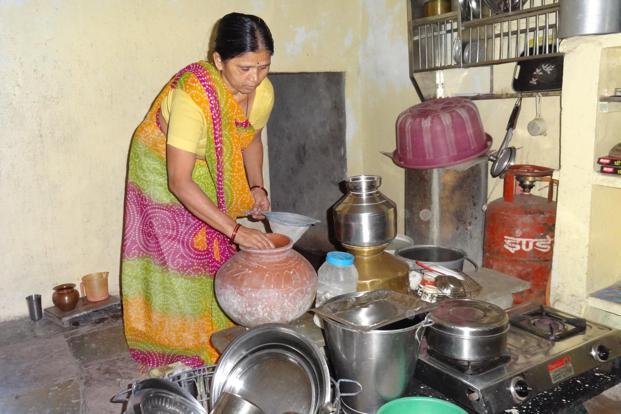
Former Karnataka chief minister and veteran BJP leader, BS Yeddyurappa, has landed himself in a spot of bother after a Dalit youth filed a police complaint against him for practising untouchability.
In his complaint, Venkatesh D alleged that, during his visit to Chitradurga district on Friday, Yeddyurappa had visited a Dalit family in Kelakote, where he had breakfast.
Venkatesh said that the Idli consumed by the former chief minister and other BJP functionaries were not prepared by the Dalit family adding that it was ordered from a hotel.
Venkatesh has also lodged a complaint with the Home Minister G Parameshwara who visited the family the family on Saturday.
Reacting to the news, the JDS’s state president, H D Kumaraswamy, had said, “Why did Yeddyurappa not eat the pulao prepared in their home?”
The incident has left the BJP red-faced given that the state goes for polls in less than a year’s time.
“The complaint is politically motivated and lodged by those who have been shaken by the dalit outreach programme.Their frustration is palpable,” Times of India quoted a BJP spokesperson.
As for Yedyurappa, he demanded apology from both the JDS and Congress for ‘disrespecting’ the Dalit family.
He said, “All the leaders who raised the issue must apologise to Dalits at whose homes I had breakfast.”
I will not wear a blue turban until saffron terrorism is rooted out from the country – Chandrashekhar, Founder of Bhim Army
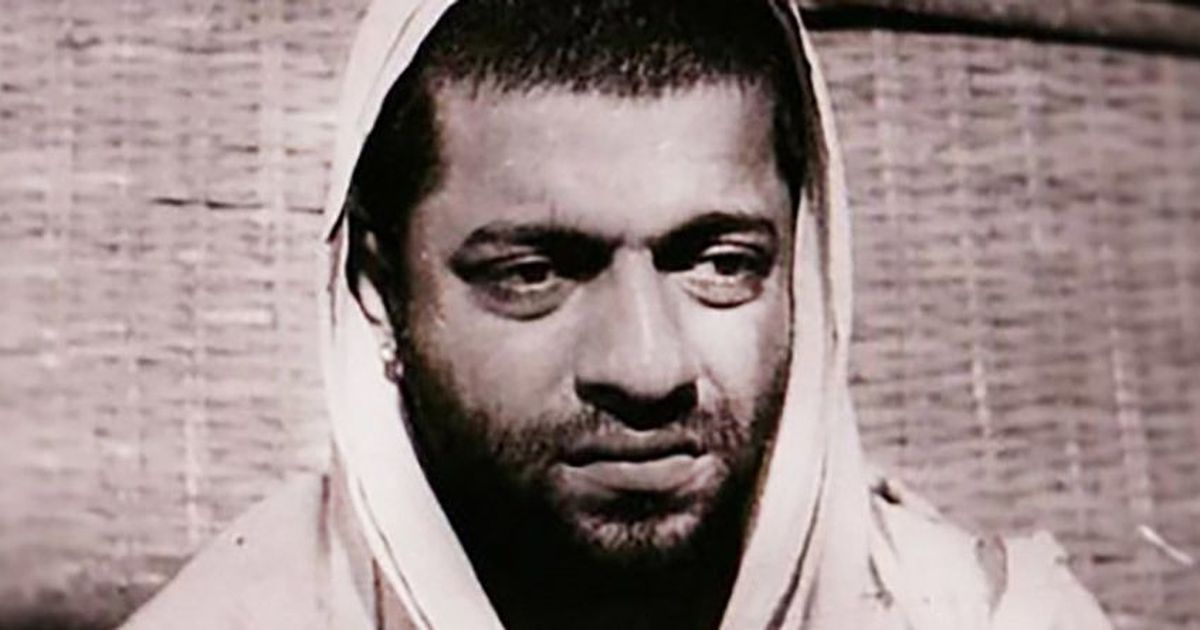
Over 50,000 Dalits from UP, Delhi and elsewhere in north India braved the blistering heat and defied the Delhi police to stage a massive protest in the nation’s capitol on Sunday. The 30-year-old lawyer and founder of the ‘Bhim Army’ Chandrashekhar, who had gone undercover following the anti-Dalit atrocities by Thakur in Saharanpur on May 5, surfaced at the rally, delivered a fiery speech. Hundreds of posters greeted Chandrashekhar, including one which read, “Racism isn’t born, its taught”.
Amidst repeated chants of “Jai Bhim” that resounded at Jantar Mantar, Chandrashekhar, “Main kayar nahin hoon. Meri awaaz aap tak pahunchana tha. Issi liye abhi tak chupa tha. Ab main surrender karronga” (I am not a coward. I wanted my message to reach you. I will surrender now). Later he went to a local court to surrender but was told to do so in Saharanpur.
On May 5, Thakurs had lodged a full scale attack on Dalits in Shabbirpur village of Saharanpur district in UP. They burnt more than 58 houses along with 4 shops, motorcycles, vans, provisions etc, looted jewellery and seriously injured 14 Dalits, including women and children.
According to the police, Chandrashekhar has been absconding since the alleged violent protests on May 9 in response to the earlier incidents of May 5.
At Jantar Mantar rally, the leader of the ‘Bhim Army’ declined to don the blue turban presented to him as a mark of honour. “Main pagdi tab tak sweekar nahin karoonga jab tak desh mein bhagwa aatankwaad khatam nahin hota” (I will not wear a turban until saffron terrorism is rooted out from the country)”, he said.
“This is our country and we will not let it break-up,” he added. He called upon Dalits present at the rally to lodge complaints of atrocities against Dalits with their respective district authorities on May 23.
Many Muslim leaders and activists also participated in the rally which was addressed among others by the Dalit activist from Gujarat, Jignesh Mewani, former president of JNU Students Union, Kanhaiya Kumar and Satya Pal Tanwar, national president of ‘Ek Nigahein’.
Mewani who has been playing a major role in mobilizing and raising Dalit demands in Gujarat since the Una incident said: “There are some politicians who call themselves Ambedkar bhakts. But in this country Muslims, Dalits and Adivasis are being attacked. Is this what is meant by sab ka saath, sab ka vikaas?
Tanwar said that Dalits had held a peaceful demonstration in Saharanpur on May 6 and given the police 24 hours to act against those responsible for the attack on Dalits in Shabbirpur village the previous day. When the police failed to act, Dalits held a peaceful rally on May 9. Tanwar alleged that without any provocation not only did the police lathi-charge the demonstrators, Bajrang Dal activists even resorted to firing at the Dalits.
After the rally a memorandum was handed over to the President of India demanding penal action against the errant police and activists of the Bajrang Dal.
The Delhi police told the media later that though permission had been denied for the rally at Jantar Mantar, they did not intervene since a large number was present and also because the rally was peaceful.
The democratic forces, organizations and the thinking minds of IIMC took part in a spirited protest today against the invitation extended to notorious ex-IG Kalluri by the IIMC administration to take part in a seminar. To start with, since last two days, there were several attempts on the part of the organizers to confuse/conceal Kalluri’s invitation. Immediately after the declaration of the protest, Kalluri’s name was dropped from the poster. There were also threats of counter-mobilisation by the BJP goons. But undeterred, as we reached the gates of IIMC at 11am, the site echoed with slogans of “Killer Kalluri Go Back”!
There was however no sign of him till 3pm and then suddenly we were told that he has “appeared” on the stage. It was informed by several residents of IIMC that he had been lodged much earlier inside IIMC campus by the organizers so as to avoid the protestors. We continued our protest outside. Now the question is why is Mr. Kalluri so scared of even placards, slogans and questions from students? What makes him scared to face protests? Why couldn’t the so called “Bastar tiger” muster enough courage to even face largely a group of students?
That’s because our questions are far more heavier than his smug arrogance. It’s because we have the power to tear apart the halo and show the real horror that he has unleashed in Bastar while he was an IG there. The protesters today made it clear that it is simply unacceptable to invite an ex-IG who is the architect of a Satya Judgment type vigilante gang; one who has presided over numerous instances of fake encounters, gang-rapes, torture and fake arrests of the adivasis; and one who has been sent on “long leave” after an investigation by the NHRC due to gross human right violations. He has also in fact presided over the threats, attacks and hounding of all those voices that have dared to expose his bloody tenure. This includes Soni Sori, Lingaram Kodopi, Bela Bhatia, Nandini Sundar and so on. He even went to the extent of telling a journalist, Kamal Shukla, “Either leave journalism, or leave Bastar.” The protestors today condemned the IIMC administration for inviting such a character to lecture on “journalism”. We condemned the design of the IIMC administration to produce stenographers instead of journalists, ones who will jot ask question, who will not look for the truth, but will parrot the likes of Kalluri. The protestors raised their voice against not just the individual or an institution, but also demanded an end to the war on people being waged by the state-corporate nexus to facilitate the loot of resources at the cost of thousands of adivasi lives and livelihood. Kalluri has just been one of its hit-men. We thereby reiterated our demand of ending Operation Green Hunt and pledged to stand by the struggle of the adivasis for their jal-jangal-jameen.
Some have put forth the question as to why did we protest Kalluri’s invitation to IIMC. They asked, aren’t we who talk about free speech not being hypocritical here? Well, Kalluri throttled free speech every day in Bastar, he arrested activists and journalists, he sent goons to intimidate anyone speaking out. The express agenda being to make the ongoing brutal war against adivasis a war without witness. In such a context to protest against Kalluri, in fact, becomes an act of defending free speech, and not the other way around. Ultimately, the fight for free speech is fundamentally a fight against power.
From Bastar Solidarity Network – Delhi Chapter, we congratulate and salute all those who stood their ground today and raised their fists, their placards and their slogans against the killer Kalluri, against Operation Green Hunt, against the puppet IIMC administration and the powers that be.
‘These people do not know hunger’: An author struggles to make sense of the Jharkhand lynchings As seven people are killed, Hansda Sowvendra Shekhar explains how cattle bind together the various communities of his ancestral village.
“The people who did this, they seem to have never seen or experienced hunger in their lives. They seem to have never been deprived of food. They just cannot understand to what extremes hunger drives a person. They just cannot understand what all a man can eat if he is kept hungry for days.” My father’s response was to the horrific incident that took place in Reasi in Jammu late in April in which a nomadic family of five was attacked by apparent cow vigilantes, about 200 of them, who believed that the Gujjars – travelling with their goats, sheep, and cattle – were taking the cows to slaughter. The people my father referred to, the ones who did not know hunger, were those cow vigilantes. “The poor are attacked for the scraps they somehow manage to find to eat.” The anguish in my father’s voice had not ebbed. “What will these gau rakshaks ever know about having to survive on a dead cow’s entrails?”
Life in Kishoripur
He proceeded to tell me how it was a norm among Santhals and other low-caste Hindus to utilise the remains of a dead cow for food and other purposes. He gave the example of our own village.
Kishoripur, my ancestral village, is in the Chakulia block of Jharkhand’s East Singbhum district. Kishoripur is a Santhal village, with the next two dominant communities being the Kamar (the blacksmith caste) and the Kunkal (the potter caste), both included in the Backward Caste category, yet, both considering themselves above the Santhals in the caste hierarchy though the Santhals, because we are Adivasis, do not have a caste system at all. The fictional village of Kadmadihi in my novel, The Mysterious Ailment Of Rupi Baskey, was partly modeled on Kishoripur and I have mentioned how the Kamar considered Santhals to be untouchables despite the Santhals being a majority.
In Kishoripur, too, the Kamar, years ago, considered Santhals to be untouchables. Though this situation has changed now and Kamar families come to draw water from the well my family owns, there are certain taboos that the Kamar and the Kunkal and other non-Adivasi communities in Kishoripur still adhere to. For example, the disposal of dead cattle. In Kishoripur, which is primarily an agricultural village, nearly all families – Santhals as well as non-Santhals – own farm land and cattle to plough those lands. Apart from cows and bullocks, several families own goats and sheep. Some Santhal families also have pigs. Yet, when cattle die, a non-Adivasi family does not touch the carcass. Cattle, when alive, are an asset, but, when dead, are impure. Hence, it becomes the job of the Santhals – either from Kishoripur or some other, nearby villages – to carry the dead cattle to the “bhagar”, the spot where animal carcasses are placed. There is a saying in the colloquial Bengali spoken in the villages: “Sokunay chinay bhagar” – a vulture identifies a bhagar.
The Santhals do not just dump the dead cattle at the bhagar. They use whatever can be used of the dead animal. The skin is used for making drums and other objects. If the carcass is fresh, the flesh is cut away to be eaten as food, especially the flesh from the rump of the cattle. Those with a taste for the entrails take those away as well. The rest of the carcass is left for the sokun, the vultures.
Credit: Hindustan Times
In some villages, Muslims, who work with animal skin, come to take the dead cattle from the houses of higher-caste Hindus or those Hindus who consider themselves too pure to touch their own dead cattle to skin the carcass. Some Muslims also come to take away dead goats and sheep.
No one is killing an animal. No one is slaughtering a cow or a bullock or a buffalo or even a goat or a sheep. It is a dead animal that is providing for the needs of human beings. Down the years, despite the concept of purity and impurity, despite the caste and community differences, people from all communities in our village have lived in an atmosphere of symbiosis. There had never been the need for any cow vigilantes or goat vigilantes.
My father proceeded to recount how, during times of drought and scarcity of food, it was this meat from the carcass of a dead cow that helped people survive. The flesh of the dead cattle was cut into long, rope-like pieces. “The thick, strong plastic rope we use nowadays,” my father gave an example to show what that rope of beef looked like. Those ropes of beef were placed out in the sun to dry on bamboo lattices, which are commonly used as boundary walls around houses in villages. Drying in the sun preserved the beef, and this preserved beef saw the poor, the lower caste and the supposedly impure through days of drought and hunger.
The nomadic family that was attacked by gau rakshaks in Jammu was, perhaps, among these poor, hungry, and impure people. They were attacked by the pure gau rakshaks despite not having a single dead cow with them. Imagine what would have happened had they been carrying beef?
“Desperation drives the hungry and the poor to gather something to eat, in any way.” My father’s voice was laced with emotion. “The gau-rakshaks will never understand this.”
The Gujjar woman whose family was attacked by cow vigilantes in Jammu in April pleads for mercy. Credit:YouTube
My father told me about a tradition in some villages where agriculture is the primary occupation and there is a lack of pasture where cattle may be taken out for grazing. Our village, Kishoripur, is one such place. In villages like these, during the farming months, from Ashadh (mid-June in the Gregorian calendar, when sowing takes place) till Kartik (mid-October in the Gregorian calendar, when harvesting takes place), the cattle of these villages are taken to settlements where there is enough pasture for the cattle to graze for three or four months. The cattle our family owns in Kishoripur, for instance, are taken to the house of a Mahato family – Mahato are Hindus, placed in the Backward Caste category – in a village called Purnapani. Purnapani is about 10 kilometres away from Kishoripur, a little off the aerodrome of the Allied Powers built in Chakulia during World War II.
Down the decades, this tradition has been ingrained so deeply that our family does not need to go to this Mahato family. Someone from this Mahato family comes to Kishoripur in June, takes all our cattle – except the bullocks we need to plough our fields – to Purnapani. While we busy ourselves with our farming, this Mahato family takes care of our cattle in their village for four months. Then, during Sohrai – the harvest festival celebrated by the Santhals, in October-November in southern Jharkhand – someone from the Mahato family comes to us in Kishoripur with all our cattle. In return, we give that Mahato family a share of our produce, usually paddy. That is how a relationship between a Santhal family and a Mahato family has grown down the decades, though their lives are so different from one another. Cattle has bound us together.
Now imagine this transport of cattle between two villages, two families, for practical reasons, in the times of purity-driven cow vigilantism.
A lone Mahato man – a member of a backward caste – is taking, perhaps, ten cows to his village to look after them while the Santhal owners of those animals are busy farming. The gau rakshaks – pure, high-caste Hindu men, who would, perhaps, never understand this relationship between a Santhal family and a Mahato family – find this Mahato man with these cows. They suspect that he is a cattle smuggler, taking the cows for slaughter. They beat him up. They might even kill him. If a lone Santhal man brings his cows back from a Mahato family, he might be in even deeper trouble. The gau rakshaks already know Adivasis to be consumers of beef.
Cow vigilantism has received some boost in Jharkhand, with cow vigilantes in April attacking even policemen on hearing rumours of cows being taken for slaughter. Maybe this was not enough. So an even more horrific method of unleashing violence and terror has been introduced in Jharkhand: branding apparently innocent men as the abductors of little children.
People in Jharkhand watch images of a lynching on their phones. Credit: Hindustan Times
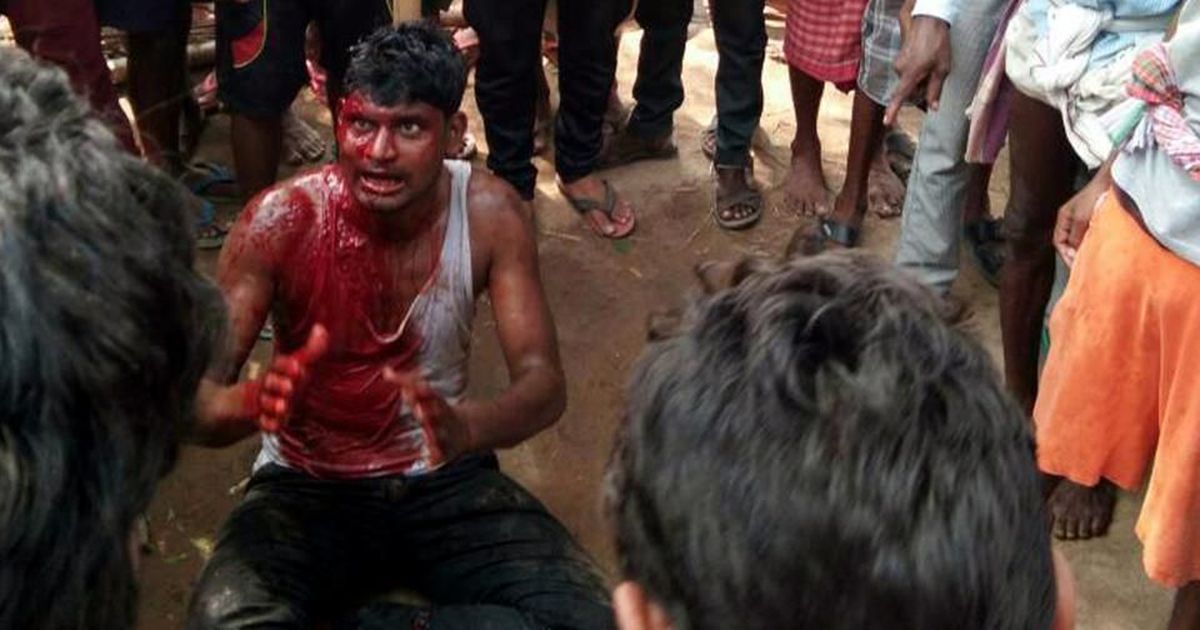
In the past few days, at least seven people, some of whom were reported to be cattle traders, have been lynched by mobs, fearing that those men were kidnappers. Seven men were lynched in Seraikella-Kharsawan district, while one man was lynched in Narwa area of East Singbhum district. Seraikella is one of my favourite places, while East Singbhum is my own home district. The news of these killings have filled me with terror even as I sit in Pakur in northern Jharkhand, nearly 700 kilometres away from those scenes of crime in southern Jharkhand.
The practice of mobs lynching people for possessing or consuming beef will be unlikely to become commonplace in Jharkhand, in my opinion, because the state, due to its remarkable Adivasi population, has traditionally been known to be a consumer of beef, pork, and whatever else might be considered taboo or inedible by the majority – for example, monitor lizards. Hence, what new story could be cooked up to create a situation of fear and distrust? What is most dear to people? Their children. Accuse some people of being kidnappers of children and have them lynched. In this age, when social media has become a carrier of hatred, is it that difficult to get anyone lynched? Be it beef or the abduction of little children, everything is just a pretext, an excuse. The purpose is to kill, to terrorise, to dominate, to create a pure and ideal kingdom.
Nearly every day, I see Santhal men, women, and children migrating from Pakur. So many minors must being kidnapped, forced to do things that no human being aspiring to live a life of dignity should ever do. Why is there no outrage? Why does a stray rumour of a kidnapping makes a mob in a mofussil town lynch some men ruthlessly while the entire nation is quite blind to the reality of Adivasi women and children being trafficked day in and day out?
Some days ago, I watched an English-language horror film called Darkness Falls. Roughly based on the legend of the Tooth Fairy and set in a fictional town called Darkness Falls, this film tells the story of a widow who loves children and whom children adore. However, when two children go missing, the townspeople blame that widow and burn her. When those two children are found unharmed, the people realise their mistake: they had killed an innocent woman. But it is too late. The vengeful soul of that widow returns to kill the children and adults of that town. In this lynching movement against non-existent abductors of children, are we turning innocent men into vengeful souls?
In the film, the innocent widow is shown turning into a fearful villain and, in the climax, is killed the way villains are usually killed in mainstream, adrenaline-pumping films. She does not find justice, although everyone knows that she was innocent. In these lynching incidents too, I am afraid, those who are lynched will never find justice. Once branded villains, they will remain villains. An innocent man being killed for no fault of his, an innocent man not being given an opportunity to clear his name as he is already dead, an innocent man never finding justice – that is the kingdom we should be afraid of.
Hansda Sowvendra Shekhar is a doctor and the author most recently of The Adivasi Will Not Dance, a collection of short stories.
Unrest continued in many parts of Jamshedpur city in Jharkhand as fresh clashes between protestors and an apparently callous police continued on Sunday morning. Prohibitory orders under Section 144, which disallows more than four people from gathering at a place, were imposed in four parts of the city after violence in and around the areas on Saturday, reported PTI. The unrest has been sparked by the lynching of four Muslim men in Saraikela-Khushwahan district on Thursday. The local police sought to act on rumours that were being spread on What's App for over a month on alleged 'child kidnappers' on the prowl.
The commercial electronic media has in a sense blacked out the developments in Jharkand even as the Telegraph, Hindustan Times and Indian Express have been reporting on it.
This was one of the two incidents of mob violence that took place in south Jharkhand on the same day as a viral Whatsapp rumour circulated in the area claiming that gangs of kidnappers were taking away children and killing them in a gruesome manner.
The first incident took place in Sobhapur village in Saraikela-Khushwahan district. Mohammed Naeem, an animal dealer and resident of Phulpal village in East Singhbhum, was passing through Sobhapur in Saraikela-Khushwahan district in a truck with three companions, Sajad Saju, Siraj and Alim on May 18. The people of the neighbouring Rajnagar village, who came to Sobhapur in search of child-kidnappers, attacked and killed Naeem and his three companies.
Later, a similar incident took place in Nagari village in East Singhbhum district, where a mob killed three people, including one Gautam Verma and his brother Vikas Verma, claiming that they were “bachcha chors” or child kidnappers. The Vermas had gone to the village to enquire about buying some land there.
As news of the first incident spread, protests were held in some Muslim areas on Friday, where residents closed shops and blocked roads, reported Indian Express. On Saturday, the protests intensified and several policemen were injured in the stones pelted by the mobs, reported Prabhat Khabar.
On Sunday, the police fired in the air to disperse the mobs in Jamshedpur’s Mango area. “The situation is under control now and adequate force have been deployed in the area,” Deputy Commissioner of East Singhbhum district Amit Kumar said. There are several videos etc of the police action in Jamshedpur.
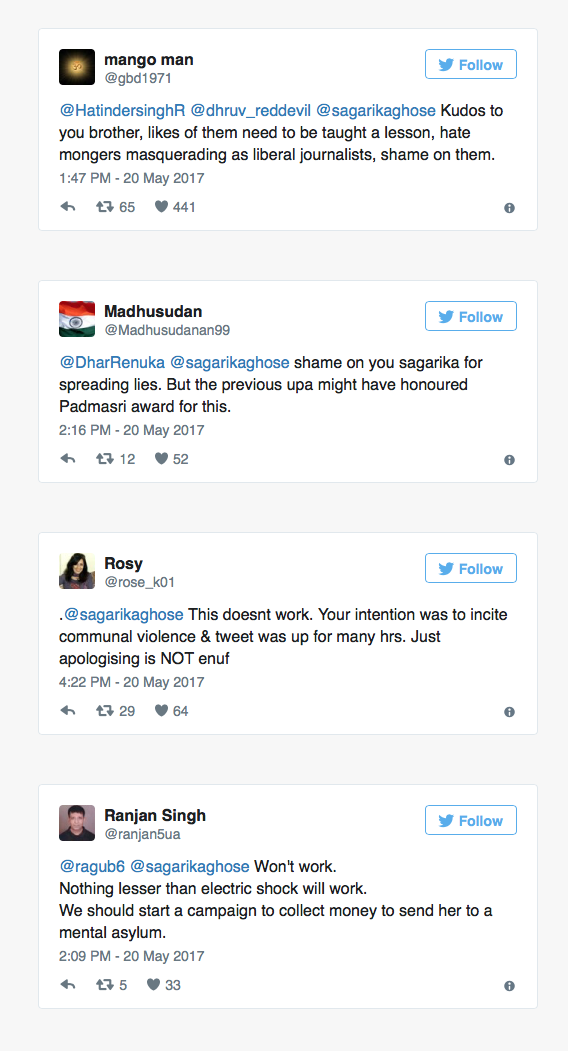
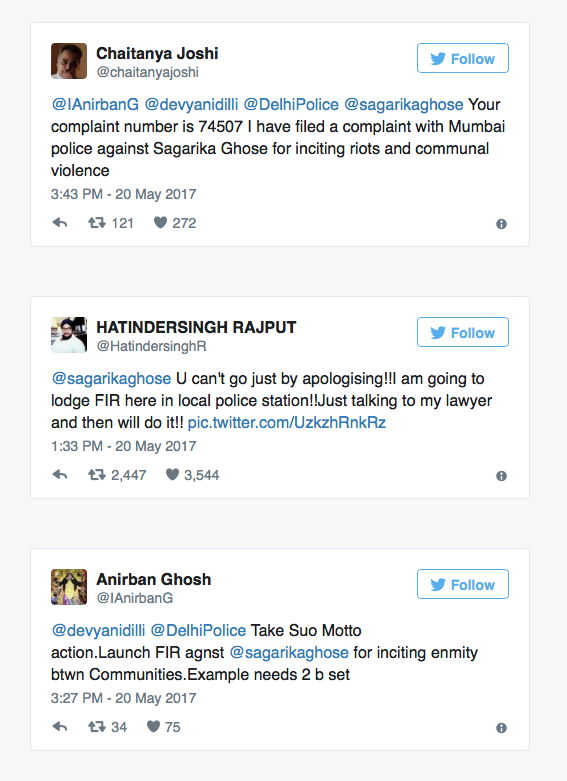
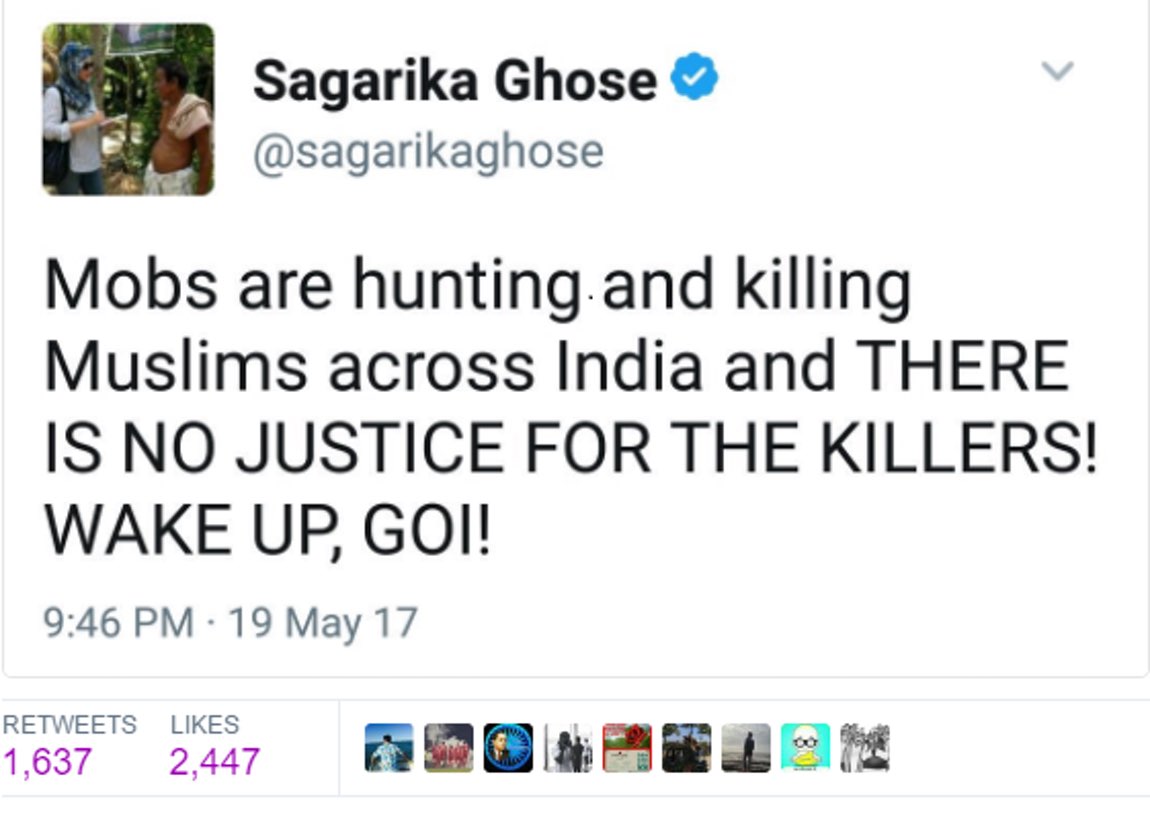
Trolls on Twitter Threatened Noted journalist and author Sagarika Ghose after she tweeted on Friday asking the government to act against those behind the alleged killings of Muslims across the country – and triggered a Twitter storm in the process.Ghose’s tweet immediately drew sharp reactions from twitterati, with one user even claiming to have filed an FIR against her.
The Twitter War that Followed is a Revelation.
Have deleted my tweet on attacks on Muslims & apologise if sentiments were hurt. However I remain a vigilant observer of communal violence..
The struggle for social justice and Human Rights of the Dalits from Bhagana village in district Hisar, Haryana completed five years recently. It was on May 21, 2012 that they were forcibly thrown away from village by imposing economic boycott by the upper caste villagers. Around 150 families along with their children moved out to Hisar Secretariat and started living in makeshift tents.
Later many of them as mark of protest started a padyatra to Delhi and decided to bring their protest to national capital when they found that the government in Haryana was not very responsive to their issue. Unfortunately they have been betrayed by the political parties and many others. Jagdish Kajala has been in the forefront of this movement from very beginning who left everything at Hisar. We recorded this conversation some months back when the people from Bhagana had come to National Commission for Scheduled Castes in Delhi to get justice where DGP Haryana was supposed to come but with six hours wait at the Commission's headquarter at Loknayak Bhavan no official turned up and people again were taken for granted. Bhagana's struggle can provide a lot of learning for future and what is important to ensure that they are taken to logical conclusion. Sharing this conversation with Jagdish Kajala about the movement and its future.
.
भगाना के लोगो के आन्दोलन को आज पांच साल हो गए हैं . २१ मई २०१२ को हिसार जिले के भगाना गाँव के दलितों को वहा के जाटो के द्वारा आयोजित सामाजिक आर्थिक बहिष्कार के चलते गाँव छोड़ना पड़ा था . करीब १५० परिवार हिसार के मिनी सेक्रेटेरिएट में रह रहे थे. बाद में बहुत से लोगो ने हिसार से दिल्ली तक का पैदल मार्च आयोजित कर मामले को देश के राजधानी में ला दिया क्योंकि हरयाणा सरकार के तरफ से कोई सकारात्मक जवाब नहीं मिल रहा था . पांच साल के लम्बी लड़ाई में जगदीश काजला और उनके भाई सतीश सुबह शाम अपना सब कुछ छोड़कर जंतर मंतर पे डटे रहे जिसमे उन्होंने लोगो के अलग अलग चेहरों को देखा . बहुत से लोग समर्थन में आये और बहुत से जुड़ने के बाद अलग हो गए . बहुतो ने आरोप लगाया के आन्दोलन भटक गया है तो बहुतो ने कहा के राजनीती करना चाहते हैं लेकिन हकीकत यह है के गाँव जाना अभी भी दूभर है और लोग या तो हिसार सेक्रेटेरिएट में हैं या अपने अपने रिस्ठेदारो के यहाँ दूर दूर चले गए हैं . इस पुरे आन्दोलन के प्रश्नों को लेकर जगदीश काजल से ये बातचीत जंतर मंतर पर कुछ महीने पूर्व रिकॉर्ड की गयी थी जब वह गाँव के अन्य साथियो के साथ रास्ट्रीय अनुसूचित आयोग में गए थे जहाँ पुरे दिन इंतज़ार करने के बाद भी हरयाणा पुलिस के प्रमुख अंततः नहीं पहुंचे जो यह भी दिखाता है के सरकारी आयोगों को अधिकारी कितनी गंभीरता से लेते हैं
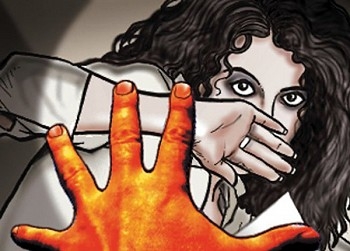
Female genital mutilation is a serious criminal offence under IPC and POSCO Act, 2012 inviting an imprisonment of not less than 10 years and may extend to imprisonment for life
Representational image
Dawoodi Bohra activists are “absolutely delighted” over the statement of Union Minister for Women and Child Development (WCD), Maneka Gandhi that the central government will pass a law to prohibit female genital mutilation (FGM) unless the community’s headpriest [Syedna Mufaddal Saifuddin] voluntarily issues an advisory to the community to banish the practice.
Gandhi according to a report today in the Hindustan Times has described the practice of female genital mutilation (FMG, also referred to as female genital cutting, khatna) as a “criminal offence”.
On May 8, the Supreme Court has issued notices to the Centre and four state governments in response to a PIL seeking the outlawing of the shameful practice.
It is reliably understood that the WCD ministry has sent advisories to state governments pointing out that FMG is a violation of sections of the IPC and the POSCO Act.
“We will write to respective state governments and Syedna, the Bohra high priest, shortly to issue an edict to community members to give up FGM voluntarily as it is a crime under Indian Penal Code (IPC) and Protection of Children from Sexual Offenses (POCSO) Act, 2012. If the Syedna does not respond then we will bring in a law to ban the practice in India,” Gandhi told the Hindustan Times.
“This is fantastic news and absolutely welcome”, the convener of the group ‘Speak Out Against FGM’, Masooma Ranalvi told Sabrang India. The group had recently launched an online petition calling upon the WCD minister to bring a law banning the practice.
“We are very excited and very happy”, enthused Arefa Johari of Sahiyo, an organization of Dawoodi Bohra women campaigning to end the practice of what it prefers to call female genital cutting (FGC).
“This is something we have been working at for a very long time and we heartily welcome the minister’s statement”, Johari added.
Ranalvi told SabrangIndia her group has been holding talks with the minister on how to banish the FGM practice which is “un-constitutional, against human rights and against existing Indian laws of the land”: Indian Penal Code (IPC) and The Protection of Children from Sexual Offences Act, 2012 (POSCO Act).
Johari stated that individual members of Sahiyo who were victims of FGC had also made representations before the WCD ministry.
“We hope that Syedna saheb (head priest of the global Dawoodi Bohra community will abide by the laws of the land and issue an advisory to all his Indian followers to give up the practice of FGM just as he has already issued advisories to all Dawoodi Bohras living in the West,” she told Sabrang India.
Ranalvi categorically asserted that what is referred to as khatna or khahafz is not “female circumcision” as the community’s priests pretend it to be but falls within the Type 1 and Type 4 categories of FMG as described by the World Health Organisation (WHO).
It may be noted that FMG is considered a serious criminal act with severe consequences both under IPC and POSCO.
Section 326 of IPC: “Voluntarily causing grievous hurt by dangerous weapons or means—Whoever, except in the case provided for by section 335, voluntarily causes grievous hurt by means of any instrument for shooting, stabbing or cutting, or any instrument which, used as a weapon of offence, is likely to cause death, or by means of fire or any heated substance, or by means of any poison or any corrosive substance, or by means of any explosive substance, or by means of any substance which it is deleterious to the human body to inhale, to swallow, or to receive into the blood, or by means of any animal, shall be punished with 1[imprisonment for life], or with imprisonment of either description for a term which may extend to ten years, and shall also be liable to fine”.
Section 327 of IPC: “Voluntarily causing hurt to extort property, or to constrain to an illegal act.—Whoever voluntarily causes hurt, for the purpose of extorting from the sufferer, or from any person interested in the sufferer, any property or valuable security, or of constraining the sufferer or any person interested in such sufferer to do anything which is illegal or which may facilitate the commission of an offence, shall be punished with imprisonment of either description for a term which may extend to ten years, and shall also be liable to fine”.
Section 9 (h) (i) and (j) of the POSCO Act define Aggravated Sexual Assault as: “(h) whoever commits sexual assault on a child using deadly weapons, fire, heated substance or corrosive substance; or “(i) whoever commits sexual assault causing grievous hurt or causing bodily harm and injury or injury to the sexual organs of the child; or “(j) whoever commits sexual assault on a child, which — “(i) physically incapacitates the child or causes the child to become mentally ill as defined under clause (l) of section 2 of the Mental Health Act, 1987 or causes impairment of any kind so as to render the child unable to perform regular tasks, temporarily or permanently”.
The punishment for aggravated sexual assault under the Act is “rigorous imprisonment for a term which shall not be less than 10 years but which may extend to imprisonment for life and shall also be liable to fine”.
In the past year members of the Dawoodi Bohra community held responsible for FMG have been jailed in Australia last year. In USA last month federal authorities have made arrests and the accused face prosecution for performing, aiding or abetting FMG.