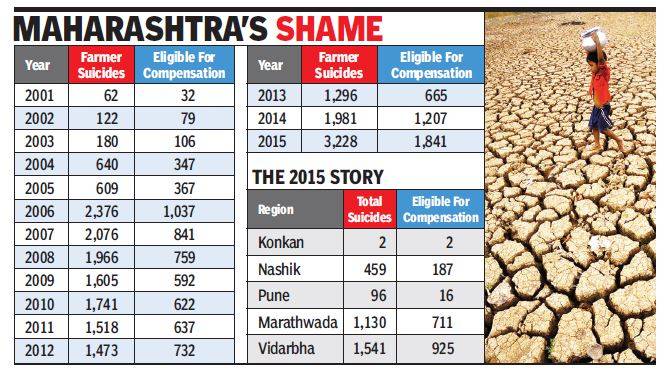
Maharashtra has reported 852 farmer suicides in the four months between January to April this year, according to government data. Times of India reports that this means an average of seven farmer suicides were reported every single day during this period. As many as 409 cases – or 48% – are from Vidarbha region, from where chief minister Devendra Fadnavis hails.
Overall, the figures are lower than the 1,023 cases reported during the same span last year, when the state was in the grip of a severe drought and water crisis. Subsequently, the state experienced a good monsoon.
Within the cotton belt of Vidarbha, the bulk of farmer suicides are from the five districts of Amravati, which reported 324 cases. This is not much lower than the 339 cases reported during this period last year. So far, 85 cases have been reported from Nagpur division. Marathwada region, which had experienced successive years of drought, reported 291 cases till April this year, or 34% of the total. Last year, by April, the figure was 375.
North Maharashtra reported 132 farmer suicides by the end of April, or 15% of the total cases. The Konkan belt reported only one case so far, while the sugar belt of Western Maharashtra has reported 19 cases, according to revenue department figures.
The Opposition has been demanding a farm loan waiver, the issue which led to its Sangharsh Yatra. But the state has refused to grant it, saying it would cost Rs 30,500 crore and that the earlier waiver did not stem suicides.
Farm leaders say the government has not done enough to address the critical issues of pricing and farm loans. "As we face the monsoon, many farmers who have not been able to repay existing loans will not be eligible for fresh loans," says farm leader Vijay Jawandhia. Pointing to the tur dal glut, he said the government did not act quickly enough to impose restrictions on imports.
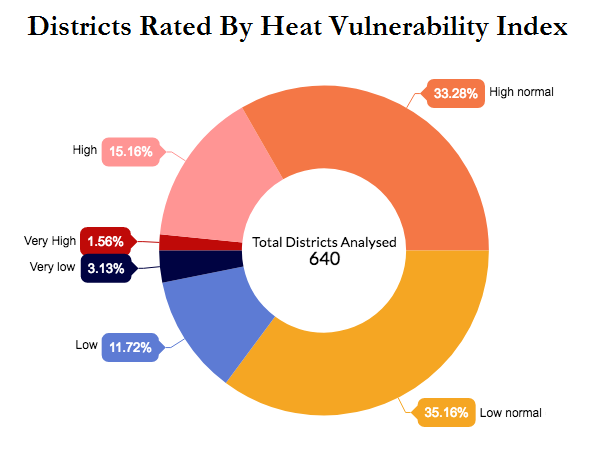
People living in underdeveloped parts of central India are most vulnerable to the health impacts of heat waves, a Heat Vulnerability Index (HVI) for India has found.
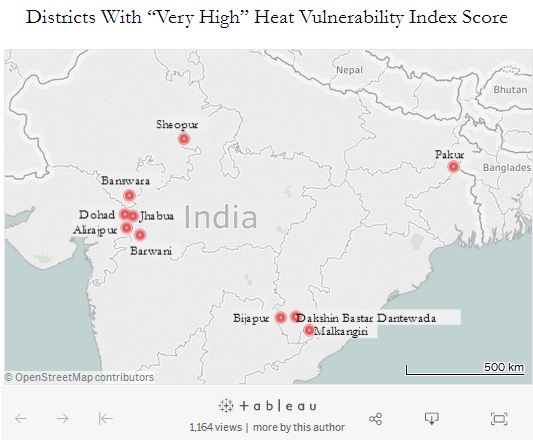
The index considered various factors including a person’s age, caste, income and health, as well as the green cover in an area, as having a bearing on people’s heat vulnerability, and its analysis of 640 (of the 707) districts in the country finds ten districts to be “very high risk.” Six of these are in relatively underdeveloped areas in Madhya Pradesh and Chhattisgarh. In contrast, the 20 districts in the “very low risk” category are mostly in the relatively developed states of Kerala and Goa and the union territory of Lakshadweep.
The Index was published in The International Journal of Environmental Research and Public Health, a peer-reviewed scientific journal, in March 2017.
Researchers used data from the 2011 Census of India, the District Level Household Survey-3 and the Indian Space Research Organisation, combining it statistically to create the index, according to this Rand Corporation blog post by two of the authors, Gulrez Shah Azhar and Jaime Madrigo.
The very high-risk areas, concentrated in Madhya Pradesh and Chhattisgarh, are less urbanised and people there have fewer household amenities as well as lower rates of literacy and access to water and sanitation.
These high-risk areas are not the same as areas with high or rising temperatures — the correlation between the HVI and average land surface temperatures is moderate. “When we think of temperature, there are several issues to consider–in addition to temperature there is effect of humidity and radiant heat on mortality. At the same time, local populations are adapted to (used to) the prevailing temperatures. Deaths happen when heat exceeds these adaptation thresholds,” Gulrez Shah Azhar, one of the authors, told IndiaSpend.
Azhar gave the example of Dehradun, which reported heat wave deaths at lower temperatures than neighbouring cities in UP last year. “In UP there were much higher temperatures but no reported deaths, since the much higher temperatures are normal for UP,” he said, adding, “If we include temperature as a variable in the index itself, it would bias the results towards places with higher normal temperatures.”
India’s largest avoidable natural disaster
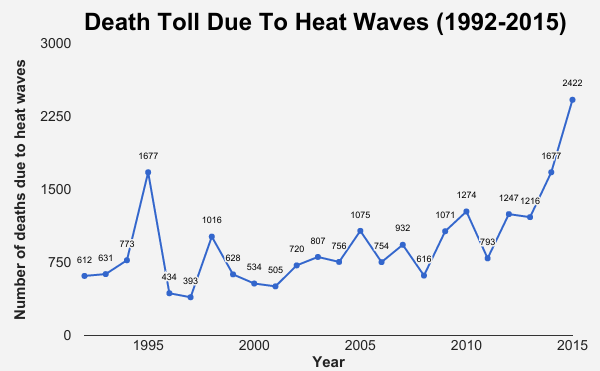
The number of deaths due to heat waves recorded in 2015–more than 2,400–was higher than the number of deaths caused by any other natural disaster, according to the ministry of home affairs. In 1998 the death toll was 3,000 and in 2002, over 2,000, according to data from the National Disaster Management Authority (NDMA) 2016 action plan for the prevention and management of heat waves. The NDMA is an agency under the ministry of home affairs.
A heat wave is a period of abnormally high temperatures (more than the normal maximum temperature) that occurs during the summer season, with the resultant atmospheric conditions causing physiological stress, and sometimes death, among affected populations, according to the NDMA.
The Indian Meteorological Department uses several factors to quantify a heat wave:
a. Hot weather conditions are not considered a heat wave unless the maximum temperature reaches 40°C in plain areas and 30°C in the hills.
b. If the normal temperature in an area is less than 40°C, an increase of 5-6°C above 40°C constitutes a moderate heat wave while an increase of 7°C or more is a severe heat wave.
c. When the normal temperature is more than 40°C, an increase of 4-5°C from this normal is considered a moderate heat wave, while an increase of 6°C or more is a severe heat wave.
d. When the actual maximum temperature remains 45°C or more for two consecutive days, irrespective of normal maximum temperature, it is considered a heat wave.
Despite casualties, and the fact that heat wave deaths occur due to atmospheric conditions, heat waves are not included in the notified list of natural disasters, according to this response by the ministry of home affairs to a question asked in the Rajya Sabha, the upper house of parliament.
In 2016, the NDMA prepared guidelines for state governments to formulate action plans for the prevention and management of heat waves, outlining four key strategies: forecasting heat waves and enabling an early warning system; building capacity of healthcare professionals to deal with heat wave-related emergencies; community outreach through various media; and inter-agency cooperation as well as engagement with other civil society organizations in the region.
The NDMA says adopting these measures has brought heat wave-related mortality down in many places such as Ahmedabad. The city experienced a major heat wave in 2010, and registered over a 1,000 additional deaths in May that year that could be attributed to heat wave conditions. In 2013, the city adopted a ‘Heat Action Plan’ (HAP) that has reduced mortality in succeeding years. The primary objective of the HAP is to alert populations most at risk of heat-related illness to existing or impending extreme heat conditions, and to take precautions.
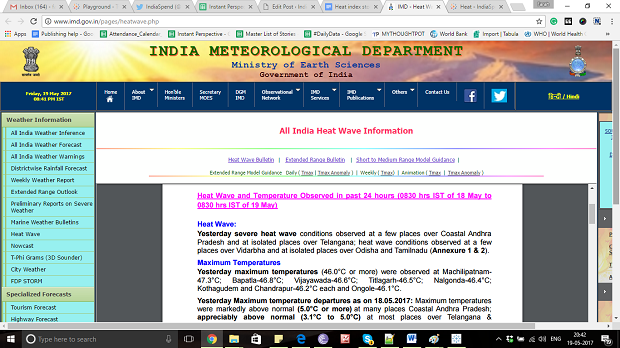
At the same time, the India Meteorological Department publishes daily bulletins containing information about the prevailing temperature and a warning for coming days. For example, on May 17, severe heat wave conditions were observed at isolated places over coastal Andhra Pradesh, and heat wave conditions at isolated places over Odisha, Vidarbha and Tamil Nadu, according to this IMD bulletin.
“The combination of exceptional heat stress and a predominantly rural population makes India vulnerable to heat waves. Vegetable vendors, auto repair mechanics, cab drivers, construction workers, police personnel, road side kiosk operators and mostly weaker sections of the society have to work in the extreme heat to make their ends meet and are extremely vulnerable to the adverse impacts of heat waves such as dehydration, heat and sun strokes,” the NDMA guidelines say, “Therefore, it is not surprising that these workers, homeless people and the elderly constitute the majority of heat wave casualties in India.”
The HVI confirmed as much. Pointing out that the high and very high HVI districts are in the central part of the country,the paper said that with a higher tribal population, these states have been at the lower end of various health, education, economic and population growth indicators.
Some Solutions
a. Further research using sub-district level data to provide separate indices for urban and rural areas to enable more targeted geographical interventions.
b. Deeper analysis of urban ward-level data to provide intra-city vulnerability patterns.
c. Provision of public messaging (radio, TV), mobile phone-based text messages, automated phone calls and alerts.
d. Promotion of traditional adaptation practices, such as staying indoors and wearing comfortable clothes.
e. Popularization of simple design features such as shaded windows, underground water storage tanks and insulating housing materials.
f. Provision of drinking water within housing premises and indoor toilets.
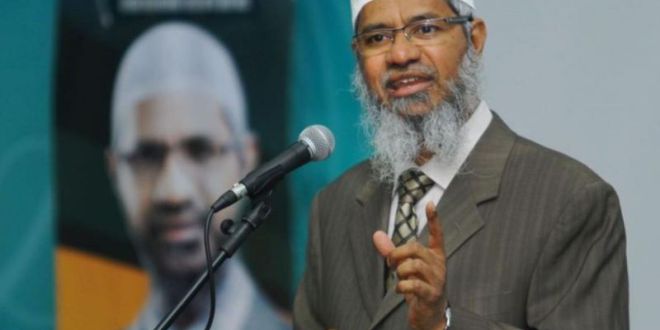
Wanted by India: Zakir Naik. Photo credit: Middleeastmonitor
Controversial televangelist Zakir Naik who is wanted by authorities in India for alleged terrorist offences, hate speech and money laundering has been granted Saudi citizenship, the Middle East Monitor has reported.
Saudi King Salman reportedly intervened to grant his country’s citizenship to Naik to protect him from arrest by the International Police Organisation (Interpol) on India’s request.
Last month, Indian courts issued a second arrest warrant for Dr Naik in connection with his alleged role in a terror-related case and over money laundering allegations. Naik, who was on tour at the time, decided not to return to India and remained in Malaysia where permanent residency status was granted to him five years ago by the Malaysian government, according to the Middle East Monitor.
The 51-year-old Muslim supremacist was out of India last year when the authorities began investigations against him, following the disclosure by Bangladesh security agencies that one of the terrorists who had died in the Dhaka bomb blasts in July was inspired by Naik’s preachings.
He had since then refused to come to India despite several attempts by the investigating agencies. Naik stated repeatedly that he was willing to be questioned through Skype but declined from returning to India to face the authorities.
The Enforcement Directorate had moved to get Naik’s Indian passport revoked paving the way for his arrest by Interpol.
The Union Ministry for Home Affairs which had cancelled the FCRA registration of Naik's Islamic Research Foundation last year, also cancelled the FCRA registration of his educational trust last month.
The Saudi citizenship has been granted to him even though well aware that the courts in India had issued an arrest warrant against Naik.
If not the only, it is certainly one of the rare cases where Saudi Arabia has granted citizenship to an Indian national.
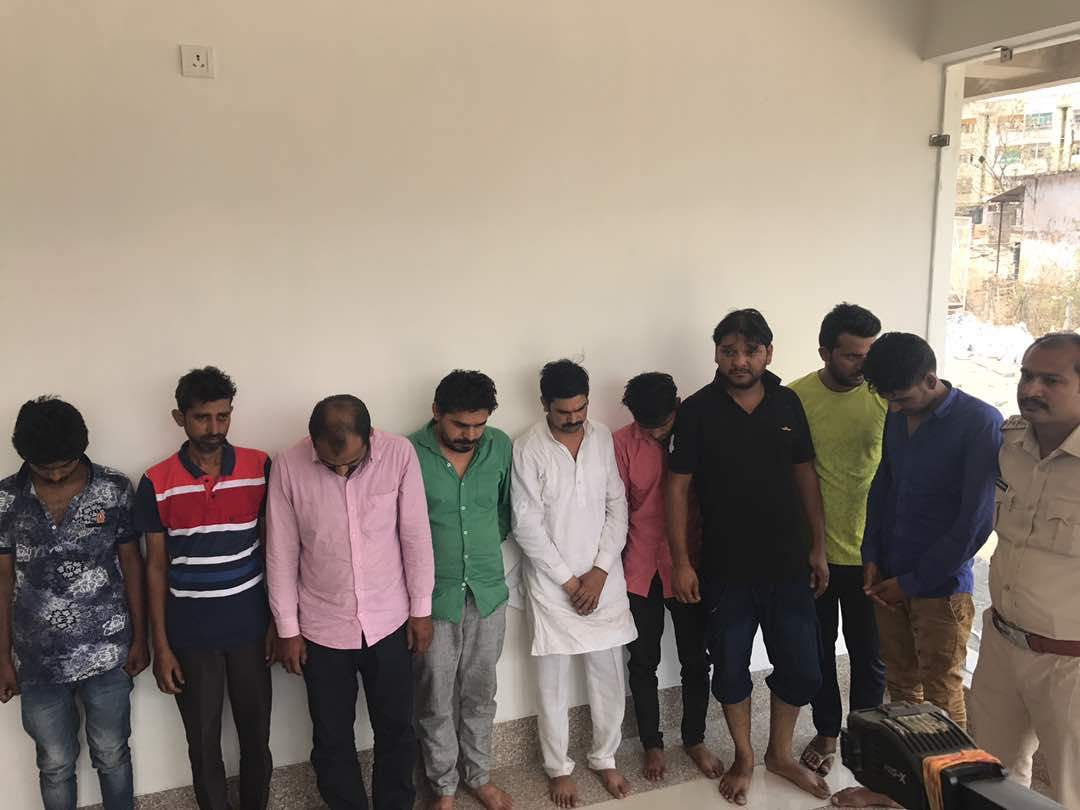
Arrested for running a sex racket. Photo Credit: New Indian Express
Nine men, including a leader of the ruling BJP, have been nabbed by the cyber cell of the Bhopal police for running an online sex racket.
Among those arrested was Neeraj Shakya (33) who was appointed as state media in-charge of the ruling BJP’s scheduled caste (SC) cell in Bhopal only a few days ago.
Shakya is reportedly close to the fiery VHP leader Sadhvi Rithambra.
Shakya with Sadhiv Rithambara
“Following his arrest by the cyber cell, State BJP president Nandkumar Singh sacked him from the party,” MP state BJP chief spokesperson Deepak Vijayvargiya told the New Indian Express.
The SP (Cyber Cell, Bhopal) Shailendra Chouhan gave the names of the others accused of running the sex racket and arrested as Dinesh alias David Singh, Suresh Gahlot, Ravi Prajapati, Harjit Dhanwani, Manoj Kumar Gupta, KK Jaiswal, Suresh Belani, Miswauddin.
Three customers were also arrested during the raid late on Thursday night.
Four women looking for jobs hailing from Maharashtra, Meghalaya and Panna (MP) were rescued.
In February this year, three ruling BJP cadre, including Bhopal BJP IT Cell chief Dhruv Saxena, were arrested by the State anti-terrorism (ATS) squad for running Chinese simbox enabled illegal telephone exchanges, which allegedly aided spying by Pakistan’s inter-service intelligence (ISI) in India.
According to SP (Cyber Cell Bhopal) Shailendra Chouhan, “our team was working on the matter since three months following specific inputs about an online sex racket running in posh areas of Bhopal through a web portal.” Sustained probe revealed that those operating the racket were regularly scanning resumes/CVs of girls and women urgently needing jobs on various job portals.
The men had listed their own contact numbers on the web portal facilitating the alleged sex racket.
The victims of the July assault have faced three more attacks while some Dalit activists are rallying against ‘fake’ cow vigilantism.
Aarefa Johari
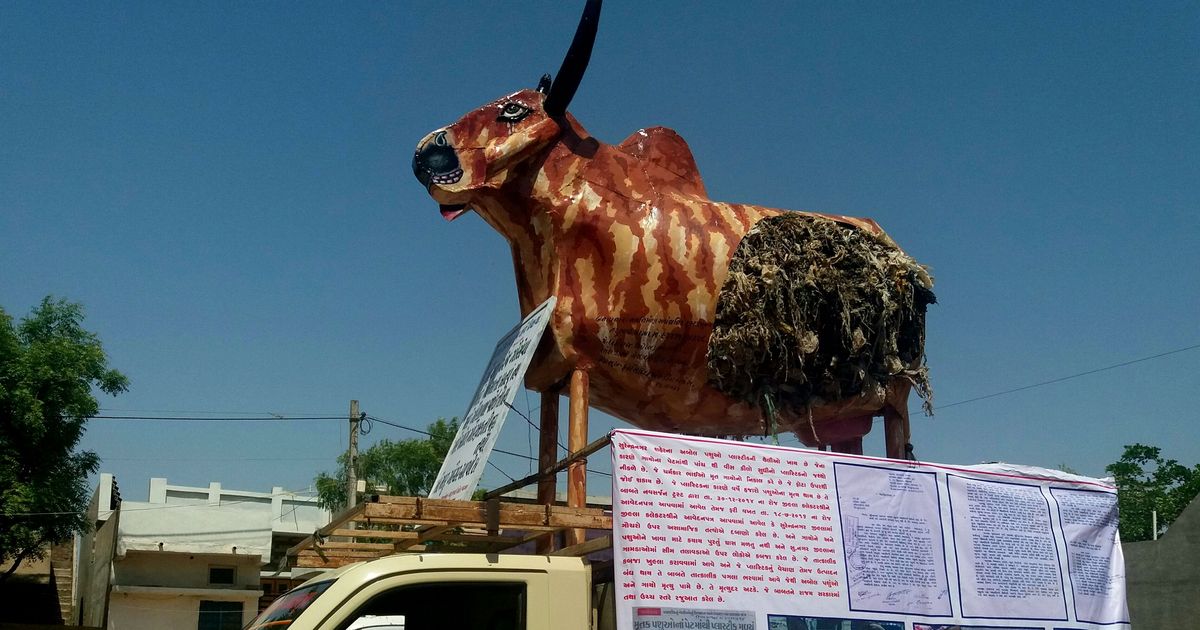
On the morning of May 10, a giant metal cow wound its way through Gujarat’s Surendranagar town, mounted on a tempo and glinting in the harsh sun. It was a compelling spectacle: a cow painted in almost life-like colours, with a cavernous hole in place of its abdomen, stuffed to the brim with greenish, indefinable trash.
“This is the actual plastic waste found in the stomachs of dead cows when Dalit chamars [tanners] skin them,” said Natubhai Parmar, a Dalit rights activist and the man driving the tempo. “This is what is killing our cattle the most, not the Muslims or Dalits that gau rakshaks keep attacking.”
Participating in this unusual rally against what Parmar called fake cow protection vigilantism, as it made its way from the town’s outskirts to the district collector’s office, were around 70 protestors, mostly Dalit and Adivasi youth from across Gujarat. Among them was 21-year-old Ramesh Sarvaiya, one of four leather tanners from Una town who were accused of cow slaughter and assaulted by upper-caste cow vigilantes while they were skinning a dead cow in July. The incident had triggered perhaps the biggest Dalit protest movement in Gujarat in recent history. As angry remonstrators had spilled on to the streets, Parmar had spearheaded a dramatic form of protest – collecting dead cattle from across the region and dumping their carcasses on the roads and in front of government offices. If Dalits were going to be attacked for simply carrying out their traditional occupation, then the carcass protest declared that Dalit tanners would no longer skin dead cattle.
Now, 10 months since the Una incident and six months before the Assembly elections, where does the movement against Gujarat’s cow politics stand? And how much has life changed for Dalits in Una?
During Natubhai Parmar's rally in Surendranagar town on May 10, a truck displays bunches of plastic removed from dead cows, with signs depicting the weight of plastic removed from each animal.
Protest for grazing land
In the weeks following the Una attack, amidst national outrage, 40 men accused of the crime were arrested. But the Dalits, who hoped the government would crack down on self-proclaimed gau rakshaks, were disappointed.
On March 31 this year, the Gujarat government introduced a law that makes cow slaughter punishable with life imprisonment, instead of the previous three to seven years in jail. This stringent law triggered fears of a possible rise in cow vigilantism targeting Muslims and Dalits, and they have not been assuaged. On May 6, an Adivasi man from Sabarkantha district – the first to be arrested under the new law – died in police custody.
In April, even as the Supreme Court sought responses from Gujarat and five other states about the need to ban self-styled gau rakshak groups, news reports indicated that Gujarat’s Gauchar Vikas and Gau Seva Board – a government body dedicated to cattle development – was likely to increase the number of “best gau rakshak” awards it offers from three to six.
These developments drove Natubhai Parmar to pursue a cause he had long been passionate about: juxtaposing the state government’s concern for cows with its alleged indifference to rampant encroachments on gauchar or cattle-grazing land in Gujarat. At his modest rally in Surendranagar, the protestors’ primary demand was restoration of lost gauchar land.
State governments are required to allot tracts of pastoral land for cattle-grazing in every village, but in Gujarat, this gauchar land allotment has been contentious for several years. In 1988, the state government stipulated that 39.5 lakh hectares of land in the state should be allotted for cattle-grazing – at least 16 hectares for every 100 animals. But in 2014, the non-profit Maldhari Rural Action Group conducted an independent survey of three districts and found a 65% shortfall in the total gauchar land that should have been allotted.
A 2011 Supreme Court order also prohibits the sale of gauchar land for industrial or commercial use, but in 2014, various courts in Gujarat were hearing more than 11,000 cases related to illegal possession of such plots. Reports also found that more than 400 villages no longer have any land left for cattle to graze on. Parmar alleges that the land has either been encroached upon by wealthy farmers or sold to various industries.
“Without land to graze on, cows are eating garbage and choking on plastic,” said Parmar, who also belongs to the community of leather tanners. “All these fraud gau rakshaks who harass us don’t care about protecting grazing land, but we demand that the government do a land survey and free gauchar land from industries and encroachers.”
Ramesh Sarvaiya, the Una attack victim who still suffers from back pain, attests to Parmar’s concerns. “Gauchar land around my village has been usurped by big farmers,” he said. “And I know cows are dying of plastic because I have personally pulled out several kilos of knotted plastic from dead cows.”
At the May 10 protest, Ramesh Sarvaiya and others carried 182 bottles of plastic trash recovered from the stomachs of dead cows, one for each of the state's MLAs.
No respite in Una
In Una, Sarvaiya and his relatives who were assaulted in July have given up cattle-skinning for good. But all these months later, they have still not found another vocation.
“I try to do farm labour sometimes, but my body still hurts from the injuries they gave me,” said Balubhai Sarvaiya, Ramesh Sarvaiya’s father. For now, the family is living off the government compensation they received, but Balubhai Sarvaiya is worried about the future. “The government had promised us five acres of land to farm on, but they seem to have forgotten. They also promised that the Una case would be resolved in two months, but in 10 months they have not even found three attackers who are absconding.”
He also blames the government for the atmosphere of fear in which Una’s Dalits continue to live. In the past two months alone, relatives of the arrested gau rakshaks and other members of the higher Darbar caste have been involved in at least three alleged incidents of intimidation and assault on the Sarvaiya family.
In the first incident in March, Ramesh Sarvaiya was returning from a wedding in a neighbouring village when a young woman from the Ahir caste, which is included in the Other Backward Classes in Gujarat, asked him for a lift in his auto, and he obliged. “The woman was from our own village, and the Ahirs did not mind,” said Balubhai Sarvaiya. “But the Darbar men interfered and threatened my son.”
A few days later, when Balubhai Sarvaiya was traveling with four relatives on the highway, a group of Darbars related to the arrested men stopped their auto and forced the Sarvaiyas out. “They issued warnings to the auto driver never to ferry us again, and we went away because we did not want to get into a fight,” he said. “But later, some of us went to the Darbars and warned them that if any such thing happened a third time, we would not tolerate it.”
The third incident occured in April, when Balubhai Sarvaiya’s nephews Mansukh Sarvaiya and Raoji Parmar were waiting for an auto on the highway. “Out of the blue, a drunk Darbar man came up to us, started hurling abuses and hit me with a metal rod,” said 24-year-old Raoji Parmar, who walks with a limp because of a birth defect. While he sustained injuries on his head, Mansukh Sarvaiya, 25, was injured on his hand as he tried to help his cousin.
True to their word, the family did not let this attack slide. They reported the incident to the Una police and the assailant – a relative of one of the men arrested for the July attack – was arrested. “But he is already out on bail, and now out of fear we no longer use that highway,” said Raoji Parmar.
Limited political impact?
The Sarvaiyas and other Dalit activists are certain they will not support the Bharatiya Janata Party in the Gujarat elections due in November. But this may not make a significant dent to the party’s fortunes in a state where most higher-caste voters remain oblivious to the lives of Dalits. During the May 10 rally in Surendranagar, for instance, few citizens of the town showed any curiosity or interest in the cause of gauchar land, while local political leaders from higher castes were even dismissive of the “Dalit protest”.
In other parts of Gujarat, many upper-caste farmers believe the Dalits of Una were themselves responsible for last year’s attack, and refuse to let this belief be challenged. “We don’t really have a gau rakshak problem,” said Govindbhai Gohil, a farmer from rural Ahmedabad and a Congress member of the zila parishad. “Those Una Dalits were beaten because they actually killed a cow.”
Towards new horizons
Despite the wide indifference to their woes, some Dalits from the Una region are now expanding their horizons in the hope of pulling their community out of poverty and oppression. Ramesh Sarvaiya, for instance, has joined a three-month skills and leadership training course at the Dalit Shakti Kendra in Central Gujarat’s Sanand town.
Ramesh Sarvaiya, one of the four Una tanners flogged by cow vigilantes in July last year, says his injuries still hurt.
The Dalit Shakti Kendra was founded by the Navsarjan Trust, Gujarat’s oldest and largest Dalit rights organisation that was abruptly forced to shut down in March after the Central government declared its activities undesirable and revoked its licence to receive foreign funding. While Navsarjan’s former employees, like Natubhai Parmar, have continued their personal activism, the Dalit Shakti Kendra has survived independently, on Indian funding, as an educational centre for Dalit and Adivasi youth from across India.
Last month, it enrolled its first students from Una, thanks to the efforts of a former Navsarjan employee from Surendranagar, Mahesh Rathod. “The Dalits of Una taluka, and in fact all of Gir Somnath district, did not have much education or consciousness of their rights before the attack last year,” said Rathod, who has spent the past 10 months making multiple trips to Una to educate and mobilise the region’s Dalits. “Now, finally, two young boys and two girls from Una are learning vocational skills at the Dalit Shakti Kendra, and they are going to go back and be community leaders.”
For Ramesh Sarvaiya, a Class 8 dropout, this course allowed him to travel outside his district for the first time in his life. “I am learning tailoring so that I can get another job when I go home,” he said. “But more importantly, I am going to serve my community so that what happened to me does not happen to any Dalit again.”
Making a strong case for extending the quota on reservations, Justice Sawant argues that the demand for reservations by Marathas, Jats and Patidars should be considered seriously.
The Mandal Commission has laid down additional tests for recognising social backwardness.
For some time now, the country has been witnessing agitations for reservations by communities like the Jats in Haryana, Patidars in Gujarat and Marathas in Maharashtra. One thing common to these communities is that they consider themselves of a higher social status because they are higher in caste ranking but are economically vulnerable. They are caught in a pincer. They have no bread at home, but are too proud to beg.
Take the case of the Marathas, who have been demonstrating in huge numbers across Maharashtra. The community constitutes 32 per cent of the state’s population. After the formation of the state of Maharashtra on May 1, 1960, the Marathas are seen in larger numbers compared to others, in all elective bodies. However, on account of their traditional economic and educational backwardness, they are disproportionately less in number in the non-elected, elite, competitive, and strategically key institutions and professions, which have been the traditional preserve of the higher castes and classes.
On the contrary, they are found in considerably high number in the menial occupations and services. They are the mill and factory workers, porters and mathadi workers, the unorganised workers and marginal farmers, class IV employees in offices, constables in the police and jawans in the army. They are also found in large number among the slum and hutment dwellers, the illiterates and those below the poverty line. Yet, they are not considered “socially” backward. The plight of the Jats and Patidars is not very different. It is against this background that we have to examine the insistent demand for reservations of these communities, in education and government services.
The controversy over the reservations for these communities centres around the present criteria for reservation: For “socially and educationally backward classes” and denied to other backward classes such as the “economically” backward classes. It also raises a dispute as to who should be called “socially” backward. There is also a dispute with regard to the percentage of the reservations.
Taking first the question of social backwardness, generally speaking those who are economically backward are also socially backward. The Mandal Commission has, however, laid down additional tests for recognising social backwardness. Even if we take into consideration those criteria, it will be difficult to deny these communities the “category” of the socially backward class. Yet, they are denied this label.
The inclusion of any community in the socially backward class is necessary only for giving it reservation for entry into the educational institutions, since Article 15(4) of the Constitution specifically mentions that the reservations for entry in the educational institutions is restricted only to the “SC, ST and socially and educationally backward” classes. Article 16(4), which permits reservations in the government services, does not restrict them to the above classes but extends it to “any backward class” which does not have adequate representation in the services. Hence only “economically backward class” which does not have adequate representation in the government services, is entitled to claim reservation under that article. It, however, appears from the court decisions that they have restricted the definition of the “backward class” in Article 16(4) to the backward classes mentioned in Article 15(4). In view of the clear language of Article 16(4), it is not legitimate to do so. Hence, while interpreting Article 16(4) as per its clear mandate, we have to include in it any backward class whether it is only economically or only socially backward. Thus interpreted, communities like the Marathas, Jats and Patidars will be entitled for reservation in government services if they are not adequately represented in them. There is no need to amend the Constitution for that. The state government by legislation or executive order can create a separate class of the economically backward and prescribe a reasonable quota.
However, regarding reservation in educational institutions, since Article 15(4) confines the reservations, among others, to socially and educationally backward classes, the classes which are only economically backward will not be entitled to the same unless there is an amendment made in Article 15(4) to include them specifically as a separate class. An easier solution could be for the state governments to create enough seats in educational institutions to accommodate all the aspirants. The present agitation is mostly on account of the high cost of education. Students from the SC, ST and OBC communities get free education, hostel and books. If these facilities are extended to all the economically backward students there will be no agitation by the others. It is possible for the states to extend such facilities free to all the economically backward classes, if need be by levying taxes.
Coming next to the question of the percentage of reservations to be kept in education and in services, at the outset it must be noted that no quota can be legally assigned to any particular caste or community. Attempts to do so will not stand legal scrutiny. The present limit of reservation is restricted to 49 per cent on the ground that reservations being an exception to the general rule of equality, it has to be less than the rule. It is necessary to have a fresh look at this premise. It is true that the exceptions have to be smaller than the rule. However, the question arises whether the reservations can be considered an exception to the rule of equality.
For centuries, this country has suffered gross social and economic inequalities. The mere number of the Scheduled Castes, Scheduled Tribes and OBCs (without the inclusion of such castes as Jats, Patidars and Marathas) is over 60 per cent of the population, according to estimates. (According to the 2011 census, SCs are 16.6 per cent and STs 8.6 per cent. OBC population estimates vary from over 40 per cent to 50 per cent). Studies have revealed that 77 per cent of our population does not earn more than Rs 20 daily. The sum and substance of this survey of backwardness shows that about 85 per cent of our population, if not more, is backward. In other words, backwardness is a rule and forwardness is an exception in this country.
The majority of unequals are living with a minority of equals. To treat unequals equally is as much injustice as to treat equals unequally. Hence, in this country, injustice is being already caused to an overwhelming majority, that is 85 per cent of the population.
The reservations are a means to bring equality and as such complementary to the principle and rule of equality, and not an exception to it. Thus viewed, the limit of 49 per cent placed at present on reservations is both in principle and in practice unjustified.
It is also unfair to think that reservations affect the quality of education and administration. The assumption underlying this contention is those who come from the backward classes are unintelligent, incompetent, substandard and non-meritorious. This assumption is an insult to the great majority of our countrymen. The backward classes have remained undeveloped and underdeveloped because of the denial of opportunity to them to blossom, and not because they are in any way inferior in intelligence, ability or talent. A survey of the cut-off marks for the open category, backward classes, most backward classes and Scheduled Castes in professional courses made by Era Sezhian, a former MP from Tamil Nadu, (The Hindu, October 8, 1990), and reproduced in this author’s judgement in Indra Sawhney versus Union of India is revealing. For instance, the cut-off marks for the MBBS course in Madras University was 95.22 per cent for open category, 93.18 per cent for backward classes, 89.62 per cent for most-backward classes and 83.98 per cent for the Scheduled Castes. Since candidates from the backward classes had secured the said marks while living and studying in adverse social and material conditions, it has to be admitted that they are superior in merit to the candidates from the open category.
Much of the progress this country has made so far is on account of the contribution of 15 per cent of the population belonging to the advanced classes. If the remaining 85 per cent had as much opportunity as the advanced classes, this country would have been more advanced than most countries of the world. The reservations are meant for empowering the backward classes to enter the advanced class. Hence, the limit of 49 per cent on reservation needs to be revised both on the principle of equality as well as the basis of the ground reality in the country. The controversy with regard to the limit of reservation can be resolved if the Supreme Court reviews and revises the said limit. It is also necessary to caution the backward classes that reservations cannot be their sole saviour.
(The writer is a former Supreme Court judge; this article first appeared in The Indian Express on October 31, 2016 and is being reproduced with the permission of the author)
This decision has been taken on the eve of the ninth anniversary of the first agitation of the Gujjars for inclusion in reservation that took place on May 23, 2008; another agitation that turned violent took place in 2015
The Rajasthan government has on May 19 re- included five castes, including Gujjars, in the Other Backward Classes (OBC) category. This decision has been taken on the eve of the ninth anniversary of the first agitation of the Gujjars for inclusion in reservation that took place on May 23, 2008. This is after the state High Court had struck down the Special Backward Class (SBC) Reservation Act, 2015, which provided special backward class status to Gujjar and four other castes, in December just last year. The states Social Justice and Empowerment Department on Friday issued a notification declaring that the five castes -? Banjara/Baldia/Labana, Gadia-Lohar/Gadalia, Gujjar/Gurjar, Raika/Rebari and Gadaria (Gaadri) — have again been included in the OCB list.
There is a background to this entire affair, these castes were first included in the OBC list in 1994. A law was enacted in 2008 to grant five per cent quota in government jobs and educational institutions under the SBC category to four castes/communities. It was implemented in 2009 and a separate government notification was issued in 2012 to include Gadaria (Gaadri) in the SBC list. However, this government decision ran into legal issues and the high court stayed the reservation in 2009 as it had exceeded the legal ceiling of 50 per cent. Finally six years later, in September 2015, the state assembly passed the Rajasthan Special Backward Classes (reservation of seats in educational institutions in the state and of appointments and posts in services under the state) Bill to give 5 per cent reservation to the five castes and issued a notification on October 16, 2015 to bring the act into effect. Following the notification, the overall reservation in the state had reached 54 per cent.
However, the high court had scrapped the Act last year, saying there were no extraordinary circumstances to allow that overall reservation in government jobs and education institutes in various states should be allowed to go beyond the 50 per cent cap set by the Supreme Court. "The Act was struck down by the high court on December 9, 2016. As a result, all five castes have again been included in the OBC list," the notification issued by ACS, Social Justice and Empowerment, Ashok Jain said. The notification is effective from December 9, 2016. Meanwhile, Rajasthan Gujjar Aarakshan Sangharsh Samiti spokesperson Himmat Singh Gujjar has said the community will protest against the decision. The decision to protest has always a threat to turn violent given the recent history of Gujjar protests.
Background of Protests: Violent The Gurjar agitation in Rajasthan had seen a series of protests in the state of Rajastan, India, beginning 2008 and then most significantly in 2015.
Nine years ago, violence erupted in the state of Rajasthan on May 23, 2008 when police fired on protesters belonging to the Gurjar caste who were demanding a higher scheduled tribe status, instead of their current OBC (Other Backward Class) status. The agitation turned violent and in retaliation, the protesters lynched a policeman in the Bharatpur district of Rajasthan. The spiral continued and in response, police shot at protesters as they tried to damage railway lines and government property. At least 15 were killed on the spot.
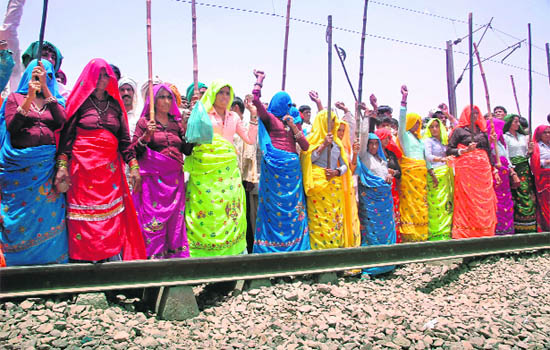
It was on May 24 of 2008 that the Indian army was called in to help calm the violence as another 15 people were killed when police shot at a mob of protesters trying to torch a police station in Sikandra. Many thousands of protesters blocked a rail route between Delhi and Mumbai. Highways had also been blocked, and state authorities cancelled many buses. Getting almost nothing from the government for their demand of a 5% quota for government jobs, Gurjars again went on to agitate, this time in 2010. This time there was an Ashok-Gehlot run Congress government in the state. They jammed trains on the Jaipur-Delhi and Mumbai-Delhi routes. Unlike the unrest in 2008, there was no violence in 2010. In May 2015, a similar protest was organized and over thousands of Gujjars blocked railway tracks halting train traffic.
The state government, however, has so far declined to change their status. Instead, it has announced that Rs. 2.82 billion ($ 67 million)will be spent to improve schools, clinics, roads and other infrastructure in Gurjar-dominated areas. However, Gurjar leaders have said that they "do not want money". Kirori Singh Bhainsla, the head of the main Gurjar protest organisation issued a statement — "We do not accept the economic package."
In 2007, Gurjars in Rajasthan fought police and members of the Meena tribe that had already qualified for Scheduled Tribe benefits and is opposed to Gurjars sharing the benefits it has cornered for itself. At least 26 people were killed in that violence. In the wake of the ongoing Gurjar agitation in neighbouring Rajasthan, high alert had been sounded in the border districts of Madhya Pradesh to check any spread of violence. The agitation finally ended after Rajasthan Chief Minister Vasnundhara Raje agreed on a 5% reservation under a new special category.
Violence
Soon after the Modi government assumed power in Delhi in May 2014, Gujjars demonstrated their caste might. In 2015, in an agitation that saw the widespread destruction of public property and also the utter paralysis of roads and communciations that led to the national capital, Gujjars mainly targeted the Jaipur-Delhi, Jaipur-Agra, and the Mumbai-Delhi transport routes as they believed it would capture the attention of the government and media altogether and resorted to violence when security forces tried to clear the roads and railways.
Some Gujjars alleged that the role of home minister and chief minister as provocative and oppressive. They blamed the government for giving the agitation a violent turn by firing at people gathering around patoli village whose bodies were then preserved using salt and ice for the duration of the entire period of agitation. The demand for punishment for those responsible for killing the villagers was added to that of gaining the reservation. The news of dead bodies lying without cremation attracted many gurjars from far off areas and even other states which added to the numbers of agitators who were now beyond the control of the police or the rapid action force and thus the Indian Army was called in. However, the violence only stopped after some assurances from the government. Police in Sikandra town fired at protesters who torched a police station and two buses and shot and wounded a policeman, said Amanjit Singh Gill, Rajasthan's director-general of police. Protesters also burned down a police station in the nearby village of Chandra Guddaji, Gill said. Fifteen demonstrators died Friday when police fired live ammunition and tear gas to halt rioting, said Singh. A police officer was also beaten to death. At least 70 injured people were hospitalized in Jaipur, the state capital, and the town of Dosa.
Demonstrators blocked a major highway linking Jaipur to Agra — site of the world famous Taj Mahal monument — stranding thousands of people. Thousands of army, police, and paramilitary forces patrolled villages to control the violence.
Sporadic violence began again on 26 May when more than 36 towns observed a bandh to protest the police firing into the crowds. Six wagons of a goods train on its way to Agra derailed near Bandikui station in Dausa district due to tampering of rail tracks, allegedly by the Gurjars. Northern railway cancelled nine trains passing through Rajasthan and diverted several others to different routes.
ADGP holds meeting in view of East Singhbhum lynching incident
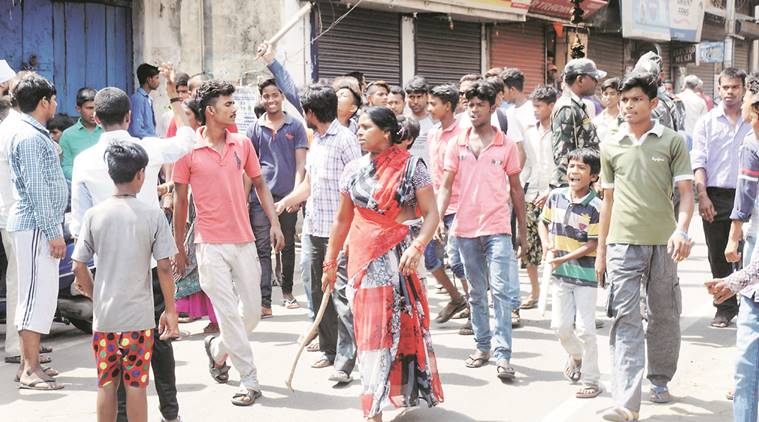
The Additional Director General of Police R K Mallick on Friday held a meeting with senior police officials of East Singhbhum district in view of the lynching of seven persons in the district on Thursday. With rumours raging across parts of Jharkhand about child kidnappers on the prowl, seven people were lynched in separate incidents on Thursday while at least six have had a narrow escape in the past 10 days. PTI reports thatADGP (Operations) R K Mallick, Inspector General (STF) R K Dhan and DIG (Kolhan) Prabhat Kumar held a meeting with the Deputy Commissioner of East Singhbhum district Amit Kumar and other senior officials to review the situation. The question of who or which organisation is responsible for spreading such panic and rumours so far remains unanswered.
The high level meeting of the Jharkand police was held after seven persons were lynched by villagers on suspicion of being child lifters at Nagadih under Bagbera police station area yesterday night, an official release here said.The deputy commissioner said miscreants were spreading rumours about child lifting through the social media for the last few days. Kumar said the administration was keeping a vigil on the mischief mongers and assured stringent action against them.
He said no complaints were registered with the police regarding child lifting and directed the officials to spread awareness among people. He also asked people to ignore such canard and maintain peace. The deputy commissioner also directed all block development officers and circle officers to be present at rural pockets and keep vigil on mischief mongers.
He asked all the officials to convene gram sabhas in order to make village chiefs aware of the problem and convince villagers to inform the police whenever they detect any suspicious activities. Apart from Nagadih incident here, four persons were lynched for similar reasons in Shobhapur and Sosomouli village under Rajnagar police station area in adjoining Seraikela-Kharswan district on Thursday last.