According to Section 19 of the law, a child marriage should not be considered an offence if it meant for the interest of an underage girl.
Photo:Dhaka Tribune
Speakers at a discussion on Monday said the slum children, especially girls, in the country are living amid great fear of rape and sexual abuse.
The risk grew even further as the number of raped girl children increased ever since the Child Marriage Restraint Act 2017 was passed on February 27 with a special provision allowing underage marriage, they said.
Child abusers and rapists, as they claimed, are taking advantage of the law by creating situations to force the victims’ parents to marry their daughters off to them.
Ain o Salish Kendra (ASK) organsied the programme titled National Consultation with Civil Society Organisations on Slum Dwellers Rights and Reality Challenges and Way Forward in Achieving Sustainable Developments Goals in Dhaka.
“Security of girl children in the country’s slums are under a great threat. The special provision of the Child Marriage Restraint Act has intensified the danger, causing rape incidents to increase,” said ASK Executive Director Sheepa Hafiza.
Referring to an estimate of the organisation, she also expressed her concern over the rape of underage girls and cases filed after the incidents.
Dr Mustafa K Mujeri, executive director of Inclusive Finance and Development (INM), said the percentage of rapes has gone higher this year so far compared to that of the same period in 2016.
“But, the problem is only 1% victim go to police seeking legal action,” said Mustafa.
According to a nationwide data of ASK, prepared based on newspaper reports, at least 51 girls, aged below 18, were raped between January and Mach this year. The number of gang-rape and attempted rape victims over the same period was 12 and 13 respectively.
According to Section 19 of the law, a child marriage should not be considered an offence if it meant for the interest of an underage girl.
The act also states the marriage has to be done conforming the directives of a court and that too, upon the consent of guardians.
On contrary, the law puts boys below 21 and girls under 18 years in the underage category, saying any marriage involving one or both parties below the legal age will be considered child marriage.
The provision has been garnering a wave of public criticism about the potential abuse of this provision, since the law was drafted.
The problem can only be solved by a leadership which recognises to begin with that a problem exists.
Towards the end of his presidency, Lyndon B Johnson, the 36th President of the United States of America, had been reduced to a figure of universal scorn and derision. His escalation of the Vietnam War to a point from which it became impossible to extricate the US ended up in becoming one of the defining human tragedies of twentieth century. This was war fought on the basis of pretexts that did not actually exist. The slur “Hey, hey, LBJ, how many kids did you kill today?” which became an anthem of sorts for protestors eventually compelled him to forgo running for a second term in office in 1968. Those protesting against the war, those who eventually forced Lyndon Johnson to leave the political arena were Americans who were overcome with images of atrocities and the rising count of civilian deaths in a mindless war.
The Vietnam War was far from an exception. Even after its end, we might still be able to catalog scenes of wanton brutality and killings from around the world into several heavy volumes, each prefaced by notes indexing the vileness of the human species, which remains the only one to conjure schemes of the annihilation of its own kind for reasons that have no justification or sanction in the natural world. No life form kills for the sake of the shape of a map in an atlas. Nationalism routinely makes humans go to war for such reasons.
Some of these same false premises that have been used to rationalize killing elsewhere in the world have also been in use for far too long to perpetuate brutality and subjugation in Kashmir. For years Indians have been indoctrinated with an image of their country on a map that has no bearing on reality. The shape of the state of Jammu & Kashmir on Indian maps lies at the heart of this fiction. Be it an average fruit seller or an industrialist or a mentally and morally bankrupt bureaucrat or a duplicitous politician – this image has made Indians of all manner and description treat Kashmir as their backyard. This is what lies at the core of the intransigence of the Indian establishment when it comes to Kashmir, and it is this very intransigence that is hurtling the populace of Kashmir towards a precipice, accompanied by an increased wave of repression. The Indian state is straddling a moral abyss. Incidentally, this situation exposes the hollowness of even that section of Indian society that takes prides in calling itself ‘progressive’.
In recent days, in the face of rising discontent, we have witnessed the voicing of Indian demands for even more stern actions by the armed forces in Kashmir than have been already employed. One wonders what could be sterner than the blinding of people, including under-aged children through indiscriminate and unprecedented use of pellet guns. It is as if Kashmir becomes an exception to the perception of how any form of state power should be used to deal with a recalcitrant population. Stone pelters elsewhere in the territories policed by the Indian state are not met with bullets and pellets, but in Kashmir, they inevitably are. What is it that makes many ‘progressive’ Indians (who refurbish their credentials by being so vocal against the actions of the rabidly right wing government of Narendra Modi) fall silent when it comes to Kashmir, atrocities in Kashmir, or even the outstanding issue of the legal status of the territory. Is that ingrained, unquestioned map of India, with Kashmir as its crown that forces even ‘progressives’ to become alter egos of the activists of hardcore rightwing parties?
The situation in Kashmir remains what it has been for more than two decades and a half, littered with instances of Indian mendacity and deliberate sabotage of any move towards real peace that reflects the aspirations of the population. The majority of Kashmiris themselves, despite having gone through the upheavals of a violent insurgency and state terror in the 1980s and 1990s remain unchanged in their demands and aspirations. Their aspirations for freedom and peace have remained constant through the transition from an armed insurrection to a virtually unarmed mass struggle.
What has also remained unchanged is the violent vehemence of the Indian establishment’s response to these aspirations. Until the current Modi regime decided to publicly take a hard line on Kashmir, many Indian politicians (in and out of power) professed a desire to ‘engage’ with the people of Kashmir. These public pronouncements never altered the realities on the ground, which instead of moving forward, only worsened with time. An over-reliance on an electoral process already discredited by force and fraud led to a wilful neglect of the basic nature of the disputed status of the relationship between Kashmir and the Indian Union. This only led to further deterioration of an already dire situation. Amidst all the noise and kerfuffle that emanated from India vis-a-vis Kashmir, what fell through the cracks of the sparse and frugal mental apparatuses of the Indian establishment (and of even its ‘liberal’ and ‘progressive’ factions) was the fact of the dehumanizing siege that the entire population of the Kashmir valley had been subjected to since the beginning of the uprising in the late 80s, or even before. Now, with the Modi regime all but declaring war on the people of Kashmir, the crisis has reached unimaginable proportions. How did things get so bad? Those who call themselves ‘progressive’ in India and yet retain a fondness for the Indian master narrative on Kashmir cannot absolve themselves of responsibility for the situation having become what it is today.
Leaving aside for a moment the well documented cases of extra-judicial assassinations, rapes, enforced disappearances and torture for more than two decades, one needs only take into consideration the minute by minute humiliations that people in Kashmir have had to endure at the hand of security personnel at checkpoints, while being frisked, at ‘identity’ parades, in the course of random ‘spot’ checks, house-to-house searches, curfews and a heap of senseless harassment that constitute the daily grind. If you face this reality squarely, then the fact that an entire people are rising ought to come as no surprise.
Take, for instance, the recent parading by the Indian Army of a young man, a voter, called Farooq Ahmad Dar, as a ‘human shield’ with a paper warning tied to his chest and bound to the front bumper of a jeep while he was driven through nine villages was hardly the isolated incident it is being made out to be. The image of this incident, which hit the world media, has become emblematic of the India-Kashmir relationship. While this image did evoke genuine outrage in some sections in India, it is also true that it was celebrated and justified, and became the catalyst of demands for ‘even more stringent actions’. These demands did not come from the Hindutva fringe alone. They were also voiced by some ‘liberals’ who had otherwise been outraged at the lynching of Akhlaq and Pehlu Khan by Hindutva vigilantes. Its as if things change the moment one invokes Kashmir.
What is that evokes such reactions against the population in Kashmir even amongst some liberals? Is that imaginary map of greater India so chiseled into their brains that the thought of any tinkering leads to complete irrationality? Perhaps that is where some introspective reading of history, not only of Kashmir but of the entire world, can help sometimes to dispel in-built prejudices.
The exact circumstances of the accession of Kashmir to India remain shadowy. The accession, for what it was worth, was contingent on a plebiscite that India has never allowed to be held. One leader after another of the Kashmiri people were bought, or thrown into prison, or were thrown into prison and then bought. Every kind of leadership, both Indian and Kashmiri, played its part in suppressing the aspirations of the the population of Kashmir. There grew to be an unbridgeable chasm between what was professed and what was practiced in Kashmir. The mantra of Kashmir being an ‘integral part’ of the Indian Union revealed a fixation that cared for the occupation of land, never for a concern with the people who happened to be on that land. The people of Kashmir never became anything other than colonial subjects for India, just as Indians had been for the British. And like Britain, India also always found local collaborators, especially to help it indulge in meaningless electoral exercises.These ‘polls’ which India touted in place of the absent plebiscite, got so discredited over time with force and fraud that the last exercise of elections attracted only seven percent of the electorate and ended in a toll of eight deaths.
Lyndon B. Johnson ended his presidency completely discredited by the fiasco of Vietnam, but he is still considered among the greatest presidents the United States has ever had. After assuming the presidency in the wake of the assassination of John F. Kennedy, Johnson went on to achieve something that had eluded every American presidents after Abraham Lincoln’s abolition of slavery. The Johnson presidency saw the successful passage of the civil rights bill that undid racial segregation and allowed backs to vote throughout the country. Despite everything, these facts remain unmatched and stellar accomplishments. Ironically, immediately after the passage of voting rights acts there were widespread riots by African-Americans in different cities. Johnson, who could understand the irony, famously said, “What did you expect? I don’t know why we’re so surprised. When you put your foot on a man’s neck and hold him down for three hundred years, and then you let him up, what’s he going to do? He’s going to knock your block off.”
Can the problem of Kashmir ever be solved? It can, only if India evolves a leadership with a Only if Johnsonian grit and the altruistic determination to acknowledge that the problem exists in the first place. No solution will ever come from someone like Modi, given his avid hatred of Muslims in general. One just has to play those recordings from the time of Gujarat riots of 2002 when Modi taunted the hapless Gujarati victims of the macabre killings that took place under his watch to understand why Modi simply cannot be expected to take the initiative towards peace in Kashmir. Rather than working towards a solution, the doomed coalition between Modi’s party, the BJP and the local family business of the Mufti clan under the garb of the Peoples Democratic Party has made things even worse. It has made the ever existing chasm between Kashmir and India wider than ever and it has sullied India’s image more than ever, at home and abroad. Things are so bad, that it is difficult to imagine them getting worse. Paradoxically, this recognition may also hasten the complete rupture between Kashmir and India. Perhaps the moment is ripe for an Indian LBJ, who takes heed of the need to be sensitive to the question of civil rights, and, instead of perpetuation a needless war, ends it. Can the Indian Liberals find such an LBJ, or will history snatch Kashmir away from them without the grace of a dignified departure?
There has been good news and cheer after the Gujarat Board released the results of science stream of class 12 on May 11. PTI reports that the family of Farhana, daughter of a auto rickshaw driver, Farooqbhai who scored 99.72 percentile in medical stream was both thrilled with her achievement yet also worried about future prospects in furthering her education, given severe financial constraints.
Farhana’s mother Shamim Bavani responded emotionally when she said,“Koi khushi nahi hai hume (we are not happy)” she said. The family was unhappy as Gujarati and English medium papers of National Eligibility cum Entrance Test (NEET) were different and the Gujarati medium question paper was more difficult. They said that the combined result would be unfair to Farhana and other thousands of students like her.
They were all disheartened and said that the girl had never considered any other career option. Her mother also said “We have just one wish, the government must separate the Gujarati and English medium results. Maybe then our daughter’s work and dedication will yield results”
Resident of Ahmedabad’s Raikhad area, her mother said “Throughout these four semesters, she had a very good result and studied so hard but what was the point of this? For two years, she forgot to eat or sleep, she spent all her time studying to the extent that I had to feed her myself a lot of times.” Farhana’s childhood dream was to become a doctor, she adamantly chose Science as a subject inspite of her parents encouraging her to consider other options.
Adding to the disparity in the two question papers and the uncertainty of the NEET result, student of F D High School in Jamalpur Farhana said, “The Gujarati medium paper of NEET was very difficult as compared to the English medium one. The rigid rules for NEET exam were unnecessary. We were so sure that my result would be so good that I would get a free seat for MBBS. But the NEET paper surprisingly didn’t go well.”
Two years after the devastating earthquakes that struck Nepal, the country is struggling to bounce back. Nearly 70% of the affected people still live in temporary shelters, and it is common to see damaged houses, temples without roofs, and earthquake debris lying around, even in the capital Kathmandu.
The recovery is painfully slow, and many families who lost their loved ones continue to live in traumatic conditions. Over the past two years, working with CARE Nepal and the Southasia Institute of Advanced Studies, we have talked to local communities in the Gorkha, Kathmandu and Kavre districts, and helped to organise a national workshop involving senior government officials, researchers and civil society actors.
Devastation
The twin earthquakes that struck on April 26 and May 12, 2015 caused around 9,000 deaths, and around half a million families in the central region of the country lost their homes. As well as houses, dozens of Kathmandu’s heritage buildings were destroyed, including the iconic Dharahara tower.
In the quakes’ immediate aftermath, relief and rescue work began swiftly, with local volunteers working with the army and international aid workers. However, over the past two years the recovery effort has slowed to a crawl.
Political bickering, a lack of accountability and poor management of funds have all hampered efforts to rebuild. After two years, Nepali media have branded the situation a “failure”. What went wrong? Our fieldwork and interviews identified four underlying problems.
The historic nine-storey Dharahara tower in Kathmandu, two years after it was severely damaged. REUTERS/Navesh Chitrakar
1. Partisan squabbling
Immediately after the disaster, the government and opposition parties agreed to create a new public body, the National Reconstruction Authority (NRA), to oversee rebuilding.
However, despite pressure from international donors and humanitarian agencies, protracted political wrangling meant it took almost nine months to appoint someone to lead the new body. The chief executive has changed three times in little over a year.
Donors pledged more than US$4 billion to the NRA, but little of the aid money has found its way into the work of rebuilding. As a result, fewer than 10% of the roughly 500,000 damaged homes have been rebuilt with support from the government and donors.
The earthquake hit at a time when Nepal was embroiled in debate over its new constitution, which became a matter of controversy. For about ten years, the disaster response agenda had been neglected by the contentious politics of state restructuring, following the decade-long violent Maoist revolt.
Disaster response has thus been sidelined by protracted political instability, characterised by constitutional transition, ideological and ethnic tension, and frequent changes of government.
Local elections have finally been announced for May 14 and June 14, 2017, but the damage caused by more than a decade of political vacuum is huge. The loss of political accountability to local people is one of the key factors of the failure of disaster recovery in Nepal.
In several locations, we found unaffected local elites included in the lists of victims receiving financial support. Without local democratic leadership, people cannot voice their concerns, mobilise community resources, or scrutinise projects.
Despite this, Nepalese people enjoy strong local social capital, which has helped them in times of distress and difficulty. Community leaders in Gorkha told us: “we work together at the community level to rebuild damaged houses one by one even when there is no support from the government or donors”.
Some local leaders have worked with their communities to build infrastructure, small roads, schools and hospitals. Nevertheless, these individual efforts are no substitute for strong and democratic local government.
A girl lights a candle as she marks the anniversary of the first 2015 Nepal earthquake, at Boudhanath stupa in Kathmandu.REUTERS/Navesh Chitrakar
3. Ineffective international aid
In the aftermath of the earthquakes, Nepal’s National Planning Commission estimated that the country needed more than US$7 billion for recovery. The billions of dollars committed by international donors was not translated into a clear plan to direct the money, which meant it has had little impact in rebuilding.
The NRA, which should have led the major state response to the disaster, has been hampered by cumbersome administration. A proposal to allow the NRA to bypass the standard procedures failed to eventuate, and a senior official told us their work is slowed by inefficient and lethargic regulations.
Donors have therefore preferred to give to international NGOs instead of state options; in Gorkha alone there were 300 different NGOs operating immediately after the earthquake.
The effectiveness of these organisations has been questioned by independent commentators and academic researchers, some even describing the post-disaster aid industry as “disaster capitalism”. However, despite challenges, several NGOs have delivered vital relief in times of need.
Nepal still lacks effective and enforceable mechanisms to monitor the use of humanitarian support. Having the money is not enough; it must reach the projects that truly help people.
4. Regional tensions
Nepal exists in a delicate balance between India and China, and a few months after the earthquakes a blockade between India and Nepal disrupted supplies. Nepal blamed India for the blockade, while India said the disruption of supplies was due to internal political problems in Nepal.
As a landlocked country, Nepal has historically relied on India for its basic supplies. India’s blockade led to almost total paralysis of not only the recovery work, but the entire economy. At the same time, in recent years China’s interest in Nepal has grown.
During the blockade, China provided free oil, but such one-off assistance did not address recovery needs. The competition between China and India for influence in Nepal has not resulted in any substantial benefit for those affected by the disaster.
Given the persistent seismic risks in the Himalayas, there is a need to create a coherent regional structure for disaster recovery. Yet internal tensions appear to have prevented the Nepal government from promoting serious international cooperation.
Since the entire Himalayas is prone to multiple forms of disaster, a region-wide research and recovery initiative, involving both China and India, is crucial.
Nepal is just one case of poor disaster recovery management. The questions we need to ask, two years on, are: how can we improve national and local government responses? How can international aid work with government efforts? And how can we foster regional cooperation?
The principle of justice demands that law cannot rely on or be influenced by any delusionary sense or mood of the people.
AFP
There are times when the actions of human beings are so grotesque and sordid that we want to tear ourselves away from our own skin and body. Moments when we wonder if we could by choice reject our natural membership of the human club. The Delhi gang rape and murder of December 2012 was one such event. This case ripped apart even the slightest hidden possibility of consideration towards the accused. As the details were unraveled, we had nowhere to hide and the lid was blown off what is the norm in our society. We treat women as objects of pleasure provided by the creator for men to feed on and discard as we please. Those little risqué acts that occur everyday in office spaces and on public buses and we pass off as normal is where all this begins.
A few days ago, the Supreme Court awarded the death sentence to every one of the convicted attackers in the case. And I am sure, soon the debate around the death penalty will be revived. But irrespective of whether we are for or against the death sentence, as long it remains in our Constitution, judges will use it. There is, however, a phrase used by the honourable judges in their judgement that troubles me deeply – collective conscience.
This is not the first time this conceptual framework has been used in awarding the death sentence. But the truth of the matter is that in similar cases, one judge has confirmed the death penalty while another has been more lenient, commuting the sentence.
Collective conscience makes its appearance through the individual conscience of the judge. So, when judges use this phrase, it is really to express what is essentially their own viewpoint, or they have taken it upon themselves to determine “collective consciousness”. Both these positions are entirely self-generated.
The Delhi gang rape verdict implies that the “tsunami shock” to the collective conscience of our society caused by that horror demanded that the death sentence be pronounced. Can the courts allow any kind of public outcry, sense of conscience, sentiment or feeling to even remotely influence their decisions, especially when it is a case of the death sentence? This is even more relevant in the times that we live in, when television and social media bombard us, creating and determining opinion.
I am no legal expert and, therefore, speak as a legally challenged citizen. The very idea that a collective “sense”, however powerful and influential, can play a role in anything legal needs to be pondered. It is in that direction that we need to ruminate, especially in cases where the judgement is entirely dependent on the interpretation by a solitary judge or solitary Bench. I am going to extend this phrase beyond its present interpretative legal framework for death sentencing and wonder whether this idea of collectiveness, cumulative opinion, practice, tradition, culture, etc has already been employed by judges while handing down disturbing judgements.
Prisoners of conscience
I began this piece with a few thoughts on rampant misogyny and patriarchy in our midst. But if we allow our collective sense to be part of anything judicial, we will find that many judges will become more than lenient with misogyny and male-chauvinism. Have we not heard judges, lawyers, public figures and politicians demand dress codes for women, accuse women of inviting rape and molestation because of the clothes they wear? Even recently, we heard women being questioned for being out late at night. And, of course, we as a society say nonchalantly that “men are just like that”.
The bitter fact is that this mode of thinking and acting is a natural part of large section of the Indian society. A judge, as just an extension of society, accepts and agrees with a perceived collective conscience, then interprets this in whatever way they want. This is exactly why we have had judges pronounce verdicts that leave us agape, yet if we go by collective sensibility as a measure, we will have to accept their diktat. Beyond what is clearly stated in the law books, there are so many grey areas with regard to culture, rituals and traditional practices that can be entirely driven by majoritarian leanings. It was our Supreme Court that overturned the progressive and beautiful judgement by Justices Ajit Prakash Shah and S Muralidhar of the Delhi High Court that held that Section 377 of the Indian Penal Code violated Articles 14, 15 and 21 of the Constitution. It is that very same collective morality that resulted in the Supreme Court’s wrong decision.
This can flow way beyond sexism. We live in times when the right to fearlessly speak, write or sing is constantly under attack. We have a government that uses greater good of the country, nationalism, national security and Indian-ness as devious strategies to overwhelm dissent under its weight. We are led by a political party that has a control over social media like no other outfit and sways public opinion through a propaganda machinery that is unmatched. Where are we headed if beyond the evidence and details of the cases, judges can get inspired by this manipulated collective “sense” to lay down more limitations on how we live our lives?
Take, for example, the compulsory “you better stand up for the national anthem when it is played in cinema theatres” order by the Supreme Court. There are many who find this entirely acceptable and the court itself might have sensed this collective agreement and a politically orchestrated national mood of jingoism. But the truth is, this order is authoritarian. A beautiful song that I love to hear and love to sing has become an instrument of compulsion. Will there be a day when the Supreme Court, after mulling over all the over-bearing and complex evidence, allows a Ram temple to be built in Ayodhya because the Hindus of this country (close to 80% of the population) wish for that to happen?
Our Constitution is based on the principle of justice for the most marginalised, disfranchised, oppressed, unknown, unseen and ignored. This spirit demands that law cannot rely on or be influenced by any delusionary sense or mood of the people.
We need in judges a liberal energy and the ability to be creative human beings. Creativity, incorrectly, is seen as lawlessness and hence many in the courts function “by the book” or “by their culture”, choosing between the two as per their convenience. But creativity is the only way we can fight inertia, conservatism and orthodoxy. If we do agree that the basic tenets of our Constitution rejoice in humanity, then creativity is the only way forward. The creative breathes within systems, yet it detaches itself from the personal and the public, allowing for the ethical and humanitarian to pave the way. Our judges need this vitality.
Experts believe that the rise of divorce in Dhaka is a positive trend because more and more women are speaking up against marital abuse.
Dhaka has seen a rise in the number of divorces in recent years, and around two-thirds of them are initiated by women Bigstock
Ten years ago, Halima Akter, employed at a private company in Agargaon, Dhaka, would not have dreamt of divorcing her husband despite the incompatibility that plagued their marriage.
In 2014, the situation was quite different, which enabled Halima to seek a solution to her problems – a divorce. She sent a divorce notice to her husband of seven years, Rasel Ahmed, on March 18, 2014.
Things have changed in Dhaka in recent years; more and more women are speaking up about their marital problems and seeking a solution. In most cases, divorce is the end result.
Dr Sadeka Halim, sociology professor in Dhaka University, believes this is a positive trend because it means that more women are willing to overcome their fear of social stigma in order to build a better life for themselves.
“In a patriarchal society like ours, women are held primarily responsible for keeping their families together – even at the cost of their own happiness and well-being,” she told the Dhaka Tribune. “But that is a flawed concept, because a husband and a wife are equally responsible for their family.
“Though we have a law to prevent domestic violence, it is still a major problem in Bangladeshi households. In most cases, it is the women who are suffer physical and mental abuse in the hands of their husbands and in-laws. But now many women are speaking up against the abuse and choosing to break out of the vicious cycle.”
According to Dhaka North City Corporation (DNCC) and Dhaka South City Corporation (DSCC) data, around 67% of the divorce notices issued from 2011 to 2016 were by women. In all five zones of DNCC, 28,355 divorce notices were issued in 2011-2016, 14,966 of which were filed by women.
In two zones (Zone 1 and Zone 4) of DSCC, 4,811 divorce notices were issued in 2011-2016, 3,215 of which were sent by women.
Zones 1 and 4 cover Dhanmondi, Kalabagan, Green Road, Kathalbagan, Nilkhet, Kakrail, Bailey Road, Shantinagar, Ramna, Elephant Road and Old Dhaka.
The numbers of divorce notices are increasing every year.
In 2011, 2,864 notices (1,773 by women, 1,091 by men) were issued in DNCC and 819 (533 by women, 285 by men) in Zones 1 and 4 of DSCC. In 2016, the numbers of divorce notices issued in DNCC was 4,847 (3,426 by women, 1,421 by men) and 852 (569 by women, 283 by men) in DSCC.
Salma Ali, executive director of Bangladesh National Women Lawyers’ Association (BNWLA), said divorce nowadays is also propelled by the fact that women are becoming self-sufficient.
“Before, most women were entirely dependent on their husbands, which is why they tolerated all kinds of abuse silently. But as women are becoming financially independent, they have both the confidence and the opportunity to get out of abusive marriage, even though divorce is still heavily frowned up in our society,” she said.
She said couples with problems should seek counselling first to see if their issues can be resolved without ending the marriage.
However, there are many cases where Muslim men deliberately torture their wives so they would initiate the divorce, because they are under the impression that if their wives seek divorce, they would be exempted from paying denmohor, the alimony that is mandatory under Islamic law, Salma said.
Marjia Mukta, a housewife and mother of an eight-year-old daughter in Agargaon, dissolved her 10-year marriage by divorcing her husband Ekram Hossain because he was having an extramarital affair. Ekram, who lives in Saudi Arabia, said he did not want to initiate the divorce because he did not want to pay denmohor to his wife.
This is a major misconception, says Dr Kazi Zahed Iqbal, lawyer in the Supreme Court.
“According to Muslim Family Laws Ordinance, 1961, no matter which party files for divorce, the husband must pay the denmohor to the wife,” he told the Dhaka Tribune.
This article was first published in the dhakatribune.
New Delhi: Even as the NDA government completes three years in power amid tall claims of development, the India Exclusion Report 2016 released by Centre for Equity Studies (CES) has presented a dismal picture of the condition of historically disadvantaged groups in terms of exclusion with respect to four public goods.
The report was released on Friday, May 12th at the Indian Social Institute in New Delhi. This is the third edition of the annual flagship publication of CES.
The India Exclusion Report reviews exclusion with respect to four public goods, one each in the areas of the social sector; infrastructure; land- labour, natural resources and legal justice. For 2016 Indian Exclusion Report, the topics chosen were, pensions for the elderly, digital access, agricultural land, and legal justice for under-trials.
The report termed Dalits, Tribals, Muslims, and Elderly and Disabled as worst hit by the continuous exclusion from the four chosen fundamental public services.
“The headline of this and indeed every exclusion report so far has been that the evidence is consistent that for virtually every public good that we examine, it is always the same sets of peoples who are excluded,” writes Harsh Mander, who has edited the report in its introduction.
“These are the historically oppressed group of women, Dalits, Adivasis, Muslims, persons with disabilities and casual informal workers and the poor. This report only confirms these findings, and illuminates the multiple ways in which even the democratic state in the Indian republic has failed these oppressed peoples and not assured them equitable access to the public goods essential for them to lead lives of dignity,” he writes.
The report has found that the pattern of land distribution reflects the socioeconomic hierarchy — large landowners invariably belong to the upper castes, cultivators to the middle castes, and agricultural workers are largely Dalits and Adivasis.
“The rate of landlessness was highest among Dalits at 57.3%. Among Muslims, it was 52.6%, and 56.8% of women-headed households were landless. Around 40% of all those displaced by “development activity” were Adivasis,” reads the report.
“Land reform efforts have not benefited Dalits, women or Muslims significantly. Land allotments to SC/ST households were often only on paper, as allottees were forcefully evicted or not allowed to take possession,” the report further adds.
The report has taken a dig at PM Narendra Modi on job creation which was one of Prime its prime election promises.
“Yet more than halfway through his tenure, there are almost no jobs available. Job creation has fallen to levels even below those that the preceding UPA government plunged to,” notes the report. The report also notes the rising rich-poor gap in the country.
The report further notes that the Digital India, which aimed to cover 1,00,200 panchayats under Phase 1 by March 2014 – added only 48,199 panchayats by April 2016 out of which only close to 6,000 panchayats have internet access.
Regarding the legal justice, the report has proposed that state governments, prison departments and jail authorities must work together, and adopt certain reform measures, to make the custodial system more open and less exploitative.
While reacting to the report, Adivasi activist and political leader Soni Sori in conversation with TwoCircles.net said, “Yes the report indicates the reality of Adivasis.The discrimination with them is not only in these four parameters but many others also.”
“Adivasis don’t get pension and legal justice is out of bounds for them. We have seen it many times; a tribal picked up by police and thrown in lockup for weeks without an FIR,” she added.
National Campaign for Dalit Human Rights (NCDHR), General Secretary, Paul Diwakar said, “The continuous exclusion of Dalits from public goods can be attributed to the fact that they are not at power block. At policy designing and implementation, Dalits don’t have any say and there is lack of accountability involved.”
“So, instead of having policies which are pro disadvantaged sections, they frame general polices,” he told TwoCircles.net.
According to Navaid Hamid, President, All India Muslim Majlis-e-Mushawarat, the findings of report aren’t surprising.
He said, “The government of India which usually calls for sabka-saath and sabka-vikas should spell out the reasons why there is still such exclusion of Muslim in provision of public goods.”
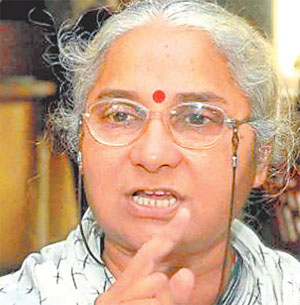
In an email alert to Sabrang india, leader of the anti-dam movement (Narmada Bachao Andolan (NBA) Medha Patkar has warned that “after almost 32 years of struggle, lakhs of people in the Narmada valley to be affected by the Sardar Sarovar Dam in Gujarat, are being threatened with brutal eviction.”
Signed by Parkar and several of her colleagues, including Nurji Vasave, Sanober Mansoori, Bhagirath Dhangar, Rahul Yadav, Kailash Awasya and others, the email alert reports, the Madhya Pradesh government has begun a frantic exercise of “sending its emissaries to convey to the farmers, labourers and all inhabitants of the Narmada valley that they will have to move out of their homes and hearths, their farms and orchards.”
The 'national media' has been conspicuously anant from any coverage on the issue.
“They are asked to leave behind their pucca houses, children’s schools, shops and markets, all the sources of livelihood attached to land and the mother river Narmada”, it continues, adding, “All the temples and ghats, mosques and mazars, age-old religious and cultural monuments, not just archaeological but their ancestors’ remnants underneath, which are not live, yet legendary.”
“The officials and employees are merely the carriers of the message that they will be given a tin shed if they come out of their houses, may it be one built of bricks and mud or cement. Those in one-storied building well-to-do farmers and traders too will follow the poor, landless, fisher people, potters and labourers”, the email alert says.
The Madhya Pradesh government move follows the order by Supreme Court bench headed by chief justice JS Khehar to pay Rs 60 lakh compensation towards purchase of land in lieu of the property they lost under the acquisition proceedings for the project, even as telling NBA that the authorities would thereafter resort to force to evict them thereafter, as one “cannot take everybody for ransom” by now allowing the “the project to come up.”
Medha Patkar
The email alert insists, this is happening when the rehabilitation sites “are not at all ready with amenities, mandated under the Narmada Tribunal, and endorsed by all the judgements of the Apex Court.”
Alleging “huge corruption in the establishment works at these sites, exposed by Comptroller and Auditor General (CAG) and then by NBA”, the email alert says, as many as 40 engineers have been “sacked after a long legal battle indicating the low quality” of the sites, something which was also “exposed by the technical reports by IIT Mumbai and MANIT Bhopal, accepted by Justice Jha Commission.”
Pointing out that “90% of families haven’t shifted to the new sites, which are full of problems with no drinking water or no drainage, leading to waterlogging and submergence of houses”, the email alert says, “Many have no house plots to build houses on, with large pits, unlevelled or black cotton soil. Thousands of families can’t even build the plinths with the meagre compensation for a house paid to them, 10 to 15 years back.”
All this is happening, says Patkar’s email alert, when Prime Minister Narendra Modi will participate in the much-trumpeted Narmada Seva Yatra, to be concluded on May 15, wondering, “Whom are they trying to save this least polluted river for? Why are they suddenly spending Rs 1,000 crore on propaganda?”
Insisting that it’s the corporate power, ranging from Coca Cola to Adani, which is “snatching away the waters leaving the riverine population high and dry”, the email alert says, “The state is getting ready to use force, which they were never ever permitted by any court, till the latest order of February 8 this year.”
All this, says the email alert, is happening when, even according to official sources, “112 villages from four districts in Madhya Pradesh – Badwani, Dhar, Alirajpur and Khargone with 8,000 families – are likely be submerged as of today. Yet, it wonders, why are 76 villages from district Dhar alone are being “asked to vacate”.