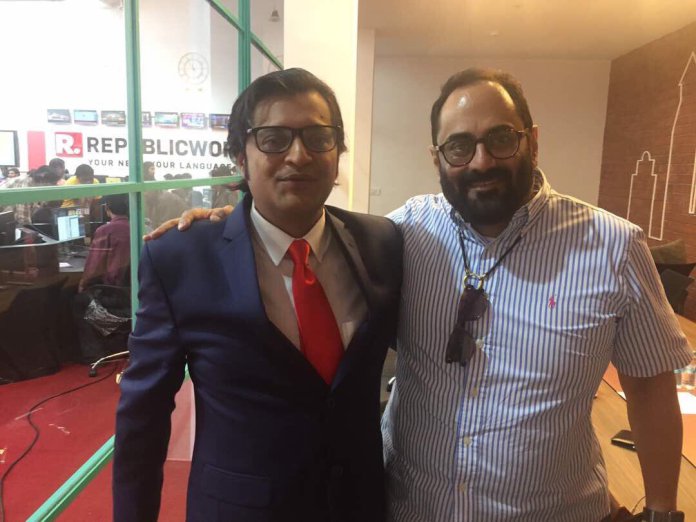
In November 2016, while delivering the vote of thanks during Ramnath Goenka awards, Indian Express’s Editor-in-Chief Raj Kamal Jha had regaled the audience with an anecdote. He told the gathering that once when a Chief Minister told the group’s founder Ramnath Goenka, “Aap ka reporter bahut achha kaam kar raha hai (Your reporter is doing good work)”, Ramnath Goenka had sacked the reporter. Raj Kamal Jha stated that criticism from the Government was a badge of honour. What people witnessed on Twitter today as part of the launch of Arnab Goswami’s Republic TV is the exact opposite of the Ramnath Goenka school of journalism.
From BJP Union Minsiters, to BJP MPs, to BJP MLAs to BJP Spokersperson, to BJP supporters, everybody seemed overjoyed at the launch of Republic TV.
BJP Union Ministers
BJP MP
BJP MLAs
BJP Spokespersons
The unprecedented amount of love showered on Republic TV’s launch by folks from BJP is not surprising though considering Rajya Sabha MP Rajeev Chandrasekhar who is NDA’s vice-chairman in Kerala is a prominent investor.
It is to be seen whether Arnab Goswami exposes the politician-mafia nexus in BJP ruled statues just like he has in a non-BJP state like Bihar with his Lalu Prasad-Liquor don Shahabuddin story. Bihar has had a liquor ban for just about 2 years, Gujarat has had one for many decades and everybody knows what goes around here.
For a long time now, Arnab Goswami’s journalism has looked like an extension of BJP’s propaganda arm. Recently, after the Sukma attack, he tweeted four times targeting everyone except the Government.
In 2014, when a Naxal attack had happened in the same region, he had questioned the role of UPA’s Home Ministers namely P Chidambaram, Shivraj Patil and Sushil Kumar Shinde.
Since Arnab refused to question the ruling BJP Governments in Chhattisgarh and Delhi for the Sukma attack, he’s probably seen as an ally and which is possibly why everybody in BJP’s rank and cadre can’t stop gushing about his new channel.
The India’s banks have been rising rapidly in recent times.
THAT the large non-performing assets (NPAs) on the books of banks, especially public sector banks, is the only blemish in India’s continuing economic story, is the official view. Speaking recently at the Council on Foreign Relations in New York, Finance Minister Arun Jaitley reportedly declared that NPAs were “one very big challenge” facing the government, and resolving that problem was its “top priority”. Parallel to this, others such as top-level Reserve Bank of India officials, have been floating trial balloons, in the form of recommendations on various methods of addressing the NPAs. Not the least controversial among these suggestions is one, which calls for the sale of equity and assets by public sector banks, which will shrink their size and reduce government shareholding to well below 50 percent. NPAs are providing the final push for re-privatisation of banking. But opting for this may amount to throwing the baby out with the bathwater.
It cannot be denied that NPAs on the books of India’s banks have been rising rapidly in recent times, and provision for loss assets is affecting profitability extremely adversely. The ratio of gross non-performing assets to total advances rose from 5.1 percent at the end of March 2015 to 7.8 percent at the end of March 2016 and 9.1 percent at the end of September 2016. The figure is expected to exceed 10 percent by March 2018.
This sharp increase in GNPAs during the tenure of the current government is the result of two factors. First, the decision of the Reserve Bank of India to put to an end the practice of restructuring non-performing loans and treat the resulting ‘restructured’ assets as standard assets. And, second the unwillingness of the government to set aside adequate funds to write off the bad loans of the public sector banks, which were the principal locations for bad assets. GNPAs with the public sector banks stood at Rs 5.02 lakh crore at the end of March 2016, but the budgetary support for recapitalisation during 2015-16 and 2016-17 amounts to a tenth of that sum or Rs 50,000 crore.
This reticence to recapitalise adequately was a signal that the government would not relax its fiscal conservatism to release resources to restructure the public sector banks, leaving them finally to their own devices. This does not meet the criterion of fairness, since what was happening to the public sector banks was, in substantial measure, the result of other policies being adopted by the government. Two such policies need special mention. One was the decision to substantially relax a range of controls on foreign capital inflow into the economy, through moves first adopted in the early 1990s, that gained momentum subsequently. This resulted, during the post-2003 surge of cross-border capital flows worldwide, in a huge infusion of external liquidity into India that was nowhere near matched by foreign exchange outflows either for current expenditure or investments abroad. The increase in liquidity swelled deposits with the banks and forced a sharp increase in the credit advanced by the banking system. As the Reserve Bank of India (RBI) has itself recognised, the rapid build up of credit resulting from the expansion in deposits provided the ground for inadequately informed or risky lending decisions.
The second set of policies that underlie the bad debt problem was the decision to encourage private players into the infrastructural areas and incentivise investment by them, to make up for shortfalls in public investment as a result of the fiscal ‘crunch’. Simultaneously the government in the name of financial reform shut down the development banks with access to lower cost capital because of lending and guarantee support from the central banks and the government. Development banks were too dependent on the State and prevented the provision of a level playing field for the private sector, it was argued. So the promoters of many infrastructural projects, deprived of access to development banks, had to turn to the commercial banks for financing. Possibly mistaken that these projects had an unstated government guarantee of viability, the banks flush with funds came forward with the funding.
Unfortunately, many of these projects proved unviable, and soon were defaulting on their debt service commitments, contributing in substantial measure to the NPA problem. So the government’s policy of private sector based infrastructural development, combined with its decision to close development banks, led to increased bank exposure to risky infrastructural projects with long gestation lags.
The effect of all this has been a now forgotten feature of post-liberalisation banking in India. That effect was a post 2003 credit surge. That surge increased exposure to more risky sectors and borrowers and resulted in a reversal of the decline in the Gross NPA ratio ensured by a restructuring exercise that began in the mid 1990s. GNPAs had come down from 15.7 percent of gross advances in 1996-97 to 10.4 percent in 2001-02, 5.2 percent in 2004-05and 2.3 percent in 2008-09. It is in the period since then that the ratio has again risen back to an estimated 10 percent plus currently. In sum, the years of liberalisation and reform have been characterised by a decline, followed by a rapid build up in the NPA ratio. Hence addressing the phenomenon required the State to rethink the policies that led to the explosive NPA turn-around.
Those policies led to an unsustainable expansion in commercial bank credit to finance the private consumption and investment that drove the economy’s high growth. With the credit boom running up against large scale default, that growth is under question. The Reserve Bank of India’s Financial Stability Report released in December 2016 recognised this strain when it said that NPAs together with the danger that deteriorating macroeconomic conditions could worsen the problems faced by these banks, had made the banks “risk averse”, as they focused on “cleaning up their balance sheets”. Outstanding non-food credit from the SCBs, which rose in all other major areas such as agriculture, services and personal loans, fell in the industry sector over the year ending November 2016. Outstanding loans to industry which had risen from Rs 25,419 billion on November 28, 2014 to Rs 26,687 billion on November 27, 2015, fell to Rs 25,793 billion on November 25, 2016.
The decline in lending to industry was focused on the infrastructural sector, with power and telecommunications setting the trend. Outstanding loans to power, which had risen from Rs 5,311 billion in end November 2014 to Rs 5,865 billion at the end of November 2015, fell significantly to Rs 5,253 billion at the end of November 2016. The figures for telecommunications were Rs 863 billion, Rs 907 billion and Rs 849 billion respectively on those three dates.
If despite this, non-food credit growth was positive during 2015-16 (November to November), though reflecting considerable deceleration in growth relative to the previous year, it was largely because of a sharp increase in retail lending, mainly for housing investments and vehicle purchases. Even in financial year 2015-16, retail lending registered double digit growth with housing loans that accounted for 54 percent of the total, increasing by more than 16 percent. Outstanding housing loans also rose from Rs 5,946 billion on November 28, 2014 to Rs 7,052 billion on November 27, 2015, and to Rs 8,153 billion on November 25, 2016. The corresponding figures for vehicle loans were Rs 1,194 billion, Rs 1,379 billion and Rs 1,673 billion respectively.
Thus, clearly, banks are cutting down on their overall lending and restructuring their portfolios to reduce exposure to the infrastructure sector in favour of the retail sector. Both these trends have implications for growth in the immediate future. For a decade and a half now, Indian growth has been fuelled by credit financed investment and consumption spending. So a deceleration in credit expansion implies that the principal stimulus to growth is being dampened, with obvious implications.
So resolving the NPA issue is crucial to keep credit flowing and sustaining growth. Moreover, restructuring debt is also the means to preventing a deleveraging process that could convert a growth slowdown into a crisis. Yet, trapped in its obsession with the fiscal deficit and unwilling to raise additional revenues through taxation, the government is hoping that the banks that were called upon to take on the task of driving growth would address the resulting NPA problem themselves.
Policies have been aimed at supporting the restructuring efforts of the banks. One was to permit private Asset Reconstruction Corporations, which would buy up stressed or loss assets at a large discount, with part payment in cash and the rest in security receipts that would be settled when the loan assets had been restructured and sold. Despite the presence of 16 ARCs by 2016, the pace of acquisition of NPAs by these companies has been slow, because of the huge discounts they demand and their own limited absorption capacities. Faced with this impasse the government has at various points considered the option of setting up a State-backed ARC. But that would require outlays from the budget, with attendant implications for budgetary outlays and the fiscal deficit it is unwilling to accept.
To avoid this, the government seems to be making a final push for privatisation, so as to mobilise resources for this round of NPA write off. That would let off the defaulters, often wilful, who have taken large loans and misused them. But it would also shrink the public sector and place the private sector in charge of much of credit flow in the economy. The private banking sector will cherry pick its clients and finance high-return speculative ventures, depriving industry and infrastructure of financial support. Growth would suffer. Many would be excluded from financial access. And if global experience is evidence, NPAs would only return. But an obsession with fiscal conservatism promoted by finance is pushing the government to adopt this drastic and counterproductive turn in policy.
In 2011, after several years of deliberation and under pressure from the Supreme Court, the Union government under the United Progressive Alliance decided to conduct a socio-economic and caste census. This followed massive protests that had broken out in 2006 against the Centre’s decision to reserve government jobs and seats in higher educational institutions for members of the Other Backward Classes. The court said that it needed concrete data on caste numbers so that it could determine whether the quota limit, which it set at 50% in 1992, could be altered.
But six years after the caste census was completed, there is no sign of the caste component of the data being released, though a small part on the economic conditions was put out in 2014.
In the meantime, state governments have begun challenging the 50% limit. In April, for instance, the Telengana government decided to increase quotas for Muslims and Scheduled Tribes. In 2015, the state government had set up the Sudhir commission to study the Muslim community’s conditions. It was found that despite constituting 12% of the state population, Muslims got only 7.6% of government jobs. The community was also lagging behind in education. By increasing the quota for Muslims to 12% from the existing 4%, the Telengana government went way past the 50% ceiling.
In order to avoid judicial intervention, the state government said the reservations for Muslims had nothing to do with religion: it contended that the quota was alloted on the basis of the community’s economic backwardness. However, the courts have struck down previous attempts to create quotas for religious groups. They have not viewed the economic argument favourably as the Constitution recognises only educational and social backwardness. Telangana Chief Minister K Chandrashekhar Rao had also cited the example of Tamil Nadu, where quotas are as high as 69%. A challenge to Tamil Nadu’s reservation policy is currently before a nine-member Constitution bench of the Supreme Court.
What does this confusion really say about India’s policy of affirmative action? First, the Supreme Court’s decision to cap reservations at 50% has been criticised widely for its arbitrariness. Some have argued that such a cap allows members of the upper castes to corner a disproportionate share of resources, since they dominate the 50% of jobs and seats left to open competition.
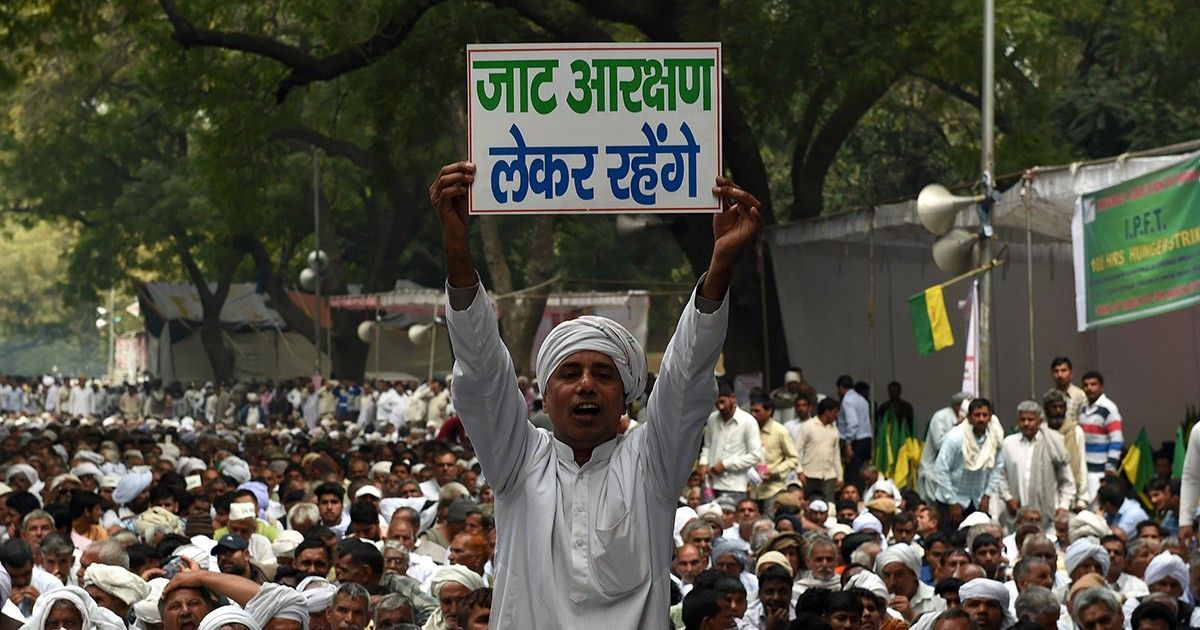
Secondly, the only reason that could be cited for the Centre’s failure to release the caste data is its reluctance to take on upper caste interests. In the process, not only is the Centre denying vulnerable communities their legitimate share of reservations, it is also risking the danger of the caste census being dismissed as dated. In the meantime, the absence of quality data on caste and socio-econimic condition is leading to what the Supreme Court termed as “competitve backwardness”. Even historically well-off groups, such as Patels in the Gujarat and the Jats in North India, are seeking reservations, to the detriment of weaker communities.
There was also the question of federal rights involved in this debate. By holding back the caste census data, the Centre is also indirectly limiting the powers of state legislatures from making changes to the reservation law since they are unable to get the 50% ceiling lifted in the courts.
Two judgements within a day of each other have caught national attention. The first is the Supreme Court judgement in the Nirbhaya case. The second is the Mumbai High Court judgement in the Bilkis Bano case. Two cases, two women, two standards of justice.
The Nirbhaya case aroused the conscience of India in an unprecedented way, calling into action thousands of young people who had perhaps never earlier joined street protests. The bravery and courage of the young woman, Jyoti, the brutality of the crime against her, now detailed in the judgement, the utter injustice and horror of her death symbolized so much that is rotten in our system, it reflected so many real fears and experiences of young women, it was a case with universal relevance across social boundaries. The Nirbhaya case and the public outrage forced the then government and all political parties to set up a commission led by the former Chief Justice JS Verma which made important recommendations, not only for amendments to the law, but also for steps on behalf of authorities for the prevention of sexual crimes against women and to create a secure and safe environment for women to exercise their equal right to public spaces. Some of the amendments suggested by the Verma Commission were accepted and adopted by parliament. But the measures required to make the country more secure and safe for women are far from being implemented. In our country, where the conviction rate in sexual crimes against women is as low as 20 per cent, where cases drag on for decades, it is a matter of great satisfaction that the perpetrators of the horrific crime against Jyoti could not get away with it and that the judicial process could be completed in four and a half years. There is little doubt of the guilt of those who have been sentenced in the Nirbhaya case. Some of the earlier arguments in the lower courts advanced by the defence were outrageous aspersions on the conduct of the young woman, both in court and outside, common to so many defence arguments in cases of rape and it is welcome that they were rejected.
Victims fighting for justice in cases of sexual crimes against women will be encouraged by these positive features in the judicial process concerning the Nirbhaya case and will expect that it become common rather than a rarity.
As far as the sentence is concerned, the courts, starting with the lowest, held the accused guilty and pronounced the death sentence which has now been upheld by the Supreme Court.
The defence argued that there was no previous record of criminality. This has been a legal consideration in judicial decisions on sentencing. Poverty and the brutalizing conditions of the lives of the criminals was an issue also brought up by the defence as a mitigating factor. This would be an unacceptable justification of a crime of this nature. It is true though that in a grossly unequal society like India, children of the poor often have few avenues of survival, becoming prey to the exploitation of criminal forces. Here, in the capital of the country, we have before our eyes hundreds of street children, many of them runaways, surviving in inhuman conditions. How do they grow up, what do they take with them on their path to adulthood, these are indeed deeply disturbing and relevant questions. Often criminality is born by circumstance in capitalist societies such as India. Particularly when the death penalty is on the statute books, such questions are literally a matter of life and death.
There are many cases where the Supreme Court has reversed the death sentence to life imprisonment. Often there are subjective factors that decide which case falls in the rarest of rare categories. The death sentence has been given in some cases to assuage the "collective conscience", an argument that can equally apply to justify the actions of a khap panchayat. The process is arbitrary and subjectively decided. There are compelling reasons for the abolition of the death penalty. As a society, we need to consider whether a maximum punishment of rigorous life imprisonment without parole is not more appropriate. I myself believe in principle in the abolition of the death penalty.
The arbitrary nature of decisions regarding the death penalty has been shown up in the judgement in the Bilkis Bano case. There are some who argue that if the criminals in Nirbhaya's case can get the death penalty, then why not those involved in the barbaric violence that Bilkis and her family were subjected to? Bilkis herself has been reported to have said after learning of the Nirbhaya judgement that she would appeal to the Supreme Court to pronounce the death sentence against those guilty in her case too. But the purpose of my argument in contrasting the two cases is to point out the frailty and flawed process in deciding the death penalty.
In Bilkis Bano's case, there was no national outrage. Since March 2002, she has fought virtually alone in the most adverse of circumstances, helped mainly by a band of human rights champions like Teesta Setalvad, who themselves became victims of the processes of injustice, precisely because of the help. extended in cases like Bilkis'. After 15 years, Bilkis's quest for justice is still not over.
In this judgement too, the terrible details of the crimes perpetrated are recorded. According to the judgement "on February 27, death of large numbers of Hindu karsevaks took place.. at Godhra railway station…allegedly by members of the Muslim community. On account of this, large scale riots erupted in the State of Gujarat. A large number of lives were lost in the communal riots which ensued."
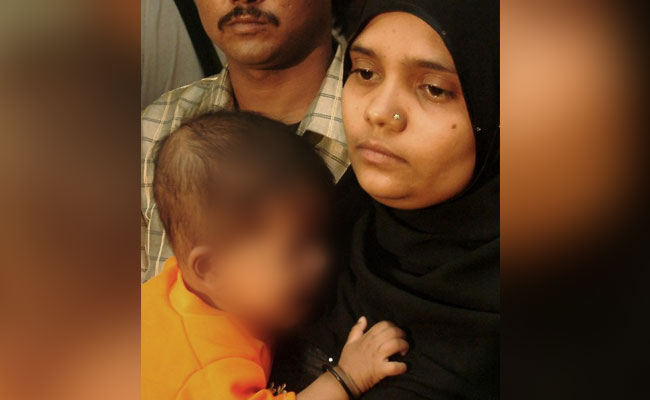
This is the background of the horror that Bilkis faced. Young, pregnant she had to flee her village of Randhikpur in the Dohad district with her entire extended family. On March 3, moving from one village to another, the group were spotted by gangs of men in two cars hunting for Muslims. At the time she was carrying Saleeha, her three-year-old daughter, in her arms. She recognized the men, mainly from her own village, who rushed towards her. They tore the child from her arms and smashed her head on the ground. The child died before her mother's eyes. Three men gangraped the pregnant Bilkis. Her sister and cousin sister were also raped. One of them had given birth only the day before.The baby was with her. Every single one of the group of eight was killed including the baby. Bilkis, who had lost consciousness, was left for dead, but she survived. It is not possible here to recount the dreadful story of her suffering. At every stage, her fight for justice was destroyed. The FIR was manipulated, the medical reports and postmortem of the bodies omitted all the most important details, the bodies were never given to the families but buried by the police themselves. The body of Bilkis's daughter disappeared. The lower court accepted all the lies and falsehoods and the case was sought to be closed within a year saying that although the crime had occurred, the criminals were "undetected" and therefore the case was closed. It was the NHRC team and others who recorded the details. A case was filed in the Supreme Court demanding that the case be reopened and handed over to the CBI. It was two years later, in 2004, that the CBI started its own investigation.
But it was always a small step forward and many steps back for Bilkis in her fight for justice. She was the main witness in the case. She faced threats, pressure, great hardship living in a state where the then Chief Minister and government were using state power and official resources to support and defend all the accused in hundreds of cases of killing and violence. Because of the open and defiant subversion of justice for the victims of the Gujarat riots by the Gujarat government and administration, the Supreme Court accepted her plea, and her case was shifted from Gujarat to Mumbai. 12 men had been given life imprisonment by the sessions court but others were acquitted. The police officials and doctors accused by the CBI of the direct destruction of evidence were acquitted. The charge of conspiracy was also struck down. The CBI went in appeal to the High Court.
Here too the recent judgement delivers justice only partially. The accused policemen and doctors have been found guilty and sentenced to three years in jail. This is the maximum penalty given under the present laws under Sec 217 and 218 of the IPC. This seems far too light a sentence for the extent of the crime committed, but it is indeed a welcome step that the court shredded the bogus arguments and defence put up by the earlier court judgement and has found them guilty. This is the first such judgement when police and doctors involved in a massive cover-up of the crimes committed have been brought to book.
The charge of conspiracy under Sec 120 B has been rejected by the court. Here, standards differing from those used in the Nirbhaya case are evident. The court has held that " it was on the spur of the moment." Yet in another place in the same judgement it is held that "they were hunting for Muslims…" If they were hunting for Muslims, how could the crimes be on the spur of the moment? They were not hunting for Muslims to have a dialogue with them, they were hunting for Muslims precisely to rape and kill. This could have been done only if they had all agreed to go on the "hunt." According to the Nirbhaya judgement "agreement between the accused" is the key to understand conspiracy. Yet in this case, the charge of conspiracy is struck down.
The grounds for rejection of the CBI appeal for the death sentence are also problematic. One of the grounds advanced is "after the Godhra incident…they were boiling with revenge…they are not history sheeters or hard core criminals." Can "revenge" be a cause for a lighter sentence? The Nirbhaya case criminals are not "history sheeters or hard core criminals". But this ground was rejected by the Supreme Court given the nature of the crime. Yes, Bilkis survived, but her sisters were brutally gangraped and killed. It is abhorrent to compare the extent of brutality in crimes committed against women. But can it be said that the nature of the crime against them is any less than in other cases where the death sentence has been given? The judgement describes the case as "a rare massacre manifesting ugly animosity and hostility" and "such crime is not justifiable and is shunned", but does the reasoning in the judgement not have wider implications which may result in lesser sentences for crimes motivated by communal hatred?
Some find closure at least to some extent in the judgements of the courts and for some, questions remain.
Brinda Karat is a Politburo member of the CPI(M) and a former Member of the Rajya Sabha. Disclaimer: The opinions expressed within this article are the personal opinions of the author and do not reflect the views of Sabrangindia. This article also appeared on NDTV.COM and is being reproduced here with the permission of the author
Varsha Dongre, who deleted her post later, called for introspection and has now been suspended.
A deputy jailer, posted at the central jail in Chhattisgarh’s capital city Raipur, was suspended on Saturday for a social media post alleging torture of a tribal women by the security forces in the state’s Maoist insurgency-hit Bastar region. Varsha Dongre, the deputy jailer of Raipur central jail, had claimed in a social media post last week that she had seen tribal girls being stripped at police stations in Bastar and tortured.
“I have seen the torture. The tribal girls were given electric shocks on their breasts and wrists. I have seen the marks and I was horrified. Why are such small tribal girls being subjected to third-degree torture? Our constitution and law system do not allow such inhuman torture. It’s time for us to introspect and the truth will come out. The people getting killed on both sides (during the Maoists-Security forces conflict in Bastar) are Indians. The capitalistic system is being forced into Bastar, villages are being burnt, tribal women are being raped. Is it really being done to end the Maoism?” Ms. Dongre had alleged in her post after the Maoist attack on the CRPF in Sukma which had led to the death of 25 CRPF men.
Ms. Dongre had deleted the post after it went viral on social media. However, the jail department of Chhattisgarh police had ordered an inquiry against her.
“Ms. Varsha Dongre has been suspended and charge-sheeted after it was found in a preliminary inquiry that her conduct was in violation of service rules and other rules,” Giridhari Nayak, the Director General of Police, Jail administration, Chhattisgarh police, told The Hindu.
An officer of the same department revealed on the condition of anonymity that it was Ms. Dongre’s social media post which led to her suspension as its language was “extremely offensive”. Known to be an upright officer, Ms. Dongre had also opined that the fifth schedule of the Indian constitution should be applied in tribal areas and the “so-called development” should not be imposed on tribals.
“The tribals do not want the Maoists. They want the Maoism to end but the way our country’s security forces are targeting the dignity of their women and daughters, burning their houses and slapping false cases against them, where will they go for justice?” the suspended deputy jailer had alleged in her post.
Ms. Dongre could not be reached for her reaction despite repeated attempts.
Background
"I am a witness to the torture of minor tribal girls … In the police stations, women personnel have stripped and tortured girls as old as 14 and 16 … They were given electric shock on their hands and breasts. I have seen the marks … I was horrified … Why third-degree torture on minors? I have given directions for their treatment", Varsha Dongre, deputy jailer of Raipur Central Jail, recently wrote in a post in Hindi.
"We need to introspect, because those who are getting killed in either side of this war in Bastar are our own people. The capitalist system is being forced on Bastar, tribals are being pushed out of their lands, their villages are being burnt, women raped — all this to grab land and forests. All this isn't being done to end Naxalism", she added.
Coming in the wake of the Maoist attack on CRPF jawans in Sukma district of the state, her comments were shared widely on social media. The jail department was forced to order of a probe, based on her allegations.
"The tribals can't leave this place as it is their land but when law-enforcers target women and minor girls and false case are registered, where do the victims go for justice?" she went on. "The CBI report says it, the court says it — this is the reality. When human rights workers or journalists tell the truth, they are sent to jail. If everything is fine in tribal lands, why government is so afraid and why people are not allowed to go there?"
Dongre invoked India's constitution to say it doesn't allow anyone the right to harass and torture another citizen. "A particular kind of development can't be thrust on the adivasis," she said. "Farmers and jawans are brothers, they shouldn't kill each other."
Following in the footsteps of the United States, the French are looking to “terrible simplifications” to solve their problems as they head to the second round of their presidential election on May 7.
Activists wear masks of Jean-Marie Le Pen, founder of the National Front, with his daughter’s hair, Marine, currently the extreme-right candidate in France’s election. Gonzalo Fuentes /Reuters
Polls predict that Marine Le Pen, candidate of the far-right National Front party could take 38% of the vote. Even if she loses on Sunday, some commentators believe that this campaign has paved the way for a victory in France’s 2022 election.
Viewed from Pakistan, this situation is a direct blow to a country which, in our minds, has been the bastion of democracy, rationalism and enlightenment.
France’s embrace of Le Pen is all the more concerning because, in Pakistan, we know exactly what autocratic populism looks like, and what it can lead to.
Pakistan’s first populist ruler Founded in 1947 during the Partition with India, Pakistan started its journey into nationhood in the turbulent 1950s, after an independence bill liberated the Indian subcontinent from the British empire.
Ordinary Pakistanis were struggling to eke out an existence. But the new nation’s leaders were experimenting with an ideology, inspired by “two nation theory” of Pakistan’s main thinker, Muhammad Ali Jinnah, that advocated for separated nations for India and Pakistan based on religion. To some extent this communal approach prevented the more critical progressive left from developing in Pakistan.
The 1960s gave rise not only to industry but also to numerous economic crises that challenged the fragile young nation. By the end of the decade, frustration was on the rise among the Pakistani people. Widespread protests ultimately brought down president Ayub Khan in 1968, ending Pakistan’s first military dictatorship.
This change opened the doors for Pakistan’s first populist leader, Zulfiqar Ali Bhutto, whose Pakistan People Party (PPP) emerged at the end of the 1960s atop a rising tide of public approval and support. People loved its slogan, “roti, kapra, aur makan” – “bread, clothing, and a home” – and in 1970 Butto was democratically elected as Pakistan’s fourth president.
That’s how Pakistan entered the age of populist politics: at the ballot box. The PPP expounded the same goals that we hear contemporary populist parties claim, namely that of freeing the state from tyrannical and incompetent rulers.
Zulfikar Bhutto speaks as President of Pakistan on the war with Bangladesh, NFO archive.
In the troubled context of the war with India and the subsequent creation of independent Bangladesh in 1971, Bhutto maintained his grasp on power. In 1973 he was elected Pakistan’s ninth prime minister, claiming that he wanted to bring democratic changes to the country.
His populism took an anti-imperialist guise, which garnered wide domestic support given both Pakistan’s own history and the state of world affairs at the time, which included US atrocities in the Vietnam War.
But when his power was challenged, particularly on labour and trade questions, Bhutto abandoned democracy. In 1977 he imposed martial law and curfews throughout the country. The civil unrest that followed galvanised General Zia ul Haq. He deposed Bhutto in a military coup that same year and had him hanged in 1979.
A repetitive pattern of populist leaders This pattern that has been repeated in Pakistan since then. Our shaky democracy never found stability after Zia, who was killed in a plane crash in 1988.
Four successive democratic governments were unconstitutionally ousted by military leaders, truncating their five-year terms and creating a chaotic alternation between civilian and army rule. Democracy would not return until 2008, when the Pakistan People’s Party won a presidential election on a wave of sympathy for the 2007 assassination of former prime minister Benazir Bhutto (daughter of Zulfiqar). For the first time in nearly 20 years, a government was able to complete its five-year term.
Imran Khan, populist opposition leader and former star cricket player, leads an anti-government protest in Islamabad, April 28 2017. Faisal Mahmood/Reuters
Today, Pakistan once again stands at the crossroads of civilian and military rule. The unpopular sitting government lost credibility with the Panama Papers scandal – in which the huge financial assets of incumbent Prime Minister Nawaz Sharif’s children were exposed – and opponents like the former cricket player Imran Khan are now suggesting that the military should take over. The media’s role in populism
France is still very far from dictatorship, of course. But Pakistan’s history shows that opening the door to populist leaders is a big step towards a dangerous and unknown future. If you flirt with extremism, you have to be willing to accept its dire consequences.
Today, populism in Pakistan has a broad and idealistic agenda, ranging from sustenance for the poor to changing the world order. Its euphoric 1960s ideals failed because they assumed the possibility of change as a “push-button operation”.
Still, populism has now become a cultural norm here. It grows from the inner contradictions of a democratic power structure that’s corrupted, incapable of solving social and economic issues and prone to passing liberticidal laws. And it thrives on right-wing patriotic, xenophobic and anti-politics rhetoric. France, take note.
Populist rhetoric also suits the sensation-hungry, ratings-seeking corporate media. In Pakistan the media has openly espoused populism by regularly portraying politics as a dirty game of power-hungry politicians. This narrative gives rise to cynical and anti-politics attitudes within the general public.
To make matters worse, the press covers some of the world’s demagogues, in the US as at home, in a very light manner. Such populist extremists are, of course, happy to win more positive media spin.
A dangerous frustration Some 8,000 kms from Islamabad, frustrated men and women in France are sick of politics, too. Watching their presidential debates and TV talk shows, they want to see someone who will secure the nation to bring back their lost pride.
Le Pen’s nationalist proclamations that France should “not [be] dragged into wars that are not hers” and other Trump-style “make France great again” slogans have become popular simplifications.
When the decision is upon them, will French voters enter the populist realm of “the fantasmatic”?
Populism can be far more dangerous than it seems, taking all forms of constraints, from negating the diversity of society to censoring individual liberties and free speech.
Abstract from Charlie Chaplin’s ‘The Great Dictator Speech’
Are the French ready for that?
It would be devastating to see France – a nation built on the ideals of transparency, equality, freedom, responsibility and compassion – taken down in a tragedy of its own making. Life is not a reality show, and demagogues do not make good rulers.
Take it from a people who know: there is no glorious past waiting to be restored. There is no golden future, either.
As the prophet Zarathustra pithily put it, “Not perhaps ye yourselves, my brethren! But into fathers and forefathers of the Superman could ye transform yourselves: and let that be your best creating!”
West Bengal is going through a tectonic political shift
The TMC will remain the dominant force in West Bengal for a long time/REUTERS
A few weeks ago, Chandrima Bhattacharya of the Trinamool Congress (TMC) won a by-election to the state legislative assembly in West Bengal. This was not particularly remarkable insofar as the election took place in Kanthi Dakshin in East Midnapur district, where TMC has been the dominant party for more than a decade. It is the influential Adhikari family who leads the TMC in Midnapur.
Adhikari dominance The head of the family, the 75-year-old Sisir Adhikari, was first elected to the state legislative assembly back in 1982. He is currently a member of the Lok Sabha and was for some time the Minister of Rural Development in the second United Progressive Alliance government under Manmohan Singh. His son, Subhendu, has also been a member of the Lok Sabha and is now the Minister of Transport in West Bengal. Another son, Dibyendu, is an MP.
Since 2001 one of these three Adhikaris — Sisir, Subhendu, or Dibyendu — has represented Kanthi Dakshin in the state assembly, and so it was hardly surprising that the TMC also came out on top this time.
The margin of victory was large — Chandrima received almost twice as many votes as the runner up.
The biggest upset was rather that it was the BJP’s Sourindra Mohan Jana who came second. At the state assembly elections in 2011 and 2016, Jana’s party had received only approximately 3% and 8% of the votes in Kanthi Dakshin; now, the BJP garnered more than 30%, relegating the Left Front’s candidate Uttam Pradhan from the CPI to third place.
Pradhan received only 10% of the votes; with a little more than 1% of the votes, Naba Kumar Nanda of the Congress Party barely managed to outperform the NOTA (None of the Above) option — but not by much.
Jonesville is not America and Kanthi Dakshin is not West Bengal, but much suggests that this by-election constitutes a tectonic political shift in Bengal — the second in less than a decade. The first shift occurred when the TMC dislodged the Left Front from power after more than three decades of uninterrupted communist rule. The current shift sees the left parties relegated to a remote third position in the state, while the BJP looks set to emerge as the main opposition.
Historically, the BJP has always had a negligible presence in West Bengal, and even during the heyday of Vajpayee’s National Democratic Alliance government around the turn of the millennium, the party struggled to cross the double digit mark at elections.
However, during the last couple of years, the BJP has worked hard to extend its grassroots presence. And, it was widely expected that the Modi-wave that has swept across almost all of India would also have an impact in West Bengal. But few had expected that the BJP would capture nearly a third of the votes in Kanthi Dakshin.
The implications of this tectonic shift are likely to be as follows. First, the TMC will remain the dominant political force for the foreseeable future. Mamata Banerjee is still a popular chief minister; the left is no longer capable of mounting an efficient challenge; the BJP is not yet adequately established organisationally; and whatever remains of the Congress Party is confined to a few isolated pockets.
Tricky tactics Secondly, the Left Front’s days as a powerful political force are over. As Arild Ruud and Dwaipayan Bhattacharyya have shown us in their rich ethnographic studies of the CPI(M) in West Bengal, it was the combination of progressive political ideology, broad popular movements, and a cohort of young, educated, left-leaning activist that enabled the CPI(M) to establish itself as a political force in the villages from the 1960s.
For many decades, the party was extremely adept at combining left-wing rhetoric and politics “from above” with a strategic and more pragmatic mediation of social relations and resources “from below” in such a way that the CPI(M) appeared to many voters as either the best or the only political alternative.
However, this apparently formidable construct, which had seemed invincible for more than three decades from 1977 onward, had gradually become more fragile than it appeared.
Large sections of the CPI(M) have switched to the TMC with few transaction costs; and what was formerly party conflicts between the CPI(M) and the TMC are now played out as factional conflicts
As one can read in Bhattacharyya’s recent book Government as Practice, this construct began to crumble already in the 1990s, and when it first began to collapse around 2008, it crumbled in little time.
Large sections of the CPI(M) have in many places switched to the TMC with few, if any, transaction costs; and what was formerly party political conflicts between the CPI(M) and the TMC are now played out as factional conflicts within the TMC. In addition, the by-election in Kanthi Dakshin showed that the BJP is gaining at the expense of the Left, and not of the TMC. The left appears to be left with only its radical political rhetoric “from above,” whereas the grassroots that should translate this rhetoric into pragmatic practice “from below” is crumbling.
BJP’s conquest of West Bengal Third, the BJP is on its way to becoming the second pole in a new bipolar political system. Modi is popular among many voters, and the BJP has both the resources to and an interests in conquering Bengal. While the BJP has previously tried to establish a foothold in Bengal by adapting its hardcore Hindutva rhetoric to local conditions — for example, by downplaying the political use of the somewhat dubious figure Ram, and instead highlighting well-known Bengal icons like Vivekanda and Tagore — the BJP’s current strategy is much less oriented towards local adaptations.
Now, Ram Navami (Ram’s birthday) is celebrated with swords and machetes drawn, in combination with anti-Muslim rhetoric and fierce accusations of “minority appeasement” against Mamata Banerjee. This is a well-known recipe on the part of the BJP and it may find some resonance among some voters insofar as the roughly 25% of the population that are Muslims do tend to support the TMC.
If the BJP succeeds in polarising the state along religious lines, we are likely to see an increase in so-called communal clashes in the future. And yet, as the recent election in Uttar Pradesh showed, it is the BJP’s unmatched organisational ability to micro-manage elections at the local level that wins elections.
In West Bengal the BJP is not yet organisationally capable of replicating its “Uttar Pradesh model.” But, there is little doubt that the collapse of the left has offered the BJP a space from which to work towards that end.
Kenneth Bo Nielsen is a postdoctoral researcher at the University of Bergen.
If you were asked to name the most important philosopher of 10th-century Baghdad, you would presumably not hesitate to say ‘al-Farabi’. He’s one of the few thinkers of the Islamic world known to non-specialists, deservedly so given his ambitious reworking of Platonic and Aristotelian metaphysics and political philosophy. But if you were yourself a resident of 10th-century Baghdad, you might more likely think of Yahya ibn ‘Adi. He is hardly a household name now, but was mentioned by the historian al-Mas‘udi as the only significant teacher of Aristotelian philosophy in his day. But ibn ‘Adi is not just a good example of how fame wanes across the centuries. He is also a fine illustration of the inter-religious nature of philosophy in the Islamic world.
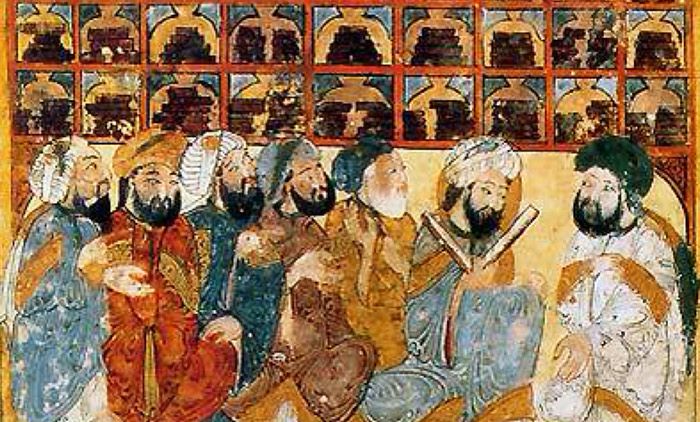
Scholars in a library from the Maqama of Hariri manuscript. Courtesy Bibliotheque Nationale/Wikipedia
Ibn ‘Adi was a Christian, as were most of the members of the group of philosophers who wrote commentaries on Aristotle at this time in Baghdad. The Muslim al-Farabi, who was apparently ibn ‘Adi’s teacher, was an exception to the rule. Completing the ecumenical picture, ibn ‘Adi was involved in an exchange of letters with a Jewish scholar named Ibn Abi Sa‘id al-Mawsili, who wrote to him with questions about Aristotle’s philosophy that he was hoping to have cleared up. Admittedly, Baghdad was an exceptional place, the capital of empire and thus a melting pot that drew scholars from all over the Islamic world. But philosophy was an interfaith phenomenon in other times and places too. The best example is surely Islamic Spain, celebrated for its culture of convivencia (‘living together’). Two of the greatest medieval thinkers, the Muslim Averroes and the Jew Maimonides, were rough contemporaries who both hailed from al-Andalus. After Toledo fell into the hands of the Christians, the Jew Avendauth collaborated with the Christian Gundisalvi to translate a work by the Muslim thinker Avicenna from Arabic into Latin.
That last example is a revealing one. Philosophy in these times often involved representatives of different faiths because it often presupposed translation. Hardly any philosophers of the Islamic world could read Greek, not even Averroes, the greatest commentator on Aristotle. He and other Muslim enthusiasts for Hellenic wisdom had to rely on translations, which had mostly been executed by Christians in the 8th to 10th centuries. Knowledge of Greek had been maintained by Christian scholars in Byzantine Syria, which explains why Muslim patrons turned to Christians to render works by Aristotle, Ptolemy, Galen and many other ancient thinkers into Arabic. Thus the very existence of Hellenic-inspired philosophy in the Islamic world was a manifestation of inter-religious cooperation.
All of which is not to say that the Islamic world was free of inter-religious dispute. On the contrary, it seems that one reason those Muslim patrons were interested in Aristotle was that his logic would give them the tools to keep up with Christian opponents in theological debate. A vivid example is provided by al-Kindi, the first Muslim thinker to draw on Hellenic sources. He wrote a short refutation of the Trinity in which he used Greek logic to argue that God must be wholly one, not one and three – mentioning that Christian readers should be able to follow the argument, given their familiarity with logical concepts. A nice twist to the story is that we know of this refutation only thanks to the aforementioned ibn ‘Adi, who quoted al-Kindi in order then to rebut his attack on the Christian dogma.
While men such as al-Kindi were appropriating Greek ideas to defend Islam and attack Christianity, others disapproved of the importation of these same ideas into Muslim culture: al-Kindi responded to unnamed critics who deplored the use of pagan philosophy, and the founder of the Christian Baghdad school got into a public dispute with a Muslim grammarian over the usefulness of Aristotle’s logic. The grammarian mocked the pretensions of the Christian Aristotelians, and delighted in pointing out that all this logic had not prevented them from believing that God can somehow be both one and three.
Still, it remains the case that philosophy and the sciences more generally offered a kind of meeting point or neutral ground for intellectuals of different faiths. Muslims, Christians and Jews who shared an interest in Aristotle’s metaphysics or the medical theories of Galen read each others’ commentaries and elaborations on the Hellenic tradition. This is shown even by the disputes that they had with one another: using Greek logic to debate the Trinity implicitly suggested that this was a topic that could be resolved by appeal to reason. And many of the thinkers mentioned above argued that philosophy offered the best resource for the interpretation of sacred texts, whether the Torah, the Christian Bible, or the Quran. So it is no coincidence that in the Muslim al-Kindi, the Christian ibn ‘Adi, and the Jew Maimonides, the One God of Abrahamic tradition bears a striking resemblance to the god of Aristotle’s Metaphysics. Their shared enterprise as elite philosophers meant that they had more in common with one another than they did with most of their co-religionists.
Peter Adamson is a professor of philosophy at the Ludwig Maximilian University of Munich. He is the author of several books, including The Arabic Plotinus (2002) and Great Medieval Thinkers: al-Kindi (2007) and Philosophy in the Islamic World (2016), and hosts the History of Philosophy podcast.