Following in the footsteps of the United States, the French are looking to “terrible simplifications” to solve their problems as they head to the second round of their presidential election on May 7.
Activists wear masks of Jean-Marie Le Pen, founder of the National Front, with his daughter’s hair, Marine, currently the extreme-right candidate in France’s election. Gonzalo Fuentes /Reuters
Polls predict that Marine Le Pen, candidate of the far-right National Front party could take 38% of the vote. Even if she loses on Sunday, some commentators believe that this campaign has paved the way for a victory in France’s 2022 election.
Viewed from Pakistan, this situation is a direct blow to a country which, in our minds, has been the bastion of democracy, rationalism and enlightenment.
France’s embrace of Le Pen is all the more concerning because, in Pakistan, we know exactly what autocratic populism looks like, and what it can lead to.
Pakistan’s first populist ruler Founded in 1947 during the Partition with India, Pakistan started its journey into nationhood in the turbulent 1950s, after an independence bill liberated the Indian subcontinent from the British empire.
Ordinary Pakistanis were struggling to eke out an existence. But the new nation’s leaders were experimenting with an ideology, inspired by “two nation theory” of Pakistan’s main thinker, Muhammad Ali Jinnah, that advocated for separated nations for India and Pakistan based on religion. To some extent this communal approach prevented the more critical progressive left from developing in Pakistan.
The 1960s gave rise not only to industry but also to numerous economic crises that challenged the fragile young nation. By the end of the decade, frustration was on the rise among the Pakistani people. Widespread protests ultimately brought down president Ayub Khan in 1968, ending Pakistan’s first military dictatorship.
This change opened the doors for Pakistan’s first populist leader, Zulfiqar Ali Bhutto, whose Pakistan People Party (PPP) emerged at the end of the 1960s atop a rising tide of public approval and support. People loved its slogan, “roti, kapra, aur makan” – “bread, clothing, and a home” – and in 1970 Butto was democratically elected as Pakistan’s fourth president.
That’s how Pakistan entered the age of populist politics: at the ballot box. The PPP expounded the same goals that we hear contemporary populist parties claim, namely that of freeing the state from tyrannical and incompetent rulers.
Zulfikar Bhutto speaks as President of Pakistan on the war with Bangladesh, NFO archive.
In the troubled context of the war with India and the subsequent creation of independent Bangladesh in 1971, Bhutto maintained his grasp on power. In 1973 he was elected Pakistan’s ninth prime minister, claiming that he wanted to bring democratic changes to the country.
His populism took an anti-imperialist guise, which garnered wide domestic support given both Pakistan’s own history and the state of world affairs at the time, which included US atrocities in the Vietnam War.
But when his power was challenged, particularly on labour and trade questions, Bhutto abandoned democracy. In 1977 he imposed martial law and curfews throughout the country. The civil unrest that followed galvanised General Zia ul Haq. He deposed Bhutto in a military coup that same year and had him hanged in 1979.
A repetitive pattern of populist leaders This pattern that has been repeated in Pakistan since then. Our shaky democracy never found stability after Zia, who was killed in a plane crash in 1988.
Four successive democratic governments were unconstitutionally ousted by military leaders, truncating their five-year terms and creating a chaotic alternation between civilian and army rule. Democracy would not return until 2008, when the Pakistan People’s Party won a presidential election on a wave of sympathy for the 2007 assassination of former prime minister Benazir Bhutto (daughter of Zulfiqar). For the first time in nearly 20 years, a government was able to complete its five-year term.
Imran Khan, populist opposition leader and former star cricket player, leads an anti-government protest in Islamabad, April 28 2017. Faisal Mahmood/Reuters
Today, Pakistan once again stands at the crossroads of civilian and military rule. The unpopular sitting government lost credibility with the Panama Papers scandal – in which the huge financial assets of incumbent Prime Minister Nawaz Sharif’s children were exposed – and opponents like the former cricket player Imran Khan are now suggesting that the military should take over. The media’s role in populism
France is still very far from dictatorship, of course. But Pakistan’s history shows that opening the door to populist leaders is a big step towards a dangerous and unknown future. If you flirt with extremism, you have to be willing to accept its dire consequences.
Today, populism in Pakistan has a broad and idealistic agenda, ranging from sustenance for the poor to changing the world order. Its euphoric 1960s ideals failed because they assumed the possibility of change as a “push-button operation”.
Still, populism has now become a cultural norm here. It grows from the inner contradictions of a democratic power structure that’s corrupted, incapable of solving social and economic issues and prone to passing liberticidal laws. And it thrives on right-wing patriotic, xenophobic and anti-politics rhetoric. France, take note.
Populist rhetoric also suits the sensation-hungry, ratings-seeking corporate media. In Pakistan the media has openly espoused populism by regularly portraying politics as a dirty game of power-hungry politicians. This narrative gives rise to cynical and anti-politics attitudes within the general public.
To make matters worse, the press covers some of the world’s demagogues, in the US as at home, in a very light manner. Such populist extremists are, of course, happy to win more positive media spin.
A dangerous frustration Some 8,000 kms from Islamabad, frustrated men and women in France are sick of politics, too. Watching their presidential debates and TV talk shows, they want to see someone who will secure the nation to bring back their lost pride.
Le Pen’s nationalist proclamations that France should “not [be] dragged into wars that are not hers” and other Trump-style “make France great again” slogans have become popular simplifications.
When the decision is upon them, will French voters enter the populist realm of “the fantasmatic”?
Populism can be far more dangerous than it seems, taking all forms of constraints, from negating the diversity of society to censoring individual liberties and free speech.
Abstract from Charlie Chaplin’s ‘The Great Dictator Speech’
Are the French ready for that?
It would be devastating to see France – a nation built on the ideals of transparency, equality, freedom, responsibility and compassion – taken down in a tragedy of its own making. Life is not a reality show, and demagogues do not make good rulers.
Take it from a people who know: there is no glorious past waiting to be restored. There is no golden future, either.
As the prophet Zarathustra pithily put it, “Not perhaps ye yourselves, my brethren! But into fathers and forefathers of the Superman could ye transform yourselves: and let that be your best creating!”
West Bengal is going through a tectonic political shift
The TMC will remain the dominant force in West Bengal for a long time/REUTERS
A few weeks ago, Chandrima Bhattacharya of the Trinamool Congress (TMC) won a by-election to the state legislative assembly in West Bengal. This was not particularly remarkable insofar as the election took place in Kanthi Dakshin in East Midnapur district, where TMC has been the dominant party for more than a decade. It is the influential Adhikari family who leads the TMC in Midnapur.
Adhikari dominance The head of the family, the 75-year-old Sisir Adhikari, was first elected to the state legislative assembly back in 1982. He is currently a member of the Lok Sabha and was for some time the Minister of Rural Development in the second United Progressive Alliance government under Manmohan Singh. His son, Subhendu, has also been a member of the Lok Sabha and is now the Minister of Transport in West Bengal. Another son, Dibyendu, is an MP.
Since 2001 one of these three Adhikaris — Sisir, Subhendu, or Dibyendu — has represented Kanthi Dakshin in the state assembly, and so it was hardly surprising that the TMC also came out on top this time.
The margin of victory was large — Chandrima received almost twice as many votes as the runner up.
The biggest upset was rather that it was the BJP’s Sourindra Mohan Jana who came second. At the state assembly elections in 2011 and 2016, Jana’s party had received only approximately 3% and 8% of the votes in Kanthi Dakshin; now, the BJP garnered more than 30%, relegating the Left Front’s candidate Uttam Pradhan from the CPI to third place.
Pradhan received only 10% of the votes; with a little more than 1% of the votes, Naba Kumar Nanda of the Congress Party barely managed to outperform the NOTA (None of the Above) option — but not by much.
Jonesville is not America and Kanthi Dakshin is not West Bengal, but much suggests that this by-election constitutes a tectonic political shift in Bengal — the second in less than a decade. The first shift occurred when the TMC dislodged the Left Front from power after more than three decades of uninterrupted communist rule. The current shift sees the left parties relegated to a remote third position in the state, while the BJP looks set to emerge as the main opposition.
Historically, the BJP has always had a negligible presence in West Bengal, and even during the heyday of Vajpayee’s National Democratic Alliance government around the turn of the millennium, the party struggled to cross the double digit mark at elections.
However, during the last couple of years, the BJP has worked hard to extend its grassroots presence. And, it was widely expected that the Modi-wave that has swept across almost all of India would also have an impact in West Bengal. But few had expected that the BJP would capture nearly a third of the votes in Kanthi Dakshin.
The implications of this tectonic shift are likely to be as follows. First, the TMC will remain the dominant political force for the foreseeable future. Mamata Banerjee is still a popular chief minister; the left is no longer capable of mounting an efficient challenge; the BJP is not yet adequately established organisationally; and whatever remains of the Congress Party is confined to a few isolated pockets.
Tricky tactics Secondly, the Left Front’s days as a powerful political force are over. As Arild Ruud and Dwaipayan Bhattacharyya have shown us in their rich ethnographic studies of the CPI(M) in West Bengal, it was the combination of progressive political ideology, broad popular movements, and a cohort of young, educated, left-leaning activist that enabled the CPI(M) to establish itself as a political force in the villages from the 1960s.
For many decades, the party was extremely adept at combining left-wing rhetoric and politics “from above” with a strategic and more pragmatic mediation of social relations and resources “from below” in such a way that the CPI(M) appeared to many voters as either the best or the only political alternative.
However, this apparently formidable construct, which had seemed invincible for more than three decades from 1977 onward, had gradually become more fragile than it appeared.
Large sections of the CPI(M) have switched to the TMC with few transaction costs; and what was formerly party conflicts between the CPI(M) and the TMC are now played out as factional conflicts
As one can read in Bhattacharyya’s recent book Government as Practice, this construct began to crumble already in the 1990s, and when it first began to collapse around 2008, it crumbled in little time.
Large sections of the CPI(M) have in many places switched to the TMC with few, if any, transaction costs; and what was formerly party political conflicts between the CPI(M) and the TMC are now played out as factional conflicts within the TMC. In addition, the by-election in Kanthi Dakshin showed that the BJP is gaining at the expense of the Left, and not of the TMC. The left appears to be left with only its radical political rhetoric “from above,” whereas the grassroots that should translate this rhetoric into pragmatic practice “from below” is crumbling.
BJP’s conquest of West Bengal Third, the BJP is on its way to becoming the second pole in a new bipolar political system. Modi is popular among many voters, and the BJP has both the resources to and an interests in conquering Bengal. While the BJP has previously tried to establish a foothold in Bengal by adapting its hardcore Hindutva rhetoric to local conditions — for example, by downplaying the political use of the somewhat dubious figure Ram, and instead highlighting well-known Bengal icons like Vivekanda and Tagore — the BJP’s current strategy is much less oriented towards local adaptations.
Now, Ram Navami (Ram’s birthday) is celebrated with swords and machetes drawn, in combination with anti-Muslim rhetoric and fierce accusations of “minority appeasement” against Mamata Banerjee. This is a well-known recipe on the part of the BJP and it may find some resonance among some voters insofar as the roughly 25% of the population that are Muslims do tend to support the TMC.
If the BJP succeeds in polarising the state along religious lines, we are likely to see an increase in so-called communal clashes in the future. And yet, as the recent election in Uttar Pradesh showed, it is the BJP’s unmatched organisational ability to micro-manage elections at the local level that wins elections.
In West Bengal the BJP is not yet organisationally capable of replicating its “Uttar Pradesh model.” But, there is little doubt that the collapse of the left has offered the BJP a space from which to work towards that end.
Kenneth Bo Nielsen is a postdoctoral researcher at the University of Bergen.
If you were asked to name the most important philosopher of 10th-century Baghdad, you would presumably not hesitate to say ‘al-Farabi’. He’s one of the few thinkers of the Islamic world known to non-specialists, deservedly so given his ambitious reworking of Platonic and Aristotelian metaphysics and political philosophy. But if you were yourself a resident of 10th-century Baghdad, you might more likely think of Yahya ibn ‘Adi. He is hardly a household name now, but was mentioned by the historian al-Mas‘udi as the only significant teacher of Aristotelian philosophy in his day. But ibn ‘Adi is not just a good example of how fame wanes across the centuries. He is also a fine illustration of the inter-religious nature of philosophy in the Islamic world.
Scholars in a library from the Maqama of Hariri manuscript. Courtesy Bibliotheque Nationale/Wikipedia
Ibn ‘Adi was a Christian, as were most of the members of the group of philosophers who wrote commentaries on Aristotle at this time in Baghdad. The Muslim al-Farabi, who was apparently ibn ‘Adi’s teacher, was an exception to the rule. Completing the ecumenical picture, ibn ‘Adi was involved in an exchange of letters with a Jewish scholar named Ibn Abi Sa‘id al-Mawsili, who wrote to him with questions about Aristotle’s philosophy that he was hoping to have cleared up. Admittedly, Baghdad was an exceptional place, the capital of empire and thus a melting pot that drew scholars from all over the Islamic world. But philosophy was an interfaith phenomenon in other times and places too. The best example is surely Islamic Spain, celebrated for its culture of convivencia (‘living together’). Two of the greatest medieval thinkers, the Muslim Averroes and the Jew Maimonides, were rough contemporaries who both hailed from al-Andalus. After Toledo fell into the hands of the Christians, the Jew Avendauth collaborated with the Christian Gundisalvi to translate a work by the Muslim thinker Avicenna from Arabic into Latin.
That last example is a revealing one. Philosophy in these times often involved representatives of different faiths because it often presupposed translation. Hardly any philosophers of the Islamic world could read Greek, not even Averroes, the greatest commentator on Aristotle. He and other Muslim enthusiasts for Hellenic wisdom had to rely on translations, which had mostly been executed by Christians in the 8th to 10th centuries. Knowledge of Greek had been maintained by Christian scholars in Byzantine Syria, which explains why Muslim patrons turned to Christians to render works by Aristotle, Ptolemy, Galen and many other ancient thinkers into Arabic. Thus the very existence of Hellenic-inspired philosophy in the Islamic world was a manifestation of inter-religious cooperation.
All of which is not to say that the Islamic world was free of inter-religious dispute. On the contrary, it seems that one reason those Muslim patrons were interested in Aristotle was that his logic would give them the tools to keep up with Christian opponents in theological debate. A vivid example is provided by al-Kindi, the first Muslim thinker to draw on Hellenic sources. He wrote a short refutation of the Trinity in which he used Greek logic to argue that God must be wholly one, not one and three – mentioning that Christian readers should be able to follow the argument, given their familiarity with logical concepts. A nice twist to the story is that we know of this refutation only thanks to the aforementioned ibn ‘Adi, who quoted al-Kindi in order then to rebut his attack on the Christian dogma.
While men such as al-Kindi were appropriating Greek ideas to defend Islam and attack Christianity, others disapproved of the importation of these same ideas into Muslim culture: al-Kindi responded to unnamed critics who deplored the use of pagan philosophy, and the founder of the Christian Baghdad school got into a public dispute with a Muslim grammarian over the usefulness of Aristotle’s logic. The grammarian mocked the pretensions of the Christian Aristotelians, and delighted in pointing out that all this logic had not prevented them from believing that God can somehow be both one and three.
Still, it remains the case that philosophy and the sciences more generally offered a kind of meeting point or neutral ground for intellectuals of different faiths. Muslims, Christians and Jews who shared an interest in Aristotle’s metaphysics or the medical theories of Galen read each others’ commentaries and elaborations on the Hellenic tradition. This is shown even by the disputes that they had with one another: using Greek logic to debate the Trinity implicitly suggested that this was a topic that could be resolved by appeal to reason. And many of the thinkers mentioned above argued that philosophy offered the best resource for the interpretation of sacred texts, whether the Torah, the Christian Bible, or the Quran. So it is no coincidence that in the Muslim al-Kindi, the Christian ibn ‘Adi, and the Jew Maimonides, the One God of Abrahamic tradition bears a striking resemblance to the god of Aristotle’s Metaphysics. Their shared enterprise as elite philosophers meant that they had more in common with one another than they did with most of their co-religionists.
Peter Adamson is a professor of philosophy at the Ludwig Maximilian University of Munich. He is the author of several books, including The Arabic Plotinus (2002) and Great Medieval Thinkers: al-Kindi (2007) and Philosophy in the Islamic World (2016), and hosts the History of Philosophy podcast.
It is easy to blame radical politicians and religious leaders for igniting the spark. But let’s not forget those who fuel the fire.
Matthew Fearnley [Licensed under CC BY 2.0]
As a child, when I visited Jagannath temple of Puri in Odisha, my mother told me how Kalapahada, a Muslim king, had attacked and destroyed much of the temple. She added how Ma Mangala, the local Thakurani (village goddess), protected the shrine, and forced Kalapahada to retreat. Eight such Thakuranis guard the temple, she told me. I was filled with awe at the image of warrior-goddesses riding lions and tigers, protecting the grand temple complex that was at the heart of my cultural inheritance.
Years later, during a tour of South Indian temples, I heard a similar tale, of a Muslim warlord called Malik Kafur who attacked and desecrated the shrines of Madurai and Srirangam. The narration had details of a fascinating adventure embarked upon by local priests who went all the way to Delhi, disguised as singers and dancers, impressed the Muslim ruler there, and convinced him to return their sacred icons. In some stories, a Muslim princess follows them and ends up deified as the Muslim consort of a Hindu deity. Were these pre-modern attempts to reconcile communal rivalry?
Over time I encountered similar tales in Ujjain, Mathura, Kashi, Ayodhya, Kolhapur, Somnath and Kashmir. Most of these stories had many self-evident internal inaccuracies and contradictions. Such is the nature of orally transmitted lore. What was interesting is not what was said, but how it was said.
There was never any rage or bitterness in my mother’s voice, or any sense of victimhood, when she narrated the story. She did not want me to hate Kalapahada, or Muslims. In fact, she almost seemed to justify Kalapahada’s action by telling me how he was actually Hindu who was stopped by orthodox priests from entering the temple as he had either married a Muslim girl he loved, or had been forced to convert to Islam by his captors. This made him angry, because he loved Jagannath too much, and that is what made him a monster. The point of the narration, for my mother, was to impress upon me, how the glory of Jagannath survives despite all attacks and misfortunes, which is why we must have faith in him, cling to him as a raft in tempestuous waters. In other words, the narration was rooted in the paradigm of karma.
Image credit: Bernard Gagnon [CC BY-SA 3.0]
Justice for the gods
Karma, however, is often mocked in educated circles. In lecture after lecture, for the past 20 years, I have encountered young students, presenting common understanding of karma rooted in colonial and missionary discourse. Reduced to fatalism and determinism, karma is seen as a cultural excuse for maintaining caste hegemony and social stagnation, one that must be abandoned. It is never seen as a key factor for Hindu tolerance, the ability to reconcile with change and diversity.
Students of modern education are trained to be scientific and rational in their thinking. This demands rejecting the paradigm of karma and embracing the paradigm of justice, equality and revolution. We are told the latter is the rational way, the right way. No one points to the underlying Abrahamic “saviour” complex.
Revolution is seen as anti-determinism, anti-fatalism, anti-karma – as something that determines progress, and grants freedom. This makes it “the good fight”. This paradigm fuelled national building as we rose up against imperial powers, and did not just accept them. It led the founding fathers of our country, many of them lawyers trained in England, to challenge what was claimed to be old traditional (karmic? regressive?) modes of thinking and establish a constitution that would create the Idea of India. Sadly, it had unintended consequences.
What was embraced by the Left was also embraced by the Right. If the Left saw the immediate past as oppressive, the Right saw the medieval past as oppressive. If the Left sought justice and equality for the poor and the marginalised, the Right sought justice and equality for Hindu gods whose houses, they believed, had been torn down by Muslim kings and whose doctrines, they argued, had been mutilated by colonial scholars. Those who demanded an end to Brahminical privileges on grounds that they had enslaved the Dalits for centuries started being challenged by those who demanded an end to what they called state-sponsored appeasement for Muslims who, they argued, had enslaved India for a thousand years, and who had, they pointed out, wiped out all trace of Hinduism, and Buddhism, in Afghanistan, and Pakistan, and now Kashmir.
Educated members of the Right saw temple lore not in terms of karma and devotion, but as memories of social injustice. They started demanding equal treatment for Ram, and Krishna. Temple discourse was systematically changed. It was no longer about the glory of stoic and wise gods, who patiently watched the rise and fall and rise of their temples, but of devotees who wanted the glory of their gods to be restored. Hindu religious leaders who during the Freedom Struggle focussed on rediscovering and popularising Hindu philosophy were recruited to speak of the lost glory of Hinduism to evoke a sense of victimhood in their disciples and followers in India and abroad. For the Right knows, like the Left, there can be no revolutions unless there is a festering wound, and a villain.
Jannat al-Baqi in Medina Saudi Arabia. Image credit: Mardetanha [CC BY-SA 3.0]
Truth of the historians
Then came the historians. Armed with data, they claimed the Right was spreading lies, and all these temple lore, retold over generations, were myths. By myth they meant fiction. A few sensible historians prefer the use of the word imaginary, over fiction, or myth, for they realised that not a single religious “fact” however profound, from resurrection to prophethood, is based on measurable, verifiable, facts. Where one locates matters of faith, still remains a question. Rational extremists insist that all religious doctrine is essentially “fake news”. And you see this in the writings of many modern young, rather combative, historians, who want to prove that all Hindu temple lore are nothing but fabricated propaganda serving Right Wing radicals.
First, these modern historians argue that Muslim kings broke temples because temples were centres of wealth and power, and there was no religious motivation whatsoever. It had nothing to do with the Islamic contempt for shirk, or idolatry, and polytheism. These Muslim kings were actually mimicking their local Hindu counterparts, these historians argue, who were also breaking temples of rival Hindu rulers. It had all to do with wealth and power, not Ram or Allah. In other words, these historians separate the political from the religious.
Second, they point to the relative paucity of archaeological evidence of temple desecration, disproportionately low compared to the perception whipped up by temple lore. They provide evidence of how many temples were given grants by Muslim kings, how many Hindu officers worked for Muslim kings, and Muslim officers worked for Hindu kings, almost indicating the total absence of bigotry – or, at best, prevalence of cynical secularism that uses religion as a lever to secure rules, breaking and building temples and mosques as per convenience. Third, they argue that biographers of Muslim kings, not wanting their masters to appear greedy, draped the political action with a religious cloak, and went on to highly exaggerate the extent of the plunder, describing in gory details how Hindus were killed or enslaved or converted for the glory of Islam. Writing of such hagiographies began 800 years ago, and continued for nearly 500 years.
Finally, these historians show how, during the British Raj, colonial historians who were the first to apply scientific methods in the study of history, had prejudices of their own. Their uncritical examination of the hagiographies of Indo-Muslim rulers helped them to establish the idea that India was plundered and enslaved by Muslims. This was to discredit the local kings and to establish the East India Company as saviours. Later, this became a lever in their divide-and-rule policy. This discourse contributed greatly to the demands for Pakistan, the partition of India, and the clamour for Hindu Rashtra, cherished by those who subscribe to the Hindutva doctrine.
This separation of the religious from the political by historians is an interesting exercise. It almost grants legitimacy to temple breaking. It does not distinguish the difference between breaking of Hindu temples by Hindu rulers, who would move the images to their own private temples (not as trophies, but as deities), and Hindu temples by Muslim rulers, who would not do the same. For example, in Puri Jagannath temple complex, the guides point to images placed in minor temples, with full fledged rituals and priests of their own, that were as per temple lore brought by kings of Puri from Kanchi in the South after a great battle. Did Sikandar Butshikan, who 500 years ago broke the Martand temple (dedicated to the sun-god) in Kashmir, do the same?
Babri masjid being demolished on December 6, 1992. Image credit: Vimeo
Not bigots but cynics
If non-religious but merely political breaking of Hindu temples is not such a big deal, could it be argued that the breaking of Babri Masjid, had it happened in medieval times, would have been fine as long as it was a Hindutva, hence political, exercise, and not a Hindu, hence religious, one?
Right now, holy and historical monuments around Kaaba in the holy city of Mecca, in Saudi Arabia, are being torn down to make way for five-star hotels. This is being done by the local government, and the royal family, who are guardians of the shrine. Protests by Shia Muslims and historians of Islam are falling on deaf ears.
Are these religious actions of the Wahabi theocracy, or simply economic activity to cater to the vast number of pilgrims entering the holy city, as is being claimed? Will these historians declare mosque-breaking in Mecca legitimate if inspired by economic ambition, may be even political, but illegitimate if inspired by religious sentiments? If it is alright for Muslims to break mosques, can Hindus break mosques too? Or will such thoughts be dismissed as false equivalence, and reckless whataboutery?
Many have argued that Islam is being treated with kid gloves in academic circles, almost the same way as so-called “cow protectors” seem to be treated by the current government. While it is perfectly fine for educated liberals of the West to mock Christianity or even (pagan?) Hinduism, the very same people take pains not to appear Islamophobic, going to the extent of arguing that hijab is empowering. Why, Saudi Arabia has even been included by United Nations Women’s Rights Commission.
I wonder if this has something to do with collective Euro-American guilt at turning a blind eye to the Holocaust or to the role the West played in establishing the Jewish state of Israel in Muslim-controlled regions thus triggering the Palestinian tragedy that haunts us to this day. Or does it have to do with American military interests in West Asia – what they call the Middle East. After all, only in the United States, are educational institutes mapped on geographical grounds, mirroring military divisions. Thus we have Departments for South Asian, or for African, studies, for example.
Balustrade entrance to ornate open mantapa at Vittala temple, Hampi. Image credit: Dineshkannambadi [CC BY-SA 3.0]
If these modern historian commentaries on pre-modern history is to be believed, then religion played no role in the fall of the Vijayanagar empire in the 16th century at the hands of the Deccani sultans. Likewise, the rise of the Maratha Empire spearheaded by Shivaji in the 17th century was recast as religious only during the freedom struggle, not before. And kings like Tipu Sultan were just complex politicians, destroying some temples, supporting others, and cynically using Islam only to make alliances with the Ottoman Empire, never letting their private faith interfere with their public policies.
It almost seems these historians are trying to tell us that modern secularism is a re-discovery of medieval secularism, and that religious fanaticism is a recent invention. Medieval Muslim – or Hindu – kings, were not bigots. Religion played no role in their decisions. That is like saying that religion played no role in the migration of Protestants to America, or in the rise of England as a nation-state. Or that Evangelical Christianity plays no role in the political decisions of Singapore and South Korea. Or that religion was not the core issue for the Crusades, that horrific war between Christians and Muslims that lasted for centuries.
This character-certificate-giving approach of some modern historians, who it would seem, like to see themselves as warriors against fake news, makes me wonder how scientific these historians are in attitude. Why do they seem to function with an agenda in mind? Why do their writings appear to presuppose a villain over whom they are trying to intellectually triumph? Does that not make them activists, rather than social scientists?
Scholarship in the humanities has today become about identifying privilege and exploitation. It is about reframing the past in terms of injustice and inequality. It is driven by the demand for social justice. There is an increasingly evangelical tone in historical writing, as if to assert relevance, and guarantee research grants.
Recently, there was news of local Indian historians who traced vast metal bells taken from Portuguese churches and placed in Hindu temples by Maratha warlords. From all accounts in the public domain, these historians have neither tried to give their scholarship a communal twist as the Right tends to do, nor have they pretended to to call this a secular exercise, as the Left tends to do. There is an acknowledgment of the intense Maratha-Portuguese rivalry along the Konkan coast 300 years ago, but there is no attempt to define the battles as political, economic, or religious – or to declare them legitimate or illegitimate. It is simply acknowledging a historical fact, and letting the readers wonder about motivation and drive. There is no defendant or prosecution here, just a tone of mature scholarship, aware of contemporary political realities.
Naro Shankar Ghanta on Banks of River Godavari. Image credit: IANS Photo
History, myth and memory
Culture is not shaped only by history. It is also shaped by memory of people. And their myths, their truths, their notions of God and pollution, which inform their identity. In the quest for what they define as truth, smug historians remain clueless about emotions that cannot be captured in epigraphy or archaeology, which carry forward over generations in complex ways. Will those historians eager to see Ashoka’s edicts as truth, not royal propaganda, also see Modi’s ‘mann ki baat’ as the material on the basis of which he has to be understood by future generations? As I write this essay, I am well aware that the Left will slot me as a Hindu sympathiser (which is true) hence Hindu fanatic (which is false). But it is important to spotlight the deep and dark and insidious prejudice of many scholars in the humanities, who have reduced science into religion and rationality into activism. Let us not forget that words like “developed”, “progress” and “privilege” are not factual, but emotive adjectives, designed to manipulate the mind, enforce a value judgement and evoke a particular kind of reaction. Political correctness is an obstacle to systematic thought. It stops us from understanding the root cause of crisis in contemporary times. Missionary zeal of historians often mimics the missionary zeal of Christian Evangelists. Both want to save the world with truth. They just differ on what truth is.
To dismiss emotions of a people, to reduce what my mother told me as “fake news”, or seen as no different from Right Wing propaganda, can be very annoying. Mocking a community’s cherished truths as disingenuous and inauthentic can irritate the most mature and sensible of people of that community who understand the complex nature of inherited communication. When this irritation dips into rage, rationality evaporates. And that is when the politician sweeps in and argues for a “post-truth” world, where the traditional is respected in the most grotesque way. As the world hurtles towards rage and violence, a sense of misunderstanding prevails. It is easy to blame radical politicians and religious leaders for igniting the spark. But let these truth-seeking academicians who create a storm over memory and myth in the name of objectivity also take responsibility for collecting the fuel.
In a decade to 2016, the incidents of molestation reported in Bengaluru increased more than four-fold, statistics compiled by the Commissioner of Police, Bengaluru, on cases of molestation (under Section 354) show. Yet, according to our analysis of police data, of the 4,241 complaints filed between 2006 and 2016, the conviction rate was 0.37% (16 cases).
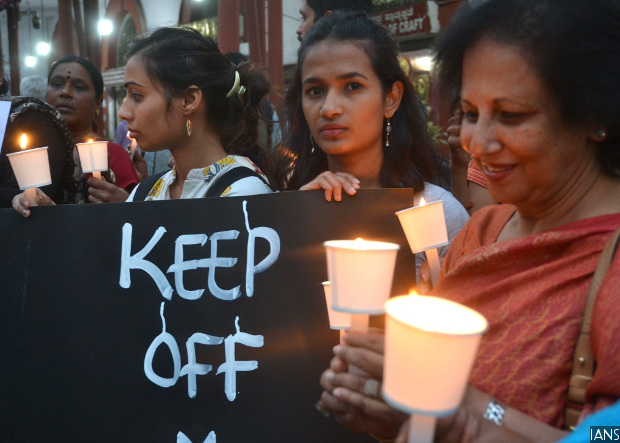
People stage a demonstration against molestation of women in Bengaluru. Of the 4,241 complaints of molestation filed between 2006 and 2016 in Bengaluru, the conviction rate was 0.37% (16 cases).
The number of complaints under under Section 354 of the Indian Penal Code (assault to outrage the modesty of a woman) rose from 150 in 2006 to 776 in 2016. Experts say this could be because of an increase in the number of incidents as well as greater willingness on the part of women to register complaints.
The data were compiled by Bengaluru Commissioner of Police for the Karnataka Legislature Committee on Prevention of Violence and Sexual Abuse of Women and Children. This data project could serve as a template for how police in India’s burgeoning cities can make sense of their crime data in public interest.
Section 354 includes sexual harassment (354A), use of criminal force with intent to disrobe (354B), voyeurism (354C) and stalking (354D). The data obtained from the Bengaluru commissionerate group these offences under ‘molestation’.
Bengaluru–India’s IT capital–entered 2017 with reports of mass molestation of women in the city’s bustling MG Road and Brigade Road areas despite deployment of thousands of police personnel. The reports came as a shock to Bengaluru residents and for people across the country who believed the city to be safe for women.
Bengaluru’s conviction rate for molestation is indicative of the larger problem nationwide. “Few women who survive sexual assault have a pathway to justice and recovery from their horror,” said Meenakshi Ganguly, South Asia director at Human Rights Watch, an advocacy, in a statement issued after the Supreme Court upheld on May 4, 2017, the death sentence to four men who were part of the gang that raped in 2012 a Delhi physiotherapy student now known as Nirbhaya.
‘A stranger tried to kiss me in front of dozens of people! No one came to my help’
Kavya S, 24, was on her way to work when a stranger attacked her in public. “It was around 8:30 am in broad daylight, I was walking to work in Kormangala when a stranger grabbed me and tried to kiss me in front of dozens of people! No one came to my help but when I screamed and kicked him, they yelled at me and asked me to leave him,” she recounted.
Kavya immediately filed a complaint with the local police under Section 354, but did not pursue the case once she shifted her residence. “Police officials were very cooperative,” she recalled, “but I couldn’t follow up on the case as I had to shift my house and job.”
Cases such as Kavya’s are increasingly common, although Bengaluru police say they are working to improve the law and order situation for women. “We have identified areas that are hotspots for crimes against women and launched 51 Pink Hoysalas (mobile units) that are dedicated to women. We have also launched an app called ‘Suraksha’ last week (April second week). Anyone can inform us if they are in danger and we would reach the spot in 10 minutes,” S Ravi, Additional Commissioner of Police (Crime), told IndiaSpend.
Bengaluru’s criminal justice system is marred by delays, as with the rest of India’s (discussed here, here and here). Of the 4,241 molestation cases reported, 2,248 (53%) are pending trial, according to data from the Bengaluru City Police Commissionerate.
Among the cases tried, there have been 523 acquittals (12%) and 16 convictions (0.37%)–even as the police consider 97% of cases to be “true” after investigation. A decade earlier, the figure for “true” cases was 84%, indicating more open-mindedness in dealing with women’s complaints as well as better effort on the police’s part to investigate.
However, lawyers and activists believe the large proportion of acquittals are due to shoddy investigation. “In most crime against women cases, especially the molestation cases, the accused get acquitted or the cases are kept pending for years,” Pramila Nesargi, a noted lawyer and a well-known women’s rights activist, said. “The main reason for all these is the reluctance of police in getting proper evidence.” She said the government needs to appoint well-trained investigative officers.
Source: Bengaluru City Police Commissionerate Note: Figures are for cases under Section 354 of the Indian Penal Code. Totals may not tally as some cases may be under investigation.
The government needs to think from women’s perspective, Rani Shetty, coordinator of Vanitha Sahayavani, a government agency that provides rescue and support services for women in distress, and operates from the office of the Commissioner of Police, told IndiaSpend. “I have met many victims of molestation whose cases have been pending for years. The legal system needs to be strong, there should be fast-track judgment for any cases related to women,” she said.
As per law, the police have to file a chargesheet within 90 days of a crime being reported. “[I]n most cases, they fail to do so, and this in turn affects the court proceedings,” Ugrappa VS, a member of the Karnataka Legislative Council and chairperson of the expert committee to prevent crimes against women and children, told IndiaSpend.
At the same time, public prosecutors, who are responsible for presenting the case in court, are overworked. “The main reason for cases pending for years is because public prosecutors are given too many cases,” public prosecutor SN Hiremane, who has been in the field for over 20 years, said. “I myself have 450 molestation cases pending so far.”
Judicial delays, which make it easy for the accused to get bail, can be extremely dangerous for victims of sexual assault. In one case, a grade IX student was molested by her 25-year-old neighbour. Her family filed a Section 354 case at the Peenya police station and the accused was arrested immediately. On his release on bail within four months, he kidnapped the girl and raped her. He is back in jail now.
“What happened to me shouldn’t happen to any girl. He has to be punished,” the girl told IndiaSpend.
“If the police had taken strict action on his first crime, they could have prevented the second incident. Now he is in jail but he might do the same thing when he comes out,” her father said.
The city’s burgeoning population, with a massive influx of immigrants, could be one of the factors behind molestation cases such as the one that took place on New Year’s eve, former Lokayukta Justice (Retd) N Santosh Hegde said speaking at a private college in the city in March 2017. The 2011 census had pegged Bangalore city’s population at 84.4 lakh. By 2016, it had risen to more than 1.15 crore.
“They come alone. They stay alone. And the manly desire is always there,” he said at the discussion about immigrants, adding that the benefit of anonymity in an overcrowded city apparently emboldens them to pursue their pervert desires. He also cited a lack of morals as one of the reasons.
She said cases of sexual violence against women have their root in the society’s mindset towards gender and it depends on how boys and girls are raised in home and school, Monisha Srichand, noted psychologist and Director of TalkItOver Counselling Services, explained.
“From childhood, boys are taught they are better, superior to girls, while the latter are seen as sex objects. They see it all around them in the media, movies… There’s a lot of gender inequality and as men see women walking around freely, being independent, working outside the house, being out late, they subconsciously want to assert their power over her,” she added.
(Mani is a Bengaluru-based independent journalist and a member of 101Reporters.com, a pan-India network of grassroots reporters.)
Those who buy and sell milch cows and oxen for farm work say cow vigilantes have made it impossible for them to conduct their business.
Cow vigilantism has been portrayed as a blowback against the Muslim community’s insistence on consuming beef, unmindful of the fact that slaughtering cows hurts Hindus who worship the animal. This depiction has framed the cow as an incendiary issue between Hindus and Muslims, an irreconcilable clash of cultures, so to speak.
This narrative was challenged during a three-day dharna that civil society groups and a clutch of political parties organised in Jaipur from April 24 to protest the killing of Pehlu Khan, a dairy farmer who was waylaid in Alwar on April 1 while transporting milch cattle to his farm.
“We insisted it was not a Muslim issue,” said Kavita Srivastava, president, Rajasthan People’s Union for Civil Liberties, who was one of the organisers of the demonstration. “Lynching is unacceptable because it does away with the rule of law.”
Srivastava said the dharna was also a protest against criminalising the victim. “The Rajasthan home minister [Gulab Chand Kataria] continues to defend those who killed Pehlu Khan,” she said. “They are gau goondas, not gau rakshaks.”
It is very likely that some readers will dismiss Srivastava’s remark as typical of the irreverence Left-liberal activists have for religion and its symbols. But Srivastava’s sentiment is shared by many Hindu farmers, dairy owners and traders who are simmering with anger against thugs masquerading as cow protectors.
Their anger is reflected in six separate clips made from a lengthy video that a journalist friend sent to this writer. He filmed it at the cattle market held every week in Jaipur. The footage was shot on April 8. The journalist-friend’s questions to a cattle trader triggered a passionate debate in which both Hindus and Muslims participated, belying the claims that the two communities have been divided because of their contrarian sentiments on the cow.
Each of the clips in the story is followed by a synopsis for those who do not understand Hindi.
‘One-way export of cattle’
In the first clip, a man in a white shirt introduces himself as Kailash, a dairy farmer who has been in the cattle trade for 35 years. He says vehicles from Rajasthan ferry milch cows to Uttar Pradesh, Madhya Pradesh and Gujarat, but always return empty. Are they being milked? “We do not know,” he declares, suggesting they might have been slaughtered.
The export of cattle from Rajasthan has had three consequences, Kailash claims. The price of cows has shot up, their population in Rajasthan has dwindled, their rampant sale has deprived farmers’ children of milk.
A vociferous rebuttal
The second video shows Kailash’s comments have enraged those around him. They accuse him of lying. Different voices are heard, though the religious identity of speakers is not always obvious. They counter Kailash on each and every point. A voice claims that Rajasthani farmers breed cows, which are counted as among the best in the country. Why breed cows in the absence of an organised dairy farming in the state, counters Kailash, who is again rebutted by many voices clamouring simultaneously.
The clip ends with a man in a checked shirt asking the videographer to follow him.
A cow worth Rs 1 lakh
In the third clip, the man in the checked shirt, bristling with rage, says he is Nemichand, a son of a Jat. He is shown standing next to a cow, which he says is worth Rs 1 lakh and gives 40 litres of milk daily. He challenges those who accuse farmers of selling cows for slaughter to come before them instead of waylaying them on roads. “Two cases have been filed against me,” Nemichand says.
‘Take care of plastic-eating cows first’
In this video, Nemichand punctures some of the pet theories of cow protectionists. Referring to the Rs 1-lakh cow he had shown to the videographer, he and others say it makes no sense to sell it for slaughter as its meat and other parts, such as skin, would fetch the buyer between Rs 5,000-Rs 6,000 and Rs 8,000-Rs 10,000. Nemichand hurls expletives at gau rakshaks for the sheer irrationality of their accusation – and violent actions.
Others demand to know why gau rakshaks do not look after cows foraging in rubbish heaps, which consume plastic and die. Nemichand says that if Uttar Pradesh Chief Minister Adityanath and Prime Minister Narendra Modi pay Rs 20 lakh to each dairy owner, they would stop trading in cattle. Later in the clip, Nemichand asks the videographer to send pictures of abandoned cows to Modi and Adityanath, saying if they arrange feed and water for them, he and others would stop their dhanda (business).
The people around him break into a chant: “Hum dhanda nahin karegein.” We will not do this business.
‘Just do the math’
The fifth clip is of Narendra Bhatore from Ujjain, Madhya Pradesh, who comes to Rajasthan to buy cows. He testifies to Shiv Sainiks harassing him and others in the trade, and says he cannot kill the cow because Hindu religion prohibits it, apart from the fact that it makes little economic sense to buy an animal for Rs 50,000 only to slaughter it.
Earlier, 20 vehicles would come from Madhya Pradesh to cart away cattle from Rajasthan. The number is now down to just two. Narendra describes his scary encounter with the cow protectionists in Deoli, Rajasthan, in 2016. His animals were seized, and the court case continues. “They beat me very badly,” says Narendra. “Had the police not arrived, I would have died.”
‘Can’t transport holy cows’
In this sixth video, Azharuddin, who has come from Mathura in Uttar Pradesh to Jaipur, says he buys animals for mahatmas, or holy men, who run ashrams. They provide him with letters and he secures the requisite permits before ferrying the cattle from Jaipur. Yet the Bajrang Dal activists accost him, impervious to his pleas that he purchases cows on behalf of mahatmas who worship them.
Azharuddin says he has been attacked twice, once in Bharatpur, near Agra, where his two vehicles with 15 cows and calves were seized. Each animal cost him Rs 1 lakh to Rs 1.25 lakh. A case was filed against him. The cows were sent to a gaushala. Ultimately, Azharuddin won the case, but nine of his animals in the gaushala had perished by then.
Azharuddin claims that the attacks on traders and transporters of cattle began two years ago. “It has been particularly bad since Yogi Adityanath became chief minister,” he says. “This is because he speaks in a partisan language.”
These videos testify to gau rakshaks not even sparing Hindu farmers and traders ferrying cows purchased legitimately from cattle marts. It is, therefore, bewildering why the plight of Hindu victims of cow vigilantism has not been reported in the national media. Is it because a story on cow vigilantism is considered worthy only when it victimises a Muslim, or there is a dead person to mourn? Are such heartfelt narratives exploited to bring about a polarisation between Hindus and Muslims?
‘Safer to breed goats’
Hindu farmers and traders have been attacked not only on highways, too far away from their homes for anyone to come to their rescue, but also near their farms located in the vicinity of where they stay.
Take Rajinder Singh Bhati, an army clerk who retired at the age of 36, in 2006. He decided to enter into the dairy sector, not least because he was deeply interested in cross breeding cows. His farm, Tanotrai, is just a 40-minute drive from Jaipur, and his stock comprised 70 heads. Until 2014, he supplied 450 litres of milk daily to Jaipur.
Typically, Bhati would transport cows that were not in lactation from Tanotrai to other farms he has elsewhere. These serve as pastures for them. “It cuts down the cost of production,” Bhati explained. With Tanotrai as his base, he hops from one farm to another through the year.
Before embarking on such a trip one day in September 2014, he instructed his most trusted farmhand to transport 10 cows from Tanotrai to another farm of his.
In his absence, the cows were loaded onto a vehicle and driven out.
But just 2 km later, members of the Gau Rakshak Seva Samiti swooped down upon Bhati’s vehicle. They claimed that the cows were being taken to a slaughterhouse. Bhati said that the villagers intervened only because his brother had been the panchayat head. The police seized the truck and the farmhand spent a night in the lock-up.
“I returned to Tanotrai, showed the authorities the relevant documents I possessed, and told them I had served in the army,” Bhati recalled. “My man was released as were the cows.”
But life was not to be the same for Bhatti thereafter. The farmhand was so frightened he left Bhati’s service. “I was completely dependent on that man,” said Bhati. “You need honest people in the dairy business because it is so easy to adulterate milk. I just couldn’t get a replacement for him.”
He could not get a replacement because the farm’s reputation was tarnished. It was made out as if Bhati bred cows to ultimately sell them to slaughterhouses.
His interest in cows did not measure to the risk of incurring the wrath of gau rakshaks. “I sold 60 of them, keeping 10 for my family’s need for milk, and I breed goats now,” Bhati said with a chuckle.
Photo credit: Wikimedia Commons.
Bhati might have had the resources to switch from breeding cows to goats, but such options are not available to most. He says what is common knowledge: that most farmers rear two or three cows to supplement their income from agriculture. This is more so in Rajasthan because it does not have an elaborate irrigation network so its farmers are vulnerable to the vagaries of monsoon rains.
“Farmers sell those cows which stop giving milk and use the proceeds to partially finance a new cow,” said Bhati. “But with gau rakshaks around, who would want to risk rearing cows?”
This is why dairy farmers, big and small, are dismayed, and angry, at the havoc gau rakshaks have wreaked on the rural economy. But they have not been able to unite against their tormentors or mount pressure on the state government to provide protection to them. “It is difficult to unite a person who has two cows with one who has 20 or 70 or 100,” Bhati said.
The Modi effect
So controversial has the cattle trade become that even the authorities are reluctant to issue relevant documents to those who purchase cattle from markets. This reluctance took an ironic twist for Shailendra Singh, who is no ordinary man. As Deputy Superintendent of Police who headed Uttar Pradesh’s Special Task Force for Poorvanchal in the early 2000s, Singh took on politician-dons Brijesh Singh and Mukhtar Ansari in Varanasi.
In 2004, he apprehended an army deserter who was going to deliver a light machine gun to Ansari, which was when he came under tremendous pressure from Mulayam Singh Yadav, then the Uttar Pradesh chief minister. In a huff, Singh resigned from the police service, and joined the Anna movement against corruption. He then joined the Congress, fought on its tickets from Chandauli in Uttar Pradesh in the 2009 Lok Sabha elections, and after meeting Modi twice, entered the Bharatiya Janata Party. Singh was in charge of Modi’s Varanasi war room during the 2014 Lok Sabha elections.
At the end of April, Singh bought cows in Bharatpur, Rajasthan, and sought certificates from the district authorities vouching for the legitimacy of his purchase. But the authorities declined his request. “What am I going to show gau rakshaks?” Singh asked them.
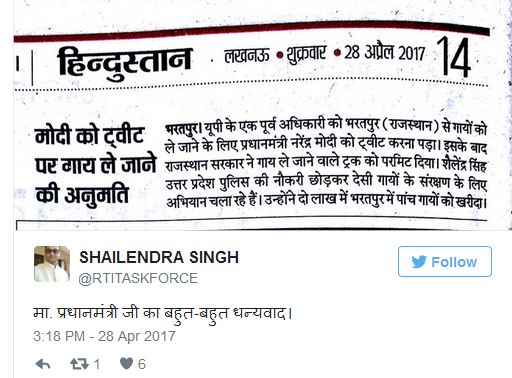
Since the authorities did not relent, an angry Singh tweeted to Modi’s twitter handle about his plight. It prompted the Prime Minister’s Office to intervene – the relevant documents were handed over to him.
Singh thanked Modi through this tweet:
“I was able to reach Modi,” Singh said. “But the aam aadmi can’t. If we can’t breed cows, improve our stock or even rear them, the rural economy can’t be given a boost.”
Oxen trade in trouble too
But it is not just about extortion and violence, for once the cattle are seized, they are sent to gaushalas until their buyers are able to secure release orders from courts. “They just don’t look after cows there,” said Parash Ram Banjara, convener of the Banjara Vikas Shakti Sangathan, who has been campaigning against cow vigilantism. “The buyers have to provide food and water and milk to them. It adds to their cost. Some just decide to abandon them.”
In October, Banjara organised a public protest against Bajrang Dal activists who abducted a member of the Banjara community and his two sons along with the six oxen they had purchased from Rajsamand district to sell them in South Rajasthan. (His interview can be read here).
“We Banjaras trade in oxen, not in cows,” said Banjara. “These oxen are used to plough the rocky terrain of South Rajasthan. Trading oxen is our identity, our right. And, mind you, we too are Hindus. But the vigilantes have turned the cow into an emotional issue for their dubious ends.”
It is palpable that cow vigilantism has many worried and they aren’t just Muslims. Some fear that cow vigilantism is bound to adversely affect milk production in the country.
“This is because if farmers don’t have buyers to whom they can sell cows which have stopped yielding milk, they will be saddled with providing for animals no longer useful to them,” said Badri Prasad, general secretary, Rajasthan Kisan Union. Since farmers struggle to feed their own families, they cannot be expected to provide fodder to animals no longer useful to them.
“Another few years of cow vigilantism and milk production will be badly hit,” Prasad predicted. He said the other inimical consequence of cow vigilantism is that it will reduce the participation of women in economic activities. It is the women who feed and take care of the one or two cows that small farmers keep to supplement their income from agriculture.
(Photo credit: Reuters).
Why then are farmers not raising their voices against cow vigilantism? Hasn’t their silence enabled Hindutva forces in the country to spin the cow into a Hindu-Muslim issue?
Prasad says they are silent because of sociological changes in villages. “The younger generation wants to escape the non-profitable agriculture sector and migrate to cities,” he said. “The older generation is biding its time – they are reconciled to the inevitable.”
Inevitable? Prasad answers, “The land has been subdivided to the point of agriculture providing diminishing returns. Cow vigilantism will further hit earnings. People will start to sell their land and corporates will enter farming. Today’s farmers will become their employees.”
This might sound like a conspiracy theory floated by those who find it difficult to believe that people could kill human beings in the name of the holy cow, and consequently search for a hidden agenda. But given that gau rakshaks have not dithered from targeting the Hindu farmer who has over the centuries nurtured and worshipped the cow, it does seem a bit surprising why a Hindutva dispensation, menacing in its rhetoric and muscular in its responses, has not curbed their activities.
Ajaz Ashraf is a journalist in Delhi. His novel, The Hour Before Dawn, has as its backdrop the demolition of the Babri Masjid.
It is appalling to see how every time I speak about the violence unleashed by RSS or VHP, I am told to leave for Pakistan.
Representational image. Photo credit: Patheos
My life has revolved around the concept of God. I have been a Muslim, a theist, an agnostic and an atheist in all types of phases of my life. I am sure, I am still just growing and my perceptions will mature as I grow.
My Muslim identity slowly faded when I picked Dawkins and Ayaan Hirsi Ali in my late teens. To put it simply I was a perpetually angry Muslim. Angry at Islam, angry at Wahabism, angry at imposed patriarchy in Islam. I believed religion was so bad for the world, so unscientific.
And so I wrote and I discussed with my fellow Hindu friends. They opened their hearts out. A lot of them told me how Muslims were always cruel and misogynistic. And they told me how I was different to see the truth. I felt a sense of moral superiority, I felt I was so unbiased and rational that I could see faults in my own religion.
A bookworm that I was, I read from Deepak Chopra to Reza Aslan, from Sam Harris to Stephen Hawkings, from Carl Sagan to Joseph Goldstein, from Plato to Nietzsche. I tried understanding paganism, Sufism, Spiritualism, Buddhism everything that came my way.I was surprised to find how I missed all the beauty the Sufis had to offer to the world, I found their philosophy strikingly similar to what the Buddha taught, for which I have immense respect.
And every time I saw a search for the truth in the writings of a physicist or a philosopher or a saint or Sufi, I only saw humility in the awe of whatever it is that has made us. Call it God, call it entropy driving random bits of matter to generate complexity, or just complex biological matter dancing to the tunes of nature’s laws, but to me, this relationship is something very personal and to associate a person’s identity with mere religion is outright ridiculous.
Some time back, I met a charismatic Muslim woman. She wore a hijab and she was studying medicine. She was highly intellectual and in her conversation, open to concepts I hadn’t even heard of. I was impressed and loved the conversation with her. She also told me no one ever forced the hijab on her and that it was her own choice, she felt closer to God that way.
And at that moment, I saw a hypocrite in me. I remembered mocking hijab-wearing women and considering them backward. I thought to myself, maybe, what is just a piece of cloth to me, maybe is an identity to her, maybe she has an attachment to it, just like one may have with a ring they wear. This is not to deny the horrific patriarchal history associated with forced covering of bodies of women, but why do we forget every human is different and everyone perceives things differently.
Why should we just presume that how we imagine a person should dress up is the only appropriate way? I want to emphasize here I do not support the forceful imposition of any kinds of clothing, and to me, the concept of modesty is different as well. But I am writing this story to emphasize that there is a latent hate culture associated with hijab which is very explicitly visible today. Many women who identify themselves as feminists mock hijabis and feel a sense of moral superiority. I want to bring forth two points to explain why it’s futile and hypocritical:
1. The message of feminism in this respect is ‘Stop dictating me what to wear.’ And it should stand for hijab as well. But what if those who wear it do so as their choice?
2. And for those who are forced to wear, when you mock a burkha clad woman, you are speaking the language of their oppressor. Stand for the true cause of feminism if you want to, which is solidarity to fellow women. Telling her that she is powerless will ultimately increase the feeling of alienation they have towards us. If you want to help her, try empowering her, help her in ways that will actually improve her condition instead of passing smirks.
Recent events in my country have opened my eyes. The same friends who applauded me when I wrote against the burkha, suddenly turned hostile when I spoke for Akhlaq. Wasn’t it hideous my friends? Shouldn’t our souls have shuddered at the thought of a man being killed by a mob for the suspicion of the type of meat he has in his fridge? Shouldn’t we weep at the applause the killers were receiving?
And there have been numerous such incidents that have followed. And all we get to hear by way of response is, ‘Media is just sensationalizing it!’ Really? And you can call yourself a human after saying that? We are talking about a loss of life! And what is more baffling is the ‘whataboutery’ that follows, which goes like this – but what about the bombs ISIS threw there in that country that day?’
The self-proclaimed nationalists unapologetically defended these violent acts by saying how the liberal Muslims are themselves responsible for their plight because they don’t criticize the extremists enough? Really? Do you know it’s actually Muslims who are most severely affected by Islamic terrorism? And it is ridiculous to expect Muslims to behave as a united, homogenous entity. We would never think of referring to Christians or Hindus in a similar way because we are aware that the catch-all description is virtually meaningless.
And it is appalling to see how every time I speak about the violence unleashed by RSS or VHP, I am told to royally leave for Pakistan. I am told ‘so what they are not as bad as ISIS’. I mean, really? Is that is your benchmark of morality? Won’t you speak up until they really become ISIS? Or you secretly want your mini ISIS here?
I dug up more and more about religions and their history. I was surprised to see how many of my Hindu friends don’t even know that what’s being sold to them in the name of Hinduism is actually ‘Hindutva’, which is the toxic equivalent of Nazism to say the least. Hinduism, on the other hand, I found to be a beautiful religion. I was dumbstruck at the intellectual complexity the Gita has to offer. People like Carl Jung and Aldous Huxley have expressed their utmost respect for Gita.
I want to ask those saffron clad rioters: ‘Do you even know what you are fighting for? You are no different from the jihadis you hate.The anger that has been sold to you is poison for you only.’ Remember what Krishna said, “Delusion arises from anger. The mind is bewildered by delusion. The reasoning is destroyed when the mind is bewildered. One falls down from the right path when reasoning is destroyed.”
‘I want to tell those Muslim hating Indians, ‘You don’t love India, you don’t even understand a fragment of the plurality it is known for, you are not Hindus, you are just haters, ego stricken Muslim haters.’ Don’t forget that Indian Independence struggle was a plural project. Look at where we are standing today after 70 years of independence, open up a news channel and listen to the issues our country is investing all the time in the world to.
Are our issues really Ram Mandir and cow protection? Is this what our country needs? Stop feeding your egos and wake up! Our power lies in our unity not in that petty sense of victory that you feel after shouting on someone following a different faith. Remember ‘together we stand, divided we fall’
Sarah Ather is an architect and freelance writer based in New Delhi
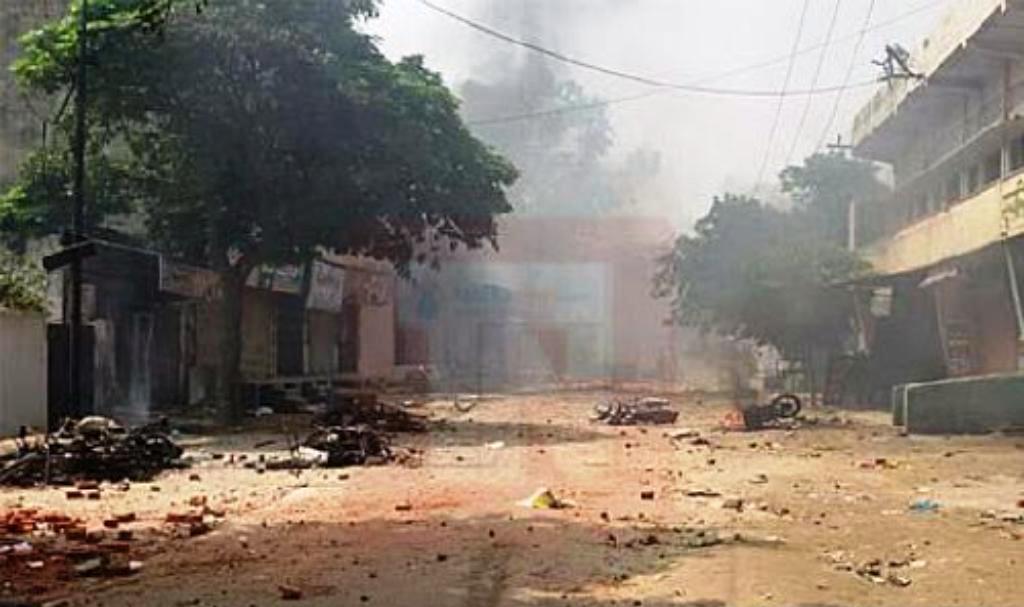
Saharanpur district of western UP remains tense after Thakurs of the area tried to take a procession parade on Maharana Pratap in the region.
Photos: Two Circles.
Violence started after the Thakur community of Shimlana village took out a procession march to commemorate the birth anniversary of Maharana Pratap, and it moved towards a Dalit dominated village Shabbirpur.
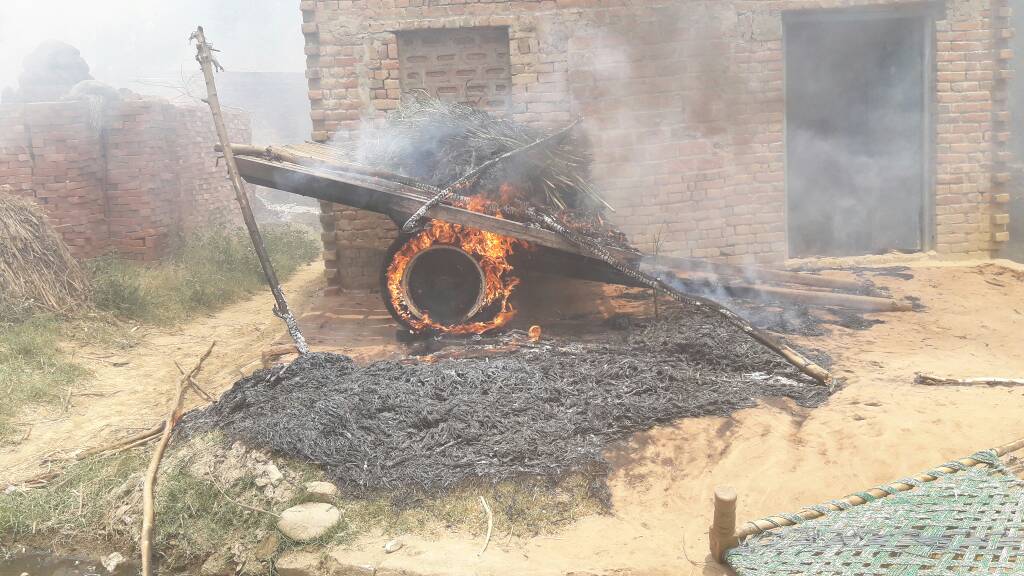
At Shabbirpur, residents raised objection and as a result of that a verbal spat started between the two groups. The whole argument led to spark of violence which was supported by stone pelting and burning of private as well as public properties. After a Dalit woman was hit badly by the stone, the Dalit community also started stone pelting. Things turned out more ugly and Thakurs allegedly broke Ravidas temple and a statue of Ambedkar.
During the altercation, a stone hit 25-year-old Sumit, s/o Dharmpal, on the head and he was declared dead when taken to the hospital.
When the news of the death reached the clash site, members of Thakur community set ablaze 25 houses of the Dalit community.
Moreover, the police was also targeted this time the mob. A fire engine was broke down and three police vehicles were set on fire.
Chaman Singh Chavda, CO Deoband, also got injured when he intervened in the matter. Violence came to a halt after District Magistrate NP Singh and SSP Subhash Dubey reached the spot with security forces from adjoining districts.SSP Dubey said, “The situation is tense but in control. To maintain the peace is our priority.”
Earlier on April 20, situation in Saharanpur got communally tense when Saharanpur MP from BJP Ram Lakhan Pal Sharma tried to take out a procession March in remembrance of Dr. BR Ambedkar without permission from the government.
Sharma’s brother Raghav Lakhanpal Sharma started beating police personnel while Ram Lakhanpal Sharma started shouting on police to shoot Muslims. FIR was lodged against both of them.