ADVANCE QUESTIONS TO INDIA (FIRST BATCH) UPR Process 2017
112 Countries will Pose Questions to India, the World's Largest Democracy
ADVANCE QUESTIONS TO INDIA (FIRST BATCH)
SLOVENIA
Please provide information on envisaged or implemented monitoring mechanisms that oversee the implementation of laws dealing with sexual violence against women and children.
We welcome India's efforts to combat human trafficking, especially its commitment to better protect children and the implementation of training programmes for law enforcement officials and judges. Please provide further information on bilateral cooperation for prevention of human trafficking between countries, in particular the results thereof.
SWEDEN
What measures are being taken by the Government of India to ratify the ILO Conventions no. 138 and 182 concerning child labour?
Same-sex sexual relations are prohibited by the Indian Penal Code. Civil society organizations have reported discrimination of LGBT persons. What measures is the Government of India taking to ensure full equality before the law of all individuals regardless of their sexual orientation or gender identity?
Safeguarding a woman’s right to exercise informed consent in making reproductive health decisions is fundamental to protecting her sexual and reproductive health and rights. Women have the right to access safe, effective, affordable and acceptable contraceptive methods of their choice. Echoing the requests made by several U.N. special procedures in their 2015 communication to India, what steps is the Government of India taking to prevent coercive, unsafe, and abusive sterilization and create greater accountability for these practices, including to ensure free and full consent prior to conducting the procedure and compliance with international and national standards?
SWITZERLAND
How does the Government of India ensure that anyone who faces the death penalty has access to a legal counsel of the defendant's choice during the entire trial?
While the process to ratify the Convention against Torture and Other Cruel, Inhuman or Degrading Treatment or Punishment is under way, has the Government of India already implemented measures in order to adapt its national legislation accordingly?
The Indian Constitution prohibits discrimination on grounds of religion, race, caste, sex or place of birth. What steps are being taken by the Government of India to hold accountable public and police officials found complicit in shielding criminals involved in intimidating and unleashing violence against minorities and those who advocate religious hatred?
Will the Government of India be willing to repeal its reservations regarding articles 5 (a) and 16 (1) of the Convention on the Elimination of All Forms of Discrimination against Women? If not, how does the Government of India ensure that these reservations do not impede the effective economic empowerment of women?
Indian Courts recognize the right to water and to sanitation as legally enforceable human rights. What steps are being taken by the Government of India to implement them at the national level?
UNITED KINGDOM OF GREAT BRITAIN AND NORTHERN IRELAND
What steps is the government of India taking to improve prison conditions in order to ensure the rights and dignity of all those deprived of their liberty?
What other steps could the government of India take to promote and protect the rights of persons belonging to minority groups, as enshrined in India’s constitution?
What steps is the government of India taking to ensure swift adoption of the Prevention of Communal and Targeted Violence Bill?
The second round of the French presidential election is not about voting for the lesser of two evils. It’s about bringing progressives together to vote against evil itself.
It is perhaps the single-most important failure of progressives across Europe since the outbreak of the 2008 financial crisis and Brussels’ blundering crush of the Athens Spring in 2015 – an utter inability to come together and present a solid front, and a sensible, non-sectarian agenda, against the xenophobic and toxic nationalistic forces tearing apart the European Union.
While the urgency to once and for all overcome such a failure to unite should have become painfully obvious after the Brexit and Trump experiences of 2016, the latest wakeup call to European progressives after the first round of the French presidential election may also go ignored along with another missed opportunity for progressives to come together.
Regardless, we must try.
When Emmanuel Macron made it to the second round of the French presidential election last month, banning Marine Le Pen from occupying the Élysée Palace for the present time, the EU breathed a sigh of relief with our European representatives and various heads of state echoing their euphoria. The threat to the Union had, once more, been averted. But sadly this is as myopic as Brussels can be.
Macron may very well prevent the Front National’s rise to power next Sunday, but by what margin and for how long? The epic demise of Macron’s former Socialist Party has left its electorate fractured among him, Benoît Hamon and Jean-Luc Mélenchon, so the young former Minister of Economy and maverick investment banker is doomed to endure an extremely weak presidency after the legislative race in June. This is particularly dangerous if there is no clear alternative in sight.
Despite his fourth-place finish, Mélenchon was the clear winner on the left political spectrum, and yet he lost a golden opportunity to galvanise his supporters, particularly the disenfranchised youth, and help defeat Le Pen’s hopes for victory. It is incomprehensible how the France Insoumise candidate failed to send a strong message to the same demographics he shares with the fascist leader regarding the side of history on which young French voters should position themselves.
Equally incomprehensible is the attitude of Podemos, Mélenchon’s ‘comrades’ south of the Pyrenees, with some of its leadership going so far as to make calls for abstaining from next Sunday’s vote. Petty party-politics, dogmatism and tactical manoeuvring is not something European democrats can afford at this moment in time.
Looking the other way is not an option. Washing our hands, promoting an empty ballot and delivering ambivalent rhetoric against a clear enemy of fundamental human rights is tantamount to becoming an accomplice to the return to the post-modern 1930s DiEM25 has been warning about since its launch a little over a year ago.
There is still time to see off this evil in our midst, and then a second step immediately becomes equally imperative: organising and campaigning in favour of a broad alliance of progressive internationalists in the June legislative elections.
The day after the election is when we must all regroup and, once and for all, come together to combat those policies which are eroding our Union and turning our young over to the likes of Le Pen, Orbán and Wilders. Thus, on May 8, we must assume our responsibility to unite in the broadest possible alliance and form a sensible political opposition to such policies not only at the Assemblée Nationale, but also in parliaments and municipalities across the EU. It is our time to step up, so that a progressive agenda for Europe can be turned into policy and the EU into a true common space for humanism, prosperity and solidarity.
If Europe continues to disintegrate and those who want to destroy it manage to dictate our politics, and even the discourse of the emerging progressive forces, history will judge us all again. Severely. French progressives do not have to choose between the lesser of two evils on May 7. For French democrats and progressives, next Sunday’s rendezvous at the ballot has a clear two-fold purpose: to vote against evil itself and to come together.
Luis Martín is a political scientist and journalist. He writes about International Relations, Economics and the Eurozone. He is currently Communications Coordinator of the Democracy in Europe Movement 2025
Can the practice of unilateral divorce among some Muslims be confronted without looking at societal norms that make women stay in abusive marriages?
Photos: Courtesy Scroll.
On May 11, more than a year after Shayara Bano sought a ban on the Muslim practice of triple talaq, drawing national and political attention to the issue, the Supreme Court bench will finally begin hearing petitions arguing for and against this form of instantaneous, unilateral divorce that can be pronounced only by men.
The movement against triple talaq was started by Muslim women’s organisations and women who felt wronged by the practice. But during the course of the year, politicians, clerics and the All India Muslim Personal Law Board, an NGO that claims to represent the community, have vociferously taken over the debate, in the name of protecting oppressed Muslim women.
But how are individual Muslim women – those who have received triple talaq – engaging with this high-pitched debate? Opponents of triple talaq tend to club all Muslim women as victims trapped by the patriarchy of Muslim personal laws. Defenders of triple talaq emphasise their Muslim identities while declaring, for instance, that 2.7 crore Muslim women do not want changes to Sharia law.
But is it fair to categorise all Muslim women as a homogenous entity? Scroll.in spoke to three women in Mumbai who had been affected by triple talaq and found that their perspectives on the divorce mechanism are varied, complex and often problematic.
All three women had arranged marriages and subsequently experienced extreme forms of domestic violence, but none of them sought divorce themselves. Their stories, in fact, are no different from those of many other domestic violence survivors in India and raise a crucial question: should one look at triple talaq without simultaneously confronting the deeper-rooted problems of gender-based violence and the societal attitudes that make women stay in abusive marriages?
‘Who made the Personal Law Board anyway?’
On the night of her wedding in September 2014, Gausiya Ahmed’s in-laws snatched away her mehr, the money paid to a Muslim bride by the groom. The dowry harassment began soon after, and on multiple occasions, Gausiya was almost beaten to death. Even though she was a Unani doctor, she was not allowed to work. She got pregnant, but the violence still didn’t stop.
“Throughout the pregnancy, they kept telling me that they would accept only a boy child,” said Gausiya, a petite 28-year-old from Bhiwandi, a town North of Mumbai. In August 2015, when Gausiya’s daughter was born, her husband stormed out of the hospital and never showed up again. Two months later, she received a divorce notice. “A lawyer came with a written notice saying ‘talaq’ three times, but I don’t accept this divorce,” she said. “It wasn’t even oral talaq, and anyway, how can he just wash his hands off his wife and child in one shot?”
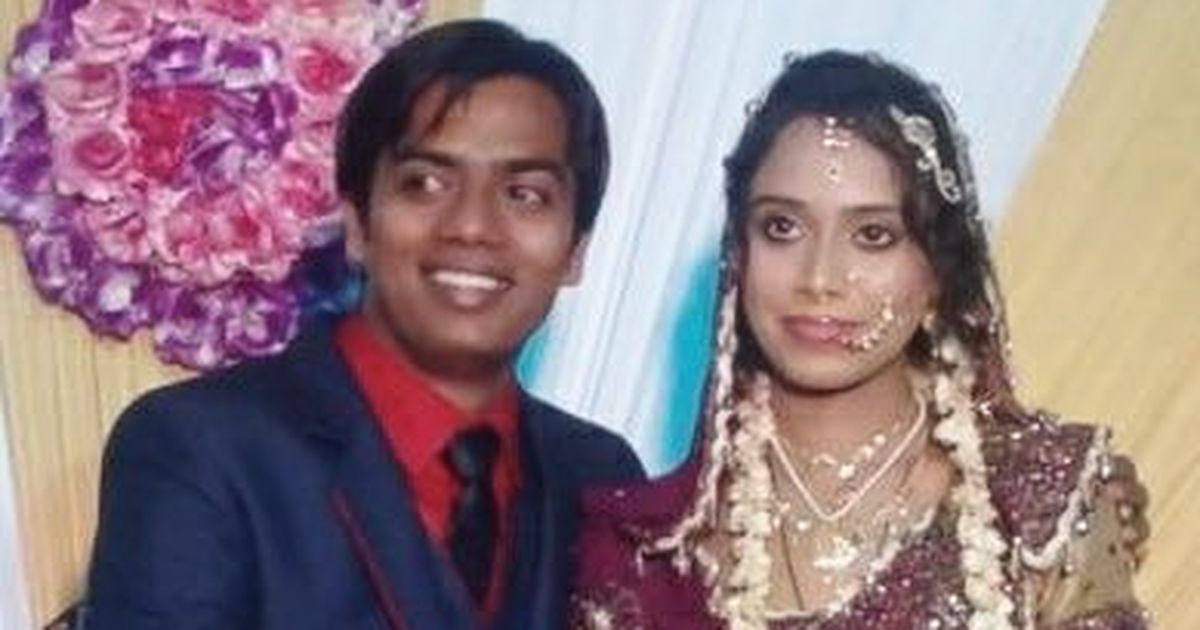
Gausiya Ahmed on her wedding day.
Gausiya consulted several priests and mullas, who gave conflicting opinions on whether her divorce was valid. Outraged, Gausiya approached the police. “But when the police tried to tell my husband that triple talaq is invalid, his family brought Sharia books to defend themselves,” she said. It took two weeks of persistence for the police to finally file domestic violence and dowry harassment complaints. Her cases are still pending 18 months later.
Meanwhile, her husband has also filed for a civil divorce at the Family Court. “This is absurd because we never had a civil marriage to begin with, but it shows that even he is not convinced that the triple talaq he gave me is valid,” said Gausiya.
It is this confusion within the Muslim community that has convinced Gausiya about the need to ban triple talaq. “The Sharia is being misused and if mullas themselves disagree about its interpretations, then we women need to be under Indian law, not Sharia law,” she said.
The litigation against triple talaq has brought out the firebrand in Gausiya and she now declares that she does not accept the All India Muslim Personal Law Board. “Half the Muslim population does not accept the Board anymore,” she said. “Who made them the Board anyway? They just incite people and they don’t want women to get religious education, because if women knew all of this, they would never marry.”
All Gausiya wants, she said, are her basic rights as a wife and mother. If her divorce is deemed valid, she wants her husband to pay her a sufficient maintenance. If the Supreme Court strikes down triple talaq, she wants him to give Gausiya and her daughter a roof over their heads. “I know it is risky, but I don’t even mind living with him again,” she said.
For now, Gausiya is financially dependent on her younger sister, an engineer. And none of her three sisters plan to get married till the Supreme Court is out with its final verdict on triple talaq. “After my experience, they don’t trust Muslim men anymore, so they are waiting for some legal safeguards,” said Gausiya, seething with anger once again. “All those Muslim women who support the Personal Law Board’s stand on triple talaq – are they going to step out and give me a roof over my head?”
‘I don’t want a divorce – I still love him’
In the 20 years since her wedding, Zeenat Sheikh has lost count of the number of times she almost committed suicide. Each time, the thought of her two daughters held her back, but Zeenat squarely blames her husband for fragile mental condition.
In 1997, at the age of 19, Zeenat had an arranged marriage with a businessman and moved to Mumbai from her hometown in Kerala. Her husband imposed endless restrictions on her – she was not allowed to step out of the house or keep the windows open and received a beating if she ever argued – but it took years of physical and emotional trauma for Zeenat to realise that things were terribly wrong with her marriage.
Zeenat Sheikh at her home in Mumbai. Photo: Aarefa Johari
“In the last six years, his violence grew particularly bad,” said Zeenat, now 40. “Then in 2014, he suddenly said, main tujhe talaq doonga – talaq, talaq, talaq.” I will divorce you, he had said. A distraught Zeenat rushed to a maulvi and was relieved to know she had been saved by grammar: the priest assured her that the talaq was invalid, since her husband had used the future tense.
After this episode, however, Zeenat’s condition worsened. “He now began to beat me like I wasn’t even human,” she said. In November 2016, after a particularly violent episode, Zeenat wrote a suicide note for her family and left the house. “But I couldn’t do it. I couldn’t kill myself, and instead spent three days on the streets or inside dargahs,” she said. “When they found me, the police tried to explain to me that this was my fault, that I should bear what happens at home. They told me to call the 103 helpline only if it happens again.”
Zeenat now found herself back home at the mercy of her husband. In December 2016, as he threw her to the ground and rained kicks on her, he carefully uttered triple talaq using the present tense. Three days later, he reaffirmed the oral divorce through a written talaqnama, which he sent to Zeenat on WhatsApp.
Enraged, Zeenat decided she had finally had enough. She yelled at the maulvi for writing the talaqnama without asking for her side of the story, went back to the police, secured an order restraining her husband from entering their house and is now doggedly pursuing a domestic violence case against him. It is the triple talaq, however, that worries Zeenat the most. At least two other maulvis – including one from the local office of the All India Muslim Personal Law Board – have assured her that her divorce is invalid, and she is praying for the Supreme Court to ban the practice.
Zeenat is clear that she doesn’t want a divorce, and lists three reasons for it. “First reason is that I love him,” she said. “My daughters don’t understand it, but I was married at 19 and have only lived with him. Besides, he cannot just pay me a little money and expect his responsibility to be over.” The third reason, Zeenat said, is society. “I don’t want people to point fingers at my girls and say that their mother got divorced after 20 years of marriage. It is a taboo.”
Despite this, Zeenat’s recent experience fighting the domestic violence case has made her see a downside to a ban on triple talaq. “I have met a Hindu woman who has been trying to get a divorce in court for years and she is actually envious of how quick our triple talaq is,” said Zeenat. “So maybe what we need is not an end to triple talaq, but some strong law that will make husbands scared of divorcing their wives.”
Zeenat Shaikh's talaqnama, sent to her by courrier.
‘Believe in Sharia more than any court’
Like many wives in abusive marriages, Sabina Khan put up with her husband’s violence for two reasons: she had been taught from childhood that such conflicts were normal between married couples, and she believed that one day, he would change for the better.
A 25-year-old tuition teacher from Dharavi, Mumbai, Sabina had an arranged marriage in 2011 and a daughter two years later. In the first four years of their marriage, Sabina grew increasingly wary of the regular beatings and frequent divorce threats. “He never worked, never looked after our daughter and wanted sex all the time,” said Sabina. “I would tell him I am not a machine, but he often forced himself on me.”
Two years ago, during a bitter fight, her husband uttered talaq three times. When Sabina’s father confronted him, he “begged for forgiveness and claimed he had said it by mistake”. But Sabina’s family believes in the validity of triple talaq and refused to accept his sudden remorse. After that, her husband left the city after that and has not showed up since.
“But his family now claims that I am lying, that he never gave me an oral divorce and that they will not let me marry again,” said Sabina, who tried to file a police complaint against her missing husband in October 2016, but claims she received no support from the police.
Sabina has visited several muftis who have assured her of the validity of the oral talaq. But the ongoing Supreme Court case makes her nervous: if triple talaq is outlawed, she says, she would be bound to her husband again. “I believe in Islam and what the Sharia says is more important to me than what any court says,” said Sabina. “But now all I want is written proof of my divorce through a talaqnama, so that I am free to move on.”
The female Jamaat activists were holding a clandestine meting on Sunday night
Police have detained 37 activists of Jamaat-e-Islami’s women wing, including its Narail unit chief, with a huge stockpile of Jihadi books from the town’s Bhouakhali area.
Narail Police Superintendent Rakibul Islam said they had been tipped off about a clandestine meeting of the female Jamaat members at the residence of the party’s district unit chief Ashak-e-Elahi on Sunday night.
He said they had found a large number of Jihadi books and donation receipts at the house.
“We detained 37 female activists, including their district unit leader Hosne Ara,” the SP added.
It is a matter of profound shame to admit that Indian governments of every shade and description have had a long history of collaboration with tyrants in Muslim majority countries.
PM Modi with Turkish President Ergodan
Everyone else’s father is in prison in Istanbul,
they want to hang everyone else’s son
in the middle of the road, in broad daylight
People there are willing to risk the gallows
so that everyone else’s son won’t be hanged
so that everyone else’s father won’t die
and bring home a loaf of bread and a kite.
People, good people,
Call out from the four corners of the world,
say stop it,
Don’t let the executioner tighten the rope
[ Nazim Hikmet, 1954 ]
Its best to stay as far away as possible when two m***a dons meet to talk business. Especially when their deep state security detail has a disturbing tendency to shoot first and ask questions after. Today, Delhi’s roads are emptier than usual, even on a Sunday. And I am reading Nazim Hikmet, because a thug is coming to town.
The Turkish president Recap Tayyip Erdogan’s motorcade will soon be speeding from Palam Airport. He is on his way to Delhi to meet Prime Minister Narendra Modi right now. They have a busy two days ahead, so many meetings, so many handshakes. Perhaps, later today or tomorrow, to save time, they could resort to the latest bit of political technology that they are both known to be found of – the hologram, to engineer at least one or two successfully ecstatic public appearances. Imagine two giant holograms – Modi and Erdogan, illuminating the growing darkness of a New Delhi night, hand in hand. What a sight that would be for sore neo-fascist Hindi-Turki eyes.
Today, in Turkey and in India, the head hangs low, the mind is running scared.
But seriously, the agenda is full. Back-to-back, man-to-man meetings – there’s so much to talk about, so many notes to compare. How to strike a deal about what needs to happen so that India can brown nose the Nuclear Suppliers Group (where Turkey packs a heavy punch). The minor matter of how to deal with pesky little Cyprus (which Modi just did, last week, by telling the visiting Cypriot president that Erdogan was next in queue, so Cyprus had better hurry up and go).
How to win elections and run a declared-undeclared emergency at the same time. How to have the media fight over who gets the choicest crumb thrown from the high table while they salivate for more. How to have cronies rake in the loot on an unprecedented scale and still pretend to be a saint running a corruption free government. Then there is the usual question of how to kill more Kurds, sorry Kashmiris (same difference). Not to forget – how to arrest students, professors and shut down universities. Busy, busy, busy. Like the bromance of two real men at the helms of state ought to be.
And Modi gets a bonus, a real Turkish delight, a halva to remember. He gets a photo op with Erdogan,and voila – some pliant minoritarian ‘opinion makers’ (also known as men with Muslim names available for rent to the highest bidder) agree to forget the Gau Rakshaks, ignore Love Jihad paranoia and the genocide fantasist Yogi-Chief Minister. You can almost hear them say “Agar Modi-Erdogan Ho Bhai-Bhai toh Hindu Rashtra Bhi Why Not Try”. (If Modi and Erdogan Can be Brothers, why Not Accept a Hindu State’. Nice. Or as they would say in Turkish – Mükemmel.
A few hired Maulanas, a few ‘community leaders’ and a tame vice-chancellor in attendance, in their best ironed sherwanis and gleaming polyester suits, bent and smiling that eager but absent-mindedly fake smile that terrified subjects offer to bored, violent and venal sultans.
In exchange, Erdogan gets a shiny Re-Designed for Dictators Doctor of Letters Degree over tea and kababs (broiler chicken, not beef) at Jamia Millia Islamia. With a few hired Maulanas, a few ‘community leaders’ and a tame vice-chancellor in attendance, in their best ironed sherwanis and gleaming polyester suits, bent and smiling that eager but absent-mindedly fake smile that terrified subjects offer to bored, violent and venal sultans.
As for honorary degrees, what’s the big deal? Jamia Millia Islamia gave it to Ban ki Moon, to the Dalai Lama, and what was that pesky economist – Amartya whatsisname Sen. That was a mistake, bad mistake. But listen, they did give it to the useful Saudi Superslime, who’s par-dada log were mere vassals of the Ottoman Empire. So why not Erdogan, the Neo-Ottoman Caliph in Waiting. Why not indeed? It feels nice to bask for a moment in the fleeting light of the comet-tail of a passing tyrant when you have no dignity left to call your own.
At the last count, 1,00,155 people have been detained; 2,099 educational institutions (including several universities) across Turkey have been shut down; 7,317 academics have lost their jobs, and 2,824 student activists are in prison.
Making nice with Erdogan Aqa is another way of staying in the good books of Modiji and Yogiji. Who knows which minor governorship might come one’s way? There are always advantages to accommodation, just like some ‘community leaders’ of Jewish settlements in Eastern Europe thought, while managing their communities’ transport arrangements with the likes of Hitlerji and Himmlerji. Remember, this was done in exchange for a slight postponement of the dates of their particular appointments with the Zyklon B technicians. One must always learn from history.
The last time a Turkish head of government came visiting India, in 2000, he was also conferred with an honorary doctorate – and this was Bülent Ecevit, who was felicitated with a doctor of letters (Honoris Causa) degree, no, not by Jamia Millia Islamia, Delhi, but by Vishwa Bharati University, Shantiniketan.
Bülent Ecevit
Ecevit, like many politicians of his time, was a complex character, combining a hardline Turkish secular nationalism (which prompted him to issue orders for an armed invasion of Cyprus) with a commitment to an open, democratic and broadly centre-left consensus, that was opposed to the deep structures of militarist power in the Turkish state, an enlightened, secular cultural and educational policy, and a sincere appreciation of basic civic rights. One can at least look back at his legacy with a certain degree of ambivalence. But there cannot have been any doubts about his having deserved an honor from the university founded by Rabindranath Tagore.
An early edition of Gitanjali by Rabindranath Tagore, Translated by Bulent Ecevit
It is a little known and little appreciated fact that Bülent Ecevit, apart from being a hard-nosed survivor and wily left of centre Turkish politician, was also a fluent Bangla speaker, Sanskrit scholar and translator of Rabindranath Tagore.
Ecevit and Erdogan are a study in contrasts. Ecevit was a contradiction, an ivory tower intellectual who had the guts to take on the Turkish military at the height of the cold war, a ruthless Turkish chauvinist who could also be an open minded liberal, a deeply learned man of culture who was also a savvy backroom politician, as well as a bit of a demagogue.
Erdogan, on the other hand, is a street thug and a smart operator who made it to the big time courting the tails of shady imams. Many Turkish men and women of a certain generation can suddenly pull line after line from Tagore in chaste Turkish, especially after a few rounds of Raki, because they say that during the years of the military coup in Turkey, Tagore helped them think about a time when their country could once again awaken to a state ‘where the mind is without fear, and the head is held high’.
Incidentally, there was a period in the 1970s in Turkey, when Turkish translations of the writings of Tagore (and interestingly Charu Mazumdar !) were banned, together with translations of the Upanishads and the Gita – because these books were often found in the hostel rooms of leftist students. Turks owe their Tagore to Ecevit. To Erdogan, they owe mainly an epidemic of shiny shopping malls.
Today, in Turkey and in India, the head hangs low, the mind is running scared.
Both Erdogan and Modi are authoritarian, dictatorial leaders buoyed by electoral victories achieved through masterly media manipulation and messaging, both invoke religion and majoritarian anxieties cynically, both deploy fantasies of global great power status to excite large populations of insecure men who are kept busy as armies of trolls and vigilantes, and both nurture a deep, pathological hatred of intellectual dissent and openness.
Erdogan and Modi are both leading civilian regimes which despite having elected parliamentary majorities behind them are intent on behaving like insecure military dictatorships. Both have a growing and ugly cult of personality, and both seem particularly irritated by the idea that universities should be places where anyone should learn anything other than how to chant ‘Bharat Mata ki Hai’ or “Huzur, Güvenlik, İstikrar” (Peace, Security, Stability) in classrooms about as empty as the minds of the two dear leaders themselves.
Ever since the brutal repression of the peaceful Gezi Park citizens protests in Istanbul’s Taksim Square in 2013 (to resist the demolition of a popular park to make way for a mosque and mall complex in which members of Erdogan’s inner circle in the AK Party have commercial interests – through ties to the controversial construction company Kaylon – but which rapidly turned into a wide ranging general protest against the Erdogan regime) and a few high profile investigations threatened to reveal the mountain of corruption carefully nurtured by Erdogan’s son and his cronies, (including cabinet ministers) the AKP regime has taken a decisive turn towards authoritarianism.
The convenient spectacle of a Turkish Islamism and Ottoman revivalism (exactly like its twin – Hindutva and Great Indian Nationalism) has been deployed by Erdogan’s government to roll back freedom in public spaces, to attack the rights of women (for instance to free and safe abortion) and sexual minorities and to turn a vibrant, open, deeply secular society into one riven by paranoia, patriarchal grandstanding and cultural censorship.
Artists, writers and musicians have been attacked, the state has deliberately insulted, targeted and provoked religious minorities such as the Shia Alevi, workers and working class activists have been assaulted, state terror against the Kurdish minorities unleashed, and despite overt statements to the contrary, the Erdogan regime has flirted with the ISIS in Syria and Iraq, especially to provide safe passage to ISIS fighters engaged in combat with the militantly secular, feminist and anti-state partisans of the Kurdish dominated YPG guerrilla forces in northern Syria, who are locked in a triangular battle against the Syrian state and its Iranian mentors, the ISIS rebels and the US and Saudi backed Al Nusra front.
The latest wave of repression in Turkey, following a shadowy coup attempt apparently involving Gulenist elements (Fethullah Gulen is a US based soft-Islamist cult leader and sometime ally of Erdogan who has fallen out with him of late) had led to a total crisis, especially in the universities and intellectual and cultural life in Turkey. The repression is reaching unimaginable proportions. Just for example, as of today, you would not be able to follow some of the links in the this post, which lead to Wikipedia pages on the Gezi Park protests, or to the 2013 corruption scandals, because today, the Erdogan regime decided to ban access to Wikipedia in Turkey.
To try and stem the crisis of legitimacy of his regime, Erdogan recently called for a plebiscite to affirm constitutional changes to expand and consolidate his power. It is widely acknowledged that the plebiscite, which took place under repressive conditions and a gagged media, and widespread, well substantiated allegations of electoral fraud, is deeply flawed. For whatever its worth, it is true that Erdogan won the plebiscite, Trump style, by a very narrow margin, while completely losing the confidence of every major Turkish city. The comparisons of this victory with Ahmedinijad’s stolen election in Iran of 2009 are by no means unwarranted.
The Erdogan–Modi chemistry is transparent (Marine Le Pen, the far right French leader revealed an interesting truth when she said that she believes that the world has changed, that it is now a Trump-Modi-Putin world. She forgot to include Erdogan and Hungary’s Viktor Orban in this axis, but she might as well have had). Both Erdogan and Modi are authoritarian, dictatorial leaders buoyed by electoral victories achieved through masterly media manipulation and messaging, both invoke religion and majoritarian anxieties cynically, both deploy fantasies of global great power status to excite large populations of insecure men who are kept busy as armies of trolls and vigilantes, and both nurture a deep, pathological hatred of intellectual dissent and openness.
At the last count, 1,00,155 people have been detained; 2,099 educational institutions (including several universities) across Turkey have been shut down; 7,317 academics have lost their jobs, and 2,824 student activists are in prison. Academicians for Peace, a group of more than one thousand Professors who signed an open letter condemning human rights violations in Turkish Kurdistan were charged with treason and are now being prosecuted. Professors expelled from universities are now well attended taking classes in open public spaces.
One has only to read a minor detail in this litany of horrors to understand what exactly is happening in Turkey under Erdogan. Here is an extract from a report of April 3, 2017 (exactly twenty seven days ago) of the English language site of Hurriyet, a mainstream Turkish newspaper.
CHP deputy Özel said the number of arrested and convicted students was “terrifying.” (CHP is a moderate centre left opposition party)
“It is above our estimations. Even the students unfurling banners about free education are charged with [crimes related to] the armed terrorist organizations. The prosecutors trying to create criminals seemed to have achieved that,” Özel said.
Galatasaray University student Cihan Kırmızıgül was arrested for wearing a “poshu” scarf in Kağıthane in Feb. 2010 and was kept under arrest for 25 months. “Since the piece of cloth called poshu was used for the intention of a crime, it is decided on his confiscation according to the Article No: 54 of the Turkish Penal Code,” the court’s verdict for Kırmızıgül read.
If we think that Modi is rapidly pushing India into a space where educational institutions and universities become empty ghosts of their former selves, we have no idea of implications of the scale of repression that Erdogan has unleashed in Turkey. Our worst nightmare would be to have India emulate Turkey, Modi learn how to fine tune repression from Erdogan.
Screenshot from the Scholars at Risk Webpage
[For more information on the educational emergency on Turkish campuses please see the section on Turkey in the ‘Scholars at Risk’ website.]
That this should happen is not surprising in itself, and frankly I do not care how many times Modi kisses Erdogan’s Ottoman, but it comes as a terrible surprise and shock to learn that Jamia Millia Islamia, the university where I studied, which gave me and my batch mates at the Mass Communication Research Centre (AJ Kidwai-MCRC, as it is known today) a precious gift of time to learn how to think critically, should now honour this monster.
The Jamia that I was in had stalwarts like Prof. Anwar Jamal Kidwai, and Prof. Habib ur Rahman Kidwai, who were proud of the university’s traditions of openness and liberality, and determined to inculcate a critical attitude in their students.
The Jamia that I was in had stalwarts like Prof. Anwar Jamal Kidwai, and Prof. Habib ur Rahman Kidwai, who were proud of the university’s traditions of openness and liberality, and determined to inculcate a critical attitude in their students. I cannot imagine someone of the stature of AJ Kidwai bending his ram-rod straight spine to genuflect to a third rate fraud like Erdogan, or even Modi.
Today, the Jamia administration’s actions reflect a tragic transformation, the alteration of the university’s character into a pathetic, provincial, narrow minded shadow of its former institutional self, ever eager to conform to every diktat of an authoritarian regime, always willing to police and restrain its students, and shorn of the dignity that it once had as a proud and independent institution.
It is for this reason that a petition was initiated yesterday on Change.org to campaign amongst students, faculty, alumni of Jamia Millia Islamia to express their strongest possible condemnation of the university authorities’ shameful decision to act as a tool of the Modi regime in the course of its appeasement of Erdogan. I urge as many people as possible to sign this petition.
I am aware that some friends who have shared the petition, especially young women student activists, have received pathetic, misogynist and obscene hate messages, from people who claim that Erdogan makes them feel proud to be Muslim. This only shows, yet again, that there is a perfect convergence in the interests and operational styles of Hindutva and Islamist goons. They are everywhere, the identical enemies of freedom. The same macho morons.
Nothing can be further from the truth. I know this, because I started the petition, and the charge that someone like me has something to do with Fethullah Gülen and Hizmet, his version of Islamism Lite (erstwhile supporters of Erdogan before things turned sour, as already noted) is about as high in terms of probability as the suspicion that I am connected to the charlatan called Sri Sri Ravi Shankar and his *art of Living (who also may in time become erstwhile supporters of Narendra Modi. It is politics, after all, things change.)
It is a matter of profound shame to admit that Indian governments of every shade and description have had a long history of collaboration with tyrants in Muslim majority countries. It does not matter at all who the powers of the moment at either end are. In the midst of the relentless Pakistan phobia that is drummed up constantly in our media, we forget that India consistently kowtows to tyrannies every where else in the Islamicate world.
We, the citizens of this unfortunate republic, owe it to our friends and comrades, in Turkey, Iran, Iraq, Syria, Bangladesh, Afghanistan, Pakistan, Morocco, Algeria, Indonesia and indeed, everywhere else in the ‘Muslim’ world, to stand by them in their times of trouble. We have long historic ties with these societies, which we cannot allow be torn down by the actions of all our tyrants, secular or sectarian.
We need urgently to listen to the great Turkish communist poet, Nazim Hikmet to speak out from “our corner of the world and say stop” when the executioner, also known as Erdogan proceeds to “tighten his rope“. Let us say, in Jamia Millia Islamia, in every university in India, that we do not want “everyone else’s father in prison in Istanbul, everyone else’s son hanged, in the middle of the road, in broad daylight’.
This much, at least, we owe our friends in Turkey, and to ourselves, and to our linked futures.
The Human Rights Watch (HRW) has accused Indian government of silence and denial over the violence unleashed by cow vigilantes across the nation in the past couple of years.
The criticism from HRW comes two days after the United States Commission on International Religious Freedom (USCIRF) alleged that 10 of the 29 Indian states are suffering from severe religious rights violation, and blamed Hindu nationalist groups for the situation.
“Indian authorities should promptly investigate and prosecute self-appointed ‘cow protectors’ who have committed brutal attacks against Muslims and Dalits over rumors that they sold, bought, or killed cows for beef,” HRW said.
Acknowledging the link between Hindutva groups and the BJP, the report added, “Instead of taking prompt legal action against the vigilantes, many linked to extremist Hindu groups affiliated with the ruling Bharatiya Janata Party (BJP), the police, too often, have filed complaints against the assault victims, their relatives, and associates under laws banning cow slaughter.”
Meenakshi Ganguly, South Asia director of HRW said, “Self-appointed ‘cow protectors’ driven by irresponsible populism are killing people and terrorizing minority communities.”
“The government should condemn this violence and take prompt action against those responsible for these attacks or face allegations of complicity,” she added. The report explains major violent incidents which are somehow ‘related to protection’ of cows. Citing Mohd. Akhlaq’s lynching to Pehlu Khan’s lynching, HRW said, “BJP leaders have attempted to portray the majority Hindu population as victims, whipping up fear of Muslim men who they say kidnap, rape, or lure Hindu women into relationships as part of a plot to make India into a Muslim-majority country.”
HRW’s report also takes a considerable note of atrocities against the Dalit community.The report cited untouchability as one of the major reasons behind such incidents “Self-appointed cow protectors are increasingly conducting raids and attacks, claiming the police don’t take adequate action against those slaughtering cows. There have been numerous incidents in which they have allegedly assaulted, harassed, threatened, and extorted money from Muslims and Dalits. Dalits, so-called “untouchables,” are equally vulnerable as they traditionally carry out jobs to dispose of cattle carcasses and skin them for commercial purposes,” the report said.
Ganguly said, “The mild admonitions from BJP leaders when Muslims and Dalits are lynched over cows send a message that the BJP supports this violence,” the report added.
Two suspected cow thieves were lynched in Assam’s Nagaon district on Sunday.
The incident raised concerns about self-styled gau rakshaks being involved but the Nagaon superintendent of police, Devraj Upadhyay told the Telegraph there was no communal angle involved in the incident.
Meanwhile, the state spokesperson of the RSS added that there were no gau rakshaks or cow vigilantes in Assam.
The state’s organising secretary of the Jamiat Ulema-e-Hind, Maulana Kalimuddin too said he was not aware of gau rakshaks being active in Assam. Beef is not banned in this north-eastern state.
The lynched suspects were identified by the police as Riajuddin and Abu Hanufa. "They were caught in Kachamari village (around 3km from Nagaon town) while allegedly taking away a bull from the grazing area. It was only about a month ago that the two had been caught by villagers while trying to steal goats. They were fined Rs 5,000 by the villagers then. Today, the villagers chased them for over 2 kms before catching them," Upadhyay told the Telegraph.
On coming to hear of the incident, the police reached the spot and rushed the suspects to Nagaon hospital where they breathed their last.
More than 100 suspected cattle thieves have been arrested in Nagaon district, around 120km from Guwahati, over the past three months alone, Upadhyay said.
The stolen cattle are reportedly smuggled across the border to Bangladesh.
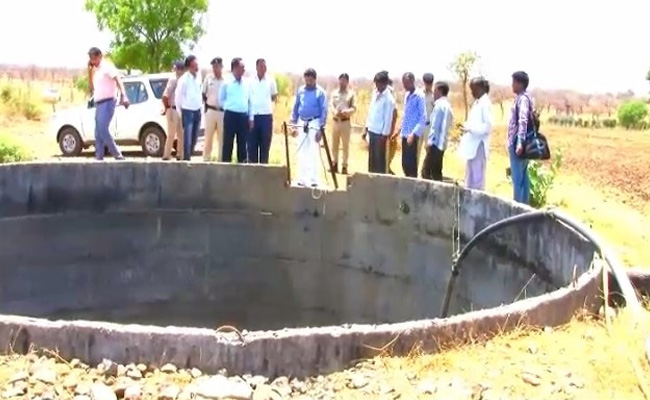
Kerosene poured in to foul up the well. Photos credit: NDTV
Because a Dalit from a village in Madhya Pradesh‘dared’ to have band baaja in his wedding procession, the local upper castes poured kerosene to foul up the water in the only well on which 500 Dalits depended for drinking water and other needs.
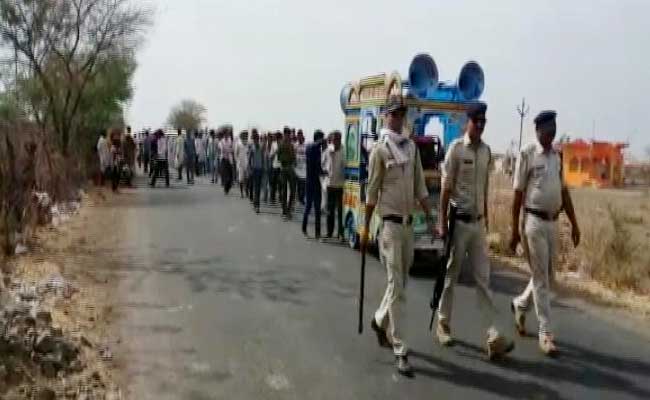
This happened two days after the wedding of Mamta, daughter of Chander Meghwal in Maada village in Madhya Pradesh, according to a report by NDTV. The wedding procession on April 23 had passed off without incident only because it was escorted by policemen, armed with batons, rifles and teargas. But two days later, kerosene was poured into the Dalit well.
Wedding procession under police protection
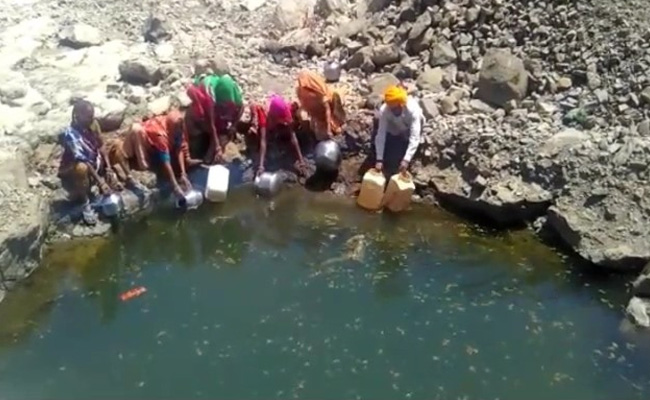
Authorities have had to be called in to clean up the well. But in the meantime, Dalit women have had no choice but to fetch water from a river 2 kms away for the past week.
Dalit women scooping water from a river bed 2 kms from their village
The village “rule” permits only upper caste people to have a music band at their wedding. The Meghwals had been warned to ensure that no band baaja accompanied the bridegroom’s party when it entered the village to marry Mamta. But the Dalits of the village stood by the Meghwal family and the collective punishment followed.
Durvijay Singh, a senior official, told NDTV the kerosene pouring was "not such a big issue" since the various communities in the village "live in amity". "Obviously someone has done this deliberately. It will eventually come out who was responsible," he said.
But no case has been registered in the matter and no investigation has been started, although the police have been stationed again in the village to provide protection to Dalits.