'Arrest of all accused for lynching Pehlu Khan, end vigilantism in the name of cow protection, punish police officers for dereliction of duty'
Dear Ms. Vasundhara Raje,
We are very disturbed by the lynching and murder of Pehlu Khan in Alwar . He was attacked on April 1st at Behror in Alwar District and died of the injuries a few days later. We are also dismayed by the acts of omission and commission of the government following the incident, including the delay and marked reluctance in arresting all those guilty of the act.
You are aware of the fact that Pehlu Khan and four others were returning to Haryana from Rajasthan with the cows they had bought, and the necessary documents corroborating the fact that the purchase had no relationship with cow slaughter. Cows of a well-known breed of milch cattle were being transported from a cattle fair in Rajasthan to their village in Haryana.
While one may have strongly differing sentiments on the importance of cows, and their slaughter or consumption, the killing of Pehlu Khan by an arbitrary self- appointed group of vigilantes shows us how much we have succeeded in undermining the most basic principles and values on which we have based our nation. This kind of vigilantism if not checked will lead to large scale violence, brazen disregard for the rule of law, and the complete disregard of constitutional provisions, the preservation of which is a fundamental responsibility of any democratic government.
The act of lynching is in itself a mindless and horrifying act, and yet the perpetrators have not been promptly and legally dealt with. The post facto delays and inefficiencies reflect on the inefficacy of government. Vigilantism must be seen as a serious threat to law and order and peoples’ lives and the government must act strongly and immediately.
There has been a reprehensible attempt on the part of certain people in authority in Rajasthan as well as in the Union government to deny this horrific incident, or to minimise its gravity. Other authority figures, whose duty it was to make on example of the perpetrators of this crime, have made themselves complicit by their inaction and silence.
In this context, we would urge that the FIRs registered in regard to this incident and the dying statement of Pehlu Khan be acted on decisively. The culprits must be arrested to restore the faith of the victims’ families and their communities in the system of justice in the country. The failure to take immediate action at this juncture will amount to a mockery of good governance and the rule of law, and will inevitably lead to anarchy.
We are sure you will appreciate the urgency and importance of your public statement and action in this matter, and restore the confidence in the government of Rajasthan by:
· Arresting all those who attacked Pehlu Khan.
· Ending all vigilantism in the name of cow protection.
· Punishment of police/administrative personnel for dereliction of duty.
France is heading to the polls on April 23 for the first round of its presidential election. This election holds particular importance for the European nation, which finds itself at a crossroads, with its whole political system in question.
Campaign posters of the 11 candidates in the French election. Left, right and centre can seem pretty blurred in 2017 France. Eric Gaillard/Reuters
From abroad, the situation seems puzzling to many commentators. According to the newspaper China Daily, for instance, the election is particularly “messy” (because it’s confusing).
While five candidates appear to have emerged as favourites from the 11 who qualified to stand for election, their platforms, the values they promote and their political affiliations (except for a few) are not very obvious.
Indeed, France is witnessing a “political blur”, in which the clash between left- and right-wing ideologies seems long gone. Just ahead of the first round of the polls, 42% of French people have declared that they still haven’t made up their minds.
The second round of voting will take place on May 7.
Labels that date to the King
Left and right are old labels, dating back to the French Revolution. In 1789, the National Constitutive Assembly met to decide whether, under France’s new political regime, the king should have veto power. If so, it queried, should this right should be absolute or simply suspensive, for a period of time.
When voting, supporters of the absolute veto sat on the president’s right, the noble side. According to Christian tradition, it is an honour to be seated at the right side of God, or to the right of the head of the family at dinner. Those who wanted a highly restricted veto were seated on the left.
Thus, the layout of the room took on political significance: to the right, supporters of a monarchy that sought to preserve many of the king’s powers; to the left, those who wished to reduce them.
In the 19th century, this vocabulary was increasingly used to describe the political leanings of members of the French parliament.
The great advantage of these labels is their simplicity: they reduce complex political ideas to a simple dichotomy. It also makes it easy for people to identify the “right” side, to which they belong, and the “wrong” side, which they condemn.
From the 19th century onward, sub-categories quickly developed, aimed at placing every politician on a kind of spectrum from left to right. In this way, political parties can be said to be more or less left wing, or more or less right wing, in relation to one another.
Soon, people were talking about “right-wing coalitions”, “left-wing blocks”, “centre-right”, “centre-left”, “far-right” and “far-left”, and the like.
‘The clash of two Frances’
At the beginning of the 19th century, the left-right divide essentially distinguished supporters of an absolute monarchy from those of a constitutional monarchy.
It would later set monarchists against republicans, then conservative republicans against the modernists who implemented the major social reforms of the Third Republic that included the freedom of the press, freedom of association, the right to belong to a trade-union and divorce, among other things.
At the turn of the 20th century, the left-right debate essentially covered the divide between the defenders of Catholicism and advocates for the separation of church and state. This shift, which took place in 1905, would often be referred to as “the clash of two Frances” – Catholic and anticlerical.
From the 1930s onward, the economic divide came to the fore, with the left advocating for socialism and the right calling for economic liberalisation.
By the 1970s, the liberalisation of social mores had become a key issue, with continuing debates on abortion, divorce, homosexuality, marriage equality and euthanasia. The same is true of immigration and openness to the world, which stood in opposition to cultural, social and economical protectionism.
Parties with many faces
In France, the divide grew in several political realms. In his famous work, The Right Wing in France, political historian René Rémond defined three separate right-wing currents: the legitimist and counter-revolutionary right, the liberal right, and the Bonapartist right, authoritarian and conservative.
Whether or not these divisions still exist today is open to debate. What is certain is that there is still a significant difference between the conservative, more authoritarian right that favours an economy in which the state plays a regulatory and protective role, and the liberal right that favours deregulation, less restrictive labour laws and more entrepreneurship.
Today’s French Republican party represents the latter position well, from former prime minister Jean-Pierre Raffarin to former president Nicolas Sarkozy.
The Bonapartist right – often identified to Gaullism after the former French president Charles de Gaulle (1959-1969) – can now be partially identified with Marine Le Pen’s National Front, which prizes a strong leader, order and patriotism.
In truth, for each overarching area of political debate, there are at least two right wings and two left wings. Concerning family values and gay marriage, for instance, a minority on the right are open to increased tolerance, while a minority on the left are rather reluctant.
The same can be said of immigration. Not everyone on the right is convinced by restrictive immigration policies, while open immigration policies are far from universally approved of on the left.
Don’t forget the centre
Centrist positions are often difficult to pin down. Those who self-identify as centrists sometimes occupy the middle ground on certain main political issues but stand to the left on one issue and to the right on another.
Early 20th century radicals, often characterised as defenders of secularism and basic freedoms, were also economically liberal, and generally considered as having “their heart on the left but their wallet on the right”. Centrists from the Christian Democratic tradition, who favoured social protections, dialogue between workers and management, and oppose unchecked economic liberalism, were also conservative on family issues.
Young women dressed as Marianne, the French revolutionary symbol of freedom, demonstrating against same-sex marriage in Paris on January 13 2013. Marie-Lan Nguyen / Wikimedia Commons, CC BY-ND
While it is possible to identify broad schools of thought that can be classified as right, left or centre over the long term, policies vary greatly over time. We cannot ascribe unchanging, universal content to these categories.
These days, we cannot even say that the right is for the status quo or that the left wants change, as has sometimes been claimed. When it comes to the welfare state, people on the right clamour for reform, whereas those on the left want to defend social protections.
Still, in each era, centre, left and right have served as signposts, allowing us to classify political parties, politicians and the ideas they promote.
The 2017 presidential election deepens the divide
In the right- and left-wing “primaries” that took place a few weeks ago, French parties selected candidates who clearly illustrated their ideological differences.
But this process also revealed more left- or right-leaning positions within each camp, as demonstrated by the second-round primary between François Fillon and Alain Juppé, on the right, and, on the left, between Benoît Hamon and Manuel Valls.
It’s likely that the majority of those who watched the first televised debate on March 20, prior to the first round of voting, would have similarly placed candidates on the spectrum of left to right.
Jean-Luc Mélenchon, the candidate for “La France insoumise” (the rebellious France), embodies a type of social protest. He refuses any alliance with the current left-wing government and takes more radical stands on institutions, Europe and economics than the Social Democrat Benoît Hamon.
Jean-Luc Mélenchon, France’s current ‘protest’ candidate, represents several ‘radical left-wing’ groups. Pierre Sélim/Wikimedia, CC BY-NC
Emmanuel Macron, the former economy minister responsible for a large share of President François Hollande’s economic policy, is running on a centrist platform. A strong proponent of liberal economic policies, he also supports a certain social safety net and the integration of immigrants while opposing discrimination against minorities. He is trying to attract moderates from the left and the right.
In other words, Macron seeks to build an electorate comprised of Socialists who find Benoît Hamon too lefty and of Republicans or centrists who find François Fillon too far to the right. That marks a clear difference between this mainstream right and the populist, protectionist, anti-European extreme right represented by Marine Le Pen’s National Front.
Not all the same
So why is the belief that there is no real difference between left and right so commonly held?
This view can be traced back to opinion surveys from the 1980s. A growing number of people now claim that the concepts of left and right have lost all meaning. Yet these same people, in the same surveys, happily self-identify on a continuum of left to right and define their political identity in these dichotomous terms.
This apparent paradox can be explained. Many people who personally feel more left wing or right wing according to their convictions also believe that governments tend to implement similar policies when in power. They therefore expect clear political platforms that can be summarised as left wing or right wing but are ultimately disappointed by the outcomes.
As a result, candidates make promises to attract votes without taking into account how difficult they may be to implement. But selling right- or left-wing ideas during an election campaign also serves to make people dream – capturing hearts and minds at the expense of considering the realities that elected governments must face.
Translated from the French by Alice Heathwood for Fast for Word.
Media reports that Sulkhan Singh who on Saturday took over as the new Director General of Uttar Pradesh. Addressing the press in Lucknow he said UP police would be impartial and would not tolerate vigilantism in the name of cow protection.
Sulkhan Singh, today took charge as the new Director General of Police in Uttar Pradesh.
Addressing the media after taking over from Javeed Ahmad, Singh vowed to crack down on "gundagardi" and said that his force will work with total impartiality.
"Anybody indulging in criminal activities will not be spared, whether from ruling party or not, we have strict orders from UP CM (Yogi Adityanath)", the new Uttar Pradesh DGP. Singh, who previously was the DG (Training), also promised a corruption-free police force and addresses the hot-button topics of vigilantism in the name of cow protection and Uttar Pradesh's recently instituted anti-Romeo squads.
Since the Modi regime took charge at the Centre (May 2014) and over the past weeks and months, especially since the Yogi dispensation in Uttar Pradesh (March 2017), there have been several incidents of alleged cow smugglers being assaulted in the country. Recently, a dairy farm owner was killed by self-proclaimed gau rakshaks in Rajasthan. Sulkan Singh today said that action will be taken against such vigilantes in Uttar Pradesh.
On anti-Romeo squads, which have come under criticism for harassing couples and for alleged moral policing, Singh said that the personnel on the squads will only act against people indulging in "objectionable behaviour." What the DGP Said Today
Any person indulging in criminal activities will not be spared, whether from ruling party or not; these are the strict orders coming from Chief Minister Yogi Adityanath.
No 'gundagardi' will be tolerated; it will be acted upon, Uttar Pradesh police will work with total impartiality. Uttar Pradesh police has zero tolerance towards corruption.
Police personnel on duty for anti-Romeo squads will act and take action only on people with objectionable behaviour.
Personnel in Plain clothes, but this does not mean that they will start needlessly questioning people. This will be reiterated in standing orders issued to the personnel.
Vigilantism will Not be Tolerated: Action will be taken on anyone indulging in vigilantism in the name of Gau Raksha or anything else, no one has the right to intervene. Will not disclose complainant's name in such a case (of alleged vigilantism), but won't allow anyone to indulge in forceful behaviour.
An excerpt from a new book explains how the so-called fringe Hindutva group issues threats and then provides security.
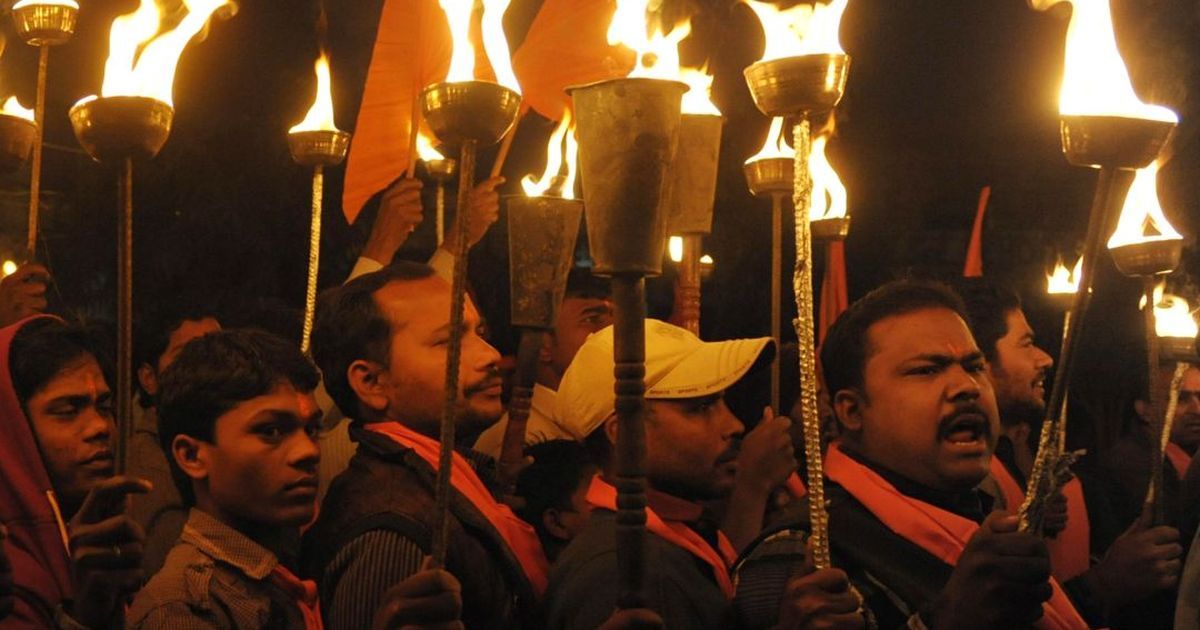
The affable manner of forty-year-old Sharan Pampwell, the Mangalore-based leader of the Bajrang Dal in Karnataka, belies his exceptional business acumen. Like a good entrepreneur – obeying the laws of demand and supply – he has put to good use the anxiety felt by local businessmen as a direct result of the Bajrang Dal’s activities. He offers them protection by using the foot soldiers of the very same Hindutva outfit he represents.
“We strictly follow the rules of business,” Sharan tells me as I sit down with him to understand the economics of his politics. “Businessmen are prepared to work with us because we offer them security services at a very reasonable rate.” Politics may once have been the sole reason for the existence of the Bajrang Dal – an aggressive youth brigade of the VHP, in turn an offshoot of the RSS – but in Mangalore, where this organisation is very active today, it is a convincing profit motive that seems to drive its activities.
It works like this: first, the demand is created through the Bajrang Dal’s agitational activities, which range from vigilantism to hooliganism to vandalism.
This creates a sense of insecurity among owners of malls, shops and apartments. Then Eshwari Manpower Solutions Limited, a company owned by Sharan, offers security guards to the terrified businessmen so their fears are assuaged. The manpower for both these activities is drawn from the same pool. “All the supervisors and the majority of the security guards who work for the company are Bajrang Dal karyakartas,” says Sharan. “As the leader of the Bajrang Dal in this city, it is my duty to secure a livelihood for the karyakartas. But I don’t turn away anyone who comes to me for a job. There is enough demand for security guards in the city. Some of our guards are even Muslims.”
Sharan Pampwell has had a meteoric rise in the Bajrang Dal since joining the organisation in 2005. In 2011 he became the convener of the Mangalore division, and in 2014 was given the same designation in the south Karnataka region. In the Bajrang Dal’s organisational structure, the state of Karnataka is divided into two units, north and south, each with its own convener. While in northern Karnataka the Bajrang Dal is weak, in the south it is hyperactive, perhaps far more than in any other part of the country.
With Eshwari Manpower Solutions Limited requiring constant business opportunities, the Bajrang Dal considers its agitational activities crucial to its economic gains under Sharan’s leadership. “I started this business soon after I was made the convener of the Mangalore division. Now I have the security contracts of three malls – City Centre, Forum Fiza and Big Bazar – apart from several shops and apartments in the city,” he said. City Centre at KS Rao Road and Forum Fiza at Pandeshwar are among the largest malls in Mangalore. Big Bazar, located in the Lal Bagh area of the city, is another important shopping complex.
Interestingly, most of the shops in City Centre and Forum Fiza belong to Muslims, the community that is the main target of the Bajrang Dal’s attacks in Mangalore, as in other parts of the country. In Mangalore, however, the anti-Muslim basis of the Bajrang Dal’s politics gives way to communal harmony the moment the Hindutva outfit doubles up as a business firm with minorities as clients.
Sharan tacitly admits this as he demonstrates his entrepreneurial shrewdness.
“We are getting a lot of business from Muslim shopkeepers and mall owners. That is primarily because they have faith in us and in our company.” He maintains silence about the secret of his success among minorities – the fear factor that compels Muslim businessmen to opt for Eshwari Manpower’s security services. “Given the kind of activities they [Bajrang Dal members] indulge in, this is the best way to do your business peacefully,” says a Muslim shop owner in City Centre. “In a city like Mangalore, if you don’t outsource your security to them, you become extremely vulnerable. In the end, it is not a bad deal either. You do not just get security guards from them but also an assurance that you will be spared from any Hindutva activity. After all, one attack is enough to bring down your business.”
The transformation of the Bajrang Dal into a protection racket is not necessarily the natural progression of street-level Hindutva politics. It has been possible in Mangalore because of the widespread perception among businessmen and ordinary citizens that appealing to the police for protection is futile. When the state is unable to rein in troublemakers and the government’s law and order machinery appears overwhelmed by them, perhaps the only option is to cooperate with the perpetrators of criminal culture.
The Bajrang Dal’s approach to politics in Mangalore – small scale, local and business-oriented – makes obvious sense for any organisation which has as its main stock of activists unemployed youth from economically weaker sections of society. It is equally obvious why employment via the Bajrang Dal protection racket appeals to those who have struggled – and failed – to secure a livelihood in a highly competitive market.
However, when the Bajrang Dal was set up in 1984 by the VHP as its “militant youth wing”, its original objective was to increase Hindu mobilisation for the Ayodhya movement, which the VHP had adopted as its central campaign barely a few months earlier. The epithet “bajrang” (meaning strong and sturdy), which is associated with the name of Hanuman, the monkey god who led Rama’s armies into battle, was chosen to emphasise the muscle power of the members of this organisation.
Excerpted with permission from Shadow Armies: Fringe Organizations and Foot Soldiers of Hindutva, Dhirendra K Jha.
NDTV reports from Srinagar that at least five people including a nine-year-old girl have been injured in an attack by 'gau rakshaks' or self-styled cow vigilantes in the Reasi district of Jammu and Kashmir. The incident took place when a nomad family was moving with their livestock at Talwara area.
Image: New Indian Express
They were intercepted by a large group of gau rakshaks and beaten up. Cow Vigilantes have been on the rampage, functioning with impunity since the Narendra Modi government was sworn in May 2014.
The victims say the attackers took away their entire flock including goat, sheep and cows. The injured have been shifted to hospital. Police say an FIR has registered and five of the attackers have been identified.
Ambedkar’s progressive ideas are essentially antithetical to the right-wing politics.
Newsclick talked to Badal Saroj, CPI(M) state secretary, Madhya Pradesh, on Dr. B. R. Ambedkar. He talked about the contribution of Ambedkar on labour right, women movement along with the social upliftment of the depressed casts. He said that Ambedkar’s role in strengthening of labour rights cannot be ignored. The BJP and RSS has constantly tried to appropriate Ambedkar, which is ironic. Ambedkar always stood firm against their brand of communal politics. He categorically wrote against manusmriti, which the RSS wanted to replace the constitution with. Ambedkar’s progressive ideas are essentially antithetical to the right-wing politics.
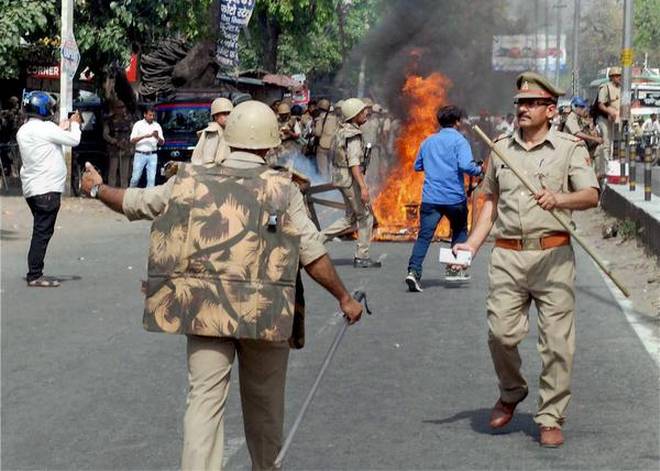
Residence of police officer attacked, public property set aflame
Photo Credit: The Hindu
Communal violence erupted in Saharanpur district in Uttar Pradesh on Thursday and the main culprit is none less than the BJP MP, Raghav Lakhanpal. The district’s Senior Superintendent of Police (SSP), Love Kumar has ordered the filing of an FIR against Lakhanpal and over 500 others for violence, vandalism and attack on the house of the SSP and the district magistrate’s office.
The trigger for the violence was the insistence of Lakhanpal and other local BJP leaders to take their “Ambedkar Shobha Yatra” through a communally sensitive area for which the police had refused permission.
No procession has been permitted for the last seven years through Sadak Dudhli, a village with a mixed Muslim and Dalit population on the skirts of Saharanpur city.
Emboldened with Yogi Adityanath’s occupation of the chief minister’s chair in the state, rightwing Hindu groups along with local BJP leaders had announced that this year they will take the procession through the village. And they went ahead with their plan despite denial of police permission.
When the police blocked the yatra’s procession through the Muslim area of the village, BJP supporters went on a rampage and attacked the SSP’s residence. The violent mob also allegedly smashed the CCTV cameras and furniture and set public property on fire. In an attempt to bring the situation under control, heavy police bandobust has been put in place throughout Saharanpur city.
“We will not allow Saharanpur to turn into Kashmir,” the BJP MP has reportedly stated.
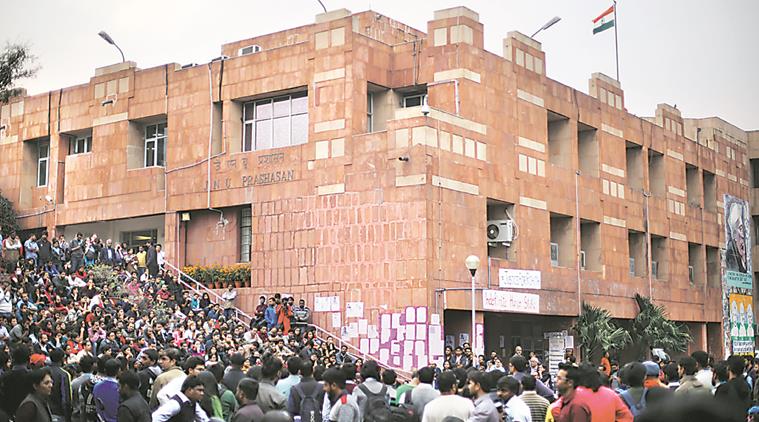
Amidst these bitter contestations, it is worthy to recall that one of the greatest but least acknowledged contributions of universities like JNU to India’s public life has been that these citadels of higher learning admitted and nurtured students from deprived backgrounds.
This 26 year-old university student cries easily. We meet Sumit in a story front-paged in The Indian Express: “He cried that day in 2015 when he travelled from his hometown Hisar to Delhi and found his name on the admission list of JNU’s MA programme; again, when he couldn’t understand what was taught in his first class; then, when his professor told him, ‘you have come to JNU, you are in safe hands’. And now, sitting in his professor’s room, Sumit cries again as he talks about JNU’s decision to implement the UGC cap on MPhil/PhD seats” (IE, ‘Deprivation points go, so do some JNU dreams: ‘All I wanted was a PhD, then to teach in Hisar’’, April 12, the second of a three-part series).
The son of a helper to a vegetable vendor in Hisar, Sumit did everything to get to JNU — picked up plates at weddings, gave out tokens to patients at a hospital — all to fulfil his dream of getting a PhD and returning to teach at his Haryana hometown. But his dream lies shattered with the UGC cap on MPhil and PhD seats. JNU had a unique system of deprivation points that gave weightage to students from disadvantaged social backgrounds and regions. The university faculty in JNU consciously fostered a climate that encouraged and supported these students to accomplish their potential. This effort had many fractures. The recent suicide of Dalit student, J. Muthukrishnan, was a sobering jolt, reminding us that even the best of our institutions of higher learning remain threatening and hostile to students not reared with privilege.
Ever since a storm broke out around JNU in early 2016, amidst allegations that slogans against the nation were raised by left-leaning students, questions of both the limits to freedom of student dissent, and of whether the state should fund liberal arts higher education, have been raised. A number of official steps have been taken since that erode the independence, the pluralism, the equity and the public-ness of these institutions. Amidst these bitter contestations, it is worthy to recall that one of the greatest but least acknowledged contributions of universities like JNU to India’s public life has been that these citadels of higher learning admitted and nurtured students from deprived backgrounds. But that is set to change. The Delhi High Court struck down its system of deprivation points as “legally impermissible”.
A vivid reminder of what a consciously equitable centre of higher learning can accomplish emerges from Kanhaiya Kumar’s recent memoir From Bihar to Tihar. His story could have been that of millions of young people. He describes his indigent childhood in an impoverished village in Begusarai. His father, a small farmer and daily wage labourer with poor health, had not passed class 10. His mother had passed her Class 10 exam and became the family’s main bread-earner as a helper in a government infant-care centre, at a monthly salary of Rs 3,000.
He was born into a high caste and therefore, spared caste discrimination. But his village school had neither a toilet, nor a library. A bright student, his parents decided to invest a significant fraction of their small income in sending him to a private school. He recalls that in his school, richer children wore clean clothes and shoes, mufflers and full trousers. “Poor kids like me wore shorts, that is, ‘half pant’, to school, because we could get two half pants from the fabric needed for one full pant”. He became ashamed of his family’s poverty and began to lose confidence. His academic performance slipped, but he slowly pulled himself up.
After passing high school, he persuaded his parents to spare for him Rs 500 a month, and left his village with a small suitcase and a gas cylinder to seek his fortune in Patna. He describes his first encounter with a city, disoriented and excited. He shared an unventilated room in a cheap lodge. He joined a maths coaching class to prepare for an engineering entrance exam. But in a year, he ran out of money, and decided instead to train in repairing air conditioners and fridges, thinking he would find a job in Dubai. He learned, meanwhile, to be a “Patna boy”, travelling without tickets on trains, hanging out at roadside stalls, drinking tea and arguing But he gave up his idea of eventually working in Dubai and decided to pursue the UPSC. He passed his intermediate examination in the second division without cheating, from a college that did not teach. He then joined a college in which, indeed, there were classes, and struggled to complete his bachelor’s degree.
For his master’s degree, he decided to try his luck in Delhi, armed with little more than “the big, hungry dream to go to the country’s capital and study, teach, become something in life”. His early struggles in Delhi again mirrored those of thousands of young men and women arriving there. “They live on a very tight budget, spending carefully from their parents’ hard-earned money. They eat little, walk everywhere and wear the same clothes over and over again”. His UPSC dreams were dumped when the government suddenly changed the examination pattern. He was advised to apply to JNU. This decision, he said, was to “completely change” his life.
His description of his years in JNU, growing from a student raised in poverty in a village in Bihar, is almost idyllic. He speaks of his joy in encountering a place of education without discrimination, where women and men mixed freely, where students came from every corner, where every language in the country could be heard, where teachers were friendly and supportive, and where “politics was everywhere”. It is this university that nurtured and developed this young man and enabled him to become the confident, eloquent and progressive student leader that the country now knows.
But in his last Facebook post before his suicide, JNU’s Dalit student, Muthukrishnan, wrote, “When Equality is denied everything is denied”. Recent years have seen the massive expansion, and the equally massive privatisation of higher education in India. It is estimated that between half and two-thirds of all students in India today could be of the first generation to ever enter higher education. JNU is among the few public institutions that have actively welcomed such students, undertaking an inestimable public duty.
The problem we face in India today is not that too much but too little public money is being spent on institutions of higher education. Of the little that is spent, far less is spent in institutions that encourage independent thinking and include young people raised in poverty and social discrimination. In seven decades, we have done far too little for the large masses of India’s young people, who enter adulthood without education and hope. What little we have done also stands in imminent danger of demolition. JNU doctoral student Umar Khalid lamented in a Facebook post: “Our universities are being turned into graveyards for the oppressed.” They are on the verge of closing their barely opened doors to young people who do not enjoy the privileges of geography and history, of wealth, educated parents, gender, caste and childhoods in cities. Unequal India will then become even more intolerably unequal.
(The author is a human rights worker and writer. The article appeared in The Indian Express on April 22, under the heading Depriving JNU and is being reproduced here with the permission of the author)