The video of a Kashmiri man tied to an army jeep and paraded across villages in the Valley has spoken by making astonishing revelations.
Contrary to media reports that branded him as a stone pelter, 26-year-old Farooq Ahmed Dar said that he was on his way to attend a funeral in the family when he was picked up and tied to the army jeep.
He told Indian Express, “I am not a stone-pelter. Never in my life have I thrown stones. I work as an embroiderer of shawls, and I know some carpentry. This is what I do.”
Dar said that he was paraded 25 kms by army before being released adding that he found himself helpless because of his poverty-stricken life.
He said, “Gareeb log hain, kya karengey complain (We are poor people, what will we complain). I live alone with my asthmatic mother who is 75-years-old. I am scared. Anything can happen to me. I am not a stone-pelter.” His mother Fazie agreed: “No, we don’t want any inquiry. We are poor people. I don’t want to lose him. He is the only one I have to look after me in my old age.”
Meanwhile, Home Minister Rajnath Singh on Friday said that he would look into the issue of a video showing a man tied to an army jeep, purportedly to be used as a human shield against stone pelters in Kashmir, which has gone viral.
He said he had no information on the video as of now, but added, “Whatever has happened, we will look into it.”
The video showed a man tied to an army jeep, purportedly to be used as a human shield against stone pelters, in the Beerwah area of Budgam district on April 9.
Singh said, “I have already asked for filing an FIR on the incident (of) CRPF jawans (being heckled) while carrying electronic voting machines.”
In that video, a CRPF man on polling duty was seen being heckled by protesters in the Chadoora area of Budgam district.
Army and defence officials were not immediately available for comment.
The video has evoked angry reactions from social media users with many calling the act by the Indian armed forces as a gross violation of human rights in Jammu and Kashmir.
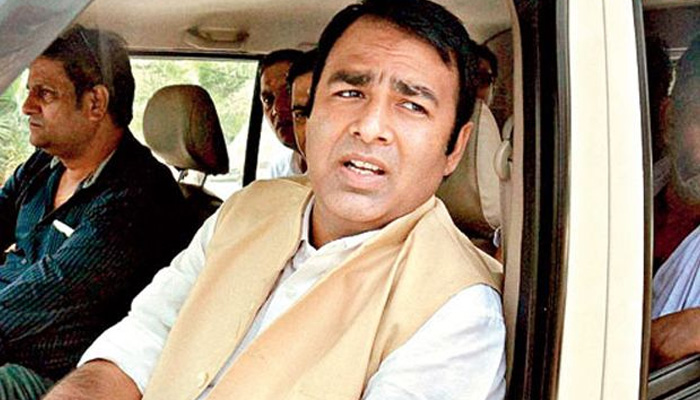
Claiming that it did not have evidence to prosecute BJP’s MLA Sangeet Som for the video which ignited the 2013 communal violence in Muzaffarpur, the UP police have filed a closure report in a local court.
According to inspector Dharampal Tyagi, the investigating officer in the case, “the closure report was filed earlier this week because Facebook’s headquarters in California could not provide the complete details, which could have helped in collecting evidence in the case. The closure report has been filed on the ground that no evidence could be found”.
The court is yet to take cognizance of the report.
The police say they had no confirmation from Facebook that the video circulated on the social media about two youths being assaulted had originated from Som’s account.
The video was circulated two days after the killing of two youths — Sachin and Gaurav — allegedly in retaliation for the murder of Shahnawaz, a resident of Kawal village in Muzaffarnagar, on August 27, 2013. The video had a message running across the clip: “Bhai Sahab Dekho Kya Hua Kawal Mein” (Please watch what’s happening in Kawal, brother).
According to a report in the Indian Express, the police found that the video had originally been posted on social media two years earlier, and possibly not filmed in India.
Primary investigation, the police said, revealed that the video was uploaded on YouTube by another accused, Shivam Kumar, and circulated widely allegedly after it was shared on Som’s Facebook account.
On August 29, 2013, an FIR was lodged at the City Kotwali police station against Som, Kumar and 229 unidentified persons under IPC sections 420 (forgery), 153-A (promoting enmity on religious grounds), 120-B (conspiracy) and section 66 of the Information Technology Act.
During investigation, police found that Kumar and Som had removed all details, including Friends lists, from their Facebook accounts. The 229 persons, who had “liked” the video, were also found to have removed their personal details from their accounts.
It was at this point that the police had sought information from Facebook’s headquarters in the US about Shivam’s and Som’s accounts. According to the police “some information” was received but that was insufficient to proceed with the case.
The distinction between anti-national and anti-religion is increasingly blurred.
On my visits to India, I am often asked for my views on whether Partition should have happened.
This question partly arises out of nostalgia – the longing for the unbroken motherland, the desire to travel across the border, the yearning to stand on the soil and breath the air that gave birth to our ancestors.
But the question is also party a euphemism that hides layers of assumptions and assertions. Hidden in it are several other questions and statements: “Aren’t you upset with Pakistan’s state of affairs? The nation is fragmented, at war with it itself. There is no national identity. Don’t you wish it was still a part of India, that Partition had never happened?”
The quest for roots
Back home, Pakistanis often joke among themselves that it is only cricket that can bring the nation together. In drawing room conversations, some will quip about the lack of national unity, while others will somberly discuss the need to craft a national identity by taking pride in indigenous traditions and practices. Some will say that rather than teaching children Shakespeare, we should educate them about Bulleh Shah and Baba Farid.
Others, though in the same spirit of creating national solidarity, will propose different solutions. Some will ask for Bollywood movies to be banned so that Pakistani cinema and artists can flourish and children can grow up without Hindu influences, while yet others will speak about expunging American influences that have been supposedly corrupting the nation and taking it away from its own roots.
This desire to go back to their roots is shared by many Pakistanis, though what those roots are is increasingly being contested. For some liberals and intellectuals, going back to the roots, could mean owning pre-Islamic traditions and histories from the Indus Valley Civilization, for others it manifests in religious appropriation of those very roots. Car number plates will read
“Al-Bakistan” and there will be an argument for making Arabic compulsory across schools while indigenous languages like Punjabi are sidelined as unruly and crude.
Children will be forbidden from seeing the viral cartoon series, Peppa Pig because the animal is considered “unislamic.” And committing blasphemy will become far too easy, because everything and anything can be construed as sacrilegious in a society bent upon Islamisising all aspects of life, from cartoons to car number plates.
Does all of this help in creating a national identity? It is often alleged that Pakistan suffers from an existential crisis, uncertain of why it was created and even more unsure of how it will continue existing in the face of growing threats, both internal and external. It is also argued that the country has a weak national identity, if any at all. National spirit, national pride and national unity are missing.
Nation = religion
Contrary to this, I would argue that the nation has as strong a national identity as its neighbour to the East, or for that matter, as most nations. In fact, Pakistan can be considered a pioneer in constructing national identity in the contemporary world if one broadens the understanding of what nationalism means today.
From Europe and America to India, religious nationalism is on the rise. Nationalism is no longer limited to patriotic spirit, of being proud of what one’s nation has achieved; rather, it is increasingly about who should be achieving and who is holding them back. Donald Trump’s victory in the 2016 US Presidential elections has been hailed as a victory of white Christian America. After decades of oppression, he has promised to give them back their rights and opportunities, that had for far too long been hijacked by those who don’t really belong – namely Mexicans and Muslims.
In Europe, the refugee influx, mostly from Muslim countries, has become a catalyst for the rise of rightwing, religiously inclined parties. Brexit – Britain’s vote to exit the European Union – was also inspired by the idea of separating oneself from particular races and religions that can pose a threat to British sovereignty.
And in India, what it means to be patriotic has increasingly become saffronised. The dangerous growth of vigilantism in the name of protecting the cow, religious indoctrination in textbooks and violence against anyone perceived as anti-national is alarming. Just as nationalism and Islam have been woven into a complex web in Pakistan, in India too nationalism is increasingly becoming synonymous with Hinduism.
Religious rhetoric
In Pakistan, religion has always been politicised and embedded in the national rhetoric. The country’s raison d’être is the two-nation theory, which is premised on the separation of Hindus and Muslims. Soon after the creation of the country, it became the Islamic Republic of Pakistan. The swift action gave Muslims greater rights and privileges while largely invalidating the existence of any non-Muslims.
Today, the most popularly understood meaning of Pakistan is, “La Ilaha Illallah Muhammadur Rasulullah,” – there is no god but Allah – the same holy words that are used while converting someone to Islam. How, then, can a Hindu, Sikh, Christian, Baha’i or Parsi belong as much to this land as Muslims do?
The State has crafted one of the strongest religious-national identities based on the opposition of the other: non-Muslim and the infidel. The narrative is so powerful that the State often does not even need to step in to ensure its persistence. Mob attacks and violence against anyone deemed to be challenging Islam are rampant. And since Islam is seen as synonymous with Pakistan, it becomes all too easy to charge all those perceived to be anti-nationals as anti-Islamic and hence open them to all kinds of punishment, both by the state and the moral policing of fellow citizens.
This was also seen during the disappearance of five Pakistani social media activists, known for their secular, Left-leaning views, who mysteriously went missing in January and were soon labeled as blasphemers, which in Pakistan can be punishable by death. The lines between anti-state and anti-Islam are increasingly blurry.
Finding inspiration in this religious-nationalist narrative, other countries have followed suit. They have realised that while people may be open to hearing criticism of state policies, they will be far less likely to hear anything that goes against their religious sentiments. Infusing religion into national sentiments is perhaps the most sure-shot way of maintaining supremacy and silencing all dissent.
Anam Zakaria is the author of Footprints of Partition: Narratives of Four Generations of Pakistanis and Indians.
Turkey is approaching a critical juncture in its long-term political development. Irrespective of the outcome, the country’s April 16 referendum, which proposes changing the constitution to concentrate power in the hands of the president, heralds a new political era.
Many signs seem to point to a narrow victory for President Recep Tayyip Erdoğan in his attempt to establish an executive presidencya la Turca, but the result is not a foregone conclusion.
Should Erdoğan’s suggested reforms be rejected, Turkey’s near future would be defined by its president’s next move. Without a formal shift in constitutional structure, Erdoğan could resort to nefarious means to consolidate his grip on power. Alternatively, given his long-standing ambition to establish what we call a “constitutional Erdoğanistan”, he might simply pause briefly before attempting a second bite at the cherry.
Turkey on the brink
Turkey has a strong parliamentary system with a prime minister as its head. The referendum proposes to abolish the role of prime minister and replace it with an executive presidency. A major shift like this is something that has only happened a handful of times since the republic was founded in 1923 according to renowned historian of Turkey, Erik J. Zürcher.
The country’s political system has already undergone significant economic, social, and political changes since the Justice and Development Party (known by its Turkish acronym AKP) came to power in 2002. The AKP was an eager champion of legal reforms relating to Turkey’s EU candidacy and accession starting in 2004. And in September 2010, it successfully shepherded changes aimed at bringing the constitution into compliance with EU standards.
Still, were the Turkish people to vote “yes” on April 16, the changes would be fundamental and irreversible. The referendum proposes 18 amendments that will abolish nearly 70 years of multiparty parliamentary government, moving Turkey away from the core norms of a pluralist, parliamentary state of law by reducing the separation of powers and the checks and balances system, among other changes.
Erdoğan’s aim is to transform the country into a majoritarian authoritarian system centred on one man. What Turks are risking is nothing less than “democide” – the scholarly term for voting to abolish democracy itself.
A critical juncture
Since the birth of the Turkish Republic in 1923, Turkey’s parliament, the Grand National Assembly of Turkey, has been the place where national sovereignty resides.
In the early republican period, it was dominated by the party of modern Turkey’s revered founding father, Mustafa Kemal Ataturk (1881-1938). Since the transition from single-party rule to a multiparty democracy in 1946, the parliament has been the crucial institution in the political life of the country.
President Atatürk leaving the Grand National Assembly of Turkey in 1930. Dsmurat./Wikimedia
Elected lawmakers have long shared power with strong guardians of institutions such as the military, the judiciary and Turkey’s government bureaucracy – all Kemalist-dominated – in a kind of hybrid political system not unlike that of contemporary Iran, Thailand, Pakistan and Myanmar.
The parliament has also served as the site where governments have been formed, thrown out of office and restricted.
As the scholar of Turkish constitutional development Ergün Özbudun notes, “even at the height of Atatürk’s prestige, the Assembly rejected a proposal to give the President of the Republic the power to dissolve the Assembly”.
Under Erdoğan, the AKP has worked through the parliament to legitimise its rule. By 2010, it had vanquished the last Kemalist bastions within the state thanks to successive landslide electoral victories and a now-defunct strategic alliance with the Gülenists (members of a Muslim-organised educational community who follow the US-based Islamic cleric Fethullah Gülen).
Since then, Turkey has been a weak electoral democracy, with the power of the National Assembly slowly eroding. A “yes” victory in the April 16 referendum could permanently diminish the authority of this venerable institution.
An unbalanced campaign
The authoritarian style Erdoğan has in mind for the future was already on display during the referendum campaign itself.
Erdoğan’s tone has been aggressively nationalistic and populist. He compared European countries’ criticism of the campaign with the attempts of the Allies to dismember Turkey at the end of the first world war, for instance. And he promised to reinstate the death penalty after the referendum.
Meanwhile, the Republican People’s Party (Cumhuriyet Halk Partisi), the main opposition, which draws its support primarily from Turkey’s secular and Alevi minorities, was allocated 17 hours, while the less influential Nationalist Movement Party (Milliyetçi Hareket Partisi) enjoyed just 14.5 hours. The Peoples’ Democratic Party, (Halkların Demokratik Partisi), a pro-minority party that is advocating a “no” vote, saw only 33 minutes of news coverage.
A March 2017 report from the Organisation for Security and Cooperation in Europe confirms that state officials have leaned heavily on the scales to support the “yes” campaign. By occupying the bully pulpit of the presidency, with all the resources of the government along with privileged access to media at its disposal, the “yes” group has had an overwhelming campaign advantage.
President Erdoğan has dominated the media during the referendum campaign. Murad Sezer/Reuters
A ‘yes’ vote means more Erdoğan
If Erdoğan prevails in the April 16 referendum, the plan is to hold presidential and general elections together in 2019. Were he to win these, Erdoğan would be eligible to serve two additional five-year terms, allowing him to stay in office until 2029. His previous terms in office (2003-2014) would not count toward the two-term limit.
As president, by current law, Erdoğan had to resign from his party and officially assume a politically neutral stance.
But under the new rules, he could rejoin the AKP, which, according to opposition parties, will abolish any chance of impartiality. The proposed amendments also make it harder to remove the president from office.
The proposed changes will grant the president wide-ranging powers to issue binding decrees with the force of law. And even though these will be subject to judicial review, the president himself will appoint most of the judiciary.
With his new presidential powers, Erdoğan would also be enabled to indefinitely extend the current state of emergency that was put in to effect following the failed July 2016 coup against him.
A ‘no’ vote
Despite the uneven playing field, surveys show that the referendum race is tight, and Erdoğan could be defeated.
Currently, both the opposition Republican People’s Party and pro-Kurdish People’s Democratic Party are advocating a “no” vote in the referendum. DİSK, a left-wing trade union body, and numerous other NGOs and civil society groups have also come out against the proposed changes.
A narrow loss on April 16 would be a blow to Erdoğan, but it is unlikely to kill his ambition. He is expected to simply regroup and try again, including by renewing the state of emergency that gives him wide-ranging authority to continue bypassing parliament. Such a move would allow for continued purges of those deemed in opposition to the government, including Kurdish groups and Gülenists.
Supporters of the ‘No’ campaign demonstrate on the pedestrian shopping street of Istiklal in Istanbul on April 9 2017. /Huseyin Ald/Reuters
This is Erdoğan’s modus operandi: to foment and instrumentalise social crises to centralise power. After the 2013 Gezi park protests against urban development in Istanbul developed into a wider movement against the regime, for example, the government severely clamped down on individual rights, including media freedom. Erdoğan claimed that Gezi protesters and their supporters were a threat to the national will.
Thus, rather than stabilise the situation, a “no” vote is likely to induce further volatility in Turkey. Erdoğan can be expected to quickly introduce a new package of “constitutional reforms” – a move that would require either a national crisis or a new “enemy of the Turkish people” as a pretext.
Rhetorical attacks on Europe are likely to intensify. Earlier this year, charges of Nazism levelled against Germany, and criticism of interference in campaign rallies by Austria and the Netherlands, were widely cheered in Turkey, giving Erdoğan every incentive to double down on the EU animosity if he loses his referendum.
In a sense, no matter who prevails on April 16, Erdoğan may remain undefeated.
Religion can be a crutch for patriarchy—and a tool to dismantle it.
Battle scene between Kripa and Shikhandi from the Mahabharata. Credit: Wikimedia. Public Domain.
Unlike most of my peers, my favorite time of day as a child was bedtime. Well, at least it was when my maternal grandmother — who visited my family every other year from the time I was born to the time I left for college — was in town. From the minute she arrived at the airport, I would latch onto her like a tiny barnacle, pestering her with questions from sunup until she finally fell asleep at night, no doubt exhausted by a five-year-old girl with a seemingly unquenchable curiosity about everything.
There was one question to which, however, she never said no. “Ajji?” I’d ask her, my voice high and ever so slightly petulant as she brushed my hair and got me in my pajamas, “Can you tell me a story?”
And she always did. Her repository of stories was seemingly endless, and she had a natural talent for making these tales accessible to a kindergartener without glossing over any moral nuances or situational complexities addressed therein. She drew upon her knowledge of Hindu epics to feed me bite-sized excerpts; exciting tales of kings at battle or goddesses who harnessed their rage to destroy evil.
This is how, before I even really knew what religion was, I was soaking up parts of the Mahabharata and the Ramayana, getting my first primer to the Bhagavad Gita, and obtaining a solid foundation in the religion that would leave me conflicted for the next several years to come.
As I got older, I realized that Hinduism, and my relationship with it, would be a bit more complicated than I had previously thought. Well into puberty, I held fast to my tomboy-like tendencies; I far preferred to run around with the neighborhood kids, playing soccer and catching bullfrogs, to princesses or dress-up. I was incredulous, then, when I was stuffed into sequined lehengas, made to wear bejeweled bindis, and put flowers in my hair when visiting the temple or family friends’ houses.
When I protested, I was simply told that girls were akin to the goddess Lakshmi, and so it was expected that we dress like her to bring light into the home. It didn’t seem right that my discomfort — an alienation of my personal boundaries — was being justified via religion, but who was I to argue with a goddess? I kept my mouth shut, but even then, I knew something wasn’t sitting quite right with me.
The older I got, the more serious my problems with the religion in which I was raised grew. My family got their first taste of my self-righteous indignation shortly after I started high school. A few times a week, my whole family would get together to sing bhajans. Before one of these gatherings, however, I was pulled aside and told politely that I was not to participate in the bhajan because I was menstruating and therefore unclean and not allowed to enter the prayer area. A rage heretofore unknown to me filled my soul — how was I being made pariah in my own home? Why was I being punished for performing a normal bodily function? Why did my religion, one that claimed to profess love and acceptance, make me feel nothing but shame and sadness?
Even then, I knew that my anger at the women in my family was grossly misdirected. They were not subjecting me to anything that they had not experienced, or forcing me to grapple with issues that they had not grappled with as young women. They were merely perpetuating the only lifestyle they had ever known onto the next generation — one that had been thrust onto them, and every generation of women before them, as an unquestionable rule with hazy religious rationale. Religion had become the ultimate crutch for a patriarchal society — one where men made the rules and God enforced them.
I carried my sense of disenfranchisement, and my ultimate disappointment with the religion of my family for many years. All through college I openly decried it, pointed out to anyone who would listen, it seemed, the misogyny I thought intrinsic to the practice of Hinduism.
Somewhere during this period I visited my grandmother, and as we were chatting, she asked me if I had been keeping up with my prayers and visiting the temple regularly while away at college. Though it seemed easier to lie and tell her that I was still pious, something stopped me — this woman, whom I had idolized since I was a toddler, deserved better. She deserved the truth.
I told her I had been struggling with my religion, with the idea of any sort of faith at all; in my view, it seemed to serve only as a way to oppress people, and enforce structures of power that turned people against each other. She thought about what I said for a minute, and then simply looked at me and said, “That’s okay. You love your family, your friends, and you want to help other people. That’s all God really wants you to do.”
While I didn’t know it then, this simple sentiment made an indelible impression on me, and softened my view on Hinduism, and religion in general. I went back to the Mahabarata, re-read the Gita, tried to make sense of the anger of my past. While I found the seeds of what could be interpreted as misogyny in these texts, I also found guidelines on how to live a fulfilling life as an insignificant human living in a cruel and confusing world. These texts were not meant to oppress me, but to try and enlighten me. Religion was a tool that humans used to understand a world that hurt them for no reason; a lack of education and an imbalance of power made it an easy scapegoat for systematic societal oppression.
While I cannot say that I am pious, devout, or even religious, I do have a renewed respect and appreciation for the faith I was raised in. And if, one day, I ever do have children of my own, I hope to tell them the same bedtime stories my grandmother told me as a child. In my mind, that is where the true beauty of my Hinduism resides.
Rashmi Venkatesh is (almost) a pharmacologist living in the Washington D.C. area. Her interests include feminism, pop science, South Asian diasporic culture and media, and biryani. You can find her on twitter at @rashmiv11.
Today, on Ambedkar Jayanti, the country pays homage to its great son Dr Babasaheb Bhimrao Ambedkar one of the main founders of India's constitution. It was he who organised the "untouchables", battering down the impregnable fortress of the caste system, challenging Brahmanical theories and practices, giving voice and strength to the millions considered sub-human by "civilized" society. He held the mirror to that society, revealing in the light of his ferocious intellect, its flawed character, its hypocrisies, its double standards.
Among his brilliant multi-faceted contributions to the building of a secular democratic India was his understanding of and his work against the subjugation of women in India. He drew its links with the system of Chaturvarna and stressed the urgent need for reform within Hindu laws. He had said during the course of the discussion on the Hindu Code Bill, "Whatever else Hindu society may adopt, it will never give up its social structures (chaturvarna) for the enslavement of the shudra and the enslavement of women. It is for this reason that law must now come to their rescue in order that society may move on."
It was he as Law Minister in the Nehru cabinet who was tasked with piloting the Hindu reform laws through parliament. This was very soon after he had completed the Herculean task of getting the Constitution of India finally adopted.
He was attacked, reviled, abused by representatives of the Hindu orthodoxy in parliament in various political parties. At that time, even on the question of the limited reforms within Hindu laws suggested by Dr Ambedkar, the RSS and its ideologically affiliated leaders like Shyama Prasad Mukherjee, then a member of the Hindu Mahasabha, strongly opposed the reforms and also made vicious personal attacks against Ambedkar. They were in the company of many top-ranking leaders of the Congress including then President of India Rajendra Prasad and then Minister for Home Affairs, Shri Vallabhbhai Patel and others. They were also in the company of Muslim fundamentalists, some of whom, like Naziruddin Ahmed, took the lead in strongly opposing the Bill, proving once again the truth that whether Hindu or Muslim, fundamentalists and their retrograde views have everything in common, are two sides of the same coin.
It is worth revisiting the debates of the time because there are so many aspects that resonate through the years relevant to this day and time.
The "hot" topic of discussion today, as far as women's equal rights are concerned, is the issue of Muslim Personal law reform with particular reference to the ongoing case before the Supreme Court on the issue of instant and arbitrary triple talaq. The friends of yore, the Hindu and the Muslim fundamentalists who were united on the same side in their opposition to the Hindu law reform, are arraigned on opposite sides today. However, what remains unchanged and in fact similar to both sides, is that their positions for or against instant triple talaq are determined not out of concern for women's rights to equality, but by their own sectarian agendas. In the case of the RSS and company, it sees this as a step forward to the scrapping of Muslim Personal law altogether. As far as the Muslim fundamentalists are concerned, it is a case of protecting the most retrograde patriarchal practices in the name of religion.
Shamefully, other political parties have refused to take a firm position in support of Muslim women's demand for an end to this abhorrent practice, thus lending strength to the narrow agendas of both the RSS camp and that of the Muslim fundamentalists. A party like the Trinamool Congress has backed fundamentalists in the community, with their Muslim MPs taking the lead in slogans such as religion being in danger because of the proposed reform. The highly objectionable statements of the Muslim Personal Law Board, which are an affront to democratic rights of women, are taken to be representative of the community as a whole by these parties. In fact, many other Muslim institutions have condemned this practice but these opinions are ignored.
Such positions make women's rights hostage to political opportunism and affect women of all communities. Babasaheb had fought against such opportunism. He was equally forceful in his assertion that all practices have to be judged by the rights guaranteed by the constitution.
The main narrative of the BJP-led central government is that Muslim women have been discriminated against because they have not had the benefit of reforms, whereas Hindu women have had this advantage. It is assumed that the reform in Hindu laws is complete. This is far from the truth. There are still significant discriminations against Hindu women such as in guardianship laws, in property rights with women still being lower in the hierarchy of coparcenaries eligible to inherit ancestral property, Hindu women being discriminated in the right to agricultural land and so on. However, such reforms are not on the government's agenda precisely because their interest is not women's rights
What is required is a step by step reform in all personal laws while also strengthening the framework of secular laws that apply to all women. This is the way forward to achieve equal rights for all women within communities and also between communities.
But equally important to the promulgation of laws are their implementation. In the course of the debate on Hindu law reform, the issue of the implementation of the Sharda Act, which prohibits child marriage, came up. It was the contention of many of the anti-reform speakers that when the community did not accept a law, it was impossible to get it implemented. An example given was the non-implementation of the law against child marriages as it was held that this was in consonance with Hindu tradition.
This was enunciated earlier by the RSS Sarsanghchalak, Shri Golwalkar. In an interview given to the press in Nangal, Punjab in March, 1950, the text of which is reported on the website in his name, he expressed his opposition to the Sharda Act on grounds that it was not being implemented. In answer to a question on whether it proved beneficial, he said "Did it?..Many things spring up in society as necessity arises" and then went on to defend polygamy among Hindus, saying, "Weavers near Nagpur require hands to work for them, but cannot afford paid workers. Hence they feel polygamy is necessity for them." Later in the debate, those members of parliament allied to his ideology took the same position, opposing monogamy as the norm in the reformed Hindu laws.
At present, one of the most non-implemented laws is the Dowry Prohibition Act, even as dowry practices are rampant. It is mainly Hindu women who are victims of what are known as "dowry deaths." Often, cultural practices and traditions prevent women from walking out of a violent situation. The practice of Kanya Daan, an essential ritual in Hindu marriages, symbolizes the break expected from the young bride with her natal family. She is now the property of her husband and in laws, having been gifted to them. In fact, it is a most cruel tradition which breaks a girl's heart. She is expected to bear the torture and violence she may face, as she would otherwise be a burden to her family having broken the tradition of the Daan.
In the last ten years, according to the National Crimes Research Bureau, there have been on average 8,000 dowry deaths every year. Dowry death is defined by Sec 304 b of the Indian Penal Code as " Where the death of a woman is caused by any burns or bodily injury or occurs otherwise than under normal circumstances within seven years of her marriage and it is shown that soon before her death she was subjected to cruelty or harassment by her husband or any relative of her husband for, or in connection with, any demand for dowry, such death shall be called 'dowry death', and such husband or relative shall be deemed to have caused her death."
By religion, most of the 80,000 victims were Hindu women. Did a single Hindutva organization, now so vocal on the issue of Muslim women's rights, ever protest, ever campaign, ever come out against this barbarity? On the contrary, these organisations have been campaigning for dilution of the laws against domestic violence, describing them as a western concept against the ethos of "Hindu culture."
The evil practice of dowry has also spread to the Muslim community. Women's organisations running legal aid cells in areas inhabited by Muslims have ample evidence of the violence Muslim women face as a result of unfulfilled dowry demands. The Muslim Personal Law Board and other such organisations are well aware of this reality. Have they declared it to be against religion? Have they ever said such practices endanger their religion? On the contrary, women have rarely found any support from them on such issues.
It was this kind of hypocrisy that Ambedkar fought. When we remember him today, it is also important to take lessons from his courage to fight all kinds of fundamentalisms that threaten to overwhelm his legacy.
Brinda Karat is a Politburo member of the CPI(M) and a former Member of the Rajya Sabha. The article appeared on Ndtv.com and is being reproduced with the permission of the author. The original may be read here.
In an open communication to union minister for human resources development, Prakash Javadekar, the national convenor of the All India Parents Association (AIPA), Ashok Agarwal, has demanded radical reform through the enactment of central legislation. Abolishment of discriminatory schooling through private schools should be immediately abolished, the communication urges.
On the occasion of the country today celebrating the 126th Birth Anniversary of the architect of Indian Constitution Baba Saheb B. R. Ambedkar, a great personality who has for his whole life fought against social injustice in the society, the communication urges the Modi government that, “The best tribute to him would be that your Government should immediately abolish all kind of discriminatory public funded schools and convert them into common schools. It would also be the right time for your Government to enact Central Legislation on lines of Allahabad High Court judgment mandating all public servants to send their children to public funded schools.”
The letter to the central minister states that,
“You are aware of the fact that the unaided private schools are exploiting the hapless parents by subjecting them to unjustified and arbitrary fee hike and other charges and thereby openly indulging in commercialisation of Education which is legally impermissible.
“Parents and students of unaided private schools have been nationwide agitating. 5 States, namely, Tamil Nadu, Maharashtra and Rajasthan, Punjab and Gujarat have so far enacted legislations regulating fee in unaided private schools. These legislations are not uniform but certainly a step forward to protect parents from the exploitation. There is a crying need of a robust Central Legislation to check commercialisation in unaided private schools.
“You are also aware of the fact that barring few public funded exclusive schools, all most all other public funded schools in the country are not performing well, resulting in wide-spread unrest among the masses. Despite the fact that the Constitution talks of an egalitarian society, we have discriminatory system of public funded schools in our country. It is unfortunate, that the Governments in power, instead of abolishing such discriminatory public funded schools, have been encouraging the same by adopting various dubious methods. “
The letter also points out that the “Supreme Court in recent decisions has excluded the minority schools (both aided and unaided) from the purview of the RTE Act, 2009 referring to the provisions of the Constitution. It is well known fact that the unaided minority schools are indulging in all kind of malpractices and commercialisation in Education. It is also important to note that all children constitute one class qua school education and therefore, it would be unjust to discriminate them on the basis of minority and non minority schools. There is, therefore, need of amendment in the Constitution to bring all minority schools within the ambit of the Right to Education.”
Among the specific demands placed before the government by the AIPA are: 1. Central Government should enact national law on lines of Allahabad High Court judgment mandating all public servants to send their children to public funded schools. 2. Central Government should enact central law regulating fee and other charges in unaided private schools in the country. Such law should also give minimum of 50 ℅ representation to the parents and teachers in the managing committee of such unaided private schools. 3. Central Government should enact a central legislation on the lines of existing provisions of Section 10 (1) of Delhi School Education Act, 1973 mandating all unaided private schools in the country to pay to their employees including teachers salary and other benefits not less than what is provided to their counter parts working in the schools run by the State. 4. Central Government should amend the Constitution of India so as to bring all minority schools in the country within the ambit of right to education for all intents and purposes. 5. Central Government should amend Right of Children to Free and Compulsory Education Act , 2009 ( RTE Act, 2009) (i) extending the benefit under Section 12 (1) (c) to the EWS /DG students to complete their schooling up to class 12th instead of class 8th and (ii) school education should be completely free.
On the eve of the 126th Birth Anniversary of Dr BR Ambedkar, yesterday, the Gujarat High Court refused a CBI Probe into the Dalit Flogging Case at Una.
Surprisingly, the refusal to grant a CBI probe is on grounds that it is not a `rarest of the rare' incident and that the investigation by CID (crime) was satisfactory. The Times of India has reported that despite a writ petition filed by Kanti Chavda, that prayed for an inquiry by the central agency, to investigate if there was a common conspiracy among the fanatical organisations and the Una-based NGO Shri Sanathan Charitable Trust or other organizations working across India, the High Court has turned the plea down. The decision of the High Court comes on the eve of Ambedkar Jayanti, April 13, 2017.
The HC has, in effect turned down the demand to investigate charges of conspiracy. In this petition, the petitioner wanted the CBI to probe why such organisations are terrorising particular castes and communities, and what the main agenda behind their illegal activities is. The probe should also demand, the petitioner has asked, whether other police officials, apart from those arrested in one month's time, were involved in the conspiracy.
The bench of Chief Justice R S Reddy and Justice V M Pancholi dismissed the PIL because the Una dalit flogging incident of July 11, 2016 was not one of the “rarest of the rare“ incidents that warrant a CBI probe. Such an in investigation can be ordered only in rare and exceptional cases, where high officials are involved or those that police does not investigate in a proper manner. The HC found the investigation to be satisfactory since forty-three persons including police personnel were arrested and charged in this case.
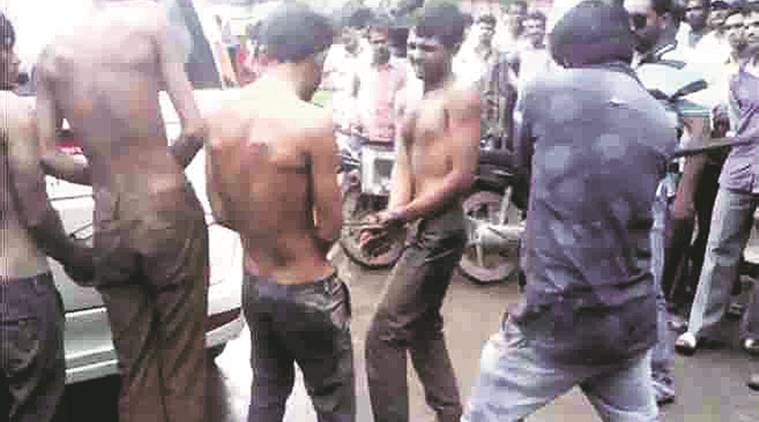
On July 11, 2016, four young Dalits were publicly flogged and paraded around in Una in broad daylight, for skinning a dead cow. The most inhuman kind of torture has been meted out to people on the pretext of cow protection, and the perpetrators in their bravado have uploaded the brutal acts on social media with impunity. The assaulters spread news of their act on a facebook video. Their actions sparked widespread protests in the state which transformed into a movement for Dalit rights. On July 31, at a Dalit Maha Sammelan in Ahmedabad, thousands of Dalits pledged to stop picking up carcasses and give up occupations like manual scavenging.
It also led to the formation of the Una Dalit Atyachar Ladat Samiti to seek justice for the victims of the brutal attack in Una. Shortly after, on August 5, 2016 the Dalit Asmita Yatra was flagged off from Ahmedabad and travelled over 400 kilometres through different villages of Gujarat. Pledges were taken in village after village to shun the traditional caste-based occupations of manual scavenging, cleaning sewer lines and skinning or disposing of dead cattle. The ten-day yatra culminated in the Azadi Kooch at Una on Independence Day. The Una protest and Dalit Asmita Rally are a historic response to attacks on Dalit lives, dignity and livelihood. They have seen an unprecedented unity of purpose with different individuals and progressive groups coming out in solidarity with this unique protest. The upsurge among Gujarat's Dalits even resulted in the resignation of then chief minister, Anandiben Patel. In a strange move, the then chief minister 'offered to resign' on August 1, through a facebook post on August 1, 2016.
Following the Una incident a Dalit man and his pregnant wife were allegedly beaten up by members of another community at Ugala village in Gir Somnath district for preventing them from grazing their cattle in a farm where the couple had been working as labourers. The incident happened on Christmas Day. Babubhai Sankhat (35) and his six-month pregnant wife Rekhaben (30) were allegedly attacked on December 25.“Babubhai and Rekhaben were hired by the farm owner to work in the cotton field at Ugala village. On December 25, they had an altercation with some members of a community who wanted to take their cattle in the field for grazing,” investigating officer and deputy superintendent of police, SC/ST Cell, PS Valvi said. An FIR was been registered at Gir-Gadhada police station in this regard. Police are yet to make any arrest.