Ajmer, Rajasthan : A special National Investigation Agency (NIA) court on Monday (22 MAR 2017) sentenced Bhavesh Patel and Devendra Gupta both RSS members to life imprisonment for their conviction in the Ajmer Dargah blast case.
The blast which took place on 11 October 2007, at the Shrine of Khawaja Moinuddin Chisti at the time of Roza Iftaar, had left three pilgrims dead and 17 others injured.
On 8 March 2017, the NIA court had convicted Patel, Gupta and Sunil Joshi in the case while acquitting others including Swami Aseemanand. Sunil Joshi murdered soon after the blast. This case has come to special court on 16 march but after hearing from both the parties court had postponed the judgement to 23rd March .
Judge Dinesh Gupta ruled out a death sentence citing mitigating circumstances, including the fact that the two had not been involved in any criminal activity prior to the blasts; they hadn’t been shown to be a constant menace to society; and they had been found guilty by drawing inferences from circumstantial evidence.
The case was handed over to the ATS Rajasthan and was later transferred to NIA which re-registered the case with the NIA police station in New Delhi on 6 April 2011.
In this case there were 12 accused, There were as many as 149 witnesses in the case and 451 documents were examined and the NIA filed three supplementary charge sheets in the case.
At the same time, the court questioned the NIA on its clean chit to two other accused, Ramesh Gohil and Amit, as well as “suspicious persons” such as senior RSS leader Indresh Kumar, Pragya Singh, Rajenda Chaudhary and Jayant, stating that it could not be done without invoking appropriate sections of the CrPC. It ordered the NIA DGP to do so by March 28. Ramesh Gohil died recently.
Has Media being biased? Invoking ‘Vasudhaiva Kutumbakam (the world is one family)’, Sharma sought appropriate sentences for the guilty, adding that “apart from Muslims, Hindus also come in large numbers to pay obeisance at the (Ajmer) shrine and the aim of the bomb blast in the holy month of Ramzan was to spread terror between the two communities and to prevent Hindus from going to the shrine.”
But none in the media mentioned these convicted terrorists as ‘Terrorist’ which applies on a particular community for even lesser crime. Has media being under control or they have taken charge to label accordingly?
The Uttar Pradesh police on Thursday arrested a man from Noida for allegedly posting an “objectionable” picture of the newly elected Chief Minister Adityanath on his Facebook wall, PTI reported. The vigilante group formed by the Yogi himself, Hindu Yuva Vahini, registered a complaint on the basis of which the UP police was prompt to act.
Rahat Khan, 22, was accused of posting the image and adding objectionable comments to it. The picture in question had a morphed image of the chief minister with a caption saying “Yogi hai, ya bhogi hai”, reported Hindustan Times.
Khan was arrested under Sections 66A of the Information Technology Act, 2000. Khan’s mother said her son was being framed by the land mafia who had hacked into his Facebook account and posted the content. She added that the Khan family has been involved in many social service activities. “We [the family] won applauds from Prime Minister Narendra Modi for raising the issue of triple talaq,” she told the English daily.The Supreme Court has struck down this controversial section of the IT Law.
The incident comes days after a woman in Bengaluru was booked for “objectionable” Facebook posts against Adityanath. A complaint had been filed by the Yuva Morcha members of the Bharatiya Janata Party under various sections of the IT Act. Clearly, sections of the Indian police, regardless of whether the states are ruled by the BJP like in UP or Congress as in Karnataka treat some persons as special, and the long arm of the law is used to stifle critical comments or satire.
Amidst Government of India seeking to make aadhaar mandatory for filing income tax returns, Right to Information (RTI) queries have revealed that the Unique Identification Authority of India (UIAI) has deactivated a whopping 85,67,177 aadhaar cards for “biometric update”, and yet another 408 for “demographic update” between September 2010 and August 2016.
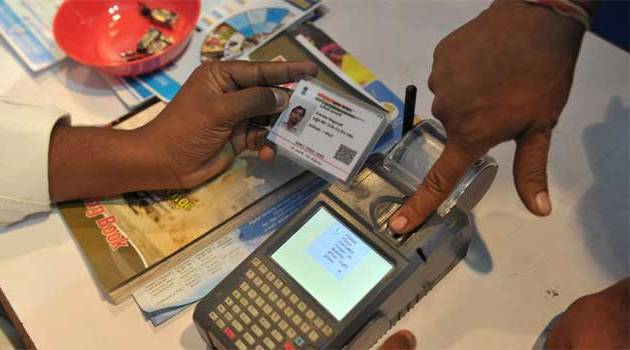
Interesting though it may seem, one of the RTI replies, given to a plea made by senior journalist Anumeha Yadav of left-of-centre site, scroll.in, says that aadhaar numbers requiring deactivation are “identified by enrolment processing systems” and the deactivation is done “without human intervention”.
Yet another reply says that the UIAI does not maintain “data on deactivations according to the enrolment agency or the registrar that carried out the enrolment, or the authorised official who carried out the deactivation”. In all, Yadav received five separate replies to her queries, which she had made last year.
Bringing this to light, Yadav write, “The Authority’s Data Update Policy states that the fingerprints and iris scans of infants and children enrolled in Aadhaar must be updated within two years of their attaining the age of five, and then again at the age of 15.”
“If they fail to do so within this stipulated two-year period, their aadhaar numbers will be automatically deactivated”, Yadav says, adding, as for the demographic updates – which are surprisingly extremely few (just about 408 in seven years) – these “pertain to changes such as death, change of address, or to correct errors in demographic data during enrolment.”
Yet another RTI reply says that UIAI does not maintain data on month-wise deactivations, nor does it maintain state-wise and district-wise deactivation data, which may be necessary to monitor if some states showed more enrolment or fingerprint errors and subsequent deactivations.
One of the RTI replies
Though Yadav is also told that “those whose numbers are deactivated are informed via text message on their mobile phones”, she is also informed that individuals are “not communicated the deactivation in printed mode or by post.
Yadav quotes Vikash Shukla, senior manager, communications and public outreach, UIAI, as saying, “Most deactivations occur as children are required to update their biometrics when they turn five or 15 years old, and if their data is not updated, their Aadhaar numbers get deactivated.” As for the grievances redressal system, the UIAI says in RTI reply, it does not have information on officials, within it or outside, who are authorised to carry out deactivation on receiving complaints, nor does it share information on the policy and procedure followed with respect to officials responsible for grievance redressal.
Pointing out that UIAI does receive complaints both through a portal of the Department of Administrative Reforms and Public Grievances, an online platform used by various ministries, and through post, one of the RTI replies shares year-wise and state-wise grievances received between 2010 and 2016 on the “PG portal”, but adds it does not maintain “any record for offline grievances submitted on paper.”
The reply further states that grievance redressal through the 1947 call centre services have been “outsourced” to Tata Business Service Solutions and M/S SMPL. “These firms have their own policies to recruit customer care executives [voice and non-voice], and it is their internal matter. These are contractual partners of UIDAl and UIDAI has no role in recruitments of staffing in these firms.”
According to Yadav, the replies are significant, as these also come following government notification that aadhaar, or at least proof of enrolment in Aadhaar, was mandatory for several vulnerable groups – including women rescued from trafficking, workers engaged in forced labour, schoolchildren between six and 14 years of age, and people with disabilities – to continue to receive government benefits.
In the case of the schoolchildren, for instance, they will not be served mid-day meals from June if they cannot present their Aadhaar credentials.
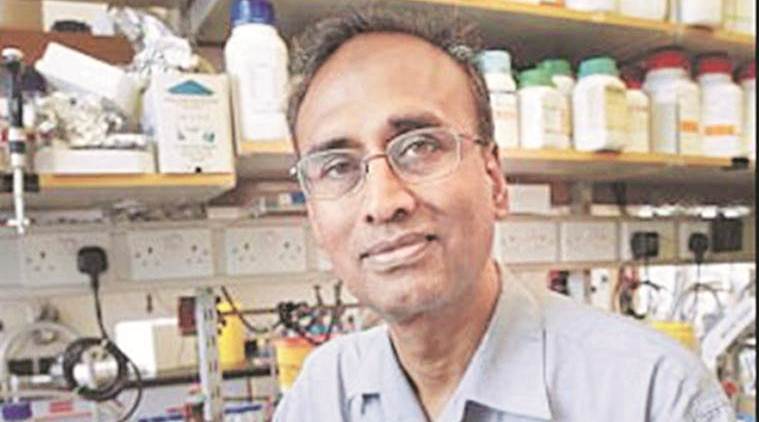
Aluminum of MSU, Vadodara & Nobel Laureate Venkataraman Ramakrishman has in a strongly worded letter assailed the university's move to trivialise the curriculum.
Venkatraman Ramakrishnan Image: Indian Express
On the university’s move, he wrote: “Instead of giving prominence to these real contributions [by people like (C V) Raman, S N Bose, J C Bose and (Meghnad) Saha and the invention of zero and the positional number system in the past], it is disappointing that the university chose to print an official diary that ascribes to figures from religious scriptures discoveries that belong to modern science, such as nuclear technology, airplanes and cosmetic surgery. The people who did this may think they are being patriotic, but in fact they are bringing disrepute to the university and to India generally. I urge the university to renounce these features in the official diary and consider reprinting the diary.”
According to Ramakrishnan, who won the Nobel Prize for Chemistry in 2009, such depictions bring “disrepute” to the university and the country.
Nobel Laureate Venkatraman Ramakrishnan, who is an alumnus of Vadodara’s Maharaja Sayajirao University (MSU), has urged its administration to consider reprinting its diary and planner, which credited sages from ancient India for their “contribution to science” — from “developing nuclear technology” to “discovering rockets and aeroplanes”. According to Ramakrishnan, who won the Nobel Prize for Chemistry in 2009, such depictions bring “disrepute” to the university and the country.
The Indian Express had reported on March 9 that the MSU’s annual diary and planner for this year, which was released recently, hailed nine Indian sages for work ranging from “discovering rockets and aeroplanes” to pioneering cosmetic surgery.
The paper reports that in an email sent Thursday to The Indian Express, Ramakrishnan wrote: “India has produced many great discoveries in the past. ***The most striking example is the invention of zero and the positional number system, which transformed arithmetic and mathematics in general. There were also many great discoveries made in the 20th century by people like (C V) Raman, S N Bose, J C Bose and (Meghnad) Saha.*** [Emphasis added.] In fact, the Science Museum in London is planning a special exhibition on Indian contributions to science and mathematics in connection with the 70th anniversary of Indian independence.”
On the university’s move, he wrote: “Instead of giving prominence to these real contributions, it is disappointing that the university chose to print an official diary that ascribes to figures from religious scriptures discoveries that belong to modern science, such as nuclear technology, airplanes and cosmetic surgery. The people who did this may think they are being patriotic, but in fact they are bringing disrepute to the university and to India generally. I urge the university to renounce these features in the official diary and consider reprinting the diary.”
Ramakrishnan was responding to a request seeking comment from this newspaper. The request was sent after Professor A C Sharma, dean, Faculty of Science, MSU, told the university senate during an ongoing debate on the diary that he had received an email from Ramakrishnan on the issue.
As The Indian Express reported, the diary hails Sushrut as the “father of cosmetic surgery”; Acharya Kanad as the one who “developed nuclear technology”; Kapil Muni as the “father of cosmology”; Maharshi Bhardwaj as the one who “discovered rockets and aeroplanes”; Charak Rishi as the “father of medicine”; and, Garga Muni, as the “scientist of stars”. The sages share space with eminent scientists like J C Bose, Vikram Sarabhai and C V Raman.
With the issue being raised at a senate meeting Thursday — the diary was not on the agenda — Prof Sharma told the gathering: “We know that this university has great alumni and many people who are associated with us. All of them don’t agree with our activity. Nobel Laureate Venkatraman Ramakrishnan has made a comment in this regard.”
Sharma, quoting Ramakrishnan, said, “Though I fully agree with all those who have sentiments for our history but before making anything public, we should have concrete evidence and whatever we are writing should be scientifically proven facts.”
During the debate, professors of the Faculty of Science contested the claims of senate member Jigar Inamdar, who referred to the Constitution to defend the representation of sages in the diary.
Inamdar produced pages from a reproduction of the Constitution, which depicted illustrations from Ramayana and Mahabharata, asked why an issue was being made about attributing the scientific inventions to sages.
“The Congress party has been objecting to the presence of sages in our diary saying that we are insulting the sages and our Constitution. But on Page 6 of the Constitution, we have a picture depicting the Ramayana and on Page 18, a picture of Mahabharat. So what is wrong with paying a tribute to the sages through the diary?” he asked.
Inamdar holds various positions in the university, including honorary executive director of the Institute of Leadership and Governance; Gujarat government-nominated syndicate member; elected senate member from the donor’s constituency, and, regional director of Indian Council for Cultural Relations (ICCR).
When contacted, Inamdar told The Indian Express that he did not agree with Ramakrishnan’s suggestion. “I personally respect Venki (as Ramakrishnan is popularly known). But just because he is a Nobel Laureate, whatever he says does not become true. He has the right to object. It is my right to say that the MSU diary should have these details about the sages, and it is his right to object to it. But just because he is a Nobel Laureate, we cannot accept whatever he says as truth,” he said.
“It is India’s misfortune that the British introduced the education system in India through (Thomas Babington) Macaulay. They destroyed our existing education system and kept the Western culture in mind. They taught the wrong history to all of us for all these years. Our Hansa Mehta library (in MSU) has several books related to astronomy that prove Indian scientific research. I am proud to be a BJP member and an RSS worker as the party is working hard to bring to light the actual Indian culture. The Congress regime has only pushed forward the Western education agenda.”
According to Inamdar, the debate should only be about whether the sages had been able to prove their research or not. “Who can prove that these Indian researches were not proven in their own time. I staunchly believe that Lord Ram travelled in the Pushpak Viman. There were no Wright brothers at that time. But the Pushpak Viman existed.
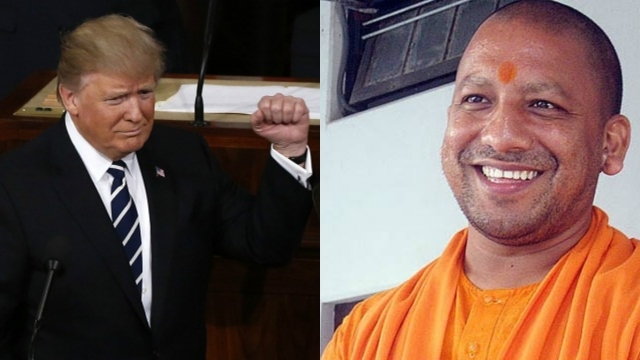
Trump says “When you’re a star, you can do anything, grab them by the p*ssy”. Yogi Adityanath while referring to inter-religious marriages talks about how if ‘they’ take one Hindu girl, then we’ll take away 100 Muslims girls. Trump mocks a reporter for his disability because the reporter is critical of him. Yogi Adityanath warns that if ‘they’ kill one Hindu, we won’t file an FIR but will get 10 ‘such people’ murdered. Trump labels Mexicans as rapists and criminals while Yogi Adityanath labels Muslims as Jehadis. Now, how does one choose between these two forms of extreme bigotry? Well, apparently some people can and Rahul Kanwal, the managing editor of India Today, is one of those who has this unique ability to choose between these two forms of bigotry.
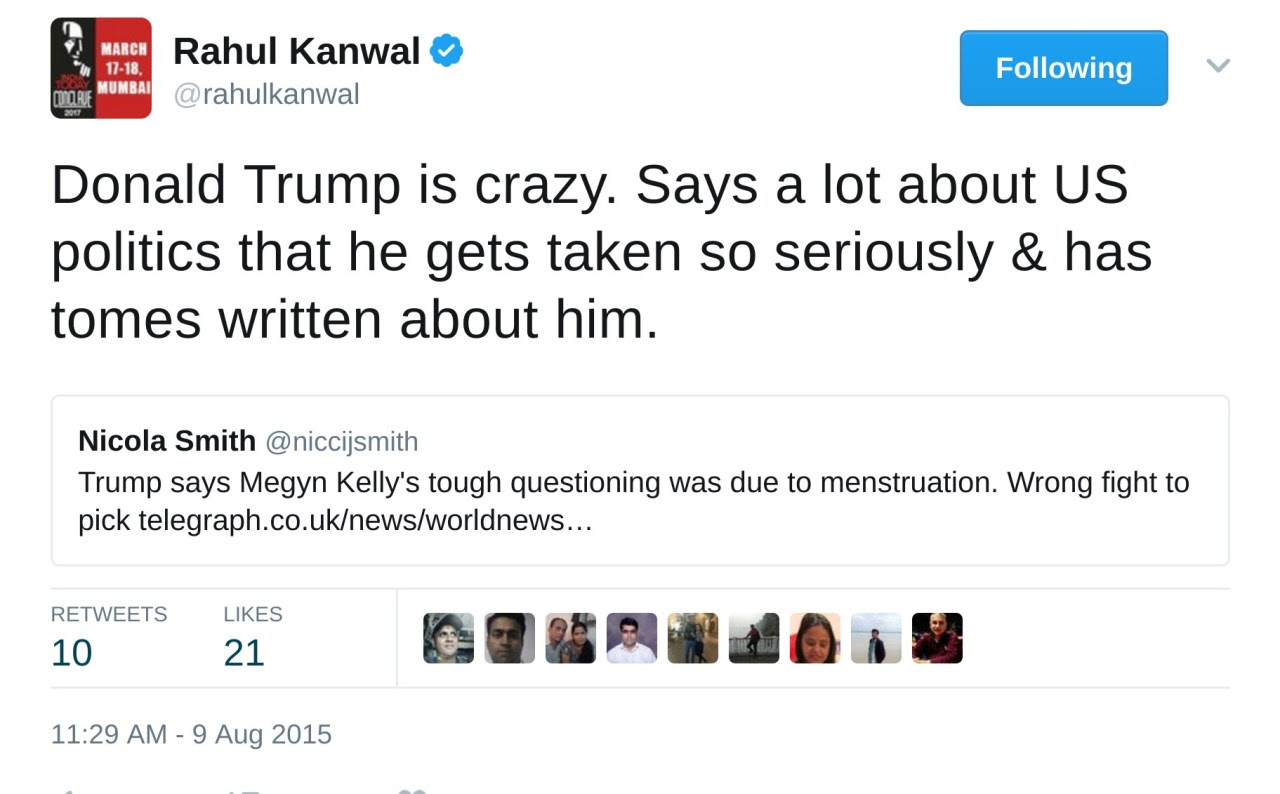
Let us first look at Rahul Kanwal’s views vis-a-vis Donald Trump as expressed via his tweets about the American President.
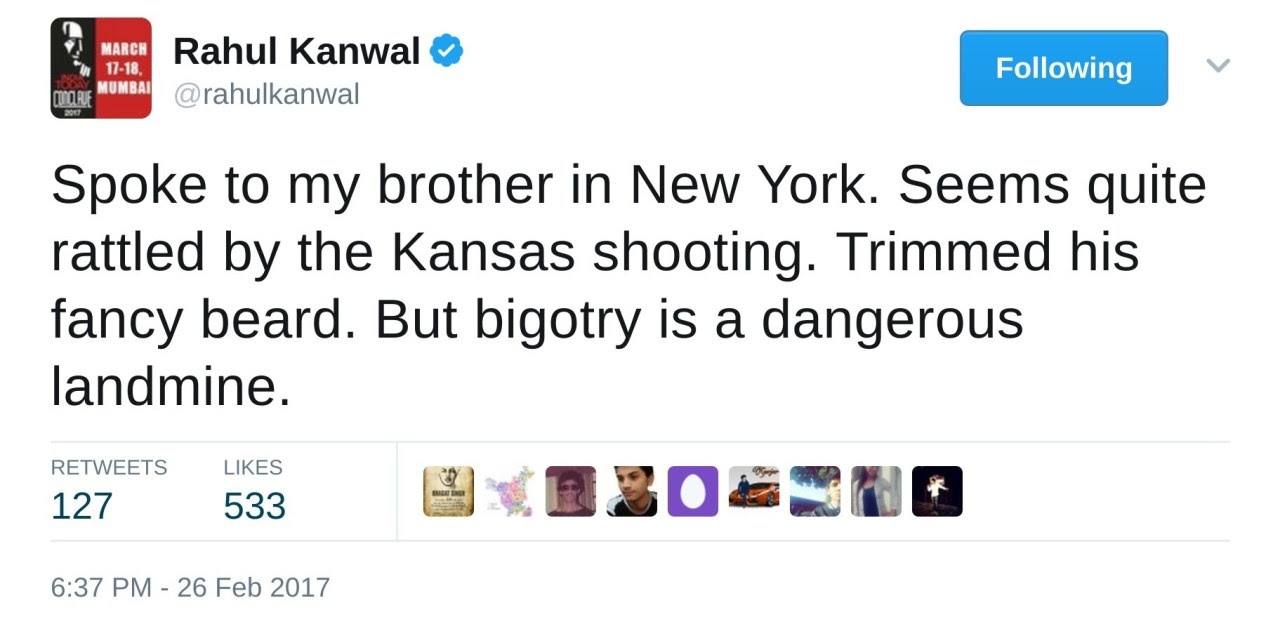
So, Rahul Kanwal thinks that it says a lot about ‘US Politics’ that a person like Trump is taken seriously. He’s essentially trying to point out at the degradation in US politics because a person like Trump was taken seriously. These were his views before Trump was elected as the President. In the last month, after Trump officially took over the charge as the US President, many people of Indian origin in the United States have faced racial attacks. In one incident, an Indian citizen, Srinivas Kuchibhotla, was shot down after being asked to go back to India by an American military veteran. This happened in a bar in the state of Kansas. What does Rahul Kanwal think about that?
He thinks that the bigotry that Trump has brought with him is a dangerous landmine, an opinion influenced by the fact that his brother felt rattled because of his ‘fancy beard’. In fact, Rahul Kanwal’s dislike for Donald Trump is such that he even recommends an application that will block anything related to Donald Trump.
So, if bigotry is a dangerous landmine as Rahul Kanwal claims in reference to Donald Trump, something which Yogi Aditynath has in abundance, you’d think that Rahul Kanwal would have a problem with Yogi Adityanath becoming the Chief Minister of Uttar Pradesh? If bigotry is a landmine, and you’re opposed to it because your brother is ‘rattled’ because of the consequences of that bigotry, surely you wouldn’t want your fellow citizens to be a victim of such bigotry? So, what does Rahul Kanwal think about Yogi Adityanath?
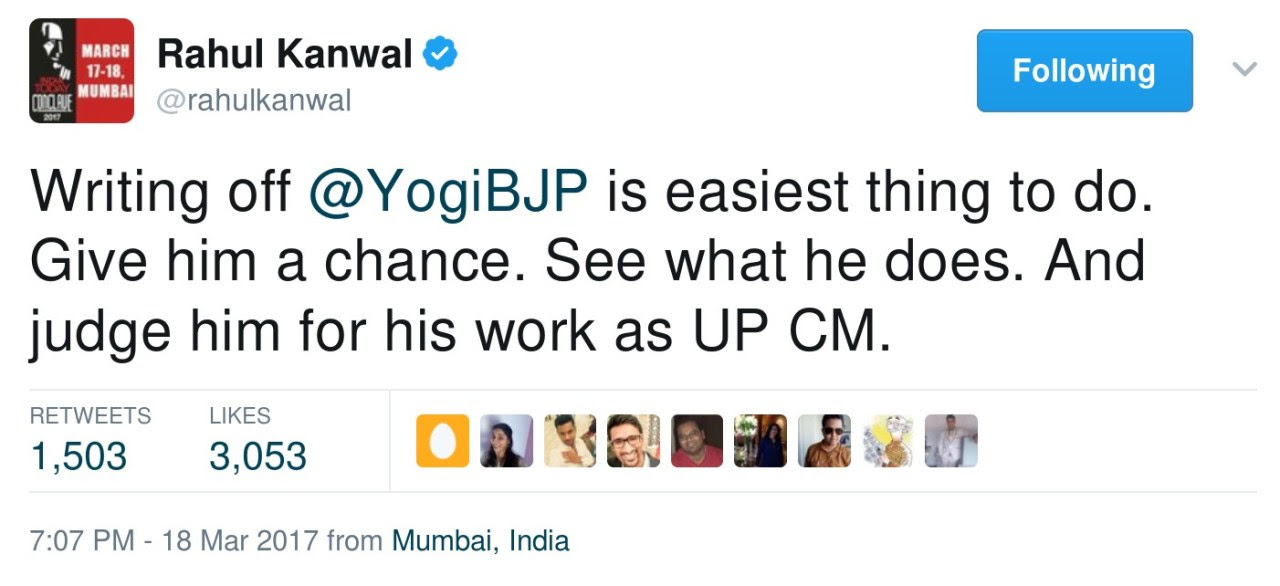
Oops! Apparently, not. Rahul Kanwal thinks that Yogi Adityanath’s version of bigotry deserves ‘a chance’. Rahul Kanwal thinks that a man who has given speeches in which he’s warned that “If they kill one Hindu, we will kill 100 of theirs” deserves a chance. Rahul Kanwal thinks that a man who thinks that inter-religious marriages are a case of Love-Jihad deserves a chance. Rahul Kanwal thinks that a man who offers Guns to Hindus in Dadri after the murder of Mohammad Akhlaq deserves a chance. Rahul Kanwal thinks that a man who demanded for the release of all the accused in the Dadri case deserves a chance. “Give him a chance, See what he does. And judge him for his work as UP CM”.
If only Rahul Kanwal’s brother with his ‘fancy beard’ was in Mau district during the 2005 riots when Yogi Adityanath’s Hindu Yuva Vahini reined terror, he probably would have used the adjective ‘bigoted’ at least once in reference to Yogi Adityanath.
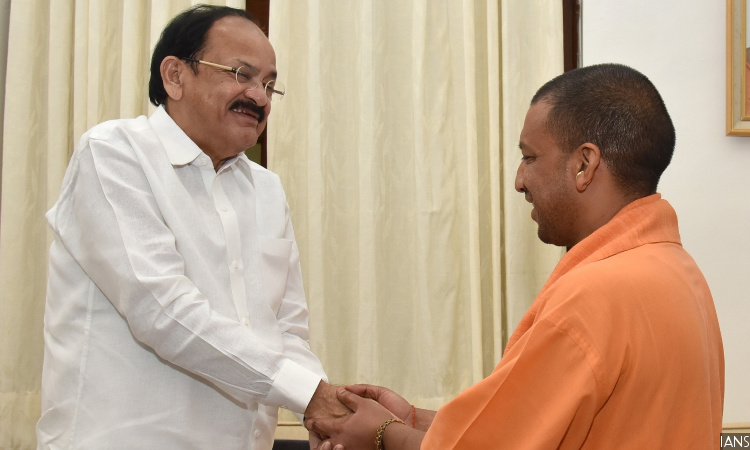
“It is unfortunate that some opponents, communalists are trying to portray him as a rabble-rouser and fringe personality. They should go through his parliamentary debates. Those reveal his seasoned thinking on various issues of governance,” union urban development minister M Venkaiah Naidu said on his Facebook page on March 19, 2017, referring to Uttar Pradesh (UP) chief minister Yogi Adityanath.
Factchecker did just that, analysing Yogi Adityanath’s performance over the last eight years as a member of Parliament (MP) in the 15th and 16th Lok Sabha (lower house of Parliament), using data from PRS Legislative Research, an advocacy focussed on parliamentary affairs, and the Lok Sabha archives.
Our four main findings:
While the 44-year-old politician raised a variety of concerns–including river pollution and rising cases of encephalitis–his most recurring choice of debates focussed on Hindu affairs and cow slaughter, particularly over the last three years.
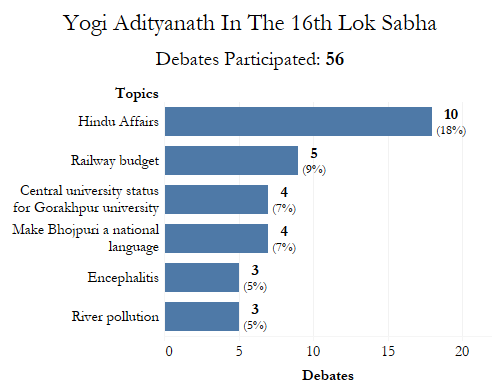
In the 16th (current) Lok Sabha, 18% of Adityanath’s debates have focussed on Hindu issues, seven-percentage points more than during his previous term as MP. The topics include cow slaughter, enforcing a uniform civil code, and protection of Hindu pilgrims. Even his debates on the Enemy Property Bill (now an Act) and his concerns about Indian youth in Islamic State of Iraq and Syria (ISIS), counted under internal security debates, held religious underpinnings.
A science graduate, Adityanath had the most queries (57) for the ministry of health during the 16th Lok Sabha: 11 were on corruption in medical bodies, and six on population control measures to address India’s “reported demographic imbalance”, a reference to his belief that Muslims, who make up 14.2% of India’s population, were growing faster than Hindus.
Adityanath asked almost as many questions (52) of the ministry of home affairs over the last eight years of the 15th and 16th Lok Sabha. Of these, 34% were related to fears about the effect of ISIS, Indian Mujahideen extremists and Christian separatists on internal security.
Here is a more detailed analysis:
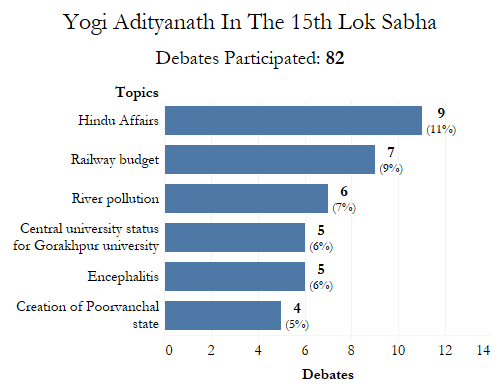
15th Lok Sabha (June 2009 to February 2014): Although Adityanath’s parliamentary attendance (72%) was slightly below the average for MPs from his state (79%) and the rest of the country (76%), he participated in more debates and asked more questions than the average MP, according to PRS Legislative Research data.
Adityanath participated in 82 debates against the average of 38 for other MPs.
While seven, or 8.5%, of the debates in which he participated were related to the railway budget, 11% of Adityanath’s debates were related to Hinduism. The topics included “reorganisation of the Amarnath Shrine Board and facilities for Amarnath pilgrims”; “lifting the ban on Kailash Mansarovar Yatra to Nepal”; and the need to “develop the area related to Ramayan era in Mithilanchal” (a proposed state in India that comprises part of the historic Mithila region, which extends into modern-day Nepal).
During this term, Adityanath, who has been charged for intimidation, rioting, promoting enmity between different groups and defiling a place of worship, also raised concerns over violence in Muslim-dominated Kishtwar district of Jammu and Kashmir, and UP’s Moradabad district, where Muslims constitute nearly half the population.
Adityanath, a science graduate as we said, also discussed the pollution of Indian rivers six times. He participated in five debates on the spread and eradication of encephalitis and Japanese encephalitis, and five on according “central university status” to Gorakhpur University. On four occasions, he spoke about carving a separate Poorvanchal state from eastern UP.
16th Lok Sabha (June 1, 2014 to March 15, 2017): Adityanath participated in 56 debates–fewer than the average of 72 clocked by MPs from his state, PRS data show.
In nearly a fifth of these–a seven-percentage-point jump over the previous term–the five-time MP (he was first elected to the Lok Sabha in 1998 at age 26) participated in debates that focussed on Hindu affairs. These included a national ban on cow slaughter, enforcing a uniform civil code, and ensuring the safety of Hindu pilgrims. Even his debates on internal security that voiced concerns about a conspiracy to bring Pakistanis to India through the Enemy Property Bill, and the alleged involvement of Indian youth in the Islamic State, carried religious undertones.
During this term, in four of five “Demand for Grants” debates on the railway budget that Adityanath participated in (data for the most recent debate in 2017 are yet to be put out)–which Naidu described as “levelheaded and inspiring”–the Gorakhpur MP primarily praised the budget and congratulated the railway ministry while criticising the previous Congress-led government and states where the party still holds power. In one debate, he presented demands for grants to set up rail lines and to upgrade rail infrastructure in his constituency, Gorakhpur.
He also wanted “central university status” for Gorakhpur University, and asked–in four debates–for the Bhojpuri dialect of eastern UP and Bihar to be regarded as a national language.
His concern for polluted rivers and the spread of encephalitis continued in his debates but took up a considerably smaller share (5%).
Regarding deteriorating law and order situation in Uttar Pradesh: “According to an estimate, incidents of murder, robbery, abduction and misbehavior are happening between 250 to 275 per day in Uttar Pradesh… These incidents are not only in conformity, but also by the National Crime Bureau.”
Regarding 5151st anniversary of Shrimad Bhagavad Gita: “I would like to request to you through the ministry of culture of the government of India that this event is required to be celebrated (sic) at the national level and at the international level, even then, wherever the world is full of jihadi terrorism, somewhere other religious obsessions, the whole humanity is moaning in those situations, the message of the Bhagavad Gita can pave the way for the welfare of all humanity.
Regarding the Disapproval Of Enemy Property (Amendment And Validation) Ordinance, 2016 And Enemy Property (Amendment And Validation) Bill, 2016: “If a government really fulfills this order (allowing properties to be returned to owners), half the cities of this country will be destroyed, a large population will be destroyed. A new class struggle will be created inside the country, and under it, all the citizens of Pakistan will start to make backdated ration cards together with those few vote bank merchants within India, and will start saying ‘we are living in India since 1947’. Under this guise, an attempt is being made to bring those people inside India.”
“Rapid reduction in the number of Sikhs and Buddhists along with sanatan (classical) Hinduism and the rapid increase in the Muslim population attract attention to the dangerous situation of demographic imbalance, it is shocking… the need for an effective equal civil law and population control is being felt within the country,” Adityanath said in a 2016 debate on uniform civil code.
While the country’s overall population grew at 17% in the decade to 2011, Census data showed Muslim population growth hit a 20-year low of 24.6% in 2011, as IndiaSpendreported in August, 2015.
Naidu, in his Facebook post, quoting a Hindustan Timesreport, said Muslims in the state welcomed Adityanath’s appointment. “A large number of Muslims seem to be celebrating,” the post reads.
30% of Adityanath’s questions to four ministries
In both the 15th and 16th Lok Sabha, Adityanath raised more questions than the average MP, with 347 queries (against the average of 300) upto February 2014 and 284 upto March 2017 (against the average of 180).
In the 16th Lok Sabha, queries to four ministries–external affairs, health and family welfare, home affairs and human resource development–formed 30% of his questions to 43 ministries.
In the 15th Lok Sabha, he directed nearly 50% of his questions to six of 39 ministries which include the four we mentioned earlier, and the ministries of railways and road transport and highways.
The external affairs ministry received 51 questions from Adityanath since 2009. Two-thirds of these pertained to his suspicions of anti-Indian activities and sentiments across India’s border, particularly in Nepal. Others include questions about imposing a ban on Pakistani movies and artists coming to India, security of the Indo-Nepalese border, and the “misbehaviour” of a Nepalese airliner towards Hindu pilgrims.
UP CM’s bills in Parliament: Ban on cow slaughter, renaming India ‘Hindustan’
Since 2009, Adityanath has had five private member’s bills pending in the Lok Sabha, more than the average of one per MP. They are:
The Constitution (Amendment) Bill, 2014 (Amendment of article 1, etc.): This proposes a change in the country’s name, from “India, that is Bharat,” to “Bharat, that is Hindustan,” according to this 2014 report on private members’ bills and resolutions.
The Ban on Cow Slaughter Bill, 2014: This bill, reintroduced in the 16th Lok Sabha, is a replica of Adityanath’s 2009 bill for the 15th Lok Sabha. In both versions, the three-page bill, which says slaughter of cow, bullocks, bulls and oxen should be banned on scientific lines, offers no details justifying the need for such a restriction.
The Constitution (Amendment) Bill, 2014 (Omission of article 44, etc.): This would turn the directive principle of creating a uniform civil code for India into a law. The implications of this bill would have far-reaching effects on the personal laws and practices of people of various religions in India.
The Constitution (Amendment) Bill, 2015 (Insertion of new article 25A): This seeks to insert a new article in the Indian Constitution that will ban forcible religious conversions.
The High Court at Allahabad (Establishment of a Permanent Bench at Gorakhpur) Bill, 2015: This seeks a permanent bench of the Allahabad High Court in his constituency.
None of these bills has been passed yet. Adityanath’s High Court bill and the ban on forced religious conversions are yet to be introduced in the House, as the Indian Expressreported in March, 2017.
(Saldanha is an assistant editor with IndiaSpend & FactChecker.)
They were in love and had been together for more than four months. But a few days ago, Shahjahanpur resident Feroz Ahmed (19) shot Gunjha Sharma (18) in the head and then killed himself with the gun, according to a report in the Times of India.
Both were reportedly under intense pressure from their respective families who were not happy with this inter-religious union. Family members told the Times of India that "the young couple had started feeling that, given the situation in the state, their relationship was going to bring trouble to their families."
So, on the morning of March 20, near the railway station at Bantara, in front of shocked witnesses, the couple hugged each other, following which Feroz shot Gunjha in the head and then killed himself with a pistol.
The police initially suspected this was yet another case of honour killing because the two belonged to different religions. However, eyewitnesses explained to the police what had actually transpired.
"It happened before we could even believe what was going on. The couple was standing near the railway station, and then they hugged, and then we heard the gunshots," said Mohan Singh, a local resident who happened to be passing by at the exact moment when the incident happened.
The relatives of both families were informed of the incident but both sides refused to take away the bodies after the post-mortem.
School attendance in this Haryana district fell to as low as 5% after a doctored video began to do the rounds on social media.
Image: Menaka Rao
In the morning of March 10, the government school teachers of Ghata village in Haryana’s Mewat district went from door to door to urge parents to send their children to school. They came back with just 20 children, most of whom were girls.“When we go to their houses, children run out of the house and up the hill in barely two minutes,” said Zakir Hussain, the government school principal, pointing to the Aravalli ranges behind the village.
Officially, 185 children are registered in the primary grades of the school and 60 children in the middle grades. But ever since rumours began to circulate in the local Muslim Meo community in early March that schoolchildren were being administered injections that would make them sterile, parents had stopped sending them to school. Attendance had fallen to as low as 5%, claimed officials.
Government officials have clarified no injections are being administered to children.
The first rumour was triggered by a truncated video taken from the Hindi news channel ABP News. The channel runs a programme called “Viral Sach”, which deconstructs and disproves rumours. The programme’s edition, which ran on February 11, focused on rumours in Tamil Nadu and Karnataka that school children were being injected with a substance that causes sterility.
In February, the Union health ministry had launched a campaign to administer the measles-rubella vaccine to children between the ages of nine months and 15 years. The campaign started with the states of Tamil Nadu, Puducherry, Karnataka, Goa, and Lakshadweep. The campaign was yet to reach Haryana.
The first half of the ABP News programme summarised the rumours that had spread in Karnataka and Tamil Nadu, while the second half featured experts, including doctors, debunking them. Only the first half of the programme circulated on WhatsApp in Mewat.
Soon, another video that had been shot locally surfaced. On March 4, an eight-year-old child from Meoli village was brought to Mewat’s government medical college with symptoms of breathlessness. The child complained that he was injected on his scrotum while he was playing in the jungle by an unknown person.
Dr Sansar Chand, the director of the college said that the child was kept under observation for a day and discharged. “He was breathing fast. His systems were perfectly all right,” said Chand. “We suspect the child had an emotional outburst in public. Perhaps it was just hyperventilation.”
But it wasn’t just viral videos – some people who had relatives working in South India, particularly Bengaluru and Chennai, heard about the rumours on phone.
In Autha village, Rashida Khatoon said her son, Rehan, who works as an air conditioning mechanic in Bengaluru, told her about the rumours which he had read about online. Since then, Khatoon stopped sending her seven grandchildren to school.
Harooni Khatoon’s son Khalid called her from Chennai and told her not send his children to school. “Duniya keh rahi hai,” said Harooni, a resident of Alipore Tigra. The whole world is talking about it, not just us.
Harooni Khatoon's son called her from Chennai and told her not to send his children to school. (Photo: Menaka Rao)
Looking for reason
Outside the school at Ghata village government health official Dr BS Singhal tried to reason with some men.
Singhal started by saying, “On the road, I saw an animal whose face was that of a lion and the body was that of a pig,” said Singhal. “Would you believe me if I said that?”
He waited for a moment people to react. Some of the men said “No” but did not seem to understand the point of this story. Singhal then added, “Rumours are always false. Please do not believe them.”
This hypothetical exercise to separate truth from rumours was repeated in the next school at Alipore Thirda village.
“There is no injection made in the world which can make a person sterile in just one shot,” he said.
Still, residents of the area were not convinced of and proceeded to ask him about whether their children might die from these injections.
“Ailaan nahi kiya, pakki nahi hui, tasalli nahi hui,” said Mohammed Hanif, a resident of Alipore Tigra. Hanif was adamant that only a declaration by the maulvi over the community loudspeaker stating would convince him that the rumours were false.
In three villages that Scroll.in visited, government officials had not held any public meetings regarding this issue till last week. Singhal visited two villages on Friday. Only teachers, Accredited Health Social Workers or ASHAs and other local workers were talking to people in the villages about the rumours. But without answers to worried parents’ questions about children falling sick or dying, they could do little to keep children in school. For instance, they did not know enough about what happened to the child from Meoli village to counter the claim.
But, most children went back to school during the week after Holi to write their exams, said Dinesh Shastri of the district education department. The principals of two schools confirmed the situation had improved but added that some children were still staying away.
Mehboob Khan, father of two girls who were in school that day, lingered outside the school gate just in case. “I am guarding my children,” he said.
Other health programmes suffer
Lack of school attendance had already caused some damage in early March. “For two weeks we could not run any government programme,” said Dr SK Kaushik of the district health department.
Every Monday, school children are given doses of iron and folic acid supplements in the form of tablets. Twice a year, children are given a dose of Albendazole as part of the deworming programme. The first dose of 2017 was due in March.
Deworming pills (top image) and iron and folic acid syrup bottles (bottom image)
But data collected by the district health department indicate that over the first two weeks of March, only a small fraction of all school-going children between the ages of 10 and 19 received the dose. Of the 1.35 lakh children in this age group, only 14,000 had taken the iron and folic acid supplement, 6,500 had taken the vitamin A syrup, and 5,000 had taken the deworming tablet, said Dr SK Kaushik.
Said Dr Krishan Kumar, senior medical officer at the community health centre of Firozpur Zhirka block: “We can only give the children these supplements if they turn up in school.”
This is the first part in a series on the spread of rumours in Haryana’s Mewat district.
This reporting project has been made possible partly by funding from New Venture Fund for Communications.