There is no disputing that the Narendra Modi-led BJP’s decisive, even spectacular victory in the politically significant state of Uttar Pradesh signals not just that much of his personal popularity remains but also that his party, grounded as always with the huge organisational muscle of the Rashtriya Swayamsevak Sangh (RSS) has mastered the fix that the Indian first past the post electoral system requires to win. The writer has written about the brazen use of money and muscle by the BJP, as also the carefully spun anti-minority rhetoric of Modi and his men, as the seven phase polls in UP wound down to the last day on March 8. The utter disregard for the Muslim minority vote or their concerns has laced the BJP’s policy framework and campaign especially since Modi captured the national leadership in the run up for the last general election in May 2014. (he was elected prime ministerial candidate in 2013)

Despite the high drama of this particular win, and the high decibel superlatives on Indian television channels so cheekily described by one of India’s sane television watchers, the veteran Shailaja Bajpai when she wrote of a “Dear Modi from Trump” column on March 16, dry numbers tell a more nuanced tale. Bajpai describes the terms used by India’s television anchors, “ ‘Look how they described your brilliant victory in the polls: “Modi Tsunami Sweeps”, “Tsunamo”, “Modi juggernaut”, “Modiwave”, “NaMoStar”, “NaMoStan”, “NaMoIsDominant”,
“NaMoForNewIndia”, “Modi, Modi, Modi’” and goes on in Trump mode to bemoan the American New York Times (NYT) and BBC as ‘losers’ in comparison!! What makes Indian television so grovel, fear, sycophancy or worse, a brazen corporate connect, is a question, too that needs asking!
Let’s come back to the results and the much needed, rational analysis, however. While there is no denying at all that the ‘Modi phenomenon’ needs serious, focused and more rigorous political tackling, there is no gainsaying the fact either that the BJP’s saffron chariot may have been convincingly halted in Uttar Pradesh just as dramatically as it was in Bihar just a year and a quarter back in November 2015, had the ‘secular’ opponents to what we in India dub as a proto-fascist force like the RSS, tied up in a grand alliance.
What then prevented from the political opponents of saffron-hued majoritarianism from coming together ‘to defeat the common enemy?’
Narendra Modi's party finally ended up with an impressive 312 seats in a House of 403, polling 39.7 per cent of the state's votes, while the Samajwadi-Congress alliance won just 54 seats. Mayawati's Bahujan Samaj Party finished third with 19 seats. The BJP's two allies, the Apna Dal and the Suheldev Bharatiya Samaj Party, together won 13 seats, with the Apna Dal's 9 seats outdoing the Congress's 7.
But what about the vote share? While there is no disputing that the defeat of all ‘secular’ forces in the politically significant state of Uttar Pradesh (UP) has been ignominious and the victory of the BJP under Modi decisive, yet again, the disparity between vote share and seats won, by themselves tell a story. Have a look at what is already up on the Election Commission of India Website.
A whopper of 312 seats won by the saffron BJP was a result achieved with a decisive 39.7 voter share, not an insignificant feat. What is not so explicable however, until one dissects both India’s first past the post system, voter distribution and share over vast regions and constituencies is the fact that second in vote share is the Bahujan Samaj Party (BSP) that even in the state assembly seats of 2017 got the second highest vote share at 22.9 per cent. The Samajwadi Party (SP) at a close number 3 with 21.8 per cent of the vote share won 47 seats and the Congreess with barely 6.2 per cent of the vote share got 7 seats!!
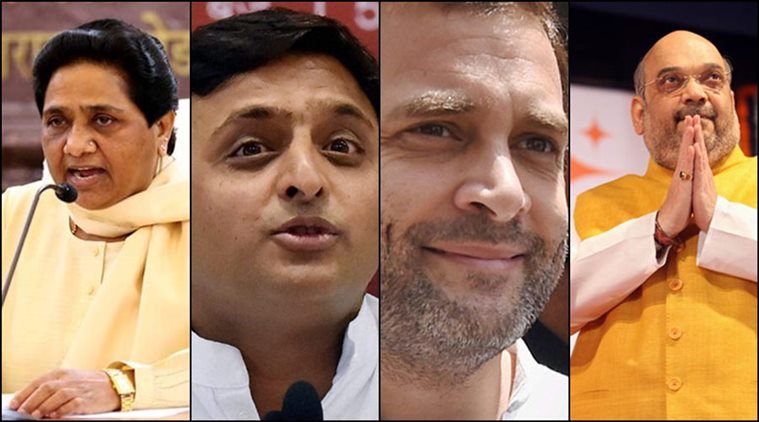
Number crunching takes us further: the BJP's votes in 183 of the seats it has won are less than the combined votes of the Samajwadi-Congress alliance and Mayawati's party, whom outgoing chief minister Akhilesh Yadav had tried courting on the eve of the results. Only The Telegraph, published from Kolkatta dealt with this at some length. Had the leaders of the three parties that opposed the RSS-BJP ensured that it was not a triangular contest (Akhilesh Yadav of the SP, Rahul Gandhi of the Congress and Mayawati of the BSP) and struck a successfully functioning pre-poll alliance, the BJP would have, arguably, won just 129 seats. The BJP's allies too would have lost seven of the seats they won, and the coalition would have logged in a tally of 263, a clear majority (this is after the adding the seats won anyway by the alliance and the BSP). Not as dramatic as what the BJP clocked in, but a clear majority nevertheless. And UP would have been saved the current brand of rabid majoritarianism, made worse by the choice of Adityanath by the Modi-Shah combine as chief minister.
In November 2015, another politically significant state of Bihar had ensured just such a loss for the BJP (under Modi)—the second state defeating the ‘charismatic prime minister’ after Delhi state in January 2015. In that election too the BJP had received more votes than any other party – 24.4 per cent of those polled in the state overall. But the "grand alliance" of the JDU (16.85 per cent of the vote), RJD (18.35 per cent) and the Congress (6.66 per cent) swept the election with a combined vote share of 41.86 per cent, winning 178 seats in a House of 243. The BJP won just 53 seats. The dye has however now been metamorphically cast and the run up to 2019 already gives a handicap to Modi and the BJP.
Here’s a quick look at only some of these 183 seats where the tally of the SP-INC and BSP’s votes is higher than that of the winning candidates, from the BJP. [The Sabrangindia Team has done a seat wise tally of these seats that will be uploaded here by the end of this week]. In the rural seat of Ajgara, that falls within the parliamentary seat of the prime minister (Varanasi), the number 2 candidate, Lalji Sonkar (SP) polled a not insignificant 62,429 votes and the number 3 from the BSP polled 52,480. Together this amounts to 1,14909 votes a decisively higher number than that polled by the winner from the BJP’s alliance partner, the Sukhdev Bharatiya Samaj Party, Kailash Nath Sonkar who got 83,778 votes. Similarly in another constituency located within the Varanasi segment, Pindra also a rural segment, the combined votes of the number two candidate from the BSP and the number 3 from the Congress were 10,1954 votes, higher than what the winner from the BJP got which was 90,614 votes.
Two of the eight assembly segments could have thus been wrested from the BJP in the Varanasi segment and in another three, Varanasi North, Shivpur and Sevapuri a more decisive fight ensured if such a grand alliance had been in place. Similarly look at the Aurai seat where the BJP candidate won with 83,325 votes. The SP candidate at number 2 with 63,546 votes and the BSP at number 3 with 49,059 votes together got 11,2605 votes.
Or check out the Aonia seat where the SP and BSP at number 2 and 3 respectively polled 11,3811 votes and the BJP won with just 63,165 significantly lower than the combined tally. In Allahabad North constituency, again, the BJP won with 85, 518 votes when the number two, sassy student leader Richa Singh from the SP obtained 60,182 votes and the number 3 from the BSP polled in 40,499 (totalling 100,681 votes.
The list is long and a similar trend can be seen in 183 of UP’s state assembly seats. Aliganj, Aligarh and Alapur tell a similar story. In Aliganj the combined votes of the secular opposition is 121119 votes and the BJP candidate won with 88,695 votes. In Aligarh where the BJP won with 11,3752 votes the number 2 and 3, SP and BSP respectively polled 98,312 and 25,704 votes totalling12,4016 votes. Similarly in Alapur where the BJP won getting 72,366 votes, the combined opposition vote is far higher at 11,8444.
So what was it about narrow, competitive politics that did not ensure a sagacious and rational alliance that could have stopped the majoritarian and supremacist BJP in its track? Will India be able to recover from this historical miscalculation and political short-sightedness? Amethi in Uttar Pradesh is a particularly crucial constituency for the Congress given the fact that the Gandhi scion, Rahul Gandhi wins his parliamentary seat from here. Even here, in this crucial assembly segment, the ‘secular opposition’ was not able to bury their personality driven differences and what followed was not a three but a four cornered contest!
Here is what the poll results show: The SP candidate polled 59,161 (quite close to the winner from the BJP who acquired 64,226 votes) while the BSP at number 3 polled 30,175 votes; worse the Congress also polled a separate candidate (belying the alliance logic) and got 20,241 votes. Add up the three opposition parties and you have a figure of 10,9577 votes decisively higher than what the BJP candidate won. But win they did.
The Muslim Vote
This writer has written consistently on how the BJP has over the past two elections successfully marginalised the Muslim vote in UP. Muslim votes make up about 19% of the electorate. The BJP's resounding victory , even in Muslim concentration areas, has led to speculation that, either the Muslim vote got divided between SP and BSP letting BJP win easily, or that Muslims voted for BJP. Both appear to be erroneous theories.
The SP (29%) and BSP (18%) together got 47% vote in the 59 constituencies in UP where more than a quarter of the voters are Muslim. This is virtually unchanged since 2012 elections, although it went down to 43% in the 2014 Lok Sabha elections. So, the Muslim support for the two parties is intact. The difference this time was that the BJP mopped up most of the other votes –getting 39% of total votes. This was less than their 43% in 2014 Lok Sabha elections but still so far ahead of the rivals that they won 39 seats while SP won 17 and BSP ended up with none. SP's 29% vote share in these seats shows that its Muslim sup port base was largely intact.The Dalit Vote There was a much hyped battle between the BJP and BSP to win the Dalit votes, especially non-Jatav dalits. Dalits make up about 21% of the population in UP. Since the BSP lost badly in the elections ending up with just 19 seats, there was a view that the Dalits voted en masse for the BJP.
Actually , the BSP has got 24% votes, down from its 27% in 2012 but up from 23% in 2014 Lok Sabha elections. Among the 85 reserved seats in the state, the BJP outflanked all other parties by getting 40% of the votes with the BSP a distant second at 24%. Again, the BJP's appeal was across all castes and may have included some Dalit communities too, but BSP's vote share indicates that it is just about retaining its Dalit base while the BJP surged ahead.
Much is now being written and said about the need to match Modi’s social media engineering, the BJP’s troll expertise, the Modi magic with the electorate. None of these are insignificant observations. Senior analyst and former Indian bureaucrat, SP Shukla has called for the need for a more transformative agenda that appeals to the small peasantry and youth, but also which rises above the simple arithmetic of identity based politics. The language of that mobilisation will be crucial in coming months and a real challenge to the Indian political class. Are they up to the task?
Says Shukla, “The explosive potential of the peasantry in crisis cannot be overstated. Nor that of the burgeoning legions of youth seeking jobs with dignity. Today they could be won over by the slogans of cultural nationalism and the tactics of social engineering. But it would not be long before the hollowness of the strategy is exposed spreading massive discontent and unforeseen, anarchic upheavals.
No nation-state can survive long, let alone prosper, with a huge population of 18 crores of its people sulking as second- class citizens and feeling insecure. No amount of ‘nationalist’ sloganeering can eradicate that fact. No amount of force can alter that fact. The only viable politics for India is that based on the inclusive and modern values of Equality, Liberty, Fraternity and Justice. We need to reinvigorate these fundamentals enshrined in our constitution and reconstruct the narrative of nation-building.
This is a challenge that has been long in the making.