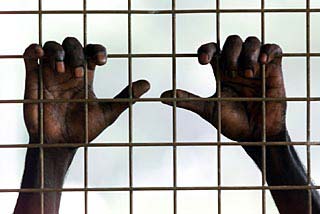
There were 35 such deaths in Maharashtra in 2013, 21 in 2014, and 19 in 2015, taking the score to the highest among all states. This is what the Government admitted on Tuesday: that instances of custodial death in Maharashtra were "little more" in comparison to other states."Custodial deaths in Maharashtra are a little more," Minister of State for Home Kiren Rijiju said in Lok Sabha during Question Hour.
The minister also submitted nationwide statistics of custodial deaths, according to which, there were 35 such deaths in Maharashtra in 2013, 21 in 2014, and 19 in 2015, highest among all states.Rijiju said there were enough guidelines and directives issued by the National Human Rights Commission and the Supreme Court under which immediate action is taken against policemen responsible for custodial deaths.
BJP member Satyapal Singh, a former Commissioner of Mumbai Police, tried to counter Rijiju's statistics saying that Maharashtra Police and Mumbai Police were the best police forces in the country, prompting hearty laughter from members. Responding to the comment, Speaker Sumitra Mahajan remarked "We will have to find out your records", leading to another bout of laughter from the MPs. However, former Union Home Secretary R K Singh and former Director General Police of Jharkhand Police V D Ram, both BJP MPs, seemed to disagree with Satyapal Singh and wanted to speak.
The formal closure of Posco’s steel plant project in Odisha is seen as a victory of agrarian economy over unwanted industrialization and the betel leaf farmers of Jagatsinghpur are rejoicing, although those who lost their land face new challenges
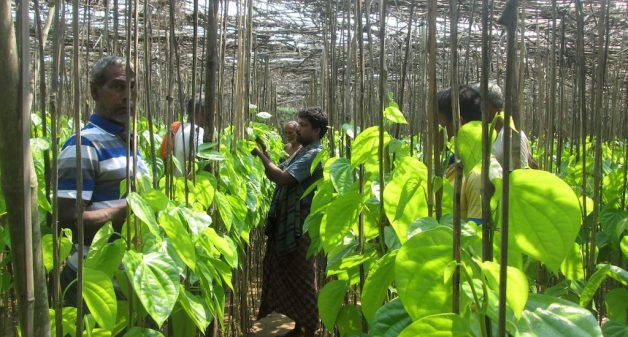
A betel leaf vineyard in Jagatsinghpur district of Odisha. (Photo by Basudev Mahapatra)
In a unique case of victory of the agrarian economy over mineral-based industrial economy, betel leaf farming in the Jagatsinghpur district of Odisha proved to be more dependable and promising than the proposed $12 billion integrated steel plant project planned by one of the world’s largest steel producer POSCO.
The betel leaf stood firm against steel and forced the South Korean steel major out of its Odisha project. POSCO confirmed the withdrawal of its project by requesting the Odisha government to take back the land transferred in its name, according to a statement by Odisha’s Industry Minister Devi Prasad Mishra made on March 18.
POSCO had suspended its the project in July 2015 and, later, by deciding to temporarily freeze the project in 2016. Experts say POSCO had to drop the idea of investment in Odisha as the project couldn’t make any progress over the years due to strong resistance by local people. Since signing a memorandum of understanding (MoU) with Odisha government for the project on June 22, 2005, POSCO faced consistent opposition from local people, many of whom were betel leaf cultivators.
Betel leaf economy It’s important to realize the economic importance of betel leaf in order to understand the factors behind people’s fight against the gigantic project that would have attracted largest investment by a foreign company to India.
“This is not just a leaf, but the soul of our life and economy and the source of income that any industry can hardly offer to us,” said Ramesh Chandra Pashayat of Govindpur village, who had lost his betel vineyard for the POSCO project.
“After meeting all expenses and making the labor payments, I used to earn around Rs 50,000 a month from my vineyard on nearly 40 decimal of land. This apart, the cashew plants around it fetched me be Rs 30-40,000 in a season. This apart, the mango and moringa trees in the vicinity always supported our food and income,” said Sridhar Swain of the same village, while asking: “Given the fact that I don’t have any formal education, can POSCO or any other industry offer me an opportunity of this kind?”
“This is the reason why we opposed POSCO and wanted to protect our land and the dependable source of livelihood — the betel vines,” Sridhar told VillageSquare.in.
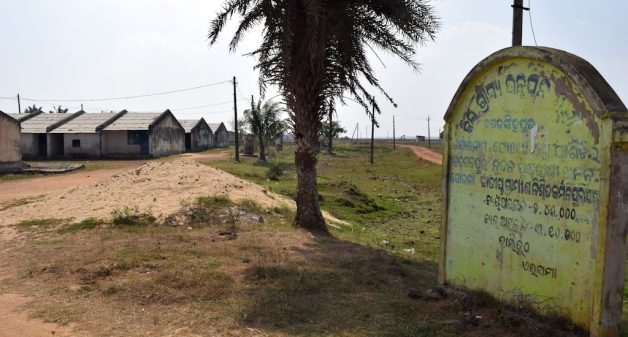
A transit camp lies abandoned after supporters of the Posco project were evicted. (Photo by Basudev Mahapatra)
Stronger than steel According to the farmers, the vineyards raised by the villagers had the potential to employ thousands of people from this locality and even from outside. The daily transaction in the betel leaf business in the area exceeded Rs 5 million.
“The cultivation of betel leaf generated significant income. Destruction through the project development promised little compared to the social, economic and cultural benefits of existing livelihoods,” notes the Routledge International Handbook of Criminology and Human Rights, based on facts collected on the ground.
As per rough estimates, a vineyard raised on an acre (100 decimal) of land usually fetches the farmer a profit over Rs 1 million every year. This means every decimal of land pays the farmer at least Rs 10,000 a year. This economics probably made the betel leaf stronger than steel and a better choice for people.
“While acquiring land for POSCO, the government offered us Rs 11,500 per decimal of land as one-time compensation money. How could a farmer sacrifice the land permanently for such a meager compensation?” questioned Bishnu Das, a betel leaf grower.
Forceful demolition Despite strong opposition from the farmers, the government didn’t heed to their voice and demands. Going by its unilateral decision in favor of POSCO, the local administration demolished hundreds of acres of vineyards by force. “Some of the vineyard owners were forced to accept the compensation money and vacate their land while at least 32 farmers didn’t get any compensation for their vineyards,” said Nibha Samal, a farmer.
“I had spent nearly 3 lakhs of rupees to raise my vineyard on 60 decimals. The administration demolished it but didn’t pay any compensation money. The list of farmers published by the administration listed many who never had a vineyard while several of the real farmers didn’t feature in the list,” 60-year-old Shiba Bardhan told VillageSquare.in. “We have filed cases against such injustice done to us by the administration.”
“They did not only destroyed the betel vines but also cleaned the area by cutting trees around and made our green surrounding look like a desert,” said Gouri Das, a woman farmer.
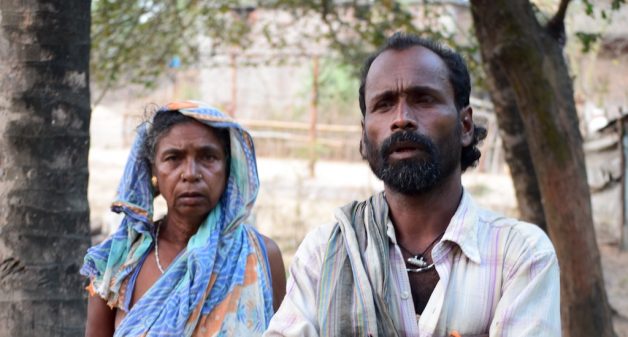
An anguished Gouri Das, seen here with her son Ranjan Das, has lost her land to the now-abandoned steel project. (Photo by Basudev Mahapatra)
Battle won, but challenges remain Despite all efforts to curb the people’s movement and acquire the land, POSCO is now a lost dream for the Odisha government. On the other hand, though the people’s movement came out victorious so far, it’s only a lose-lose situation for the people who lost their land, livelihood sources and everything for POSCO.
Their betel vines were demolished with promises that the upcoming project would provide an alternate livelihood. As the industry didn’t come, their livelihood is now completely lost.
“The compensation money they paid has been exhausted by now because we had to live without any immediate employment. The project didn’t happen. We are now reduced to daily wagers. How will we survive with a daily wage of 200 rupees?” asks an angry Gouri Das who has lost his land.
“The government forgot all its promises like an interim stipend, alternate livelihood etc. So, once farmers, we live like beggars today,” said Ramesh Das, who has not only lost his land but also has broken his hand in the conflict between people and the government over the POSCO project.
Those who extended whole-hearted support for the project and submitted their land are living a more miserable life. “The government betrayed us. We surrendered all our resources to see the industry in our area and enjoy the benefits of industrialisation. But the government couldn’t make it possible. Nor has it returned the land to us to continue our traditional economic activities like raising betel vines to make a survival,” said Tamil Pradhan, leader of people who supported the government.
The most pathetic story is of the people who sacrificed everything for POSCO and were kept by the government in a transit colony. “They were the first supporters of the project. But as POSCO decided to freeze the project, we suddenly became a burden on the government. The administration threatened to disconnect electricity and lock the houses unless we vacate the transit colony immediately and return home,” said Chandan Mohanty of Patana village, who was also the president of the POSCO Transit Colony Association.
“The administration even didn’t bother to shift us to our village safely. So, we had to negotiate with people who opposed POSCO project and came back to our village to live our own destiny,” he said with agony.
Sounds of another battle As the plights of people keep increasing since POSCO has shown indications to withdraw its Odisha project, the discontent among people of the project area is simmering too. “Since POSCO has scrapped the Odisha project and the government has not taken any responsibility of the affected people and the land losers, the lands must be returned to people immediately,” said Tamil Pradhan who also hinted that the affected people and land losers are to hold a meeting soon to decide on the issues and to re-occupy their land. “If the government was not sure about the intentions of POSCO, why did it take away and ruin our guaranteed sources of livelihood? Even if we get the land wherefrom we shall get money to re-raise our vineyards?” asked Jayanti Pashayat and many other farmers who have lost their land has been acquired for the POSCO project.
Even the POSCO Pratirodh Sangram Samiti (PPSS), which opposed the steel project, has announced to start a mass repossession drive in the affected villages.
However, there is very little chance for the land losers to get back their land because, as per Odisha government’s revised policy for land acquisition notified on 7th February 2015, “Land acquired and possession taken over but not utilized within a period of five years from the date of possession shall in all cases revert back to the State and deposited in the Land Bank automatically.”
“The acts of the government are highly questionable because it destroyed the sources of people’s livelihood and couldn’t bring the industry to fulfill its promises of alternate livelihood. Putting people in such a miserable state is purely anti-people and against the very spirit of democracy. We won’t allow this to continue and, also, won’t allow the farm lands to be converted for any other use,” said Abhay Sahu, president of PPSS.
“Shortly, we are going to start another movement against the government and mobilise people to repossess their farm lands and reconstruct their vineyards for the cultivation of betel leaves,” PPSS Spokesperson Prashant Paikray stated.
The sounds of another war to reoccupy the land and revival of the betel leaf economy have started reverberating in the villages surrounding the land acquired in the name of the POSCO project.
Basudev Mahapatra is a journalist based in Bhubaneswar.
Cross party complaints have been received from UP, Nashik, Pune and Mumbai showing alarming levels of electoral manipulation
In the recent concluded local elections in Maharashtra, serious accusations have been made about tampering with the Electronic Voting Machines (EVMs). Following the results of the District Panchayat and Mahanagar Palika polls, several complaints to the state election commission have alleged that EVMs had been hacked. The fraud has gone to inexcusable levels: in many places, a large difference has been noticed between the number of voters registered and the votes counted.
In Mumbai, it has been found that one candidate had secured '0' votes. In this context candidates of the respective parties have registered complaints before the Election Commission. Several parties across the political spectrum, the Shiv Sena, the NCP, the MNS, and the Congress candidates have lodged complaints about an alleged fraud within the EVMs.
Besides, tampering has also been alleged with the electoral rolls. During the polls of Mumbai Mahanagar Palika, 11 lakh voters lost their right to vote at the last moment, as their names were missing. Many of these were from underprivileged sections of society.
For example, in one ward of Nasik town it so happened that the number of votes cast were more than the total number of voters registered. In Yeravada ward of Pune, the number of voters registered were 33289, but during counting votes cast were found to be 43324 (at least 10,000 higher!). In one area, after issuance of confirmation letter of victory under the article 194, a victory procession was taken out. Later on after one hour, the victorious candidate was told that the counting of one EVM was still pending. In that EVM all the votes cast were found in favour of BJP candidate and suddenly the results were overturned and the BJP candidate was declared as winner.
In the Sakinaka area of Mumbai also, one Independent Candidate Shrikant Sirsat secured '0' votes. He has maintained in his complaint that even when his family and neighbours had cast votes in his favour, the outcome was a Zero vote! In Nagpur also, NCP has raised a clear demand for inquiring into the ‘EVM scam.’ In Amaravati town, all the parties have together gotten together and called for a 'Bandh' against the misuse of EVMs. The protest received a good response. In Kolhapur, one former Judge of the High Court, B. G. Kolse Patil is on record saying that that as there is tampering with EVMs, and the necessity of a verifiable paper trail machine is inevitable. If it is not possible then a demand for 'back to ballot' should be made.
Similar incidents of election-related fraud have allegedly taken place in several locations in the course of the recent elections to five Indian States as learned from reports in the media. BSP supremo, Mayavati and all other opposition parties have levelled accusations alleging large scale irregularities committed through the EVMs in the recently concluded Assembly elections to the state of U.P. The accusations are serious, alleging as they do that through this alleged EVM tampering, the state election results have been actually manipulated.
The current outcry against EVMs this time being articulated by BSP’s Mayawati and Aam Admi Party’s Arvind Kejriwal have been echoed by senior BJP leaders in the past. In 2009, it was the BJP's Lal Krishna Advani, and Dr. Subramaniam Swami who had expressed severe distrust and doubts against EVMs and party's chief spokesman G.V.L. Narsimha Rao had even authored a book on the subject.
Many computer experts have opined that since the EVMs function through computer programming, this programming can be manipulated by hackers with requisite skills. Technical experts assigned the job of keeping a vigil on the security of the EVMs also believe that it is not difficult for EVMs to be hacked.
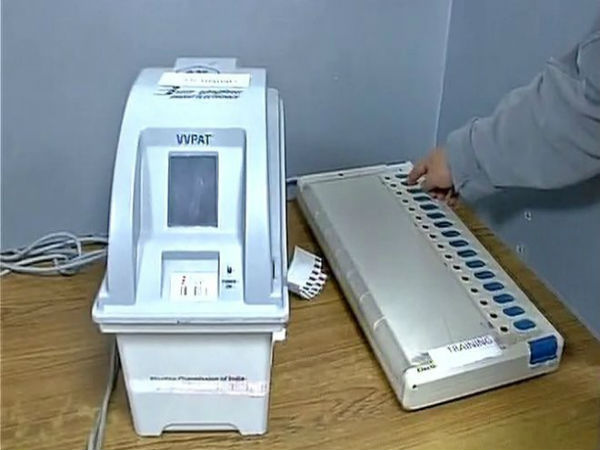
In the year 2009 it was the BJP, then in the Opposition that had, accompanied with electronic experts, initiated a campaign across the length and breadth of the country, attempting to prove that EVMs can be tampered with. It was in response to this robust movement, that carried on till 2014, that a direction was obtained from the Supreme Court (SC): to implement the 'Voter Verified Paper Audit Trail' (VVPAT). This needs to be urgently implemented. The Paper Trail is such a method, which allows a voter to obtain permission to verify whether his/her vote fell to the candidate that he voted for. This is how it works: After the voter casts his vote, a printed sheet comes out of the EVM which reveals, to him/her, who he/she had voted for. The Supreme Court (SC) has now, again, in 2017, — opining that for free and fair polls, the VVPAT is essential– issued one more directive to the Election Commissioner to ensure its implementation.
Through this Paper Trail Method of Verification, the sanctity and transparency of the electoral process can be maintained; and the credibility of the EVM machines can also be ensured. During voting a cross-check related to accuracy can be maintained and in the event of any controversy, through the manual counting of votes, any dispute can be resolved. For free and fair elections, such a Paper Trail is inevitable. By doing so, the trust of the people, the Indian voters on the EVMs can be regained.
Will the Election Commission responsible for the deliverance of free and fair elections implement the SC directive on the Paper Trail? Before complete faith on the electoral process is shaken, all concerned citizens and the organisations must make intense efforts for the compulsory implementation of the Paper Trail. Our demand must be that the Gujarat Assembly Polls must take place, in 2017 with the fall-back Paper Trail Method firmly in place. This is the need of the hour.
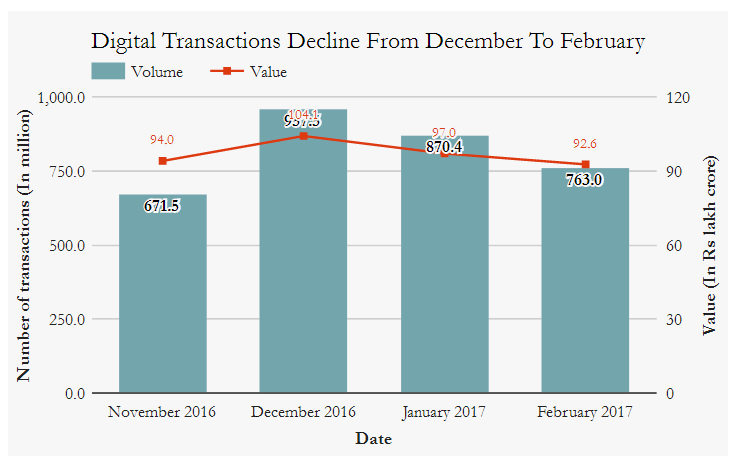
The value of digital transactions nationwide declined marginally (1.5%) to Rs 92.6 lakh crore ($1.4 trillion) in February 2017 from Rs 94 lakh crore in November 2016 ($1.42 trillion), according to representative data (provisional) on electronic payments released by the Reserve Bank of India (RBI).
The data do not cover all transactions across all banks. But, card payments data for four major banks, mobile banking figures for five banks and prepaid payment instruments (PPI, meaning mobile payment gateways such as PayTM and FreeCharge) data for eight non-bank issuers have been considered as representative for analysing trends in payments.
Digital transactions (volume) had increased 42% from 672 million in November 2016 to 958 million in December 2016 but have since declined 20% over two months to 763 million in February 2017.
This puts in peril the government’s target to achieve 25 billion digital transactions in 2017-18, which translates to at least 2 billion transactions per month. The February 2017 figure of 763 million transactions falls 60% short of the monthly requirement.
“The continuance of that high growth with a further pick up in some components (of digital payments) (sic) from November to January 2017 was a positive fallout of demonetisation. However, the pace of growth moderated somewhat in February 2017,” the RBI noted in its first assessment of demonetisation, Macroeconomic Impact of Demonetisation- A Preliminary Assessment.
Nine of 11 digital platforms show decline
Prime Minister Narendra Modi—whose narrative of development earned Bharatiya Janata Party a landslide mandate in the 2017 Uttar Pradesh assembly polls —changed his demonetisation narrative from black money and fake currency initially to digital/cashless economy later, IndiaSpend reported in December 2017.
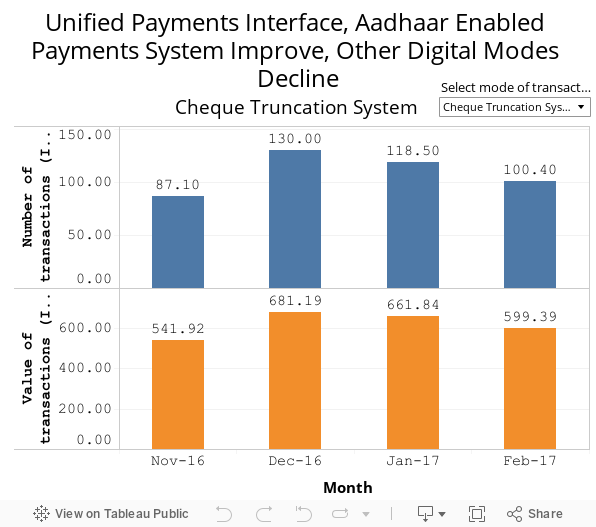
Only two payment platforms, Unified Payments Interface (UPI) and Aadhaar Enabled Payments System (AEPS), show a consistent rise in value (in Rupees) and volume (number) of transactions post demonetisation. All other forms have shown a decline–either consistently or in one or two months in the four-month period.
While UPI links mobile applications to a person’s bank account directly, AEPS is an Aadhaar-linked biometric identification system used for direct cash transfers under government schemes.
Source: Reserve Bank of India, National Payments Corporation of India Note: (1) Figures are negligible, so units have been changed. (2) Card transactions of four banks. (3) PPI issued by 8 non-bank issuers for goods and services transactions only. (4) Mobile Banking figures are taken from 5 banks. The total volume & value of electronic payment systems does not include mobile banking.
“Digital cannot substitute cash. The share of digital among transactions might increase in the long run but cash is affordable,” Rajeswari Sengupta, economics professor, Indira Gandhi Institute of Development Research, told IndiaSpend.
“Digital transactions demand a person to buy a smartphone and spend on data, which incur higher cost per transaction. People naturally prefer cash where the cost is borne by the government.”
Use of online banking using the National Electronic Funds Transfer (NEFT) platform reduced consecutively in January and February 2017, while that of Immediate Payment System (IMPS) increased in December 2016 and January 2017 but declined in February.
“The catalytic push from demonetisation hastened migration towards digital payments in November and December 2016. However, ease in availability of cash by progressive remonetisation impacted the pace of growth of digitalisation in February 2017,” the RBI assessment said.
Debit and credit card transactions for four major banks show little difference between November 2016 and February 2017–205 million swipes transacting Rs 35,200 crore in November 2016 to 212 million swipes transacting Rs 39,200 crore in February 2017.
“As the cash in circulation will settle to a lower normal than the pre-demonetisation levels, digital payments will settle at a higher normal and continue its upward trend as before,” Sangram Singh, head of cards and payments, Axis Bank, told IndiaSpend.
Card transactions improved to 311 million swipes transacting Rs 52,000 crore in December 2016, showing a 50% rise in transactions and 48% rise in value transacted over a month.
But the pace of addition in debit and credit cards has not been matched by an equal focus on point of sale (PoS) terminals.
“..in comparison to the 800 million cards that have been issued as of now, the number of PoS terminals has not been really adequate,” RBI deputy governor R. Gandhi said in a February 2017 speech.
High capital and operational expenses have deterred the expansion of PoS infrastructure, Gandhi said later in his speech.
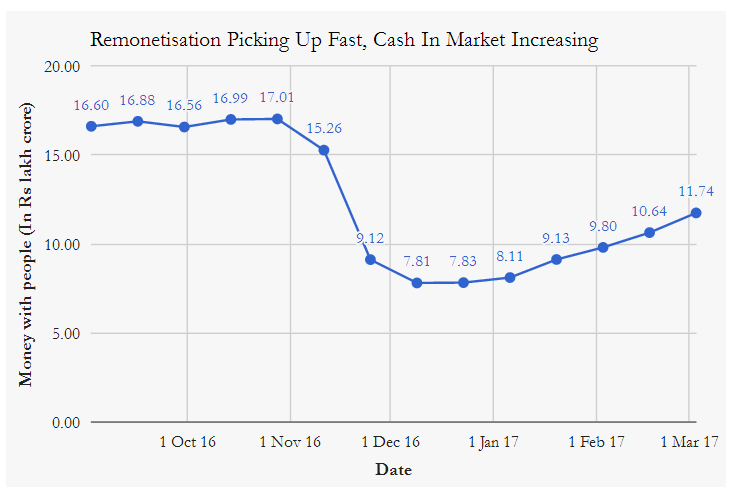
Cash available with people, which reduced from Rs 17 lakh crore just before the demonetisation announcement to the lowest post-demonetisation level of Rs 7.81 lakh crore ($ 118 billion) on December 9, 2016, increased to Rs 11.74 lakh crore ($ 178 billion) on March 3, 2017, according to Reserve Bank of India (RBI) data.
“Remonetisation is taking place at a very fast pace. We have some way to go but I think we expect that within two to three months, we will reach full currency in circulation,” RBI deputy governor Viral Acharya was quoted in this Mint article on March 6, 2017.
The prime minister had announced the world’s biggest currency swap programme that scrapped 86% of high denomination Indian currency on November 8, 2016.
The current level of currency with people matches the November 2013 level of Rs 12 lakh crore ($200 billion at the then prevailing exchange rate of Rs 60 per US$).
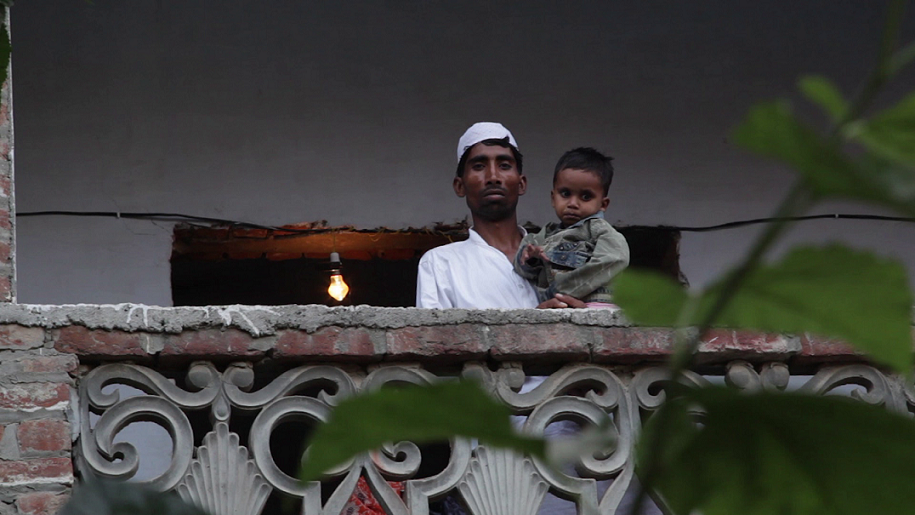
In what appears to be a case of religious intolerance and discrimination, two Muslim students from Glocal University hired by a private company were fired within a month for allegedly offering Friday prayers in the office premise.
Representation Image
Mohammed Kashif and Shamsher, two students from B.Tech (Civil) were hired as trainees on February 15 by Spatial Geotech Private Limited (SGPL) at their Noida office. Speaking with Twocircles.net, Kashif, 22, said, “When we both joined, there were two more Muslims who were working in the company. We asked them where they offered Friday prayers, and they said no. So, all four of us went to our boss, Annu Gupta, and asked her if we could take some time off on Friday afternoons to offer the Jumma Prayers. She flatly refused the idea despite us saying that we would compensate for the time.”
After they were denied permission to visit a Mosque, the four decided to offer Zuhr prayers within the office premises. In the first week of March, according to Kashif, the four were called by Gupta and warned to not ‘disrupt the office environment’. “At that time, I did not know she was talking about us offering prayers,” he said. Subsequently, when they did the same in the following week, the two were again called to Gupta’s office and were shown a video of them performing the prayers. “We were told to wait in the office, and by evening we came to know through our college placement cell that the two of us (Kashif and Shamsher) had been terminated from our jobs. I am pretty sure that this was due to our offering prayers in the office, as the same was told to us by Gupta when we were in her office,” says Kashif. The two were not even given a termination letter and when they asked for a No-Objection Certificate from the company, even that was denied.
A member of the Glocal University placement office confirmed to Twocircles.net that these two had been terminated, but said that the reason was cited as performance and not the religious prayers. “In the telephonic conversation, however, the issue of offering prayers did come up, and Annu Gupta and the recruiting consultant Arjun Mishra did point out that this was not conducive to the office environment.”
He added, “The issue of performance is difficult to believe since they had been there only for three weeks, and clearly, the offering of prayer did not go down well with the company,” he said.
When Twocircles.net contacted Annu Gupta for comments, she said that the company’s response had been conveyed to the University and refused to add anything to the same. The recruitment agent flatly denied any case of religious discrimination and said, “The two were performing below par and that is why we asked the placement division to send more students.” He also said that the placement team had been told thrice about their incompetence, a charge which was denied by the placement officer. “I have no such written communication from them, and this was not pointed to us earlier. Yes, they had asked for more students, but that was not because these two were not performing well.”
But what is even more startling is that the letter sent by Mishra to the placement division complained of these students being “intoxicated” at work. “Unfortunately, even after the counselling and ample duration of time to learn and improve yourself, there has been no change in their performance. Their performance was still unsatisfactory and they were often found intoxicated at work, to the extent that they were so impaired that they were unfit to be entrusted with the employment duties.”
Kashif denied the claims, saying that he had never touched alcohol and that it was an insult to him and his faith. “This is the first time I have heard this (about the contents of the mail). I am shocked beyond imagination and hurt at their allegations…I wanted some time to offer prayers, and instead, they accuse me of being drunk?”
The two students, who have been under immense stress since this incident, are currently looking for other jobs, but they say that they have been left mentally scarred by the event. “I hope nothing like this happens ever again to another person,” said a cousin of Kashif. “He was just practising his faith. Since when has that become an issue?” he asked.
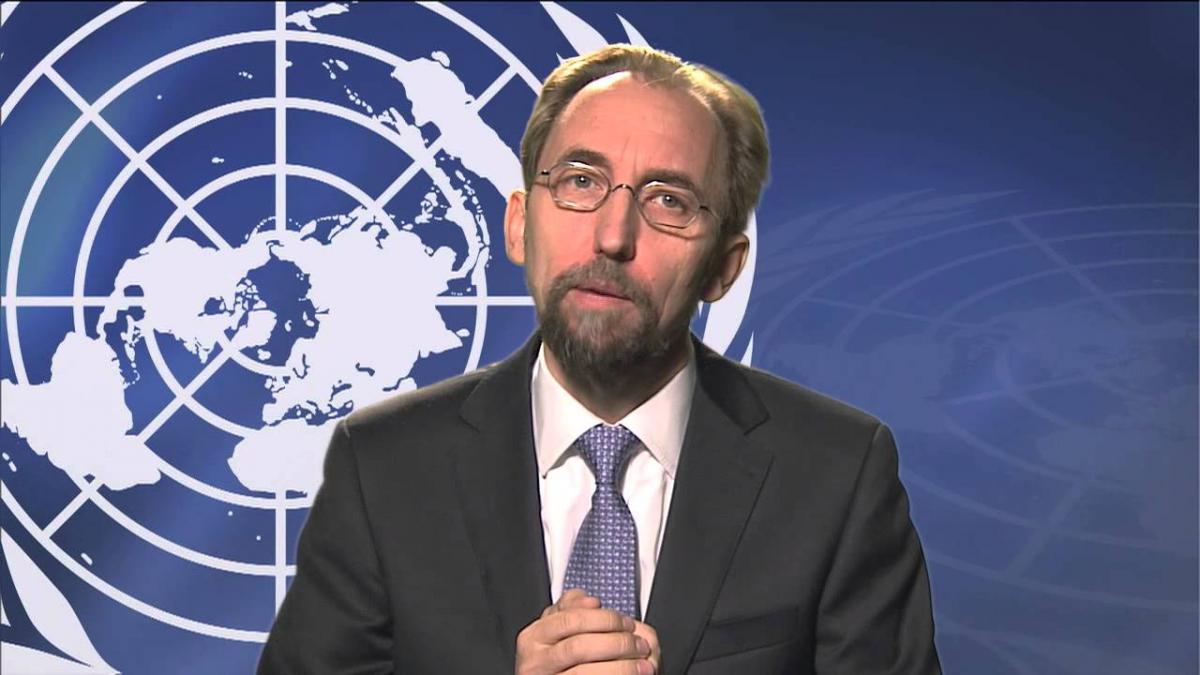
Statement by UN High Commissioner for Human Rights Zeid Ra'ad Al Hussein on International Day for the Elimination of Racial Discrimination
The International Day for the Elimination of Racial Discrimination (March 21) is an annual reminder to us all to do more to combat racism, racial discrimination, xenophobia, hate speech and hate crimes.
But 21 March needs to be more than a reminder. People of African descent continue to be victims of racist hate crimes and racism in all areas of life. Anti-Semitism continues to rear its ugly head from the US to Europe to the Middle East and beyond. Muslim women wearing headscarves face increasing verbal, and even physical, abuse in a number of countries. In Latin America, indigenous peoples continue to endure stigmatization, including in the media.
The dangers of demonising particular groups are evident across the world. Xenophobic riots and violence targeting immigrants have recently flared again in South Africa. In South Sudan, polarised ethnic identities – stoked by hate speech – have brought the country to the brink of all-out ethnic war. In Myanmar, the Rohingya Muslim community, long denigrated as “illegal immigrants,” have suffered appalling violations.
Across the world, the politics of division and the rhetoric of intolerance are targeting racial, ethnic, linguistic and religious minorities, and migrants and refugees. Words of fear and loathing can, and do, have real consequences.
And across the world, the politics of division and the rhetoric of intolerance are targeting racial, ethnic, linguistic and religious minorities, and migrants and refugees. Words of fear and loathing can, and do, have real consequences.
UK government statistics showed a sharp increase in reported hate crime in the weeks following the 23 June 2016 referendum on the UK’s membership of the European Union, in which immigration was a dominant issue.
FBI figures indicated a rise in hate crimes nationwide in 2015, a year when the US presidential election campaign – a campaign that often focused on the supposed threats posed by migrants, Hispanics and Muslims – began in earnest. Data collected by the Southern Poverty Law Center indicates that migrants, African-Americans and Muslims were the most affected by hate crimes in the immediate aftermath of the election, although full data for 2016 is not yet available.
In Germany in 2016, there were approximately 10 attacks a day on migrants and refugees, a rise of 42 per cent on 2015. Cases of reported hate crimes increased more than three-fold in Spain from 2012, reaching 1,328 in 2015. Italy saw reported hate crimes rise from 71 to 555 in 2015; Finland experienced a doubling of reported hate crimes from 2014 to 2015, when 1,704 incidents were reported.
Many States do not collect data on racist hate crimes, leaving the true extent of the problem obscured.
These figures paint a partial picture of the situation in the respective countries but there are many States that do not collect data on racist hate crimes, leaving the true extent of the problem obscured. Tackling racism and xenophobia begins with understanding the scope of the problem. I encourage States to do more to collect disaggregated data, including on the basis of race and ethnicity, so they can monitor trends, understand causes and design and implement targeted action to bring about real change.
This day reminds us that States have no excuse for allowing racism and xenophobia to fester, much less flourish. They have the legal obligation to prohibit and eliminate racial discrimination, to guarantee the right of everyone, no matter their race, colour, national or ethnic origin, to equality before the law.
States should adopt legislation expressly prohibiting racist hate speech, including the dissemination of ideas based on racial superiority or hatred, incitement to racial discrimination, and threats or incitement to violence.
States should adopt legislation expressly prohibiting racist hate speech, including the dissemination of ideas based on racial superiority or hatred, incitement to racial discrimination, and threats or incitement to violence. It is not an attack on free speech or the silencing of controversial ideas or criticism, but a recognition that the right to freedom of expression carries with it special duties and responsibilities.
We face a world where discriminatory practices are still widespread. But it is not the time for despair.
Equality bodies and national human rights institutions in many countries work to prevent and combat discrimination. Some law enforcement agencies are incorporating human rights standards into their actions, not just because they are legally obliged to, but because it leads to more effective policing. Similarly, education and healthcare professionals, as well as good employers, are tackling the racial, ethnic and religious prejudices and profiling that exist in their sectors. Progress here needs to continue, including through affirmative action, training and representation of ethnic and racial minorities.
My Office, the UN Human Rights Office, is asking people around the world to"Stand Up for Someone's Rights Today". And, around the world, that is exactly what many people are doing. Taking a stand against discrimination, no matter where it happens.
*TheInternational Day for the Elimination of Racial Discriminationwas established in remembrance of the 69 unarmed and peaceful South African protestors who were killed in Sharpeville, South Africa on 21 March 1960 — an event which inspired people around the world to act to end the racist apartheid regime.
The UN Human Rights Office is running a global campaign called “Stand Up for Someone’s Rights Today. The campaign aims to galvanize everyone – private sector, governments, individuals, civil society – to play an active role in standing up to defend the human rights of all, at a time when these hard-won rights and freedoms are facing increasing pressures across the world.
The state is aware that free press means more accountability and their fear of being monitored, exposed, or held accountable indicates how fragile and insecure they are.
Protest in front of journalists' syndicate in Cairo on 2 January 2017. NurPhoto/SIPA USA/PA Images. All rights reserved. “Listen only to me” – Even if he had tried, Egyptian President Abdel Fattah El Sisi could not have described his authoritarian military reign better. Exactly one year since he demanded the people not believe the “enemies of the nation”, the margin for freedom of speech and expression has progressively shrunk to absurd levels.
On 17 March 2017, government sponsored candidate Abdel-Mohsen Salama became the head of the journalists' syndicate. Salama is the managing editor of state owned Al-Ahram newspaper, and at the top of his list of supporters is former National Security officer Ahmed Mousa, a notorious mouthpiece for the regime who was supposedly intentionally planted in Al-Ahram. This recent development forecasts even darker times for an already gloomy era.
The militarization of politics as well as authoritarianism are suffocating the people of Egypt. Public spaces are slowly but surely being securitized as the media is coopted. The economy is being divided like a pie to a select few, as a number of business tycoons and regime loyalists strategically buy out firms and distribute them among military men and their associates.
Falling in line with this clampdown, assets of Mostafa Sakr, owner of Daily News Egypt, Egypt's only English independent daily print newspaper, and Arabic financial newspaper Al Borsa, were frozen.
Sakr has been accused of belonging to the Muslim Brotherhood terrorist organization. Although handed out abundantly, the accusation was even more ridiculous this time, as the regime had previously used the newspaper to seek out investors for its mega projects. It seems hypocritical, to say the least, to then accuse the owner of the very same newspaper of being affiliated with the Muslim Brotherhood. “President Sisi to Daily News Egypt” read the front page of an August 2014 issue.
The freeze order coincided with parliament passing a media "regulations" bill, which gives the government total control over both state and private owned media outlets. The new law stipulates the formation of three regulatory bodies to oversee all of Egypt’s media outlets, be it public or private. Heads of these bodies are appointed by none other than the president himself, according to Article 32.
“The new law opens the door for the executive authority to dominate media,” Yehia El Qallash, ex-head of the Press Syndicate, told me. The state is refraining from building trust, he added, asserting that the current situation does not champion freedom of expression, and that of the press.
However, Qallash has more to worry about than the new law.
Qallash informed me that the syndicate had presented the Amnesties Council with a list of 29 imprisoned journalists, and 18 other journalists not imprisoned but under threat. Qallash is of those 18 individuals under threat as well as the head of the syndicate’s Freedoms Committee, Khaled El Balshy.
Never has the syndicate head been tried and handed an imprisonment sentence in its 75 year history. Never has the syndicate also been stormed before, but both catastrophes took place under the Sisi regime.
Qallash and El Balshy are accused of “harboring fugitives”, namely journalists Amr Badr (also editor-in-chief of Bawabet Yanayer) and Mahmoud Al Sakka. Both journalists were arrested the night the syndicate headquarters were attacked in May 2016. They had been outspoken against the selling of the two Red Sea Islands to Saudi Arabia, and skeptical about official narratives of the murder of Giulio Regeni, pointing fingers at the state.
“Authorities were also bothered by the website’s coverage,” Badr said, disclosing that during the investigation, the journalists were questioned about the stories they had published. They were put behind bars over stating their opinions, adding to their 63 jailed colleagues.
“Freedom of expression in Egypt is a big zero,” Badr believes.
Disbelief clouded those in the profession, as journalists were banned from attending the funeral held for the victims of a recent church explosion, considered one of the biggest terror attacks during Sisi’s reign of power. The journalists were kept in a separate room, and were handed official photographs on their way out.
Openly expressing dissent with policies in Egypt, the contracts of correspondent AlBaraa Abdullah and TV anchor Lilian Dawood with OnTV were both terminated after the channel was acquired by pro-state businessman Abu Hashima.
Abu Hashima now also owns Al Youm Al Sabe’, Ain, and Sawt Al Omma newspapers, as well as the Dot Masr online website. One only has to take a look at these outlet’s amateur headlines to know what kind of messages they are conveying.
Sisi’s loyal clan deny the obvious militarization of Egypt and it will be interesting to see their justification for the appointment of former military spokesman Mohammed Samir as head of Al-Asema TV Channel.
The internet is no exception to the state’s control attempts. While the digital age provides massive room for freedom of expression, the Egyptian State is going out of its way to curb this space. Using its ‘digital armies’ and paid social media trolls, it floods the internet with messages that influence the less informed, threatening opposition, and constructing an illusion of a public opinion supportive of the state.
As the state took away more human rights, it shunned its criticizers in the name of economic and security stability. But as the value of the Egyptian Pound sinks lower, it has become harder to mute critical voices. Prices have increased, while wages remain stagnant. The economic crisis has started biting the middle class as it depletes the poor.
Although militant attacks in northern Sinai have not ceased, with an Egyptian general assassinated in October, the church explosion exposed the security apparatus. In the following months, the situation crumbled until hundreds of Copts fled Al-Arish City, fearing increased threats, killings, and attacks by militants. Security is why Sisi came to power, and its lax at a time of economic turmoil is threatening his reign day after day.
With every decision the government makes, the volume of criticism gets louder, and the state grows more paranoid. The state is aware that free press means more accountability and their fear of being monitored, exposed, or held accountable indicates how fragile and insecure they are.
“Dictatorships fear the truth,” El Balshy told me, narrating how the media had a big role in exposing toppled President Hosni Mubarak’s regime, and overturning Mohamed Morsi’s.
Between killing and imprisoning journalists, a syndicate report stated that more than 782 violations were carried out in 2015 alone. The Committee to Protect Journalists named Egypt the third country in the world with the highest number of jailed journalists in 2016.
The sad truth remains that if you are not a government mouthpiece, you are in danger. While the state punishes journalists for doing their job, many behind bars are being granted international awards, including Ismail Alexandrani and Mahmoud Shawkan. Until shackles are broken, those holding dearly to the essence of their profession will have to continue shouting “journalism is not a crime”.
Aya Nader is an independent journalist based in Egypt, writing for Daily News Egypt, Al-Ahram Weekly, and BECAUSE among others. She is an MA candidate in International Relations at the American University in Cairo. Tweets @AyaNaderM
The parties in the Opposition have long abandoned any real commitment to secular values, or even the defence of the country’s minorities.
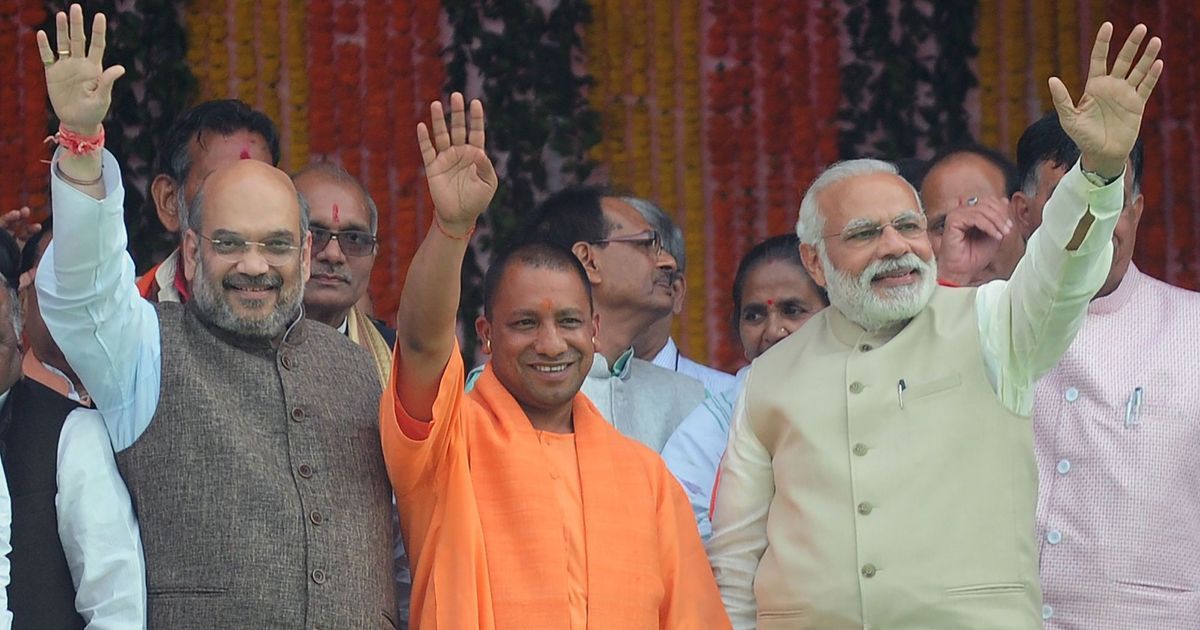
The masks have been thrown to the winds. Prime Minister Narendra Modi and his most trusted aide and Bhartiya Janata Party President Amit Shah have audaciously signalled to both national and global public opinion that they feel no need for masks and fig-leafs any longer. So many commentators in the mainstream media had wasted reams to persuade us that the emphatic vote for the BJP in the spring elections of 2017 in Uttar Pradesh represented not a hard communal consolidation of the Hindu voter against the perceived Muslim “other”. It was instead, they argued, a cross-caste, cross-community vote for sab ka vikas – development for all – and Modi was the new Indira Gandhi, the combative leader for building a better life for the poor.
Many Hindu voters read the election results quite differently. They saw it just the way many voters saw the election of Donald Trump in the United States a few months earlier, as a vote for majoritarian triumphalism, a vote against Muslims and minorities, a vote that legitimised prejudice and hatred. I saw a Facebook post of a notice pasted in villages of Gorakhpur district in Uttar Pradesh.
It starts with the rallying slogan of the Ram Janam Bhumi movement – Jai Shri Ram. It goes on to give notice to the Muslims of the village that they must leave the village by the end of the year. It warns them that if they do not comply, then they themselves will be responsible for the consequences. It goes on to warn them that they will be treated in the way that they are being treated in Trump’s America, because a BJP government will be installed in Uttar Pradesh. Decide quickly, the notice says, because you do not deserve to live in the village. It is signed by the Hindus of the village, whose sanrakshak or patron is said to be Yogi Adityanath, Member of Parliament from Gorakhpur.
But by selecting Adityanath, one of its most belligerent anti-Muslim campaigners, given to unapologetically coarse hate speech and skirmishes, as chief minister of the country’s largest state in terms of population, Modi and Shah have gestured unambiguously and brazenly their frank and unashamed resort to hard-line Hindutva as the calling card of their party.
Hate speeches
The election speeches of Modi and Shah already signalled the direction the party has chosen. Adityanath’s hate speeches are in-the-face and dangerously toxic. Ever since he was hand-picked by Modi and Shah as chief minister, the social media is full of his pronouncements. I rely here on only one such compilation.
His intent is unambiguous: “I will not stop till I turn UP and India into a Hindu rashtra”. He blames Muslims for communal violence: “In places where there are 10 to 20% minorities, stray communal incidents take place. Where there are 20 to 35% of them, serious communal riots take place and where they are more than 35%, there is no place for non-Muslims”.
Despite numerous reports that deny the claim of the “exodus of Hindus from Kairana”, he still claims in the spirit of “post-truth” that “the population of Hindus which was once 68% has come down to 8% there”. He blames this on alleged policies of “pseudo-secularism and appeasement” followed by successive governments in Uttar Pradesh, which “speak against the majority community in the name of secularism”.
A falsehood that even Prime Minister Modi was to echo was that “governments in UP give land for kabristans (graveyards) but not for shamshanghats (cremation grounds)“. “Issues like the exodus of Hindus from Kairana, love jihad and women’s safety”, he claims are threatening to turn “western Uttar Pradesh … into another Kashmir”.
Even more sinister are his open threats to Muslims. “Every time a Hindu visits the Vishwanath temple, the Gyanvapi mosque taunts us. If given a chance, we will install statues of Goddess Gauri, Ganesh and Nandi in every mosque”. The Ram Mandir is high on his agenda. “When they could not stop karsevaks from demolishing the Babri Masjid, how will they be able to stop us from carrying out the construction of the mandir?”
Yogi Adityanath. Image: Hindustan Times
Any of these declarations amount to gravely provocative and culpable criminal hate speech. Adityanath has a number of hate crimes lodged against him. These are not the utterances of an outrageous fringe rabble-rouser. He is the man chosen by the country’s prime minister to lead the country’s largest state in terms of population, which if it were a separate country, would be the world’s fifth most populous country of over 200 million people. Among these, a fifth or around 40 million are people of Muslim faith. It is a frightening time to be a Muslim in Uttar Pradesh today. It was bad enough that the election results reflected the unification of most Hindu caste and class groups against the Muslims and that the BJP found it unnecessary to field even one Muslim candidate from a fifth of the state’s population and that the prime minister and, even more, his party chief and other candidates openly resorted to a communally charged discourse. But if some among them were still hoping that with such a large majority, at least after the elections, there would be a move to more responsible governance in the state, the choice of Adityanath as their chosen leader leaves no ambiguity about their status.
The Muslims in UP, it seems, must learn the same lesson that Muslims in Gujarat have been forced to learn so painfully since 2002. This is that they would be “permitted” to live in the state, but only as second class citizens, if they accept the political, cultural, economic and social superiority and dominance of their Hindu neighbours. It is the further fruition of the vision for India of the Rashtriya Swayamsevak Sangh, less than a hundred years since it was constituted in 1925.
Secular culpability
This is indeed a victory for the RSS, its ideology and cadres and for Modi’s muscular and crushing leadership. But the victory of a brawny politics of communal hectoring and name-calling, hate and division and the defeat of the constitutional values of fraternity and equality, cannot be laid only at their door. Equal credit, or culpability, lies with the parties of the opposition, which have long abandoned any real commitment to secular values, or even the defence of the country’s minorities.
I will illustrate their multiple failures with their role, or the lack of it, in Muzaffarnagar in Western Uttar Pradesh, which I observed closely in the course of our work with the survivors of the mass communal violence of 2013.
We must begin with the pernicious role of the BJP, and the cadres of the RSS, the Vishwa Hindu Parishad and the Bajrang Dal, in stirring the communal cauldron in these regions which had an unbroken history so far of communal amity, even during the Partition riots and the turbulent movement for the demolition of the Babri Masjid.
It is proved beyond doubt that BJP MLA Sangeet Som circulated a fake video of two youth being lynched by a crowd of Muslims. He claimed mischievously and dangerously that the lynch mob was of Muslims of the region, and the men who were brutally killed were two Jat brothers who were trying to defend the honour of their sister from the sexual harassment of a Muslim youth. It mattered little in the post-truth world of command prejudice led right from the top, that all of these assertions were falsehoods, that the video was of a lynching in Pakistan, and that the Jat brothers and Muslim youth killed each other not because of any sexual predation but following a skirmish stemming from a motor-cycle accident. These falsehoods resulted in the largest episode of communal violence in a decade (along with the attack on Christians in Kandhamal).
Between 70,000 to 1,00,000 Muslims fled from their villages in terror after their neighbours of generations suddenly turned against them, burning and looting their homes, raping women of their village, killing even elders and children. The role of the RSS was not different from what it has been since the Partition riots – fomenting communal hatred and violence through hate propaganda and rumours. But the role of the Samajwadi Party government led by Chief Minister Akhilesh Yadav, and other parties that claim to be secular, requires much closer interrogation.
I found the character, the part played and the attitude of the state administration in Uttar Pradesh hardly different in most ways from that of the state administration in Gujarat in 2002. It could have prevented the scale of hate attacks on Muslims if it had been firm and steadfast in not permitting the mahapanchayats in which hate speeches were made against Muslims based on the RSS-created rumours. It was a mahapanchayat that led directly to massive crowds being mobilised and provoked and incited to inflict hate violence against their Muslim neighbours.
The soft-pedalling by the administration did not just suggest criminal administrative incompetence: if it was just this, it would be bad enough. The real doubt was that it secretly believed that it would benefit along with the BJP from the polarisation between Muslims and Hindus in a communal riot, a harvest that both parties hoped to reap in the 2014 general elections.
Muzaffarnagar baqi hai
Payments to stay away
Even more shameful was the neglect, and even hostility, of the Uttar Pradesh state administration to the refugees from hate violence in camps. I visited the camps on many occasions and found them little different from the relief camps I had seen in Gujarat in 2002. In both, the state administration refused to establish and run relief camps for those displaced from their homes by hate violence.
It left this mainly to the battered community itself, as though the responsibility for taking care of these hate refugees was not of the state but of organisations of Muslim people. With nowhere to go, people endured the winter cold, the hot dusty summers and the rains under plastics, with reports of children dying, but the state administration remained unmoved. As in Gujarat in 2002, we found little presence of the state in these camps: it did not organise sanitation, health care, child care or police outposts to record people’s complaints.
The only real departure of the practice of the Uttar Pradesh administration from that of the Gujarat administration 11 years earlier was in the payment of five lakh rupees as compensation to those persons who undertook that they would not return to their original villages. This policy had no precedent in India. For people displaced by hate violence, the duty of the state administration was recognised to be to create conditions that were conducive to enabling people to return to their original homes. This required the administration to take the lead in attempting to rebuild social bonds between the estranged communities, and to ensure the security of those who returned.
Far from doing this, the action of the Uttar Pradesh state government in effect accepted that Muslim and Hindu populations would no longer live together peacefully, and even incentivised their separation. In earlier large episodes of rural communal violence, as in Bhagalpur and Gujarat, we found that social fractures tend to be enduring, and Muslims are ejected from mixed settlements. The state should have fought and resisted this, promoting the restoration of mixed habitations, rather than for the first time actually incentivising separate living on religious lines. This was an utterly bankrupt state policy adopted by the Akhilesh government, with communal underpinnings, one that has no precedents in past communal riots.
Camp at the village of Jaula in Muzaffarnagar District on April 10, 2014Image: AFP PHOTO/Prakash SINGH
Premature closing of camps
Just three months after the carnage, the state government officially terminated all relief camps, again as happened in Gujarat, even though several thousand displaced persons were still in fear and dread, and unwilling to return home because they continued to feel unsafe. Whereas displaced persons in camps should be officially assisted and supported to return to their original homes by promoting reconciliation and security, to force them to do so by premature closure of camps resulted only in thousands being left without even the meagre food and health support which the government had extended in the camps.
The sense of fear and alienation of the survivors was enhanced by distressing reports of organised social and economic boycott of Muslims after the mass violence, once again just as in Gujarat. Many men testified that if they went back to their villages, they were told they should cut their beards off if they wished to live in their village. People also reported similar hate exchanges in buses and public spaces. Survivors recounted intimidation and boycott in employment as farm labour, or economic activities like pheris¸ or selling cloth and other goods from house to house.
The Akhilesh Yadav-led state government did little to create conditions in which survivors felt safe to return to the villages of their birth. Without any public remorse by their attackers, any official or community initiatives for reconciliation, and any attempts at justice, these hapless people were unable to return to the villages of their birth. Sometimes with small grants from government or NGOs, but mainly with usurious loans from private moneylenders, they bought house-plots in hastily laid out colonies in Muslim majority villages on what were cultivated fields. Seizing the opportunity to make windfall profits, local large farmers and real estate developers sold these plots at exorbitant rates to these luckless displaced persons.
Living Apart
The indifference of the state government was reflected also in the fact that there was no official record of these mostly self-settled colonies, let alone official plans to ensure that they were able to access basic public goods and citizenship entitlements. In a survey undertaken by Aman Biradari and Afkar India Foundation, we discovered as many as 65 refugee colonies, 28 in Muzaffarnagar and 37 in Shamli, housing 29,328 residents, described in Living Apart: Communal Violence and Forced Displacement in Muzaffarnagar and Shamli, a book about the conditions of the survivors, written jointly by my colleagues Akram Akhtar Chaudhary, Zafar Eqbal and Rajanya Bose, and me.
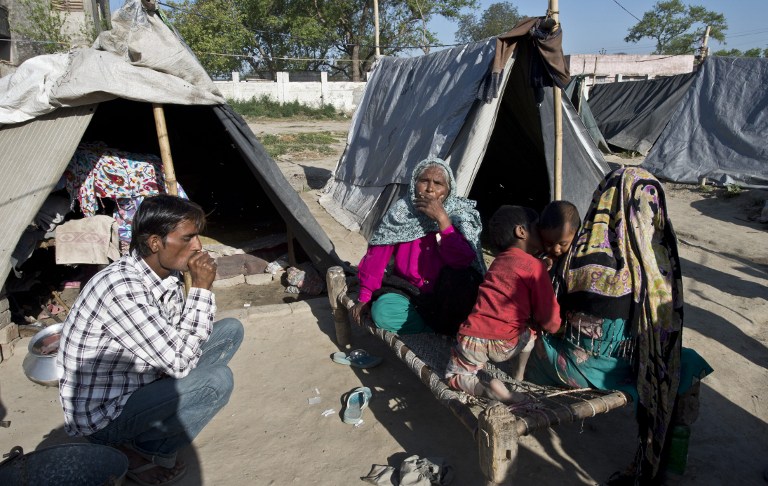
In hellish slum-like settlements, these internal refugees are bravely building their lives anew. Perhaps our most striking survey finding was the almost complete absence of the state from these efforts to begin a new life of the refugees. Apart from a 5 lakh rupee grant given only to households directly hit by the violence (and none to the much larger number who escaped their villages because of fear of attacks), the state took no responsibility for helping them resettle in any way. The displaced were forced to either abandon or sell their properties at distress prices in their villages of origin, and the state compensation for the loss of their moveable assets was negligible. The colonies were settled substantially with the self-help efforts of the impoverished and battered refugees themselves. This again mirrors the story of the violence-affected people of Gujarat.
Muzaffarnagar, after the riots. September 9, 2013. Image: AFP PHOTO/STR STRDEL / AFP
No justice
The confidence of survivors to return to homes was further shaken because of the very low numbers of arrests and convictions of the men accused of murder, rape, arson and looting. Without justice, as we have learned from survivors in many sites of communal violence, neither do wounds heal nor can fresh violence be deterred.
Police and even the judiciary in Uttar Pradesh often displayed communal biases similar to their Gujarati counterparts. Of 6,400 persons accused of crimes in 534 FIRs, charges were ultimately pursued against only 1,540 persons. Most of the cases of murder were closed without a charge-sheet or trial claiming the accused were “unknown persons”. Even a year after the carnage, only 800 people were arrested, and most of those who were arrested were quickly released on bail. One reason given for low numbers of arrests by the police administration was that large numbers of women blocked the entrance to the village entry whenever police vehicles drove there for arrests, or farmers parked tractors to thwart police passage.
Survivors on the other hand believed that police themselves informally tipped off the villagers before arriving to make arrests, otherwise how would so many assemble at short notice to blockade village roads? This allegation was difficult to independently verify, but no self-respecting police administration could accept this kind of public blockades to persist when it came in the way of their fulfilling their official duties.
Only three of the 25 men accused in six cases of gang-rape were held. In one rape case, all the accused men have been acquitted. In another, after three years no one has been arrested. And in the other rape cases, all the accused men are out on bail. There was enormous pressure on the witnesses to rescind on their statements, and a large number of witnesses have turned hostile in court.
Although Indian criminal law does not permit “compromise” in heinous offences, this remains a routine practice after mass communal violence. Since the accused freely roam the same villages, either evading arrest or on bail, they are free to intimidate the complainants and victims. It does not help that the majority of the complainants are impoverished farm workers or brick kiln labour, critically dependent economically on the large Jat landowners for work and loans.
The police was particularly soft in acting against politicians who were allegedly directly involved in the rioting. They have at best been booked in very minor sections like Section 188 of the Indian Penal Code. Most of them did not even see the inside of a jail. There were also other distressing signs of judicial bias, because most arrested persons have been granted bail almost the next day or soon after their arrests. This ignored the gravity of hate crimes, and the susceptibility of the survivors to intimidation because of their vulnerable situation after mass targeted violence has spurred large-scale fear, destruction of livelihoods and habitats and migration.
Absent political parties
When the carnage unfolded, and in the crucial months that followed, the Congress Party headed the United Progressive Alliance government in the centre. But it never directed or advised the state government in Uttar Pradesh to fulfil its constitutional duties to the violence affected people more responsibly or compassionately, nor did it reach out to them directly in any way.
As a party, I found Congress workers completely absent from the relief camps, in Muzaffarnagar as much as in the Gujarat camps a decade earlier. This is where the Congress Sewa Dal (does it even exist?) should have been visible, extending discernible solidarity and service to the people displaced by hate violence.
Equally, Mayawati never once reached out to the hapless violence-hit people. She mostly maintained her imperious silence, indicating indifference. What credibility would she carry when years later, she reached out for an alliance with the Muslims of the state, as she did before the Assembly elections?
The only political party that did reach out in any way to the violence-hit people of Muzafffarnagar was the Communist Party of India (Marxist), which helped establish a resettlement colony. But even this assistance was much smaller and less visible than the role that the Communist Party played in the early communal riots after Independence.
No credible alternative
The lesson, then, is that the runaway electoral victory of the BJP in the elections to the Uttar Pradesh assembly in the spring of 2017 is as much due to the BJP’s polarising campaign and Modi’s charismatic but divisive leadership, as it is due to the failure of any authentic and credible secular alternative.
Secularism is not treating Muslim minorities as a hapless, powerless, dependent client population whose votes can be taken for granted at election time and forgotten for the rest. Secularism is not a selective, opportunistic policy, to be played with a continuous timid eye fixed on not upsetting majoritarian communal sentiment. It is an article of faith, which rises above all immediate electoral considerations.
The enormous tragedy of India’s secular majority, as much as of India’s minorities, is that India today lacks an authentically secular political opposition. This emboldens a resurgent and triumphalist political right, led by Modi and Amit Shah, to display their communal fangs with the selection of communal firebrand Yogi Adityanath as the leader of Uttar Pradesh.
It is ordinary people who must act as the opposition. Our large so-called secular political opposition has betrayed us profoundly, and the people if India are paying the cost. The hot winds of communal hatred of the past three years can be expected to grow now into a blinding sandstorm.