Vadodara – Cultural Capital of Gujarat Falsifying History
The Hindu right-wing has long been trying to propagate their belief that many inventions and discoveries of modern science and technology were known to people of ancient India. The right-wing administration of the Maharaja Sayajirao University (MSU) has reiterated this belief by hailing several sages dating between 6th and 2nd BCE for their “contribution to science” in their official dairy for 2017. These sages are being credited with the invention of nuclear technology, cosmetic surgery and rocket science.
Only few days ago, the MS University administraion called off a workshop on politics of caste and social movements in India citing possible “backlash” from “some people” similar to the ruckus the ABVP created in Ramjas college of Delhi University. Now, we hear that Sushrut is being hailed as the “father of cosmetic surgery” and that Acharya Kanad “developed nuclear technology”. The dairy also states that Kapil Muni is the “father of cosmology”, Maharshi Bhardwaj, “discovered rockets and aeroplanes”, Charak Rishi is “father of medicine” and Garga Muni is the “scientist of stars”. It’s a pity that an educational institution cannot dicsuss the realities of India – caste, dalit movements, labour issues and corruption – but lies such as these can be perpetuated by the administation; the administration which should actually be creating a space for fearless learning.
These bunch of people in the adiministration of MSU are merely following the path that the right-wing has paved for decades and one which the Prime Minister of India treads on. Narendra Modi gave the examples of Karna and Ganesha to support the view that cosmetic surgery and reproductive genetics were used thousands of years ago in this part of the world.
One wonders whether there are any women figures among these ancient scientists? The bhakths equally propagate the lie that the Vedic period was a women friendly period, and that violence against women is influenced by the West. Deep knowledge of history is not needed to disprove these claims. One lie of the right-wing negates another lie.
It is obvioius for evident reasons that we need not raise the question of what caste these wannabe scientists belonged to. They had to belong to the educated caste.
Mayank Vahia of Dept. of Astronomy and Astrophysics, Tata Institute of Fundamental Research, who leads India’s Astronomy Olympiad programme said at an event last week that these false “claims make Indian scientists look like idiots. And even genuine work gets negated because of these baseless ideas.” He also said that he was very proud of his Indian heritage and has great respect for Aryabhatta, Charaka, and many others who have made some phenomenal scientific and philosophical contributions.
Vadodara or Baroda, where Maharaja Sayajirao University is located, is known as the cultural capital of Gujarat. Capital of what kind of culture? That of threatening free speech, of curtailing right to discuss and debate, and of falsifying history?
…The value of a man was reduced to his immediate identity and nearest possibility. To a vote. To a number. To a thing. Never was a man treated as a mind. As a glorious thing made up of star dust. In every field, in studies, in streets, in politics, and in dying and living.
…My birth is my fatal accident. I can never recover from my childhood loneliness. The unappreciated child from my past.
(Excerpts from Rohith Vemula’s suicide note)
The middle of this month would witness a different type of Yatra on the streets of Telangana and Andhra Pradesh. It would neither be led by high profile leaders – who have the aura of Z plus security with them – nor would it be undertaken in an ultramodern bus – fitted with latest facilities and which could even be used as podium for a public meeting.
It would be taken out on a blue pickup truck renamed Bhim Auto and would be led by a 50-year-old woman Radhika Vemula along with her son Raja demanding justice for her elder son Rohith.
During this yatra Radhika intends to visit one Velivada ( Dalit hamlet) after other in the two states to tell people how castiest forces are hell bent upon denying dalits their due rights and how justice is still being denied to her son who committed suicide because of the machinations of such people. (http://nsi-delhi.blogspot.in/search/?q=rohith+vemula).
She would also communicate to them that the ruling dispensation at the Centre led by BJP but the and the state governments in Andhra Pradesh and Telangana have been callous towards the plight of the Dalits and have joined hands to deny justice to her son. Not so long ago the government of Andhra Pradesh had made outrageous statements about Rohith not being a Dalit and earlier in February had demanded that Radhika 'prove' that she is Dalit in 15 days.
Speaking at a rally in Bengaluru Radhika Vemula announced her plan in detail.
She plans to raise two key demands through this awakening programme: – Sacking of Hyderabad University vice chancellor & his prosecution under SC/ST Prevention of Atrocities Act. – Passage of 'Rohith Act' aimed at stopping discrimination in educational institutions.
Today Radhika Vemula might have become a household name for her uncompromising struggle to render justice to her deceased son but a year and two months back not very many people – barring those from her own village and surroundings – had even heard her name. The mass upsurge which erupted immediately after Rohith's death, demanding justice to him and the manner in which she joined the ongoing struggle, has helped her emerge as a symbol of resistance against the dispensation at the Centre.
And she has not kept her concerns confined to her deceased son only. She was there when thousands of Dalits and other anti-caste forces and democratic formations gathered in Una, Gujarat on 15th August (2016) to demand 'land to dalits. She joined Fatima Naseem, mother of JNU student Najeeb Ahmed whose sudden disappearance – after a scuffle with the members of ABVP on the JNU campus – has become a cause of concern.
It has been more than a year that Rohith ended his life but there have been no concrete steps to ensure justice to him. We know how this activist of Ambedkar Students Association – who had started his political journey with a left student group – had decided to take the extreme step, how a biased administration with due connivance of a rightwing student formation and support from representatives of the central government continued to play havoc with the lives of dalit students, how it expelled them from hostels, how it stopped their scholarships, how it was instrumental in compelling them to live on 'Velivada' of a different kind on the Hyderabad Central University (HCU) campus.
Podile Apparao, the controversial vice chancellor of the university, who had to leave office temporarily in the immediate aftermath of the movement, has since resumed duties. And an all-out attempt is being made to silence all dissenting voices on the campus.
The authorities are so keen to mute all such oppositional voices that they did not even allow a rally of students, youth led by Radhika Vemula to enter the university campus and pay their homage to Rohith on his first death anniversary. (17th January 2017). All those students and concerned citizens were arrested at the gates of Hyderabad Central University itself. Perhaps authorities feared that if they are allowed to get in it might well rekindle the mass uprising which was had rocked the campus last year.
While justice still seems to elude Rohith, the only saving grace is that bowing to tremendous public pressure put up by the mass movement of student and youth, cases have been filed under strict provisions of the SC-ST Act, 1989 against all those who allegedly had a role in the whole episode. We are told that Podile Apparao and two central ministers do find mention in the FIR filed in the particular case. It is a different matter that things have stood still since then. And there has been no action against them.
What has further added urgency to the whole case is the planned manner in which attempts are on even today to deny Rohith his identity as a Dalit and portray him as basically a cheat and fraud and not a radical activist.(http://www.epw.in/journal/2017/9/margin-speak/robbing-rohith-his-dalitness.html). The logic is simple: Deny dalithood to Rohith, and thus dilute the case filed against all those people who find mention in the concerned FIR. The authorities have tried every trick in their kitty to deny him his identity and instead portray him as a member of the backward Vaddera caste – to which his father – who had deserted his mother long ago belonged. The latest in the case is the manner in which it was declared that Raja – Rohith's younger brother – has submitted false certificate to prove that he was a Dalit.
It is clear that the powers that be have deliberately glossed over the historic judgement by a two member Supreme Court bench of Justices Aftab Alam and Ranjana Desai which deliberated on the caste of the offspring in an inter-caste marriage where the mother happens to belong to one of the scheduled castes. It had clearly opined: “The determination of the caste of such a child was essentially a ‘question of fact’ to be decided on the basis of evidence in each case.” The child can claim the mother’s caste if he or she is brought up by the mother as an SC or ST
In a marriage between a tribal woman and a forward caste man, the offspring will get tribal status if the child is brought up in the mother's environment and will be entitled to reservation, the Supreme Court has held.
Though earlier judgments of this court said that “in an inter-caste marriage between a tribal woman and a non-tribal, the woman must in all cases take her caste from the husband,” these were not binding precedents, said a Bench of Justices Aftab Alam and Ranjana Desai.
“My name is Rohith Vemula. I am a Dalit from Guntur. Jai Bheem to all. I am a student of UoH since 2010. I am doing PhD in the social science department. The university has decided to suspend five Dalit students and they have expelled us from the hostel premises. They have said that the notice that we were served says that our presence in public places, hostel premises and administration building can be treated as criminal acts. I am the son of a daily wage labourer and my mother raised me.’’
The mischievous manner in which retired Justice Roopanwal Commission – which was formed to look into the case – declared that Rohith was not a dalit clearly transgressing its brief was also evident. In fact the one man commission had been assigned to two specific tasks via a proper notification:
– Examining the circumstances and facts, which led to the death of PhD Scholar Rohith Vemula and bringing the perpetrator, if any, to task. – To review the functioning of the grievance committee and suggest measures for its improvement.
A cursory glance at the 12 pages of the judgement report of the committee makes it clear that four of its pages were devoted to declare the caste of Rohith Vemula and this despite the fact that it was not even asked to give an opinion about his caste nor the judge was the competent authority to do so. Retired justice clearly glossed over the fact that Guntur district collector Kantilal Dande, had already communicated to the National Commission on Scheduled Castes that Rohith was a dalit. Based on the inputs by the district collector and all related documents the National Commision on Scheduled Castes had also clearly declared that Rohith was a dalit. P L Punia, its then chairman had even demanded strict action nder SC-ST ( Prevention of Atrocities) Act against all those who compelled Rohith to end his life.
The powers that be did not want to take any chances.
Perhaps looking at the growing controversy around the determination of Rohith's caste and their dubious role to deny Rohith his due they planned another move. One Darsanpu Srinivas, who himself is a dalit but belongs to some Hindu organisation was asked to file a complaint to the Guntur collector regarding Raja Vemula. Darsanpu approached the Guntur collector with the complaint that Raja has obtained his caste certificate by fraudulent means. It is difficult to understand why the same collector who had already confirmed Rohith's caste sent the complaint to the Caste Scrutiny Committee of the district for verification. And this district level committee came out with a report that Raja was not a dalit.
Anybody can gather that the stakes are really high for the dispensation at the centre. Imagine one fine morning they have a change of heart and they decide to admit the dalithood of Rohith Vemula then what would happen. Under the strict provisions of the SC-ST Prevention of Atrocities act, actions will have to be initiated against all those people – which includes central ministers also – against whom FIR has been filed. And this possibility looks remote.
It was not for nothing that they decided to raise the whole bogey of 'nationalism' focussing themselves on JNU with a pliant media – ready with doctored videos – even to further their agenda just when the movement around justice for Rohith was at its peak. Remember, it was a time when the government had been put on the defensive because of the large scale churning among student youth as well as broad section of dalit masses.
Looking at the ambience in the country and the way powers that be seem determined not to 'listen' to the demands of aggrived sections it is not difficult to predict what would be the outcome of this Dalit Swabhiman Rath Yatra. A layperson can even predict whether the demand for Justice to Rohith and enactment of Rohith Act would be fulfilled or not? But it is difficult to hazard a guess whether the onward journey of this ordinary looking woman would help rekindle similar mass movement across campuses to pressurise the powers that be to listen to the voices of the humiliated and the marginalised.
Victory of the struggle or its continuation, one thing is certain that the justness of the cause which Radhika Vemula represents and the indomitable manner in which she has persisted – thanks to the grand support she has received from concerned individuals and various, left, Ambedkarite and democratic organisations – has already delivered a moral victory to her against the unholy trinity of insensitive and biased university administration, duly supported by people in power at the centre and a brigade of violent young lumpens who with all their acts and analysis seemed to imitate the storm troopers of the Nazi era.
Rohith might be dead but the cause for which he fought remains incomplete.
Question arises what people like us- students, youth, members of the academia and other concerned citizens, who are keen that Justice should be ensured to Rohith and who are themselves under onslaught of various types- can do in this unfolding situation?
We should remember one thing. Hindutva Supremacists have reached the citadels of power on their own for the first time but they are not going to remain there forever. If we join hands and launch united struggles it would be difficult for them to curb all such voices. Perhaps the issue of justice to Rohith could be a starting point once again.
Let us resolve to light a candle in Rohith's memory wherever we are and raise our voice in unison remembering a Chinese proverb which says :
Earth Sticks to earth and makes a wall Poor people stick to poor people and overthrow a kingdom.
Six years have passed since the Fukushima nuclear disaster on March 11, 2011, but Japan is still dealing with its impacts. Decommissioning the damaged Fukushima Daiichi nuclear plant poses unprecedented technical challenges. More than 100,000 people were evacuated but only about 13 percent have returned home, although the government has announced that it is safe to return to some evacuation zones.
In late 2016 the government estimated total costs from the nuclear accident at about 22 trillion yen, or about US$188 billion – approximately twice as high as its previous estimate. The government is developing a plan under which consumers and citizens will bear some of those costs through higher electric rates, taxes or both.
The Japanese public has lost faith in nuclear safety regulation, and a majority favors phasing out nuclear power. However, Japan’s current energy policy assumes nuclear power will play a role. To move forward, Japan needs to find a new way of making decisions about its energy future.
Uncertainty over nuclear power
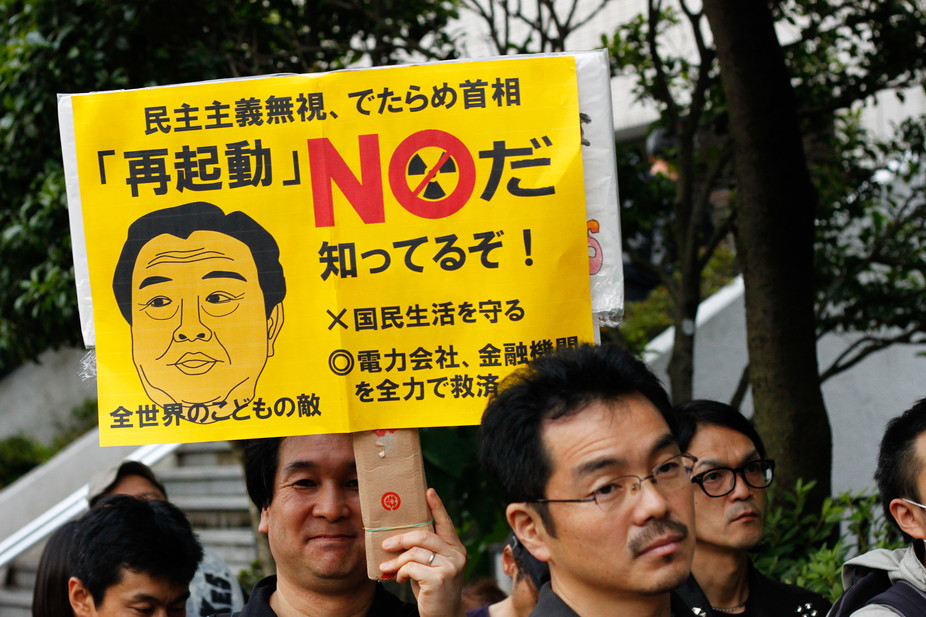
When the earthquake and tsunami struck in 2011, Japan had 54 operating nuclear reactors which produced about one-third of its electricity supply. After the meltdowns at Fukushima, Japanese utilities shut down their 50 intact reactors one by one. In 2012 then-Prime Minister Yoshihiko Noda’s government announced that it would try to phase out all nuclear power by 2040, after existing plants reached the end of their 40-year licensed operating lives.
Now, however, Prime Minister Shinzo Abe, who took office at the end of 2012, says that Japan “cannot do without” nuclear power. Three reactors have started back up under new standards issued by Japan’s Nuclear Regulation Authority, which was created in 2012 to regulate nuclear safety. One was shut down again due to legal challenges by citizens groups. Another 21 restart applications are under review.
In April 2014 the government released its first post-Fukushima strategic energy plan, which called for keeping some nuclear plants as baseload power sources – stations that run consistently around the clock. The plan did not rule out building new nuclear plants. The Ministry of Economy, Trade and Industry (METI), which is responsible for national energy policy, published a long-term plan in 2015 which suggested that nuclear power should produce 20 to 22 percent of Japan’s electricity by 2030.
Meanwhile, thanks mainly to strong energy conservation efforts and increased energy efficiency, total electricity demand has been falling since 2011. There has been no power shortage even without nuclear power plants. The price of electricity rose by more than 20 percent in 2012 and 2013, but then stabilized and even declined slightly as consumers reduced fossil fuel use.
Japan’s Basic Energy Law requires the government to release a strategic energy plan every three years, so debate over the new plan is expected to start sometime this year.
Public mistrust
The most serious challenge that policymakers and the nuclear industry face in Japan is a loss of public trust, which remains low six years after the meltdowns. In a 2015 poll by the pro-nuclear Japan Atomic Energy Relations Organization, 47.9 percent of respondents said that nuclear energy should be abolished gradually and 14.8 percent said that it should be abolished immediately. Only 10.1 percent said that the use of nuclear energy should be maintained, and a mere 1.7 percent said that it should be increased.
Another survey by the newspaper Asahi Shimbun in 2016 was even more negative. Fifty-seven percent of the public opposed restarting existing nuclear power plants even if they satisfied new regulatory standards, and 73 percent supported a phaseout of nuclear power, with 14 percent advocating an immediate shutdown of all nuclear plants.
Who should pay to clean up Fukushima?
METI’s 22 trillion yen estimate for total damages from the Fukushima meltdowns is equivalent to about one-fifth of Japan’s annual general accounting budget. About 40 percent of this sum will cover decommissioning the crippled nuclear reactors. Compensation expenses account for another 40 percent, and the remainder will pay for decontaminating affected areas for residents.
International Atomic Energy Agency experts review plans for decommissioning the Fukushima Daiichi nuclear power plant, April 17, 2013. Greg Webb, IAEA/Flickr, CC BY-SA
Under a special financing scheme enacted after the Fukushima disaster, Tepco, the utility responsible for the accident, is expected to pay cleanup costs, aided by favorable government-backed financing. However, with cost estimates rising, the government has proposed to have Tepco bear roughly 70 percent of the cost, with other electricity companies contributing about 20 percent and the government – that is, taxpayers – paying about 10 percent.
This decision has generated criticism both from experts and consumers. In a December 2016 poll by the business newspaper Nihon Keizai Shimbun, one-third of respondents (the largest group) said that Tepco should bear all costs and no additional charges should be added to electricity rates. Without greater transparency and accountability, the government will have trouble convincing the public to share in cleanup costs.
Other nuclear burdens: Spent fuel and separated plutonium
Japanese nuclear operators and governments also must find safe and secure ways to manage growing stockpiles of irradiated nuclear fuel and weapon-usable separated plutonium.
At the end of 2016 Japan had 14,000 tons of spent nuclear fuel stored at nuclear power plants, filling about 70 percent of its onsite storage capacity. Government policy calls for reprocessing spent fuel to recover its plutonium and uranium content. But the fuel storage pool at Rokkasho, Japan’s only commercial reprocessing plant, is nearly full, and a planned interim storage facility at Mutsu has not started up yet.
The best option would be to move spent fuel to dry cask storage, which withstood the earthquake and tsunami at the Fukushima Daiichi nuclear plant. Dry cask storage is widely used in many countries, but Japan currently has it at only a few nuclear sites. In my view, increasing this capacity and finding a candidate site for final disposal of spent fuel are urgent priorities.
Japan also has nearly 48 tons of separated plutonium, of which 10.8 tons are stored in Japan and 37.1 tons are in France and the United Kingdom. Just one ton of separated plutonium is enough material to make more than 1,200 crude nuclear weapons.
Many countries have expressed concerns about Japan’s plans to store plutonium and use it in nuclear fuel. Some, such as China, worry that Japan could use the material to quickly produce nuclear weapons.
Now, when Japan has only two reactors operating and its future nuclear capacity is uncertain, there is less rationale than ever to continue separating plutonium. Maintaining this policy could increase security concerns and regional tensions, and might spur a “plutonium race” in the region.
As a close observer of Japanese nuclear policy decisions from both inside and outside of the government, I know that change in this sector does not happen quickly. But in my view, the Abe government should consider fundamental shifts in nuclear energy policy to recover public trust. Staying on the current path may undermine Japan’s economic and political security. The top priority should be to initiate a national debate and a comprehensive assessment of Japan’s nuclear policy.
Results for the recently held Uttarakhand assembly elections will be released tomorrow, yet no matter which political party comes to power, it has its hands full.
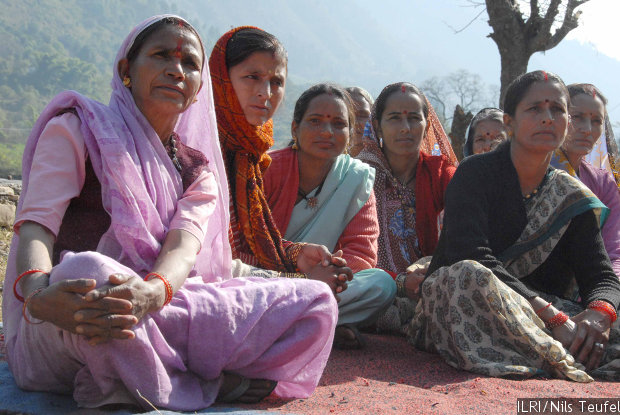
Women farmers in Jukanoli village, in the hill district of Almora, Uttarakhand. The state’s hill districts are still struggling with low per capita income, bad access, poor healthcare facilities, unemployment, decline in agricultural output and neglect.
Uttarakhand, the Himalayan state which borders along China, is the sixth richest state in India in terms of per capita income but those living in its hill districts benefit less from this development than those in the plains.
Consider this: The per capita income of Haridwar, a district in the plains that is 53 km from state capital Dehradun, is Rs 122,172. But Uttarkashi, the northern-most Himalayan district, reports half that per capita income at Rs 59,791, according to the 2014-15 Statistical Diary, Uttarakhand. This is close to the per capita income of Jharkhand which ranks among the 17th in the country.
The irony is that Uttarakhand was carved out of Uttar Pradesh (UP) in 2000 precisely so that exclusive attention could be given to the development of its remote hill districts. These had been left neglected by successive governments based in UP’s capital Lucknow, around 600 km from Dehradun.
Sixteen years since, the mountain districts of Uttarakhand are still short of basic facilities, especially healthcare. There are no jobs to be had in these districts and this is leading to large-scale migration to the plains, leaving entire mountain villages uninhabited. And farming, which used to be the principal occupation in the hills, is crippled by small land holdings and a lack of government agri initiatives that neighbouring Himachal Pradesh sees in plenty.
“Uttarakhand was not founded for the development of Haridwar and Haldwani (cities in the plains) but for the development of the 16,000 plus villages in the hills of the state. But nothing is being done for them,” said Anil Joshi, environmental activist and convenor of the Gaon Bachao Andolan (save the village movement), a campaign to tackle the state’s migration issue.
At Rs 122,804 Dehradun’s own per capita income is closer to that of Haridwar. Though it is a hill district, it benefitted from being the state capital.
Rich state, poor health: Only 68% health centres function well
Uttarakhand’s health infrastructure is facing a crisis, as IndiaSpend reported in February 2017–only 68% of its primary health centres that form the frontline of the public healthcare system work 24×7, as they are supposed to. The second-rung community health centres are short-staffed–they are 83% short of emergency specialists and have half the number of nurses needed.
Uttarakhand also suffers poor infant mortality rates (IMR), ranking 18th among 29 states, according to an Observer Research Foundation analysis. But the hill districts of Rudraprayag, Pithoragarh and Almora record fewer infant deaths despite their inaccessible terrain. It is the well-developed pilgrim district of Haridwar that reports the worst figure of 70 deaths per 1,000 infants (2012-13), the same as conflict-ridden Congo. Haridwar also represents a high rate of stunting–low weight for height–52% in children under five, compared to Pithorgarh’s 22%.
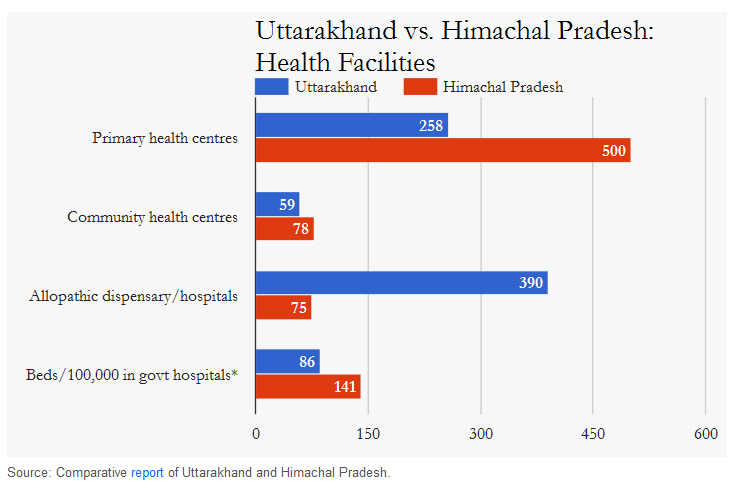
Himachal Pradesh too has a problem accessing hilly districts but it is doing much better than Uttarakhand on the healthcare front as this comparative report of the two states for 2014-15 shows. Himachal Pradesh has 141 beds per 100,000 people compared to 86 beds in Uttarakhand–which has 47% more population (10 million) than the former (6.8 million). Himachal Pradesh has nearly double the primary health centres (500) Uttarakhand does (258). And its community health centres (78) outnumber those in Uttarakhand (59).
Ghost villages in the hills: 1,048 emptied out completely
People living in the mountains have always migrated to cities in the plains in search of white-collar jobs. But they would leave their families, or a part of it, behind. Now migrations to the plains involve entire families moving from the hills to the plains, either within Uttarakhand or to other parts of the country, said locals.
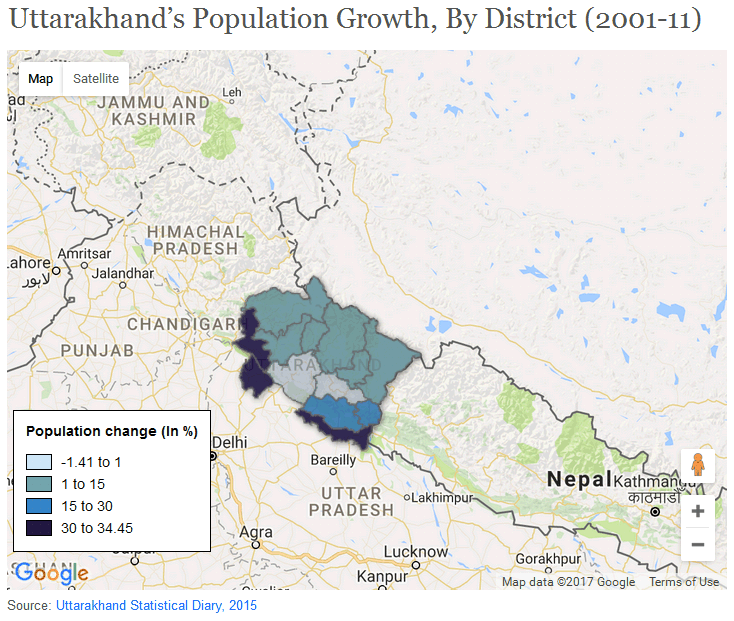
While hill districts saw a decadal population growth of 12.75%, the plains recorded almost 32%. This is a sure sign of large scale migration of entire families from the hills.
There are 1,048 villages in the state that are uninhabited—“ghost villages”, according to Census 2011. Here migration has emptied out entire villages.
There has been a negative decadal growth observed in the districts of Almora (-1.28%) and Pauri Garhwal (-1.41%). The population in both districts together fell by 17,868 persons between 2001 and 2011.
In 2015, the National Institute for Rural Development and Panchayat Raj conducted a survey of 217 households in Almora and Pauri Garhwal to understand the dynamics of migration and its impact on the village economy. They found the following: 88% of households reported having at least one person migrating for a job; 86% of those who had migrated were men, 51% of them were between 30-49 years. Also, 73% of them reported migrating for durations between six and 12 months.
The top reason for migration was employment–47% of migrants cited the lack of job opportunities in their home districts. And 18% said they migrated anticipating better jobs in cities while 17% said they had landed jobs or were being transferred out by their existing employers.
“The attraction to cities arising due to hardships of village life in hills such as poor transport connectivity, lack of water, inadequate medical facilities, poor educational facilities and inaccessible markets have (sic) further accelerated the process of migration of youth,” said the paper.
Uttarakhand’s literacy rate at 78.8% is higher than the national average of 73%. The teacher to student ratio in primary section is 1:23 compared to the national figure of 1:41.
“With the kind of education that we are offering our children, there are no jobs for them here in Uttarakhand,” said Shekhar Pathak, former professor at the Kumaun University and founder of the People’s Association for Himalaya Area Research (PAHAR). “We are unable to offer youngsters dignified jobs in the state and hence entire families have been migrating.”
Falling yield: Agriculture growth slows to 4%
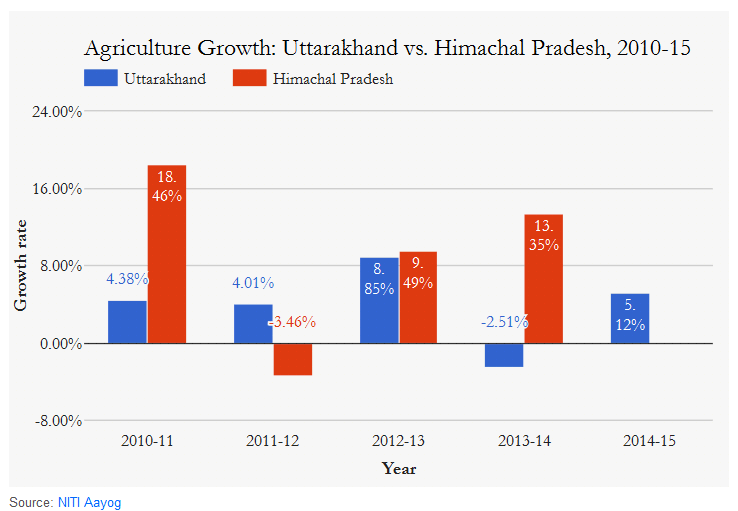
There has been slowing down of growth in agriculture and allied activities in Uttarakhand. Its annual, average growth stood at 4% between 2010 and 2015 compared to Himachal Pradesh’s 9% in the same period.
“Himachal Pradesh earns more than Rs 15,000 crore every year from horticulture and agriculture because of its government policies. The Uttarakhand government never focussed on developing agriculture and that is why there is this deep decline,” said Joshi.
Also, smaller land holdings give smaller returns on investment and 73% of all farmers in the state are marginal, with less than 1 hectare of land according to the state statistical diary.
With migrants abandoning their land to the elements, vacated farmlands are attracting wild animals from surrounding forests and this is leading to animal-human conflicts. Even though a notification passed in February 2016 allows the culling of wild boars, the implementation of the notification has been poor.
“Villagers say that even if they work in the fields, their crops will be destroyed by monkeys and boars, so what’s the point?,” said a senior officer working in the horticulture department requesting anonymity. He also pointed out that climate change has pushed fruit cultivation to even higher altitudes, causing a drop in the production.
“An upwards altitudinal shift in cropping has been reported in cash crops like apple, rajma, potato and carrot. Some projections speculate on an increase of night time temperature (Dimri and Dash, 2011) which may not only lead to decrease in production of some crops such as rice, but also reduce the winter killing of pests, hereby decreasing crop yields,” said 2015: Climate Change in Uttarakhand, a report by the Centre for Ecology, Development and Research.
There has also a drop in annual rainfall in the region that has impacted the state’s dominantly rain-dependent farming. “Most of the old water sources are drying up, agriculture is becoming very challenging,” said the official.
An analysis of temperature and rainfall data over 100 years shows a decline in rainfall that grew steeper after 1970s. “Although the average reduction rate in annual total rainfall has been insignificant, yet it may put great stress on the water resources of the region. The rainfall declining trend (sic) is not the same all over the state,” noted Changing Climate of Uttarakhand, a paper published in 2014 in the journal Geology and Geosciences.
Haridwar received more rainfall than normal while all other districts witnessed less precipitation. “This rainfall shortage is more acute in Pithoragarh, Bageshwar, Almora, Champawat and Nainital Districts,” the report further noted.
Older residents said that tougher conditions for agriculture mean that it is harder for the youth to resist the pull of migration.
“Youngsters here prefer to work as security guards in Delhi earning a measly Rs 3,000 a month than working here. They see no future here,” said the senior officer in the horticulture department.
(Yadavar is principal correspondent with IndiaSpend.)
We welcome feedback. Please write to respond@indiaspend.org. We reserve the right to edit responses for language and grammar.
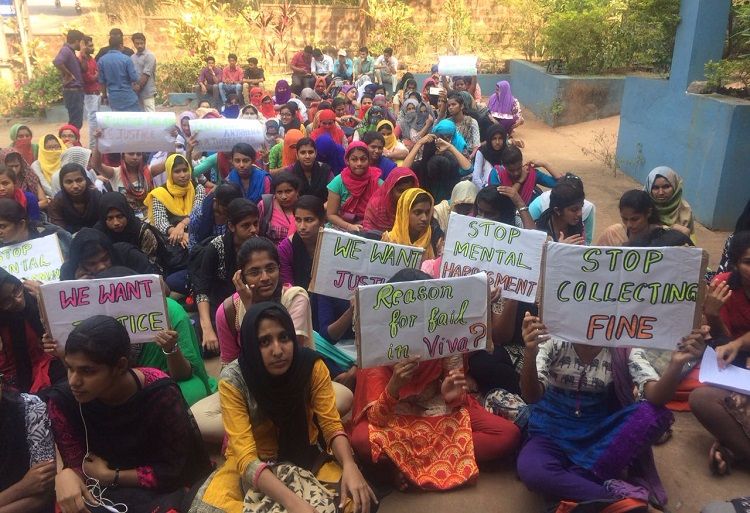
MV Shetty College students allege that a lecturer had deliberately failed the 21-year-old.
The students of MV Shetty College in Karnataka's Mangaluru are up in arms against the management, after a 21-year-old student attempted to kill herself two days ago.
The student was reportedly upset over the management denying her permission to appear for the final semester examination, stating that she had failed in an internal viva test. However, students claim that a lecturer had deliberately failed Vincy and five other students.
On Tuesday night at around 9pm, Vincy, a native of Kozhikode and a sixth semester student of MV Shetty College of Speech and Hearing, said that she wanted to take a shower and insisted that her roommate leave the room. When Vincy did not come out of the bathroom for some time, her roommate went to check on her. To her horror, Vincy's roommate found blood on the floor of the room, following which the students then broke open the bathroom door. They found Vincy unconscious on the floor, with her veins cut.
Vincy, who was rushed to a nearby hospital, continues to receive medical treatment.
More than 150 students of the college have been protesting outside the main campus since Wednesday, demanding that the management allow Vincy and other students to appear for the sixth semester examination. Speaking to The News Minute, Vincy's classmate- on the condition of anonymity- accused one teacher of targeting several students, time and again.
"Teacher Vini Abhijith from our department is extremely partial and she targets those students whom she does not like. She would mark them really low in class tests…it was evident that she had a few targets in every class. But the management remains mum because she is close to those higher up," the student alleged.
Vincy's father Gangadharan, a retired government employee said that the college had made him pay the examination fees, but had not allowed his daughter to appear for it.
"Three weeks ago, the college Principal summoned me and the parents of five other students and said that our children were short on attendance. He said that they had failed in an internal test and that they could still appear for the final semester exam. But then Vincy called me up a week ago and said that the college had gone back on its words and even offered to refund the examination fee we had paid. She was devastated because this meant that she had to repeat one full academic year," Gangadharan said.
Neither Gangadharan, nor Vincy's friends had any inclination that she would attempt suicide.
"She is a strong girl and so, although we knew she was upset, we did not take it too seriously. After the college management told her that she could not appear for the exam, Vincy even stopped talking to us. She would just sit on the bed and just not talk to anyone," another friend said.
The students also alleged that the college management first refused to even listen to their demands when they began protesting on Wednesday.
"The whole day, we stood outside the gate, demanding a dialogue with the management. A few of them agreed to talk to us at around 3pm and summoned some students in. But we were clear, we wanted the management to address all of us and not just one or two students. The representatives of the management then walked out," a student said.
Speaking to TNM, Principal Satish K claimed that external political elements were involved in manipulating the students. He said that the students had never raised a complaint about Vini, the lecturer, and that disqualifying the six students including Vincy was normal procedure.
"Those students have failed in the test and must accept the result no matter what. Also, Vincy was never a bright student. She barely managed to pass previous examinations," Principal Satish said.
After the students continued their protest on Thursday, the management agreed to consider their demands, including strict action against two lecturers Vini Abhijith and Binoy Shany, "who are responsible for the plight of the students."
Do you really believe that our beautiful, strong and ancient country is in danger from a few students who express dissatisfaction with the state of the nation?
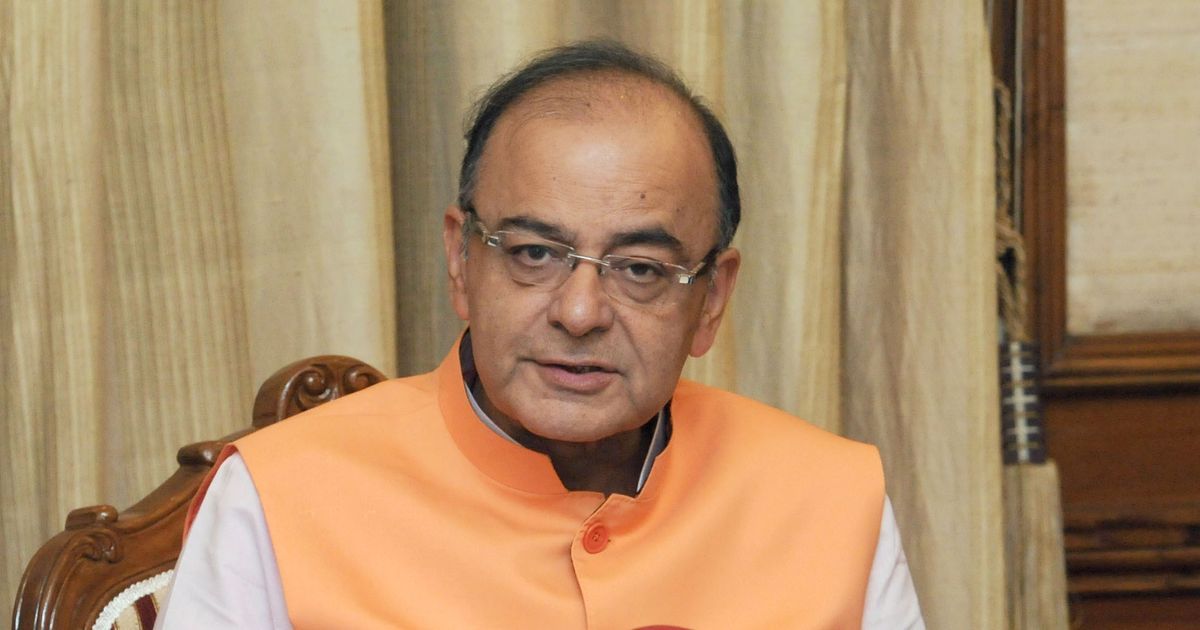
Dear Mr Arun Jaitley,
Pranam, greetings, As-Salaam-Alaikum. I trust you are well and as usual, fighting fit.
As a lawyer you know better than most denizens of this country that the breath and heartbeat of democracy are openness, dissent, civility and non-violence. One other quality that Gandhi had in plenty, but is sorely missing these days, is a sense of humour about our follies. It ensures that we are not only self-aware but are able to internalise the notion that it is the bonds of brotherhood that are the foundation of this marvellous potpourri called India. It is in the light of this background that I find it incomprehensible and disturbing that a seasoned lawyer like you, who is also our finance minister, keeps talking about the imminent dangers to the polity just because a university student spoke openly about her desire to defend the right to freedom of expression and drew a fine but thoughtful line between the people of Pakistan and war.
Who is the real enemy?
A few weeks ago, I had written an article asking how we don’t know who the enemy in the North-West is even after decades of being victimised. The enemy is definitely not the majority of Pakistanis who, like us Indians, are busy making ends meet. The enemy is the Pakistani Army and the Inter-Services Intelligence who control not just the terrorist organisations in Pakistan like the Taliban, Lashkar-e-Taiba, Al-Qaeda and Jaish-e-Mohammed, but also mastermind the planning and execution of terror attacks in India, and even in Pakistan itself, destroying the holy sites of Sufi saints and killing hundreds of their own people. We know that the Pakistani Army and the Inter-Services Intelligence control that country’s prime minister himself and dictate policy. General Pervez Musharraf, the former Pakistan President, was happy to admit to this just a few days ago.
Who should know this better than you? After all you and Amit Shah are one of the triumvirate headed by Prime Minister Narendra Modi. We know that while your portfolio is finance, you often speak on behalf of Modiji and the Bharatiya Janata Party. You express your wrath often on every conceivable subject, especially the country’s territorial integrity and the student community. But starting with your daily reversals and revisions in diktats during the demonitisation tsunami, why does almost everything have to boil down to a mantra of nationalism and patriotism? Why are you constantly fuming and conjuring up sedition fantasies? Why are you suffering from so much insecurity? Do you really believe that our beautiful, strong and ancient country, which weathered 250 years of foreign rule and many other disasters, is so shaky that it is in perpetual danger from a few students who express dissatisfaction with the state of the nation?
India’s strength
Come on Jaitleji, you too were a firebrand in your youth with perhaps a different bee in your bonnet. India is unlike any other country. We have deep roots that go back all the way to Mahavir and the Buddha and to Gopal Krishna Gokhale, Rabindranath Tagore, Gandhiji, his colleagues and the foot soldiers of our freedom struggle. Surely you and your party do not need to be reminded that this is how we are still the only country in the world that stood up to the might of the British Empire and won independence with the most unique weapon on earth, non-violent civil disobedience.
On the other hand, not for a moment do I underestimate the appalling danger that ISIS [Islamic State of Iraq and the Levant] poses to the free world. But there is a cure for ISIS. It is democracy at its best where every citizen has the same rights, the same superb education (not doctored texts by ideologues of any variety), the same opportunities and the same rights and duties. In short, a binding inclusiveness where everyone has an intense feeling of belonging to this land.
I hope to God that the citizens of our country will never permit the highly inflammable and barren hate campaigns of Donald Trump in the US, Marine Le Pen in France, Nigel Farage in the UK and so many others to find fertile ground in India.
‘Talk to the youth’
Jaitleyji, if you want to win over the minds of youngsters, then “chill out”, as they put it, and sit amongst them minus your overheated rhetoric. Instead of talking down to them, talk with them about their ambitions, literature, idealism, the intense need for a wide open and enlightened educational system, listen to their opinions. You will be amazed at how knowledgeable many of them are. Show them that the oxygen of democracy is freedom of expression and inclusiveness. Show them that you would have cared deeply about Gurmehar Kaur even if her father had not been a military man who lost his life. Show them that you would protect anyone – young women or men, the elderly or the middle-aged – because that is where this country’s honour lies. That anybody who threatens a woman with rape, verbal or physical harm will be arraigned instantly and punished under the law. The same will hold for the threat of violence against anyone. And if it is not too much to ask, put an end to the glib doublespeak. Cut out the platitudes. Mean what you say. Insist on actual action, and show the people that our democracy is in top shape and functions for every single person.’’
‘Remember the Constitution’
As a highly-respected lawyer, perhaps you and Ravi Shankar Prasad, our minister of law, should remember that the only sacred – but areligious – text in our polity is the Constitution of India. Forgive me for putting the matter in such a tentative manner but the two of you and even our much-revered Prime Minister often have memory lapses and seem to be unaware of a document of such enormous importance. We must, however, grant that every now and then your memory is active enough to invoke the Constitution. For instance, we watched you flare up last year on the issue of Jawaharlal Nehru University’s Kanhaiya Kumar, who was jailed on the charge of sedition, or regarding Rohith Vemula, the doctoral student from Hyderabad Central University who committed suicide after he was thrown out of his hostel room. In Vemula’s case the government asked his mother to prove her Dalit antecedents within 15 days. Are we to understand that the Dalit label has overnight become so highly prized that Vemula and his mother would claim to belong to the much-maligned “wretched of the earth”, as the psychoanalyst and philosopher Frantz Fanon called the poor and depressed classes?
Here’s another instance. How could one forget that Mohammed Akhlaq of Dadri village in Uttar Pradesh was lynched by a mob, and his young son brutalized, because a Brahmin priest from the village temple claimed that there was beef in the family fridge? Police investigations and the forensic probe proved that there was no beef in the house. But months later, it turns out that the tested substance had changed its chemical or other components and gone back to being beef. So now Akhlaq’s bereaved family is once again in serious trouble with the law.
How come you and Ravi Shankar Prasadji are so incensed when students voice their opinions that you hold forth on the danger to the nation from these young people, but seem utterly indifferent to the law transmuting Akhlaq’s victimised family into criminals? It is incomprehensible how the government can alienate our minority communities with such abandon.
The case of Kashmir
And here’s one more egregious case of antagonising our own people. I am talking about what happened in Kashmir a few months ago. Let us grant that things got out of hand. Was that so unusual? Our relationship with that former jannat (paradise) has been dicey from the time we won independence. Could you two senior ministers at the Centre, the honorable Prime Minister, the home minister and the chief of the Army not see the horrendous consequences of firing pellets that blinded so many people, especially children? How have we become so callous and blind? Surely there are many other less dangerous but effective methods of controlling mobs. Can’t you see that you are not just making lifelong enemies, you are ensuring that the next 50 or 100 generations will keep these terrible crimes and injustices alive, and never forgive us? Can you not see that the Indian State is turning into the most efficient recruiting agency for ISIS in India?
Bounty on Vijayan
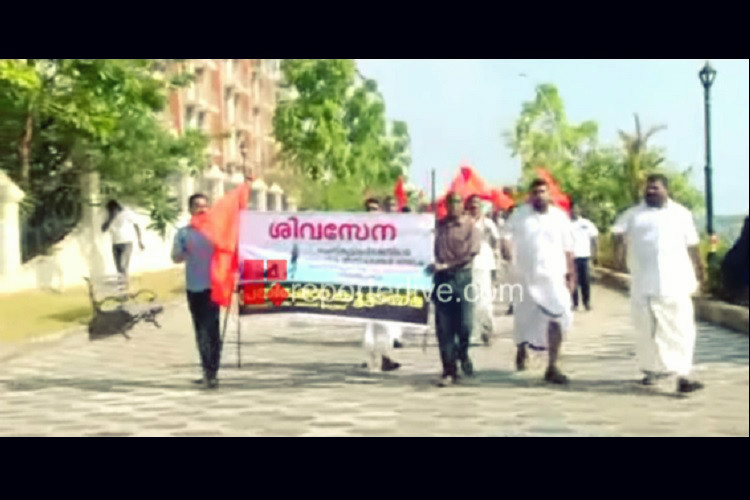
Then on March 2, Kundan Chandravat, a Rashtriya Swayamsevak Sangh sah pracharak pramukh (joint head of dissemination for RSS ideology) announced a Rs 1-crore bounty for anyone who murdered Pinarayi Vijayan, the chief minister of Kerala. According to Chandravat, Vijayan was responsible for the deaths of 300 RSS activists in the state. Were these alleged murders a clandestine operation by Chief Minister Vijayan that even the Centre was unaware of, or was this just routine Rashtriya Swayamsevak Sangh political hyperbole? But Chandravat had more poison to share with the public. He said he was willing to “offer a garland of 3,00,000 human skulls to Bharatmata in revenge”.
As expected, the RSS leadership announced that it was disassociating the institution from this statement and its source. However, there was total silence from the Union government. Modiji, Jaitleyji, Prasadji, and Singhji, there was not a peep out of you. When it comes to India’s youngsters, you hector people, you spew extreme disapproval and your diatribes get louder and more intolerant and more hostile, all in the name of sedition. But you take zero note and action when someone from the RSS, in full public view, using the most obnoxious words, threatens death to a chief minister and three lakh citizens. Is silence all you can offer to such vile threats? While students get jailed, Chandravat gets to walk freely and spread his deadly talk without the police or the leadership of the ruling party doing a thing.
So, does our country now have two Constitutions – one for the ruling party and its affiliates, and another for the rest of the country? This also raises another question: why has the judiciary not issued a suo moto notice to Chandravat yet? I will take my leave now. Do remember that there is no malice here, just what the French call “a cry from the heart”.
Warm regards, and may God keep all of you safe and in good health,
Kiran Nagarkar
PS: One simple question: How come we, the people of this land, cannot have a conversation with you, Prime Minister Modi, Amit Shah, Ravi Shankar Prasad, and most of your leaders and spokespersons? The slightest disagreement and all of you come down on us as if we were traitors. Is it not possible to lower the temperature and talk to each other instead of being constantly slammed down? Is dialogue with all of us outside the pale of Hindutva? It might come as a shock to you but we are not the enemy. We too belong to the same country as you and are Indians.
The official estimates released by government recently, show a robust 7% growth in GDP, belying the effect of demonetisation on the economy. According to Prof. Surjait Majumdar, the growth figure is over estimated and is based on a faulty methodology. He explains that methodology of GDP estimation, that is being followed since 2011-12, underestimates the impact demonetization on the informal sector which is the major provider of employment. He also, explains that the evidence from other indicators – declining index of industrial production, reduced credit off take from banks and stagnant tax collection coupled with lack of cash for transactions, clearly indicate that economy is in stagnation.
No country in the world has achieved full gender equality, but the Arab region – a diverse grouping of 22 countries in the Middle East and North Africa – ranks lowest in the world, according to the 2016 Global Gender Gap Report.
Amr Abdallah/Reuters
Despite some advances in women’s economic equality in Qatar, Algeria and the United Arab Emirates, at the present rate, the region’s 39% gender gap (compared to 33% in South Asia and 32% in Sub-Saharan Africa) will take another 356 years to close. Worse still, between their patriarchal societies, increased conservative movements and lack of political will to move towards gender equity, the Arab world today is seeing a backlash against women’s rights and freedoms.
As the Executive Secretary for UN Economic and Social Commission for Western Asia (ESCWA), Rima Khalaf, said to commemorate International Women’s Day in 2016, “We are celebrating the many achievements of Arab women in sciences, literature and arts, but primarily in the art of survival.”
Here are the top five barriers facing women in the Arab world this year, along with some bright spots on the horizon. Women of the region are, of course, not all the same, but many share these profound challenges.
1. Ongoing conflict
For many Arab countries, instability is becoming the norm. The region’s multiple protracted humanitarian crises, including those in Syria, Palestine and Iraq, have destroyed systems of social protection, reduced access to safe services and support, displaced communities, and increased vulnerabilities.
The threat of violence is particularly high for young women and women of ethnic minorities, according to the 2016 Arab Human Development Report. For all women, but these in particular, even escaping conflict does not necessarily bring safety.
For young women and women of ethnic minorities in particular, escaping conflict does not necessarily bring safety. Rodi Said/Reuters
Despite research showing that the biggest predictor of peace in a country is not economics or politics, but how the country treats its women, in times of conflict gender equality goals quickly disappear from the agenda. And, in a situation all too common around the world, Arab women generally do not have a seat at the table or a voice in negotiating their nations’ peace.
2. Gender-based violence
One in three women worldwide has experienced some form of gender-based violence in their lifetime. In the Arab world, violence against women takes many forms, with intimate partner violence being the most common (affecting approximately 30% of women in the region) and the least reported. Here, intimate partner violence is often not labelled as such. When it is, social stigma and family and community pressures keep women from reporting it.
Honour killings are also prevalent in many Arab countries, which have largely failed to amend relevant laws. Jordan has the highest percentage in the region: each year it registers between 15 and 20 reports of such crimes. Finally, in countries that host Syrian refugees, child marriage is increasing as a response to the ongoing crisis.
But we are seeing progress.
One way to counter violence against women in the Arab world is increasing its visibility among youth – as this student video competition for the 16 Days of Activism Against Gender-Based Violence – has done. Another promising initiative is a robust study led by the UN Economic and Social Commission for Western Asia (ESCWA) to estimate the regional cost of violence against women. The aim is to use economic arguments to raise awareness and influence policy.
Other organisations, such as the regional civil association ABAAD’sAl Dar (emergency shelters), are providing a safe environment for survivors of gender-based violence, and those at risk, to access services and support. These are promising emerging practices, although uncommon in the region.
Women in Arab countries have the lowest female employment rates in the world. Mohamed Abd El Ghany/Reuters
Most women who work outside the home are relegated to traditionally feminised sectors. In cases where women are accessing male-dominated fields, traditional gender dynamics remain firmly entrenched. So women are promoted less and have little access to decision-making positions.
While men’s employment is a prerequisite to marriage, women’s employment often ends with marriage; being married is viewed as a disadvantage in the workplace as well.
There are strong economic incentives to change these practices. Globally, gender equality results in higher GDP – more workers means more productivity. But the strongest argument of all is principle. This is a woman’s right – and it is the right thing to do.
Vocational training, micro-lending, business planning, access to markets, and other supportive measures would help bring women into the labour market. As would addressing factors, such as lack of access to (safe) transport, safety in public spaces and daycare, all of which place limits on women’s employment prospects.
4. Lack of political participation
Arab women still lag significantly behind in terms of women’s participation and representation in politics. According to the WEF, only 9% of the political gender gap is closed. And four out of the world’s five lowest-ranking countries are in this region, including Oman, Lebanon, Kuwait and Qatar. They have closed less than 3% of their political gender gap.
Only the United Arab Emirates has seen improvement in terms of increased women parliamentarians. Although, again, presence in the political arena does not necessarily entail power.
In Lebanon, women currently occupy just four parliamentary seats, 3% of ministerial positions, and around 5% of seats in municipal councils. But information on women’s political positions is often incomplete, as these statistics are counted manually from municipality to municipality.
This lack of political participation is largely due to cultural barriers, a lack of access to economic and financial resources, and the absence of successful active role models in politics.
Women politicians are relatively rare in the Arab world. Amr Abdallah Dalsh/Reuters
5. Restrictive family laws
Despite critiques of women’s legal status in the Arab region, changing family patterns, and a booming young female adult population, aspiring to professional lives, family laws in Arab countries still endorse inequality between spouses and discriminate against women in all aspects of their lives.
This is a key obstacle to sustainable development, preventing women’s self-determination and contribution to public and productive life and reforms have been slow and uneven across the Arab region.
Since 2000, Egypt has introduced a series of legal changes, but to little effect. This includes no-fault divorce, where women can initiate divorce. However, the consequence is that they lose any right to financial support and must repay the dowry they received upon marriage. Family courts were established in 2004, but a holistic approach to family law reform is still lacking as these courts continue to perpetrate the same archaic and discriminatory laws.
In 2004, a reform of Morocco’s Moudawana (family code) similarly increased women’s right to divorce and child custody and also restricted polygamy. But the Moroccan government remains hesitant to actually implement these reforms.
In Lebanon, reform efforts face unique challenges due to the diversity of its 15 separate personal status laws for the country’s various officially recognised religious communities, of which there are 18 in total. But the ongoing refugee crisis, in which at least 1.4 million Syrian refugees have come to Lebanon, is an urgent reminder that conflict, war, and forced migration continue to reinforce the need for legal protection for women. Still, there is potential for reform within challenging Arab contexts – whether during conflict, post-conflict, or when stable. Future policies for women must build on Arab activism and academic scholarship to reform family laws using a human rights framework and aligning with global goals (such as the Convention on the Elimination of All Forms of Discrimination Against Women) to build a foundation for full equality.
These issues are overlapping, meaning progress – or regress – in any of these areas has an impact on many other aspects of women’s lives. The underlying message is this: unless we’re addressing inequalities everywhere, we will achieve equality nowhere.