Delhi chief minister, Arvind Kejriwal, on Wednesday once again urged Prime Minister Narendra Modi to unfollow the vicious right-wing trolls, who are known for giving grief to women on Twitter.
Wishing women on International Women’s Day, Kejriwal wrote, “Happy women’s day to all. On this day, I urge Hon’ble PM to unfollow all those who abuse n threaten women n take strong action against them. (sic)”
Kejriwal also shared a tweet, which mocked Modi for his decision to address a group of women village heads on the occasion of International Women’s Day in Gujarat.
Happy women's day to all. On this day, I urge Hon'ble PM to unfollow all those who abuse n threaten women n take strong action against them
Twitter user Jignesh Mevani had tweeted, “Modi Ji will be giving ‘upadesh’ to hundreds of Mahila sarpanch of Gujarat but will not utter a word about naliya sex scam.”
Modi, for his part, tweeted, “Saluting the indomitable spirit, determination & dedication of Nari Shakti on International Women’s Day.”
Saluting the indomitable spirit, determination & dedication of Nari Shakti on International Women's Day.
Abusive trolls enjoying Modi’s blessings has been a topic of intense social media debate but even in the face of incessant criticism from intellectuals and hosts of civil rights activists, the prime minister has not stopped following them. Critics say that the abusive trolls in question form the infamous Twitter army of the saffron party.
Meanwhile, President Pranab Mukherjee has conveyed his greetings on the occasion of International Womens Day saying generations of Indian women have made an invaluable contribution to the development and progress of the country.
“On the occasion of International Womens Day, I extend warm greetings and best wishes to women in India and in all parts of the world,” he said in a message.
Mukherjee said that the government had introduced and implemented historic legislations and far sighted programmes for their empowerment and equal participation in nation building and referred to the Beti Bachao, Beti Padhao campaign.
Elsewhere, the Delhi Commission for Women (DCW) will honour 30 women from different walks of life across the country on the occasion of International Womens Day tomorrow.
The second edition of the 2nd Annual International Womens Day Awards will also honour men who have helped women in distress.
“These awards not only recognise the unsung heroes of our society but will also prove as an inspiration to others. We received many nominations and 30 persons were shortlisted,” said DCW chief Swati Maliwal.
Across the wide world, women are rising up to protect the Earth, one another, and the common good
Indigenous women of the Ecuadorian Amazon stand for their communities and the Earth on International Women’s Day 2016. (Credit: Emily Arasim/WECAN)
Women around the world stand at the forefront of rising movements to defend and protect the health of water, land, air and diverse communities. On this International Women’s Day, it is vital to honor the women defenders who, with incredible courage and effort, are taking on corporations and governments to say ‘no’ to resource extraction and the continued violation of human rights, women’s rights, and the rights of Indigenous peoples and frontline communities. Through their work, these women act so that the generations to come may yet stand a chance of inheriting a sustainable and livable planet.
With increased frequency however, many of the women and men who advocate daily in defense of a just world are being systematically criminalized, attacked and murdered with impunity. According to 2016 reports by Global Witness, 2015 was the most dangerous year on record for land defenders, with at least three people per week killed for non-violent opposition to mining and fossil fuel projects, agribusiness, hydroelectric dams, logging and other extractive industries.
"The violation of women rights and land defenders speaks in a profound way to the derangement of our times."
Indigenous peoples defending ancestral territories represent upwards of 40% of those killed. Women, and Indigenous women in particular, face even greater challenges and dangers, as they navigate the brutal intersection of environmental devastation, cultural dislocation, and sexual violence and gender based persecution.
Tragedies such as the 2016 murder of Honduran activist Berta Caceres indicate the acceleration of these trends, which have prompted United Nations Special Rapporteur on Indigenous Rights, Victoria Tauli-Corpuz to warn of an “epidemic” of murder of Earth defenders.
The violation of women rights and land defenders speaks in a profound way to the derangement of our times, and to the dangerous worldviews of domination and exploitation, which sit at the root of both degradation of Earth’s natural systems, and violence against women of the world.
Despite experiencing the impacts of environmental harms with disproportionate severity, women are rising in diverse manifestations to demonstrate that they hold the knowledge, skills and heartfelt passion needed not only to protect their homelands, but also to build substantial and creative solutions needed to avert the worst impacts of environmental destruction and the climate crisis.
In this context, standing in solidarity with women defenders is critical – to uphold fundamental human rights, to protect frontline communities, and to ensure sustainability on Earth. Frontline women can also be supported by demanding governments and corporate actors comply with Indigenous rights and sovereignty, issues which often lie at the root of violations.
On International Women’s Day, the Women’s Earth and Climate Action Network shares the stories of just a few of the world’s countless women human rights and Earth defenders, and raises the call to visibilize, support, and honor all frontline women defenders for their fierce dedication and unrelenting voice and action for justice.
Photo 2: ‘Women united, will never be defeated.’ (Credit: Emily Arasim/WECAN)
Melania Chiponda, Zimbabwe After bearing witness to violence and sexual abuse of women by security and military forces attempting to suppress local opposition to mining, Melania Chiponda of Marange, Zimbabwe began advocating as a woman defender, working independently and with WoMin. For many years, Melania has been speaking out against actions by the diamond mining industry to forcibly break the connection between women and their ancestral lands. For her work to protect Indigenous women’s land rights, and stop land grabbing and militarization of mining regions, Melania has been arrested, detained and threatened many times. She commented recently as part of the DefendHer campaign.
"We fight. Because we have nothing else to lose."
—Melania Chiponda, Zimbabwe“If you take away land from women in the rural areas, you take away their livelihoods; you take away the very thing that they identify with. Then we fight. Because we have nothing else to lose.”
Josephine Pagalan, Philippines In the Philippines, Manobo Indigenous woman leader Josephine Pagalan is fighting to protect her people's ancestral lands from mining and logging operations. Following the murder of several of her colleagues, Josephine was forced to leave her community to seek safety in the city, fearing that impunity in her remote village would lead to her own death. Despite harassment, Josephine continues representing the public face of the many Indigenous Lumad women who are on the frontlines demonstrating, documenting human rights abuses, and filing legal suits in opposition to the militarization, violation of community rights, and environmental devastation taking place across their homelands.
Josephine explained to Womens E-News, “We want the government to be made accountable for the human rights violations and attacks. Mining companies promised too many things in the past but they did not deliver. We don’t want to give up our land because money can be consumed but land will not perish.”
Ana Mirian Romero, Honduras "That is all we want – land, air and water that is not contaminated by the dams. We are persecuted and threatened for this, but we do it for our children’s future."
—Ana Mirian Romero, HondurasIn Honduras, Ana Mirian Romero, leader of the Lenca Indigenous Movement of La Paz and San Isidro Labrador Indigenous Council, is standing for land rights for the region's Indigenous peoples, working most recently in opposition to the Los Encinos hydro-electric dam, a project which never received free, prior and informed consent, as required by the United Nations Declaration on the Rights of Indigenous Peoples.
Repeatedly since 2014, Ana Mirian has been subject to harassment, death threats, raids, beatings by police while pregnant, arson attacks and gunmen outside her home. In 2016, while being awarded the Front Line Defenders Award for outstanding contribution to the protection of human and land rights despite the immense personal risk endured, she explained, “We defend the river, the forests, and the pure air that we breathe. That is all we want – land, air and water that is not contaminated by the dams. We are persecuted and threatened for this, but we do it for our children’s future.”
Joy Braun and LaDonna BraveBull Allard, North Dakota, United States Joy Braun (Cheyenne River Sioux Peoples) and LaDonna Brave Bull Allard (Standing Rock Sioux Peoples) are two of the extraordinary Indigenous women defenders of the Standing Rock, Dakota Access Pipeline resistance movement, both taking action to protect water and life since the first day of the encampments. For many months, both women and their families have been exposed to violence, militarized police forces, raids and surveillance.
Joy Braun works in the region of North Dakota where rampant fracking (which would supply the Dakota Access pipeline if it becomes operational) has been taking a devastating toll on the health and safety of Indigenous women for many years.
LaDonna’s home, and the grave of her son, overlook the Missouri River at the point of Dakota Access pipeline crossing. During a Fall 2016 interview she pronounced:
“First and foremost we are water protectors, we are women who stand because the water is female, and so we must stand with the water. If we are to live as a people, we must have water, without water we die. So everything we do as we stand here, we must make sure that we do it in prayer, and that we do it in civil-disobedience. We do it with goodness and kindness in our hearts, but we stand up. We will not let them pass. We stand. Because we must protect our children and our grandchildren.”
Indigenous women lead a direct action at Standing Rock, North Dakota. (Credit: Emily Arasim/WECAN)
When women land and water protectors are harmed we must speak out and take action to resist and repudiate these abuses, and acknowledge that these women put their bodies on the line for the survival of all of us. Though the challenges and dangers faced are dire, we cannot help but remember the proverb which says: “They tried to bury us, they forgot that we are seeds.”
For each woman persecuted for her courageous defense of people and planet—let one hundred more rise to build the world we seek.
Emily Arasim is an avid photojournalist, writer, seed saver and farmer from New Mexico. She has served as WECAN International's Communications Coordinator and Project Assistant since 2014.
A young Muslim woman contestant of a singing reality show has faced social media trolling after she decided to sing a bhajan, Hindu devotional song, on a Zee TV show in Karnataka.
The trolling began after a Facebook page Mangalore Muslims posted the photo of 22-year-old Suhana Sayeed along with a long message in Kannada language. The page has more than 46,000 followers.
“You have not achieved any great feat…Your parents will not go to heaven as you have exposed yourself to other men. Stop wearing the hijab, you don’t know how to respect it,” the Facebook post said.
According to NDTV, Sayeed, who was wearing a colourful hijab, sang for 100 seconds as the reality show judges remained in their seats blindfolded.
Soon after Sayeed completed her performance, one judge said, “Your voice is really good.”
Aside from winning plenty of plaudits from the audience, Sayeed was also admired by judges for being a symbol of unity in India.
One judge said, “By singing a Hindu devotional song you’ve become the symbol of unity. Music is a medium which unites people, differences disappear.”
Sayeed has received a lot of support on Facebook.
Moin Shaeb wrote, “In Kerala Hindu girls singing Muslims’ Holy Malayalam songs and some of singers using Quran words in in the stage programme. If you want to see go to Malyalam T V channels. And watch the programme. There is no partiality in between them. Then why we are fighting each other. ISLAM is teaching respect all Religion and human being. (sic)”
Nasreen Jodha commented, “Masha Allha, Hr kamyabi pe apka nam hoga, Apke hr kdam pe duniya ka salam hoga, Mushkilo ka samna our iss koum ke bure nazaronse himat se karna, Dua hai ek din waqt bhi apka gulam hogi….. Allha tuje shukar rakhe…. kuda afis….Good Luck to u Suhana Syed Hassan. (sic)”
Raghu Kundar’s comment said, ” Brothers , if you have problems with she is competeting on SARIGAMAPA. Sania Mirja should start playing Tennis with Burkha (sic)”
A special NIA court has acquitted terror accused Swami Aseemanand in the Ajmer blast case. The court, however, found three men guilty.
Last year, Aseemanand was granted bail in Samjhauta Express blasts case, where he’s the prime accused.
This came after the National Investigation Agency (NIA), which is controlled by the central government, decided not to oppose the conditional bail granted to Aseemanand, chargesheeted in the 2007 Samjhauta blasts case.
This was stated by Minister of State for Home Haribhai Parathibhai Chaudhary in Lok Sabha while replying to a written question by Asaduddin Owaisi of All India Majlis-E-Ittehadul Muslimeen (AIMIM) last month.
The Narendra Modi government had also declined to grant permission to challenge a bail order granted to two other Hindutva terror accused in the Mecca Masjid blasts case, Devender Gupta and Lokesh Sharma, on the “grounds of parity” since bail had been granted to Bharat Mohal Lal and Tejaram Parmar which had not been challenged by the prosecution.
Workers everywhere are beginning to understand that they can’t expect their governments to end the war.
Two days before International Women’s Day in 1917, the Petersburg Interdistrict Committee, largely populated by Bolsheviks, sent out a call for the widest participation in the March 8th march. The temperature seemed high.
Soldiers on the front wilted in poor morale as the Great War turned out to be anything but for them. Peasants and workers suffered economic chaos, as the Tsarist bureaucracy seemed incapable of solving the basic problems of hunger and insecurity. There was little expectation that this suffering would catapult the people into full-scale revolt. In Petersburg, the revolutionary socialists were themselves divided. It was a feat to get out this pamphlet, which is below.
International Women’s Day had its origins in the socialist movement. It was celebrated on March 8 from 1911 onwards. The revolutionary socialists could not come up with a united platform for 1917’s celebrations. The Inter-district Committee’s call was sent out to educate workers about the reasons for their difficult conditions.
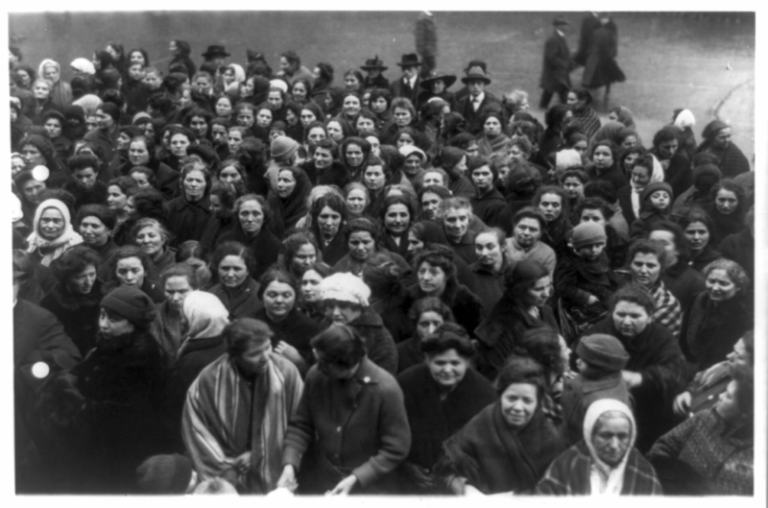
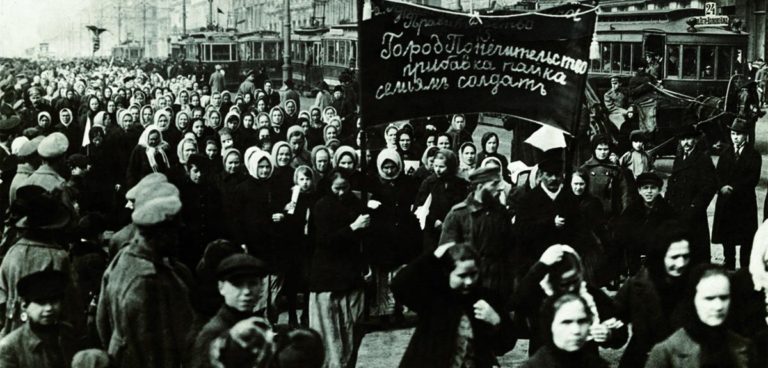
On March 8, fuel shortages prevented the bakers from baking their bread. Women left the long queues without bread and returned home or to the factories. Many were angry. Women workers in the textile industry left their factories to join the march. Others would leave their workplaces and follow the banners. The Bolshevik leader Alexandra Kollontai wrote of that day,
The March 8 start of the revolution is known as the February revolution because of Russia – at that time – used the Julian calendar. It is also why the October Revolution began on 7 November (in the Gregorian calendar, which we use today). This first protest – on March 8 – opened the door to the revolutionary spirit.
In late March, Lenin would write, ‘To the Russian workers has fallen the honor and the good fortune of being the first to start the revolution—the great and only legitimate and just war, the war of the oppressed against the oppressors’. It would have been appropriate for Lenin to be more specific. It was to the Russian women workers that the honor and the good fortune go, for they started the Revolution on March 8.
We, at LeftWord Books, are happy to say that coming soon from us are the following books:
V. I. Lenin, Revolution! The 1917 Writings, edited and introduced by Prakash Karat.
John Reed, Ten Days that Shook the World, introduced by P. Sainath.
Alexandra Kollantai, Selected Writings, introduced by Parvathi Menon.
Nadezhda Krupskaya, The Woman Worker, introduced by Elisabeth Armstrong.
<<>>
(Below is the pamphlet from the Petrograd Interdistrict Committee, translated by Barbara C. Allen, author of Alexander Shlyapnikov, 1885-1937: Life of an Old Bolshevik).
Russian Social Democratic Workers’ Party.
Proletarians of all countries, unite!
Working women comrades! For ten years, women of all countries have observed February 23rd as Women Workers’ Day, as women’s “May First.” American women were the first to mark this as the day to review their forces on it. Gradually, women of the entire world joined them. On this day, meetings and assemblies are held at which attempts are made to explain the reasons for our difficult situation and to show the way out of it.
It has been a long time since women first entered the factories and mills to earn their bread. For a long time, millions of women have stood at the machines all day on an equal footing with men. Factory owners work both male and female comrades to exhaustion. Both men and women are thrown in jail for going on strike. Both men and women need to struggle against the owners. But women entered the family of workers later than men. Often, they still are afraid and do not know what they should demand and how to demand it. The owners have always used their ignorance and timidity against them and still do.
On this day, especially, comrades, let’s think about how we can conquer our enemy, the capitalist, as quickly as possible. We will remember our near and dear ones on the front. We will recall the difficult struggle they waged to wring from the owners each extra rubble of pay and each hour of rest, and each liberty from the government. How many of them fell at the front, or were cast into prison or exile for their brave struggle? You replaced them in the rear, in the mills and factories. Your duty is to continue their great cause – that of emancipating all humanity from oppression and slavery.
Women workers, you should not hold back those male comrades who remain, but rather you should join them in fraternal struggle against the government and the factory owners. It is for their sake that war is waged, so many tears are shed, and so much blood is spilled in all countries. This terrible slaughter has now gone into its third year. Our fathers, husbands, and brothers are perishing. Our dear ones arrive home as unfortunate wretches and cripples. The tsarist government sent them to the front. It maimed and killed them, but it does not care about their sustenance.
There is no end in sight to the shedding of worker blood. Workers were shot down on Bloody Sunday, January 9, 1905, and massacred during the Lena Goldfields strike in April 1912. More recently, workers were shot in Ivanovo-Voznesensk, Shuia, Gorlovka, and Kostroma. Worker blood is shed on all fronts. The empress trades in the peoples’ blood and sells off Russia piece by piece. They send nearly unarmed soldiers to certain death by shooting. They kill hundreds of thousands of people on the front and they profit financially from this.
Under the pretext of war, owners of factories and mills try to turn workers into serfs. The cost of living grows terribly high in all cities. Hunger knocks at everyone’s door. From the villages, they take away cattle and the last morsels of bread for the war. For hours, we stand in line for food. Our children are starving. How many of them have been neglected and lost their parents? They run wild and many become hooligans. Hunger has driven many girls, who are still children, to walk the streets. Many children stand at machines doing work beyond their physical capacity until late at night. Grief and tears are all around us.
It is hard for working people not only in Russia but in all countries. Not long ago the German government cruelly suppressed an uprising of the hungry in Berlin. In France, the police are in a fury. They send people to the front for going on strike. Everywhere the war brings disaster, a high cost of living, and oppression of the working class.
Comrades, working women, for whose sake is a war waged? Do we need to kill millions of Austrian and German workers and peasants? German workers did not want to fight either. Our close ones do not go willingly to the front. They are forced to go. The Austrian, English, and German workers go just as unwillingly. Tears accompany them in their countries as in ours. War is waged for the sake of gold, which glitters in the eyes of capitalists, who profit from it. Ministers, mill owners, and bankers hope to fish in troubled waters. They become rich in wartime. After the war, they will not pay military taxes. Workers and peasants will bear all the sacrifices and pay all the costs.
Dear women comrades, will we keep on tolerating this silently for very long, with occasional outbursts of boiling rage against small-time traders? Indeed, it is not they who are at fault for the people’s calamities. They have ruined themselves. The government is guilty. It began this war and cannot end it. It ravages the country. It is its fault that you are starving. The capitalists are guilty. It is waged for their profit. It’s well-nigh time to shout to them: Enough! Down with the criminal government and its entire gang of thieves and murderers. Long live peace!
Already the day of retribution approaches. A long time ago, we ceased to believe the tales of the government ministers and the masters. Popular rage is increasing in all countries. Workers everywhere are beginning to understand that they can’t expect their governments to end the war. If they do conclude peace, it will entail attempts to take others’ land, to rob another country, and this will lead to new slaughter. Workers do not need that which belongs to someone else.
Down with the autocracy! Long live the Revolution! Long live the Provisional Revolutionary Government! Down with war! Long live the Democratic Republic! Long live the international solidarity of the proletariat! Long live the united RSDRP.
Petersburg Interdistrict Committee
Published in A. G. Shlyapnikov, Semnadtsatyi god, volume 1, 1923, pp. 306-308.
Why does the belated attempt to polarise Hindus and Muslims despite its low intensity frighten so many?
Given India’s bloody communal past, it should not surprise us one bit to discover that the ongoing Uttar Pradesh Assembly election has been belatedly polarised between Hindus and Muslims. This is because India, particularly Uttar Pradesh, has always had a strong communal undercurrent, which at times breaks to the surface in irrepressible tides of blood that bathe its cities and towns.
Partition was an example of it: competitive politics built around the idea of separatism triggered a veritable holocaust in which countless perished. The idea of separatism gained wide currency because it was a manifestation of the socio-cultural cocoons in which Hindus and Muslims lived, their interaction rife with suspicion.
The bloodletting during Partition spawned the hope that our politicians would seek to bridge the gap between communities, not widen it, eschew communal mobilisation that enhances the degree of separation existing at a point of time between them. Crafting a riot is the most effective method of communal mobilisation, which the Indian political class took recourse to within a decade of the first general election in 1951-’52.
From Jabalpur in 1961, often cited as the first big riot post-Partition, we have erected several tombstones mourning the blood spilled in Hindu-Muslim violence. On these tombstones are etched the names of Ranchi, Jamshedpur, Bhiwandi, Tellicherry, Meerut, Moradabad, Biharsharif, Bhagalpur, Jaipur, Bombay, Gujarat, Muzaffarnagar, etc. Add to this the tension and violence under which much of North India reeled during the three stages of the Ram Janmabhoomi movement – the shilanyas yatra of 1989, Bharatiya Janata Party leader LK Advani’s rath yatra of 1990, and the demolition of the Babri Masjid in 1992.
Bajrang Dal members in Amristar mark the 22nd anniversary of the demolition of the Babri Masjid in Ayodhya. Image: AFP
By comparison, the current communal polarisation in Uttar Pradesh pales into insignificance. Yet media reports have lamented the division between Hindus and Muslims, and noted, with alarm, the reluctance of Hindus to vote for Muslim candidates and vice-versa. But even this trend isn’t new. This is why Muslims are rarely fielded from constituencies in which their community is around 10% or so.
For instance, the Congress thought it prudent to field Maulana Abdul Kalam Azad from the Muslim-dominated Rampur in India’s first Lok Sabha election, much to his dismay. The maulana believed he wasn’t just a leader of Muslims, but of the nation as such, deserving of support of all. He had, after all, battled the Muslim League during the great Partition debate of the 1940s. His own self-assessment was rudely undermined in Independent India’s very first tryst with democracy.
Changing role of communalism
This backdrop raises the question: Why is it that communal polarisation of relatively low intensity today alarms us more today than it did in previous decades? The short answer to it is that the role of communalism and the popular perception of it have changed since the late 1980s.
Until then, in what is called the era of Congress dominance, riots were localised and strategic. They were localised in the sense that they affected a district or two-three constituencies. Many of these communal conflagrations were triggered even then by Hindu rightwing groups, at times though in connivance with Congress leaders. Either the Congress-led administration was inept in controlling them or deliberately allowed it to teeter out of control, as so many Commissions of Inquiry in their reports concluded.
These riots were strategic in nature because it was a ploy of local Congress leaders to polarise the electorate to bolster their chances of notching electoral victories. But these did not constitute the meta-narrative of Congress leaders, neither at the State nor the national level. They didn’t portray the riots as an expression of justifiable Hindu assertion, and a method of showing Muslims their place.
In fact, the Congress leadership, whether hypocritically or otherwise, expressed apologies and sought to atone for riots through such measures as formation of peace committees, which aimed to repair the broken relationship between Hindus and Muslims. It was their way of ensuring that if the separateness between the two communities couldn’t be bridged, it wasn’t at least widened beyond what it was. For all these reasons, riots did not have the kind of resonance that, say, the 2002 anti-Muslim violence in Gujarat had.
Play
The only exception to the localised, strategic nature of riots in the era of Congress dominance were the anti-Sikh riots of 1984. It was pan-India. Congress leaders were implicated in fomenting it. Congress administration was guilty of idly watching Sikhs being killed with impunity. Then Prime Minister Rajiv Gandhi even sought to rationalise the pogrom against Sikhs through his infamous quip: “When a big tree falls, earth shakes.”
Yet, after weeks of insanity and intemperate remarks or, as some would rather say, after securing a brute majority in the Lok Sabha in the 1985 elections, the rhetoric of the Congress no longer dripped with venom against Sikhs. Subsequently, it was seen to have atoned for its guilt by appointing Manmohan Singh as Prime Minister. On August 12, 2005, that is, 20 years later, Singh apologised to the nation in the Lok Sabha, “because what took place in 1984 is the negation of the concept of nationhood in our Constitution”.
Ideological communalism
By contrast, communalism and riots for the Bharatiya Janata Party, as this writer argued in a piece in the Hindu in 2013, are elemental aspects of the Sangh Parivar’s politics. Its ideology is predicated on articulating and redressing the real or imagined grievances of Hindus, which have their provenance in the medieval past or in contemporary times in which contentious issues have been manufactured.
The BJP’s ideology seeks to pit the Hindus against Muslims until the former’s grievances are addressed. But these cannot be addressed to the satisfaction of the BJP and its followers because the list of grievances is inexhaustible. Is it possible to assuage sentiments seemingly hurt by tales cherry-picked from centuries of Muslim-rule, deliberately delinked from their historical context and often fictionalised or exaggerated?
Then again, the Ram Mandir issue has been festering for long. But should it be resolved in the times to come, demands for relocating mosques abutting the Krishna and Shiv temples in Mathura and Varanasi will be raised. Apart from these pan-India Hindu symbols, disputes over places of worship having state-wide significance have been imagined – for instance, the Bhagyalakshmi temple located at the base of the Charminar monument in Hyderabad, the Babu Budangiri-Guru Dattatreya shrine in Karnataka, and the Bhojshala complex in Dhar, Madhya Pradesh.
In addition, foot soldiers of the Rashtriya Swayamsevak Sangh have sought to appropriate graveyards and shrines which scarcely have resonance beyond a district or two. Not only this, fertility rates, a Uniform Civil Code, the triple talaq practice, the Enemy Property Act, in fact anything having a faint whiff of Muslim-ness or the community’s opposition to it, is turned into examples of insult to Hindu pride and unjustified pampering of Muslims. In other words, the Sangh’s ideology aims not only to maintain the separateness of Hindus and Muslims, but to also erect a barbed wire-fence, so to speak, between them. Unlike the strategic and localised communalism of Congress, that of the BJP is ideological and pan-India and does not seek closure. Because the BJP’s endeavour is to make permanent the separateness between Hindus and Muslims, the communal polarisation in Uttar Pradesh, relatively of a lesser intensity than experienced in the past, appears so menacing.
True, the Sangh’s ideology dates to its very inception in 1924. But its influence on the Indian psyche was marginal until 1989, when the Ram Janmabhoomi movement boosted its political fortunes and clout. Acquisition of power enhances manifold an entity’s capacity to spread its defining ideas, palpable in the link between the BJP’s rise and its growing ideological influence.
Gujarat, 2002. Image: Reuters.
Middle-class support
But it is also true that the BJP’s ideological influence might not have acquired such salience but for the conversion of a large segment of the Hindu middle class to the cause of Hindutva, directly or indirectly. As such, the middle class around the world believes it is responsible for transforming society. To the Indian middle class, dominated by the Hindu upper caste, the decision to introduce reservations in jobs in 1990 seemed a setback to its agenda of transformation, not least because it sliced half of the cake that had been theirs until then.
In its anxiety, it lurched towards the BJP and its Hindutva philosophy. For one, this was because among all parties supporting reservations, the BJP was the most reluctant, manifest even as recently as in the 2016 statement of the RSS chief Mohan Bhagwat that suggested revisiting the policy of affirmative action. For the other, Hindutva’s lure for the Hindu middle class-upper caste stemmed from the possibility of that philosophy becoming a lightning rod to unite the Hindus for overcoming caste cleavages and countering subaltern assertion.
Economic liberalisation expanded the middle class, further enhancing its clout. Yet it was also gnawed by anxiety. As eminent sociologist Yogendra Singh, in an interview to Scroll.in last year, said,
“By nature, global studies show, that the middle class is the most nationalist class. It is also the most narrow-minded in its nationalism. This is because…it resents any force which it thinks (or threatens to) disrupt its agenda of transformation. Anxiety is a natural consequence of it… Its anxiety, in turn, inspires it to promote (narrow-minded) nationalism.”
Apart from the fear of subaltern assertion, the anxiety of the middle class was fanned by secessionism in Kashmir and Punjab, where religious minorities are in majority, and because of Pakistan sponsoring heinous terror attacks. Already partial to Hindutva, the middle class found in its narrow nationalism an antidote to their insecurities and anxieties.
Its members are opinion-makers whose influence is disproportionate to their numbers. It is the same middle class which, 30-40 years ago, spearheaded the agenda of bridging the separateness between communities. It is the same middle class which now thinks otherwise. No doubt, the Indian middle class isn’t a monolith – students and teachers of, say, Jawaharlal Nehru University or Ramjas College, are as much part of it. Yet it is perhaps not wrong to say that a substantial section of the middle class is now wedded to Hindutva.
The Hindutva section in the middle class isn’t apologetic or ashamed of its beliefs and feelings, openly voicing what till now had lurked beneath the surface or deliberately suppressed. Hindutva is a badge of conservative politics worn unabashedly, with pride, an observation which so many report in horror on meeting acquaintances and friends from the past. This feeling is similar to what journalists experience on listening to lawyers or doctors or academicians or engineers openly voice their hatred for Muslims, busting the myth that communalism is exclusively the passion of the poor and illiterate.
Image: PTI
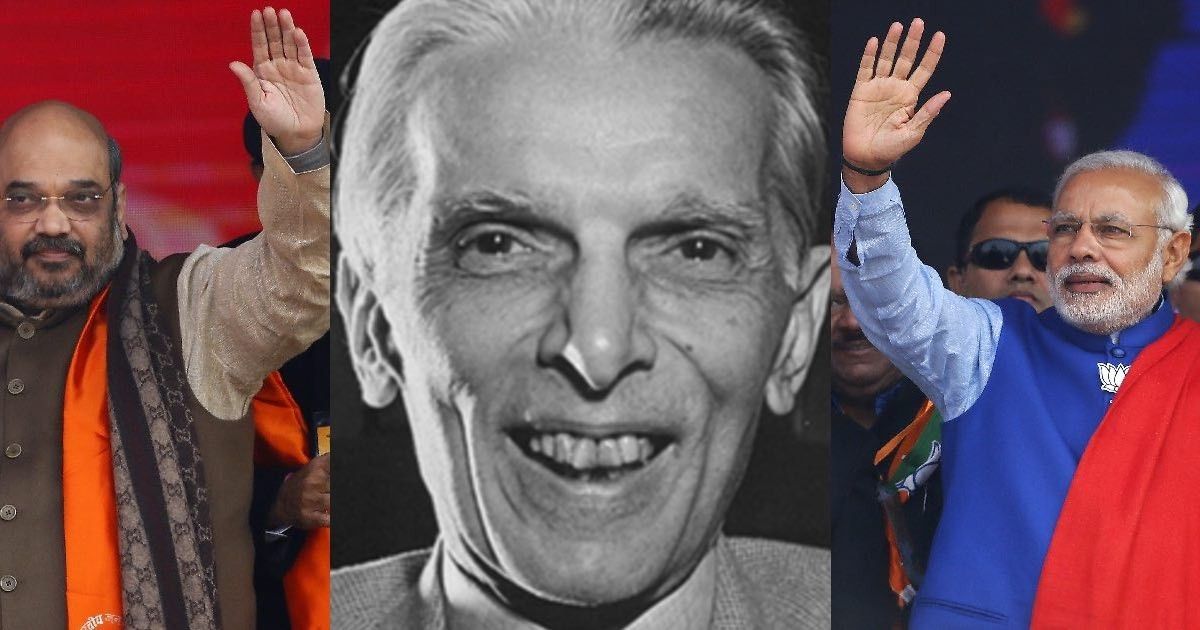
But all this wouldn’t have mattered for one unprecedented development during the Uttar Pradesh election campaign. For the first time in India’s electoral history, a prime minister has sought to enhance the degree of separateness between Hindus and Muslims. This was indeed the motive of Prime Minister Narendra Modi’s allusion to qabristans and shamshan ghats, as was also of BJP president Amit Shah, Modi’s most trusted lieutenant, when he coined the acronym Kasab to represent the Congress, Samajwadi Party and Bahujan Samaj Party.
With no less than the prime minister and the president of the ruling party seeking to retain if not exacerbate the degree of separateness between Hindus and Muslims, Muhammad Ali Jinnah must be laughing in his grave. After all, it was his logic that the separateness of Muslims and Hindus is unbridgeable – a condition of living in which minds and hearts are forever divided. This is why even the low-intensity communal polarisation of Uttar Pradesh frightens so many.
Ajaz Ashraf is a journalist in Delhi. His novel, The Hour Before Dawn, has as its backdrop the demolition of the Babri Masjid.
Women activists have condemned social media celebrity Ashoke Pandit for posting misogynistic comments and casting aspersion on women’s character in a Twitter rant on Monday.
Pandit, known for his his support for Hindutva ideology and bigotry, had posted a tweet in response to a tweet by the former JNU students’ union vice president, Shehla Rashid.
Pandit’s tweet had said, “It’s better to be a Sanghi than sleeping around with terrorists and raising #antiIndia slogans in JNU.#ProudSanghi.”
His tweet was in response to a social media post by Rashid, who questioned the Censor Board’s decision not to certify a women oriented film, Lipstick Under My Burkha.
Rashid, who had tagged the Censor Board chief, Pahlaj Nihalani and Pandit in her tweet, had written, “CBFC banned a movie because it was too “lady-oriented”
CBFC is staffed by Sanghi idiots like (sic)”
Leading the group of women who condemned Pandit for his obnoxious tweet was actor and famous TV host, Simi Grewal.
Grewal wrote, “Such a shameful & disgusting comment. Has he no conscience? If the law can’t punish men like him. God surely will..”
Such a shameful & disgusting comment. Has he no conscience? If the law can't punish men like him. God surely will.. https://t.co/o21DjsxgmP
Attacking a woman's character instead of her politics is d hallmark of misogyny.The quality of political debate has sunk to an all time low. https://t.co/ugCFyF6AeV
And those condemning Pandit also reportedly included his daughter, Shaarika Pandit, who wrote,
Since Shaarika has her Twitter account protected, we could not verify whether her tweet in the screenshot above was indeed posted by her. Shaarika had account open until Tuesday morning, but after the above screenshot went viral, she decided to protect her account.
Pandit, who claims to be a Bollywood director but has no tangible works to substantiate his credentials, had, last year, resorted to foul language and insinuation against a Congress’ lady spokesperson Priyanka Chaturvedi.
Pandit, known for yelling and aggressive behaviour on live TV, had told Chaturvedi, “I don’t need a certificate from such third rated spokesperson because we know how these people have climbed ranks in their party.”
His angry reaction was in response to Chaturvedi’s allegation that he had merely used the plight of displaced Kashmiri Pandits to further his political and professional ambitions.
The Censor Board had last month refused to certify Prakash Jha’s Lipstick Under My Burkha starring Konkona Sensharma and Ratna Pathak Shah.
Listing the reasons for denial of certificate, Central Board of Film Certification (CBFC) in a letter, posted by Bollywood celebrities online, wrote, “The story is lady oriented, their fantasy above life. There are contanious sexual scenes, abusive words, audio pornography and a bit sensitive touch about one particular section of society, hence film refused under guidelines (sic).”
The family of GN Saibaba, who was sentenced to life on Tuesday, had been hoping for an acquittal.
Expecting an acquittal, GN Saibaba’s family had planned to take the wheelchair-bound Delhi University teacher to Hyderabad for a gall-bladder surgery after the court appearance on Tuesday. “My brother-in-law would have taken him straight from Nagpur to the Hyderabad hospital where he had been admitted in 2016,” said his wife Vasantha Saibaba.
The verdict delivered by the Sessions Court in Gadchiroli, Maharashtra – conviction and life-imprisonment for Maoist links – on Tuesday “was shocking” even to battle-weary Vasantha Saibaba, 51. “We will challenge this, of course,” she said. “Our lawyers told us there was a 99% chance he would be acquitted. We were told during the trial that there was no concrete evidence against him. This is an inhuman judgement and a sign of the state’s oppression.”
The case began in 2013, with a police raid at Saibaba’s Delhi University quarters. The police had alleged he was “an urban contact” for Maoists and that he was named by Hem Mishra, then a Jawaharlal Nehru University student, who was arrested at Gadchiroli shortly before the raid for serving as a courier. Mishra was one of the six who appeared before the court on Tuesday.
Vasantha Saibaba may head to Hyderabad, where she has family, for a short while. The couple’s daughter, 19 and a final-year student at a Delhi University college, may move in with a friend. On Tuesday, the pair, by themselves at their Delhi home, fielded constant phone calls from friends, Saibaba’s former colleagues and the media. Some activists dropped in, expressed their support and left to organise a protest.
“None of this has sunk in yet,” said Saibaba’s daughter. Unlike her parents – Vasantha Saibaba was active in women’s groups in the late-1990s – she is not an activist and hopes to collect an MA from Delhi University. “All of this began when I was still in school,” she explained.
But first, mother and daughter want to know what will be done to preserve Saibaba’s health in jail. By the time he set out for Gadchiroli on Monday, he had been taking “almost 10 pills a day”.
‘He must be in pain’
Already 90% disabled and a wheelchair-user, Saibaba’s health problems were compounded by two stints at the Nagpur Central Jail over 2014-2016. He was first arrested and incarcerated in May 2014. In late June 2015, the Bombay High Court granted him temporary bail on medical grounds and he was released in July. This period had included a prolonged stay in the egg-shaped, highly restrictive “anda cell” and he left with heart disease, muscle-damage in one hand and shoulder and gall-stones. He went back in in December when the Bombay High Court cancelled bail and was released, this time granted bail by the Supreme Court, in April, 2016.
“A good part of his time outside jail has been spent on treatment,” said Vasantha Saibaba. On February 22, he complained of chest-pain and breathlessness. He was taken to a private hospital and admitted for a week, spending one day in an intensive-care unit. “He was diagnosed with infection in the pancreas and advised to get his gall-bladder operated once that cleared up,” she said. He also suffers from pain in the back. “He does not show it but the pain is constant,” she said. “Travelling from Nagpur to Gadchiroli and now, presumably on the way to jail in Nagpur, he must be in pain.” Her advocates, she said, had appealed for an order to ensure help was at hand for him but were not given one.
Fighting for reinstatement
The rest of his time in Delhi, Saibaba spent trying to get his job at Delhi University’s Ram Lal Anand College back. He had been suspended from the department of English, after his arrest, in May 2014. Once out on bail, he sought reinstatement which was supported by some teachers and students and opposed by others.
The college initiated an inquiry by a single-member committee, which is still underway. “In the third week of February the committee wrote to us asking for details – including invitations – of foreign travel over 10 years,” alleged Vasantha Saibaba. “They wanted to know about funds and the property we own. We got very little time to respond but we did. The college still extended his suspension for another 180 days.
She added: “The state wants to punish intellectuals and activists fighting violations of human rights. We learnt how to fight the state’s repression.”