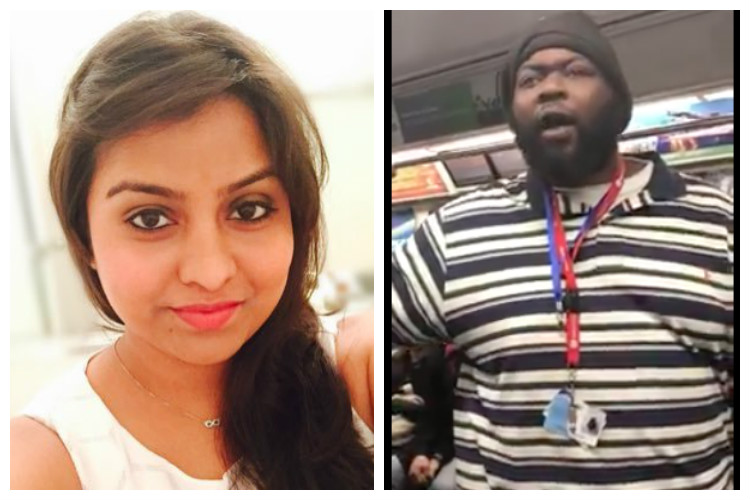
Ekta Desai, who stays in New York, posted a video on her Facebook profile that shows a man hurling racial slurs at her and another Asian woman on a train.
An Indian-origin girl was racially abused by a stranger in a New York train while she was on way to work. A video of the incident is now going viral on social media.
Ekta Desai, who stays in New York, posted a video on her Facebook profile that shows a man hurling racial slurs at her and another Asian woman on a train.
The video is now going viral on the social media.
"So this is something that happened while I was on my way from work today!! This man was on the same PATH train as me along with 100 other passengers, I had my headphones on and was like any other day. Next thing I know he is yelling on my face (Did not bother to listen/react). Knowing it's pointless I step away, next target alongside an Asian lady!" Desai wrote.
"Asian piece of s*** to I will F*** you all right here to get your F***ing ^$$es back to your country etc etc etc" (putting it in the best words here) he went on relentlessly!" Desai said in Facebook post.
When Desai threatened to inform the police, the man repeatedly shouted at her to stop shooting his video and was quoted as saying that he did not touch anybody.
"I did not touch anybody. I just expressed what I feel. Freedom of speech," the man was heard saying in the video.
"Not sure the cops found him or even took any action, though they showed up 15 mins after all this drama and he walked away with his friends!" she added.
The video was posted on Facebook on February 22 and within six days it got more than 49,000 views. It is being widely discussed after Indian engineer Srinivas Kuchibhotla was shot dead in Kansas in an apparent hate crime.
US President Donald Trump on Tuesday denounced the killing of Kuchibhotla saying the country "stands united in condemning hate and evil".
Curfew has been imposed in Lakhimpur city following clashes over an objectionable video which was allegedly circulated by two students.
The curfew was imposed last night. Tension had gripped the city after the video which allegedly hurt religious sentiments went viral on social media.
Image courtesy: indianexpress.com
The city police arrested the two students who had allegedly circulated the video.
However, protests began last evening and the markets were also closed. There were reports of clashes and firing following which the distict magistrate announced the imposition of curfew till further orders.
“To maintain peace and law and order, curfew restrictions in the city area have been imposed and people have been asked to stay home,” District Magistrate (Kheri) Akashdeep told reporters today.
Stressing that the situation was under control, he asked people to avoid spreading rumours.
The district magistrate and Superintendent of Police Manoj Kumar Jha visited the city and asked people to keep calm.
Akashdeep said a person has been reported to have been injured in a clash, however, he is reported to be out of danger.
Meanwhile, heavy police force have been deployed in the city. The IG and the DIG arrived at Kheri late last night and reviewed the situation.
Watch here for our latest video update by Rifat Jawaid, editor in chief, Janta ka Reporter.
When I think of my growing up years, one memory that flashes in my mind is that of watching you rule the cricket ground. My generation did not get to see Bradman. Neither did we see Sobers or Gavaskar. We missed out on witnessing India become the world champion in ‘83. But we’ve seen Sachin. We’ve seen our very own Dada. And we’ve seen you. We’ve seen how greatest of the bowlers used to become clueless about where to bowl the next ball, when you were at the crease. At a casual stroke of your bat, even the deadliest yorker used to fly into the stands. These are the images my entire generation grew up watching.
During your playing days, your critics often said that Virender Sehwag epitomizes thoughtless aggression. But we, the Sehwag fans, used to fight back. After all, who scored the first triple century for India? It is neither Gavaskar nor Sachin. It is not even Mr. Dependable, Rahul Dravid. It was you. That too, not once but twice. Even a third time almost came: you fell short by just seven runs.
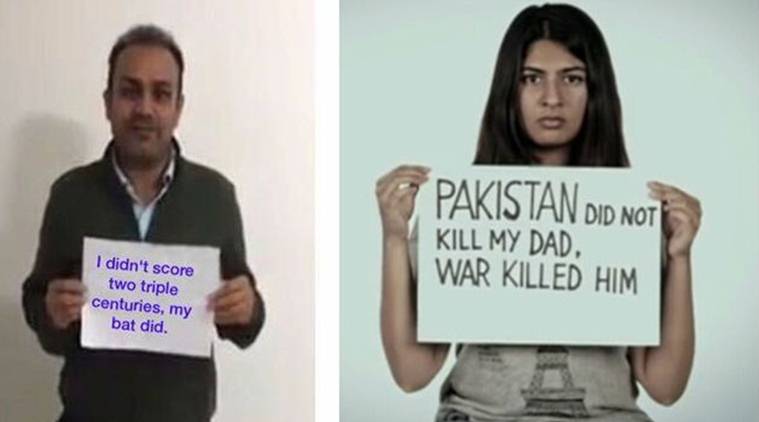
But a few days back, when you posted your picture holding a poster that read, “I didn’t score two triple centuries, my bat did,” even a staunch Sehwag fan like me thought it was really a poor shot-selection from my favorite batsman.
Clearly, your dig was aimed at. Gurmehar Kaur, a young student of the Delhi University, who had earlier posted a similar placard that read “Pakistan did not kill my dad. War killed him.” Now, one cannot expect this statement to go down well with everyone, particularly with the BJP-RSS clan, who are known to feed on the cuts earned from the coffins of martyred soldiers in Kargill. As one would expect, they immediately resorted to attacking the young lady. But Veeru, what suits the ABVP, does not suit you. Do you realize that with this one tweet, you have unwittingly joined the troll-army of those self-proclaimed patriots, who have stooped to the level of giving rape threats to the young lady?
Gurmehar had lost her father at Kargil War, when she was a baby. While we were celebrating our victory that came at the border, she witnessed her father’s body being carried in a coffin. Like your triple centuries, the war victory also made us proud. But the loss of her father taught Gurmehar the real cost of war. So today as we escalate our state sponsored, media pampered jingoistic nationalism, perhaps Gurmehar remembers her father.
Veeru, you may know that during the World War I, conscription i.e. compulsory war service was introduced in Britain. Thousands of college and university students had to give up their books, bid farewell to their loved ones, and go to war. Perhaps to not return ever again. That day, inside the army trenches, with their fingers on the rifle-triggers, poets like Wilfred Owen and Siegfried Sassoon were born. They wrote poetry about the loss of lives, and wastage of human resources caused by futile wars. History remembers them as War Poets. Their dispatches from the battlefield taught the following generations the hollowness in the celebration of warfare. Only the people fighting real battles understand its real cost. The young men at the battlefield that day realized that from either sides of the battle-line, the barrel of every gun targets a regular human being, who had also wanted to live and celebrate life. Just the way the pitch at the Multan Cricket Stadium had taught you that Shoaib Akhtar and Saqlain Mushtaq are your opponents, not enemies.
Veeru, you’ve also fought for your country like a soldier. But your battle was different from the one that took away Gurmehar’s father. Do you remember the day when you first got the call to fight? Celebrations must have swept your family. Perhaps happiness and pride for her son did not let your mother sleep that night. But do you realize when the battlefield calls out for Gurmehar’s father, and thousands others like him, their families also spend sleepless nights. Out of anxiety. When victory came from your bat, you were awarded man-of-the-match. But what if you lost? Honestly, did that make much difference?
Even when you lost, match-fee of a few lakh rupees used to reach your bank account. On scoring a century, thousands of autograph books chased you. But even when you were bowled out for a duck, fans used to cheer for you in the next match. At this point, does the other war look similar to the ones you fought?
Gurmehar’s father – his team, our team, won in Kargil. Still he could not return to his family. In whichever side of the border the victory comes, after the last cannon is fired, mothers will lose their children, wives will lose their husbands and the Gurmehars’ will lose their fathers in every battle-field.
How many of these martyrs do their countrymen remember? Veerupaji, we love cricket. We remember your triple centuries. But you seem to love war. So tell me honestly, did you even know the name of Martyr Captain Mandeep Singh, who died defending our border at Kargil, till her daughter took a stand against ABVP? And why blame only you? Did any of us remember? We didn’t. We don’t. Only the Gurmehars cannot forget their fathers.
Veeru, was it really necessary to mock the lady instead of sharing her grief? Couldn’t you even try to understand why she hates war? Do you realize how much strength and courage does it take for a 20-year old to point out what killed her father instead of dwelling on who killed him?
At Melbourne, while batting at 195, you once attempted a six; the ball went for a catch. But it wasn’t world-records or double centuries, rather this daring attitude that made you our hero.
However in the game of life, trying to hit a six at every ball is not a good idea! Many of your tweets stand out for their wit. Your strokes are as fluent in Twitter, as they used to be on the field. But this one shot really disappointed many of us. A young student is fighting her own battle with her head held high. If you can’t support her, don’t. But do you really need to taunt her so crudely? Break her heart? This certainly doesn’t suit our Sultan of Multan.
Please, take back that tweet. Gurmehar, along with many like her across the globe, are fighting to end every war in this planet. Stand by them. Every time seeing you walk into the crease gave us hope. This time please bat for humanity.
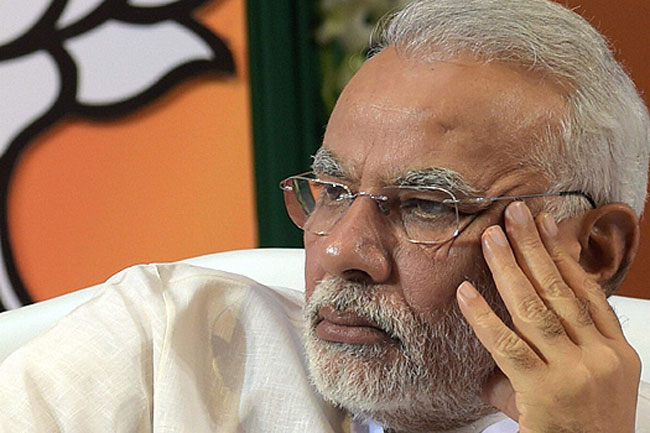
Varanasi, Kashi, spiritual fountainhead as also a hub of business and trade will vote on March 8. Jittery with a sullen electorate Modi has despatched 75 percent of the Government of India's cabinet ministers to somehow snatch victory from the jaws of possible defeat. There are eight assembly seats with Modi's Parliamentary constituency, three urban and five rural.
Image: India Today
In 2014, this city that also symbolises India's unique synthesis of different faiths had gifted Modi a historic win with a landslide margin. Today with eight assembly seats within the vast parliamentary segment, Modi's party the Bharatiya Janata Party (BJP) faces the possibility of a rout. At best, due to the division in the 'secular' vote, the BJP may sneak in winning two of the eight seats. But in no part of this city that is the hub of trade, commerce and business apart from being a spiritual centre to millions, do voters have any good things to say for Modi or the BJP.
There is more than a niggling feeling of betrayal as the city, whose MP is the Prime Minister of 2017 India, grapples with potholed roads, chaotic traffic, collapsing sewerage and mountains of garbage. Given to irrational hyperbole, Modi had sworn to transform Varanasi into Japan’s ancient city of Kyoto. Today high pollution and dust and a crippled informal cash economy thanks to the disastrous move towards demonetisation, threaten to seriously dent Modi's electoral appeal, come counting day. It is among the BJP's own supporters, the trading and business classes that there is a seething undercurrent of restlessness and anger. One way or another, this segment will make it's displeasure felt. Traders feel doubly cheated after 30,000odd traders received income-tax notices regarding their bank deposits since November 8. A leading trader who has never hitherto strayed away from the saffron fold maintains that rage has grown and firmed into a consensus that the BJP must be punished for turning on its core constituency in such a savage manner.
A close look at the three urban dominated seats within Varanasi is telling. All three have a significant and pre-ponderance of Muslim Votes. In 2012, the prestigious city's Cantonent seat saw a tussle between two heavyweights from the powerful Kayastha caste, Jyotsana Srivastava (BJP) who polled 57,918 votes and Anil Srivastava (INC) who polled 45066 votes with the former winning with a 12,852 vote margin. SP's Ashfaq Ahmad (alias Dablu) was the spoiler leeching away 37,922 votes and Chandra Kumar Mishra (alias Guddu Maharaj) of the BSP also getting 22162 votes. Clearly it was only the 'secular spoilers' that ensured a BJP win here.
In 2017, again Anil Srivastava fights to wrench victory. BJP has chosen to give the ticket to Jyotsana Sivastava's son, even as in nearby Dakshini (Varanasi south) many times elected Shyam Dada Choudhary was not only humiliated by the Modi-Shah combine but his son was not accomodated either. Anil Srivastava of the Congress faces yet again a 'secular spolier' in the face of Rizwan Ahmad of the BSP, otherwise a newcomer. It is only if Muslims drift towards him that Srivastava's win could prove tricky.
Coming to Varanasi south, a grand, Bihar like alliance that contained division of Muslim votes would have surely meant a BJP defeat. Here too Modi-Shah's preferred candidate, a Brahmin, Neelkanth Tiwari is weak with dubious links. The SP-Congress alliance has fielded a former MP, Rajesh Mishra who is facing a stiff challenge from a robust newcomer from the BSP, Rakesh Tripathi. Tripathi brings a solid Dalit-Dhobhi-Malha vote base to the table and working as he has been for the past six months has also been able to garner much of the anger against the BJP. (In 2012, BJP's veteran Shyamdev Roy Chaudhari (Dada) had polled 57,868 votes while Dayashankar (Dayalu) Mishra had won 44046 when he contested the seat for the INC. Two Muslim candidates, Athar Jamal Lari for the QED (Quami Ekta Dal) and Mohammad Istaqbal for the SP had won 20,454 and 14642 votes respectively.
That leaves, Uttari, ie the Varanasi North seat. Here is 2012 Ravindra Jaiswal had beaten BSP's Sujit Kumar Maurya by a narrow margin of 2336 votes. Then too, two Muslim candidates, Abdul Samad (SP) had drawn 37,434 votes whle another Rabia Kalam from the INC had polled 31,029 votes. Today, Maurya is in the reckoning again, likely to win if he can attract even a miniscule percentage of the Muslim vote. The other contender is Samad Ansari, who threatens again to split the vote.
As far as the five rural seats within Varanasi are concerned, Ajgara,Shivpur, Rohaniya, Sevapuri and Pindra, there are fairly high chances that none of these five will go to the BJP. In three at least, Ajgara and Shivpur the BSP candidate is strong while in Pindra Ajay Rai of the Congress is on a winning wicket.
A total of 14.05 crores of voters will have cast their vote and this crucial election will determine or assess how much the popularity of Narendra Modi, India's prime minister still holds. An autocratic and shrill campaigner, Modi is used to his larger than life image being sustained by frenzied crowds. These have been missing during the UP election campaign that began in the western end of the state and moved to the east where the last two phases are now due.
Six months after Modi swept to power in Delhi in May 2014, he and his party faced the first humiliating defeat during the state assembly elections to the state capital, New Delhi in February 2015. Of the 70 seats to the assembly, the BJP won only three, with the new and radical Aam Aadmi Party sweeping to power humiliating the older Indian political party, the Indian National Congress. Then again in November 2015, Bihar, another politically crucial state defeated Modi's designs of complete and autocratic control of both houses of the Indian Parliament by unequivocally voting for a Grand Alliance against the BJP.
As the penultimate rounds of the state's elections draw near, money and muscle power are being used by the BJP to turn the tide in his favour. Local newspapers have sarcastically commented on the fact that 75 per cent of the Government of India's cabinet is presently camping in the holy city of Varanasi to somehow ensure that Modi is not humiliated in his own backyard.
Poor performance and pathetic levels of accountability have marked Modi's band of parliamentarians voted to power in 2014. Despite winning the UP 2014 elections on the 'development plank', BJP's members of parliament failed to spend the mandatory government funds —a whopping Rs 333.6 crores earmarked to better facilities, education, health etc in their own constituencies. Modi's party had won 73 o the 80 seats to the Lower House of the Indian Parliament, the Lok Sabha. Within this overall failure to deliver, the party and it's representatives were especially tardy in those 33 Lok Sabha seats that have both Dalits and Muslims in sizeable number. (While Rs 71 crore remained unspent in 17 Dalit-dominated constituencies, over Rs 64 crore could not be spent in 16 other constituencies where Muslims account for more than 20 percent of the population).
Brazen about this non-performance, the BJP is still ahead, beating all political parties in splashing ads on TV, radio and print; spends over Rs 150 cr in Goa, Punjab, and UP. Quoting data from AdEx India, a division of TAM Media Research, The Economic Times reports that the BJP’s share in the overall ad insertions across the three mediums was as high as 59% in the three states between November last year till February 4, 2017. The saffron party has reportedly spent more than Rs 150 crore on advertising during state elections. Interestingly, the next three parties — Samajwadi Party (SP), Bahujan Samaj Party (BSP) and Congress — put together did not spend half of BJP’s advertising share. SP’s share was at 13%, BSP’s at 12%, and Congress’ entire political campaign saw ad insertions of close to 4%.A total of 27,133 ads were aired on TV channels, while 11,722 ad spots were played on radio and 2,797 ads inserted in the print media in the month of January this year.
Before that, November saw some action with 5,754 ads insertion across TV channels, 3,212 across radio and 1,092 across print. In December, political advertising also dipped after demonetisation.
When it comes to individual states, BJP’s advertising share in Uttar Pradesh was at 69%, followed by SP’s 17%, BSP’s 12% while Lokdal and Congress at 1% each.
Will money and muscle penetrate through the fog of despair and disappointment that dominates the voter's mood in Varanasi? A week from today we will have the answers.
नई दिल्ली। राजनेताओं पर जूते फेंकने की घटनाएं थमने का नाम नहीं ले रही है। अब ताजा घटना में गुजरात के गृहमंत्री प्रदीप सिंह जडेजा इसका शिकार हुए हैं। गुजरात के गांधीनगर में गुरुवार(2 मार्च) को प्रेस कॉन्फ्रेंस के दौरान एक युवक द्वारा गृहमंत्री प्रदीप सिंह जडेजा पर जूता फेंकने की घटना सामने आई है।
दरअसल, राज्य के गृह राज्य मंत्री जडेजा जब पत्रकारों को संबोधित कर रहे थे, तभी एक युवक ने उनपर जूता फेंक दिया। हालांकि उनकी किस्मत अच्छी थी कि जूता उन्हें नहीं लगा। न्यूज एजेंसी एएनआई ने इसका एक वीडियो जारी किया है। वीडियो में मंत्री जूते से बचते हुए नजर आ रहे हैं। पुलिस ने बाद में उस युवक को अपनी हिरासत में ले लिया।
न्यूज 18 की रिपोर्ट के मुताबिक जूता फेंकने वाले शख्स का नाम गोपाल इटादरिया है। वह राज्य सरकार का कर्मचारी बताया जा रहा है। गोपाल ने कहा कि यह जूता भ्रष्टाचार के लिए गुजरात सरकार पर है। साथ ही उसने इस जूते को बेरोजगार युवाओं का गुस्सा भी बताया। बता दें कि इससे पहले भी पूर्व पीएम मनमोहन सिंह, दिल्ली के सीएम अरविंद केजरीवाल, पंजाब के सीएम प्रकाश सिंह बादल, कांग्रेस उपाध्यक्ष राहुल गांधी सहित कई अन्य नेता इस तरह की घटनाएं का शिकार हो चुके हैं।
#WATCH: Man attempts to hurl shoe at Pradipsinh Jadeja, Gujarat minister of state for home in Gandhinagar, detained by police. pic.twitter.com/wTtzihRhSN
The children of the riots continue to suffer psychological and physical scars, which no one in the administration has attempted to understand, let alone heal.
Image: Sam Panthaky
“I haven’t had a drink in five months,” said Javed Shaikh. His voice slurs and hands shake as he spits back into a tiny glass, the mango juice his wife had placed before him. It has been 15 years since the moment that defined Shaikh for life: then 14, Shaikh witnessed a Hindu mob rape and burn a pregnant Muslim woman to death during the 2002 Godhra riots in Gujarat.
That day, as he hid under a pile of dead bodies, Shaikh had seen both his parents and his older sister killed. He has told his story since to the courts, to politicians, to the numerous journalists who have sought him out – but has never spoken with a counsellor or psychiatrist about the things he saw as a child. Since 2002, he has moved from place to place seeking comfort. Each time, he has returned to Ahmedabad.
Fifteen years later, there is no official count of how many children were orphaned during the riots. Those who were left alive, like Shaikh, “wish every day to be dead because they die slowly every day,” said Hozefa Ujjaaini, a social worker who works with the riot victims through the non-profit organisation Jan Vikas. The children who survived relive the atrocities in their nightmares.
Between February 28 and March 2, 2002, the three-day-long spate of violence across Gujarat left – even by the State government’s conservative estimates – hundreds dead and over 98,000 people dispossessed. Though the state claims to have moved on, the riot-affected are stuck in time and place at the rehabilitation camps – once meant to be temporary, but which have since transformed into homes for most survivors. Many of those who remember the riots have grown weary, beleaguered from years of being ignored, displaced and overlooked. The residents of one such camp Citizen Nagar wonder when they will finally be treated like actual citizens of the country. Their children continue to suffer psychological and physical scars which no one in the administration has attempted to understand, let alone heal.
Some trials, such as the killing of Kausar Bano, witnessed by Shaikh, have been concluded – in 2012, a Gujarat court ruled that Kausar was hit with a sword and killed by Babu Bajrangi. Judge Jyotsna Yagnik, however, ruled Shaikh was too young to know whether the pregnant woman’s foetus was actually ripped out. This, along with other cases relating to the Naroda Patiya massacre, in which Shaikh was caught, are still pending before the Gujarat High Court.
Seeking a new normal
Rehabilitation colonies like Citizen Nagar, Vatva and 67 other sites across Gujarat lack basic amenities like running water, electricity and trash collection. The 130 homes in Citizen Nagar depend on a single tanker for their daily water needs. The roads are unpaved and water is scarce, a mountain of trash – all of Ahmedabad’s waste collected over decade – rises high. Black smoke spews out of the aluminium factory nearby, darkening the sky and making the air putrid.
The riot-affected of Ahmedabad have been, quite literary, moved to the outskirts of the city where they cannot be seen heard. “Many people have died,” said Moinuddin Sheikh, another survivor and witness of the Naroda Patiya massacre. “We have trouble breathing, the number of heart patients have increased since we came here in 2002.”
Sheikh was a policeman at the time of the riots. He quit right after. He recalled feeling helpless as he watched people being killed by men he has since identified in court as members of the Vishwa Hindu Parishad and Bajrang Dal. “There was no order to stop them from the Commissioner,” he said. “The police ran away first because they wanted to save their own lives.”
Sitting outside his one-storey makeshift building with a wrought iron roof, Sheikh recalls his family’s struggles in the first five years after the riots – an ordeal which has not yet ended.
Sheikh has two sons and one daughter, none of whom went to school after the riots. A graduate himself, the former cop wanted his children to be educated and to be placed in a government jobs, but this became impossible after 2002. The children were too psychologically scarred – like many child survivors of the riots – to concentrate on school or do much else.
“For the first five years, they were in a coma, you could say,” he said. “They would not move or do anything. If they would fall asleep, they’d wake up screaming, ‘Pappa, the mob is coming to kill us; Pappa, the mob is coming to burn us.’ What they saw plays in their minds even now, like a film that’s stuck in place.”
His children, and the hundreds who witnessed the brutal violence firsthand, are yet to receive any form of counselling or psychological treatment.
“Survivors of the riots say things like how many times will we be victimised?” said Hozefa. Working with the riot-affected people through Jan Vikas for a decade and a half, he asked why it should take the State government so long to intervene in their conditions. “Tata got its factory in a matter of months. These survivors have been living without a home to their name, without water or any facilities since 15 years. You cannot say it is because the government is slow to act.”
Sheikh has given up the fight for his children: his daughter was married as soon as she turned 18, his sons are day labourers and he drives an auto rickshaw. A parent’s regret loomed large on his face as he shook his hennaed head, recalling the first few years in Citizen Nagar.
“We have gone before the counsellors here, the MLA here to request water, a government hospital, a school for our children… it feels like its fallen on deaf ears,” he said. The next generation, he added, which was born after the riots in the rehabilitation colonies, will continue to suffer just like his children did. “The school is far, sending children there is expensive. Recently there was an accident and several of the colony’s children died on their way to the school, so now parents are even more scared to send their kids there.”
Rashida Ansari, a survivor of the riots and now a social worker with Jan Vikas, who helps the displaced living in Citizen Nagar, echoes the concern for the children. “No one remembers these children, the government ignored them,” she said. Workers like Ansari have invested in learning counselling techniques themselves, so they can provide relief to others suffering from post-traumatic stress disorder. Ansari received her training under Action Aid, an NGO that has worked closely with the riot-affected women and children since 2002. But there is only so much she can do without formal education. “Hum baatein sunte hai,” she said – all I do is listen.
Ansari wonders why the government never stepped up to provide safe havens for the affected and bereaved children. “Agar government ne ek orphanage bhi banaya hota jahan yeh bacche reh sakte; jahaan inki rehabilitation ho sake, abhi yeh bacche kuch aur hi hote,” she said – if only the government had provided orphanages for these children to live in, they would have been very different people today.
No exit
Today, the education and restoration of the riot-affected children is a matter of individual luck and circumstance. Shaikh Sahir Sabir Hussain is fresh-faced, with close-cropped hair and sharp eyes. He’s 16, and was seven-months-old at the time of the riot. Hussain lives in Citizen Nagar with his parents and two brothers. His brothers, 30 and 25 respectively, dropped out of school after the fifth grade. Hussain travels half an hour every day to reach the Irish Presbyterian Mission high school in Raikandh, where he is determined to finish his schooling. Until grade 10, he went to a private school, but had to move out because there were no facilities for senior classes there. “I want to study,” he said smoothening his green kurta-pyjama, “I want to study and become someone of consequence.”
Hussain’s friend Yakub is sixteen too, but dropped out of school after the eighth grade. The two boys spend their evenings together, but in the mornings, when Hussain is at school, Yakub makes furniture. “Meri mujboori thi,” Yakub said, indicating that his circumstances did not allow him to study. Yakub is the only working member in a household with five sons. His parents never objected when he stopped going to school – it was five kilometers away, and with eight mouths to feed, there were only so many textbooks and auto rickshaw rides the family could afford.
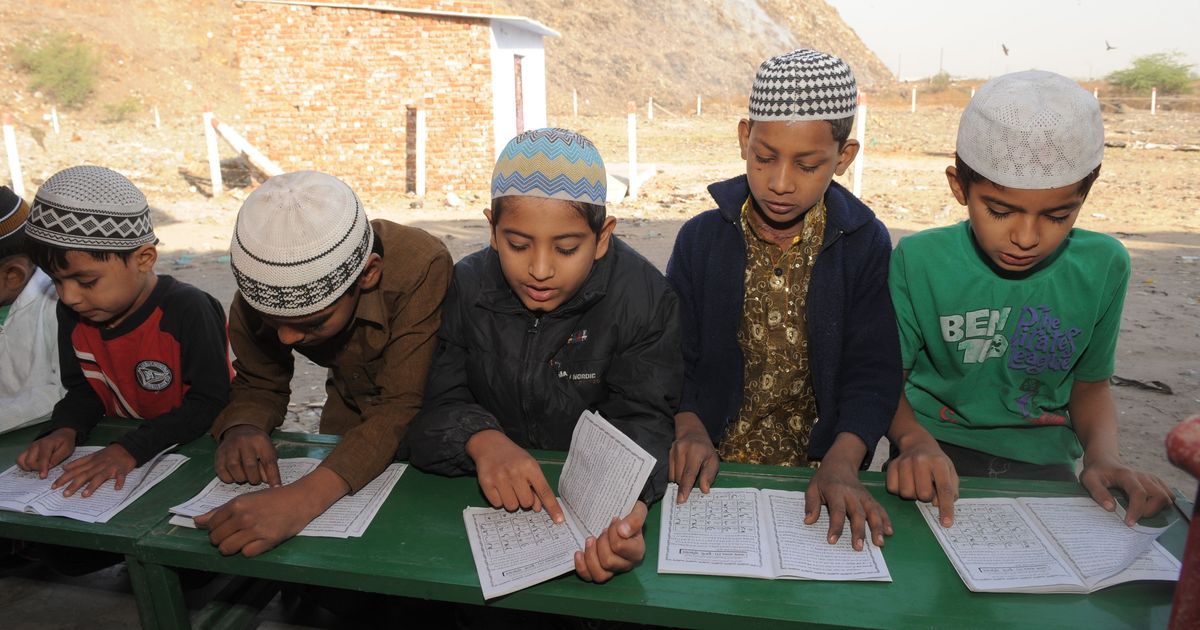
Seeing that lack of education is a growing crisis, several young men within Citizen Nagar have put together hour-long tuition classes for those who do not go to school. Students, mostly boys, gather together to learn the basics: writing their names, reading signs, simple math. Their teachers are college-going young men who donate time to help out their neighbours.
The girls have it worse. Most girls are pulled out of school after the eighth grade, with families citing various reasons, from societal norms to a fear of the Hindus living near the high schools. Most girls are married off even before they turn eighteen, never given a chance to excel at anything. In Vatva, a few girls voiced their discontent with the situation, but were resigned to the idea that this was the only way. None of them wanted to be identified – their parents had bigger problems at home, they said.
A woman waits to be registered at a food distribution centre run by the United Nations World Food Programme in Thonyor, Leer state, South Sudan. Reuters/Siegfried Modola
The classification of a famine as man-made is applied to severe hunger arising from a set of foreseeable, and therefore avoidable, circumstances. According to criteria set down by the United Nations a famine is declared in an area when at least 20% of households are viewed as being exposed to extreme food shortages, 30% are malnourished and deaths from hunger has reached two persons a day for every 10,000.
Famines can result from natural or man-made causes. Natural causes include droughts, plant disease, insect plagues, floods and earthquakes. A prolonged drought is behind the recent warning of potential famine in Somalia by the World Food Programme.
The human causes of famine include extreme poverty, war, deliberate crop destruction and the inefficient distribution of food. South Sudan’s predicament falls square under this category. There have been no major droughts, flooding or other natural catastrophe reported. Instead a three year conflict that has engulfed the country, combined with high food prices, economic disruption and low agricultural production has resulted in UN and the government of South Sudan declaring a famine in the country.
According to the head of the World Food Programme, the avoidable conflict between the main political protagonists is solely to blame. Years of conflict have created a situation in which many women, children and the elderly are suffering needlessly and have no access to food or water.
High food prices, economic disruption and low agricultural production have resulted in the large areas becoming “food insecure”. The situation could not have come at a more difficult time. Years of conflict have crippled the economy and hammered the value of its currency. Severe inflation has seen the value of its currency plummet 800% in the past year alone. This has made food unaffordable for many families.
Despite the deteriorating situation the government of South Sudan has been using its limited resources to buy weapons, increase the number of states, pay military wages and wage war on civilians.
Conflict sows seeds of hunger
Significant progress in reducing global hunger has been achieved over the past 30 years. But the impact of conflict on food production and citizens ability to feed themselves is often underestimated. This was highlighted in a study that found that
“civil wars and conflicts are detrimental to food security, but the negative effects are more severe for countries unable to make available for their citizens the minimum dietary energy requirement under which a country is qualified for food aid”
This is true of South Sudan, which can feed itself in peace time. Just six months ago, many parts of the country were bustling with agricultural activity, producing enough food for the local populations.
The medium sized town of Yei is a good example. Locals report an inability to cultivate their land since the recent escalation of fighting. A town once seen as a place where coffee bean production was on the rise is now a place where farmers no longer venture out.
It’s also likely that Yemen, Nigeria, and Somalia, could declare a famine in the next few months. It’s no coincidence that those countries are also embroiled in widespread or localised armed conflict.
Deteriorating situation
More than 100,000 people in two counties of Unity state are experiencing famine. This number could rise as an additional one million South Sudanese are on the brink of starvation. Central Equatoria state, traditionally South Sudan’s breadbasket, has been hit by ethnically targeted killings that have disrupted agricultural production.
Between 40%-50% of South Sudan’s population are expected to be severely food insecure and at risk of death in the coming months. Over 250,000 children are severely malnourished according to UNICEF and these are number where UNICEF has access to.
Yet the government does not seem to want to address the underlying causes of the famine. In fact it’s unclear what its overall plan is.
It is relocating by air internally displaced people through Juba into Malakal. The Dinka-controlled government’s strategy is not entirely clear. But some of my informants claim that the objective is to rid the capital of rival ethnic groups that could pose a direct threat to the seat of government in Juba.
Adding to this, the new Special Representative for South Sudan has raised concerns over some 20,000 internally displaced people on the West bank of the Nile in the Upper Nile region as a “real problem.” These fleeing civilians are victims of government efforts to consolidate power centrally and push certain ethnic groups who are not aligned to the government away from the centre.
Food aid restricted
The UN has repeatedly warned that government forces are blocking the delivery of food aid to affected areas.
South Sudan’s government wouldn’t be the first to have done this. In 2012 the Rohingya in Myanmar who were left to starve amidst sectarian violence with local Buddhist communities. In 2011 it was Sudan starving its people in the Nuba mountain region. More recently in Syria the government was allegedly targeting bakeries, hitting civilians waiting to buy food.
According to the Geneva Convention treaty on non-international armed conflicts a government can legally restrict food access for a short-term period if it is militarily necessary. This is a very narrow exception. It cannot and should not be used to punish civilians for their affiliation to the conflict and it cannot be used on a biased basis. And such restrictions must not result in starvation of the civilians.
Famine and political unrest
The situation in South Sudan is likely to get worse. The ongoing conflict is likely to escalate as the number of smaller armed groups rises on the back of more localised self-militias being set up. In the light of this government military action will escalate.
This new dimension in South Sudan’s conflict increases in the chances of further political turmoil and further narrows the window of peace for the world’s youngest nation.
High Court asked the petitioners why they have not filed cases against other companies and why these two firms were targeted.
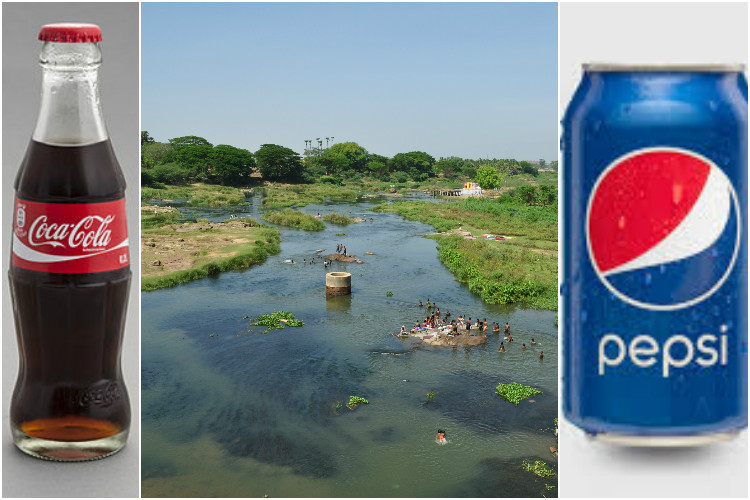
Even as MNC giants Pepsi and Coca Cola face a boycott over their products in Tamil Nadu, the Madras High Court has lifted its stay restraining the companies from using the water of the Thamirabarani river.
The order comes as a setback for the people’s movement against the soft drink manufacturers and a relief for the companies even as the Madurai bench of the Madras High Court dismissed two PILs filed against the supply of Thamirabarani water to the Pepsi and Coca Cola.
While rejecting the petitions, the bench comprising of Justices A Selvam and P Kalaiyarasan questioned the petitioners as to why they did not file cases against other industries, which were being supplied more water than the soft drink giants.
“Why are you not attacking other industries? Why have you adopted a pick and choose method?” Justice Selvam asked the petitioner, The Hindu reported.
As reported by The News Minute in December, Pepsi and Coca Cola are not the only companies drawing water from the river. In fact, the government of Tamil Nadu is the biggest user of Thamirabarani water.
SIPCOT is allowed to extract 3 million gallons per day (which is about 136 lakh litres per day) according to a government order.
Apart from using a small amount for its own use, SIPCOT then distributes this water to several other companies – 27 in total.
The 27 companies are allotted a maximum quantity they can withdraw per day, which does not mean they draw all of it out.
For instance, according to SIPCOT, in 2015-16, Pepsi was allowed to draw out 15 lakh litres per day, but it drew out only 1.135 lakh litres per day. Coca Cola’s allotted limit was 18 lakh litres per day, but it withdrew only 3.05 lakh litres a day.
In 2015-16, the total water allotted to the 27 companies was about 49 lakh litres, of which only 17.4 lakh litres were used.
Details of the case Pepsi and Coca Cola, in their counter affidavits, denied allegations that they were exploiting water from the Tamirabarani river, reported The Hindu.
In November, the Madras High Court had granted an interim stay restraining SIPCOT Industrial Growth Centre in Tirunelveli from supplying the water from the Thamirabarani to Pepsi and Coca Cola. This after two PILs were filed, one in 2015 by Appavu, an ex-MLA and another by DA Prabhakar in 2016.
The petitions stated that the river was a lifeline for Trunelveli and Thoothukudi, providing water for drinking and irrigation purposes for the two districts. One of the PILs stated that in 2016, the Tamil Nadu government allowed companies linked to PepsiCo to draw about 10 lakh litres of water every day at a cost of Rs 3.75 paise for producing soft drinks and packaged drinking water. In 2005, the Tamil Nadu government had granted companies linked to Coca-Cola permission to draw 9 lakh litres of water every day and later allowed to draw 18 lakh litres per day last year, according to the petitioner.
Appavu told The News Minute, "Other companies take water to aid production and other needs. But these companies buy the water at low rates, package and sell it back to the state's people. How can we allow this when crops are failing without water and farmers dying?"
The petitioner has further claimed that he will be moving a higher court regarding the matter.
The village of Gangaikondan village in Tirunelveli had witnessed intense protests by farmers and political groups in 2015 demanding that Pepsi and Coca Cola not be allowed to draw water from the river.