Courtesy: Indian Cultural Forum
Once a prime national centre of historical research, the Indian Council of Historical Research (ICHR) under the Modi regime has been totally handed over to the narrow word vision of the Rashtriya Swayamsevak Sangh (RSS). It is nobody’s argument that RSS cadres have no right to influence research in Indian history. But as George Orwell in his masterpiece 1984 (1949) wrote, it should not be left to the whims of a section of the sectarian ruling elite which specialises in the regular manipulation of historic records to fit a 'historical' project, both divisive and polarising that it uses as propaganda of the day. The deliberations at a recently concluded 3-day (February 8-10, 2017) national seminar on Subhash Chander Bose and the Indian National Army (INA) organised by the ICHR are testimony to the fact that that even George Orwell and practitioners of the post-truth dictum would be embarrassed by the reliance on sheer false-hoods by the RSS 'historians' and other leaders invited for the seminar.

File Photo
The guest of honour, was the organising secretary of RSS sponsored Akhila Bharatheeya Itihasa Sankalana Yojana (ABISY-All-India project for chronicling history), Balmukund Pandey. Pandey, also a senior RSS man from the cadres went on to declare: “There has been an attempt to demonise our country’s icons and heroes and Subhas Chandra Bose was the biggest victim of this effort. If there is one person who represents the country’s freedom struggle, it is Subhas Chandra Bose. But, Bose and INA are missing from our national archives and our primary school textbooks. His contribution was so great that in spite of the efforts of a few governments, Subhas continues to rule in the hearts of the people,”
Balmukund Pandey while congratulating ICHR for organising a seminar for Subhas called upon them to carry stories of Subhash and INA to every India household, “there is no other way to save this country.” YS Rao, chairman of ICHR and a senior RSS cadre, agreeing with Pandey promised that ICHR in collaboration with ABISY would organize a national seminar on Vivekanand and Bose as both “had imbibed the spirit of Goddess Kali.”
The treacherous role of organisations wedded to Hindutva (a Hindu Theocratic State) like the Hindu Mahasabha (HM) led by VD Savarkar and the RSS led by MS Golwalkar against Netaji Bose’s plan of liberating India from the clutches of British colonial masters, if widely disseminated would be not just revealing but source of great embarassment to the present rulers. The pre-Partition archives of both the Hindu Mahasabha and RSS hold a treasure trove of this evidence.
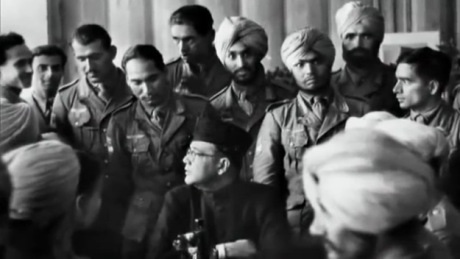
Netaji escaped from India in 1940 in order to organize a liberation army (INA) outside the country. He and his comrades wanted to use it as a force to liberate India militarily at a time when England, the colonial master was trapped in the World War II. The Congress led by Gandhi refused to back the British rulers in this War, declaring it as an imperialist war. But it was Savarkar, an icon of Hindutva politics and the RSS who decided to back the British war efforts. To what extent Savarkar helped the British would be clear by the following words of his:
“So far as India’s defence is concerned, Hindudom must ally unhesitatingly, in a spirit of responsive co-operation with the war effort of the Indian government in so far as it is consistent with the Hindu interests, by joining the Army, Navy and the Aerial forces in as large a number as possible…Again it must be noted that Japan’s entry into the war has exposed us directly and immediately to the attack by Britain’s enemies. Consequently, whether we like it or not, we shall have to defend our own hearth and home against the ravages of the war and this can only be done by intensifying the government’s war effort to defend India. Hindu Mahasabhaits must, therefore, rouse Hindus especially in the provinces of Bengal and Assam as effectively as possible to enter the military forces of all arms without losing a single minute.”
The HMS M under Savarkar organised recruitment camps throughout the country under its banner for the British army. The British Government was in regular touch with Savarkar so far as the organisation of its highest war bodies was concerned. It included individuals whose names were proposed by Savarkar. This is made clear from the following thanksgiving telegram Savarkar sent to General Wavell, the Commander in-Chief; and the Viceroy of India on the 18th instant (July 18, 1941):
YOUR EXCELLENCY’S ANNOUNCEMENT DEFENCE COMMITTEE WITH ITS PERSONNEL IS WELCOME. HINDUMAHASABHA VIEWS WITH SPECIAL SATISFACTION APPOINTMENT OF MESSERS KALIKAR AND JAMNADAS MEHTA. [As per the original text. Kalikar and Mehta were two senior HM leaders]
It is important to note here that even the Muslim League, otherwise an organisation that was subservient to the interests of the British rulers, refused to align in these war efforts or join Defence Committees established by the government.
Savarkar's presidential address at Madura (1940) is a living testimony to his unabashed support to the British imperialistic designs. He rejected out rightly Netaji’s attempts to liberate India. He declared:
“Not only on moral grounds but on the grounds of practical politics we are compelled not to concern ourselves on behalf of the Hindu Mahasabha organisation with any programme involving any armed resistance, under the present circumstances.”
He shamelessly declared that it would be a,
“political folly into which the Indian public is accustomed to indulge in thinking that because Indian interests are opposed to the British interests in general, any step in which we join hands with the British government must necessarily be an act of surrender, anti-national, of playing into the British hands and that co-operation with the British government in any case and under all circumstances is unpatriotic and condemnable”.
He demanded complete loyalty from the Hindu recruits who joined the British forces:
“One point however must be noted in this connection as emphatically as possible in our own interest that those Hindus who join the Indian [read the British] Forces should be perfectly amenable and obedient to the military discipline and order which may prevail there provided always that the latter do not deliberately aim to humiliate Hindu Honour.”
Astonishingly, Savarkar never felt that joining the armed forces of the colonial masters was in itself a great humiliation for any self-respecting and patriotic Indian. He went on to inform the Hindu recruits that through the efforts of Hindu Mahasabha alone, one lakh Hindus were recruited in the British armed forces in one year.
The HM archives are full of records of meetings between ‘His Excellency the Commander-in-Chief and Shri Jwala Prasad’ second in command of HM in which British Commander-in-Chief “expressed his grateful appreciation of the lead given by Barrister Savarkar in exhorting the Hindus to join the forces of the land with a view to defend India from enemy attacks.”
Significantly, pre-Partition RSS literature did not have a single reference to the liberation struggle of Netaji, on the contrary, has records of Savarkar regularly addressing RSS meetings regarding recruitment in the British armed forces.
Related Articles:
1. Collaborator Savarkar versus Freedom Fighter Bose
2. Dr Syama Prasad Mookerjee the Hindutva Icon was a Collaborator, with the Muslim League as much as the British
BJP women’s wing leader Juhi Chowdhury was arrested from Batasia area close to the Indo-Nepal border last night by the CID for her alleged involvement in the Jalpaiguri child trafficking case.
Four persons have been arrested so far for their alleged involvement in the case involving the trafficking of at least 17 children.

The Criminal Investigation Department (CID) officials said Chowdhury was being brought to Jalpaiguri for further interrogation and would be produced before a district today.
West Bengal BJP President Dilip Ghosh has said that the party is looking into the allegations against Chowdhury and would take action if she is found guilty.
Sonali Mondal, Chief Adoption Officer of an NGO, Chandana Chakraborty, its Chairperson and Manas Bhowmik, Chandana’s brother, were earlier arrested by the CID in the case.

They said they had been victims of severe maltreatment, sexual, physical and emotional abuse, and deception by their Saudi employers.
All three told the Dhaka Tribune that their employers expected and often demanded sex, with or without their consent. Sometimes, they even had their friends join in.
Their employers expected and often demanded sex, with or without their consent. Sometimes, they even had their friends join in.
Traumatised by their experiences, these women cannot even seek proper help.
They believed the KSA was a safe place for Muslim women to work because it is the birthplace of Islam. In blind faith, they sold off their worldly possessions to secure the funds needed to travel to the country.
They believed the Saudi Arabia was a safe place for Muslim women to work because it is the birthplace of Islam.
The names of the women have been changed to protect their identities.
Sapna moved to the KSA to work as domestic help and take care of disabled children and the elderly.
Prity, a migrant worker from Pabna, was employed as a caregiver in a household with disabled children.

A group of Saudi-bound workers in joyous mood ahead of their trip to the country but little do they know what fate has in stored for them. Photo credit: SYED ZAKIR HOSSAIN/Dhaka Tribune
Hasna, a university graduate, now works 17 hours a day as domestic help for a Saudi policeman because she and her husband could not afford to raise their three children with the wages she was earning previously.
Their contracts offer no recourse for workers subjected to abusive treatment.
A Bangladeshi diplomat currently based in Saudi Arabia agreed that the current MoU for manpower exports to the KSA does not have protective clauses to ensure the safety of female migrant workers.
Prity, has been fighting off the sexual advances from her employer and his friends for about a year. Her employers have responded by trying to beat and starve her into submission.
When the Dhaka Tribune spoke with Prity, she repeatedly asked for help to get home. Her desperation was palpable. Her family is trying their best to bring her back by raising funds to pay back the deposit made by the recruiting agency that got her the job.
Sapna told the Dhaka Tribune: “I do not fight them any more because if I do not let them have sex with me, they beat me and take away my food. I do what I have to for self-preservation, so I do not protest my abuse. Sometimes, they tip me for letting them use my body.”
Hasna’s wage was initially set at 800 Riyals ($213.30), but her employer offered her 200 Riyals for “extra work.” This “extra work” was that she had to work full-time for three different households in the building, cleaning eight rooms, comprising 16-17 hours of work every day.
She wakes up around 5 am and goes to sleep at 1:30 am every day, without a single day off.
“I am bound to work here for 2 years and for the last year, all I have seen of this country are these people’s houses and the staircase,” said Hasna.
Every day, she goes from the ground floor to the third floor and back, at least seven to eight times per day.
“I have to carry four gallons or 64 litres of water from the ground floor to the third floor daily, and sometimes I have to carry gas cylinders as well.
“It gets so overwhelming that I sometimes sit on the steps and cry from exhaustion,” she told the Dhaka Tribune.
“I don’t mind working in front of men, but when they ask me to massage their bodies or remove hairs from their nose or when they touch my body, that I can not accept. But I am forced to accept it,” says Hasna, bursting into tears.
A junior official at the Bangladesh Embassy in KSA, who asked not to be named, said: “Agencies lure unskilled Bangladeshi women to Saudi Arabia with dreams of high paying jobs. Once they get here, they realise how different the situation really is. But they are unable to go back home because their employers confiscate their passports and they have no idea how to reach the embassy.”
Many female Bangladeshi workers who migrate to the Kingdom of Saudi Arabia are uneducated, unskilled and poor. And this makes them easy prey to all kinds of exploitation.
The reformed labour law of KSA states that domestic labourers are entitled to nine hours of rest every day. Moreover, they may be entitled to one day off per week, if it is stipulated in their employment contract.
None of the migrant Bangladeshi workers this reporter spoke with were given this minimum, legally mandated rest period.
Because migrant labourers’ real-life experiences are often under-reported, and because reports of abuse are often unheeded by aspiring migrants, Bangladeshi women are increasingly travelling to KSA in search of work.
The numbers have risen from 20,952 to 68,286 last year because of an MoU signed by the two countries in 2015. The MoU expires this month.
When questioned about allegations of rape and sexual abuse, Bangladeshi Ambassador to KSA, Golam Moshi said embassy staff were more aware and proactive about the abuse of female domestic workers than before.
“As soon as we are made aware of such an issue, we take action,” said Golam, admitting that this has been a big problem since the Bangladeshi embassy has not been able to pressure the Saudi government into ensuring these migrant workers’ rights.
“The government is trying to help solve this problem by appointing companies to train these women in Saudi culture and the Arabic language,” Golam said.
A senior diplomat, speaking on condition of anonymity, suggested three potential solutions. He suggested introducing protection clauses in any future MoU, implementing fortnightly check-ins conducted by embassy staff and ensuring that workers can retain possession of their passports and phones.
The sheer volume of sexual abuse allegations in Saudi Arabia has prompted the Philippines, Sri Lanka, India, Ethiopia and Nepal to tighten their laws and outreach programmes for female migrant workers.
The demand for Bangladeshi migrant labour is high precisely because they are largely unskilled and there are no laws protecting their rights. This is one reason why Bangladesh lacks leverage when negotiating with Saudi Arabia to protect its citizens’ rights.
Tired of waiting for help, some abused workers manage to flee their places of work and some eventually reach the Bangladesh Embassy.
What happens to the ones who don’t make it to the embassy, remains a mystery.
(Republished with permission from Dhaka Tribune. The original story may be read here).

The death chamber of the lethal injection facility at San Quentin State Prison in San Quentin, California. Photo: Press Association/Eric Risberg.
Thank God, I’ve never had a child murdered. I hope I never do, and I hope that nobody else ever does. But tragically this is an occasional feature of our world, and of the people I’ve met who have lost children, the overwhelming sense I get is that it never leaves them. They learn to ‘live around it’, but they never ‘get over it’. And nothing, short of the impossible ask of bringing the child back, can ever fix it.
Which is just one of the reasons why the call by UKIP leader Paul Nuttall for the death penalty for child killers is wrong. Execution doesn’t take away the pain and it doesn’t provide closure. Speak to families of murder victims in the USA and, while different families want different things, one consistent thing is that the wrongs are not righted by killing a killer, even if justice is said to be done. For families who hoped it would be the end of their ordeal, the aftermath of execution can be bitter new stage of grief.
Many of the arguments about the death penalty have been repeated time and time again; prominent among them is the question of innocence. No justice system gets it right all the time, but you can’t release someone from death the way you can release them from prison. Indeed, of the three controversial cases that helped to end the death penalty in the UK, two of them involved men (Timothy Evans and Derek Bentley) whose were later found to be innocent, while in America, for every ten people executed since the 1970s (when new safeguards were put in place), one person has been exonerated. Less mentioned, but crucial for any victim-centred approach to the issue, is that wrongful executions mean the victim’s family will also have to live knowing that an innocent person died in the name of their loved one.
A central consideration of any issue of criminal justice, in fact of any issue full stop, should be: “What will do the most good and the least harm going forward, given where we are now?” The death penalty is not the least harmful response to murder, because of all the people it affects. The ripples spread far wider than just the killer, the victim and the victim’s family.
If you execute a child killer, then clearly somebody has to do the execution, but that also means someone has to carry the weight of doing it, of putting a fellow human to death. While there are some executioners who cope with their job (usually by focusing on it as ‘just a job’ that they try to do well), others do not. One former executioner in Kazakhstan, who was ‘initially chosen as an executioner because of his strong psychological coping capacity, reported frequent nightmares and deterioration into “a lonely and secluded life”’. American prison staff have developed post-traumatic stress disorder (PTSD) because of their role in executions, while in Indonesia, prison guards who participate in executions get three days of mandatory spiritual guidance and psychological assistance afterwards, to help them deal with it. Prison systems come up with ways to try to stop people feeling like it was ‘their fault’: in Japan, three different staff press identical buttons to hang the prisoner, but only one button is live and they never find out ‘who did it’; in the USA, this diffusion of responsibility goes even further, with guards given apparently trivially small tasks such as tying down one leg of the prisoner to the lethal injection gurney. But when you have to work so hard to make something okay, maybe that’s a sign that it’s not okay.
Lawyers are also affected; as one from India put it in a report by Penal Reform International:
“I specialise in end-stage death cases … I dread these cases, and shudder every time a new one comes my way. Having taken it on, I feel I am living with a coffin tied to my back. It takes over my life, dominates my thoughts during the day, corrupts all pleasure and invades my dreams at night. I habitually have nightmares of executions, some of which I imagine are taking place in my apartment or just on the ledge outside the balcony where a scaffold has been erected, and the prisoner is being dropped from the balcony ledge with a rope tied to his neck. While preparing the case, I sometimes get so afraid that I am unable to work, and have to curl up under a blanket and go to sleep. Alcohol has a soothing effect on my nerves, and I have to stop myself from having more than one drink in the evening, or beginning the day with a gin and tonic. Ever since I started doing this work, people have been telling me that I age six years in six months.”
And then there is also the other family: the family and children of the person sentenced to death. Speaking to these children and the people who work with them, you get a sense of a group who are themselves innocent of a crime but suffer because of the crimes of others. They are traumatised, by the crime, by the death sentence and (if it happens) by the execution; they face the stigma of being related to a killer, which can remain long after the execution; and they have to live knowing that their parent will be put to death, and while they often recognise that the parent has done wrong, they still love them and would rather the parent was alive, even if in prison. When the child is related to both the killer and the victim (such as when the mother kills the father), it becomes even harder. A parental death sentence stays with a child for their whole life.
Unsurprisingly, people want the harshest sentence for the worst crimes. But that doesn’t mean the sentence should be as harsh as you can possibly imagine. We don’t need to kill to show how much we disapprove or how sad we are that a child has died. We should be asking for sentences that allow something better to come out of a horrible, tragic situation. We cannot undo what has already happened, but we can work to make a better future, to try to ensure there are no more crimes and no more victims.
(Oliver Robertson is a Quaker working on issues of peace and human rights. He specialises in criminal justice matters, particularly the death penalty and children of prisoners, and on climate change).
This story was first published on openDemocracy.
Christians Flee Sinai As 'Islamic State' Insurgency Emerges
Since the end of January at least seven people have been attacked and killed in the provincial capital, El Arish. Five were shot, one was beheaded, and one burnt to death.
Other Christians in the area say they have received threats by mobile phone and "death lists" have been circulated online. A video issued last week by a local IS affiliate vowed to step up attacks, describing the Christians as "infidels" empowering the West against Muslims.
The authorities have been battling against jihadists in northern Sinai for several years but with limited success. A statement from President Sisi's office on Thursday said he has now given orders to "completely eradicate" them.
Although Sinai is a special case and the killings there have been particularly terrifying for Christian residents, sectarian conflict elsewhere in Egypt is not uncommon. Last December the bombing of a Coptic cathedral in Cairo left 25 dead. Country-wide, the Eshhad website has documented almost 500 incidents of various kinds since mid-2012.
Besides violence against people they include attacks on homes and churches.
The automatic response of the authorities to such attacks is to try to restore calm as quickly as possible, but that can only be a short-term fix. Successive Egyptian governments have been reluctant to confront the underlying problem of religious discrimination. That is not very surprising because the state itself institutionalises discrimination to some extent – which in turn tends to legitimise discriminatory actions by individuals.
Commenting on the the cathedral bombing in December, Timothy Kaldas, a visiting professor at Nile University in Cairo, wrote:
"While the vast majority of Egyptians rightfully condemns the murder of 25 worshippers at Sunday mass, other beliefs are pervasive, beliefs that perpetuate sectarianism throughout society and have been behind a majority of the violent sectarian attacks throughout the country. A majority of the country does not even accept that Christian citizens should have the right to build houses of worship as easily as Muslims can build mosques …
"The church building law passed in September maintains a set of rules and regulations for any sort of renovation and construction of a Christian house of worship, rules that mosques do not have to comply with. The different standards – and in the case of Christians, the more restrictive standards – drive structural and state-sanctioned inequality …
"When the state sets sectarianism as its example, it’s hardly surprising that society follows suit. Indeed, sectarian laws surrounding church building have been used as a pretext by vigilantes in rural areas to justify their attacks on Christian places of worship, whether they are private homes used to host prayers or churches seeking to renovate or repair their premises. Attackers often cite the restrictions on church building when defending their actions. The perpetrators frequently escape criminal prosecution, through either the use of reconciliation councils or through overall impunity."
Reconciliation councils – often used as part of the "calming" process after an incident – tend to favour the Muslim majority, often perpetuate injustices rather than resolving them and sometimes make rulings that are contrary to Egyptian law. A report by the Egyptian Initiative for Personal Rights in 2015 described them as "a major factor contributing to the recurrence of sectarian attacks".
Coupled with that are perceptions that the authorities do too little to protect Christians under threat and/or fail to take robust action against attackers. The most recent report on religious freedom in Egypt the US State Department noted:
"The government frequently failed to prevent, investigate, or prosecute crimes targeting members of religious minority groups, which fostered a climate of impunity, according to a prominent local rights organisation. The government often failed to protect Christians targeted by kidnappings and extortion according to sources in the Christian community, and there were reports that security and police officials sometimes failed to respond to these crimes, especially in Upper Egypt."
There are also less conspicuous forms of discrimination. Christians in Egypt are thought to account for about 10% of the population but are clearly under-represented in some key areas. The State Department 's report said:
"The government discriminated against religious minorities in public sector hiring and staff appointments to public universities, according to academic sources. They also stated no Christians served as presidents of the country’s 17 public universities and few Christians occupied dean or vice dean positions in the public university system.
"Only Muslims could study at Al-Azhar University, a publicly funded institution. Additionally, the government barred non-Muslims from employment in public university training programs for Arabic language teachers because the curriculum involves study of the Quran.
"The total number of members of parliament was 596, of whom 568 were elected, including 120 chosen through coalition or party lists, and 28 were appointed by President Sisi. Thirty-six Christians were elected to parliament, and two were appointed."
Sectarianism in Egypt is unlikely to decline unless the government takes a clear lead in combating discrimination but that is probably too much to expect so long as the government remains complicit.
This story was first published on al-Bab.
A day after he was widely condemned for allegedly bullying a 20-year-old martyr’s daughter, former India cricketer, Virender Sehwag, has now said that his mocking tweet was not meant for Gurmehar Kaur.
“My tweet wasn’t intended for Gurmehar. It was plain fun but people construed the other way,” he told India Today.

In a dig at Gurmehar’s old Facebook video message saying ‘Pakistan did not kill my father, war did,’ Sehwwag had posted his own photo with a placard that said, “I didn’t score two triple centuries, my bat did.”
There may not be many takers to Sehwag’s clarification because not only did the actor, termed as Twitter troll, mock Gurmehar, but he also shared many tweets praising him for mocking the young girl on his Twitter page.

His insulting post, however, became very popular among those who preached hatred against anyone being seen even remotely critical of the BJP or its ideological mentor, the RSS.
Among those applauding Sehwag for his tweet was Bollywood actor, Randeep Hooda, who shared the former India cricketer’s post with the ‘clap’ and loud laughter emoticons.
Hooda faced Twitter roasting for his decision to join Sehwag in what was widely perceived as an act of bullying. Soon, he issued a detailed statement clarifying that he was merely having ‘a laugh’ on a good joke.
Earlier in the day, Sehwag had avoided questions from media at a public function. The video tweeted by news agency ANI (below), showed how Sehwag desperately evaded reporters’ penetrating questions on his mocking tweet.
Meanwhile, an old of Sehwag expressing his love for Pakistani and its mutton haas now gone viral on Twitter.
User @RealHistoryPic, which is followed by even Prime Minister Narendra Modi, posted the following sarcastic tweet, which has now been shared more than 1300 times.
I didn't praise Pakistan, the checque I received from Star Sports did.~ Virendra Sehwag (2017) pic.twitter.com/wIj18cWGus
— History of India (@RealHistoryPic) February 28, 2017
Courtesy: Janta Ka Reporter

The reality is otherwise. Government’s lies are exposed by RBI’s own data. According to RBI’s latest figures, as on February 3, the total currency with public is only 9.8 lakh crore rupees. On November 8, when demonetisation was announced, the currency with the public was about Rs. 18 lakh crores. Even after 3 months of demonetisation government has not replaced Rs. 8 lakh crores out of the Rs. 15.5 lakh crores of demonetised currency.
Why is the government so slow in remonetizing? Could it be that it does not really want to fully remonetise the economy and wants push e-wallets, credit and debit cards down people’s throats, whether they are ready or not? Or is it simply that the government is totally incompetent and is covering up its failure with lies and more lies?
Join our mailing list to get the latest human rights news that matters, straight to your mailbox.
© Sabrang | All Rights Reserved