The scare being spread through word of mouth campaign and through social media about Muslim population taking over the Hindu population holds no water, as there are clear trends of decline in the decadal rate of growth of Muslim population as well.
Representational image. Photo credit: Reuters
The biases and misconceptions about conversions and population growth have been used by communal forces to divide the society. This became apparent once again when Minister of state of Home, Kiren Rijuju tweeted that that Hindu population is decreasing in the country as Hindus don't convert and that minorities in India are flourishing unlike in the neighbouring countries.
Threat of decline in Hindu population and increase in population of minorities is being propagated time and over again. As per the data of 2011 census figures, Hindu population now stands at 79.8 % and Muslim population at 14.23%. “The data on Population by Religious Communities of Census 2011 show that between 2001 and 2011, Hindu population grew by 16.76 per cent, while that of Muslims by 24.6 per cent. The population of both communities grew faster during the previous decade, at 19.92 per cent and 29.52 per cent, respectively. As a long-term trend, say demographers, the communities’ growth rates are converging.” This means that the decadal rates of growth of both communities is declining and converging closer to each other.
This is pointer to the fact that while charting out the future projections it is important to keep in mind that the rate of growth of Muslim population will be falling and will stabilise closer to that of rate of rise Hindu population. In the total population Muslims will remain a religious minority for the times to come. Interestingly, the population increase of Hindus during the period of 2001 to 2011 has been 133 millions, which is close to the total population of Muslims in 2001. The scare being spread through word of mouth campaign and through social media about Muslim population taking over the Hindu population holds no water, as there are clear trends of decline in the decadal rate of growth of Muslim population as well.
The demographers point out that the higher rates of fertility are due to lack of education and poor health facilities. Muslims in Kerala have a lower fertility rate than many Hindu communities in North India and even in Kerala. The economic profile of Kerala Muslims is much different than the Muslims in Assam, West Bengal, UP and Maharashtra for example. If we broaden this point we will see that the rise in population among Dalits (Schedule castes) and Adivasis (Scheduled Tribes) is much higher as such . As per the 2011 census STs are 8.6% while they were 6.23 % according to 1951 census. SCs now are 16.6%, while as per 1951 they were around 15%.
As such the whole truth will show us that the propaganda of communal forces has nothing to do with reality of society and deeper causes of the same. It is in this background that the likes of Praveen Togadia who said that two child norm should be imposed, while the likes of Sakshi Maharaj and Sadhvi Prachi have been extolling the Hindus to produce more children.
BJP president Amit Shah has given the 'Look North East' call to raise the scare about the Christian population in the North East. This primarily tribal area saw an increase in percentage of Christians in the decades of 1931-1951. The rise in percentage of Christian population has a lot to do with the spread of civil administration with Independence and also with the spread of education in the region. Countrywide we can see that the percentage of Christians has been static over the last few decades.
If at all, it has declined and stabilised. If we see from 1971, we see that Christian population was 2.60% (1971), 2.44 (1981), 2.34 (1991), 2.30 (2001) and 2.30 (2011).
In the meanwhile the propaganda of missionary activities and increase in the number of Christians has dominated the scene. Anti-Christian violence came to public attention with the ghastly murder of Graham Stewarts Staines (1999). Dara Singh of Bajrang Dal, which is affiliated to RSS, incited the local people that the pastor is doing conversions which is against Hindus.
Wadhwa Commission which investigated pastor Staines murder concluded that he was not involved in conversions and that in Keonjhar, Manoharpur Orrisa where the pastor was working, there was no increase in the percentage of Christian population.
Similarly Kandhmal anti-Christian violence was unleashed on the pretext of murder of Swami Laxmananand. Gujarat also saw anti-Christian activities again due to propaganda that the missionaries are converting. At the same time we see that the national population of Christians remains static. Some people do allege that conversions to Christianity are there but the converts are hiding their religion, this is again a matter of conjuncture and nothing definite can be said. Any way it cannot be a large number in any case.
As such conversions have been a part of the agenda of Hindu nationalism times and over again. During freedom movement two parallel processes of conversions were going on. One was Tanzeem, which was to convert people to Islam, the other was Shuddhi which was aimed at those who were supposed to have left their 'religion-home' and were converted to alien religions.
The premise was that conversion to other religions has made them impure so they need to be brought back through a process of purification. Last several decades RSS-VHP-Vanvasi Kalyan Ashram have been active in what is called Ghar Wapasi (returning home) to bring back the Dalits and adivasis who it is alleged have been converted through force (to Islam) and allurement or fraud (to Christianity). This Ghar Wapasi campaign has been undertaken through many newly devised rituals like bath in hot spring or rituals around fire. This has been rampant inAdivasi areasand in slums-villages.
Adivasis are animists, while RSS claims they are Hindus. To Hinduise them Vanvasi Kalyan Ashram now runs a growing network of schools and hostels in large numbers in North East. Such assertions and accompanying activities have more to with politics rather than social welfare as such. The attempt of RSS combine is to link religion with nationalism.
(This story was also published on People's Voice).
I am an Indian Muslim. I’ve been living in this country for past 1000 years or so, Yet you consider me an outsider. . I have adopted many cultural practices of yours, Be it in marriages, in costumes, in language or in food. I’ve even adopted your caste system, Your Sindoor, Your Mangalsutr, Your rituals, Yet you feel that your culture faces a threat from me. . My dietary habits are same as yours, Yet you consider me a beef eater, and insolent towards the cow you worship. Even though the Govt of India is the largest beef exporter of the world. . I am an Indian Muslim. . I’ve played Holi with you, Visited Puja pandals with you Sported the Tilak as well. Yet you consider me an orthodox proselytizer. . My literacy rate is at par with SCs and STs, My representation in bureaucracy is mere 3%, Same is the situation in other services, Be it police, judiciary or the army, Yet I’ve never demanded any special treatment in recruitment process. . I am an Indian Muslim. . Polygamy in my community is lower than among tribals and Hindus, My population growth rate has been declining, Yet you feel threatened by political demagoguery of “Hum Paanch Hamaare Pachchees” . I’ve painted your homes, Welded your grills, Tailored your clothes, Woven your textiles, Served your culinary tastes. . I pull the rickshaws, Weave your carpets, Repair your punctures, Service your vehicles, Do all menial jobs. I constitute the largest community living Below Poverty Line, Yet you consider me an unduly privileged class thriving at the cost of others. . The Hajj subsidy given in my name, Goes to Air India, Yet you feel that I’ve been pampered by ‘secular’ parties. . I’ve borne the brunt of riots, Orchestrated by virtually every party, In every nook and corner of the country, Yet you feel that I’ve been a beneficiary of ‘minority appeasement’. . I am an Indian Muslim. . I have my own share of faults, I am not an angel, Neither am I a devil, I am as mortal as you, As vulnerable to vices as you, As compassionate as you. . It pains to give an explanation of misdeeds committed by ruffians in the name of my community. It pains when I am asked to apologize for inhuman deeds over which I have no role or control. I am struggling to get out of the clutches of orthodox mullahs, To clear the image of my community Painted black by the unscrupulous media. To live in harmony with you all, To enjoy the diversity of this land and its culture. However lack of education and control of orthodox mullahs are an impediment in my way. . But you are educated. How did you fall victim to political demagoguery? What eroded the trust? The bonhomie we used to share, since ages? Can’t you see that bigotry today is a worldwide phenomenon? Engulfing human lives? Threatening Love and Trust? What is stopping you from rejecting hate embracing love? . I am an Indian Muslim. And I need you. And I believe, You need me too, As much as I do. . Coz I believe – Peace doesn’t come of its own. Those who love peace must learn to organize themselves as effectively as those who love bigotry.
15 years after the communal carnage in Gujarat, Harsh Mander narrates a tale of exceptional courage.
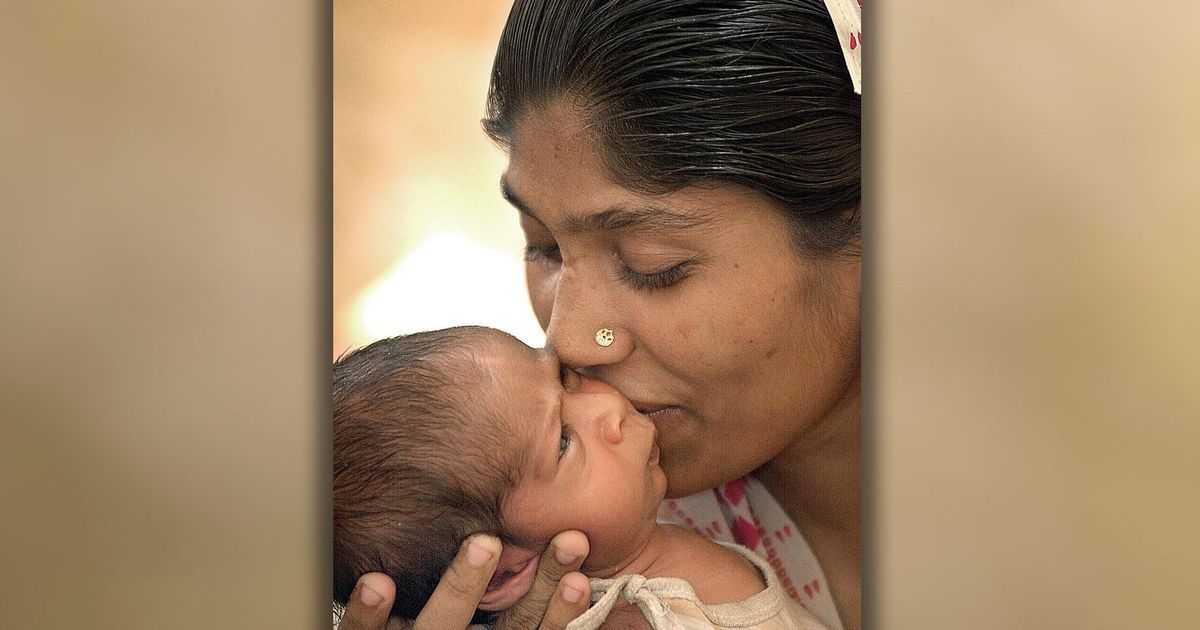
Dibyangshu Sarkar/AFP | Farzan Biwi, 22, who lost her husband during the communal violence in Gujarat, kisses her 15-day-old baby at a relief camp in Ahmedabad in May 2002.
I have engaged for many years with survivors of communal violence across India: in Nellie and Kokrajhar in Assam, Tilak Vihar in Delhi, Bhagalpur in Bihar, Muzaffarnagar in Uttar Pradesh, and Godhra in Gujarat, attempting to express some solidarity in their struggles for justice and healing.
I have found that the most vulnerable among them are the widows. Their spouses, children and elders are killed and, almost overnight, their homes, their livelihoods and earnings are wiped out. They are uprooted from familiar environs into new ones and, all at once, they are saddled with the responsibilities of rebuilding their lives and caring for other survivors. And, like most other widows in India, they battle memory, loneliness, want, as well as the negligence and cruelty inflicted upon them by society.
Despair constantly stalked the 21-room apartments allotted to widows and their children in a colony erected by relief-workers on the outskirts of the village Delol, near Godhra, for the survivors of the 2002 massacre in Gujarat. The spirit of the residents of these small homes and their sense of hope remained fragile even years after the carnage. A gust of memories, a boy’s quiet weeping, a girl’s terrified screams in her sleep, a widow’s unacknowledged loneliness, the barbed taunts of neighbours, worries about the future of children, the humiliation of continued dependence on charity – each was enough to obliterate hope.
Feisty, fierce, resilient, compassionate, impetuous and sometimes unwise, yet often defenceless in her loneliness, 31-year-old Naseebbahen Mohammedbhai Sheikh emerged as a natural leader in the colony. She had lost an incomprehensible total of 26 members of her family in the massacre, including her husband, her 12-year-old daughter, her parents, and almost every living relative in her parents’ and her husband’s home except one brother and a son.
Yet hers was the steadiest voice in the colony, one offering comfort and strength. “You have to now make two hearts beat in your breasts,” she never tired of telling the other widowed women, “one that of a mother, the other of a father.” She would urge the women, “Live for your children but also for yourself. Make sure that your children study.”
Memories of a massacre
Naseeb and her one son survived only because of a chance of fate. She had been admitted into a government hospital in Delol for a hysterectomy on February 27, 2002, just one day before the massacre engulfed her village and villages in 20 districts of Gujarat. She did not know, until much later, about the burning of the Sabarmati Express at Godhra railway station that same day, barely 20 km from where she lay on the operation table, or that the horrific deaths in the train compartment had sparked such widespread and barbarous mass communal extermination.
Her husband, Mohammedbhai, visited her grim-faced in the evening after the operation. He did not tell her that their home had been plundered and burnt down by mobs, their television smashed, that everything they had lovingly accumulated over 15 years of married life had been destroyed in minutes. Their locker had been broken into, too, and their life savings of Rs 70,000, with which they had hoped to buy agricultural land, had been looted. Mohammedbhai only gave her home-cooked food in a tiffin-carrier, asked after her health and held her hand. He then left. It was the last time that she saw him alive.
The following night, Koyobhai, an Adivasi worker from her village who had tended to their fields for many years, brought her 10-year-old son to the hospital. There had been some communal disturbances in the village, he told her briefly. Some Adivasi agricultural-workers had given her extended family shelter in their homes, he said, and they were all safe. Naseeb’s son had wept incessantly for her and he had therefore carried him to the hospital to leave him with her. Naseeb was very troubled, but Koyobhai reassured her that there was no cause for worry.
On the morning of March 2, 2002, Naseeb awoke to the roar of frenzied crowds milling around the hospital. She stumbled out of bed and ran to the gates. In the distance, she saw an overturned Tempo van being set on fire by a mob. Naseeb screamed when she thought she saw her own brother Yakubbhai among the passengers trying to escape the burning vehicle. Even as he struggled desperately, a horde of men overpowered Yakubbhai, poured petrol upon on his clothes and set him on fire. At this point, Naseeb fell unconscious. She was spared the sight of her sister-in-law being stripped naked and raped by the men even as she begged for mercy. She did not see her brother’s two terror-stricken children run screaming for safety towards the hospital and being overpowered and burnt alive.
When Naseeb regained consciousness, she found herself back in her hospital bed. To save her life, the nurses had dressed her in a sari, stuck a bindi on her forehead and spread vermilion in the parting of her hair. Her traumatised son sat frozen by her bedside. Mobs were scouring the hospital wards for Muslim patients. The doctor convinced them that she was a Hindu and they passed her by.
The doctor, Hasmukh Machi, was an elderly gynaecologist who had treated generations of women from Naseeb’s family. After the mob left the hospital, he reassured the shuddering and sobbing Naseeb that the man she had seen killed was not her brother, and that all her relatives were safe. But, as days passed and no one came to see her in the hospital, fear and panic mounted. However, the doctor told her that he had made enquiries. All the members of her family had taken shelter in relief camps. They were unable to visit her only because of the curfew and the unchecked violence.
After she was discharged, Dr Hasmukh took Naseeb to his own home where his wife and mother gently nursed her and restored her to health. It was the longest that Naseebbahen had lived in a Hindu household, she said. They treated her as one of their own. Finally one morning, twenty days after the violence first broke out, the doctor and his wife sat by Naseeb’s side and, in low, shaking voices, shared horrifying news, worse than the worst of her nightmares.
Amit Dave/Reuters
Horrific end
After their home was destroyed by the rioting mobs, the Adivasi workers – who had been employed for many years by Mohammedbhai’s family – sheltered her extended family in their huts, a total of 11 women, men and children, for three nights. But the bloodshed and butchery refused to die down. When others in the village discovered them, they advised the men that it would be safest for them to shift their families to the relief camp in Kalol, Gandhinagar. They assured them safe passage.
The entire family set out that evening in the fading twilight. They walked a short distance, then decided that it was too dangerous to continue and hid in a shallow pit on the bed of the Goma River until nightfall. Although the villagers had assured them that they would remain unharmed, they still trembled, clinging on to each other, hoping to see the dawn. But this was not to be.
A crowd of men armed with swords approached stealthily from the rear and surrounded the family. The attack was swift and surgical. They first cut off the head of Naseeb’s mother-in-law. They then attacked her husband Mohammedbhai. They hacked off his arms and, as he cried out to Allah, fatally stabbed him in the stomach. The death of their 12-year-old daughter was even more merciless: they cut off her arms, feet, hair, and only then ended her life. In this way, one by one, nine of them fell to the mob’s swords as their blood collected and coagulated in the riverbed and their screams filled the stillness of the approaching night. They burned alive two small children. The doctor’s account did not end there. Frequently breaking down, he told Naseeb that it was indeed her own brother whom she had seen from the hospital gates.
While their home was being looted and torched, her parents’ extended family of 15 remained hidden in the fields. After cowering for two days among the standing crops, enduring hunger, thirst and fear, her brother had decided that they could not continue like this indefinitely. The storm showed no signs of passing and he felt that there was no option but to drive everyone to the relief camp in Kalol.
Somehow, their Tempo van had been left unharmed and they all piled into it and left. In Kalol, they found that the roads had been blocked with crude, hastily put up barriers made out of stones and mounds of sand. Naseeb’s brother tried to desperately drive over the barriers but, at one point near the hospital where Naseeb was recovering from her operation, the van swerved and overturned into a ditch. Naseeb was witness to some of what happened afterwards.
Naseeb, now utterly distraught and incredulous, begged the doctor that she be allowed to visit the relief camp and look for survivors from her family. The doctor drove her there himself. With her son clutching her shaking hand, she walked unsteadily through the camp. The only relative that Naseeb could find was her husband’s elder brother Abdul and his wife. They had survived only because they lived in another town, Dehasar, where their homes had been destroyed but their lives had been spared. They all held on to one another and wept inconsolably. Such was the lamentation in the camp that this little family gathered around, weeping, became just one among numerous others.
No help
The state government had refused to manage the camp, or provide any assistance beyond supplying foodgrains barely enough for a subsistence-level existence. In this situation, unlikely leaders emerged. Moved by the suffering of the thousands who had survived slaughter, rape and plunder, and who were now internal refugees abandoned by their own government, many pushed their own sorrow and loss aside. Bands of young people gathered and set up makeshift shelters out of plastic sheets and bamboo sticks, cooked and distributed food, carried water for bathing and drinking, organized milk for infants and medical care for the wounded, and helped survivors file complaints with a recalcitrant and openly hostile police.
A week after Naseeb arrived in the camp, Abdul took a room on rent in Kalol and moved there with his wife and children and his sister-in-law and her son. Naseeb lived with them for three months but finally returned to the camp. She returned because she was humiliated and wearied by her sister-in-law’s insinuations. She unrelentingly taunted Naseeb, “Your whole family died, how did you alone survive?” She reviled Naseeb particularly because it was a Hindu doctor who had left her at the camp. “Why did that Hindu doctor shelter you for 20 days?” she asked. “What did you do for him?”
At the camp, they slept on the bare floor and were able to bathe only every 10 or 15 days. The camp organisers had hired a tanker to bring in drinking water but this was never enough, and the temperatures soared mercilessly all summer.
A relief camp in Ahmedabad. Photo: Sebastian D'Souza/AFP
Stigma at every step
Naseeb could not shake off the stigma and vulnerability of being a widow even in the camp. Earlier, before she had left the camp to live with her brother-in-law’s family, their religious leader, the maulana, had insisted she observe the ritual iddat of 40 days, prescribed in Islam for all widows, with complete confinement in her brother-in-law’s home.
Her brother-in-law had stoutly supported her resolve to defy this custom, even if it meant excommunication from their faith. How could a woman who had lost everything, including 26 members of her family, and now charged with raising her only surviving child, be expected to withdraw from the world for 40 days? But back at the camp, the maulana returned to his haranguing: she had been rescued by a Hindu doctor, he said, and had refused to observe iddat. There could be nothing worse in his view. There were 15 widows at the camp and they all lived together, extending to each other a sisterhood of comfort and support. None observed iddat. None escaped the maulana’s recriminations.
One day, Ransinghbhai, a Hindu vegetable dealer with whom her husband used to do business, visited them at the camp. Appalled by the conditions, he offered to take them to his own home. Naseeb declined because she was afraid of gossip, but gratefully sent her son with him.
‘We had a happy home’
Alone in the camp, Naseeb’s thoughts would frequently wander back to her husband. “Compared to my parents’ home,” Naseeb told me, “we were not so well off. But we had a happy home. My husband was a good man. He would always inform me before he left home, about where he was going, and when he would return. Not many men do that. He never beat me, and fed me well.”
Naseeb had very fond memories of her grandfather. It was he who had given her in marriage to Mohammedbhai, her mother’s sister’s son, even though the family was poor, because he wanted her to always live close by so that he could see her flourish before his own eyes.
He was a well-off landowner, with 100 bighas of irrigated land; he employed 20 farm-workers with whose help he grew vegetables and castor. He had been on the Haj thrice, each time spending a Rs 1.5 lakh . They owned three tubewells. From one, he offered a free supply of drinking water for two hours daily to any villager who needed it, regardless of community or caste. This act was exemplary in a village in which divisions of caste and religion ran very deep. He had also dug a trough of water for animals and birds. Her grandfather never foisted purdah upon the women in his family. He also encouraged them to participate in Hindu festivals like the Navratra.
Naseeb’s two brothers studied up to Class 10, but the girls were allowed to only attend the local madrassa, up to Class 7. Naseeb had wanted to study further but the religious school offered, in her words, “more Quran, less schooling.”
Naseeb was 16 when she was married off to her cousin Mohmmedbhai. He was more educated than her brothers, having studied beyond secondary school, and having acquired a diploma in electrical engineering from the local Industrial Training Institute. But he ended up in the business of dairying, with a single buffalo, which was augmented after their marriage by the second buffalo her grandfather gave them.
Her father also encouraged and assisted his son-in-law to sell the vegetables grown in their fields. When Naseeb would gather grass from her father’s fields for their buffaloes, he would never allow her to carry the load back on her head but would send her on his tractor. Naseeb and Mohammedbhai sold milk mainly to their Hindu neighbours, and vegetables to Hindu traders. Her mother-in-law was always full of praise for her, said Naseeb. “Naseeb is true to her name,” she would say, “she has brought us good fortune. Only after she came to our home has our poverty and want ended. Today we have every kind of happiness.”
As Naseeb lay on the uneven floor of the relief camp, with no clothes except the ones that she wore, surrounded by crowds of weeping children, bereaved women and dispossessed men, battling mosquitoes, the hot sun and despair, all of this seemed a distant, shadowy dream.
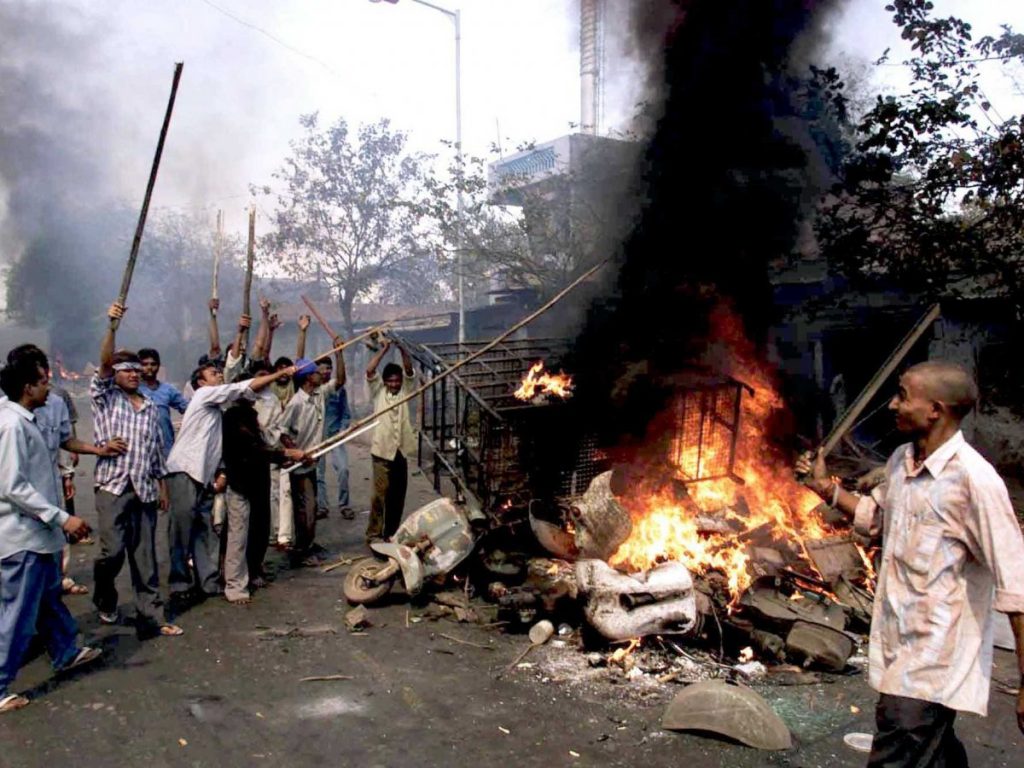
Rioters on a street in Ahmedabad. Arko Datta/Reuters
New normal
The state government forced the relief camps to close six months after they had been set up. Normalcy had been restored, local authorities claimed. And as elections to the state assembly were due, people must return to their villages. No one bothered to explain to the tens of thousands people sheltered in the relief camps how they could go back to their villages where neighbours remained violently, implacably hostile, where they had no prospects of employment and tenancy, where their homes and livelihoods had been destroyed, and when the state government had refused to offer anything more than a pittance as compensation and nothing as rehabilitation grants and loans. Naseebbahen was given a compensation of Rs 90,000 for one member of her family. The remaining 25 were declared “missing persons”, and she was informed that she would have to wait for seven years before she would be paid compensation for their deaths.
By then we had created Aman Biradari, a collective for peace and justice work, bringing together survivors of the carnage and also working-class Hindus from the villages and towns which had been engulfed by the violence. Peace-workers from Aman Biradari met Naseeb, and she decided to join their efforts. Her work as a peace-worker brought her solace. She was entrusted the responsibility for six villages in Godhra.
In each village, she gathered around women, and Muslim and Dalit youth. “I have not come to give you anything,” she said to them. “I have only come to join hands with you, to see if we can build peace, justice and unity in places where there is communal hatred.”
Everywhere, people were moved that a woman who had lost 26 members of her family could still speak of peace and love. Many joined her. She encouraged and supported women to fearlessly give evidence to the police and in courts, and to speak up about the rape, the looting and the killing. In each village, Naseeb also asked about the Hindus who had protected their Muslim neighbours during the carnage. There were many, and she invited them to be leaders of Aman Biradari’s peace groups in their villages. Together they tried to instill faith in those whose homes and livelihoods had been destroyed, and to encourage them to return to the villages of their birth, to take heart and start life again.
The maulana remained hostile to Naseebbahen’s work. “You go about with your head uncovered and speak to strange men,” he would lecture to her. “It is because of women without shame, like you, that riots occur in the first place.” He felt that the only respectable course for Naseebbahen was to remarry and even suggested suitable men to her. (He did this to the other widows as well.) Naseeb was only 31 years old and not averse to marrying, provided the right man asked for her hand. But her first priority was her work and her son.
Naseeb’s extraordinary work as a peace-worker in Aman Biradari was recognised when she was nominated among 1,000 women leaders from across the globe for the Nobel Prize.
But her own life fell apart all over again when she alleged that the leader of their relief colony had tried to rape her. This leader had grown into a respected and influential humanitarian and justice-worker in his own right. He hotly denied Naseeb’s charges. Peace activists were bitterly split in their support. I stood resolutely with Naseeb. The man against whom she had alleged rape and sexual harassment left the relief colony and moved to Ahmedabad, where he continued working with leading organisations for the cause of peace. Naseeb was bitter but remained unbroken.
But that story is Naseeb’s to tell. It is enough to say that this episode inflicted one more wound after the many that life had dealt Naseeb, but it could not fell her.
In the years that passed, she raised and educated her son into a fine and caring young man, and found a bride for him. The widows of the colony would still turn to her in difficult times. She did not remarry because she did not find the right man. But in her work for peace and with the widows, she has often said to me, “I feel that I have a new family.”
Excerpted with permission from Harsh Mander’s new book Fatal Accidents of Birth: Stories of Suffering, Oppression and Resistance, Speaking Tiger
He's the only president in modern polling to have net negative rating
(Photo: Michael Vadon/flickr/cc)
President Donald Trump's job approval rating is a mere 44 percent, an NBC News/Wall Street Journal Poll published Sunday finds, further documenting the skepticism with which the public views the former reality TV star's short time in the White House.
In fact, he has "the lowest approval ratings of any new chief executive in modern American history," CNBCwrites.
Forty-eight percent say they disapprove of Trump's performance as president, and 32 percent said his performance thus far shows he's not up to being president.
And while 63 percent of Republicans say he's off to a great start, NBC notes that Trump "is the only president in the history of modern polling to begin his first term with a net negative approval rating."
His net negative rating is -4 percent. His predecessor, in contrast, started off with a net positive 34 percent, while George H.W. Bush had a net positive of 45 percent.
The results of the poll, conducted February 18-22, come two days before Trump makes his first address to Congress.
The speech, the Associated Presswrites, gives Trump the chance "to reframe his presidency after a chaotic opening in which he's rattled world leaders, railed against leaked information, engaged in open warfare with the press, and seen his signature effort to halt some immigration thwarted by the courts."
In what Politicodescribes as an effort "to troll the new president in prime time," many Democrats will be bringing immigrants as their guests to the event.
Iranian graduate student Sara Yarjani, who was affected by Trump's now-halted travel ban, will be the guest of Rep. Judy Chu (D-Calif.). "Mr. Trump needs to see the people he has hurt," Chu said.
(This article was first published on Common Dreams).
During the times of Kabir in the 15th century, India simmered with communal tension, the reason why he wrote and sung so passionately about Hindu-Muslim unity. Like a huge flash in the pan, a riot would erupt quickly, consume what it could and die.
In India in the last few decades, this flash has been replaced by a slow burn inside a volcano –temperature continues to rise, but you don’t feel it until it’s too late.
15 years back, beginning this day in Godhra, Gujarat, one such volcano burst open and consumed at least 1044 (official figures) lives, mostly Muslims, in its wake. A critic would be right to point out that there have been worse communal carnage in modern India, Nellie (Assam) in 1983, Delhi in 1984, India post the demolition of Babri Masjid in Dec 1992 etc. In each of these cases more people have died than in Gujarat 2002, at least officially. The 1984 Sikh genocide even set a precedent that would become a norm. The party responsible for the genocide, Congress, not only gave tickets to some of the rioters, but people of Delhi elected them with record margins. How is Gujarat 2002 worse than these?
Because in no other riot, do you see a huge class of society justifying the slaughter of women, children and old people, the brutal rape and often murder of hundreds, and wear it like a badge of honour. India, especially Gujarat, is not only unashamed of the violence in Feb-May of 2002, but is actually proud of it. The pride has increased as the man at the helm of Gujarat government then – Narendra Modi – has risen to become the Prime Minister of the country.
Arguments like ‘it was important to teach the Muslims a lesson’, ‘it was necessary for Hindus to feel a sense of pride,’ ‘for once we got the better of them’ etc. are dinner table conversation around children to this day. Delhi 1984 had seen those justifications making the rounds for a while. Yet, never before in the history of India (not even during the most heinous Partition riots that claimed at least 200,000 lives from the Hindu, Muslim and Sikh communities) has the vilification and demonization of one community been done with such great fervour by such a large class of society in the country. While every other riot ended when the violence was brought under control, Gujarat 2002 continues to exist to this day tainting almost every sphere of our lives.
A 1000 years of history continues to be pushed down on the living bodies and minds of Muslims, attempting to bury them once and for all. In some Hindus segments, so degraded is their psyche that they can unite only under the umbrella of the hatred of Muslims. The love and devotion that Bhakti and Sufi cults espoused, that Hindu-Muslim peace that seers like Nizamuddin Aulia, Baba Farid, Kabir or Guru Nanak and more recently Mahatma Gandhi preached, is consistently undone by the hatred deliberately sown into people’s hearts by millions of cadres of various organisations under the Sangh Parivar, be it RSS, the ruling BJP or even its student wing ABVP who prefer to argue with sticks and stones rather than verbs and adjectives. It is a sign of great inner insecurity to be hostile to the unfamiliar, said Anais Nin.
A society which can converge into agreement only on a point of hatred rather than love, is signing its own suicide pact. And more and more every day, India walks towards that precipice of hatred, ready to jump. Ask anyone in the administrative circles and they will tell you that no communal violence can go on for more than 24 hours without the collusion of the ruling dispensation. The anti-Sikh pogroms of Delhi 1984 went on for three days because the ruling Congress allowed it. The Nellie massacre in Assam where over 2000 people were killed was a matter of 6 hours. That the Gujarat pogrom went on for almost 3 months till KPS Gill was sent by Prime Minister Vajpayee, is proof of the collusion of the then ruling BJP dispensation which either turned a blind eye, or many times actively participated in it. The volcano had simmered for at least a decade in the hatred being poured into drawing rooms of Gujarat against Muslims, before it burst open. There are huge pockets of resistance against this hatred.
It is being led by all kinds of people – upper castes Hindus, the Dalits, those who once believed in the Hindutva ideology of hatred but now believe in the sarva dharma sama bhava – the equality of all religions, the philosophy of true Hindus. They have diffused many flashpoints through the ages. Yet, many small fires are being lit every single day these days in the hopes that they turn into a rampaging forest fire. It is for these reasons that we must not only remember, but commemorate our own failings as a nation. The memory of Gujarat 2002 must not be allowed to fade, neither that of Godhra on 27 February nor what happened in the next 3 months. It is important to tell millennials what happened then, without shame or rancour but with all honesty. It is important for the sanity not just of the nation, but the world. In order to truly rise as a global superpower, we must also remember our ancient Vedic idea of: Vasudhaiva Kutumbakam – the whole world and all its inhabitants are my family. Not just in words – for us Hindus have a great, inclusive ancient ideology which we revere but conveniently forget – but practice it in actions and deeds.
Let us begin by two of Kabir’s dohas. “Pothi Padh Padh Kar Jag Mua, Pandit Bhayo Na Koye , Dhai Aakhar Prem Ke, Jo Padhe so Pandit Hoye.” (The study of a thousand books, will not a scholar make; as much as learning the four alphabets, that the word ‘LOVE’ makes.) “Bura Jo Dekhan Me Chala, Bura Naa Milya Koye, Jo Munn Khoja Apnaa, To Mujhse Bura Naa Koye.”
(I went in search of bad and found none around, when I looked inside my own mind there it lay abound.)
(Satyen K Bordoloi is a writer based in Mumbai. His written words have appeared in many Indian and foreign publications.)
In recent times, such attacks have targeted a variety of cherished sites and individuals in Pakistan. These have ranged from the 2010 bombing of the tomb of another Sufi saint, Data Ganj Bakhsh, to the murder of a popular Sufi singer, Amjad Sabri, in 2016.
As a scholar of Muslim and Hindu traditions, I’ve long appreciated the various and influential roles that Sufis and their tombs play in South Asian communities. From my perspective, the repercussions of such violence go far beyond the scores of bodies strewn around the damaged shrine and the devastated families in one geographical region.
Many Muslims and non-Muslims around the globe celebrate Sufi saints and gather together for worship in their shrines. Such practices, however, do not conform to the Islamic ideologies of intolerant revivalist groups such as the Islamic State.
Here’s why they find them threatening.
Who are the Sufis?
The origins of the word “Sufi” come from an Arabic term for wool (suf). It references the unrefined wool clothes long worn by ancient west Asian ascetics and points to a common quality ascribed to Sufis – austerity.
Commonly Muslims viewed this austerity as stemming from a sincere religious devotion that compelled the Sufi into a close, personal relationship with God, modeled on aspects of the Prophet Muhammad’s life. This often involved a more inward, contemplative focus than many other forms of Islamic practice.
In some instances, Sufis challenged contemporary norms in order to shock their Muslim neighbors into more religiously intentional lives. For example, an eighth-century female Sufi saint, known popularly as Rabia al-Adawiyya, is said to have walked through her hometown of Basra, in modern-day Iraq, with a lit torch in one hand and a bucket of water in another. When asked why, she replied that she hoped to burn down heaven and douse hell’s fire so people would – without concern for reward or punishment – love God.
Others used poetry in order to express their devotion. For example, the famous 13th-century Persian poet and Sufi leader Jalāl ad-Dīn Muhammad Rūmī relied upon themes of love and desire to communicate the yearning for a heartfelt relationship with God. Others, such as such as Data Ganj Bakhsh, an 11th-century Sufi, wrote dense philosophical tracts that used complicated theological arguments to explain Sufi concepts to Islamic scholars.
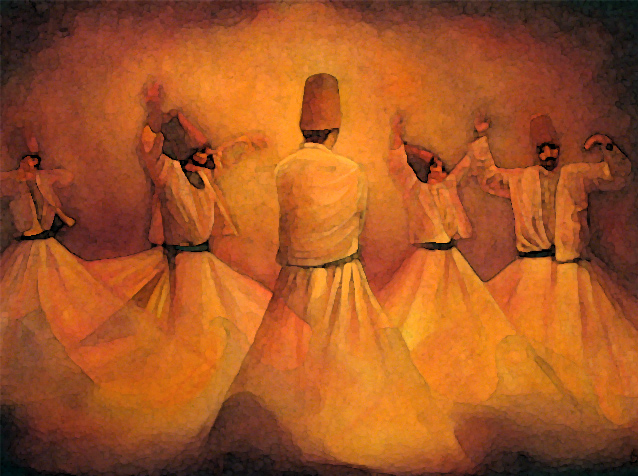
Rumi, for example, founded the famous “Mevlevi” order best known as “whirling dervishes” for their signature performance.
This is a ritual in which practitioners deepen their relationship with God through a twirling dance intended to evoke a religious experience.
Some Sufis – men and, sometimes, women – came to gain such a reputation for their insight and miracles that they were seen to be guides and healers for the community. The miracles associated with them may have been performed in life or after death.
When some of these Sufis died, common folk came to view their tombs as places emanating “baraka,” a term connoting “blessing,” “power” and “presence.” Some devotees considered the baraka as boosting their prayers, while others considered it a miraculous energy that could be absorbed from proximity with the shrine.
So, why do some groups like the so-called Islamic State violently oppose them?
I argue, there are two reasons: First, some Sufis – as illustrated by Rabia, the Sufi from Basra – deliberately flout the Islamic conventions of their peers, which causes many in their communities to condemn their unorthodox views and practices.
Second, many Muslims, not just militants, consider shrine devotion as superstitious and idolatrous. The popularity among Muslims and non-Muslims of tomb veneration alarms many conservative Muslims.
However, Islamist groups such as the Taliban reject shrine worship as well as dancing and singing as un-Islamic (hence their assassination of the world-famous qawwali singer Amjad Sabri). In their view, prayers to Sufis are idolatrous.
Success of Sufi traditions
Sufi traditions reflect a vastly underreported quality about Islamic traditions in general. While some revivalist Muslim movements such as the Wahhabis and other Salafis see only one way of observing Islam, there are others who embrace its diversity.
Many Muslims proudly defend Sufi customs such as shrine devotions because they are so integral to Muslim and non-Muslim communities, not only in South Asia but throughout the world. For many, these sites offer an Islamic expression of what it means to love God.
In fact, historically, in many regions of the world Sufis have been highly successful in adapting Islamic theologies and practices to local customs for non-Muslims. For this reason, Sufi traditions have been credited for the majority of conversions to Islam in South Asia.
It is only with the global expansion of Islamist revivalist groups in the last century that the urge to absolute conformity has become so strong. Even then, a majority of Muslimsaccept such divergent Islamic practices.
Given the popularity of Sufis, it’s no wonder IS objects to such models of Islamic pluralism.
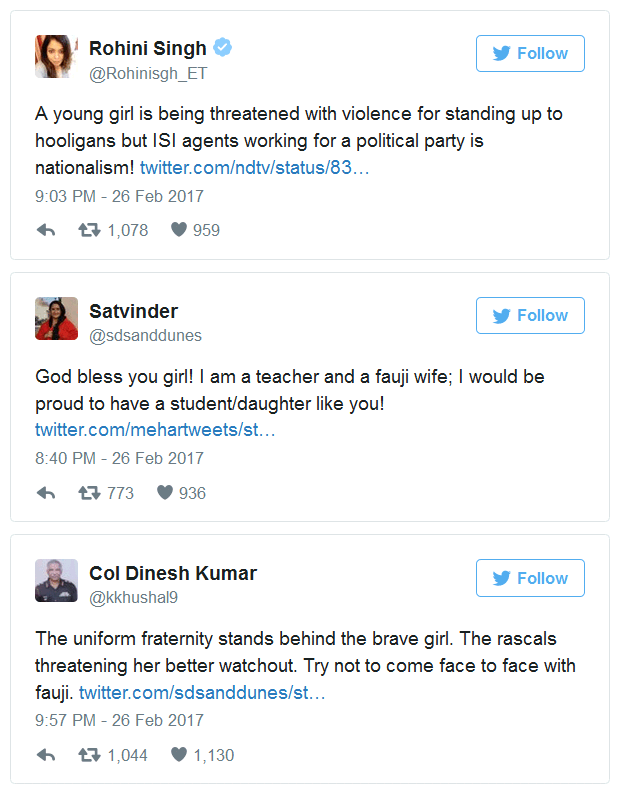
Gurmehar Kaur, a young daughter of a Kargil martyr, had recently started a Facebook campaign ‘I’m not afraid of ABVP’ has received rape threats supporters of the BJP and the ABVP.
Kaur made the sensational disclosure of rape threats on NDTV show when she said, “I’ve been getting a lot of threats on social media. When you open the profile picture that I changed, there are people who keep threatening me and calling me anti-national.
I got rape threats for calling out #ABVP, says Kargil martyr’s daughter
“I think it’s very scary when people threaten you with violence or with rape. There’s a guy called Rahul and he’s given a very detailed explanation in a comment on how he would like to rape me. That’s very scary.”
The rape threat against Gurmehar did not come in isolation. Among those wishing for a rape also included an active BJP worker Veeramachaneni Chaitanya, who posted the similar remarks on his Facebook page.
Chaitanya, reportedly a member of BJP’s Vijayawada Social Media team, whose Facebook profile proudly flaunts a photo with Prime Minister Narendra Modi as a display image, wrote, “What this Sickular girl will say if someone rapes her? No abusive comments please.”
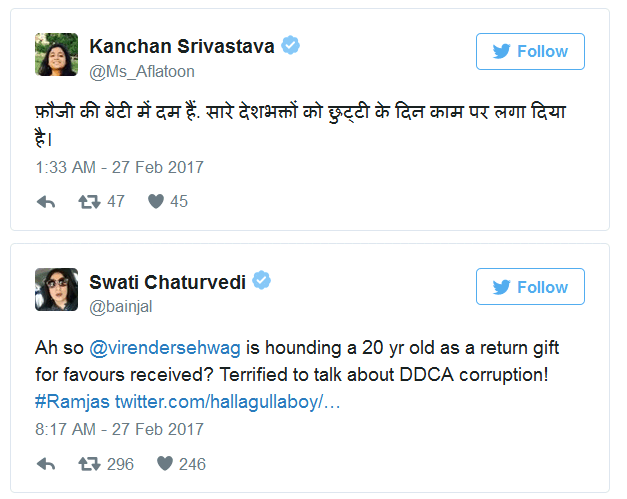
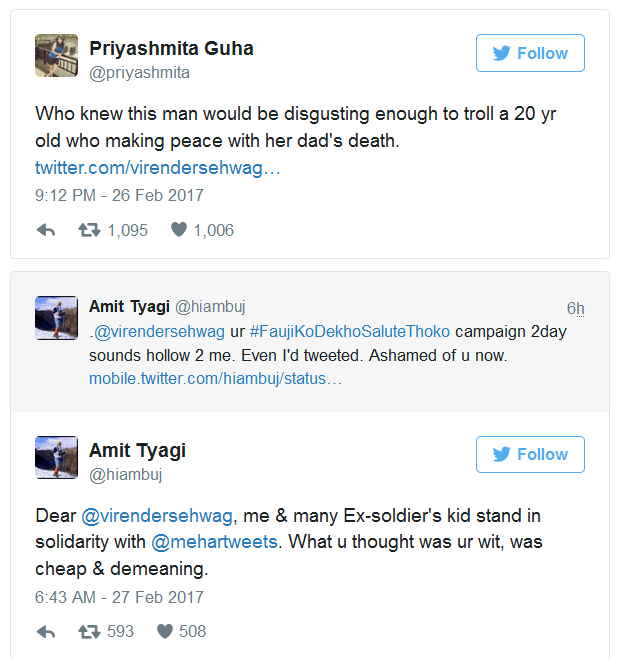
India’s right-wing Hindutva brigade also received support from former India cricketer, Virender Sehwag, in hounding the daughter of Capt Mandeep Singh, who died fighting for India in Kargil war.
In a dig at Gurmehar’s old Facebook video message saying ‘Pakistan did not kill my father, war did,’ Sehwwag posted his own photo with a placard that said, “I didn’t score two triple century, my bat did.”
Sehwag received instant social media condemnation for his ‘cheap’ shot at a vulnerable young girl just because she dared to stand against the violence of the RSS’s student wing ABVP.
Meanwhile, Gurmehar has been receiving plenty of support on social media both from ordinary users and former soldiers.
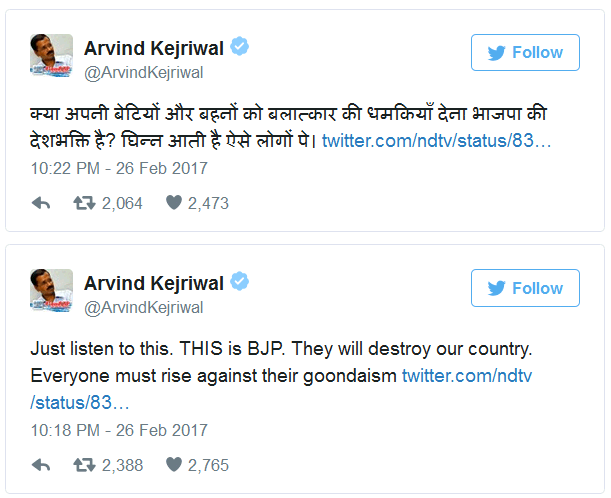
Delhi chief minister Arvind Kejriwal too condemned the rape threats issued to Gurmehar by BJP supporters. In a series of Twitter posts, Kejriwal said that he was disgusted by such people. He said, “Just listen to this. THIS is BJP. They will destroy our country. Everyone must rise against their goondaism”
Ramjas College had on Wednesday witnessed bloody scenes as the members of the Left-affiliated AISA found themselves at the receiving end by the RSS-backed ABVP workers, who with the support of Delhi Police thrashed even journalists covering the event.
The genesis of the clash was an invite to JNU students Umar Khalid and Shehla Rashid to address a seminar on ‘Culture of Protests’ which was withdrawn by the college authorities following opposition by the ABVP.
The Delhi Police has acknowledged “unprofessional” conduct on the part of some of its personnel during the clash and suspended three policemen.
The Armed Forces (Special Powers) Act — the AFSPA — is not the medicine for militancy and it is there to “extract resources” from Manipur, Irom Sharmila’s party PRJA has said.
To drive home the point, the Peoples’ Resurgence and Justice Alliance (PRJA) said that there were only four insurgent groups when the draconian AFSPA was introduced in Manipur in the 1980s and the number has gone up to 32 since.
Image courtesy:countercurrent.org
The PRJA, which was formed by Sharmila after she ended her 16-year-long hunger strike against the AFSPA in August last year, is making its electoral debut in this Assembly polls, fielding candidates in three of the state’s 60 seats. “The AFSPA is not about militancy and counter-insurgency.
It is something beyond that. To deal with militancy and counter-insurgency, you may need laws and programmes but the AFSPA is not one of them.
“In the 1980s when the AFSPA was introduced in Manipur, there were only four insurgent groups and in 2016 there were more than 32 groups reported… The AFSPA is not the medicine for militancy. It has clearly multiplied the disease. The AFSPA is there to extract resources from Manipur,” PRJA convener Erendro Leichombam said in an email interview to PTI.
He said that his party would work towards the removal of the Act, which gives sweeping powers and immunity to the army in conflict-ridden areas, from Manipur first and “then move Parliament to repeal it from all places across India”.
Asked whether the electoral fight this time was “symbolic”, the 33-year-old leader said, “Absolutely not. I think one PRJA MLA is worth 60 other MLAs. We are going to create so much ruckus inside the Assembly and expose the lies that people are going to ask for more.”
Asked whether the party would support either the Congress of the BJP in case of a hung verdict, Leichombam just said, “We are not going to ally with the Congress.”
On the possibility of a future alliance with the Aam Aadmi Party (AAP) in view of Delhi Chief Minister Arvind Kejriwal’s appreciation of Sharmila, he said, “We are a very new party, we are barely five months old. We want to make sure we establish our own identity and foundation and once we are assured of the party strength, only after that we will be looking at an alliance.”
Besides removal of the AFSPA, the nascent party is fighting the election on the planks of ending corruption, reducing unemployment, implementing Lokayukta, and ensuring a harmonious and inclusive Manipur.
Manipur is going to polls in two phases on March 4 and March 8 and the counting will be held on March 11. The Okram Ibobi Singh-led Congress dispensation has been in power in Manipur since 2002.
Asked about the party’s take on the economic blockade by the United Naga Council and its impact to the economy of the state, he said, “Every day, people are struggling because of the economic blockade. The Congress and the BJP are in power in the state and at the Centre, respectively. It is their job to resolve this at the earliest but they are just taking political mileage out of this.