Kerala Chief Minister Pinarayi Vjayan unleashed a scorching attack on Sangh Parivar in Mangalore on Saturday at an event to promote communal harmony. The event was held amid threats from the BJP-RSS-VHP that it will stop him from attending the programme. In his speech, he ripped apart the Sangh pointing at its history of licking the British feet and of worshipping the Nazis. The speech has garnered much praise for the CM from outside the state and even from Congress supporters in the state.
“I have this to say to the RSS and to [the other communal forces] who challenged me. I, Pinarayi Vijayan, did not drop down from the heavens one fine day into the chair of the Chief Minister. I am not a person who doesn’t know you – the RSS – directly. My political activism until now has proceeded by seeing and knowing you closely. Right now I travel in the midst of the protection of the weapons of the police. But there was also a time after I completed my studies at Brennen College, Thalassery and started working outside. If the new RSS men do not know about those times, they should ask the old RSS men. Then, I had walked amidst the knives you had drawn out and amidst the swords you held up. When you couldn’t do anything to me during those times, what do you think you are going to do to me today?,” he asked, amid loud cheers from the crowd which had gathered in large numbers.
Mr.Vijayan had a few weeks back cancelled a visit to Madhya Pradesh, following threats from Sangh organisations to stop him. Referring to that episode, he said – “You [the RSS] have been gloating about having managed to stop my journey to Madhya Pradesh. As a serving Chief Minister, when I go to another state, it is basic courtesy that I accept some things that the government of that State tells me. That government said that I should not go there, and I accepted it. But if Pinarayi Vijayan was not a Chief Minister, not even Indra (the king of gods in the Hindu pantheon) or Chandra (moon) would have stopped him.”
Viajayan, who started his speech thanking Karnataka government for taking all the precaution for his safety amid threats from various right-wing organisations, alleged that several media houses are functioning to promote the interests of big corporates.
The CM also launched into a long tirade against the RSS, based on their history of taking inspiration from the Nazis.
“RSS was inspired by Mussolini’s fascist movement. The founder member of RSS himself went to meet Mussolini. When Hitler destroyed the minorities of Germany, RSS was one of the organisations which praised the actions of Nazis. Golwalkar praised the anti-semitic policies of the Nazi party. RSS wants to implement Nazi policies in India. Muslims, Dalits and Communists are their prime targets. Every riot organised by RSS has a similar pattern – spew venom and divide the society. The RSS mouthpiece had on 17 June, 1947 published an article demanding that the Bhagwa Dhwaj be adopted as the National flag,” he said.
He said that the RSS has always been against the idea of secular India.
“Sree Narayana Guru played a huge role in creating a secular mindset in Kerala and Karnataka society. RSS wants to destroy it,” he said.
He praised the Karnataka CM Siddaramaiah for providing adequate security and ensuring the smooth conduct of the programme. Though RSS leaders in Kerala claimed that they will not let Kerala chief minister to address the meeting and Sangh parivar organisations even called for a hartal, thousands of people attended the rally and procession preceded it.
(This story is from a Facebook post in which the author identifies herself/himself as 'Beef Janata Party').
The rise of right wing brings along with it hate crimes of various hues – from verbal attacks in public to brutal killings. Ever since BJP and Mr Modi were voted to lead the country in May 2014, India has seen a series of hate crimes and hate campaigns, from murders over beef to campaigns such as Love Jihad. A similar trend can now be seen in the US, one which started right from the days when Donald Trump started his presidential campaign to the brutal murder of an Indian techie Srinivas Kuchibhotla a day ago just over a month after Mr Trump assumed office. In India, the mob lynching of Mohammad Akhlaq in Dadri, Uttar Pradesh, with sticks and bricks shocked many across the country.
While Akhlaq was killed on the night of September 28, 2015, Srinivas was killed on the night of 23rd February 2017 according to Indian Standard Time (IST). Since the killings happened at night, Indian newspapers covered neither of the crimes the day after. While Akhlaq’s mob lynching was covered on 30th September 2015, Srinivas’s murder has been covered by Indian Newspapers on 25th February 2015. In this post, we present a pictorial comparison of how Indian Newspapers covered the two crimes. Let’s start with Times of India, Delhi edition on the day after Akhlaq was lynched.
Front page of Times of India the day after Akhlaqwaslynched
The front page of Times of India on 30th September 2015 could only afford a tiny space on the left column on the front page of its newspaper regarding Akhlaq’s mob lynching. How did Times of India, Delhi Edition, cover Srinivas’s murder?
Times of India’s coverage of Srinivas Kuchibhotla’s murder.
Times of India dedicated a front page lead story for the murder of Srinivas Kuchibhotla. Next, let us look at Hindustan Times, Delhi Edition, coverage of Srinivas’s murder.
Hindustan Times coverage of murder ofSrinivasKuchibhotla
Again, a front page lead story. How did Hindustan Times cover Mohammad Akhlaq’s mob lynching on 30th September 2015?
Hindustan Times couldn’t find any space for Mohammad Akhlaq’s lynching on their front page.
As one can see, Mohammad Akhlaq is nowhere to be seen on the front page of Hindustan Times, Delhi Edition, on 30th September 2015. In fact, this incident was relegated to the 3rd page. Let us look at Mail Today front page next on 25th February 2017 to see how they covered Srinivas Kuchibhotla’s murder.
Mail Today’s coverage of murder ofSrinivasKuchibhotla
Mail Today, being a tabloid newspaper, featured it as one of its lead stories. How did Mail Today cover Mohammad Akhlaq’s lynching on 30th September 2015?
Mail Today, like Hindustan Times, skipped Mohammad Akhlaq’s story entirely on 30thSeptember2015
Mail Today not only skipped Mohammad Akhlaq’s mob lynching on 30th September 2015 on its front page but they failed to feature it anywhere at all on that day. They wrote about it on 1st October 2015 and that too in one of their inner pages. In fact, the only newspaper that did justice in their news coverage to these hate crimes was Indian Express. Here’s a comparison of their coverage of Akhlaq’s murder vs Srinivas’s murder.
Indian Express’s coverage of mob lynching of Mohammad AkhlaqIndian Express’s coverage of Srinivas’s murder.
From the above examples, one can see a clear bias in the coverage of Mohammad Akhlaq’s mob lynching vs the coverage of Srinivas Kuchibhotla’s murder in the US. Why this bias? Why did Indian media have to wait for a pan-national outrage to feature Mohammad Akhlaq in the news cycle? Why wasn’t adequate space given to Mohammad Akhlaq in newspapers the day after he was brutally murdered? Is it because Indian media is hesitant in highlighting right wing hate crimes? These are some of the troubling questions that Indian media needs to answer.
Many of the women had their family members, including babies and young children, butchered in front of them
More than a dozen young women, some as young as 14, took off their niqab declaring their dignity had been taken by the Myanmar Army while sharing their stories of murder and rape with Bangladesh-origin documentary film maker Shafiur Rahman.
They also described to the UK-based film maker how they had been shamed and abused in front of their families and communities during the army’s four-month-long “clearance operations” in Rohingya-dominated Rakhine state.
Many of the women had their family members, including babies and young children, butchered in front of them.
They argued that they saw no reason now to hide their faces when it came to telling the world what happened to their homes and loved ones in Myanmar.
Shafiur recorded the testimonies in December and January from registered and unregistered refugee settlements in Ukhiya and Teknaf of Cox’s Bazar, where over 70,000 Rohingya Muslims have taken shelter since October.
In a 9:53-minute video, the women disclose to the world the horrendous stories which Shafiur later uploaded in an online platform.
In early January 2017, the Aung San Suu Kyi-led government surprisingly took action against soldiers who had been depicted on video beating up members of a Rohingya family.
An investigation was announced regarding the specific case.
No investigations had previously been announced to hold individual soldiers or officers to account despite scores of far more serious allegations of widespread murder, burnings and rape of the Rohingyas in Rakhine state.
Tellingly, the government-appointed Rakhine state investigation commission has been labelled a “whitewash” by human rights organisations.
“In this context, the testimonies of these Rohingya women who have come to Bangladesh point to continued sex crimes and killings in Rakhine state perpetrated by the Myanmar security forces,” Shafiur describes.
In early February, a UN report detailed “devastating cruelty against Rohingya children, women and men.” Based on over 200 interviews, the report was introduced thus in an OHCHR news bulletin: “Mass gang-rape, killings – including of babies and young children, brutal beatings, disappearances and other serious human rights violations by Myanmar’s security forces in a sealed-off area north of Maungdaw in northern Rakhine state have been detailed in a new UN report issued Friday based on interviews with victims across the border in Bangladesh.”
The persecution of the Rohingyas in Myanmar is not a new development. As has been argued by many, most recently by Azeem Ibrahim in his book “The Rohingyas – Inside Myanmar’s Hidden Genocide” (2016), the reality the Rohingyas are facing is the threat of a genocide.
As recent arrivals, these women and their families would not be registered by the Bangladesh government, Shafiur says.
“They face an uncertain future like other unregistered Rohingyas. Begging, depending on aid and potentially becoming victims of trafficking. They will receive no psychological support for the traumas they experienced,” he adds.
Already a virulent anti-Rohingya sentiment has taken hold in some parts in southern Bangladesh. Rohingyas, it is claimed, are involved in all forms of crime including theft, drugs and terrorism.
Other allegations say Rohingyas apparently cause environmental destruction, and they run off with Bangladeshi women. The list of allegations is long.
“Indeed I spoke to individuals who said the Rohingyas must have brought Burmese wrath upon themselves by engaging in disreputable behaviour,” the film maker says.
Driving in the environs of Ukhiya, “one can’t help but notice the presence of women, infants, children and elderly men sitting by the roadside throughout the day and even late at night. The children sit obediently by their guardians and sometimes appear dazed or lethargic.
“They stretch out their hands as cars and other vehicles drive past them. These are the recent arrivals to Bangladesh – driven out by the murderous mayhem initiated in Myanmar last year.”
Their high visibility has sadly not engendered empathy and solidarity with the Rohingya people amongst the locals. “Instead, it has resulted in many Bangladeshis welcoming astonishing reports that the government of Bangladesh is considering moving the Rohingyas to a remote island called Hatia in Noakhali.”
Historian Audrey Truschke's new book examines one of the convenient myths imposed by India's colonial rules.
Hindu and Jain temples dotted the landscape of Aurangzeb’s kingdom. These religious institutions were entitled to Mughal state protection, and Aurangzeb generally endeavoured to ensure their well-being. By the same token, from a Mughal perspective, that goodwill could be revoked when specific temples or their associates acted against imperial interests. Accordingly, Emperor Aurangzeb authorised targeted temple destructions and desecrations throughout his rule.
Many modern people view Aurangzeb’s orders to harm specific temples as symptomatic of a larger vendetta against Hindus. Such views have roots in colonial-era scholarship, where positing timeless Hindu–Muslim animosity embodied the British strategy of divide and conquer. Today multiple websites claim to list Aurangzeb’s “atrocities” against Hindus (typically playing fast and loose with the facts) and fuel communal fires.
There are, however, numerous gaping holes in the proposition that Aurangzeb razed temples because he hated Hindus.
Most glaringly, Aurangzeb counted thousands of Hindu temples within his domains and yet destroyed, at most, a few dozen. This incongruity makes little sense if we cling to a vision of Aurangzeb as a cartoon bigot driven by a single-minded agenda of ridding India of Hindu places of worship. A historically legitimate view of Aurangzeb must explain why he protected Hindu temples more often than he demolished them.
Aurangzeb followed Islamic law in granting protection to non-Muslim religious leaders and institutions. Indo-Muslim rulers had counted Hindus as dhimmis, a protected class under Islamic law, since the eighth century, and Hindus were thus entitled to certain rights and state defences. Yet, Aurangzeb went beyond the requirements of Islamic law in his conduct towards Hindu and Jain religious communities. Instead, for Aurangzeb, protecting and, at times, razing temples served the cause of ensuring justice for all throughout the Mughal Empire.
Aurangzeb’s notion of justice included a certain measure of freedom of religion, which led him to protect most places of Hindu worship. Mughal rulers in general allowed their subjects great leeway – shockingly so, compared to the draconian measures instituted by many European sovereigns of the era – to follow their own religious ideas and inclinations.
Nonetheless, state interests constrained religious freedom in Mughal India, and Aurangzeb did not hesitate to strike hard against religious institutions and leaders that he deemed seditious or immoral. But in the absence of such concerns, Aurangzeb’s vision of himself as an even-handed ruler of all Indians prompted him to extend state security to temples.
Aurangzeb laid out his vision of how good kings ought to treat temples and other non-Muslim religious sites in a princely order (nishan in Persian) that he sent to Rana Raj Singh, the Hindu Rajput ruler of Mewar, in 1654: “Because the persons of great kings are shadows of god, the attention of this elevated class, who are the pillars of god’s court, is devoted to this: that men of various dispositions and different religions (mazahib) should live in the vale of peace and pass their days in prosperity, and no one should meddle in the affairs of another.”
When we strip away the flowery style of formal Persian, Aurangzeb’s point is this: kings represent god on earth and are thus obliged to ensure peace among religious communities. In the same princely order Aurangzeb condemned any king “who resorted to bigotry (taassub)” as guilty of “razing god’s prosperous creations and destroying divine foundations”. Aurangzeb promised to turn his back on such un-Islamic practices once he ascended the throne and instead to “cast lustre on the four-cornered, inhabited world” by following “the revered practices and established regulations” of his “great ancestors’. In Aurangzeb’s eyes Islamic teachings and the Mughal tradition enjoined him to protect Hindu temples, pilgrimage destinations, and holy men.
Aurangzeb had forty-nine years to make good on his princely promise of cultivating religious tolerance in the Mughal Empire, and he got off to a strong start.
In one of his early acts as emperor, Aurangzeb issued an imperial order (farman) to local Mughal officials at Benares that directed them to halt any interference in the affairs of local temples.
Writing in February of 1659 Aurangzeb said he had learned that “several people have, out of spite and rancour, harassed the Hindu residents of Benares and nearby places, including a group of Brahmins who are in charge of ancient temples there”. The king then ordered his officials: “You must see that nobody unlawfully disturbs the Brahmins or other Hindus of that region, so that they might remain in their traditional place and pray for the continuance of the Empire.”
The ending of the 1659 Benares farman became a common refrain in the many imperial commands penned by Aurangzeb that protected temples and their caretakers: they should be left alone so that Brahmins could pray for the longevity of the Mughal state.
Throughout his reign Aurangzeb’s default policy was to ensure the well-being of Hindu religious institutions and their leaders.
He issued dozens of orders that directed officials to shield temples from unwanted interference, granted land to Hindu communities, and provided stipends to Hindu spiritual figures.
For instance, in the ninth year of his reign Aurangzeb dispensed a farman to the Umanand Temple at Guwahati in Assam, confirming an earlier land grant and the associated right to collect revenue. In 1680 he directed that Bhagwant Gosain, a Hindu ascetic who lived on the banks of the Ganges in Benares, should be kept free from harassment.
In 1687, the emperor gave some empty land on a ghat in Benares (which was, incidentally, near a mosque) to Ramjivan Gosain in order to build houses for “pious Brahmins and holy faqirs”. In 1691 Aurangzeb conferred eight villages and a sizable chunk of tax-free land on Mahant Balak Das Nirvani of Chitrakoot to support the Balaji Temple. In 1698 he gifted rent-free land to a Brahmin named Rang Bhatt, son of Nek Bhatt, in eastern Khandesh in central India. The list goes on and includes temples and individuals in Allahabad, Vrindavan, Bihar, and elsewhere.
Aurangzeb carried on the traditions of his forefathers in granting favours to Hindu religious communities, a continuity underscored by his dealings with the Jangam, a Shaivite group. The Jangam benefited from Mughal orders beginning under Akbar, who confirmed their legal rights to land in 1564. The same Jangam received several farmans from Aurangzeb that restored land that had been unfairly confiscated (1667), protected them from a disruptive local Muslim (1672), and returned illegally charged rent (1674). Such measures ensured that pious individuals could continue their religious activities, a component of Aurangzeb’s vision of justice.
Aurangzeb enacted similarly favourable policies towards Jain religious institutions. Again following Akbar’s example, Aurangzeb granted land at Shatrunjaya, Girnar, and Mount Abu – all Jain pilgrimage destinations in Gujarat – to specific Jain communities in the late 1650s. He gave Lal Vijay, a Jain monk, a monastery (poshala), probably sometime before 1681, and granted relief for a resting house (upashraya) in 1679.
As late as 1703, Aurangzeb issued orders prohibiting people from harassing Jina Chandra Suri, a Jain religious leader. Given such actions, it is unsurprising that we find laudatory descriptions of the emperor in vernacular Jain works of this period, such as, “Aurangzeb Shah is a brave and powerful king” (mardano aur mahabali aurangasahi naranda).
Excerpted with permission from Aurangzeb: The Man and the Myth, Audrey Truschke, Viking, Penguin Random House India.
Data on violent incidents in the US reveal that focus on Islamist extremism since 9/11 may be misguided
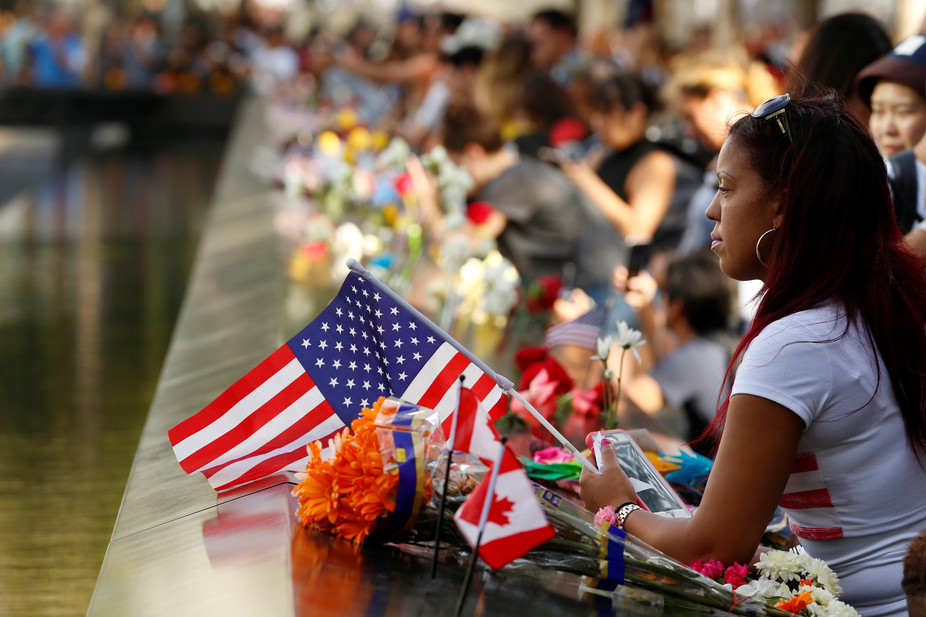
A woman holds a flag as she looks out over the National Sept. 11 Memorial and Museum. REUTERS/Lucas Jackson
On a Tuesday morning in September 2001, the American experience with terrorism was fundamentally altered. Two thousand, nine hundred and ninety-six people were murdered in New York, Virginia and Pennsylvania. Thousands more, including many first responders, lost their lives to health complications from working at or being near Ground Zero.
The 9/11 attacks were perpetrated by Islamist extremists, resulting in nearly 18 times more deaths than America’s second most devastating terrorist attack – the Oklahoma City bombing. More than any other terrorist event in U.S. history, 9/11 drives Americans’ perspectives on who and what ideologies are associated with violent extremism.
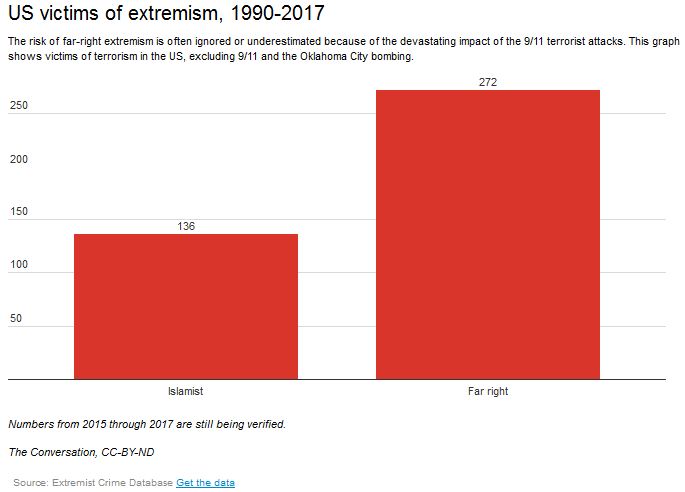
But focusing solely on Islamist extremism when investigating, researching and developing counterterrorism policies goes against what the numbers tell us. Far-right extremism also poses a significant threat to the lives and well-being of Americans. This risk is often ignored or underestimated because of the devastating impact of the 9/11 terrorist attacks.
We have spent more than 10 years collecting and analyzing empirical data that show us how these ideologies vary in important ways that can inform policy decisions. Our conclusion is that a “one size fits all” approach to countering violent extremism may not be effective.
By the numbers
Historically, the U.S. has been home to adherents of many types of extremist ideologies. The two current most prominent threats are motivated by Islamist extremism and far-right extremism.
To help assess these threats, the Department of Homeland Security and recently the Department of Justice have funded the Extremist Crime Database to collect data on crimes committed by ideologically motivated extremists in the United States. The results of our analyses are published in peer-reviewed journals and on the website for the National Consortium for the Study of Terrorism & Responses to Terrorism.
The ECDB includes data on ideologically motivated homicides committed by both Islamist extremists and far-right extremists going back more than 25 years.
Between 1990 and 2014, the ECDB has identified 38 homicide events motivated by Islamist extremism that killed 62 people. When you include 9/11, those numbers jump dramatically to 39 homicide events and 3,058 killed.
The database also identified 177 homicide events motivated by far-right extremism, with 245 killed. And when you include the Oklahoma City bombing, it rises to 178 homicide events and 413 killed.
Although our data for 2015 through 2017 are still being verified, we counted five homicide events perpetrated by Islamist extremists that resulted in the murders of 74 people. This includes the Pulse nightclub massacre in Orlando, which killed 49 people. In the same time period, there were eight homicide events committed by far-right extremists that killed 27 people.
These data reveal that far-right extremists tend to be more active in committing homicides, yet Islamist extremists tend to be more deadly.
Our research has also identified violent Islamist extremist plots against 272 targets that were either foiled or failed between 2001 and 2014. We are in the process of compiling similar data on far-right plots. Although data collection is only about 50 percent complete, we have already identified 213 far-right targets from the same time period.
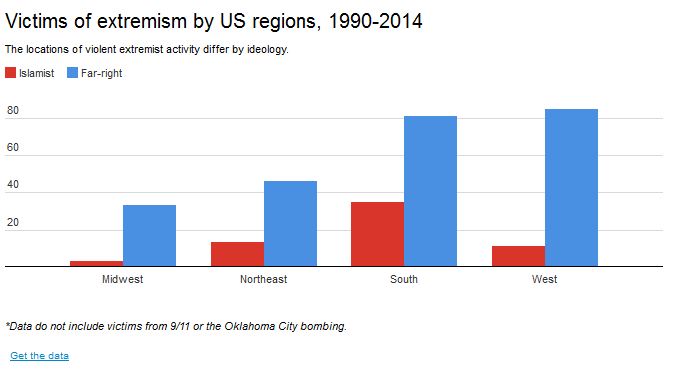
The locations of violent extremist activity also differ by ideology. Our data show that between 1990 and 2014, most Islamist extremist attacks occurred in the South (56.5 percent), and most far-right extremist attacks occurred in the West (34.7 percent). Both forms of violence were least likely to occur in the Midwest, with only three incidents committed by Islamist extremists (4.8 percent) and 33 events committed by far-right extremists (13.5 percent).
Targets of violence also vary across the two ideologies. For example, 63 percent of the Islamist extremism victims were targeted for no apparent reason. They just happened to be in the wrong place at the wrong time, often visiting symbolic locations or crowded venues such as the World Trade Center or military installations.
In contrast, 53 percent of victims killed by far-right extremists were targeted for their actual or perceived race or ethnicity. Far-right extremists, such as neo-Nazis, skinheads and white supremacists, often target religious, racial and ethnic, and sexual orientation and gender identity minorities.
Motives and methods
There are also differences in violent extremists across demographics, motives and methods. For instance, data show that guns were the weapon of choice in approximately 73 percent of Islamist extremist homicides and in only 63 percent of far-right extremist homicides. We attribute these differences to far-right extremists using more personal forms of violence, such as beating or stabbing victims to death.
We have also found that suicide missions are not unique to Islamist extremists.
From 1990 to 2014, we identified three suicide missions in which at least one person was killed connected to Islamist extremism, including the 9/11 attacks as one event. In contrast, there were 15 suicide missions committed by far-right extremists.
Our analyses found that compared to Islamist extremists, far-right extremists were significantly more likely to be economically deprived, have served in the military and have a higher level of commitment to their ideology. Far-right extremists were also significantly more likely to be less educated, single, young and to have participated in training by a group associated with their extremist ideology.
Threat to law enforcement and military
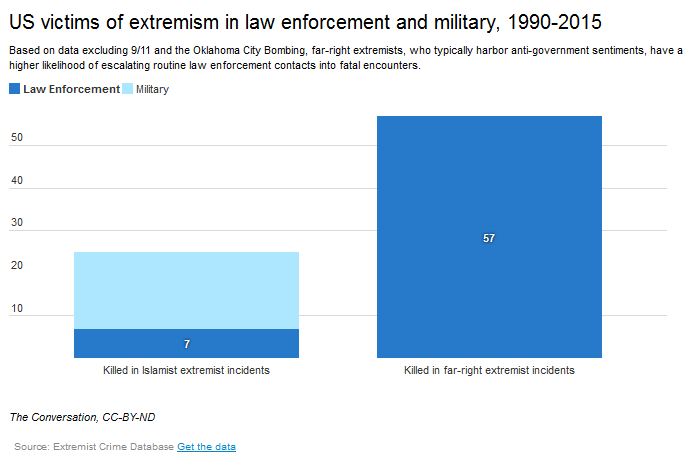
Terrorists associated with Islamist and far-right extremist ideologies do not only attack civilians. They also pose a deadly threat to law enforcement and military personnel. During the Sept. 11, 2001 terrorist attacks, 72 law enforcement officers and 55 military personnel were killed by members of Al-Qaida. On April 19, 1995, 13 law enforcement officers and four military personnel were killed when the Alfred P. Murrah Federal Building was bombed by an anti-government far-right extremist in Oklahoma City.
Outside of these two events, Islamist extremists are responsible for the murders of 18 military personnel in three incidents, and seven law enforcement officers were killed in five incidents between 1990 and 2015. Far-right extremists have murdered 57 law enforcement officers in 46 incidents, but have never directly targeted military personnel.
Far-right extremists, who typically harbor anti-government sentiments, have a higher likelihood of escalating routine law enforcement contacts into fatal encounters. These homicides pose unique challenges to local law enforcement officers who are disproportionately targeted by the far right.
Moving forward
The events of 9/11 will continue to skew both our real and perceived risks of violent extremism in the United States. To focus solely on Islamist extremism is to ignore the murders perpetrated by the extreme far right and their place in a constantly changing threat environment.
Some have even warned that there is potential for collaboration between these extremist movements. Our own survey research suggests this is a concern of law enforcement.
Focusing on national counterterrorism efforts against both Islamist and far-right extremism acknowledges that there are differences between these two violent movements.
Focusing solely on one, while ignoring the other, will increase the risk of domestic terrorism and future acts of violence.
Both ideologies continue to pose real, unique threats to all Americans. Evidence shows far-right violent extremism poses a particular threat to law enforcement and racial, ethnic, religious and other minorities. Islamist violent extremism is a specific danger to military members, law enforcement, certain minorities and society at large. It remains imperative to support policies, programs and research aimed at countering all forms of violent extremism.
(This story is republished from The Conversation. The original story may be read here).
Days after DU’s Ramjas college saw violent clashes, a Lady Sri Ram College student who is a Kargil martyr’s daughter has initiated a social media campaign, “I am not scared of ABVP”, which has gone viral.
Gurmehar Kaur, daughter of Kargil martyr Captain Mandeep Singh, changed her Facebook profile picture holding a placard which read “I am a student from Delhi University. I am not afraid of ABVP. I am not alone. Every student of India is with me. #StudentsAgainstABVP”.
Image couretsy: ibc24.in
“The brutal attack on innocent students by ABVP is very disturbing and should be stopped. It was not an attack on protesters, but an attack on every notion of democracy that is held dear in every Indian’s heart. It is an attack on ideals, morals, freedom and rights of every person born to this nation,” she said in a Facebook status.
“The stones that you pelt hit our bodies, but fail to bruise our ideas. This profile picture is my way of protesting against the tyranny of fear,” she added.
The literature student’s classmates and peers started sharing the post, prompting students from various universities across the country to change their profile pictures with the same placard, as the initiative went viral.
Kaur’s Facebook post so far has 2,100 reactions, 3,456 shares and 542 comments.
Ramjas College had on Wednesday witnessed large-scale violence between members of AISA and ABVP workers. The genesis of the clash was an invite to JNU students Umar Khalid and Shehla Rashid to address a seminar on ‘Culture of Protests’ which was withdrawn by the college authorities following opposition by the RSS student wing.
The Islamophobia industry uses lawfare (courtroom drama) to skew the conversation about Islam. The President has learned from their success
Pamela Geller, president of the American Freedom Defense Initiative, an Islamophobic pressure group. (Bryan Smith, PA Images)
The legal tussle over President Donald Trump’s controversial ban on refugees and immigrants from seven Muslim-majority countries is being watched with the intensity normally reserved for a Super Bowl showdown. Experts track every move and countermove, trying to gauge which team is ahead and who will ultimate prevail. Unlike a normal game, though, there is more to these court battles than the points that flash on the scoreboard. They are also an opportunity for hate propagandists to air their tropes and talking points before a wide audience.
Indeed, if their past campaigns are anything to go by, this may be their primary objective – to exploit the high profile spaces afforded by democratic processes and institutions for propaganda purposes, thus nudging mainstream perspectives toward their own worldview. The actual implementation or enforcement of whatever policy they’ve been agitating for may be a secondary concern. Anti-Muslim ideologues have described themselves as fighting in a “lawfare battlespace”.
Anti-Muslim ideologues have described themselves as fighting in a “lawfare battlespace”. The explicit goal of their litigation is to change public policy directly. But lawfare also presents an opening “to influence and shape public discourse to ultimately influence and shape public opinion”, says a 2015 publication from the Center for Security Policy, a major anti-Muslim think tank.
“The drama of a courtroom setting attracts public attention and thereby provides a forum and an audience for expressing the appropriate public policy narrative.”
“Litigation creates earned media and thus provides an excellent opportunity to engage the public through this media,” the report says. “Indeed, the drama of a courtroom setting attracts public attention and thereby provides a forum and an audience for expressing the appropriate public policy narrative.”
One long-running nationwide campaign to shape the narrative has involved purchasing advertising space for anti-Islam messages in various metropolitan transit systems. When a metro authority rejects an ad on account of its hateful content, the activists promptly take the authority to court for allegedly violating their free speech rights.
Even if the legal challenge fails, the controversy generates publicity for the cause. Defeat has its benefits, as it can be spun as further evidence of a rigged system. Thus, when the Washington DC metro blocked their effort, leading hate propagandist Pamela Geller accused the authority of cowardice and buckling under the Muslim Brotherhood’s pressure: “This is sharia in America”.
Another Islamophobia initiative that has won considerable public airtime in state legislatures is the campaign to stop Islamic law gaining ground in the US. The manufactured paranoia over sharia has moved more than ten states to enact new statutes or constitutional amendments to insulate themselves from non-American laws (worded broadly since they cannot explicitly discriminate against one religion). Some 20 other states have considered such provisions.there has been no push for sharia from the country’s tiny Muslim minority, and even if there were, American laws need no additional protection against subversion by competing traditions.
According to the American Bar Association and all independent legal scholars, these states are reacting to a non-existent threat: there has been no push for sharia from the country’s tiny Muslim minority, and even if there were, American laws need no additional protection against subversion by competing traditions.
But then that’s not really the point. The anti-sharia campaign’s utility lies in the opportunity to defame an entire faith in state capitol buildings, through ballot measures put to voters, and the news reports it generates.
Lawfare has also been deployed against small Muslim communities trying to partake of their freedom of religion. In 2010, Muslims in Middle Tennessee found their effort to build a mosque obstructed by anti-Muslim activists. In addition to harassment and intimidation, the Muslims were dragged into a court battle. Among other arguments, their opponents said that Muslims were not entitled to religious liberty – as Islam is not really a religion but a violent political ideology.
Predictably, the argument was thrown out; religious equality prevailed. Before long, the Islamic Center of Murfreesboro was functioning as intended, as a place for prayer and education. But it was not a total defeat for the Islamophobia network: their talking points that belonged in the extreme fringe were dignified by being deliberated in court. The Islamophobia network’s direct links to the White House are beyond doubt.
The Islamophobia network’s direct links to the White House are beyond doubt.
This is the background against which one has to analyse current events. The Islamophobia network’s direct links to the White House are beyond doubt. Foreign policy advisers in the Trump campaign include individuals linked to the aforementioned Center for Security Policy think tank, which was also the source of fabricated statistics cited by Trump to justify his proposed Muslim entry ban.
This line in Trump’s Executive Order protecting the US from foreign terrorist entry fits with the Islamophobia industry’s modus operandi: “The United States cannot, and should not, admit those who do not support the Constitution, or those who would place violent ideologies over American law.”
One of the most consequential struggles of our times is the battle for hearts, minds and lives going on between Muslims who prize peace, freedom and inclusiveness, and those who demand obedience to an intolerant absolutism. This is a legitimate debate within Muslim civilisation.
Crystallised in this sentence are talking points that anti-Muslim hate merchants have cultivated for years, treating Islam as a non-religion that threatens American life and law through a violent ideology of sharia. These are the dregs that will remain, polluting public discourse, even if the policy is struck down by the courts – which would of course be milked as further proof that the establishment cannot be trusted.
One of the most consequential struggles of our times is the battle for hearts, minds and lives going on between Muslims who prize peace, freedom and inclusiveness, and those who demand obedience to an intolerant absolutism. This is a legitimate debate within Muslim civilisation. But the Islamophobia hate merchants want to persuade Americans that it is instead a clash between civilisations. They want Islam talked about exclusively in the context of terrorism.
Trump’s executive order may not survive judicial scrutiny, but it has already helped skew the global conversation in the Islamophobia industry’s preferred direction.
(Cherian George is the author of Hate Spin: The Manufacture of Religious Offense and its Threat to Democracy (MIT Press, 2016). He is an associate professor in the communication school of Hong Kong Baptist University).
This story, first published on openDemocracy, may be read here.
11 organisations participated in the event, waving black flags and raising slogans against PM Modi and the central government.
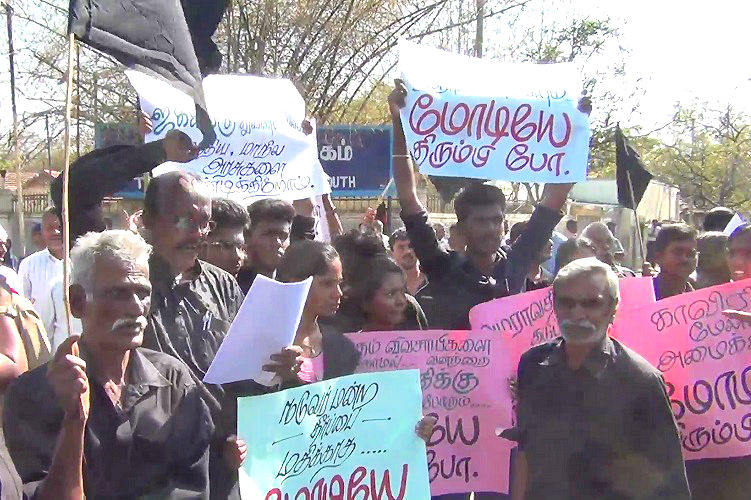
Protests by multiple organisations broke out in Coimbatore on Friday, ahead of Prime Minister Narendra Modi’s arrival at 5.30pm, for the unveiling of a 112-foot tall Shiva statue at Coimbatore’s Isha Yoga Centre.
11 organisations including the Forum against Bhavani River Dam, Thanthai Periyar Dravida Kazhagam, All Tamil Nadu Farmers’ Federation, Viduthalai Chiruthaigal Katchi, Tamil Manila Congress, Manithaneya Makkal Katchi and the Social Democratic Party of India, bore black flags and raised slogans against the PM and the central government’s “anti-Tamil Nadu policies”.
The protest attained a high pitch when the protesters tried to block public roads, and 250 people were finally detained.
Speaking at the protest, TPDK General Secretary, Ku Ramakrishnan said that the Isha Yoga Centre’s own actions in regard to wildlife proved the fact of its encroachments. “The fact that they have formed a committee to monitor the movement of wild animals, ahead of the event in which PM Modi is participating, shows that they have encroached onto the habitat of wild animals.
He also accused the central government of being anti-Tamil Nadu, and said that the centre’s bias against Tamil Nadu was shown in its failures to even follow Supreme Court directions on the Cauvery water issue.
Continuous protests have been occurring in Coimbatore since the announcement that PM Modi would be taking part in an event of the Isha Yoga Centre, which is embroiled in a series of legal cases over building and land violations, including a 2013 Madras High Court notice to demolish 44,000 sq ft of buildings. Activists have accused the PM of promoting an organisation accused of rampant environmental violations, and therefore tacitly endorsing its violations.