Mumbai: The Bombay High Court today said Maharashtra’s progress and prosperity is pointless when 50 per cent of children in the state are malnourished and below the poverty line.
Photo: Dna India
The court also observed that the government has not taken any serious steps to address the problem.
A division bench of Justices V M Kanade and P R Bora was hearing a bunch of PILs highlighting increasing instances of malnutrition-related deaths and illness among those living in Melghat region of Vidarbha and other tribal areas.
“In our state, the children’s population must be over 40 crore. Out of this, 50 per cent children are below poverty line and suffering from malnourishment. What is the point of prosperity and progress in the state when this is the situation,” Justice Kanade observed.
The court further said the state government ought to make separate allocation of funds to address the issue in the upcoming budget session.
The court has posted the petitions for further hearing on March 1, when the secretaries of Women and Child Welfare department and the Tribal Welfare department will have to submit power-point presentations to HC on how they propose to tackle the problem and what measures will be undertaken.
The court had earlier too come down heavily on the government for failing to initiate steps to solve the problem, and had said the concerned ministers will have to take more interest.
New Delhi: The Bharatiya Janata Party (BJP) won the 2014 Lok Sabha elections and contesting the Uttar Pradesh Assembly polls on development plank, but its MPs from the country’s highest populated state failed to spend a whopping Rs 333.6 crores of MPLAD funds meant for development of their constituencies.
Photo: http://ste.india.com
UP alone gave the party 71 out of the total 80 seats in Lok Sabha seats in 2014 trusting the promises of ‘vikas‘ (development) and ‘achche din‘ (good days).
Notably, Rs 135 crores of these funds not spent in 33 Lok Sabha constituencies where either Dalits or Muslims are in sizeable number, reveals a study conducted by a US-based advocacy group.
Every year, an MP is given Rs 5 crore for development works under the Members of Parliament Local Area Development Scheme (MPLADS) in his constituency.
While Rs 71 crore remained unspent in 17 Dalit-dominated constituencies, over Rs 64 crore could not be spent in 16 other constituencies where Muslims account for more than 20 percent of the population.
All these 33 seats are represented by BJP MPs.
The fund utilization percentage for 17 Dalit-dominated constituencies stood at 58.91 percent, while that for Muslim-majority constituencies was 67.76 percent.
“Average of the percent utilized for MPLAD funds drops for Dalit seats to 58.9 percent while it goes up significantly for Muslim seats to 67.8 percent. The average of all seats is 60.8 percent,” says the report.
However, if individual performance as for utilization of MPLAD funds is taken into consideration, two of all the 71 BJP MPs have performed the best.
BJP MP Satish Kumar of Aligarh has utilized 86 percent of the Rs 15 crore allotted to him for the development of his constituency. Maneka Gandhi, also from BJP, comes close second with 85.9 percent of utilization.
Kanwar Pushpendra Singh, BJP MP from Hamirpur, is the worst performer who utilized only 17 percent of his funds and Kannauj’s Dimple Yadav of Samajwadi Party, with 24 percent of funds utilization, is second from the bottom.
New Delhi: Expressing concern over the increasing number of undertrial prisoners in jails across the country, the government has urged the high courts to take suo motu action for their release after they complete half of their likely term.
Section 436A of the CrPC provides that if an undertrial has completed half of the likely term he is likely to get for the crime he has allegedly committed, then he or she can be granted bail with or without surety. It is not applicable on offence for which the punishment of death has been specified as one of the punishments under the law.
In a recent letter to chief justices of the 24 high courts, Law Minister Ravi Shankar Prasad has said that they should advise the district judiciary to review all such cases and take suo motu action for their release.
“I shall also be grateful if the high court ensures that the undertrial review committee mechanism, for periodic monitoring of undertrial releases, continues to effectively deliver its mandate, so that the basic human rights of the undertrials are not undermined,” he wrote.
In September 2014, the Supreme Court had said that states should release all such undertrials who come under the ambit of Section 436A of the CrPC.
According to National Crime Records Bureau estimates, 67 per cent of the people in jails are undertrials — those not yet convicted of any crime.
At 82.4 per cent, Bihar had the highest proportion of undertrials, followed by Jammu and Kashmir at 81.5, Odisha at 78.8, Jharkhand at 77.1 and Delhi at 76.7.
Successive Union Law Ministers and Union Home Ministers have been regularly writing to high courts and state governments to review the status of undertrials.
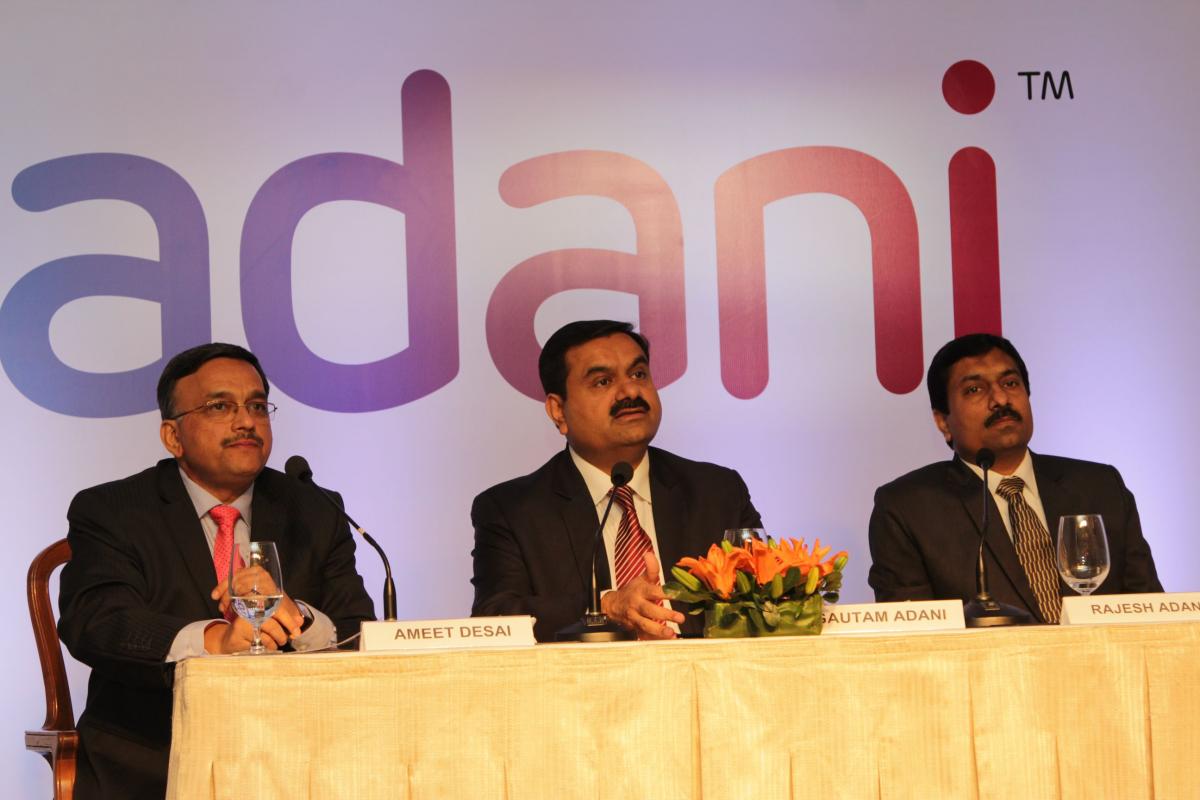
Spokesperson for W&J Adrian Burragubba said, “The document Adani is trying to pass off as an Indigenous Land Use Agreement (ILUA) with our people is illegitimate. We launched action last year to defeat this dodgy deal and we are now taking decisive action in the Federal Court to have this fake agreement struck out”.
Burragubba said, “We have put evidence before the National Native Title Tribunal to prove that Adani does not have an agreement with W&J for its mine of mass destruction, which will destroy our ancestral homelands and waters, the cultural landscape and our heritage.”
He added, “Three times we have rejected any deal with the Indian mining conglomerate. Now Adani are on the back foot and have run crying to the Queensland Resources Council and the Federal Attorney General, asking them to do their bidding by pushing through an ‘Adani amendment’ to the Native Title Act.”
Burragubba claimed, his organization has come to know about Adani's move to amend the law from former Federal Resources Minister Ian MacFarlane, who “boasted at a Townsville business breakfast last week that he has spoken to his ‘good mates in Canberra’ about amending native title law.”
He alleged, “This is just additional proof that the Turnbull government is in bed with the Indian billionaire Gautam Adani and the Queensland mining industry.”
Representing W&J, lawyer Colin Hardie said, “Adani and the mining industry are trying to manufacture a sense of crisis and appear desperate to force the Federal government to rush through changes to the Native Title Act to suit their interests.”
The Native Title Act requires all members the Registered Native Title Claimants (RNTC) to sign the ILUA, which is a voluntary agreement between a native title group and others about the use of land and waters, for any changes.
At a meeting of the indigenous group called by the industry group, said W&J, over “200 of those in attendance were people not previously identified as W&J people”, adding, worse, some members of the RNTC refused to sign the purported ILUA – the reason why the Adani is seeking to amend the Act.
Meanwhile, an Australian not-for-profit legal practice group based in Melbourne, Environmental Justice Australia (EJA), has come up with an Adani Brief, which it has forwarded to the Australian governments and potential financiers seeking to back Adani’s coalming project, saying such a move “may expose them to financial and reputational risks.”
Giving details of the Adani Brief, EJA lawyer and report author Ariane Wilkinson said, “The extremely concerning international track record of the Adani Group in India raises serious questions about whether they should be allowed to do business in Australia.”
The report, among other issues, focuses on sinking of a ship carrying Adani coal, which saw oil and coal spill off Mumbai’s coast, damaging tourism, polluting the marine environment and attracting a AU$975,000 court fine; and constructing Hajira Port without approval, destroying habitat, claiming land and blocking access to fishing communities, which resulted in a court order to pay AU$4.8 million for compensation and restoration.
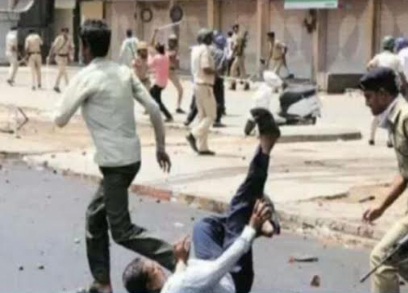
In a development which is likely to go a long way to politically hurt Gujarat BJP rulers' pro-Narmada image, the police on Tuesday allegedly attacked protesting farmers from 15 villages of Ahmedabad district, exploding teargas shells and beating up many of them up with batons for demanding Narmada waters for irrigating their fields.
The farmers were taking out a rally took near Sanand town, which attracted national attention following shifting of the Tata Nano plant from West Bengal with the direct financial support of the Narendra Modi government of Gujarat.
During the scuffle, several farmers, who belonged to Sanand, Bavla and Nalsarovar regions, were injured. At least 3,000 farmers were participating in the rally. The farmers had come in tractors, on motorbikes and other vehicles with huge banners demanding Narmada waters. Many of the vehicles were also damaged during the police attack.
While the state officialdom claimed that seven cops, including district superintendent of police, VR Asari, allegedly because of stone pelting, it admitted, the rally was taken out as the farmers were angry as the state government had refused grant permission for taking out the rally right up to Gandhinagar.
A state government spokesperson further claimed that the stone pelting began even as the cops were in talk with some of the farmers' leaders. This, he added, led to cops resorting to "mild lathicharge and firing some tear gas shells to control the situation." He added, however, "There are no reports of civilian injury." An farmer, however, said, it was the cops which resorted to stone pelting first.
The police said, they have detained more than a dozen farmers for stone pelting, and a first information report has been filed against those who were leading the rally with the Sanand Gujarat Industrial Development Corporation (GIDC) police station.
A senior non-political Gujarat farmers' leader, criticizing the Gujarat government for allowing cops for resorting to the baton charge, said, "It is difficult to understand why Narmada waters, which pass through Ahmedabad district, are not provided to the farmers of the region, but are being sent to far way Kutch and Jamnagar to help industry."
Khedut Samaj Gujarat secretary Sagar Rabari said, "The farmers' anger suggests that people are losing faith in democratic ways of protest. This is not for the first time that they were not allowed to take out a rally. The state government would do well to provide Narmada waters to the region, or face more such protests in the coming days."
Meanwhile, well-known pro-quota Patidar leader Hardik Patel has criticised the “police action” to use force against the farmers, saying this was done "the behest of BJP government in Gujarat, which is known for suppressing people who raise their voice.”
Patel said, the state was trying terrorising people. “Farmers were baton charged for raising their legitimate demand. Such atrocities prove that this government is anti-farmer", he insisted, warning, he would organize more such farmers' protest in coming days." The Congress also gave a statement condemning the police "attack".
Why aren’t institutional deliveries resulting in fewer deaths during childbirth? Simply incentivizing institutional deliveries isn’t enough to push down MMR and infant mortality rate
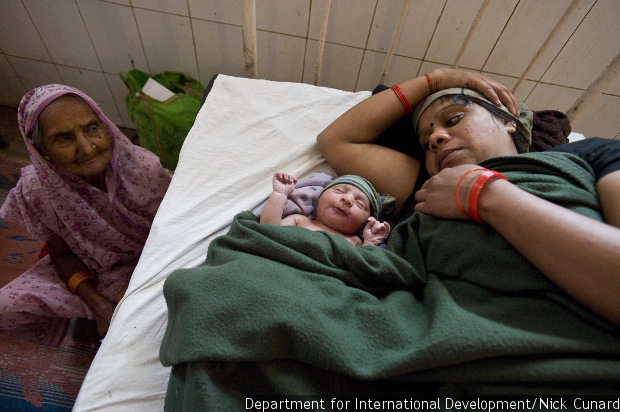
Surujmuni Marandi, 24, had decided to deliver her baby at the Godda district hospital in north-eastern Jharkhand. Like many other women, she was drawn to the idea of free medical assistance, medicines, nutrition and postnatal care for poor, pregnant women promised by Janani Suraksha Yojana (JSY), the government programme aimed at reducing India’s high maternal mortality rate (MMR).
Marandi ticked all the boxes in the JSY profile of a woman who needs to be incentivised to deliver in a hospital: She was an adivasi, poor, had little access to health facilities, and would have gone for a traditional home-birth if it wasn’t for the scheme. Marandi should have had an easy time delivering her son at the hospital. But, as this documentary by activist media group Video Volunteers shows, she is denied everything that JSY promises.
Marandi, debilitated by labour pain, was made to wait six hours for a doctor who finally did not turn up for duty. She was asked to pay for medical attention and medicines and denied the nutrition and care that was her right. Denied basic facilities, even the use of a toilet, she finally delivered with the help of a nurse.
“We don’t know where the doctor is. You go, find out,” the nurse told Marandi’s mother when she asked for assistance.
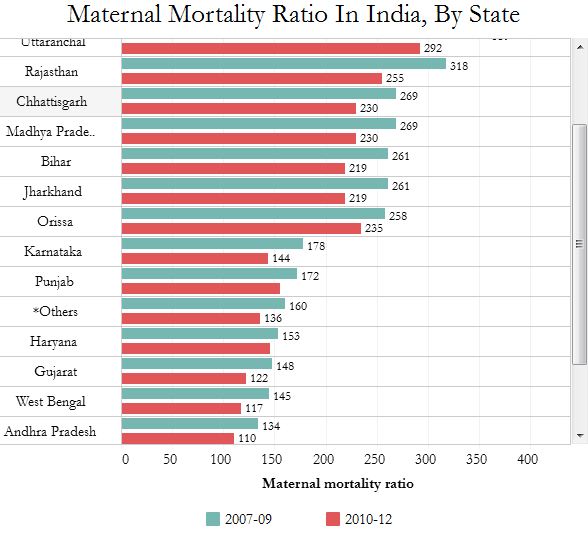
Marandi’s story holds answers to India’s maternal mortality puzzle: Despite a rise in institutional deliveries, maternal mortality continues to be a worry for in India.
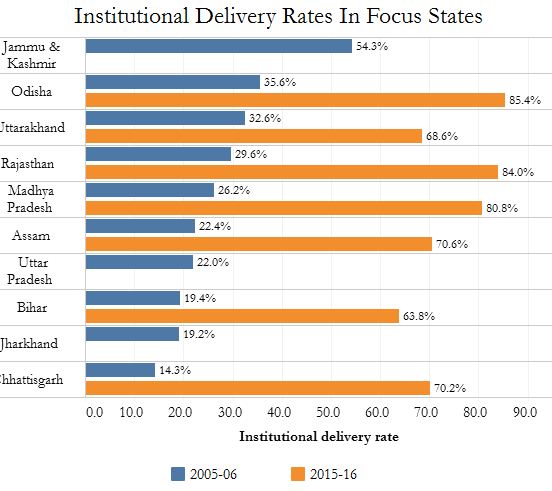
The number of institutional deliveries rose by 15% over the decade ending 2014, mostly aided by the JSY, according to this 2016 report by the think tank Brookings India, based on National Sample Survey Office (NSSO) data. Deliveries in government hospitals rose by 22%, fell by 8% in private hospitals and home-births dropped by 16%. But 167 women are still dying per 100,000 live births, as per latest government data. This is despite a 70% fall in MMR over a quarter of a century.
Why aren’t institutional deliveries resulting in fewer deaths during childbirth? Simply incentivizing institutional deliveries isn’t enough to push down MMR and infant mortality rate, wrote Ambrish Dongre, fellow at the Centre for Policy Research, in his 2014 analysis of the JSY. Physical and human infrastructure for maternal health and the quality of care too should improve, he said.
An IndiaSpend analysis of multiple reports and studies shows that Dongre’s analysis is right. The public health infrastructure, it appears, is simply unable to support the rising number of institutional deliveries that the government is encouraging. And this could possibly explain why India’s MMR is worse than Sri Lanka (30), Bhutan (148) and Cambodia (161) and the entire Arab world, as IndiaSpend reported in August 2016.
Painless, free care for pregnant women? Not quite
JSY is a 12-year-old government programme focused specially on 10 states with low rates of institutional delivery–Uttar Pradesh, Uttarakhand, Bihar, Jharkhand, Madhya Pradesh, Chhattisgarh, Assam, Rajasthan, Odisha, and Jammu and Kashmir–termed as low-performing states (LPS).
The other 19 states are clubbed together as high-performing states (HPS).
Source: National Family Health Survey 2005-06 and 2015-16
Under the programme, pregnant women in rural areas who live below the poverty line are to be given cash assistance–Rs 700 in HPS and Rs 1,400 in LPS–irrespective of the mother’s age and number of children, so that they opt for birth in a government or accredited private health facility.
In addition, it provides performance-based incentives to women health workers, ASHAs or Accredited Social Health Activists, to promote institutional deliveries. In reality, the JSY has failed to cover the poorest women, according to this 2014 analysis of JSY data by researchers from Georgetown University. Some focus states report MMRs that match those of world’s poorest countries–Mauritania (320), Equatorial Guinea (290), Guyana (250), Djibouti (230) and Laos (220), IndiaSpend reported in September 2015.
Source: Ministry of Health & Family Welfare
There is a lack of association between MMR and the rise in institutional births, according to this 2013 report, which analysed different government data for 284 districts across nine focus states. It is likely that women most vulnerable to maternal death are not getting the JSY benefits, the report said.
Marandi’s story is repeated in hospitals across India, like this one in Bankeda village in western Odisha’s Subarnapur district. Families of patients are forced to hire private vehicles, pay for check-up and delivery at government health facilities. They do not receive cash incentives–Rs 1,400 under JSY and Rs 5,000 under the state’s Mamata Yojana. “Why should we go to state-run health facilities?” the women ask.
As in Marandi’s case, 60% of women in Uttar Pradesh said they had to pay for certain public maternal health services, according to an assessment of JSY conducted by United Nations Population Fund in Bihar, MP, Odisha, Rajasthan and UP in 2012, IndiaSpend reported in September 2015.
Prime Minister Narendra Modi announced that Rs 6,000 would be transferred directly to the bank accounts of pregnant women who undergo institutional delivery/and vaccinate their children. But as FactChecker found, the option of giving Rs 6,000 to pregnant women already existed in the National Food Security Act (NFSA), 2013–it just had not been implemented by the government.
Not enough doctors, not even toilets at health facilities
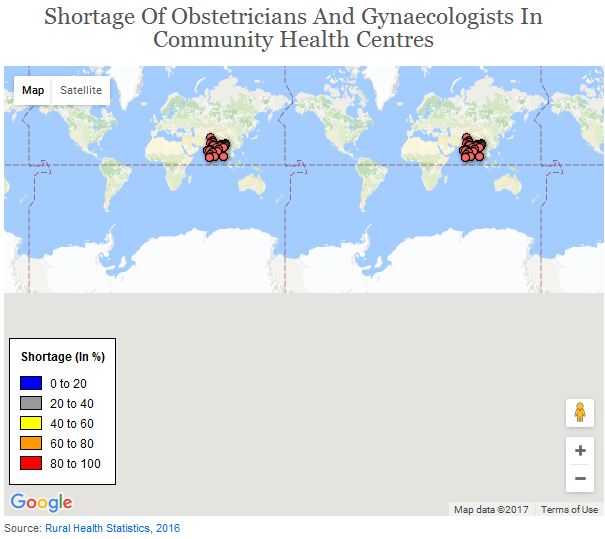
There is a 77% shortage of obstetricians and gynaecologists in Community Health Centres (CHCs) nationwide, according to the Rural Health Statistics 2016 released by the ministry of health and family welfare. And 15 states and union territories have more than 90% shortage of obstetricians, gynaecologists in CHCs.
The CHCs constitute the secondary level of health care. These provide specialist care to patients referred from Primary Health Centres (PHCs), four of which feed into each CHC, serving roughly 80,000 people in tribal, hill or desert areas and 120,000 on the plains.
Nearly 62% of government hospitals–which include CHCs, district hospitals and sub-district hospitals–don’t have a gynaecologist on staff and an estimated 22% of sub-centres are short of auxiliary nurse midwives (ANMs), IndiaSpend reported in September 2016. Additionally, in 30% of India’s districts, sub-centres with ANMs serve double the patients they are meant to.
Sanitation facilities at public health centres where women deliver are inadequate as well. In the video, Marandi can be seen struggling to find a toilet after she is given laxatives before childbirth. In one instance, she simply squats outdoors in public to ease herself.
This is not unique to Godda. There are no toilets in half the postnatal wards of PHCs, as is the case with 60% of larger CHCs in MP, according to a study by WaterAid India in 343 healthcare institutions across six states and reported by IndiaSpend in July 2016. Open defecation was allowed within 38% and open urination in 60% of health facilities in Odisha’s Ganjam district, according to the report.
This should not come as a surprise: Of the 4,000-odd multi-crore infrastructure projects in the country, only nine (0.21%), with a total investment of Rs 938 crore, are in the health sector, IndiaSpend reported in December 2015.
There is no guarantee of quality care
“The government encouragement of institutional deliveries is based on the idea that poor people choose to deliver at home either out of ignorance or an inability to make the right decisions or due to cultural norms and the exercise of (male) power,” argued Jishnu Das, lead economist, World Bank in a 2014 blog. “But an alternate starting point is that people were not using institutions to begin with precisely because quality was low, and that increasing quality would also bring more people in.”
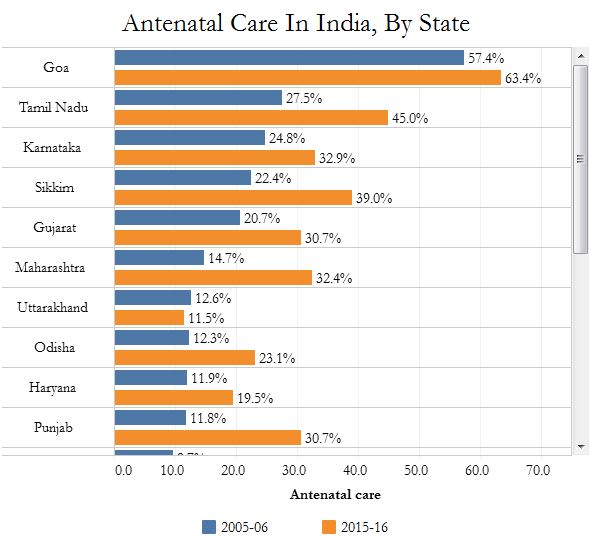
The quality of antenatal care is vital to reduce the risk of stillbirths and pregnancy complications, and the absence of it explains why more women enrolling for hospital deliveries does not translate to fewer maternal deaths.
In Odisha, only 23% of women reported receiving full antenatal care, the highest among focus states, according to National Family Health Survey data for 2015-16 (NFHS-4). The figure in Tamil Nadu, which is considered one of the best states to be a mother, was 45%. Only 3.3% of women in Bihar reported receiving full antenatal care, a decline from 4.2% in 2005-06.
Full antenatal care equates to at least four antenatal visits by health workers, at least one tetanus toxoid injection and iron folic acid tablets or syrup taken for 100 or more days. Source: National Family Health Survey 2005-06 and 2015-16.
Most obstetric complications could be prevented or managed if women had access to a skilled birth attendant–doctor, nurse, midwife–during childbirth, according to the World Health Organization.
The probability of maternal death among Indian women decreased with increasing skilled attendant coverage, among both women who were and were not admitted to a health-facility, according to this 2014 analysis of different government data.
(This story is the result of a collaboration between Video Volunteers, a global initiative that provides disadvantaged communities with story and data-gathering skills, and IndiaSpend. Saha is an MA Gender & Development student at Institute of Development Studies, University of Sussex.)
You can see the full playlist of Video Volunteers’ videos–revealing gaps in maternal-health services–here.
In the face of these threats, which Marvel superhero might be best equipped to defend the people, ideals and institutions under attack? Some comic fans and critics are pointing to Kamala Khan, the new Ms. Marvel.
Khan, the brainchild of comic writer G. Willow Wilson and editor Sana Amanat, is a revamp of the classic Ms. Marvel character (originally named Carol Danvers and created in 1968). First introduced in early 2014, Khan is a Muslim, Pakistani-American teenager who fights crime in Jersey City and occasionally teams up with the Avengers.
Since Donald Trump’s inauguration, fans have created images of Khan tearing up a photo of the president, punching him (evoking a famous 1941 cover of Captain America punching Hitler) and grieving in her room. But the new Ms. Marvel’s significance extends beyond symbolism.
In Kamala Khan, Wilson and Amanat have created a superhero whose patriotism and contributions to Jersey City emerge because of her Muslim heritage, not despite it. She challenges the assumptions many Americans have about Muslims and is a radical departure from how the media tend to depict Muslim-Americans. She shows how Muslim-Americans and immigrants are not forces that threaten communities – as some would argue – but are people who can strengthen and preserve them.
Superhero-in-training
After inhaling a mysterious gas, Kamala Khan discovers she can stretch, enlarge, shrink and otherwise manipulate her body. Like many superheroes, she chooses to keep her identity a secret. She selects the Ms. Marvel moniker in homage to the first Ms. Marvel, Carol Danvers, who has since given up the name in favor of becoming Captain Marvel. Khan cites her family’s safety and her desire to lead a normal life, while also fearing that “the NSA will wiretap our mosque or something.”
As she wrestles with her newfound powers, her parents grow concerned about broken curfews and send her to the local imam for counseling. Rather than reinforcing her parents’ curfew or prying the truth from Khan, though, Sheikh Abdullah says, “I am asking you for something more difficult. If you insist on pursuing this thing you will not tell me about, do it with the qualities benefiting an upright young woman: courage, strength, honesty, compassion and self-respect.”
Her experience at the mosque becomes an important step on her journey to superheroism. Sheikh Abdullah contributes to her education, as does Wolverine. Islam is not a restrictive force in her story. Instead, the religion models for Khan many of the traits she needs in order to become an effective superhero. When her mother learns the truth about why her daughter is sneaking out, she “thank[s] God for having raised a righteous child.”
The comics paint an accurate portrait of Jersey City. Her brother Aamir is a committed Salafi (a conservative and sometimes controversial branch of Sunni Islam) and member of his university’s Muslim Student Association. Her best friend and occasional love interest, Bruno, works at a corner store and comes from Italian roots. The city’s diversity helps Kamala as she learns to be a more effective superhero. But it also rescues her from being a stand-in for all Muslim-American or Jersey City experiences.
Fighting a ‘war on terror culture’
Kamala’s brown skin and costume – self-fashioned from an old burkini – point to Marvel Comics’ desire to diversify its roster of superheroes (as well as writers and artists). As creator Sana Amanat explained on “Late Night With Seth Meyers” last month, representation is a powerful thing, especially in comics. It matters when readers who feel marginalized can see people like themselves performing heroic acts.
As one of 3.3 million Muslim-Americans, Khan flips the script on what Moustafa Bayoumi, author of “This Muslim American Life,” calls a “war on terror culture” that sees Muslim-Americans “not as complex human being[s] but only as purveyor[s] of possible future violence.”
Bayoumi’s book echoes other studies that detail the heightened suspicion and racial profiling Muslim-Americans have faced since 9/11, whether it’s in the workplace or interactions with the police. Each time there’s been a high-profile terrorist attack, these experiences, coupled with hate crimes and speech, intensify. Political rhetoric – like Donald Trump’s proposal to have a Muslim registry or his lie that thousands of Muslims cheered from Jersey City rooftops after the Twin Towers fell – only fans the flames.
These stereotypes are so entrenched that a single positive Muslim character cannot counteract their effects. In fact, some point to the dangers of “balanced” representations, arguing that confronting stereotypes with wholly positive images only enforces a simplistic division between “good” and “bad” Muslims.
Unbreakable
Kamala Khan, however, signals an important development in cultural representations of Muslim-Americans. It’s not just because she is a powerful superhero instead of a terrorist. It’s because she is, at the same time, a clumsy teenager who makes a mountain of mistakes while trying to balance her abilities, school, friends and family. And it’s because Wilson surrounds Kamala with a diverse assortment of characters who demonstrate the array of heroic (and not-so-heroic) actions people can take.
For example, in one of Ms. Marvel’s most powerful narrative arcs, a planet attacks New York, leading to destruction eerily reminiscent of 9/11. Kamala works to protect Jersey City while realizing that her world has changed – and will change – irrevocably.
Carol Danvers appears to fill Kamala in on the gravity of the situation, telling her, “The fate of the world is out of your hands. It always was. But your fate – what you decide to do right now – is still up to you … Today is the day you stand up.” Kamala connects the talk with Sheikh Abdullah’s lectures about the value of one’s deeds, once again linking her superhero and religious training to rise to the occasion. In both cases, the lectures teach Kamala to take a stand to protect her community.
Arriving at the high school gym now serving as a safe haven for Jersey City residents, Kamala realizes her friends and classmates have been inspired by her heroism. They safely transport their neighbors to the gym while outfitting the space with water, food, dance parties and even a “non-denominational, non-judgmental prayer area.” The community response prompts Kamala to realize that “even if things are profoundly not okay, at least we’re not okay together. And even if we don’t always get along, we’re still connected by something you can’t break. Something there isn’t even a word for. Something … beautiful.”
Kamala Khan is precisely the hero America needs today, but not because of a bat sign in the sky or any single definitive image. She is, above all, committed to the idea that every member of her faith, her generation, and her city has value and that their lives should be respected and protected. She demonstrates that the most heroic action is to face even the most despair-inducing challenges of the world head on while standing up for – and empowering – every vulnerable neighbor, classmate or stranger. She shows us how diverse representation can transform into action and organization that connect whole communities “by something you can’t break.”
(Katie M. Logan is Assistant Professor of Focused Inquiry, Virginia Commonwealth University).
The documentary, Killing for Conservation, shows that rangers are allowed to shoot people.
The Environment Ministry has recommended that the British Broadcasting Corporation’s South Asia correspondent be blacklisted for filming a documentary that highlights the government’s aggressive policy in Kaziranga National Park to protect rhinos from poachers. “They [BBC] have misrepresented facts and selectively over-dramatised interviews and old footage. They had a different agenda fuelled by certain foreign NGOs and local elements opposed to conservation. We are exploring all options including legal steps,” park director Satyendra Singh told The Indian Express.
Correspondent Justin Rowlatt’s documentary, Killing for Conservation, shows that rangers are allowed to shoot people. According to Rowlatt, this shoot-at-sight policy has led to the killing of 23 people by forest guards, while 17 rhinos have been poached at the park in the past one year.
The National Tiger Conservation Authority issued a notice on Tuesday against airing the programme without getting approval from the Ministries of Environment and External Affairs. The documentary was aired on February 11.
In the notice, the NTCA has threatened to cancel all future permits to BBC if the programme is not removed from various online portals with immediate effect. “The immunity provided to forest officials under Section 197 of the CrPC has been construed as a ‘Shoot to Kill’ policy,” read the notice. It added that Rowlatt had changed the storyline. The NTCA has also requested the Indian High Commission in United Kingdom to initiate action, reported Mail Today.
A BBC spokesperson defended the documentary, saying that it is expected to present a “full picture”. He told The Indian Express, “The issues raised in the film are part of an important international debate on the appropriate way to combat poaching. We did approach the relevant government authorities to make sure their position was fully reflected but they declined to take part.”
The Kaziranga National Park houses around 2,400 one-horned rhinos, or two-thirds of the world’s population of the rare animal. The park is a world heritage site and considered the most prestigious wildlife reserve in India.