Oscar-winner Meryl Streep has responded to the President Donald Trump’s recent labelling of her as “over-rated” following her Golden Globes speech, saying “yes, I’m the most overrated and over decorated actress”.
The 67-year-old star slammed Trump in her scathing speech while accepting the Cecil B DeMille Award at Globes last month. She took swipes at his divisive rhetoric without naming him as she cautioned against powerful people using their position to “bully others”.
Later, responding to Streep’s comments, Trump tweeted at the time, “Meryl Streep, one of the most overrated actresses in Hollywood, doesn’t know me but attacked last night at the Golden Globes.”
The actress took aim at Trump yet again while speaking at the Human Rights Campaign’s 2017 Greater New York Gala Dinner, according to The Hollywood Reporter.
“Yes, I am the most overrated, over decorated and currently, over berated actress, who likes football, of my generation. But that is why you invited me here! Right?,” she said.
Without mentioning Trump’s name, she continued, “Which brings us to now. We should not be surprised that fundamentalists, of every stripe, are exercised, and fuming.
We should not be surprised that these profound changes come at a steeper cost than we originally though. If we live through this precarious moment- if his catastrophic instinct to retaliate doesn’t lead us to nuclear winter, we will have much to thank our current leader for.
“He will have woken us up to how fragile freedom is. The whip of the Executive, through a Twitter feed, can lash and intimidate, punish and humiliate, delegitimize the press and imagined enemies with spasmodic regularity and easily provoked predictability.”
Streep was honoured at the event for her acting career and also her support of the LGBT community over the years.
The actress also talked about some of her previous roles in films that addressed LGBT issues.
“In ‘The Hours’ all I did was kiss Allison Janney, take, after take, after take, after take… that wasn’t hard… I am fairly proud of my jolly portrayal of a gay conversion therapist on Lisa Kudrow’s show ‘Web Therapy’ – I feel our Vice President might want to check out those episodes, as my character’s views seem to be in line with his own,” Streep quipped.
Rather than delink police forces from the IPS, it is imperative to improve the leadership provided by the elite service.
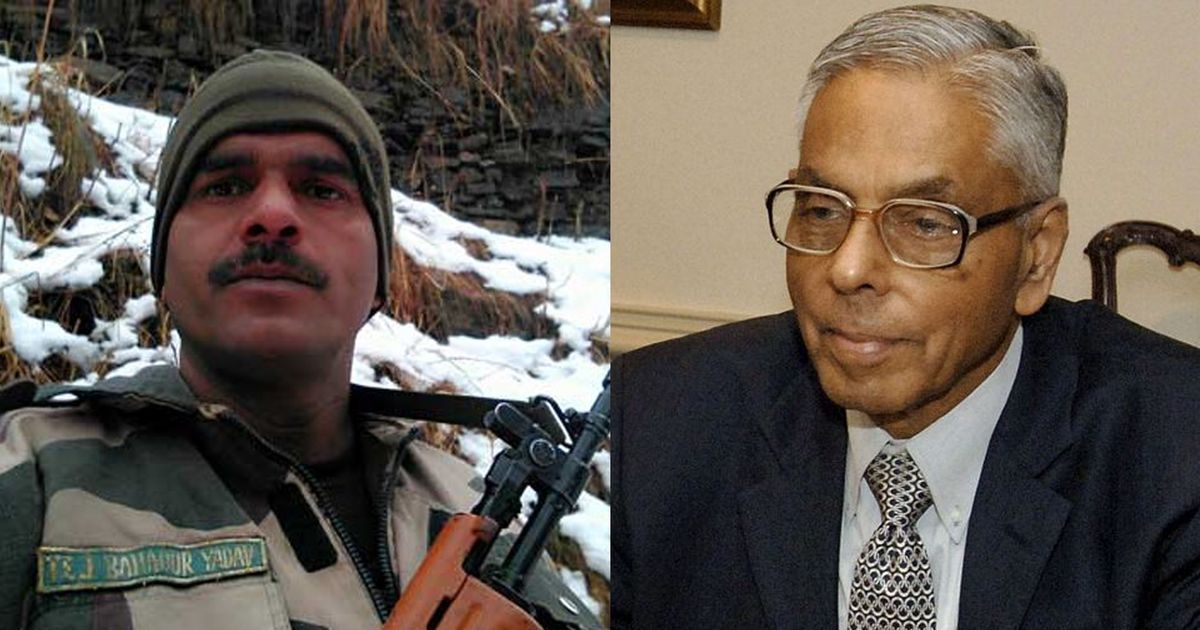
Image credit: BSF Jawan Tej Bahadur Singh (L) and MK Narayanan (R)|YouTube and Wikimedia Commons
The uploading of a series of Facebook videos in January by a disgruntled constable of the Border Security Force, Tej Bahadur Yadav, about the apparently poor quality of food and tough working conditions has understandably caused a lot of outrage and concern. The surfacing of similar social media posts in the wake of Yadav’s viral videos created a narrative of exploitation of the brave sacrificing jawans at the hands of an allegedly corrupt, callous and feudal cadre of officers. That living conditions, equipment, training and promotional avenues of our Central Armed Police Forces – which include the Border Security Force, Central Reserve Police Force, Central Industrial Security Force, Indo-Tibetan Border Police, Sashastra Seema Bal, National Security Guard, and the Assam Rifles – should improve further is not disputed. There is an awareness that our troops need to be leaner and better resourced and modernisation is a strategic imperative.
But, in view of the current mandate of internal security challenges as well as budget constraints, this transition will take much longer than the attention span of 24×7 media. One of the uninformed suggestions emerging out of the current debate is that the leadership of the forces needs to change fundamentally so that leaders are more aware of ground realities, have adequate experience, and are committed to a long-term career to lead the force rather than short casual stints.
The top leadership in the police, intelligence and investigative organisations, both in the Central government and state governments, currently come from a common pool of leaders belonging to the Indian Police Service. Somewhere up there, Jawaharlal Nehru and Sardar Vallabhbhai Patel, the architects of the All India Services who argued passionately in the Constituent Assembly for the adoption and evolution of the British-era Indian Civil Service and the Imperial Police into the Indian Administrative Service and the Indian Police Service, are sure to be wringing their hands in despair. The national needs that led them to champion the concept of the All India Services have not gone away. If anything, the challenges to India’s stability and prosperity have become more complex and acute. It is, of course, obvious that the Indian Police Service cannot consider itself a holy cow any longer. Constructive criticism as well as meaningful change are both urgently required. While meeting these challenges would require rethink and reform at all levels, including that of the IPS, abolishing it or drastically curtailing its pre-eminence in our internal security architecture would be ill-advised.
The Tej Bahadur Yadav theory of what ails our internal security goes something like this: Why do our jawans get poor facilities? Why do they choose to leave the forces in large numbers each year? Why do we have recurring incidents of fratricide and suicide? A common refrain is: because they are led by Central Armed Police Forces officers who are themselves disgruntled and resentful of the IPS presence in their organisations. So, the obvious solution is to remove the latter from the former. The argument goes that this will motivate the Central Armed Police Force officers to work with greater dedication for the welfare of their jawans.
Clearing misconceptions
Anecdotal evidence and outright fudging is marshalled as evidence to create a supposedly compelling case for radical surgery of these forces. There is no doubt that the Indian Police Service and the police organisations it leads both need reform and rejuvenation, but not for imaginary reasons based on ignorance or vested interests.
First, to clear some common misconceptions about our Central Armed Police Forces and the role of the IPS in these organisations. Barring the Central Reserve Police Force, which goes back in origin to the British Raj, every other such organisation has been created and nursed into its present shape by successive generations of IPS officers. As they have grown, the relatively small and stable size of the IPS cadre has meant that fewer IPS officers have been made available to man their tactical-level leadership positions, which are now filled by the forces’ own cadre officers. The IPS presence in these organisations has never been lower. For example, the Border Security Force has less than 50 IPS officers serving in an organisation with nearly 4,500 officers. The Indo-Tibetan Border Police has nearly 1,400 officers, of whom about 15 are from the IPS. To suggest that this limited presence is the root cause for the neglect of our jawans is stretching credulity. As things stand, more than 80℅ of Central Armed Police Force officers retire at the level of deputy inspector general or above. Compare it to the Indian Army where less than 5℅ of officers retire at the roughly comparable level of brigadier and above. Clearly, stagnation is not a credible reason for incidents such as the one involving Tej Bahadur Yadav to take place. Even the Army, which has a unified officer cadre, is not immune to occasional lapses and resultant controversies.
The unique position of the All India Services, the talent pool they represent, the exposure they have very early in their career, and the expectations from them are such that plain vanilla comparisons of career slopes can lead to misleading conclusions. The Constitution includes policing in the state list, and maintains a balance with an All India Service like the IPS for coordination between state and central organisations. Divesting the IPS of their current role as leaders of police forces in the state and the Centre goes contrary to the constitutional framework. Besides, in pure human resource terms, there is no empirical evidence that non-IPS leaders are better than those from the IPS in terms of their innate merit, that any larger public interest will be served or that coordination between central agencies or between central and state agencies will improve by undermining the current leadership structures. So, stagnation is a false premise more oriented to the interest of the proponents rather than the constitutional framework or managerial needs.
Similarly, some have pointed out high attrition rates in our Central Armed Police Forces as a symptom of the supposed rot within. Current attrition rates for these organisations are at around 2℅ overall. Any HR manager in the private sector would kill for such low numbers. What is, of course, a matter of concern is the relatively low levels of pay and other facilities given to jawans, compared to the Army. Successive pay commissions have retained the edge given to the armed forces. Ultimately, this is an issue that can be resolved by greater discussion with all stakeholders till a consensus is reached. Given the enormous responsibilities being shouldered by the police forces, it certainly merits a more sympathetic approach. However, given the hybrid nature of the Central Armed Police Forces, where they perform a plethora of duties in aid of state administration and police authorities, closing them to the IPS would damage our federal structure and impact our internal security.
BSF jawan Tej Bahadur Yadav video about service conditions went viral.
Police reforms
Coming to the wider issue of reforming the Indian Police Service to better equip it for its role as strategic leaders of our internal security, this is a topic that needs far more serious reflection and debate. Even before the Tej Bahadur Yadav incident, the service’s credibility and utility have been called into question from various quarters. Its elite nature, and its varied opportunities have ensured that it remains a coveted brand that attracts some of the finest youth from premier universities to join the police and occupy leadership positions. But, from time to time, there is criticism about the efficacy of such an elitist service and even demands for fundamental changes to leadership structures in the police. The general response of the IPS has been to deny deficiencies and blame other factors for individual command failures and performance shortfalls. The IPS cannot actively seek reform and renewal of others while sparing itself.
Nineteenth-century police reform in Britain is often held as a mirror in any conversation on police reform. The English ruling class created an independent and professional police force, thereby bestowing the police with the legitimacy to maintain order. True, the police in the United Kingdom do not carry arms, but they are equipped with the most potent weapon of policing – the consent of the people for policing society.
Young IPS officers, working as police superintendents of districts, have limited work experience and possibly know less about the intricacies of day-to-day policing than the station house officers of police stations. But, the IPS brand introduces them to an alien district immediately on arrival as trustworthy, unless proved otherwise. One of the core recommendations of the National Police Commission, appointed by the government in 1977 to review the policing system, centred on the appointment of police chiefs, so that they carry legitimacy. This aspect needs to be strengthened by ensuring that young superintendents of police are given the requisite institutional backing and resources to do their job in line with public expectations.
A second non-negotiable aspect of police leadership in the Indian context is the ability for strategic thinking; the knack for seeing the larger picture. A parallel can be drawn to the United States Army’s realisation after the Vietnam War that their military leaders need knowledge of history, sociology and international relations far more than proficiency at tactical platoon-level drill. The diversity of challenges for a graduate of the US Military Academy, West Point, today ranges from the South China Sea to the mountains of Afghanistan and the streets of Mosul, Iraq. When our current generation of police chiefs in India were trained at the National Police Academy in Hyderabad, there were no computers or mobile phones. No academy could have prepared them for the job they do today. The way West Point deals with this problem is by focussing on strategic thinking and encouraging their graduates to go on long sabbaticals to the best of US academic and research institutions for periods ranging from three years to five years, to maintain an intellectual edge throughout their careers and afterwards. That is how they come to head the army and intelligence set-up and play a pivotal role as equal partners with the foreign policy and security establishment in deciding on the role of the US in a changing world.
In understanding the role of the IPS or in seeking changes, the two factors of enhancing legitimacy and developing strategic thinking have to be core principles. Changes should be made only to enhance the legitimacy of police leaders and to give them the intellectual resources to provide strategic leadership. Uninformed criticism can always be wished away, but there is now an apprehension among serving and retired police officers that the legitimacy of police leaders and their intellectual depth to provide leadership are sharply declining. If this continues, at some point, the IPS will be perceived as no different from the rest of the police force. There is a problem in police leaders appearing ordinary or people beginning to think that whoever has political patronage can become a police chief, irrespective of intellectual depth and strategic vision. These developments will corrode the IPS brand, cultivated over long years of dedicated service to the nation.
Recruitment process
The Indian Police Service has produced two national security advisers, including current incumbent Ajit Doval.
India has seen some great police leaders such as Rustamji, Rameshwar Nath Kao, BN Mullik, Ashwini Kumar, Julio Rebeiro, KPS Gill and so on. The IPS has already produced two national security advisers in MK Narayanan and Ajit Doval. But, IPS officers, both serving and retired, recognise that the chiefs now have a much diminishing role and most are unable to go beyond adding their name to the succession board in the chief’s office. Therefore, the time has come for serious thinking on systemic reform keeping in mind the two fundamental objectives: enhancing legitimacy and strategic thinking. Recruitment, training and career planning of IPS officers must lay greater emphasis on both these factors.
Currently, recruitment to the IPS is through two routes: two-thirds of officers get in through the combined civil service examination conducted by the Union Public Service Commission, and one-third via promotion from among eligible State Police Service officers. The view that the traits required of a good police officer are different from other civil services and that they should, therefore, be recruited through a separate examination hardly shows any understanding of modern policing. The critical question is whether separating IPS recruitment will enhance the legitimacy of the service or attract officers who are more capable of strategic management. We do not think so. Given the centrality of good policing in democratic expectations of good governance, police leadership should continue to be recruited with other civil servants assigned leadership roles. In fact, the combined civil service examination is as good a way of finding talent, and holding another examination will be wasteful, unnecessary and will not lead to hiring of talent with a different background, talent-set or attitude.
But, with the expansion of police organisations at the state and central levels, there is a net shortfall of IPS officers. There is also a need to accommodate the aspirations of direct recruit assistant commandants in the Central Police Organisations. The growing strength of the Central Armed Police Forces requires their seamless integration into our internal security architecture. So, two changes can be thought up. First, the promotion quota should be increased to 50%. Second, the slots created by the increase should be used to promote officers from these forces to the IPS, which would require waiving off the condition applied to State Police Service officers that the officer should have managed a police sub-division for five years. Central Armed Police Force officers deployed on internal security duty can be asked to take the Union Public Service Commission’s examination on criminal law and then be inducted against this enhanced quota and allotted to states.
Training, intellectual growth
The Indian Police Service training, both basic and in-service, also has to undergo a complete paradigm shift, almost along the lines of the West Point Academy. Unfortunately, the outdoor training of the IPS is no different from similar training for other ranks. In fact, these infantry-style training programmes are not followed in any developed part of the world, but have been perpetuated by inertia and lack of vision. As far as academic input is concerned, the National Police Academy hires faculty members with police backgrounds. They have no academic or research experience. Unfortunately, the general lack of quality in India’s higher education system has a direct bearing on academic standards at the police academy.
But the real issue is that these officers, after some years, have to be taken away from street policing and put back in the university system, and this is where the US system scores so high. “Want to do a PhD, join the US Army”. Most US Army generals go on sabbatical, often without any financial support, to the best universities for three to five years. Within India, the Intelligence Bureau does create a facilitating environment for intellectual growth, though they continue to have an outdated obsession with protecting their organisation from enemy agents and have not allowed their officers to go out to international academic institutions. In-breeding and closed competitions can lead to problems. Over the years, the IPS has acquired a macho, gung-ho ethos that might provide fodder for Bollywood scripts but does not really meet our national need for a thoughtful, research and evidence-driven police leadership. Police leaders will look increasingly ordinary and at sea if they lose their intellectual edge. To attract the best talent to the IPS at the recruitment stage and to then fail to renew it with exposure to global best practices and cutting-edge research seems to be a criminal waste of resources.
Establishing legitimacy
Beyond recruitment and training, the loss of legitimacy of the IPS is also related to the way officers are selected for posting and promotions. There are problems in implementing any system of a “narrowing pyramid” in the police since that may further politicise the police. But, we recommend the system followed by the United Kingdom, where officers cannot get more than two promotions in command posts (assistant chief constable and above) unless they move out of their jurisdiction. This means no one can be posted as a police chief unless he or she decides to leave the parent cadre. In the Indian context, this would mean that once an officer is an inspector general of police, he or she has to move out on deputation or else cannot be posted as police chief. Carefully cultivated political equations are neutralised if the officer moves out, and the officer cannot be appointed police chief by any act of omission and commission.
There are two further requirements, again following the UK model. First, all posts of inspector general and above should be through a selection process involving short-listing and interviewing by a committee. Second, cadre rules must be made flexible. There is no harm if government organisations search for the right talent-fit by employing human resource professionals and talent hunters. The current system of limiting selection to within a state cadre should be done away with as was done in the United Kingdom long ago, because there is no other way of preventing conflict of interest and officers focusing on cultivating relationships as a career-long obsession and benefitting from compromises made along the way.
The above suggestions are only a preliminary outline of what is required. We hope that they are the start of a much needed national conversation about the role of the IPS. Despite the emotive issues raked up by Constable Tej Bahadur Yadav and the predictable chest-beating that has accompanied it, the case for reforming the IPS based on a more sober assessment of our internal security needs remains compelling. If changes cannot be brought about, the day is not far when, giving short shrift to the vision of Nehru and Patel, the IPS may well be discarded by some decisive political leader. For far too long, we in the IPS, too, have been guilty of not admitting to the writing on the wall. An ostrich-like attitude will imperil not only the role of the IPS as envisaged by our founding fathers, but will also impose huge costs on our internal security.
Dr Sudhanshu Sarangi and Abhinav Kumar are both serving IPS officers.
In a naked defiance of the Election Commission guidelines, Dainik Jagran newspaper has carried out an exit poll in favour of the BJP in Uttar Pradesh even though six more phases of polling are still left.
The newspaper, often accused of being pro-BJP, carried the exit poll by using a sample of 5,700 voters, who cast their votes in the first phase of elections on 11 February.
Its ‘finding’ said, “The BJP will become the numero uno party in the first phase. The Mayawati-led Bahujan Samaj Party (BSP) will be at second position while the Samajwadi Party-Congress alliance is not likely to get a positive response from the voters. The findings were first published by Dainik Jagran website.”
It further added, “The region is crucial to the BJP because it swept all the 12 Lok Sabha seats in Western UP in the 16th general election. The other important thing to be noted is that BJP-led NDA government has three Union Ministers from the region – Mahesh Sharma, Retired General VK Singh, and Sanjeev Baliyan.”
Jagran was among the first media groups Prime Minister had chosen to speak to after becoming the prime minister.
Jagran’s decision to carry out an exit poll in defiance of the EC guidelines is a serious development and the action was bound to have invited punitive action, even closing down of the publication, in any other matured democracy.
While it remains to be seen what action the EC, often perceived to be toothless in the face of violations favouring the BJP, would initiate against the Jagran group, the news has only prompted an otherwise beleaguered saffron party to go to town claiming victory in western Uttar Pradesh, that went to polls on 11 February.
But, the BJP isn’t alone in claiming victory in the first phase of UP polls. A day after the first phase of polling, major parties in Uttar Pradesh claimed that they had swept the round and were on the road to form government in the politically crucial state.
Samajwadi Party party chief Akhilesh Yadav said that the downfall of those who had “befooled” the people promising “achche din” has started while Mayawati asserted that she will prove pollsters wrong as she did in 2007 when they predicted her defeat.
BJP Chief Amit Shah claimed ‘achhe din’ will come in Uttar Pradesh after counting of votes on 11 March.
Claiming that SP was ahead of rivals in the first phase, Akhilesh said the trend will continue and the alliance will get majority.
“We could have got majority alone, but after alliance with Congress we will comfortably win over 300 seats,” Akhilesh said in Badaun.
“The downfall of those who had befooled people promising ‘achche din’ has started. After 2017, they will be wiped out in 2019 also. They (BJP) should tell as to what have they done for people,” he said.
Addressing a rally in Sitapur, Mayawati claimed it was a “clean sweep” for BSP in the first phase.
“The first phase of UP polls was encouraging for BSP. It was a clean sweep for our party. It’s a positive signal that we are going to form government in the state,” she told an election rally here.
She dubbed as “fake” the surveys and opinion polls that said BSP will not come to power and said that they will be proved wrong as in 2007, when her party got majority.
“You should not believe in such surveys. If BSP came to power all development schemes will be restarted and names of schemes and places that were changed will be restored,” she said.
Shah said BSP is the main rival from BJP in first two phases of Uttar Pradesh Assembly polls and Samajwadi Party in the rest five.
“As per the trend of first phase, we will get more than 50 seats (out of 73). In the first two phases we will be getting more than 90 seats (out of total 140). The main rival in these two phases is BSP. In the next phases, the rival will be SP,” Shah told reporters in Lucknow.
He claimed that issues like payment of cane dues, loans at zero per cent interest to farmers, anti-Romeo squads to check crime against women, and some other key points in BJP manifesto had attracted youths and common people and they were supporting BJP.
Slamming Akhilesh, Shah said he has conceded defeat by sacrificing 105 (of the 403) seats to Congress.
On the chief minister’s charge that ‘acche din’ have eluded the people, he said, “By saying this, Akhilesh has accepted that he has failed. After ruling for five years, he is asking when will ‘acche din’ come. It will come after March 11, when BJP will form government.”
The first phase of UP polls in 73 assembly constituencies witnessed 64.22 per cent voter turnout yesterday. Voting will be held in 67 Assembly constituencies spread over 11 districts on February 15.
The other five phases will be held on February 19, 23 and 27 and on March 4 and 8.
Amidst raging controversy over the involvement of a BJP IT Cell member in spying for Pakistan’s ISI, the RSS chief Mohan Bhagwat has said that no one has the right to judge others’ patriotism.
“Doosre ki bhakti naapne ka adhikar kisi ko nahin hai, mujhe bhi nahin hai (No one has the right to measure anybody’s patriotism. I too don’t have the right),” Bhagwat said yesterday while releasing a book here.
“Even if you think that you are running the show in the country, you cannot measure anybody’s patriotism, or after evaluating it come out with a judgment on it that if this is the kind of ‘bhakti’ (devotion) you have, then it is patriotism, otherwise it isn’t,” Bhagwat was quoted by PTI.
Bhagwat’s latest comments are in sharp contradiction to the BJP leaders’ habit of frequently label those anti-nationals, who criticised the Centre’s Narendra Modi government.
Several high profile names including Shah Rukh Khan and Aamir Khan have had to pay heavy prices for criticising the Modi government policies.
Many top BJP functionaries including some cabinet ministers have in the past have asked Modi’s critics to go to Pakistan.
However, the arrest of Dhruv Saxena, who has been working in BJP’s IT Cell since last year, for spying for Pakistan has left the right-wing Hindutva brigade in an awkward position.
He unveiled the book ‘Bharat ki Khoj Me Mere Paanch Saal’ authored by journalist Vijay Monohar Tiwari.
Earlier, addressing the Hindu Sammelan in Betul district three days ago, the RSS Chief had said, “Whoever lives in Hindustan and has respect for its traditions, are all Hindus.
Muslims may have different way of performing prayers, but their nationality is Hindu.”
“All Hindus are accountable for Hindustan,” he had added.
A bold and inclusive left populist radicalism would expose the real roots of festering social problems by speaking plainly and directly to ordinary people’s needs, without pandering to their worst prejudices and fears.
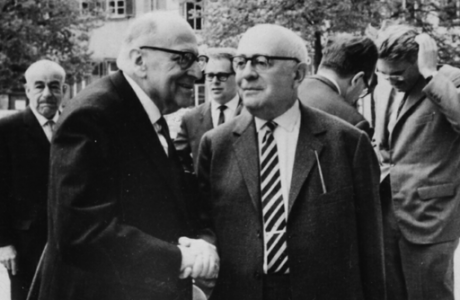
Horkheimer is front left, Adorno front right, and Habermas is in the background, right, running his hand through his hair, Heidelberg, 1964. Wikicommons/Jeremy J. Shapiro at the Max Weber-Soziologentag.. Some right reserved.
Two new worlds are now struggling to be born amidst the crumbling ruins of neoliberalism and market globalisation. The first is the waking nightmare now unfolding in the United States in the glare of the international media. A reality show with a cast of horrors, its politically successful mix of faux right-wing populism and neo-fascism has inspired and emboldened autocrats everywhere and threatens in the absence of an effective counter-power to become our new global reality.
The second, a just, compassionate, ecologically sound and democratically self-managed post-capitalist world, may be detected in what Colin Ward once described as scattered ‘seeds beneath the snow’. Deeply rooted in a rich soil of ideas and grounded utopian imagination nourished by countless counter-cultural critics of capitalism, industrialism and grow-or-die economics from William Morris, Peter Kropotkin and Elisée Reclus to Gandhi, Ivan Illich, Murray Bookchin and Ursula Le Guin – as well as a long history of popular movements from below working together to resist regimes of domination and develop progressive and sustainable alternatives to them – the tender shoots of another world are emerging all around us.
They are visible in a wide range of grassroots practices, movements, and practical utopias, from Buen Vivir in the Andes, Ubuntu in South Africa, Ecoswaraj in India, Zapatismo in Mexico, and the budding degrowth movement in Europe to solidarity economies, commoning activities, permaculture projects, re-localisation movements, community currencies, transition towns, co-operatives, eco-communities, worker occupied factories, indigenous people’s assemblies, alternative media and arts, human-scale technologies, basic and maximum income experiments, debt audit movements, radical democratic movements such as Occupy and democratic confederalism in Rojava, and emerging anti-fascist fronts and coalitions uniting immigrant solidarity groups, anti-racists, feminists, queers, anarchists, libertarian socialists and many others.
The great danger we now face is that newly empowered forces of reaction will use that power to repress progressive alternatives before they are able to coalesce as an effective counter-power, sowing seeds of hatred and intolerance instead.
Walter Benjamin’s observation that every rise of fascism bears witness to a failed revolution speaks poignantly to our current condition. It may be interpreted not only as warning, but as a grimly realistic utopian hope that we still have a fleeting historical opportunity to act before it is too late.
Many commentators of a liberal democratic or centre-left political persuasion have dismissed such warnings as scare-mongering, and suggested that the most effective antidote to ‘populist politics’ is a renewed commitment to social democracy and market globalisation with a ‘human face’. Rather than seek to understand the complex mix of reasons why American citizens voted for a demagogue like Trump, they blame an undifferentiated ‘populism’ and advocate more elite democracy instead.
The breathtaking naivety of this commentary is perhaps matched in recent memory only by Francis Fukuyama’s equally naïve and now risible prediction in 1989 of an ‘end of history’, i.e. an end to mankind’s ideological evolution with the ‘universalisation of western liberal democracy as the final form of human government’.
Walter Benjamin, Paris, 1939.
Now more than ever, it is vital that we recognise and articulate careful ideological distinctions between competing right and left wing varieties of populism, and that those of us committed to values like equality, democracy and solidarity take urgent action to oppose Trumpism and the rise of fascism not with more of the same failed elite-led liberal democracy, but with a bold left egalitarian and inclusive radicalism.
The Trump campaign gave voice to the ugly authoritarian and reactionary face of popular opposition to the political establishment. It castigated the elitism and corruption of the system, emphasised its ineffectuality in the face of sinister threats to national well-being posed by Muslims and illegal immigrants and other easily scapegoated ‘outsider’ groups, and maintained that Trump and Trump alone could ‘make America great again’. It succeeded by peddling false solutions and scapegoats for real social problems generated by the governance of interconnected political and economic elites.
By contrast, a bold and inclusive left populist radicalism would expose the real roots of festering social problems by speaking plainly and directly to ordinary people’s needs, without pandering to their worst prejudices and fears. It would offer a generous vision of a better world, and a sweeping programme for revolutionary social change that can be translated into everyday practice.
This will require a reconnection with revolutionary roots. Historically, revolutionary ideas and social movements have tended to emerge out of, and give ideological coherence to, popular democratic social forms. However, in our time once revolutionary ideologies and movements like socialism and anarchism have grown increasingly detached from their radical democratic roots, leaving a political vacuum that right-wing populists and demagogues have been quick to fill.
Walter Benjamin’s observation that every rise of fascism bears witness to a failed revolution speaks poignantly to our current condition. It may be interpreted not only as warning, but as a grimly realistic utopian hope that we still have a fleeting historical opportunity to act before it is too late.
(Laurence Davis is College Lecturer in Government at University College Cork, Ireland, and an editor of the Manchester University Press Contemporary Anarchist Studies book series).
How much control do Indian women have over different aspects of their lives?
Not much, according to the Indian Human Development Survey (IHDS), conducted by the University of Maryland and the National Council of Applied Economic Research in 2004-2005 and 2011-2012.
Only 4.99% of women in India had sole control over choosing their husbands, while 79.8% of women needed permission to visit a health centre, according to the 2012 IHDS survey, showing little change since the IHDS survey in 2005, when 5% reported having sole control over choosing their husband, and 74.2% reported needing permission to visit a health centre.
The IHDS survey in 2012 covered over 34,000 urban and rural women between the ages of 15 and 81, in 34 Indian states and union territories.
Overall, 73% of the women surveyed reported that their parents or relatives alone chose their husbands, while as few as 5% of women reported to have had sole control over choosing their husbands.
A similar survey for men has not been conducted.
Women need permission to visit a grocery store, healthcare center
Limited control over life decisions extended to visiting a healthcare centre, and a grocery store.
Almost 80% of women said they had to seek permission from a family member to visit a health centre. Out of these women, 80% said they needed permission from their husband, 79.89% from a senior male family member, and 79.94% from a senior female family member.
Further, 58% of women reported that they needed permission to visit the local kirana (grocery) store, compared to 44.8% in 2005.
Such restrictions are also echoed in other indicators. For instance, only 27% of Indian women are in the labour force, the second-lowest rate of female labour-force participation in South Asia after Pakistan, as IndiaSpendreported in April 2016.
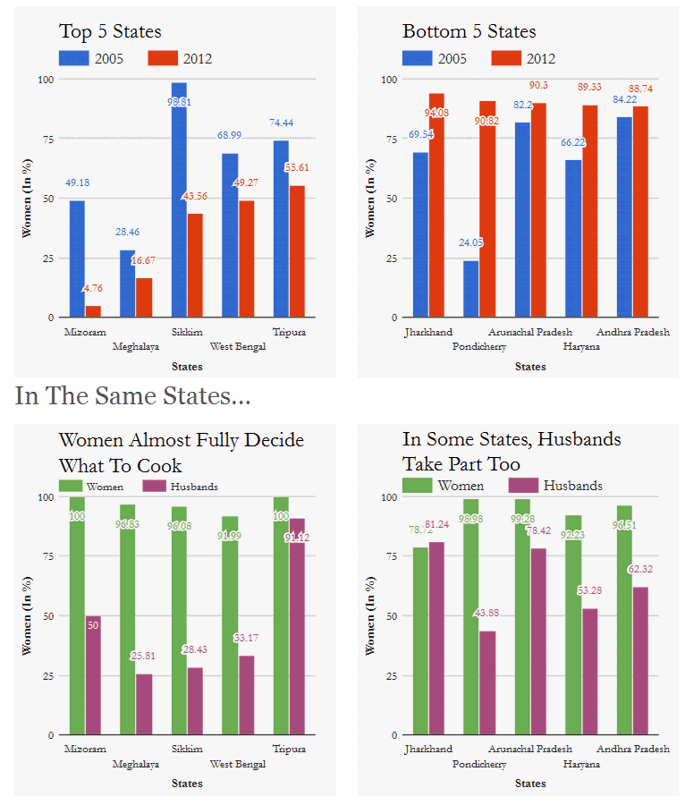
Women, however, seemed to have control over what is cooked in the house, a decision that 92.89% women reported making everyday. About 50% reported that the husband took part in deciding what to cook, highlighting the gendered nature of household chores.
Since 2005, there has been a decrease in the percentage of women who decide what they cook (94.16% in 2005), and an increase in the percentage of men (40.89% in 2005) who took part in the decision.
Women (In %) Who Ask Permission To Visit Health Center
A woman’s freedom to make decisions depends on where she lives
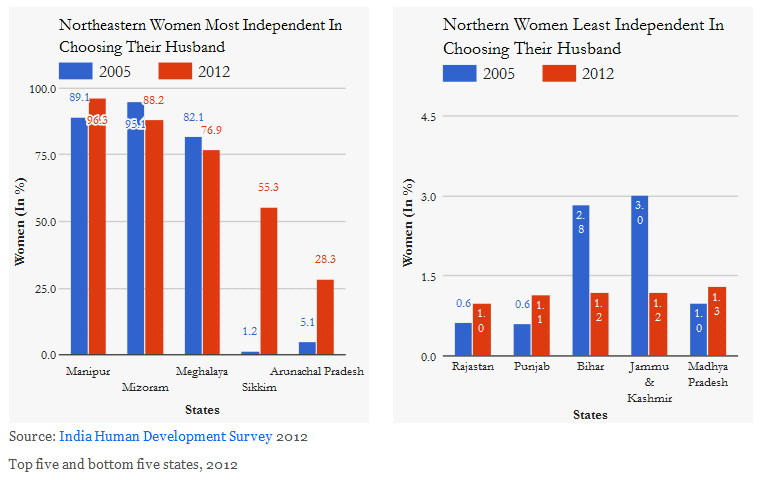
More women chose their own husband in states in north-eastern and southern India as compared to northern India, as per 2012 IHDS data.
The percentage of women who had sole say in choosing their husbands was lowest in Rajasthan (0.98%), followed by Punjab (1.14%) and Bihar (1.19%). It was the highest in Manipur (96%), followed by Mizoram (88%) and Meghalaya (76.9%).
As many as 65% of the women said they had met their husband for the first time on the wedding day, but wide variations exist across states. For instance, all women in Manipur had met their husband before the day of the wedding, while 94% of women in Bihar met their husband for the first time on the day of the wedding.
This highlights the “arranged” nature of marriages in India, a process in which prospective partners usually meet for the first time with the intention of getting married, after their family vets the spouse-to-be, and the match is backed by the support of their extended social network.
A similar trend in regional variations can be seen in the percentage of women who needed permission to visit a health care center. As many as 94% of women reported needing permission to visit a health center in Jharkhand, the highest of any state, while only 4.76% of women in Mizoram needed permission, the lowest.
The top five states, which weren’t necessarily doing well in 2005 like Mizoram, Sikkim, Tripura and West Bengal, have improved since then. However, more women in the bottom five states reported they had to ask for permission to visit the health centre in 2012 as compared to 2005.
Does higher literacy lead to greater decision-making power? Not really
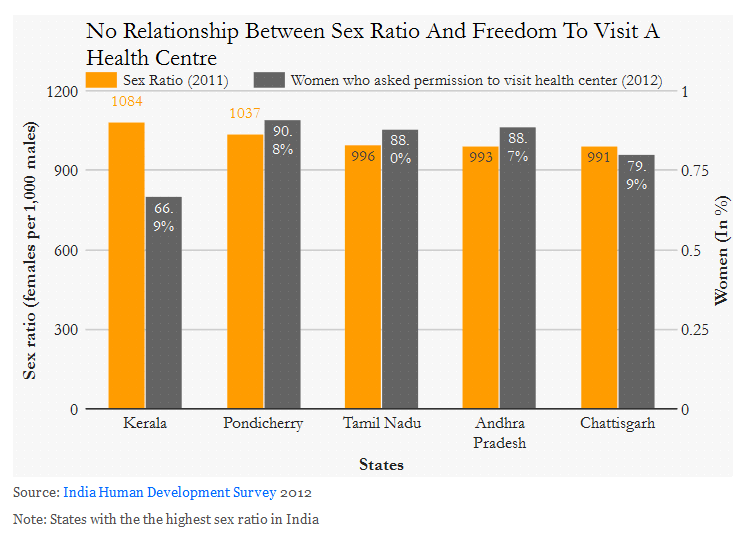
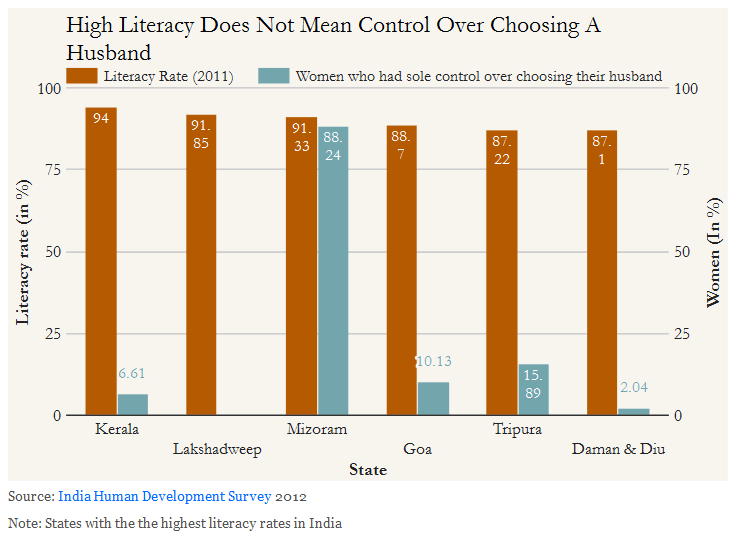
A woman’s power to make decisions regarding marriage, and visits to a healthcare centre are not correlated with literacy at the state-level, or to the sex ratio (the number of females per 1000 males), suggesting the role of social norms, which might differ by state.
For example, in Chattisgarh, which has one of the highest sex ratios in the country (991), only 7.57% women said they did not need permission from another family member to visit a healthcare center.
This paradox is not being observed for the first time–despite female literacy levels being higher than before, the child sex ratio (indication of son preference) in India is at its lowest since 1951, as IndiaSpendreported in December 2016.
“The bias against daughters can only end if women’s education is accompanied by social and economic empowerment”, concluded a study conducted over a period of 30 years in Gove, Maharashtra, by Carol Vlassoff, a professor at the University of Ottawa, as IndiaSpendreported in December 2016.
In Delhi, which has a literacy rate of 86.21% (higher than the national average of 74.04%), only 2.09% women reported they had sole control over choosing their husband. Meghalaya, which has a lower literacy rate than Delhi (74.43%), ranks third from the top in terms of women who said they had sole control over choosing their husband (76.9%).
“Cultural climate also plays a role”, said Kavita Krishnan, secretary of the Delhi-based All India Progressive Women’s Association, which works on issues such as reservation for women in Parliament and violence against women. “In and around Delhi, there is no doubt a more rigid patriarchal culture that is hostile to women’s sexual autonomy–this may be far less the case in Meghalaya”, she explained.
“This study shows that denial of autonomy is in itself one of the central problems for Indian women. This problem can’t be addressed by literacy alone, and governments need to address the issue directly”, Krishnan added.
(Garg is a Research Associate with the University of Michigan.)
Full text of the vice-president's speech in which he warned that unless the problem is tackled, conflict is bound to follow.
Vice-President M Hamid Ansari on Friday called inequality the greatest risk facing the world today, saying it “corrodes social cohesion”, “breeds economic inefficiencies and limits productivity”. Delivering the inaugural address at a three-day conclave organised by The Hindu in Bengaluru titled The Huddle, he said that while living standards have improved for many in the last 30 years, this has perhaps masked a “dramatic concentration of income and wealth” in a small segment: the richest 1% in the country owns nearly 60% of its wealth while the bottom half of Indians collectively own only 2% of national wealth.
Rising inequality can lead to conflict, both at the social and national level, he warned. The growing threat of left-wing extremism, which he said has been acknowledged as the gravest security threat to the Indian state, has its roots in economic deprivation and inequality in access to resources, he added.
He cautioned against viewing rising inequity as merely “an inconvenient truth in the saga of India’s shining future”, saying that without equality, there is unlikely to be much of a future, let alone a shining one.
This is the full text of the vice-president’s address:
“When I was first told about this conclave, an odd thought came to my mind. I wondered if the theme was a verb or a noun; the definite article however settled that. I recall the tablet that was affixed to the pedestal of the Statue of Liberty in the early years of the last century, and that reads:
Give me your tired, your poor, Your huddled masses yearning to breathe free, The wretched refuge of your teeming shore, Send these, the homeless, tempest- tossed, to me: I lift my lamp besides the golden door.
I do not propose to dilate on the context of these lines. I do nevertheless wish to draw the attention of this gathering to the second line: the quest for freedom by human kind, and to the response patterns we have witnessed in our times.
Freedom, in the dictionary meaning of the term, signifies ‘the power to act, speak and think freely’. It implies unhampered liberty to think freely, to question anything, to be able to speak frankly, to be free to explore boundaries.
Yet freedom or liberty in itself would be quite meaningless. To enjoy these ‘freedom of,’ there is a requirement first for certain ‘freedom from’.
To survive with dignity, humans require both ‘freedom from want’ and ‘freedom from fear’. Human development is understood as the continuing expansion of human freedom and humans flourishing beyond these freedoms.
In our case, the Preamble of the Constitution specifies what ‘We the People of India’ set out to attain: justice (social, economic and political); liberty (of thought, expression, belief, faith and worship); and the equality (of status and of opportunity), and fraternity (to assure dignity of individual and unity of the nation).
Thus liberty or freedom is anchored between justice and equality; also inter-spersed is a Hegelian construct on appreciation of necessity that circumscribes this freedom. Furthermore, while equality is the premise of citizenship, the latter by itself does not guarantee substantive equality.
In advance of the world’s financial and economic elite going to Davos for their annual meeting, the World Economic Forum publishes its Global Risks Report. The 2017 edition highlights some risks facing the global system and places the issue of income inequality as the number one risk because it is associated with a rise in populism and threatens the cohesiveness of countries. It describes the present as ‘a febrile time for the world’.
Four earlier annual editions of the report had similarly identified rising inequality among the top four global risks. It is therefore not surprising that reducing inequality is one of the UN Sustainable Development Goals.
And still – in this age of ‘post-truths’ and ‘alternate facts’ – deceptive appearances can be made to prevail.
The improving living standards, in segments, have perhaps masked a dramatic concentration of income and wealth over the last 30 years. A number of studies have come to the distressing conclusion that despite the increase in the number of people coming out of abject poverty, the majority of people on the planet today live in countries where economic disparities are bigger than they were a generation ago. Please consider the following:
Including capital gains, the share of national income going to the richest 1% has doubled since 1980. Within it, the largest share going to the top 0.01% – some 16,000 families – who now control almost 5% of the global wealth.
If we divide the whole income of the world into two halves, we find that the richest 8% get half, while the other half would be distributed in the remaining 92% of the population.
In almost all countries, the mean wealth of the wealthiest 10% is more than 10 times the median wealth. For the wealthiest 1%, mean wealth exceeds 100 times the median wealth in many countries and can approach 1,000 times the median in the most unequal nations.
In developing economies like India and China, despite the fact that incomes have risen for many, inequality, in both wealth and income have also risen significantly. The richest 1% in India owned nearly 60% of the country’s total wealth, with the top 20% commanding 80%. The bottom half of Indians by contrast, collectively own only 2% of the national wealth.
Nor is a reversal in sight. Rates may vary, but since the financial crisis of 2007, inequality has shown more increases than decreases in the world’s nations. Twentieth century history shows that this can be ominous.
While the economists may continue to debate the extent and causes of inequality, there can be little doubt about its implications for the political, social and economic fabric of society.
Some years earlier, Joseph Stiglitz had written about the price of inequality in the context of the United States. More recently, Kate Pickett and Richard Wilkinson have describe the ‘pernicious effects’ that inequality has on societies and provide evidence for a strong correlation between higher levels of national inequality and a wide range of health and social problems.
More worryingly, rising inequality is seen as a contributing cause for the rise of authoritarian leaders, often with a divisive agenda fuelled by sectarianism, xenophobia and nationalism.
Rising inequality can lead to conflict, both at social and at national level. Research has shown that in contrast to oligarchic regimes; democracies avoid serious political turbulence only so long as they ensure that the relative level of inequality between the rich and the poor does not become excessively large.
Other studies, similarly, indicate that social conflicts are indeed likely to break out in situations where there are large inequalities between different groups. Some studies have concluded that ethnic groups with incomes much lower than a country’s average per capita income are more likely to engage in civil war.
New protest movements have broken out around the world, many arguably rooted in the burgeoning inequality. The Occupy Movement and the Arab Spring were both fuelled by growing public despair at the sharp inequalities and growing unemployment and the perceived inability of the existing governance structures to redress the situation. In India, the growing threat of left extremism, which has been repeatedly acknowledged as the gravest security threat to Indian state, has its roots in economic deprivation and inequality in access to resources.
It has also been recognised that growing social inequality corrodes social cohesion and can destabilise states. Some recent research has found that the likelihood of a country remaining mired in poverty or achieving sustainable growth has a strong relation to the average life expectancy of the citizenry. There, it is argued, that a shorter average life span leaves less time to reap the returns on investment in human capital.
Inequality also breeds economic inefficiencies and limits productivity. Research by IMF has shown that income inequality slows growth, causes financial crisis and weakens demand. In a recent report, the Asian Development Bank has similarly argued that if emerging Asia’s income distribution had not worsened over the past 20 years, the region’s rapid growth would have lifted an additional 140 million people out of extreme poverty.
Perhaps the time has come to move the development discourse of inequality beyond the current discussion of outcomes and opportunities. A conceptual framework is provided by Amartya Sen and some others who see human capabilities as the capacity and freedom to choose and to act; and calls for the opportunities that give individuals the freedom to pursue a life of their own choosing to be equalised.
The concepts of justice and fairness are tied to the idea of equity in development. Equity has an intrinsic value since some groups face consistently inferior opportunities – economic, social and political – than their fellow citizens. Specifically, it translates into the need for equal opportunity and avoidance extreme deprivation in outcomes. To view rising inequity as merely an inconvenient truth in the saga of India’s shining future would therefore be a folly. Without equality, there is unlikely to be much of a future, let alone a shining one.
There is a need to revisit our commitment to investing in social goods. We have to move beyond seeing corporate social activity and government welfare schemes as merely minimum relief for the misery of the masses aimed mostly at neutralising the more aggressive antagonism of those who have lost income and wealth or those whose upward mobility seems permanently blocked.
We need to ask ourselves some uncomfortable questions:
Can we ignore the great inequity as merely a by-product of progress?
Has the trickle-down model of growth failed us?
Have we paid too high a cost in terms of environmental damage for our material progress?
Are conflicts and human suffering the new normal? To what extent are they induced by failed ventures in quest for unrealisable utopias?
Can we just accept the growing insularity, intolerance and discrimination?
Have we made sufficient investments in improving our human capital and public goods, like education and healthcare?
Faced with growing global violence, poverty, and injustice, it may be difficult to retain hope for an equitable future. Yet, if the reality of global inequality inspires what Antonio Gramsci called ‘pessimism of the intellect’, work must nevertheless begin with what he termed ‘optimism of the will’ the undaunted commitment that drives radical change.
I have raised questions. I hope this Huddle will bring forth some answers.
Kairana (Shamli): Taking a U-turn, Bharatiya Janata Party (BJP) MP Hukum Singh today said the “migration” of Hindus from Kairana in western Uttar Pradesh was “not communal” in nature but had more to do with the law and order situation.
Hukum Singh, who first alleged Hindus were forced to leave Kairana had later said it was “not a communal issue”.
“It is not about communal incidents… It is not about Hindus or Muslims,” the Kairana MP told reporters here on Saturday, adding it has more to do with the law and order situation.
He had earlier said that from the names of the accused, “one can grasp who are these people”, hinting at involvement of members of the Muslim community.
The MP had earlier released a list of 346 families who had allegedly been forced to flee the town, which has 85 percent Muslim population. Kairana is in Shamli district which witnessed communal riots in 2013.
Top BJP leaders raked up the issue of alleged migration of Hindus from Kairana to attack the Samajwadi Party government in the state during the Assembly election’s campaign trail.
BJP’s rebel Anil Chauhan, who joined the Rashtriya Lok Dal (RLD) to fight election from Kairana constituency, had earlier alleged Singh raked up the exodus issue only to prepare grounds for his daughter’s entry into politics. His Mriganka is contesting the polls on a BJP ticket.