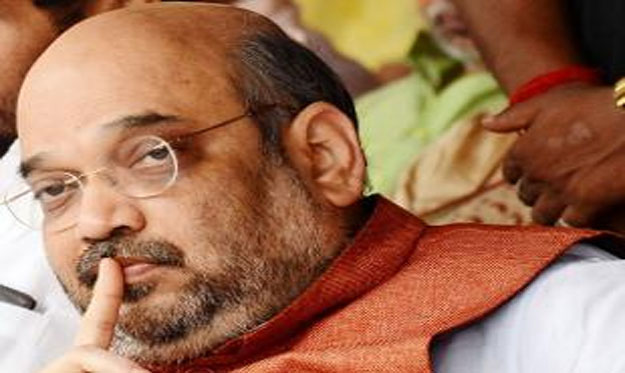
नई दिल्ली। उत्तर प्रदेश विधानसभा चुनाव से पहले भाजपा में बगावत शुरु हो गई हैं। भाजपा ने उम्मीदवारों की जो लिस्ट जारी की है उसमें “बाहरी” लोगों को शामिल किए जाने से नाराज यूपी बीजेपी कार्यकर्ताओं ने विरोध प्रदर्शन किया। भाजपा कार्यकर्ता बुधवार को अशोका रोड स्थित बीजेपी मुख्यालय पहुंचे। जहां गुस्साए कार्यकर्ताओं ने ना सिर्फ पोस्टर लहराए बल्कि भाजपा के वरिष्ठ नेताओं समेत अमित शाह के खिलाफ नारेबाजी भी की।
इस दौरान कुछ कार्यकर्ता पार्टी ऑफिस के अंदर प्रदर्शन कर रहे थे, वहीं अधिकतर लोग बाहर से नारेबाजी कर रहे थे। नारेबाजी में 'अमित शाह मुर्दाबाद, बाहरी लोगों को टिकट देना बंद करो, पुराने कार्यकर्ताओं की इज्जत करो' जैसे नारे लगाए गए। वहीं भाजपाइयों ने कई बैनर भी लहराए जिनपर लिखा था, 'सर्वे के नाम पर झूठ बोलना बंद करो और बाहरी लोगों का सम्मान, वहीं अपने कार्यकर्ताओं का अपमान बंद करो।'
दरअसल इन कार्यकर्ताओं की नाराजगी केंद्रीय मंत्री महेश शर्मा से थी, जोकि यूपी के नोएडा से भाजपा सांसद हैं। भाजपाइयों ने एक बैनर पर लिखा था, 'महेश शर्मा को अनैतिक तरीके से पार्टी पर कब्जा बंद करना चाहिए।' इसके अलावा उत्तर प्रदेश चुनावों के लिए यूपी के बीजेपी प्रभारी ओम माथुर के खिलाफ भी नारेबाजी की गई। कार्यकर्ताओं का आरोप है कि पार्टी ने उनका इस्तेमाल रैलियों में भीड़ जुटाने के लिए किया, लेकिन प्रत्याशियों को चुनते हुए उन्हें भुला दिया गया।
आपको बता दें कि भाजपा में बाहरी लोगों को शामिल किए जाने के खिलाफ यूपी में कई जगह पार्टी के खिलाफ प्रदर्शन हुआ। कई जगहों पर पार्टी का झंडा और सीनियर लीडर्स के पुतले जलाए गए हैं। वहीं, भाजपा नेता यह कहते हुए पल्ला झाड़ रहे है कि चुनाव आने पर ऐसी घटनाएं आम होती हैं। उनका कहना है कि भाजपा ने दूसरी पार्टी के उन नेताओं को शामिल किया है जो अपने क्षेत्र में दबदबा रखते हैं।
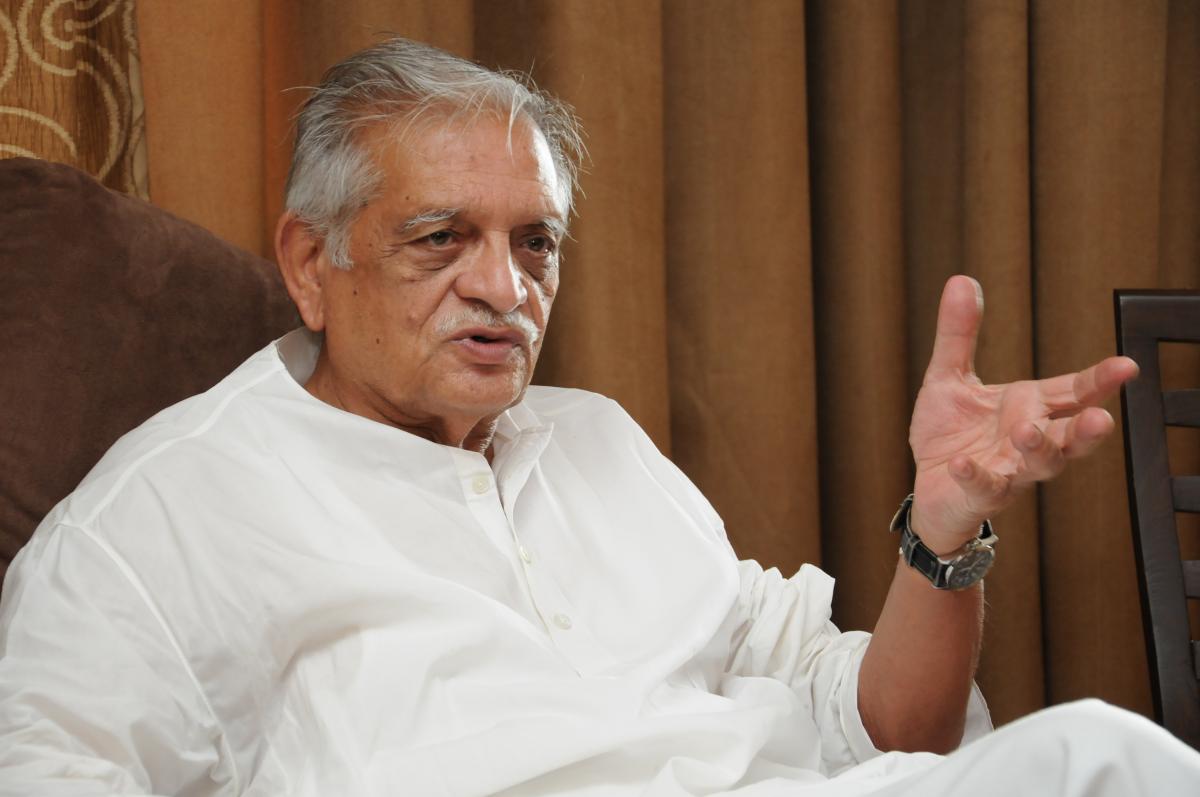
Poet-lyricist Gulzar has now come out with a book of poems and the topics range from the political climate in the country and intolerance to the plight of the common man, and from atrocities against Dalits to Indo-Pak relations.
The 52 poems in “Suspected Poems” are written by Gulzar in his inimitable style and reflect and comment, sometimes elliptically through a visual image and sometimes with breathtaking immediacy and directness, on the political reality in the country today. The poems, originally written in Hindi, have been translated into English by Pavan K Varma.
In the poem “There’s Nothing New in New Delhi”, Gulzar says, “There is nothing really new in New Delhi/ Except that every five years a new government comes in/ And converts old issues to new schemes./ Opening scabbards anew /They unsheathe again all the rusted laws/ That can cut neither grass, nor necks!”
“Gulzar Sahib writes poetry of an order that has few parallels today. His poems are, therefore, hardly ‘suspect’! So when he told me that the next volume of his poems would be called ‘Suspected Poems’, I was both amused and intrigued,” says Varma, who has translated three other volumes of Gulzar’s poems.
“But, this is the first time I have worked on a collection that is ‘suspected’! As always, there is a method to Gulzar’s occasionally elliptical genius. To my mind, these poems are all part of a specific genre. That genre relates both to larger public issues and to politics.
“It is not as though Gulzar has not poetically commented on developments in this area in the past. But, for the first time perhaps, all the poems in a volume by him are organically animated by this theme. It would be devaluing Gulzar’s poetic sophistication to believe that he might pen a polemical or partisan lyric on issues of national concern,” he says.
The poem on Kalburgi reads: “He did not die… The person who died and lies on the threshold Is someone else…”
Another one on news titles “The Same News” goes: “Every day the same newspaper column/ Gulps of the same brackish news/ Every day the same mouthful of promises/ Sentences dissected/ Each word chewed again and again.”
There are two poems on Babri and Ayodhya in the book, published by Penguin Random House.
The one on Babri reads: “From the smoke that rises daily/ A part of the sky/ Now remains black the whole day/ Only pariah kites hover above./ Families of vultures sit/ On some half-charred trees below/ Their stomachs bloated;/ Amidst the heaps of garbage lying around/ Heads on ice-cold corpses smoulder/ As the animals of dusk/ Fight for every bone of rotting limbs/ Whoever can sink their teeth in first/ Has the right over that piece of flesh./ Who was the one who struck the first blow of the axe?/ Yes, this indeed is that piece of land/ Which till yesterday was also a home to some god!”
In “Ayodhya”, Gulzar writes: “Where he once lived Is a very small town now;/ Now he is spread across the sky/ Like the light of the sun;/ I came to Ayodhya to see his ‘janmabhoomi’./ Surrounded by iron bars/ He sits behind strong barricades/ Listening to people now…/ Hordes of people come to see him;/ If you go too close/ The sentry on duty/ Pushes the crowd back with his gun./ He was an avatar once – / But looks completely like a minister today/ Not moving an inch without security!”
The topics of the other poems range from Indo-Pak relations, border posts, neighbours and Karachi to traffic jam, procession, Ramzan and newspapers, to high heels, kabaddi, blood test and tattoo.
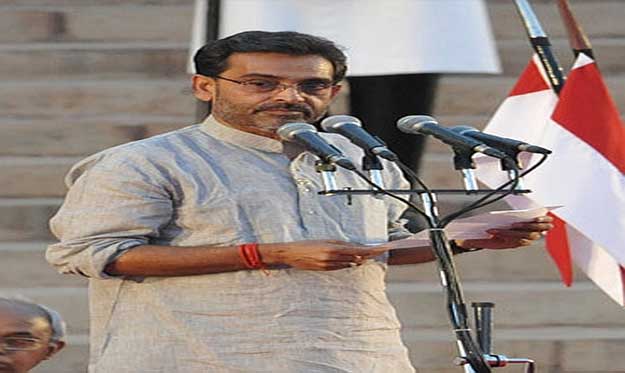
नई दिल्ली। केंद्रीय मानव संसाधन विकास राज्य मंत्री उपेंद्र कुशवाहा को पांच राज्यों में चुनाव के आते ही अन्य पिछड़े वर्ग की याद आई है। उपेंद्र कुशवाहा ने अन्य पिछड़ा वर्ग के वोटरों को लुभाने के लिए पांसा फेंकना शुरु कर दिया है। दिल्ली में एक कार्यक्रम के दौरान उन्होंने कहा कि नवोदय विद्यालयों में अन्य पिछड़ा वर्ग के छात्रों के लिए आरक्षण न होना चिंता का विषय है।
देश के जवाहर नयोदय विद्यालयों में अन्य पिछड़ा वर्ग के छात्रों को आरक्षण के लिए आरक्षण नहीं है।। उन्होंने कहा कि "नवोदय विद्यालय में अन्य पिछड़ा वर्ग का आरक्षण नहीं होना विसंगति है। केंद्रीय मंत्री ने कहा कि आने वाले समय में सरकार इस मुद्दे को संज्ञान में लेगी।"
राज्य मंत्री ने कहा कि देश में 600 जवाहर नवोदय विद्यालय हैं। लेकिन किसी भी विद्यालय में आरक्षण लागू नहीं है। उपेंद्र कुशवाहा ने का मानना है "जवाहर नवोदय विद्यालयों में ओबीसी के संबंध में आरक्षण के प्रावधानों को लागू नहीं किया गया, ये खुद मुझे अच्छा नहीं लगता है।" केंद्रीय मानव संसाधन विकास राज्य मंत्री ने ये बातें राष्ट्रीय सांस्कृतिक एकता सम्मलेन के दौरान कहीं। उनके मुताबिक "मंत्रालय, हमारे मंत्री और हम सभी का ध्यान इस दिशा में गया है। उन्होंने लोगों को विश्वास दिलाया कि आने वाले समय में इस समस्या को हल किया जाएगा।"
प्रकाश जावड़ेकर ने कहा "जवाहर नवोदय विद्यालयों में प्रवेश प्रतियोगिता परीक्षाओं के जरिए दिया जाता है, और इस साल करीब 22 लाख बच्चों ने प्रतियोगी परीक्षा में भाग लिया था जिनमें 40,000 को चुना गया। प्रकाश जावड़ेकर ने आगे कहा कि नवोदय विद्यालयों में अनुसूचित जाति के बच्चों के लिए भी आरक्षण का कम प्रावधान है लेकिन 25 फीसद बच्चे एससी कैटेगरी से आते हैं।"
केंद्रीय मानव संसाधन विकास राज्य मंत्री उपेंद्र कुशवाहा राष्ट्रीय लोक समता पार्टी के नेता हैं जो केंद्र में राजग सरकार में सहयोगी हैं. उनका बयान ऐसे समय में आया है जब उत्तर प्रदेश समेत पांच राज्यों में अगले महीने चुनाव होना है।
Politico reports that the hotel, which sits on fedeal property, has banned press
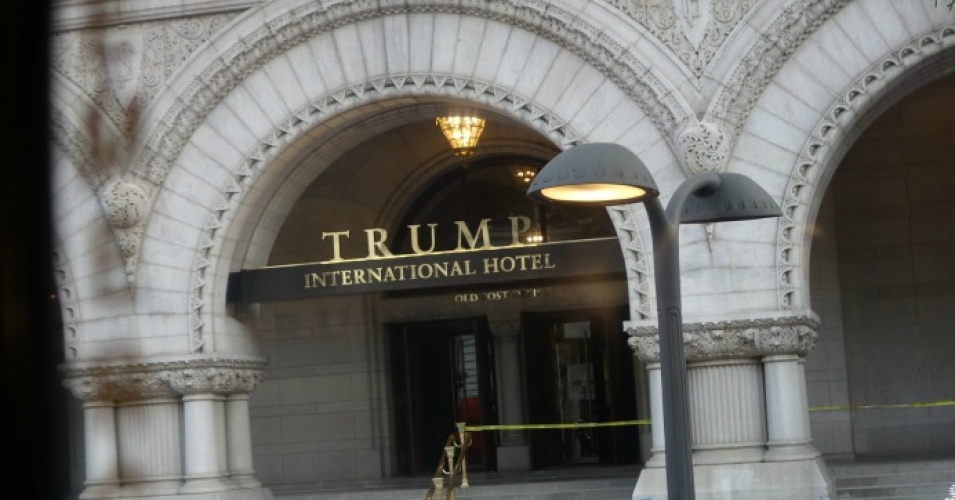
Politico reports that the Trump International Hotel in Washington has banned the press for inauguration week. (Photo: mr_t_77/flickr/cc)
The Trump International Hotel in Washington has banned the press from its premises for inauguration week, Politicoreports Wednesday.
Politico reporter Daniel Lippman was prevented from entering the property on Wednesday after being stopped and identifying himself as a journalist. Lippman writes that hotel's director of sales and marketing Patricia Tang sent an email stating: "Media is not allowed in this week in respect of the privacy of our guests."
The hotel is on federal property—it's owned by the General Services Administration. Trump and his three adult children, Ivanka, Eric, and Donald Jr., hold a 60-year lease on it, a link to which Lippman includes in his story. It states that barring "a risk to public safety," the tenant cannot close access, and that time restrictions would need approval of the landlord. In addition, Lippman notes,
D.C. legal code prohibits public places like hotels from denying "the full and equal enjoyment" of its facilities to people based on "source of income,” among other reasons, calling it an "unlawful discriminatory practice." "Source of income" could reasonably include one's occupation as a journalist.
Josh Voorhees writes at Slate that the story "reveals two ominous signs about what we can expect in a Trump administration. First, it’s a reminder that Donald Trump and his associates—both inside the government and out of it—have no interest in allowing reporters access unless it is on Trump’s terms."
In addition, notes Voorhees, the move also helps expose "the absurdity of Trump's announced plan to separate himself from his family business empire, of which the new D.C. hotel has become a pillar."
The development follows a vow from the U.S. press corps that Trump will "face a united front" if he continues his hostility towards the press.
In an open letter published Tuesday at the Columbia Journalism Review (CJR), the publication's editor-in-chief and publisher, Kyle Pope, also warns Trump that "off the record and other ground rules are ours—not yours—to set" and that "we decide how much airtime to give your spokespeople and surrogates."
In the weeks surrounding the referendum on Britain’s membership of the European Union, anti-immigrant hate crime in the UK rose to worrying levels, culminating in the dramatic murders of the Polish national Arkadiusz Jóźwik and British MP Jo Cox.
For some, it seems that the victory of the ‘leave’ campaign legitimised hostility towards immigrants and minorities. Brexit was fought on a narrative of division, tapping into deeply-felt tensions that were caused by poverty, growing levels of inequality and a crisis of faith in political representation and democracy. These tensions were then wrapped up in a simplistic package of blame against immigrants. The binary politics of the referendum—‘yes’ or ‘no’—reinforced the narratives of ‘right’ versus ‘wrong’, pushing people to pick sides crudely.
What was happening on the streets was even more present online. The anonymity of the internet offered vitriol a safe haven, with reports revealing a peak in online abuse against those from mainland Europe, British Muslims and other minorities who were openly insulted and told to ‘go back to their country.’
What we’ve seen online in the UK this year is part of a growing global phenomenon. Over the past decade social media has been linked to intensifying religious tensions in Myanmar, where Facebook has been used to feed anti-Muslim sentiment. It has been a catalyst in fuelling post-election conflict in Kenya, where politicians have been calling for violence online. And it has fuelled divisions in the US by reinforcing extreme narratives on both sides during the presidential elections.
Social media has changed the way we communicate. It offers valuable opportunities for connection but at the same time segregates people into social ‘bubbles’ that echo and legitimise one’s own opinions. As Eli Pariser, CEO of Upworthy explains, the growing personalisation of online content, especially news outlets tailored to our interests and opinions, “creates the impression that our narrow self-interest is all that exists.” Rather than offering wider exposure to social and political realities, these bubbles simplify issues and make societies more vulnerable to a ‘mob mentality’ as patterns of hate find fertile ground in a cycle where opinions and assertions go unchallenged.
As a peacebuilding organisation, International Alert’s work in conflict-affected areas around the world has demonstrated time and again that hate speech is never benign. History shows that it has fanned the flames of violence, created a language and culture of enmity, and normalised hostile environments conducive to mass violence. In Rwanda for example, the International Criminal Court has connected hate speech to war and genocide, with newspaper articles and radio broadcasts resulting in widespread acts of violence in 1994. If we are not aware of the tipping points between hate speech and conflict, violence can become a genuine risk.
Online hate speech is all the more harmful because it’s difficult to capture, qualify and regulate, yet it reaches a huge potential audience. Unfortunately, societies are ill-equipped to deal with this phenomenon because legal responses are inadequate, and however well-intentioned technology firms may try to be, they have yet to come up with any effective responses. The criminalisation of hate speech also raises ethical dilemmas: whilst it aims to protect people from harm, it also risks restricting freedom of speech.
The solutions to online vitriol have to be more holistic than simply policing, banning or repressing hateful views. They must involve the development of more responsible political and media practices that re-introduce nuance into public conversation, reflect societies’ complex social identities, and encourage respectful interaction. In the words of political satirist Jonathan Pie, “when will we understand that discussion is key?”
As political and media narratives are increasingly turning legitimate grievances and anger about political failures into irrational fears of the ’other,’ the pathologic phobia and anxiety they generate must be addressed with new tools. In behavioural therapy, one of the most efficient responses to phobia is systematic desensitisation through gradual exposure. Maybe this is what we need, being more exposed to each other, acknowledging each other’s existence and right to be different, accepting each other’s needs and grievances and getting rid of the boogieman.
But unfortunately it isn’t that easy. One experiment that was designed to burst social media bubbles around the US election showed that exposure to opposing viewpoints merely reinforced people’s adversarial attitudes. When divisions are so deep, unmediated exposure only reaffirms pre-existing beliefs. Exposure is not enough: in order to change behaviours, people need to engage safely and willingly in a process of transformation.
Peacebuilding offers a number of tried and tested tools that can help in this process. The first is active listening. In times of uncertainty, we all need to feel that our concerns are being heard, that we can worry about migration, terrorism, the economy or the failure of elite politics without being judged. Expressing one’s needs and fears opens the way to confronting the underlying problems. In addition, conflict analysis, dialogue, mediation and collaborative problem-solving are all tools that can help map grievances and improve relationships among citizens and between citizens and their institutions.
But we also need to find ways to bring these approaches to the online world, adapting the tools of peacebuilding to the particular scale and modalities of the internet, re-imagining citizen-led solutions and creative social responses that can open up the space for alternative narratives and ‘peace speech.’ This is where technology can play an important role.
Existing platforms like YouTube, Twitter and Facebook can be used in innovative ways to encourage dialogue across differences. Recent initiatives such as #refugeeswelcome or Techfugees are good examples of digital tools that facilitate positive responses to migration. Campaigns like #notinmyname or the comical trolling of ISIS leader Abu Bakr al-Baghdadi have allowed Muslims to voice alternatives to the narratives of blame that follow every terror attack, whilst also highlighting the power of humour as a great way to lighten negativity.
Initiatives like YouGov in the UK, Akshaya in India and the Digital Cabinet in Brazil show the potential of digital technology to improve accountability and increase feelings of empowerment by bringing decision-making closer to people. More generally, in our increasingly lonely societies, social media can help us to create social bonds offline, whether cooking and dining with unknown neighbours in supper clubs, meeting with strangers around common interests, or finding a life partner. However, even in the aggregate these constructive initiatives struggle to resist the tide of anger and hate. That’s why International Alert organised a #peacehack in October 2016 designed to find better ways of tackling online hate speech through the use of technology. Developers and designers drew on real-life experiences of online abuse and islamophobia described by schoolchildren from the north of England to understand how digital tools can counter hateful narratives. Ideas that emerged included Hate Speech Stopper, a plug-in that makes you pause and think before using hate speech online, and Noby—an interactive educational tool that offers guidance on how to react when faced with real-life hate crime.
Just as important were the relationships built during #peacehack. Technology professionals found out more about how they can use their skills for peace and social justice. Children had their voices heard and were empowered to craft new solutions. Initiatives like these offer an interesting channel to scale up peacebuilding approaches online. Hate picks no sides—it merely fills the gap left by broken communication. We need to stop blaming each other for society’s ills and start focussing on our basic human need and common interest to live in peaceful and prosperous environments.
Peacebuilders often say that ‘peace is a process’ of building new relationships and repairing broken ones. In an era of digital communication these relationships will increasingly be mediated through the internet, so that is where we need to focus our efforts, starting with younger generations who are both more exposed and less resilient to online hate speech. Peace education and digital literacy can be combined to transform the internet into a more positive and hopeful space.
Mana Farooghi is a Peacebuilding Advisor for International Alert. She works on peacebuilding approaches to violent extremism in the Middle East and Africa as well as on issues of hate speech and islamophobia in Europe.
There has been no response from the Centre over the EC’s proposal to insert a new section, 58B, to enable it to take similar action if voters of a constituency are bribed by political parties
Chief Election Commissioner Nasim Zaidi has written to Law Minister Ravi Shankar Prasad, asking him to revisit the government’s rejection of the Election Commission’s proposal seeking permanent legal powers to cancel polls in case there is credible evidence of voters being bribed.
On June 6 last year, the commission had sent a proposal, seeking an amendment to Section 58A of the Representation of the People Act, 1951, which empowers the EC to adjourn or cancel elections in case of booth capturing.
The EC had sought insertion of a new section, 58B, to enable it to take similar action if voters of a constituency are bribed by political parties.
As first reported by The Indian Express on November 21, 2016, the government’s rejection of this proposal was communicated to the EC in a letter dated September 26, 2016, saying that booth-capturing and bribery are not comparable “as the latter would be a matter of investigation and proof”.
This was reiterated on November 18, 2016, in Prasad’s letter to Zaidi on proposed electoral reforms. The Law Minister’s missive had come 10 days after the PM’s announcement of demonetisation. While announcing the move, PM had referred to the role of black money in elections.
Pressing the government to reconsider its stand, Zaidi wrote on November 23, 2016, “…I would point out that even in case of booth capturing, the Commission takes up follow up legal action only after verification of facts and on satisfaction as laid down under relevant law. Same would be the case on the issue of bribery.”
Although the poll panel had cancelled elections to two Tamil Nadu Assembly seats on grounds of bribery, Zaidi argued that it is not desirable for the commission to resort to its emergency powers frequently to deal with a problem as widespread as bribery.
According to sources, the commission hasn’t heard from the Law Ministry on the proposal.
As per the file notings obtained by The Indian Express, FTII Director Bhupendra Kainthola has directed the heads of departments (HODs) and Deans to route all files pertaining to scholarships and foreign exchanges through the office of the Proctor, who is in charge of maintaining discipline. Documents obtained by The Indian Express, under the Right to Information Act, from various FTII departments showed that the nomination of eight students, who have “disciplinary matters” pending against them, came under the scanner.
Of these, four students were involved in gheraoing then FTII Director Prashant Pathrabhe in August 2015, at the height of the agitation against Chauhan’s appointment.
The four ‘disqualified’ students are also among the 35 students, including some who have since completed their course in FTII, undergoing trial at a Pune court on charges related to the agitation and gheraoing. Files pertaining to four other students eligible for scholarships showed that FTII had denied release of funds, as three of them were accused of “consuming alcohol and creating disturbance”, while another student was accused of ‘talking disrespectfully to and shouting at the Proctor’. Incidentally, the scholarship of the fourth student was cleared after he submitted a written apology.
However, not everyone fully supported the stance taken by Kainthola. Amit Tyagi, Dean (Films), said on September 22, 2016: “Issues of discipline are minor infringements… and should not prejudice our assessment of students who are basically talented. Hence, scholarships should be awarded to students. However, the final decision is with the director.”
Kainthola told The Indian Express, “It’s true that scholarships have been held back, but only in cases of serious indiscipline or when the inquiry is incomplete. It is equally true that scholarships have been released for students who have apologised in writing and promised good behaviour.”
Yesterday I received a disturbing message from a young man in Yemen who fears for his life – not because of the tragic war there but because of something that he wrote.
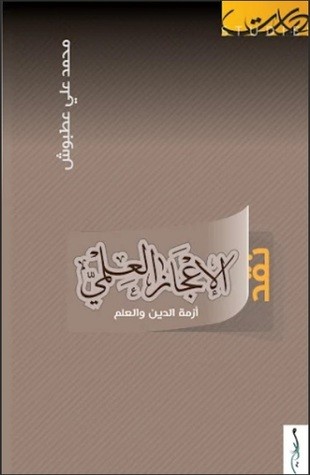
Twenty-year-old Mohammed Atboush (seen in the video above) is a medical student in Aden and the son of a judge. He also takes an interest in philosophy, which led him to write a book about the conflict between science and religion in Islam.
His book, "Critique of Scientific Inimitability", was published last February by Masarat Publishing & Distribution in Kuwait and has been featured at book fairs in several Arabic countries, including Yemen. It looks critically at claims that the Qur'an is a "scientific miracle" – claims which are also included in the Yemeni school curriculum.
The book that Mohammed Atboush wrote
The "scientific miracle" claim is a fairly recent invention and not part of Islamic tradition. It originated in Saudi Arabia in the 1970s and is based on the idea that the Qur'an contains scientific information which could not have been known in the time of the Prophet – thus reinforcing belief that the holy book must have come from God.
Publication of Atboush's book was reported in a factual way by a local news website in September but it is also said to have been denounced in some of the mosques. Then, last month, Atboush narrowly escaped assassination.
The attack happened on the evening of December 29 when Atboush arrived at his family home in Khormaksar, a normally quiet district of Aden. The street was unlit because of a power cut.
Atboush says he was knocking on the door of his home for someone to let him in when a masked man got out of a white Toyota Corolla. The man fired at him from a distance of two metres with a silenced handgun but the bullet hit a wall. Since no one had answered his knocking, Atboush then ran to a hotel nearby to seek help. The masked man fired again before getting back into the car which then drove off.
The attack was widely reported in local Arabic media (here, here, here, here, and here). Police believe it was the work of al-Qaida militants.
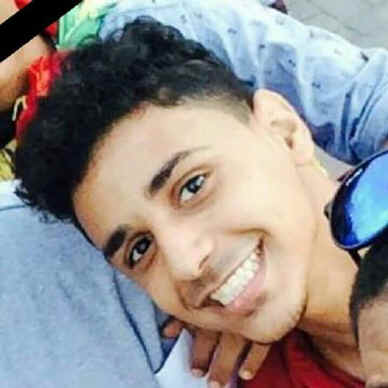
Last April another young man in Aden was murdered after religious fanatics accused him of atheism because of comments he had posted on Facebook. Seventeen-year-old Omar Mohammed Batawil was abducted in front of his home in the Crater district and his body was found later in another part of the city. He had been shot.
Omar Mohammed Batawil: abducted and killed in Aden
Atboush seems to have caused offence by questioning whether the Qur'an really contains foreknowledge of modern scientific discoveries. The idea that it does can be traced back to a French doctor, Maurice Bucaille, who served as family physician to King Faisal of Saudi Arabia in the early 1970s. Bucaille wrote a book, "The Bible, The Qur’an and Science", which was published in 1976. In it, he argued that while the Bible contains many scientific errors, the Qur'an was remarkably prescient: references to the Big Bang, black holes and space travel can all allegedly be found in its verses.
Since then, the idea that the Qur'an is miraculously scientific has given many Muslims a renewed sense of pride in their religion and has become a major tool for Islamic proselytising – with considerable success. In the eyes of others, though, it has done much to discredit Islam.
One popular claim (among many) is that the Qur'an reveals the existence of the ozone layer surrounding the earth.
An article on the True Islam website talks about the ozone layer and begins by explaining its importance in shielding the Earth from harmful rays. “The discovery of the ozone layer,” it continues, “took place many centuries after the Qur’an was revealed, nevertheless, there is mention in the Qur’an about this protective layer that shields us against the sun’s harmful rays.” Then comes the all-important verse:
Until he reached the rising of the sun, he found it rising on a people for whom We had provided no shield against it [i.e. the sun].
For those who don’t immediately see that this refers to a hole in the ozone layer, True Islam's writer explains:
Five implications are drawn from this verse: 1. The word “shield” implies that there is something harmful from the sun, because if there was no harm to come from the sun, there would be no need for a shield. 2. In earlier interpretations of the Quarn [sic] the word “shield” was taken to mean mountains or hills, but mountains and hills do not shield us from the sun’s rays ultra violet rays unless we live all our lives inside one! 3. The phrasing of the verse indicates that the people mentioned as having no shield are in fact the exception and that for the rest of mankind there exists a shield. 4. The words “We had provided no shield” indicate that the shield is a natural one (of God’s making) and not a man-made one. This automatically eliminates the suggestion of houses and other man-made shelters. 5. The verse indicates the presence of a people, and thus areas, that are not shielded. This is in line with the current knowledge concerning the existence of holes in the ozone layer. It is generally thought that these holes have always existed. The matter has suddenly acquired an alarming nature because the size of these holes are greatly being enlarged as a result of man’s pollution of the planet. The only phenomenon that is able to accommodate all these five implications is the ozone layer.
On a more unscientific note, the same verse seems to imply there is a spot, somewhere on earth, where the sun rises. There's also another verse stating that the sun sets into a muddy spring.
This type of Qur'anic "science" relies heavily on linguistic ambiguities. Describing Bucaille's methodology, Pervez Hoodbhoy, a Pakistani physicist, writes: "He asks his readers to ponder on some Qur'anic verse and then, from a variety of meanings that could be assigned to the verse, he pulls out one which is consistent with some scientific fact."
Hoodboy also notes that the same phenomenon can be found in other religions. Hindus used to claim their scripture was full of evidence supporting the Steady State theory of cosmology – until scientists abandoned the Steady State theory in favour of the Big Bank theory. Needless to say, Hindus soon found other scriptural passages “which were in perfect accord with the newer theory and again proudly acclaimed as a triumph of ancient wisdom”.
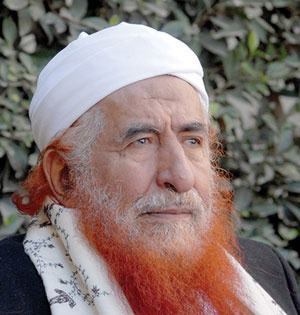
Abdul Majeed al-Zindani
A key figure promoting Qur'anic "science" in the 1980s was a Yemeni sheikh, Abdul Majeed al-Zindani, who worked at King Abdulaziz University in Saudi Arabia and began seeking out western scientists who were visiting the kingdom, with the aim of getting them to say positive things about scientific "knowledge" in the Qur’an. Zindani’s technique was described by Daniel Golden in an article for the Wall Street Journal:
His breakthrough came when one of his assistants, Mustafa Abdul Basit Ahmed, presented a leech to Keith Moore, a University of Toronto professor and author of a widely used embryology textbook.
Mr Ahmed wanted to show that a verse from the Qur’an, which states that God made man as a leech, was an apt simile to describe early human gestation as seen under a microscope. Mr Ahmed says Prof Moore was bowled over by the resemblance between the leech and the early embryo. Since the Qur’an predated microscopes, Prof Moore, son of a Protestant clergyman, concluded that God had revealed the Qur’an to Muhammad.
Moore was so impressed that in 1983 he produced an "Islamic edition" of his embryology textbook, "The Developing Human", which he described as containing the same material as the original version but with the addition of "numerous references to statements in the Qur’an and Sunnah about human embryology". The book is currently available on the internet, free of charge.
Zindani left King Abdulaziz University but in 1984 secured Saudi funding to establish the “Commission on Scientific Signs in the Qur’an and Sunnah”. Mustafa Abdul Basit Ahmed – the man who had presented the leech to Professor Moore – was then employed by the commission at $3,000 a month to travel around North America cultivating scientists, according to Golden.
The commission drew the scientists to its conferences with first-class plane tickets for them and their wives, rooms at the best hotels, $1,000 honoraria, and banquets with Muslim leaders – such as a palace dinner in Islamabad with Pakistani President Mohammed Zia ul-Haq …
During the course of their trips, scientists were presented with verses from the Qur’an to consider in the light of their expertise. Zindani then interviewed them about the verses in front of a video camera, pushing them to acknowledge signs of divine inspiration. Golden spoke to several who felt they had been tricked or manipulated. Here is one account:
Marine scientist William Hay, then at the University of Colorado, was assigned a passage likening the minds of unbelievers to ‘the darkness in a deep sea … covered by waves, above which are waves.’ As the videotape rolled, Mr Zindani pressed Prof Hay to admit that Muhammad couldn’t have known about internal waves caused by varying densities in ocean depths. When Prof Hay suggested Muhammad could have learned about the phenomenon from sailors, Mr Zindani insisted that the prophet never visited a seaport. Prof Hay, a Methodist, says he then raised other hypotheses that Mr Zindani also dismissed. Finally, Prof Hay conceded that the inspiration for the reference to internal waves ‘must be the divine being’, a statement now trumpeted on Islamic websites. “I fell into that trap and then warned other people to watch out for it,” says Prof Hay, now at a German marine institute.Years later, many of the comments from scientists targeted by Zindani are still circulated on the internet.
Zindani, who had long-standing ties to Osama bin Laden, eventually returned to Yemen where he became a prominent figure in the conservative/Islamist Islah party and founded the notorious Iman University, a Yemeni religious institution with about 6,000 students.
Thanks to the university’s research efforts, Zindani claims to have developed a herbal cure for HIV/AIDS. Since 2004, he has been listed by the US as a Specially Designated Global Terrorist, mainly because of his connections with Bin Laden and al-Qaida.