

Demonetisation is an ill-thought out strike against the real economy by Prime Minister Narendra Modi.
Demonetisation is not merely an ill-thought out strike against the real economy by Prime Minister Narendra Modi and his troupe of sycophants and followers.
Perverse Logic
But it bears emphasis that we cannot fully understand the origins of this “surgical strike” (or more accurately “carpet bombing”) that has been let loose by a regime on its own people, if we do not also take into account the obscurantist obsession that drives the perverse logic behind this move. It is also clear that the Modi dispensation saw demonetisation as their distinctive version of a “big bang” announcement that the Vajpayee sarkar had done with the Pokhran nuclear tests. The Parivar's gloating over the secrecy with which demonetisation was unleashed and the constant reference to the “courage” and “boldness” of Modi clearly pointed to this. But most recently, speaking to India Today on December 12, the eminence grise of the Parivar, S Gurumurthy, head of the Vivekananda India Foundation, praised demonetisation as a “financial Pokhran,” evidence that the notion of demonetisation as Modi's bomb is very much on their minds.
The sheer unreason of the move, particularly its singularly backward and primitive understanding of how modern economies work, is one of the reasons why it has confounded economists the world over, across the political spectrum, from Manmohan Singh, Lawrence Summers and Paul Krugman to Kaushik Basu, Deepak Nayyar, Jean Dreze and Prabhat Patnaik. Common to all their criticisms is their astonishment at the foolhardiness of the move, its pointlessness vis-a-vis its stated objectives, its disruption of economic activity on a very large scale, and the suffering it inflicts on a huge number of good citizens (in contrast to the few who are hoarders of illegal wealth – and that too in cash). The obsession of Modi and his followers of course blinds them to what is in fact evident to economists and commentators from all over the world.
Black money (along with corruption) has been a singular obsession of Hindutva – and perhaps its sole original contribution in matters relating to economics. In recent times it has been one of the major issues in the RSS view of what ails Indian society. The RSS was clearly taken by the Anna Hazare campaign against corruption and black money, reflected in the annual reports of the RSS leadership to their Pratinidhi Sabha in 2011 and 2012, which referred enthusiastically to the growing concern with black money among the public. As a well-known Hindutva author, especially on matters of corruption and black money, M G Chitkara, (a lawyer by profession, who also served as the advocate-general of Himachal Pradesh) puts it in his book, Hindutva Parivar (published in 2003), "Hindutva Parivar believes that one of the factors to rejuvenate Indian economy is to be declared the state property, the unaccounted money of terrorists, bureaucrats, politicians, businessmen and others, lying in foreign banks. Such a key can open the Indian economy, locked in Swiss and other foreign banks.” The simultaneous invocation of corruption and terrorism is in striking similarity to Modi's announcement of demonetisation.
This typical piece of prose appears in an amusing chapter titled "Hindu Economics", and as the author goes on to define it: “We need to make national wealth, individually and collectively, along with progress in science and technology, art and culture. Let us stop therefore the culture of social and political pampering, of non-working people and correct our labour laws. All of us should make money but by right means, through intelligence and cleverness and not by deceit and crookedness. That is Hindu economics." It is important to note the moral dimension to this argument – corruption and black money are moral problems and to be solved by enforcing a moral order. A harsh hand is required to set matters right is the underlying message and Modi has lived upto this too – including ignoring parliament in the beginning and then coming in to sit, following repeated opposition demands, without making any statement whatsoever.
Apart from this long-standing obsession, elements of the Parivar were clearly putting pressure on Modi to act – not for "second generation" reforms, but on "corruption and black money". Baba Ramdev criticised Modi openly in mid-2016 and was mollified later. But most interestingly, speaking to the press welcoming Modi's announcement, he claimed in his remarks that he had in fact suggested this very move earlier.
Modi's innovation appears to have been to focus less on foreign banks, though the government has concluded a pact with Switzerland that will see information flow on Indian account holders (but only from 2019), but to act dramatically in the domestic arena. In this new twist to an old Parivar obsession, new obscurantist elements seem to have emerged, of which the most prominent is the Arthakranti Pratishtan. Anil Bokil, its head, has claimed that he was repeatedly consulted by the government, including a one and a half hour presentation made personally to Modi. He has also claimed specifically credit for demonetisation – though Bokil for his part would have left only the fifty rupee note intact and suggests a mad potpourri of other measures including the abolition of all taxes. Bokil's claims have not been contradicted in any way by the government or the office of Modi.
The RSS stalwarts are also involved, with press reports suggesting that Gurumurthy was closely consulted from the beginning.
Demonetisation is the first distinctive Hindutva contribution to economic affairs. In its first stint at power under Vajpayee, and thus far in its second under Modi, the economic policies of the BJP regimes have tended to follow well-trodden paths – without any dramatic departures from the well-known nostrums of neo-liberal economists of varied hues. Indeed with respect to the Congress-led regimes, before and after the BJP's one could clearly see a remarkable continuity. Thus far, in economic policy-making the BJP has not left any significant footprint. If anything it has been a rather poor understudy to the Congress, with a total lack of understanding of agriculture and rural India in particular, and lacking even the minimum deftness of the latter (in measures such as MNREGA, Forest Rights Act, and the like) in staving off the extremes of crisis for the poorest of India's population. The NDA government's ham-handed economic policies clearly led, at least in part, to the resounding defeat of the BJP in 2004. The return in 2014 was perhaps far more due to deep dissatisfaction with the Congress than any promise that the BJP represented, especially in terms of economic policy. India's big bourgeoisie clearly expected more of the same in economic terms, only faster and more efficient than the Congress which appeared to have lost its way –"second generation" reforms was their cry. And thus it has seemed until November 8, as international and domestic analysts have noted, with the Modi government not going much beyond renaming Congress schemes with the names of their own political icons.
Response to this Shift
It remains to be seen whether India's bourgeois establishment will be able to stomach this shift in Modi's economic policy, whatever the other benefits they may reap under his dispensation. They have not been enthusiastic in their reception, even if some well-known cronies have come out openly in support. But surely the chorus of international criticism will make them pause for thought – it is the one thing that they are acutely sensitive to. But this chaos is also surely not what they bargained for, and their international networks are indeed sending the same message rather emphatically. Large-scale disruption of economic activity as a result of Hindutva obsession is not an agenda likely to enthuse them.
At the same time, Modi's move uncovers a rather interesting point about the BJP and the Sangh Parivar. Much has been written earlier with reference to the social base of Hindutva and the BJP in particular within the trading communities and the large mass of merchant capital, mostly of the smaller variety. In the ascendance of Modi to national status, this aspect has been eclipsed in the discussion, with the focus being much more on the large corporate support that he has drawn. However with this move, it is clear that BJP has lost none of the character that one has always associated with its traditional social base in merchant capital, especially the link between its obscurantism and the backwardness of its social base. But in giving rein to its obsessions the BJP has also perhaps initiated its alienation from this base, and has underestimated how far even this backward section of Indian capital has been drawn into the larger changes in the Indian economy.
Modi's “financial Pokhran”, to use Hindutva's own phrase, is a weapon of mass destruction, meant not to threaten external enemies or ward off external threats, but a weapon unleashed on India's people themselves, causing immense damage in the short run with unforeseen long-term consequences. It is imperative that this message is delivered simply, clearly and urgently by democratic forces across the country.
Courtesy: Newsclick
Image Courtesy: Catch News
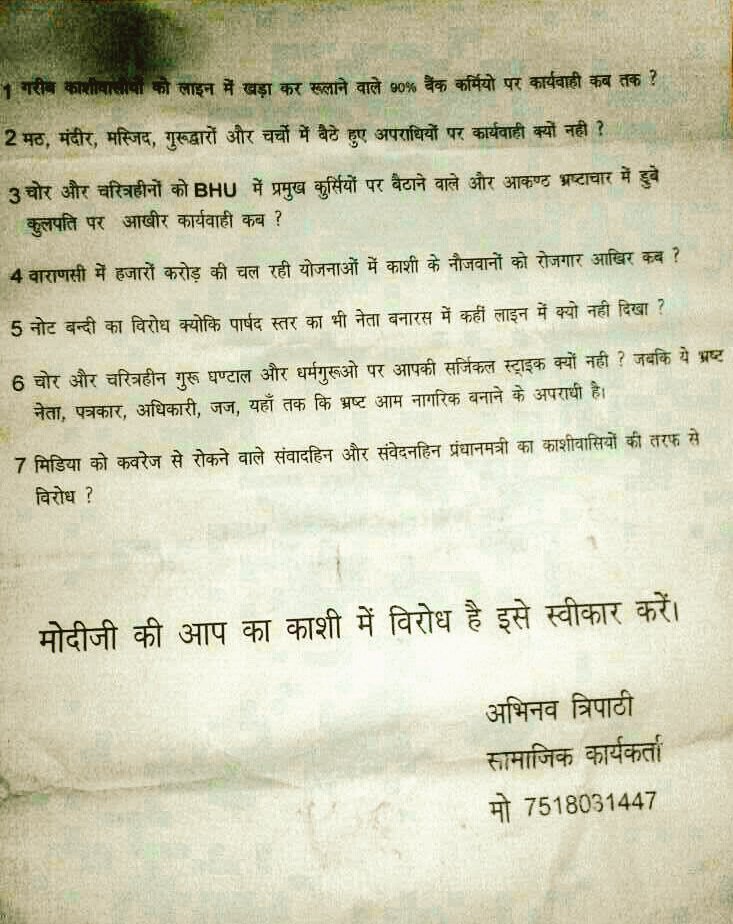


 फ्रांस की क्रांति से लेकर साल 2010 में ट्यूनीशिया से शुरु हुई ‘स्प्रिंग रिवोल्यूशन’ के दौरान इस बात की पुष्टि हुई कि क्रांति और आंदोलनों की जरुरत कभी खत्म नहीं होती. जॉर्ज बर्नार्ड शॉ ने कहा था, ‘इतिहास हमें यह सिखाता है कि हम इतिहास से कुछ नहीं सीखते.’ शासक और राजनेता इतिहास से कुछ नहीं सीखते, से कहना बेहतर होगा कि वे अपनी सुविधा के मुताबिक ही कई चीजें देखते हैं और कइयों से आंखें फेर लेते हैं. उनका इतिहास से सबक न लेना ही कई बार आंदोलन और क्रांति की जरुरत बन जाता है. कई बार क्रांति या इंकलाब की आवाज बुलंद करने वाले ही बाद में एक और क्रांति की जरुरत पैदा कर देते हैं.