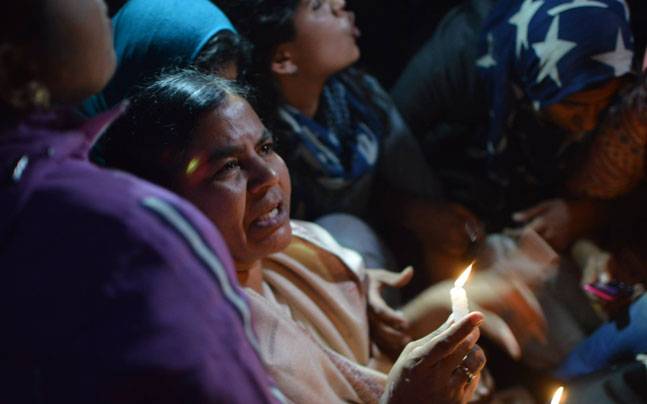
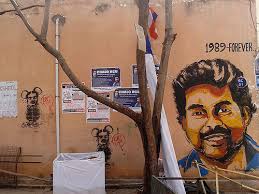
Radhika Vemula was manhandled by the Delhi Police in February 2016 even as then MHRD Minister, Smriti Irani made a speech dis-regarding
the pain of the Dalit students struggle in Parliament
Ambedkarite students of the University of Hyderabad (UoH) have in a detailed and strongly worded memorandum to the President of India, substantiated by 26 authenticated annexures, demanded that he exercise his powers as Chancellor of the university and remove Podile Appa Rao as ViceChancellor . The memorandum also appeals for directions to the Government of Telangana to implement SC/ST Prevention of Atrocity Act in the criminal case (Cr.No 20/2016, Gachibowli Police Station) against the authorities pending in the High Court
The memorandum says that there is a direct link between VC Podile Appa Rao’s actions and the death of Rohith Vemula
The searing letter of Rohith Vemula, dated December 18, 2015 addressed to the Vice Chancellor speaks of the bitter humiliation suffered by Dalit students and sarcastically advises how very Dalit student should be given a hangman’s noose and bottle of sodium azide on admission
Further humiliation was heaped on research scholars including Rohith Vemula after he sent the letter, including expulsion from hostel rooms and being barred from the library and other parts of the university
Podile Appa Rao by not responding to the communication and further humiliating the scholars, demonstrated not just his bias, but his unfitness to hold such a responsible position
The detailed memorandum, signed by three close colleagues of Rohith Vemula, Dontha Prashanth, Vijay Pedapudi and Seshaiah Chemuduguntha is meticulously prepared and states how a sub-standard academic was chosen for the post of Vice Chancellor over more deserving candidates simply because of his connections to central minister Venkaiah Naidu and him being part of the politically strong Kamma caste
Further, it details how the Modi Govt and its Ministers crudely, through the appointment of a one man Roopanwal Commission, tried to untruthfully establish that Rohith Vemula was not a Dalit even as the competent authority of the District Collector had already incontrovertibly proved his caste status
The Memorandum also traces the vicious influence exercised by members of the Akhil Bharatiya Vidyarthi Parishad (ABVP) over the administration of the university
What emerges is, again the alleged chain of command responsibility into the institutional murder (suicide) of research scholar Rohith Vemula on January 17, 2016: Humiliation and unfair treatment meted out by Podile Appa Rao at the instigation and abetment by Bandaru Dattatreya, a Central Minister,N.Ramachander Rao, Krishna Chaitanya, Nandanam Susheel Kumar and Nandanam Diwakar which caused to the death of Rohith Vemula along with injuring the lives of other four Scheduled Caste Research Scholars namely, Dontha Prashanth, Vijay Pedapudi, Seshu Chemudugunta and Sunkanna Velpula
The text of the Memorandum released today may be read here:
To,
His Excellency
Honorable President,
Republic of India,
Respected Sir,
Sub: Sub: Seeking your kind intervention in the removal of Prof Podile Appa Rao as the Vice Chancellor, Hyderabad University, and his arrest under SC/ST (Prevention of Atrocities) Act, 1989
As you are aware, the sad demise of the brilliant research scholar Rohith Vemula on January 17, 2016, following extreme casteist harassment induced by Podile Appa Rao on behest of BJP leaders has shocked the people of this country, triggered nationwide protests and sullied India’s image in the international community as a democratic republic where the rights of the meek are protected by a robust and progressive Constitution.
The facts of the case, which we have summarized below, lucidly point to a grand conspiracy executed through the Hyderabad University’s Vice Chancellor Podile Appa Rao and hatched by ABVP and BJP to persecute and humiliate a group of law-abiding, Scheduled Caste students, one of whom was Rohith Vemula.
Podile Appa Rao’s appointment to the post of Vice Chancellor by the Ministry of Human Resources Development (MHRD), on September 21, 2015 had raised many eyebrows as several candidates, immensely more qualified than Podile Appa Rao, were overlooked and he was chosen solely because his political patrons (Venkaiah Naidu) in BJP on caste (Kamma) lineages had faith that he will pursue their agenda while running the affairs of the university (Annexure – 1).
In the following days after this political appointment, Podile Appa Rao set upon the task that his political masters in the BJP had chosen: destroy the anti-sangh Ambedkar Students Association. Without even conducting an enquiry, he passed orders banning Rohith Vemula and four ASA colleagues from hostels, common areas and contesting in the elections.
The despotic, casteist and patrisan attitude of Appa Rao Podile made Rohith Vemula write him a letter on December 18, 2015 (Annexure -2). Dripping with sarcasm, the letter needs to be quoted in full to establish the levels of despondency to which Rohith Vemula had been pushed:
“To,
The Vice Chancellor
Subject: Solution for Dalit problem
Sir,
First, let me praise your dedicated take on the Self-Respect movements of Dalits in HCU campus. When an ABVP president got questioned about his derogatory remarks on Dalits, your kind personal interference into the issue is historic and exemplary. 5 Dalit students are “socially boycotted” from campus spaces. Donald Trump will be a lilliput in front of you. By seeing your commitment, I am tempted to give two suggestions as a token of banality.
1. Please serve 10mg Sodium Azide to all the Dalit students at the time of admission. With direction to use when they feel like reading Ambedkar.
2. Supply a nice rope to the rooms of all Dalit students from your companion, the great Chief Warden.
As we, the scholars, PhD students have already passed that stage and already members of Dalit Self-Respect movement unfortunately, we here are left with no easy exit, it seems.
Hence, I request your highness to make preparations for the facility “EUTHANASIA” for students like me. And I wish you and the campus rest in peace forever.”
As a follower of Dr.B.R.Ambedkar, being a member of Dalit Self-Respect movement, Rohith Vemula strongly felt that the social boycott and the punishment leveled against Five Dalit Research Scholars belonging to Ambedkar Students Association was a direct attempt to choke the voices of Schedule Caste students who are reading Ambedkar and who are asserting their self-respect.
He also expressed that arrangement of facility such as “Euthanasia” for him can make Appa Rao Podile and campus rest in peace forever, which explicitly shows the amount of harassment induced against Rohith Vemula and Four ASA colleagues by Appa Rao Podile.
Rohith Vemula was found dead in the afternoon of January 17, 2016, hanging by the neck in a friend’s room. There was a letter found in the same room written by Rohith Vemula which makes it amply clear that he felt deeply dehumanized at multiple levels note made it amply clear that he felt deeply dehumanized at multiple levels. Read along with his earlier suicide notice to Podile Appa Rao exactly 1 month before i.e December 18, 2015, in which he suggests that the administration should provide a rope to Ambedkarite students to kill themselves instead of following Ambedkar’s teachings, clearly points to the discriminatory atmosphere created by the administration, and to all those who pressured him and robbed him of his dignity in this process and in society, as the cause for his suicide.
We see this as an institutionally sanctioned murder, where the institution persecuted him and passed a casteist order of social boycott intended to humiliate him and lead him into a state of resignation.
Instead of protecting a student, who was being pressured furiously by the BJP and the Central Government, who in turn were acting in affiliation with their student group ABVP rather than behaving professionally as non-partisan governers of the public, the University administration issued a punishment without providing any material proof of wrongdoing.
The former Vice-Chancellor, R P Sharma and the Medical Officer of the University had visited the complainant ABVP student — Nanandam Susheel Kumar who is from a family of BJP leaders — in the hospital. The medical records shown to them at the hospital clearly stated that the ABVP leader had been operated for appendicitis (Annexure -3). The medical records showed no evidence of beating or external injuries.
These facts were duly noted in the interim report of the Proctorial Board, which concluded that there was no evidence to prove that Nandanam Susheel Kumar had been assaulted. However, bucking under immense political pressure (Para-2, Page No. 10), the final order summarily suspended five ASA leaders including Rohith Vemula.
This order was revoked in less than three days as it was found that the entire process was vitiated by the fact that the enquiry committee did not have a single SC/ST member, did not summon either the complaint ABVP leader or the ASA leaders who he had falsely charged with assault. The orders were revoked on the condition that the entire enquiry would be conducted afresh.
Podile Appa Rao was introduced to the campus as the Vice Chancellor — overlooking many superior scholars — at this crucial stage by the Ministry of Human Resources Development with the objective of executing a sinister plan. He influenced an order by the Executive Council — banning Rohith Vemula and his four ASA colleagues from hostels and common areas — without conducting a fresh enquiry. It is with the objective of vitiating the fresh enquiry that Prof Apparao was selected out of turn by the Ministry of Human Resources Development.
This arbitrary, unjust and politically motivated order was supported by the Vice Chancellor Appa Rao despite the fact that it was based on an order that had been nullified by the previous Vice Chancellor on the grounds that the procedure employed was unfair and violative of the principles of natural justice.
The five ASA leaders including Rohith Vemula — the targets of the Vice Chancellor — were brilliant research scholars, in the prime of their youth with dreams of reforming society based on the ideals of the Indian Constitution and Dr B R Ambedkar. Each of the five was also a first generation university entrant, raised in extreme poverty and dependent on State support for his education.
By expelling them from the hostel, Podile Appa Rao cut off a crucial lifeline for these students and by banning them from public spaces, he subjected them to the worst form of social exclusion. The order passed by Podile Apparao effectively banished the students from the university community.
He did not care about the evidence before him. He did not even give the ASA leaders a chance to present their side of the story.
What can explain this cruelty besides the fact that it was motivated by extreme hatred? It is a hatred of an ancient kind; the kind that was outlawed by the Indian Constitution and subsequently the SC/ST (Prevention of Atrocities) Act, 1989. What Podile Apparao committed was an act of caste hatred intended to lower the social standing of the five Scheduled Caste scholars in front of the entire elite of the academic community.
There is a direct link between Podile Appa Rao’s actions and the death of Rohith Vemula. He must be held both ethically and criminally responsible.
We had hoped that Rohith Vemula’s death would stir the conscience of the government and law enforcement agencies and result in the swift delivery of justice. Hon’ble Chief Minister of Telangana, Sri. K.Chandrasekhar Rao had made a statement in the assembly on 26/03/2016, that he would ensure for recall of Podile Appa Rao, Vice-Chancellor, University of Hyderabad and subsequently would speak to the Prime Minister on the same. Even Prime Minister Narendra Modi shed crocodile tears when students of Babasaheb Bhimrao Ambedkar University protested against BJP during convocation on the incident of Rohith Vemula Suicide, where he said “Mother India Lost its Son”.
However, what happened later only exposes the hypocrisy, casteism and despotic nature of BJP in persecuting Dalits, infact they witch hunted Rohith Vemula’s mother Radhika Vemula who declared a fight seeking Justice for her son Rohith Vemula against BJP and Podile Appa Rao. Despite National Commission for Scheduled Castes having declared Rohith Vemula as Scheduled Caste, despite the competent authority such District Magistrate having declared Rohith Vemula as Scheduled Caste, BJP led centre in an utmost cruel and inhuman manner formed and directed a one-man commission led by Ashok Kumar Roopanwal to deliver the utmost unjust verdict, by terming Radhika Vemula as one who faked her identity. Such highhandedness by BJP was displayed in order to save their henchmen and their ministers from the SC/ST Prevention of Atrocities Act. Since, Rohith Vemula’s institutional murder, almost a year has passed without the culprits having to face even the slightest inconvenience.
Indeed, it is our case that the people responsible for pushing Rohith Vemula toward suicide have been protected from the law and rewarded for their mercenary actions with unwavering political patronage. On the other hand, the students of Hyderabad University, who employed peaceful means to agitate for justice for Rohith Vemula, were systematically harassed by the Central and State governments, the Telangana police and the university administration. There were cases registered against both students and faculty, and they were sent to Charlapally Central Prison for registering their dissent against Prof.Podile Apparao who returned as Vice-Chancellor on 22nd March 2016 with the blessings of Venkaiah Naidu.
We also would like to elucidate a brief timeline of events explaining the episode around Rohith Vemula’s suicide and the intervention of BJP and Central Cabinet Ministers leading to the Social Boycott of Five Dalit Research Scholars.
03rd August 2015:
Ambedkar Students Association (ASA), University of Hyderabad (UoH) organized a protest gathering “Against ABVP attack on Montage Film Society” at University of Delhi, New Delhi. At the protest the ASA also raised the issue of the harassment of the students of the Film and Television Institute of India (FTII), Pune and Pondicherry University.
On the same day, Nandanam Susheel Kumar — a student of UoH and President of the UoH unit of the Akhila Bharatiya Vidyarthi Parishad (ABVP) and the son of a BJP leader ( Nandanam Vinaya ) — posted a comment about the agitating Dalit students of ASA on Facebook at about 09:18 PM in which he said: “ASA GOONS ARE TALKING ABOUT HOOLIGANISM – FEELING FUNNY” (Annexure -4).
The derogatory and provocative statement was posted with the sole aim of humiliating Scheduled Caste students and typecasting them as antisocial elements.
While reinforcing the centuries-old negative stereotyping of Scheduled Caste communities, the comments by the ABVP president created an air of hatred, enmity, and ill-will toward these marginalized communities.
Although deeply outraged, ASA members decided that it was best to solve this issue using peaceful methods. In the presence of Duty Security Officer Dilip Singh (Annexure – 5), Nandanam Susheel Kumar was asked to explain why he had referred to a group of students, who expressly follow the teaching of Dr B R Ambedkar and tenets of the Indian Constitution, as “Goons”. He failed to explain his actions and subsequently agreed to issue an unconditional apology in writing (Annexure -6).
04.08.2015
In less than 24 hours, the grand conspiracy, hatched by a powerful political party, against the ASA, which has no political affiliations besides its commitment to the teachings of Dr B R Ambedkar, began to unfold.
First, about 100 activists of Bharatiya Jana Yuva Morcha (BJYM) led by Bharatiya Janata Party MLC, N Ramchandra Rao blocked the main gate of the university alleging that ASA students had assaulted Nandanam Susheel Kumar. N. Ramachandra Rao even went inside the administrative building and threatened the then V.C Prof. R.P.Sharma that “if action is not initiated against the students of ASA, outsiders will teach them a lesson”. This fact is recorded by the Office of Vice-Chancellor in the detailed minutes of the meeting on 04.08.2015 (Annexure -7).
In a coordinated move, two formal complaints against ASA leaders were filed — one with the Gacchibowli police and the other with the university management.
In the police complaint, Nandanam Susheel Kumar falsely accused ASA members D Prasanth, Ch Seshaiah, V Sunkanna, Vemula Rohit and P Vijay Kumar of assaulting him and police registered a case (Crime number 296/2015) under Sections 448 (trespass), 341 (wrongful restraint), 506 (criminal intimidation), 323 (voluntarily causing hurt) r/w 147 (rioting) of the IPC (Annexure -8).
Simultaneously, General Secretary of the ABVP, Mr.Krishna Chaitanya, submitted a complaint to the university management, alleging that Nandanam Susheel Kumar was assaulted the previous night by ASA leaders Rohith Vemula, Dontha Prashanth, K.Vincent, Sunkanna Velpula, Vijay Pedapudi and Seshaiah Chemudugunta (Annexure -9).
That this was a well planned move, is borne out by the fact that Krishna Chaitanya was not even present when Nandanam Susheel Kumar submitted an apology to ASA students.
Following this false and frivolous complaint, several students, including the ASA, demanded a probe into the incident and the matter was referred to the Proctorial Board.
August 5, 2015
The Vice Chancellor along with the Chief Medical Officer of the university and other officials visited the hospital where Nandanam Susheel Kumar was admitted and claiming that he was receiving treatment for the injuries sustained during the alleged attack by ASA students. However, when they perused the medical records, they discovered that a surgery had been performed on Nandanam Susheel Kumar not for injuries but to remove an inflamed appendix (Ref.Annexe -2). This discovery should have been enough to establish the charade that Nandanam Susheel Kumar and his patrons in the BJP were trying to play. But that was not to be the case.
On 10th August, 2015
Sri Nandanam Diwakar, Vice President, BJP, R.R. District, wrote a false, frivolous and malicious letter to Sri Bandaru Dattatreya, Minister of State, Labour& Employment, Government of India, falsely accusing students of ASA and framing false charges aimed at ruining their careers (Annexure – 10).
On 13.08.2015
The university Registrar, basing on the Interim report of Proctorial Board issued a strong warning to N. Susheel Kumar for posting objectionable comments on Facebook against the ASA. Strangely, and despite the fact that the Proctorial Board found no evidence of violence against Nandanam Susheel Kumar, the Registrar warned Rohith Vemula, Dontha Prashanth, K.Vincent, Vijay Pedapudi for seeking apology instead of complaining to appropriate authorities (Annexure -11 ).
On 17th August 2015
Bandaru Dattatreya, Union Minister for Labour and Employment precipitated matters further by writing a letter to Smt. Smriti Zubin Irani, then Minister of Human Resource Development persuading the ministry to intervene in to the affairs of the university and take action against members of Ambedkar Students Association (Annexure -12). Subsequently, on 03rd September 2015 Ramjee Pandey, Under Secretary to MHRD sent the letter of Bandaru Dattatreya to Registrar, University of Hyderabad through E-Mail (Annexure -13).
On September 8, 2015
The political pressure had its intended effect. Contrary to the findings of the Proctorial Board in the interim report, the final report deemed the five research scholars of the ASA guilty and they were summarily suspended. It is pertinent to note that the committee which passed the orders did not have a single SC or ST member (Annexure – 14).
On September 10, 2015
Citing the glaring lapses in procedure, including the fact that no evidence of beating Susheel Kumar was found, Murala Rupa, General Secretary of ASA, wrote to the Vice Chancellor seeking immediate revocation of the suspension and the establishment of a separate enquiry committee or a Proctorial Board with different set of members for an impartial enquiry (Annexure -15).
On September 11, 2015
Based on the on Murala Rupa’s representation, the suspension order was revoked subject to afresh enquiry to look into the incident that took place in the intervening hours of August 3 and 4 (Annexure 16).
On September 21, 2015
Professor Podile Appa Rao was appointed as new Vice-Chancellor by MHRD overlooking several candidates who were far more qualified than him (Ref. Annexe – 1).
On September 24, 2015
Subodh Kumar Ghildiyal, Deputy Secretary, MHRD addressed a letter to Registrar, University of Hyderabad with the following Subject line: “Antinational activities in Hyderabad Central University premises – Violent attack on Sri Nandanam Susheel Kumar, Ph.D. student and President of ABVP – reg.” Taking a clear stand in favor of the BJP, ABVP and Nandanam Susheel Kumar, and without any direct access to the material facts of the case, Mr Ghildiyal sought an expeditious report on the imaginary attack that took place in the intervening hours of August 3 and 4 (Annexure -17).
On 06th October 2015
Subodh Kumar Ghildiyal sent a second letter, this time to the political appointee, Vice Chancellor Podile Apparao expressing non-receipt of facts/comments on earlier letter dated 24-09-2015 and requested for expedition of the process (Annexure -18).
On October 20, 2015
Sukhbir Singh Sandhu, Joint Secretary, Central Universities and Language, sent a letter to Vice Chancellor Podile Appa Rao asking him to personally initiate action against the ASA students on the basis of the letter written by Bandaru Dattatreya to Smriti Zubin Irani (Annexure -19).
On November 19, 2015
Further pressure was applied, through a letter written by Ramji Pandey, Under Secretary, MHRD addressed to Podili Appa Rao (Annexure – 20). This letter referred to the letter written the previous month by Sukhbir Singh Sandhu and instructed Podile Appa Rao to follow up on the matter. Again, the letter made it clear what the MHRD’s political view was on the subject line, which read: “Antinational activities in Hyderabad Central University premises – Violent attack on Sri Nandanam Susheel Kumar, Ph.D. student and President of ABVP – reg.”
NOTE: None of these letters of duress from powerful officials acknowledged the fact that no evidence had been found against the ASA leaders and that Nandanam Susheel Kumar had been hospitalized not injuries but for an appendicitis surgery.
On November 27, 2015
Podile Appa Rao performed precisely the kind of task he was chosen for by his political masters. As chairman of the Executive Council, he put pressure to take action against the Scheduled Caste students who had been falsely accused. At his prodding, its 167th meeting, the Executive Council passed orders banning the five ASA students from accessing the hostel, other common areas, the administrative building (Annexure – 21). The social boycott of these students from the university community was completed by barring them from contesting the student body elections.
It is of great significance that this unjust order — passed without a proper enquiry and without giving the defendants a chance to respond to the allegations — was issued by a committee that did not have a single SC or ST member.
On December 04, 2015
Keeping with the script, Podile Appa Rao approved the order passed by the Executive Council. He took this hasty step knowing full well that the EC’s order was passed without conducting a proper enquiry and without giving the students a chance to respond in their defence.
With this one act, Podile Appa Rao compromised the autonomy of the university with the sole purpose of endearing himself to his political masters in the government.
On December 17, 2015
The beneficiaries of this fraudulent action of the Vice Chancellor, the ABVP, heaped further insult on the ASA students by putting up posters across the campus titled: “Fitting Verdict to Goondas” (Annexure – 22). The text of the said posters was equally derogatory and once again described ASA activists as “Goons”. A jubilant Nandanam Susheel Kumar, President, ABVP also shared the digital version of this poster on Facebook.
On December 18, 2015
Rohith Vemula along with other students submitted a representation to Chief Proctor in which a strong protest was lodged against the humiliating and provocative posters circulated by the ABVP (Annexure -23). On this occasion, Rohith Vemula also stressed that ABVP is clearly trying to instigate unrest and distort the peace on campus. But no action was taken against N.Susheel Kumar, ABVP and others.
On the same day, dejected and depressed at the biased, arbitrary and blatantly discriminatory attitude of Podile Appa Rao, Rohit Vemula addressed a letter to him expressing his unease and displeasure at the commitment and personal interest shown by the VC to persecute Dalit students.
Dripping with sarcasm, the letter needs to be quoted in full to establish the levels of despondency that Rohith Vemula had been pushed:
“First, let me praise your dedicated take on the Self-Respect movements of Dalits in HCU campus. When an ABVP president got questioned about his derogatory remarks on Dalits, your kind personal interference into the issue is historic and exemplary. 5 Dalit students are “socially boycotted” from campus spaces. Donald Trump will be a lilliput in front of you. By seeing your commitment, I am tempted to give two suggestions as a token of banality.
1. Please serve 10mg Sodium Azide to all the Dalit students at the time of admission. With direction to use when they feel like reading Ambedkar.
2.Supply a nice rope to the rooms of all Dalit students from your companion, the great Chief Warden.
As we, the scholars, PhD students have already passed that stage and already members of Dalit Self-Respect movement unfortunately, we here are left with no easy exit, it seems.
Hence, I request your highness to make preparations for the facility “EUTHANASIA” for students like me. And I wish you and the campus rest in peace forever.”
But nothing could move the VC and the five students had no option but to start living in the open in the harsh winter without access to food, water and sanitation.
On January 14, 2016
The Joint Action Committee for Social Justice comprising Students’ Union 2015-16 (officially elected body), and all students organization except ABVP requested the Vice-Chancellor to terminate the illegal order imposed upon Five Scheduled Caste Students. The demonstration had absolutely no impact on Podile Apparao.
Rohith Vemula, whose family depended on money that he sent home, became increasingly restless as he was barred from entering the administrative building and submitting his claims to fellowship. Some unseen hands had choked up his funding and he had not received his fellowship for 7 months. Several students are witness to the fact, and willing to testify before anybody, that Rohith Vemula was haunted by the financial troubles imposed on him by the university management. He was also severely dispirited in his last days and repeatedly spoke of the futility of fighting for social change against an all-powerful political adversary.
January 17, 2016
Rohith Vemula was found dead in the afternoon of January 17, 2016, hanging by the neck in a friend’s room. His suicide note made it amply clear that he felt deeply dehumanized at multiple levels (Annexure -24). Read in context with his note to Podile Apparao exactly 1 month before, suggesting that he should provide a rope to Ambedkarite students to kill themselves when repeatedly encountering such blatant violations of their dignity in the University, it clearly points to the actions of the administration, and to all those who pressured him and robbed him of his dignity in this process and in society, as the cause for his suicide.
January 18, 2016
A complaint was lodged by Dontha Prashanth at Gachibolwi Police Station registered as FIR : 20/2016, against the harassment, atrocities. Humiliation, injustice by Podile Appa Rao at the instigation and abetment by Bandaru Dattatreya, N.Ramachander Rao, Krishna Chaitanya, Nandanam Susheel Kumar and Nandanam Diwakar which caused to the death of Rohith Vemula alongside injuring the lives of other four Scheduled Caste Research Scholar namely, Dontha Prashanth, Vijay Pedapudi, Seshu Chemudugunta and Sunkanna Velpula (Annexure -25)
It distresses us to bring to your notice the fact that Podile Appa Rao is not just a casteist criminal but a substandard scholar as well. It has been proved beyond reasonable doubt that Prof Apparao is a plagiarist (Annexure – 26).
Against this backdrop and on the basis of facts summarized above, we sincerely urge you to remove Prof.Podile Appa Rao as Vice-chancellor of University of Hyderabad with a subsequent direction to the Government of Telangana to implement SC/ST Prevention of Atrocity Act in the matter related to Cr.No 20/2016 at Gachibowli Police Station.
Thanking you,
Yours Sincerely,
(DONTHA PRASHANTH)
(VIJAY PEDAPUDI)
(SESHAIAH CHEMUDUGUNTA)
(The memorandum will be dispatched to the President of India tomorrow)
Related Articles:
- A Letter that Should Shake our World
- Rohith’s Death: We are all to Blame
- Calling Smriti Irani's Bluff: Twisted Truths in Parliament
- When Police act as Sangh’s private army
- HRD Ministry should not be Converted into Hindu Rashtra Development Ministry: CPM
- A Letter that Should Shake our World
- HCU Bows to Campus Outrage: Suspension of 5 Students Revoked