Background:
More than 300 Adivasi children have died in Malkangiri in the past two months of Japanese Encephalitis, official figure says 121 but local activists say the number is much higher, what is happening in Malkangiri?
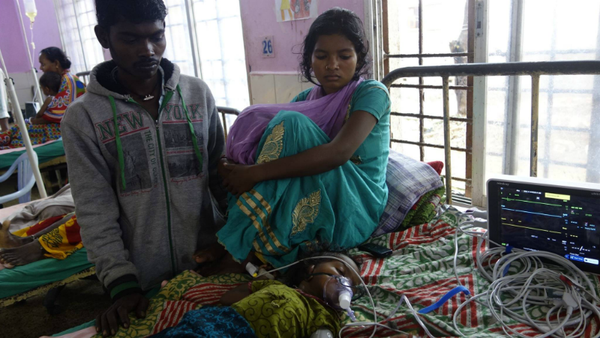
Photo Courtesy: Greeshma Aruna Rai
Firstly, 32 children have been confirmed to have died due to JE. This by itself is cause for concern and requires all the necessary action by the Odisha government. The government is only now waking up to training health professionals to carry out immunization. Why was there so much of a gap in response. It shows that the government has not responded in a timely fashion and is now getting out of a difficult situation by hiring experts who minimize the role of JE and therefore the role of the government, which increasingly the burden of responsibility on the community. Safe and effective vaccines are available to prevent JE. WHO recommends that JE vaccination be integrated into national immunization schedules in all areas where JE disease is recognized as a public health issue. Why has the government of Odisha not done this even if, by their own estimates 32 children had died of JE.
Of those who survive JE infection, 20%–30% suffer permanent intellectual, behavioral or neurological problems such as paralysis, recurrent seizures or the inability to speak. This requires urgent action by the government even if there are one or two confirmed cases. Instead the government did nothing, allowed many more deaths to occur and then brought in an expert committee which then went on to make the community the violator rather than the government. This is like adding fuel to the fire.
The expert committee makes no mention of how they went about ruling out JE. Did they do IgM Elisa tests on all the children? If yes, what were the findings? And if no, it only points to how delayed government response has been.
Surveillance of the disease is mostly syndromic for acute encephalitis. Confirmatory laboratory testing is often conducted in dedicated sentinel sites, and efforts are undertaken to expand laboratory-based surveillance. Case-based surveillance is established in countries that effectively control JE through vaccination. Why was this not being done in this area??
Safe and effective JE vaccines are available to prevent disease. WHO recommends having strong JE prevention and control activities, including JE immunization in all regions where the disease is a recognized public health priority, along with strengthening surveillance and reporting mechanisms. Even if the number of JE-confirmed cases is low, vaccination should be considered where there is a suitable environment for JE virus transmission. There is little evidence to support a reduction in JE disease burden from interventions other than the vaccination of humans. Following this recommendation by the WHO the government has taken no steps to ensure spread of the disease.
Since Odisha has been shown to have a rising occurrence of JE, all children should be considered to have had JE unless it has been actively ruled out. The expert committee makes no mention of how they went about ruling out JE. Did they do IgM Elisa tests on all the children? If yes, what were the findings? And if no, it only points to how delayed government response has been.
When John claims that ‘we found toxin in the urine samples of a few tested children’, it is hardly the statement of a researcher. How can few then go on to mean that the toxin itself caused the issue? And how can this be extrapolated to all the other children.
Those children about whom it is claimed to have died due to encephalopathy caused due to consumption of seeds of Bana Chakundi, it is unlikely that a community will have continued to eat a food that causes such high mortality. Local knowledge would have identified if deaths due to this seed was high.
All communities who eat this seed are likely to have traces of it in the urine. The only way of confirming is to rule out JE completely which the expert panel doesn’t seem to have done. The traces of anthraquinone in the urine could be a confounding or an aggravating factor.
JE could affect the normal metabolism of this plant Bana Chakundi or aggravate the possible side effects. This plant is being eaten throughout the year and probably by all families. Why are the deaths happening now?
5 urine samples out of 121 children (unofficially the figure stands at more than 300 hundred) who died is hardly evidence
Dr. Jacob John says that the children have eaten the raw seeds and somehow makes that as the cause of the deaths. From finding the toxin in 5 children to making claims that bada chakunda seeds are behind most deaths amounts to misrepresentation and twisting of facts.
Encephalopathy due to any cause will have close similarity. So when the report says that the acute encephalopathy in Malkangiri has close similarity with encephalopathy found in western UP, this doesn’t make sense because encephalopathy would have many similar findings even if due to a variety of causes.
The expert committee is premature at best and with a vested interest of placing the locus of attention on the community than on the government which should have responded with much more urgency and seriousness. The committee has recommend further investigation into relative contribution of JE and encephalopathy along with other causes that might affect the CNS. Without having the baseline data, this expert committee cannot make an absolute statement that some cases were due to diet induced encephalopathy and not as a result of JE.
The maximum that the expert committee can say is that confirmed deaths due to JE are 36 and five of the children who died had the toxin in their urine which could or could not have contributed to the encephalopathy. It is important that all children with symptoms are tested for JE and also the government takes cognizance of the 36 deaths and take immediate and adequate response to prevent further JE deaths. Here the expert team seems to be attempting to underplay the role of JE in the deaths and surmise that toxin found in the urine of5 children automatically means that all the other deaths are due to the plant. How is this scientific and evidence based?
His simple suggestion for managing this crisis is that children and their parents have to be advised not to consume raw Chakundi beans. Where is his evidence for this? To expect a community to break a long tradition, without adequate evidence and basis amounts to abuse of expert position. The government somehow then becomes the benevolent guardian who has to educate the community. Why is the expert team not pushing the government to prevent cases of JE when 32 deaths have been confirmed due to the virus?
Why has this expert group not made any comment on the state of disarray and dysfunction of the anganwadis in the area? Have they made any attempts to find out if these children have been receiving adequate foods?
Just because 64 deaths were JE negative doesn’t automatically mean that they were due to the toxin.
On this, the tribal leader has questioned the effect of consumption of these seeds. According to him, “The tribals very well know about the roots and seeds they eat. This food habit of the tribals finds its way back to hundreds of years back. Each and every member of the family eatsChakundi seeds, then how come they were not infected for so many years?”
About saying that malnourishment could have compounded the diseases, John says that it has to be verified. This is again a flippant attitude because there is enough evidence that with poor nutrition children have a lesser ability to fight disease that they would normally be capable of fighting. Why has this expert group not made any comment on the state of disarray and dysfunction of the anganwadis in the area? Have they made any attempts to find out if these children have been receiving adequate foods? So on the one hand the expert committee wants to wave a wand to take away traditional foods of people while on the other hand the do not even critique that the state has abdicated its responsibility by not providing healthy hot and culturally relevant food to the children as clearly prescribed by the ICDS guidelines.
I completely agree with the tribal MLAs statement that the expert opinion is misleading. I would also add that it may be driven by an agenda. This agenda could be to show that the government had no role in this problem and to minimize the criticisms that have been thrown on the government. In this effort, the expert committee has far overstepped their role of being objective and following due diligence and instead seem to be more focused on giving a report that removes the responsibility from the government.
It is also important to check the credentials of these expert committees and positions that they have taken earlier. The expert committee report has been lapped up by the government and media which is going out of the way to take away the onus of responsibility from the government.
Most JEV infections are mild (fever and headache) or without apparent symptoms, but approximately 1 in 250 infections results in severe clinical illness. Severe disease is characterized by rapid onset of high fever, headache, neck stiffness, disorientation, coma, seizures, spastic paralysis and ultimately death. The case-fatality rate can be as high as 30% among those with disease symptoms. Fever will not occur due to a plant based encephalopathy is it is not infectious. Without correlating with any other clinical signs and symptoms or history, the expert team cannot take one finding of toxin the urine of just five children and then go on to make sweeping statements that the major cause is the plant.
Dr. Sylvia Karpagam is a Public health doctor who works with marginalised communities.
Courtesy: India Resists