First published on: August 1, 2010

It is now or never in Kashmir
“Kashmir may be conquered by the force of spiritual merit but not by the force of soldiers.” – Kalhana Pandit
So total has been the loss of hegemony of Kashmir’s elected representatives, in government and in the legislature, over the last two months, and so desperately brutal the recourse to coercive subjugation of fearless young anger on the streets of the valley, that if ever there was a time to say resistance to authority (sic) deserves to be rewarded with what it seeks, it is now. If the prospect, that is, of the secession of the valley – since other parts of the state of Jammu and Kashmir desire, contrarily, not secession but more complete integration with the union of India – were not fraught with incalculable negative consequences not just for India and Pakistan but for the inhabitants of the valley itself.
To that I shall return.
Just the other day the home minister of India made two significant averments in Parliament. One, that the union recognises that the accession of the state of Jammu and Kashmir was a “unique one”; and two, that apart from all else, the republic and its successive governments had failed to keep promises made to the people of Jammu and Kashmir.
Since the time for pussyfooting about Kashmir is conclusively at an end, it would help to flesh out these two averments beyond the minister’s en passant mention.
A unique accession
It will be recalled that the two conditions agreed upon as the signposts for India’s pre-independence princely states, as determinants of whether they would accede to India or to Pakistan were the religion of the majority within the states and the contiguity of the states to either dominion.
In this context, the three states of Hyderabad, Junagadh and Jammu and Kashmir offered interesting paradigms. Where the first two had Muslim rulers but majority Hindu populations, Jammu and Kashmir had a Dogra-Hindu ruler but a majority Muslim population. Of the three, Jammu and Kashmir, being also contiguous to Pakistan, had the clearest case for accession to Pakistan.
But the ruler of Kashmir, Maharaja Hari Singh, desired accession to neither of the two new countries and wished to remain independent. Having succeeded in signing what was called a “Standstill Agreement” with Pakistan, it was his hope to do the same with India. Except that the fates intervened in the shape of a precipitate invasion of the state he ruled by tribal warriors from the North-West Frontier Province of Pakistan, with that state’s active support and involvement, in late October 1947.
With next to no means of his own to meet, let alone defeat the invasion, he found himself constrained to appeal to India for military help and thus sought accession to the Indian dominion. In a letter dated October 26, 1947 addressed to the then governor general of India, Lord Mountbatten of Burma, the maharaja wrote:
“The mass infiltration of tribesmen drawn from distant areas of the North-West Frontier… cannot possibly be done without the knowledge of the provincial government of the North-West Frontier Province and the government of Pakistan. In spite of repeated requests made by my government, no attempt has been made to check these raiders or stop them from coming into my state… I have no option but to ask for help from the Indian dominion. Naturally they cannot send the help asked for by me without my state acceding to the dominion of India. I have accordingly decided to do so and I attach the Instrument of Accession for acceptance by your government.”
This much from a Hindu ruler who was reluctant to join even a Hindu-majority India but for the fact that circumstances had forced such a decision upon him. And yet, even on acceding, the Instrument of Accession that he signed stated that the accession in no way bound him to “acceptance of any future Constitution of India” (Clause 7) and that “Nothing in this instrument affects the continuance of my sovereignty in and over this state” (Clause 8). Stipulations that to this day continue to colour the fraught history of tensions between the union and the state.
As a result, Article 306A was adopted in the Draft Constitution and in course of time became the much-talked-about Article 370 in the final Constitution of India. Most significantly, the “special status” thus accorded to the state of Jammu and Kashmir, backed by the then home minister of India, Sardar Vallabhbhai Patel (who said to the Constituent Assembly that “in view of the special problems with which the government of Jammu and Kashmir is faced, we have made a special provision for the constitutional relationship of the state with the union”), was accepted without demur also by Syama Prasad Mookerjee, a member of Jawaharlal Nehru’s cabinet who was later to become the most vociferous and disruptive voice of the Hindu right wing. We will come back to this later.
But the best part of the “uniqueness” lay elsewhere, namely in the heroically principled declaration of allegiance to a prospectively secular and democratic Hindu-majority India by a Muslim Kashmiri leader of a Muslim-majority state, Sheikh Abdullah.
Internally, within the princely state of Jammu and Kashmir, a popular movement for the overthrow of the maharaja’s rule had been underway for two decades before 1947, precipitated by the events of July 1931 when some 21 popular resisters were gunned down by the maharaja’s police force in front of a courthouse. The incident marked a watershed in the state’s political affairs and led to the formation of the “Muslim Conference” which came to be led by Sheikh Mohammad Abdullah, a postgraduate from the Aligarh Muslim University who was denied a teaching post in the state by the maharaja’s regime at a time when the number of educated Kashmiri Muslims could be counted on one’s fingertips.
Within mainland India, although the Muslim League had come a cropper in the 1936 elections to the provincial assemblies (held under the Government of India Act of 1935), between that loss and 1946 the party under Mohammad Ali Jinnah made huge strides among Muslims in the states of Punjab and Bengal. It was during this time that Jinnah was to make fervent arguments to Abdullah urging that the Kashmir Muslim Conference join forces with Jinnah’s League and support the Pakistan resolution which the League had passed in 1940.
By then Sheikh Abdullah was undisputedly the tallest leader of the valley and indeed the entire state. Remarkably however, despite the Kashmiri maharaja’s decidedly anti-Muslim regime, and though Abdullah had himself forged the “Muslim Conference”, and despite the fact that Jammu and Kashmir was a Muslim-majority state, he came to reject the two-nation communal thesis of the Muslim League and instead declared his preference for the secular-democratic struggle that the Indian National Congress under Gandhi and Nehru had been waging against colonial rule as he converted the “Muslim Conference” into the “National Conference” in 1938. This was done some nine years before the partition of India and the tribal invasion of Kashmir.
‘What the Muslim intelligentsia in Kashmir is trying to look for is a definite and concrete stake in India’ – Sheikh Abdullah
In these years Abdullah repeatedly gave voice to his convictions. Arguing that the matter of accession could not be left to the whims and fancies of rulers but must reflect the voice of the people, he gave public expression to the popular Kashmiri view in a speech at a historic rally (some three weeks before the tribal invasion) on October 4, 1947:
“We shall not believe in the two-nation theory which has spread so much poison [referring to the communal killings that had been underway in the Punjab and in Bengal]. Kashmir showed the light at this juncture [Gandhi was famously to say that the only light he saw amidst the darkness of communal killings was in Kashmir where not a single incident took place]. When brother kills brother in the whole of Hindustan, Kashmir raised its voice for Hindu-Muslim unity. I can assure the Hindu and Sikh minorities that as long as I am alive, their life and honour will be quite safe.”
Following the maharaja’s proclamation of March 5, 1948 announcing the formation of a popular interim government, Sheikh Abdullah took over as prime minister of the state. The very next day he told a press conference:
“We have decided to work with and die for India… We made our decision not in October last but in 1944 when we resisted the advances of Mr Jinnah. Our refusal was categorical. Ever since, the National Conference has attempted to keep the state clear of the pernicious two-nation theory while fighting the world’s worst autocracy” (The Statesman, March 7, 1948).
On December 3, he spoke at a function held by the Gandhi Memorial College in Jammu: “Kashmiris would rather die following the footsteps of Gandhiji than accept the two-nation theory. We want to link the destiny of Kashmir with India because we feel that the ideal before India and Kashmir is one and the same.”
These ideals – secularism, democracy, an end to feudal land lordship – were the basis for the adoption of the “provisional accession of the state to India” by the National Conference in the month of October 1948.
The betrayal
Although the accession and Article 370 of the Indian Constitution which conferred a “special status” on Jammu and Kashmir had, as stated above, received approval from both Patel and Syama Prasad Mookerjee, a new situation was to develop as the Abdullah government launched its ‘New Kashmir’ manifesto which was founded – among other extraordinarily progressive pronouncements, equal status of women in education and employment being but one – on the promise of giving land to those who tilled it.
Thus disregarding Clause 6 of the Instrument of Accession (“Nothing in this instrument shall empower the dominion legislature to make any law for this state authorising the compulsory acquisition of land for any purpose” and should land be thus needed, “I will at their request acquire the land”), Abdullah declared a maximum land ceiling of 22.75 acres, set up a land reform committee and set about distributing surplus land thus acquired to those who were the actual tillers of the soil. Abdullah was to rub home the point that such land reforms would never have been possible in a feudal Pakistan.
This was trouble royal.
Most of the land was then in the possession of Hindu Dogras and most of the tillers were Muslim Kashmiris.
Thus it came to be that the material loss of land holdings was sought to be converted into a communal question through the opposition now to Article 370 by a newly organised forum called the Praja Parishad which came to be led by the very Mookerjee who had been a willing party to the adoption of the article as a member of the union cabinet.
According to the provisions granting “special status” to Jammu and Kashmir, the state was to have its own Constitution for which it would form its own Constituent Assembly. When elections to the Constituent Assembly took place in 1951, candidates picked by Abdullah’s National Conference won all 75 seats. The assembly met on October 31, 1951. In his address to the assembly on November 5, Abdullah outlined the major items on its agenda:
- To frame a Constitution for the governance of Jammu and Kashmir;
- To decide on the fate of the royal dynasty;
- To decide whether any compensation should be paid to those who had lost their land through the Big Landed Estates Abolition Act;
- To “declare its reasoned conclusion regarding accession”.
Abdullah noted: “The real character of a state is revealed in its Constitution. The Indian Constitution has set before the country the goal of a secular democracy based upon justice, freedom and equality for all without distinction. This is the bedrock of modern democracy. This should meet the argument that the Muslims of Kashmir cannot have security in India where the large majority of the population are Hindus. Any unnatural cleavage between religious groups is the legacy of imperialism… The Indian Constitution has amply and finally repudiated the concept of a religious state which is a throwback to medievalism… The national movement in our state naturally gravitates towards these principles of secular democracy.”
Security forces in Kashmir: Bloodthirst unquenched
And, of Pakistan, he said:
“The most powerful argument which can be advanced in her favour is that Pakistan is a Muslim state and, a big majority of our people being Muslims, the state must accede to Pakistan. This claim of being a Muslim state is, of course, only a camouflage. It is a screen to dupe the common man so that he may not see clearly that Pakistan is a feudal state in which a clique is trying by these methods to maintain itself in power… Right-thinking men would point out that Pakistan is not an organic unity of all the Muslims in this subcontinent. It has, on the contrary, caused the dispersion of the Indian Muslims for whose benefit it was claimed to have been created [a prescient observation that is said to have been earlier voiced by Maulana Azad in an interview given to the Urdu magazine Chattan in 1946, a year before partition].”
Abdullah considered the third option of independence (Kashmir as an “Eastern Switzerland”) and concluded as follows:
“I would like to remind you that from August 15 (the day of Indian independence) to October 22, 1947 (when the tribal invasion began) our state was independent and the result was that our weakness was exploited by the neighbour with invasion. What is the guarantee that in future too we may not be victims of a singular aggression?”
All this notwithstanding, the Hindu right-wing assault also began to gather force as it launched the Jan Sangh (precursor of today’s Bharatiya Janata Party, the BJP) in 1951 – the year that the Jammu and Kashmir Constituent Assembly was established. The newly formed Jan Sangh was headed by none other than Syama Prasad Mookerjee with the Rashtriya Swayamsevak Sangh lending its leaders Atal Bihari Vajpayee and LK Advani in support.
As stated earlier, stung by the redistribution of land holdings, the Hindu right wing sought to make the terms of the accession the issue and, defying the democratic-federal principles enshrined both in the Constitution of India and in their reflection in the trust reposed therein by Abdullah, it announced a programme ostensibly aimed at strengthening national unity. At its first session the Jan Sangh called for:
- An education system based on “Bharatiya culture” (read Hinduism);
- The use of Hindi in schools (in the knowledge that other than Kashmiri, Urdu was the language predominantly used by educated Kashmiri Muslims. Indeed from about the first decade of the 20th century, the wholly artificial cleavage between Hindi and Urdu had begun to be deployed by communalists on either side to press their claims to “true” national allegiance);
- The denial of any special privileges to minorities;
- Full integration of Jammu and Kashmir into the Indian union.
On the other side, in letters exchanged over a period of time between Abdullah and Nehru, an agreement between the state and the union was taking shape. This contract, which came to be called the Delhi Agreement 1952, stated:
- Commitment to Article 370;
- That the state legislature would be empowered to confer special rights on “state subjects” (a right that had been won through the anti-maharaja struggles of 1927 and 1932 – a form of privilege restricted to permanent residents of the state in property ownership and jobs);
- That Kashmir would have its own flag although subordinate to the union tricolour;
- That the sadar-e-riyasat (later, the governor of the state) would be elected by the state assembly but would take office with the concurrence of the president of India;
- That the Supreme Court of India would “for the time being” only have appellate jurisdiction in Jammu and Kashmir;
- That an internal emergency could only be applied with the concurrence of the state legislature.
The Hindu right wing’s riposte to this took the form of a slogan around which the Jan Sangh sought to mount its attack on the terms of accession later that year:
“Ek desh mein do vidhan,
Ek desh mein do nishan,
Ek desh mein do pradhan,
Nahin chalengein, nahin chalengein”
(We will not accept two Constitutions, two flags, two prime ministers in one and the same country).
This communalist right-wing putsch against the principles on which the state had agreed to accede to India began to find resonance within sections of the Congress party as well. Much to Nehru’s chagrin, his candidate for the first president of India, C. Rajagopalachari, was rejected in favour of Rajendra Prasad (who was soon to lock horns with Nehru on the Hindu Code Bill and go to the Somnath temple, once ravaged by Ghaznavi and other chieftains of old, to effect renovations at state expense – a move wholly in conflict with the secular foundations of the republic).
When the Indian home minister speaks of keeping promises to the Kashmiris, these promises have a much wider ambit than the question merely of amending the vile Armed Forces (Special Powers) Act which allows even the lowest-ranking army man to shoot to kill without accountability
Other collateral tendencies also began to surface, such as bespoke scant regard on the part of the union of India for the federative principles. In his despondent letter to Maulana Azad dated July 16, 1953, Abdullah complained about the usurpations underway in contravention of the terms that had been agreed upon:
“We the people of Kashmir regard the promises and assurances of the representatives of the government of India, such as Lord Mountbatten and Sardar Patel, as surety for the assistance rendered by us in securing the signatures of the maharaja of Kashmir on the Instrument of Accession which made it clear that the internal autonomy and sovereignty of the acceding states shall be maintained except in regard to three subjects which will be under the central government [namely Defence, Communications and External affairs].”
And: “When the Constituent Assembly of India proceeded to frame the union Constitution, there arose before it the question of the state. Our representatives took part in the last sessions of the assembly and presented their point of view in the light of the basic principles on which the National Conference had supported the state’s accession to India. Our viewpoint drew appreciation and Article 370 of the Constitution came into being, determining our position under the new Constitution.”
Abdullah pointed out that although it had been agreed that the “accession involves no financial obligations on the states”, such demands were being made and that “the changes effected on several occasions in the relationship between India and Kashmir greatly agitated the public opinion”.
And on the other source of perceived menace: “A big party in India [the Jan Sangh] still forcefully demands merger of the state with India. In the state itself, the Praja Parishad is threatening to resort to direct action if the demand for the states’ complete merger with India is not conceded.”
Abdullah’s anguish at what appeared to be gathering storms on two fronts – the subversion by the union of the terms of accession and a Hindu communalist putsch to undo Article 370 – found poignant expression in a speech he was meant to deliver to an Id gathering on August 21, 1953 (12 days after his government was dismissed and Abdullah was arrested and incarcerated). In it, he wrote:
“[T]here is the suggestion that the accession should be finalised by a vote of the Constituent Assembly… It is the Muslims who have to decide accession with India and not the non-Muslims… The question is: must I not carry the support of the majority community with me? If I must then it becomes necessary that I should satisfy them to the same extent that a non-Muslim is satisfied that his future hopes and aspirations are safe in India. Unfortunately, apart from the disastrous effects which the pro-merger agitation in Jammu produced in Kashmir [the valley]… the Muslim middle class in Kashmir has been greatly perturbed to see that while the present relationship of the state with India has opened new opportunities for their Hindu and Sikh brothers to ameliorate their lot, they have been assigned the position of a frog in the well… What the Muslim intelligentsia in Kashmir is trying to look for is a definite and concrete stake in India” (emphasis added).
As I mentioned earlier, the die had been cast and his great friend Nehru had him arrested on suspicion that he had been hobnobbing with the Americans to garner support for Jammu and Kashmir’s secession from the union and its declaration of independence. And though there may have been grounds for such a suspicion, no evidence has so far been forthcoming.
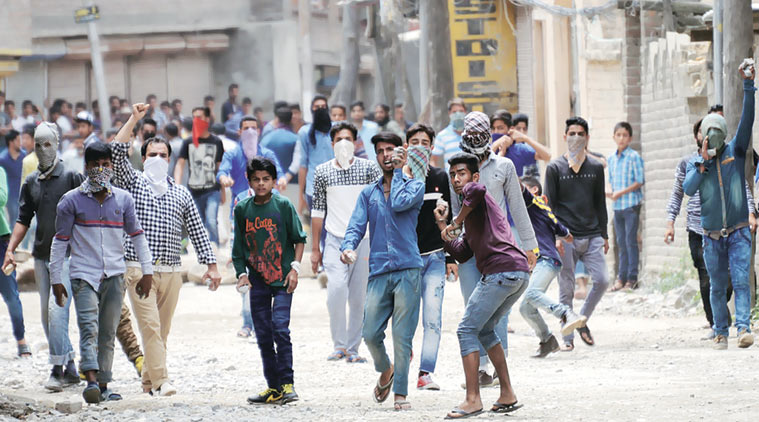
But read Abdullah’s lament quoted above and hear it exactly echoed in Kashmir today, there is in it nothing more or different than what informs the frustrated Kashmiri youth who are at this minute agitating in the valley, willing to confront police bullets for their cause.
It is another matter that long years later, in 1974, Abdullah signed an accord with Indira Gandhi, the then prime minister of India, which stipulated among other things that: “Parliament will continue to have power to make laws relating to the prevention of activities directed towards disclaiming, questioning or disrupting the sovereignty and territorial integrity of India or bringing about secession of a part of the territory of India from the union…”
Thus when the Indian home minister speaks of keeping promises to the Kashmiris, these promises have a much wider ambit than the question merely of amending the vile Armed Forces (Special Powers) Act which allows even the lowest-ranking army man to shoot to kill without accountability.
Throughout these turbulent years of conflict never once has any government of India sought to formulate schemes whereby talented Kashmiri Muslims, products of an educational explosion – all thanks to Abdullah’s New Kashmir programme – could be made to feel not just safe in the heartland but like valued assets in the ongoing narrative of national “development”. Not to mention the communal lens through which Kashmiri Muslims continue to be viewed by Indian society at large, an old malaise made dangerously trenchant in the era of “terrorism”.
And paradoxically, the more that strong-arm methods and vicious prejudices fail to deliver the desired results, the more the state means to persist with them. And now that a glimmer of recognition appears to have dawned within policy establishments, the present-day incarnation of the old Praja Parishad and Jan Sangh are back to the same old perfidy, robbing the secular democratic sections within the Congress chiefly of any will or courage to disregard Hindu right-wing communalism and do right by Kashmir.
Azadi – Cry for freedom
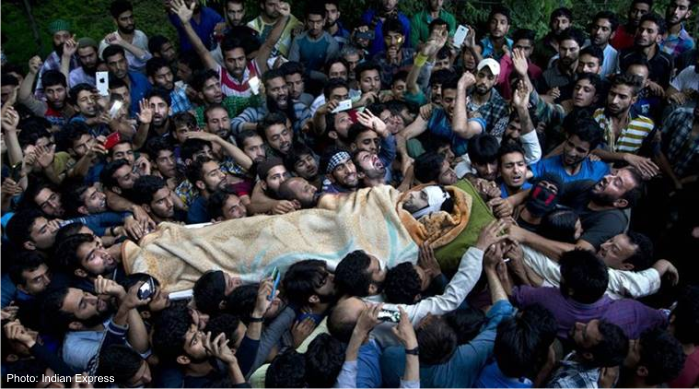
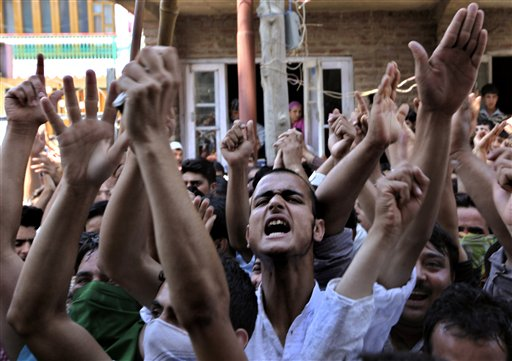
Over the last two months some 51 teenage Kashmiris screaming for secession have been killed by police bullets in the valley.
Let us for the moment ignore the legalities of the question (in respect of the Sheikh Abdullah/Indira Gandhi accord, for instance) and the hard reality that such secession will never be approved by any political establishment in India or any government of the day or be accepted by Indians at large. Let us assume for the moment that the parts of Jammu and Kashmir that do not want secession can be persuaded that the valley of Kashmir be granted independence and sovereignty and let us consider the possible consequences of such secession:
- Following such a declaration, demands for azadi could gain legitimacy in other states, Manipur, Nagaland and Assam, to name a few, and would be hard to deny once a precedent has been set;
- A Hindu communalist backlash could possibly engulf India, rendering the lives of Indian Muslims vulnerable and leading to demands that India be declared a Hindu state, since the secession of the valley would have proved that the two-nation theory was correct after all;
- Within Pakistan, first the Baloch and then the Sindhis might take heart and set themselves the objective of freedom from Punjabi ethnic dominance through secession;
- Within the valley, a Bangladesh-like situation might well emerge, namely a struggle among those who will wish to retain a secular democratic state and those who might argue for an Islamic state. It is well to remember that of Bangladesh’s 40-odd years of independent nationhood, brought about under the leadership of the Awami League on secular principles, some 30 years were to see the communalists in power. It is only recently that the Supreme Court of Bangladesh has struck down the controversial fifth amendment to the Constitution and thereby reverted to disallowing any religion-based party formations. But this welcome move comes after much blood has been spilt.
I have often been accused of exaggerating the Sufi-secular orientation of Kashmiri Muslims and of sentimentally misreading acts of personal and individual camaraderie and brotherhood displayed by Kashmir Muslims towards visiting Pandits as representative of the totality. I have once been kindly described as a “jihadi lapdog” (see Google). But all this notwithstanding, it remains a fact that at the time of the exodus of the Kashmiri Pandits from the valley in 1990, a strident campaign was in evidence as loudspeakers in mosques blared calls that the “Nizam-e-Mustafa” (Islamic statehood) was at hand, that the Pandits must hasten their exodus from the valley but take care to leave their women behind. You will also hear people speculate that one of the reasons why elements within the valley do not at bottom wish the Pandits to return home en masse is that they do not wish an Indian “fifth column” to be reinstated there; with them gone, the idea of an Islamic state is more closely approximated. Much as the Jews in Israel, for instance, who fear the return of Palestinian refugees into what was once their homeland.
I must confess to having another sort of experience during recent visits to the valley, namely the chagrin with which any mention of “Kashmiriyat” (denoting the good old syncretic ways of Kashmiris) now tends to be received there. Indeed I recall being at a seminar at the university in Srinagar where a senior academic read a short “paper” titled ‘Kashmiriyat’ only to rubbish the concept – albeit without much substance. “Kashmiriyat” is now seen as something of a trick used to deny the fact that Kashmir is in essence Islamic, a notion that finds increasing expression in textbooks on history and culture as the pre-Islamic period (roughly up to the 14th century AD) is sought to be erased.
Other disturbing trends appear to be surfacing as evidenced by an incident in Pulwama not so long ago when a Sikh Kashmiri was surrounded and asked to recite the Islamic Kalima, failing which some of his hair was cut off. It must be said however that the incident, uncharacteristic in the extreme, drew condemnation from all sections of the Kashmiri leadership.
Thus while some residual Kashmiri Pandits who have never left the valley continue to be protected by their Muslim neighbours, and their weddings and funerals are organised with customary syncretic brotherhood, and although periodic visits by Pandits living in camps outside the valley to age-old Hindu shrines in the valley are greeted with warmth, after the near total evacuation of the Pandits, it would be wrong to aver that the impulse to forge a sovereign and independent valley into a theocratic state was no more than a baseless surmise.
Be that as it may, what would the security logistics of the new state be, bordering as it does Russia, China, Pakistan, Afghanistan and, following its proposed secession, India as well? To return to what Sheikh Abdullah had said with regard to this option (of Kashmir as an “Eastern Switzerland”), how would the new state tackle these vulnerabilities?
And can it be said that the imperialist from you-know-where, already stationed in countries nearby, would not then presume that at long last the valley was his for the taking, with all the Afghanistan-like consequences that could follow, both in terms of turmoil and cultural defilement?
Not to mention the kind souls from Pakistan’s wild western provinces, many in fact now resident in the country’s main city centres? How might the Kashmiris resist their call to a jihadist embrace, in disregard of the time-honoured ethnic Kashmiri prizing of exclusivity and identity? And if they were to become more insistent even after a polite “no”, who would come to the aid of the Kashmiris?
Kashmiris grow more insistent every day as the current imbroglio continues that jobs, development, opportunities, are not the real issues. Yet in time these might indeed become issues of great magnitude for a prospectively landlocked valley lacking both monetary and infrastructural resources. These resources may then have to come from other places with all the attendant implications, whether the donors are the Saudis, the Yankees or the Chinese. Altogether, a pickle in the making.
The road ahead
If these be not unfounded considerations, what is to be done?
It is time that the question was addressed with some candid concern.
A good beginning would, I think, be made if all the contending parties recognised that Kashmir is a problem that may never be resolved to the satisfaction of all parties. And it would be wrong to think that this avowal is merely a pre-emptive ploy. I doubt that time will prove me wrong.
Let me say at once that the two options which seem closest to the heart of the contending parties – the union and the agitators – I see as non-starters. On the one hand there is the Indian state’s wish that things will drag on as before until exhaustion seals a fait accompli and on the other hand there is the desire, however fervent, of the young agitators for a country of their own in the valley.
The first is bad not only because such a fait accompli is unlikely in the extreme but also because it belies the founding pretensions of the republic of India – chiefly its claim of “unity in diversity”. And it reinforces a sentiment widely felt even beyond the valley, that the Indian state, especially after the beginning of the neo-liberal era in the 1990s, has become increasingly impatient of both secularism and democracy and wholly inimical to the rights of the majority of Indians who to this day feel they have, in Abdullah’s words, no “definite and concrete stake in India”. This applies to the lives of India’s tribal populations, to Dalits and to minorities of varying description on a differentiated scale of neglect. In this context, if the Indian state believes that sooner or later the Kashmiris will tire and turn around, it is only fooling itself.
And the second is a bad option because, as suggested earlier, secession of the valley would be fraught with negative consequences for all parties in the dispute and for the subcontinent as a whole.
These recognitions return us willy-nilly to salutary reflections on the possibility of recuperating and refurbishing the covenant of the federative promise and principle – something on which the state’s accession to the union had been based in the first place, setting a uniquely outstanding example both in terms of plurality of citizenship and of political partnership in opposition to totalitarian impulses in both areas.
This Kashmiri still thinks that the aforementioned Delhi Agreement of 1952 still offers the most workable and fair point of engagement. With the caveat – which with the advantage of hindsight any cool Kashmiri would recognise – that extending the jurisdiction of the Supreme Court of India and the Election Commission of India to Jammu and Kashmir, far from impinging on the state’s autonomy, would in fact be credible guarantee of protection from excesses and denials.
As for the majoritarian nationalists, they are as much a menace to the rest of India as they are to any attempt at a fair solution in Kashmir. That being so, the Indian state and civil society must needs muster the strength and the will to defy and overcome their shenanigans if the nation is to be saved not so much from the Kashmiris as, first of all, from them.
It is good, better late than never, that the prime minister has made some moves of the sort suggested here. Let his government and society at large understand fully that it is now or never in Kashmir, and thus avoid slipping into another decade-long siesta after the ongoing violence inevitably lulls.
As for Pakistan, I am tempted to simply nod in assent to the words of Sheikh Abdullah before the UN Security Council when he went there to plead India’s case in February 1948: “I refuse to accept Pakistan as a party in the affairs of Jammu and Kashmir state. I refuse this point blank.”
After what Pakistan has done to its own people over the decades, this refusal seems entirely appropriate. What the people in Pakistan-occupied Kashmir choose to do, how they decide their fate, is best left to them. Significantly, a 2009 Chatham House poll showed that some 58 per cent of Kashmiris favoured the formalisation of the Line of Control between the two parts of Kashmir as the international border between India and Pakistan. This is as it should be. And once that happens, human and other commerce between the two Kashmirs can be put on a sound international footing, all ambiguities and hassles removed.
If initiatives along the lines of those mentioned above are not undertaken soon, it may be pointless to write anything further on the subject of the Kashmir problem. Neither reason nor analysis nor conjoint effort will then sort it out, only a conflagration that could lead who knows where.
Note
Literature on Kashmir is mind-bogglingly plentiful and I have sought to look into as much as time and tide allow. But, for purposes of this piece, I wish to record my indebtedness to three authors on Kashmir, chiefly – Prem Nath Bazaz, Balraj Puri and MJ Akbar, on whose work I have drawn with abandon. The interpretations thereof being entirely my responsibility.
Archived from Communalism Combat, July-August 2010, Anniversary Issue (17th).Year 17, No.153 – Cover Story 1




.jpg)