The Bombay High Court today struck down two of the most controversial amendments to the Maharashtra Animal Protection Act of 1976.
While the ban on slaughter of cows, bulls, and bullocks in Maharashtra stays, the high court verdict decriminalises the possession and consumption of beef imported from outside the state.
As reported by the ‘Bar and Bench’ website,
Justices AS Oka and SC Gupte read out the operative parts of their judgment in Vishal Seth & 2 Ors v. State of Maharashtra today before a packed courtroom number 13 of the Bombay High Court. The provisions (Sections 5D and 9B), have been struck down as Constitutionally invalid.
Section 5D of the Act reads, “No person shall have in his possession flesh of any cow, bull, or bullock slaughtered outside the State of Maharashtra”
Section 9B of the Act reads, “In any trial for an offence punishable under 9 or 9A for contravention of the provisions of this Act, the burden of proving that the slaughter, transport, export outside the State, sale, purchase or possession of flesh of cow, bull or bullock was not in contravention of of the provisions of this Act, shall now be on the accused.”
Justice Oka said that the impugned provisions were in violation of the right to privacy, a right which is part of personal liberty. The other provision, namely S.9B, was held to be violative of Article 21.
Senior councils Aspi Chinoy and Mihir Desai had argued a batch of petitions filed on behalf of consumers of beef.
In February 2015, the President granted assent to the Maharashtra Animal Preservation (Amendment) Act. While the original 1976 Act banned slaughter of cows, the amendment prohibited, in addition, slaughter of bulls and bullocks and possession and consumption of their meat.
Image: K Fayaz passed his PHD Synopsis Exam while on Hunger Strike
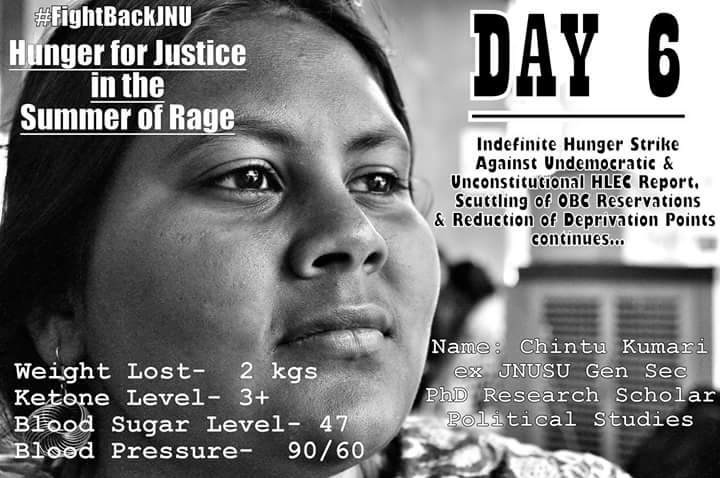
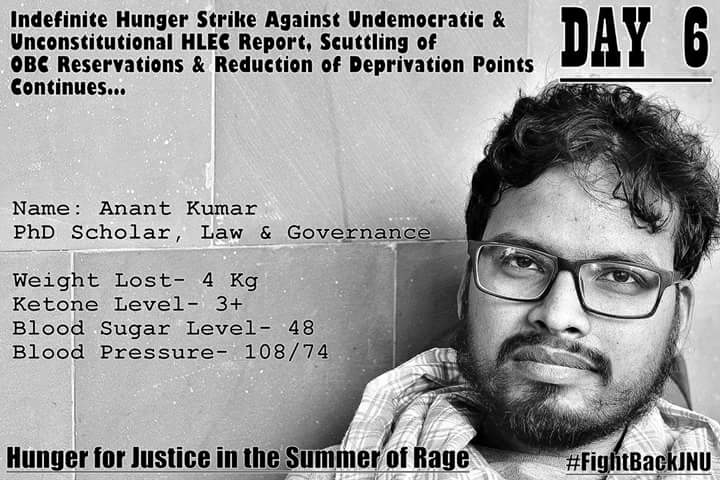
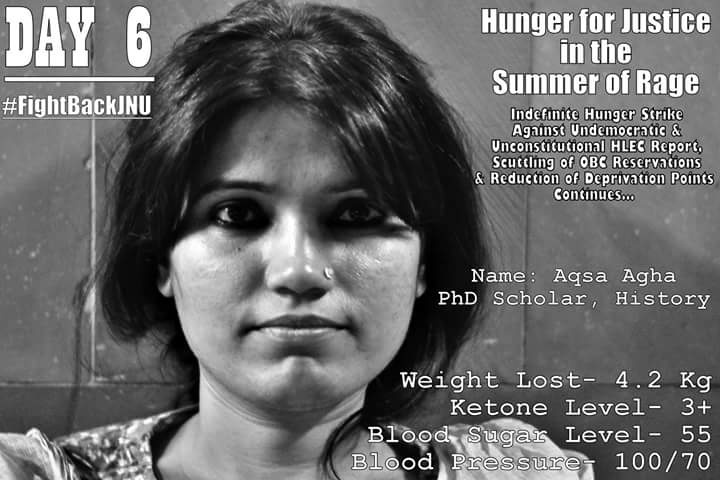
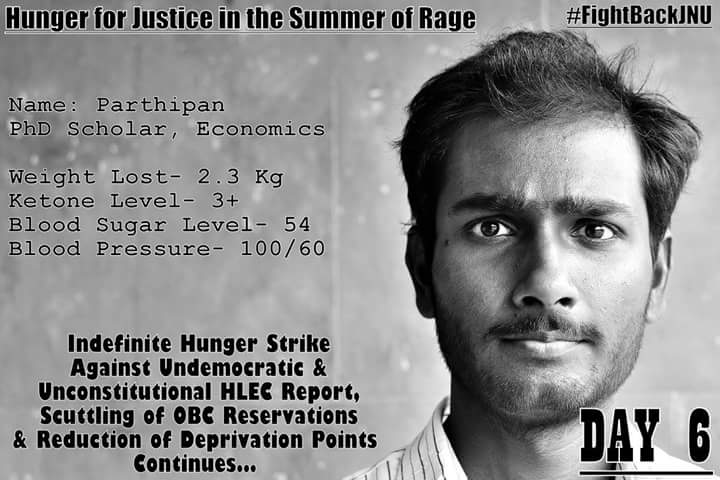
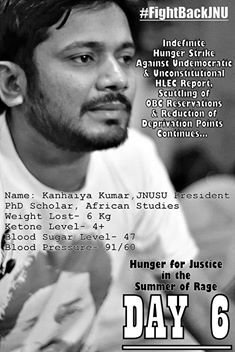
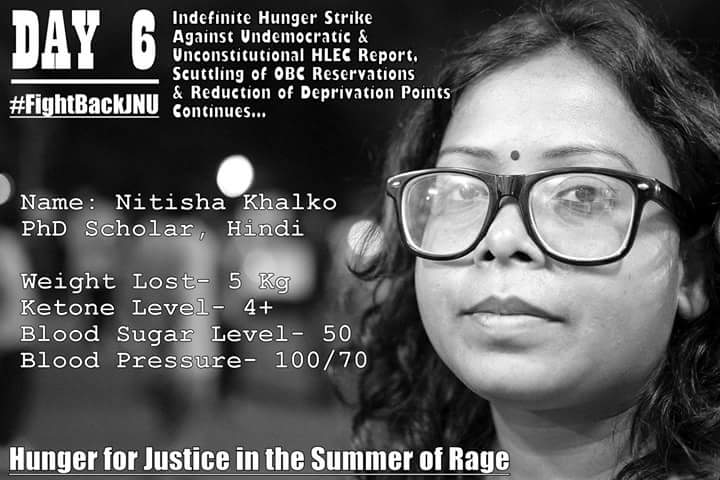
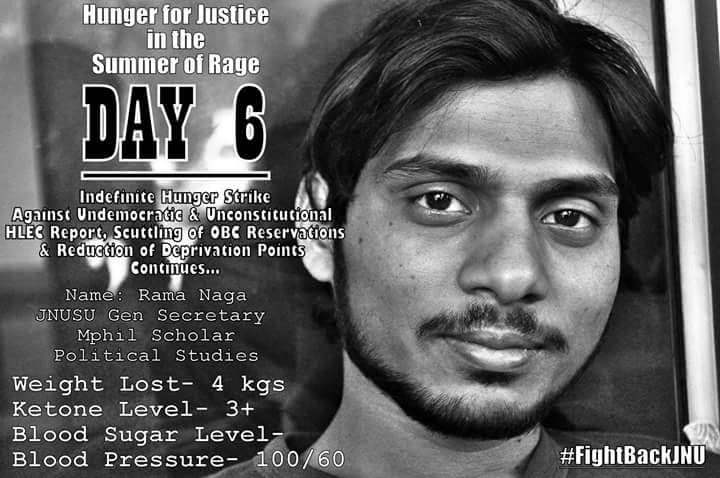
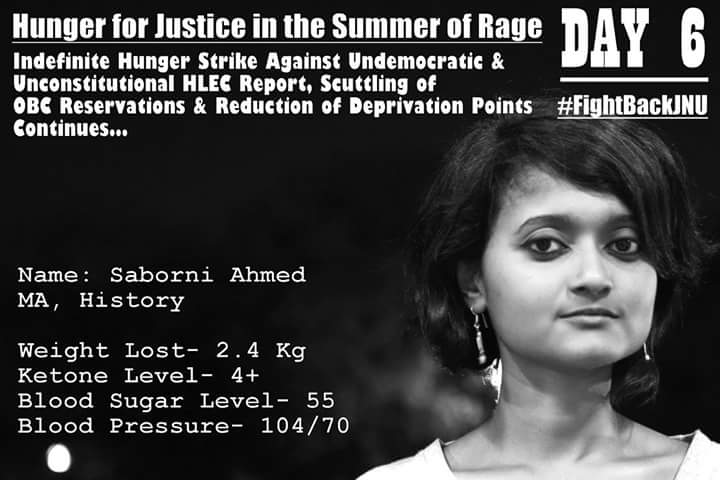
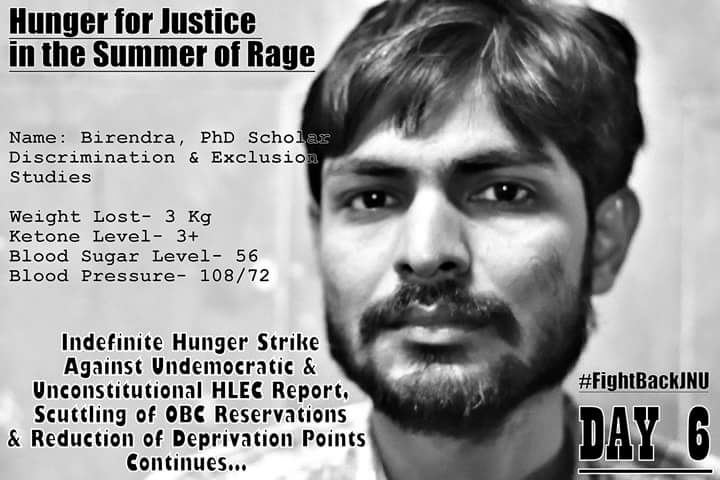
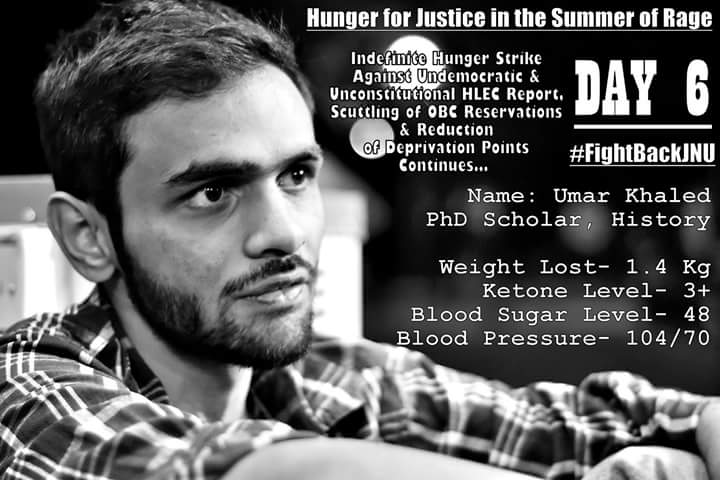
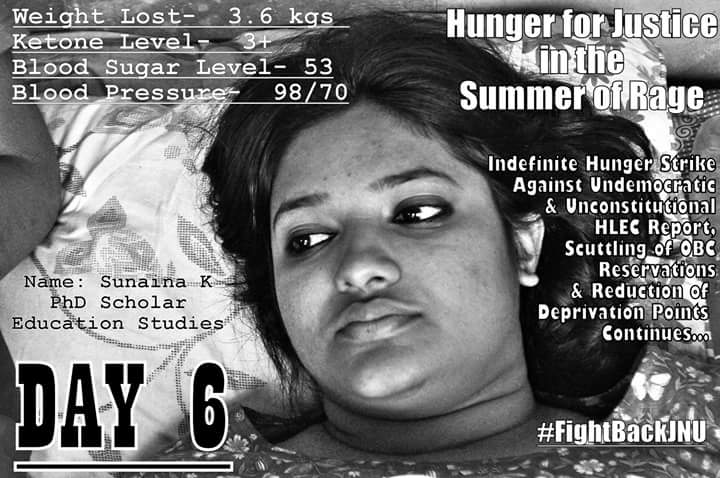
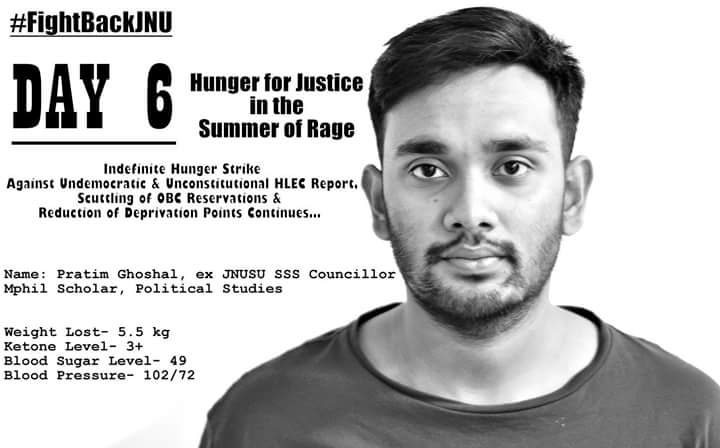
All Party Delegation of MPs to meet JNU VC Today as an Intransigent GOI and JNU Admin Remain Adamant,
Senior members of parliament (MPs) have been in touch with the JNU administration and will be meeting the VC Jagadesh Kumar to ensure that some negotiations between the fasting students –on an indefinite hunger strike since the night of April 27 — and the administration begin. The Left Parties, JD(U), Indian National Congress (INC), Nationalist Congress Party (NCP) are all together coordinating the initiative. Senior parliamentarians are expected to join the delegation, names of which would be released and finalised shortly. D Raja, veteran parliamentarian, KC Tyagi, senior leader JD(U), Tapan Sen (CPI-M) and Pavan Kumar Varma are likely to be part of the delegation.
Meanwhile, since the afternoon on Thursday, the health of Kanhaiya Kumar, President of the Jawaharal Nehru University Students Union (JNUSU) president, Kanhaiya Kumar was very serious. This morning Kanhaiya Kumar has issued the following press release:
कन्हैया को आज भी डॉक्टर एम्स में ही रखेंगे। सीटी स्कैन व कुछ टेस्ट्स होने बाकी है । वे पहले से थोड़ा बेहतर महसूस कर रहे हैं, पर ज्यादा सुधार नहीं है। कन्हैया ने सभी शुभचिंतकों का शुक्रिया अदा किया है, और भूख हड़ताल पर बैठे हुए अपने सभी साथियों को अपना सलाम भेजा है। बीमार हालत में भी वे आज 2 बजे एड ब्लॉक पर होने वाले प्रोटेस्ट के बारे में पूछ रहे थे व भारी संख्या में छात्रों से जुटने की अपील की है। साथ ही केरल में 30 वर्षीया दलित छात्रा जिशा का बलात्कार कर जघन्य हत्या कर दिये जाने के विरोध में बापसा द्वारा दिये गये प्रोटेस्ट कॉल पर केरल भवन के सामने 11बजे से होने वाले प्रोटेस्ट में शामिल होने की अपील की है। जयन्त जिग्यासु,
मीडिया प्रतिनिधि, कन्हैया कुमार Meanwhile the spirits at "Freedom Square" Admin Block JNU continued to be upbeat even as Delhi's scorching heat took its toll. Supporters from all walks of life have been coming in to express support even as the cultural programmes every evening have kept spirits up. The JNUTA, the Teachers Association is on a Relay Hunger Fast today with other civil society activists.
Hunger Strike by Mumbai Students In Solidarity With JNU, Other Universities
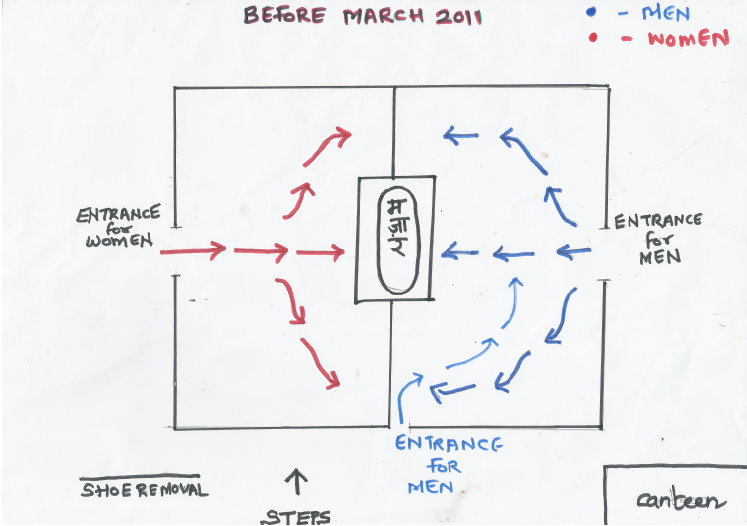
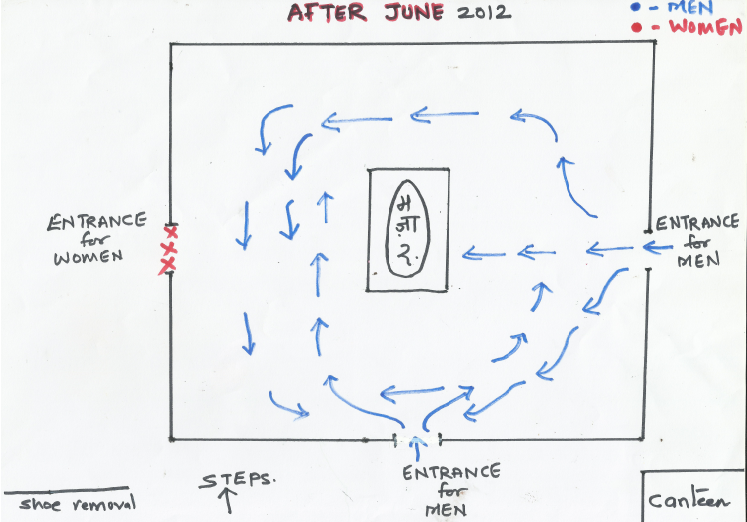
Before and after: How access to the mazaar has been blocked for women. Sketches by BMMA.
“Beyond our ideas of right-doing and wrong-doing, there is a field. I’ll meet you there. When the soul lies down in that grass, the world is too full to talk about. Ideas, language, even the phrase ‘each other’ doesn’t make sense any more.”
~ Rumi the Mystic
A new phase has arisen in the struggle for women’s emancipation, whereby women of faith are asserting their right to equal access to sacred space, be it a temple, masjid, church or a dargah (tomb). Even as they assert their constitutional rights as equal citizens of India, women are simultaneously challenging the patriarchal hegemony, male-centric interpretation of scripture and tradition.
In 2012 women were overnight barred from going close to or touching the mazaar (elevated grave) of Haji Ali, which is an iconic part of Bombay’s syncretic, secular landscape. Women questioned this “innovation” for which no reason or logic was offered by the dargah’s trustees.
Refusing to be pushed back, Noorjehan Safia Niaz and Zakia Soman, co-founders of the Bharatiya Muslim Mahila Andolan (BMMA) challenged the arbitrary manner in which the trustees had relegated women to second class believers. For two years they knocked on the doors of the Maharashtra government, but to no avail. The all-male trustees of the dargah refused to even meet them. They finally filed a petition in the Bombay High Court in 2014. The case lingered on in the court, till on January 26 this year, when the Shani Shingnapur movement emerged, with a valiant group of women of the Bhumata Brigade led by Trupti Desai attempted to enter the sanctum sanctorum of the Shani temple in Ahmednagar.
This acted as a catalyst for women across all religions who no longer accept their relegation to an inferior status. For believing women it’s a question of spiritual equality.
They scoff at the laughable and irrational illogical arguments hurled at them including the notion of purity-impurity, challenge male-supremacist interpretation of religious scriptures, argue that tradition and culture be tested against constitutional principles of justice and parity. In debate after debate in the print and electronic media, women and progressive men have demolished the rationale offered by the religious orthodoxy.
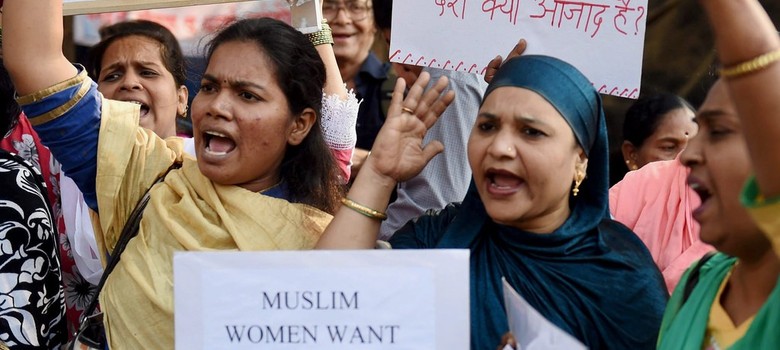
Dharna organised by 'Haji Ali sab ke liye forum near Haji Ali dargah on April 28. Photo credit: PTI
Within days of the Shani Shingnapur agitation, at BMMA’s initiative, we held a cross-community protest demonstration at Azad Maidan, Mumbai to express our solidarity with the demand of women for equal access at Shani Shingnapur temple (Ahmednagar, Maharashtra), Sabarimala temple (Kerala) and elsewhere. The participants included BMMA activists led by Noorjehan, Khatoon Apa and, Zeenat Shaukat Ali (Islamic scholar), Jyoti Badekar (Vaghini), Javed Anand (Muslims for Secular Democracy), Salim Saboowala, Jatin Desai, this writer.
Some of our friends from within the secular fraternity were ambivalent or indifferent. A few even questioned the wisdom of secularists getting associated with women of faith demanding for gender parity in religious rituals and practices.
However a large majority among the progressives felt differently. Firstly, they argued that all of religion cannot be reduced to superstitious beliefs and blind faith. Secondly, being secular is not synonymous with being an atheist. Thirdly, the issue is not whether I believe or not, but the right of believing women to equality in the domain of religion. In other words, it was essentially a matter of right to equal access to sacred space. It was about democratising religious, social, cultural spaces and structures of beliefs and power.
The assertions and demands continued to grow encompassing the Sabarimala temple, the Trimbakeshwar temple (Nasik, Maharashtra), Haji Ali dargah, Mumbai. Soon the issue was being debated and discussed among sections of the Muslim community. Many Muslim women and men spoke out about the right of women to pray inside masjids (mosques).
On March 8, International Women’s Day, we organised a major programme at the Azad Maidan around the central theme: “Women from all religions have an equal right to worship and sacred space”. A separate march organised by various leftist, feminist organisations had also included this demand within their larger programme. Thus the assertion by women of faith was crossing new boundaries.
Azad Maidan solidarity demo in support of women's right to equal access to temples/dargahs at ; Photo credit: DNA
After the historic verdict of the Bombay High Court (March 31, 2016) in favour of women’s access to the sanctum sanctorum of temples across Maharashtra, some of us decided to take the struggle for women’s equal access to the Haji Ali dargah to the next level.
On April 20, a cross-community forum, ‘Haji Ali sab ke liye’ was launched jointly at a press conference by prominent Muslim intellectuals, activists and artists (men and women), supported by over a dozen secular-democratic mass organisations. The name of the forum had a simple but powerful inclusive message. It was a message that the Haji Ali trustees and their supporters found very difficult to counter.
At the press conference it was announced that a peaceful dharna will be held near Haji Ali Dargah on April 28. Trupti Desai who had shown interest in the forum’s initiative was invited to the press conference where she declared that she too would participate in the dharna along with other organisations and individuals.
The struggle for equality at Haji Ali dargah has raised some key questions that are now being widely debated within the Muslim community. It is also leading to a new assertion of Muslim women, who cannot see any logic in being treated as second class believers in masjids and some dargahs, even as they stride forward in the fields of education and employment.
Sanatani Hindutva organisations who had vehemently opposed Trupti’s temple entry agitation had earlier challenged her to enter Haji Ali dargah. It is to be noted that at the joint press conference she made no mention of her plans to enter the dargah on the day of the dharna.
In the backdrop of the Bombay High Court’s order on women’s right to enter the sanctum sanctorum of all temples throughout the state, some of the remarks from Supreme Court judges during the ongoing hearing in the Sabarimala temple case, and with the Bombay High Court’s ruling in the Haji Ali dargah case pending, all that the forum planned was a peaceful gathering of progressive Muslim women and men, along with leading secular organisations and activists. The objective was to create public awareness about the right of women to equal access, on par with men, to sacred spaces.
Before the proposed dharna, several TV news channels carried heated debates where several forum members were pitched against the Muslim clergy and other conservatives. The latter’s premise was that the Quran, Hadiths and Sharia prohibited women from getting close to the mazaar. Forum members and other progressive individuals participating in the debates asserted that this was not an issue concerning religion but custom and tradition which could not override constitutional principles.
Satyen Bordoloi
The conservatives claimed that the Indian constitution gives them the right to freedom of religion under Article 25 & 26, which is more important that the right of equality guaranteed under article 14. There were some who made the outrageous proposition that to the Sufi saints (men) buried in the dargah, women appear naked and that is why they must not be allowed up to the mazaar. Asked to explain the logic, if any, all they would say was: “It’s in the Sharia”.
It’s the very same non-logic that is applied by some for barring Muslim women from entering a cemetery, where the souls of the dead and buried, it is claimed, were hovering around and they too could see women naked. On being told that the same logic should apply to the souls of dead and buried women who could also see man as naked, they were speechless.
The fact is that Sharia appears to mean different things at different dargahs. Women are barred from getting close to Haji Ali’s mazaar since 2012, whilst at the Mahim dargah of Makhdoom Baba just a few kilometers away and at Ajmer Sharif (the dargah of the most revered Sufi saint in South Asia) there is no such restriction or gender segregation.
Yes, the constitution does grant minorities the right to religious freedom but not the right to discriminate and oppress women in the name of religion. Women are now asserting their right to interpret scriptures and personal laws, which is no longer the exclusive domain and monopoly of the male clergy.
As the day of our protest approached, the cacophony of our opponents also grew. Haji Arafat (Shiv Sena), Abu Asim Azmi (Samajwadi Party), Shamsher Khan Pathan (Awami Vikas Party), the Indian Muslim League, Owaisi’s MIM, all turned out in large number to prevent Trupti from entering the dargah premise.
Here both Trupti and the coalition against her erred. In yet again projecting an anti-women perspective, those arraigned against her provided ballast for the media. In unilaterally over-stepping the commonly agreed programme of the forum, Trupti herself created confusion and chaos.
In any case, the struggle for equality at Haji Ali dargah has raised some key questions that are now being widely debated within the Muslim community. It is also leading to a new assertion of Muslim women, who cannot see any logic in being treated as second class believers in masjids and some dargahs, even as they stride forward in the fields of education and employment.
It is also compelling the Muslim conservatives to take a fresh look at the many uncomfortable questions being raised at every TV debate. The Urdu press in Mumbai has also been supportive of the push for gender equality and this too is a welcome development.
The reality of the situation is that Muslim conservatives, fanatics and extremists stand exposed the world over, even as the edifice of extremist political Islam continues to implode.
The onus now lies on progressive, liberal Muslims. There is a need for Muslim intellectuals, scholars, lawyers, artists and activists within and outside secular democratic mass movements and political parties with broader agenda to join the struggle for long overdue reform.
The progressive Muslim women’s movement is already leading the struggle for equality and emancipation, reinterpreting the scriptures, asserting their constitutional rights, challenging the citadels of patriarchy. It’s time for progressive Muslim men to come out in large numbers, organise themselves and stand in solidarity with the struggle of Muslim women.
Today women have been relegated to an inferior status at the Haji Ali dargah. Tomorrow it could be other dargahs. Who knows, next they may demand that only those Muslim women wearing a burqa would be allowed. Then they might pronounce that music is haram so Qawalis are a no-no.
Where does this plague of patriarchy and fanaticism stop?
Which is the next dargah they will target?
Could it be the Ajmer dargah itself?
This is a battle we must not lose.
(The writer is among the initiators of the ‘Haji Ali Sab Ke Liye’ forum).
UPDATE: An intransigent administration and a completely callous Ministry for Human resources Development Ministry (MHRD) has refused to come and even dialogue with the students. Sabrangindia issues an appeal to all right-thinking individuals and organisations all over the country to come out in strong support of the student leaders of JNU who are on an indefinite Hunger Strike. Yesterday while some student leaders met the VC, he still remained adamant in his demand that the students call fof the strike and "accept" the HLEC report. It may be recalled that the report of the HLEC has been condemned for a violating both procedure and substantive justice. See this report
The health of student leaders is very frail and it is shocking that none from the ruling regime in Delhi has thought it fit to address the legitimate demands of the fasting students.
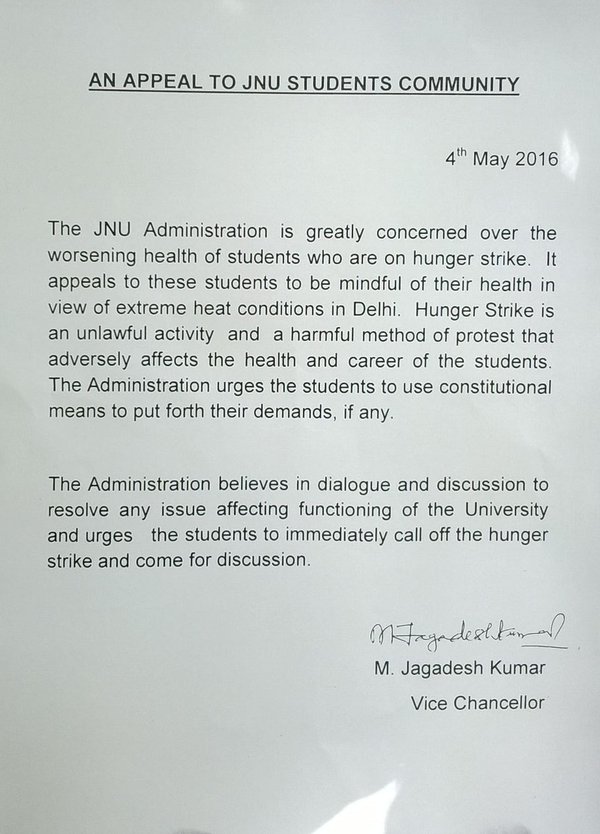
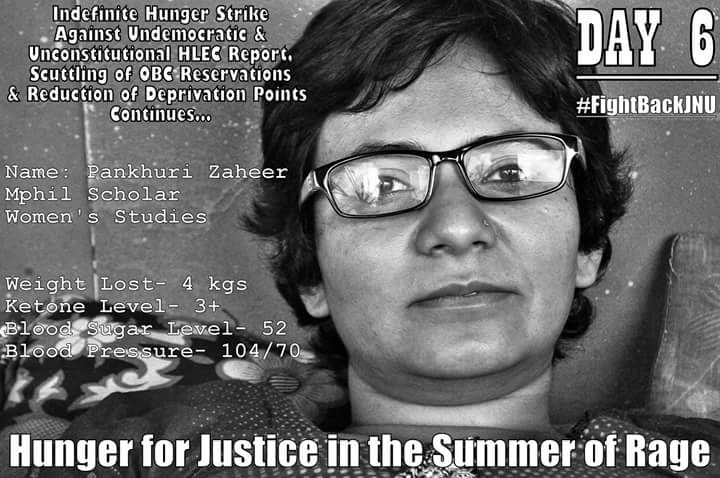
JNU Student Leaders are Eight Days Into an Indefinite Hunger Strike against an Unjust and Procedurally Inadequate High Level Enquiry Committee (HLEC) that dished out vindictive actions against several students. The health of students is sinking and fragile and a villification campaign against many has been unleashed. President of the Jawaharlal Nehru Students Union (JNUSU) Kanhaiya Kumar has been on a hunger fast even as he has travelled to Bihar and back. Students have been giving regular medical reports on their health which have been released. Following these reports becoming public on social media, an "appeal" was made by an otherwise intransigent JNU administration to the students.
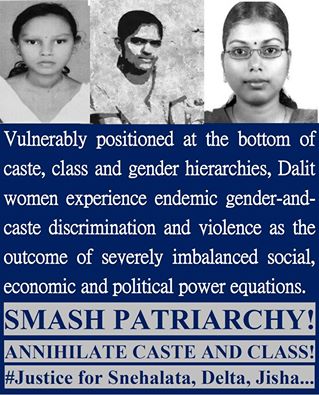
Barely 38 days ago, on March 29, a brutal rape and murder, also of a bright young Dalit student, Delta Meghwal, 17 years old, studying to become a teacher, took place in Barmer, Rajasthan close to the Pakistan border. It was three days later that the story was pushed by web portals and the social media – triggering protests in six different cities – on April 3 and thereafter, while a strangely selective media, hardened to prioritising issues, simply refused to pick up and project the story.Mahendra Meghwal, Delta’s father made a heart-rending appeal to the nation: “I want Justice Not Character Assassination but the television channels remained unmoved.
It started almost the same way with Jisha. A 30-year-old Dalit woman, brutalised in a sickeningly sensational way, raped and killed, in Kerala on April 28 – a month after Delta was found dead.
Only on May 3 did the national media pick up and run the story. NDTV India’s Ravish Kumar in his inimitable style raised questions about the media’s role in his nightly telecast last night (May 4).
By the afternoon of May 5, the gruesome story could no longer be ignored. And, now it is sure to make front page news. At 12.24 p.m. on May 5, NDTV India reported that PM Modi will visit the mother of Jisha on May 11. It is election season in Kerala and the news that the “jumlebaaz” PM will fly down south to condole with Jisha’s inconsolable and seriously unwell mother who has been hospitalised will surely capture the news moment. And the nation will wait with bated breath for the outcome of what will be a much-publicised visit. Television cameras and journos caught napping when the incident first came to light will wake up, make up with much overdue coverage, now.
Sorry Delta. It was not election season in Rajasthan when you were allegedly traumatised by your PT teacher, raped before being cruelly done away with it. The school authorities did not see fit to even wait for your parents before the post-mortem was done. There is still a deathly silence on the incident: its fallout and investigation. Sorry, Delta, that your dreams to teach and share knowledge creatively were not to be.Your teacher tells us that your lesson plans were exceptional and you would have made a wonderful teacher. But sorry again, Delta, a nation that dreams of ‘Skill India’ has little value for the teacher, or the student. Sorry, Delta, also that you were born – and died — in the wrong state at the wrong time. In BJP ruled Rajasthan at a time when elections are far away.
The prime minister had also flew down to the southern-most tip of India when an awful temple fire broke out weeks ago. It took a bold director general of police to say that Modi, and Rahul Gandhi’s visit, hampered, not helped the emergency relief efforts.
Modi did not however drive down to Sunpedh village in Haryana where two young Dalit children – one just a baby – were burnt down allegedly by Rajputs on October 23, 2015. Just seven months ago. The distance of Sunpedh from the national capital could not have been the issue; it is barely 35 kilometres from the national capital, no big deal for the globe-trotting PM. Two days after upper caste Rajputs allegedly set fire to the home of a Dalit family in Sunpedh, killing two young children aged two years and nine months (Vaibhav and Divya) sleeping within, the minister of state for external affairs made remarks that invited widespread condemnation. The minister who was in Ghaziabad at the time was quoted by The Indian Express on October 23 as saying, “ “To harc heez par, koi wahan par pathar maar de ya kutte ko to, sarkar jimmewaar hai? Aisa nahi hai. (For everything…like if somebody throws a stone at a vehiclw or a dog, then the Central Government is responsible? …it is not like that)”. The allegorical reference to a dog, demeaning when two young children had been brutally killed, though much criticised, drew no response from the prime minister. That Haryana is also a BJP ruled state and there were no elections due there either, may not be a coincidence.
The list of pregnant silences and selective condolences can be quite long even though this government has been in power only for 23 months: since May 2014. It could make an interesting calendar depicting the ‘Ayes’ for when it was politically expedient for the PM to visit and condole, and ‘Nayes’ for when it was prudent to remain silent and look, literally, the other way.
Radhika Vemula will not ever have Modi or Irani’s shoulder to cry on, especially since she, as her son Rohith Vemula, is a vocal critique of the Sangh. She has now converted with her surviving son, Rajah, to Buddhism.
The Mohsin Shaikh, the Mohammed Akhlaq,the Mazloom Ansari and Imtiyaz Khan killings. Perhaps I need not even mention them here as their birth, names and community are not those that Modi or the Sangh in any way concern themselves with. Mohsin was lynched to death in Pune on June 2, 2014, within days of Modi’s swearing in ceremony. Akhlaq was lynched to death in Dadri by those riding high on the ‘Save Gau Mata, Hate Beef Eaters' campaign. Speaking on the ghastly incident on October 14 to the Anand Bazar Patrika Modi had said, “The incident is sad, but what is the Centre’s role?”. What we wonder is the Centre’s role in Jisha’s brutal rape and murder in Kerala?
The sight of Mazloom and Imtiyaz hanging from a tree in Latehar, Jharkand – again a story that the national media chose to gloss over – should have made any civilised ‘nation’ cringe in shame. Shame and decency are not emotions that go down well with the bullish sangh regime.
Mohsin in Pune, Mohammad Akhlaq in Dadri, Mazloom and Imtiyaz in Latehar — they have all, in the language and politics of the sangh parivar — been born in the wrong homes, to the wrong families, in the wrong faith. So why waste tears on them?
Rewind to six years back, 2008, Mumbai. Hemant Karkare was shot dead by terrorists from Pakistan on November 26, 2008, Mumbai’s 9/11. The siege was still on, Mumbai shocked and traumatised, television cameras still trained on the Taj and Trident hotels. Modi, who was then the chief minister of Gujarat – having won a second term — had flown down from Gandhinagar, and was spotted outside the Trident in South Mumbai.
He was actually booed by grief-stricken relatives and Mumbaikars, who had no use for his posturing. Undeterred, he had driven down to central Mumbai to Karkare’s residence to condole with his widow, Kavita Karkare. Grief-stricken, she had first refused to even see him. Later, as she sat stiff and uncomfortable in his presence, Modi condoled in the way he knew best. He announced Rs 1 crore as ‘compensation’ to the family of Karkare and other police officers killed in the attack. Kavita Karkare firmly, and immediately turned down the ‘offer’.
India Today had then reported: “Modi along with other leaders of the BJP, including prime ministerial candidate, LK Advani and others from the Shiv Sena have been baying for Karkare’s blood post the Malegaon investigations into the allegations of terrorist activities by the saffron brigade.”
Self-respect and dignity have no price, Mr Prime Minister. And condolences, if they are selective and self-serving, really of no value.
Seismic-Sensitive Arunachal Pradesh cannot risk a rapacious planning policy that allows Big Dams uncaring of the risks to people's lives and the environment
Image: Ritu Raj Konwar / The Hindu
Three days ago, on May 2, 2016, in an ugly turn of events, two people, namely Monk Nyima Wangdue and Tshering Tenpa, were killed and many injured, while protesting against the arrest of Lama Lobsang Gyatso in Tawang including a young Buddhist Lama. The Victims were protesting for the release of Lama Lobsang Gyatso, one of the most vocal opponents of hydropower projects in the Tawang region and secretary of the Save Mon Region Federation (SMRF), an organization of the Monpa Community in the Mon-Tawang region of Arunachal Pradesh. The NAPAM (National Alliance of People’s Movements) has condemned this brutal police action on peacefully protesting communities and demands immediate action against the responsible officials.
As far back as September 2014, six year and two rejecteions later, India’s largest hydro project was cleared. The project was rejected twice by the FAC, the original proposal in 2013 and a revised proposal in April.
The 3000 MW Dibang Hydel project for which former prime minister, Manmohan Singh laid its foundation stone and which had twice been denied environmental clearance, the Forest Advisory Committee (FAC) of the Ministry of Environment and Forests (MoEF), gae it clearance subject to a reduction in the dam height by 20 m from the originally envisaged 288 m.
This clearance for India’s largest hydro project and the world’s tallest concrete gravity dam came after a September 3 letter from Nripendra Mishra, Principal Secretary to the Prime Minister, to the Environment Secretary to “clear the project expeditiously” as per the decision of the Cabinet Committee on investment. This was the person whom Modi had had a special ordinance passed to enable his appointment.
This clearance had raised eyebrows, since on August 28, 2014 the MoEF had written to the Arunachal Pradesh government rejecting the proposal for diverting more than 45 sq km of forest land to National Hydroelectric Power Corporation (NHPC) for the project. A day after Mishra’s letter, the Ministry revived the project by writing to the “project proponent that sensitivity analysis of reduction of dam height up to 40 m may please be submitted for further consideration”.
In 2013, in the run up to the general elections of 2014, as the National Democratic Alliance’s prime ministerial candidate in the 2014 Lok Sabha election, Narendra Modi had given hope to anti-dam activists in Assam when he spoke against the controversial large dams proposed in Arunachal Pradesh. But those hopes were dashed on February 20, when Modi visited Itanagar to attend Arunachal Pradesh's 29th Statehood Day. At an election rally on February 22, 2013 at an election rally at Pasighat in Arunachal Pradesh, Modi had said that he would prefer smaller hydro power projects in the region, honouring the sentiments of the region’s people. A year later and the prime minister had forgotten his promise. He pushed for hydropower projects in the state and said Arunachal Pradesh can light up the entire country.
Tawang Today
While Tawang continues to reel under the shock of police firing, Arunachal Pradesh chief minister Kalikho Pul at a ASSOCHAM forum in New Delhi in a complete insensitive statement has advocated the ‘fast-tracking environmental clearances’ for hydropower projects and also suggested a single window clearance to the hydro project developers.’ This reveals a complete disregard for environmental and people’s concerns.
NAPM leaders like Medha Patkar, Prafulla Samantara and others have said that, “Our experience from struggles against the big dams have shown that, when world over the big dams are being done away with, it is extremely unfortunate that we are till trying to harness the hydro power in the most environmentally sensitive regions, or in densely populated areas, displacing massive populations. Around 250 hydro-power projects are in pipeline in Arunachal Pradesh only, which would prove fatal for the whole north east and Himalayan region.
For a long time now, the Krishak Mukti Sangram Samiti (KMSS) has been opposed to the Lower Subansri Hydroelectric Project, which would threaten the livelihood of more than 5 lakhs of fishworkers, farmers and others dependent downstream. Again, procedures and due process of law have been sidelined or given a backseat: though a eight member expert committee report is awaited the construction on dam has started once again, facing challenge from people.
It is a similar story for many of the dams in North East where public hearings have been a complete hogwash and based on half-baked and unscientifically conducted Environmental Impact Assessment keeping communities often in dark. The overall planning of hydro development in the State and Himalyan region needs a thorough examination keeping in mind the people’s interest first, until then put a moratorium on the planned projects.
Already Uttarakhand and other states are reeling under an insensitive and callous pattern of growth.
“ Our own experience of struggle against the Narmada, Tehri, Waang Marathwadi, Gosi Khurd and other Dams across the country have exposed the false claim of clean energy by hydro power projects. In the process of building big dams, we have destroyed rivers, villages, townships, lives and livelihood of millions. The people are still suffering from the impact on agriculture, livelihoods and the cultural disconnect along with ecological disasters like frequent landslides and loss of forest cover in the areas.Itstime we stopped damming the mountains and bringing ecological destruction.Everywhere these dams and hydropower projects are facing resistance and protests from communities and often govt. has resorted to violence and arrests. This must stop now!
In the Tawang Valley, police forces made complete mockery of the rule of law and killed two of them and opened fire at mere gathering of 200 people who were simply and peacefully demanding release of their leader.All these events suggest a dangerous political motivation to strike down the people’s voices and provide a free hand of destruction to corporate through hydro power projects planned in the state.
In light of these developments, , we strongly condemn the political involvement and misuse of police forces in this matter and demand the following:
AP government must constitute an independent judicial commission, under the Commission of Enquiry Act, headed by a sitting or retired judge, to investigate the whole incident including role of police officials, local MLA and other politicians;
Suspension of all the involved police officers along with SP, Divisional Commissioner and others until the completion of the enquiry;
A moratorium on all the planned hydro power projects until a Comprehensive Scientific Review is conducted, opinion of the communities concerned taken and consent achieved. This must take a comprehensive look at the serious risk of environmental disasters and geological instability.
Background: Reportedly, 13 of the over 150 hydel projects planned by the state since 2005 are in the Tawang. To stall this spree of dam construction and upcoming ecological devastation, the people from the Monpa Community joined hands with local Buddhist monks in 2011 to form the Save Mon Region Federation (SMRF).
Under Lobsang Gyatso's leadership, SMRF has been advocating socio-culturally and ecologically sensitive development in the Mon-Tawang region. The group has protested against ecologically destructive hydropower projects, demanded accountability in the execution of government schemes and development projects, and exposed corruption.
Their work has been bearing fruit as on April 7, the SMRF saw its first significant achievement. In response to its petition filed in 2012, the National Green Tribunal (NGT) suspended the environment clearance granted by the Union environment ministry for the Rs. 6,400 crore Nyamjang Chhu hydropower project in Tawang’s Zemingthang area. The NGT noted that the project – promoted by the Noida-based steel conglomerate LNJ Bhilwara Group – did not consider its impact on the habitat of the endangered black-necked crane, which is endemic to the region. The bird is rated “vulnerable” in the International Union for Conservation of Nature’s list of endangered species and is listed in schedule 1 of the Wildlife (Prohibition) Act 1972 and also considered sacred to the Buddhist Monpa community, who consider it an embodiment of the 6th Dalai Lama, who was from Tawang and wrote about the bird in his poetry.
Lobsang Gyatso and SMRF have been supporting villagers in recording their objections against other destructive hydropower projects in Tawang too, including Tawang II HEP.However Lobsang Gyatso’s success seems to have made him a target for the local police authorities. Following the events, he was arrested twice last month on charges of disrupting peace in the Gongkhar Village and for alleged critical comments against Guru Rinpoche, the Abbot of Tawang Monastery, in reply of that the Abbot has appealed to find a peaceful solution to the volatile situation but the politicians exploited the issue and filed an FIR against the leader Lobsang Gyatso after which the protests erupted in the region for his release.
The political motivation is also clear as the SMRF is preparing to file public interest litigation in the Supreme Court against the Mukto Shakangchu hydel project, report sections of the media. Even though over 90 crores rupees were officially spent by the state government on the project, most of what was constructed has been washed away by the river waters within three and a half months of completion of work due to use of sub-standard material.
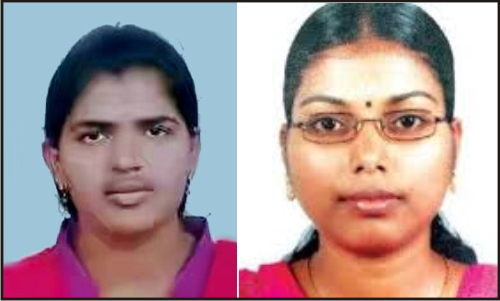
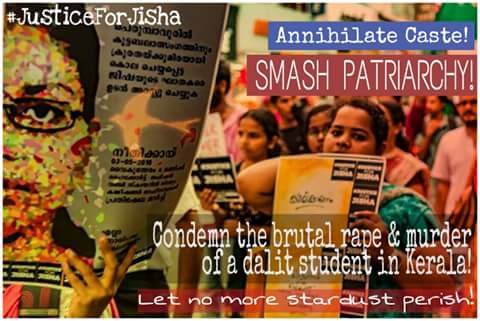
The brutal violence meted out to Jisha, a 30 year old Dalit woman in Kerala sparked protests all over the country after, the national media, despite initial days of silence, discussed the story. Sabrangindia had focused on the story nationally after Kerala newspapers and television channels had reported on the incident that took place on April 28.
Yesterday, May 4, AIDWA (All India Democratic Women’s Association) and other organisations held a protest outside Kerala House in Delhi. Tomorrow, May 6, a protest is being held by activists and organisations at the Town Hall, Bangalore at the Town Hall.
जिशा, मेरी दोस्त मेरी यार, क्या कहूँ यार तुम्हारे साथ जो दंविये बर्बरता हुई उसके लिए मुझे शब्द नहीं मिल रहे हैं कुछ कहने को. ये देश ये समाज हर रोज़ ऐसे झटके देता रहता है और इतना देता है, इतना देता है, की हमारे लिए वीभत्स से वीभत्स घटना क्रूरतम से क्रूरतम घटना साधरण बन गई है और इन घटनाओं को पचाने की क्षमता में भी हम माहीर हो गए है. देखो न दोस्त, असाधारण कहाँ कुछ रह गया है. बचपन से आज तक तो यही सब देख- देख कर पले बढे हैं हम सब की, जो कुछ हो अपना हक़ मत मांगना, पढने लिखने की बात मत करना , बाप या भाई लात घूंसे मार- मार कर तुम्हे अधमरा कर दे लेकिन एक शब्द भी उनके खिलाफ बोलने की गुस्ताखी मत करना, गाँव के उच्च जाति वर्ग के सामंती तुम्हे अगर छेड़े तुम्हारा बलात्कार करे तो उसका बहिष्कार मत करना कियोंकि ये तो उनका जन्म सिद्ध अधिकार है.
तुम्हारे लिए जो लक्ष्मण रेखा खिंची गई है उससे बाहर जाने की कोशिश की तो तुम्हारी शामत आना पक्की है. और शादी? ये तो दूसरी जात में तो दूर की बात अपनी जाति में भी करने का अधिकार या आजादी की बात मत करना ये तय करना घर के बड़े पुरुषों के कंधे पर छोड़ो. सती सावित्री बनो, एक सद्गुणी बेटी, बहु और पत्नी बनो इसी में तुम्हारी भलाई है.
[ Photograph by Biju Ibrahim ]
लेकिन जिशा तुमने ये क्या किया? तुमने तो सामाजिक नीतियाँ जो की मनुस्मृति ने महिलाओं के लिए बनाई है उनके आदर्शों पर चलने की बजाय उन नीतियों को तोड़ दिया, जर्जर कर दिया. तुम्हारी ये हिम्मत कैसे हुई की तुम एक महिला और वो भी दलित महिला होकर भी तुम्हारे लिए बनी सारी नीतियों के तोड़कर यूनिवर्सिटी में लॉ की पढाई करने चली गई? तोबा रे तोबा इस मनुवादी व्यवस्था के प्रति बड़ा अन्याय किया तुमने और जब इतनी बड़ी गुस्ताखी की तो सजा तो मिलनी ही थी.
यार तुम कितनी बड़ी गलती कैसे कर बैठी? तुम तो जानती हो न की इस देश में दलितों, महिलाओं,मुसलमानों, आदिवासियों, गरीबों, वंचितों और पिछड़ों के जीवन का कोई मोल नहीं हैं. अगर थोड़ी सी भी ऊँची आवाज़ उठाओगे तो वैसे ही कुचल दिए जाओगे जैसे कीड़े मकोड़े.
तुमने अपने अतीत से भी कोई सीख नहीं ली. तुमने देखा नहीं निर्भया ने रात में बाहर निकलने की गलती की तो उसका क्या क्या हश्र हुआ? तुमने देखा नहीं था की बदायु में दो दलित लड़कियों को बलात्कार करके कैसे पेड़ पर लटका दिए गया था? तुमने देखा नहीं की बथानी टोला में रणवीर सेना द्वारा कैसे पुरे के पुरे गाँव की महिलाओं को किस तरह जलाया मारा काटा गया था .उनके साथ भरी दोपहरी में राज्ये और प्रशासन के संरक्षण में बलात्कार किया गया था. यहाँ तक की गर्भवती महिलाओं के गर्भ को चीरकर- फाड़कर उसके अजन्मे बच्चे तक पर तलवार घूंसा कर आसमान में उछल दिया गया था ? कारण दिया गया की अगर इनके बच्चे बचे रह गए तो नक्सली बन जायेंगे.
तुमने देखा नहीं की खैरलांजी की दलित महिलाओं को कैसे नंगा करके गाँव में घुमाया गया था बलात्कार किया गया था और उसके बाद उनका बलात्कार किया गया था? तुमने क्या जाना नहीं था की भगाना दलित महिलाओं को किस तरह जाटों द्वारा अगवा करके उनका बलात्कार किया था ? सोनी सोरी जो आदिवासी अधिकारों के लिया अपने जल जंगल ज़मीन के लड़ रही हैं और गलती से आदिवासी होकर भी शिक्षिका बन गई है उनके साथ क्या-क्या नहीं हुआ. उनको पुलिस कस्टडी में कितना सुरक्षित रखा गया था? उनको कस्टडी में बलात्कार के साथ सुरक्षा देने वाले अंकित गर्ग को गलेंट्री अवार्ड से नवाज़ा गया.उससे भी संतुष्टि नहीं मिली तो उनके चहरे पर तेजाब लगाकर उनके चेहरे को काला किया दबंगों ने. हलाकि ये बात अलग है की मानवता के दुश्मनों ने उनका चेहरा जितना काला किया उनका चेहरा उतना ही चमका और इतना चमका की उनके चेहरे के रौशनी से सत्ता वर्ग की ऑंखें भी चौंधिया गई.
अब देखो न मनोरमा देवी ने भी यही गलती की थी उन्होंने तो सर्वमान्य, सर्व्सत्य AFSPA पर ही सवाल खड़ा कर दिया था तो उनको भी उसी के अनुसार उनके हिस्से की सजा मिली. दरिंदगी के साथ उनके गुप्तांगों को जख्मी किया गोली मारा,रेप किया और जंगल में उठ कर फेंक दिया था. और कुछ भी करो सेना पर तुम कैसे सवाल उठा सकते हो.
जिशा, तुमने तो बिहार के कुरमुरी में रणवीर सेना के कमांडर ने जो छह नाबालिक मुसहर जाती की कूड़ा चुगने वाली लड़कियां जिनमे अधिकतर 15 साल की उम्र से नीचे की थी के साथ जो जबरन बलात्कार किया रस्सी में बंधकर जो घंटों -घंटो उनका दोहन किया गया उसके बारे में भी पढ़ा होगा . बिहार स्टेट ने उस अपराधी को बचाने में पूरी जान लगा दी. तो क्या हुआ ? उसमे क्या बड़ी बात हो गई ऊँची जाति के बर्चास्व और शक्ति पर सवालिया निशान कैसे लगा सकते हो? ये तो उनका जन्मसिद्ध अधिकार है.
कश्मीर और नार्थ ईस्ट की तो बात ही मत करना कियोंकि वहां तो ऐसा साशन चलता है जिसमे औरत तो दूर मर्दों का भी मुह सील कर दिया जाता है. कुनान्पोश्पुरा में तो मिलिट्री अपना संविधानिक अधिकार समझकर पुरे गाँव की महिलाओं के साथ बलात्कार करती है न ? और वास्तव में संविधान तो वहां की सेना खुद है दूसरे संविधान की ज़रूरत क्या है ? हाल ही में तो कश्मीर के हडवारा में एक नाबालिक लड़की के साथ पुलिस द्वारा छेड़-छाड़ करने का आरोप सामने आया. इसके बाद पुलिस और अर्धसैनिक बलों द्वारा गोलीबारी में 5 लोगों लोगों की जाने भी गईं. यहाँ तक की उस नाबालिक लड़की को अब तक नज़रबंद करके रखा गया है. इस घटना की जितनी ही निंदा की जाये कम है.लेकिन कश्मीर में बनी नई नवेली सरकार पर भी कोई असर नहीं देखने को मिला. उस नाबालिक के सारे मानव अधिकारों को उससे छिना गया. लेकिन कौन से नेता ने उसकी बात की? डेल्टा मेघवाल के साथ क्या हुआ? तुम खुद देख लो मुज़फ्फरनगर हो या गुजरात दंगा किसमे महिलाओं को बक्शा गया है? और अब मै ज्यादा नाम नहीं गिनाना चाहती कियोंकि उसका कोई अंत नहीं है.
देखो न जिशा इनमे से कितनों को न्याय मिला? सही बोलो तो न्याय की जगह न्याय की हत्या जी गई, इनमे से ज्यादातर को न्याय से वंचित किया गया . न्याय की आस में लोग मर मिटते हैं लेकिन सच्चाई तो ये है की न्याय उनके लिए बना ही नहीं. फिर भी मैं बराबर न्यायालय पर विश्वास जताने की कोशिश करती रहती हूँ. लेकिन बार -बार न्याय का गला घोंटते देख काफी निराश हो जाती हूँ. शायद तुमने सोचा होगा की लॉ की पढाई करके तुम इनकी आवाज़ उठाओ जो अब तक न्याय से वंचित हैं. लेकिन हिन्दू जाती व्यवस्था के अनुसार तो ये घोर पाप किया तुमने, न्याय देना तुम्हारा काम थोड़े ही था जो चल पड़ी लॉ की पढाई करने. महिलाओं के प्रति बेरहमी, दरिंदगी, क्रूरता, अपमान ये सब समाज के नोर्म्स हैं इसको सवाल किया तो तुम्हारी खैर नहीं. महिलाओं और खासकर दलित महिलाओं के प्रति अमानवीयता इतना साधारण और ज़िन्दगी का एक अटूट हिस्सा इस समाज ने बना दिया है की आज इसपर कोई ध्यान ही नहीं देता.महिलाओं को इतना बुद्धिहीन साबित कर दिया गया है की अगर हिन्दू लड़की किसी मुस्लमान से अपनी इच्छा से भी शादी करे तो वो लव जिहाद हो जाता है. कहा जाता है की मुस्लमान लड़के उन्हें बहलाकर चोकलेट और मोबाइल देकर फुसला लेते हैं. महिलाओं को इसी हैसियत और निगाहों से देखा जाता है जो सिर्फ ठगी जाती हैं, उनकी कोई स्वायता नहीं हो सकती, कोई स्वतंत्र सोच नहीं हो सकती, उनके अन्दर विवेक नहीं है इसलिए मर्दों के विवेक को उनपर थोपा जाता रहा है.महिलाओं का अपना कोई स्वतंत्र अस्तित्व नहीं है, अपनी कोई पहचान नहीं है.
लेकिन तुम लोग हो की उसी के फ़िराक में लगी हो स्कूल और कॉलेज जाकर उसी पितृसत्तात्मक समाज को चुनौती देती रहती हो. इतने बड़े पाप को ये समाज कैसे पचा सकता है.और सच पूछो तो महिलाओं के प्रति ये हिंसा दुष्कर्म और बलात्कार कोई सेक्सुअल अर्ज के कारण नहीं होती वास्तव में इस समाज में जो पिरिसत्तात्मक सोच है, सामंती- जातिवादी वर्चस्व है और शक्तिशाली होने का जो उनका अहंकार है उस वर्चस्व और अहंकार को बनाये रखने के लिए ये हिंसा किया जाता है. ताकि तुम अपनी हदों को पार न कर लो और उनकी शक्ति और वर्चस्व को चुनौती न दे सको. लेकिन फिर भी महिलाये उनको चुनौती दे रही हैं, वो अपने स्वतंत्र सोच और पहचान की लड़ाई लड़ रही हैं और वो बोल रही है की हम बच्चा देने की मशीन नहीं है न ही तुम्हारे गुलाम है. सिर्फ इसी की सजा उनको मिल रही है.
जिशा मुझे समझ नहीं आता की इस देश में दलितों की जान इतनी सस्ती किउन हो गई है? दलित गरीब मजदूर महिलाओं की बात तो छोड़ो तथा कथित ऊची जाती के उच्च विचारों वाली महिलाओं को भी नहीं बक्शा गया है. जिशा लॉ की पढाई करके जो तुमने गुस्ताखी की वही गुस्ताखी हम सबको करनी होगी. पुरुष प्रधान सामंती और जातिवादी मनसिकता वाले इस विचार के खिलाफ जो भी हो हमें एकजूट हो लड़ना ही होगा.कियोंकि अकेले में तुम्हारी आवाज़ और गले को घोंट दिया जायेगा और तुम गुम हो जाओगी.ये जंग एक लम्बा जंग है और इसकों जीतना हमारा ध्येय होना पड़ेगा नहीं तो इस सड़ी-गली व्यवस्था में महिलाये सदियों से ऐसे ही सताई जाती रहेंगी. और जब हम ऐसा कह रहे हैं तो इसका मतलब ये नहीं है की महिलाओं के वर्चास्व वाला समाज चाहते हैं .हम तो सिर्फ बराबरी का अधिकार चाहते है जिसमे महिला पुरुष एक साथ मिलकर एक आज़ाद समाज की रचना करें . एक ऐसा समाज जो महिलाओं का भी हो, पुरूषों का भी हो, दलितों, अद्वासियों, अल्पसंख्यकों पिछड़ों वंचितों, गरीबों और महिलाओं का भी उतना ही हो जितना की उच्च जाती वर्ग का है.
चिंटू पीएचडी शोधार्थी सेंटर फॉर पोलिटिकल स्टडीज ,jnu फोर्मर महासचिव JNUSU, AISA एक्टिविस्ट चिंटू जेएनयू में अनिश्चितकालीन भूख हड़ताल पर छात्रों में से एक है